Author: DEG

  • Oktoberfest


    The 2017 Oktoberfest will start in Munich, Bavaria, Germany on the 16th of September at noon Central European Time and will run until the 3rd of October. It is the world’s largest beer festival with roughly six million attendees annually, but it is more than just beer. There is food, carnival rides, and shooting competitions.

    There are other Oktoberfest celebrations around the world. The Munich Oktoberfest is the oldest, largest, and the subject of this article.

    I went to Oktoberfest in 2016. It was not my first time in Munich, but it was my first time at Oktoberfest. Unfortunately, I missed the shooting competitions, but I drank, ate, and enjoyed myself.

    The countdown to the start of the festival is on the website for the festival.

    First, a little mood music from the Rockaholix Buam where they sing about Bavaria in the Bavarian dialect to the tune of an Irish drinking song while driving around the Bavarian countryside in an American made pick-up truck flying a pirate flag and flags with the Bavarian coat of arms.

    Oktoberfest History

    To summarize the Oktoberfest Wikipedia article, the first Oktoberfest was held in front of the Munich city gates on October 12th, 1810. It celebrated the marriage of Crown Prince Ludwig of Bavaria to Princess Therese of Saxe-Hildburghausen. The location was named Theresienwiese (Theresa’s Meadow) and is commonly known today as Wiesn. The celebration included horse races, food, and drink. The celebration turned into an annual event. As the event grew and became more popular, the festival moved to September to take advantage of better weather. With only a few exceptions due to war and epidemics, the festival has been an annual tradition. This year’s Oktoberfest is the 184th Oktoberfest.

    Oktoberfestbier

    The most common beer served at Oktoberfest is a Märzen. The style name comes from the fact that the beer was traditionally brewed in March then stored in cellars and caves over the summer. The beer was brewed in March because brewing was prohibited in Bavaria between April and September. Early Oktoberfestbier was darker than modern Oktoberfestbier. The beer’s alcohol by volume will vary from 5.5% to 6.2%.

    The Modern Oktoberfest

    The modern day Oktoberfest starts in September and runs until either the first weekend in October or German Unity Day (October 3rd) if the first Sunday in October is either the 1st or the 2nd. The festival lasts 16 to 18 days.

    The only beers served are beers brewed in Munich that comply with the Rheinheitsgebot. Currently, the brewers who meet those criteria are Augustiner (the locals’ favorite), Paulaner, Spaten, Hacker-Pschorr, Löwenbräu, and Hofbräu.

    There are 14 large beer tents and many smaller tents. The tents are torn down and rebuilt each year. The big tents have indoor seating capacities from 1,000 to 8,400 people and many have outdoor seating areas. The smaller tents have indoor seating capacities in the hundreds and most do not have outdoor seating.

    Each tent has one brewer’s beer available. Oktoberfestbier is only available in one liter glasses called Maß. The official price list for a Maß of Oktoberfestbier is here. Hefeweizens, where available, come in half liter glasses. There are tents that sell wine, and one of the big tents specializes in wine.

    The tents have food available. Each tent has its own menu. A few examples of the variety of food:

    • ox at the Ochsenbraterei
    • seafood at the Fisch-Bäda
    • veal at the Hochreiter’s Kalbsbraterei
    • fresh baked goods at Cafe Mohrenkopf
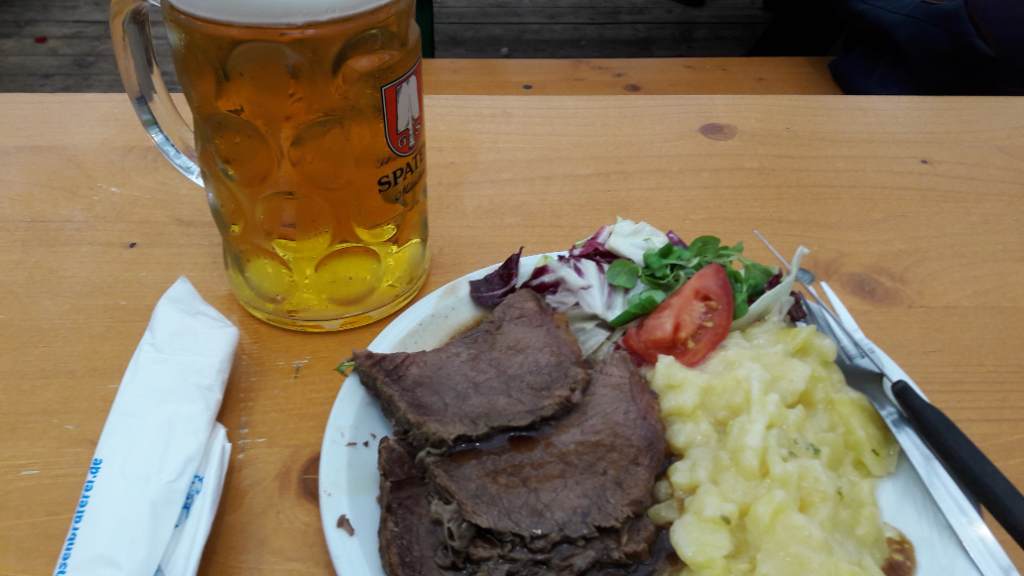
    The atmosphere is different in each tent. Locals like the Augustiner-Festhalle. Hofbräu Festzelt is popular with American, Australian, and New Zealander tourists. Bräurosl hosts a gay and lesbian party on the first Sunday of the festival, see Rosa Wiesn, in German only, for more information.

    There are also a wide variety of carnival rides and games. The Teufelsrad seems to be rather popular. The goal is to stay on a wheel spinning with increasing speed while the staff try to knock you off the wheel.

    Before we talk about the shooting competitions at Oktoberfest, let’s talk a little about guns, shooting clubs, and shooting festivals in Germany.

    Gun Laws in Germany

    This paper from the Library of Congress has one of the best English language summaries of German gun laws I’ve seen. Germany is not a good place to be a gun owner. This article says the current system traces its roots to 1928. The current system mandates separate licenses for acquiring, possessing, or carrying a firearm. Obtaining a license is not easy. There are storage requirements for firearms. Except for the national registry of firearms, current legislation is implemented by the German states even though the legislation is federal.

    According to the registry, there are about 5.5 million legal privately owned firearms in Germany and about 1.4 million legal gun owners. In 2013, Der Spiegel published an analysis of the registry breaking down gun ownership by state. Bavaria has the most registered firearms (1.1 million) but only comes in second on a per capita basis (9.2 per 100 residents). Rhineland-Palatinate has the highest per capita rate of gun ownership (9.7 per 100 residents).

    No one knows how many illegal firearms are in circulation in Germany. The Der Spiegel article I linked above includes an estimate of 20 million illegal firearms. In my research for this article, I’ve seen estimates as high as 40 million illegal firearms. Unfortunately, none of the articles I’ve been able to find include a methodology.

    Shooting Clubs and Shooting Festivals

    There are shooting clubs all over Germany. Many are affiliated with the Deutscher Schützenbund (DSB). The DSB was established in 1861 and reestablished in 1951. The DSB has regional organizations, and clubs are under the regional organizations. Total membership is about 1.4 million. Their English language website is here. Their website has historical information about German shooting clubs from their start until to the Second World War; however, almost all of the history is in German. With some help from Google translate as my German is not good enough to read all the historical information, I will summarize.

    German shooting clubs trace their roots to Medieval times. German towns were defended by militia companies armed with crossbows. Over time the companies took on a broader view of protection and defense, and started acting as mutual aid societies. Their practices grew into social events, which over time turned into modern Schützenfests (shooting festivals).

    As European armies switched over to firearms, the shooting clubs switched as well. The shooting festivals and clubs began receiving municipal funds. Winning competitions became quite prestigious. In the 17th and 18th centuries, the reliance on shooting clubs for defense declined; however, the clubs’ and festivals’ existence continued. In the mid-19th century, clubs in Gotha, Frankfurt am Main, and Bremen worked on centralizing and standardizing clubs. This work culminated in the founding of the DSB in 1861.

    In the late 19th century, with the rise of the German Empire, the DSB declined again. The reason is that competition shooting with military arms grew. The DSB did not allow use of these arms as they wanted to stay apolitical. The DSB stayed apolitical until the rise of the Nazis, whom they initially supported in hopes the Nazis would end the internal disputes and disunity of Germany. On the other hand, the Nazis did not like the DSB and tried to shut it down. The DSB could not show a clear Germanic origin for traditions like shooting birds, and the DSB did not want Nazi paraphernalia at their shooting ranges.

    Schützenfests continue today and have spread throughout the world. The oldest in America is in Cincinnati, Ohio. Australia has one near Adelaide, South Australia.

    Germany has many, and hosts the largest in the world, which takes places annually in late June to early July in Hanover, Lower Saxony. The 2018 Schützenfest runs from Jun 29th through July 8th. The Hanover Schützenfest opens with a parade of shooters from all over the world, though I’ve read that not all take part in the shooting. According to the festival’s website, in 2017 12,000 shooters took part in the parade. The website says there were 148 million attendees, but based on other sources I think that is a typo. 1.48 million attendees in 2017 is probably the correct number. The festival includes beer tents and carnival rides.

    Shooting at Oktoberfest

    Oktoberfest is not a Schützenfest, it is a folk and beer festival. However, there are some elements of the shooting festivals at Oktoberfest and it has two shooting competitions. One competition involves air pistols and air rifles. The other uses crossbows.

    The first Sunday of the festival, there is a parade of rifleman. After the parade, the shooting competitions may begin. At the end of Oktoberfest, there is a ceremony at the Bavaria statue near the Schützenfestzelt to recognize the Landesschützenkönige (loosely translated as the shooting champion).
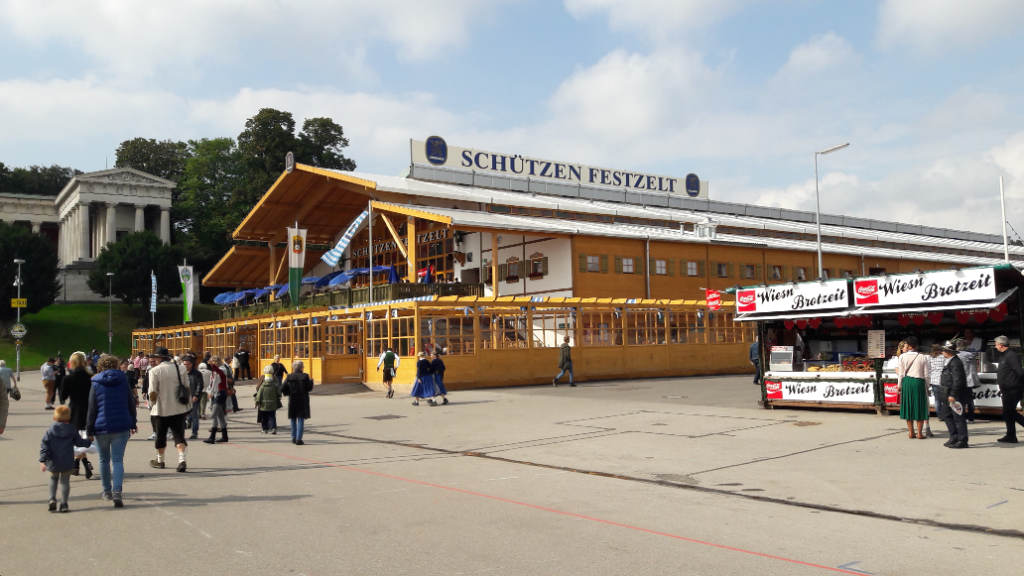
    The rifle competition is held at the Schützenfestzelt (Shooter’s Party Tent, website here). The competition is run by the Bayerischer Sportschützenbund e.V. (Bavarian Sport Shooting Association, BSSB, German only website). The competition uses air guns at a distance of 10 meters (roughly 11 yards). There are 110 shooting stands in the Schützenfestzelt. I have not been inside the Schützenfestzelt, but supposedly it is possible to watch the shooting. The BSSB’s website says the general public, aged 12 and older, is allowed to take part in the competition; however, only members of the BSSB are eligible to be Landesschützenkönig. The shooting hours are 8 AM through 5 PM on the Saturdays and Sundays of the festival, except the last Sunday when shooting stops at 2:30 PM. Weekdays shooting is on Wednesday, Thursday, and Friday between 10 AM and 5 PM. Entry fee for air rifle shooting is 18.50 Euros for adults and 7.50 Euros for students and children. Entry fee for air pistols is 12.50 Euros for adults and 5.50 Euros for students and children. There is prize money available, from tens of Euros to low hundreds of Euros.
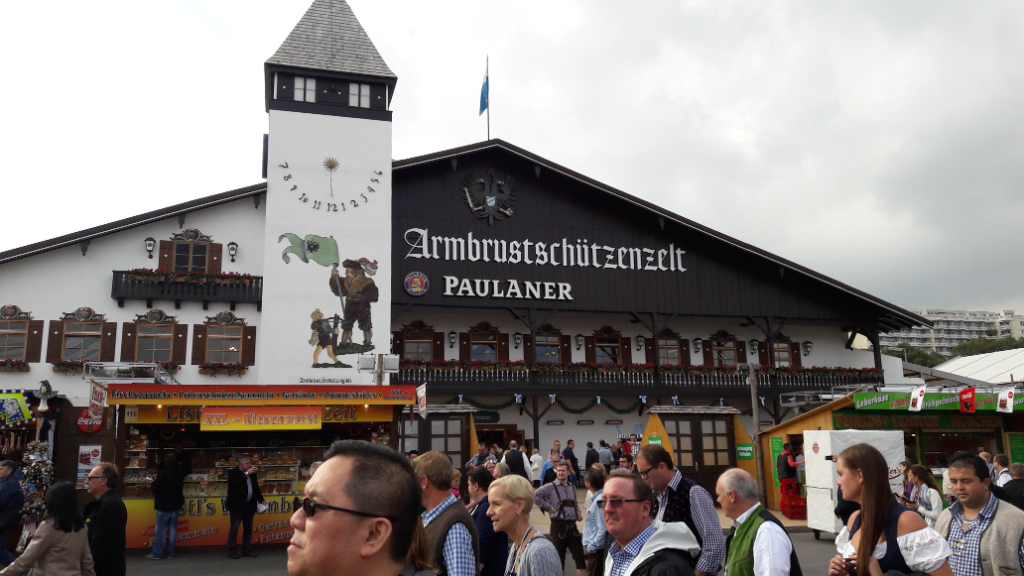
    The crossbow shooting competition is held in the Armbrustschützenzelt (Crossbow Shooter’s Tent, website here). I’ve been inside the Armbrustschützenzelt, but I could not find where the competition occurs. The Winzerer Fähndl, a crossbow guild, built the original Armbrustschützenzelt after moving out of the Winzerer Fähndl tent. I cannot find much information about this competition beyond that it dates back to 1895 and this brief video.

    When You Go

    • Book early. When I went in 2016, I looked for hotels in February 2016. Most hotels were already booked.

    • The Munich City government has imposed restrictions on AirBNB like services, so be careful if you go this route. Don’t be the person that gets your host in trouble.

    • Munich locals agreed with me when I told them my plans: Skip the weekends and go to Oktoberfest during the week. The weekends are too crowded and it is too difficult to get into a tent. If you do go on the weekend, expect the tents to fill up in the early afternoon. The weekdays are much quieter and the tents fill up in evening instead of early afternoon. Note that some tents have family days during the week where families get discounts; however, anyone is welcome in the tent.

    • I’ve heard that some tents accept credit cards, but I didn’t see any acceptance of credit cards when I was there. Expect Oktoberfest to be strictly cash-only, and pay as you go.

    • It’s OK to stand or dance on the benches, but keep your feet off the tables.

    • You can reserve tables in the tents, but only for large groups (usually eight or more people). Reservations fill up early, so like with hotels, reserve early. If a table isn’t reserved and isn’t full, ask if you can join. Most locals will gladly let you join them if there is room for your party. In almost every tent, you won’t be served unless you are seated.

    • If you decide to wear a Dirndl or Lederhosen, spend money (a few hundred Euros from what I hear) to get good stuff. Otherwise you will stick out as a tourist. Ladies, the Dirndl apron knot goes on your left front if you are available, the center front if you are a virgin, right front if you are not available, and back if you are a widow or a waitress.

    • I didn’t get a car while I was there. I relied on public transit. German public transit is good. The Münchner Verkehrs-und Tarifverbund (MVV, Munich’s public transit system) English language website includes schedules, maps, fare information, and trip planners. There is an U-bahn (subway) station at the Wiesn for the U4 and U5 lines, which is sometimes closed during Oktoberfest due to security concerns. The Hauptbahnhof (Main Train Station) is a fifteen minute or so walk from the Wiesn. All S-bahn lines except the S20 go through the Hauptbahnhof. The S1 and S8 go to the airport. To go from the Hauptbahnhof to the Wiesn, follow the signs. There are signs at the Wiesn which will direct you to both the U-bahn station and the Hauptbahnhof.

    • Due to increased security, you won’t be allowed to take large bags into the Wiesn. The Wiesn is now fenced off, and you can only enter and exit at certain points.

    • Don’t drink too much unless you want to end up on the Munich Barfs web page or in Youtube videos like this one.

    If you go, I hope you have a good time. Oktoberfest is a lot of fun.

    Postscripts

    For those that like looking at men

    I’m a straight guy, so I am a bit clueless about what those that like looking at men are attracted to, but I think the pictures I found of men in Lederhosen won’t work. Instead, have a video of Bavarian Stone Lifting, which does not take place at Oktoberfest.

    For those that like looking at women

    Enjoy this gallery of women at Oktoberfest.

    Editor’s Note: DEG is already deep into the spirit of Oktoberfest, so to speak, so he’ll check in for comments, questions, and general applause on Monday.

  • Long Arms and the American Revolution


    This article goes over the more common and interesting long arms used during the American Revolutionary War in what is now Canada and the United States. If I tried to cover all weapons used in anywhere the war was fought, this would be a very long article.

    The American Revolutionary War turned into a global conflict. As the war in the American Colonies progressed, France and Spain entered the war on the Colonial side. Both France and Spain wanted revenge on Britain for past losses. Spain did not recognize the United States’ independence due to concerns that Spain’s colonies would get ideas about themselves becoming independent. France thought that supporting American independence would give France leverage over Britain. The Dutch colony of Sint Eustatis became a major shipment point for goods going between the American Colonies and their supporters. Angry at the Dutch support for the American Colonists, Great Britain declared war on the Dutch in 1780. The expansion of the conflict led to fighting in the Caribbean, Central America, Europe, and India.

    With such a wide ranging war, and with such a large number of combatants, there is a huge variety of arms used by all sides in the American Revolution. Some examples:
    • American militia men equipped themselves with firearms and a secondary bladed weapon. Requirements for those weapons from each colony’s militia system could be vague.
    • Some British sergeants still carried halberds, and some British officers carried spontoons.
    • Indian forces used rockets against British troops in Mysore.
    So, to try and keep the article to a reasonable length, I’m going to write only about long arms used in what is now Canada and the United States.

    Flintlocks

    First, a description of flintlocks for those aren’t familiar with them. All long arms covered in this article are flintlocks. A flintlock uses a piece of flint, held in a hammer, to strike a piece of metal called the frizzen to create sparks. Underneath the frizzen is a small pan which holds gunpowder. There is a hole in the pan leading to the chamber with the powder and ball. When the flint strikes the frizzen, the sparks ignite the gunpowder in the pan. The sparks travel down the hole to ignite the powder, firing the weapon. Since the powder in the pan was exposed to the elements, flintlocks were useless if it was raining. The flintlock’s lock brings all the pieces (hammer, frizzen, pan, and barrel) together. This short animation shows a flintlock in action.

    Muskets

    Muskets were the most common type of long arm used during the American Revolutionary War. Muskets are muzzleloading, smooth bore firearms.

    “I need a good source for how fast someone can shoot a musket… Oh shit.”

    Muskets could be reloaded and fired quickly. The best on-line source, a re-enactor’s work, I can find states that a rate of 3-4 rounds per minute come from 18th century live fire studies, but doesn’t mention the studies. The British Manual of Arms for a soldier to reload and fire a musket consist of 15 steps. If each can be done in a second, then there is a theoretical limit of four rounds per minute.

    Black powder residue would foul rifling; however, the residue would even buildup in smooth bores, eventually making reloading difficult despite the smooth bore. To increase the amount of time before fouling made loading difficult, musket balls were generally smaller than the musket’s bore size, which hurt accuracy. Muskets of the period did not have sights, though some had sighting grooves and bayonet lugs on the top of the barrel that could be used as sights. Muskets had an effective range from 50 to 80 yards, depending on the musket.

    I’ve read that if you use a tight enough fitting ball, a smooth bore musket can be fairly accurate, rivaling rifles of the time. I have not found any tests which show this.

    As a result, tactics of the time emphasized speed of loading and mass fire over accuracy. Hand-to-hand combat with fixed bayonets finished the battle.

    American Made Muskets

    In 1775, “Committees of Safety” placed orders with gunsmiths to produce muskets for Colonial forces. Few of these muskets survived. Most had no identifying markings due to fear of prosecution from Royal authorities. Soon the states superseded the local committees. As the war went on, Congress centralized production, storage, and repair of arms in six arsenals: Philadelphia, PA; Carlisle, PA; Lancaster, PA; Head of Elk, MD; Albany, NY; and Manchester, VA.

    Early in the war, American made muskets were loosely based on the “Brown Bess” muskets. Later in the war, production shifted towards French designs. However, there was no standard design pattern. American gunsmiths used whatever parts they could get their hands on. Many parts were imported because, despite British blockade, it was easier and cheaper to import whole components. Those parts which American made tended to be cruder and more cheaply made than imported parts.

    “Brown Bess”

    “Brown Bess” is the nickname for the British Land Pattern Musket. The “Brown Bess” traces its roots to 1713, when the Royal Board of Ordnance began standardizing weapons production for the British Army. Entrenched interests in favor of the existing arms procurement system opposed these changes. The Board persevered, and in 1722 released the “King’s Pattern” musket. Political pressure and the lack of wartime pressure delayed the new musket’s production until 1728. The new musket was first issued in 1730 as the “Long Land” pattern musket. There are many explanations for how the musket received its nickname, none of which are convincing to me. The earliest reference to the name I can find, courtesy of George Neumann’s work, is in the “Connecticut Courant” newspaper in 1771.

    The musket is .75 caliber and has a walnut stock. The stock ends before the muzzle to allow for a bayonet. Attached accessories were made of brass. The musket weighed 10 to 11 pounds. The barrel was held to the stock with heavy pins. The musket’s bayonet lug could be used as a front sight and there was a groove at the rear which could be used as a rear sight. There were many variations of the musket. The two broad variations were the “Long Land” which had a 46 inch barrel and the “Short Land” which had a 42 inch barrel. There are several sub variations which were developed based on war time experience with the musket and to ease production.

    British, American Colonial, Loyalists, and Hessian troops all used the Brown Bess. Generally, only the British forces used the newer variants. American Colonial forces used whatever Brown Bess muskets they had at the beginning of the war or could capture as the war progressed. The British equipped Loyalist and Hessian forces with older Brown Bess muskets which were being replaced by newer muskets shipped in from England.

    Here is a video of Australian re-enactors demonstrating Brown Bess accuracy using standard loads.

    Charleville Musket

    The French infantry musket was standardized in 1717. The musket became known as the Charleville musket, after one of the many arsenals which produced the musket, even though Charleville was never an official name for the musket. I did not find any official naming for the musket beyond it being identified by the year a variation was introduced. Most of the variations were to lighten the musket and make maintenance easier. The musket used a .69 caliber ball to reduce weight in the field. The stock is walnut. The barrel and stock were held together with three lightweight bands. The musket throughout its life was lighter than the Brown Bess.

    The French sent 200,000 of these muskets of various types to American Colonial forces. American Colonial forces received the Model 1763, Model 1766, and the Model 1774. Post-war, the Model 1766 heavily influenced the design of the American Springfield Musket of 1795. The Model 1763 was shorter than previous models and had a different lock. The Model 1766 was a lightened version of the Model 1763. The Model 1774 had more lock modifications and had a modified stock.

    The French kept the Model 1777 for their own forces. The Model 1777 stayed in use in the French military through the Napoleonic Wars. The Model 1777 supported a new type of bayonet, had a cheek rest in the stock comb, among other variations.

    Quebec militia units probably used left-over Model 1728 muskets while defending against American Colonial invasion.

    German Mercenary Muskets

    The British, for various reasons, found it cheaper and easier to hire German mercenaries than to raise more troops for the British Army. The British hired about 30,000 mercenaries from various German states for combat in America. As a side note, George III, who was also King of Hanover, leased some of his Hanoverian soldiers to Britain for use during the American Revolution. The Hanoverian troops remained in Europe. Roughly half of those that went to America came from Hesse-Kassel, which is why the mercenaries are known in America known as Hessians. In addition to Brown Bess muskets from the British, the mercenaries’ muskets came from all over Germany. While American colonists captured many Hessian muskets during the war, only a few hundred were listed in American post-war inventories.

    M1752 Musket

    The Spanish Army’s first standardized firearm was the M1752 musket. Spanish Colonial forces were armed with this musket when they attacked British forces at Pensacola. Spain sold between 10,000 and 12,000 of these muskets to American Colonial forces.

    Rifles

    Rifles are a long arm with a rifled bore. Rifling is the process of cutting spiral grooves into the bore. The rifle’s projectile, when fired, grips these grooves as it travels down the bore. The spin stabilizes the projectile, improving the weapon’s range and accuracy. Muzzle loading rifles of the time were slower to load than muskets due a tighter fighting ball and were more prone to problems with powder fouling. Rifles of the time could not be fitted with bayonets.

    The American Revolutionary War was the first war with widespread use of rifles. German mercenaries, American Colonial forces, and British forces all used rifles.

    Use of rifles was fairly new to the British Army. British rifles corps were small.

    American Colonists and German Jäger troops were familiar with rifles. Hunting was a common past time among both groups.

    The range of rifles of the time is disputed, but there are accounts of effective fire from 200 to 300 yards. I’ve searched for information on the longest rifle shot in the Revolutionary War, and found nothing definitive. Timothy Murphy’s killing of General Simon Frasier comes up most often. The range for that shot varies between 300 and 500 yards, depending on the source. Unfortunately, it is impossible to verify.

    Ferguson Rifle

    Major Patrick Ferguson was a Scot who joined the British Army. During his time the British Army, he developed a breech-loading flintlock rifle. This was the first breech-loading firearm adopted by a military, but it was not the first breech-loading firearm. Maj. Ferguson based his rifle on the French Chaumette.

    The Ferguson rifle relied on a screw mechanism to open the breech. The riflemen would turn the trigger guard, which worked the screw, and opened the breech. The rifleman could fire four to six rounds a minute, as fast or faster than the muskets of the time. The rifle was expensive, difficult, and slow to make. The rifle also used a special powder, which was more expensive than regular musket powder.

    Only about 100 or so Ferguson rifles were made. These rifles equipped an experimental unit which was under Ferguson’s command. They arrived in America in May, 1777. Ferguson was killed at the Battle of King’s Mountain. His unit was disbanded afterwards.

    Here is a short video from the NRA about the Ferguson Rifle. At the end of the video is a demonstration of shooting a Ferguson Rifle replica.

    Jäger Rifle

    Among the mercenaries from Hesse-Kassel were Jäger troops. These troops were armed with rifles, and they covered advances and withdrawals. Their rifles were made in Schmalkalden (a town in present day Thuringia). Their rifles had 29 inch long barrels whose external shape was octagonal. The rifle bore was .65 caliber.

    Long Rifle

    The Long Rifle dates to the early 1700s when German immigrant gunsmiths began making rifles in Lancaster County, PA. The rifles were based on German patterns and there is a good bit of variation between rifles. Generally their bore is between .45 and .60 caliber, and the barrels long. American Colonists used the rifles to engage in hit and run tactics and to snipe at British officers, which the British considered “ungentlemanly.”

    Pattern 1776 Infantry Rifle

    The Pattern 1776 rifle was another British attempt to equip troops with rifles in order to counter American rifleman. About 1,000 were made. They were made in Germany and by four different manufacturers in England. Nine are known to survive to this day, and some had been modified after the Revolution. Loyalist American rifle companies were among the units which received the rifles.

    Sources

    Allison, Robert, “The American Revolution: A Very Short Introduction”

    Chavez, Thomas E., “Spain and the Independence of the United States: An Intrinsic Gift”

    Collins, Bethany, “8 Fast Facts About Hessians”, https://allthingsliberty.com/2014/08/8-fast-facts-about-hessians/

    Edler, Friedrich, “The Dutch Republic and the American Revolution”, https://archive.org/stream/dutchrepublic00edlerich#page/170/mode/2up

    Haigst, Don N., “The Aim of British Soldiers”, https://allthingsliberty.com/2013/08/the-aim-of-british-soldiers/

    Harrington, Hugh T., “The Inaccuracy of Muskets”, https://allthingsliberty.com/2013/07/the-inaccuracy-of-muskets/

    Harrington, Hught, T, “The Man Who Shot Simon Fraser”, https://www.varsitytutors.com/earlyamerica/early-america-review/volume-7/the-man-who-shot-simon-fraser

    Neumann, George, “American-Made Muskets in the Revolutionary War”, https://www.americanrifleman.org/articles/2010/3/29/american-made-muskets-in-the-revolutionary-war/

    Neumann, George, “Dutch Arms in the American Revolution”, https://www.americanrifleman.org/articles/2009/10/8/dutch-arms-in-the-american-revolution/

    Neumann, George, “The Redcoats’ Brown Bess”, https://www.americanrifleman.org/articles/2009/12/9/the-redcoats-brown-bess/

    Neumann, George, “The ‘Revolutionary’ Charleville”, http://www.jaegerkorps.org/NRA/The%20Revolutionary%20Charleville.htm

    NRA Staff, “Ferguson Rifle History”, https://www.americanrifleman.org/articles/2009/10/5/ferguson-rifle-history/

    Paterson, Thomas; Clifford, J. Garry; Maddock, Shane J.; Kisatsky, Deborah; Hagan, Kenneth, “American Foreign Relations: A History, Volume 1: to 1920”

    Pegler, Martin, “The Genesis of Sniping”, https://www.americanrifleman.org/articles/2015/7/30/the-genesis-of-sniping/

    Ramsey, Syed, “Tools of War: History of Weapons in Early Modern Times”

    Thayer, Charles, “Tories, Traitors, and the Birth-Pains of a Nation: British Pattern 1776 Rifles in the American Revolution”, http://www.thayeramericana.com/back/research/research12.pdf

    Thomas, Ryan, “The Pennsylvania Long Rifle”, http://pabook2.libraries.psu.edu/palitmap/Rifles.html

    Troiani, Don, “Soldiers of the American Revolution”

    Sambasivam, Richard, “The Tiger Aids the Eaglet: How India Secured America’s Indepdence”, https://allthingsliberty.com/2016/04/the-tiger-aids-the-eaglet-how-india-secured-americas-independence/

    -, “The French Charleville”, http://www.11thpa.org/charleville.html

    -, “Hessians”, http://www.mountvernon.org/digital-encyclopedia/article/hessians/