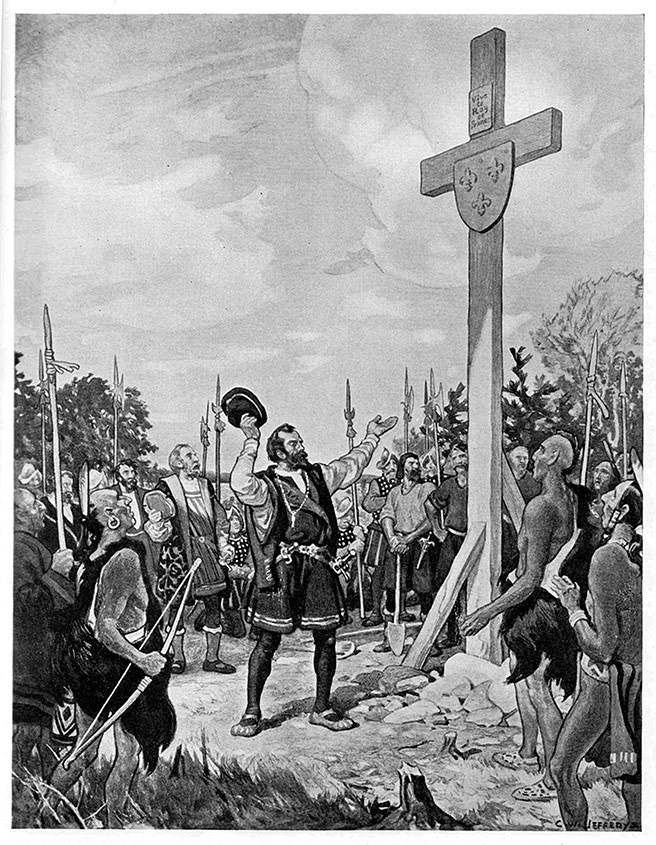
Greetings, and welcome back to this long, meandering lecture on the history of Canada for our southern friends. When last we left off, early French attempts to colonize the New World failed spectacularly, and then they decided to take a break from the whole idea while they fought amongst themselves.
Birth of New France (1604-1635)
You know what Europeans love? Hats. You know what makes good hats? Beaver pelts. You know what Europe doesn’t have a lot of? Beavers. You know who does have a lot of beavers? French Canada.
Since Cartier’s attempts at colonization failed numerous French merchants and traders have continued to trade with the native populations for beaver pelts and have attempted to establish permanent trading posts. One merchant, Pierre de Chauvin de Tonnetuit, is granted a monopoly on the fur trade by the French Crown and attempts to build a settlement at Tadoussac. Only five men survive the winter, and it’s only due to the intervention of the natives. Chauvin forfeits his rights to the fur monopoly in 1602 and dies a year later. The fur monopoly is granted to a new merchant, Aymar de Chaste, who is approached by a man called Samuel de Champlain, who requests a place on the first voyage.
Champlain has a background that makes him extremely qualified for a position. A commoner raised in a family of mariners, he learned how to navigate and draw coastal maps at a young age. In his twenties, he served in the French Army during their religious wars, where he apparently had a reputation as an excellent marksman. In the 1590s he worked as a sailor for the Spanish, traveling to the West Indies and rigorously studying Spanish colonial ventures. When he returned to France he wrote a detailed espionage report on these ventures for King Henry IV, cementing his influence in the French court.
Chaste hires him as an observer on the voyage run by François Gravé Du Pont, the previous captain who sailed for Chauvin’s expeditions. Du Pont and Champlain soon become bros for life, the former educating the latter on the geographical nature of the St. Lawrence River. When Champlain returns to France, he’s created a detailed map of the region and believes he can explore further than Cartier did. By 1607 merchants in favour of free trade have managed to get the French Crown to cancel the fur trade monopoly, and Champlain is hired by a former employer, Pierre Dugua de Mons, to establish a permanent colony on the St. Lawrence.
Champlain has both studied the successes and failures of other colonial ventures and experienced his own failures trying to set up settlements in what becomes Nova Scotia for Dugua. So by 1608 he knows what he’s doing, and sails down the St. Lawrence with Du Pont to establish a settlement he calls ‘the Habitation’ with 28 men on what will become Quebec City. Champlain is sure to design the settlement with fortification in mind, building a large stockade and massive moat. Severe winters, famine and disease will continue to plague the Habitation for decades, but he has successfully set up the first permanent settlement along the St. Lawrence River. Meanwhile, far down south, some big English stupidheads have established their own permanent settlement at a place called Jamestown (it will never last, I’m sure).

In order to avoid the mistakes of the past, as well as to ensure that the fur trade continues, Champlain begins to negotiate with the local tribes, primarily the Algonquin and Wyandot (called the Huron by the French). The natives, interested in a long-term alliance, demand that the French assist them in their war with their longstanding rivals, the Iroquois. The Iroquois are a tribal confederacy that lived in what is now upper state New York. Champlain sets out with a war party of around three hundred Huron and travels south. Having failed to find any Iroquois, most of the party disbands, leaving Champlain, two Frenchmen, and several dozen Huron. And that’s when two hundred Iroquois attack. As the battle begins, one of Champlain’s native guides points out the chiefs of the Iroquois in their formation.
Champlain raises his arquebus and kills two of them with a single shot.

The Iroquois, horrified by both this show of European gunpowder and Champlain’s sheer badassery, flee. Little does he know it, but Champlain’s shot is the opening salvo in the next hundred and fifty years of conflict between the French and Iroquois, a likely inevitable conflict due to the Iroquois’ later alliance with the English. Champlain goes on to also fight the Mohawk, with similar results. With their major tribal rivals pushed back the Huron and Algonquin agree to an alliance that will define early French Canada.
Champlain travels back to New France and builds a fort and fur trading outpost on what will become Montreal. After returning to France to deal with some political upheaval and secure long-term funding for colonization (also, he has sex with a twelve-year-old, but I’m trying to write a hagiography here, so moving on) Champlain returns in 1613 and begins to explore west, into what is now Ontario. He travels the Ottawa River and later portages until he becomes the first European to reach the Great Lakes.
Throughout this time Champlain is using his native connections and geographical knowledge to establish a long line of trade routes reaching into the interior. In order to further solidify relations with various native groups, he has been leaving young French boys with them in order for them to learn the language and the culture. These boys will become the first coureur des bois (‘Runners of the Wood’), independent interpreters and entrepreneurs that will become a key part of the French-Indian trade system. Many coureurs will intermarry into the native populations (there’s very, very few women in New France, so it’s either native women or ‘what happens in des bois, stays in des bois’) and create long-term trade alliances that will ensure the spice…err, furs will flow. The government of New France will later prefer that the trade be directly between French merchants and native groups but will find the coureurs are a vital middleman between them. Champlain himself ends up spending an extended period of time learning native customs. In 1615 while fighting the Iroquois with native allies he ends up lost after retreating. He spends three days alone, surviving in the wilderness before wintering with Huron allies.
After returning to France once again, Champlain decides to focus on administrative matters and settles back in The Habitation. He’s managed to negotiate a peace treaty with the Iroquois, who are still reeling from his raids into their territory, and works to improve the stone fortifications of his new city. The fur trade has become an on-again-off-again monopoly based on who the king favours for the past decade, but that’s about to change. Cardinal Richelieu, the famous French statesmen, views New France as a vital colonial expansion of the French Kingdom. Thus he creates a new colonial company, the Company of One Hundred Associates, to manage the fur trade. Made up of one hundred investors, including Champlain himself, it looks like it will dominate the fur trade in the New World.
Except then the war with England starts. Part of the broader Thirty Years War in Europe, the war gives every French and English bandit, pirate and rogue a full justification to start attacking their opponents’ settlements. In 1628 two Scottish merchants, the Kirkes, show up at The Habitation and demand Champlain’s surrender. Champlain is able to bluff them into not attacking, claiming that his gunpowder supply is “HUUUUUUUUUUUGE” and that The Habitation’s walls are “the best wall, it’s fantastic, and I got the Iroquois to pay for it”. In reality, supplies are low, and Champlain writes to both the Company and the French government for support. Unfortunately, the Kirkes intercept the message, and also take over almost the entirety of the Company’s merchant fleet, permanently damaging their revenue and ensuring their decline. Champlain is forced to surrender in 1629. Three months after a peace treaty was signed.
Because bureaucracy is just as slow back then as it is now, it took three years before New France was returned to France per treaty obligations. Champlain, having spent the last few years in London demanding the English “give me my goddamn land back” is assigned the Lieutenant General of New France. By this point in time Champlain is basically the Governor of the colony, but due to his status as a commoner will never receive the title. Champlain would continue to administrate the new colony until his death in 1635, just as a new war with the Iroquois was breaking out.
Champlain is called ‘the father of New France’, and rightly so. For over two decades he managed to establish permanent colonies, ensure lasting diplomatic ties with the Huron and Algonquin, develop a complex and wide-reaching trading system, map most of what would become southern Quebec and Ontario, and vastly expand French influence in the region. In Canada today he has rivers, lakes, bridges, colleges, shopping malls, and a lake monster named after him. On a hill overlooking downtown Ottawa stands his statue, where teenagers like to make out. While he watches them. From beyond the grave. Smiling.

Have You Accepted Jesus Christ Into Your Life? *Shot with arrows* (1635-1660)
With Big Boss Sam dead, the most influential group in New France became the Catholic Church, who had been granted a great deal of land by both the French Crown and Champlain himself. The Jesuits in particular were massively expanding their operation in the region. Jesuits establish schools and chapels throughout the region and turn Champlain’s fort into an actual town called Ville Marie, the precursor to Montreal. The Jesuits in New France have come to embrace an ideal similar to the American settlers’ ‘Shining City upon a Hill’ concept. They believe that they can carve out a Catholic French-native utopia in New France.
Since the French refused to trade with any native group who wouldn’t accept missionaries, the Jesuits could always find some souls that needed saving. The Huron, in particular, became a primary focus of the Jesuits. Huron cultural practices had, over a short two decades, become completely dependent on French goods. In addition to that, European diseases have become a major problem within their communities. Jesuit sources say that many Huron believe that the Jesuits will curse you with illness unless you convert. Unsurprisingly, conversion is not solving the problem. On top of all that, the Huron need to convert in order to acquire firearms. The Iroquois have recently begun trading with the Dutch. Being the Dutch, they’ll sell you their mother if you promise to throw in a second item for half off, so they’re giving the Iroquois firearms freely, with no requirements for conversion. This is fueling Iroquois expansion, and they have a score to settle with the Huron and the French.
By the 1640s the Beaver Wars (stop laughing) begin again, as the Iroquois stage a large-scale invasion into Huron and Jesuit lands. They burn several Huron settlements and mission villages to the ground and capture several Jesuits. These missionaries are ritualistically tortured and then executed. For example, one missionary, Isaac Jogues, had his fingernails torn out and his fingers gnawed down to the bone. Then they forced him to run through a gauntlet of Iroquois beating him with sticks, kind of like that Klingon trial thing from Star Trek. Jogues, along with eight others, took their horrific torture like champs and as such are now the Canadian Martyrs in Catholic Church tradition.
Most of the Jesuit missions are leveled by the Iroquois. The Jesuit influence in New France decreased substantially as a result. Later missions will have some degree of success, but sudden Indian conflicts will always hinder their operations. The Huron did not fare much better. By 1649 they begin a scorched earth policy of burning their villages and scattering as refugees into other tribes. The remaining Huron relocated to the area around Quebec City, but by this time their influence is waning. The Huron will never be a prominent force in the region again.
Without the Huron and other tribes providing a strong buffer, the Iroquois now begin to freely attack New France. The fort at Ville Marie sits on an important strategic point on the St. Lawrence River. It is the central location of the fur trade due to its easy access to numerous inland rivers. Iroquois began to encamp along the Ottawa River and plan raids on other major settlements, such as Quebec City and a new settlement, Trois-Rivières. The natives are advising the French to use their fortresses to their advantage, but the Iroquois attacks are disrupting the fur trade. Some suggest that an offensive is needed, including the commander of Ville Marie’s militia, Adam Dollard des Ormeaux.
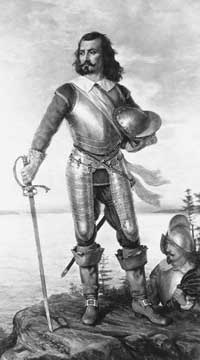
Sometimes a picture says a thousand words, so I’m not going to describe how much of a badass Adam Dollard is, I’m just going to post one of his most common depictions:
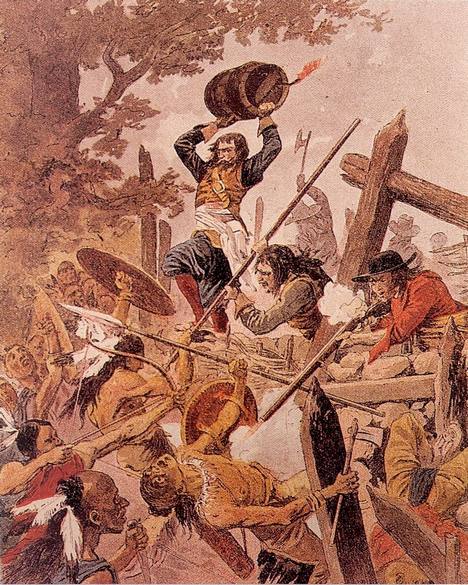
In 1660 Dollard leaves Ville Marie with around twenty men, mostly French militia, and travels to Long Sault, where he occupies an old Algonquian fort and begins to reinforce it. Several dozen Huron show up and pledge to assist him. Shortly afterward, two hundred Iroquois in war canoes are spotted traveling down the Ottawa River. Dollard lays an ambush and attacks them, killing several and forcing the remainder to land. Retreating to his fort, the Iroquois attempt to attack and are beaten off. They attempt to parley, but Dollard is here to kill Iroquois, not talk to them and refuses. In response they destroy the French militia’s undefended canoes, cutting off their only escape route.
The Iroquois attack the fort a second time and are repulsed again by musket fire, with one of their chiefs being killed. Dollard, being somewhat pissed about the whole canoe affair, leads some men outside of the fort, still fighting off the Iroquois, so they can cut off the chief’s head and mount it on their wall. A third attack follows that also fails. It’s at this point that another five hundred Iroquois come rolling down the river. This attack force was planning on assaulting Ville Marie, but now they’re going to go after the half-crazed white man in the fortress.
Unfortunately for Dollard, his luck is running out. Huron slaves in the Iroquois group call out to the Hurons in the fort and tell them that if they switch sides they will be spared. The Hurons do so, but hell hath no fury like Dollard scorned, and only five of them survive the next attack. The Iroquois have begun constructing crude wooden walls to protect themselves from musket fire as they advance. With their food supply low and their major advantage now neutralized, the Iroquois attack for a fourth and final time, hacking at the walls of the fort with axes.
The Iroquois break through, pouring into the fort. Dollard, in a final fuck-you, lights a barrel of gunpowder and tosses it at the advancing horde. But it’s not enough. The fort is swarmed and then set on fire. Any remaining Frenchmen are too wounded to try to escape and are burned alive. Iroquois desperately search the ruins for Dollard’s massive, iron balls to keep as a trophy but fail to find them. Iroquois losses are extremely heavy, and it prevents them from attacking their initial targets. To this day Dollard is seen as a heroic figure in French Canadian history.
The Battle of Long Sault is, in many ways, a turning point for New France. Afterward, the established settlements will not be threatened by any major attacks, at least from natives. But it is still primarily a series of barely populated trading posts in the middle of vast wilderness. Following 1660, New France will undergo a transformation that will solidify it as a true colonial state in the New World.