Author: Lord Humungus

  • What Podcasts Are You Listening To?

    This is an open thread to discuss your favorite podcasts.  Below I’ve listed some of my recent favorites.  As you can see I stay away from the political and instead enjoy history and true crime.

    History on Fire – Daniele Bolelli is an author, history professor, and martial artist who was influenced heavily by Dan Carlin’s Hardcore History. If you want your history fix, and can get by Bolelli’s noticeable Italian accent, then History on Fire is a good place to go. Based on the podcasts I’ve listened to he doesn’t veer off from historical sources but still doesn’t come off as unbearably dry. Instead he explores the bloodier chapters of the past without fear of offending modern sensibilities.

    A History of the World in 100 Objects – this is aural popcorn, short 14 minute episodes about the meaning of objects along with the hows and whys they were constructed. Neil MacGregor, the presenter, has a stuffy (as in head cold) British accent that hustles through the material, along with a few short interviews. The material spans the very ancient to the modern day.

    Casefile True Crime – if you like Australian accents, then Casefiles is for you. This anonymous podcaster touches on cases all over the English speaking world, going through evidence including available recordings that are presented to the listener. Some of the material is chilling, especially the 911 calls. The cases range from old historical pieces, to well-known serial killers, and even child abductions. Not for the faint of heart.

    True Crime Garage – Nic and the Captain explore cases both old and new, all while consuming a reviewed beer. Some very rare anti-gun proselytizing does occur, but the musings on the suspects and motives is always interesting. The focus is mostly on American crimes, and sometimes the episodes veer into odd tangents of humor, but it’s never a boring ride. I rate this a little lower than Casefile but still worth a listen, especially for the deep dives into modern cases that have only just faded from the headlines.

    Breakdown – Over the course of a season, Breakdown will concentrate on one case. The listener will hear the evidence, including the police interviews, and opinions of lawyers not directly associated with the case. Given the title name the podcast mostly concentrates on wrongful convictions with improper police procedures and evidence tampering.  Since it is produced by the Atlanta Journal Constitution, journalistic standards (remember those?) are high.

  • Tuesday Afternoon Links – The Lordly Links: Visiting the Underbelly of the World

    Just Walk Away

    There are two worlds we inhabit: one a sunlit land of opportunity, cheap guzzoline, and giggling children; the other filled with Florida Man, junkies (I repeat myself), ghosts, cheap diners, and silly roadside attractions.  You see ever since I was a kid, I had a real love for the roads less traveled, whether it be punk rock shows, partying with misfits, or trying to find meaning in things where very little meaning exists.

    Why do I have this love for the obscure?  Perhaps it comes from growing up in a boring backwater of suburban wasteland where dreary people lived dreary little lives.  Or maybe it was the TV series In Search of…, my reading of Chariot of the Gods, Star Blazers, comic books, or anything else that was outside of the normal day-to-day routine found in Nowheresville.

    It’s too bad that age has taught me that the supernatural and such mysteries are more product of the human imagination that reality.  A world with haunted houses, STEVE SMITH Sasquatch, Warty and his time suit, and vampires would certainly be a lot more interesting, but it sure would be hell on insurance rates.  But for just a moment let’s cast away our sensible and rational brains so we can explore – with childlike wonder – what is going on in the “other” world.

    So enough Joseph Campbell-like musings, let’s get on with some links:

    Hunting Bigfoot in the Upper Peninsula – STEVE SMITH doesn’t strike me as a Yooper, but perhaps there is something about the denizens of the UP that draws the attention of the world’s most famous Rapesquatch, eh?

    Red-faced ghost hunter exploring a ‘haunted’ witches’ prison is scared out of his wits by a TEDDY BEAR (the use of all caps is a dead giveaway that this is a Daily Mail link) – I once knew a haunted teddy bear.  It had been molested for years by tomcat who had sexual feelings for the poor thing.   You could see the dead stare on the teddy bear’s face.  Sad!

    Real-Life Vampire Couple Says Sucking Blood Is Better Than Sex – there’s something very, very wrong with a hipster beard “vampire.”

    For $125K, you can own a ‘haunted house’ in Texas – “A client got literally nauseously ill and thought she was going to pass out and ran out,” Foley said. “She kept saying, ‘I can’t go back in there. Something hit me the moment you opened the door. I cannot go back in there.’”  That Tex-Mex cooking will get ya every time.

    UFO sightings on the rise in Philly and PA – “Volunteers even logged a sighting during an Obama rally at the Art Museum.”  At least this makes some sense.  I, for one, welcome our new lizard overlords.

    Mysterious shoes on Napoleon Avenue: Anybody got an explanation? – “I’ve been told for years that the explanation for tennis shoes thrown over utility wires indicates a place to buy drugs. Maybe this dealer is a diva.”

    And there ends our cruise through the backwaters of this country, or some other country, or maybe even another planet.


  • A Taste of Honey

    Honey is not an item one thinks about very often unless you are fermenting a tasty mead or like to use the natural sweetener (gag) on your morning toast.  But there are lessons to be learned from honey: the effects of tariffs and as a parallel to the drug war.

    Americans apparently love their bee squeezings, consuming a yearly average of 1.3 pounds per person for nearly 400 million pounds in total.  Since demand is so high, U.S beekeepers can only supply forty-eight percent of this amount, with forty-one other countries making up the rest.  But honey, like so many other market products, is controlled (to some degree as we are about to find out), and foreign imports are, in theory, kept in check by tariffs.  Chinese honey, in particular, has been targeted since the year 2001 with a stiff tariff, tripling the import duty to $2.63 per net kilogram.  This was enacted because American producers complained that the Chinese were undercutting “fair market” prices (whatever those are!), making it difficult for domestic beekeepers to compete.

    Since the tariff on Chinese honey, to no one’s surprise, the imports from other countries suddenly spiked, as Chinese producers found other means to move their product.  Honey Laundering, as it is called, happens by shipping the product from China to a neutral port, changing the country of origin, and then sending the barrels onward to the United States.  Recent estimates say that a third of the honey consumed here comes from such illegal sources.  And because of filtration methods, the pollen – used to determine the country of origin – can be scrubbed clean, creating an untraceable product.  Some Chinese producers also create fake honey – make from artificial sweeteners and mixed with other liquids to look like the real thing.

    China, as to be expected, views the tariff as a protectionist measure.  The domestic producers counter that Asian honey has antibiotics and the presence of lead; also the tariff not only protects American beekeepers but is an important health issue.  For example, in India, honey tested for export in 2010 found lead and antibiotics in twenty-three percent of the samples. These samples were assumed to have come from Chinese sources, relabeled as Indian production.

    Over the past few years, there have been indictments and arrests for honey laundering, spanning several countries.  There are federal agencies at work here, too: the Department of Justice, ICE, and the FDA, busy busting illegal importers but only making a minor dent in the flow of illegal honey.  Honey laundering continues, and will continue as long as there are incentives to do so.

    Sources: various articles found online (take that!).


  • One State Libertarianism

    Cast your mind back to 2006. It wasn’t a good year for the Republicans; not with George W and his muddled and seemingly endless war. This was the time when a New Republic article came out – one that is still referenced today – concerning the supposed new political fusion called Liberaltarians. There were, of course, several responses to this. Lost in the mix was John Derbyshire’s take. This was before his expulsion from Nation Review for saying, to put it kindly, less than politically correct things about African-Americans. But I won’t dwell on that, but will instead cover his idea of Libertarianism in One Country which, as to be expected, involves immigration restriction.

    First some snippets to put this in context:

    A liberal, in the current sense of the term, is a person who favors a massive welfare state, expansive and intrusive government, high taxation, preferential allocation of social goods to designated “victim” groups, and deference to international bureaucracies in matters of foreign policy.

    It is not difficult to see why such a person would favor lax policies towards both legal and illegal immigration. Immigration, legal or otherwise, concerns the crossing of borders, and a liberal regards borders, along with all other manifestations of the nation-state, with distaste. “International” trumps “national” in every context. The preferences a citizen might have for his own countrymen over foreigners, for his own language over other tongues, for his own traditions and folkways over imported ones, are all, in the minds of a modern liberal, manifestations of ugly, primitive, and outdated notions — nativism, xenophobia, racism. The liberal proudly declares himself a citizen of the world, and looks with scorn and contempt on those narrow souls who limit their citizenly affections to just one nation.

    This is some pretty strong proto-alt-right stuff. Viewed eleven years on it prophesied, though to what degree is uncertain, of the rise of Trumpism. There are several issues that I have with this description of liberalism, but let’s move on to the meat of his problem with libertarians.

    The affection of liberals for mass immigration, both legal and illegal, is thus very easy to understand. Why, though, do libertarians favor it? And why do I think they are nuts to do so?

    So far as the first of those questions is concerned, I confess myself baffled. I think that what is going on here is just a sort of ideological overshoot. Suspicion of state power is of course at the center of classical libertarianism. If the state is making and enforcing decisions about who may settle in territories under the state’s jurisdiction, that is certainly a manifestation of state power, and therefore comes under libertarian suspicion. Just why libertarians consider it an obnoxious manifestation — well, that’s where my bafflement begins. (That some exercises of state power are necessary and un-obnoxious is conceded by nearly all libertarians.)

    After some quotes from Charles Murray, Derbyshire continues:

    As to why I think libertarians are nuts to favor mass uncontrolled immigration from the third world: I think they are nuts because their enthusiasm on this matter is suicidal to their cause. Their ideological passion is blinding them to a rather obvious fact: that libertarianism is a peculiarly American doctrine, with very little appeal to the huddled masses of the third world. If libertarianism implies mass third-world immigration, then it is self-destroying. Libertarianism is simply not attractive either to illiterate peasants from mercantilist Latin American states, or to East Asians with traditions of imperial-bureaucratic paternalism, or to the products of Middle Eastern Muslim theocracies.

    And here lies, at least to my eyes, the battle of Open Borders within the (American) libertarian community. What is the effect of culture on an individual? Is there something about American Dynamism that is unique in our historical place? Or, to put it another way, are the concepts of freedom, liberty, and, most importantly of all, individualism truly universal? This outlook, one started by the Reformation, created in the firestorm of 18th century European philosophy, and finally crystallized in the American Revolution may be unique in history. Or maybe not. I’ll let the commentators hash that one out since I know I don’t have an answer.

    Now Mr. Derbyshire goes a bit off the rails. I wouldn’t let Stalin run a lemonade stand because he would do more than squeeze the lemons.

    The people who made Russia’s Communist revolution in 1917 believed that they were merely striking a spark that would ignite a worldwide fire. They regarded Russia as a deeply unpromising place in which to “build socialism,” her tiny urban proletariat and multitudinous medieval peasantry poor material from which to fashion New Soviet Man. Their hope was that the modern industrial nations of the world would take inspiration from them — that the proletarians of those nations would rise up against their capitalist masters and inaugurate a new age of world history, coming to the aid of the Russian pioneers.

    When it was plain that none of this was going to happen, the party ideologues got to work revising the revolutionary dogmas. One of them — it was actually Joseph Stalin — came up with a new slogan: “Socialism in One Country!”

    Derbyshire’s final point:

    I think that libertarians should take a leaf from Stalin’s book. They should acknowledge that the USA is, of all nations, the one whose political traditions offer the most hospitable soil for libertarianism. Foreigners, including foreigners possessed of the urge to come and settle in modern, welfare-state America, are much less well-disposed towards libertarianism.

    If less than one in seven American voters is inclined to libertarianism, then there is much missionary work to be done among present-day American citizens. To think that this missionary effort will be made any easier by a steady stream of arrivals from foreign parts, most of which have never known rational, consensual government, is highly unrealistic, to the point of delusion.

    That is why I say that libertarians who favor mass immigration are nuts. If there is any hope at all for libertarianism, it rests in the libertarianism of my title: libertarianism in one country.

    What say you?  Is libertarianism a unique strain of political thought that resides most strongly in American tradition?  Or is it universal – something that transcends across time and culture?  If one was to magically transport to Xia Dynasty in China, or to the height of the Roman Empire, would the citizens there understand individualism and freedom in the ways that we do?  Or, to put it in more modern terms, would a person with a tribal background, let’ say from the depths of Borneo, understand the basics of the philosophy?  (Am I beginning to sound like a certain judge?)


  • Millennials and Socialism

    Joel Kotkin at the Daily Beast has a new article up about Millennials: The Screwed Generation Turns Socialist.  And they appear to be the most leftward since the Great Generation.

    In this past election, those over 45 strongly favored Trump, while those younger than that cast their ballots for Clinton. Trump’s improbable victory, and the more significant GOP sweep across the country, demonstrated that the much-ballyhooed Millennials simply are not yet sufficiently numerous or united enough to overcome the votes of the older generations.

    Yet over time, the millennials —arguably the most progressive generation since the ’30s—could drive our politics not only leftward, but towards an increasingly socialist reality, overturning many of the very things that long have defined American life. This could presage a war of generations over everything from social mores to economics and could well define our politics for the next decade.

    And some broad political generalizations ensue about the voting patterns of the existing generations.  For the sake of brevity we will skip this and get right to the meat of the article:

    Millennials’ defining political trait is their embrace of activist government. Some 54 percent of millennials, notes Pew, favor a larger government, compared to only 39 percent of older generations. One reason: Millennials face the worst economic circumstances of any generation since the Depression, including daunting challenges to home ownership. More than other generations, they have less reason to be enamored with capitalism.

    These economic realities, along with the progressive social views, has affected their voting behavior. Millennials have voted decisively Democratic since they started going to the polls, with 60 percent leaning that direction in 2012 and 55 percent last year. They helped push President Obama over the top, and Hillary Clinton got the bulk of their votes last year. But their clear favorite last year was self-described socialist Bernie Sanders, who drew more far millennial votes in the primaries than Clinton and Trump combined.

    And Socialism – everyone’s favorite zombie ideology lives on:

    Roughly half of Millennials  have positive feelings about socialist, twice the rate of the previous generation. Indeed, despite talk about a dictatorial Trump and his deplorables, the Democratic-leaning Millennials are more likely to embrace limits on free speech and are far less committed to constitutional democracy than their elders. Some 40 percent, notes Pew, favor limiting speech deemed offensive to minorities, well above the 27 percent among the Xers, 24 among the boomers, and only 12 percent among silents. They are also far more likely to be dismissive about basic constitutional civil rights, and are even more accepting of a military coup than previous generations.

    But fear not there is some hope:

    Other factors could slow the lurch to the left. There is a growing interest in third party politics, not so much Green but libertarian; 8 percent of Millennials voted for Third Party candidates, twice the overall rate. Overall, Tufts finds that moderates slightly outpace liberals, although conservatives remain well behind. Millennials, note Winograd and Hais, also dislike “top down” solutions and may favor radical action primarily at the local level and more akin to Scandinavia than Stalinism.

    As Millennials grow up, start families, look to buy houses, and, worst of all, start paying taxes, they may shift to the center, much as the Boomers did before them. Redistribution, notes a recent Reason survey, becomes less attractive as incomes grow to $60,000 annually and beyond. This process could push them somewhat right-ward, particularly as they move from the leftist hothouses of the urban core to the more contestable suburbs.

    As the old saying goes, read the article for yourself to get all of the details.  There is also a warning to the Republican Party, suggesting they abandon socially conservative ideas that offend Millennials.


    My analysis: Political generalization are often broad, and many writers assume that the parties are static and will only become fossilized as the next generational wave comes roaring in.  And maybe there is a lag in time before the voters trust an ostracized party again, one that I believe the Democrats are going through now, and the Republicans went through after Bush the Second.  Of course, Trump’s election may be a political outlier; we shall see how much he upsets the DC apple cart.  Based on past history I don’t give him much chance against the Bureaucratic State.

    Regarding Millennials – I see some of them drifting rightward as time and their incomes rise.  Some may keep their idealism, but reality has a funny way of destroying that.  Perhaps this is a chance for libertarians or even the Big-L Libertarian Party?  I have little trust in the latter, but some distant hope for the former.  We have to find ways to educate, and dare I say, gain some political leverage during this strange Trump intermezzo.  It remains to be seen whether that means the slow take-over of the Republican Party, or splitting off on our own.  Based on the current two-party dynamic, I’m guessing the first.  But if that brand image is forever tainted, then maybe a strong Libertarian party is the way to go.


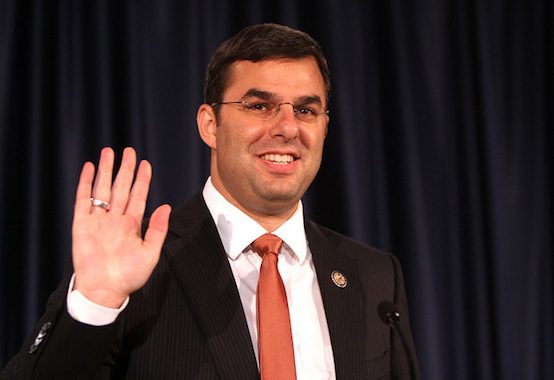
  • Justin Amash Emerges as Leading Critic of Fellow Republican Donald Trump

    Talk to the HandPer the WSJ:

    President Donald Trump’s “constant fear-mongering’’ about terrorism is “irresponsible and dangerous.’’ He needs to “stop attacking the legitimacy of the judiciary.’’ He picked an attorney general with “anti-liberty” positions on surveillance and police seizure of property.

    Those tough assessments come not from one of the president’s critics in the Democratic Party, but from a conservative Republican House member whose district decisively backed Mr. Trump in the election.

    … snip…

    Mr. Amash says his opposition is based on principle, as a libertarian concerned about government overreach and adherence to the Constitution. While many Republican lawmakers hold similar beliefs, Mr. Amash has been an especially outspoken proponent of smaller government, even on issues—such as reducing surveillance—where his views put him out of step with the more mainstream elements of the GOP.

    “To me, it doesn’t matter whether it’s a Republican in the White House or a Democrat in the White House. I have a duty to defend liberty, defend the rule of law and protect the rights of all of my constituents,” said Mr. Amash.

    Nice to see some principles on display.  And one of the few politicians I don’t mind voting for.  As always, more detail in the article.

  • The Jerbs Curve

    (Business 101: Pretty graphs make everything better)

    Imagine, if you will, a country or city-state called Libertopia.  We have just overthrown our evil socialist masters and made a new government from scratch.  By some magic video game miracle, we don’t start with any debt, outside enemies, and have a fully functioning market-driven farming and industrial base that trades all over the world.  There will be no empty bellies in Libertopia tonight (except for the orphans who aren’t working hard enough in the monocle polishing factory).

    In my imaginary country only property owners can vote.   So after the revolution we get together, review the collected works of SugarFree, hem and haw, drink our fill of mead. and decide to go with the idea of keeping our borders closed to the nearby Outsiders.  We are, after all, a tight community with a shared background.

    What would happen?

    At first not much at all.  Business would go on as usual, and we would stay competitive with our neighbors.  But under the “nativist” model, as time goes on, domestic market limitations and labor issues start.  The heads of industry and farming may start to clamor for more talent and workers.

    The voters finally listen and get together.  After a few rounds of brandy and the feasting on deep-dish pizza, we decide to open our borders just a little bit; letting in a yearly allotment to meet our needs.  To keep things simple, these Outside workers aren’t citizens, nor do they have a vote or receive welfare (which doesn’t exist in our country, comrade!).  This “restrictionist” model, however, still causes worker shortages, especially if the economy starts heating up.

    Business is doing great – so great that more Outside workers are needed to meet demand.  Once again the voters get together, do a few squats, and finish off a keg or two.  We decide to open the borders all the way, allowing everyone who wants to come in.  After all, things are looking fantastic for business.

    But we begin to notice that the citizens are starting to get angry.  There are protests and labor strikes because they have to compete with the Outsides for jobs.

    Now what’s the point of this simplified and rather silly story?  Using the scenarios above I’m trying to minimize input variables for the idea of something like the Laffer Curve, but instead of dealing with taxation, we are touching on immigration.  I imagine such an idea has already been explored before, but hey, I’m no economist (we can tell! – ed).  This is not an economic model either, but something soft and political science-y.

    Is there an optimum rate of immigrants – we’ll call it the “Jerbs Curve” – before the citizens get resentful (the Resentment Index?) with having to compete for wages with the Outsiders?  See Chinese rail workers or the Irish immigrants as an example.  And is there a point where they get angry enough at this perceived unfairness that they revolt and put in a new leader?  Or in a real world case, have enough electoral votes to put in someone like Trump?

    If there is such a thing as a Jerbs Curve, it would only skew the line in one direction or another: adding in welfare, illegal immigration, race, identity politics, war, the state of the economy, political party dynamics, and countless other variables.

    Perhaps the conclusion to all of this, if we can make one, it is that the world is a complicated place that often defies the most simple of models. Something as dynamic as a highly populous country with millions of inputs, variations, outputs, needs, and whatnot is impossible for anyone to predict. As far as intellectual exercises go, you can create models that are perfectly logical, but do they reflect the real world at all? How would they be when implemented or exposed to the real world?

    Comments and insults are welcome.

    edited by Elspeth Flashman

  • Ford’s Dozing Engineers Side With Google in Full Autonomy Push

    The future is here and the future is going to be sleepy:

    As Ford Motor Co. has been developing self-driving cars, the U.S. automaker has started noticing a problem during test drives: Engineers monitoring the robot rides are dozing off.

    Company researchers have tried to roust the engineers with bells, buzzers, warning lights, vibrating seats and shaking steering wheels. They’ve even put a second engineer in the vehicle to keep tabs on his human counterpart. No matter — the smooth ride was just too lulling and engineers struggled to maintain “situational awareness,” said Raj Nair, Ford’s product development chief.

    Maybe a taser collar or a spike to the bottom would help.  And such technology would also help the S&M market to really take off.

    “These are trained engineers who are there to observe what’s happening,” Nair said in an interview. “But it’s human nature that you start trusting the vehicle more and more and that you feel you don’t need to be paying attention.”

    The struggle to prevent snoozing-while-cruising has yielded a radical decision: Ford will venture to take the human out of the loop by removing the steering wheel, brake and gas pedals from its driverless cars debuting in 2021. That sets Ford apart from most automakers including Audi and General Motors Co., which believe drivers can be counted on to take the wheel if an accident is imminent.

    I’m an old Luddite when it comes to cars.  I don’t even trust an automatic transmission to find the right gear, and prefer to row my own.  Even carburetors have their limited upsides –  like simplicity if you’re a home wrencher.  But I’m also the sort of guy who hates driving long distance, so in the future a self-driving luxury barge could be added to my fleet.

    BMW, Mercedes-Benz and Volkswagen AG’s Audi plan to roll out semi-autonomous cars starting next year that require drivers to take over with as little as 10 seconds notice. On a scale embraced by the U.S. government, these cars would qualify as Level 3 — more capable than cars where drivers do everything, but short of full automation.

    Ford plans to skip that level altogether. The automaker has aligned with Alphabet’s Inc’s Waymo, which made similar discoveries related to human inattention while researching Google’s driverless car.

    …snip…

    “There’s evidence to suggest that Level 3 may show an increase in traffic crashes,” Nidhi Kalra, co-director of the Rand Center for Decision Making Under Uncertainty, said this week during a U.S. congressional hearing. “I don’t think there’s enough evidence to suggest that it should be prohibited at this time, but it does pose safety concerns.”

    Well that fills me with good cheer.  I can already imagine hordes of self-driving cars skittering into an ice storm as the passengers sleep, smoke the Devil’s Weed, or fornicate.  On second thought maybe paradise has finally come to Earth.

    One matter both sides agree on is that too many requests for human intervention could wreck the autonomous experience.

    As part of its testing, Ford used sensors that monitor facial expression and track eye movement to determine if a driver was alert and ready to take over. This led to an unenviable experience in which drivers felt they were being constantly reminded to pay attention. “The car is actually yelling at you all the time,” Nair said.

    My Mother The Car comes true!  My dream has been broken.  Now the roads will be filled with cranky passengers who just want to sleep, fuck, or smoke but instead are being badgered by the Nanny Car.  Maybe it would be better to just pay someone to drive me around.  Now I know where the Open Borders folks are coming from.

  • Deconstructing the ‘Liberal Campus’ Cliche?

    (Image from Google Image Search)

    From The Atlantic: Deconstructing the ‘Liberal Campus’ Cliche

    The author, Jason Blakely, start with admitting that yes, there might be a problem:

    Are American universities now spaces where democratic free expression is in decline, where insecurity, fear, and an obsessive, self-preening political correctness make open dialogue impossible? This was a view voiced by many at the start of the month, after the University of California, Berkeley, canceled a speech by the right-wing provocateur, Milo Yiannopoulos, when a demonstration against his appearance spun out of control. Yiannopoulos had been invited to speak by campus Republicans, but headlines the next morning were dominated by images of 100 to 150 protesters wearing black masks, hurling rocks, fireworks, and Molotov cocktails en route to doing $100,000 dollars of damage to a student center named after the great icon of pacifist civil disobedience, Martin Luther King, Jr.

    But you see it’s all just part of a false narrative:

    Such reports have in turn reinforced a longstanding political narrative, which seeks to demean America’s universities as ideologically narrow, morally slack, hypersensitive, and out of touch. For example, commentators like the New York Times columnist Ross Douthat have argued that America’s “university system” is “genuinely corrupt” in relying on “rote appeals to … left-wing pieties to cloak its utter lack of higher purpose.”

    But does this widespread portrait of universities as morally weak and anti-democratic—circulating at least since the time of Allan Bloom—really hold true? This vision of American universities is largely inadequate in at least two ways. First, it incorrectly blames increased fragility exclusively on the university system itself and, second, it relies on a reductive caricature of America’s institutions of higher learning.

    And then starts with numerous hand-waving and deflections.  And leaves the question unanswered: is the “conservative-identity” group merely responding in kind because of the left?

    Identity politics places individual and group notions of selfhood at the center of politics. As the philosopher Charles Taylor has argued at length, the main goal of identity politics is “recognition” or validation of a given identity by others in society. I have written elsewhere about how identity politics (normally associated with American liberalism) is actually a major engine fueling the rise of Trump. The categories of left and right often distort the ways in which cultural trends, like those associated with identity politics, are far more widely shared across American life. While some left-wing groups on campus are guilty of retreating from open dialogue, a conservative-identity movement has likewise tried to buffer students from having to hear ideas that upset them.

    And a summation:

    Any society that routinely attacks and undermines the institutions that support its greatest minds is caught up in an act of either extravagantly naïve or profoundly sinister self-sabotage. America’s college campuses remain places of astounding diversity in which democratic exchange of the highest kind still routinely takes place. The country’s university system remains, with all its imperfections, the best school for American democracy.

    If the United States is to flourish in the coming generation in the way it did in the prior century, it will need to embrace and even learn from the diversity and dialogue of its universities—not destroy them through simplistic grabs for popular power.

    It’s been over two decades since I’ve been in college, and yes, there were both liberal and conservative groups on campus.  But neither were rioting; that was for after the homecoming game when the student body burned sofas and overturned cars.  Now that was a honored tradition!

    Today one doesn’t see right-wing or moderates shaking their fists, chanting, or throwing stones in response to someone from the left visiting campus.  Instead we have a “progressive” movement that not only riots when someone they don’t like visits, but also expects the universities to enforce their limited belief system.  And very often they do.

    Mr. Blakely fails to address the First Amendment issues and also the growing concern that higher education are hardening into leftist enclaves.  If we truly want the country to flourish, then free inquiry and freedom of speech are a necessity, not an option.