Author: mexican sharpshooter

  • Stouts Part 1–The Imperial Stout


    Because there is no reasonable way to do a write up of this genre and continue to be employed, this must be done in pieces.  Which is fine, since the subgenres are unique enough to stand on their own.

    Part 1:  The Imperial Stout

    The Imperial Stout is a style with origins in England, who’s brewers had contracts to supply Russian Czars with beer—particularly Catherine the Great (pictured below).  

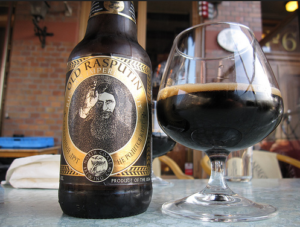
    This style is not Russian in origin which is why nearly every take on the Imperial Stout is associated with Russia or the Soviet Union is misleading.  The standard bearer, at least out west, comes from California’s Northcoast Brewery and associates itself with a Czarist wizard who is famous for his ability to survive multiple attempts on his life.  Possibly due to jealousy over that bitchin beard.

    Czar Nicholas II, after multiple attempts at siring an heir finally had son, Aleksei Nikolayevich in 1904.  Unfortunately, he was diagnosed at an early age with hemophilia and at that time there wasn’t exactly a treatment for it.  Once Aleksei began to bleed, his parents did what any rational person would do and consulted mystics, holy men and healers to cure their son.  In 1908 they finally found a Siberian who delivered.  Grigory Efimovich Rasputin, a man who underwent a bit of a religious transformation after travels to Greece and Jerusalem in his formative years.  Upon his arrival to St. Petersburg he gained a self-proclaimed reputation as having both healing powers and the ability to predict the future.  Part of why anybody really talks about him is that somehow, whatever he did, helped Aleksei survive.  Nobody is certain if he really did anything, or if it was just a coincidence.  In 1916, conspirators from the royal family believed Rasputin to have sexual relations with the queen and that his beard was an evil presence that was taking over Russia.  

    In order to save Mother Russia, Rasputin had to die.

    Turns out killing Rasputin and his beard was quite the task.  First, they tried to lure Rasputin with a sexual foray and leave cyanide laced pastries and wine.  Rasputin eventually ate the pastries, and drank the wine, with no effect.  They then tried a more direct approach and shot him, with Rasputin initially convulsing and going still.  An hour later, they found Rasputin stumbling across the courtyard.  After a bit of a chase, they eventually shot him in the back, which stopped the beard momentarily.  Finally, they did something Russians are quite proficient, and shot him in the back of the head.  Even then, the beard continued to crawl forward with the final blow being a kick to the head.

    The beer itself is just as relentless.  It is black in color, and has an insane level of complexity.  The color of beer is the direct result of roasting malt prior to adding it to the wort.  For light colored beers, the malt is lightly roasted or not at all.  In the case of stouts, the malt is roasted almost to the point of being burnt.  Much the same way that Starbucks roasts their coffee beans, which is why the word coffee almost universally comes up in conversation when describing Imperial Stouts.  What makes it imperial?  High gravity or high ABV.  These typically operate in the 8-10% range.  Other things you might taste in this style of beer is dark fruit, chocolate, nutty bread and a pleasant hop intensity to balance most of this out.  

    As a bonus, this beer does not contain Cyanide. Old Rasputin Russian Imperial Stout 4.3/5

    Since I like to believe I know my audience, this next one comes with the STEVE SMITH SEAL OF APPROVAL.  AND BY APPROVAL, MEAN RAPE.

    This one is just as good, but the unfortunate aspect of this style is that they very nearly all taste alike unless you’re the type that will stick your nose into the glass to find the underlying aromatics.  I will end this by saying I suck at STEVE SMITH jokes.  THE PEANUT GALLERY HERE GETS THIS ONE.  AND BY PEANUT GALLERY, MEAN……  

    GREAT DIVIDE YETI IMPERIAL STOUT.  4.3/5

  • Review – Tank #7 Farmhouse Ale

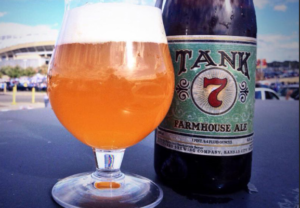
    This is my review of Tank #7 Farmhouse Ale, by Boulevard Brewing Company.

    Here is my mistake.  I mentioned in passing what I will be reviewing next and somebody tells me there is a standard to these things that I am overlooking.

    *pours beer down the sink*

    Okay, fine.  They didn’t have it at the Fry’s I shop at that used to be Smitty’s, therefore it’s the ULTIMATE FRY’S.  I instead went to BevMo–no dice.  Finally, I found it at Total Wine, which was the last bottle they had on the shelf.  

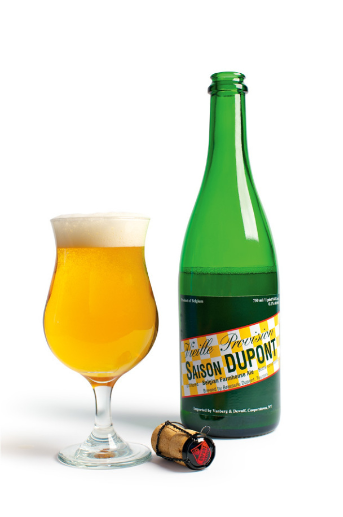
    This is my review of Saison Dupont Brasserie.  Hat Tip:  Nephilium.

    Holy shit.  This almost costs $14, including the $1.39 worth of state legitimized theft levied on beer, wine and spirits.  This reminds me of the time I was shopping for a new vehicle and I checked out the Toyota Tacoma.  For what Toyota charges people for the privilege of being labeled tough enough to drive a Taco; in comparison to some of its competitors in the light truck market it better be an amazing truck.  By golly, the Taco it is an amazing truck.  Is it amazing enough to justify buying it over a comparably priced, but used full sized?  Saison Dupont reminds me of this quandary.  It is expertly crafted, has a lot of body which is evident in the way the foam coats the inside of the glass.  It is bottle conditioned and continuously fermented, which is why it is sealed with a cork similar to the ones used to bottle champagne.  The smell is reminiscent of a crisp summer evening in the countryside, in a place where the pavement will not burn your bare feet.

    Why is it called Saison?  Those of you that speak French will probably tell me the word itself means season.  This is indeed true; Belgians like the Germans and nearly every other traditional beer culture adopted the practice of brewing beer seasonally in the time before refrigeration.  Part of the reason it is typically done in the colder months is that small insects hibernate and won’t infest the wort.  The other part is consistency in temperature.  Germans took this to another level in developing lagers, which is not nearly as resistant to temperature fluctuations as most ale, by brewing underground.  This is not why it’s called Saison.

    It was explained to me once the reason lunch is dinner and dinner is supper in the Midwest is due to the type of meal that a farm hand might have.  If one sits down for a large midday meal at a table it is more likely to be referred to as dinner.  This is how they referred to it in the dining facility at the Air Force base I was stationed at in South Carolina.  Typically, the meal was large as I was hungry at the time since I last ate around 0400 so that I can complete the airfield lighting check prior to the start of the ops day.   Lunch on the other hand, is often a much smaller meal.  When I think of lunch today, I am normally sitting at my desk munching on something small.  Be it a sandwich, or salad for example, the intent is to simply keep me going until the end of the day.  It is this type of meal that Midwesterners might refer to as lunch, just something small they can provide a farm hand that they won’t have to worry about their workers going hungry*. Back in the day, Belgian farmers would provide beer to their farm hands, known as Saisonniers, with this type of beer in part as a meal replacement but also because one gets rather thirsty when working in the fields.  This explains why it is often called Farmhouse Ale.

    *I realize this might be the most controversial statement I make in this entire article, but this is how it was explained to me.  

    Like I said before, it is expertly crafted with a lot of body in the traditional manner that defines the style.  It has a thick texture with a heavy citrus aftertaste.  To make this even more confusing, it is highly carbonated but it dissipates in the glass (foam) leaving a pleasant aroma and does not leave you feeling bloated.  Like most beers of this type, you must be into it to like it.  Wheat beers in general have a polarizing effect on people and not everybody is into it.  If you are, you will certainly appreciate its charms but perhaps will not appreciate its price tag.  Saison Dupont Brasserie 4.0/5.

    ‘Murica!

    If Brasserie is the master, Boulevard is its apprentice.  Like many American Brewers, they are quite adept at creating a worthy copy.  Often the argument against the craft industry is that they can never make the traditional ales made in Europe.  Is it the same?  No, it’s not a carbon copy, and that isn’t the point, but it certainly holds its own given the more affordable price tag. Boulevard Brewing Co. (Kansas City), Tank #7 Farmhouse Ale 3.9/5.

    In honor of the NL Wild Card, I picked up this one I never heard of as—a wild card.  

    This one is not terrible. Considering the fact that I turn into an emotional wreck watching playoff baseball, particularly when it is my team…I might have to try this one again.  I was hardly objective at the time… There is less body than expected and it is a little more sour than many would like but it is not bad. It is not one to go toe to toe with a traditional European product but it does what it does well. Prairie Artisan Ales Merica Farmhouse Ale 3.0/5

    A word on fruit  

    This is a libertarian website, it is in this spirit that I say that if you add a slice of orange to this type of beer, so be it.  To call that apostasy would make me no different than those pushing a social campaign that insists men ignore their natural preferences for women and accept them as is–i.e. real men like women that_______ or with_______.  This is hogwash; real men like whatever the fuck they want.  If you like Belgian farm girls picking strawberries, go right ahead.

    You can only pick one!
    So choose wisely

    If you like female Belgian soldiers…You might have issues, but go for it.

    If you want to add an orange because you like it, because it makes you happy, I am not going to say you are wrong.  I will not say that you should not add fruit to your beer and you may as well go to Morton’s and ask for ketchup with your steak.  It’s an immoral stance to take and I will not entertain an argument to the contrary.  Do what you like.

    Having said that, this is a libertarian website and since I have been graciously provided a platform for free speech I will state my personal opinion:  if you add orange to a well-crafted Saison–you are wrong.  Go wash your mouth with a revolver.

  • Review – Fat Jack


    This is my review of Fat Jack Double Pumpkin Ale, by Sam Adams.  

    Let’s get this out of the way right now.  Yes, it will get you drunk.  TW:  This goes on for over two minutes.

    https://youtu.be/5szRnQmyI4E

    Pumpkin Ale suffers from the indignity of being associated with hipster culture in that it only seems to come out at the time of year where everyone and everything gets excited for all things pumpkin.  Pumpkin cider, pumpkin parfaits, pumpkin cookies ….

    ….even pumpkin spice M&Ms.  It’s to the point where one can trigger an emotional response by telling a 28 year old woman in vintage glasses, a turtleneck sweater and wool scarf that she lives in Arizona, it is 96 degrees, there is no reason to dress like that and there is no reason for me to give two shits about your pumpkin spice latte.  Pumpkin ale however, I think is unfair to associate with these people to some degree.

    Pumpkins, like chocolate, corn, potatoes, and beans are indigenous to the Americas and like the other food mentioned was traded around the globe as a result of the Columbian exchange.  Native Americans initially ate only the seeds, because that was the only palatable part.  Later varieties were cultivated so that the flesh could also be consumed.  This became a staple in the diet of many native cultures, as indicated by the number of European explorers that wrote about pumpkins and the distance between the parts of North America they explored.  Jacques Cartier in Canada, to Alvar Nuñez Cabeza De Vaca in Florida, and John Smith in Virginia all wrote about the abundance of the gourds.  At the beginning of the colonial period, settlers were unable to grow the same type of crops they could grow in Europe, therefore is should be no surprise pumpkin became a staple of these early settlers.  If you want to know more about Pumpkins, click here.

    Beer/ale at the time was a necessity because the fermentation process made water potable, this has been true since the medieval period.  Being that there was at first, no barley to make it the colonists had to make due with something to make water drinkable and help them forget they were probably going to die during the winter—guess what happened to be around in great quantity?  Pumpkin ale fell out of favor after the civil war and cultivation made it more lucrative for farmers to supply a decorative element that rots on my porch overnight after the 1970s.  It was only a recent development that everybody with the means could put the stuff to market as part of the annual hipster pumpkin craze.  In other words, this is something those snooty, technocratic, Euro-weenies cannot claim because it is a uniquely American beverage with unique American heritage.  Europe can go suck it.  

    Modern Pumpkin Ale comes in two types:  The type that wants to be a severely over-spiced, gluten-free Dunkel and the other that wants to be liquid pumpkin pie.  Fat Jack is the former.  It comes at over 8% ABV so it is prudent you operate machinery or firearms while drinking this.  It is also handy to have around when Carson Palmer wants to embarrass himself by muffing the snap in an attempt to come back in the 4th quarter.  Way to go dumbass, it’s now 3rd & 20 and my only solace is a thick, hearty ale, with a flavor heavily influenced by ginger, cinnamon, ginger, cloves, ginger, allspice and ginger.  Did I mention Ginger?

    In fairness, they had to balance out the pumpkin somehow and with the high ABV, there is a lot of pumpkin in there.  This one is still pretty good but is not one to chug.  3.5/5

    If you are looking more towards the liquid pumpkin pie end of the spectrum, a good example is Elysian Night Owl Pumpkin Ale.  

    Same spices as Fat Jack, just not as intense, and a much lighter ale with less body as you can probably discern from what is indeed my photo.  It has a faint, pumpkin bitterness in the back which is kind of nice.  3.8/5

    This one is absolutely amazing.  Last time I had it in Colorado the guy at the liquor store asked that I not purchase more than 2 packs of it at a time.  The reason is because he typically sold out of it within the day.  This has a faint vanilla along with the usual pumpkin spices, so it actually tastes like pumpkin pie, like the kind your mom made.  If you happen to be in Colorado, and you happen to come across a liquor store in the fall pick some up, cowboy. 4.5/5

  • Review – Oktoberfest

    This is my review of what is arguably, the greatest beer in the world, ever.  At least according to this guy.

    https://youtu.be/MyJJZa5Q2Fw?t=25s

    This movie plays on the stereotypes and misconceptions that Americans have about Oktoberfest, particularly the ones that have never attended.  For the uninitiated, it’s pretty much viewed as a bunch of singing drunks served by this lady.

    I have no way of legitimately commenting on the accuracy of the portrayal of Oktoberfest, drinking contests, the German people, the Bier Garden wait staff, or sexual activity among amphibians in this film.  For that, I will direct you to a much better source previously posted by another guest contributor.  Hat Tip:  DEG.

    While Hefeweizen is served at Oktoberfest, I will not get into these.  To be sure, my aversion to German wheat beer has absolutely nothing to do with a drunk Native American that failed to recognize that I hailed from the big tribe in the south, and that I am not a homosexual.   Apparently in Northern Arizona, Hefeweizen is a calling card for gay men; I also happen to be more of a fan of the Belgian varieties of wheat beer.

    That leaves us with Marzen but since this is a somewhat saturated marked, where to begin?

    Paulaner Oktoberfest Marzen

    Unfortunately, this is a German entity therefore we must concede the standard must be set by them.  Other well-known German brewers such as Spaaten, Warsteiner, and Becks all put their own version to market and none of them are bad.  As you can tell from what is once again, not my photo, Paulaner’s offering is copper in color, a nice light lager with caramel notes and a nutty finish.  It is lightly carbonated so it will not stop you from knocking back several liters at a time.  The only problem, as mentioned in the comments section at other dark corners of this website, German beer does not travel well, particularly lagers.  German Beer Purity laws may have something to do with that but even given the proviso that it may be a hair on the skunky side, it is still quite good.  Too bad we can’t all go to Germany. 3.8/5

    Since going to the source is not always feasible, that leaves us with the American Craft industry to pick up the slack.


    Left Hand Brewing Co. Oktoberfest – Longmont, CO

    As you can tell from what is once again, not my photo, Left Hand’s offering is copper in color, a nice light lager with caramel notes and a nutty finish.  It is lightly carbonated so it will not stop you from knocking back several liters at a time.  Yes, I just repeated what I wrote about Paulaner’s.  Am I really that lazy?  Perhaps, but repeating myself might be the best compliment I can make about it.  This is as good a copy you can get in the mountain west, and for many of us that is as good as it gets.  The reduced travel time and the Colorado snow met make this one slightly more enjoyable than waiting on the import to arrive. 4.0/5

    Tenaya Creek Brewery Oktoberfest  – Las Vegas, NV (Right)

    Another one I’ve had recently is from Tenaya Creek Brewery in Las Vegas.  Not as malty as I like but given its source it is also a fair bit lighter than the norm for this type of beer. If you feel the need to enter a drinking competition this might be a good choice. 3.5/5

    Goose Island Oktoberfest – Chicago, IL (Left)

    The next one is from Goose Island from Chicago.  It could just be the batch I got; this might have been bottled sometime the previous year and left in a warehouse somewhere in Phoenix with questionable climate control.  Whatever it is, this one should be better but it is not.  I want to give them the benefit of the doubt, but after briefly researching on ratebeer.com others seem to agree.  If you are in the area, please explain this if you like because I will not extend more mental energy to find out where they went wrong.  After all the definition of pizza in that town is apparently up for their interpretation.  My only regret is I bought a 12 pack. 2.5/5.

    San Tan Brewing Co. – Chandler, AZ

    The last one is a local (to me), from San Tan.  This is probably going to be discounted as bias but I will say my local offering is pretty damn good!  My pick for this genre is still from Left Hand out of CO but it stacks up well.  The biggest difference is the nuttiness in this one gives is a slightly thicker texture than Left Hand’s.  It could also be the local water, as it is notorious for its mineral content.  3.8/5

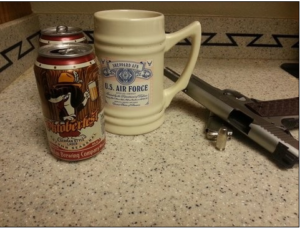
    Whether it is glass or ceramic, serve in a mug of some kind like above.  Bonus points if you have a boot.

  • Review – Heavy Metal Inspired Beer


    Iron Maiden Trooper

    I picked it up despite its $5.99/can sticker price mostly due to my being a sucker for good marketing.  Apparently, Bruce Dickinson happens to be an “ale enthusiast.”  At least this is the message listed on the can.  I interpret that as Bruce is really an aging 1980’s, metal-god who happens to be British.  I am absolutely shocked–SHOCKED–to find out he drinks a lot of beer.  I went through my iTunes playlist of other Maiden songs while I tried this out.  In the off chance you do not have any Maiden on your playlist, here’s a link.

    The song, of course, is about the Battle of Balaclava during the Crimean War, and the famous Charge of the Light Brigade.  I never studied the history behind this war, but skimming the surface appears to be the usual, completely avoidable conflict between European powers.  To oversimplify:  Russia wanting some control over the area took advantage of the Ottoman Empire’s weakness but for some reason was not the aggressor—that was the Ottomans.  The Russians won the first round handily.  France joined the conflict over what appeared to be nothing more than pride from losing to the Russians at Waterloo in 1812.  Britain engaged in hostilities because of the Ottoman’s strategic location, with the Ottoman regime being their access to India at the time.  Further background on this can be found at this link here.

    How is the beer?  It’s a traditional English Extra Special Bitters (ESB) Ale.  If you’re into the ‘proper’ English ales or even understand why our British cousins use that adjective for everything, you’ll probably find this enjoyable.  Perhaps not as enjoyable as the music, but I’m pretty ambivalent about the beer.  It has the traditional full bodied texture, heavy malt character, and an ever so slight nutty aroma.  Some reviews on the internet also claim there is a hint of lemon, but I cannot taste that.  It does what it needs to do fairly well, but not enough for Bruce to quit his day job 2.8/5.

    AC/DC Rock or Bust

    It is easy to lob all the verbal jabs at the Thunder from Down Under for their remarkably simple riffs and their ability to sell millions of albums filled with songs that all sound the same.  When you do that for around 30 years, those jabs start to fall short.  Their beer in question shares this remarkably simply quality that tastes like every other mass produced pale lager in existence.  I will respect the beer more if they manage to sell it in large quantities for as long as they have filled stadiums.  Until then, I probably should not have wasted my time mentioning it here 1.9/5.

    Megadeth A Tout Le Monde

    This one comes with a backstory.  At the UFC Fight Night in Phoenix last January I got a sample of this for free.  If I bought one I got a ticket to meet Dave Mustaine, who also happened to go to the fight but I imagine got better seats than me.  My parents owned a store I worked at while growing up that he frequented.  By most accounts, he is a nice guy and I have to agree.  Since I met him before I gave the ticket away to a random fan.  The beer is a Saison, made by the same brewery that makes Fin de Monde.  Given that pedigree, one might assume it is pretty damn good.  It does in fact, live up to those expectations.             

    It has a nice foamy head, that holds up for quite some time.  The scent is a sweeter citrus, like tangerine or orange, but it finishes with a muted lemon.  I was disappointed they sold it with a twist cap when I bought it at the store but it is hardly a deal breaker.

    Way better than the swill AC/DC slapped their name on and held up way better than BJ Penn’s face.  Much like the Ottomans, that guy rather handily got his ass kicked.

    A Tout Le Monde weighs in at 4.2 /5.

  • Review – Rogue Sriracha Hot Stout


    If you ever had Cave Creek Chili beer, you probably agree with the popular opinion that it is dreadful.  It didn’t help that when Cave Creek came out with the beer it was several years before novelty beers became more popular.  So when I received this as a gag gift at the office Christmas Holiday Party, I decided I would be as objective as possible.  After all, I like beer.  I like sriracha sauce, the combination should be okay, right?

    Let’s start with what is right about this.  Sriracha sauce or its parent company Huy Fong foods was founded by David Tran, a Vietnamese Immigrant.  Legend has it, the former ARVN officer stowed away on a freighter in the early 1980s.  Having survived the trip, he found himself penniless, without hot sauce to his liking, and worst of all in California.  He made the sauce first by hand, selling mainly to Chinese restaurants and his company grew from there by word of mouth.  The company is named for the freighter that brought him to America.

    The beer is not hopped at all as far as I can tell but it does not matter because there is no balance to this at all.  This reminds me of the Lindt chocolate bars with chile or those candies from Mexico.  There is a sweet full bodied beer behind it but it is overpowered by flaming cock sauce.  Mexican Indians drank something similar.  Cacao trees are native to the Americas and were believed to be a gift from the Quetzalcoatl, the god of wisdom.  It was originally prepared as a beverage; evidence of fermenting cacao seeds to make alcohol suggests the practice was in place as early as 1400 BC. To this day, it is still prepared as a hot frothy beverage mixed with spices that is believed to be a powerful aphrodisiac. Powerful, like this guy:   

    The peppers are somewhat muted by the stout but not nearly enough.  Perhaps now is a good time to mention that my ancestors engaged in human sacrifice and cannibalism, but quite frankly, I can only see myself eating this with Thai curry or Pho.  Even then I would probably only do it on a dare.

    I was at a loss as far as glassware.  That Gordon Biersch glass (they call it a Willibrecht) is as neutral a glass that I own but I typically use it for Amber and Pale Ales.  IPA, Barley wines, Trappist, and Brown Ales I opt for the Chalice or a Tulip Glass.  Lagers go in a mug.  Stouts and Porters go in a Pint glass.  The spices are so intense, it doesn’t suit any of my glassware.

    If you are going to spend the five days following the winter solstice, holed up in your house while waiting for the gods to finish deciding whether to end the world or let you live for another year…you might like this.  If you like covering yourself with black mud to celebrate the god’s gift of a new year…you might like this.  If you plan on ripping open the sternum of one of your enemies, beheading him and eating his still beating heart…you might like this.  If you have achieved a higher plane of consciousness, climbed into your pyramid and flew back to your home planet…you may like this.  For the rest of us, I leave it by saying that it is not for everyone.  I couldn’t finish the bomber, instead I pulled out a Four Peaks Kiltlifter to round out my evening. 2.2/5.

  • Review – My Antonia Imperial Pilsner by Dogfish Head


    I typically don’t buy from this brewery.  For some reason they think rather highly of themselves despite the fact they produce exactly one beer, an IPA.  They just make it with a varying amount of hops, which means they get to sell them in packs of 4 for what might normally be the price of 12.  Another reason I avoid them?  They reside in a state whose most famous resident is a bit of a creeper and likely would be considered a racist in a sane world.  That day was different and I picked it because Imperial Pilsners aren’t all that common and I remembered a book I read in high school with the same name.  

    My Antonia is a tale that begins when Jim, the novel’s main character, meets a woman by chance on a train that happened to have a mutual friend named Antonia.  Jim and his contact agree to exchange a memoir of sorts of their experiences with Antonia.  The novel is intended to be Jim’s submission to his contact on the train.  This makes the novel an unusual read because it is not written to follow a discernable plot line, rather it is a collection of “books” from Jim’s point of view.  Jim was orphaned at the age of ten and goes to live with his grandparents in Nebraska; the first book begins on a train to Black Hawk which also has the Shimerda’s, a Bohemian immigrant family with a daughter slightly older than Jim, as passengers.  It is obvious from the start that Jim has a thing for the Bohemian girl next door. 

    Her family just so happens to live on the property adjacent to his grandparents.  Later, Antonia meets Jim by a creek, where she inquires on several pronunciations to certain words in English.  As a token of her appreciation, Antonia offers Jim a gift.  The entire scene is broken up when her father awkwardly arrives and gives Jim an inquisitive look.  This language barrier comes up repeatedly as a plot device as the Shimerdas are constantly screwed over by another Bohemian immigrant from whom they purchased their property.  Jim and his family to their credit were always willing to give them a helping hand.  Ironically, Jim’s grandparents had a bilingual farm hand, Otto, who could’ve solved most of these language issues but didn’t even bother because he happens to be Austrian.

    I was 14 when I read this book, and even then, I questioned why the author wrote Otto in as a character or even made him a German speaking character at that?

    Antonia herself seems almost bipolar, depending on the season.  Eventually her father kills himself because nobody in Nebraska wants to hear him play his violin, Jim goes to Harvard and becomes a lawyer.  Academics for some reason think of this as a tale of “the west.”  It is your typical coming of age story written by an early 20th century feminist.  

    Predictably, the male protagonist, in a book full of terrible sexual metaphors–fails to score.  

    At least, I would have remembered if he did, but to be honest I didn’t finish the book. It is unclear whether Jim’s contact on the train sends her manuscript, further giving the reader the impression that Jim is an archetypal beta-male of some sort.  I imagine him penning this manuscript for a random lady on a train, reminiscing about a girl he once knew while naked on a cold New England evening.  Rewriting it numerous times because of the unreadable black streaks from the tears wiped away from his parchment.   

    Right…the beer. As you can tell from what is not my photo, is not quite amber in color.  It has a nice foamy head with some citrus notes.   Saaz hops which are Czech in origin are extremely prevalent, which makes no sense because the girl is not from that region.  Wouldn’t Hallertau or any German variety be more appropriate?  People notice details like this, Dogfish, and I only grade on a five-point scale.   The Saaz hops leave a dry aftertaste on the back of the tongue.  I like that they chose to go with the original Czech style, rather than the German styles that Americans are accustomed to, but for the most part these aren’t all that different.  The Imperial Pilsner variety is of course similar to any Pilsner style lager, with the obvious contrast of an insane amount of hops tossed in the mix.  The hop’s assault on your palate is reminiscent of this Czech SWAT team.

    https://youtu.be/ygGEpl0EJRw

    This video is fitting because why arm a tactical team only with pistols?  Why name a libation like this after a book?  

    Bottom line, this book sucks and under no circumstances should you take anyone seriously that says otherwise.  The beer however, is good.  I give it a solid 4.2/5.

  • Single Payer Healthcare – Part 2

    (Part 1)

    Introduction

    Once it is determined who is granted access to the system and how this system is going to be paid for, the next step is discovering how these health care services are going to be delivered.  After all, the point of our nation becoming part of the noble cadre of nations that recognize access to health care for all citizens as a civil right of some kind is to actually treat sick people.  Sounds like a given, but how do they go about doing it?

    Primary Care – The PACT Model

    The key to delivery in the VA is through the Primacy Care Provider (PCP).  There is one doctor (MD), or nurse practitioner (NP) that is charged with providing the basis to all services to an individual Veteran.  The team also has a small cadre of Registered Nurses (RN), Licensed Practical Nurses (LPN),

    Nursing Assistants and Medical Support Assistants (MSA) that work in support of the PCP.  This is in effect, a small clinic that operates similar to many health care systems and even at private clinics.

    What the PACT team does, is provide the Veteran with general services, also a given since the MD is typically a general practitioner.  This team should handle routine services, and also does the grunt work in terms of keeping track of medical history.  They provide this based on particular medical criteria designed to stay abreast of common health factors affecting the given population.  As noted in the previous essay, most of the Veteran population is older and male.  

    This means the PACT can focus on the types of issues older men typically face.  Examples of such conditions include obesity, hypertension, diabetes or any condition that will worsen over time if a relationship with a physician is not maintained.  If a condition worsens, the PCP will know about it and be in a good position to alter his or her plan of care.  This proactive approach is often pointed out by advocates of single payer health care systems as a feature of these systems since most of the time healthcare in the United States is a reactive proposition.  Reactive in the sense that most people will simply wait until that bump gets bigger, or that knee becomes too unbearable to walk on, or it hurts too much to urinate in the morning before finally making an appointment to see a doctor.  

    Symptoms may not appear until it is too late for treatment to be effective for many fatal diseases; the system is more likely to catch an underlying condition while it is most effective to treat in this proactive system.  Catching these conditions early on has the added benefit that it is often more cost effective than catastrophic treatment (6).

    There are studies that Longman cites in his book that suggest a correlation to this approach leading to better outcomes versus the patient waiting until the symptoms get too unbearable (6).  There are some studies that go so far as to say that VA patients live a longer life, in spite of disability, alcoholism, PTSD, et cetera, being more frequent than in the general population.  Even studies with outcomes in specific areas cited as performing better than the private sector (6).  The overall cost of such a system also has a tendency to be lower than the fee for service model.  One study from 2004 suggested all VA services provided during FY 99 if reimbursed at Medicare rates would be result in an estimated 17% higher cost to the taxpayer (1).

    Specialty Care

    This is where things get a little more complicated.  Consider what many third party insurers require of their customers to see a specialist.  Typically, if a customer wants their insurance to pay for specialty care they will have to first go to a primary care clinic to initiate a referral.  What this does for the insurer, is inform them the requested service is medically necessary.  This necessity is important to insurers because specialty care providers have a tendency to provide services that are more expensive than their general counterparts.  Similarly, in order to see a specialist, a Veteran must first see their PCP.  This step allows the PCP to discuss all of the options available to the Veteran and if their condition truly warrants the expertise of a specialist they will initiate a consult.  

    The consult is essentially a documented source of communication between the PCP and the specialist.  Once the PCP enters the consult, the specialist is notified via a provider alert on the Electronic Health Record (EHR) Software.  They will review the PCP notes, review the Veteran’s charts if necessary, and if the specialist agrees the service is necessary the specialty clinic’s MSA will contact the Veteran to schedule an appointment.  At this point, the treatment varies with the Veteran’s circumstances.  It could be an evaluation, a noninvasive outpatient treatment or perhaps a surgery needs to be scheduled with an inpatient stay.  All of these specific circumstances are documented on the consult.  Once the service is provided, the specialist will document their findings in the EHR to be ultimately reviewed by the PCP.  If the specialist does not agree the services are needed, the reason why is documented and the consult is discontinued.  If the specialist needs more information, a lab for instance, this will be documented and sent back to the PCP, this way the specialist has every resource available to make an informed decision.

    Drugs–the legal variety.

    The reason often cited for the efficacy of VHA versus private sector hospitals is the VistA EHR system. It allows a somewhat simple integration between clinics as discussed in the previous sections.  It also allows medical data to be stored easily, and later used for research purposes.  During the Clinton administration, Ken Kizer, the SecVA at the time, implemented a prescription drug formulary by researching this data as well as recognizing that once Veterans go to the VA they typically stay there.  For whatever reason why they stay, they identified they were there for life.

    ‘If you are going to have your patients for five years, ten years, fifteen years, or life,’ explains Kizer, ‘there are both good economic and health reasons why you would want to use the more expensive drugs.  You have a population of patients who are at high risk for sclerotic heart disease, and you’ve got them for life.  You make a different decision about what’s on your drug formulary than you might if you knew you only had them for a year or two.’ (6)

    What the researchers were able to do with this was create a formulary that determined what drugs worked long term.  When the FDA approves a drug, there typically is no long term research into the drug’s efficacy, only if it does what it claims and if it is safe for use.  What this means is the VA will only prescribe drugs that have well-known, established effects, but also have been around long enough to be on the generic market.  If a new prescription drug treatment hits the market, it is almost certain the VA will not add it to their formulary, even if the drug is truly is a medical breakthrough, as discovered with the new Hepatitis C drug (7).   While it was later approved, it required a cost/benefit analysis on the cost of treatment at the VA for hepatitis C before they were able to add it to the formulary.  The result is a system that according to the Heritage Foundation costs significantly less than Medicare Part D but presents its patients with no choice whatsoever in their prescriptions (3).

    The VA formulary is created through access restrictions on drugs. For drugs to be covered on the formulary, their makers must list all of their drugs on the Federal Supply Schedule (FSS) for federal purchasers at the price given to the most favored nonfederal customer under comparable terms and conditions.  Additionally, drug makers must offer the VA a price lower than a statutory federal price ceiling (FPC), which mandates a discount of at least 24 percent off the non-federal average manufacturer price (NFAMP), with a rebate if price increases exceed inflation (3).

    Otherwise, the VA negotiates pricing based on volume, as they are the largest health care provider in the country. The drug companies that sell to the VA recognize that it is a closed system and there is little chance of market distortions from below market priced VA drugs.  It is also small enough as a portion of the entire health care market, that they are able to break even by selling non-generic prescription drugs elsewhere (3).

    Scheduling

    Everything in the previous sections of this essay is utterly meaningless if Veterans cannot get an appointment.

    The thing is, most major hospital systems and private practices do not worry too much about whether or not they are able to schedule patients in a timely manner.  The reason being, they have many fixed costs that are baked into their operating budgets.  Paying for the cost of operations requires treating patients.  If they can’t get patients into beds, they go under–kind of like when airlines have no passengers. The private sector is also large enough at the moment that if a patient cannot be seen at one place, they can find another.  In the grand scheme of things it is about as difficult to schedule an HVAC technician as it is to schedule an appointment with a private doctor—it just depends on where you live, and the local supply and demand for services.

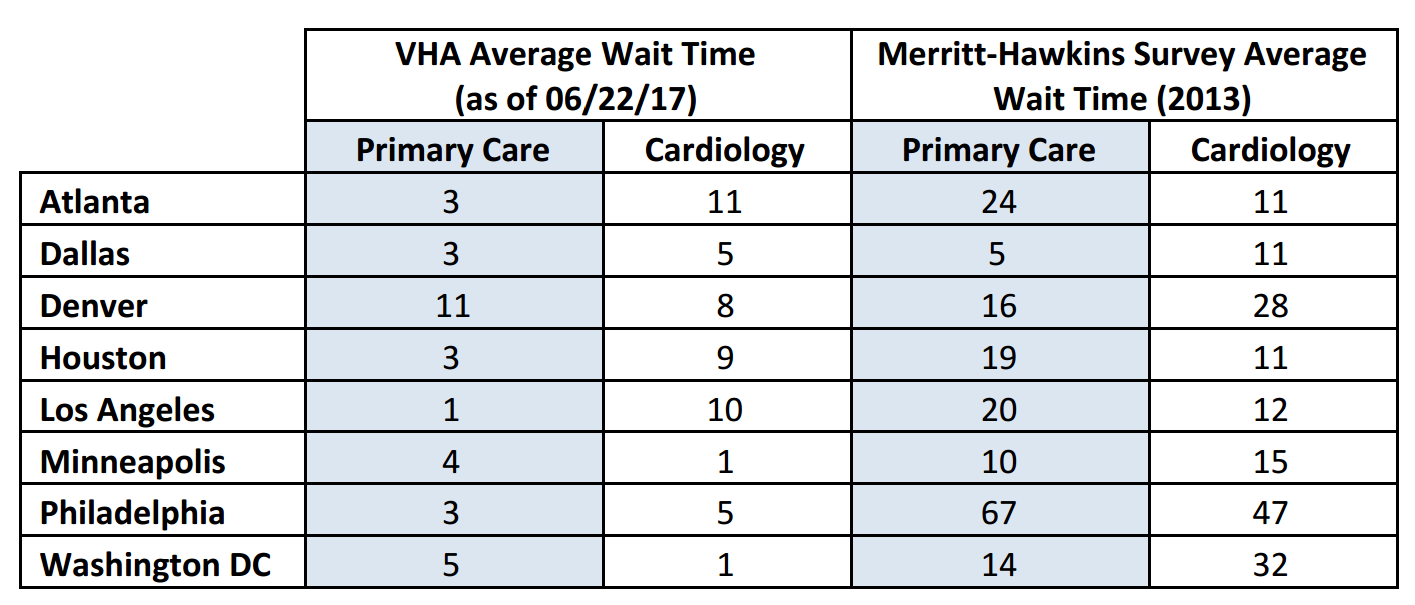
    Because of this, it is often difficult to find an apples to apples comparison for scheduling times.  In 2014, Merritt-Hawkins published a survey on Medicare/Medicaid acceptance rates and average wait times for a number of US Metropolitan areas (2).  Unfortunately, their survey uses 2013 data and is limited to a few clinic types.  The VA does have a public website that currently presents average wait times at all their facilities, for a similar number of clinic types (4).  For purposes of brevity, only Primary (or Family) Care and Cardiology average wait times will be displayed here by number of days.  The references section has links to both resources in case further research is desired.


    Ruminations on Primary Care, Specialty Care, Drugs and Scheduling

    While the scheduling numbers in the area listed appear comparable or better than their private sector counterparts there is something that should be mentioned here:  these data were made available as a result of a well-known scandal involving the manipulation of the wait times first identified in Phoenix, but later found to be endemic of the system as a whole.  Here are a few other examples:

    Tucson:  https://www.va.gov/oig/pubs/VAOIG-14-02890-72.pdf

    VISN 6 (VA, NC):  https://www.va.gov/oig/pubs/VAOIG-16-02618-424.pdf

    Houston:  https://www.va.gov/oig/pubs/VAOIG-15-03073-275.pdf

    Colorado Springs: https://www.va.gov/oig/pubs/VAOIG-15-02472-46.pdf

    Providence: https://www.va.gov/oig/pubs/VAOIG-15-05123-254.pdf

    Cincinnati: https://www.va.gov/oig/pubs/VAOIG-15-04725-272.pdf


    The VAOIG website is full of these. Unfortunately, bottlenecks within the system can occur.  With a large number of people congregating into urban areas, it is very likely to happen in a hypothetical single payer system.  Keep in mind the VA only provides care for a small minority of Americans (around 9 million) and scaling the system for the entire population is unlikely to make it work any faster, this is the practical experience in other countries as well.  There is also the question of coordinating care with a specialist.  So to recap the consult management practice goes like this:

    AH! ➔ Appointment with PCP ➔ PCP Agrees and writes up a consult ➔Specialist receives consult and reviews ➔ Specialist accepts and schedules appointment ➔ Treatment ➔ Specialist documents treatment ➔ Specialist informs PCP of treatment ➔ Re-evaluation by PCP if needed.  

    Each of these steps requires human input; miss a step and the entire process stops.  Stop early enough and treatment may never be given at all.  One of the findings from an investigation determined there was little oversight at the time of the investigation of the process at all, which likely lead to unnecessary deaths (6).  The prevailing issue with government systems such as these is lack of accountability.

    In terms of prescription drug pricing, the VA formulary only works because it is a closed system.  Scaling it up will create a massive market distortion that according to the Heritage Foundation, will only drive up costs (3).  Consider the formulary is based on restricting the drugs it will pay for, and what doctors can prescribe.  This will result in shifting costs to new medications for those willing to pay for it.  There is also the matter of the formulary’s insistence on using generics.  Generic drugs are made by a limited number of manufactures and if the only thing the hypothetical single payer will pay for are generics and the physician is required by law to only prescribe generics, it will only result in a temporary shortage due to the spike in demand.   When coupled with the price controls it is probably going to take these companies longer to increase their manufacturing capacity due to limited funding.  Of course if their lobbyists are half as good as they are rumored to be, they might avoid that.  Not to mention the obvious result of, “billions of dollars in averted research and development expenditures by drug makers, forgone investment in an untold number of new drugs, and the considerable loss of valuable research and science jobs (3).”

    Finally, there is little evidence that profit motive automatically results in poor outcomes.  An informed pedant might throw out Roemer’s law.  Which postulates that in the for profit model with an insured patient population, every hospital bed will be full.  If the hospital finds that they are not balancing their books with primary care, they will simply shift their resources to providing a higher paying specialty—like cardiology.  It is in this way they can maintain their patient population and continue to keep their revenue streams in place.  If a patient needs a cardiac catheterization, they are probably going to be comforted by the fact the hospital they are at performs the procedure thousands of times a year.  Given the procedure involves a surgeon threading a device through a vein in the groin and then insert a device into or near the heart, the patient might think of this as a feature rather than a bug.  Finally, even if there are benefits to the “proactive” approach the VA system currently uses that can materialize in a hypothetical single payer, the argument this can only be achieved with a state-run system without the profit motive is made out of ignorance of the industry or dishonesty.  

    Why? Because there happens to be a similar for-profit system, that apparently made $504 million in Q1 2016 (8).  While they are only available in a few areas, it just so happens they specialize in the same type of fully integrated, proactive approach to care that is touted as the feature of state run systems.   

    Their EHR isn’t a relic from the 1970s either.


    References

    1. Nugent, Gary et al.  Value for Taxpayers’ Dollars:  What VA Care Would Cost at Medicare Prices.  Medical care Research and Review, Vol. 61 No. 4 (December 2004) pages 495-508. http://journals.sagepub.com/doi/pdf/10.1177/1077558704269795
    2. Merritt-Hawkins. 2014 Physicians Appointment Wait Times and Medicaid and Medicare Acceptance Rates.  (2014) pages 1-32. https://www.merritthawkins.com/uploadedFiles/MerrittHawkings/Surveys/mha2014waitsurvPDF.pdf
    3. Angelo, Greg.  The VA Drug Pricing Model:  What Senators Should Know.  The Heritage Foundation, No. 1420 (April 11, 2007) 1-4. http://s3.amazonaws.com/thf_media/2007/pdf/wm1420.pdf
    4. Department of Veterans Affairs.  How Quickly Can My VA Facility See Me? http://www.accesstocare.va.gov/Healthcare/Timeliness
    5. Longman, Phillip.  Best Care Anywhere.  Polipoint Press, February 2007.
    6. U.S. Government Accountability Office (GAO).   Report 14-808 VA Health Care Management and Oversight of Consult Process Need Improvement to Help Ensure Veterans Receive Timely Outpatient Specialty Care.  http://www.gao.gov/assets/670/666248.pdf
    7. Reid, Chip. VA can’t afford drug for veterans suffering from hepatitis C. http://www.cbsnews.com/news/va-cant-afford-drug-for-veterans-suffering-from-hepatitis-c/ (06/22/2017)
    8. Rauber, Chris.  Kaiser Permanente:  First quarter profits down, but revenue and enrollment up.  http://www.bizjournals.com/sanfrancisco/blog/2016/05/kaiser-permanente-healthcare-50-percent-drop.html (06/22/2017)
  • Single Payer Healthcare – What It Could Look Like

    Introduction

    The lamentable position that is often tossed around this site as well as others, including this site’s precursor, is that single payer healthcare will be implemented within the lifetime of the current generation. While the majority of the intended audience may not fall into this demographic, others here will probably experience this for themselves. This series of essays is not necessarily intended to be an advocacy piece. This is intended to provide a snapshot of a healthcare system that is currently in place in the United States today, that embodies everything a single payer system in a ‘civilized’ nation such as those in Western Europe, Canada and elsewhere. Governments tend not to be innovative, and instead will opt for a solution with a historical basis for which an ‘educated’ opinion can be determined. In other words, if and when this happens it will not be a brand new system but one which will be based on prior experience and there is only one American system today that has the capacity, scope and history for which to base a single payer system. The problem of course, is the system in question is only available for an surprisingly small group of Americans and many who may argue against such a system are not likely to have experienced it for themselves. As Sun Tsu once postulated in order to defeat the enemy, one must know the enemy better than they know themselves.

    If advocates of free markets, Federalism and personal responsibility are to define coherent arguments against such a system it is best they first understand what the future may look like. While the practical experience in Western Europe should provide enough ammunition, it is likely these systems will be used as arguments for single payer systems. It should however be noted, the experience in these countries are unlikely to be comparable to the United States, because these governments historically are more enthusiastic(?) in their approach to governance. Not to mention the centralized nature of the population and demographic homogeneity make it easier for these socialized systems to be implemented. An American example is needed–and fortunately is available for interpretation. It is this way freedom advocates will know, and knowing is half the battle.

    This is the Veterans Health Administration (VHA). As interpreted by a mid-level GS employee with direct experience at the VISN (regional) and Facility level.

    Eligibility

    The first thing any health care system will need to determine is the eligibility requirements to utilize the services provided by the system. Without boundaries, there will be no limitations to the extent these services are rendered.

    In conceptual terms, eligibility is the first form of control. This is to determine who gets in, and among those, what can be allocated.

    First thing first, nearly everyone using VHA services are Veterans but not all are combat veterans. There are Veterans that were given a disability for other reasons, such as injuries during peacetime, asthma or sexual trauma, which unlike its counterpart on college campuses actually did happen to a good extent in the past. There even are some annoying situations where Veterans of some wars are simply viewed as better than others. WWI and the Mexican Border War Veterans for example, assuming there are any living examples, by law are currently allowed unlimited access to all services at any VHA facility (1). While Eddie Rickenbacker does not need to worry about paying for a colonoscopy, there are others with ailments such as Agent Orange or Gulf War Syndrome that were affiliated with wars that were determined by popular culture to be unpopular from a political standpoint, and were thus swept under the rug.

    For good reason, with his hat tilted the wrong way and his hands conspicuously in his pocket, America’s first ace has the kind of swagger that will drive a Sgt. Major to the brink of insanity. Most can only dream of such awesomeness. Therefore Mr. Rickenbacker should not need to worry about his access to quality healthcare and he is not at all worried–because he is dead.

    For everyone else, it is a process that begins at a recruiting station when nobody is old enough, or even cognizant of the future’s possibility. Nobody discusses VHA benefits with a recruiter, because quite frankly even the recruiter does not know because he or she is not to that point in their life either. This process starts at the end of an enlistment or near retirement. Once a retiree drops the paperwork at the personnel office or upon signing the separation paperwork, they are eligible to apply for disability. The math on this is not what most consider to be math to begin with.

    For most sane individuals with the most rudimentary of education, 10+10+20=40, right?

    Wrong!

    The VA uses a descending efficiency scale (2). What this means, is the government decided that math was too straightforward and made a system of it. Essentially, a service member shows up at the recruiting office at 100% because most of the recruiting process is determining medical qualifications. The military is quite efficient at weeding out those that are not at 100%. It is assumed the service member will incur some type of injury that will negatively affect the rest of his or her life. For instance, asthma as previously mentioned will net the service member a 30% disability. Hearing loss is another 10% resulting in a total of 30% disability. How? Asthma reduced him to 70% of his initial ability. Now that he can only hear in his left ear, reduces that 70% by another 7%, because 10% of seventy is seven.

    30+7=37 rounded down to the nearest 10 is 30. Get it?

    Most Veterans will fall into the trap where they tell a doctor something hurts, therefore it affects them negatively. This is not how it works. The doctor performing a Compensation & Pension Examination is concerned about how the condition will inhibit your ability to function from a quality of life standpoint. In other words does it keep you from getting a job? Back pain does not prevent one from working the concierge desk at the local Marriott, nor does being wheelchair bound keep one from working at a bank. It will keep them from working a high paying job on a oil rig, railroad or construction site. The post industrial job market, the Montgomery (later Post 9/11) GI Bill and the Americans with Disability Act do provide some relief for those alternatively abled. In order to help the Veteran handle his pain physically, the VHA has a well negotiated prescription drug formulary. It is designed to control the cost of medication, and thus facilitate a solution for pain relief.

    Now this service connection will net the service member (now considered a Veteran) a disability payment that will need to be paid monthly as long as the Veteran lives. Per the numbers ran by the associated press the last time Veterans were used as a political hot potato during the Sen. Ted Cruz led government shutdown of 2013, this is around $5 billion–monthly (3).

    Once a Veteran has a service connected disability (SC), they are deemed eligible for VHA healthcare–even if that disability is 0%.

    Why is eligibilty so important? The system needs to know how many it must serve. The health insurance industry also has a concept tossed around from time to time known as ‘moral hazard.’ What this means is the more an individual is insulated from the costs of the services being paid for, the more likely they will use the service. This needs to be accounted for in order to control their costs. In other words, people will not care if it is not their money at stake. This is a concept familiar to many free-market aficionados. There is also the small issue of Veterans and non-Veterans alike in abusing the system to enrich themselves financially(4) . Most of these are, hopefully, outliers but abuses to the system also lead to inefficiencies caused by programs within the system designed to ensure the program’s solvency, which leads to Veteran’s waiting a long time for their eligibility paperwork to be processed.

    This SC rating translates to how a VA Medical Center (VAMC) is funded.

    Funding

    If only it were simple to explain how a VAMC is funded: Congress does not write into a budget that VAMC Tom, Dick and Harry shall receive $X. The system is designed so that the Veteran population can be in flux and the allocation can reflect how ‘sick’ that particular population is and how often it is used. It is based on disability, age and other factors, like if a Veteran received a Medal of Honor, a Purple Heart, was a Prisoner of War, and the like. Sgt. Dakota Meyer has two out of the three mentioned, and that ain’t bad. Then again, so does Sen.
    John McCain.

    The bottom line is, the more service connected the Veteran is and the greater resources it would theoretically take to treat the Veteran individually, the more money the VAMC receives from Washington. This is not just for the big things like, a prosthetic or a cochlear implant that are SC, this also works for little things like flu shots and almost everything else Veterans use that is not SC. The dirty secret is, most services Veterans use at a VAMC are not SC, even if he or she is 100%. This funding system is called Veteran’s Equitable Resource Allocation (VERA).

    The cited report from the Rand Corporation is predictably thorough in its methodology, analysis and description of the VERA system. The highest VERA category is about $70,000/year. This is designed to put a higher value on Veterans that need the care versus the ones that may not, and cover the cost difference of the former with the latter. A Las Vegas oddsmaker works in a similar fashion. It should be pointed out, Rand’s overall assessment of the system and its efficiency is highly dependent upon the Veterans that are also eligible for Medicare(5) . In short, the overall cost of care for Veterans is largely uncertain for any that are over 65. The reason being, VHA is unable to bill Medicare for services, much like one does not bill their spouse for services performed around the house. Ultimately, the proceeds from such a transaction are coming from and going to the same budget. Since many Veterans are part of this demographic or soon will be, it is likely the cost to providing Veterans health care is going to be skewed by this factor. What makes this more difficult to quantify, is HIPAA and that Medicare providers are under no obligation to provide VHA with medical records for services that are not provided under VHA auspices.

    In fact, this factor was cited by Longman as an argument to save costs on Medicare. It is estimated VHA has a lower overall cost of care due to the VHA ownership in facilities and control of the services in terms of medical necessity, by about ⅔ the cost of Medicare. In a CBO report reviewing costs from 2007-2015, it was estimated that putting Veterans qualifying for Medicare back on VHA would save $29.5 Billion over the time period, with $4.8 Billion saved from Medicaid(1) .

    Third party revenue can also be captured by VHA. This is allowed under the Balanced Budget Act of 1997(6) where the VAMC can code and bill a private insurance company the same way as any health system. The difference being they are only able to bill if the Veteran has other health insurance and are financially capable of paying a $15 or $50 copay. Under the PPACA, the IRS will automatically notify VHA if the Veteran has other health insurance. This accounts for 10-20% of a VAMC budget.

    There are other ways to fund specific programs such as prescription drugs, durable medical equipment, real estate, furniture and NonVA Care. These however, are largely allocated to VAMC a with a specific purpose. There is some discretion on how VERA funds can be allocated between facilities, but this is for the most part, a reaction to the present circumstances and typically planned within a fiscal a year. This is how a VAMC can install millions of dollars worth of solar panels in the parking lot but somehow fall short of their budgetary obligations with few repercussions.

    Ruminations on Eligibility and Funding

    From experience with eligibility, a moral case can be made on determining who is eligible. Some questions that may be raised include:

    – Does a minority, or anyone from a supposedly aggrieved demographic deserve more or less than a white male between the ages of 18-55?
    – Does an individual with late stage cancer receive a higher allocation than a single mother with 4 kids?
    – The VA currently will not pay for the surgeries necessary for one to transition to the opposite gender, will this hypothetical American single payer cover this cost, and how?

    All are questions that Congress would have to address in any hypothetical piece of legislation. It is unfortunate that questions like these that were once easy to answer, might now be more difficult because of the social concerns that dominate the current political parties. This will lead to needless fights in justifying why one is more deserving of the other. Much like Eddie Rickenbacker is eligible for VHA benefits automatically, but an OIF/OEF Veteran must justify why he or she is deserving. Such duplicity does not bode well for those arguing that healthcare is a right. Furthermore, shifting the costs to the system for the oldest, and therefore most likely the sickest patients to Medicare illustrates a practice for a medical system designed to control costs simply by determining who is eligible through at best, arbitrary criteria. At worst, it may be determined by politically insidious criteria.

    Such a practice in a hypothetical single payer system designed to cover all citizens is hardly equitable.

    In terms of funding, there is no way to determine how much this will truly cost. Simply scaling up VHA to the present population is only a rough estimate and does not account for demographics. Simply put, most VHA eligible beneficiaries are men, between the ages of 55-65. This demographic has very specific and more importantly predictable needs which easily control costs, but are hardly indicative of the entire American population. Coupled with the unknown costs shifted to Medicare/Medicaid, any quantification that will be presented is simply dishonest.

    For the audience which this piece is intended however, the moral case is simple: In order to participate in such a medical system an individual will necessarily need to justify the labor from skilled professionals while simultaneously reimbursing those professionals through appropriation made possible only by other individuals coerced into doing so. This is immoral as the previous sentence is a bunch of words more concisely described as theft. In the case of Veterans, at the very least they can point to a record where this appropriation was earned; the merits of which are understandably debatable for some and for others unjustified.

    Eligibility for existing within a politically determined border, what kind of earned merit is that?

    References

    1) Longman, Phillip. Best Care Anywhere. Polipoint Press, February 2007. Pages 102-106.

    2) Guina, Ryan. Funny Math–VA Disability Ratings. When 30+20 Doesn’t Always Equal 50. http://themilitarywallet.com/va-math-combined-disability-ratings/. 06/19/2017.

    3) Zoroya, Greg. Shutdown holding up military, VA benefits.
    https://www.usatoday.com/story/nation/2013/10/08/shutdown-casualties-combat-benefits -unpaid-pentagon/2941809/ 06/19/2017.

    4) Dinan, Stephen. Veterans caught triple-dipping on benefits.
    http://www.washingtontimes.com/news/2014/oct/30/veterans-caught-triple-dipping-on-benefits/ 06/19/2017.

    5) Wasserman, Jeffery et al. Understanding Potential Changes to the Veterans Equitable Resource Allocation (VERA) System. http://www.rand.org/pubs/monographs/MG163.html.

    6) Office of Inspector General. Report of Audit Congressional Concerns over Veterans Health Administration’s Budget Execution. https://www.va.gov/oig/52/reports/2006/VAOIG-06-01414-160.pdf.

  • A charlatan, a Bagdhad Battery and a six year old pixie

    While I was at work, I was given a menial task requiring that I extract medical documentation for an audit. Given the mindless nature I decided I needed some background noise and I wasn’t really up for music at that point in the day so I pulled up YouTube and came across this video from Stefan Molyneux titled, “Why I was wrong about Libertarians.”

    Yeah, I know. So here’s where I engage a bit in a little virtue signaling over Molyneux. He is basically a personified version of Mike Hihn. No, I am not saying he is a 68 year old shell of a person, waiting for a male nurse to change his diaper while still living in his mother’s basement. What I am saying are his arguments and his approach to principle requires such rigid adherence, it is nearly impossible to apply it in the real world. Nobody can realistically live to such a standard. That said, many of his arguments are very well researched and he does put a lot of effort in building the logical framework to support his conclusions.

    I should warn you, it’s mostly him staring into the camera 12 inches from his face in his steely-eyed, condescending, bald white guy with an accent, shtick. Watch the video, (or don’t) but fair warning: it’s almost an hour long.

    https://www.youtube.com/watch?v=HZzeC06hVvA

    Since nobody clicks links around here, here’s the Cliff’s Note’s version: In general, we have so little influence over the culture that we seem to believe it, gives us a pass for not living up to principle. Actions speak louder than words, as they say. If we are to preach NAP, but don’t live it, nobody will take us seriously. I’m a Federal worker, so I am very much guilty of this myself. I won’t get mad if you call me a mexican slaver, it’s probably true. To his credit, he does give an example or two where we can make such a change.

    Specifically what hit me is around the 6:30 mark where he talks about spanking your children.

    Does spanking violate NAP? Molyneux seems to think so. I find this a bit problematic because I have spanked my children in the past, mostly because I was spanked as well. I approached libertarianism from the cultural right like many. Yes, like nearly all Hispanics (or whatever adjective you prefer), I am Catholic and that authoritarian “there are rules to life” attitude, coupled with a patriarchal culture, generally means corporeal punishment fell neatly into the child rearing toolbox. Plus, since I was often around 18-19 year olds in the Air Force and working on high voltage power lines, it was a handy tool as an NCO, as well, because NCOs are often surrogate parents. It’s quick, to the point, and most importantly, the idea that you did something wrong has a tendency to stick around for a while—quite literally, because it hurts. Great for that stupid Airman looking to get himself electrocuted. I also go for hand slapping, and egregious offenses (mostly Airman) got a hand to the occipital bone; they recover quickly.

    Yet, violence begets violence. While nobody died on my worksite, a fact I am still somewhat proud of given the tendency for high voltage military assets to explode due to operator error, I could have easily been charged with assault. I was called to my son’s school when he punched a kid for reasons he still won’t tell me. Growing up, one of the few memories of my dad was my being scared to death after I talked back. My youngest son is now the same age I was from that memory. I could be a terrifying figure as he is one tenth my size.

    The easiest way to create another libertarian is to be one in front of your children; chances are they will emulate you, so to make a long story short, that douchebag has a point.

    Which brings me to last Saturday. My oldest son has a book filled with random projects he can build with household items. One of them he was interested in was the classic, potato powered light bulb. We decided to take it a step further by assembling a small lamp powered by a Bagdhad Battery.

    Off to the hardware store we go with my six year old daughter deciding to tag along. Now, my relationship with my daughter is much different than my two sons. I don’t believe children bond with their parents as an infant; it comes about 3-4 months later when they begin to walk and interact with the world. I was in Iraq while my oldest son was that age so there is something…missing. That same thing is missing between my wife and daughter, as my wife was in Afghanistan while she was that age–my daughter and I are very close. So we get to Ace Hardware, I pay for our material, we hop back in the Jeep, and head home.

    She took a long time hopping out of the Jeep and had a curious gait walking back into the house. I stopped her, and asked what she was hiding and she says, “Nothing.” I asked again, pointing out she has a square item hidden under her dress, that she is holding in her hand and she again replied, “Nothing.” I pull up her dress (don’t go there) and reveal a small tin of Altoids. She then proceeded to tell me that my sister gave her that and said she could eat it in the car.

    Bullshit. NOBODY EATS IN MY CAR.

    Oddly enough, when I told my wife what happened she told me that she shoplifted on occasion until the age of ten, which added another WTF to my weekend.

    Eventually, I got it out of my daughter that she found it at the hardware store in the impulse buy section and she slipped it under her dress while the cashier and I were verifying that I cut my body length of stranded, #14 AWG copper wire, exactly 71 inches, priced appropriately at $0.49/foot. I could’ve slapped her hand then but I decided not to. You people are always complaining that there are no libertarian women, so maybe I’ll try to do my part. Don’t get any bad ideas OMWC…

    I first told her since she was going to steal from the store, I was going to steal from her. I had her pick her favorite shoes (she likes shoes) and set them in a box. I then considered this was non-productive because her favorite shoes are silver boots, and since we live in Phoenix she won’t wear them until October, anyway. This also creates a double standard a six year old can recognize. I settled for making her watch her brothers eat strawberry shortcake that evening.

    This upset her, so I took her to her room and explained to her why she wasn’t getting cake. The lesson however, was the can of mints was an item for sale. Selling the mints means the store gets money for the mints. If the store has money, they can continue to stay open and sell more mints for people that want them. If enough people want or need mints, the store will have to hire people to be able to stock and sell these mints. To sum it up for a 6 year old, she was stealing from the workers, because the mints pay their salary. She was stealing from the store owner (ACE is a franchise, it’s why I shop there), the cranky old man in the back that makes keys, because the mints help pay his lease and his livelihood. Finally, she was stealing from me, because all crime is the theft of something valuable. In this case, she stole my trust.

    She was crying after that so in a way, maybe I did hit her. She recovered fairly quickly and is still a six year old pixie.

    How’d I do?