Author: trshmnstr the terrible

  • A Deep Dive into Cryptocurrencies and Their Operation: Part 2

    In Part 1, we talked basic computer science. I highly recommend reading/re-reading Part 1 before reading this article if you don’t have a firm grasp on the basics of computer science.

    We’re going to start here in Part 2 by talking generically about some of the hurdles that cryptocurrencies have had to overcome, then we’ll define some terms, and finally we’ll put all the pieces together into a basic model of how a blockchain-based cryptocurrency works.

    Traditional Ways of Passing Data through an Untrusted Medium

    Let’s do a quick survey of a few ways that important data can be passed through an untrusted medium (i.e. the Internet). You’ll recognize some of these from Part 1.

    Encryption

    Pretend you have a secret message that you want to send from your computer to your friend’s computer. An easy example may be a message including your credit card information to purchase Glibertarians pink footie pajamas. How do you send that information from your computer, through a bunch of network devices (routers, switches, etc.) that are owned by neither you nor your friend, and to your friend without being intercepted by a nefarious third party?

    The easy answer is cryptography. Let’s change the message in a way that only your friend has the “key” to unchange it. There are many ways to do this, but one of the most common is public key cryptography. If you want more info on public key cryptography, check out Part 1.

    Secured Channels

    Sometimes, you’re sending a bunch of secret information across the network to the same place. The most common example is when you’re working from home. You’re transacting a bunch of secret information with your corporate servers, and it may be easier to just establish a secure channel between your computer and the corporate network so that you don’t have to manage the overhead of encrypting the info piecemeal. What am I describing? VPN.

    This doesn’t really have anything to do with blockchain, but it gives you a bit of context about how security can be implemented over the Internet.

    Trusted Authorities

    Trusted authorities also have nothing to do with blockchain, except to act as an opposing contrast to the way blockchain works. We talked in Part 1 about the two ways that public key cryptography can be used. One way is to securely send secret information across an untrusted link. Another way is to sign a message and validate that the message came from the person you think it did.

    What if I want to know that you’re legit before I send you all my personal information? STEVE SMITH could easily insert himself between  you and me, send me his public key, and then intercept and decrypt my response. This is called a “man in the middle” attack. Rather than just trust that the public key you supposedly sent me, I can reach out to a trusted 3rd party, who has your public key on file. I request your certificate from this trusted 3rd party (called the Certificate Authority), and compare the public key in the certificate with the public key you sent me to make sure it hasn’t been meddled with. The weakness of this method is that you have to trust the security of the Certificate Authority (the most well known CA is VeriSign).

    Blockchain uses some of the encryption technologies we have discussed, but specifically cannot use VPN or CA technology because blockchain is implemented in a completely trustless environment. Why is it a trustless environment? Because authority is distributed rather than centralized.

    Centralized, Decentralized, and Distributed: A Libertarian Way to Organize Things

    I’m going to keep this focused to the tech realm, but y’all are smart enough to expand these concepts outside the realm of computers. There are three main ways of organizing tech in order to accomplish a task. Centralized systems involve everybody reaching out to one single node (e.g. server or cluster of servers) in order to accomplish the task. Decentralized systems involve everybody reaching out to one of a small number of nodes in order to accomplish the task. Distributed systems involve everybody reaching out to everybody else in order to accomplish the task.

    Centralized

    Centralized systems are what we use on an everyday basis. I want to buy something from Amazon, so I connect to an Amazon server and make the purchase. You want something from Amazon, so you connect to an Amazon server and make your purchase. This is a centralized system*, everybody connects with an Amazon server in order to complete their transaction.

    * You could argue that Amazon runs a decentralized system, because there are Amazon servers all around the world to share the load of so many people shopping simultaneously. However, for this description, “centralized” refers to only one “entity”  being involved, no matter the number of physical servers.

    Decentralized

    Decentralized systems are less common, but are still used on a regular basis. I want to refinance my house, so I go to LendingTree or any one of the other online insurance brokers. I input my information, which is sent to a handful of banks and other lenders, and each lender returns the request individually. If one lender doesn’t respond, it’s not quite as efficient, but I still have access to all of the other lenders.

    Distributed

    What if we take it a step further? Rather than a handful of entities, everybody can be an entity and everybody interacts with everybody. For example, Uber. You submit a ride request, and other people choose whether or not they want to fulfill that request. Uber isn’t perfectly distributed, as there is a barrier to entry before you can drive for Uber, but the barrier is low enough that it’s essentially distributed for our purposes.

    How Transactions are Verified when Nobody can be Trusted

    We have two obstacles to get over before we can verify a transaction. The first obstacle is ensuring that nobody has stepped in and altered a legitimate transaction. The second obstacle is ensuring that legitimate creator of the transaction isn’t trying some funny business.

    We’ve already discussed a method for tackling the first obstacle, using public key signing. The person who is giving the money signs the transaction with their private key, and the public key is included in the transaction data. Then, anybody in the public can check the signature using the public key to make sure that the transaction was approved by the originator.

    What about the second obstacle? Well, that’s a little more complicated and involves some economic incentives. We’ll get into this in more detail in Part 3 of this series, but suffice it to say that pulling off a con to steal somebody’s cryptocurrency involves an impossibly large amount of computer resources, and an immense amount of luck. The incentive to steal is way overridden by the costs of acquiring the raw processing power required to make such a con even remotely possible.

    How does bitcoin get stolen, then? Usually some currency exchange website is hacked, and the private keys of users’ accounts (wallets) are compromised. It’s not a flaw in cryptocurrency, but in the exchange’s security. Blaming such hacks on cryptocurrency is like blaming the US Dollar because Chase’s system gets hacked.

    Definitions and Terms of Art

    Blockchain (Sometimes called distributed ledger technology) A list of connected messages that contain transaction information. The blockchain is copied to every node (computer) in the blockchain network, allowing each and every participant in the blockchain to examine the blockchain for inconsistencies.

    Cryptocurrency – A financial product that is transferred between people using a blockchain. Some people view cryptocurrencies as investment products (commodities). Others view cryptocurrencies as a currency. Many cryptocurrencies use a mathematical algorithm for “printing” new money that is rather deflationary, making them attractive long term investment vehicles.

    Bitcoin The original cryptocurrency that is trading for somewhere in the neighborhood of $11k per Bitcoin at the time of writing. You don’t have to buy full Bitcoins, but can buy as little as 0.0000001 Bitcoin.

    Smart Contract – Some uses of blockchain are less tightly coupled to currency. Ethereum, for example, is a broader use blockchain system, and includes smart contracts, which are publicly inspectable contracts that are mostly self-executing. For example, if getting the wifi password is keyed to paying your rent, the smart contract will retain the new month’s wifi password and will not release it to the tenant until rent is paid.

    Fork (of blocks in a chain) – A condition of the blockchain where two blocks are created and verified by different nodes in the network at substantially the same time. In such a situation, there is a “fork” until the next block is verified. Whichever forked block is retained by the node that verified the next block is the “winner”, ending the “fork.”

    Fork (of cryptocurrencies) – A split off of a new cryptocurrency from an old one. Usually this happens because the older cryptocurrency has some limitation or flaw that the new cryptocurrency resolves. Depending on the specific situation, the older currency may transform into the new currency.

    Merkle Tree – A type of binary tree (a hierarchical linked list where a “parent” node has at most two “children”) used to organize the cryptocurrency transactions stored within a block. Each leaf node (i.e. nodes without children) of the Merkle tree represents a transaction, and the parent nodes represent a combination of multiple transactions. Each node has a hash, with the root node (the parent of all parents) containing a transaction hash for the entire block. These hashes can be used to verify the accuracy of the transactions, and the transaction hash for the entire block is used in creating the hash for the block.

    Wallet – A data structure built around a user’s private key that retains all of the cryptocurrency that has been transferred to it.

    Exchange – A website that retains a cryptocurrency wallet for each of its users. Exchanges are like a cross between a bank and an investment broker.

    Blockchain? Is That Some New Type of Jewelry?

    Blockchain is the technical underpinning of cryptocurrencies. A blockchain is a linked list of data structures. Each data structure includes a header, a transaction ledger, and a pointer to the prior block.

    Here is a very high-level view of what a blockchain looks like. You have ledger of transactions arranged in a tree form (a tree is a linked data structure kind of like a linked list, but with more than one relationship saved in the structure. For example, in a binary tree, each “parent” data structure has two “children”). The actual transactions are located in the leaf nodes (a leaf node has no children), and the root is the top parent node. The Merkle tree (the specific type of binary tree used for blockchain transactions) calculates the hash of each transaction, and then continues to hash the combined hashes up the tree until we get what’s called the Merkle root hash (shown as “trans: H( )”). The specifics of how all this works isn’t super important, and it’s fairly intuitive once you understand hashing. You’re essentially taking hashes of hashes until you get one single hash that represents all of the transactions in the block. Why do we want that?

    Because the hash of the block (used for security/verification purposes) isn’t the hash of the ENTIRE block, but only of the header of the block. The actual transactions and the Merkle tree are contained in the transaction ledger, and are not taken into account when calculating the hash of the block. However, the Merkle root hash (which takes into account all of the transactions) is located in the header of the block and is thus taken into account when calculating the hash of the header of the block. If a nefarious actor tried to change one of the transactions to route currency to his wallet, it would change the Merkle root hash, which would change the hash of the block, resulting in it being obvious to the blockchain network that something has been tampered with. We’ll go into more detail on this in Part 3 of the series.

    The last concept I want to bring up in this article is the increasing security over time. How does that work? Well, it has to do with the linked list of blocks. Let’s say we have three blocks that STEVE SMITH wants to corrupt in order to steal some cryptocurrency.
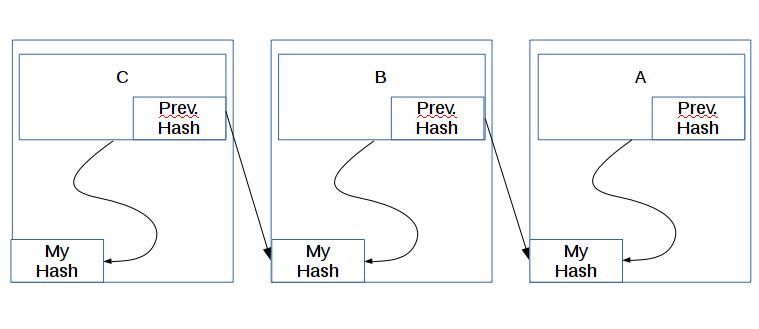
    STEVE SMITH will have the easiest time corrupting block C. Why? Because all he has to do is change the transactions and calculate the new hash for C. I say “all he has to do” as if it’s easy. We’ll talk in Part 3 about why this is nearly impossible to do. However, let’s assume for a moment that STEVE SMITH has a ton of computing resources and it isn’t quite nearly impossible to corrupt C anymore. Now, let’s see why the older a block is, the harder it is to corrupt.

    STEVE SMITH sees a huge transaction of cryptocurrency in block A and wants it for himself. In order to pull of his heist, he alters the transaction in block A, but now A’s “My Hash” is wrong (we’ll discuss tomorrow how the network knows it’s wrong). STEVE SMITH then spends a bit of time calculating A’s correct new My Hash. Once that’s done, there’s still a problem. B’s “Prev. Hash” is wrong, and the network will see the obvious inconsistency. STEVE SMITH changes B’s Prev. Hash to match A’s My Hash. Great! All fixed!

    But wait! B’s My Hash is calculated in part using B’s Prev. Hash, so now B’s My Hash is glaringly wrong. With a sigh of frustration, STEVE SMITH begins the time intensive process of calculating B’s new My Hash. STEVE SMITH, being one of the smartest of his race, sees that block C is going to have the same issue, so he quickly updates C’s Prev. Hash after figuring out B’s My Hash, and begins cranking on C’s My Hash. Finally, after a bit of time, STEVE SMITH has updated the blockchain and his crime was a success!!

    Or not. See, while he was cranking hard calculating new hashes for three blocks, the blockchain network was adding new blocks every few minutes (10 minutes for Bitcoin). His fraud sticks out like a sore thumb because blocks D through L all have the wrong hash when his “modified” blocks are included. In order for STEVE SMITH to succeed in his nefarious plan, he would need to control a significant portion of the entire world’s computing power, something on the order of 45% of the blockchain would need to be controlled to give his plan even a dismal chance.

    I’m going to stop here. We’re going to dive down to a place where giant octopi and fish with bioluminescent lures live in Part 3. We’ll discuss the details of how hashing is extensively used in the blockchain, how incentives are used to increase security through mining, how blockchain can be used outside of cryptocurrency, a description of the major cryptocurrencies and what they’re useful for, and some of the drawbacks of cryptocurrencies.

  • A Deep Dive into Cryptocurrencies and Their Operation: Part 1

    What this is

    An in depth perspective on how blockchain and cryptocurrencies work, along with a running commentary on social value, libertarianism, and whatever the heck fits my fancy. I’m attempting to write this at a high school comprehension level so that those who haven’t sat through 4 years of computer engineering classes can make sense of all of this.

    What this isn’t

    A primer on Bitcoin, an economic treatise, or a how-to. (Although, elements of all of those things will appear)

    For those who don’t feel like scrolling through pages and pages of my ramblings, here’s the TL;DR. Blockchain is a bunch of messages with security built into them. The security isn’t perfect, but each message is increasingly secure as time passes. The list of messages is saved on every computer that participates in the blockchain, and the lists are constantly being compared for agreement. Blockchain relies on a bit of a gambit. They essentially say “you may be able to break the security on one node, or even a few, but after a few the increased security that comes with time passing will catch up with you, and you’ll be stuck well before you come close to succeeding in fraud.”


    A Survey of Computer Science

    Numbers in an Array

    Computers are complex and simple at the same time. It takes millions of lines of code and tens of thousands of man-hours to put together the latest Windows or OSX version, and yet everything a computer does is simply a whole bunch of numbers saved in an array called memory.

    Let’s look at an example computer memory:

    Whaaaaaaaa??

    Let’s ignore all of the writing for a moment and discuss what we’re looking at. Memory is “byte-addressable,” which means that you can access information 8 bits (there are 8 bits in a byte; a bit is a single value of “1” or “0”) at a time. If I want to access the byte at address 0, I write some code that properly references address 0, and I have access to the value in that address of memory. If all data was 8 bits long (e.g. a number between 0 and 255), then we’d have a pretty easy go of accessing data. Just remember the order you put it in, and you just call the number that you put it in (minus 1 because the addresses start at 0).

    However, as shown in the above image, data can be much larger than 8 bits. The yellow 2-byte data is a short integer (e.g. a value between 0 and 65,535). The purple 4-byte data is an integer (e.g. a value between 0 and ~4.3 billion). There are other types of data that are even longer, like decimal numbers (called floating point numbers). Here’s more info on memory and how it works. Now it gets a bit more complicated to remember where things are in memory.

    Arrays: A Simple Way to Store Large Amounts of Data

    When dealing with simple data, like an integer, storing it in memory is relatively simple. As long as you know what address it starts at and how long that type of data is, you can access and retrieve the data. However, what are we to do when there is a bunch of related data?

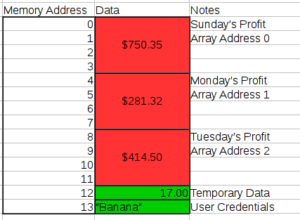
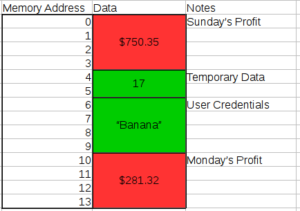
    For example, what if we want to store the daily profits for the week from our monocle and top hat shop? Now we don’t have just one piece of data to deal with, but seven. We could just toss each day’s profit into memory as we encounter it, but the accounting program we’re running may store additional info in memory: temporary values, user credentials, and other information needed by the program will also reside in memory.

    We can remember each address for each individual day’s profit data, but these values are related, and it’s hard to manage access information on seven values, let alone 70 or 700 or 700,000. Treating each value individually doesn’t scale.

    As shown above, Sunday’s Profit is separated from Monday’s Profit (both in red) by intervening unrelated data (in green). In order to access the week’s profit, you need to know the address of each and every day’s profit, and you have to individually retrieve each data point.

    In comes a better way to handle such data: Arrays! Much like memory is an array with addresses referencing each byte, array data structures store related information sequentially so that each piece of information can be referenced with an array address.

    The difference is clear. The array groups the related data together, and you can simply reference the array to get to any of the data. Array address 0 is Sunday’s profit, which is located in memory addresses 0-3. Array address 1 is Monday’s Profit and is located in memory addresses 4-7. Rather than needing to remember all of the memory addresses for each day’s profit, you can simply remember the starting memory address of the array, and use the array address to calculate where each piece of information in the array is located. For example, array address 1 translates to the array starting memory address (0) plus one array element (which is 4 bytes long), resulting in a memory address of 4. If you look at the above image, array address 1 starts at memory address of 4. NOTE: I haven’t included all 7 days of profit in the above image so that it won’t get too complicated and confusing. Here is some additional information on arrays.

    However, you can also see a limitation in the above image. It works great if you know exactly how much data you need to store, but look at where the Temporary Data and User Credentials are stored. If you need to include one more piece of information in the array, you’re hosed. Either you have to start moving a bunch of stuff around in memory to make room (which is not ideal), or you have to continue the array somewhere else in memory and keep track of 2 array portions (which is also not ideal).

    Linked Lists: Good for dynamic data

    You may be wondering what the point of all of this is. We’re talking about blockchain, not about memory management, right? I promise, this is where we connect to blockchain.

    Let’s see if we can combine the best of both worlds. Writing each day’s profit to memory separately allows you to add additional days without having to shuffle data around in the memory. On the other hand, preserving the relationship between all of the days’ profits without having to keep track of each day’s memory address allows you to scale up to large amounts of data without overcomplicating things.

    One of the “best of both worlds” solutions is called a linked list. A linked list operates much like writing each day’s profit to memory separately, but preserves the relationship between the different days by including an additional bit of information pointing to the location of another day’s profit in memory.

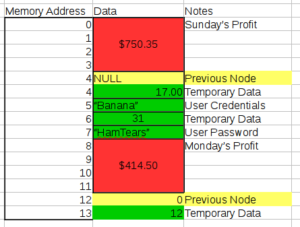
    As you can see, we have expanded Sunday’s profit and Monday’s profit from 4 bytes to 5 bytes. The additional byte (in yellow) points to the previous node. Since Sunday’s profit is the first node, its previous node is NULL (meaning it doesn’t have a previous node). Since Monday’s profit is the second node, it points back to Sunday’s profit. Previous Node 0 points to the starting memory address of Sunday’s profit.

    Visualized another way, the linked list looks like this:

    This is the basis of blockchain. A data structure with a payload and a reference to the previous block in the chain. Now let’s talk about security.

    Hashes: Breakfast for the Masses

    I dunno about y’all, but I’m sick of reading. Let’s take a quick break before getting into hashes by enjoying some pictures

    Breakfast Hash and some red meat for the audience.


    Hashes: Preserving Relationships and Security

    Alright, back out of your bunks. Time for some more learnin’. Hashes are conceptually simple, but mathematically complicated. Since we’re not diving into the math, this section should be a breeze!

    No, not that kind of Brees!

    Let’s take a look at the array again:

    If we call Array[0] we get Sunday’s Profit, and if we call Array[1] we get Monday’s profit. However, we don’t always have a situation where we know exactly what order the data will be put into the array. Imagine, for a moment, that instead of 3 days of profits, we have 3 years of profits, entered manually by an employee who isn’t guaranteed to get everything perfectly in order. How do we find Monday’s Profit in that deluge of data?

    The traditional way is to search for the data in the array. Here is some more information on searching.

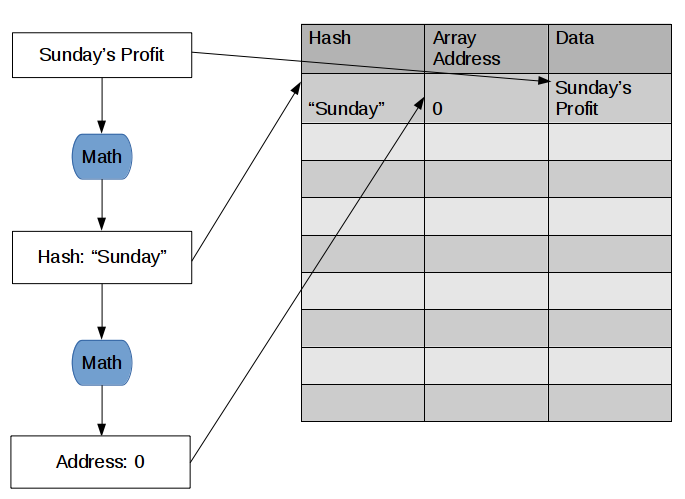
    The fun way is to use hashing! How about we use some relevant characteristic of the data to access the data instead of the array index (“index” is another term for array address number). All you need is two math equations: one to determine the hash from the data, and another to determine a memory location from the hash.

    As you can see, Sunday’s Profit data was hashed to “Sunday”, which is a characteristic of the data (specifically, the day of the week), and “Sunday” was computed to be connected to array address 0. Now, instead of accessing Sunday’s Profit data by loading Array[0], you can access Sunday’s Profit data by loading HashArray[“Sunday”].

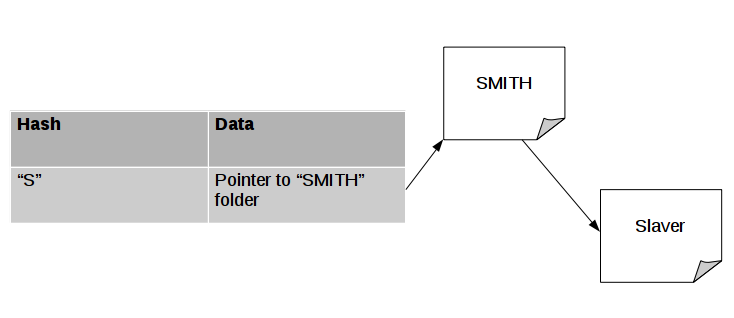
    If this is a bit confusing, another simple hashing algorithm that appears in everyday life may clarify things. Placing medical records in alphabetical order by the first letter of the last name is another hashing algorithm. If the last name is SMITH, the “algorithm” for obtaining the hash involves looking at the first letter of the last name, “S”. Then, the hash “S” points to a specific shelf in the fileroom (the “S” shelf, for lack of a better name). SMITH’s folder is placed on the “S” shelf. When I want to retrieve a folder starting with “S”, I pull a folder off the “S” shelf, and I have SMITH’s folder.

    But there are many people with a last name starting with “S”. What happens when SMITH’s folder is stored on the “S” shelf and I want to store Slaver’s folder? This is called a “hash collision.” Depending on the specific situation, a hash collision is either an inevitability or a disaster. In cases where hash collisions are expected, we could simply change the data stored. Rather than just storing one piece of data for each hashed value, we can store the data for each hash in a linked list. Now, the “S” shelf looks like this (pointer is just a fancy term for the memory address):

    This is great for categorization hashes like the alphabetical sorting of medical records, but isn’t the best for cryptographic hashes like are used in blockchains. Instead, cryptographic hashes rely on another protection from hash collisions, small data density.

    Bitcoin and most other cryptocurrencies use what is called SHA-256 hashing. In SHA-256, a message of any* size is hashed using really fancy math into a 256 bit number, which means there are 2^256 possible hashes (1.1×10^77 for you scientific notation folks, or roughly 1/10 of the total number of atoms in the universe). Hash collisions are so rare under SHA-256 as to be practically nonexistent.

    *Technically, there is a maximum length of message, but it’s enormous.

    But I mentioned above that hashes are based on characteristics of the data. “S” is the first letter of SMITH, and it’s fairly easy to see the relation. What is the relation between some seemingly random 256 digit number and a Bitcoin block? Well, it has to do with math well beyond my ken, but you can go here for a bit of an explanation (as well as a look ahead). In essence, the math takes all of the data, divides it into chunks, and does a mathematical transformation on each chunk before assembling the results into the hash.

    Okay, assuming you’re following along so far, you understand how categorization hashes work and that cryptographic hashes are different, but how do cryptographic hashes work?

    Cryptographic hashes work on the principle that it’s much easier to do the math to hash the data than to derive the data from the hash. Let’s look again at the medical records example for a picture of how this works. If you’re given the last name SMITH and told that the hashing function (fancy term for the math to calculate the hash) is the first letter of the last name. It’s trivial to calculate a hash of “S” from the data “SMITH.” However, let’s go the other direction… if all I give you is “S”, you have thousands of last names to choose from. The chance of you guessing “SMITH” is extremely low.

    The same principle applies to SHA-256 hashes. It’s relatively easy for a computer to calculate the hash from the original data, but (practically) impossible to derive the original data from the hash.

    We’ll discuss the specific way cryptographic hashes are used in blockchains later on.

    Let’s take another break. Things are getting a bit intense. In the spirit of the glib baby pics from a while back, here’s me in a sombrero.

    Cultural Appropriation from a Young Age

    How about some relaxing pics from a backpacking trip I took a long time ago?

    Public Key Cryptography

    Alright, back to talking security! We’ve laid the groundwork for explaining the structure and security of the blocks in a blockchain, but let’s talk about individual currency transactions and how they’re secured. If I want to send 50 bitcoins to ZARDOZ, we create a transaction to transfer the bitcoins from my wallet to his. The details will be covered later, but it’s important to notice that without any security, STEVE SMITH could read the transaction, and use the information contained in the transaction to create a fake transaction to send the 50 bitcoins to him instead of ZARDOZ.

    What sort of security is used on these transactions? Public key cryptography! Public key cryptography uses the same concept of “one way” algorithms, just like the cryptographic hashes. In fact, in some cases, the mathematics for generating cryptographic hashes is used in public key cryptography.

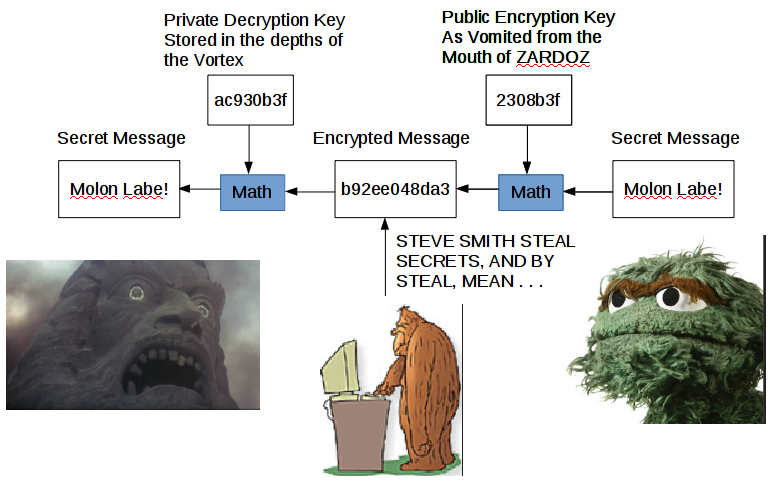
    How does it work? Let’s assume I want to send a secret message to ZARDOZ. I’m sending it over the Internet, which isn’t a particularly trustworthy place. I can’t just send the text in the open. ZARDOZ decides to generate two “keys.” In this context, one of the keys is used in combination with fancy math to encrypt the message so that it can’t be read by STEVE SMITH. The other key is used in combination with more fancy math to decrypt the message. The cool thing about public key cryptography is that you can’t figure out the decrypting key by looking at the encrypting key or at an encrypted message. This is called asymmetric cryptography.

    In contrast, symmetric cryptography can be “broken” by looking at the encryption key and the encrypted message. Of course, that means you shouldn’t broadcast your symmetric encryption key on an insecure channel. For example, if my encryption algorithm is addition of the encryption key to the data, and my encryption key is 4, then if my data is the number 10, the encrypted data is the number 14 (10+4 = 14). I send 14 across the unsecured network to ZARDOZ, who uses the symmetric decryption key (the number 4), and the decryption algorithm of subtraction of the decryption key from the data, and ZARDOZ gets the original data, the number 10 (14 – 4 = 10).

    Seems secure enough, especially when we use something more complicated than “add 4” as an encryption. But why are we talking about asymmetric cryptography instead? Well, because we have a problem. The Internet isn’t particularly secure, and we’re not gonna VPN with the entire bitcoin network, most of whom we don’t trust, to send them our secret key. With asymmetric cryptography, the encryption key (called the public key) can be known by everybody. It doesn’t matter if half the world can encrypt messages intended for you. As long as they’re not able to decrypt those encrypted messages, the system is secure. That’s why the decryption key is called the private key. The private key must be kept secret by the receiver of the message.


    As shown above, I have sent ZARDOZ the message “Molon Labe!” ZARDOZ has vomited forth (published) his public key, which allowed me to encrypt my message and send it across the Internet securely. As you can see, STEVE SMITH can try his hardest to intercept my message to ZARDOZ, but all he gets is a bunch of gibberish. Then, once ZARDOZ receives the encrypted message, he uses his private decryption key (secreted away in the Vortex where nobody can access it except ZARDOZ) to decrypt the message and read “Molon Labe!”

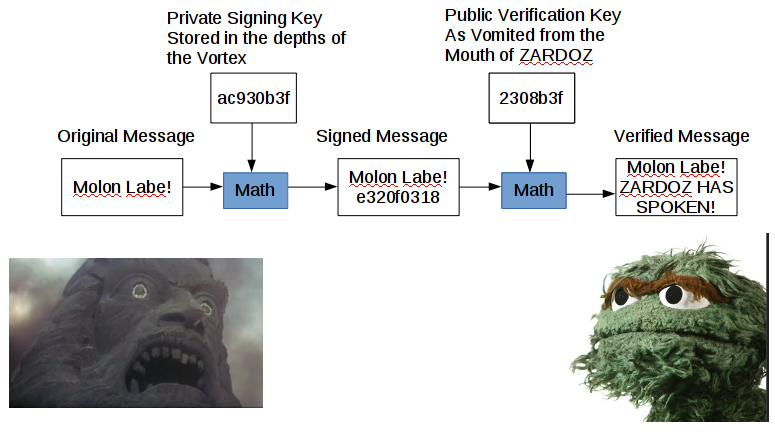
    Now, this is great and all, but isn’t blockchain about publicly accessible data and verification instead? Well, yes. Let’s take this public key encryption and flip it around. Now, instead of keeping the data secret, we want to make sure the data is from the right person. I’m expecting a message from ZARDOZ, and want to make sure that it’s legitimately from ZARDOZ and not from STEVE SMITH.

    As you can see, the message stays public the entire time, but there is extra data added based on ZARDOZ’s private key. This is called a signature. Upon receipt, anybody can verify the authorship of the message by using the public key.

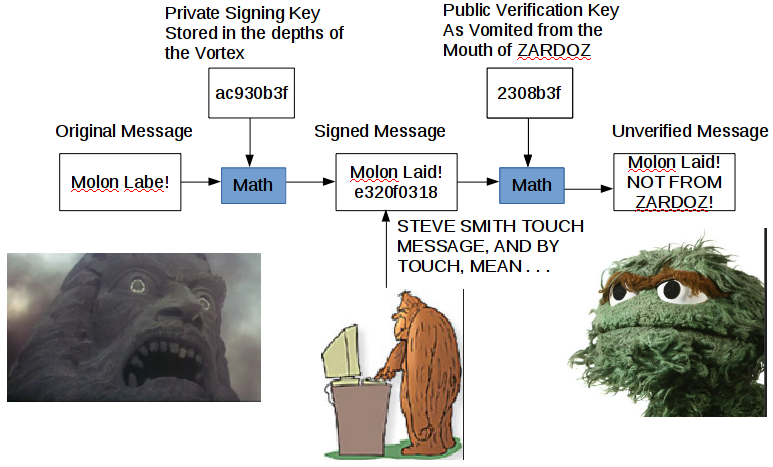
    What happens when STEVE SMITH tries to meddle again?

    As you can see, STEVE SMITH, in his ham fisted way, has altered the message before I have received it. When I try to verify the message’s authorship, I find out that it’s not from ZARDOZ, and thus it’s a suspect message to be ignored.

    This is the basis for verifying cryptocurrency transactions. We’ll put all of this book learning together into a workable model in the next article or two, but this article explains most of the theoretical underpinnings of blockchain and cryptocurrencies.

  • MEMORANDUM REGARDING TIME OFF FOR INFIDEL HOLIDAYS

    FROM: OFFICE MANAGER MOHAMMED

    TO: ALL OFFICE STAFF


    It has come to my attention that a large portion of the office staff has requested to use their time off during the INFIDEL holidays soon to be celebrated. Although it is official corporate policy to shut down the office during these BLASPHEMOUS AND SACRILEGIOUS RITUALS, I have received special dispensation from the corporate executives to keep our building open. I know that you, my hard working SLAVES staff will RECEIVE DIVINE INSPIRATION FROM ALLAH AND REJECT THE BLASPHEMERS WHO WORSHIP FALSE GODS! AS WE TURN TO MECCA THIS DAY MAY MUHAMMAD (PBUH) TRUMPET FROM THE RAMPARTS THE CONQUEST OF THE INFIDELS AS WE KILL THOSE STUBBORN WITH UNBELIEF!! YOU TREACHEROUS LOT, YOU IMPETUOUS SLAVES, NOW IS NOT THE TIME FOR LEISURE, IT IS THE TIME FOR GLORIOUS JIHAD!!

    Also, whoever wrote “Halal-lelujah” in the men’s bathroom stall with the image of that UNCLEAN SWINE has been reported to the HR department Bias Response Team. We do not tolerate BLASPHEMY AND SACRILEGE in this office, and mocking THE ONE TRUE FAITH is unacceptable. For those FLEA BITTEN DOGS who have been snickering and giggling about that DEBAUCHED FILTH, THE PROPHET (PBUH) HAS DECREED YOUR DEATH! YOUR BLOOD WILL RUN THROUGH THE BUILDING AND INTO THE STREETS! THE GLORIOUS SOLDIERS OF JIHAD WILL TRAMPLE OVER YOUR CORPSES AND TAKE YOUR CHILDREN AS SLAVES!! ALLAH WILL WIPE YOU FROM THE BOOKS OF HISTORY AND SELL YOUR WIVES INTO BROTHELS!!!

    Many thanks to Susan for the nice Ramadan party. Even though only three people were able to attend and Susan ordered A DISGRACEFUL AND IMMORAL lunch, the party was quite the CALL TO JIHAD! However, Susan has been let go by the HR Bias Response Team for catering a sandwich platter with INEDIBLE, FILTHY SWINE! DISHONORING ALLAH IN SUCH A DEBASED MANNER DISPLAYS THE FULL DESPICABLE NATURE OF THE INFIDEL!! THE PROPHET (PBUH) DECREES THAT THE SWINE EATING INFIDEL SHALL BE TIED TO A POLE AND GIVEN 50 LASHES FOR HER INTRANSIGENCE!!

    We had a great “Bring Your Kids to Work” day thanks to Linda. However, whoever put my wife in the group of elementary school kids is a SCOUNDREL OF THE HIGHEST DEGREE!! HOW DARE YOU INSULT MY BRIDE BY TREATING HER AS IF SHE IS MY CHILD!! YOU DIRTY BEASTS DISHONOR MY FAMILY AS IF YOU NO LONGER UNDERSTAND YOUR SUBJUGATION TO ME AND TO ALLAH!! YOUR BODIES WILL BE FLAYED OPEN AND HUNG FOR ALL TO SEE WHAT HAPPENS TO THOSE WHO UNDERMINE THE SOLDIERS OF ALLAH!!!

    Finally, there have been some complaints about the attire worn by the UNBELIEVING WHORES in finance. Excessive exposed skin is AN AFFRONT AGAINST ALLAH! YOU SCURRILOUS WENCHES DESERVE NOTHING MORE THAN TO MEET AN UNTIMELY DEATH FROM THE STONE! YOUR ATTEMPTS TO DISTRACT THE SOLDIERS OF JIHAD FROM THEIR MEDITATIONS TOWARD MECCA ARE BEGGING FOR THE PUNISHMENT BEFITTING A JEZEBEL!! YOU WILL BE BEHEADED EVEN IF I HAVE TO DO IT MYSELF!!! WEAR THE BURQA OR DIE A MOST PAINFUL DEATH!!!


    Warmest Regards,

    OFFICE MANAGER MOHAMMED


    OMM/tm


    BONUS FEATURE:

    By Yusef Drives a Kia

    OFFICE MANAGER MOHAMMED: Today We start on a new project, We shall build a minaret in the parking lot, so that We may Hear the Call to Prayer better.

    Lead project manager: But we’re a software company

    OFFICE MANAGER MOHAMMED:Allah wishes a minaret, We will build it, now Everyone grab all the unopened reams of paper and follow OFFICE MANAGER MOHAMMED.

    After several ankle sprains and back injuries, the several hundred reams are assembled in a crooked, off center pile, about 20 foot high.

    OFFICE MANAGER MOHAMMED: You, IT support INFIDEL, climb to the top and make the call to prayer.

    ITS: It’s kind of high, do we have like, a ladder or something?

    OFFICE MANAGER MOHAMMED: No, climb on your knees INFIDEL if Allah wills it you will get to the top.

    IT support proceeds to carefully pick his way amongst the #20 bond and reaches the pinnacle, a bunch of post it notes bound with Scotch tape, and makes the call.

    OFFICE MANAGER MOHAMMED: Excellent, you are assured your 72 Virgins

    IT support: but I’m not a Jihadist.


    OFFICE MANAGER MOHAMMED, cackling with glee, gambols to his waiting Mercedes 500 SL, and drives away at the approach of ALABAMA MAN, carrying a blowtorch and 5 gallons of gas.

  • Nashunul Futzbull Leeg versus Murica!

    Sometimes I like to write stream-of-consciousness posts when I’m procrastinating on more research intensive articles. This is yet another one of those situations. (Crafting a Narrative Pt. 3 will be ready soon)

    Let’s have some fun together tearing apart this whole NFL v. Trump shitshow piece by agonizing piece. If we do this right, we’ll trigger literally everybody.

    First, let’s address the elephant in the room. The entire frickin kneeling protest is an unorganized shitshow. When Kapernick started kneeling, it was vaguely in support of Black Lives Matter, but even BLM is a fucking mess of intersectional leftism. I’m not going to kill brain cells by going to their website again, but there was shit about ableism and transgenderism last time I went. On top of that, now everybody is kneeling for a thousand different reasons. Some are civil rights LARPing, some are protesting police brutality, some just hate Trump, and most of them have no fucking clue why they’re kneeling except for the fact that it pisses Trumphitler off.

    Why the hell are you kneeling during the national anthem? Cops are employees of the state and local governments. They’re not even affiliated with the American flag, let alone somehow symbolizing it .Of course, if you’re smart, you don’t take the kneelers’ stated intentions at face value. The reality is that this protest against “systematic injustice” is really just a bunch of rich idiots being played like marionettes by no-kidding communists. Kapernick is in neck-deep with the commies, and his totalitarian milieu has polluted the NFL as a whole.

    Why are you biting the hand that feeds you? We’ll get to the ridiculous reaction from fans in a minute, but it was a quite predictable reaction. Most football fans lean conservative and working class. Most conservative and working class folks are quite patriotic. They tend to either be veterans or know quite a few veterans. Disrespecting the flag is seen by them as pissing on their service and sacrifice. Any idiot can see this dynamic, and any idiot could have predicted the backlash that was created by these overprivileged multimillionaires disrespecting the flag.

    It’s virtue signalling at its finest. There’s nothing accomplished by kneeling during the anthem. Not one cop is going to think twice about shooting some black kid just because some NFL player kneeled during the national anthem. Rather, the NFL is sending the message that they play ball with the SJW left. Unfortunately, the SJW left has resoundingly ignored the NFL… y’know because contact sports are icky and boring and not artisanal enough.

    What of the boycotters? If there’s anything more pathetic than protesting a symbol that has nothing to do with the supposed object of your ire, it’s the people who are acting offended because other people won’t play patriotism olympics with them. By all means, boycott the NFL if you don’t like the message they’re sending. Hell, I’m watching much less NFL because I’m sick of all the personal interest stories, the “special interest here” month this and that, every other commercial being a PSA for some stupid cause, CTEs, and lefty virtue signalling around every corner (*cough* Bob Costas *cough*). What happened to football being about men in pads hitting one another? At the end of the day, though, respect or disrespect of the flag is a pretty stupid reason to change your entertainment habits. Why?

    Because modern patriotic nationalism sucks. I completely get the connection between the flag and the service of our soldiers and veterans. I completely respect their courage and sacrifice. This is why I stand for the national anthem, even though I don’t participate. However, if there’s one thing that gets and eye roll from me in record time, it’s the old tired line of “freedom isn’t free. They fought and died for your freedoms.” Sorry, but when were my freedoms last threatened by a foreign power? Maybe WWII? That’s really stretching it, because the biggest threat to my freedoms in that era was FDR (internment camps, threatening the supreme court if they didn’t rule favorably, etc.). Maybe one could argue that the actions in Afghanistan were preserving our freedoms after 9/11, but again, the Patriot Act, TSA, and DHS are much bigger threats to my liberty than Al-quaeda has ever been. In my opinion, it’s completely appropriate to honor those who fought and died in the name of our nation without bullshitting us by saying that they were “fighting for our freedoms.” If anything, that cheapens their legacy, because it paints a paper thin GI Joe veneer over a much more complicated and difficult situation.

    Beyond this, why the hell do we need to sing the national anthem at sporting events in the first place? What a stupid and ridiculous tradition that is! We don’t sing the national anthem before music concerts or starting the workday or before the movie starts at the theater. The idolatry that passes as patriotism these days would have the founding fathers rolling so hard they’d power the entire country’s electric grid.

    Speaking of violently spinning founders, let’s talk about the bullshit that is both sides of the police brutality argument. On one side, you have the SJWs and civil rights LARPers who think this is Birmingham in 1958. On the other side, you have law & order conservatives who think this is Mayberry in 1965. Both are laughably wrong, but there’s no adult in the room to tell them to stop being idiots.

    Cops aren’t heroes, at least not all cops are heroes. Cops are not tyrants, at least not all cops are tyrants. I’m not a strict individualist. I believe that you can assign generalities to individuals of a group. However, I think that you have to pursue such generalizations very carefully. By and large, people apply generalities too strongly and too broadly. That is the case here, as well.

    The BLM agitators are notorious for swinging and missing every. single. time. Trayvon Martin? *whiff* Michael Brown? *pbfffft* The few cases that were actually open and shut abuse cases were completely ignored by BLM. Why? Because their end goal isn’t ending police abuse. Their end goal is stirring up racial strife in order to elevate their political (and financial) clout.

    Cops aren’t walking targets in urban areas. Despite what some would have you believe, most folks don’t get their rocks off by taking pot shots at pigs. Save for one major incident, and a handful of one-off incidents per year, most people who have an issue with cops simply try to run away. This aura painted by the right of embattled cops struggling to make it home to their wives and 2.5 kids is completely made up.

    Questioning the motives of cops is very patriotic. Police are armed enforcers of the state. They do good things (like handling outlaws), but they’re also the single quickest path to authoritarianism. The rapid militarization of police over the past 2 decades, paired with lax due process protections and highly aggressive tactics has turned policing from an Andy Taylor/Barney Fife context to a wannabe soldier context. The conservatives are happy to play along, grouping “first responders” with veterans in the exalted ranks of “heroes” to be honored with the flag.

    Before this gets too long, I’ll wrap it up with a few quick hits.

    • If cops were heroes, they’d be held to a higher standard than the public. Instead, they’re held to a lower standard.
    • Qualified immunity has been abused and distorted to cover a cop’s every action. If it were “right sized,” any escalation by the cop would fall outside of qualified immunity.
    • The fact that BLM and other civil rights griefers are even treated as legitimate shows how absolutely fucked up our media is.
    • If the NFL players wanted to kneel before the thing that destroyed the black community, they’d find the nearest Medicaid office and kneel there. Then they’d join Antifa in tearing down all the LBJ statues.
    • Nothing about the treatment of urban blacks is going to change until their culture changes. Holding police accountable for their overreaches isn’t going to fix the “systematic” issues. Only a massive cultural shift will do that.
    • The NFL and Goodell are utter dumbasses. They should’ve nipped this in the bud a year ago, but they were sympathetic with Kapernick, and now they’re getting their asses bit for it.
    • Notice I haven’t even mentioned Trump’s or Pence’s reaction. That’s because they have nothing substantive to add to the conversation. They’re charlatans playing the controversy for political points.
  • How to Craft a Narrative, Part 2: Setting the Center of Discussion

    Last article was a case study of how the media uses experts and studies to push its agenda. However, that is but one tactic used to sway opinion. The second is their unfettered ability to set the center of the discussion.

    In football, “setting the edge” is a term used to describe setting the bounds of the “pocket” where the quarterback can move during a play. The defensive player uses leverage to move the offensive blocker in the proper direction, and the quarterback is contained inside by the defensive player.  In essence, the defensive player has shrunk the field accessible to the quarterback.Krugman tried to break it, but it weighs over a ton

    In politics, the same thing occurs. Most of us are familiar with the Overton window, the bounds of acceptable discourse within society. The media are masters of “setting the edge” in a way that favors their agenda. By containing the public perception of events within certain bounds, the media grabs Orwellian control over the way that politics can be discussed.

    There is a psychological theory called price bracketing, where a seller offers two versions of a product to consumers. The first version is the basic version (e.g. a base model car). The second version is the premium version (e.g. a car with option packages). Consumers will buy a certain amount of the basic version (let’s say 60% of total sales) and a certain amount of the premium version (40% of total sales). However, we’re evil greedy Glibertarians, so we want to make more money, which means selling more of the premium version. Being evil and having thumbed through the latest Psychology Today, we decide to try out this price bracketing thing. In order to do that, we introduce a third version of the product on the market, a super-premium version (e.g. a car with all the option packages and even more). Then, we price it so that it’s a poor value in comparison to the premium version. After a few months, we look back at the sales and see that they have changed significantly. Now consumers are buying less of the basic version (let’s say 25% of total sales), sales of the premium version have skyrocketed (70% of total sales), and a few rubes are buying the super-premium version (5% of total sales).

    People want to feel like they’re getting a good deal, and you can trick them into thinking they’re getting a good deal by offering them a choice of a comparatively worse deal. The same trick can be played in the political realm.

    Bracketing in the Political Context

    Isn’t this how it always works out? You have two talking heads on the show, radical SJW leftist professor on one split screen, and establishment Republican think tank fellow on the other split screen. The show’s host sits in between, moderating the bloodbath. This is classic bracketing. In the eyes of the media, you have the basic version of political ideology (establishment Republican) and the super-premium version (the SJW leftist), and you have the bracketed premium version (the progressive leaning host). Inside the average person’s head, they’re thinking “Well, I want something better than the basic version, and the super-premium version costs too much, but that host is asking reasonable questions and making reasonable points.” Slowly, but surely, the culture shifts leftward as the sympathies of the media are ingrained into society.

    Contributors as Intellectuals

    Dr. Archibald Eagle, Senior Lecturer in Rodentiology and Executive Administrator of the Council for Cleaner BeaksPeople tend to defer to those that they find smart. It’s a shortcut we take that’s probably baked into our DNA. Our tribal instincts say “don’t waste your time reinventing the wheel, trust the egghead.” There’s a certain authority that comes with being deemed an intellectual. There’s also a certain condescending attitude. “Well ayctually” seems to be their verbal tic these days. This affectation seems to work because the arguments promulgated by these talking heads spread like wildfire. Their on-air preening signals to the audience that they and their opinions are important.

    Cable news networks are notorious for exploiting this natural human deference to intellectual authority. Every segment starts like this: “We’d like to welcome Dr. Ukunwe Selekala, senior research professor of East African Postmodern Banjo Studies at St. Jemima’s-Maple Tap, Vice President of Aboriginal Affairs for the Southern Tennessee Coalition for Crisis Action, and author of a new best-selling book, ‘Twangs of Heart Strings: The Lasting Impact of Colonialism in East Timor.’ Dr. Selekala, thanks for coming on. My first question is why do state governments act in such a racist manner when they’re confronted with their Confederate heritage?”

    The fact that is lost in all of the preening and groveling is that “Dr. Selekala” is no more qualified to talk about state politics RE: Confederate heritage than you or I. He’s a puppet, placed on the screen to parrot a predictable opinion with an air of intellectual authority. His last three research papers have been on Saharan ancestral music, and his book is an unreadable and poorly researched emotional screed. However, he’s a radical leftist, and he anchors the conversation in one direction. On the other side is either a withering establishment moderate or a conservative held on a very tight leash by the host. Neither talking head has any experience that is relevant to the conversation, but they play their parts and the unsuspecting viewers are pulled in by the intellectual authority signaled to them by both sides. I got nuthin.

    Success in the Small Things

    When viewed in the big picture, it seems a bit outlandish to assert that the media can drag people kicking and screaming to a new opinion. However, they don’t need to move the whole mountain. They can move it one grain at a time. Merely mixing a lie/mischaracterization/biased statement in with an otherwise completely objective statement can sway viewers. If you do this repeatedly, the lie becomes truth to the viewers. Irma is the most powerful hurricane ever in the Atlantic (except it isn’t)

    7 I win, 11 you lose.Part of our perception that the media is going nuts is the fact that they’re doubling down on their injection of lies and half-truths into the conversation. They have lost control of the populace, and they’re trying to get it back the only way they know how, through rigging the debate in their favor. The only problem is that once you load the die too much, it becomes obvious that it’s off-balance.

    Part 3 of this series will tie a neat bow on things by explaining how public opinion polling is a complete sham and how the media uses polls to sway their viewers’ opinions.

  • How to craft a narrative, Part One: The media’s use of “Experts” and “Studies”

    File:2011資訊月-安心亞1 (6486759931) (2).jpgThe all-encompassing nature of mass media is relatively new to the human experience. By and large, humans throughout history have only been immersed in the “news” of their family and their neighbors. News, in the regional, national, and global sense, was a triviality ridden into town on the back of a camel, a donkey, or a horse. It wasn’t until the 19th century that reliable, near-real-time national media coverage was normalized through national daily newspapers. It wasn’t until the mid-20th century that the nation, and later the world, was shrunk down and neatly packaged in a tiny box in every family’s living room. That growing scope of awareness, combined with the growth of media titans created what is now known as the “mainstream media.”


    An apt analogy, shipwrecked and leaning to the left
    Run aground

    These days, the power of the mainstream media wanes. Internet-based alternatives have exposed people to stories that the mainstream media deemed “unfit to print.” Gaffe after gaffe has eroded the trust society once had in the mainstream media. However, Rome didn’t fall in a day, nor will the mainstream media. Their power to craft narratives still exists, and is still quite powerful.

    What power does the media hold over society and voters?

    There are essentially two theories about the level of power the media holds over their customers. The Agenda-Setting Theory asserts that media can set the cultural agenda. They can’t control what people think, but they can control what people think about. For any observant consumer of media, this is obvious. It’s quite curious how Confederate statues that have been standing for a century are all of a sudden a “crisis.” People in the real world are talking about racism because the media has been hammering on the “alt-right nazis” incessantly for months. On the other hand, hardly anybody is talking about the looming debt ceiling issue? Of course, once the Nazi crisis subsides, the debt ceiling will become front-page news, and Trump will be “leading from behind” and “holding the American people hostage” and a dozen other focus group tested insults with no substance.

    That leads into the second theory, the Framing Theory, which asserts that media can alter people’s opinions on topics by “framing” the issue in a way that lends toward one conclusion. In the past, subtle framing was required. The media would put a “thumb on the scale.” These days, the “mask has slipped,” and media sets a whole body-positive intersectional feminist on the Progressive side of the scale. Framing can work in many ways, but two of them are the favorites of mainstream media outlets. “Telegraphing” is the use of value biased terms and phrases in the description of an issue, subtly (or not so subtly) telling consumers who the “good guys” and the “bad guys” are.

    For example, let’s contrast CNN’s coverage of Trump’s struggles getting the wall funded with the Telegraph’s coverage:


    Two articles from two news services. Both critical of Trump. CNN sows dissent between GOP leadership and Trump. The Telegraph highlights Trump’s lack of leadership on getting the wall built. CNN’s framing of the issue furthers their narrative that “even the right-wingers think Trump’s unhinged.” It fuels the “fractures within the party” narrative that is tied to the “Trump’s unhinged” one.

    In contrast, The Telegraph is pushing the narrative that Trump is a loose cannon, and can’t actually get anything done. The “impotent president” narrative is disfavored in US media right now (because he needs to be seen as a potent purveyor of racism given the crisis du jour), but in the UK media, the “impotent president” narrative is king.

    Media is showing that the Framing Theory is correct. They can not only set the agenda, but they can also influence the beliefs of their consumers. People are seeing Nazis under their bed, and the media are the ones who are fueling this hallucination.

    Narrative Crafting Tactic #1: “Scientific” “Credibility” through “Experts” and “Studies”

    Hihnnnnnnnnn
    Mad Scientist

    Many people can see right through the transparent BS of a commentator spewing their unsupported opinions. Only the true believers are swayed by an emotional screed (pathos… speech 101). However, a well-sourced and dispassionately asserted scientific truth is compelling to a neutral audience (logos… again, speech 101). The media have leveraged this to the utmost, using “experts” and “studies” to push their social and political goals in a way that compels the neutral audience. As libertarians, we tend to be skeptical of the BS social science journalism that ends up filling a 30 second segment at the end of the nightly news. However, the disease is much more widespread than that.

    Let’s do a case study. I’ve pulled a random health article from CNN.com.

    Babies are being put to sleep unsafely according to a STUDY!!!!!

    (CNN)Despite a 23-year campaign urging that babies be put to bed on their backs, only 43.7% of US mothers report that they both intend to use this method and actually do so all the time, according to a new study.

    This sounds like an epidemic!!! Well, let’s go to the study:

    RESULTS: Of the 3297 mothers, 77.3% reported they usually placed their infants in the supine position for sleep

    Wait, what?? What’s the difference here? Well, the devil is in the details.

    Only 43.7% of mothers reported that they both intended to and then actually placed their infants exclusively supine.

    So, this article is based on the fact that mothers only usually placed babies on their back, but didn’t always do so. In order to warrant an article in the health section of an esteemed news outlet like CNN, the risk from babies sleeping on their stomachs must be enormous!

    There were about 3,700 sudden unexpected infant deaths in the US in 2015, according to the CDC. SIDS account for 1,600 of those while 1,200 are due to unknown causes and 900 were due to accidental suffocation and strangulation while in bed.

    By your powers combined, I am greatly inflated!
    Douchebag Frat Bro and the Federal Reserve Chairman

    1600 babies per year (39.4 deaths per 100,000 live births) isn’t a lot, and it’s not clear how many of those babies would have survived if they slept on their back (and how many of those SIDS babies were sleeping on their back). See, SIDS is not particularly well understood, so it’s quite unclear how safe or unsafe babies are by sleeping on their backs. Even assuming that EVERY. SINGLE. SIDS. DEATH. was because the baby was on their stomach instead of their back, babies are 0.039% safer than they were when mothers were less concerned with their baby’s sleeping position. Yet somehow, the title of the article SCIENTIFICALLY asserts that MOMS ARE ENDANGERING THEIR CHILDREN by putting them to sleep unsafely.


    This is but one way that media crafts a narrative by abusing scientific studies to push a social goal or undercurrent (in this case, it’s the insufficiency of mothers in taking care of their children without TOP MEN overseeing them). This doesn’t even get into the perverse incentives between government bureaucracy, the media, and university social science departments.

    In Part Two, I’ll discuss Narrative Crafting Tactic #2: “Contributors” and other talking heads as intellectuals.


  • What are Rights? An Encore

    People seemed to enjoy the discussion in the original article, so I’m going to expand on it based on some of the conversation we had in the comments. As noted in the comments, August is employing the Socratic method. In real life, August is a Being your own Socrates | sHR.classmate from law school who was a philosophy major. He and I enjoy sipping bourbon, smoking pipes, and talking politics, philosophy, and theology.

    In the original article, I made the assertion that rights are meaningless outside of a relationship. I also asserted that rights are definitions of the boundaries of authority between co-equal entities (man to man; man to human institution). In this article, I will address some of the points brought up in the comments: conflicting rights, objective v. subjective rights, negative v. positive rights, how rights flow from self-ownership.

    The conversation picks up at the end of the prior article:

    AUGUST: So if rights are based on authority and the equality of man, are you saying that rights are attempts to prevent inequity between men and between man and institutions created by man?

    OSCAR: Yes! As with any co-equal relationship, there are certain things solely in the domain of the first, other things that are solely in the domain of the second, and some things that are in an overlapping domain between the two. For example, parenting.

    AUGUST: So, in this Venn Diagram description, your domain is your rights with respect to me, my domain is my rights with respect to you, and the shared domain is collective rights between us and conflicting rights between us. How can rights conflict if they are natural?

    OSCAR: Well, this is more of a semantic difference. Either you can paint with broad strokes (“right to life; right to play loud music; right to swing your arms”) and deal with conflicts of the rights (“my right to swing my arm ends at your nose”), or you can paint more carefully (“right to swing your arms in open portions of your personal space”) and not have to deal with conflicts. Either way, there is a limit to the extent of your rights where you begin to infringe somebody else’s rights.

    AUGUST: This still seems fuzzy. How do you know when you’re infringing somebody else’s rights?

    OSCAR: Well, we need to know how to identify a right in order to be able to tell if we’re infringing on rights. There are two things called “rights” these days. One is negative rights, and the other is positive rights. Positive rights are largely a misnomer in the context of strangers (including the government). The only relationship in which positive rights make sense is the dependent/caretaker relationship. This is why people refer to the “Nanny State” when government enshrines positive rights in law. Negative rights, however, are natural rights. They derive from self-ownership. Negative rights are things whose direct, tangible consequences are felt only by the rights owner and consenting others. In essence, you are the sovereign of your own vintage seminude woman reading by MementoMori-stock on DeviantArtdomain; only you have the authority to make decisions that result in consequences to only you. Thus, you are infringing on somebody else’s rights when you do something that keeps them from exercising sovereignty over themselves and their property.

    AUGUST: Direct, tangible consequences? Like economic externalities, emotional effects, and social consequences?

    OSCAR: No, usually rights violations are one of three categories: force, fraud, and coercion. Nobody forces you to feel a certain way. Nobody coerces the market to ripple when you make a transaction. Nobody forces society to react to your actions. All of these consequences to the exercise of rights may be of concern to people and to society at large, but they are outside of the authority of strangers and the government to resolve by infringing on the free exercise of rights.

    AUGUST: But we discussed before that there are times when you can use force, like in self-defense. It seems like you can’t use force until you can.. it’s all very arbitrary sounding.

    OSCAR: Not at all. There is a basic principle that you can respond to immoral force with force of your own, but you cannot initiate immoral force: the non-aggression principle.

    AUGUST: Ah, so when my neighbor accidentally steps on my side of the property line, I get to kill him?

    OSCAR: No, the NAP is better seen as a negative limitation than a positive one. The NAP tells you when you CAN’T use force, but doesn’t dictate HOW you can use force when it is not immoral to do so. There are rules of proportionality that are outside the scope of rights.

    AUGUST: That is all well and good, but I’m still not convinced that negative rights are a necessary consequence of self-ownership.

    OSCAR: Ownership implies control. If you own yourself, you have control over your actions. Ownership also implies exclusivity as to strangers. There can be co-owners of something, but co-ownership implies a consenting relationship. You cannot be a co-owner with a complete stranger. Therefore, absent consensual abdication of your self-ownership, your claim to your own body and to your actions is exclusive. As previously discussed, the only time this changes is when your actions cause direct, tangible consequences to non-consenting others.

    Part of your actions include your labor. You are the owner of your labor, including the economic value of your labor. Economic value of your labor can be traded for physical property, which makes you exclusive owner of capital. Throughout this entire chain, your exclusive ownership and control has not been severed unless consensually negotiated for. Therefore, self-ownership implies control over your actions, your labor, and your property, up to the point where you cause direct, tangible consequences to non-consenting others. It is important to note here that the direct, tangible consequences need to be caused against a legitimate claim of the non-consenting other. If I buy the Mona Lisa, I deprive you of being able to see it. However, you have no legitimate claim to the Mona Lisa because you have no grounds to claim ownership of the Mona Lisa.

    AUGUST: What’s the point of all of this if a “might makes right” government comes in and imposes its will on you?

    OSCAR: Rights are not subjective. Negative rights are natural outcroppings from the physical reality of self-ownership. Positive rights are natural outcroppings of the duties that are inherent in a caretaker role. Practical infringements of rights do not affect the ethical reality of rights.

    AUGUST: Do you have the right to do something that is wrong?

    OSCAR: In my definition of rights as authority boundaries between co-equal entities, the question is somewhat irrelevant. If your “wrong” thing does not involve using force, fraud, or coercion on a non-consenting other, then government has no rightful authority to stop you. However, this says nothing of the inherent morality of your actions. You could perpetrate a horrible evil against yourself (or against God, for those who believe), and it would no more be within the government’s rightful authority than if you did a great good for yourself (or for God, for those who believe).


    For a detailed treatment of this question and other related topics, I turn it over to Milton Friedman (1 hr youtube vid).

  • Civil War II: A reflection on my hot take from May

    Image result for second civil war

    In May, I wrote an article about the unlikely chance of Antifa and the Alt-Right coming to blows and kicking off a civil war. The Antifa Brownshirts were agitating about impeachment at that time, but two months later, they’ve changed gears and gone after the skinheads. While that, in and of itself, isn’t of particular concern, there is a more disturbing trend emerging. Antifa feels free to organize against any “unwoke” social gathering and attempt to get some scalps. What used to be a Simon and Garfunkel concert is now a Dropkick Murphys mosh, and the cops are happy to just sit there and watch. Even if there was just a small escalation in arms between the commies and the nazis, it wouldn’t be noteworthy, except for the way that Antifa is being treated by the left and their media hack cronies.

    As I wrote in the May article:

    Although people joke about “alternative facts,” it’s not a joke. There are two prevailing agendas across the country: 1) Trump is LITERALLY HITLER and A RUSSIAN MOLE AT THE SAME TIME!!! 2) Trump is DADDY and GOD-KING OF KEKISTAN, VANQUISHER OF THE SJWs and CUCKS!!! The left has their educational and media empire churning out outrage by the gallon. The right has their independent media matching the outrage of the left.

    Antifa is smashing windows and folks like Based Stickman (who the fuck is Based Stickman and why is he called that??) are bashing Antifa heads in. People are primed to believe that the violence will do nothing but escalate.

    This dynamic is still there, and the excuse making for the violence injected by Antifa has come to a fever pitch. It wasn’t enough that Trump denounced all of the violent elements in a volatile situation. No, he specifically had to denounce the supposed “right wing” (read: non-Marxian) “hate group” (read: non-PC group). Now that he’s showing an ounce of backbone in standing up to the Prog-Fascist media, he’s LITERALLY HITLER yet again.

    Once again, we approach a crossroads. Will a critical mass of people buy the media’s angle? Will the escalating violence of Antifa be excused away as a righteous backlash against an evil President backed by a malignant social movement? Or, will people cut through the BS and hold both sides accountable for the increasing tension and violence? The first fatal blow has been struck, and it’s just a matter of time before more are landed. Will people give a collective shrug and go back to living their largely unaffected lives, or will they be galvanized to one side or the other by the unaccountable mayhem?

    I still think that a widespread conflict is quite unlikely, but let’s jump back through the portal and get comfy in the Derplight Zone once more. What factors are festering under the surface that could bubble up into a civil war?

    LITERALLY HITLER

    Antifa and their media and political organs are doubling down on the LITERALLY HITLER rhetoric, which is absolutely polarizing and dehumanizing. There’s a reason that people were extremely hesitant to analogize to Hitler in domestic politics for 50 years. The guy was so dangerous that we co-opted an entire nation’s resources for 4 years to end his reign, at immense cost in human and economic terms. When the left compares Trump to Hitler (even implicitly), they’re sending a message to the right, and especially the Alt-Right, that this isn’t just a domestic debate, but a fight to the death.

    The dangerous part is when the left leaves no room for dissent. People on both sides of the political aisle have always been susceptible to hyperbole and puffery, but when the left uses the power of boycott, violence, doxxing, and blacklisting on a regular basis, people who believe differently are given no outlet to vent off their pent up political energy. Much like gunpowder, their anger fizzles out when lit in the open, but when contained in a tidy little container, the results are explosive. The increased “all or nothing” attitude from the LITERALLY HITLER left is boxing the Alt-Right up in a tidy little container.

    “They’ve Gone Too Far This Time”

    I’ve seen a lot of people react this way to the way Antifa has been acting lately. It’s one thing to protest, boycott, shout down, or even make a hostile work or learning environment. It’s a completely different thing to act as a mob. People don’t like mobs, and average non-political folks are taking notice of the mob mentality that has taken hold in certain parts of the left. Antifa has chosen their targets very carefully so far, but one poorly chosen location for a riot could result in a violent response from otherwise unattached people. For most of the unattached, the distance between them in their cozy suburban or rural lifestyle and the violence in the urban liberal college setting is far enough that they don’t feel threatened. If Antifa were to overstep their bounds and perhaps threaten something more relatable to suburban folks (like schoolchildren), the backlash would be swift and violent.

    Widespread Acceptance of Increasing Violence

    I hate the phrase “the new normal,” but it is apt in this situation. Most people see the increasing violence, rail about it for 24 hours, and then forget about it. Like mentioned above, there’s a comfort in the fact that these goons seem to be contained on Image result for soccer momMarxist-sympathizing college campuses. However, you get less of what you penalize and more of what you celebrate. While the average Joe and Jane are ignoring the violent protests, the mainstream and leftist media are praising these goons for “punching Nazis.” We’re going to see more of this simply because there are hardly any consequences worth mentioning in comparison to the accolades bestowed upon these “woke” counter-protesters standing up to the evil Nazis. It’s getting to the point where people are resigned to the possibility of a second civil war.

    Shifting Reaction to SJWs

    The time is starting to come where perceptions of SJWs are shifting from a mix of fear and apathy to abject hatred. The problem is that most SJWs are emotionally stunted and unable to handle rejection. The resulting dynamic is a bunch of SJWs throwing temper tantrums, seeing that their Antifa friends (there is a significant crossover between the groups) are the golden children for breaking windows and harassing “Nazis.” On the other side is the Alt-Right, a reactionary group that makes its hay harassing SJWs and is stepping up its own reaction to these Antifa goons. As much as the Alt-Right dislikes Antifa, they HATE SJWs. They’re looking for an excuse to use Antifa’s tactics against the SJWs.

    Economic Downturn

    We’re about due for another recession, and people tend to be more amenable to violence when they don’t have a job. This one is fairly self-explanatory and well-documented throughout history.

    Floundering Media

    The traditional media is dying, and they’re trying everything they can to get people to consume their content. They’ve long since removed their mask and exposed their Marxist-sympathetic leanings, but they get consumers when there is conflict. These days they’ve gone from reporting on conflict to stoking it, and I don’t think there’s an end in sight. They’re going to do everything they can to start a race war, a communist revolution, and a national witch hunt all at the same time. The ratings will be amazing!

    Overall, I’m still pessimistic on the chances of widespread fighting. I think the worst we will possibly see is an LA riots type situation. However, as shown in Charlottesville, all it takes is one body for the self-righteous leftist media to climb on top and start agitating. Like a high-stakes game of “Press Your Luck,” both sides keep smacking the button, hoping to hit the political jackpot, ignorant of the lurking Whammy.

  • What are rights?

    A couple years back, I engaged in discussion with a conservative friend who is very philosophical and very well read. He is extremely good at making me question the assumptions I don’t even know I’m making. This conversation is loosely based on the one we had. *Standard Amateur Disclaimer: I am not, nor have I ever been a philosopher. My exposure to philosophy is minimal at best. I may trample over great discoveries of the past without even acknowledging them, or I may walk into giant bear traps without even knowing. This is a stream of consciousness article with minimal editing.Pensive Boater.jpg

    OSCAR: Natural rights are the most important concept in governance. As governments drift further away from recognition and defense of natural rights, they become more evil.

    AUGUST: Absolutely, natural rights like free healthcare, abortions, and public accommodations.

    OSCAR: Those aren’t natural rights, they’re infringements on natural rights.

    AUGUST: Infringements like profiteering, not paying your fair share, and bigotry?

    OSCAR: No, those are consensual activities and mere thoughts.

    AUGUST: So, mere thinking and consent are the difference between rights and infringements?

    OSCAR: Well, no. Those are characteristics of things that are rights, but rights aren’t rights just because they’re mere thoughts or consented to. Rights are consequences of self-ownership.

    AUGUST: Self-ownership means you have unassailable natural rights, like the right to life?

    OSCAR: Yes, self-ownership includes an unassailable right to life.

    AUGUST: You’re saying that, because you have self-ownership, you have an unassailable natural right to life? How do you know this? Does nature somehow affirm this natural right? Or does nature indiscriminately kill you, despite your unassailable right to life? Or is it that people are somehow physically prevented from killing you?

    OSCAR: Well, no, none of that. Rights are more about morality than some law of physics.

    AUGUST: Oh, morality! Right and wrong! Virtue and vice! So, since people have an unassailable right to life, it’s wrong in all situations to kill somebody, including in self-defense, the death penalty, and war?

    OSCAR: There are certainly exceptions. For example, self-defense is the clash of one’s right to life against another’s right to life. In such a situation, the wrong is in the initial aggression that causes the clash of rights.

    AUGUST: I see, so it’s okay to kill your boss for the initial aggression of exploiting your labor.

    OSCAR: No, of course not. Exploitation isn’t infringing a right. You aren’t forced to work for your boss.

    AUGUST: So rights mean that you shouldn’t be forced to do things?

    OSCAR: Yes, rights are things you shouldn’t be forced to do without your consent.

    AUGUST: So, criminals shouldn’t be forced to respect other people’s rights?

    OSCAR: Well, uhm…. rights only extend so far. You don’t have a right to violate other people’s rights. You may only violate their rights when you have their consent or when not violating their rights would cause one of your rights to be violated.

    AUGUST: That seems to rely a lot on what a right is. What is a right?

    OSCAR (now wary of being corner cased to death): Umm, a right is . . . a right is easier to describe than to define. A right is dependent on the interpersonal interaction. A child has different rights in respect to their parents than in respect to a stranger. A right is also dependent on the specific context. Killing a burglar stealing your wallet from your bedroom in the middle of the night is different from killing a fraudster who stole your money by grabbing your credit card information.

    AUGUST: So a right is some undefinable thing that changes wildly with context?

    OSCAR: Well, no. Rights change based on the authority relationship. You have no liberty in view of a superior authority, except as voluntarily ceded or compelled by an even more superior authority. See, for example, the town having no authority in view of the state, except where the state or  federal government grants it to the town. In contrast, you have total liberty in view of an inferior authority. A dog can in no way morally restrain you, except for when you voluntarily abstain for the dog’s benefit. It is only in view of a co-equal authority that rights have any meaning. It is the equality of man and human authority that give meaning to rights.

    AUGUST: So if rights are based on authority and the equality of man, are you saying that rights are attempts to prevent inequity between men and between man and institutions created by man?

    OSCAR: Yes! As with any co-equal relationship, there are certain things solely in the domain of the first, other things that are solely in the domain of the second, and some things that are in an overlapping domain between the two. For example, parenting.

    AUGUST: So, in this Venn Diagram description, your domain is your rights with respect to me, my domain is my rights with respect to you, and the shared domain is collective rights between us and conflicting rights between us. While that may be helpful on a theoretical level to be able to categorize things, it leads into the question, how do I know what is in your domain, what is in my domain, what is in our shared domain, and what is in neither of our domains? In other words, what rights are there?


    Hopefully this conversation is useful to spark dialogue. From this, you can see that my contention is that rights are the boundaries erected between rightful exercise of authority between co-equal people and immoral abuse of authority between the same co-equal people.

    If this type of article has enough interest, I may continue to write in this style in the future, continuing this conversation.

  • Book Review: Intellectuals and Society by Thomas Sowell

    I can’t remember when I last wrote a book report! I’m a big fan of Thomas Sowell, and I’ve been buying up his audiobooks on Audible whenever they’re having a 2 for 1 sale. Compared to some of his other titles, I wasn’t super excited about Intellectuals and Society, but even the least interesting sounding book from Dr. Sowell has to be ten times better than the drivel Audible usually recommends for me. Image result for intellectuals and society

    Thomas Sowell on Intellectuals and Society

    Generally, I find Thomas Sowell’s writing a bit repetitive. He uses the same examples and phrases extensively through any writing he does, and it becomes a bit boring. I don’t know whether this is a problem with the audiobook format or whether reading the book would result in the same boredom. Either way, it’s usually just small pockets of repetition sprinkled in generally great writing.

    In Intellectuals and Society, Dr. Sowell takes aim at “professional” intellectuals: those academicians, politicians, “journalists,” advocates, and public-facing social engineers that steer society from “on high.” Early in the book, Sowell outlined two different worldviews, the “tragic” worldview that views life as a series of minute tradeoffs versus the “anointed” worldview that views life as a top-down progression toward perfection. On a high level, he equates the “anointed” view with big-government liberalism and the “tragic” view with small-government conservatism. This is where I take slight issue with his generalization. I think that these views are more cross-spectral strata than split by political ideology. To an extent, progressives are more susceptible to “daddy gubmint” mentality (the “anointed” view) than conservatives, but both sides are quite willing to rely on experts, “verbal virtuosity” (a phrase Sowell coined to describe the virtue signalling elites do to get their way), and logical fallacy.


    He then spent some time describing the techniques intellectuals use to pull the wool over the eyes of their society. This section was a bit repetitive, because every single technique was an “argument without an argument” and “verbal virtuosity.” Nonetheless, Sowell’s detailed analysis cuts the legs out from under the most common and relied upon tactics of the misinformative intelligentsia. The most lasting concept from this section was the idea that these people aren’t intentionally lying, but are happy to stop at the most superficial analysis of their worldview when the so-called evidence confirms their biases. Rationalization sweeps away any non-conforming data. From there, the “vision of the anointed” adds a moral tinge that stops them from rethinking their worldview when the evidence mounts against it. Besides stylistic criticism of this section, I have no other criticisms. Sowell nails the pseudo-intellectualism that only tangentially relates to reality.

    After setting down his framework, Sowell proceeded to step through multiple examples, each of a massive failure of the intelligentsia to grasp reality, resulting in widespread harm to society. Sowell’s magnum opus is his detailed and excoriative dressing down of the intellectuals that agitated for disarmament in the interwar period in the early 20th century. In authoritative fashion, Sowell steps through the accumulating evidence against pacifism, the continued headlong dive into pacifism by the intellectuals of Britain and France, and the graphic unraveling of their belief system in World War II. In going through their flawed worldview, Sowell didn’t shy away from showing the modern branches thought still relying on the flawed assumptions of the 20s and 30s.

    While Intellectuals and Society wasn’t as good as Basic Economics as a whole, Sowell’s utter dismantling of the interwar progressive pacifists is the best I’ve ever read from him. The book is also short enough that you can finish it quickly. The repetition didn’t annoy me nearly as much as it did in Basic Economics. Overall it’s a good read, and Sowell’s take on interwar appeasement is worth the price of admission on its own. I give it four trash can lids out of five.