Author: Zero Sum Game

  • What Does the BBC Call “Serious Crime” Anyway?

    According to an article published by the BBC, Technology behind ‘all serious crime’, per analysis of a report by Europol, the European Union’s law enforcement agency. It ought to come as no surprise that a rise in technology us–in general–should correspond to a rise in tech-savvy criminals. However, what categories of crime were covered by the report itself, and is the headline of the piece warranted or sensationalized?

    I'm not saying it's ninjas, but it's ninjas.
    Europe’s depiction of the culprits.

    What did the report include as serious crime; murder, rape, human trafficking? Only the third category was mentioned in the report at length but didn’t make the BBC’s summary. The BBC focused on increased technology use to facilitate burglaries, black market drug trade, and ransomware.

    For instance, said the report, drones were now being used to transport drugs and many burglars now track social media posts to work out when people are away from their home.

    It’s long-established libertarian doctrine that the violence related to the drug trade accompanies resistance to the enforcement of laws prohibiting drugs. Mark Thornton’s analysis of alcohol Prohibition (a fair proxy for comparison) in the United States published by the Cato Institute, described it as a “miserable failure on all counts.” His analysis includes a graph of homicide rates depicting a steady rise during the Prohibition era and the precipitous drop in murders after Prohibition’s repeal in 1933.
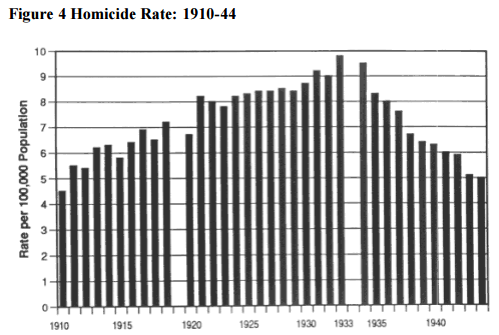
    Can anyone say, 'unintended consequences'?
    Source: Cato Institute Policy Analysis No. 157: Alcohol Prohibition Was a Failure, pg. 7.

    Given libertarians’ stringent belief in self-ownership and the fact that drug use itself is a victimless crime, drug addiction cannot be rightly called a “serious” crime. Exchange of contraband items, provided that no people are exploited or otherwise harmed in the exchange, is similarly not of a serious nature.

    It stands to reason that with the rise in the use of drones, or quadcopters as many aficionados prefer to call them, for drug delivery, one might expect an accompanying decrease in drug-related violence. Fewer contacts between human beings–drug traffickers and law enforcement as well traffickers with one another–may correspond to fewer homicides to protect drug profits kept artificially high by prohibition.

    An increase in home burglaries corresponding to use of social media to determine times when the victims are unlikely to be home is concerning, and invasion of homes are of a more serious nature than petty thefts and shoplifting. However, it also seems reasonable that a decrease in violence due to burglars encountering residents unexpectedly may occur. Property crimes are, of course, of a less serious nature than homicides and other forms of physical violence. An investigation is required. An overall rise in burglaries may also negate any reduction in burglary-related homicides, should the rise in technology use prove causative for the increased rate of burglaries.

    Much of the Europol report focuses on organized crime activities that facilitate drug trafficking and further organized crime (e.g. document fraud, money laundering, etc.), which strains credibility to characterize as “serious” in their own right. The intersection between technology use and human trafficking may have been omitted from the BBC’s summary for a reason. Europol’s 2016 situation report, Trafficking in human beings in the EU, did show a rise in reports of human trafficking, but it doesn’t necessarily demonstrate an increase in human trafficking itself. In that report, Europol says:

    No distinctive trend in this variation of data was recognised as linked to any particular fact. A possible reason could be that Europol is increasingly being addressed by MS law enforcement for the provision of operational support during cross-border THB investigations.

    Thus, the rise may simply be an increase in reporting to Europol itself rather than a bona fide increase in human trafficking.

    The brevity of the BBC summary of the Europol report may be subtle justification for expanded law enforcement intrusion into citizens’ privacy under the pretense of reducing crime. The UK government has an interest in softening widespread hostility to the recently-implemented Investigatory Powers Act of 2016, or “Snoopers’ Charter” as opponents have popularly characterized it. The report itself doesn’t warrant that conclusion, as it is unclear whether technology use in crime is causative of the increase of crimes like burglaries or tracking a trend that accompanies higher immigration, drops in economic prosperity, and other factors known to influence crime levels. Too many issues are simply not addressed by the BBC article or Europol in its report to form any conclusions about whether technology use itself has increased serious crime regardless of the definition of “serious crime” they’re using.

  • We’re Living in a Post-Digital-Evidence Age

    Revelations from Wikileaks have far deeper implications than have been covered by the media as yet. The CIA has lost control of not only a trove of documents about the organization’s cyber warfare capabilities. It’s lost control of the weapons themselves.

    WikiLeaks has dropped a bomb on the CIA

    In digital warfare, there exists the concept of a zero-day exploit. In hacker/information security parlance, a zero-day is an undisclosed vulnerability in software that has been discovered. Ordinarily, watchdog groups and the organizations that produce software have procedures in place to discuss vulnerabilities and issue patches before releasing details of exploits to the general public. Only in the extreme circumstance of an organization deliberately ignoring reports by security researchers of exploitable weaknesses do ethical hackers resort to releasing details of the attack to the general public. The obvious ramification of knowledge being openly available before a patch is released is that anyone can use it prior to patching.

    There is the obvious issue, raised by Wikileaks itself, that the CIA has duplicated the functions of the NSA, but very likely with even less oversight for the use of their arsenal. This is not only a waste of taxpayers’ money, but possibly a revelation that unconstitutional attacks on the privacy of American citizens may be taking place by more than one government agency. If that is the case, it is a clear violation of the CIA’s mission, as laid out by Congress.

    The ultimate effect of losing this digital arsenal, which may now be in the hands of anyone, is that literally any digital evidence may be called into question. The scope of who may have access to it is completely unknown, and this genie cannot be put back into its bottle. The evidentiary value of criminal activity stored on computers could be disclaimed as planted evidence. This has wide-ranging implications not only for cases under consideration, but for future cases which may be brought.

    The CIA now has an obligation to the American people to disclose all of the methods of its infiltration to software developers in advance of the coming storm. It must shatter the weapons it created and, if Congress deems it necessary, it may rebuild a new arsenal.

    Furthermore, Congress must probe the agency deeply and potentially reform the country’s spying agencies completely. There is evidently far too much overlap for which the taxpayer is expected to foot the bill. It is also evident that there is too little civilian oversight and too much delegation of powers in the name of national security, a long-standing problem which has now become an emergency. Ethical considerations of spying on foreign powers aside, this lapse has made it clear that our own spying agencies are as much a danger to our own citizens as they are to the rest of the world.

  • The Fourth Estate’s Decline Signals the Rise of Freedom of the Press

    The story of our times is a faint signal obscured by a great deal of noise. Every once in a while a tiny glimmer of truth peeks out. Consider the following article published in The Atlantic: The Mark Zuckerberg Manifesto Is a Blueprint for Destroying Journalism. The article lays out a case that Facebook stands poised to deal the death blow to the so-called Fourth Estate, the media apparatus that purports to keep us all informed. Adrienne LaFrance writes:

    Zuckerberg uses abstract language in his memo—he wants Facebook to develop “the social infrastructure for community,” he writes—but what he’s really describing is building a media company with classic journalistic goals: The Facebook of the future, he writes, will be “for keeping us safe, for informing us, for civic engagement, and for inclusion of all.”

    These functions are, of course, believed to be firmly in the purview of traditional journalism. Everything must be interpreted before consumption. The masses are not smart enough to make up their own minds about what is being said. Journalists are the educated, the connected, the nucleus of society for what is moral and ethical. The edifice creates the civic engagement needed to hold politicians accountable. Even if one commands an empire whose subscriber base is approximately a quarter of the population of the planet, respect must be given. In fact, respect can be demanded unabashedly even from the President of the United States.

    It’s also not Zuckerberg’s responsibility to solve a broken business model in journalism.

    It is not a problem with journalism in general that is causing papers to fail, it’s just that the traditional revenue stream was captured by usurpers like Facebook.

    Is it any wonder that the elite of the Western world are bucking a rising tide of populism? The Internet put every one of us in contact with a great many ideas and the dynamic shifted. No longer do we need to wait until the morning paper is delivered to our door or for film at 11. Old media was slow to adapt and had few enough scruples. New media has practically no scruples whatsoever. The media clamors for recognition, rallying around near-mythical icons of integrity, such as Edward R. Murrow. This is what we were, and still are, or so it goes. It shouts this while the Internet picks all the locks of the gates they’ve long kept, often giving the lie to the narratives that have been constructed. “Information wants to be free” goes the familiar credo in hacker culture.

    While the media loses its collective mind over President Trump’s supposedly unfair treatment of it, one ought to take note of his favored tactics. Instead of delivering a carefully constructed speech penned by a team of expert writers, he takes questions unfiltered. Instead of giving the White House press corps an inside track, he uses Twitter to speak to the public directly. Rather than commit solely to edited video interviews, he holds rallies and speaks directly to the people, going so far as to offer the microphone in a symbolic gesture to a random supporter completely unafraid of what the man might say having been given the platform.

    Donald Trump is an enemy of the First Amendment, or so we’re told. But that narrative is shattered by simple observation.

    Well, do you?
    Do you have a license for that, sirs?

    It’s a trick of language that “the press” referred to by that Amendment has ceased to evoke the image of literal printing presses, which anyone could own, and came to mean the journalistic establishment. In reality, “the press” is the people. It is to be found in the spirit of Ben Franklin’s publishing shop, and in the rogue presses of several other founders, often writing under pen names chosen purely because they believed the ideas were more important than the people speaking them. The press is any one of us daring enough to put thought to paper. LaFrance wrings her hands at the notion that Facebook is going to destroy the press, while failing to acknowledge that Facebook is the press and it always has been. It is, of course, not the only press, nor should it be.

    By taking his message directly to the people, President Trump is proving that at some basic level that he understands freedom of the press better than the media establishment who have co-opted the term to refer to themselves. It should not need to be said that this recognition is an endorsement of all of Trump’s views or policies. Alas, in a world gone mad, one must disclaim that engaging with an idea is not the same as accepting it. Each time the journalistic establishment blares, “This is not representative of America”, be sure to answer that audacity with whatever platform you can find. Maybe it’s not, but America can speak for itself, thank you.


    Corrected to include omitted lines from original