Recently, congress actually did something. I know, I am as shocked as you are. I was even more floored to learn that what they did was something I was happy about. The house recently passed HR 38, better known as the Concealed Carry Reciprocity Act. This bill, if passed, will provide ‘full faith and credit’ protections provided by the constitution to concealed carry permits. What this means is that your state issued concealed carry permit will be valid in all states, just like your driver’s license and marriage license (SLD fucking state licensing). This of course has causedmuchpant shittingterror in the liberal world, because if enacted, flyover hicks (myself included) would be crawling all over New York, LA, and every other liberal bubble armed to the teeth. It’s one thing to arm criminally negligent illegal aliens or teenage gang members, but that hayseed with a MAGA hat and a Ruger LCR in his pocket is just too much to deal with. Today I want to take a glimpse into the future, a future where concealed carry is the de facto legal standard. Join me while we explore.. TRUMPS AMERICA! (horns blare, title fades to black)
What would be the result of national reciprocity? Defiant hysterical opposition, initially. Those latte sipping snowflakes aren’t going to just smile nervously and let a bunch of heavily armed Nazis march into their cities (insert France joke here). Expect a lot of illegal arrests, a lot of lawsuits, and probably at least one officer involved shooting where he is as guilty as the DNC’s IT staff but gets off cause ‘muh fear for muh safety!’. Eventually the defendants will be found innocent, the unlawful detainment lawsuits will succeed, and the coasts will be brought kicking and screaming to the reality that we do live in the same country. This is where it gets interesting. You see, once the coastal elite realize no one is coming to save them and this is the reality they now inhabit, they are going to have to make a choice: either stick to their guns (pun intended) and insist their path is righteous, or demand to have the same ability to carry concealed as the unwashed horde now terrorizing their city. Knowing what I know about the average progressive and his moral integrity, they will universally choose the latter. I expect to see mobs with pitchforks and torches (since, you know, they don’t have guns) demanding shall issue concealed carry in all of the restrictive states within a few years. Hawaii may be able to hold out, since they are an island and flying with guns is still a pain in the ass, but the rest will fall like dominos.
Then the miracle will happen. Those people on the coasts, the ones that swore to god and their country that national reciprocity would lead to blood in the streets, that Armageddon is nigh, will wake up and realize that they are still alive. Some of them might even find a handgun on their nightstand and a second picture ID in their wallet. And that is when the lie will come crashing down. They will realize that gun ownership is not some mark of the devil, and that carrying a gun doesn’t turn you into a Klansman. It is simply the end result of being a responsible member of society. A society that understands that there are those that exist to exploit and intimidate others for their own personal gain, and at the end of the day you are your own first responder.
Am I being a bit naive in my assessment? Perhaps. Maybe the courts completely disregard the written intent and prior law and declare the bill unconstitutional. Perhaps the police simply ignore the law and the prosecutors look the other way. Maybe the blue states prosecute every defensive shooting so aggressively that carrying concealed is a greater liability than it is worth. But maybe I am right. And if I am, this will be the greatest cultural shift in America in recent history. For the first time in 50 years, guns will become normalized. That is what the progressives truly fear. They have based so much of their rhetoric on othering gun owners, painting them as racists, knuckle draggers, vigilantes, closet murders, that should the curtain be pulled back on this it would be damn near a death blow to their culture war. How can you continue to live the lie of the evil gun owner when your daily existence contradicts that? When your friends and relatives prove you wrong every time you go out to dinner? When random strangers smile and hold open doors for you instead of shooting you dead? You can’t. This is my vision of the future. As a gun owner, and an eternal optimist, I can only hope.
This is from a long, far-ranging discussion of economics and politics a former friend and I had on Facebook, and this post was originally written in 2013. I think this still stands up well, but this is not a new post.
My friend has a BA in Business Administration, hence the reference at least once to his business degree, and presumed cluefulness about how businesses operate and how business owners think. This jumps into the middle, and I’d rather just post this as-is, so I’ll paraphrase his points leading up to this. We wandered over to minimum wage via government regulation (which in turn stemmed from a discussion of the incestuous relationship between business and government); I’d said that most regulations are obsolete and hurt business, he pointed out that yes, some are obsolete, but others are there to protect people, and voila, minimum wage is an example of protecting workers.
My response:
You and I are coming from the minimum wage question from 2 completely different angles. You believe in (federal) government protection of workers. I believe in the (federal) government sticking to the Constitution… and minimum wage isn’t in the Constitution, even under the commerce clause (what Joe Shmoe is paid in Wichita, KS, has nothing to do with a different franchise in Kenosha, WI, selling their burgers). If it was a state minimum wage, it’d be a different thing… although I’d still be against it, the “it’s not a role of government” argument wouldn’t apply.
However, setting that argument aside, I’m still coming at it from the side of “personal responsibility”. You have 3 options as a burger flipper: either find an employer who will pay you what you think a burger flipper is worth at whatever quality of burger flipper you are (I’d assume shoddy, since you feel you need some kind of protectionism to get paid a ‘decent’ wage, but I may be wrong and you may just be ignorant and unaware that you can switch jobs without your world shattering), be the best damn burger flipper you can be and justify that raise you’re asking for (what everyone making over minimum wage does when they want/need to make more money), or learn a skilled trade or get a higher education in something and stop being a burger flipper and start being something like a carpenter or architect.
Again, I’m not talking out my ass, or in theoretical terms about things I only vaguely observe from some mystical ivory tower somewhere… I have the t-shirt. In high school and through college (and after college for a couple years, because of the recession) I worked really crappy jobs. Food Lion and Walmart didn’t pay minimum wage (even McDonald’s doesn’t), but it was bloody close. After I moved out, I didn’t make enough most of the time to cover my gas and such (I was in college by the time I moved out)… so I did the best job I could do and got raises every year. When I could, I got promotions. And when I found a job that paid me well and needed my skill set, I changed jobs and came to work at my current job. I didn’t ask the government to make anyone pay me more, or wish minimum wage was $12/hr… I made myself a better employee and justified the money I was getting, and went above and beyond so raises and promotions would be justified as well.
And since you have a BA, I assume you know as well as I do that businesses aren’t charities– they aren’t there to give workers the money they ‘want’, or deserve for being a special snowflake human being. Businesses exist to make money, and as a side effect pay people to make money for the business… and that pay is in proportion to a person’s value as an employee. If Mother Teresa sucks at flipping burgers, then dang it, Mother Teresa deserves minimum wage… or to be fired. It doesn’t matter to Burger King that she’s Mother flippin’ Teresa, man. She’s a terrible employee, and her pay reflects that.
Also worth noting is the point he’d made earlier about employees being replaced by automation if they get too expensive to employ. This is a very valid point that most minimum wage workers and people who advocate for them don’t seem to understand. Again, people own businesses to make themselves money. If they can’t make enough money, something’s got to give. And when there’s no more non-employee overhead to cut, they need to start cutting people. As a general rule of thumb, it costs about twice an employee’s gross pay to employ them (given employer shares of FICA, certain states’ income tax, worker’s comp, benefits, etc.)… so that $10k/yr employee actually costs the business owner around $20k. I’d imagine Obamacare penalties and/or post-obamacare insurance premiums have upped that 2:1 ratio. So if it costs less than $20k/yr to set up an automated ordering kiosk and a burger flipping robot, guess what a business owner is going to do?
And then there’s the economic effects of raising the minimum wage. Less than 10% of workers make minimum wage, so this would have very little direct positive effect on people. However, in short order, it would have great negative effects on a large number of people. Artificially raising the wages of one segment of the population increases cost for certain businesses, they raise their prices, which raises costs for other businesses, and so on down the line until prices have increased across the board, and we’re right back where we were. This is how raising the minimum wage is a driver of inflation.
In this country, like most countries in the world, we have a fiat currency; that is, a currency whose value is not linked to a commodity (like gold, silver, or salt), but is based on the trust that the country issuing the currency can pay its bills. By its nature, fiat currencies are subject to almost constant inflation through devaluation of the currency. Especially when the country in question is engaging in… let’s say non-optimal monetary and economic practices. In our case, budget deficits, a high national debt, and things like quantitative easing. It’s part of the reason everyone’s parents have stories of “I remember when gas was $0.35!” (for my generation’s parents) or “I remember when gas was $0.98!” (the story I get to tell if/when I have kids and they’re old enough to be regaled with tales of ‘the good old days’). Another factor in inflation is artificially raising wages– you’ve arbitrarily decided that the dollar is worth less than it is, so people need more of them. And by deciding that one segment of the population needs more, less valuable dollars, everyone else needs to have and spend more, less valuable dollars to keep up with the sudden devaluation of a dollar for a certain segment of the population.
So, with a rough idea of how inflation works in mind, it makes sense that raising the minimum wage (or even having one, I would argue) is detrimental to the economy as a whole, and you end up chasing your own tail. What happens when inflation catches right back up to you again? The cycle of artificial inflation begins again, and the minimum wage is raised, devaluing the currency and forcing business costs to go up, rippling down the supply chain, raising costs of end-consumer goods, etc. We aren’t going to rein in fiat-based inflation any time soon, but we can stop wage-induced inflation by not raising the minimum wage.
I thought the topic was done with. The Catalonian leadership had waffled, Madrid had growled and it looked like the whole thing was done. A bluff called and folded.
Remember, Sully, when I promised not to talk about Catalonia anymore?
But, as in many things…I was wrong. The Spanish central government appears to want this over with, once and for all. As I have been questioning – what does this matter to a libertarian? Is this a case of “When in the course of human events it becomes necessary for one people to dissolve the political bands which have connected them with another and to assume among the powers of the earth, the separate and equal station to which the Laws of Nature and of Nature’s God entitle them“? Or just a bunch of whiny Socialists saying “What do we want? Socialism! Where do we want it? Here!” Should that even matter?
And now my bid to win a Judge Napolitano Medal for Meritorious Question Marking:
A good point Playa Manhattan had brought up – at what point is enough of the populace saying “we want out” enough? The referendum that trigger this shitstorm did not see even majority of eligible voter participation. Is there a number where you can draw a line and say “OK, there it is, enough to call it just”?
What happens to someone who wants to remain Spanish? You see a lot about the Spanish Constitution saying Spain is indivisible – does that hold for people who were not even born, or of age when it was adopted?
Will Madrid’s continuing crackdown push Catalans to say “hey, maybe the independence types are right…Madrid really does want to crap on us!”?
Can we just airdrop STEVE SMITH or send Zardoz over there to solve the whole thing?
I am torn…but if pushed, I would say that I would reluctantly back the Catalans. I do truly believe that Governments are instituted among Men,deriving their just powers from the consent of the governed.But I can be convinced this is not the case here. Discuss, debate and snark, as you will.
People seemed to enjoy the discussion in the original article, so I’m going to expand on it based on some of the conversation we had in the comments. As noted in the comments, August is employing the Socratic method. In real life, August is a classmate from law school who was a philosophy major. He and I enjoy sipping bourbon, smoking pipes, and talking politics, philosophy, and theology.
In the original article, I made the assertion that rights are meaningless outside of a relationship. I also asserted that rights are definitions of the boundaries of authority between co-equal entities (man to man; man to human institution). In this article, I will address some of the points brought up in the comments: conflicting rights, objective v. subjective rights, negative v. positive rights, how rights flow from self-ownership.
The conversation picks up at the end of the prior article:
AUGUST: So if rights are based on authority and the equality of man, are you saying that rights are attempts to prevent inequity between men and between man and institutions created by man?
OSCAR: Yes! As with any co-equal relationship, there are certain things solely in the domain of the first, other things that are solely in the domain of the second, and some things that are in an overlapping domain between the two. For example, parenting.
AUGUST: So, in this Venn Diagram description, your domain is your rights with respect to me, my domain is my rights with respect to you, and the shared domain is collective rights between us and conflicting rights between us. How can rights conflict if they are natural?
OSCAR: Well, this is more of a semantic difference. Either you can paint with broad strokes (“right to life; right to play loud music; right to swing your arms”) and deal with conflicts of the rights (“my right to swing my arm ends at your nose”), or you can paint more carefully (“right to swing your arms in open portions of your personal space”) and not have to deal with conflicts. Either way, there is a limit to the extent of your rights where you begin to infringe somebody else’s rights.
AUGUST: This still seems fuzzy. How do you know when you’re infringing somebody else’s rights?
OSCAR: Well, we need to know how to identify a right in order to be able to tell if we’re infringing on rights. There are two things called “rights” these days. One is negative rights, and the other is positive rights. Positive rights are largely a misnomer in the context of strangers (including the government). The only relationship in which positive rights make sense is the dependent/caretaker relationship. This is why people refer to the “Nanny State” when government enshrines positive rights in law. Negative rights, however, are natural rights. They derive from self-ownership. Negative rights are things whose direct, tangible consequences are felt only by the rights owner and consenting others. In essence, you are the sovereign of your own domain; only you have the authority to make decisions that result in consequences to only you. Thus, you are infringing on somebody else’s rights when you do something that keeps them from exercising sovereignty over themselves and their property.
AUGUST: Direct, tangible consequences? Like economic externalities, emotional effects, and social consequences?
OSCAR: No, usually rights violations are one of three categories: force, fraud, and coercion. Nobody forces you to feel a certain way. Nobody coerces the market to ripple when you make a transaction. Nobody forces society to react to your actions. All of these consequences to the exercise of rights may be of concern to people and to society at large, but they are outside of the authority of strangers and the government to resolve by infringing on the free exercise of rights.
AUGUST: But we discussed before that there are times when you can use force, like in self-defense. It seems like you can’t use force until you can.. it’s all very arbitrary sounding.
OSCAR: Not at all. There is a basic principle that you can respond to immoral force with force of your own, but you cannot initiate immoral force: the non-aggression principle.
AUGUST: Ah, so when my neighbor accidentally steps on my side of the property line, I get to kill him?
OSCAR: No, the NAP is better seen as a negative limitation than a positive one. The NAP tells you when you CAN’T use force, but doesn’t dictate HOW you can use force when it is not immoral to do so. There are rules of proportionality that are outside the scope of rights.
AUGUST: That is all well and good, but I’m still not convinced that negative rights are a necessary consequence of self-ownership.
OSCAR: Ownership implies control. If you own yourself, you have control over your actions. Ownership also implies exclusivity as to strangers. There can be co-owners of something, but co-ownership implies a consenting relationship. You cannot be a co-owner with a complete stranger. Therefore, absent consensual abdication of your self-ownership, your claim to your own body and to your actions is exclusive. As previously discussed, the only time this changes is when your actions cause direct, tangible consequences to non-consenting others.
Part of your actions include your labor. You are the owner of your labor, including the economic value of your labor. Economic value of your labor can be traded for physical property, which makes you exclusive owner of capital. Throughout this entire chain, your exclusive ownership and control has not been severed unless consensually negotiated for. Therefore, self-ownership implies control over your actions, your labor, and your property, up to the point where you cause direct, tangible consequences to non-consenting others. It is important to note here that the direct, tangible consequences need to be caused against a legitimate claim of the non-consenting other. If I buy the Mona Lisa, I deprive you of being able to see it. However, you have no legitimate claim to the Mona Lisa because you have no grounds to claim ownership of the Mona Lisa.
AUGUST: What’s the point of all of this if a “might makes right” government comes in and imposes its will on you?
OSCAR: Rights are not subjective. Negative rights are natural outcroppings from the physical reality of self-ownership. Positive rights are natural outcroppings of the duties that are inherent in a caretaker role. Practical infringements of rights do not affect the ethical reality of rights.
AUGUST: Do you have the right to do something that is wrong?
OSCAR: In my definition of rights as authority boundaries between co-equal entities, the question is somewhat irrelevant. If your “wrong” thing does not involve using force, fraud, or coercion on a non-consenting other, then government has no rightful authority to stop you. However, this says nothing of the inherent morality of your actions. You could perpetrate a horrible evil against yourself (or against God, for those who believe), and it would no more be within the government’s rightful authority than if you did a great good for yourself (or for God, for those who believe).
For a detailed treatment of this question and other related topics, I turn it over to Milton Friedman (1 hr youtube vid).
In May, I wrote an article about the unlikely chance of Antifa and the Alt-Right coming to blows and kicking off a civil war. The Antifa Brownshirts were agitating about impeachment at that time, but two months later, they’ve changed gears and gone after the skinheads. While that, in and of itself, isn’t of particular concern, there is a more disturbing trend emerging. Antifa feels free to organize against any “unwoke” social gathering and attempt to get some scalps. What used to be a Simon and Garfunkel concert is now a Dropkick Murphys mosh, and the cops are happy to just sit there and watch. Even if there was just a small escalation in arms between the commies and the nazis, it wouldn’t be noteworthy, except for the way that Antifa is being treated by the left and their media hack cronies.
As I wrote in the May article:
Although people joke about “alternative facts,” it’s not a joke. There are two prevailing agendas across the country: 1) Trump is LITERALLY HITLER and A RUSSIAN MOLE AT THE SAME TIME!!! 2) Trump is DADDY and GOD-KING OF KEKISTAN, VANQUISHER OF THE SJWs and CUCKS!!! The left has their educational and media empire churning out outrage by the gallon. The right has their independent media matching the outrage of the left.
Antifa is smashing windows and folks like Based Stickman (who the fuck is Based Stickman and why is he called that??) are bashing Antifa heads in. People are primed to believe that the violence will do nothing but escalate.
This dynamic is still there, and the excuse making for the violence injected by Antifa has come to a fever pitch. It wasn’t enough that Trump denounced all of the violent elements in a volatile situation. No, he specifically had to denounce the supposed “right wing” (read: non-Marxian) “hate group” (read: non-PC group). Now that he’s showing an ounce of backbone in standing up to the Prog-Fascist media, he’s LITERALLY HITLER yet again.
Once again, we approach a crossroads. Will a critical mass of people buy the media’s angle? Will the escalating violence of Antifa be excused away as a righteous backlash against an evil President backed by a malignant social movement? Or, will people cut through the BS and hold both sides accountable for the increasing tension and violence? The first fatal blow has been struck, and it’s just a matter of time before more are landed. Will people give a collective shrug and go back to living their largely unaffected lives, or will they be galvanized to one side or the other by the unaccountable mayhem?
I still think that a widespread conflict is quite unlikely, but let’s jump back through the portal and get comfy in the Derplight Zone once more. What factors are festering under the surface that could bubble up into a civil war?
LITERALLY HITLER
Antifa and their media and political organs are doubling down on the LITERALLY HITLER rhetoric, which is absolutely polarizing and dehumanizing. There’s a reason that people were extremely hesitant to analogize to Hitler in domestic politics for 50 years. The guy was so dangerous that we co-opted an entire nation’s resources for 4 years to end his reign, at immense cost in human and economic terms. When the left compares Trump to Hitler (even implicitly), they’re sending a message to the right, and especially the Alt-Right, that this isn’t just a domestic debate, but a fight to the death.
The dangerous part is when the left leaves no room for dissent. People on both sides of the political aisle have always been susceptible to hyperbole and puffery, but when the left uses the power of boycott, violence, doxxing, and blacklisting on a regular basis, people who believe differently are given no outlet to vent off their pent up political energy. Much like gunpowder, their anger fizzles out when lit in the open, but when contained in a tidy little container, the results are explosive. The increased “all or nothing” attitude from the LITERALLY HITLER left is boxing the Alt-Right up in a tidy little container.
“They’ve Gone Too Far This Time”
I’ve seen a lot of people react this way to the way Antifa has been acting lately. It’s one thing to protest, boycott, shout down, or even make a hostile work or learning environment. It’s a completely different thing to act as a mob. People don’t like mobs, and average non-political folks are taking notice of the mob mentality that has taken hold in certain parts of the left. Antifa has chosen their targets very carefully so far, but one poorly chosen location for a riot could result in a violent response from otherwise unattached people. For most of the unattached, the distance between them in their cozy suburban or rural lifestyle and the violence in the urban liberal college setting is far enough that they don’t feel threatened. If Antifa were to overstep their bounds and perhaps threaten something more relatable to suburban folks (like schoolchildren), the backlash would be swift and violent.
Widespread Acceptance of Increasing Violence
I hate the phrase “the new normal,” but it is apt in this situation. Most people see the increasing violence, rail about it for 24 hours, and then forget about it. Like mentioned above, there’s a comfort in the fact that these goons seem to be contained on Marxist-sympathizing college campuses. However, you get less of what you penalize and more of what you celebrate. While the average Joe and Jane are ignoring the violent protests, the mainstream and leftist media are praising these goons for “punching Nazis.” We’re going to see more of this simply because there are hardly any consequences worth mentioning in comparison to the accolades bestowed upon these “woke” counter-protesters standing up to the evil Nazis. It’s getting to the point where people are resigned to the possibility of a second civil war.
Shifting Reaction to SJWs
The time is starting to come where perceptions of SJWs are shifting from a mix of fear and apathy to abject hatred. The problem is that most SJWs are emotionally stunted and unable to handle rejection. The resulting dynamic is a bunch of SJWs throwing temper tantrums, seeing that their Antifa friends (there is a significant crossover between the groups) are the golden children for breaking windows and harassing “Nazis.” On the other side is the Alt-Right, a reactionary group that makes its hay harassing SJWs and is stepping up its own reaction to these Antifa goons. As much as the Alt-Right dislikes Antifa, they HATE SJWs. They’re looking for an excuse to use Antifa’s tactics against the SJWs.
Economic Downturn
We’re about due for another recession, and people tend to be more amenable to violence when they don’t have a job. This one is fairly self-explanatory and well-documented throughout history.
Floundering Media
The traditional media is dying, and they’re trying everything they can to get people to consume their content. They’ve long since removed their mask and exposed their Marxist-sympathetic leanings, but they get consumers when there is conflict. These days they’ve gone from reporting on conflict to stoking it, and I don’t think there’s an end in sight. They’re going to do everything they can to start a race war, a communist revolution, and a national witch hunt all at the same time. The ratings will be amazing!
Overall, I’m still pessimistic on the chances of widespread fighting. I think the worst we will possibly see is an LA riots type situation. However, as shown in Charlottesville, all it takes is one body for the self-righteous leftist media to climb on top and start agitating. Like a high-stakes game of “Press Your Luck,” both sides keep smacking the button, hoping to hit the political jackpot, ignorant of the lurking Whammy.
What is libertarianism’s best strategy to gain a legitimate amount of power nationally (and then happily cede it to the people)? Libertarians of the small-l and big-L varieties have sought to gain power by either co-opting one of the major political parties (See; Ron Paul Revolution that the GOP squashed) or by finding candidates to run as a Libertarian that appeal to establishment voters (see: Aleppo). But I believe there is a third, and overlooked, option: get a candidate who does some libertarian things that irritate the major parties and the deep state apparatus, and allow those actions to result in political hysterics from ultra-partisans while average Americans see no net loss from the actions and in many cases a serious net gain. I believe this will continue to set in motion a series of events where the government can be shrunk to a level that’s at least tolerable to minarchists and other run-of-the-mill libertarians.
How libertarian is President Donald Trump?
The answer is: not very. I think that’s been established. The man swam in a pool of cronyism sharks his entire professional life. He, through desire or necessity, has been a rent-seeker. He has used eminent domain to further his projects. He has sought special treatment from political entities both domestic and foreign to further his interests. The man is no altruist. But does that make him distasteful, or does it make the system in which he operated distasteful? Personally, I will rarely fault someone for utilizing the same processes his competition would use, so long as it does not originate from a position of government authority. And Trump never held office before his inauguration. In other words, he never utilized political office for financial gain by, say, orchestrating government access to foreign actors that overwhelmingly donated to your personal foundation or for trade groups and banks that hired your unqualified husband to give speeches at ridiculously over-inflated fees. In other words, I don’t hate the player, I hate the game.
And yes, Trump is allowing Jeff Sessions to wage the drug war, which is a sticking point to a lot of libertarian minds. But I ask you, is it better to wage a drug war and uphold the concepts of equal protection and the rule of law (while allowing Congress to do their job and vote to legalize drugs the right way)? Or is it better to arbitrarily enforce duly enacted laws based on the geography of a person and/or their willingness to bend a knee to the state and support legalization with a ton of unlibertarian strings attached?
The sadder these people are, the happier I get.
Some policy positives already achieved and in the works:
So now we come to Donald Trump’s libertarianism or lack thereof. The man, no doubt, will continue some of our military adventurism overseas. But he has already stopped our policy of running guns to terrorists and terrorist-sympathizers in Libya and Syria after the previous admin established those programs and destabilized an entire region, while thoroughly destroying the likelihood that a rogue regime would abandon its weapons programs and try to re-enter the international community (read: we came, we saw, he died). There has been no resurrection of the programs nthe last two administrations ran to ship guns into Mexico through the drug cartels, for different motives yet still in gross violation of Mexican sovereignty. And perhaps he will continue to not carry out targeted assassinations of American citizens that have never been charged with a crime, which the prior admin was all too happy to do in gross violation of the Fourth Amendment. Furthermore, he has already started to roll back our country’s association with liberty-robbing agreements like the Paris Climate Accord and the Trans-Pacific Partnership. Both of those agreements undercut the ability for American companies and consumers to freely negotiate what they were willing to exchange goods and services for. Removing our name from them is a step in the right direction, especially if it’s followed up with free trade agreements that haven’t existed in a century or more. That action is yet to be seen, but at least someone had the audacity to upset the globalist apple cart and stop a little bit of the insanity those agreements put us further along the path to.
Get us out of this circus, please!
As for civil liberties, Trump is still an unknown quantity. His statement about “roughing up” suspects is problematic to say the least. And I can only hope it was hollow bluster. But even so, it sets a very poor example and he should correct it immediately. Now, having said that, he has not furthered Obama’s policy of killing Americans without due process, but that’s not going to be enough. His willingness to stop going after businesses that exercise what should be a fundamental right to free association looks good so far. As do his overtures to Second Amendment causes. As does his willingness to tackle Affirmative Action and Title IX insanity. Holy crap, I just realized he’s been the best president on civil liberties we’ve had in recent memory. People that overlook the substance of these actions due to his boorishness need to reassess what their priorities are, in my opinion.
Furthermore, our business climate has benefited greatly from having an outsider installed as the head of the regulatory apparatus. Trump has already vowed, and started to carry out, a dismantling of the bureaucracies that stifle economic growth and freedom for Americans. From the onerous EPA regulations to CAFE standards being rolled back or passed to the states, there has been a serious uptick in confidence from the business and manufacturing sectors that Trump will get the government out of the way of prosperity. The hilarious irony there is that Trump was a crony his entire life, as I mentioned earlier. But perhaps he had no choice but to play the game the only way that could lead to success: do what the government tells you and push others out. Now, when given the reins, he seems to be more than willing to eliminate programs that he personally benefited from but that create barriers to entry for others. Yes, he could have opposed the system while benefiting from it. But let’s not pretend he’s some awful hypocrite because he played the hand he was dealt. Business “leaders” like Elon Musk, Mark Bezos, Mark Zuckerberg, Bill Gates, etc, etc, etc have done the same thing and so did their forefathers like Ford, Carnegie, Mellon, and others on back through the ages as long as there was a government agent with a hand in their pocket. So I’m willing to forgive that.
Be happy for this.
And lastly, he put what appears to be a strict constructionist on the Supreme Court in Neil Gorsuch. That is a marked improvement on any names mentioned by establishment candidates on either side of the aisle during the last campaign.
The other intangible positive results of a Trump presidency:
Another thing libertarians have always sought is a diminished reverence for elected officials and other “public servants” whose goals are often at odds with those of the people. Trump’s mere presence has caused probably 2/3 of the political spectrum to demand the reverence for the office be scaled back. They are now calling for more power in the hands of the states or localities and even ::gasp:: the people, on occasion. These are people that have been statists to the core. They are the Big Government democrats and NeoCon statist Republicans. And they are finally unified in an effort to diminish the role of the Executive Branch. This serves to re-establish the separation of powers that has become all-too-muddy with much of the congressional responsibilities being passed to Executive Branch agencies in an attempt to deflect responsibility and ensure easy reelection for entrenched politicians. The more responsibility that is pushed back into the laps of our directly elected officials and down to the state or local level, the better for us. It helps us create a more diverse political environment where “laboratories of democracy” are able to compete for ideas and human investment, rather than an all-powerful centralized state controlling everything. And one need look no further than minimum wage laws (since we have them, I’ll address it) to realize a top-down approach where the minimum wage “needed” in New York is imposed on small towns in New Mexico or Wyoming, where the cost of living doesn’t even come close, is a horrific idea. The Trump era is returning us to an ideal the founders embraced in that respect.
And he is returning us to another ideal the founders cherished: temporary service from business-people and non-careerist politicians. The flood of people on Trump’s coattails from all sides of the political spectrum is refreshing. Sure, many are moneyed and or celebrity candidacies. But so what? Its a step in the right direction any time we start to end political dynasties and careerists that sit in the Senate for 30 years as they grow further and further out of touch from average Americans. More turnover from political novices has a much better potential upside of shrinking our government than does further entrenching those who have pushed us to near financial ruin and reduced individual liberty.
Pucker up!
The net result so far (in my opinion):
So let us all embrace the non-libertarian president. For one of these reasons or for another I might have missed. But embrace it nonetheless, because it has already borne libertarian fruit, and I suspect it will continue to do so for many of the right and some of the wrong reasons. Its the best we could have hoped for and probably the most libertarian moment in America for a hundred years.
Here’s a proposal for a different way of representation to be determined by election, the so-called Fair Vote Act. Putting aside my pet peeve about that sort of naming (as well as ostentatiously “designed” logos and pleas for donation), there’s some interesting points here that I’d love to see argued over so we can get an honest idea of the pros and cons of this proposal. My own take so far is that I’m frankly not in favor of more “democracy” nor “making government work better.” But… anything with the potential to break the Mafia stronghold of Team Red and Team Blue (and their respective donors) has merits worth discussing.
One thing that stood out to me is the strong probability of total gridlock and ineffectiveness. But perhaps there’s a downside as well.
In both England and the United States, the legal establishment, helped by would-be reformers, first curtailed the power of grand juries to reach independent judgments, and gave grand juries the power to abuse power on behalf of prosecutors. Then the enemies of the grand jury turned around and indulged in concern-trolling about how grand juries didn’t give adequate protection to suspects. This softened up the grand jury system, making it more vulnerable to attack, and in some cases to abolishing the institution or making it optional.
Zachary Babington (1611-1688) was a functionary in Restoration England’s judiciary system. He was at various times an associate court clerk, a deputy clerk, and a justice of the peace. Zachary’s brother Matthew had been one of the chaplains to Charles I, who was killed when his royal tyranny provoked a counter-tyranny by revolutionaries. That unpleasantness was supposedly over after Charles II, son of the “martyr,” took the throne, but the new king’s supporters were on their guard to safeguard royal prerogatives and minimize the opportunities for the people to thwart the royal will. Zachary may well have learned from his pious brother about the perils of trusting the judgment of the people. So Zachary had a crack at grand juries, trying to limit their usefulness as shields for the rights of suspects. Fortunately, Zachary did not prevail at that time.
In a 1676 book, Advice to Grand Jurors in Cases of Blood, Zachary Babington complained that grand jurors often dared to ignore the judge’s instructions, and to refuse to indict suspects, or to indict suspects for manslaughter when the judge wanted a murder indictment.
“Hi, it’s me again, William Penn. The judges wanted me punished for preaching in the streets, and when the jurors refused to convict, the jurors got punished, but some of the jurors fought their case in a higher court and won, and here we are…isn’t it weird how I keep turning up everywhere?”
…as well as the House of Commons had told judges they couldn’t punish jurors for making “wrong” decisions. Most pertinently for our purposes, the House of Commons had raked Chief Justice John Kelynge over the coals for his treatment of grand jurors. Don Jordan and Michael Walsh wrote that Kelynge was so biased toward suspects and defendants that he “made George Jeffr[e]ys, ‘The Hanging Judge,’ [look] like Rumpole of the Bailey.”
Lord Chief Justice Jeffreys presided at the Bloody Assizes, but he was still a piker next to Kelynge (not shown)
Kelynge had punished grand jurors for refusing to indict for murder in homicide cases, and the Commons warned Kelynge that he had to allow both grand jurors and trial jurors vote how they wanted, without penalty.
Babington apparently realized that, deprived of their power to punish recalcitrant grand jurors, judges could only rely on persuasion to get grand juries to fall into line. So in his Advice, Babington tried to use argument to achieve what threats and punishment had failed to do in Kelynge’s situation. Babington urged grand jurors to give the prosecution, not the suspect, the benefit of the doubt, and to err on the side of overcharging the defendant. If the defendant was innocent, or was guilty of a lesser offense, the trial jury could figure that out later. Babington specifically applied his principles to homicide cases. So long as the prosecution showed evidence that the suspect had committed a homicide, Babington said, the grand jury should indict for murder, even if there was evidence that might justify, say, a lesser charge of manslaughter. The grand jurors “are only to prepare fit matter for the Court to proceed further upon, and to make a more diligent inquiry after.” Only the trial jury can figure out the true nature of the crime after hearing “both sides” – Babington assumed the grand jury would only hear the prosecution’s side, and seemed to think that this was prejudicial…to the prosecution.
“There is very much difference in Law betwixt an Inquiry and a Trial, betwixt a Presentment and a Conviction,” said Babington, and there was a lesser standard of evidence for the grand jury’s “Presentment” – “if they find upon their Evidence, that the party said to be slain in the Indictment, by the person there charged with it, with the time, and place, and manner how, they are to enquire no farther into the nature of it.” If the charges the grand jury files turn out to be excessive, it was up to the trial jury to exonerate the defendant – “however it passeth fairly out of [the grand jurors’] hands, they may more clearly than Pilate wash their hands in Innocency from the Innocent blood of such a person.”
Pontius Pilate washes his hands to symbolize his total innocence of shedding innocent blood. (Matthew 27:24)
Babington was discussing cases of murder – then automatically a capital crime – but his reasoning would justify the grand jury in giving the prosecution the benefit of the doubt in any kind of case.
(Babington’s view of a grand jury’s functions were articulated in 2014 by, of all people, an avowed libertarian deploring the grand jury’s failure to indict police officer Darren Wilson – “the likelihood that Darren Wilson would have been acquitted if he had faced a homicide charge in connection with the death of Michael Brown does not mean he should not have been indicted….A public airing of the evidence, with ample opportunity for advocates on both sides to present and probe it, is what Brown’s family has been demanding all along….”)
Actual grand juries do not seem to have taken Babington’s Pilatian advice. While the evidence is incomplete, Professor J. S. Cockburn says “surviving gaol [jail] calenders suggest that in the seventeenth century approximately twelve per cent. of all assize bills were returned ignoramus” – that is, grand juries disagreed with the prosecutors in 12 percent of cases and refused to indict.
A colorful figure and prolific author, Henry Care, eloquently rebutted authors like Babington. Care published the book English Libertiesin 1680, expressing doctrines directly contrary to Babington’s, and more in line with the real-world activities of grand jurors.
Care said that grand jurors, “if they be doubtful, or not fully satisfied” about the truth of the accusation against a suspect, should not file charges.
People may tell you; That you ought to find a Bill [of indictment] upon any probable Evidence, for ’tis but matter of Course, a Ceremony, a Business of Form, only an Accusation, the party is to come before another Jury, and there may make his Defence: But if this were all, to what purpose haye we Grand furies at all ?…Do not Flatter yourselves you of the Grand Jury are as much upon your Oaths as the Petty [trial] Jury, and the Life of the man against whom the Bill is brought, is–in your Hands…The [famous judge and legal author Edward Coke]…plainly calls the Grand Jury-men all wilfully forsworn: and Perjured, if they wrongfully find an Indictment; and if in such a Case the other Jury [trial jury] through Ignorance, &c. should find the person Guilty too, you are Guilty of his Blood as well as they: but suppose he get off there, do you think it nothing to Accuse a man upon your Oaths of horrid Crimes, your very doing of which puts him, tho never so Innocent, to Disgrace, Trouble, Damage, danger of Life, and makes him liable to Outlawry, Imprisonment, and every thing but Death itself, and that too for all you know may wrongfully be occasion’d by it, your rash Verdict gaining Credit, and giving Authority to another Jury to find him Guilty…
Care wrote that, before a grand jury can indict a suspect, the testimony must be “clear, manifest, plain and evident.” The grand jurors must “diligently inquire” into the credibility of the witnesses.
The prophet Daniel exposes the lying witnesses who falsely accused Susannah
It was Care’s defense of English liberties, not Babington’s attack on them, which became a popular work in the American colonies. Not only did Care’s English Liberties fill shelf space in colonial libraries, its content was invoked by the Patriots of the Revolutionary era in defending American liberties against British oppression. The side which cited English Liberties was the side that won the American Revolution, while the side that looked to the likes of Zachary Babington for advice was the losing side. At least for the moment.
And in both England and America, the influential eighteenth-century jurist William Blackstone came down on the side of the duty of grand jurors to protect suspects against unfounded charges.
Sir William Blackstone
In Blackstone’s words, grand jurors should only vote to indict “[i]f they are satisfied of the truth of the accusation.” Blackstone spoke of a “strong and two-fold barrier, of a presentment [grand-jury indictment] and a trial by jury, between the liberties of the people, and the prerogatives of the crown.” Before approving charges, at least twelve grand jurors had to be “thoroughly persuaded of the truth of an indictment” – “remote possibilities” were not enough.
While America was going through its founding era, on the other side of the Atlantic English grand juries blocked indictments in 10%-20% of cases – so for every ten suspects, one or two were cleared without the danger, expense, anxiety and humiliation of a public trial.
But the legal reformers were circling like birds of prey, waiting to enfeeble and then devour the grand jury system. Jeremy Bentham, the utilitarian legal reformer, denounced the grand jury in the eighteenth century, but added that the legal establishment wanted to keep the system: “lawyers and their dupes never speak of [the grand jury] but with rapture.”
If only that were so! In the nineteenth century, many lawyers and judges, in England and America, joined the ranks of the reformers. “Probable cause” became the standard which grand juries were told to follow in deciding whether to indict. This is certainly curious in the American case – the Bill of Rights does indeed mention “probable cause,” but that’s in the Fourth Amendment, dealing with warrants, rather than in the Fifth Amendment’s grand jury clause.
Probable cause doesn’t seem to be the same thing as believing the suspect is guilty. In fact, the concept is kind of vague. As Professor Orin Kerr put it: “In one study, 166 federal judges were asked to quantify probable cause. Their answers ranged from 10% certainty to 90% certainty, with an average of 44.52% certainty.” Perhaps that sort of vagueness is tolerable when judges or magistrates are issuing warrants, but not in the case of grand jurors accusing their fellow citizens of serious crimes.
Not only was the standard of proof watered down, but grand juries were limited in the kind of evidence they could hear. The only outside evidence they were entitled to examine was the evidence provided by the prosecutor (including private prosecutors in England – contradicting Justice Brown, English reformers said the grand jury was not an adequate protection against unjustifiable private prosecutions). Members of the public could not submit evidence to grand juries, the legal establishment made clear – not even suspects could send in affidavits and lists of witnesses with information favorable to them. Unless the grand jurors had personal knowledge of an alleged crime, they would have to rely for their information on what the prosecutor chose to spoon-feed them, and then they had to vote on the proposed indictment based on the loose “probable cause” standard, with the evidence stacked in favor of indictment by the prosecutor.
The New York judge Sol Wachtler, an opponent of grand juries who supposedly said a grand jury would indict a ham sandwich…
…had further animadversions against grand juries in his prison memoir, After the Madness. (The judge was convicted of stalking and harassing his former lover.)“If anyone should try to convince you that the grand jury is not a device used by prosecutors to garner publicity at the expense of someone still presumed innocent, watch out! The deed to the Brooklyn Bridge is probably in his back pocket.” That sort of misbehavior, of course, is the fault of the prosecutor, not of the grand jury. And somehow, even when they bypass grand juries, prosecutors find ways to generate prejudicial publicity about their cases.
Ovio C. Lewis, a law professor who served on a grand jury in Cleveland, Ohio, decided that the grand jury system was defective in comparison to the reformers’ favorite objective of a preliminary hearing before a judge. Writing in 1980, Lewis said: “In most cities where the grand jury is used it eliminates fewer than twenty percent of the cases it receives. In Cleveland, Ohio, the figure is seven percent; in the District of Columbia, twenty percent; and in Philadelphia, Pa., two to three percent.” From these figures, we see that at least some people were getting exonerated even under the watered-down grand jury system which had come to replace the robust grand jury of the founding era. It would be nice to know what those figures would be like in the case of a grand jury which fulfilled the functions described by Care and Blackstone: investigating and sifting the evidence and only indicting people whom the grand jurors are convinced are guilty.
Returning to the 19th century: some English grand juries – especially in big cities – called for their own abolition. These grand juries were influenced by presiding judges who discussed the alleged uselessness of the grand jury in front of the grand jurors themselves. The Birmingham Daily Post criticized one of these judges in 1872. Even though the newspaper agreed with the judge about the desirability of abolishing grand juries, it said it wasn’t cricket to harangue the grand jurors themselves on the subject:
The Recorder of Birmingham, in his charge the other day, made the usual remarks about the uselessness of grand juries. . . . It is unpleasant enough to have to sit in a stuffy room for two or three days, against one’s will, and it certainly does not render the infliction more tolerable to be penned up in a box, and be publicly told that one is incompetent and useless, and out of date, and in the way-nothing more in fact, than a sort of antiquated machine, less ornamental than a barrister’s wig, and less useful and important than the wheeziest of ‘criers of the Court’.
With these attitudes, it’s hardly surprising that judges and juries were making their talk of grand juries’ uselessness into a self-fulfilling prophecy.
Parliament put grand juries on hold during the First World War, as a supposed emergency measure. This simply whetted the appetite of the judicial establishment for a permanent, peacetime ban on grand juries, and such a ban was finally achieved by Act of Parliament in 1933.
You know why else 1933 was a bad year for liberty?
Albert Lieck, chief clerk (or former chief clerk?) of London’s Bow Street Police Court, rejoiced at the abolition of the grand jury, while inadvertently suggesting reasons the institution should have been retained. Lieck acknowledged that grand juries had sometimes released suspects: “Here and there a bill [of indictment] was thrown out, but on no discoverable principle.” Perhaps the grand jurors hadn’t been satisfied of the suspects’ guilt?
Lieck uttered a non-sequitur which one would associate with Yogi Berra more than with a distinguished British bureaucrat: “the real security against oppression lies not in outworn judicial machinery [i. e., the grand jury], but in the alertness and resolution of the citizen.” Of course, grand jury service has the potential to provide citizens a vehicle to exercise their alertness toward the criminal-justice process.
American critics of the grand jury cited (and still cite) abuses which are not in any way required by the Fifth Amendment. That amendment simply says you need an accusation from a grand jury in order to be brought to trial for a sufficiently serious crime. The Fifth Amendment doesn’t say grand juries should be dependent on prosecutors for their information, or interrogate witnesses without their lawyers, or wield overbroad subpoena powers, or act in complete secrecy (unless the prosecutors chooses to leak information, of course), or fail to keep records of their proceedings. Critics have harped for a long time on these “Star Chamber” features of grand jury procedure, suggesting that the only cure is to bypass the grand jury and have magistrates or judges hold preliminary hearings, where both sides can present evidence and argue over whether probable cause exists. Then the magistrate or judge, after such an open hearing, would decide if there is probable cause to bring the suspect to trial. This type of “reform” has been adopted in England, and in many U. S. states.
The problem with such a “reform” is that it cuts the public – at least the informed portion of the public which has actually heard the evidence – out of the decision whether to bring charges against a suspect. The suspect is dragged into a public hearing by the accusation of a prosecutor, and put at the mercy of a judge who – at least in a well-publicized case – may well feel the voters – who generally don’t know the details of the case but know that the suspect is guilty – breathing down the judicial neck and demanding a trial. With the vagueness of the term “probable cause,” it wouldn’t take a whole lot of evidence for the judge to put the case down for trial, if that’s the judge’s mood at the time. Not to mention the loss of the opportunity for nullification if the defendant, while technically guilty, is morally innocent and doesn’t deserve to be dragged through a trial.
There are some useful features which were traditionally associated with American grand juries. These features are not required by the Fifth Amendment, but they provide some historical context to refute those who think the founders would have been happy to do without grand juries. Grand juries used to have (and to a greatly limited extent sometimes still have) responsibility for making recommendations relating to the problems of their communities: from fixing bad roads to dealing with polluted streams to making new laws, American grand juries have historically often broadened out from simply looking at local criminal cases.
Sometimes, and this is hard to believe nowadays, grand juries, on their own initiative, looked into corruption and misconduct by local officials, including even prosecutors and judges and cops and jailers. Sometimes grand jurors took the bit between their teeth and looked into certain types of local crime which the prosecutors and judges would just as soon not look into – maybe because the prosecutors and judges were trying to sweep that crime under the rug.
Whatever we think nowadays of these crusading, self-assertive grand juries from history – and the Fifth Amendment doesn’t require that grand juries play this role – we can reject the idea that most of the founding generation took a dismissive view of grand juries or would have been willing to abolish or sideline them, or to abolish their constitutional role in protecting suspects from overzealous or corrupt government prosecutors and judges.
The point of having two juries – a grand jury and a trial jury – is to have the grand jury make a broad inquiry, with comparatively few technical rules, in order to find the truth, and if the grand jury believes the charge, then it’s time to have the evidence heard by a trial jury under much more rigid procedural rules. For serious enough charges, it should take these two juries – one acting broadly and informally, the other following careful rules – to agree that someone is a criminal before that person can be punished as a criminal.
Now, in the real world, where most criminal charges are resolved through plea-bargaining, I’d advocate a more limited objective: To make sure that a person suspected of a serious crime has his case considered by at least one jury – and since cases are generally resolved with pleas before a trial jury can be called, that one jury would have to be the grand jury. There should be laws to prohibit plea negotiations from beginning in serious cases until after a grand jury has issued its indictment(s). We may have come full circle to the days of Henry II – grand juries are usually the only criminal juries involved in a case, and the trial procedure is almost as unreliable as in Henry’s day – a plea negotiation approaches in arbitrariness the old dunking-in-cold-water procedure when it comes to sorting out the innocent from the guilty. All the more reason to keep grand juries, so that some type of jury, at least, will review serious cases.
Is there any chance that the right to a grand jury, as intended by the Founders, will be restored any time soon? Probably not. The political and judicial establishment seems to have no particular interest in encouraging such a degree of citizen involvement. They either want to keep grand juries on a tight leash, acting on the limited evidence the prosecutors spoon-feed them, or to keep them on the sidelines, taking no role in cases unless a prosecutor needs political cover for a controversial decision.
And many regular citizens are parading around demanding that the right to a grand jury be abrogated.
And of course advocates of a restored grand jury system will be called racists.
Well, it’s too bad, but there it is.
Works Consulted
Richard L. Aynes, “Unintended Consequences of the Fourteenth Amendment and What They Tell Us About its Interpretation,” 39 Akron L. Rev. 289 (2006).
William J. Campbell, “Eliminate the Grand Jury,” 64 J. Crim. L. & Criminology 174 (1973).
Nathan T. Elliff, “Notes on the Abolition of the English Grand Jury,” Journal of Criminal Law and Criminology, Volume 29,Issue 1 (May-June) Summer 1938.
Thomas Andrew Green, Verdict According to Conscience: Perspectives on the English Criminal Trial Jury 1200-1800. Chicago: University of Chicago Press, 1985.
Don Jordan and Michael Walsh, The King’s Bed: Sex, Power and the Court of Charles II. London: Little, Brown, 2015.
Orin Kerr, “Why Courts Should Not Quantify Probable Cause” (March 28, 2011). The Political Heart of Criminal Procedure: Essays on Themes of William J. Stuntz (Klarman, Skeel, and Steiker, eds), pages 131-43 (2012); GWU Law School Public Law Research Paper No. 543. Available at SSRN: https://ssrn.com/abstract=1797824
Andrew D. Leipold,”Why Grand Juries Do Not (and Cannot) Protect the Accused,” 80 Cornell L. Rev. 260 (1995). Available at: http://scholarship.law.cornell.edu/clr/vol80/iss2/10
Ovio C. Lewis (1980) “The Grand Jury: A Critical Evaluation,” Akron Law Review: Vol. 13 : Iss. 1 , Article 3. Available at: http://ideaexchange.uakron.edu/akronlawreview/vol13/iss1/3.
Albert Lieck, “Abolition of the Grand Jury in England,” Journal of Criminal Law and Criminology, Volume 25, Issue 4, November-December (Winter 1934).
Kenneth Rosenthal, “Connecticut’s New Preliminary Hearing: Perspectives on Pretrial Proceedings in Criminal Law.” University of Bridgeport Law Review, Volume 5, Number 1, 1983.
Suja A. Thomas, The Missing American Jury: Restoring the Fundamental Constitutional Role of the Criminal, Civil, and Grand Juries. New York: Cambridge University Press, 2016.
___________, Nonincorporation: The Bill of Rights after McDonald v. Chicago, Notre Dame Law Review, Vol. 88, 2012.
Mary Turck, “It is time to abolish the grand jury system,” Al Jazeera America, January 11, 2016, http://america.aljazeera.com/opinions/2016/1/it-is-time-to-abolish-the-grand-jury-system.html
Rachel A. Van Cleave, “Viewpoint: Time to Abolish the ‘Inquisitorial’ Grand Jury System” (2014). Publications. Paper 656. http://digitalcommons.law.ggu.edu/pubs/656.
Sol Wachtler, After the Madness: A Judge’s Own Prison Memoir. New York: Random House, 1997.
_________, “Grand Juries: Wasteful and Pointless,” New York Times, Opinion, January 6, 1990, http://www.nytimes.com/1990/01/06/opinion/grand-juries-wasteful-and-pointless.html.
Richard D. Younger, The people’s panel: the Grand Jury in the United States, 1634-1941. Providence, RI: American History Research Center, Brown University Press, 1963.
“No state shall make or enforce any law which shall abridge the privileges or immunities of citizens of the United States…” – Fourteenth Amendment, U. S. Constitution
“No person shall be held to answer for a capital, or otherwise infamous crime, unless on a presentment or indictment of a grand jury, except in cases arising in the land or naval forces, or in the militia, when in actual service in time of war or public danger…” – Fifth Amendment, U. S. Constitution
We saw in Part One how, according to the Supreme Court, the Fourteenth Amendment doesn’t require the states to obey the grand-jury clause of the Fifth Amendment. Most of the Bill of Rights has been applied to the state – “incorporated” is the technical term – but not this part.
(In its incorporation cases, the Supreme Court likes to talk in terms of “due process,” but here’s Justice Clarence Thomas explaining how the Privileges and Immunities Clause is what we should be looking at.)
For the most part, when the U. S. Supreme Court exempts the states from part of the Bill of Rights, most states don’t take advantage of this. With some exceptions, the states chose on their own to obey the Bill of Rights, even when the Supremes wouldn’t hold them to it – state courts would sometimes interpret some rights differently than the federal courts, but they admitted the rights were applicable, if only as a matter of state law.
That’s not the case with the grand-jury clause. Here, the Supremes opened the door for the states to disobey this clause, and the states rushed through the open door.
Between the Civil War and the end of the First World War, many American states amended their constitutions so that suspects could go to trial for serious crimes without the approval of a grand jury (Michigan had started the ball rolling on the eve of the Civil War). This analysis summarizes the situation as of 2014. In most cases, grand juries were kept in reserve in case the prosecutors, in their discretion, wanted to use the grand jury procedure. Only two states – Pennsylvania and Connecticut (I would probably add Michigan) – banned grand juries even as an option (apart from extraordinary cases). Twenty-three holdout states still mandated that certain serious crimes be reviewed by grand juries, at least if the suspect demanded it.
Rather than give a comprehensive history of the victories of “reformers” who curtailed grand-jury rights in state after state, let me attempt to give some historical vignettes, and tie these vignettes together with some semblance of narrative coherence. Then later, I’ll give an account of the triumph of the reformers in their battle against the grand jury.
The Plessy Judge vs. Grand Juries
U. S. Supreme Court Justice Henry Billings Brown came to the Court too late to take part in the Hurtado case, which said the states could limit or abolish the right of a suspect to have his case considered by a grand jury. But Brown was one of the many would-be reformers of that era who wanted the institution of the grand jury largely abolished.
Justice Henry Billings Brown
Brown gave a speech to the Ohio Bar Association in 1892 that included the judge’s discussion of this issue. Getting rid of grand juries, said Brown, would make criminal procedure more simple and efficient. Brown noted that he had begun his legal career in Connecticut, where grand-jury indictments were only required for crimes punishable with death or life imprisonment. Then Brown boasted of his fifteen-year legal career in Michigan (1860-1875), where grand juries were rarely used and were never required before a defendant could be brought to trial.
Brown suggested that grand juries may have been necessary in England to protect suspects against false charges by private accusers, but this problem didn’t exist in America. In America there were public prosecutors to bring charges and judges to rule on probable cause, and with these steadfast public servants on the job, Brown triumphantly concluded, grand juries were no longer necessary to shield suspects from wrongful accusations.
Brown went on to praise trial juries for their power of nullification – they could spare a guilty defendant, if punishing him went against local community norms. Of course, grand juries could perform that function too, sparing worthy but technically guilty suspects from the ordeal of a trial, not to mention saving them many legal expenses. That did not seem to occur to the Justice. “I think the question whether a man in a particular case should be punished for a crime is a question that is properly left to the public,” Brown said. But under Brown’s scheme, the nullification of an unfair charge would have to wait until the end of an excruciating trial for the suspect, since “the public” would only be able to get a word in edgewise after the trial was over. The public would be kept out of the decision of whether to bring charges in the first place.
Another defect in Brown’s logic is apparent with the growth of the plea-bargaining system, which requires a defendant to gamble on the possibility of a higher sentence if he wants to try his luck with a trial jury.
Brown concluded his speech with a boast that “[t]he Anglo-Saxon is a slow-moving race, but it rarely takes a step backward. It makes mistakes, but its progress has been in the right direction. No serious mistakes have yet been made.”
Speaking of serious Anglo-Saxon mistakes: four years after his speech, Brown again showed his ability to have things both ways and to spin nice-sounding legal theories which were oppressive in practice. Brown gave the Supreme Court’s decision in Plessy v. Ferguson. States could pass Jim Crow legislation separating blacks and whites, Brown’s opinion declared, so long as the separate facilities were “equal” (Justice John Marshal Harlan dissented in the Plessy case – Harlan had also defended the right to a grand jury in his dissent in the Hurtado case). Brown had affirmed the importance of equal protection under the law, while negating this principle in practice with his endorsement of racial segregation. In a similar manner, Brown had praised trial juries for their power of nullification, while calling for the abolition of grand juries which were in the best position to nullify charges against a suspect before he could be dragged through the court system.
Plaque on Homer Plessy’s tomb, New Orleans
Grand juries as scapegoats for police abuse
The fact that one of the most infamous racists in American judicial history wanted to abolish grand juries hasn’t stopped modern, hip and woke activists from throwing the racism charge at grand juries themselves.
In Minnesota, a proposed state constitutional amendment on the 1904 ballot would abolish the right to a grand jury and empower the legislature to decide how prosecutions were to be initiated – and it was correctly anticipated that the legislature would allow the elected county prosecutors to bring charges without grand jury approval. This concerned an anonymous “Voter,” who wrote to The Princeton Union to warn against the amendment. This voter was more skeptical about the professionalism of prosecutors than Justice Brown had been:
The grand jury is a body of citizens who are selected regardless of political belief or creed….[T]he law throws around them secrecy in their actions and they are entirely removed from all political taint or influence. It very often happens that county attorneys are not men wholly competent to exercise powers ordinarily delegated to a grand jury. Much of our politics is run on the “good fellow” plan and sometimes men are kept in office for being good fellows or for various reasons, regardless of qualifications or fitness for office….[County attorneys] are human and to say that their judgment in a case would be as good as as that of the members of a grand jury would be to make an extravagant statement.
The “good fellow” plan
A majority of Minnesotans went ahead and approved the amendment despite these arguments, and the legislature proceeded to give county attorneys the option of bringing charges without using grand juries. Grand juries would still be held in reserve if the prosecutor wanted to employ them, but suspects would no longer have the right to have their cases considered by grand juries. The optional system necessarily gives grand juries a bad odor – prosecutors who use grand juries when they don’t have to do so are often hiding behind the grand jurors’ skirts in order to pass the buck for controversial decisions. And sometimes the public falls for it.
In 2015, two Minneapolis cops confronted and shot Jamar Clark, who died of his injuries. The fact that Clark was black made the issue particularly volatile. Protesters demanded that the county attorney, Mike Freeman, investigate the shooting without involving a grand jury. Freeman had this option thanks to the voters’ decision back in 1904.
Minneapolis protesters in the Clark case
The protesters got their wish. Freeman announced that his office would no longer use grand juries when investigating shootings by police. The president of the Minneapolis NAACP, Nekima Levy-Pounds, said:
I am overjoyed that in this instance Mike Freeman decided to do the right thing. Mike Freeman is fully aware that the grand jury process has been ineffective here and nationally in holding officers accountable. I believe sustained community pressure played a huge role in Mike Freeman’s decision.
Then Freeman, without the help of a grand jury, announced he wouldn’t be bringing charges. The omission of a grand jury didn’t placate the protesters. An NAACP spokesperson (not Levy-Pounds) said, “You, Mr. Freeman, did not give a fair and accurate portrayal…and let me tell you: If the city burns, it’s on your hands.”
Last I heard, Minneapolis was still standing, though the shooting did provoke some protests. Nevertheless, cutting the grand jury out of the loop in the Clark case didn’t ease community tensions, or lead to charges being filed (assuming for the sake of argument that charges ought to have been filed).
The opposition to grand juries was exacerbated when a grand jury in Missouri failed to charge Officer Darren Wilson for shooting Michael Brown. The grand jury’s decision sparked riots. But the Obama/Holder Justice Department, examining the evidence against Wilson, also decided not to bring charges, and there was no grand jury involvement in that decision. So a grand jury took the rap for taking the same position on a racially-charged police shooting as the country’s two top-ranked race-baiters.
(Click here for an article about a controversy over using grand juries in police-abuse cases in California.)
Grand juries came first
The grand jury system was itself created through the actions of a would-be reformer, Henry II of England. The ruler who encouraged St. Thomas Becket’s assassination…
…was not a civil libertarian, but he “built better than he knew” in creating the grand jury. Henry was thinking more in terms of law and order when he decreed that panels of his subjects would be summoned and commanded to report about crime in their localities. What Henry wanted was to root out criminals who had managed to evade justice. Before Henry’s decree, bringing alleged criminals to trial in the secular courts required a private accuser to voluntarily come forward, risking punishment if he failed to prove his charge – and risking retaliation from the criminal. Henry knew that there were criminals running around who were known to the general public, but not known to the courts, since nobody had the guts to make a formal accusation. Not to mention that England was an occupied country whose rulers spoke a foreign language (French) and might not be au courant with the news circulating among their English-speaking subjects.
So Henry II’s early versions of grand juries were required to name people in their area who were believed by the public to be guilty of serious crimes. The grand jurors were not making their own investigations or reaching their own conclusions, but were reporting what was widely believed among their neighbors. Malicious local gossip need not be reported – just the solid consensus of public opinion.
King Henry, the scourge of the Church, was actually adapting a procedure used in England’s Church courts. The Church’s jurists and reformers borrowed from Roman law the maxim that the public interest required crime to be punished. This was in contrast to the Germanic idea of using the justice system to mitigate blood feuds. The descendants of the Germans who conquered the Western Roman Empire wanted people who had mortal grudges against each other to resolve their differences without dragging entire clans into Hatfield/McCoy style, multigenerational cycles of reprisal and counter-reprisal. So if angry relatives came seeking an alleged murderer, the matter would be settled with a trial by battle (if the feud was among aristocrats) or by some form of ordeal (if the feud was among the lower orders) – putting your hand on a burning piece of iron, getting thrown in water to see if you floated, trying to swallow a morsel of bread after boasting of your innocence (choking=guilt). If these methods didn’t identify the criminal with 100% accuracy, at least it was an agreed-upon method, presided over by priests, to settle the feud and move on. And if a crime didn’t spark a feud, or if the victim or their would-be champions were too weak, then it was like “OK, forget about it and let’s have some more mead.”
The Church’s reformers noticed that a lot of crime was overlooked in this way, and that trial procedures left something to be desired in terms of accuracy. So the Church courts, at least in England, came up with a procedure which seemed to inspire Henry II. Instead of waiting for a private individual to take the initiative and prosecute, the Church’s judges would identify a suspect and summon a panel of the suspect’s neighbors to see if public opinion regarded the person as a criminal. If the community wasn’t fairly solid in believing that the suspect committed the crime in question, that was the end of the matter – or rather, any crimes would have to be settled in the “internal forum” (the confessional). But if the community witnesses were like, “yeah, everyone thinks he did it,” then that counted as “fama” – the equivalent of a formal accusation – and a trial would begin.
King Henry thought that was a good idea, so he created his early version of the grand jury to report to the secular courts about those people whom local public opinion identified as serious criminals. If a person was so reported, the accused would undergo an ordeal – apparently the throw-them-in-water-to-see-if-they-drown ordeal – because the criminal trial jury hadn’t been invented yet. Yes, in criminal cases there was only one jury, and that was the ancestor of the grand jury – and unless you put your reliance in the cold-water ordeal, you better hope that public opinion, as reflected by the grand jury’s accusation, was accurate.
“So if the water receives my body, I’m innocent? And if I float, I’m guilty, and you execute me? It’s a good thing the grand jury correctly identified me as the murderer, otherwise I’d be really annoyed at this whole procedure.”
The creation of the English criminal jury was kind of forced on England by the Church. The Fourth Lateran Council in 1215, decided that priests should not preside at ordeals – because priests shouldn’t be shedding blood and because ordeals were not always reliable anyway. Without priests to bless the water ordeal, the practice fell into disuse, and so the English started using trial juries to decide the guilt or innocence of people who had been charged by grand juries with serious crimes.
Another important decision of the Fourth Lateran Council was in clarifying how church courts would go about ascertaining whether a suspect had a reputation as a criminal, so that the court could proceed in the absence of an individual accuser. It wasn’t enough if the rumors against the suspect were generated by “enemies and slanderers” – the public accusations had to come from “prudent and honest persons, not once only, but often.” Commentators gave Biblical examples: the clamor against the sinners of Sodom and Gomorrah, which prompted God to investigate (Genesis 18:20), and the complaints against the steward in Luke 16:1, which prompted the master to demand an accounting from the steward.
Since the creation of secular grand juries in England had probably been prompted by church-court procedure, it is not surprising that grand juries, acting on the same principles as the Fourth Vatican Council, undertook to distinguish between true and false public opinion. As the grand jury evolved, it came to do its own investigation, not simply reporting what their neighbors believed. Grand jurors were becoming the representatives of responsible public opinion by acting as “prudent and honest persons” and seeking reliable evidence about suspects.
But at least people who were accused by grand juries could now look forward to a full trial by another jury, not simply an arbitrary procedure like the water ordeal where one prevails only through blind good fortune. Even today, a small proportion of those who are indicted by grand juries go on to have their cases heard by a trial jury (the rest, of course, resolve their cases by plea-bargains, where the result totally isn’t arbitrary).
Works Consulted
Bab(b)ington Family – Descendants of John de Babington, http://members.iinet.net.au/~billeah/babingdesc.html
Henry Billings Brown, “Justice Brown’s Address,” in Proceedings of the Ohio State Bar Association, 13:35-51 (July, 1892).
Rebecca V. Colman, “Reason and Unreason in Early Medieval Law,” Journal of Interdisciplinary History, 4.4 (Spring, 1974), 571-591.
Nathan T. Elliff, “Notes on the Abolition of the English Grand Jury,” Journal of Criminal Law and Criminology, Volume 29,Issue 1 (May-June) Summer 1938.
Richard M. Fraher, “The Theoretical Justification for the New Criminal Law of the High Middle Ages: ‘Rei Publicae Interest, Ne Crimina Remaneant Impunita’” (1984). Articles by Maurer Faculty. 1854.
http://www.repository.law.indiana.edu/facpub/1854
Richard. H. Helmholz, “The Early History of the Grand Jury and the Canon Law,” 50 University of Chicago Law Review 613 (1983), online at http://chicagounbound.uchicago.edu/cgi/viewcontent.cgi?article=2484&context=journal_articles
Finbarr McAuley, “Canon Law and the End of the Ordeal.” Oxford Journal of Legal Studies, Vol. 26, Issue 3, pp. 473-513, 2006.
Kenneth Pennington, “Introduction to the Courts,” in Wilfried Hartmann and Kenneth Pennington (eds.), The History of Courts and Procedure in Medieval Canon Law. Washington, D. C.: Catholic University of America Press, 2016.
“Proposed Amendments to the Constitution of Minnesota,” Cook County Herald (Grand Marais, Minn)., Oct. 22, 1904, p. 8, column 1.
“Shall we abolish the grand jury,” The Princeton union, October 06, 1904, p. 3, column 2, http://bit.ly/2strpg7
Suja A. Thomas, The Missing American Jury: Restoring the Fundamental Constitutional Role of the Criminal, Civil, and Grand Juries. New York: Cambridge University Press, 2016.
___________, Nonincorporation: The Bill of Rights after McDonald v. Chicago, Notre Dame Law Review, Vol. 88, 2012.
Richard D. Younger, The people’s panel: the Grand Jury in the United States, 1634-1941. Providence, RI: American History Research Center, Brown University Press, 1963.
I suppose I don’t have to ask if you’re familiar with the phrase “beaten like a red-headed stepchild.” I am going to describe how one of the rights listed in the Bill of Rights – the right to a grand jury – got that treatment at the hands of the states.
Today I’ll discuss the U. S. Supreme Court’s role in all this. It was a case the Supremes decided in 1884. I’m going to focus less on legal analysis and more on biographical details about the defendant and the judges who judged him. If I seem to wander away from the specific case in order to describe the lives of the Justices, I hope it doesn’t bore you, but instead helps demythologize these supposed demigods who purport to adjudicate the limits of our liberties.
And the fact that, given the unpromising backgrounds of these two justices, even one of them (Harlan) was willing to stand up for the Bill of Rights and its red-headed stepchild, the right to a grand jury, is all the more impressive.
The case involved
Joseph Hurtado
…a resident of Sacramento, California who, according to a chronicler of his case, like other “Hispanic men of the era[,] enjoyed nothing better then to cast aside their burdens from a hardscrabble life to frequent pulquerias, or saloons, imbibe prodigious quantities of liquid refreshment, gamble, and hurl epithets at each other” (if the chronicler wasn’t named Martinez, he might get in trouble for that sort of broad generalization).
Hurtado was the kind of man you can find among all ethnicities – the kind with a violent temper, especially when provoked. He had already killed a man, but had been acquitted.
A friend of Hurtado’s, José Estuardo, somehow decided that it would a wise course of action to have an affair with Hurtado’s wife when Hurtado was at work.
“What’s the worst that could happen?”
When Hurtado found out, he made Estuardo promise not to do it again – in exchange for this promise, Hurtado let Estuardo live. Then Estuardo broke his promise and went back to banging Hurtato’s wife. Hurtado found out again and attacked Estuardo in the street before getting restrained by passers-by. Estuardo had Hurtado prosecuted for assault – “He is a dangerous man to be at large,” Estuardo warned the court (Estuardo should have thought about that earlier). Hurtado, released anyway, went to a saloon to drink, acted like he was waiting for Estuardo to come by, then he came out and confronted Estuardo, this time shooting Estuardo to death.
A picture of a similar incident
This was, to be sure, a case that looked very much like premeditated murder, though a sympathetic grand jury might have stretched a point and filed lesser charges for this crime passionel. But no grand jury considered the case. Invoking a provision in the state constitution, the prosecutor persuaded a magistrate rather than a grand jury to send the case to trial. Hurtado was charged with capital murder, convicted by a trial jury, and sentenced to death. The rules of evidence at the trial (unlike the more flexible rules of a grand jury hearing) didn’t allow evidence of the adultery, thus depriving the crime of its context (which the grand jury might have considered). The judge suggested commuting the death sentence to life imprisonment. A citizens’ committee complained that the jury should have heard about Estuardo’s adulterous ways. And some locals suggested that Estuardo had simply gotten what was coming to him. But the death sentence stood.
Hurtado went to the U. S. Supreme Court with the claim that he shouldn’t have been brought to trial, because a grand jury had not indicted him. Perhaps Hurtado’s supporters hoped that a grand jury would have reflected some of the local pro-Hurtado sentiment.
Hurtado invoked the Fourteenth Amendment, especially its guarantee of “due process of law” (the “privileges and immunities” clause had been watered down to homeopathic levels by earlier Supreme Court decisions). According to Hurtado, “due process of law” included the following guarantee from the Fifth Amendment:
No person shall be held to answer for a capital, or otherwise infamous crime, unless on a presentment or indictment of a grand jury, except in cases arising in the land or naval forces, or in the militia, when in actual service in time of war or public danger…
This has generally been read to mean roughly that nobody could go on trial for a felony unless a grand jury has first accused him of that felony. And Hurtado’s case involved a “capital…crime,” which was specifically subject to the grand-jury clause. California had not used a grand jury in Hurtado’s case; did the states have to do so, or did this part of the Fifth Amendment apply only to the federal government?
Hurtado’s conviction was OK, said the U. S. Supreme Court, because the Fourteenth Amendment (contrary to what Hurtado claimed), did not require states to obey the Fifth Amendment’s grand jury clause. Only the federal government had to obey it.
The case marked a clash between two of the Justices. Both were Republicans who had worked together even before serving on the Court. Both of them veterans of the Union Army in the Civil War. And both of whom had records leaving their support for civil liberties open to question.
In one corner was the author of the majority opinion,
Matthews grew up in Cincinnati, but as a young man before the Civil War, Matthews lived in Tennessee, met his wife there, and helped run a Democratic newspaper. His father worried that Matthews would pick up Southern ways from living in the South.
“Oh, Dad, don’t be silly, I just happen to like the Rhett Butler look.”
Matthews moved back to Cincinnati to be a lawyer-politician. He befriended antislavery leaders like Salmon P. Chase and became the editor of the Cincinnati Weekly Herald, and then of the Cincinnati Weekly Globe, which promoted the antislavery Liberty and Free Soil Parties respectively. To Matthews, slavery was now “that awful chain of bondage, which holds three million of immortal souls in hopeless degredation.” Under the Constitution, Matthews wrote, “all men have an indefeasible natural right to freedom.” After all “Who can doubt the essential sin of slavery?”
Matthews considered joining a Fourierist phalanx (socialist commune), and he flirted with the Know-Nothing party, but ultimately he decided to go back to the Democrats. He remained in the Democratic Party even after most antislavery Democrats had left. The Democrats might be pro-slavery, Matthews thought, but the party could at least defuse the slavery issue and preserve the Union from disintegration.
Or as Matthews’ biographer William Wantland put it (in a different context, but the remark is applicable to Matthews’ Democratic Party membership): “Torn between the desire to follow a moral path in the political arena and an equally powerful desire to perpetuate an allegiance with friends and maintain avenues of personal advancement, Matthews generally chose the latter course.”
“That’s not true, I give equal consideration to both options.”
In 1857, Matthews helped the prominent pro-slavery Democrat Clement Vallandigham defend the pro-slavery position. Federal marshals, attempting to enforce the Fugitive Slave Act, shot a county sheriff who was trying to interfere with this enforcement effort. Matthews, Vallandigham and the rest of the marshals’ defense team helped the marshals escape justice for the shooting.
For supporting the proslavery Democrat James Buchanan for President, Matthews received a reward from a grateful Buchanan: the U. S. Attorney (federal prosecutor) job in southern Ohio. Here Matthews once again engaged in pro-slavery behavior.
William M. Connelly was a Cincinnati journalist who, when not doing his day job, helped fugitive slaves. Two of the slaves he sheltered were Irwin and Angelina Broadus, a husband and wife who were claimed as slaves by a Kentucky Colonel named C. A. Withers. Accompanied by federal marshals, Withers came to a room which Connelly had provided to shelter the fugitives. Irwin Broadus plunged the blade of a sword-cane into the body of one of the marshals, leaving the blade bloody for eight inches (the marshal survived, or else he would have ended up in the U. S. Marshals’ roll of honor). Withers shot and wounded Irwin Broadus. The federal government sent Broadus and his wife back to Kentucky where Irwin Broadus died from his wounds. The Ohio Anti-Slavery Bugle said Broadus had been “Freed at last.”
“And before I’d be a slave. I’ll be buried in my grave. And go home to my Lord and be free.”
Meanwhile, Connelly fled to New York, where federal marshals arrested him and took him back to Cincinnati. As the U. S. Attorney, Matthews prosecuted Connelly for sheltering the Broaduses from those who wanted to enslave them. Matthews conducted the prosecution “despite his anti-slavery convictions” (as a law professor later put it).
“I’m personally opposed to slavery, OK? Give me a break, I’m just doing my job.”
Thanks to Matthews, Connelly was convicted, but the judge only gave Connelly a 20-day jail sentence and a $10 fine. While Connelly served his sentence, abolitionist women in Cincinnati sent him pastries and other good food. On the day of his release, the jailer was persuaded to keep Connelly locked up for a few extra hours so that a group of supporters would have time to arrive and give Connelly a celebratory parade.
When the Civil War started, Matthews went into the Union Army along with his old college roommate and friend, Rutherford B. Hayes. Matthews had an undistinguished military career, and was not popular with his men. Matthews returned to Tennessee – as part of the occupying army. Due to an injury, he missed out on the important battle of Stones River where many of his men were killed. Soon after that, in early 1863, he quit the Army and became a judge in Cincinnati. He wanted to restore the Union “just as it was” – that is, with slavery still intact; an unrealistic goal as the war progressed. At the same time, Matthews rejected Ohio’s Democratic peaceniks, led by his former co-counsel Clement Vallandigham – these “Copperheads” wanted a truce followed by peace negotiations. Because he rejected any truce, and believed in fighting the war through to victory, Matthews and other “War Democrats” fused with Republicans into the Union Party.
Matthews had joined the Old School Presbyterian Church, the country’s largest Presbyterian denomination, in 1859 – the deaths of several of his children had turned his thoughts in a spiritual direction.
The Old School Presbyterians are not to be confused with other Presbyterian denominations – this simple diagram should clarify things.
The Old School Presbyterians soft-pedaled the slavery issue before the war, to placate Southern members, but after Southern Presbyterians seceded from the church during the war, the now Northern-dominated Old Schoolers took a prowar position. Matthews was a ruling elder of the Cincinnati Presbytery (a subdivision of the church), and as a prominent Presbyterian leader he drew up a report on slavery in 1864 which the General Assembly (governing body of the Old Schoolers) largely adopted during its meeting in Newark, New Jersey. Matthews and his fellow-Old Schoolers had finally accepted that the war was destroying the Peculiar Institution, and Matthews’ report thanked God for “work[ing] out the deliverance of our country from the evil and guilt of slavery.”
Matthews joined the Republican Party and renewed his acquaintance with Samuel Chase, now Chief Justice. Now Matthews was for a reconstruction policy which let the former slaves vote. Supporters of such a policy were then known as Radical Republicans.
Matthews left the Cincinnati judiciary and went back to private practice after the war. In 1869, the Cincinnati School board hired him as lead counsel to defend its new policy banning Bible readings in public schools. There had been hints that the Catholic Church in Cincinnati might want to merge its massive parochial system with the local public schools. The school board realized that the public schools’ practice of classroom readings from the Protestant King James Bible might be a stumbling block to Catholics. So the Board put an end to these and any other Bible readings. Even after the Catholics backed out of the merger talks, the school board continued with its ban.
“I need someone to find me a loophole in Deuteronomy 23:15-16.”
Matthews felt obliged to resign as a Presbyterian elder, due to the opposition his anti-Bible-reading stance provoked. He warned the court against “Protestant supremacy” – because if the public schools set religious exercises the Protestant majority would decide what those exercises would be. The Ohio Supreme Court ultimately sided with Matthews and the school board. (For more about the “Cincinnati Bible Wars,” click here).
Matthews at first joined the Liberal Republican movement against President Grant in 1872, deploring administration corruption and calling for more conciliatory treatment of the white South. Then Matthews backtracked and endorsed Grant. When he mentioned corruption, said Matthews, he wasn’t talking specifically about the Grant administration, just about, you know, corruption in society and stuff.
Representing powerful railroad interests, Matthews was able to “swell my income” – as Matthews put it to Hayes. He went back into politics when his old friend Hayes was nominated for President in 1876 – Matthews himself ran for U. S. House. Matthews lost his race, but as part of Hayes’ legal team he fought to have Hayes recognized as the victor in the disputed Presidential election. The famous Wormley House Conference was held in Matthews’ room at the Wormley House hotel in Washington – at this conference Hayes’ representatives (including Matthews) agreed to abandon the “carpetbag” Republican governments in the South and the Southern Democrats agreed to recognize Hayes as President and respect black rights.
“Well, that last part is a relief. For a moment there we were worried we were getting double-crossed.”
Serving a two-year term as U. S. Senator from Ohio, Matthews spoke up for an old client of his, railway magnate Jay Gould. He also spoke up for Chinese immigrants and against the gold standard and the New York customs boss, Chester Arthur. Then he stepped aside to let James Garfield take his Senate seat – a seat Garfield had wanted two years earlier.
Garfield was elevated from the Senate to the Presidency in the 1880 election, but before Garfield was inaugurated, the lame-duck Hayes nominated Matthews to the U. S. Supreme Court. Matthews’ Senatorial opponents bottled up the nomination in committee until Garfield took office. Garfield renominated Matthews. The scandals of Matthews’ past life came back to haunt him. Problems included Matthews’ support for railroad interests (his support of Chinese immigration was put down to this), the enmity of New York Senator Roscoe Conkling (Chester Arthur’s sponsor), and Matthews’ enforcement of the Fugitive Slave Act. The New York Times called Matthews a “Northern slave-hound and dough-face.”
A dough-face is a Northern man with Southern principles
The Senate Judiciary Committee recommended against Matthews’ nomination. There was a dissenting vote in Matthews’ favor, but that vote came from Senator Lucius Quintus Cincinnatus Lamar, Democrat of Mississippi. Not exactly a resounding refutation of the “doughface” charge.
The Senate confirmed Matthews by a 24-23 vote. Here is a Thomas Nast cartoon on the subject.
So, back to the Hurtado case – Matthews’ opinion said that “due process” did not require grand juries, even for the most serious crimes. Giving such an interpretation of due process
would be to deny every quality of the law but its age, and to render it incapable of progress or improvement. It would be to stamp upon our jurisprudence the unchangeableness attributed to the laws of the Medes and Persians….The Constitution of the United States…was made for an undefined and expanding future, and for a people gathered and to be gathered from many nations and of may tongues….as it was the characteristic principle of the common law to draw its inspiration from every fountain of justice, we are not to assume that the sources of its supply have been exhausted. On the contrary, we should expect that the new and various experiences of our own situation and system will mould and shape it into new and not less useful forms….Restraints that could be fastened upon executive authority with precision and detail might prove obstructive and injurious when imposed on the just and necessary discretion of legislative power…
Facing off against Justice Matthews was the author of the dissent in the Hurtado case,
Harlan, an Old School Presbyterian like Matthews, had been a Kentucky politician before the war – first a Whig, then a Know-Nothing, then a member of the “Opposition party” (anti-Democrat). He run for Congress in 1858, accusing his Democratic opponent of not being proslavery enough. Harlan in turn had to fight off slanderous reports that he had given legal representation to a slave who had sued for freedom. Harlan lost the race by 67 votes. He suspected the Democrats had committed fraud.
Let me get my shocked face
During the Civil War, Harlan became a colonel in the Union army, where he fought against the Confederate cavalry raider John Hunt Morgan.
Part of a John Hunt Morgan statue in Lexington, KY. This is a close-up of the testicles of Morgan’s mare, Black Bess
Laying aside his prewar Know-Nothing affiliation, Harlan praised the courage of the Catholic soldiers under his command.
Unlike Matthews, Harlan was admired and respected by his men. Like Matthews, Harlan resigned from the Army in 1863 – in Harlan’s case because his father’s death required him to provide for his family.
Harlan was elected Kentucky attorney general on the Union Party ticket. He wanted to beat the Confederacy, but he opposed the efforts of Lincoln and other Republicans to free the slaves. Campaigning against Lincoln’s re-election in 1864, Harlan said Lincoln was “warring chiefly for the freedom of the African race,” when he should have simply been fighting to restore the Union. In another campaign speech, Harlan used a joke to illustrate his argument that Republicans had too much concern about “ze little black nigger.” Harlan tried to prosecute the federal commander in Kentucky for freeing slaves.
Old Kentucky slave pen
Harlan opposed the Thirteenth Amendment, and opposed civil rights for black people after the war.
Then in 1868, Harlan saw the light and the scales fell from his eyes.
Or at least he realized that he had a better future in the Republican Party
…and he switched to supporting the Republicans and the Republican-sponsored Reconstruction Amendments, including the 14th.
Harlan worked with other Republicans, including the black entrepreneur and politician Robert Harlan who was probably John’s half-brother.
A more influential connection was Benjamin Bristow, who was John Harlan’s law partner and later acquired fame as an honest member of President Ulysses Grant’s Cabinet. Unfortunately for his reputation among libertarians, Bristow was Secretary of the Treasury and zealously enforced the federal whiskey tax.
“I’m a get those Duke boys.”
Like Matthews, Harlan loyally supported the Old School Presbyterian Church – fighting in the Supreme Court, and winning, in order to keep some church property out of the hands of pro-Confederate Presbyterians. This was an important precedent by which the secular courts deferred to rulings by church bodies.
When Rutherford B. Hayes obtained the Presidency in 1877, he put Harlan on a commission to investigate the turbulent political situation in Louisiana. Harlan and the other commissioners gave Hayes cover for getting federal troops out of the state and letting the Democrats take over. Harlan thought the Democrats had become more enlightened on racial matters – though by the time of the Plessy decision Harlan would have changed his mind.
Later in 1877, Hayes nominated Harlan for the U. S. Supreme Court. Like Matthews, Harlan faced difficulty getting confirmed to the Supreme Court by the Senate on account of his political past. Former Attorney General James Speed reassured hesitant Senators that Harlan “never was a Democrat” and that he had “sloughed his old pro-slavery skin.” Harlan was duly confirmed.
Harlan’s dissent in the Hurtado case said:
Those who had been driven from the mother country by oppression and persecution brought with them, as their inheritance, which no government could rightfully impair or destroy, certain guaranties of the rights of life and liberty, and property which had long been deemed fundamental in Anglo-Saxon institutions….It is difficult…to perceive anything in the system of prosecuting human beings for their lives by information which suggests that the State which adopts it has entered upon an era of progress and improvement in the law of criminal procedure….Does not the fact that the people of the original States required an amendment of the national Constitution, securing exemption from prosecution, for a capital [or “infamous”] offence, except upon the indictment or presentment of a grand jury, prove that, in their judgment, such an exemption was essential to protection against accusation and unfounded prosecution, and, therefore, was a fundamental principle in liberty and justice?
The Supremes gave their decision against Joseph Hurtado on March 3, 1884. Exactly a month later, on April 3, Hurtado died of “consumption” (probably tuberculosis) in prison. There hadn’t even been time to set a new execution date. The Sacramento Daily Record-Union published a sympathetic death notice, saying that Hurtado “spent the greater proportion of his life in this city, where he had many warm friends.” He had “experienced religion,” and his final moments were spent in the company of his family (including his wife), and of priests and nuns.
Hurtado’s body ended up in the same Catholic cemetery as Joe DiMaggio, in Colma, San Mateo County, California. As Wikipedia explains: “With most of Colma’s land dedicated to cemeteries, the population of the dead outnumbers the living by over a thousand to one. This has led to Colma’s being called ‘the City of the Silent’ and has given rise to a humorous motto, now recorded on the city’s website: ‘It’s great to be alive in Colma.’” More about Colma here – more about Holy Cross Catholic Cemetery here – consider taking one of the cemetery’s walking tours, but if I had to guess I’d imagine that you’re more likely to be shown the grave of Joseph DiMaggio than that of Joseph Hurtado.
“The boast of heraldry, the pomp of power, / And all that beauty, all that wealth e’er gave, / Awaits alike the inevitable hour. / The paths of glory lead but to the grave.” – Thomas Gray, “Elegy written in a country churchyard.”
Works Consulted
Eric Foner, Reconstruction: America’s Unfinished Revolution 1863-1877. New York: Harper and Row, 1989.
The Fugitive Slave Law and its Victims. New York: American Anti-Slavery Society, 1861.
Larry Gara, The Liberty Line: The Legend of the Underground Railroad. Lexington, KY: University of Kentucky Press, 1996.
“Local Intelligence,” Sacramento Daily Record-Union, April 4, 1884, p. 3, column 1. Available online at http://chroniclingamerica.loc.gov/lccn/sn82014381/1884-04-04/ed-1/seq-3/
Clare V. McKanna, Jr., Race and Homicide in Nineteenth Century California. Reno: University of Nevada Press, 2002.
J. Michael Martinez, “Hurtado v. California (1884) and 19th-century criminal procedure,” in The Greatest Criminal Cases: Changing the Course of American Law. Santa Barbara: Praeger, 2014, pp. 1-12.
Stephen Middleton, The Black Laws: Race and the Legal Process in Early Ohio. Athens: Ohio University Press, 2005.
The Record of Hon. C. L. Vallandigham on Abolition, the Union and the Civil War. Columbus, Ohio: J. Walter & Co., 1863.
“Stanley Matthews,” The Sun (New York, NY), May 13, 1881, p. 2, column 6.
Mark Wahlgren Summers, The Ordeal of the Reunion: A New History of Reconstruction. Chapel Hill: UNC Press, 2014.
Suja A. Thomas, The Missing American Jury: Restoring the Fundamental Constitutional Role of the Criminal, Civil, and Grand Juries. New York: Cambridge University Press, 2016.
___________, Nonincorporation: The Bill of Rights after McDonald v. Chicago, Notre Dame Law Review, Vol. 88, 2012.
Lewis G. Vander Velde, The Presbyterian Churches and the Federal Union 1861-1869. Cambridge: Harvard University Press, 1932.
William Robert Wantland, Jurist and Advocate: The Political Career of Stanley Matthews, 1840-1889. Ph.D. Dissertation, Miami University, Ohio, 1994.
Jennifer L. Weber, Copperheads: The Rise and Fall of Lincoln’s Opponents in the North. New York: Oxford University Press, 2006.
Tinsley E. Yarbrough, Judicial Enigma: The First Justice Harlan. New York: Oxford University Press, 1995.
Richard D. Younger, The people’s panel: the Grand Jury in the United States, 1634-1941. Providence, RI: American History Research Center, Brown University Press, 1963.

 Also worth noting is the point he’d made earlier about employees being replaced by automation if they get too expensive to employ. This is a very valid point that most minimum wage workers and people who advocate for them don’t seem to understand. Again, people own businesses to make themselves money. If they can’t make enough money, something’s got to give. And when there’s no more non-employee overhead to cut, they need to start cutting people. As a general rule of thumb, it costs about twice an employee’s gross pay to employ them (given employer shares of FICA, certain states’ income tax, worker’s comp, benefits, etc.)… so that $10k/yr employee actually costs the business owner around $20k. I’d imagine Obamacare penalties and/or post-obamacare insurance premiums have upped that 2:1 ratio. So if it costs less than $20k/yr to set up an automated ordering kiosk and a burger flipping robot, guess what a business owner is going to do?
 In this country, like most countries in the world, we have a fiat currency; that is, a currency whose value is not linked to a commodity (like gold, silver, or salt), but is based on the trust that the country issuing the currency can pay its bills. By its nature, fiat currencies are subject to almost constant inflation through devaluation of the currency. Especially when the country in question is engaging in… let’s say non-optimal monetary and economic practices. In our case, budget deficits, a high national debt, and things like quantitative easing. It’s part of the reason everyone’s parents have stories of “I remember when gas was $0.35!” (for my generation’s parents) or “I remember when gas was $0.98!” (the story I get to tell if/when I have kids and they’re old enough to be regaled with tales of ‘the good old days’). Another factor in inflation is artificially raising wages– you’ve arbitrarily decided that the dollar is worth less than it is, so people need more of them. And by deciding that one segment of the population needs more, less valuable dollars, everyone else needs to have and spend more, less valuable dollars to keep up with the sudden devaluation of a dollar for a certain segment of the population.
 classmate from law school who was a philosophy major. He and I enjoy sipping bourbon, smoking pipes, and talking politics, philosophy, and theology.
 domain; only you have the authority to make decisions that result in consequences to only you. Thus, you are infringing on somebody else’s rights when you do something that keeps them from exercising sovereignty over themselves and their property.
 Marxist-sympathizing college campuses. However, you get less of what you penalize and more of what you celebrate. While the average Joe and Jane are ignoring the violent protests, the mainstream and leftist media are praising these goons for “punching Nazis.” We’re going to see more of this simply because there are hardly any consequences worth mentioning in comparison to the accolades bestowed upon these “woke” counter-protesters standing up to the evil Nazis. It’s getting to the point where people are
  The traditional media is dying, and they’re trying everything they can to get people to consume their content. They’ve long since removed their mask and exposed their Marxist-sympathetic leanings, but they get consumers when there is conflict. These days they’ve gone from reporting on conflict to stoking it, and I don’t think there’s an end in sight. They’re going to do everything they can to start a race war, a communist revolution, and a national witch hunt all at the same time. The ratings will be amazing!


.jpg "In one part of the book, Care urged voters to elect independent, incorruptible men to Parliament - Care was charged with seditious libel for these statements, which the government considered a reflection on its Parliamentary supporters.")


.jpg "\"Please take away rights from these people we don't like!\"")


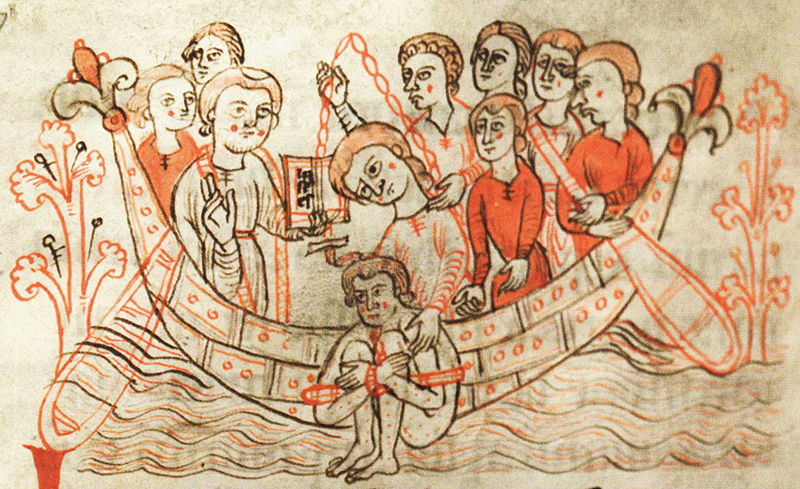


.jpg)

.jpg)

.jpg "\"Thou shalt not deliver unto his master the servant which is escaped from his master unto thee: He shall dwell with thee, even among you, in that place which he shall choose in one of thy gates, where it liketh him best;: thou shalt not oppress him.\"")


,_Sept_22,_1897,_page_6.png "\"Just between us, John, Dad was kind of a racist horndog, wasn't he?\"")

