Recently, congress actually did something. I know, I am as shocked as you are. I was even more floored to learn that what they did was something I was happy about. The house recently passed HR 38, better known as the Concealed Carry Reciprocity Act. This bill, if passed, will provide ‘full faith and credit’ protections provided by the constitution to concealed carry permits. What this means is that your state issued concealed carry permit will be valid in all states, just like your driver’s license and marriage license (SLD fucking state licensing). This of course has causedmuchpant shittingterror in the liberal world, because if enacted, flyover hicks (myself included) would be crawling all over New York, LA, and every other liberal bubble armed to the teeth. It’s one thing to arm criminally negligent illegal aliens or teenage gang members, but that hayseed with a MAGA hat and a Ruger LCR in his pocket is just too much to deal with. Today I want to take a glimpse into the future, a future where concealed carry is the de facto legal standard. Join me while we explore.. TRUMPS AMERICA! (horns blare, title fades to black)
What would be the result of national reciprocity? Defiant hysterical opposition, initially. Those latte sipping snowflakes aren’t going to just smile nervously and let a bunch of heavily armed Nazis march into their cities (insert France joke here). Expect a lot of illegal arrests, a lot of lawsuits, and probably at least one officer involved shooting where he is as guilty as the DNC’s IT staff but gets off cause ‘muh fear for muh safety!’. Eventually the defendants will be found innocent, the unlawful detainment lawsuits will succeed, and the coasts will be brought kicking and screaming to the reality that we do live in the same country. This is where it gets interesting. You see, once the coastal elite realize no one is coming to save them and this is the reality they now inhabit, they are going to have to make a choice: either stick to their guns (pun intended) and insist their path is righteous, or demand to have the same ability to carry concealed as the unwashed horde now terrorizing their city. Knowing what I know about the average progressive and his moral integrity, they will universally choose the latter. I expect to see mobs with pitchforks and torches (since, you know, they don’t have guns) demanding shall issue concealed carry in all of the restrictive states within a few years. Hawaii may be able to hold out, since they are an island and flying with guns is still a pain in the ass, but the rest will fall like dominos.
Then the miracle will happen. Those people on the coasts, the ones that swore to god and their country that national reciprocity would lead to blood in the streets, that Armageddon is nigh, will wake up and realize that they are still alive. Some of them might even find a handgun on their nightstand and a second picture ID in their wallet. And that is when the lie will come crashing down. They will realize that gun ownership is not some mark of the devil, and that carrying a gun doesn’t turn you into a Klansman. It is simply the end result of being a responsible member of society. A society that understands that there are those that exist to exploit and intimidate others for their own personal gain, and at the end of the day you are your own first responder.
Am I being a bit naive in my assessment? Perhaps. Maybe the courts completely disregard the written intent and prior law and declare the bill unconstitutional. Perhaps the police simply ignore the law and the prosecutors look the other way. Maybe the blue states prosecute every defensive shooting so aggressively that carrying concealed is a greater liability than it is worth. But maybe I am right. And if I am, this will be the greatest cultural shift in America in recent history. For the first time in 50 years, guns will become normalized. That is what the progressives truly fear. They have based so much of their rhetoric on othering gun owners, painting them as racists, knuckle draggers, vigilantes, closet murders, that should the curtain be pulled back on this it would be damn near a death blow to their culture war. How can you continue to live the lie of the evil gun owner when your daily existence contradicts that? When your friends and relatives prove you wrong every time you go out to dinner? When random strangers smile and hold open doors for you instead of shooting you dead? You can’t. This is my vision of the future. As a gun owner, and an eternal optimist, I can only hope.
Missed me, didn’t ya? Since we haven’t one in awhile I’ll just do some gun links. Better to ease into it after a long absence.
Remember the SHARE act? Remember how it was going to be the most awesome pro gun bill in history? Remember when Las Vegas got shot to shit? Well, good news! The SHARE act is back! Except it isn’t going to deregulate silencers anymore… it’s gonna ban bump stocks instead! Yay…. wait, WHAT?! What the actual fuck! What kind of stupid party bait and switch is this exactly? Do you want to get firebombed, DC? Cause this is how you get firebombed.
Your weekly nut punch: Record expunged for ex-Tulsa cop acquitted in fatal shooting. Not only does she get to go home safely, but she can find a new job without all of that pesky negligent homicide business muddying up the waters! Still won’t save her from a 10 second google duckduckgo search.
For all my ATF haters out there, SB Tactical is feeling you. They just released two new products designed to work with their stock arm brace that makes it even better as a stock arm brace. Seriously, they aren’t even trying to hide it anymore.
See, this is why only police officers should have guns. They are the only ones calm, responsible, and trained enough to shoulder the burden of safe firearms usage.
Sometimes I like to write stream-of-consciousness posts when I’m procrastinating on more research intensive articles. This is yet another one of those situations. (Crafting a Narrative Pt. 3 will be ready soon)
Let’s have some fun together tearing apart this whole NFL v. Trump shitshow piece by agonizing piece. If we do this right, we’ll trigger literally everybody.
First, let’s address the elephant in the room. The entire frickin kneeling protest is an unorganized shitshow. When Kapernick started kneeling, it was vaguely in support of Black Lives Matter, but even BLM is a fucking mess of intersectional leftism. I’m not going to kill brain cells by going to their website again, but there was shit about ableism and transgenderism last time I went. On top of that, now everybody is kneeling for a thousand different reasons. Some are civil rights LARPing, some are protesting police brutality, some just hate Trump, and most of them have no fucking clue why they’re kneeling except for the fact that it pisses Trumphitler off.
Why the hell are you kneeling during the national anthem? Cops are employees of the state and local governments. They’re not even affiliated with the American flag, let alone somehow symbolizing it .Of course, if you’re smart, you don’t take the kneelers’ stated intentions at face value. The reality is that this protest against “systematic injustice” is really just a bunch of rich idiots being played like marionettes by no-kidding communists. Kapernick is in neck-deep with the commies, and his totalitarian milieu has polluted the NFL as a whole.
Why are you biting the hand that feeds you? We’ll get to the ridiculous reaction from fans in a minute, but it was a quite predictable reaction. Most football fans lean conservative and working class. Most conservative and working class folks are quite patriotic. They tend to either be veterans or know quite a few veterans. Disrespecting the flag is seen by them as pissing on their service and sacrifice. Any idiot can see this dynamic, and any idiot could have predicted the backlash that was created by these overprivileged multimillionaires disrespecting the flag.
It’s virtue signalling at its finest. There’s nothing accomplished by kneeling during the anthem. Not one cop is going to think twice about shooting some black kid just because some NFL player kneeled during the national anthem. Rather, the NFL is sending the message that they play ball with the SJW left. Unfortunately, the SJW left has resoundingly ignored the NFL… y’know because contact sports are icky and boring and not artisanal enough.
What of the boycotters? If there’s anything more pathetic than protesting a symbol that has nothing to do with the supposed object of your ire, it’s the people who are acting offended because other people won’t play patriotism olympics with them. By all means, boycott the NFL if you don’t like the message they’re sending. Hell, I’m watching much less NFL because I’m sick of all the personal interest stories, the “special interest here” month this and that, every other commercial being a PSA for some stupid cause, CTEs, and lefty virtue signalling around every corner (*cough* Bob Costas *cough*). What happened to football being about men in pads hitting one another? At the end of the day, though, respect or disrespect of the flag is a pretty stupid reason to change your entertainment habits. Why?
Because modern patriotic nationalism sucks. I completely get the connection between the flag and the service of our soldiers and veterans. I completely respect their courage and sacrifice. This is why I stand for the national anthem, even though I don’t participate. However, if there’s one thing that gets and eye roll from me in record time, it’s the old tired line of “freedom isn’t free. They fought and died for your freedoms.” Sorry, but when were my freedoms last threatened by a foreign power? Maybe WWII? That’s really stretching it, because the biggest threat to my freedoms in that era was FDR (internment camps, threatening the supreme court if they didn’t rule favorably, etc.). Maybe one could argue that the actions in Afghanistan were preserving our freedoms after 9/11, but again, the Patriot Act, TSA, and DHS are much bigger threats to my liberty than Al-quaeda has ever been. In my opinion, it’s completely appropriate to honor those who fought and died in the name of our nation without bullshitting us by saying that they were “fighting for our freedoms.” If anything, that cheapens their legacy, because it paints a paper thin GI Joe veneer over a much more complicated and difficult situation.
Beyond this, why the hell do we need to sing the national anthem at sporting events in the first place? What a stupid and ridiculous tradition that is! We don’t sing the national anthem before music concerts or starting the workday or before the movie starts at the theater. The idolatry that passes as patriotism these days would have the founding fathers rolling so hard they’d power the entire country’s electric grid.
Speaking of violently spinning founders, let’s talk about the bullshit that is both sides of the police brutality argument. On one side, you have the SJWs and civil rights LARPers who think this is Birmingham in 1958. On the other side, you have law & order conservatives who think this is Mayberry in 1965. Both are laughably wrong, but there’s no adult in the room to tell them to stop being idiots.
Cops aren’t heroes, at least not all cops are heroes. Cops are not tyrants, at least not all cops are tyrants. I’m not a strict individualist. I believe that you can assign generalities to individuals of a group. However, I think that you have to pursue such generalizations very carefully. By and large, people apply generalities too strongly and too broadly. That is the case here, as well.
The BLM agitators are notorious for swinging and missing every. single. time. Trayvon Martin? *whiff* Michael Brown? *pbfffft* The few cases that were actually open and shut abuse cases were completely ignored by BLM. Why? Because their end goal isn’t ending police abuse. Their end goal is stirring up racial strife in order to elevate their political (and financial) clout.
Cops aren’t walking targets in urban areas. Despite what some would have you believe, most folks don’t get their rocks off by taking pot shots at pigs. Save for one major incident, and a handful of one-off incidents per year, most people who have an issue with cops simply try to run away. This aura painted by the right of embattled cops struggling to make it home to their wives and 2.5 kids is completely made up.
Questioning the motives of cops is very patriotic. Police are armed enforcers of the state. They do good things (like handling outlaws), but they’re also the single quickest path to authoritarianism. The rapid militarization of police over the past 2 decades, paired with lax due process protections and highly aggressive tactics has turned policing from an Andy Taylor/Barney Fife context to a wannabe soldier context. The conservatives are happy to play along, grouping “first responders” with veterans in the exalted ranks of “heroes” to be honored with the flag.
Before this gets too long, I’ll wrap it up with a few quick hits.
If cops were heroes, they’d be held to a higher standard than the public. Instead, they’re held to a lower standard.
Qualified immunity has been abused and distorted to cover a cop’s every action. If it were “right sized,” any escalation by the cop would fall outside of qualified immunity.
The fact that BLM and other civil rights griefers are even treated as legitimate shows how absolutely fucked up our media is.
If the NFL players wanted to kneel before the thing that destroyed the black community, they’d find the nearest Medicaid office and kneel there. Then they’d join Antifa in tearing down all the LBJ statues.
Nothing about the treatment of urban blacks is going to change until their culture changes. Holding police accountable for their overreaches isn’t going to fix the “systematic” issues. Only a massive cultural shift will do that.
The NFL and Goodell are utter dumbasses. They should’ve nipped this in the bud a year ago, but they were sympathetic with Kapernick, and now they’re getting their asses bit for it.
Notice I haven’t even mentioned Trump’s or Pence’s reaction. That’s because they have nothing substantive to add to the conversation. They’re charlatans playing the controversy for political points.
One of the questions I often ask myself (other ‘can I afford a new gun?’ and ‘Is she over 18?’) is: Why do statists hate poor people? Time and again we see how their policies disproportionately affect poor people in increasingly negative ways. Case in point: I have an internet buddy from Australia. Being Australian, he is predictably progressive, but he is the rare breed of progressive that agrees to disagree on certain political issues, so even though he hates guns and knows that I love them, we can still get along without him calling me a baby killer. I was talking to him once about various aspects of shooting, and I mentioned offhand how expensive guns and ammo have become. He responded that he would hope that guns and ammo are expensive. I asked him point blank: Should poor people not be allowed have guns? His response was a rather terse and unapologetic ‘no they should not’. And just like that, we get to one of the hidden pillars of gun control: Elitism.
While the racist roots of modern gun control stemming from post reconstruction Jim Crow laws are fairly well documented, the class warfare elements are usually glossed over or hand waved away. This is true for the ‘may issue’ concealed carry permits in places like New York and Maryland which are only accessible to the rich and powerful, but it is even more stark when you look at the case of ‘Saturday night special’ laws. For those unaware, ‘Saturday night special’ is a slang term for inexpensive mass produced and usually low caliber handguns. Such guns were very popular among the poor, especially among working class black families in high crime neighborhoods. Obviously, we can’t have affordable firearms for black poor people, lest they wander off the plantation and find a sense of agency along the way. Thus, the anti-gun politicians went after these guns under the dubious claim that criminals were using them as burner guns at a disproportionately high rate. In point of fact there is no actual basis to this claim, but why let facts stand in the way of good old fashioned civil rights infringement. The gun control act of 1968 (back when people named their bills honestly) specifically banned these cheap imports by implementing a points system requirement for imported handguns based on size, caliber, and a host of other useless and outdated features. Fun fact: imported Glocks cannot pass the import system in their factory configuration. The ones built in Austria for import to the US (which I assume is all of them) are equipped from the factory with expensive target sights, which are removed and replaced with the standard combat sights after they make it stateside. This is also why many smaller imported pistols have ridges on their triggers. Apparently the ridges make them ‘target triggers’ which give them enough points to pass importation. Same goes for those beloved finger grooves on the smaller Glocks. They are ‘target grips’ required for importation. No, I am not making a word of this up, in case you somehow think that gun control laws could not actually be this arbitrary. Oh, and government agencies are exempt from these restrictions, of course, because no real gun control law is complete without a hefty side order of cop carve outs.
What? Criminals don’t obey the law? Not even gun control laws?
The effects of these laws on the underprivileged cannot be understated. A criminal does not care about the price of a gun. He can barter for one using drugs or other contraband. He can obtain them from criminal associates. He can simply steal one from an empty house or unattended vehicle. A poor law abiding person cannot, or more precisely will not, engage in these sorts of activities, and therefore is simply artificially priced out of the market. There was even a study done that shows that mid and high priced guns are more common as crime guns than cheap burners. Apparently criminals shop for quality and caliber over price. The purpose of these laws are simple: keep the proles disarmed and unable to fight back against their betters. The ruling class would rather have the poor defenseless in the street against criminals and their own corrupt police than allow them to defend themselves and risk a riot or power struggle.
Good thing such a blatant and obvious infringement would surely attract the attention of the various professional victims minority empowerment organizations who would immediately oppose and dismantle such a racist, elitist law, wouldn’t it? You bet it would! In 2003, the NAACP filed a federal lawsuit over the availability of handguns to minority communities. Oh wait, silly me! They filed suit against a number of firearms manufacturers for making and selling so called ‘Saturday night specials’ to minority communities. Huh… kinda went the other way with that one. Surely the NAACP values the self defense rights of minorities over oppressive disarmament schemes? I mean, it’s not like the NAACP is completelymorallybankrupt or anything, right?
Item originally published here. Republished with author’s consent.
Not Robert E. Lee.
Let me say up front I am not a Nazi, a white nationalist, or a sympathizer of them. I am a military history buff who knows a lot about the Civil War and am firmly pro-union and very unsympathetic to the southern cause. I don’t buy a word of the lost cause or other mythologizing of the old south. So, anyone reading this can please not waste their time accusing me of being a white nationalist or confederate sympathizer. I am most certainly not.
Second, before we get onto the important work of using the events of yesterday to slander our political enemies, I think we might want to at least look at the facts as we know them. The facts are, as best I can tell, as follows. A white nationalist organization known as Unite the Right decided to have a national rally in Charlottesville, VA, to protest the removal of the city’s Robert E. Lee statue.
After months of work and hype on social media, Unite the Right managed to get 200 marchers to show up in Charlottesville Friday. On Friday night they marched around with tiki torches and waved flags without incident. On Saturday a group of Antifa counter protesters showed up. The counter protesters proceeded to attack the Unite the Right Marchers and a riot broke out.
According the the Virginia ACLU, the Charlottesville police stood down and did nothing to control the situation. During this riot, a supporter of the march, it is unclear if he is a member of any of the organizations there, slammed his car into a crowd of counter protesters, killing one person and injuring 19 others. It is unclear if the driver had planned to do this to any counter protesters before the march or if he just took the riot as an excuse to do it.
Those are the facts as we know them currently. What they mean can be debated. Any debate about this subject should be based upon facts, not assumptions or hasty generalizations. What can we reasonably conclude from the known facts? Three things, I think.
First, the white nationalist movement is still the same small, insignificant movement it always has been. Despite months of hype and work, the Unite the Right rally drew 200 people. The white nationalist KKK movement has been able to draw a couple hundred people at a national rally for my entire lifetime. So let’s stop with the nonsense about this being some significant rally or that the white nationalists are any more popular or emboldened today than they ever have been. They are not. It’s the same small group of morons that have always been there. The proof of that is in the numbers. If there had been 10,000 people at that rally, I might reconsider that. But there wasn’t.
Second, what played out yesterday in Charlottesville is just a repeat of what happened in Berkeley, Middleburg, NYU, and other places over the last year and a half. Some group Antifa finds objectionable has a speech or a rally. Then Antifa shows up and starts assaulting people and the police stand down, let them do it, and let the riot happen. That is exactly what happened yesterday. It should surprise no one that one of these riots has now resulted in someone’s death. The fact that the death was the result of the actions of the enemies of Antifa, rather than Antifa itself, changes nothing. This was going to happen eventually.
Third, this is exactly what Antifa wanted. Their plan is always to attack their enemies hoping they fight back and then get blamed for the resulting violence. And time and again the police let them do it. Every time some self-righteous writer like David French gets up and talks about this being the result of the “alt right,” whatever that is, they are doing nothing but emboldening Antifa and encouraging this to happen more in the future.
You want this stuff to stop, and you should, don’t waste your time virtue signaling about the dreaded Virginia Nazis. They are an insignificant group that are defended by no one and whose only use seems to be to allow Democrats and writers like David French to slander their political opponents. Prosecuting and condemning the person who did this is an essential start. But you can’t undo the harm he did and you can’t deter or prevent the actions of truly violent people.
What can be done is to hold local police accountable for doing their jobs and preventing situations like the one in Charlottesville from happening in the first place. As the President said, the solution to this is for police to restore law and order. There are no other answers or deeper lessons here. It is just that simple.
Editor’s note (8:32 pm central): there are several people involved at Glibs. I took it upon myself personally and without discussion to post this article. I thought it was well-written and would provoke a respectful and engaging discussion from the readers. It is in no way the consensus opinion of everyone involved and shouldn’t be considered such. -sloopyinca
Yeah, I don’t have a whole lot to cover this week either. I still haven’t gotten to try my new gun (although with any luck I will have by the time you read this) so I can’t talk much about that, and nothing particularly noteworthy has popped up this week that I can devote a whole topic to, so I’ll be doing more firearms links. At least these one’s are actually worth talking about.
Okay, which one of you idea stealing fuckers set this website up? I thought we had a deal!
better than the last time there were German rifles walking around Paris.
I want to talk quickly about a serious topic for a bit. There have been some high profile cases lately in which police officers have shot suspects under less than justifiable conditions and ended up found not guilty after a trial. The two that most readily spring to mind are Philandro Castile and Terrence Crutcher. My personal opinion is that both of these shooting were not justifiable, and while they may not constitute outright murder I would not hesitate to label these as involuntary manslaughter. The thread tying these two cases together is that both of the victims were either high or at least regular drug users (Crutcher tested positive for PCP while Castile tested positive for THC). A very disturbing trend I have noticed on my gun blogs (which in general run on the conservative side) are that these people somehow deserved their fate because they were drug users and therefore criminals. I get very bent out of shape when I hear people suggest that using drugs somehow justifies being murdered by a police officer because you violated a minor traffic law. It’s particularly maddening when very pro gun people, nearly all of whom carry a concealed handgun everyday, justify Castile’s shooting on the basis of ‘well he’s a drug user then by definition he’s not a legal concealed license holder’. And yes I have heard these actual arguments out of gun owners. It’s really put me off from the usual gun blogs as of late. I don’t have an answer to these problems, but it really sobers you up on the reality of traditional conservatives opening up their views on drug decriminalization.
“No state shall make or enforce any law which shall abridge the privileges or immunities of citizens of the United States…” – Fourteenth Amendment, U. S. Constitution
“No person shall be held to answer for a capital, or otherwise infamous crime, unless on a presentment or indictment of a grand jury, except in cases arising in the land or naval forces, or in the militia, when in actual service in time of war or public danger…” – Fifth Amendment, U. S. Constitution
We saw in Part One how, according to the Supreme Court, the Fourteenth Amendment doesn’t require the states to obey the grand-jury clause of the Fifth Amendment. Most of the Bill of Rights has been applied to the state – “incorporated” is the technical term – but not this part.
(In its incorporation cases, the Supreme Court likes to talk in terms of “due process,” but here’s Justice Clarence Thomas explaining how the Privileges and Immunities Clause is what we should be looking at.)
For the most part, when the U. S. Supreme Court exempts the states from part of the Bill of Rights, most states don’t take advantage of this. With some exceptions, the states chose on their own to obey the Bill of Rights, even when the Supremes wouldn’t hold them to it – state courts would sometimes interpret some rights differently than the federal courts, but they admitted the rights were applicable, if only as a matter of state law.
That’s not the case with the grand-jury clause. Here, the Supremes opened the door for the states to disobey this clause, and the states rushed through the open door.
Between the Civil War and the end of the First World War, many American states amended their constitutions so that suspects could go to trial for serious crimes without the approval of a grand jury (Michigan had started the ball rolling on the eve of the Civil War). This analysis summarizes the situation as of 2014. In most cases, grand juries were kept in reserve in case the prosecutors, in their discretion, wanted to use the grand jury procedure. Only two states – Pennsylvania and Connecticut (I would probably add Michigan) – banned grand juries even as an option (apart from extraordinary cases). Twenty-three holdout states still mandated that certain serious crimes be reviewed by grand juries, at least if the suspect demanded it.
Rather than give a comprehensive history of the victories of “reformers” who curtailed grand-jury rights in state after state, let me attempt to give some historical vignettes, and tie these vignettes together with some semblance of narrative coherence. Then later, I’ll give an account of the triumph of the reformers in their battle against the grand jury.
The Plessy Judge vs. Grand Juries
U. S. Supreme Court Justice Henry Billings Brown came to the Court too late to take part in the Hurtado case, which said the states could limit or abolish the right of a suspect to have his case considered by a grand jury. But Brown was one of the many would-be reformers of that era who wanted the institution of the grand jury largely abolished.
Justice Henry Billings Brown
Brown gave a speech to the Ohio Bar Association in 1892 that included the judge’s discussion of this issue. Getting rid of grand juries, said Brown, would make criminal procedure more simple and efficient. Brown noted that he had begun his legal career in Connecticut, where grand-jury indictments were only required for crimes punishable with death or life imprisonment. Then Brown boasted of his fifteen-year legal career in Michigan (1860-1875), where grand juries were rarely used and were never required before a defendant could be brought to trial.
Brown suggested that grand juries may have been necessary in England to protect suspects against false charges by private accusers, but this problem didn’t exist in America. In America there were public prosecutors to bring charges and judges to rule on probable cause, and with these steadfast public servants on the job, Brown triumphantly concluded, grand juries were no longer necessary to shield suspects from wrongful accusations.
Brown went on to praise trial juries for their power of nullification – they could spare a guilty defendant, if punishing him went against local community norms. Of course, grand juries could perform that function too, sparing worthy but technically guilty suspects from the ordeal of a trial, not to mention saving them many legal expenses. That did not seem to occur to the Justice. “I think the question whether a man in a particular case should be punished for a crime is a question that is properly left to the public,” Brown said. But under Brown’s scheme, the nullification of an unfair charge would have to wait until the end of an excruciating trial for the suspect, since “the public” would only be able to get a word in edgewise after the trial was over. The public would be kept out of the decision of whether to bring charges in the first place.
Another defect in Brown’s logic is apparent with the growth of the plea-bargaining system, which requires a defendant to gamble on the possibility of a higher sentence if he wants to try his luck with a trial jury.
Brown concluded his speech with a boast that “[t]he Anglo-Saxon is a slow-moving race, but it rarely takes a step backward. It makes mistakes, but its progress has been in the right direction. No serious mistakes have yet been made.”
Speaking of serious Anglo-Saxon mistakes: four years after his speech, Brown again showed his ability to have things both ways and to spin nice-sounding legal theories which were oppressive in practice. Brown gave the Supreme Court’s decision in Plessy v. Ferguson. States could pass Jim Crow legislation separating blacks and whites, Brown’s opinion declared, so long as the separate facilities were “equal” (Justice John Marshal Harlan dissented in the Plessy case – Harlan had also defended the right to a grand jury in his dissent in the Hurtado case). Brown had affirmed the importance of equal protection under the law, while negating this principle in practice with his endorsement of racial segregation. In a similar manner, Brown had praised trial juries for their power of nullification, while calling for the abolition of grand juries which were in the best position to nullify charges against a suspect before he could be dragged through the court system.
Plaque on Homer Plessy’s tomb, New Orleans
Grand juries as scapegoats for police abuse
The fact that one of the most infamous racists in American judicial history wanted to abolish grand juries hasn’t stopped modern, hip and woke activists from throwing the racism charge at grand juries themselves.
In Minnesota, a proposed state constitutional amendment on the 1904 ballot would abolish the right to a grand jury and empower the legislature to decide how prosecutions were to be initiated – and it was correctly anticipated that the legislature would allow the elected county prosecutors to bring charges without grand jury approval. This concerned an anonymous “Voter,” who wrote to The Princeton Union to warn against the amendment. This voter was more skeptical about the professionalism of prosecutors than Justice Brown had been:
The grand jury is a body of citizens who are selected regardless of political belief or creed….[T]he law throws around them secrecy in their actions and they are entirely removed from all political taint or influence. It very often happens that county attorneys are not men wholly competent to exercise powers ordinarily delegated to a grand jury. Much of our politics is run on the “good fellow” plan and sometimes men are kept in office for being good fellows or for various reasons, regardless of qualifications or fitness for office….[County attorneys] are human and to say that their judgment in a case would be as good as as that of the members of a grand jury would be to make an extravagant statement.
The “good fellow” plan
A majority of Minnesotans went ahead and approved the amendment despite these arguments, and the legislature proceeded to give county attorneys the option of bringing charges without using grand juries. Grand juries would still be held in reserve if the prosecutor wanted to employ them, but suspects would no longer have the right to have their cases considered by grand juries. The optional system necessarily gives grand juries a bad odor – prosecutors who use grand juries when they don’t have to do so are often hiding behind the grand jurors’ skirts in order to pass the buck for controversial decisions. And sometimes the public falls for it.
In 2015, two Minneapolis cops confronted and shot Jamar Clark, who died of his injuries. The fact that Clark was black made the issue particularly volatile. Protesters demanded that the county attorney, Mike Freeman, investigate the shooting without involving a grand jury. Freeman had this option thanks to the voters’ decision back in 1904.
Minneapolis protesters in the Clark case
The protesters got their wish. Freeman announced that his office would no longer use grand juries when investigating shootings by police. The president of the Minneapolis NAACP, Nekima Levy-Pounds, said:
I am overjoyed that in this instance Mike Freeman decided to do the right thing. Mike Freeman is fully aware that the grand jury process has been ineffective here and nationally in holding officers accountable. I believe sustained community pressure played a huge role in Mike Freeman’s decision.
Then Freeman, without the help of a grand jury, announced he wouldn’t be bringing charges. The omission of a grand jury didn’t placate the protesters. An NAACP spokesperson (not Levy-Pounds) said, “You, Mr. Freeman, did not give a fair and accurate portrayal…and let me tell you: If the city burns, it’s on your hands.”
Last I heard, Minneapolis was still standing, though the shooting did provoke some protests. Nevertheless, cutting the grand jury out of the loop in the Clark case didn’t ease community tensions, or lead to charges being filed (assuming for the sake of argument that charges ought to have been filed).
The opposition to grand juries was exacerbated when a grand jury in Missouri failed to charge Officer Darren Wilson for shooting Michael Brown. The grand jury’s decision sparked riots. But the Obama/Holder Justice Department, examining the evidence against Wilson, also decided not to bring charges, and there was no grand jury involvement in that decision. So a grand jury took the rap for taking the same position on a racially-charged police shooting as the country’s two top-ranked race-baiters.
(Click here for an article about a controversy over using grand juries in police-abuse cases in California.)
Grand juries came first
The grand jury system was itself created through the actions of a would-be reformer, Henry II of England. The ruler who encouraged St. Thomas Becket’s assassination…
…was not a civil libertarian, but he “built better than he knew” in creating the grand jury. Henry was thinking more in terms of law and order when he decreed that panels of his subjects would be summoned and commanded to report about crime in their localities. What Henry wanted was to root out criminals who had managed to evade justice. Before Henry’s decree, bringing alleged criminals to trial in the secular courts required a private accuser to voluntarily come forward, risking punishment if he failed to prove his charge – and risking retaliation from the criminal. Henry knew that there were criminals running around who were known to the general public, but not known to the courts, since nobody had the guts to make a formal accusation. Not to mention that England was an occupied country whose rulers spoke a foreign language (French) and might not be au courant with the news circulating among their English-speaking subjects.
So Henry II’s early versions of grand juries were required to name people in their area who were believed by the public to be guilty of serious crimes. The grand jurors were not making their own investigations or reaching their own conclusions, but were reporting what was widely believed among their neighbors. Malicious local gossip need not be reported – just the solid consensus of public opinion.
King Henry, the scourge of the Church, was actually adapting a procedure used in England’s Church courts. The Church’s jurists and reformers borrowed from Roman law the maxim that the public interest required crime to be punished. This was in contrast to the Germanic idea of using the justice system to mitigate blood feuds. The descendants of the Germans who conquered the Western Roman Empire wanted people who had mortal grudges against each other to resolve their differences without dragging entire clans into Hatfield/McCoy style, multigenerational cycles of reprisal and counter-reprisal. So if angry relatives came seeking an alleged murderer, the matter would be settled with a trial by battle (if the feud was among aristocrats) or by some form of ordeal (if the feud was among the lower orders) – putting your hand on a burning piece of iron, getting thrown in water to see if you floated, trying to swallow a morsel of bread after boasting of your innocence (choking=guilt). If these methods didn’t identify the criminal with 100% accuracy, at least it was an agreed-upon method, presided over by priests, to settle the feud and move on. And if a crime didn’t spark a feud, or if the victim or their would-be champions were too weak, then it was like “OK, forget about it and let’s have some more mead.”
The Church’s reformers noticed that a lot of crime was overlooked in this way, and that trial procedures left something to be desired in terms of accuracy. So the Church courts, at least in England, came up with a procedure which seemed to inspire Henry II. Instead of waiting for a private individual to take the initiative and prosecute, the Church’s judges would identify a suspect and summon a panel of the suspect’s neighbors to see if public opinion regarded the person as a criminal. If the community wasn’t fairly solid in believing that the suspect committed the crime in question, that was the end of the matter – or rather, any crimes would have to be settled in the “internal forum” (the confessional). But if the community witnesses were like, “yeah, everyone thinks he did it,” then that counted as “fama” – the equivalent of a formal accusation – and a trial would begin.
King Henry thought that was a good idea, so he created his early version of the grand jury to report to the secular courts about those people whom local public opinion identified as serious criminals. If a person was so reported, the accused would undergo an ordeal – apparently the throw-them-in-water-to-see-if-they-drown ordeal – because the criminal trial jury hadn’t been invented yet. Yes, in criminal cases there was only one jury, and that was the ancestor of the grand jury – and unless you put your reliance in the cold-water ordeal, you better hope that public opinion, as reflected by the grand jury’s accusation, was accurate.
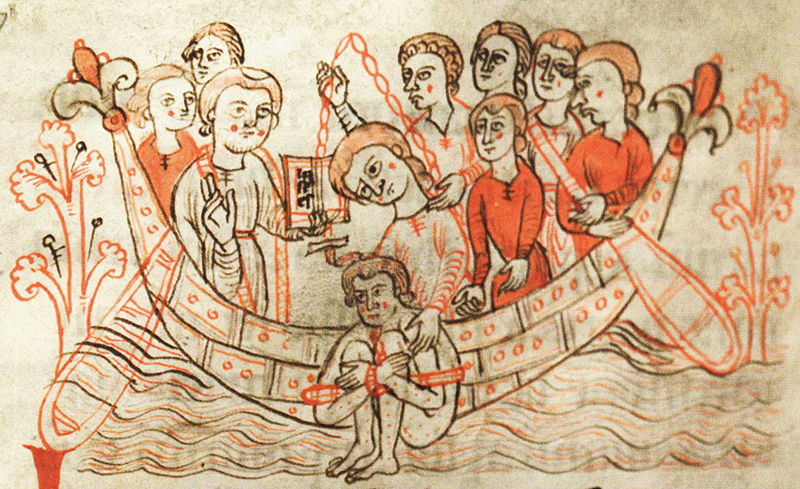
“So if the water receives my body, I’m innocent? And if I float, I’m guilty, and you execute me? It’s a good thing the grand jury correctly identified me as the murderer, otherwise I’d be really annoyed at this whole procedure.”
The creation of the English criminal jury was kind of forced on England by the Church. The Fourth Lateran Council in 1215, decided that priests should not preside at ordeals – because priests shouldn’t be shedding blood and because ordeals were not always reliable anyway. Without priests to bless the water ordeal, the practice fell into disuse, and so the English started using trial juries to decide the guilt or innocence of people who had been charged by grand juries with serious crimes.
Another important decision of the Fourth Lateran Council was in clarifying how church courts would go about ascertaining whether a suspect had a reputation as a criminal, so that the court could proceed in the absence of an individual accuser. It wasn’t enough if the rumors against the suspect were generated by “enemies and slanderers” – the public accusations had to come from “prudent and honest persons, not once only, but often.” Commentators gave Biblical examples: the clamor against the sinners of Sodom and Gomorrah, which prompted God to investigate (Genesis 18:20), and the complaints against the steward in Luke 16:1, which prompted the master to demand an accounting from the steward.
Since the creation of secular grand juries in England had probably been prompted by church-court procedure, it is not surprising that grand juries, acting on the same principles as the Fourth Vatican Council, undertook to distinguish between true and false public opinion. As the grand jury evolved, it came to do its own investigation, not simply reporting what their neighbors believed. Grand jurors were becoming the representatives of responsible public opinion by acting as “prudent and honest persons” and seeking reliable evidence about suspects.
But at least people who were accused by grand juries could now look forward to a full trial by another jury, not simply an arbitrary procedure like the water ordeal where one prevails only through blind good fortune. Even today, a small proportion of those who are indicted by grand juries go on to have their cases heard by a trial jury (the rest, of course, resolve their cases by plea-bargains, where the result totally isn’t arbitrary).
Works Consulted
Bab(b)ington Family – Descendants of John de Babington, http://members.iinet.net.au/~billeah/babingdesc.html
Henry Billings Brown, “Justice Brown’s Address,” in Proceedings of the Ohio State Bar Association, 13:35-51 (July, 1892).
Rebecca V. Colman, “Reason and Unreason in Early Medieval Law,” Journal of Interdisciplinary History, 4.4 (Spring, 1974), 571-591.
Nathan T. Elliff, “Notes on the Abolition of the English Grand Jury,” Journal of Criminal Law and Criminology, Volume 29,Issue 1 (May-June) Summer 1938.
Richard M. Fraher, “The Theoretical Justification for the New Criminal Law of the High Middle Ages: ‘Rei Publicae Interest, Ne Crimina Remaneant Impunita’” (1984). Articles by Maurer Faculty. 1854.
http://www.repository.law.indiana.edu/facpub/1854
Richard. H. Helmholz, “The Early History of the Grand Jury and the Canon Law,” 50 University of Chicago Law Review 613 (1983), online at http://chicagounbound.uchicago.edu/cgi/viewcontent.cgi?article=2484&context=journal_articles
Finbarr McAuley, “Canon Law and the End of the Ordeal.” Oxford Journal of Legal Studies, Vol. 26, Issue 3, pp. 473-513, 2006.
Kenneth Pennington, “Introduction to the Courts,” in Wilfried Hartmann and Kenneth Pennington (eds.), The History of Courts and Procedure in Medieval Canon Law. Washington, D. C.: Catholic University of America Press, 2016.
“Proposed Amendments to the Constitution of Minnesota,” Cook County Herald (Grand Marais, Minn)., Oct. 22, 1904, p. 8, column 1.
“Shall we abolish the grand jury,” The Princeton union, October 06, 1904, p. 3, column 2, http://bit.ly/2strpg7
Suja A. Thomas, The Missing American Jury: Restoring the Fundamental Constitutional Role of the Criminal, Civil, and Grand Juries. New York: Cambridge University Press, 2016.
___________, Nonincorporation: The Bill of Rights after McDonald v. Chicago, Notre Dame Law Review, Vol. 88, 2012.
Richard D. Younger, The people’s panel: the Grand Jury in the United States, 1634-1941. Providence, RI: American History Research Center, Brown University Press, 1963.
“The right of the people to be secure in their persons, houses, papers, and effects, against unreasonable searches and seizures, shall not be violated, and no Warrants shall issue, but upon probable cause, supported by Oath or affirmation, and particularly describing the place to be searched, and the persons or things to be seized.”
That said, how did the beginning of this destruction happen? There are 3 things in play here: seatbelt laws, the drug war, and the erosion of the protections of the 4th amendment. Beginning June 30th, Arkansas’ seat belt law changes to permit a law enforcement traffic stop based on the primary violation of a motor vehicle driver or front-seat passenger who is not buckled-up.
You’re not from ’round these parts, are you?
What this means is that a police officer may stop any vehicle that he claims to observed an unbuckled driver or front seat passenger. This adds to the nearly infinite list of reasons for being stopped that already exist. It also serves as a good way to generate revenue for a department. My state (Arkansas) resisted making seatbelt violations a primary offense for many years. However they caved, in June of 2009, under federal pressure and a threat to withhold DOT funding if the legislature didn’t pass the law. I guess that’s the price you pay when you accept federal dollars. You must bow down to federal demands.
You know how a regular person can get a DUI even if they test out below the minimum BAC? Apparently a Chicagoland cop is immune from that even when he runs over and kills someone. Hell, even when he was said to be intoxicated by witnesses pre- and post-accident. Which reminds me: if you’re ever pulled over, don’t blow.
Not a real photo of Raoul Berger – scroll down and click his name to see a real photo
Charles Jones and C. A. Cecil were Jehovah’s Witnesses from Mount Lookout, West Virginia. On June 28, 1940, they came to the nearby town of Richwood. Richwood’s dominant local industries relied on harvesting the high-quality (or “rich”) wood from local forests. Jobs working wood and coal helped swell Richwood to about 4,000 inhabitants. That represented a lot of doorbells to ring and souls to save. Simultaneously with spreading their spiritual message, Jones and Cecil wanted to get signatures on a petition against the Ohio State Fair, which had cancelled its contract to host a national convention of Witnesses.
Downtown Richwood, West Virginia, 2006
Under the dictatorial direction of their boozy but efficient leader, Joseph Franklin Rutherford, the Jehovah’s Witnesses had become a society of evangelizers. All members were required to spend time spreading Christian truth to their neighbors (in time which they spared from their day jobs). Basically, as many people as possible needed to be rescued from the diabolical world system, dominated by evil governments and the “racketeering” clergy of other religious groups. The end times were imminent, or had already arrived – the exact details changed with time, but the urgency of the situation did not change. Witnesses had to descend on communities like “locusts” – Rutherford’s term – and turn people to God’s ways.
The true nature of the current wicked system must be made clear in publications, speeches, and even phonograph records. Certain sinful behavior must be shunned. In 1935, Rutherford had made clear that saluting the U. S. flag was idolatry – Rutherford compared it to the Nazi salute. (To be fair, until the end of 1942, the American flag salute was uncomfortably similar to the Nazi salute – and German Witnesses were killed or put in concentration camps for their defiance.) Young Witness men must not sign up for the draft because all Witnesses – not just the leaders – were ministers and entitled to the draft law’s exemption for clergy.
In World War I, before Rutherford took over, the antiwar teachings of the Witnesses (then called Bible Students) had been so provocative that it was persecuted in many countries including the U.S. And as a new world war was underway, Rutherford had ratcheted up the confrontation between his group and the forces of mainstream American society. A new era of persecution was dawning as mainstream American fought back in often-ugly ways.
Jones and Cecil were picked up by the police, who took them to state police headquarters, where cops and members of the American Legion (a nationalistic veterans’ group, more militant at the time than it is today) interrogated them. Martin Louis (or Lewis) Catlette was a twofer, a Legionnaire and a deputy sheriff. This sort of overlap between American Legion vigilantes and law enforcement was common in the attacks on the Witnesses.
Catlette and others accused Jones and Cecil of being spies and Fifth Columnists and gave them four hours to get out of town. The two Witnesses returned to Mount Lookout, but came back to Richwood the next day, June 29, with seven more members of their sect.
Their enemies were waiting. The Legionnaires had searched the boarding house where Jones and Cecil had stayed, finding some very suspicious items, like maps (of homes the Witnesses intended to canvass), and literature about refusing to salute the flag or serve in the military. It was time to teach these subversives a lesson.
Catlette and his Legionnaire friends got the Witnesses together in the Mayor’s office, holding them prisoner there while Richwood Chief of Police Bert Stewart guarded the door. Catlette took off his badge, proclaiming that what he was going to do would be as a private citizen, not as a law officer.
A local doctor was among the Legionnaires, and he was not very mindful of the Hippocratic Oath. He brought some castor oil, which the mob forced the prisoners to drink.
Castor oil was then considered a useful medicine for intestinal distress if administered in small doses. If given in large doses, as in this case, it induces severe diarrhea. One of the Witnesses, who got an extra dose because he tried to resist, had bloody urine.
Forced dosing with castor oil had a notorious history. Mobs in Fascist Italy often poured castor oil down the throats of political opponents or people suspected of anti-social activities, as a humiliating lesson for anyone who dared resist fascism.
The Witnesses’ ordeal was not over. Catlette and his associates tied the Witnesses’ left arms together and paraded their prisoners through the streets and tried to force them to salute the U. S. flag (with their free arms). Then the vigilante mob marched the Witnesses to their cars, which had been vandalized, and ordered them out of town again.
Incidents like this were erupting throughout the country. The Germans had just overrun France and the Low Countries, and the public was on high alert for “Fifth Columnists” – Nazi agents undermining morale in preparation for an invasion. The Witnesses aroused suspicion because of their aggressive proselytizing, their vehement denunciation of the government (and every other religion but their own), and their refusal to salute the flag. The U. S. Supreme Court had just issued an opinion that public schools could force Jehovah’s Witness pupils to salute the flag (an opinion the Court would overturn three years later, saying compulsory flag-salutes violated the Witnesses’ freedom of religion). As in many countries, both Allied and Axis, the Witnesses were considered as a subversive influence and persecuted as such.
Attorney General Francis Biddle, in 1941, publicly denounced the “cruel persecution” of the Witnesses, but his Justice Department didn’t seem to be acting against the persecutors. Indeed, the feds didn’t mind doing some persecuting of its own, prosecuting Witnesses for resisting the draft.
(And after Pearl Harbor, there was the persecution of Japanese-Americans, as well as of the prosecution of certain critics of the war – but we’re getting away from the subject, which is how concerned the U. S. Justice Department was about the rights of minorities.)
You might say that the Goddess of Justice was disarmed
In West Virginia, the local federal prosecutor, Lemuel Via, recommended against bringing charges in the Richwood case. The recently-formed Civil Rights Section of the Justice Department pressed for prosecution. By 1942, the Civil Rights Section had won out, and Via was instructed to take the case to the grand jury. Via asked the Justice Department to send one of its lawyers to assist him. This would show “that this case was being prosecuted by the Department of Justice, rather than the United States Attorney.” In other words, Via wanted to signal to the community that if it were up to him, he wouldn’t be harassing the local patriots simply for giving the Witnesses what they deserved.
So the Justice Department sent one of its recent hires, Raoul Berger, to help Via out and take the responsibility off of him.
Raoul Berger was born in 1901 in a town near Odessa, now in Ukraine but then in the Tsarist Russian Empire. The Berger family was Jewish, and there was lots of anti-Semitic agitation in the empire. Also, according to Raoul’s later recollection, his father Jesse predicted (correctly) an impending war between Russia and Japan.
So it was time to emigrate. Jesse came to the United States in 1904, initially, perhaps, without his family. In 1905, Russia experienced the predicted war with Japan, a revolution, and an anti-Jewish pogrom in Odessa.
A Jewish shop destroyed in the Odessa pogrom, 1905
This may have reinforced Jesse’s wish to bring his wife Anna, little Raoul, and his sister Esther, to the United States, which Jesse did no later than 1907 (if he had not done it already).
Jesse worked as a cigarmaker in the West Side of Chicago. He wanted his son to study engineering, but Raoul was taken with music. Raoul acquired a violin, learned some gypsy tunes, and began more formal musical studies under a private tutor. After he got out of high school, Raoul went to New York City to study at the Institute of Musical Art, now Julliard. His teacher was Franz Kneisel, a rigorous and stern instructor. Raoul later reflected on how, in studying the violin, he learned “patience and rigorous attention to detail,” which stood him in good stead throughout his life.
After an unsuccessful sojourn in Berlin to study under Carl Flesch, Berger came back to New York to finish his studies with Kneisel. Then it was on to Philadelphia to play violin for the Philadelphia Orchestra. The conductor was Leopold Stokowski, whom Berger recalled as vain and insufferable, albeit a genius.
Leopold Stokowski
Berger lasted a year under Stokowski, and then went to Cleveland to become second concertmaster of the Cleveland Orchestra, under Artur Rodzinsky.
After two years at this job, Berger got a position in Cincinnati as associate concertmaster to the conductor Fritz Reiner. With three others in the orchestra, Berger formed the Cincinnati String Quartet. In Berger’s telling, Reiner was dictatorial without the compensating advantage of genius like Stokowski.
Fritz Reiner
Around this time, Berger stopped being a professional musician and started looking around for another line of work. Berger’s son Carl, in a brief account of his father’s musical career, suggests that there may have been financial considerations: Berger’s new wife was the daughter of a big-shot doctor, and Berger may have wanted to give his bride a better lifestyle than a Depression-era violinist could afford. By Berger’s own account, the problem wasn’t money, but the dictatorial conductors he worked under, which led him to reconsider his musical career choice.
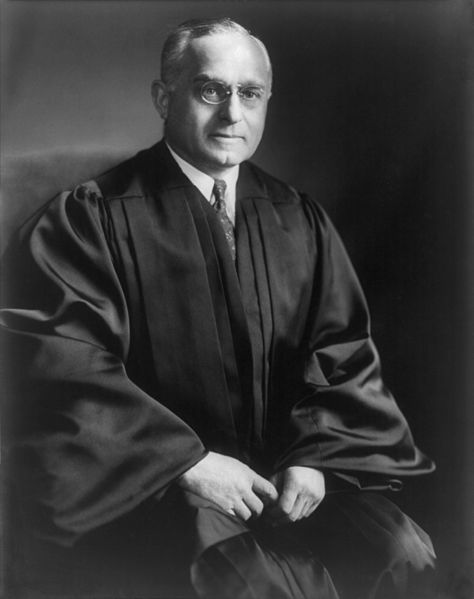
After the sight of a dissecting room scared him away from medicine, Berger went to law school at Northwestern and Harvard. At Harvard he was a student of Felix Frankfurter, who remained as a mentor figure after Berger’s graduation.
Felix Frankfurter
With excellent credentials, the new attorney tried to get a position in a big law firm, but none of them would hire him because he was Jewish. The firms he applied to had either filled their Jewish quota, or their quota was zero. Not even the intervention of Felix Frankfurter helped.
Fortunately, the head of the Securities and Exchange Commission (SEC) was a friend of the dean at Northwestern, so Berger began working as a government attorney. The Department of Justice hired Berger away from the SEC, and now they dropped the Richwood castor-oil case in his lap. Berger later said, probably correctly, that his bosses didn’t like this case, and expected to lose, so they handed it off to Berger who was the “low man on the totem pole.”
OK, fine, here’s the real Felix Frankfurter
Berger took the case to the grand jury. The Jehovah’s Witness victims testified about what happened to them. In a memorandum, Berger described how the grand jurors responded with hostile questions “about the particulars of their religion, their refusal to bear arms, their invasion of Richwood in search of ‘trouble.’” No indictments were forthcoming.
Since the grand jury refused to indict Catlette and Stewart, felony charges were not an option. Instead, the prosecutors filed an information charging Catlette and Stewart with the misdemeanor of denying the Witnesses’ civil rights “under color of law.” By seizing and mistreating the Witnesses, the charges said, the two lawmen had violated the Witnesses’ rights under the Fourteenth Amendment of the U. S. Constitution, including “the exercise of free speech”…
…and the right “to practice, observe and engage in the tenets of their religion.”
U. S. Supreme Court precedent at the time held that the First Amendment rights of free speech and free exercise of religion were also protected by the Fourteenth Amendment, and thus could not be violated by state officials. The Supreme Court had exempted the states from most of the Bill of Rights, but not from these key provisions.
(The charges also said that the defendants’ behavior had violated due process and equal protection, which are specifically protected by the Fourteenth Amendment.)
The trial was held in early June 1942 in Charleston, WV. Federal District Judge Ben Moore presided. In his argument to the jury, as Berger later summarized it, “I played one string” – American boys were overseas fighting Mussolini, and these defendants were engaging in Mussolini-style behavior right here in the United States.
The jury gave its verdict: Both defendants were guilty.
Catlette was sentenced to a year in prison and a $1,000 fine. Stewart got away with a $250 fine, which he paid. Catlette appealed his conviction to the federal Fourth Circuit court. Berger helped argue the appeal on the government’s behalf.
While Berger was fighting to keep Catlette in prison, the University of Chicago Law Review published an article Berger had written in his private capacity. The U. S. Supreme Court had just given an opinion saying the public had a broad right to criticize judges, a right which neither the federal government nor the states could take away. In his article, Berger indicated that he was sympathetic to a broad vision of free speech, but – in an elaborate historical analysis – Berger argued that the historical meaning of the First Amendment allowed judges to punish their critics.
Speaking as a good New Deal liberal, Berger was glad that the Court was no longer imposing economic liberty on the country in the name of constitutional rights. These discredited conservative precedents (as he saw them) had led to “a generation of sweated labor and unchecked industrial piracy” from which the country was just recovering. But now that New Dealers controlled the Supreme Court, would they impose their left-wing activism on the constitution the way earlier courts had (allegedly) practiced right-wing activism? ” [I]t is easier to preach self-restraint to the opposition than to practice it oneself,” Berger reminded leftists.
What the Supreme Court ought to do, wrote Berger, was adhere strictly to the historical meaning of the Constitution, even if this sometimes produced results leftists disliked. Some advocates of judicial activism said judges should adapt the Constitution to modern circumstances. But “an ‘unadapted’ Constitution may be the last refuge of minorities if a national Huey Long comes to power.” (To Berger, it was Long, not FDR, who served as an example of a tyrannical populist demagogue.)
And in a foretaste of things to come, Berger included a brief footnote in his article noting the Supreme Court’s inconsistency on whether the First Amendment even applied to the states.
For now, though, Berger was seeking to apply the First Amendment to the states by locking up Martin Catlette.
In January 1943, the Fourth Circuit upheld Catlette’s conviction, rejecting Catlette’s claim that by removing his badge he had turned himself into a private citizen and was not acting “under color” of state law as the charges against him alleged.
The judges made short work of Catlette’s efforts to dodge responsibility:
We must condemn this insidious suggestion that an officer may thus lightly shuffle off his official role. To accept such a legalistic dualism would gut the constitutional safeguards and render law enforcement a shameful mockery.
We are here concerned only with protecting the rights of these victims, no matter how locally unpalatable the victims may be as a result of their seeming fanaticism. These rights include those of free speech, freedom of religion, immunity from illegal restraint, and equal protection, all of which are guaranteed by the Fourteenth Amendment.
The conviction of Catlette and Stewart represented the only successful prosecution in the country of anti-Witness vigilantism.
Catlette served his sentence in the Mill Point, WV, federal prison camp. As befitted someone who had only been convicted of a misdemeanor, Catlette did not live under a very harsh prison regime. Maureen F. Crockett, daughter of the prison’s parole officer, later wrote:
The minimum-security prison on top of Kennison Mountain had no locks or fences, and minimal supervision. Inmates stayed inside the white posts spaced every 40 feet around the perimeter. Escape was as easy as strolling into the nearby woods, but the staff took a head count every few hours. During the [twenty-one] years it was open, the prison had only 20 escapes.
Local lore says so few prisoners left because they thought the local woods were haunted.
For whatever reason, Catlette did not run off. He served eleven months of his twelve-month sentence before being paroled (and the court excused him from paying the fine). During his incarceration, he probably had the chance to meet some of the convicted draft resisters who were entering Mill Point at this time, including Jehovah’s Witnesses.
Berger continued his career as a government lawyer. His jobs included working at the Office of the Alien Property Custodian.
After his stint in government service, Berger went into private practice.
In 1958, Berger was devastated by the death of his wife. He considered what to do with the rest of his life. Perhaps, he thought, he could return to being a musician. He went to Vienna and gave a violin performance.
To illustrate the idea of Vienna, here are some Vienna sausages
As Berger told it, he was deterred from resuming his musical career when he read a review in the Vienna press, saying that he played the violin very well…for a lawyer.
Berger began a new career as a law professor. Eventually, his research would lead him to the conclusion that the states did not have to obey the Bill of Rights.
How would Martin Catlette react if he knew that one of the prosecutors who sent him to prison for violating freedom of speech and religion would later claim the states were exempt from the Bill of Rights?
But before Berger got to that point, he had a date with destiny in the form of a crooked President.
Works Consulted
Cecil Adams, “Did Mussolini use castor oil as an instrument of torture?” A Straight Dope classic from Cecil’s store of human knowledge, April 22, 1994, http://www.straightdope.com/columns/read/965/did-mussolini-use-castor-oil-as-an-instrument-of-torture
Raoul Berger, “Constructive Contempt: A Post-Mortem,” University of Chicago Law Review: Vol. 9 : Iss. 4 , Article 5 (1942).
Available at: http://chicagounbound.uchicago.edu/uclrev/vol9/iss4/5
James Penton, Apocalypse Delayed: The Story of Jehovah’s Witnesses (Third Edition). Toronto: University of Toronto Press, 2015.
Shawn Francis Peters, Judging Jehovah’s Witnesses: Religious Persecution and the Dawn of the Rights Revolution. Lawrence: University Press of Kansas, 2000.
Chuck Smith, “Jehovah’s Witnesses and the Castor Oil Patriots: A West Virginia Contribution to Religious Liberty,” West Virginia History, Volume 57 (1998), pp. 95-110.
_________, “The Persecution of West Virginia’s Jehovah’s Witnesses and the expansion of legal protection for religious liberty,” Journal of Church and State 43 (Summer 2001).
Note – There’s a Martin Lewis Catlette (1896-1965) buried in the Richwood Cemetery. I can’t say for sure if this is the same person as the deputy Sheriff (the appeals court gives the deputy’s middle name as “Louis”). The person in the cemetery seems to have served in the Navy in both world wars, and his wife died in 1943, the year that the deputy would have gotten out of prison. If this is the same person as the deputy, I would be able to add a paragraph about the widower, newly freed from prison, soothing his grief by returning to military service.

 Because modern patriotic nationalism sucks. I completely get the connection between the flag and the service of our soldiers and veterans. I completely respect their courage and sacrifice. This is why I stand for the national anthem, even though I don’t participate. However, if there’s one thing that gets and eye roll from me in record time, it’s the old tired line of “freedom isn’t free. They fought and died for your freedoms.” Sorry, but when were my freedoms last threatened by a foreign power? Maybe WWII? That’s really stretching it, because the biggest threat to my freedoms in that era was FDR (internment camps, threatening the supreme court if they didn’t rule favorably, etc.). Maybe one could argue that the actions in Afghanistan were preserving our freedoms after 9/11, but again, the Patriot Act, TSA, and DHS are much bigger threats to my liberty than Al-quaeda has ever been. In my opinion, it’s completely appropriate to honor those who fought and died in the name of our nation without bullshitting us by saying that they were “fighting for our freedoms.” If anything, that cheapens their legacy, because it paints a paper thin GI Joe veneer over a much more complicated and difficult situation.


 Second, what played out yesterday in Charlottesville is just a repeat of what happened in Berkeley, Middleburg, NYU, and other places over the last year and a half. Some group Antifa finds objectionable has a speech or a rally. Then Antifa shows up and starts assaulting people and the police stand down, let them do it, and let the riot happen. That is exactly what happened yesterday. It should surprise no one that one of these riots has now resulted in someone’s death. The fact that the death was the result of the actions of the enemies of Antifa, rather than Antifa itself, changes nothing. This was going to happen eventually.


.jpg "\"Please take away rights from these people we don't like!\"")