I’ve just finished The Campus Rape Frenzy, by K. C. Johnson and Stuart Taylor, Jr. The subtitle – The Attack on Due Process at America’s Universities – should dash any false hopes that this book is a STEVE SMITH adventure. It’s about how the federal government forced – or probably the right word is egged on – colleges to provide inadequate hearings for male students accused of sexual misconduct.
The usual scenario is that Bob
and Betty
Drive safely, indeed
two hypothetical students at Hypothetical U, both drink a lot of booze, then get together and have sex.
Here’s a picture of the booze
Later, sometimes much later, Betty decides that she was raped and, after failing to persuade the real-world judicial system of the reality of the crime (or neglecting to report the alleged crime to the real-world judicial system at all), takes the case to the campus “justice” system.
In the name of being Tough on Rapists, the federal government – invoking the anti-sex-discrimination statute, Title IX – has encouraged the campus SJWs who were already pressing for making campus “courts” accuser-friendly. The campus “judges” are students, administrators and faculty who have been trained to view accusers sympathetically and to be on the lookout for those predatory rapists responsible for 1 in 5 or 1 in 4 coeds getting sexually assaulted. These “judges” are warned that the idea of large numbers of false accusations is a myth, and “only” 2%-8% of accused men are actually innocent. These statistics are phony, as the authors show.
Never mind, though – combined with the “judges’” training is their ability to ignore many traditional due-process restraints on their power, restraints which might allow the accused man to throw a wrench or two in the accusation. The “courts” can put the defendant on trial on really short notice, they can limit his right to cross-examine the accuser, invoke the assistance of a lawyer, or present evidence in his own favor (there’s a lot of cases where the texts the “victim” sent at the time of the “rape” are not consistent with the behavior of the victim of such a crime, but the “judges” aren’t always interested in seeing these texts).
Sometimes the trial is conducted by one person hired by the college to conduct and investigation and reach a verdict, without holding a full-dress hearing in front of both parties as in traditional Anglo-American trials. The judge/investigator just interviews the witnesses, gives the accused a (perhaps incomplete) summary of what the witnesses said, and then reaches a verdict.
It almost gets to be like the old joke of the judge who didn’t want to hear the other side because hearing both sides tended to confuse him.
All rise for His Honor
The bottom line is Bob is branded a rapist and suspended or expelled. It’s kind of hard for him to get another college to accept him, and many employers, seeing that the guy was branded a rapist, will be like “don’t call us, we’ll call you.”
So if Bob or his family has enough money he can sue, and maybe win or maybe lose. But any victory, while it benefits Bob, doesn’t necessarily benefit the next guy who comes along accused of rape in the Kampus Kangaroo Kourt.
And if there actually was a rape? In that case only the real-world justice system can impose the prison sentence needed to keep the rapist away from the public for term of years. Throwing an actual rapist out of college and out onto the streets seems a tad lenient, and not entirely safe.
You want to teach rapists not to rape? Send them to one of these educational institutions.
Johnson and Taylor have all sorts of perfectly sensible ideas for reform, but I want to focus on one idea they reject.
Johnson and Taylor indicate that it might be desirable to discourage students from getting drunk and screwing. This might annoy Jimmy Buffett (NSFW), as well as the “don’t blame the victim – teach rapists not to rape” crowd. But such discouragement is a good idea as far as it goes. Rape accusations flourish, as a practical matter, in vaguely-remembered encounters which may be regretted once sober, adding to which is how easy it is (according to university regulations) for alcohol to make consent to sex irrelevant. And current dogma means that if both Bob and Betty are drunk when they have sex, Bob is raping Betty but not vice versa. How colleges reconcile this doctrine with Title IX’s ban on sex discrimination is unclear, but that’s how the system operates.
But Johnson and Taylor don’t go all the way (so to speak). They frown on drunken sex, but they scoff at the idea of discouraging student sex in general. They acknowledge that, given the kind of cases which lead to these “he said/she said” controversies, a good survival strategy might be “celibacy,” but the authors dismiss this as a “nonstarter[]” which “few will find appealing.” College students in the past – often from necessity – often managed not to rut like bunnies while pursuing their studies, but I suppose the idea is that we’re a more sophisticated, liberated, non-taboo-having, healthier people today.
“I hate going to these orgies – so many thank-you notes to write afterwards.” /old joke
What if colleges simply stopped encouraging student sex? That could make moot the question of how to handle drunken hookups by their students.
Don’t mistake my meaning – I am speaking of the separation of college and sex, not the abolition of sex itself, although of course as you know abolishing sex is the ultimate objective of the Catholic conspiracy.
Colleges can only do so much, and training the horniness out of its students is something which is beyond their capacity. But that doesn’t mean a college should provide boinking facilities for its students. No using dorms as sleepover facilities, fraternity would-be orgies, etc.
When I worked as a student dormitory assistant, checking students into and out of their rooms, I felt like the clerk at a sleazy hotel. My job wasn’t to keep the guys out of the girls’ rooms or vice versa, but to make sure they left their student IDs at my office before going upstairs for their…whatever it was they did (probably not canasta).
I was also the piano player
Did colleges put up with this sort of thing in the past? No – although students weren’t any less horny than today. College education wasn’t as near-universal as now, you needed some money or enough talent to get a scholarship, but if you had one of these qualifications there were plenty of institutions to choose from. But generally, the colleges at least made an effort to keep the students on the straight and narrow.
Mandatory chapel. Curfews. If the college admitted women (not a given), then there was separation between the sexes, and social events needed chaperones.
“Don’t mind me, you kids just have fun.”
Most students wouldn’t put up with that today. But that’s all right, most students don’t need to be at a modern residential college.
We’re in a situation where colleges and universities ought to downsize anyway. A four-year sojourn at a residential college (often involving indebtedness and fairly sketchy post-college plans for promptly paying off that indebtedness) is not an essential part of every young person’s life, if it ever was.
There are some career paths which may require studying at a residential college, some career paths which may call for online education (dropping by the local public library for proctored exams), and some career paths which may call for a good high school education (where it can be found) and/or an apprenticeship.
And there are some people who may still go in for a liberal arts education as defined by Cardinal Newman – learning for its own sake, including the things associated with being a learned person, including theology, the “queen of the sciences.”
Blessed John Henry Newman
In each of these situations, the college can separate itself from enabling its students’ sex lives.
If a student is working on his or her online degree while holding down a job, then their college life and social life will run on separate tracks, for the most part, or if they get together with other students it will be off campus and they’ll have signed all sorts of forms that the college won’t be liable for broken hearts, broken bones, disease, death, etc., resulting from independently developing relationships with other students.
Or if students are taking one of those intensive courses of study which requires a residential program, they should be warned to do their foolishness (if any) while they’re off campus.
And at least in theory, nontraditional-age students supplementing their education, often online or through occasional visits to campus for class purposes, will have homes of their own and any kinkiness they do will be in those homes (and they should ask their spouses first, if any).
And for those few liberal-arts residential colleges which survive the coming shakeup of higher education – those colleges should be unashamedly elitist, recruiting students who are actually committed to a course of study, with socializing with the other sex limited to chaperoned activities like in earlier times.
(If a young man and woman meet at a residential college (or before going) and decide to get married, then of course after their marriage the college should put them in married-student housing.)
I guess the one downside to my scheme would be that it would force the SJW “student life” bureaucrats to get other work.
Look carefully, and you might be able to see the violin on which I am playing “My Heart Bleeds for You”
The West. Two cowboys, Bart and Biff, are sitting around a campfire…
BIFF: Well, we’ve amused ourselves quite a bit lighting our own farts, now let’s find some other way to entertain ourselves.
BART: Let’s tell the story of “Gunplay” Maxwell.
BIFF: OK, let’s see…”Gunplay” Maxwell is known as a Western outlaw, but he was actually born James Otis Bliss, the son of a respectable businessman in Massachusetts. I heard tell that when things got too hot for him in the West, Maxwell/Bliss would send his wife and daughter to live with his Bliss relatives in Massachusetts until things cooled down.
BART: But when she wasn’t in Massachusetts, his wife would be with him to help him out in his criminal pursuits.
BIFF: Now, some say that Maxwell was turned down for membership in Butch Cassidy’s gang…
“We have considered your application, Mr. Maxwell, and we’re sorry to say we have no positions available at present. We’ll keep your resume on file.”
BART: That ain’t the way I heard it. Way I heard it, Maxwell was in on some of Butch Cassidy’s gang’s jobs.
BIFF: When we’re looking at the career of “Gunplay” Maxwell, it looks a lot like that Japanese movie Rashomon.
BART: Never seen it.
BIFF: ‘Course you never seen it, it ain’t been made yet, but you’re supposed to pretend you’ve seen it, so you can look sophisticated.
BART: …says Mr. “Look at me lighting my own farts.”
BIFF: Anyways, the historiographical conflicts have yet to be resolved, but Maxwell was either an outlaw with Cassidy’s gang, or else he was acting just with his own gang, rustling cattle and stuff like that.
BART: And supposedly, one time the cops were out to arrest him, and he was going to turn himself in, but his wife said he was being a wimp so he got away and stayed on the run.
BIFF: And a lot of his jobs were supposedly planned with the help of a local postmaster.
BART: Ha ha, going postal.
BIFF: But the important part of the story takes place in Springville, Utah on May 28, 1898, when an alarm from the bank was linked to a store across the street. Now, the storekeeper hear the alarm go off, but at first he didn’t think anything of it, because there had been a lot of false alarms lately…
BART: But the fact that we’re sitting here talking about it now is kind of a tip-off that it wasn’t no false alarm this time…
BIFF: Yeah, it was the Maxwell gang trying to rob the bank, but the teller had the presence of mind to trigger the alarm.
BART: Yeah, so the townspeople formed a posse.
BIFF: And they killed Maxwell’s companion, but they took Maxwell alive, and he was convicted.
BART: So Maxwell got himself a lawyer and took his case to the highest court in the land.
BIFF: Judge Judy?
BART: No, dummy, the U. S. Supreme Court. Now, the Supremes had previously given a decision that said a trial by jury meant a trial by exactly 12 jurors. Yet Maxwell’s jury, in accordance with the Utah Constitution, had only eight members.
Eight is enough?
BIFF: Those Mormons, amirite?
BART: Sure, the Mormons agreed to put this idea of 8-person juries (with certain exceptions) in the Utah constitution, but it wasn’t strictly the Mormons’ idea. It was the idea of some non-Mormon lawyers who were members of the state constitutional convention, like C. C. Goodwin. In fact, Goodwin was very disparaging of the idea of trial by jury and openly fantasized about abolishing juries altogether.
BIFF: Is that the same C. C. Goodwin who ran the anti-Mormon Salt Lake Tribune? The guy who supported the federal prosecution of Mormon polygamists? Why would the delegates care about what he said? Wouldn’t they do the opposite of what Goodwin wanted?
BART: Danged if I know. When the state constitution was being written in 1895 there seems to have been kind of a truce between the Mormons and their erstwhile oppressors, and this Goodwin fella used to be a judge, so I guess they were willing to listen to his legal expertise…
BIFF: Earth to Mormons: Don’t take advice from your sworn enemies about whether to dilute your constitutional rights! But the U. S. Supremes said that a jury means 12 people, so I guess Maxwell won his case?
BART: No, actually, because even though the Supreme Court said a jury means 12 people, in Maxwell’s case the Supreme Court also said that the states don’t have to have trial by jury. So since Maxwell didn’t have the right to a trial by jury, it didn’t matter how many jurors he had, or even if he had any jurors at all.
BIFF: Well if that don’t beat all! So what did happen to Maxwell?
BART: He got together a bunch of local citizens, including the judge at his trial, who persuaded the parole board to release him. It helped that Maxwell assisted in stopping a jailbreak by other inmates.
BART: I dunno, maybe you could say he was rehabilitated…right up until he picked a fight and got fatally shot. Some say he was planning another job at the time.
BIFF: That Rashomon thing again.
BART: But in the 1960s, the Supreme Court admitted that states have to provide jury trials, at least to those accused of serious crimes.
BIFF: So now we all have a right to a 12-person jury?
BART: No, because the Supremes also said around that time that a jury doesn’t need twelve people anymore. Maybe it can be as few as six.
BIFF: So they changed their mind about that, too? But the fewer jurors you have, the less of a cross-section of the community you’ve got.
BART: I think that’s the point.
Book Learnin’ that I Consulted
Erma Armstrong, “Aunt Ada & the Outlaws: The Story of C. L. Maxwell.” The Outlaw Trail Journal, Winter 1997.
Raoul Berger, “Trial by Jury:” Six or Twelve Jurors,” in Government by Judiciary: The Transformation of the Fourteenth Amendment. Cambridge, MA: Harvard University Press, 1977, pp. 397-406.
“C.L. aka John Carter “Gunplay” Maxwell,” https://www.findagrave.com/cgi-bin/fg.cgi?page=gr&GRid=5459997.
Richard C. Courtner, The Supreme Court and the Second Bill of Rights: The Fourteenth Amendment and the Nationalization of Civil Liberties. Madison: The University of Wisconsin Press, 1981.
“Gunplay Maxwell – Utah Gunfighter and Outlaw.” http://www.legendsofamerica.com/we-gunplaymaxwell.html
Official Report of the Proceedings and Debates of the Convention Assembled at Salt Lake City on the Fourth Day of March, 1895, to Adopt a Constitution for the State of Utah, Volume 1.Salt Lake City: Star Printing Company, 1898.
Charles S. Peterson and Brian Q. Cannon, The Awkward State of Utah: Coming of Age in the Nation, 1896-1945. Salt Lake City: University of Utah Press, 2015.
Michael Rutter, “Gunplay Maxwell, the Wannabe Gunman,” in Outlaw Tales of Utah: True Stories of the Beehive State’s Most Infamous Crooks, Culprits and Cutthtroats. Guilford, Conn: Twodot Press, 2011, pp. 156-165.
Jean Bickmore White, Charter for Statehood: The Story of Utah’s State Constitution. Salt Lake City: University of Utah Press, 1996.
Having occasion to visit London, I was flattered to receive an invitation from the eminent John Watson, MD, to visit him at his practice.
John Watson, James Watson, whatever
The good doctor shook my paw. “I have never seen such a marvel as yourself-a talking dog! And, like my friend Sherlock Holmes, something of a detective.”
“Ruh-ruh,” I replied, shaking my head in the negative, and I explained how I had given up on investigating crimes and strange occurrences. My nerves no longer allowed it, and having parted ways with my young human friends, who had traditionally drawn me into such misadventures, I no longer felt inclined to pursue such investigations myself. But I noted my admiration for the famous Mr. Holmes and his solutions to perplexities much more complicated than anything with which I had been accustomed to encounter.
“It was so convincing!”
“I am glad to hear that you have left the consulting-detective business,” said Dr. Watson, “and this brings me to the reason I invited you to see me. You see, I am in something of a dilemma when it comes to my friend Mr. Holmes. On the one hand, the exertion of his constant adventures strains him beyond what he is willing to admit, and I believe he ought to rest. Yet on the other hand, when my friend isn’t solving cases, he reaches for other forms of mental stimulation, and he indulges his cocaine habit. As a physician, I am familiar with the ravages cocaine causes, and I do not wish my good friend to inflict these on himself, but neither do I want him to wear himself out with constant work, which for him is the only alternative to taking cocaine. So you see that I am caught, as it were, between Scylla and Charybdis.
“But of the two of us, Holmes is not the only one who finds resourceful ways to solve problems. I believe I have hit upon an excellent method of letting my friend get the rest he needs, without experiencing the cocaine craving he develops during periods of idleness.”
“I am sending him on a vacation to the United States, to divert his mind with the sights and sounds of that trans-Atlantic republic. I would very much like you to accompany him, to provide him with the challenge of dealing with a talking dog, and otherwise to help him find healthy outlets for his energy and curiosity. But if that does not work-”
Here Watson retrieved from a cabinet a pouch from which emanated a familiar smell which I had sensed in the anteroom. The pouch was in form like a standard tobacco pouch, but the smell was not of tobacco.
“This is a preparation of my own devising,” explained Watson, “prepared largely from certain plants provided to me by a botanist on the staff of the Governor of Jamaica. This medicinal mixture, when burnt and inhaled, produces in the patient a considerable slowing of the faculties. It also relaxes the patient to the point where he can enjoy idleness, without constantly craving mental labor and intellectual stimulation. And if there is anything my friend needs right now, it is some temporary relief from the constant intellectual restlessness which is driving him to overwork and, I fear, potentially to an early grave.”
What is the narrator insinuating here?
I accepted the good doctor’s assignment, happy to do my part to help Holmes, flattered that I would be the companion of such a great man during his holiday, and relieved that although accompanying the world’s greatest detective on his travels, I would not be asked to undertake any dangerous adventures, of which I had had my fill.
Or so I thought.
When we first arrived in New York, I thought that my mission had failed before it had begun. Holmes purchased a newspaper and, upon turning a couple of pages while we were at a restaurant, exclaimed:
“Look at this! A wealthy American eccentric who has been living on Park Avenue has mysteriously disappeared without a trace…leaving no forwarding address, no instructions, and no news about his situation. Many fear the worst. This is a problem which presents many interesting features…”
Holmes puffed excitedly on his pipe as he looked at the article, but fortunately the pipe was filled with Dr. Watson’s excellent calming medicine. After a few minutes of smoking, Holmes put down the newspaper, sighed, and said, “Well, there is no point in allowing this to interrupt our holiday. The local constabulary should be perfectly able to solve this case without us. I doubt the gentleman is in any danger. I shall proceed with our trip as planned. Could you ask our waiter for another serving of his excellent corn chips?”
And thus the crisis passed as soon as it had arisen, and Holmes and I embarked on a railway journey to the western states. As Holmes had predicted, the missing rich man had apparently not been in any danger – it turned out that his wealth was built on borrowed money and he had absconded in order to escape his creditors, to whom he sent taunting letters. So Holmes and I thought no more of the matter.
So it came about that we were relaxing in a saloon in a small town in one of the Western states. I was contentedly digesting some sausage links I had purchased with Watson’s extensive travel budget, while Holmes, pipe in mouth, was sitting at the bar.
“A lemonade please, if you have one,” Holmes said to the saloonkeeper behind the bar.
“Coming up,” said the saloonkeeper. “I do quite a business in temperance beverages with all the Baptists in town. And speak of the devil…” this in reference to a man with a pinched face and gray suit who had just entered the saloon.
“Hello, reverend,” the saloonkeeper said to the man as he took a seat next to Holmes.
“I’m not really a minister,” said the man, turning to Holmes. “I’m Donald Gravely, undertaker, also president of the Baptist Sobriety League. Sometimes I come by this saloon to persuade the proprietor to sell something besides liquor. And he accommodates me-” as the saloonkeeper passed Gravely a tall glass of lemonade – “though I wish to see the day when he sells only lemonade.”
Meanwhile, a gentleman sat on Holmes’ other side. Puffing on his pipe, Holmes regarded the new arrival languidly.
“Gimme a bourbon,” said the man, who promptly introduced himself as Bob Touter.
Louis XIV of the House of Bourbon
“New in town?” Touter asked Holmes. “So am I – I’m trying to set up a circus in these parts. I have exhibits Barnum would die to have – marvels and wonders that…”
Holmes stifled a yawn. “That’s all very interesting, gentlemen,” he said, “but I think I shall retire to my room.” And he left, trailing a cloud of smoke from his pipe, with me following close behind.
I thought that the two of us would soon retire for the night, but after a couple of hours of smoky contemplation, Holmes suggested we go out for a stroll. This didn’t seem like the best idea, since a light snowfall had just commenced and was probably going to increase as the night advanced, but Holmes was all for a relaxing walk.
As he lit his oil lantern, he said, “Please accompany me if you wish, or not, it is all cool. I simply want to take in the sights of the local countryside.”
I went downstairs with my friend, and the saloonkeeper said, “Ah, Mr. Holmes, it’s a nice night to visit the haunted house, isn’t it?”
“The what?” asked Holmes.
“Why,” said Touter, “everyone in these parts knows about it – folks have been seeing and hearing strange things at the old Jones mansion.”
“Gentlemen,” said Holmes, “I care nothing for such things. I won’t be going in that direction. I am simply here as a tourist, and I will thank you not to present me with any riddles, puzzles, cases of strange goings-on, or reports of anything out of the ordinary. I have simply lost my interest in such matters. Be so kind as to tell me the direction of this so-called haunted house, so I can go in another direction entirely.”
When the denizens of the saloon pointed to the north, Holmes announced his desire to direct his steps southward instead.
Words cannot express the relief I felt as Holmes and I began our walk out of town in the direction opposite that of the haunted house. Hauntings, ghosts, apparitions, goblins, long-leggedy beasties, and things that go bump in the night had lost whatever slight appeal they had once contained for me. That we were going where such things most assuredly were *not* was a consolation.
And there might have been nothing left to tell of this story, except for an unfortunate thing – as we began exploring the increasingly-snowy countryside, Holmes took his pipe out of his mouth and began gesturing with the stem to various geographical features which struck his interest. As we kept walking in the fresh air, and as Holmes reduced his puffing on the pipe, his mind must have begun to clear, and his interest in mystery-solving must have begun to revive, because, to my great alarm, I observed him begin to turn his steps westward, then northward, so that we were taking a circuit around the town and approaching the location where, we have been informed, the haunted house lay.
I intimated by whimpers, by tugging at Holmes’ cloak, and other signs, that I was dissatisfied with the direction in which he was turning, but far from paying attention to my warnings, Holmes quickened his stride, and all too soon were came in sight of an abandoned house. The front door was off its hinges, the broken, darkened windows stared out into the gathering gloom like empty eyes, and in short I concluded that our search for the haunted house was over.
Imagine it’s nighttime
I didn’t like the odors I could detect, even at this distance, emanating from the building. From the smell of old foeces, it did not take Holmesian deduction to infer that human and animal visitors had come to the house over the past few years, hopefully simply to visit, shelter from the cold, and relieve themselves.
But then Holmes stooped over and pointed to several sets of footprints, faint and growing fainter as the snow began covering them.
“From the imprint of these boots,” said Holmes, “I must conclude that they belong to…to…devil take it, I neglected, while back at the saloon, to take notice of the boots of the saloonkeeper and the guests. Ah, Watson, your cursed Jamaican preparation has worked its magic – I was truly heedless of my surroundings. That will not do at all.”
And Holmes tapped his pipe so that the precious calming mixture he had been smoking fell onto the snowy ground. Holmes then reached into his cloak, drew out the pouch in which the mixture was stored, and threw it far from him.
“So much for Watson’s attempt to lure me into the Land of the Lotus Eaters!” Holmes exclaimed. “From now on I shall keep my wits about me, and…”
He paused, noticing, as I had just noticed as well, the sound of horse-hooves and carriage-wheels behind us.
The approaching carriage was light-green in color, and as the driver came to a halt and dismounted in order to greet us, Holmes said to me sotto voce, “I perceive that he is wearing the clerical garb of the Roman Church, and I am confident that behind that orange scarf which he wears to keep out the winter cold, he has his clerical collar on. Give me a few seconds, and I believe I will be able to identify him…”
“No, Lestrade, not that kind of orange scarf.”
The priest came forward, hand extended, and said, “Mr. Sherlock Holmes, what a pleasant surprise! I am…”
“Father Frederick, special assistant to the Archbishop of Baltimore for confidential spiritual investigations,” said Holmes as he vigorously clasped the man’s extended hand.
“Why Holmes,” said the Father Frederick, “how ever did you guess? I have been at some pains not to have my identity or my work known to the general public.”
“It was quite elementary,” said Holmes, happy to provide a specimen of his swiftly-recovering powers of observation. “It is my habit to collect stories in newspapers and periodicals which may turn out to be of use to me. From my reading of certain specialized publications, I learned of your identity and your role in examining claims of supernatural manifestations, in order to discover whether these manifestations are genuine, or the product of fraud or superstition. And I am pleased to note that in the vast majority of your inquiries you found the latter causes at work, rather than spiritual influences.
“And since my research had already shown that such a person as Father Frederick existed, it was an obvious inference that you and he were one and the same. What reason would any priest except Father Frederick have to visit an abandoned house, reputed to be haunted, and without as far as I know any residents in need of confession or last rites?”
“You are right on all counts,” said Father Frederick. “The haunted-house rumors are what brought me here. As you say, generally these phenomena have nothing of the supernatural in them, but in cases like this it is useful to examine the possibility, however slight, of something beyond the merely human being involved, so that we can verify whether that superhuman influence be of a benevolent or a malevolent nature.”
“Before we go into the house,” said Holmes, “for if you will excuse me I wish to join your investigation, I hope you will introduce me to your assistants. From the exertions of the horses, I recognized that they were pulling the weight of more than one person.”
“I would be happy to introduce my associates,” said Father Frederick, “just as I would be happy to have the assistance of the world’s greatest detective in our investigation.”
Father Frederick opened the carriage door and assisted a nun in clambering out onto the ground. Even a nonhuman animal such as myself can appreciate human female beauty, and on examining this nun I reflected that the Church’s gain was some unfortunate young man’s loss. The woman’s hair glowed a fiery red in the lamplight as Father Frederick introduced her.
“This is Sister Agnes,” said the priest, “an invaluable assistant to my enterprise. And here – ” as a shorter, stockier nun emerged from the carriage – “is Sister Catherine, named after…”
Holmes interrupted. “Named after Saint Catherine of Siena, the famous scholar-nun. I can see the resemblance – observe her spectacles, unusually thick for a women of her young age, indicating that she has sadly been harming her eyesight from constant reading.”
Sister Catherine sniffed. “That wasn’t hard to figure out,” she said, “since I’m carrying a book,” pointing to a small volume which was tucked under her left arm.
“Indeed,” said Holmes, and I could see that he was adapting himself, reluctantly, to the presence of another learned person – a woman – who was unimpressed by his manner. “And now, Father Frederick, I hope you will introduce me to the fourth member of your party.”
Although nobody had mentioned a fourth person, I realized that I could hear from within the carriage the sound of teeth chattering, as of someone shivering, but surely not from the cold, since carriage seemed very warm inside.
“Come out, Father Rogers,” said Father Frederick, in a stern but affectionate tone, “we have arrived at the haunted house.”
“Th-that’s what I was afraid of,” said another priest as he emerged, slowly, from the carriage. This new priest, unlike the impeccably-dressed Father Frederick, was dressed in rumpled and ill-fitting garments, a fact of which Fr. Rogers seemed somewhat self-conscious.
“I got these clothes cheap at a surplice sale,” said Fr. Rogers.
“Come on, that was a great pun!”
There was apparently nothing for it but to go into the house, which Fr. Rogers and myself did somewhat more reluctantly than the others, hanging back until the rebukes of Holmes and Fr. Frederick shamed us into climbing on the rotting porch and entering through the doorway after the rest of the party.
“My suggestion, Holmes” said Father Frederick, “is that you and the sisters explore the upper story-” pointing to a ruined stairway leading to what was left of the second floor- “while Fr. Rogers and I go down into the basement to locate the source of that strange sepulchural smell.”
I was relieved that Holmes would not be in the party descending into the basement, since of two unpalatable choices, ascending a staircase to an upper floor seemed less frightening to me than descending into what Fr. Rogers quite rightly called a “creepy basement.”
It was with a chill of horror that I hear Fr. Frederick conclude his remarks by saying, “and Holmes, I should like to borrow your dog, the better to detect the source of these strange scents.”
And so it was that I found myself not following, but leading the two priests into the basement, one slippery, stony step after another, sniffing the stairway in order to trace a powerful graveyard stench whose origin I would have preferred to leave a mystery.
The illumination of Fr. Frederick’s lantern, as it shone into the basement from our position at the foot of the stairs, revealed a coffin lying on the ground. I immediately turned and tried to go back up the stairs, with Fr. Rogers right beside me, but Fr. Frederick grabbed us both by our collars and insisted that we remain and investigate.
Exploring the basement, we found that the strange scents came from within the coffin, but the coffin was tightly sealed and locked. So we proceeded to the other end of the basement to see what could be found there when a creaking sound behind us caused us to turn and look.
Like a vision out of a nightmare, a figure clad in black metal armor climbed out of what had until just now been a securely locked coffin.
Fr. Frederick had spoken of benevolent spiritual forces and malevolent ones, and I suspected that we were confronting an example of the latter. This impression was reinforced by the gigantic battle-axe which the armored figure wielded, and which he brandished as he began striding towards us..
I have difficulty recollecting the details of the next few minutes, since time itself seemed to speed up as the three of us ran for dear life, pursued by the ghastly apparition. All I can be sure of is that we managed to race past the ghostly knight and start ascending the stairs, while the clank of metal footsteps showed that our adversary was following close behind.
By some mercy of Providence, the door at the top of the basement stairs was still in place, with a functioning lock. Fr. Frederick closed and bolted the door mere moments before we could hear the armored figure reach the top of the steps we had just ascended with such rapidity. Then commenced the sound of repeated blows of an axe on the other side of the door, indicating that we would only have a respite of a few minutes before the enemy was upon us again.
Then we heard footsteps which proved to be Holmes descending, with great haste, the stairway from the second floor. He came up to Fr. Frederick and, pointing upstairs, said:
“Don’t just stand there, man! Come back upstairs with me, where something of a very curious nature is transpiring. The sisters are in difficulty.”
“Where are Sister Agatha and Sister Catherine?” asked Fr. Frederick with some asperity as Holmes led us up the creaking wooden staircase to the upper floor.
“They are safe for the moment behind a locked closet door,” said Holmes. “It is not for them that we should be concerned, but for ourselves. Look!”
From the head of the stairs, we could see to the end of a long hallway, at the end of which was a man in the garb of the far West, who was rapidly running towards us. The fur on my back bristled as I saw the glow emanating from the figure, illuminating the passageway without the need of any lantern.
“I am the ghost of Jesse James!” said the figure. “I’m gonna get all of you!”
“I’ve heard of Western ghost towns, but this is ridiculous!”
And then I heard behind us the sound of metal shoes climbing the stairs behind us. We were hemmed in on both sides.
A closet door opened nearby. Sister Catherine emerged from the closet and said, “Father Frederick! Your scarf!”
“Yes,” said Holmes, “I was about to suggest that you use your scarf to confound our foes. And you,” turning to me, “I have an idea for dealing with this knight.”
“I think I see what your plan is,” said Fr. Frederick, removing his orange scarf. “Quick, hold the scarf across the passageway in front of ‘Jesse James.’”
As was related to me later, Fr. Frederick – assisted by Sister Agatha, who rushed up to provide her aid – held his scarf across the passage along which the ghostly gunfighter was approaching. Failing to notice the trap in front of him, the glowing figure stumbled in a most un-ghostly way and fell on his face. Fr. Frederick sat upon his back to hold him.
Meanwhile, following Holmes’ hasty instructions, I ran in a direction which was not customary for me – toward the axe-wielding knight and not away from him. The latter was my strong preference, but a sense of duty toward Holmes and my new friends prevailed over my timidity.
Jumping onto the figure’s armor, I climbed to the head and barked repeatedly into the visor. The echo of my barking resounded throughout the armor’s helmet, apparently causing a ringing in the ears of the person or entity inside. Discomfited, the knight staggered, and it took only a push from Holmes to send him banging and slamming down the stairs until he landed on his back the main floor, the weight of the armor preventing him from getting to his feet again.
“Now,” said Fr. Frederick, “we shall learn the identities of these putative phantoms.” Perceiving that “Jesse James’” face was merely a rubber mask, Fr. Frederick reached to pull it off.
“It is the saloon-keeper,” said Holmes, and upon the removal of the mask, I perceived that indeed it was.
“Now for our knight,” said Fr. Frederick, annoyed that Holmes’ identification had preceded the unmasking.
As Father Frederick strove to take off the knight’s helmet, Holmes and Sister Catherine said in unison, “it is Silas Newcombe.” When the helmet was off, I recognized from his newspaper photograph the former Park Avenue denizen who had fled New York to avoid his creditors. Silas Newcombe was, in fact, his name.
“OK, I’ll confess,” said the saloonkeeper. “You see, I -”
“Do not trouble yourself,” said Holmes. “I can explain your actions, and you only need interrupt if I am mistaken in any of my facts.
“Now, when I reflected on the Baptist influx into the town, prompting you to start selling lemonade, I thought that the temperance influence may have caused you to seek out new, nonalcoholic beverages to sell. Your friendliness with the Baptist showed that you were reconciled to the new way of things. And once I became clear of the influence of Dr. Watson’s well-intentioned herbal mixture, I recalled glancing over the counter of the saloon and seeing mud on your boots – the same sort of mud which is found near this house.
“The rest was elementary. This house is often visited by inebriate vagrants, so clearly your objective was to, as you Americans put it, ‘scare them sober’ by posing as a ghost, thus creating increased demand for the lemonade you sell.”
“And as for you,” said Holmes, turning to Newcombe, but Sister Catherine interrupted.
“I know what Silas Newcombe was up to,” she said.
“Then pray inform us,” said Holmes, and crammed his pipe into his mouth in what I had come to recognize as a gesture of irritation.
“It’s all in this book,” said Sister Catherine, showing us the book she had been carrying under her arm – and which she had had the presence of mind not to drop even during her flight from the disguised saloonkeeper.
“The book is by Newcombe himself, and it’s all about an invention which he was trying to promote – a coffin which can be opened from the inside. Newcombe got his idea from Edgar Allen Poe’s story “The Premature Burial,” which expresses the author’s fear of being buried alive. Newcombe thought he could sell this special coffin to people like Poe, to reassure them that they would be able to escape from their coffins in case they were wrongly put into them while still alive.”
Poe-stage stamp
“It’s a genius idea,” said Newcombe, “but the public wasn’t interested, and refused to buy any of my coffins. So I couldn’t repay the loans I’d taken out to make my coffins. I thought that if I could just hide out for a while in this abandoned house, sleeping in the coffin and emerging from it from time to time, I could demonstrate the effectiveness of my invention. And come to think of it, I have.”
“Wait a minute,” said Fr. Frederick, “you can’t just walk away, you tried to kill us, and that’s a crime.”
“Now, Father Frederick,” said Father Rogers, “King David did worse, yet he obtained forgiveness.”
“Yes,” said Holmes, “I suggest we overlook this slight legal lapse by a beleaguered businessman, and for that matter that we also let the offenses of the saloonkeeper fade into oblivion.”
“Solving these cases is somehow less fulfilling when we can’t arrest the people we unmask and listen to them cursing their ill luck to have encountered us,” said Fr. Frederick, “but I suppose we would be ill-advised to copy someone else’s schtick.”
Which remark was greeted by peals of laughter from one and all.
During my morning news read, I came across this article in National Review Online. It got me thinking about the abuse of science by the legal system. This quote jumped out at me:
The second reason, a much more disturbing one, is that criminal trial lawyers tend not to be adept in evaluating scientific evidence.
Nor are prosecutors, judges and courts in general. Are there positive and negative controls? Of course not. Is the testing done double-blind with randomized controls and replications? Of course not. Is the lab being paid by the same people paying the prosecution? Of course. Is there an incentive for them to give the desired (by the State) answers? Of course. Can the jurors in a trial ask tough questions to determine the validity of evidence? Of course not. Can they even research for themselves what scientific basis is used for the evidence? Don’t be silly!
The criminal justice system is inherently corrupt and incompetent when it brings in “science.” And if one has any doubts about the way the “law” has determined what good and bad scientific evidence is, the courts will prevent any such skepticism from being allowed into the jury box. The upside is that the prospective juror will be dismissed and not be subjected to involuntary servitude. The downside is that the State’s carceral machine continues to hum along efficiently.
None of this was the focus of the March For Science’s outrage- their concern was solely “gimmee free stuff” and “let’s adopt Team Blue talking points as dogma.” Putting people in cages is good for the public employee unions funding Team Blue, so best not to even THINK about this.
On October 7, 1873, the new American ambassador to Japan met emperor Mutsuhito and showed his credentials.
A high-level Japanese delegation, headed by Iwakura Tomomi, the minister responsible for foreign affairs, had in the previous month returned from a lengthy foreign journey, which had included the United States. The Iwakura Mission had sought to alert the West to Japan’s complaints about the “unequal treaties” forced on the country under the prior Japanese regime, the Shogunate.
After the United States “opened up” Japan in 1853-54, the U.S. and several European powers had negotiated treaties with the Shogun’s regime. Many Japanese patriots considered the treaties to be unfair and humiliating. In the 1860s, Japan went through a civil war. The victorious faction had overthrown the Shogunate and established the “Meiji Restoration” regime in 1868. The Meiji government, which ruled in the Emperor’s name, believed its predecessor had been too weak in the face of foreign pressure.
The new American minister plenipotentiary would adopt a conciliatory approach regarding Japan’s grievances.
John Armor Bingham
John A. Bingham was a former member of the U.S. House of Representatives, but the local leaders of Bingham’s own Republican party had denied him renomination the previous year. Bingham had left Congress under something of a cloud. He’d had dubious dealings with the crooked Crédit Mobilier company, and on his way out the door he joined his Congressional colleagues in voting themselves a retroactive pay increase (known as the “Salary Grab”). But despite some grumbling, the Grant administration and the Senate had approved him as minister to Japan.
Bingham had once been an important legislator and prosecutor when America, like Japan, was enduring civil strife in the 1860s. Bingham supported laws to conscript men, suspend habeas corpus, and to take other steps allegedly needed to win the war. During a two-year interval after he had been rejected by the voters in the Democratic surge of 1862, Bingham served as a military prosecutor. His cases included the controversial court-martial of Surgeon General William A. Hammond during the war, and the also-controversial military trial of the alleged Lincoln assassination conspirators at the war’s end.
Accused of violating the Bill of Rights with his wartime actions, Bingham replied that in the dire emergency posed by the war, civil liberties would have to be set aside.
Bingham’s constituents sent him back to the House in time for him to serve in the postwar Congress as it grappled with Reconstruction. Bingham seemed to have been chastened by his defeat in 1862 – a believer in equal rights, he’d been reminded that he could only go so far ahead of his white racist constituents. He began showing comparative caution on race – at least he was cautious in comparison to Thaddeus Stevens, whose unswerving commitment to racial equality, combined with his anger at the ex-Confederates, earned him the title “Radical.”
Thaddeus Stevens
Re-elected in 1864, Bingham became a member of the powerful committee on Reconstruction when Congress started its postwar deliberations in December 1865. Bingham wanted to keep military rule in the occupied South until the former Confederate states adopted a new constitutional amendment – the Fourteenth. Bingham would at first be content with that, without obliging the states to enfranchise the former slaves. But Bingham, and Congress, ultimately decided that the defeated Southern states would have to reorganize themselves with governments chosen by black and white voters, in addition to ratifying the new Amendment. After taking these steps, the rebellious states would be restored to the Union.
Bingham helped shape the Fourteenth Amendment, particularly its provisions about civil liberties (Sections One and Five), as expressed in language about the privileges and immunities of citizens, due process, and equal protection. Section One was “the spirit of Christianity embodied in your legislation,” Bingham assured his constituents. Concerning the evils which the amendment would prevent, Bingham said:
Hereafter the American people can not have peace, if, as in the past, states are permitted to take away the freedom of speech, and to condemn men, as felons, to the penitentiary for teaching their fellow men that there is a hereafter, and a reward for those who learn to do well.
In this and other remarks, Bingham suggested that the Fourteenth Amendment provided federal enforcement to the Bill of Rights in the states. At one point, Bingham suggested that the 1833 decision in Barron v. Baltimorehad simply denied that the feds could enforce the Bill of Rights in the states – the Court had not denied that the states were bound by the Bill of Rights. The Fourteenth Amendment would arm the federal government with the needed enforcement tools.
The Supreme Court indicated that it might ruin everything by requiring civil trials for subversive elements in the ex-Confederacy. To ensure that the U. S. military could punish ex-Confederate obstructionists without a jury trial, Bingham helped strip the Supreme Court of jurisdiction in those sorts of cases. The Supreme Court acquiesced. Bingham thought it would be time enough to allow full constitutional rights after the South had accepted the terms of Congressional Reconstruction.
When President Andrew Johnson tried to obstruct the Congressional Reconstruction program, the House impeached him. Bingham was one of the “managers” (prosecutors) in the impeachment trial, which ended with the Senate acquitting Johnson with a nailbiting margin of one vote.
With the former slaves enfranchised and the Fourteenth Amendment ratified, Congress readmitted the former Confederate states into the Union and restored civil government. Bingham kept an eye on the South, supporting the Fifteenth (voting rights) Amendment and pushing for a bill to prosecute white supremacist terrorists like the Klan. After the Klan prosecutions seemed to cripple that organization, the Reconstruction process, and the transition to a peacetime regime of full constitutional liberties, seemed complete.
Meanwhile, in the year Bingham arrived in Japan, the Japanese government took various reform and modernization measures with a view of catching up with the West. In 1873, the government, in an attempt to bolster its military, adopted conscription. Bingham would be familiar with conscription, which he pushed during the Civil War, but Japanese conscription was initiated in peacetime (though a dissident faction unsuccessfully pushed for a war in Korea in that same year).
1873 also marked Japan’s adoption of the Gregorian calendar and the legalization of the previously-banned religion of Christianity. Bingham would certainly have applauded the latter measure, even though many of the newly-legalized Christians were Catholics, not members of the zealous Presbyterian “Covenanter” denomination to which Bingham belonged. Around the same time that it made Christianity legal, the Japanese government was supervising the building of new shrines for the official Shinto religion, which focused its devotional energies on the Emperor.
As ambassador, Bingham tried to free Japan from the tentacles of the “unequal treaties”…
…agreeing in 1878 that the United States would renounce any rights under these treaties if the European powers could be induced to do so, too. Bingham wished to treat the Japanese government with respect instead of throwing his weight around and stomping through Tokyo like a giant fire-breathing lizard.
That lizard is YUUUGE!
In 1878, as Bingham was showing his willingness to get Japan out from the “unequal treaties,” the secretary to minister Iwakura Tomomi published a journal of the Iwakura Mission from a few years before. The secretary, Kume Kunitake, discussed the American part of the delegation’s journey in the first of his five volumes.
Japanese foreign minister Iwakura Tomomi with several key members of his delegation
The delegates were not exactly giddy as schoolgirls about their 1872 trip through the U. S….
What kind of image did you think I was going to put here?
They were not simply sightseers. As Kume’s official journal showed, the delegates wanted to find out what they could about the United States so that they could turn that information to good use in their own country. The publication of the journal in 1878 indicated that the Japanese public was expected to learn these lessons, too.
Readers of Kume’s journal learned that the delegation visited many Western and Northern states, with the visits to the ex-Confederacy limited to Washington’s home in Mount Vernon, VA. Perhaps they wanted to learn from the Civil War’s winners, not its losers. Delegation members studied the schools in Oakland, CA (“a famous educational centre in the western United States”), observed some Native Americans in Nevada (“Their features display the bone structure often seen among our own base people and outcasts”), visited Salt Lake City (“According to Mormon beliefs, if a man does not have at least seven wives he cannot enter Heaven”), visited Chicago in the wake of its recent fire (“said to have been the worst fire since the city was founded”), mixed sightseeing and diplomacy in Washington, D.C., where they reflected on the turbulence of the Presidential election (“Merchants forgot their calculations; women stayed their sewing needles in mid-stitch”), visited the naval academy in Annapolis, MD (“In America, women are not forbidden from entering government buildings”), went to see New York City’s Bible Society and YMCA (“We were suspicious of the tears of those who prayed before a man condemned to death for heresy, whom they acclaim as the son of a celestial king”), checked out West Point (“Those who fail are shamed before their relatives, but, on the other hand, this may serve as a spur to them”), and “attended a concert at the World Peace Jubilee and International Music Festival” in Boston (“Now the world is at peace, with not a speck of dust stirring”).
Kume’s journal frequently paused in its descriptions to inform the readers of the lessons the Japanese should learn from what was being described. After recounting how the delegates were able to hire an American company to ship packages to Japan, Kume added these reflections: “When Japanese merchants think of the West, they imagine some distant galaxy. When western merchants view the world, however, they see it as a single city. With that attitude, they cannot fail to prosper.” Recounting the death of Horace Greeley “of a broken heart” after he lost the Presidential election in 1872, Kume wrote: “This reveals how Westerners are willing to throw their whole heart into the pursuit of their convictions, and if they do not realise them, they are even willing to sacrifice their lives. Without such extreme virtue and endurance, it is hard to expect success in this world.”
Horace Greeley, before he died for honor
Kume’s account of the American Civil War also seemed to point to a moral for the Japanese to follow. After describing the strength of the proslavery forces before the war, Kume’s journal said: “Faced with such determination, the abolitionists looked into their hearts and fought harder.”
Kume described how, after the war, many black people had achieved success in business and politics, thus showing that skin color was unconnected to intelligence. After noting the surge in the establishment of black schools, Kume’s journal added: “It is not inconceivable that, within a decade or two, talented black people will rise and white people who do not study hard will fall by the wayside.” Kume was marking out a path to success for any people whom whites were trying to marginalize.
The North had won the American Civil War in the name of the supremacy of the federal government. But from the standpoint of centralized Japan, the U. S. still had broad respect for states’ rights: “With its own legislature, each state maintaining its autonomy and assumes the features of a genuine independent state within the federal union….the federal government derives its power from the states; the states are not created by the federal government.”
By 1878, when Japanese readers were reading about the lessons of the Iwakura Mission’s American travels, the U. S. had already dropped a notch or two since 1872 when it came to civil liberties. President Rutherford B. Hayes, to shore up support for his contested election victory, agreed to withdraw federal troops from the South at the very time that white terrorism was resuming against the former slaves. The Supreme Court narrowed the scope of the Fourteenth Amendment, denying it the broad liberty-affirming meaning which Bingham had once attributed to it (the process had started with the Slaughterhouse decision shortly before Bingham departed for Japan in 1873).
To nationalists like Kume and his bosses in the Japanese government, civil liberties as such were not a concern. To them, Japan could not afford much Western-style individualism. As Bingham left his post in 1885 – removed from office by an incoming Democratic administration – Japanese leaders were preparing a Constitution which did not exactly embody Bingham’s vision of peacetime civil liberties. That constitution came out in 1889, and it centered political authority in the Emperor, not in the people. Civil liberties were generally subject to being restricted by law. The one similarity with Bingham’s ideas was a provision that the Emperor could operate without regard to constitutional rights during war or “national emergency.”
After his diplomatic service, Bingham told Americans that he was impressed by Japan’s Meiji leadership. Like Bismarck (and like himself, Bingham might have added), the Japanese rulers had centralized and modernized a great country. Bingham did worry about one thing – the propensity of the Japanese leadership for foreign aggression.
In his old age, Bingham fell into poverty and was apparently deteriorating mentally. His friends in Congress proposed to award him a Civil War pension based on his wartime service as a military prosecutor. To sweeten the pill for the now-resurgent Southern Democrats, Bingham’s supporters magnified his clashes with Thaddeus Stevens, whose memory the Southern leaders execrated. Bingham, the scourge of Southern “traitors,” became, in the feel-good glow of retrospect, an apostle of moderation and kindness to the white South. The pension bill was adopted. Bingham died in 1900 at age 85.
What rescued Bingham from comparative obscurity was the debate over the meaning of the Fourteenth Amendment – specifically, the question of whether the Fourteenth Amendment required the states to obey the Bill of Rights – a doctrine known as “incorporation.” Supporters of incorporating the Bill of Rights portray Bingham as a James Madison figure who shaped the Fourteenth Amendment and whose vision was adopted by the people. Opponents of incorporation pay attention to Bingham for the purpose of minimizing his role or portraying him as legally ignorant.
One of Bingham’s key scholarly opponents was Raoul Berger, who referred to Bingham’s “sloppiness” in reasoning, and called him a “muddled thinker, given to the florid, windy rhetoric of a stump orator, liberally interspersed with invocations to the Deity.” Berger said Bingham was “utterly at sea as to the role of the Bill of Rights.”
Berger’s discussion of Bingham was included in his book Government by Judiciary, published in 1977. This book is a key event in the history of originalist Constitutional thought. The book took aim at key Warren Court’s decisions, in which the Court invoked the Fourteenth Amendment to justify remaking state laws regarding criminal justice, legislative apportionment, welfare rights, education, and so on. Berger presented evidence that the Fourteenth Amendment, if read according to intent of the framers of that amendment, did not achieve what the Warren court said it did.
Some of Berger’s claims proved highly contentious, even among his fellow originalists. For instance, Berger said that the Fourteenth Amendment was never meant to abolish segregated schools or to apply the Bill of Rights to the states.
Supporters of the Warren Court, the sort of folks who had loved Berger’s works on impeachment and executive privilege, took issue with Berger’s conclusions on the Fourteenth Amendment.
“We would like to address some disagreements we have with your work.”
Conservatives, on the other hand, liked Berger’s main points, and Berger’s book became the jumping-off point for the movement of legal originalism, which conservatives liked because it exposed the bad Supreme Court decisions they opposed as illegitimate.
Ronald Reagan’s Attorney General, Edwing Meese, took up the theme of originalism in the 1980s, including criticism of the incorporation of the Bill of Rights.
Edwin Meese (center) in 1981 In 1989, Berger doubled down on his contention that the Fourteenth Amendment does not incorporate the Bill of Rights. Berger had even more epithets for Bingham – the Congressman was “[i]ntoxicated by his own rhetoric,” his “confused utterances must have confused his listeners,” he was wrong about Barron v. Baltimore.
To many originalists, who liked much of what Berger had to say, attacking the incorporation of the Bill of Rights (and attacking the Brown decision) represented a step too far. It was one thing to criticize made-up rights like welfare rights and the right to abortion, but there was nothing made-up about the Bill of Rights or about its applicability to the states.
Bill of Rights on left, bad Supreme Court precedents on right
Berger’s claim, briefly, was that the relevant provisions of the Fourteenth Amendment had been intended to validate the Civil Rights Act of 1866. This law guaranteed that with respect to certain basic rights (like property ownership and access to the courts), all native-born citizens would have the same rights as white citizens. Thus, so long as the states had the same laws for black people as for white people, it didn’t matter whether they obeyed the Bill of Rights.
Berger’s opponents said, with John Bingham, that the Fourteenth Amendment was intended to force the states to obey at least the rights spelled out in the Bill of Rights, and maybe other rights of citizenship as well.
The debate continues.
“You’ve got your Bill of Rights in my Civil Rights Bill!” “You’ve got your Civil Rights Bill in my Bill of Rights!”
Berger, who had regarded himself as a good progressive, wasn’t sure he liked the praise he was getting from the likes of Ronald Reagan, but he did not back down, defending his work in speeches and numerous articles – and even in more books.
He died in 2000 at the age of 99.
Works Consulted
Raoul Berger, Death Penalties: The Supreme Court’s Obstacle Course. Harvard University Press, 1982.
___________, The Fourteenth Amendment and the Bill of Rights. Norman, OK: University of Oklahoma Press, 1989.
___________, Government by Judiciary: The Transformation of the Fourteenth Amendment. Cambridge, MA: Harvard University Press, 1977.
Marius B. Jansen, The Making of Modern Japan. Cambridge, MA: The Belknap Press of Harvard University Press, 2000.
Kume Kunitake (Chushichi Tsuzuki and R. Jules Young eds.), Japan Rising: The Iwakura Embassy to the USA and Europe. Cambridge: Cambridge University Press, 2009.
Walter LaFeber, The Clash: A History of U. S. – Japan Relations. New York: W. W. Norton, 1997.
Gary L. McDowell, “The True Constitutionalist. Raoul Berger, 1901-2000: His Life and His Contribution to American Law and Politics.” The Times Literary Supplement, no. 5122 (May 25, 2001): 15.
Gerald N. Magliocca, American Founding Son: John Bingham and the Invention of the Fourteenth Amendment. New York: New York University Press, 2013.
Johnathan O’Neill, Originalism in American Law and Politics: A Constitutional History.Baltimore: The Johns Hopkins University Press, 2005.
“Raoul Berger, Whose Constitution Writings Helped To Sink Nixon,” Boston Globe, reprinted in Chicago Tribune, September 28, 2000, http://articles.chicagotribune.com/2000-09-28/news/0009280256_1_executive-privilege-writings-constitutional
You know how a regular person can get a DUI even if they test out below the minimum BAC? Apparently a Chicagoland cop is immune from that even when he runs over and kills someone. Hell, even when he was said to be intoxicated by witnesses pre- and post-accident. Which reminds me: if you’re ever pulled over, don’t blow.
In Part One, we started following the life of Raoul Berger (1901-2000).
Now in Part Two, we pick up where we left off last time. We find Berger, recently widowed, in his sixties as the Sixties got started. He took a job teaching law at the University of California at Berkeley.
“Berkeley, here I come! California sun, hippies, free love, rock and roll, marijuana, taking over the dean’s office…I hope they don’t make too much noise enjoying those things while I’m at the library studying constitutional history.”
Holding his views about the importance of history to nailing down the meaning of the Constitution, Berger was now in a position to flesh out that history. He began the first of several historical research projects seeking the meaning of the Constitution as understood by those who framed and adopted it.
Berger produced a two-part article about executive privilege in the UCLA Law Review in 1964 and 1965. These articles vehemently attacked the executive privilege doctrine, both on practical grounds and on the grounds of the intent of the Framers of the Constitution.
Executive privilege is basically part of a double standard cooked up by lawyers in the Cold War executive branch. At a time when the executive branch was engaged in massive intrusions into the privacy of the American people (with or without the approval of Congress and Congress), Presidential lawyers suggested that neither Congress nor the courts could see the private and confidential records of the executive branch or obtain testimony about the executive’s affairs, unless the President approved. The justification was that, if the President’s advisers feared having their confidential advice being disclosed to Congress and the courts, it would make them timid. Welcome to the world the rest of us have to live in – a world where things we thought were private can be revealed to the government via subpoenas and snooping.
For the supporters of “executive privilege,” one of the rhetorically most effective arguments involved former Senator Joseph McCarthy (R-WI), who flourished from 1950 to 1954. As a powerful subcommittee chairman from 1953 to 1954, McCarthy had been able to subpoena various government departments (such as the Army) for testimony and documents about possible Communist infiltration and the adequacy of existing procedures for keeping Communists out of the government. When we realize that McCarthy’s subcommittee was the Permanent Subcommittee on Investigations of the Committee on Government Operations, we can see how utterly irrelevant McCarthy’s subpoenas were to anything in which Congress or the public had an interest (note the sarcasm). The Eisenhower administration had ducked and defied the subpoenas and had justified its behavior by reference to executive privilege. McCarthy’s censure in 1954 had seemed to justify the Eisenhower administration’s stance. (To be sure, the censure denounced McCarthy, not for abusing his Senate investigative powers, but for obstructing Senate committee investigations into his own conduct). Given McCarthy’s reputation as a reckless demagogue who targeted innocent people, executive privilege could be portrayed (though it was a stretch) as a necessary protection against Congressional prying into the executive branch’s affairs.
“Now, Mr. Hendrix, remembering that you are under oath, answer my questions: Are you experienced? Have you ever been experienced?”
Berger’s article said that “One who would espouse the claim of Congress to be fully informed must face up to the fact that the rampant excesses of the McCarthy Senate investigations left the process in bad odor.”
Congress had every right, said Berger, to demand information from the executive branch. The President and the bureaucracy were seeking “immunity from congressional inquiry except by executive leave.” This was wrong as a matter of policy because the executive branch had too much power already, and Congress was entitled to get information about the operation of the laws it passed and the spending of the money it appropriated. Executive privilege wasn’t necessary to protect the executive, as shown by the fact that the Kennedy administration had greatly curtailed the use of executive privilege, without any noticeable harm. The issue had not yet been settled however. The current President, Lyndon Johnson, still claimed the right to invoke executive privilege even though, like Kennedy, he was not exercising it very much. “[I]t may be doubted in light of the past, whether future successors who lack [Kennedy and Johnson’s] legislative experience will” be as deferential to Congressional demands for information.
To show the unconstitutional nature of executive privilege, Berger gave a lengthy review of “parliamentary and colonial history prior to the adoption of the Constitution, without which ‘the language of the Constitution cannot be interpreted safely.’” (the internal quotation is from this case). This history, Berger argued, demonstrated that the Constitution did not confer on the executive branch the unlimited privilege of withholding information from Congress.
“History,” Berger proclaimed, is “the traditional index of constitutional construction.” Berger did not insist that historical analysis would trump all practical considerations, but he added that there was no conflict between history and practicality when it came to the executive privilege question. “For present purposes, it suffices to regard historical evidence, not as conclusive, but as a necessary beginning upon which we can rely until, in Holmes’ phrase, ‘we have a clear reason for change.’” In a footnote, Berger reiterated his belief in the historical approach: “the Constitution was designed as a bulwark for minorities; and it can be sapped by freewheeling interpretation.” Berger commented in another footnote: “On any theory it is incompatible with the lofty role of the Constitution to ‘expand’ it as waywardly as an accordion.”
Berger’s solution was to have the courts review Congressional demands for information from Congress. This would avoid giving the final decision to the executive, and it would avoid the dangers of an opposite problem of unlimited Congressional power.
During the mid-sixties, executive privilege was a strictly back-burner subject. It was of interest to legal scholars like Berger, but as Berger himself had mentioned in his article, Presidents Kennedy and Johnson had dialed back on the exercise of the privilege. Of course, Kennedy and Johnson still insisted they had the right to block Congressional inquiries, but this sort of abstract question was not the sort of thing which would get most people excited. Certainly not in the left-progressive community, which for the moment was comfortable with the idea of broad Presidential power. With the White House occupied by Democrats who were more leftist than the Congressional leadership, progressives had no urgent need to curtail the President’s prerogatives. So they thought.
Berger left Berkeley in 1965. He ended up at Harvard, where he would become the Charles Warren Senior Fellow in American Legal History.
Harvard Gate, with its low-key, modest inscription
The fruits of Berger’s next research project came out in 1969. His work was based on a desire to find out whether judicial review – the power of federal courts to declare laws unconstitutional – was actually based in the original understanding of the Constitution. Berger also wanted to know whether Congress could limit the power of the U. S. Supreme Court to hear appeals from lower courts. In Congress v. The Supreme Court, Berger answered the first question with a yes (the original understanding justified judicial review) and the second question with a no (Congress did not have the power to limit the Supreme Court’s appellate jurisdiction).
These particular topics certainly resonated in 1969, given then-recent history. To review this history, given that my ultimate topic is the Bill of Rights, let me discuss what happened with the Bill of Rights in the 1960s, and let me in particular direct the reader to the dog that didn’t bark.
Awww…cute little doggie! Now, what was I saying?
In a series of decisions in the 1960s, the Supreme Court under Chief Justice Earl Warren said that the states were required, under the Fourteenth Amendment, to obey several provisions of the Bill of Rights from which the Court had previously exempted them.
You may remember Earl Warren as the author of a California law by which a criminal defendant’s refusal to take the stand could be considered evidence of guilt. The Supreme Court had upheld that provision in 1947, based on the idea that the states didn’t have to respect the privilege against self-incrimination. In 1964, the Supremes said that actually, the states couldn’t force criminal defendants to incriminate themselves.
(In 1965 the Supremes clarified that this made Earl Warren’s old law unconstitutional – a defendant’s refusal to testify could not be used against him. Warren did not take part in this decision due to his authorship of the law the Court was striking down).
States now had to obey the Fifth Amendment’s self-incrimination clause. States also had to obey a bunch of other clauses which had formerly been optional for them: the Sixth Amendment’s right to trial by jury, the Eighth Amendment’s ban on cruel and unusual punishments, the right to counsel (even for the poor), the Fifth Amendment’s ban on double jeopardy, and some others. By the time the Court was finished, only a few Bill of Rights provisions remained optional for the states – minor things like the Second Amendment and the grand jury clause.
If applying parts of the Bill of Rights to the states had been all the Warren Court had done, the Justices probably wouldn’t have provoked a lot of fuss. The reason that opposition to the Warren Court grew in the 1960s wasn’t because of the Bill of Rights, it was because of the Court’s controversial interpretations of the Bill of Rights.
Specifically, the court gave three controversial decisions – Escobedo v. Illinois, Miranda. v. Arizona, and United States v. Wade. Under these decisions, federal, state, county, and city cops had to follow certain standards when investigating or questioning suspects or else their police work wouldn’t hold up in court. The cops had to allow a suspect have his lawyer with him during questioning or during a post-indictment lineup. The cops had to inform a suspect of his rights, including the right not to talk to the cops at all. If the cops ignored a suspect’s newly-enunciated rights, then any confession they obtained would have to be excluded from the suspect’s trial. In the case of post-indictment lineups held without the suspect’s lawyer, a witness who had been tainted by such a lineup wouldn’t be allowed to identify the defendant in court.
These decisions may well have been the right call, but what I want to emphasize is the nature of the opposition these decisions provoked. Opponents didn’t say that it was an outrage that the Supremes imposed parts of the Bill of Rights on the states. They didn’t object in principle, they claimed, to the right against self-incrimination or the right to a lawyer. What they objected to was the broad interpretation the Supremes had given to these rights, an interpretation so broad (opponents claimed) that it improperly assisted criminals against society’s “peace forces” (to quote Richard Nixon, who began his Presidential campaign around this time). To the critics, a suspect’s confession could be perfectly voluntary even if the police hadn’t given an explicit Miranda warning in advance of questioning, and a witness who said (s)he recognized the suspect from a lineup should be able to say so in court even if the cops hadn’t allowed the suspect’s lawyer to attend the lineup.
So here is “the dog that didn’t bark.” Whether the opponents of the Warren Court were right or wrong, what irked the critics wasn’t that the Court had imposed parts of the Bill of Rights on the states. The critics simply interpreted the Bill of Rights differently than the Court did, and they claimed that the Court’s interpretation was excessively pro-defendant.
This distinction can be shown by an anti-Warren-Court proposal put forward by two influential Senators, John McClellan (D-Arkansas)
Senator John McClellan
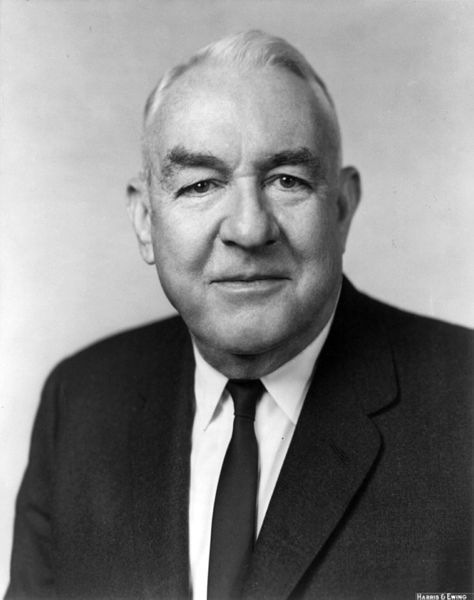
and Senator Sam Ervin (D-North Carolina).
Senator Sam Ervin
McClellan and Ervin proposed to strip…
…the U. S. Supreme Court of its jurisdiction in certain cases. Specifically, McClellan and Ervin proposed that if a state trial court found a confession to be voluntary or decided to admit eyewitness testimony, and if a state appeals court agreed with the trial court, the U. S. Supreme Court would not have any jurisdiction to hear any challenge to the confession or the testimony (and the lower federal courts wouldn’t have jurisdiction, either). To McClellan and Ervin, this was not an attack on the Bill of Rights because properly interpreted, the Bill of Rights did not force the courts to ignore what the Senators deemed to be voluntary confessions and reliable eyewitness testimony.
(In contrast, one might question whether a confession given in police custody, by someone who hasn’t been told of their rights, is truly voluntary; one may also question whether eyewitness testimony is reliable if the witness was influenced by an unfair lineup, especially when the suspect’s lawyer wasn’t there to double-check the process. Anyway, this is a debate on the meaning of the Bill of Rights, not on its applicability to the states.)
McClellan and Ervin said their proposal was constitutional because the Constitution specifically empowered Congress to make “Exceptions” to the appellate jurisdiction of the Supreme Court.
While McClellan and Ervin failed in their attempt to limit the Supreme Court’s jurisdiction, the controversy was still in the memory of Berger’s readers in 1969. In Congress v. The Supreme Court, Berger seemed to take the side of the Warren Court against its critics. Berger’s take on the intent of the founding generation was that they fully meant the U.S. Supreme Court to be able to exercise judicial review of state and federal laws. As to attempts to strip the Supremes of jurisdiction, Berger said this was unconstitutional. His analysis of the Founders’ intent took priority over what one would think was the clear constitutional language about “Exceptions.”
In the debate over ratification, Berger explained, the “Exceptions” clause only came up with respect to the issue of jury verdicts. Opponents of the Constitution had said that the Supreme Court might arbitrarily overrule jury decisions on factual issues, and the Constitution’s supporters cited the “Exceptions” clause to show that Congress could protect jury fact-finding from Supreme Court meddling. In contrast, nothing in the ratification debates indicated that Congress would be able to close off particular legal issues from the Supremes, as McClellan and Ervin had attempted to do. Allowing such action would contradict the Founders’ concerns about the dangers of Congressional overreach and the need for judicial checks on such overreach.
Berger concluded his book by rejecting the ideas of some Warren Court supporters that the U.S. Supreme Court should serve a policy-making role. Many progressives, unable to get their favorite policies enacted in the states and Congress, rejoiced to see Earl Warren and his colleagues impose such policies on the country in the name of the Constitution. Shouldn’t an enlightened Supreme Court provide “leadership” to a country in dire need of it? Berger said no, the U. S. Supreme Court was intended by the Founders to be a strictly legal tribunal, not a policy-making body.
The progressives were willing to forgive Berger for opposing their vision of a policy-making Supreme Court. After all, didn’t Berger’s scholarship show that the Supreme Court was constitutionally protected against the reactionaries who would hobble the Court’s ability to do justice? So Berger got a good deal of praise in progressive circles.
Now Berger turned to another obscure legal topic: impeachment.
To Be Continued…
Works Consulted
Raoul Berger, Congress v. The Supreme Court. Cambridge, MA: Harvard University Press, 1969.
___________, “Executive Privilege v. Congressional Inquiry,” Part I, 12 UCLA L. Rev. 1043 1964-1965.
___________, “Executive Privilege v. Congressional Inquiry,” Part II, 12 UCLA L. Rev. 1287 1964-1965.
Adam Carlyle Breckenridge, Congress Against the Court. Lincoln, NE: University of Nebraska Press, 1970.
Carl E. Campbell, Senator Sam Ervin, Last of the Founding Fathers. Chapel Hill: University of North Carolina Press, 2007.
Richard C. Cortner, The Supreme Court and the Second Bill of Rights. Madison: University of Wisconsin Press, 1981.
Gary L. McDowell, “The True Constitutionalist. Raoul Berger, 1901-2000: His Life and His Contribution to American Law and Politics.” The Times Literary Supplement, no. 5122 (May 25, 2001): 15.
Johnathan O’Neill, Originalism in American Law and Politics: A Constitutional History. Baltimore: The Johns Hopkins University Press, 2005.
David A. Nichols, Ike and McCarthy: Dwight Eisenhower’s Secret Campaign Against Joseph McCarthy. New York: Simon and Schuster, 2017.
Israel Shenker, “Expert on the Constitution Studies Executive Privilege,” New York Times, July 26, 1973.
Everything has a limit. The natural world is full of them. For example, there is no such thing as an unboilable liquid. Every liquid will boil if you heat it up enough. The same holds true for man-made things. It is impossible to build a mile-high brick tower with parallel sides, because after a few hundred feet, the weight of the bricks on top would crush the ones at the base.
(Source: physbot.co.uk)
There are mental and emotional limits as well. There is a limit to how much a person can remember or learn. There is a limit to how much stress a person can take, and so on.
Laws have limits, too. Many people mistakenly think laws are magic spells that alter behavior. Nothing could be further from the truth. Take speed limits, for example. How many people drive the speed limit? Hardly anyone. Almost everyone drives over the speed limit – most by a little, some by a lot.
If there were no speed limits, most people would drive faster, but only up to a point. This is because there are mechanical limits to how fast it a car can go, as well as psychological limits – such as the driver’s sense of fear.
Many people do not realize what a law is. Laws are not suggestions or friendly pieces of advice. They are enforced with violence. A law is essentially a formal threat. “Do this or else.”
People weigh risk when they make any decision, including whether to follow a law. Even if a law carries a very harsh punishment, it will not deter many people if there is a low risk of being caught. For example, in 19th century England, many minor crimes such as theft were punishable by death. Thieves were hanged in public before huge crowds. And while those people were gawking, pickpockets would take advantage of the distraction to steal.
In brief, laws are like language – they only work when a community is in near universal agreement on them. Imagine if each person in a town spoke a language differently. That language would be useless because the same word would mean different things to different people.
Fuck this guy.
Another point to consider is that since laws are made by imperfect people, there will be imperfect laws. Things which were once illegal are now legal and vice-versa. And in many cases, those bad laws were only repealed because many people were breaking them, and this put pressure on politicians to change them. All moral progress comes from lawbreakers – the abolitionists who defied slavery laws, the suffragettes who defied sexist laws, the anti-war protesters who defied draft laws, and so on. The United States itself was founded by outlaws.
Shakespeare wrote, “None call treason as treason if it prospers.” So it is with laws. If a group of outlaws are successful in getting a law repealed, they are no longer outlaws.
One last point to consider: there are limits to how well a law can be enforced. There is only so much that can be spent on police, courts, jails, and so on. Given that, the sensible thing would be to focus those scarce resources on preventing actual crimes – the kind that actually have a victim.
Laws can also have awful side-effects. In Boulder, CO, for example, the city built many speed bumps in residential areas to prevent speeding cars from hitting children. Unfortunately, those speed bumps also forced ambulances to slow down, and for heart attacks, a minute or two can make the difference between life and death. The speed bumps lead to a great increase in heart attack mortality.
Research in the USA supports these claims. One report from Boulder, Colorado suggests that for every life saved by traffic calming, as many as 85 people may die because emergency vehicles are delayed. It found response times are typically extended by 14% by speed-reduction measures. Another study conducted by the fire department in Austin, Texas showed an increase in the travel time of ambulances when transporting victims of up to 100%.
There are no solutions, only trade-offs. If you want to make A better, you will make B worse.
When most people hear of a problem, they reflexively say “there ought to be a law.” They ought to remember these words:
“The wise know that foolish legislation is a rope of sand which perishes in the twisting; that the State must follow and not lead the character and progress of the citizen;… that the form of government which prevails is the expression of what cultivation exists in the population which permits it. The law is only a memorandum.”
―Ralph Waldo Emerson
A former Huntington police detective has been sued in federal court along with the city and supervisors for civil rights violations including sexual abuse. The complaint alleges too that the city has failed to supervise officers.
Representing the plaintiffs, attorney Tim Eves listed nearly 20 alleged instances of policies and procedures not followed, failure to exercise reasonable or slight care, and failure to follow standards by supervisors. Eves asserted that supervisors knew the officers had been the subject of prior investigations of excessive force, had prior disciplinary actions against him, and “was not qualified to safely investigate and/or meet with potential female victims.” The complaint alleges that the officer had “unlawfully stopped, arrested, and physically assaulted others while on duty,” including illegal search and seizure, unlawful restraint without due legal process, and invasive search without probable cause, and “offensive contact” of their persons.
The city attorney has spoken out (emphasis mine again):
Responding to documents in the Earle case related to the sexual abuse, attorneys for the city have stated that the incident occurred while the detective was OFF DUTY and working a part time job.
“It is generally alleged that this incident involved a non-consensual sexual contact by Officer N with two females,” the city’s response said. “However, and without disclosing the sordid details of this incident, it must be noted that Officer N possesses real and valid defenses to these allegations, including evidence of consent to any sexual interactions.”
Well, that’s different! He was off the clock. Although, he was on the clock when he beat that elderly woman to death a year before the alleged incidents in this case.
Either way, the taxpayers are going to likely be on the hook for any settlement or judgment that comes from it. Which is the real travesty here. Well, that and the alleged sexual assaults, beating deaths and the city’s dismissive treatment of their citizens.
According to an article published by the BBC, Technology behind ‘all serious crime’, per analysis of a report by Europol, the European Union’s law enforcement agency. It ought to come as no surprise that a rise in technology us–in general–should correspond to a rise in tech-savvy criminals. However, what categories of crime were covered by the report itself, and is the headline of the piece warranted or sensationalized?
Europe’s depiction of the culprits.
What did the report include as serious crime; murder, rape, human trafficking? Only the third category was mentioned in the report at length but didn’t make the BBC’s summary. The BBC focused on increased technology use to facilitate burglaries, black market drug trade, and ransomware.
For instance, said the report, drones were now being used to transport drugs and many burglars now track social media posts to work out when people are away from their home.
It’s long-established libertarian doctrine that the violence related to the drug trade accompanies resistance to the enforcement of laws prohibiting drugs. Mark Thornton’s analysis of alcohol Prohibition (a fair proxy for comparison) in the United States published by the Cato Institute, described it as a “miserable failure on all counts.” His analysis includes a graph of homicide rates depicting a steady rise during the Prohibition era and the precipitous drop in murders after Prohibition’s repeal in 1933.
Source: Cato Institute Policy Analysis No. 157: Alcohol Prohibition Was a Failure, pg. 7.
Given libertarians’ stringent belief in self-ownership and the fact that drug use itself is a victimless crime, drug addiction cannot be rightly called a “serious” crime. Exchange of contraband items, provided that no people are exploited or otherwise harmed in the exchange, is similarly not of a serious nature.
It stands to reason that with the rise in the use of drones, or quadcopters as many aficionados prefer to call them, for drug delivery, one might expect an accompanying decrease in drug-related violence. Fewer contacts between human beings–drug traffickers and law enforcement as well traffickers with one another–may correspond to fewer homicides to protect drug profits kept artificially high by prohibition.
An increase in home burglaries corresponding to use of social media to determine times when the victims are unlikely to be home is concerning, and invasion of homes are of a more serious nature than petty thefts and shoplifting. However, it also seems reasonable that a decrease in violence due to burglars encountering residents unexpectedly may occur. Property crimes are, of course, of a less serious nature than homicides and other forms of physical violence. An investigation is required. An overall rise in burglaries may also negate any reduction in burglary-related homicides, should the rise in technology use prove causative for the increased rate of burglaries.
Much of the Europol report focuses on organized crime activities that facilitate drug trafficking and further organized crime (e.g. document fraud, money laundering, etc.), which strains credibility to characterize as “serious” in their own right. The intersection between technology use and human trafficking may have been omitted from the BBC’s summary for a reason. Europol’s 2016 situation report, Trafficking in human beings in the EU, did show a rise in reports of human trafficking, but it doesn’t necessarily demonstrate an increase in human trafficking itself. In that report, Europol says:
No distinctive trend in this variation of data was recognised as linked to any particular fact. A possible reason could be that Europol is increasingly being addressed by MS law enforcement for the provision of operational support during cross-border THB investigations.
Thus, the rise may simply be an increase in reporting to Europol itself rather than a bona fide increase in human trafficking.
The brevity of the BBC summary of the Europol report may be subtle justification for expanded law enforcement intrusion into citizens’ privacy under the pretense of reducing crime. The UK government has an interest in softening widespread hostility to the recently-implemented Investigatory Powers Act of 2016, or “Snoopers’ Charter” as opponents have popularly characterized it. The report itself doesn’t warrant that conclusion, as it is unclear whether technology use in crime is causative of the increase of crimes like burglaries or tracking a trend that accompanies higher immigration, drops in economic prosperity, and other factors known to influence crime levels. Too many issues are simply not addressed by the BBC article or Europol in its report to form any conclusions about whether technology use itself has increased serious crime regardless of the definition of “serious crime” they’re using.


.jpg "It looks like the inmates in this cell block only got a C in not-raping.")


!["As long as you're looking, can you find [insert name of unpopular sports player]'s talent?"](https://commons.wikimedia.org/wiki/Category:Microscopes_in_art#/media/File:Santiago_Ram%C3%B3n_y_Cajal_(8691434507).jpg "\"As long as you're looking, can you find [insert name of unpopular sports player]'s talent?\"")


.JPG)
.jpg)

.jpg)


.jpg)


_-_panoramio.jpg "These treaties were a national calamari, I mean calamity")


_(14780845575).jpg "\"Wait, so I'm some kind of kamikaze pilot? Yeah, I'll show you a 'divine wind' - breathe deeply!\"")

![[insert joke with Jar-Jar Binks accent here]](https://commons.wikimedia.org/wiki/File:The_Troika_1981.jpg "[insert joke with Jar-Jar Binks accent here]")