Category: Death Penalty

  • The states and grand juries, Part Three: Reformers weaken, and in some cases destroy, the right to a grand jury

    Click here for Part One

    Click here for Part Two

    In both England and the United States, the legal establishment, helped by would-be reformers, first curtailed the power of grand juries to reach independent judgments, and gave grand juries the power to abuse power on behalf of prosecutors. Then the enemies of the grand jury turned around and indulged in concern-trolling about how grand juries didn’t give adequate protection to suspects. This softened up the grand jury system, making it more vulnerable to attack, and in some cases to abolishing the institution or making it optional.

    Zachary Babington (1611-1688) was a functionary in Restoration England’s judiciary system. He was at various times an associate court clerk, a deputy clerk, and a justice of the peace. Zachary’s brother Matthew had been one of the chaplains to Charles I, who was killed when his royal tyranny provoked a counter-tyranny by revolutionaries. That unpleasantness was supposedly over after Charles II, son of the “martyr,” took the throne, but the new king’s supporters were on their guard to safeguard royal prerogatives and minimize the opportunities for the people to thwart the royal will. Zachary may well have learned from his pious brother about the perils of trusting the judgment of the people. So Zachary had a crack at grand juries, trying to limit their usefulness as shields for the rights of suspects. Fortunately, Zachary did not prevail at that time.

    In a 1676 book, Advice to Grand Jurors in Cases of Blood,  Zachary Babington complained that grand jurors often dared to ignore the judge’s instructions, and to refuse to indict suspects, or to indict suspects for manslaughter when the judge wanted a murder indictment.

    A few years previously, both the Court of Common Pleas

    The Penn is mightier than the sword
    “Hi, it’s me again, William Penn. The judges wanted me punished for preaching in the streets, and when the jurors refused to convict, the jurors got punished, but some of the jurors fought their case in a higher court and won, and here we are…isn’t it weird how I keep turning up everywhere?”

    …as well as the House of Commons had told judges they couldn’t punish jurors for making “wrong” decisions. Most pertinently for our purposes, the House of Commons had raked Chief Justice John Kelynge over the coals for his treatment of grand jurors. Don Jordan and Michael Walsh wrote that Kelynge was so biased toward suspects and defendants that he “made George Jeffr[e]ys, ‘The Hanging Judge,’ [look] like Rumpole of the Bailey.”

    "Don't trust the narrator, I'm way more frightening than Keylinge...just Google 'Judge George Jeffreys ghost.'"
    Lord Chief Justice Jeffreys presided at the Bloody Assizes, but he was still a piker next to Kelynge (not shown)

    Kelynge had punished grand jurors for refusing to indict for murder in homicide cases, and the Commons warned Kelynge that he had to allow both grand jurors and trial jurors vote how they wanted, without penalty.

    Babington apparently realized that, deprived of their power to punish recalcitrant grand jurors, judges could only rely on persuasion to get grand juries to fall into line. So in his Advice, Babington tried to use argument to achieve what threats and punishment had failed to do in Kelynge’s situation. Babington urged grand jurors to give the prosecution, not the suspect, the benefit of the doubt, and to err on the side of overcharging the defendant. If the defendant was innocent, or was guilty of a lesser offense, the trial jury could figure that out later. Babington specifically applied his principles to homicide cases. So long as the prosecution showed evidence that the suspect had committed a homicide, Babington said, the grand jury should indict for murder, even if there was evidence that might justify, say, a lesser charge of manslaughter. The grand jurors “are only to prepare fit matter for the Court to proceed further upon, and to make a more diligent inquiry after.” Only the trial jury can figure out the true nature of the crime after hearing “both sides” – Babington assumed the grand jury would only hear the prosecution’s side, and seemed to think that this was prejudicial…to the prosecution.

    “There is very much difference in Law betwixt an Inquiry and a Trial, betwixt a Presentment and a Conviction,” said Babington, and there was a lesser standard of evidence for the grand jury’s “Presentment” – “if they find upon their Evidence, that the party said to be slain in the Indictment, by the person there charged with it, with the time, and place, and manner how, they are to enquire no farther into the nature of it.” If the charges the grand jury files turn out to be excessive, it was up to the trial jury to exonerate the defendant – “however it passeth fairly out of [the grand jurors’] hands, they may more clearly than Pilate wash their hands in Innocency from the Innocent blood of such a person.”

    Pilate isn't wearing his official Roman uniform - it must be Casual Friday.
    Pontius Pilate washes his hands to symbolize his total innocence of shedding innocent blood. (Matthew 27:24)

    Babington was discussing cases of murder – then automatically a capital crime – but his reasoning would justify the grand jury in giving the prosecution the benefit of the doubt in any kind of case.

    (Babington’s view of a grand jury’s functions were articulated in 2014 by, of all people, an avowed libertarian deploring the grand jury’s failure to indict police officer Darren Wilson – “the likelihood that Darren Wilson would have been acquitted if he had faced a homicide charge in connection with the death of Michael Brown does not mean he should not have been indicted….A public airing of the evidence, with ample opportunity for advocates on both sides to present and probe it, is what Brown’s family has been demanding all along….”)

    Actual grand juries do not seem to have taken Babington’s Pilatian advice. While the evidence is incomplete, Professor J. S. Cockburn says “surviving gaol [jail] calenders suggest that in the  seventeenth century approximately twelve per cent. of all assize bills were returned ignoramus” – that is, grand juries disagreed with the prosecutors in 12 percent of cases and refused to indict.

    A colorful figure and prolific author, Henry Care, eloquently rebutted authors like Babington. Care published the book English Liberties in 1680, expressing doctrines directly contrary to Babington’s, and more in line with the real-world activities of grand jurors.

    In one part of the book, Care urged voters to elect independent, incorruptible men to Parliament - Care was charged with seditious libel for these statements, which the government considered a reflection on its Parliamentary supporters.

    Care said that grand jurors, “if they be doubtful, or not fully satisfied” about the truth of the accusation against a suspect, should not file charges.

    People may tell you; That you ought to find a Bill [of indictment] upon any probable Evidence, for ’tis but matter of Course, a Ceremony, a Business of Form, only an Accusation, the party is to come before another Jury, and there may make his Defence: But if this were all, to what purpose haye we Grand furies at all ?…Do not Flatter yourselves you of the Grand Jury are as much upon your Oaths as the Petty [trial] Jury, and the Life of the man against whom the Bill is brought, is–in your Hands…The [famous judge and legal author Edward Coke]…plainly calls the Grand Jury-men all wilfully forsworn: and Perjured, if they wrongfully find an Indictment; and if in such a Case the other Jury [trial jury] through Ignorance, &c. should find the person Guilty too, you are Guilty of his Blood as well as they: but suppose he get off there, do you think it nothing to Accuse a man upon your Oaths of horrid Crimes, your very doing of which puts him, tho never so Innocent, to Disgrace, Trouble, Damage, danger of Life, and makes him liable to Outlawry, Imprisonment, and every thing but Death itself, and that too for all you know may wrongfully be occasion’d by it, your rash Verdict gaining Credit, and giving Authority to another Jury to find him Guilty…

    Care wrote that, before a grand jury can indict a suspect, the testimony must be “clear, manifest, plain and evident.” The grand jurors must “diligently inquire” into the credibility of the witnesses.

    Oh, Susannah, yours is a canonical story / It's in the Catholic Bible, click the link and you will see
    The prophet Daniel exposes the lying witnesses who falsely accused Susannah

    It was Care’s defense of English liberties, not Babington’s attack on them, which became a popular work in the American colonies. Not only did Care’s English Liberties fill shelf space in colonial libraries, its content was invoked by the Patriots of the Revolutionary era in defending American liberties against British oppression. The side which cited English Liberties was the side that won the American Revolution, while the side that looked to the likes of Zachary Babington for advice was the losing side. At least for the moment.

    And in both England and America, the influential eighteenth-century jurist William Blackstone came down on the side of the duty of grand jurors to protect suspects against unfounded charges.

    "Don't let my hairpiece fool you; I'm a Tory, not a W(h)ig - get it?"
    Sir William Blackstone

    In Blackstone’s words, grand jurors should only vote to indict “[i]f they are satisfied of the truth of the accusation.” Blackstone spoke of a “strong and two-fold barrier, of a presentment [grand-jury indictment] and a trial by jury, between the liberties of the people, and the prerogatives of the crown.” Before approving charges, at least twelve grand jurors had to be “thoroughly persuaded of the truth of an indictment” – “remote possibilities” were not enough.

    While America was going through its founding era, on the other side of the Atlantic English grand juries blocked indictments in 10%-20% of cases – so for every ten suspects, one or two were cleared without the danger, expense, anxiety and humiliation of a public trial.

    But the legal reformers were circling like birds of prey, waiting to enfeeble and then devour the grand jury system. Jeremy Bentham, the utilitarian legal reformer, denounced the grand jury in the eighteenth century, but added that the legal establishment wanted to keep the system: “lawyers and their dupes never speak of [the grand jury] but with rapture.”

    If only that were so! In the nineteenth century, many lawyers and judges, in England and America, joined the ranks of the reformers. “Probable cause” became the standard which grand juries were told to follow in deciding whether to indict. This is certainly curious in the American case – the Bill of Rights does indeed mention “probable cause,” but that’s in the Fourth Amendment, dealing with warrants, rather than in the Fifth Amendment’s grand jury clause.

    Probable cause doesn’t seem to be the same thing as believing the suspect is guilty. In fact, the concept is kind of vague. As Professor Orin Kerr put it: “In one study, 166 federal judges were asked to quantify probable cause. Their answers ranged from 10% certainty to 90% certainty, with an average of 44.52% certainty.” Perhaps that sort of vagueness is tolerable when judges or magistrates are issuing warrants, but not in the case of grand jurors accusing their fellow citizens of serious crimes.

    Not only was the standard of proof watered down, but grand juries were limited in the kind of evidence they could hear. The only outside evidence they were entitled to examine was the evidence provided by the prosecutor (including private prosecutors in England – contradicting Justice Brown, English reformers said the grand jury was not an adequate protection against unjustifiable private prosecutions). Members of the public could not submit evidence to grand juries, the legal establishment made clear – not even suspects could send in affidavits and lists of witnesses with information favorable to them. Unless the grand jurors had personal knowledge of an alleged crime, they would have to rely for their information on what the prosecutor chose to spoon-feed them, and then they had to vote on the proposed indictment based on the loose “probable cause” standard, with the evidence stacked in favor of indictment by the prosecutor.

    The New York judge Sol Wachtler, an opponent of grand juries who supposedly said a grand jury would indict a ham sandwich…

    "After you have completed your ten-year sentence, you will be paroled into the custody of...I better not name the restaurant chain."

    …had further animadversions against grand juries in his prison memoir, After the Madness. (The judge was convicted of stalking and harassing his former lover.) “If anyone should try to convince you that the grand jury is not a device used by prosecutors to garner publicity at the expense of someone still presumed innocent, watch out! The deed to the Brooklyn Bridge is probably in his back pocket.” That sort of misbehavior, of course, is the fault of the prosecutor, not of the grand jury. And somehow, even when they bypass grand juries, prosecutors find ways to generate prejudicial publicity about their cases.

    Ovio C. Lewis, a law professor who served on a grand jury in Cleveland, Ohio, decided that the grand jury system was defective in comparison to the reformers’ favorite objective of a preliminary hearing before a judge. Writing in 1980, Lewis said: “In most cities where the grand jury is used it eliminates fewer than twenty percent of the cases it receives. In Cleveland, Ohio, the figure is seven percent; in the District of Columbia, twenty percent; and in Philadelphia, Pa., two to three percent.” From these figures, we see that at least some people were getting exonerated even under the watered-down grand jury system which had come to replace the robust grand jury of the founding era. It would be nice to know what those figures would be like in the case of a grand jury which fulfilled the functions described by Care and Blackstone: investigating and sifting the evidence and only indicting people whom the grand jurors are convinced are guilty.

    Returning to the 19th century: some English grand juries – especially in big cities – called for their own abolition. These grand juries were influenced by presiding judges who discussed the alleged uselessness of the grand jury in front of the grand jurors themselves. The Birmingham Daily Post criticized one of these judges in 1872. Even though the newspaper agreed with the judge about the desirability of abolishing grand juries, it said it wasn’t cricket to harangue the grand jurors themselves on the subject:

    The Recorder of Birmingham, in his charge the other day, made the usual remarks about the uselessness of grand juries. . . . It is unpleasant enough to have to sit in a stuffy room for two or three days, against one’s will, and it certainly does not render the infliction more tolerable to be penned up in a box, and be publicly told that one is incompetent and useless, and out of date, and in the way-nothing more in fact, than a sort of antiquated machine, less ornamental than a barrister’s wig, and less useful and important than the wheeziest of ‘criers of the Court’.

    With these attitudes, it’s hardly surprising that judges and juries were making their talk of grand juries’ uselessness into a self-fulfilling prophecy.

    Parliament put grand juries on hold during the First World War, as a supposed emergency measure. This simply whetted the appetite of the judicial establishment for a permanent, peacetime ban on grand juries, and such a ban was finally achieved by Act of Parliament in 1933.

    "OK, that's it, now that I've become Chancellor and obtained special powers, it's time to repeal Godwin's Law."
    You know why else 1933 was a bad year for liberty?

    Albert Lieck, chief clerk (or former chief clerk?) of London’s Bow Street Police Court, rejoiced at the abolition of the grand jury, while inadvertently suggesting reasons the institution should have been retained. Lieck acknowledged that grand juries had sometimes released suspects: “Here and there a bill [of indictment] was thrown out, but on no discoverable principle.” Perhaps the grand jurors hadn’t been satisfied of the suspects’ guilt?

    Lieck uttered a non-sequitur which one would associate with Yogi Berra more than with a distinguished British bureaucrat: “the real security against oppression lies not in outworn judicial machinery [i. e., the grand jury], but in the alertness and resolution of the citizen.” Of course, grand jury service has the potential to provide citizens a vehicle to exercise their alertness toward the criminal-justice process.

    American critics of the grand jury cited (and still cite) abuses which are not in any way required by the Fifth Amendment. That amendment simply says you need an accusation from a grand jury in order to be brought to trial for a sufficiently serious crime. The Fifth Amendment doesn’t say grand juries should be dependent on prosecutors for their information, or interrogate witnesses without their lawyers, or wield overbroad subpoena powers, or act in complete secrecy (unless the prosecutors chooses to leak information, of course), or fail to keep records of their proceedings. Critics have harped for a long time on these “Star Chamber” features of grand jury procedure, suggesting that the only cure is to bypass the grand jury and have magistrates or judges hold preliminary hearings, where both sides can present evidence and argue over whether probable cause exists. Then the magistrate or judge, after such an open hearing, would decide if there is probable cause to bring the suspect to trial. This type of “reform” has been adopted in England, and in many U. S. states.

    The problem with such a “reform” is that it cuts the public – at least the informed portion of the public which has actually heard the evidence – out of the decision whether to bring charges against a suspect. The suspect is dragged into a public hearing by the accusation of a prosecutor, and put at the mercy of a judge who – at least in a well-publicized case – may well feel the voters – who generally don’t know the details of the case but know that the suspect is guilty – breathing down the judicial neck and demanding a trial. With the vagueness of the term “probable cause,” it wouldn’t take a whole lot of evidence for the judge to put the case down for trial, if that’s the judge’s mood at the time. Not to mention the loss of the opportunity for nullification if the defendant, while technically guilty, is morally innocent and doesn’t deserve to be dragged through a trial.

    There are some useful features which were traditionally associated with American grand juries. These features are not required by the Fifth Amendment, but they provide some historical context to refute those who think the founders would have been happy to do without grand juries. Grand juries used to have (and to a greatly limited extent sometimes still have) responsibility for making recommendations relating to the problems of their communities: from fixing bad roads to dealing with polluted streams to making new laws, American grand juries have historically often broadened out from simply looking at local criminal cases.

    Sometimes, and this is hard to believe nowadays, grand juries, on their own initiative, looked into corruption and misconduct by local officials, including even prosecutors and judges and cops and jailers. Sometimes grand jurors took the bit between their teeth and looked into certain types of local crime which the prosecutors and judges would just as soon not look into – maybe because the prosecutors and judges were trying to sweep that crime under the rug.

    Whatever we think nowadays of these crusading, self-assertive grand juries from history – and the Fifth Amendment doesn’t require that grand juries play this role – we can reject the idea that most of the founding generation took a dismissive view of grand juries or would have been willing to abolish or sideline them, or to abolish their constitutional role in protecting suspects from overzealous or corrupt government prosecutors and judges.

    The point of having two juries – a grand jury and a trial jury – is to have the grand jury make a broad inquiry, with comparatively few technical rules, in order to find the truth, and if the grand jury believes the charge, then it’s time to have the evidence heard by a trial jury under much more rigid procedural rules. For serious enough charges, it should take these two juries – one acting broadly and informally, the other following careful rules – to agree that someone is a criminal before that person can be punished as a criminal.

    Now, in the real world, where most criminal charges are resolved through plea-bargaining, I’d advocate a more limited objective: To make sure that a person suspected of a serious crime has his case considered by at least one jury – and since cases are generally resolved with pleas before a trial jury can be called, that one jury would have to be the grand jury. There should be laws to prohibit plea negotiations from beginning in serious cases until after a grand jury has issued its indictment(s). We may have come full circle to the days of Henry II – grand juries are usually the only criminal juries involved in a case, and the trial procedure is almost as unreliable as in Henry’s day – a plea negotiation approaches in arbitrariness the old dunking-in-cold-water procedure when it comes to sorting out the innocent from the guilty. All the more reason to keep grand juries, so that some type of jury, at least, will review serious cases.

    Is there any chance that the right to a grand jury, as intended by the Founders, will be restored any time soon? Probably not. The political and judicial establishment seems to have no particular interest in encouraging such a degree of citizen involvement. They either want to keep grand juries on a tight leash, acting on the limited evidence the prosecutors spoon-feed them, or to keep them on the sidelines, taking no role in cases unless a prosecutor needs political cover for a controversial decision.

    And many regular citizens are parading around demanding that the right to a grand jury be abrogated.

    And of course advocates of a restored grand jury system will be called racists.

    Well, it’s too bad, but there it is.


    Works Consulted

    Richard L. Aynes, “Unintended Consequences of the Fourteenth Amendment and What They Tell Us About its Interpretation,” 39 Akron L. Rev. 289 (2006).

    William J. Campbell, “Eliminate the Grand Jury,” 64 J. Crim. L. & Criminology 174 (1973).

    Nathan T. Elliff, “Notes on the Abolition of the English Grand Jury,” Journal of Criminal Law and Criminology, Volume 29,Issue 1 (May-June) Summer 1938.

    Thomas Andrew Green, Verdict According to Conscience: Perspectives on the English Criminal Trial Jury 1200-1800. Chicago: University of Chicago Press, 1985.

    Don Jordan and Michael Walsh, The King’s Bed: Sex, Power and the Court of Charles II. London: Little, Brown, 2015.

    Orin Kerr, “Why Courts Should Not Quantify Probable Cause” (March 28, 2011). The Political Heart of Criminal Procedure: Essays on Themes of William J. Stuntz (Klarman, Skeel, and Steiker, eds), pages 131-43 (2012); GWU Law School Public Law Research Paper No. 543. Available at SSRN: https://ssrn.com/abstract=1797824

    Andrew D. Leipold,”Why Grand Juries Do Not (and Cannot) Protect the Accused,” 80 Cornell L. Rev. 260 (1995). Available at: http://scholarship.law.cornell.edu/clr/vol80/iss2/10

    Ovio C. Lewis (1980) “The Grand Jury: A Critical Evaluation,” Akron Law Review: Vol. 13 : Iss. 1 , Article 3. Available at: http://ideaexchange.uakron.edu/akronlawreview/vol13/iss1/3.

    Albert Lieck, “Abolition of the Grand Jury in England,” Journal of Criminal Law and Criminology, Volume 25, Issue 4, November-December (Winter 1934).

    Kenneth Rosenthal, “Connecticut’s New Preliminary Hearing: Perspectives on Pretrial Proceedings in Criminal Law.” University of Bridgeport Law Review, Volume 5, Number 1, 1983.

    Suja A. Thomas, The Missing American Jury: Restoring the Fundamental Constitutional Role of the Criminal, Civil, and Grand Juries. New York: Cambridge University Press, 2016.

    ___________, Nonincorporation: The Bill of Rights after McDonald v. Chicago, Notre Dame Law Review, Vol. 88, 2012.

    Mary Turck, “It is time to abolish the grand jury system,” Al Jazeera America, January 11, 2016, http://america.aljazeera.com/opinions/2016/1/it-is-time-to-abolish-the-grand-jury-system.html

    Rachel A. Van Cleave, “Viewpoint: Time to Abolish the ‘Inquisitorial’ Grand Jury System” (2014). Publications. Paper 656. http://digitalcommons.law.ggu.edu/pubs/656.

    Sol Wachtler, After the Madness: A Judge’s Own Prison Memoir. New York: Random House, 1997.

    _________, “Grand Juries: Wasteful and Pointless,” New York Times, Opinion, January 6, 1990, http://www.nytimes.com/1990/01/06/opinion/grand-juries-wasteful-and-pointless.html.

    Richard D. Younger, The people’s panel: the Grand Jury in the United States, 1634-1941. Providence, RI: American History Research Center, Brown University Press, 1963.

  • The inn-arrr light – Quakers and Pirates, Part 3: The pirates of Penn…sylvania

    In Part One, we followed the adventures of a pacifist Quaker sailor captured by pirates.

    In Part Two, we saw the Quakers, helped by William Penn, defeat an attempt by their religious opponents in the 1790s to have them prosecuted as blasphemers.

    But by the late 1690s, William Penn was no longer feeling his oats.

    File:William Penn.png

    He wasn’t getting any younger, he wasn’t getting the revenue he had expected from being Proprietor of Pennsylvania, and his finances were in a bad condition thanks to his un-thrifty, un-Quakerly spending habits. Worst of all, Gulielma, his beloved wife of twenty-two years, had died in 1694.

    File:Grass on hill.jpg
    “As for man, his days are as grass: as a flower of the field, so he flourisheth. For the wind passeth over it, and it is gone; and the place thereof shall know it no more.” – Psalm 103, 15-16 (KJV)

    But there was no time for Penn to sit around feeling sorry for himself….

    File:Mattheus van Helmont - Old Man Drinking.jpg
    Hey, what did I just say?

    The Board of Trade, the bureaucracy which oversaw the English Empire, had been receiving complaints that England’s Caribbean and North American colonies were tolerating pirates, with Pennsylvania among the worst of the lot. Other complaints about Pennsylvanians were that they were buying and selling goods without regard to the arbitrary British trade restrictions – this voluntary commerce in honest goods was to British imperial authorities about as much of a sin as trafficking in stolen pirate goods. Plus the antiwar views of the colonists meant the Empire wasn’t getting a lot of help from Pennsylvanians in the struggle with France.

    As far as the Board of Trade was concerned, the worst of the pirates was Henry Every.


    Seriously? An umbrella? That seems kind of effete for a pirate, if you ask me. And what about the poor umbrella holder?
    Henry Every (under the umbrella)

    Every led a mutiny and took over an English ship in Spain. Renaming the ship the Fancy, Every sought plunder in the Indian Ocean, the latest popular destination for greedy sea-robbers. These East Indies pirates were based in what is now called the Ile Ste Marie off the east coast of Madagascar. From this island the pirates sailed forth against the richly-loaded ships which carried goods and treasure from the Orient.

    They'll go no more a-roving. ALTERNATE ALT-TEXT: I don't want to be buried in a Pet Sematary, I don't want to live my life again, I don't want to be buried in a Pirate Sematary, I just want to sail upon the Main
    Pirate Cemetery, Ile Ste Marie, Madagascar

    Every left a message to English and Dutch merchants in the area telling them simply to identify their nationality and they would not be harmed. Like other East Indian pirates, Every targeted ships from the Muslim countries in the area (and would be happy to seize French or Spanish ships too). The Barbary Pirates who enslaved Europeans were Muslim. The Turkish armies which had jihaded their way through Europe, almost to Vienna, were Muslim. So there was a convenient conflation between the hostile Muslim powers near Europe and the not-yet-hostile Muslim powers with their tempting loot in the Indian Ocean.

    Every’s Fancy came across the Ganj-i-Sawai, a ship belonging to the powerful Mughal Emperor in India, a potentate named Aurengzeb. The Ganj-i-Sawai was part of a fleet which was returning from a Muslim pilgrimage to Mecca with many distinguished passengers and a prodigious amount of treasure.

    Every and his men captured the ship, stole the treasure and – if we are to believe the Mughal accounts and some of the pirates who later turned states’ evidence – raped the women. Every supposedly married Aurengzeb’s granddaughter, who had been on the captured ship, and she allegedly became a pirate queen.


    WHY WASN'T STEVE SMITH INVITED?
    “Hand over yer booty – we’re talking to you, ladies.”

    The problem was that Aurengzeb was not someone the English wanted to cross – England’s East India Company was beginning its penetration of the Indian subcontinent, but Aurengzeb might put a stop to that if he became angry. At the time Aurengzeb was regarded as very harsh and cruel, though recent historical revisionism suggests he wasn’t that bad (for example, “Aurangzeb protected more Hindu temples than he destroyed”). But it was unwise to provoke the Emperor’s wrath, and Aurangzeb was wrathful that ships from a supposedly friendly power had committed such aggression on his pilgrim ship. What are you going to do about it, he asked the English threateningly, as he commenced retaliating.

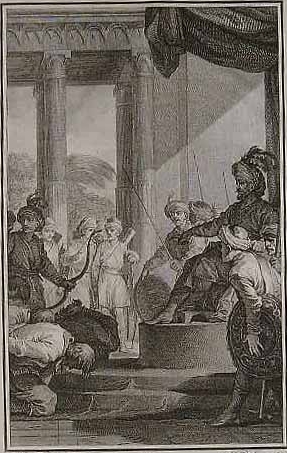
    Apologizing for the incident,

    To be fair, this is from a French book, so the authors would have an incentive to portray the English in an ignominious position
    Here are the English apologizing to Aurangzeb on an earlier occasion

    …the English tried to repair the damage by hunting for Every and his crew.

    Several of Every’s crew members were captured in Ireland, brought to London, convicted and hanged. Based on the trial and on the confessions of the captured pirates, authorities in London got a great deal of information about the friendly reception which England’s North American and Caribbean colonies gave to Every and other pirates. Reports came in of Every’s former shipmates spending and selling their loot in the colonies, bribing officials, and even settling down and becoming respectable citizens. The Board of Trade believed that Every and the remainder of his crew might be hiding out in America.

    Many people in English America were indeed friendly with the East India pirates. Many in the colonies, including many colonial officials, had personal memories of slavery at the hands of the Muslim Barbary Pirates, slavery from which they had had to be ransomed at heavy prices after enduring painful and arduous labor. The East Indies pirates were simply robbing Muslims – who were cut from the same cloth as the Barbary Pirates, the colonists thought. Speaking of cloth, calico, an Indian fabric, was very much the rage at the time, and the pirates brought calico to enliven the wardrobes even of the Boston Puritans. The stolen goods were a great stimulus to local, currency-starved economies in America.

    Reports from Rhode Island, New Jersey and Pennsylvania were particularly disturbing, at least to those willing to believe ill of the Quakers – and many English officials were willing. Tiny Rhode Island had a large measure of self-government, and the rich Quakers who ruled the colony enthusiastically cooperated with the East India pirates. New Jersey, with a heavy Quaker influence, had similar problems. Of course, the non-Quaker colonies, such as New York, Massachusetts, and the Bahamas, also provoked complaints, and these places were not Quaker-run.

    In Pennsylvania, Every’s former crew members were selling their loot and settling in that colony, like elsewhere in English America. As deputy governor of Pennsylvania, William Markham, a non-Quaker cousin of Penn’s, was responsible for wielding Penn’s powers while Penn was away in England. Markham had been in the British Navy and had taken part in a naval attack on Algiers, the Muslim pirate-state which Markham may have equated, through guilty by association, with the Muslim kingdoms of India.

    Like other American governors, Markham gave commissions to pirates for the ostensible purpose of fighting the French, who were at war with England at the time. The commissions often spoke vaguely about “the King’s enemies,” implying that the French were not the only targets. In any case, the newly-commissioned “privateers” (a term which was beginning to evolve to describe government-sanctioned pirates who fought the government’s wars) went straight to the East Indies and preyed on Muslim shipping while making the French (who didn’t have as much seizable booty) a secondary priority at best.

    Markham praised the friendliness of the pirates and the stimulus they gave to the local economy. They also seem to have brought many gifts to Markham, gifts he accepted in pretended ignorance of the givers’ piratical origins. Markham accumulated a collection of East India luxuries Although Markham arrested some of Every’s crew under pressure from London, these prisoners somehow managed to get bailed out or to simply escape. A royal official investigating Pennsylvania affairs suggested that the King wouldn’t act to suppress a rebellion against Markham, if one should develop (hint, hint). The governor of Maryland tried to stir up just such a rebellion in order to add Pennsylvania to Maryland, though that didn’t work.

    A Red Sea pirate named James Brown…

    File:JamesBrownNY87.jpg
    Come here mama…and dig this crazy scene / He’s not too fancy…but he has loot from the Red Sea / He ain’t no drag. / Papa’s got a bunch of swag

    …sailed into Philadelphia with his ill-gotten treasure, and went to see Markham, presumably with a view toward making some gifts. Brown explained to Markham about his activities, admitting that he’d sailed with the pirate Thomas Wake and also with Every, but in the latter case only as a passenger, Brown insisted. This was probably a cover story – I don’t know if Every even offered passenger service. Of the voluntary kind, that is.

    Markham’s daughter fell in love with Brown and the she married the buccaneer.


    "Where's the caterer? I'll keel-haul him!"
    “Daddy, you can tell William Penn that we totally take piracy as seriously as he does.”

    Perhaps this video will give some idea of the wedding ceremony. William Penn, however, probably did not feel good about having a pirate in the family. James Brown settled on a farm in what is now Delaware, then part of Pennsylvania.

    Penn had to balance the demands of the imperial authorities and those of his people in Pennsylvania. In 1696, Parliament passed a law increasing royal power over the colonies, including Pennsylvania, partly in the name of getting tough on piracy. Penn feared the loss of self-government and even trial by jury. Penn tried to explain to London authorities that Pennsylvanians had moved to their colony “to have more and not less freedom than at home.”

    The colonial legislature of Pennsylvania shared Penn’s concerns to an extreme degree. The Pennsylvania Quakers, as Penn had pointed out, had a longstanding suspicion of the English government, which had oppressed them when they lived in England, would seize on any excuse to extend its persecuting arm across the Atlantic. Even the anti-piracy crusade might be a pretext for colonial officials to mistreat Pennsylvanians. Robert Quarry, the admiralty judge sent to Pennsylvania to crack down on piracy, had been removed from the governorship of South Carolina for collaboration with pirates. Now Quarry had commercial interests in Pennsylvania, which suspicious Pennsylvania officials believed would give him an incentive to use his official powers to harass rival merchants – all in the name of law and order. Quarry catechized Quaker meetings about the religious beliefs, which would have reinforced the suspicion that the anti-piracy crusade was another step in England’s long-term persecution of Quakers.

    But Quarry had his own complaints:

    All the persons that I have employed in searching for and apprehending these pirates, are abused and affronted and called enemies to the country, for disturbing and hindering honest met, as they are pleased to call the pirates, from bringing their money and settling amongst them.

    The Pennsylvania lawmakers made an “anti-piracy” law full of loopholes to shield pirates’ local accomplices. James Brown, Governor Markham’s son-in-law was elected to the legislature but didn’t show up; when he did, he suggested he hadn’t want to risk arrest for piracy. The legislature expelled Brown and Markham acted to arrest his son-in-law, while also helping him out with bail money.

    Penn came to his colony to in 1799 (bringing his second wife Hannah with him), to preside over the government in person and address the vehement complaints of the colonial officials in London. He wanted to protect Pennsylvania’s autonomy as far as he could, but he also wanted to check the unrealistic defiance of the locals against the empire. If Pennsylvanians believed themselves put-upon now, how would they like it if London took the proprietorship away from Penn (again) and administered the colony directly, removing the buffer Penn provided between his colonists and the wrath of hostile imperial bureaucrats?

    Investigating the situation, Penn found that, indeed, former pirates had settled in the colony, including his cousin William Markham’s son-in-law. Penn replaced Markham and other colonial officials who had buddied up too closely to the pirates.

    After Penn gave the colonial legislators a stern talking to…

    WILLIAM PENN SPEAKS TO YOU, HIS BROTHERS AND SISTERS. STOP DOING BUSINESS WITH PIRATES, AND IN GENERAL, PAY MORE RESPECT TO MY AUTHORITY AS PROPRIETOR OF THIS COLONY.

    …the solons repealed their defendant-friendly piracy law. Mellowing somewhat, Penn suggested that the reformed pirates who had settled in Pennsylvania be left alone, so long as they earned an honest living far from the ports and coastal areas, where they might be tempted (or tempt others) into piratical ways. Perhaps Penn was thinking of his in-law, James Brown, the pirate-turned-farmer.

    Penn left Pennsylvania in 1701, and never returned.

    "Don't worry, we'll build you some monuments after you die and pretend we loved you all along."
    “Goodbye, William, Godspeed, we will take to heart all of your solemn lectures!”

    The Board of Trade was not placated, continuing to see the North American and Caribbean colonies as refuges for pirates. The problem, the bureaucrats concluded, was that not all the colonies were governed directly by the Crown. So the Board prepared a bill for Parliament by which the proprietary colonies (like Pennsylvania) and those colonies which were self-governing based on royal charters (such as Massachusetts) would become directly ruled from London Also, the colonies would be merged into larger megacolonies – for instance, Pennsylvania would be merged with Maryland and New Jersey (PenJeryland?).

    A bill matching some of the Board’s ideas was introduced in the House of Lords. To opponents of the bill, such as Penn, this was sheer oppression, abrogating charter rights. And anyway, New York was a crown colony but its former governor, Fletcher, had been in cahoots with the pirates nonetheless (Fletcher had spent time as governor of Pennsylvania when Penn had been deprived of his proprietorship). The Quakers and other colonial agents out-lobbied the Board of Trade. Penn defended his powers as proprietor in terms their Lordships could understand: “Powers are as much Property as Soil; and
    this is plain to all who have Lordships or Mannours [manors] in England… .” The bill died in Parliament – but not before passing a second reading in the House of Lords. The Board kept pushing for its pet bill, but without success.

    There wasn’t a major crackdown on piracy in the colonies until the pirates began relocating their predatory activities to the vicinity of the colonies themselves, as opposed to the remote Indian Ocean. Then the colonists bestirred themselves, and some serious pirate hangings began, putting an end to what some call the Golden Age of Piracy.


    Works Consulted

    William C. Braithwaite, The Second Period of Quakerism. London: MacMillan and Company, 1919.

    Douglas R. Burgess, Jr., The Politics of Piracy: Crime and Civil Disobedience in Colonial America. ForeEdge, 2014.

    Leonidas Dodson, “Pennsylvania Through the Eyes of a Royal Governor,” Pennsylvania History,Vol. 3, No. 2 (April, 1936), pp. 89-97.

    Mark G. Hanna, Pirate Nests and the Rise of the British Empire, 1570-1740. Chapel Hill: University of North Carolina Press, 2015.

    Rufus M. Jones, The Quakers in the American Colonies. London: MacMillan and Company, 1911.

    John A. Moretta, William Penn and the Quaker Legacy. New York: Pearson Longman, 2007.

    Andrew R. Murphy, Liberty, Conscience and Toleration: The Political Thought of William Penn. New York: Oxford University Press, 2016.

    P. Bradley Nutting, “The Madagascar Connection: Parliament and Piracy, 1690-1701,” The American Journal of Legal History, Vol. 22, No. 3 (Jul., 1978), pp. 202-215.

    I. K. Steele, “The Board of Trade, The Quakers, and Resumption of Colonial Charters, 1699-1702,”  The William and Mary Quarterly,Vol. 23, No. 4 (Oct., 1966), pp. 596-619.

    Alexander Tabarrok, “The Rise, Fall, and Rise Again of Privateers,” The Independent Review, v., XI, n. 3, Winter 2007, pp. 565-577.

    C. E. Vulliamy, William Penn. New York: Charles Scribner’s Sons, 1934.

  • The states and grand juries, Part One: The case of an enraged husband leads a couple of former pro-slavers to quarrel over the meaning of the Constitution

    I suppose I don’t have to ask if you’re familiar with the phrase “beaten like a red-headed stepchild.” I am going to describe how one of the rights listed in the Bill of Rights – the right to a grand jury – got that treatment at the hands of the states.

    Today I’ll discuss the U. S. Supreme Court’s role in all this. It was a case the Supremes decided in 1884. I’m going to focus less on legal analysis and more on biographical details about the defendant and the judges who judged him. If I seem to wander away from the specific case in order to describe the lives of the Justices, I hope it doesn’t bore you, but instead helps demythologize these supposed demigods who purport to adjudicate the limits of our liberties.

    And the fact that, given the unpromising backgrounds of these two justices, even one of them (Harlan) was willing to stand up for the Bill of Rights and its red-headed stepchild, the right to a grand jury, is all the more impressive.

    The case involved

    Joseph Hurtado

    …a resident of Sacramento, California who, according to a chronicler of his case, like other “Hispanic men of the era[,] enjoyed nothing better then to cast aside their burdens from a hardscrabble life to frequent pulquerias, or saloons, imbibe prodigious quantities of liquid refreshment, gamble, and hurl epithets at each other” (if the chronicler wasn’t named Martinez, he might get in trouble for that sort of broad generalization).

    File:Templo de la Virgen del Carmen, Celaya, Guanajuato, México 24.jpg
    Saint John of the Cross, a Hispanic man and thus presumably a brawling party animal

    Hurtado was the kind of man you can find among all ethnicities – the kind with a violent temper, especially when provoked. He had already killed a man, but had been acquitted.

    A friend of Hurtado’s, José Estuardo, somehow decided that it would a wise course of action to have an affair with Hurtado’s wife when Hurtado was at work.

    File:Gianciotto Discovers Paolo and Francesca Jean Auguste Dominique Ingres.jpg
    “What’s the worst that could happen?”

    When Hurtado found out, he made Estuardo promise not to do it again – in exchange for this promise, Hurtado let Estuardo live. Then Estuardo broke his promise and went back to banging Hurtato’s wife. Hurtado found out again and attacked Estuardo in the street before getting restrained by passers-by. Estuardo had Hurtado prosecuted for assault – “He is a dangerous man to be at large,” Estuardo warned the court (Estuardo should have thought about that earlier). Hurtado, released anyway, went to a saloon to drink, acted like he was waiting for Estuardo to come by, then he came out and confronted Estuardo, this time shooting Estuardo to death.

    "Shot through the heart and you're to blame, you give love a bad name."
    A picture of a similar incident

    This was, to be sure, a case that looked very much like premeditated murder, though a sympathetic grand jury might have stretched a point and filed lesser charges for this crime passionel. But no grand jury considered the case. Invoking a provision in the state constitution, the prosecutor persuaded a magistrate rather than a grand jury to send the case to trial. Hurtado was charged with capital murder, convicted by a trial jury, and sentenced to death. The rules of evidence at the trial (unlike the more flexible rules of a grand jury hearing) didn’t allow evidence of the adultery, thus depriving the crime of its context (which the grand jury might have considered). The judge suggested commuting the death sentence to life imprisonment. A citizens’ committee complained that the jury should have heard about Estuardo’s adulterous ways. And some locals suggested that Estuardo had simply gotten what was coming to him. But the death sentence stood.

    File:Tombstone courthouse gallows.jpg

    Hurtado went to the U. S. Supreme Court with the claim that he shouldn’t have been brought to trial, because a grand jury had not indicted him. Perhaps Hurtado’s supporters hoped that a grand jury would have reflected some of the local pro-Hurtado sentiment.

    Hurtado invoked the Fourteenth Amendment, especially its guarantee of “due process of law” (the “privileges and immunities” clause had been watered down to homeopathic levels by earlier Supreme Court decisions). According to Hurtado, “due process of law” included the following guarantee from the Fifth Amendment:

    No person shall be held to answer for a capital, or otherwise infamous crime, unless on a presentment or indictment of a grand jury, except in cases arising in the land or naval forces, or in the militia, when in actual service in time of war or public danger…

    This has generally been read to mean roughly that nobody could go on trial for a felony unless a grand jury has first accused him of that felony. And Hurtado’s case involved a “capital…crime,” which was specifically subject to the grand-jury clause. California had not used a grand jury in Hurtado’s case; did the states have to do so, or did this part of the Fifth Amendment apply only to the federal government?

    Hurtado’s conviction was OK, said the U. S. Supreme Court, because the Fourteenth Amendment (contrary to what Hurtado claimed), did not require states to obey the Fifth Amendment’s grand jury clause. Only the federal government had to obey it.

    The case marked a clash between two of the Justices. Both were Republicans who had worked together even before serving on the Court. Both of them veterans of the Union Army in the Civil War. And both of whom had records leaving their support for civil liberties open to question.

    In one corner was the author of the majority opinion,


    Justice Stanley Matthews

    File:Thomas Stanley Matthews - Brady-Handy.jpg
    Stanley Matthews (not the soccer player)

    Matthews grew up in Cincinnati, but as a young man before the Civil War, Matthews lived in Tennessee, met his wife there, and helped run a Democratic newspaper. His father worried that Matthews would pick up Southern ways from living in the South.

    File:Clark Gable as Rhett Butler in Gone With the Wind trailer cropped.jpg
    “Oh, Dad, don’t be silly, I just happen to like the Rhett Butler look.”

    Matthews moved back to Cincinnati to be a lawyer-politician. He befriended antislavery leaders like Salmon P. Chase and became the editor of the Cincinnati Weekly Herald, and then of the Cincinnati Weekly Globe, which promoted the antislavery Liberty and Free Soil Parties respectively. To Matthews, slavery was now “that awful chain of bondage, which holds three million of immortal souls in hopeless degredation.” Under the Constitution, Matthews wrote, “all men have an indefeasible natural right to freedom.” After all “Who can doubt the essential sin of slavery?”

    Matthews considered joining a Fourierist phalanx (socialist commune), and he flirted with the Know-Nothing party, but ultimately he decided to go back to the Democrats. He remained in the Democratic Party even after most antislavery Democrats had left. The Democrats might be pro-slavery, Matthews thought, but the party could at least defuse the slavery issue and preserve the Union from disintegration.

    Or as Matthews’ biographer William Wantland put it (in a different context, but the remark is applicable to Matthews’ Democratic Party membership): “Torn between the desire to follow a moral path in the political arena and an equally powerful desire to perpetuate an allegiance with friends and maintain avenues of personal advancement, Matthews generally chose the latter course.”

    File:C2E2 2013 - Two Face (8683586201).jpg
    “That’s not true, I give equal consideration to both options.”

    In 1857, Matthews helped the prominent pro-slavery Democrat Clement Vallandigham defend the pro-slavery position. Federal marshals, attempting to enforce the Fugitive Slave Act, shot a county sheriff who was trying to interfere with this enforcement effort. Matthews, Vallandigham and the rest of the marshals’ defense team helped the marshals escape justice for the shooting.

    For supporting the proslavery Democrat James Buchanan for President, Matthews received a reward from a grateful Buchanan: the U. S. Attorney (federal prosecutor) job in southern Ohio. Here Matthews once again engaged in pro-slavery behavior.

    William M. Connelly was a Cincinnati journalist who, when not doing his day job, helped fugitive slaves. Two of the slaves he sheltered were Irwin and Angelina Broadus, a husband and wife who were claimed as slaves by a Kentucky Colonel named C. A. Withers. Accompanied by federal marshals, Withers came to a room which Connelly had provided to shelter the fugitives. Irwin Broadus plunged the blade of a sword-cane into the body of one of the marshals, leaving the blade bloody for eight inches (the marshal survived, or else he would have ended up in the U. S. Marshals’ roll of honor). Withers shot and wounded Irwin Broadus. The federal government sent Broadus and his wife back to Kentucky where Irwin Broadus died from his wounds. The Ohio Anti-Slavery Bugle said Broadus had been “Freed at last.”

    File:The Hunted Slaves by Richard Ansdell 1861.jpg
    “And before I’d be a slave. I’ll be buried in my grave. And go home to my Lord and be free.”

    Meanwhile, Connelly fled to New York, where federal marshals arrested him and took him back to Cincinnati. As the U. S. Attorney, Matthews prosecuted Connelly for sheltering the Broaduses from those who wanted to enslave them. Matthews conducted the prosecution  “despite his anti-slavery convictions” (as a law professor later put it).

    File:Slavery in Brazil, by Jean-Baptiste Debret (1768-1848).jpg
    “I’m personally opposed to slavery, OK? Give me a break, I’m just doing my job.”

    Thanks to Matthews, Connelly was convicted, but the judge only gave Connelly a 20-day jail sentence and a $10 fine. While Connelly served his sentence, abolitionist women in Cincinnati sent him pastries and other good food. On the day of his release, the jailer was persuaded to keep Connelly locked up for a few extra hours so that a group of supporters would have time to arrive and give Connelly a celebratory parade.

    When the Civil War started, Matthews went into the Union Army along with his old college roommate and friend, Rutherford B. Hayes. Matthews had an undistinguished military career, and was not popular with his men. Matthews returned to Tennessee – as part of the occupying army. Due to an injury, he missed out on the important battle of Stones River where many of his men were killed. Soon after that, in early 1863, he quit the Army and became a judge in Cincinnati. He wanted to restore the Union “just as it was” – that is, with slavery still intact; an unrealistic goal as the war progressed. At the same time, Matthews rejected Ohio’s Democratic peaceniks, led by his former co-counsel Clement Vallandigham – these “Copperheads” wanted a truce followed by peace negotiations. Because he rejected any truce, and believed in fighting the war through to victory, Matthews and other “War Democrats” fused with Republicans into the Union Party.

    Matthews had joined the Old School Presbyterian Church, the country’s largest Presbyterian denomination, in 1859 – the deaths of several of his children had turned his thoughts in a spiritual direction.

    File:Presbyterian Family Connections.jpg
    The Old School Presbyterians are not to be confused with other Presbyterian denominations – this simple diagram should clarify things.

    The Old School Presbyterians soft-pedaled the slavery issue before the war, to placate Southern members, but after Southern Presbyterians seceded from the church during the war, the now Northern-dominated Old Schoolers took a prowar position. Matthews was a ruling elder of the Cincinnati Presbytery (a subdivision of the church), and as a prominent Presbyterian leader he drew up a report on slavery in 1864 which the General Assembly (governing body of the Old Schoolers) largely adopted during its meeting in Newark, New Jersey. Matthews and his fellow-Old Schoolers had finally accepted that the war was destroying the Peculiar Institution, and Matthews’ report thanked God for “work[ing] out the deliverance of our country from the evil and guilt of slavery.”

    Matthews joined the Republican Party and renewed his acquaintance with Samuel Chase, now Chief Justice. Now Matthews was for a reconstruction policy which let the former slaves vote. Supporters of such a policy were then known as Radical Republicans.

    Matthews left the Cincinnati judiciary and went back to private practice after the war. In 1869, the Cincinnati School board hired him as lead counsel to defend its new policy banning Bible readings in public schools. There had been hints that the Catholic Church in Cincinnati might want to merge its massive parochial system with the local public schools. The school board realized that the public schools’ practice of classroom readings from the Protestant King James Bible  might be a stumbling block to Catholics. So the Board put an end to these and any other Bible readings. Even after the Catholics backed out of the merger talks, the school board continued with its ban.

    "Thou shalt not deliver unto his master the servant which is escaped from his master unto thee: He shall dwell with thee, even among you, in that place which he shall choose in one of thy gates, where it liketh him best;: thou shalt not oppress him."
    “I need someone to find me a loophole in Deuteronomy 23:15-16.”

    Matthews felt obliged to resign as a Presbyterian elder, due to the opposition his anti-Bible-reading stance provoked. He warned the court against “Protestant supremacy” – because if the public schools set religious exercises the Protestant majority would decide what those exercises would be. The Ohio Supreme Court ultimately sided with Matthews and the school board. (For more about the “Cincinnati Bible Wars,” click here).

    Matthews at first joined the Liberal Republican movement against President Grant in 1872, deploring administration corruption and calling for more conciliatory treatment of the white South. Then Matthews backtracked and endorsed Grant. When he mentioned corruption, said Matthews, he wasn’t talking specifically about the Grant administration, just about, you know, corruption in society and stuff.

    Representing powerful railroad interests, Matthews was able to “swell my income”  – as Matthews put it to Hayes. He went back into politics when his old friend Hayes was nominated for President in 1876 – Matthews himself ran for U. S. House. Matthews lost his race, but as part of Hayes’ legal team he fought to have Hayes recognized as the victor in the disputed Presidential election. The famous Wormley House Conference was held in Matthews’ room at the Wormley House hotel in Washington – at this conference Hayes’ representatives (including Matthews) agreed to abandon the “carpetbag” Republican governments in the South and the Southern Democrats agreed to recognize Hayes as President and respect black rights.

    File:SlaveChildrenUnknown.jpg
    “Well, that last part is a relief. For a moment there we were worried we were getting double-crossed.”

    Serving a two-year term as U. S. Senator from Ohio, Matthews spoke up for an old client of his, railway magnate Jay Gould. He also spoke up for Chinese immigrants and against the gold standard and the New York customs boss, Chester Arthur. Then he stepped aside to let James Garfield take his Senate seat – a seat Garfield had wanted two years earlier.

    Garfield was elevated from the Senate to the Presidency in the 1880 election, but before Garfield was inaugurated, the lame-duck Hayes nominated Matthews to the U. S. Supreme Court. Matthews’ Senatorial opponents bottled up the nomination in committee until Garfield took office. Garfield renominated Matthews. The scandals of Matthews’ past life came back to haunt him. Problems included Matthews’ support for railroad interests (his support of Chinese immigration was put down to this), the enmity of New York Senator Roscoe Conkling (Chester Arthur’s sponsor), and Matthews’ enforcement of the Fugitive Slave Act. The New York Times called Matthews a “Northern slave-hound and dough-face.”

    "Hey, youse guys, play some Skynyrd!"
    A dough-face is a Northern man with Southern principles

    The Senate Judiciary Committee recommended against Matthews’ nomination. There was a dissenting vote in Matthews’ favor, but that vote came from Senator Lucius Quintus Cincinnatus Lamar, Democrat of Mississippi. Not exactly a resounding refutation of the “doughface” charge.

    The Senate confirmed Matthews by a 24-23 vote. Here is a Thomas Nast cartoon on the subject.

    So, back to the Hurtado case – Matthews’ opinion said that “due process” did not require grand juries, even for the most serious crimes. Giving such an interpretation of due process

    would be to deny every quality of the law but its age, and to render it incapable of progress or improvement. It would be to stamp upon our jurisprudence the unchangeableness attributed to the laws of the Medes and Persians….The Constitution of the United States…was made for an undefined and expanding future, and for a people gathered and to be gathered from many nations and of may tongues….as it was the characteristic principle of the common law to draw its inspiration from every fountain of justice, we are not to assume that the sources of its supply have been exhausted. On the contrary, we should expect that the new and various experiences of our own situation and system will mould and shape it into new and not less useful forms….Restraints that could be fastened upon executive authority with precision and detail might prove obstructive and injurious when imposed on the just and necessary discretion of legislative power…

    Facing off against Justice Matthews was the author of the dissent in the Hurtado case,


    Justice John Marshall Harlan

    File:John-Marshall-Harlan.jpg
    John Marshall Harlan

    Harlan, an Old School Presbyterian like Matthews, had been a Kentucky politician before the war – first a Whig, then a Know-Nothing, then a member of the “Opposition party” (anti-Democrat). He run for Congress in 1858, accusing his Democratic opponent of not being proslavery enough.  Harlan in turn had to fight off slanderous reports that he had given legal representation to a slave who had sued for freedom. Harlan lost the race by 67 votes. He suspected the Democrats had committed fraud.

    File:Shocked Face.jpg
    Let me get my shocked face

    During the Civil War, Harlan became a colonel in the Union army, where he fought against the Confederate cavalry raider John Hunt Morgan.

    The horse was trans - does it bother you that the Confederates were so tolerant?
    Part of a John Hunt Morgan statue in Lexington, KY. This is a close-up of the testicles of Morgan’s mare, Black Bess

    Laying aside his prewar Know-Nothing affiliation, Harlan praised the courage of the Catholic soldiers under his command.

    Unlike Matthews, Harlan was admired and respected by his men. Like Matthews, Harlan resigned from the Army in 1863 – in Harlan’s case because his father’s death required him to provide for his family.

    Harlan was elected Kentucky attorney general on the Union Party ticket. He wanted to beat the Confederacy, but he opposed the efforts of Lincoln and other Republicans to free the slaves.  Campaigning against Lincoln’s re-election in 1864, Harlan said Lincoln was “warring chiefly for the freedom of the African race,” when he should have simply been fighting to restore the Union. In another  campaign speech, Harlan used a joke to illustrate his argument that Republicans had too much concern about “ze little black nigger.” Harlan tried to prosecute the federal commander in Kentucky for freeing slaves.

    "A few more days for to tote the weary load, / No matter, 'twill never be light; / A few more days till we totter on the road, / Then my old Kentucky home, goodnight." - Stephen Foster
    Old Kentucky slave pen

    Harlan opposed the Thirteenth Amendment, and opposed civil rights for black people after the war.

    Then in 1868, Harlan saw the light and the scales fell from his eyes.

    File:Convertion de Paul par Boullogne 03276.jpg
    Or at least he realized that he had a better future in the Republican Party

    …and he switched to supporting the Republicans and the Republican-sponsored Reconstruction Amendments, including the 14th.

    “Let it be said that I am right rather than consistent,” Harlan told the public.

    Harlan worked with other Republicans, including the black entrepreneur and politician Robert Harlan who was probably John’s half-brother.

    "Just between us, John, Dad was kind of a racist horndog, wasn't he?"

    A more influential connection was Benjamin Bristow, who was John Harlan’s law partner and later acquired fame as an honest member of President Ulysses Grant’s Cabinet. Unfortunately for his reputation among libertarians, Bristow was Secretary of the Treasury and zealously enforced the federal whiskey tax.

    File:Dukes-of-hazzard-sheriff-car.jpg
    “I’m a get those Duke boys.”

    Like Matthews, Harlan loyally supported the Old School Presbyterian Church – fighting in the Supreme Court, and winning, in order to keep some church property out of the hands of pro-Confederate Presbyterians. This was an important precedent by which the secular courts deferred to rulings by church bodies.

    When Rutherford B. Hayes obtained the Presidency in 1877, he put Harlan on a commission to investigate the turbulent political situation in Louisiana. Harlan and the other commissioners gave Hayes cover for getting federal troops out of the state and letting the Democrats take over. Harlan thought the Democrats had become more enlightened on racial matters – though by the time of the Plessy decision Harlan would have changed his mind.

    Later in 1877, Hayes nominated Harlan for the U. S. Supreme Court. Like Matthews, Harlan faced difficulty getting confirmed to the Supreme Court by the Senate on account of his political past. Former Attorney General James Speed reassured hesitant Senators that Harlan “never was a Democrat” and that he had “sloughed his old pro-slavery skin.” Harlan was duly confirmed.

    Harlan’s dissent in the Hurtado case said:

    Those who had been driven from the mother country by oppression and persecution brought with them, as their inheritance, which no government could rightfully impair or destroy, certain guaranties of the rights of life and liberty, and property which had long been deemed fundamental in Anglo-Saxon institutions….It is difficult…to perceive anything in the system of prosecuting human beings for their lives by information which suggests that the State which adopts it has entered upon an era of progress and improvement in the law of criminal procedure….Does not the fact that the people of the original States required an amendment of the national Constitution, securing exemption from prosecution, for a capital [or “infamous”] offence, except upon the indictment or presentment of a grand jury, prove that, in their judgment, such an exemption was essential to protection against accusation and unfounded prosecution, and, therefore, was a fundamental principle in liberty and justice?

    Before leaving Justice Harlan, I should note that he famously voiced a lone dissent against Jim Crow segregation laws, unsuccessfully tried to apply the entire Bill of Rights to the states, and although he didn’t believe businesses had the right to select their own customers, he at least believed employers could choose their own employees.


    Epilogue

    The Supremes gave their decision against Joseph Hurtado on March 3, 1884. Exactly a month later, on April 3, Hurtado died of “consumption” (probably tuberculosis) in prison. There hadn’t even been time to set a new execution date. The Sacramento Daily Record-Union published a sympathetic death notice, saying that Hurtado “spent the greater proportion of his life in this city, where he had many warm friends.” He had “experienced religion,” and his final moments were spent in the company of his family (including his wife), and of priests and nuns.

    Hurtado’s body ended up in the same Catholic cemetery as Joe DiMaggio, in Colma, San Mateo County, California. As Wikipedia explains: “With most of Colma’s land dedicated to cemeteries, the population of the dead outnumbers the living by over a thousand to one. This has led to Colma’s being called ‘the City of the Silent’ and has given rise to a humorous motto, now recorded on the city’s website: ‘It’s great to be alive in Colma.’” More about Colma here – more about Holy Cross Catholic Cemetery here – consider taking one of the cemetery’s walking tours, but if I had to guess I’d imagine that you’re more likely to be shown the grave of Joseph DiMaggio than that of Joseph Hurtado.

    File:Hcc-colma-dimaggio1.jpg
    “The boast of heraldry, the pomp of power, / And all that beauty, all that wealth e’er gave, / Awaits alike the inevitable hour. / The paths of glory lead but to the grave.” – Thomas Gray, “Elegy written in a country churchyard.”


    Works Consulted

    Eric Foner, Reconstruction: America’s Unfinished Revolution 1863-1877. New York: Harper and Row, 1989.

    The Fugitive Slave Law and its Victims. New York: American Anti-Slavery Society, 1861.

    Larry Gara, The Liberty Line: The Legend of the Underground Railroad. Lexington, KY: University of Kentucky Press, 1996.

    “Local Intelligence,” Sacramento Daily Record-Union, April 4, 1884, p. 3, column 1. Available online at http://chroniclingamerica.loc.gov/lccn/sn82014381/1884-04-04/ed-1/seq-3/

    Clare V. McKanna, Jr., Race and Homicide in Nineteenth Century California. Reno: University of Nevada Press, 2002.

    J. Michael Martinez, “Hurtado v. California (1884) and 19th-century criminal procedure,” in The Greatest Criminal Cases: Changing the Course of American Law. Santa Barbara: Praeger, 2014, pp. 1-12.

    Stephen Middleton, The Black Laws: Race and the Legal Process in Early Ohio. Athens: Ohio University Press, 2005.

    The Record of Hon. C. L. Vallandigham on Abolition, the Union and the Civil War. Columbus, Ohio: J. Walter & Co., 1863.

    “Stanley Matthews,” The Sun (New York, NY), May 13, 1881, p. 2, column 6.

    Mark Wahlgren Summers, The Ordeal of the Reunion: A New History of Reconstruction. Chapel Hill: UNC Press, 2014.

    Suja A. Thomas, The Missing American Jury: Restoring the Fundamental Constitutional Role of the Criminal, Civil, and Grand Juries. New York: Cambridge University Press, 2016.

    ___________, Nonincorporation: The Bill of Rights after McDonald v. Chicago, Notre Dame Law Review, Vol. 88, 2012.

    Lewis G. Vander Velde, The Presbyterian Churches and the Federal Union 1861-1869. Cambridge: Harvard University Press, 1932.

    William Robert Wantland, Jurist and Advocate: The Political Career of Stanley Matthews, 1840-1889. Ph.D. Dissertation, Miami University, Ohio, 1994.

    Jennifer L. Weber, Copperheads: The Rise and Fall of Lincoln’s Opponents in the North. New York: Oxford University Press, 2006.

    Tinsley E. Yarbrough, Judicial Enigma: The First Justice Harlan. New York: Oxford University Press, 1995.

    Richard D. Younger, The people’s panel: the Grand Jury in the United States, 1634-1941. Providence, RI: American History Research Center, Brown University Press, 1963.

  • Harambe – Requiescat in pace

    On this exact date and time, one year ago, Harambe was cruelly taken from us.

    (5/27/99 – 5/28/16)

    Dicks out.