Category: Drugs

  • Reviews You’ll Never Use: Suspiria

    Greetings once again, my fellow travelers in the transgressive, to another installment of Reviews You’ll (Probably) Never Use.

    Last week as you’ll recall, we explored a little of the background of the wonderful Italian crime and horror genre called giallo. This week, before getting to our feature review, we’ll explore three of the main personalities which shaped and defined the giallo over the years.

    Barbara Steele in the original, and still best, “Black Sunday”

    Undoubtedly the father of giallo, and indeed of Italian horror in general, is Mario Bava. Born in 1914, Bava got his first taste of directing in 1956 when, as cinematographer for I Vampiri, he was asked to finish the film when the hired director walked out on the project. He later went on to direct the gothic horror masterpiece Black Sunday (not the one about the football game, this one is better) and began directing what are widely considered to be the first true giallo films in the early 60s. Bava’s start as a cinematographer and special effects man provided the early shape of the genre as being primarily concerned with the immediate visual impact on screen and the relegation of other aspects to subsidiary status. His son also made films, but aside from a promising turn with Demons, has utterly failed to live up to his old man.

    Next, we have the great Lucio Fulci. His film Zombi 2 was the subject of last week’s review (not linked here because linking to my own posts seems weirdly like masturbating), and if you watched or read that, you know his game. While his wonderful Don’t Torture A Duckling showcased a fine directorial ability, in general, he became known as the king of Italian gore. Despite getting his start in comedies, eventually his films were watched with a grim fascination by folks eager to see just how much brutal violence someone could get away with putting on screen. Seriously, if you have a problem with a slow close-up shot of an open eyeball having a straight razor dragged across it, don’t watch The New York Ripper. But really you should to you know, not be a pussy. His Gates of Hell trilogy (City of the Living Dead, The Beyond, and The House by the Cemetery) are all good to excellent and worth watching for any serious fan of horror. The Beyond is probably my personal favorite Italian horror film from this era.

    Finally, we come to the director of tonight’s film, one Dario Argento. He managed to have both a prolific and influential directorial career and to produce a pretty decent-looking daughter. He will be appearing at Texas Frightmare Weekend, and I will share a photo of the gentleman after I obtain my signature and regale him with stories of how much I love his movie because fuck knows he hasn’t heard that a thousand times from rando overweight white bald misanthropes. He started off as a screenwriter for Sergio Leone on spaghetti westerns but came into his own when he moved to giallo. In fact, his nearly flawless masterpiece, Deep Red, is considered by many critics to be the supreme expression of the giallo form. No less a personage than John Carpenter has frequently cited its influence on him when making American slasher innovator, Halloween. He’s fallen off recently (seriously, I bought his Dracula starring Rutger Hauer sight unseen, and returned it, it was that fucking bad), but man, when the guy was in his prime, he could make a fucking great movie experience. One thing I’ve always thought a bit off, however, was his willingness to direct his own daughter in nude scenes. How does that go? “OK sweetie, that was a good take, but now I want to see your titties a little bit more to the left, and rub that nipple a bit more sensuously. Yes, that’s the way…rub it slowly for daddy.” I mean, I know they’re Italian, and so their mores are going to be less “the corporation bought us lunch today so we can meet a deadline” and more “fuck it, let’s hit this bottle and sportfuck until the sun comes up,” but shit man, there are limits.

    WHY DO OUR CHRISTMAS DECORATIONS HAVE TO BE SO DAMN BRIGHT?

    Anyway, that brings us to our feature tonight, Argento’s Suspiria. The film was inspired by Suspiria de Profundis, a series of short essays by English author Thomas De Quincey. Argento thought to make three films out of the three Sorrows recounted in the essay: “Mater Lacrymarum, Our Lady of Tears,” “Mater Suspiriorum, Our Lady of Sighs,” and “Mater Tenebrarum, Our Lady of Darkness.” Argento would indeed go on to complete his plan with Inferno in 1980 and The Mother of Tears finally in 2007, but let’s not digress onto those paths and ruin future reviews.

    The film follows American dance student Jessica Harper as she attends a prestigious academy in Freiburg, only to discover that it’s a front for witches, just like all Arthur Murray Dance Studios in real life. Suspiria is pretty much the only famous thing Harper did, though she apparently was in Minority Report in a role I don’t recall just from reading the name.

    She’s feeling a little blue.

    Jessica’s introduction to the academy is seeing a student flee from it while ranting during a storm. The fleeing student is then murdered in most satisfying fashion. She goes to her friend’s apartment, and a random hairy-armed intruder stabs her so damn many times in the sternum that her heart is exposed, then we get a nice close-up shot of the knife being stabbed directly into the beating heart. Then she’s hung from the skylight, the shattered debris of which falls and buries itself in her aforementioned friend’s skull. It’s easily the best opening to any movie ever made, and if you disagree, you can fuck right off with your incorrect opinions which can be disproved mathematically.

    Seriously, how can you not love a movie that ostensibly takes place almost entirely at night, but is still so full of glorious colors?

    So Jessica meets the various eccentrics who staff and study at the academy. Creepy things happen, people die, and she starts to get suspicious. There’s a great scene where the blind pianist’s guide dog is possessed and rips out his owner’s throat, and tears chunks of meat out of him until a couple of polizei come running over to chase him away. Her friend Stefania Casini tries to run away from an unseen murderous fiend with a straight razor, only to fall into a storage room filled entirely with razor wire. WHAT THE EVER LOVING FUCK? It’s giallo, it doesn’t matter or need any explanation! But seriously as she’s struggling with the razor wire and getting cut up she gets her throat slit with the straight razor. Very tragic.

    Oh shit, I jumped into a room full of razor wire! I hope that guy with the straight razor who was chasing me doesn’t take advantage of this situation and come slit my throat!

    Eventually, Jessica discovers that the academy was founded by an old evil witch, and after parsing out the meaning of the opening runaway’s rant is able to find the secret passage where the academy staff congregate to perform black magic. The main baddy animates poor Stefania’s corpse, crucified on a coffin and now with needles in its eyes for some reason, to attack Jessica, but our brave Final Girl is able to see through the witch’s glamour and kill her, which causes the other witches to apparently suffer cranial bleeding and migraine headaches while the whole house tears itself apart.

    Honestly, the plot isn’t as convoluted as some critics make it out to be. You do have to pay attention and give the usual allowance for a giallo film’s somewhat blasé attachment to narrative flow, but that just comes with the territory. The real sparkle of this film is in the visual realm. The entire thing is shot in imbibition Technicolor, which was seen in films such as The Wizard of Oz and Gone With The Wind but was no longer widely used at the time. It produces a more vibrant, vivid color palette, almost to the point of garishness, though of course, that’s only a good thing in certain circumstances, of which this happens to be one. There is heavy emphasis on strong primary colors as the background in many scenes – the academy walls are deep blue and red velvet, and in a scene where sheets are set up as a screen so the ladies can sleep without a horde of maggots falling on them through the ceiling (watch the damn movie), as soon as the lights are out a nightmarish red backlight pulses through everything. Even in a bedroom, at night, there will be what looks like bright green or blue spotlights shining onto the actor’s faces. The damn skylight the initial victim is hung from is an enormous mosaic of bright colors. The entire thing is like a kaleidoscope given form and is really quite remarkable, and I can’t recommend it enough. Lord only knows how great it would be to watch it blazed (note to self: what am I doing this weekend?). Maybe the best part is what I have lovingly dubbed the Disco Peacock in the main witch’s bedroom. I desperately want one of these, and it also would be suitable for extended viewing while blazed.

    I wasn’t kidding. I present to you: Disco Peacock.
    I also wasn’t kidding about the camp-out sheets having glowing red backlight. And nobody comments on this or thinks it sinister in any way.

    Again, though, this is very much in the realm of art for the sake of art, so don’t go expecting some kind of Tarantino-esque dialog or Oscar-nominated stories of black folks overcoming oppression. It’s all enhanced with a great soundtrack by Goblin, long-time collaborators with Argento, and mentioned in my previous post. It’s less accessible to a standard horror audience than Zombi 2, but is ultimately superior. I award Suspiria 13 Sexy Witches out of 15.


  • Frank and Anne. My Girls.


    The oregano was chilling out in a little bowl on the coffee table when the doorbell rang. It was 9 pm on a Saturday night and my Brazilian roommate and I were enjoying Little Big Man after a full day of skiing at Keystone Mountain. “Ding, Dong”. Whoever was there had the patience of toddler. Matt, my roommate, finally peeled himself from the recliner and staggered to the front door. “Hey, man. It’s for you”, he said as he plopped back down into the recliner. “Ding, Dong. Ding, Dong”.

    The front door chain was still hooked. I turned the door knob to expose a sliver of the outside world to a sliver of my face. “Open the door. I can smell it from here”. At first I thought the flashlight that had wedged itself into the opening the chained allowed, was speaking to me. Nope. It was the Herb Police. Thanks, Matt. “It’s for you”. Indeed.

    The Herb Police had run up on me before. Once, when we were enjoying some basil outside a strip club, an HP officer had rolled up completely unnoticed by us. He was so stealthy that I almost passed it to him for a hit. That HP officer simply said, “You should take that inside”, before pedaling away. The irate HP officer on the nasty end of the flashlight was clearly cut from a different segment of blue cloth.

    Of course I unchained the door and let him in because he demanded, “Unchain the door and let me in”. Evidently, an HP officer’s nose is so powerful it can snort an entire 4th amendment. “I could smell the oregano from the street”, and then mumbled something into his shoulder. Great. More HPs are on the way. “You two sit there and don’t move”. So, Matt and I sat on the couch as Dustin Hoffman acted his ass off behind us.

    About ten minutes later, three HP squad cars pulled onto my front lawn. The living room curtains lit up in blue and red. Now that our cherry had been popped, six or seven HP officers strode into the house like they owned the joint. The flashlight cop, a buzz cut twerp in his early 40s, directed the

    parade and before you could say, “Clown car”, HPs were scattered throughout the house, searching for any paraphernalia related to the illicit herb trade.

    “Yes, this is all the oregano we have”, and I pointed at the coffee table. If these pasta haters are too inept to find the plants on the window sill, fuck’em. They dumped the contents of my underwear drawer on the floor, flipped the mattress over and stuffed their chubby claws between the sofa cushions. Disappointed, the HPs began trickling out of the house, one by one. All that and Matt and I wind up with a ticket for possession of a linguini altering spice. “Yes sir. We’ll make the court day”. I hesitated before locking and chaining the door behind him. What’s the point?

    Only an hour of my life, but oregano can thicken time. I walked to the window and opened the curtains a crack. “You’re safe. They’re gone”, I said to my gals on the window sill. They were still trembling. Eventually I would have to sit them down and explain to them that evil exists in the world. How hiding from it sometimes isn’t cowardice. But it wasn’t time for that talk now. I let them sleep on the night stand next to my bed that night. Frank and Anne. Sweet dreams.

  • Reviews You’ll Never Use: House

    Oh boy, where to begin with this one. Forgive me for running long, but this film deserves the digital ink.

    Let us start with this: if I were to receive some moderate sum of money, and be given complete creative control, House is the film that I would make. Please note that I am not necessarily saying this is a good thing.

    This also gives you a pretty good idea about how this movie is going to go, i.e. FUCKING CRAZY.
    Promo Image

    House is unlike anything you’ve ever seen. It’s a big (by the standards of late 70s Japanese cinema) budget art-house experiment horror-but-maybe-not-kind-of-black-comedy. To properly understand this film, you must ingest consciousness-altering substances. Drop some acid, rip as much as you can out of a bong 10 times, eat some mushrooms, get drunk, whatever you have to do to open your mind to the higher mysteries – just do it.

    Looking wistfully across the sea at the success of Jaws, in 1975 director Nobuhiko Obayashi was approached by Toho Films (makers of my favorite franchise, Godzilla) to produce a treatment for a summer thriller blockbuster. While only being a director of commercials, he was known as a creative eccentric who had produced films on the art-house circuit years before. Working with his friend Chiho Katsura, they quickly turned in a script for a haunted house film.

    The gag was, Obayashi had gone to his 10-year-old daughter and asked her for ideas of what frightened her. So impressed by the creativeness of what scares a little girl, he decided to treat the entire picture as if it was from the perspective of a young girl. This meant the inclusion of nonsensical plot elements, shallow archetypes, purposefully hokey effects and animations, all tied together with traditional Japanese ghost story elements.

    Toho green-lit the project and shopped the script for two years, but no director would touch it because they all thought it would ruin their careers. That’s how off the wall this film already was. Fearing that it would never be produced, Obayashi asked the studio if he could at least announce that it had been green-lit. They agreed, and the wild-haired filmmaker began a two-year media blitz to promote the film. He shot promo pictures with the cast, commissioned and released the soundtrack, and even had the film novelized and performed as a radio drama, all for a film that didn’t exist yet!

    That's a weird glory hole.
    So…that just happened.

    Eventually bowing to public pressure in 1977, Toho agreed to allow Obayashi to direct the film himself, even though he had only helmed commercials as a professional, and he wasn’t under contract with the studio (a highly unusual move for a Japanese studio to take at that time). His cast primarily consisted of a gaggle of 17-year-old girls who had been in his commercials previously.

    Without giving away too many details of the plot, our heroines Fantasy, Gorgeous, Melody, Mac, Sweet, Prof, and Kung Fu are slowly consumed by the house, as personified by its evil avatar, a fluffy cat named Blanche. We have an attack by a severed head from a well, which bites one girl in the rear, then vomits blood and throws itself back down the well. We have attacks by chandeliers, attacks by flying log piles, attacks by mirrors, attacks by cannibalistic pianos, attacks by futons and linens, and attacks by telephones. By the end, the house has regenerated itself, showing shades of Burnt Offerings, which had come out in the United States the year before (if you get the chance to see it, Burnt Offerings is a passable haunted house film mostly notable for being mediocre despite a fantastic cast including Oliver Reed, Karen Black, Bette Davis, and even a few minutes of Burges Meredith playing, shockingly, a curmudgeonly old man).

    The plot, though, is not the point of this film. This film is entirely focused on the telling, rather than the tale. The Austin Chronicle perhaps said it best, “there’s surprisingly little to recommend House as a film. But as an experience, well, that’s a whole other story.” We have scenes in which one character tells the others a story, which is shown as a sepia-tone film reel which the other girls can see and comment on. One girl describes a mushroom cloud as looking like cotton candy. There are animations, matte paintings, animals that are clearly being thrown at the actors from off screen, a man who mysteriously turns into a pile of bananas, and several scenes involving 17-year-old girl titties…sometimes disembodied and floating around.

    Obayashi went on to a prolific film career, and eventually in 2009 earned the Order of the Badge of the Rising Sun for contributions to Japanese culture. However, he never managed to match the beautiful insanity of his first effort. The film was a hit in Japan, due to being a breath of fresh air in a completely stagnant industry (by this time, most Japanese directors were churning out Toro-san rip-offs or pinku eiga, which is softcore porn).

    And yes, you get to see some of their little girl titties
    Our intrepid band of potential victims

    The Criterion Collection DVD has several excellent bonus features, including Obayashi’s 1966 experimental film Emotion, a lengthy interview with the director, and a retrospective by Ti West, director of House of the Devil. I had quite liked that film, but Mr. West comes across as somewhat of a smug film-school student spouting platitudes about “challenging the audience”.

    To sum up, I cannot recommend this film highly enough – if you’re a person like me, who takes most of your personal philosophy concerning the nature of existence from the Joker. If you’re a Very Serious Person who likes to Seriously Discuss Very Serious Things, and have a silly hang-up by which you insist that your films follow a coherent narrative structure and conventional character arcs, then…have an adventure and watch it anyway. But get really fucking high or drunk first. It’s worth it.

    I rate this film 8 drug-using dogs out of 10.

    Image result for crazy Image result for crazy Image result for crazy Image result for crazy Image result for crazy Image result for crazy Image result for crazy Image result for crazy

  • Weird Wednesday: Canadian Music Edition

    In 1998, I did some ecstasy but forgot that I had to work the next morning. This was a mistake. You aren’t really hungover after a night of X, but you are very, very, very tired. I was working in a college bookstore, stocking the shelves before the fall semester started. My friend Artie had gotten me the job. I really loved Artie, but he was a hippie and everyone else working there was a hippie except for me and this older lady who was always trying to start fights about religion with everyone. I managed to make it into work on time the morning after the ecstasy, despite a deep weariness and a headache that felt like a rat running around in my skull.

    The Smashmouth of Canada

    Since the store was closed while we stocked, we were playing music over the sound system. Hippie music. I was getting by, hunched over in misery, until this hippie girl decided to play a Barenaked Ladies concert bootleg. It was pretty bad, but then most loud music would have been pretty bad in the circumstance. I wanted quiet and a bed and an aspirin the size of a Frisbee. But then it got to the BNL masterpiece “If I Had $1000000,” which–for those who are unfamiliar with the twenty-minute live jam version–involves the two singers alternately repeating “If I Had $1000000…” back and forth to each other over and over again.

    “If I Had $1000000…”
    “If I Had $1000000…”
    “If I Had $1000000…”
    “If I Had $1000000…”
    “If I Had $1000000…”

    And my headache got worse and the books I was moving got heavier.

    “If I Had $1000000…”
    “If I Had $1000000…”
    “If I Had $1000000…”
    “If I Had $1000000…”
    “If I Had $1000000…”

    And my headache got worse and the books I was moving got heavier and anger rose in me.

    “If I Had $1000000…”
    “If I Had $1000000…”
    “If I Had $1000000…”
    “If I Had $1000000…”
    “If I Had $1000000…”

    And finally, I yelled, loud enough to drown out the music and for the entire store of employees to hear, “IF I HAD A MILLION DOLLARS I’D PAY TO HAVE THIS ENTIRE FUCKING BAND BEATEN TO DEATH WITH A HAMMER!”

    The bootleg tape clicked off and we worked the rest of the day in silence.

  • What Does the BBC Call “Serious Crime” Anyway?

    According to an article published by the BBC, Technology behind ‘all serious crime’, per analysis of a report by Europol, the European Union’s law enforcement agency. It ought to come as no surprise that a rise in technology us–in general–should correspond to a rise in tech-savvy criminals. However, what categories of crime were covered by the report itself, and is the headline of the piece warranted or sensationalized?

    I'm not saying it's ninjas, but it's ninjas.
    Europe’s depiction of the culprits.

    What did the report include as serious crime; murder, rape, human trafficking? Only the third category was mentioned in the report at length but didn’t make the BBC’s summary. The BBC focused on increased technology use to facilitate burglaries, black market drug trade, and ransomware.

    For instance, said the report, drones were now being used to transport drugs and many burglars now track social media posts to work out when people are away from their home.

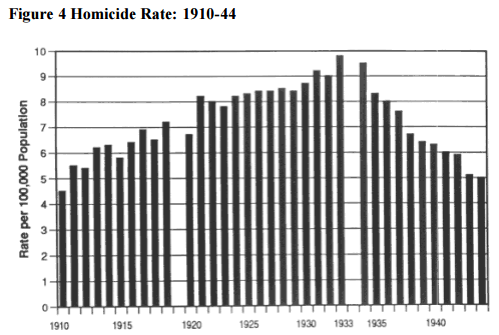
    It’s long-established libertarian doctrine that the violence related to the drug trade accompanies resistance to the enforcement of laws prohibiting drugs. Mark Thornton’s analysis of alcohol Prohibition (a fair proxy for comparison) in the United States published by the Cato Institute, described it as a “miserable failure on all counts.” His analysis includes a graph of homicide rates depicting a steady rise during the Prohibition era and the precipitous drop in murders after Prohibition’s repeal in 1933.

    Can anyone say, 'unintended consequences'?
    Source: Cato Institute Policy Analysis No. 157: Alcohol Prohibition Was a Failure, pg. 7.

    Given libertarians’ stringent belief in self-ownership and the fact that drug use itself is a victimless crime, drug addiction cannot be rightly called a “serious” crime. Exchange of contraband items, provided that no people are exploited or otherwise harmed in the exchange, is similarly not of a serious nature.

    It stands to reason that with the rise in the use of drones, or quadcopters as many aficionados prefer to call them, for drug delivery, one might expect an accompanying decrease in drug-related violence. Fewer contacts between human beings–drug traffickers and law enforcement as well traffickers with one another–may correspond to fewer homicides to protect drug profits kept artificially high by prohibition.

    An increase in home burglaries corresponding to use of social media to determine times when the victims are unlikely to be home is concerning, and invasion of homes are of a more serious nature than petty thefts and shoplifting. However, it also seems reasonable that a decrease in violence due to burglars encountering residents unexpectedly may occur. Property crimes are, of course, of a less serious nature than homicides and other forms of physical violence. An investigation is required. An overall rise in burglaries may also negate any reduction in burglary-related homicides, should the rise in technology use prove causative for the increased rate of burglaries.

    Much of the Europol report focuses on organized crime activities that facilitate drug trafficking and further organized crime (e.g. document fraud, money laundering, etc.), which strains credibility to characterize as “serious” in their own right. The intersection between technology use and human trafficking may have been omitted from the BBC’s summary for a reason. Europol’s 2016 situation report, Trafficking in human beings in the EU, did show a rise in reports of human trafficking, but it doesn’t necessarily demonstrate an increase in human trafficking itself. In that report, Europol says:

    No distinctive trend in this variation of data was recognised as linked to any particular fact. A possible reason could be that Europol is increasingly being addressed by MS law enforcement for the provision of operational support during cross-border THB investigations.

    Thus, the rise may simply be an increase in reporting to Europol itself rather than a bona fide increase in human trafficking.

    The brevity of the BBC summary of the Europol report may be subtle justification for expanded law enforcement intrusion into citizens’ privacy under the pretense of reducing crime. The UK government has an interest in softening widespread hostility to the recently-implemented Investigatory Powers Act of 2016, or “Snoopers’ Charter” as opponents have popularly characterized it. The report itself doesn’t warrant that conclusion, as it is unclear whether technology use in crime is causative of the increase of crimes like burglaries or tracking a trend that accompanies higher immigration, drops in economic prosperity, and other factors known to influence crime levels. Too many issues are simply not addressed by the BBC article or Europol in its report to form any conclusions about whether technology use itself has increased serious crime regardless of the definition of “serious crime” they’re using.

  • The Wire…Except For Real

    Alternate Headline: David Simon Ought To Sue Somebody!
    A David Simon, HBO, BBC 4 Production

    I don’t even know where to begin.  Should I start with the tens of thousands stolen from taxpayers in bogus overtime? The drug dealing? The $200,000 stolen from a safe in one incident? The cop that has killed two people in the line of duty in the last decade, with one of them resulting in a six-figure settlement?  There are so many choices, I just can’t decide.

    U.S. Attorney Rod Rosenstein

    Well, neither could Maryland U.S. Attorney Rod J. Rosenstein, so he charged the seven officers with racketeering.

    The accusations portray officers who stole from taxpayers through time fraud and from citizens they stopped or searched, with at least 10 victims robbed including some who had not committed crimes, officials said.

    The overtime abuses alleged include one from an officer who claimed it while on vacation in Myrtle Beach, S.C., and another who was in the poker room of a casino and not on the job, according to details released by prosecutors.

    That’s jacked up, right?  But it probably passes for petty in a city whose police department is known for corruption.  Alas, the story continues:

    The alleged robberies included stealing $1,500 from a maintenance man who planned to use the cash for rent and a theft of about $200,000 from a safe and from bags seized at a search location, authorities said.

    In another instance, one officer is accused of helping an associate in a drug conspiracy remove a GPS tracking device placed on the person’s car by the DEA.

    Police Chief Kevin Davis

    And there we are.  Fortunately the new Police Chief seems to be as disgusted as you are, calling them “heinous” and the acts of “1930’s gangsters.”  Not only that, but their actions have corrupted multiple federal cases, although the U.S. Attorney’s office didn’t say what exactly they were.

    Now, this is probably the last thing Balmer needs in the wake of the Freddie Gray killing and riotous aftermath.  Erosion of confidence in police has already reached a critical mass once.  Something like this could set any progress they’ve made back quite a bit.  Fortunately, the Chief seems to grasp some of the systemic problems, acknowledging that the overtime abuse “represents a pattern and practice that has undoubtedly existed in this department for many years.”  Perhaps a conviction will make other time-stealing cops think twice before continuing.  Only time, and a positive outcome in the case, will tell.  But he also said something else that gives me a little hope:

    Davis addressed the troubled department, saying, “Reform isn’t always a pretty thing to watch unfold, but it’s necessary in our journey toward a police department the city deserves.”

    Encouraging.

    The officers named in the indictment:

    The seven officers charged under the racketeering statute all live in suburban Baltimore. They were identified as Momodu Bondeva Kenton Gondo, 34, of Owings Mills; Evodio Calles Hendrix, 32, of Randallstown; Daniel Thomas Hersl, 47, of Joppa; Wayne Earl Jenkins, 36, of Middle River; Jemell Lamar Rayam, 36, of Owings Mills; Marcus Roosevelt Taylor, 30, of Glen Burnie; and Maurice Kilpatrick Ward, 36, of Middle River.

    Authorities said that Gondo, known as “GMoney,” also has been charged with joining a drug conspiracy. Five alleged members of that conspiracy were also charged Monday with drug offenses for allegedly selling heroin at a shopping center in Northeast Baltimore.

    Good luck, Mr. Rosenstein and Mr. Davis.  I know you’ve got your work cut out for you as you try to root out corruption and help the citizens of Baltimore get a police department they can not only be proud of, but that they can trust to not rob them blind.

  • When A Game Of Chicken Goes Horribly Wrong

    I know its a week old, so sue me!

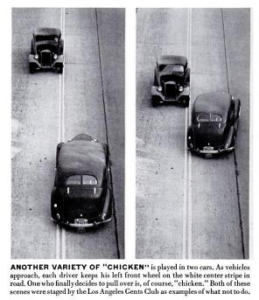
    Florida Man?  Pshaw!  Alabama Man, not to be outdone by his panhandly (it could be a word) neighbors, decided it was a good idea to play chicken at 4:00 am.  His son, rather than talk him out of the plan, decided to participate in the festivities.

    This is not how they did it.

    An Alabama father and son were killed in a head-on collision with each other on Saturday morning, police said.

    Police said that alcohol was a factor in the crash that killed Jeffrey Morris Brasher, 50, and his son, Austin Blaine Brasher, 22, but they are continuing to investigate.

    The crash occurred at around 4:10 a.m. when the 2006 Ford pickup the Brasher was driving collided with his son’s 2004 Chevrolet pickup, according to police.

    Neither Brasher was wearing a seatbelt, according to reports.

    Neither was available for comment.

  • Why President Trump Should Follow The Rule Of Law Like Bolivia

    By: The Fusionist

    One issue raised by drug warriors about the legalization of marijuana in various U.S. states involves the United Nations drug-control treaties, especially the 1961 Single Convention on Narcotic Drugs. This multilateral treaty requires the parties – including the United States – to ban a whole list of drugs, including cannabis. So the prohibitionists say that when Colorado, etc., legalize dope, this puts the United States in violation of the Convention.

    The Devil Weed

    The United States are (not “is”) a Union of states, so the question arises: How to reconcile compliance with the Convention with respect for federalism? The prohibitionists, including the bureaucrats at the International Narcotics Control Board, say that countries with a federal system must be held to observance of the Convention regardless of federalism considerations. Legalizers (including you-know-what magazine) say that the Convention allows for federalism and thus there’s no problem if Colorado, etc. choose to go their own way on marijuana.

    In fact, the Convention seems to face both ways on federalism. On the one hand, Article 4 says member countries must “give effect to and carry out the provisions of this Convention within their own territories” without any mention of federalism. On the other hand, Article 35, while requiring member countries to adopt penal measures against drugs (including marijuana.), says that each member country’s responsibility in this regard is “[s]ubject to its [the country’s] constitutional limitations.”

    The broad language of Article 4 does seem to militate against a country simply up and allowing legalization of any of the substances which are supposed to be banned. The federal government, with its responsibility for foreign affairs, would be in an awkward position explaining to the international community how our country remains committed to “carrying out” the cannabis ban “within [the United States’] own territories” even while many of the constituent parts of our federal Union are making it legal. This would be particularly awkward when the United States government was a leader in pressing for this drug Convention in the first place, rebuking other countries for their alleged softness in the prohibitionist cause.

    On the other hand, the answer to this problem is not for the federal government to trample on our Constitution in order to please the United Nations – either with a tortuous reading of the Commerce Clause or under the guise of passing enforcement legislation under the treaty power. Even if we make the dubious assumption that the Supreme Court was right about Congress’ power to override federalism in the name of enforcing treaties, it’s not clear that the Supreme Court’s decision allows the complete abrogation of federalism to enforce this particular treaty. Since the penal article of the treaty, at the very least, allows us to respect our own “constitutional limitations,” it seems a bit circular to say that Congress has to pass penal legislation to stay in compliance with this article.

    I’m sure President Trump stays awake nights contemplating this dilemma. So let me offer a suggestion – why not respect the rule of law like Bolivia did?


    If you want to hang out, you’ve gotta take her out

    The Bolivian government was a party to the UN Narcotic Convention, and faced a similar problem to ours. Out of respect for the rights of indigenous peoples (which is kind of like federalist principles, if you think about it), Bolivia legalized the chewing of coca leaves by these peoples, apparently a traditional practice. But the Convention apparently required coca-leaf chewing to be criminalized.

    Instead of doing fancy legal footwork to try and claim they were complying with the Convention, Bolivia pulled out of the Convention altogether, which Article 46 of the Convention allows. Then Bolivia re-ratified the Convention, but this time they attached a reservation that the indigenous practice of coca-leaf chewing could remain legal. Some countries, including the U.S., objected to this reservation, but there weren’t enough objections to make any legal difference, and Bolivia was accepted back into the Convention subject to its coca-leaf reservation.

    (Fun fact: “socially liberal” Sweden was one of the countries which unsuccessfully objected to Bolivia’s coca-leaf reservation, declaring that “the ambition expressed in the convention is the successive prohibition also of traditional uses of drugs.”)

    So let’s assume that President Trump’s drug-war zeal is stronger than his skepticism about multilateral treaties, and that he wants the U.S. to stay part of the UN Narcotic Drug Convention. All he needs to do is pull out of the Convention, and then ask the Senate to re-ratify with a reservation that lets us legalize marijuana.

    Now, in such a case, I’d be cheering for the Senate to reject the treaty as a violation of U.S. sovereignty, not to mention dubious policy, but in that case Trump’s hands would be clean, he would have made clear his drug war bona fides without going full retard about it.


    Citations:

    Catechism of the Catholic Church

    Fourth Commandment and Fifth Commandment

    The UN Drug Control Conventions: A Primer

    SINGLE C ONVENTION ON NARCOTIC DRUGS , 1961 As amended by the 1972 Protocol amending the Single Convention on Narcotic Drugs, 1961

    Bolivia Rejoins UN Drug Treaty, Sans Coca Ban

    Does Marijuana Legalization Violate International Law?


    Contribution of the International Narcotics Control Board to the high-level review of the implementation by Member States of the Political Declaration and Plan of Action on International Cooperation towards an Integrated and Balanced Strategy to Counter the World Drug Problem” (pp. 41-43),

    Missouri v. Holland


    Catholic disclaimer:

    “2211 The political community has a duty to honor the family, to assist it, and to ensure especially…

    “- the protection of security and health, especially with respect to dangers like drugs, pornography, alcoholism, etc….

    2291 The use of drugs inflicts very grave damage on human health and life. Their use, except on strictly therapeutic grounds, is a grave offense. Clandestine production of and trafficking in drugs are scandalous practices. They constitute direct co-operation in evil, since they encourage people to practices gravely contrary to the moral law.” (from the Catechism)

    As the great St. Thomas Aquinas showed, the state is not bound to forbid all sins, and until recently, Catholics have not been prohibitionists. As for protecting the family from drugs, I would say that the state should step in only in cases of clear harm, like when someone’s abuse leads them to neglect their family responsibilities, but that the Church should intervene pastorally even earlier than this, to keep Catholics (or non-Catholic beneficiaries of Catholic charity) on the straight and narrow.

  • Marijuana And Unconstitutional Laws

    By: The Fusionist

    So, Spicer (the Presidential spokesdude) said the Trump administration might increase prosecution for state-legal recreational marijuana (as opposed to medicinal marijuana, protected by the Rohrabacher Amendment).

    The predictable prog freakout includes “wrong side of history” (the WA state attorney general) and “hypocrisy” (for respecting states’ rights on chicks with dicks, but not with dope).

    But let me ask, what are the *principled* grounds for proggy complaints? Congress passed anti-dope statutes, applying not simply to marijuana which flows in interstate commerce, but to marijuana which is grown and consumed within a single state. The Supreme Court, by a 5-4 vote, said that these federal statutes are a valid exercise of the Constitution’s Commerce Power, 10th Amendment be damned. Sure, there was an eloquent dissent by Justice Thomas, and critics ask why it took a constitutional amendment to ban booze on the federal level while marijuana required only a Congressional statute.

    But all this is beside the point, isn’t it? After all, the Supreme Court, according to prog dogma, is a secular magisterium. If the Supremes say that Congress can use the “interstate commerce” rationale to prevent the growing, selling and using of a plant within a single state, then the Court’s word is final, isn’t it? Isn’t the Supreme Court our secular Magisterium, whose pronouncements on constitutional law are binding on the consciences of the citizens, and of officials in other government branches, until such time as a new 5-4 majority on the Court overrules the former majority, in which case the *new* pronouncement of the Court is binding on the consciences of officials and citizens.

    Any Congressional statute pronounced constitutional by the Supreme Court of the United States is, therefore, perfectly valid and part of The Law, and the President is bound to see that the laws are faithfully executed. Congress has passed statutes forbidding marijuana even if grown, sold, and used exclusively within the borders of a single state. Therefore, the President is bound to enforce this law against all violators, right? And if the authorities in some defiant state refuse to comply, then do with them like the feds did with George Wallace: make them get out of the way so the will of the Supreme Court can be enforced.

    To the extent progs have principles, this is definitely one of them. They should get bumper stickers for their Volvos – “The Supreme Court said it, I believe it – that settles it!”

    So why are they bitching and moaning at Trump? Because Trump! and weed! of course.

    I suppose they will utter some noises about prosecutorial discretion, but that’s not the constitutionally required faithful enforcement of the law. That’s *fitful* enforcement.

    Fortunately, those of us who aren’t progs and who believe the federal dope laws are unconstitutional, need not paint ourselves into a corner like this. We get to say that just because the Supreme Court says something doesn’t make it true. The Supreme Court has previously admitted it was wrong in the past. So it’s like the famous conundrum of whether to believe the person who says he’s a liar.

    The federal courts are checks on abuses of power by Congress, the President, and the states. So if (to take a purely hypothetical example), the President (perhaps with Congressional approval), locks someone up without a trial, the federal courts can use habeas corpus to get the prisoner released.

    So the courts should be seen as a *check* on the powers of the other branches, but their decisions should not be seen as a *blank check* for unconstitutional federal actions.

    The President, as well as the members of Congress and the Supreme Court, are pledged to uphold the Constitution. That means defending the constitution against attacks from any quarter – even the courts and Congress.

    If Congress passes an unconstitutional statute and the Supremes uphold it, then all the more reason for the President to take another look at the statute to make sure it’s not an unconstitutional oppression of the people. If he thinks it’s unconstitutional and that the courts aren’t going to block enforcement, then the President, under his own responsibility, should uphold the Constitution and forbid the enforcement of the unconstitutional statute(s).

    Sometimes a statute creates or enforces private rights, so that if the President tries to block enforcement, a person whose rights are affected can go into federal court to challenge the Pres, and if the Supreme Court has already upheld the law, the Pres will lose. I’m not sure, however, whose legal rights are violated if the President *doesn’t* enforce the drug laws. Without an actual case, the Supreme Court won’t be able to step in.

    That leaves Congress. If the House of Representatives think the President is disobeying or thwarting the implementation of a constitutionally-valid statute, then the House can impeach the President and those who aid him (or, if they’re wimps, the House can impeach solely the subordinate executive officials who carry out the President’s orders).

    Then the Senate will decide whether to convict. Two-thirds are required for a conviction, so if 2/3 of the Senators believe the President violated a constitutionally-valid statute, they should find him guilty. On the other hand, if 1/3 plus one of the Senators believe the statute is unconstitutional, they should vote to acquit, and the President’s action will be sustained, assuming there’s no plaintiff with standing to force the Pres to enforce the statute.

    So under my suggestion, the Pres would be able to go over the head of the Supreme Court and thwart the enforcement of an unconstitutional law. Congress in its judicial capacity would have the final word on the validity of its own statutes and would throw obstructive executive-branch officials out of office if they obstruct valid statutes. On the other hand, if you can’t get a majority of the House and 2/3 of the Senate to agree that a statute is constitutional, then it’s just as well for the public the statute isn’t getting enforced, because it probably *isn’t* constitutional.


    (I may post another discussion about drug treaties)

  • Psychopathic Exhibition On the Menu


    Making the rounds on the outrage circuit is this latest update into the continuing saga of Trump – Oh, What An Ass.

    ‘‘This is what it’s like to be with Trump,’’ Christie said. ‘‘He says, ‘There’s the menu, you guys order whatever you want.’ And then he says, ‘Chris, you and I are going to have the meatloaf.’’’

    The big take-away we’re supposed to have is that Trump is such dickhead. How Dare He. The choice of supper entree for an enormous fat man already the subject of one failed lap banding is none of your business, sir – he has agency, you know!

    Pardon me if I hesitated to clutch my pearls. As many times as this story has been passed from shocked ear to shocked ear, people missed what I found to be the pertinent lede to the story, which defined a damning study in character itself.

    Trump and Christie discussed the nation’s opioid epidemic during the lunch.

    Christie on Wednesday signed a series of bills he requested to address the crisis, including a five-day limit on initial prescriptions for opioids and mandating state-regulated insurance plans cover treatment.

    I’m sorry, were we discussing agency here? The agency of someone afflicted with a self-inflicted morbidity known to cause early death, disorder and severe limitations on quality of life?

    Oh yes. I went there.


    Chris Christie believes there is an opioid epidemic. Is he correct? Possibly. To what ends? His own. If the opioid epidemic were a problem for the consumers of opioids, they’d be proposing their own solutions. They might even be doing so – we don’t know, since Top Men and the mainstream media do not appear to have invited them to the discussion. But the real problem here is that Christie ate meatloaf when he might have chosen something else. Sure.

    As detailed in my earlier article, Finding the Why, humans have a talent for spotting malfunction as defined through their own worldview. We apply self-serving corrections, and then when our best-laid plans end up tattered wrecks, we blame everyone else for the failure.

    I, personally, believe Chris Christie needs to put the snacks down and take the stairs more often. I am fully confident that if he does not do so, his life will be needlessly shortened and suffer a loss of quality. I might even be right. So, tell me, America – at what point do I get to override Governor Christie’s agency in order to apply my corrections to his choices?

    In my opinion, I don’t.


    If he wants to be a great big fat bastard, that’s his problem. Nothing to do with me. But what about his elevated healthcare costs, due specifically to his bad lifestyle choices and now foisted onto the backs of taxpayers? Who, exactly, paid for Governor Christie’s surgery; the one that didn’t work?


    Red herring. If we all eat enough of them, we’ll be thin as rails. The problem isn’t that Christie has a sweetheart Cadillac healthcare plan exempted from Obamacare’s onerous health-damaging idiocies, at the expense of people who lack such privilege. The problem isn’t even that he uses this sweet privilege to rectify the self-inflicted abuse of his body. The problem is that government picks my pocket to enrich people who think lunch should be not merely free, but an all-you-can-eat buffet. Those who rob Peter to pay Paul, will always have the support of Paul.

    Is the analogy too subtle? Perhaps it is. In the abundance of articles about poor, poor Christie’s stolen agency, not one thus far to mine eyes has pointed out these astonishing parallels. Christie is upset at the loss of his own agency, while taking others’ agency away with both hands and the expectation of applause.

    Governor Christie is the very thing against which he rails. He merely has trouble seeing this clearly, since he is as convinced of his own narrative rightness as every other human on the planet. He is the good guy, because that’s what his head tells him is so.

    Being the good guy isn’t a side, a team. It doesn’t come with the proper hand-waving to paper over what you did with a thin veneer of respectability and concern. It’s an action. Those who do bad things are not the good guys. Everything from there is rationalization.

    Prediction: If an opioid epidemic exists, it will not be cured by talking at opioid consumers coupled with the proper removal of just exactly the right set of agencies from the correct people, handing that power over to some bureaucrat whose claim to fame is a bachelors degree in fine arts and a cushy job divorced from the requirement for functional results. What we’ll get then is another set of dysfunctions, and more people insistent that more money and and more power to the people who caused the new problems are the next sole best solution.

    If there is an opioid epidemic, we’d be best served to start with finding the why.

    Why are more people consuming more opioids? If consumption has reached levels causing individual health concerns, why has that individual come to the conclusion that this was the most effective cure for their pain despite the risk-reward calculation? Lest anyone labor under the delusion that only people making good and proper social normie choices make risk-reward calculations, allow me to disabuse them of that notion. Everyone makes risk-reward calculations. The man drinking himself to death knows it. This choice nevertheless appears, to his mind, to be the most effective option available. If this calculation fails to make sense, I’d suggest asking him to explain it rather than assuming we know everything about the matter and can solve that problem for him.

    Chris Christie post-surgery is still grossly obese. If you want to know why, don’t ask his surgeon; ask Christie.

    Therein lies our real solutions. Taking away the proper agencies and handing more power and money to people ill-equipped to use them will solve nothing. Such actions have, in fact, gotten us to this state of disorder and chaotic whack-a-mole with accompanying enormous and rising costs; both fiscal and societal.

    We need to start involving those who we purport to assist. Not at them and to them, but with them, will these problems be solved. Every individual has agency, and re-labeling people as sub-human and otherwise lesser-than to excuse our actions in taking away their individuality does not make us the good guys.

    It makes us psychopaths.

    The… characteristics referred to as antisocial personality in the FBI report were as follows: sense of entitlement, unremorseful, apathetic to others, unconscionable, blameful of others, manipulative and conning, affectively cold, disparate understanding of behavior and socially acceptable behavior, disregardful of social obligations, nonconforming to social norms, irresponsible. These… were not simply persistently antisocial individuals who met DSM-IV criteria for ASPD; they were psychopaths- remorseless predators who use charm, intimidation and, if necessary, impulsive and cold-blooded violence to attain their ends.

    We are eating the very people we claim to help because it feeds our narrative and increases power and money in one direction only. The stated goals are never reached, and the subjects loathe us for our efforts; this is natural, since we are not helping them, that’s just our rationalization of our bad choices. This is tribal monkey behavior with evolved vocabulary, not civilized humanity.

    Civilization is a choice. Let’s choose it.