This is the world globalists want!“Green Lives Matter” – Yes, our Border Patrol actually believes this shit.
Earlier this week, President Trump delivered his second annual speech concerning his administration’s national security strategy. In it, Trump presented a Manichean world, in which America’s cultural, economic, and military hegemony must be maintained at all costs against an insidious Asiatic peril that consists of the combined forces of Cathay and the Volga Tartar. While it is encouraging to finally see recognition of the fact that “history” is far from over, with Trump specifically, and without obfuscation, declaring Russia and China as “rival” nations of which “protection” of a nebulously defined American economic interest is a prerequisite for “cooperation,” one is forced to inquire in what essential way does Trump’s national security policy deviate from the zero-sumWeltanschauung of the neoconservatives?
After all, it was Trump’s putative national security and foreign policies that were the banner Rockwellians held aloft, front and center, when declaring a ‘libertarian case for Trump’. Instead, the bill of goods sold to libertarians by Bannon, Gorka, Miller, et alia was merely the The Project for a New American Century covered with a lamina of mercantilistic trade protectionism. Thus, what we have now is a mandate to para-militarize our borders to serve the triple purposes of escalating the Wars on Drugs, Terrorism, and Illegal Immigration; increased federal spending to defense and infrastructure cronies; going all-in on the Israeli position in the Middle East, the provision of arms to Ukraine, and continued support for adventures abroad to “confront, discredit, and defeat radical Islamic terrorism and ideology.” As we have learned on Monday, there is no meaningful distinction between the Trump administration’s strategy and the six major articles of the Wolfowitz Doctrine.
An in depth perspective on how blockchain and cryptocurrencies work, along with a running commentary on social value, libertarianism, and whatever the heck fits my fancy. I’m attempting to write this at a high school comprehension level so that those who haven’t sat through 4 years of computer engineering classes can make sense of all of this.
What this isn’t
A primer on Bitcoin, an economic treatise, or a how-to. (Although, elements of all of those things will appear)
For those who don’t feel like scrolling through pages and pages of my ramblings, here’s the TL;DR. Blockchain is a bunch of messages with security built into them. The security isn’t perfect, but each message is increasingly secure as time passes. The list of messages is saved on every computer that participates in the blockchain, and the lists are constantly being compared for agreement. Blockchain relies on a bit of a gambit. They essentially say “you may be able to break the security on one node, or even a few, but after a few the increased security that comes with time passing will catch up with you, and you’ll be stuck well before you come close to succeeding in fraud.”
A Survey of Computer Science
Numbers in an Array
Computers are complex and simple at the same time. It takes millions of lines of code and tens of thousands of man-hours to put together the latest Windows or OSX version, and yet everything a computer does is simply a whole bunch of numbers saved in an array called memory.
Let’s look at an example computer memory:
Let’s ignore all of the writing for a moment and discuss what we’re looking at. Memory is “byte-addressable,” which means that you can access information 8 bits (there are 8 bits in a byte; a bit is a single value of “1” or “0”) at a time. If I want to access the byte at address 0, I write some code that properly references address 0, and I have access to the value in that address of memory. If all data was 8 bits long (e.g. a number between 0 and 255), then we’d have a pretty easy go of accessing data. Just remember the order you put it in, and you just call the number that you put it in (minus 1 because the addresses start at 0).
However, as shown in the above image, data can be much larger than 8 bits. The yellow 2-byte data is a short integer (e.g. a value between 0 and 65,535). The purple 4-byte data is an integer (e.g. a value between 0 and ~4.3 billion). There are other types of data that are even longer, like decimal numbers (called floating point numbers). Here’s more info on memory and how it works. Now it gets a bit more complicated to remember where things are in memory.
Arrays: A Simple Way to Store Large Amounts of Data
When dealing with simple data, like an integer, storing it in memory is relatively simple. As long as you know what address it starts at and how long that type of data is, you can access and retrieve the data. However, what are we to do when there is a bunch of related data?
For example, what if we want to store the daily profits for the week from our monocle and top hat shop? Now we don’t have just one piece of data to deal with, but seven. We could just toss each day’s profit into memory as we encounter it, but the accounting program we’re running may store additional info in memory: temporary values, user credentials, and other information needed by the program will also reside in memory.
We can remember each address for each individual day’s profit data, but these values are related, and it’s hard to manage access information on seven values, let alone 70 or 700 or 700,000. Treating each value individually doesn’t scale.
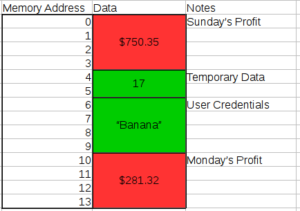
As shown above, Sunday’s Profit is separated from Monday’s Profit (both in red) by intervening unrelated data (in green). In order to access the week’s profit, you need to know the address of each and every day’s profit, and you have to individually retrieve each data point.
In comes a better way to handle such data: Arrays! Much like memory is an array with addresses referencing each byte, array data structures store related information sequentially so that each piece of information can be referenced with an array address.
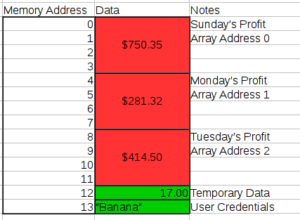
The difference is clear. The array groups the related data together, and you can simply reference the array to get to any of the data. Array address 0 is Sunday’s profit, which is located in memory addresses 0-3. Array address 1 is Monday’s Profit and is located in memory addresses 4-7. Rather than needing to remember all of the memory addresses for each day’s profit, you can simply remember the starting memory address of the array, and use the array address to calculate where each piece of information in the array is located. For example, array address 1 translates to the array starting memory address (0) plus one array element (which is 4 bytes long), resulting in a memory address of 4. If you look at the above image, array address 1 starts at memory address of 4. NOTE: I haven’t included all 7 days of profit in the above image so that it won’t get too complicated and confusing. Here is some additional information on arrays.
However, you can also see a limitation in the above image. It works great if you know exactly how much data you need to store, but look at where the Temporary Data and User Credentials are stored. If you need to include one more piece of information in the array, you’re hosed. Either you have to start moving a bunch of stuff around in memory to make room (which is not ideal), or you have to continue the array somewhere else in memory and keep track of 2 array portions (which is also not ideal).
Linked Lists: Good for dynamic data
You may be wondering what the point of all of this is. We’re talking about blockchain, not about memory management, right? I promise, this is where we connect to blockchain.
Let’s see if we can combine the best of both worlds. Writing each day’s profit to memory separately allows you to add additional days without having to shuffle data around in the memory. On the other hand, preserving the relationship between all of the days’ profits without having to keep track of each day’s memory address allows you to scale up to large amounts of data without overcomplicating things.
One of the “best of both worlds” solutions is called a linked list. A linked list operates much like writing each day’s profit to memory separately, but preserves the relationship between the different days by including an additional bit of information pointing to the location of another day’s profit in memory.
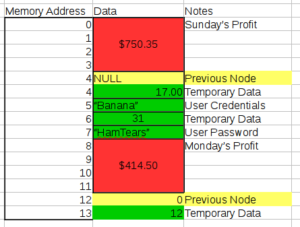
As you can see, we have expanded Sunday’s profit and Monday’s profit from 4 bytes to 5 bytes. The additional byte (in yellow) points to the previous node. Since Sunday’s profit is the first node, its previous node is NULL (meaning it doesn’t have a previous node). Since Monday’s profit is the second node, it points back to Sunday’s profit. Previous Node 0 points to the starting memory address of Sunday’s profit.
Visualized another way, the linked list looks like this:
This is the basis of blockchain. A data structure with a payload and a reference to the previous block in the chain. Now let’s talk about security.
Hashes: Breakfast for the Masses
I dunno about y’all, but I’m sick of reading. Let’s take a quick break before getting into hashes by enjoying some pictures
Alright, back out of your bunks. Time for some more learnin’. Hashes are conceptually simple, but mathematically complicated. Since we’re not diving into the math, this section should be a breeze!
No, not that kind of Brees!
Let’s take a look at the array again:
If we call Array[0] we get Sunday’s Profit, and if we call Array[1] we get Monday’s profit. However, we don’t always have a situation where we know exactly what order the data will be put into the array. Imagine, for a moment, that instead of 3 days of profits, we have 3 years of profits, entered manually by an employee who isn’t guaranteed to get everything perfectly in order. How do we find Monday’s Profit in that deluge of data?
The traditional way is to search for the data in the array. Here is some more information on searching.
The fun way is to use hashing! How about we use some relevant characteristic of the data to access the data instead of the array index (“index” is another term for array address number). All you need is two math equations: one to determine the hash from the data, and another to determine a memory location from the hash.
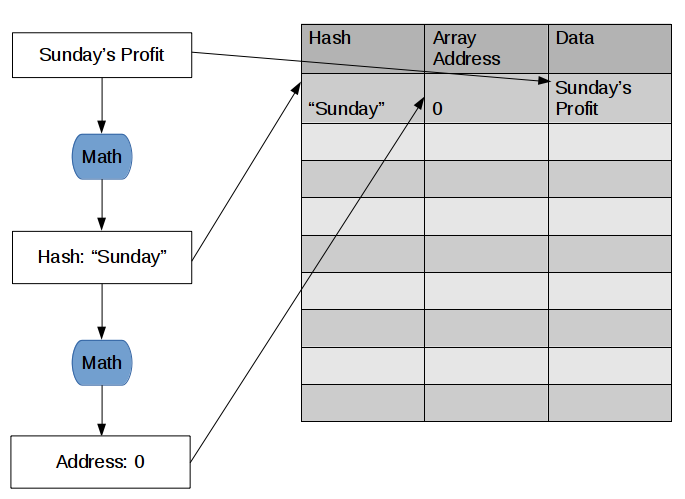
As you can see, Sunday’s Profit data was hashed to “Sunday”, which is a characteristic of the data (specifically, the day of the week), and “Sunday” was computed to be connected to array address 0. Now, instead of accessing Sunday’s Profit data by loading Array[0], you can access Sunday’s Profit data by loading HashArray[“Sunday”].
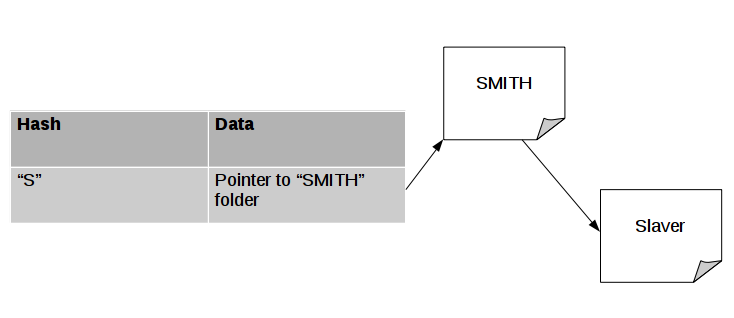
If this is a bit confusing, another simple hashing algorithm that appears in everyday life may clarify things. Placing medical records in alphabetical order by the first letter of the last name is another hashing algorithm. If the last name is SMITH, the “algorithm” for obtaining the hash involves looking at the first letter of the last name, “S”. Then, the hash “S” points to a specific shelf in the fileroom (the “S” shelf, for lack of a better name). SMITH’s folder is placed on the “S” shelf. When I want to retrieve a folder starting with “S”, I pull a folder off the “S” shelf, and I have SMITH’s folder.
But there are many people with a last name starting with “S”. What happens when SMITH’s folder is stored on the “S” shelf and I want to store Slaver’s folder? This is called a “hash collision.” Depending on the specific situation, a hash collision is either an inevitability or a disaster. In cases where hash collisions are expected, we could simply change the data stored. Rather than just storing one piece of data for each hashed value, we can store the data for each hash in a linked list. Now, the “S” shelf looks like this (pointer is just a fancy term for the memory address):
This is great for categorization hashes like the alphabetical sorting of medical records, but isn’t the best for cryptographic hashes like are used in blockchains. Instead, cryptographic hashes rely on another protection from hash collisions, small data density.
Bitcoin and most other cryptocurrencies use what is called SHA-256 hashing. In SHA-256, a message of any* size is hashed using really fancy math into a 256 bit number, which means there are 2^256 possible hashes (1.1×10^77 for you scientific notation folks, or roughly 1/10 of the total number of atoms in the universe). Hash collisions are so rare under SHA-256 as to be practically nonexistent.
*Technically, there is a maximum length of message, but it’s enormous.
But I mentioned above that hashes are based on characteristics of the data. “S” is the first letter of SMITH, and it’s fairly easy to see the relation. What is the relation between some seemingly random 256 digit number and a Bitcoin block? Well, it has to do with math well beyond my ken, but you can go here for a bit of an explanation (as well as a look ahead). In essence, the math takes all of the data, divides it into chunks, and does a mathematical transformation on each chunk before assembling the results into the hash.
Okay, assuming you’re following along so far, you understand how categorization hashes work and that cryptographic hashes are different, but how do cryptographic hashes work?
Cryptographic hashes work on the principle that it’s much easier to do the math to hash the data than to derive the data from the hash. Let’s look again at the medical records example for a picture of how this works. If you’re given the last name SMITH and told that the hashing function (fancy term for the math to calculate the hash) is the first letter of the last name. It’s trivial to calculate a hash of “S” from the data “SMITH.” However, let’s go the other direction… if all I give you is “S”, you have thousands of last names to choose from. The chance of you guessing “SMITH” is extremely low.
The same principle applies to SHA-256 hashes. It’s relatively easy for a computer to calculate the hash from the original data, but (practically) impossible to derive the original data from the hash.
We’ll discuss the specific way cryptographic hashes are used in blockchains later on.
Let’s take another break. Things are getting a bit intense. In the spirit of the glib baby pics from a while back, here’s me in a sombrero.
Cultural Appropriation from a Young Age
How about some relaxing pics from a backpacking trip I took a long time ago?
Public Key Cryptography
Alright, back to talking security! We’ve laid the groundwork for explaining the structure and security of the blocks in a blockchain, but let’s talk about individual currency transactions and how they’re secured. If I want to send 50 bitcoins to ZARDOZ, we create a transaction to transfer the bitcoins from my wallet to his. The details will be covered later, but it’s important to notice that without any security, STEVE SMITH could read the transaction, and use the information contained in the transaction to create a fake transaction to send the 50 bitcoins to him instead of ZARDOZ.
What sort of security is used on these transactions? Public key cryptography! Public key cryptography uses the same concept of “one way” algorithms, just like the cryptographic hashes. In fact, in some cases, the mathematics for generating cryptographic hashes is used in public key cryptography.
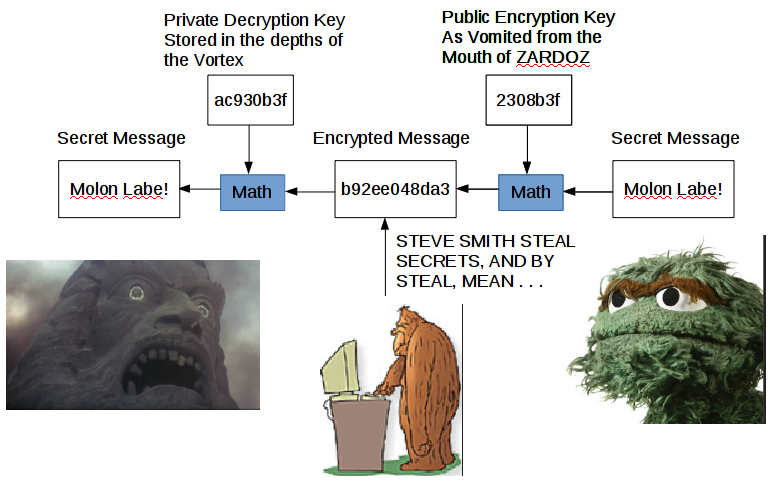
How does it work? Let’s assume I want to send a secret message to ZARDOZ. I’m sending it over the Internet, which isn’t a particularly trustworthy place. I can’t just send the text in the open. ZARDOZ decides to generate two “keys.” In this context, one of the keys is used in combination with fancy math to encrypt the message so that it can’t be read by STEVE SMITH. The other key is used in combination with more fancy math to decrypt the message. The cool thing about public key cryptography is that you can’t figure out the decrypting key by looking at the encrypting key or at an encrypted message. This is called asymmetric cryptography.
In contrast, symmetric cryptography can be “broken” by looking at the encryption key and the encrypted message. Of course, that means you shouldn’t broadcast your symmetric encryption key on an insecure channel. For example, if my encryption algorithm is addition of the encryption key to the data, and my encryption key is 4, then if my data is the number 10, the encrypted data is the number 14 (10+4 = 14). I send 14 across the unsecured network to ZARDOZ, who uses the symmetric decryption key (the number 4), and the decryption algorithm of subtraction of the decryption key from the data, and ZARDOZ gets the original data, the number 10 (14 – 4 = 10).
Seems secure enough, especially when we use something more complicated than “add 4” as an encryption. But why are we talking about asymmetric cryptography instead? Well, because we have a problem. The Internet isn’t particularly secure, and we’re not gonna VPN with the entire bitcoin network, most of whom we don’t trust, to send them our secret key. With asymmetric cryptography, the encryption key (called the public key) can be known by everybody. It doesn’t matter if half the world can encrypt messages intended for you. As long as they’re not able to decrypt those encrypted messages, the system is secure. That’s why the decryption key is called the private key. The private key must be kept secret by the receiver of the message.
As shown above, I have sent ZARDOZ the message “Molon Labe!” ZARDOZ has vomited forth (published) his public key, which allowed me to encrypt my message and send it across the Internet securely. As you can see, STEVE SMITH can try his hardest to intercept my message to ZARDOZ, but all he gets is a bunch of gibberish. Then, once ZARDOZ receives the encrypted message, he uses his private decryption key (secreted away in the Vortex where nobody can access it except ZARDOZ) to decrypt the message and read “Molon Labe!”
Now, this is great and all, but isn’t blockchain about publicly accessible data and verification instead? Well, yes. Let’s take this public key encryption and flip it around. Now, instead of keeping the data secret, we want to make sure the data is from the right person. I’m expecting a message from ZARDOZ, and want to make sure that it’s legitimately from ZARDOZ and not from STEVE SMITH.
As you can see, the message stays public the entire time, but there is extra data added based on ZARDOZ’s private key. This is called a signature. Upon receipt, anybody can verify the authorship of the message by using the public key.
What happens when STEVE SMITH tries to meddle again?
As you can see, STEVE SMITH, in his ham fisted way, has altered the message before I have received it. When I try to verify the message’s authorship, I find out that it’s not from ZARDOZ, and thus it’s a suspect message to be ignored.
This is the basis for verifying cryptocurrency transactions. We’ll put all of this book learning together into a workable model in the next article or two, but this article explains most of the theoretical underpinnings of blockchain and cryptocurrencies.
There’s a scene in Neal Stephenson’s “The Baroque Cycle” in which the 17th Century English economy is described as almost completely run from lists of debts due to the lack of circulating coinage. Welcome to the wonderful world of Bitcoin!
There is no such thing as a bitcoin. When someone says “I own a bitcoin,” what they mean is “I know the code or codes that can authorize the transfer of up to one bitcoin.” If you buy a “loaded” physical token for 0.01 bitcoin on eBay, the token contains a code. Neither the token nor the code is “bitcoin,” but the code enables you to transfer amounts adding up to 0.01 bitcoin to other accounts.
Bitcoin’s foundation is a public transaction ledger called the blockchain. Every bitcoin transaction is recorded on the blockchain and anyone can inspect the transaction history going back to the creation of the first block of the chain. Because the blockchain is public, bitcoin transactions are not as anonymous as some people currently in prison had hoped. Every new account is anonymous, but that anonymity will probably be compromised by the first transfer of bitcoin into it because the bitcoins in the source account probably have a history–and there are companies whose business plan is to delve through the blockchain to link accounts to owners and sell the information.
Here’s how the blockchain works: people with codes that control bitcoin create transactions. Transactions can have one or more input accounts and one or more output accounts. Newly created transactions are sent to the cloud of computers running bitcoin protocol clients and added to a list of pending transactions. Anyone can download a bitcoin protocol client and run it on their computer, but running a full “node” takes a lot of disk storage space and Internet bandwidth.
Some of the computers running bitcoin protocol clients are “mining” bitcoin. To mine bitcoin, one selects transactions from the pending list and packs them together into a binary blob called a “block”. The block is then scanned to create a “hash” value. The last digit of a 16 digit credit card number is a hash value calculated from the first 15 digits. This is how web sites can automatically determine if you’ve mistyped a credit card number.
The hash value created by scanning a block isn’t a single digit. It’s 78 digits long, and it’s unlikely that the first hash value created for a block will “mine” the block because there’s a trick. The bitcoin protocol tries to make it so that a block is mined every 10 minutes. To do this, the protocol periodically adjusts the difficulty of mining by specifying a maximum value for the hash value. In addition to the selected transactions, the block contains a counter. When a block is first created, the counter value is zero. The block’s hash value is calculated. If the hash value is less than the current maximum value, then the block is “mined.” If the hash value is greater than the current maximum, then the counter is incremented and a new hash value is calculated. Subsequent hash values created by incrementing the counter are essentially random values from zero to 1.16×10^77. The process of mining a block is repeatedly incrementing the block’s counter and calculating the next hash value until the hash value is less than the current maximum value.
“… What?”
When a hash value is less than the maximum value, the winning block/counter/hash combination is sent to the cloud of computers running bitcoin protocol clients, and the block is added to the end of the blockchain. The transactions in the block are considered complete and removed from the pending list. All the miners start the process over again, create a new block from transactions in the pending list, and commence mining it.
As incentive to mine, the account of a miner who successfully mines a block is credited with (as of this writing) 12.5 bitcoins. This is how new bitcoins are created. The number of bitcoins created for each successfully mined block declines slowly over time. Miners can also keep any change left over from a transaction. If a transaction specifies an input account that contains one bitcoin and specifies the output account should get 0.99 bitcoin, then the remaining 0.01 bitcoin is kept by the miner. This is incentive for miners to include the transaction in their blocks.
Most mining is done by groups of miners who join together in a mining “pool.” A central computer creates the block which is sent to the members of the pool. Each member mines using a different initial value of the counter. If a pool member mines the block, the result is sent to the central computer and the pool members share the reward in proportion to their effort. Anyone can buy a mining rig on eBay and join a mining pool.
Bitcoin mining is almost exclusively done by specialized mining equipment, and the price of bitcoin is directly related to the cost of the electricity required to mine blocks. If the exchange value of bitcoin rises to the point where it’s very profitable to mine, then existing miners buy more equipment or new mining pools are created. This makes mining faster and blocks are mined more frequently than every 10 minutes. This makes the bitcoin protocol increase the mining difficulty by decreasing the maximum hash value. This means miners have to mine longer to mine a block using more electricity and reducing profits. Miners must sell some of their new bitcoins to pay for the electricity used, so the price of bitcoin is ultimately related to the cost of electricity.
This is from a long, far-ranging discussion of economics and politics a former friend and I had on Facebook, and this post was originally written in 2013. I think this still stands up well, but this is not a new post.
My friend has a BA in Business Administration, hence the reference at least once to his business degree, and presumed cluefulness about how businesses operate and how business owners think. This jumps into the middle, and I’d rather just post this as-is, so I’ll paraphrase his points leading up to this. We wandered over to minimum wage via government regulation (which in turn stemmed from a discussion of the incestuous relationship between business and government); I’d said that most regulations are obsolete and hurt business, he pointed out that yes, some are obsolete, but others are there to protect people, and voila, minimum wage is an example of protecting workers.
My response:
You and I are coming from the minimum wage question from 2 completely different angles. You believe in (federal) government protection of workers. I believe in the (federal) government sticking to the Constitution… and minimum wage isn’t in the Constitution, even under the commerce clause (what Joe Shmoe is paid in Wichita, KS, has nothing to do with a different franchise in Kenosha, WI, selling their burgers). If it was a state minimum wage, it’d be a different thing… although I’d still be against it, the “it’s not a role of government” argument wouldn’t apply.
However, setting that argument aside, I’m still coming at it from the side of “personal responsibility”. You have 3 options as a burger flipper: either find an employer who will pay you what you think a burger flipper is worth at whatever quality of burger flipper you are (I’d assume shoddy, since you feel you need some kind of protectionism to get paid a ‘decent’ wage, but I may be wrong and you may just be ignorant and unaware that you can switch jobs without your world shattering), be the best damn burger flipper you can be and justify that raise you’re asking for (what everyone making over minimum wage does when they want/need to make more money), or learn a skilled trade or get a higher education in something and stop being a burger flipper and start being something like a carpenter or architect.
Again, I’m not talking out my ass, or in theoretical terms about things I only vaguely observe from some mystical ivory tower somewhere… I have the t-shirt. In high school and through college (and after college for a couple years, because of the recession) I worked really crappy jobs. Food Lion and Walmart didn’t pay minimum wage (even McDonald’s doesn’t), but it was bloody close. After I moved out, I didn’t make enough most of the time to cover my gas and such (I was in college by the time I moved out)… so I did the best job I could do and got raises every year. When I could, I got promotions. And when I found a job that paid me well and needed my skill set, I changed jobs and came to work at my current job. I didn’t ask the government to make anyone pay me more, or wish minimum wage was $12/hr… I made myself a better employee and justified the money I was getting, and went above and beyond so raises and promotions would be justified as well.
And since you have a BA, I assume you know as well as I do that businesses aren’t charities– they aren’t there to give workers the money they ‘want’, or deserve for being a special snowflake human being. Businesses exist to make money, and as a side effect pay people to make money for the business… and that pay is in proportion to a person’s value as an employee. If Mother Teresa sucks at flipping burgers, then dang it, Mother Teresa deserves minimum wage… or to be fired. It doesn’t matter to Burger King that she’s Mother flippin’ Teresa, man. She’s a terrible employee, and her pay reflects that.
Also worth noting is the point he’d made earlier about employees being replaced by automation if they get too expensive to employ. This is a very valid point that most minimum wage workers and people who advocate for them don’t seem to understand. Again, people own businesses to make themselves money. If they can’t make enough money, something’s got to give. And when there’s no more non-employee overhead to cut, they need to start cutting people. As a general rule of thumb, it costs about twice an employee’s gross pay to employ them (given employer shares of FICA, certain states’ income tax, worker’s comp, benefits, etc.)… so that $10k/yr employee actually costs the business owner around $20k. I’d imagine Obamacare penalties and/or post-obamacare insurance premiums have upped that 2:1 ratio. So if it costs less than $20k/yr to set up an automated ordering kiosk and a burger flipping robot, guess what a business owner is going to do?
And then there’s the economic effects of raising the minimum wage. Less than 10% of workers make minimum wage, so this would have very little direct positive effect on people. However, in short order, it would have great negative effects on a large number of people. Artificially raising the wages of one segment of the population increases cost for certain businesses, they raise their prices, which raises costs for other businesses, and so on down the line until prices have increased across the board, and we’re right back where we were. This is how raising the minimum wage is a driver of inflation.
In this country, like most countries in the world, we have a fiat currency; that is, a currency whose value is not linked to a commodity (like gold, silver, or salt), but is based on the trust that the country issuing the currency can pay its bills. By its nature, fiat currencies are subject to almost constant inflation through devaluation of the currency. Especially when the country in question is engaging in… let’s say non-optimal monetary and economic practices. In our case, budget deficits, a high national debt, and things like quantitative easing. It’s part of the reason everyone’s parents have stories of “I remember when gas was $0.35!” (for my generation’s parents) or “I remember when gas was $0.98!” (the story I get to tell if/when I have kids and they’re old enough to be regaled with tales of ‘the good old days’). Another factor in inflation is artificially raising wages– you’ve arbitrarily decided that the dollar is worth less than it is, so people need more of them. And by deciding that one segment of the population needs more, less valuable dollars, everyone else needs to have and spend more, less valuable dollars to keep up with the sudden devaluation of a dollar for a certain segment of the population.
So, with a rough idea of how inflation works in mind, it makes sense that raising the minimum wage (or even having one, I would argue) is detrimental to the economy as a whole, and you end up chasing your own tail. What happens when inflation catches right back up to you again? The cycle of artificial inflation begins again, and the minimum wage is raised, devaluing the currency and forcing business costs to go up, rippling down the supply chain, raising costs of end-consumer goods, etc. We aren’t going to rein in fiat-based inflation any time soon, but we can stop wage-induced inflation by not raising the minimum wage.
Alright, here’s what’s gonna happen, I’m gonna start out with a story from my job, talk about minimum wage and why kids don’t work today, then end with a gripe.
Foreseeable consequences are not unintended.
So I was busing tables for my $1.50 an hour, you know just watering and cutting bread, when this kid, and when I say kid, I mean a guy who was 23 and had never had a job, who was simultaneously well groomed and unkempt walks in. I thought to myself, “Oh God, fine I’ll water you and cut, whatever.” So I continue on and water him and all that. He was rude to me and the server who I’m friends with so I didn’t like this kid, but fine again, whatever. So as the night picked up, I passed by his table a few times until eventually he drops this line on his parents, “As long as we have a middle class in america we can’t have equality.” Now I had to water and cut bread so I didn’t hear more. But this made me so angry that it almost ruined my night, a night which already had a lot going wrong recently.
Alright, story time’s over, now it’s time to talk about the minimum wage. Now this is already a loaded topic so I’m not going to step into what is so intricate about it, but instead I’ll cut right to the meat of my argument. It’s not the only reason why kids can’t get jobs now. Much of the refusal to hire kids is due to the following two reasons:
Kids are now less willing to work and are thus less reliable workers who employers are willing to hire
And kids provide a whole slew of issues, to the point where even if they are willing to work, they are not allowed to work in certain places
But let’s break both of these down. Amongst kids there is a lot of pressure to not only socialize, but also to play structured sports, to the point where they have no time to spare between homework and extracurriculars. The extracurriculars are mostly used by parents earlier in the kid’s life to signal their wealth. These extracurriculars tend to then continue later into the kid’s life until we have the current situation. But what about the liability issues? Well, they primarily start around the following two laws “kids under 16 may not work with food” and “kids under 16 may not handle cash.” I don’t know if these are federal or state, but it meant that until I was 16 I couldn’t get an actual job. There are also safety issues which mean that kids can’t be involved with heavier labor like landscaping unless they get expensive medical testing. This renders most jobs unavailable for kids.
Now onto the gripe. I don’t earn $1.50 an hour on my actual paycheck, instead it’s $5.50 an hour plus tips. But the payroll tax is so utterly fucked, to the point where out of every $5.50 I never see $4. That’s $4 which goes to the fedgov and not me. Fuck payroll and income taxes together. Anyway, y’all let me know if you have any stories of your own.
The focus of the paper by Lee, Wu and Lee (2011) is on the liberalization of trade between Taiwan and the PRC as a result of the Economic Cooperation Framework Agreement (ECFA) which was signed and came into effect in mid-2010 – and the resulting expected adjustments in trade surpluses. The removal of import/export tariffs (excepting agricultural goods) reveals an increasing trade imbalance favoring Taiwan over the PRC, but the article does include some interesting notes on the cabotage policies between the nations. Specifically, while historically trade between the PRC and Taiwan was routed through third party ports in Japan, Korea and Hong Kong, as a result of liberalization, since 2008 direct trade has been permitted – although only by PRC and Taiwanese flagged ships (Lee, 186).
As part of the PRC’s overarching “One China” policy, direct trade between the PRC and Taiwan is considered “domestic” trade and only permitted by “domestically” flagged vessels – which in this case is comprised of ships flagged by either the PRC or Taiwan. Although the authors resist speculating on this point, the resulting trade imbalance previously referenced appears to be an acceptable calculated loss on the part of the PRC leadership as it allows them opportunities to speak to the “One China” policy and include both the imports and exports under the greater Chinese economic umbrella and perhaps the establishment of further precedents through trade routes and associated dependencies (Lee, 187).
ASEAN
In researching barriers to effective and efficient shipping services in the inter-ASEAN region, Tongzon and Lee (2016) conducted a series of interviews with various representatives of trade organizations, shipping corporations (government and privately owned) and associated logistics service providers. To limit the scope of the study, three countries were selected as representatives to be extrapolated from – Malaysia for the more developed economies, followed by Vietnam and Myanmar to represent the least developed countries (Tongzon, 410).
Cabotage legislation is specifically identified as a contributing barrier to increased maritime trade over the course of the discussions – and as the authors note, while Malaysia and Vietnam both employ cabotage policies, they are considered market-responsive. Malaysia is specifically noted for making exceptions for container traffic to and from Port Klang, as well as permitting shippers to opt out of restrictions by paying certain taxes and fees – although these may also be exempted if there is no Malaysian vessel available meeting the requirements (Tongzon, 416).
It should be noted that while acknowledged, cabotage policies as an average are less of a concern amongst the interviewees responding on behalf of the three featured countries than port infrastructure limitations or shortages of trained personnel. Similarly, while Malaysia is a more traditionally and historically a maritime nation due to geographic concerns than Vietnam or Myanmar, neither of the archipelagic nations of Indonesia or the Philippines were reviewed in this paper. The recent contrasting legislation passed in each of those countries – increasingly strict cabotage limitations in Indonesia over the past several years following the initial passage of Maritime Law No 17 of 2008 (Yee), and the amending in 2015 of the Jones Act-esque “Republic Act of 1937” in the Philippines (Yee), which opened up domestic traffic to international carriers in the process of importing or exporting goods – would provide an interesting counterpoint for future research.
Conclusion
In reviewing the current literature available on the topic, there does not appear to be a large volume of academic research addressing the specifics of individual nations’ cabotage policies or legislation. As a matter of self-interest, this topic appears to be of more value to various stakeholders, special interest groups and associated government partners who tend to commission their own studies as a means of influencing policymakers (MARAD).
While there is literature advocating new policies and technologies for shippers to implement – framed in public policy theory terms, the authors are in some cases unwilling or unable to recommend policy stances that would strengthen the persuasiveness of their arguments and give more rationale for reasonable implementation – Perakis and Denisis (2008), and Medda and Trujillo (2010). In contrast, Brooks and Frost (2004) are fully cognizant of the limitations imposed by the current regulatory frameworks and openly recommend changes that would prove efficient and beneficial to multiple parties – in keeping with the pre-existing trade arrangements.
Traditionally, countries have tended to be protectionist to industries considered critical to national security, but in the 21st century as manufacturing efficiencies have been diversified and shipping specialties have been outsourced, that argument has grown increasingly stale, particularly when considering the comparatively small groups that benefit from associated protectionism at the expense of nearly the entire whole. As a function of free trade agreements in particular, the removal of cabotage restrictions between partners should be a serious consideration from this point forward.
In approaching future research considerations on this topic, it would be valuable to first collate all outstanding cabotage legislation on a country by country basis and utilize that as a framework for determining economic impacts – along a framework similar to that utilized by Lewis (2013). Although there are obvious distinctions and variations between countries, a common database would allow comparison between data points such as ship flagging requirements, crewing requirements, maintenance or operation taxes and other economic [dis]incentives. With that information available to hand, it would be a simpler matter to correct for comparative gains and losses associated with these policies and recommend more specific or targeted policy adjustments with accuracy.
Some links don’t work based on library links – article information provided in case anyone else wants to look them up later:
Lee, Tsung-Chen, Chia-Hsuan Wu and Paul T.-W Lee. “Impacts of the ECFA on Seaborne Trade Volume and Policy Development for Shipping and Port Industry in Taiwan.” Maritime Policy and Management. Vol 38: No. 2, (2011): 169-189. Web. 12 Jun. 2016.
Canada (aka America’s Hat)
As the title so aptly states, “Short Sea Shipping: A Canadian Perspective” by Brooks and Frost (2004) approaches the topic of short sea shipping from a Canadian perspective – but gives due consideration to the association with the United States – particularly in connection with NAFTA. In that, Brooks and Frost provide a valuable summary of existing regulations – as of 2004 – in the US, Canada, and Europe while examining what legislative functions would need to be modified in order to broaden acceptance of short sea shipping as a viable transportation method. Significantly, one highlight of existing policies in North America is that NAFTA as a general agreement, made no dispensations for existing cabotage regimes either with respect to the Jones Act in the US or additional, similar regulations in Canada or Mexico – although the latter two countries did sign an additional bilateral treaty to address the issue. Tellingly, given the geographic and port situations between the two countries, it has had far less tangible effect than a liberalization of policies by the US would have produced across the board (Brooks, 399). The basic domestic cabotage policy requirements for Canadian shippers are also similar to those imposed by the Jones Act with respect to flagging, construction, and crewing requirements – and the potential tax liabilities for failing to meet those requirements. In some cases, however, the regulations appear somewhat more piecemeal – and potentially contradictory – than the all-encompassing Jones Act (and accompanying legislation) in the US. For instance, Canadian safety standards for new vessels are reportedly more onerous and expensive to meet than the internationally accepted IMO standards – while at the same time, a number of existing Canadian flagged ropax vessels would not meet the IMO standards if they were formally accepted as a baseline by the Canadian government (Brooks, 399). While Brooks and Frost appear to be in favor of expanding short sea shipping as an alternative to trucking – particularly in the congested I-5 and I-95 corridors – much the same as Perakis and Denisis – they are cognizant that there is no financial incentive (big surprise) to shippers utilizing current technologies – under the current regulatory regime. In order to develop a competitive alternative, particularly focusing on international traffic between Canada and the US – a market with growth potential on the East and West Coasts – both the US and Canada would need to amend their regulatory structure in order to remove port and cabotage restrictions (Brooks, 401). It bears mentioning additionally, that while the EU historically has a more robust short sea shipping sector – even following loosening of EU regulations – the service still fails to meet the just in time requirements for many shippers who continue to prefer rail or truck services for efficiency – even in light of carbon taxes or greater fuel expenditures (Brooks, 398).
The EU
Similar in tone and content to Perakis and Denisis (2008), Medda and Trujillo (2010) provide another set of good arguments in favor of short sea shipping – while in turn referencing the current policies in place across the globe – but are forced to acknowledge that a number of the current structural and economic disadvantages are still unable to be overlooked without new incentives.
While on the surface the advantages still appear to outweigh the weaknesses, particularly when it comes to public perception and environmental considerations, the fact that these issues do not necessarily have any impact on concerns espoused by shippers has severely hampered the implementation of short sea shipping in regions where it does not have a historically strong foothold. Medda and Trujillo are also careful to point out that governments to date have neither provided sufficient incentives for shippers utilizing short sea shipping or disincentives for road and rail transportation. Additionally, they are careful to note that in the EU at least, decreasing some road traffic would result in significantly decreased tax revenues for localities relying on said funds for structural maintenance and general welfare – a decidedly negative and potentially unforeseen consequence of implementing more short sea shipping (Medda, 293).
Noting the importance of efficient shipping technologies within the more limited scope of short sea shipping, the authors also recommend directing more attention towards Roll-On/Roll-Off (RO-RO) and Float-On/Float-Off (FLO-FLO) cargoes as the sort that shippers would see the most efficiencies from backing – in these early stages – in spite of the larger initial capital expenditures (Medda, 296). Similarly, many smaller ports still require significant infrastructure improvements in order to meet shippers requirements for speedy cargo handling – container or otherwise – to justify the increased focus on short sea shipping as a time-efficient alternative to road or rail transport (Medda, 297).
Paixao and Marlow (2001) provide a detailed chronological summary of EU (and prior to that, the EEC) shipping policies – addressing the various organizations and policy directives that were promoted as the Union expanded and developed. A significant amount of detail is utilized in reviewing the distinctions between mainland Europe and the outlying, more insular regions – and the need to tailor policy accordingly. In a familiar refrain, the adoption of a cabotage system or short sea shipping policy by the EU was reactive rather than proactive in response to the first expansion which added several non-continental members (Paixao, 188). Furthermore, it wasn’t until after several Northern European nations had already established free shipping agreements between themselves that the EU even began to review an official uniform trade policy on cabotage (Paixao, 192). Similarly, the short sea shipping concepts that function efficiently in some regions don’t work as well compared with trucking or rail transport in other regions.
Australia and New Zealand
The timing of Everett and Robinson’s (1998) research is set in a period in the mid to late 90s during which the Australian government was examining options on modernizing or updating its policies and does not reflect a true change in status or legislation. Additionally, the focus is more on the nationalized state of the largest domestically flagged lines – the Australian National Line (ANL) – and their inefficiency – more than any specific examination of cabotage. Everett and Robinson provide a general history of the Australian National Line and its relationship with the national government, and as a general rule, the observed inefficiencies fall along lines similar to associated protected industries in other nations (Everett, 270).
Operating from a protected position domestically, the ANL historically posted losses in spite of traditional trade barriers via cabotage policies and favorable government treatment and subsidies. At the time this article was written, several policies had been passed to increase competitiveness by shrinking mandatory crewing requirements, but there were no definitive adjustments to the established cabotage restrictions on the domestic coasting trade (Everett, 283). To date, there have been no loosening of restrictions in this market, although following the recommendations made through the Harper Competition Policy Review, there is a better likelihood of a shift towards more flexibility in response to the markets in an effort to increase market competition and greater benefits to the domestic community (Thompson).
Cavana’s (2004) study of New Zealand contrasts significantly with other countries reviewed for this paper. (Refreshing!) New Zealand’s existing cabotage laws were formally removed in 1995 – although international ships transporting cargo between domestic ports must still have delivered imports or picked up exports (Cavana, 182). After almost a decade of unrestricted trade, Cavana was commissioned by the government of New Zealand to determine whether there was any inherent benefit to reintroducing a cabotage program in whole or part. This paper was the end result of analytical discussions reviewing 83 stakeholder submissions to the Shipping Industry Review team assisting in determining how best to increase participation in the New Zealand shipping industry (Cavana, 179).
As a smaller, more isolated country largely dependent on imports while primarily exporting commodities, New Zealand is in a different position than the US and Canada – although the cabotage policy shifts reflect only a portion of a larger effort to become more of an “open economy” (Cavana, 182). By the time of this paper in 2004, market estimates indicated that international shippers had captured approximately 10-15% of the domestic coastwise shipping market, but even those estimates are difficult to quantify due to the fact that a portion of the resulting increase in traffic also appears to come from international shippers transshipping internationally bound containers between domestic ports for convenience. In this article the practice is referred to as “hubbing” – where one ship will drop off containers at a central port for another ship owned by the same company to pick up – or use feeder services to move to another port for pickup. Container traffic rose approximately 5% per annum between 1995 and the publication of this article in 2004. Accordingly, some of the smaller domestic shippers saw additional traffic as they are received more business participating in the movement of tranship containers between domestic ports (Cavana, 185-186).
Although the sample sizes are small, initial numbers during the period encompassed by this paper indicate that domestic shipper container shipping costs dropped by as much as 50% and at least one domestic shipper saw a 100% increase in volume. The shipping cost decreases vary greatly depending on the routes, however – due to the fact that most international shipping traffic utilizes a north to south route along the coast. Similarly, in a limited case scenario provided, farmers in one region see a much better return on grain sales due to the cheaper shipping options offered. The low transportation rates offered by coastwise shipping (domestic and international) force railroad and trucking services to maintain low prices to stay competitive (Cavana, 187)
Consequently, at the time of publication, Cavana recommended against reintroducing cabotage but suggested leaving it open as a future option subject to economic climate shifts. Over a decade after this assessment, cabotage has not yet been reintroduced by the government of New Zealand (NZIER, 45) .
Some links don’t work based on library links – article information provided in case anyone else wants to look them up later:
Continuing to elaborate upon my previous themes on Maritime Regulation/Deregulation. (here, here and here).
<The paper these articles were drafted from was original written Spring 2016 – it has not been updated for any modifications or new developments taking place since then.>
The practice of cabotage – defined by Merriam Webster as “trade or transport in coastal waters or airspace or between two points within a country” has been a key legal aspect of trade for centuries around the world. In the strictly maritime realm, this practice is often referenced using the term “short sea shipping” to refer to coastwise traffic and inland waterways, while “cabotage” is being utilized more frequently in reference to the associated regulatory policies.
Although there has historically been a potential for international conflict arising from government-imposed restrictions, the last century is notable for both the imposition and review of unwise or shortsighted economic policies that are arguably responsible for net economic losses in a country’s domestic population in spite of documented evidence.
The United States and the Jones Act (quick recap on themes referenced in previous articles)
“I used to be a maritime shipper like you…”
Recognized worldwide simply by name, the Jones Act – formally The Merchant Marine Act of 1920 – has become synonymous some of the most with severe restrictions on trade emanating from a government-mandated cabotage policy. From a strictly legal background, Yost (2013) (excellent paper – HIGHLY recommended for anyone looking for more legal discussion) begins with a detailed review of the Jones Act – and examines the degree that legal decisions have deviated from the original stated intent of the legislation (big surprise?) in the aim of maintaining apparently protectionist stances that have generally been harmful to the overall economy. As a matter of perspective, the author is careful to note that the Jones Act by itself is not a formal tariff (technically-speaking – “the best kind of ‘speaking’”), but functions in a similar fashion as a barrier to entry, limiting competition and protecting the existing participants. (Yost, 62) The higher capital costs lead to higher costs for the customers across the board. While noting that Jones Act compliant shippers are not receiving formal federal subsidies in the way that Amtrak does (specific to the Jones Act alone, not considering additional federal retainer payments), Yost recognizes that the barriers to entry are so steep that the handful of companies providing shipping services to Alaska, Hawaii, and Puerto Rico are essentially operating as government-sponsored monopolies protected from competition. (Yost, 66) In an interesting comparison, the author demonstrates that the current protectionist aspects and legal restrictions are not dissimilar from that of the PRC or Japan and serve no positive purpose towards stimulating domestic economic growth, and in turn advocates transitioning towards a middle-ground policy between Australia’s licensed shipping cabotage policies and the trucking cabotage policies of the EU (Yost, 76).
Approaching the issues raised by the Jones Act with respect to their economic consequences, Lewis (2013) (referenced in previous articles – highly recommended again) relates a number of studies on various aspects of the Jones Act and related legislation. Through his own calculations, he determines that the net domestic gain through repeal would be between $578 million and $685 million annually. While there would be a significant loss of domestic mariner jobs initially, many of those would be replaced by a steep intake of port services jobs around the country. A clear distinction is recognized between the inland waterways shipping industry – in which a healthy domestic competition has developed, and the vastly more capital-intensive coastal and overseas routes, including Hawaii, Alaska and Puerto Rico in which a very small number of companies have developed near-monopolies due to the restrictions imposed by the Jones Act and associated legislation (Lewis, 83). Lewis is also quick to note that while the trucking and railroad industries both faced heavy regulations earlier in the 20th century, the loosened restrictions in the last several decades vastly increased market participation while simultaneously driving down costs to shippers and consumers and there is no reason to doubt a similar outcome from addressing the maritime regulatory environment (Lewis, 92).
Finally, Lewis, like Yost, points to the EU’s maritime deregulations regarding coastal commerce as an example to be considered in adjusting long-term policies – keeping in mind the government’s push to incentivize and increase short sea shipping as a counterpoint to increased road and rail traffic (Lewis, 101).
Perakis and Denisis (2008) provide a compelling summary of the benefits of short sea shipping as an alternative to road and rail transportation in the United States. The primary concern of the authors here is to present it as both economically and environmentally efficient – with a focus on the intermodal aspects of such transportation – shifting the containers arriving from overseas from the central coastal ports to more local shipping facilities. There are two types of short sea shipping considered – one involving direct loading of containers (TEU (20 Foot Equivalent Units) or FEU (40 Foot Equivalent Units)) onto barges or similar vessels to be transported for further distribution, and the other involving direct roll-on/roll-off movement of 53ft semi-trailers (Perakis, 593). In both cases, the end state is intended to significantly decrease traffic congestion both in the vicinities of the ports, but also on the feeder interstates associated with the ports. Further assumed benefits include decreased air and noise pollution, decreased expenses associated with infrastructure repair in addition to fuel cost savings in moving tonnage further by shipping than trucking or trains (Perakis, 605).
On the whole, this analysis appears to be largely predicated from the public policy perspective. The majority of the arguments appear to be focused on decreasing activities that affect public spending outlays negatively or that represent potential public backlash for local or state governments. The actual economic functions as they apply to individual companies potentially more concerned with costs or scheduling are largely relegated to shorter discussions at the end of the paper. Indeed, there is no mention of the Jones Act – much less any other current legislative barriers – aside from its inclusion in a listing of potential obstacles hindering short sea shipping (Perakis, 608). To their credit, the authors do recognize in their conclusion that “SSS needs customized solutions for every emerging transportation market in congested trade corridors. A ‘one-size-fits-all’ approach is unlikely to be effective.” (Perakis, 612).
Some links don’t work based on library links – base article information provided in case anyone else wants to look them up later:
The United States Government is carrying a frighteningly high level of debt. However, no serious plan has been implemented, by Democrats or Republicans. This high debt will have deleterious effects on the US, including the effect on taxes, economic growth and “entitlements.”
This article will steer clear of specific thoughts on social and political upheaval, since it is too hard to predict such trajectories, and are anyway another subject. Of course, macroeconomic trends can be just as tricky, I am sure many people will have differing opinions on how our national debt will affect the economy in the coming decades.
First, we must cover the current liabilities, debts, and revenue streams of the Federal government. All figures presented will be based on the most recent year available- 2016 data unless otherwise noted.
US GDP: 18.87
Total Federal Governmental Debt: 19.98
Interest rate: 2.232%
Debt as % of GDP: 106%
Interest Spending as % of GDP: 2.36%
Long-term economic growth trend: 2% (estimated based on post-2010 data)
Inflation: 1.26%
Pretty dire straits when debt is above total GDP. Having a debt ratio this high is actually cataclysmic, as pointed out by Salim Furth at The Heritage Foundation due to a phenomenon known as debt drag. I believe this is a fairly intuitive concept. As national debt increases as a portion of the total GDP, it causes a corresponding decrease in the growth of GDP. My personal theory on how and why this happens is as follows: There is a ‘crowding out’ effect by taking investments away from high risk/reward private debts, but also because more and more money is spent servicing debt rather than being spent on goods and services. Why risk your cash when you can get a guaranteed return on investment?
The exact magnitude of the effect is of course debated but is estimated at between 0.18-0.19% lower growth for every 10% GDP debt above about 84% of GDP and 0.16% lower for every 10% above 60% of GDP (see graph below). This seems to indicate that the effect of high debt is a nonlinear decrease in economic growth; however, we will represent the relationship as a tri-linear curve. For a country with debt at 106% of GDP, the effect would be about -0.82% to the annual increase in GDP. This is massive when one considers the historic growth rate of the US in modern times was close to 3%. However, we find now that the growth rate over the past 10 years has never surpassed 3% (year-long average) and is averaging much closer to 2%. This corresponds freakishly well with the increase in Federal debt. 10 years ago debt was about 60% of GDP, which based on empirical evidence does not seem to have a large effect on growth.
Another headwind for the US will be the increasing cost of capital. During the fantastic growth of the national debt interest rates were very low, a favorable position for a debtor to be in; however, the interest rates are likely to increase with the new Fed policy to increase the benchmark rates. This means debt will become more expensive to service, and likely return closer to the historical average rate of about 5%. Debt payments will increase, further accelerating the addition of debt. With the increased debt, revenue growth will slow due to a lackluster economic growth (remember that -0.185% of growth per 10% of debt to GDP?). This all points to a rapidly accelerating downward spiral from this point on unless spending can be reined in yesterday. All evidence in recent history points to the fact that reining in spending is a political no-go, for Millennials, the fiscal hot potato has been tossed around their entire lives. Short term pain will be high if spending is to be controlled, and that only gets worse as the deficits grow.
On top of all this bad news in terms of debt, growth and interest rates we will have acceleration in the costs of the major entitlement programs as the populace continues to age and even grow infirm before their years (some of this can be attributed to the increase in the average American’s waistline). Again, there is no political will to reform these programs. If recent events are any indication, even small cuts to unimportant programs are not possible.
For this thought experiment, let us assume that the Fed is targeting 3% for inflation and that they get it in 3 years. For the sake of simplicity, say that means the interest rate reaches ~5% on treasuries. This is in excess of 100% increase over the current cost of servicing debt for the US. This means our outlays to service debt will increase; making our current budget, which already relies on deficit spending to go further into the red by the same amount. Last year total debt servicing was $432 billion (including interest paid to the Social Security trust fund). If we assume this will double over the next 3 years when interest rates go up, that is a debt cost of 2*$432= $864 Billion. This is still pretty cheap but will be added directly to the deficit (and thus converted to new debt) as our revenue is unlikely to increase any more than the economy does.
Let us review our assumptions:
• (real) Growth rate starts at 2% but is decreased with increasing debt
• Expenditures and Revenue as a portion of GDP is constant (~3% funding gap)
• Inflation reaches 3%
• The interest rates on debt reaches 5%
Now, take a theoretical person “John” he will retire in 2045 and die in 2063. When John retires in 2045, our scenario would predict a real growth rate of 1%, however, because this includes a 1%/annum growth rate in population, average living standards would cease to increase at this time. John’s kids would probably riot since no one wants to be doing only as well as their parents did. This could change our long-term assumptions, so ignore that possibility for now. In 2063 when John dies, the debt to GDP ratio would be equal to 2.7 and real growth would be -1%. Japan aside, it is not clear anyone would be willing to continue to lend to a country with such anemic growth and high-debt.
So, right around when John retires in 2045, we’re likely to have a calamity in terms of funding the government (assuming this sort of steady-state worsening of financial conditions nationwide). We’re likely to see outlays hit, especially for social security, already projected to be something like 75% of promised benefits come 2035.
I think it is reasonable to think that around 2035-2045 something major will change our trajectory, as the combining forces of the elderly being cut off and economic stagnation unheard of in American history caused major political and social upheaval. We will have to have increases in effective taxation rates, decreases in benefits or some kind of default around this time period (or some combination of all three). Combined those efforts would result in an effective decrease in our living standards by about 10% in 2045 without accounting for lost economic growth, which would be another 12%. That is actually a good thing, compared to waiting until 2063 to deal with debt issues when growth would be worse than stagnant, and thus the consequences of the debt carried by the government exacerbated by economic conditions. I would estimate that by waiting until 2063, the decline in living standards by the combination of more taxes and less spending would be close to 16% and an additional 40% loses due to unrealized economic growth.
Further Reading:
https://www.cbo.gov/ has tons of information on projections, but they are very often wrong, for example:
In CBO’s baseline projections, the deficit in 2017 totals $693 billion, $134 billion more than CBO projected in January.
That is a 20% error in the deficit over the course of just one year. You can find the most recent 10-year outlook from the CBO here: https://www.cbo.gov/publication/52801
What is libertarianism’s best strategy to gain a legitimate amount of power nationally (and then happily cede it to the people)? Libertarians of the small-l and big-L varieties have sought to gain power by either co-opting one of the major political parties (See; Ron Paul Revolution that the GOP squashed) or by finding candidates to run as a Libertarian that appeal to establishment voters (see: Aleppo). But I believe there is a third, and overlooked, option: get a candidate who does some libertarian things that irritate the major parties and the deep state apparatus, and allow those actions to result in political hysterics from ultra-partisans while average Americans see no net loss from the actions and in many cases a serious net gain. I believe this will continue to set in motion a series of events where the government can be shrunk to a level that’s at least tolerable to minarchists and other run-of-the-mill libertarians.
How libertarian is President Donald Trump?
The answer is: not very. I think that’s been established. The man swam in a pool of cronyism sharks his entire professional life. He, through desire or necessity, has been a rent-seeker. He has used eminent domain to further his projects. He has sought special treatment from political entities both domestic and foreign to further his interests. The man is no altruist. But does that make him distasteful, or does it make the system in which he operated distasteful? Personally, I will rarely fault someone for utilizing the same processes his competition would use, so long as it does not originate from a position of government authority. And Trump never held office before his inauguration. In other words, he never utilized political office for financial gain by, say, orchestrating government access to foreign actors that overwhelmingly donated to your personal foundation or for trade groups and banks that hired your unqualified husband to give speeches at ridiculously over-inflated fees. In other words, I don’t hate the player, I hate the game.
And yes, Trump is allowing Jeff Sessions to wage the drug war, which is a sticking point to a lot of libertarian minds. But I ask you, is it better to wage a drug war and uphold the concepts of equal protection and the rule of law (while allowing Congress to do their job and vote to legalize drugs the right way)? Or is it better to arbitrarily enforce duly enacted laws based on the geography of a person and/or their willingness to bend a knee to the state and support legalization with a ton of unlibertarian strings attached?
The sadder these people are, the happier I get.
Some policy positives already achieved and in the works:
So now we come to Donald Trump’s libertarianism or lack thereof. The man, no doubt, will continue some of our military adventurism overseas. But he has already stopped our policy of running guns to terrorists and terrorist-sympathizers in Libya and Syria after the previous admin established those programs and destabilized an entire region, while thoroughly destroying the likelihood that a rogue regime would abandon its weapons programs and try to re-enter the international community (read: we came, we saw, he died). There has been no resurrection of the programs nthe last two administrations ran to ship guns into Mexico through the drug cartels, for different motives yet still in gross violation of Mexican sovereignty. And perhaps he will continue to not carry out targeted assassinations of American citizens that have never been charged with a crime, which the prior admin was all too happy to do in gross violation of the Fourth Amendment. Furthermore, he has already started to roll back our country’s association with liberty-robbing agreements like the Paris Climate Accord and the Trans-Pacific Partnership. Both of those agreements undercut the ability for American companies and consumers to freely negotiate what they were willing to exchange goods and services for. Removing our name from them is a step in the right direction, especially if it’s followed up with free trade agreements that haven’t existed in a century or more. That action is yet to be seen, but at least someone had the audacity to upset the globalist apple cart and stop a little bit of the insanity those agreements put us further along the path to.
Get us out of this circus, please!
As for civil liberties, Trump is still an unknown quantity. His statement about “roughing up” suspects is problematic to say the least. And I can only hope it was hollow bluster. But even so, it sets a very poor example and he should correct it immediately. Now, having said that, he has not furthered Obama’s policy of killing Americans without due process, but that’s not going to be enough. His willingness to stop going after businesses that exercise what should be a fundamental right to free association looks good so far. As do his overtures to Second Amendment causes. As does his willingness to tackle Affirmative Action and Title IX insanity. Holy crap, I just realized he’s been the best president on civil liberties we’ve had in recent memory. People that overlook the substance of these actions due to his boorishness need to reassess what their priorities are, in my opinion.
Furthermore, our business climate has benefited greatly from having an outsider installed as the head of the regulatory apparatus. Trump has already vowed, and started to carry out, a dismantling of the bureaucracies that stifle economic growth and freedom for Americans. From the onerous EPA regulations to CAFE standards being rolled back or passed to the states, there has been a serious uptick in confidence from the business and manufacturing sectors that Trump will get the government out of the way of prosperity. The hilarious irony there is that Trump was a crony his entire life, as I mentioned earlier. But perhaps he had no choice but to play the game the only way that could lead to success: do what the government tells you and push others out. Now, when given the reins, he seems to be more than willing to eliminate programs that he personally benefited from but that create barriers to entry for others. Yes, he could have opposed the system while benefiting from it. But let’s not pretend he’s some awful hypocrite because he played the hand he was dealt. Business “leaders” like Elon Musk, Mark Bezos, Mark Zuckerberg, Bill Gates, etc, etc, etc have done the same thing and so did their forefathers like Ford, Carnegie, Mellon, and others on back through the ages as long as there was a government agent with a hand in their pocket. So I’m willing to forgive that.
Be happy for this.
And lastly, he put what appears to be a strict constructionist on the Supreme Court in Neil Gorsuch. That is a marked improvement on any names mentioned by establishment candidates on either side of the aisle during the last campaign.
The other intangible positive results of a Trump presidency:
Another thing libertarians have always sought is a diminished reverence for elected officials and other “public servants” whose goals are often at odds with those of the people. Trump’s mere presence has caused probably 2/3 of the political spectrum to demand the reverence for the office be scaled back. They are now calling for more power in the hands of the states or localities and even ::gasp:: the people, on occasion. These are people that have been statists to the core. They are the Big Government democrats and NeoCon statist Republicans. And they are finally unified in an effort to diminish the role of the Executive Branch. This serves to re-establish the separation of powers that has become all-too-muddy with much of the congressional responsibilities being passed to Executive Branch agencies in an attempt to deflect responsibility and ensure easy reelection for entrenched politicians. The more responsibility that is pushed back into the laps of our directly elected officials and down to the state or local level, the better for us. It helps us create a more diverse political environment where “laboratories of democracy” are able to compete for ideas and human investment, rather than an all-powerful centralized state controlling everything. And one need look no further than minimum wage laws (since we have them, I’ll address it) to realize a top-down approach where the minimum wage “needed” in New York is imposed on small towns in New Mexico or Wyoming, where the cost of living doesn’t even come close, is a horrific idea. The Trump era is returning us to an ideal the founders embraced in that respect.
And he is returning us to another ideal the founders cherished: temporary service from business-people and non-careerist politicians. The flood of people on Trump’s coattails from all sides of the political spectrum is refreshing. Sure, many are moneyed and or celebrity candidacies. But so what? Its a step in the right direction any time we start to end political dynasties and careerists that sit in the Senate for 30 years as they grow further and further out of touch from average Americans. More turnover from political novices has a much better potential upside of shrinking our government than does further entrenching those who have pushed us to near financial ruin and reduced individual liberty.
Pucker up!
The net result so far (in my opinion):
So let us all embrace the non-libertarian president. For one of these reasons or for another I might have missed. But embrace it nonetheless, because it has already borne libertarian fruit, and I suspect it will continue to do so for many of the right and some of the wrong reasons. Its the best we could have hoped for and probably the most libertarian moment in America for a hundred years.








 Bitcoin’s foundation is a public transaction ledger called the blockchain. Every bitcoin transaction is recorded on the blockchain and anyone can inspect the transaction history going back to the creation of the first block of the chain. Because the blockchain is public, bitcoin transactions are not as anonymous as some people currently in prison had hoped. Every new account is anonymous, but that anonymity will probably be compromised by the first transfer of bitcoin into it because the bitcoins in the source account probably have a history–and there are companies whose business plan is to delve through the blockchain to link accounts to owners and sell the information.

 Also worth noting is the point he’d made earlier about employees being replaced by automation if they get too expensive to employ. This is a very valid point that most minimum wage workers and people who advocate for them don’t seem to understand. Again, people own businesses to make themselves money. If they can’t make enough money, something’s got to give. And when there’s no more non-employee overhead to cut, they need to start cutting people. As a general rule of thumb, it costs about twice an employee’s gross pay to employ them (given employer shares of FICA, certain states’ income tax, worker’s comp, benefits, etc.)… so that $10k/yr employee actually costs the business owner around $20k. I’d imagine Obamacare penalties and/or post-obamacare insurance premiums have upped that 2:1 ratio. So if it costs less than $20k/yr to set up an automated ordering kiosk and a burger flipping robot, guess what a business owner is going to do?
 In this country, like most countries in the world, we have a fiat currency; that is, a currency whose value is not linked to a commodity (like gold, silver, or salt), but is based on the trust that the country issuing the currency can pay its bills. By its nature, fiat currencies are subject to almost constant inflation through devaluation of the currency. Especially when the country in question is engaging in… let’s say non-optimal monetary and economic practices. In our case, budget deficits, a high national debt, and things like quantitative easing. It’s part of the reason everyone’s parents have stories of “I remember when gas was $0.35!” (for my generation’s parents) or “I remember when gas was $0.98!” (the story I get to tell if/when I have kids and they’re old enough to be regaled with tales of ‘the good old days’). Another factor in inflation is artificially raising wages– you’ve arbitrarily decided that the dollar is worth less than it is, so people need more of them. And by deciding that one segment of the population needs more, less valuable dollars, everyone else needs to have and spend more, less valuable dollars to keep up with the sudden devaluation of a dollar for a certain segment of the population.
 ASEAN
ASEAN While there is literature advocating new policies and technologies for shippers to implement – framed in public policy theory terms, the authors are in some cases unwilling or unable to recommend policy stances that would strengthen the persuasiveness of their arguments and give more rationale for reasonable implementation – Perakis and Denisis (2008), and Medda and Trujillo (2010). In contrast, Brooks and Frost (2004) are fully cognizant of the limitations imposed by the current regulatory frameworks and openly recommend changes that would prove efficient and beneficial to multiple parties – in keeping with the pre-existing trade arrangements.
 Finally, Lewis, like Yost, points to the EU’s maritime deregulations regarding coastal commerce as an example to be considered in adjusting long-term policies – keeping in mind the government’s push to incentivize and increase short sea shipping as a counterpoint to increased road and rail traffic (Lewis, 101).


