Category: Education

  • Reviews You’ll Never Use: Class of 1999

    Welcome once again fellow aficionados of the absurd to another round of your favorite thing on the Information Superhighway, REVIEWS YOU’LL NEVER USE! This week, we’ll do something a bit unusual, and review a sequel to a film instead of the original. Why? Because this movie came in one of those four-movie $10 DVD multipacks when I bought it several years ago, and I had no idea it was a freaking sequel until I was doing my preliminary research for this column, so fuck me I guess.

    To be fair, it’s only a sequel in the loosest sense of the word. The film is Class of 1999, by veteran action director Mark L. Lester. Middle name starts with an L, huh, and last name is Lester. I never liked that. I don’t like alliteration in names, or even using the same beginning letter. I don’t know why, it just rubs me the wrong way. I dislike it just like I dislike it when people have two first names, like Clippers roundball player Chris Paul. Chris Paul? FUCK…YOU, get a last name! Be Chris Paulson, or something like that. Anything, just don’t have two first names! I hate it SO MUCH! I hate you for not changing your name, I hate your parents for having that name, just fucking die!

    Stacy Keach, menacingly eating a banana. The crudely stereotyped gay jokes write themselves.

    Anyway enough about my hang-ups. Mark Lester directed such endearing childhood memories as Firestarter and Commando. Lately, however, his IMDB reads like the resume of a director only someone like me could love. Dragons of Camelot? Poseidon Rex? Dragon Wasps (the cover art is of a giant wasp breathing fire)? Sand Sharks? Yeti: Curse of the Snow Demon? Game of Swords? Holy shit man, I’ve hit the junk cinema jackpot. Oddly, he’s credited as a producer for all of these things on his IMDB page, but if you actually go to the links for the movies themselves, he’s the director. I wonder what that’s all about. Whatever’s wrong, I’m sure it’s the fault of a progressive.

    Our three killbots. For some reason one of the military robots was designed to look like an old professor, complete with smoking a pipe. FFS.

    Moving on, apparently in 1982 he directed a film called Class of 1984. I’ll not link it, in case I run across it and review it someday. By not linking directly from here, I have thereby prevented any of you from being able to access any information about this film on the World Wide Web on your own initiative. But the gist of it seems to be another one of those, “The kids aren’t alright” movies about an inner-city high school overrun by gangs, new teacher comes in and has to get shit done, yada yada yada.

    In 1990, still not satisfied that society wasn’t spiraling downward into an inevitable collapse, he trotted the idea back out and directed Class of 1999. Only now instead of an inner-city decay theme, he decided to make it an action movie about street gangs vs. killbots. It was the right, nay, only move. No shit, this movie stars Pam Grier, Stacy Keach, and Malcolm McDowell as The Principal! Well, they all have supporting roles, but significant screen time, even if the titular stars are the teenage gang-bangers (not people in gangs, but rather, people who regularly engage in gang-bangs).

    The film was produced by Vestron Pictures & released by Vestron Video, and had only a very limited theatrical release, but really, check out those links. I thought it sounded familiar, and I immediately saw why. Scroll down a bit and take a look at the gems this company produced back in the day. Great low-budget awesome crap like Street Trash (which I wouldn’t have seen without the recommendation of one of the original H&R schismatics, who unfortunately left prior to the website launch) and Chopping Mall, all the way up to Princess Bride and Dirty Dancing! I had completely forgotten about these guys, but reading through this company’s history brings back a lot of fond memories. Do check out both, as the films for the two branches of the company don’t entirely overlap.

    So our film opens with some lazy exposition detailing how by 1999, gangs had taken over the city cores of most major American urban centers and turned them into “free-fire zones” where cops were scared to enter (HA, if only! -ed). In response to the crisis not of apparently ceding sovereignty to gangs but of the fact that the damned gangs aren’t going to school, the gubbmint creates the Department of Education Defense. They’re like hyper-militarized truancy…divisions. One would think that it would be a better use of resources to regain control of the cities first and then run the schools like normal, rather than simply run military ops in no-man’s land for the sole purpose of getting kids to and from schools over which no adults exercise any control, but what would I know, I’m not the visionary director of Dragon Wasps.

    This is what upper-class white people thought gangs looked like. Shit, maybe in Seattle, it *is* what gangs look like.

    The former gang-leader of the Blackhearts gang, “Cody” (because badass gang leaders are always named that), is let out of prison to resume school in his free-fire zone of Seattle as part of a pilot program. The Blackhearts, by the way, all have this dumbass little tattoo of a black heart on their cheeks to show their affiliation. It doesn’t make me afraid of them, it just makes me want to help them sign up for HIV screening. Cody acts like he wants to lay low to not violate his parole, but bizarrely insists on driving home through the turf of the Blackheart’s rivals, the Razorheads (this is what middle-aged white people actually thought gangs were named). A firefight ensues, and he makes it home only to find his friends, younger brother, and mother all living in decrepitude and addicted to drugs.

    Going to school, he meets the new principal’s goody two shoes daughter, Christie. They bond over his bad-boy image and not wanting to be in a gang anymore. We’re introduced to evil corporate CEO Stacy Keach’s trio of new teachers, two of which are people you’ve never heard of, and one of which is Pam Grier. They’re androids programmed to teach, and to be able to physically handle the violent students.

    Well of course since Stacy Keach is the head of a profit-making kkkorporation, it turns out he’s evil and only in it for the money, without caring about killing kids, because hey, what’s a few (dozen) dead kids when there’s a buck to be made? THAT’S HOW CAPITALISM WORKS. You see, the three android teachers are actually reprogrammed military robots, and this whole setup is a test run to see how they’ll work in urban combat environments. Unfortunately when Malcolm McDowell finally gets wise, he gets his throat punctured for his troubles.

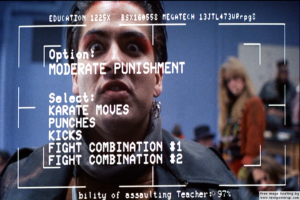
    Robo-view camera angle. Notice there is a selection for unspecified, “Karate Moves”. That’s Grade A schlock for you, right there.

    So the androids first discreetly kill a few troublesome kids, then for some reason flip their shit and decide to spark a war between the Razorheads and Blackhearts. While this war of many people firing automatic and semi-automatic weapons at each other from like 10 meters apart with nobody hitting anything rages, the androids sneak behind the lines and go on a murder-spree. There is one rather delightful scene of a kid being pulled backwards through a small hole in the wall, snapping the kid’s torso in half. Afterward, they kidnap Christie and take her to the school, trying to lure the competing gangs into a trap to restart their earlier battle. The gangs figure out what’s up, heroically join forces to defeat the androids, and after a bloodbath battle in the school, literally only Cody & Christie remain alive at the end. At one point, Cody also hilariously accurately hurls a fire axe across a classroom. Seriously, like 50 kids are killed over the course of this movie – it’s like Total Recall only with teenagers.

    The effects are workable for being a low-budget grindjob. At the end, when the androids are showing more of their robot parts, it isn’t too hysterical. Also you get to see a fake Pam Grier titty after her chest rips open. There is a gratuitous enough amount of violence to satisfy most people watching this who went into it with eyes open for what they were getting. Unfortunately the writing and directing are where this falls short (the director of Commando not being particularly adept? Gasp!). It suffers from something all of the movies of this particular subgenre suffer from, in a wildly unrealistic depiction of gangs, how gang members interact with each other, what gangs are named, what symbolism they use, etc. It’s more like what worried parents imagined in their heads when the first Hot Topic opened in their lily-white suburban mall and they saw their kids with a Dead Kennedys CD, which, as you probably know, bears precisely zero resemblance to actual gang members and activities. Movies pull shit like that all the time though. What bothers me more is that the robots really go off the reservation, and begin making stupid, witty remarks. At one point, one of them with a drill-hand (which seems much less useful on the battlefield than the other robots’ flamethrower hand and rocket-launcher hand) is drilling into a kid’s head, and he says, “I love to mold young minds!” while grinning manically. They’re robots, dude. They don’t get a boner for killing and make puns. The stupid killbots even slaughter their own support staff. During an earlier chase scene when the robots are driving after Christie & Cody after the teenagers broke into the robot’s shared apartment looking for clues, as they’re flying off a dock into the ocean, one of them says he hates getting wet. I dunno, maybe it’s just me, but I really think the whole Terminator approach to killbots is preferable to the hokey-jokey variety you see here.

    Pam Grier finally shedding her limiting human outer shell to reveal the foxy killbot beneath. Notice the look of rapturous joy on her face? I don’t think Mark L. Lester knows what robots are.

    Also the guy who plays Cody sounds oddly like Corey Feldman. It was bugging me the whole time.

    So to sum up, if you’re not looking for much except a mildly amusing way to kill 90 minutes, it certainly isn’t that bad. Christ knows I’ve seen a lot worse. But don’t let the somewhat interesting premise trick you into thinking you’re getting anything particularly great here, some overlooked low-budget gem. Those movies exist, but this isn’t one of them. It’s one rung above a made-for-TV SyFy Channel Saturday Night Special, which is apparently what Mark L. Lester is churning out these days. The real waste is seeing three good-to-great actors slumming it here.

    And oh yes, lest I forget: there is a third film in this series. But that’s a tale for another time.

    I rate this film 4 psychotic killbots out of 10.

  • Teachers Are Underpaid

    Here in Illinois, it’s so painfully obvious. After all, only five of the top 10 Best Cities for K-12 Teachers are in Illinois, and the teachers in those cities are only making 68% more money than the overall local median salary. And they have to work for nine months every year!

    In this new report examining 689 cities, “Analysts ranked cities based on eight metrics that identify places that are affordable and pay teachers well, safe, have jobs available, have a populace that values education, and are nice places to live with abundant amenities.”

    So, if, inexplicably, you are a K-12 teacher reading this post on the Glibs, consider moving to one of these lovely Chicago suburbs.

    Bonus: You could live next door to OMWC and me. We’ll show you our favorite watering holes, and with your salary, you’re buying!

    Top 10 Cities for K-12 Teachers
  • Separation of college and sex

    I’ve just finished The Campus Rape Frenzy, by K. C. Johnson and Stuart Taylor, Jr. The subtitle – The Attack on Due Process at America’s Universities – should dash any false hopes that this book is a STEVE SMITH adventure. It’s about how the federal government forced – or probably the right word is egged on – colleges to provide inadequate hearings for male students accused of sexual misconduct.

    The usual scenario is that Bob

    Can you think of a dirty joke I should have put here?

    and Betty

    According to Google Translate, "coed" is Welsh for "trees"
    Drive safely, indeed

    two hypothetical students at Hypothetical U, both drink a lot of booze, then get together and have sex.

    She's a moonshiner's daughter but I love her still
    Here’s a picture of the booze

    Later, sometimes much later, Betty decides that she was raped and, after failing to persuade the real-world judicial system of the reality of the crime (or neglecting to report the alleged crime to the real-world judicial system at all), takes the case to the campus “justice” system.

    In the name of being Tough on Rapists, the federal government – invoking the anti-sex-discrimination statute, Title IX – has encouraged the campus SJWs who were already pressing for making campus “courts” accuser-friendly. The campus “judges” are students, administrators and faculty who have been trained to view accusers sympathetically and to be on the lookout for those predatory rapists responsible for 1 in 5 or 1 in 4 coeds getting sexually assaulted. These “judges” are warned that the idea of large numbers of false accusations is a myth, and “only” 2%-8% of accused men are actually innocent. These statistics are phony, as the authors show.

    Never mind, though – combined with the “judges’” training is their ability to ignore many traditional due-process restraints on their power, restraints which might allow the accused man to throw a wrench or two in the accusation. The “courts” can put the defendant on trial on really short notice, they can limit his right to cross-examine the accuser, invoke the assistance of a lawyer, or present evidence in his own favor (there’s a lot of cases where the texts the “victim” sent at the time of the “rape” are not consistent with the behavior of the victim of such a crime, but the “judges” aren’t always interested in seeing these texts).

    Sometimes the trial is conducted by one person hired by the college to conduct and investigation and reach a verdict, without holding a full-dress hearing in front of both parties as in traditional Anglo-American trials. The judge/investigator just interviews the witnesses, gives the accused a (perhaps incomplete) summary of what the witnesses said, and then reaches a verdict.

    It almost gets to be like the old joke of the judge who didn’t want to hear the other side because hearing both sides tended to confuse him.

    The judge tends to jump to conclusions
    All rise for His Honor

    The bottom line is Bob is branded a rapist and suspended or expelled. It’s kind of hard for him to get another college to accept him, and many employers, seeing that the guy was branded a rapist, will be like “don’t call us, we’ll call you.”

    So if Bob or his family has enough money he can sue, and maybe win or maybe lose. But any victory, while it benefits Bob, doesn’t necessarily benefit the next guy who comes along accused of rape in the Kampus Kangaroo Kourt.

    And if there actually was a rape? In that case only the real-world justice system can impose the prison sentence needed to keep the rapist away from the public for term of years. Throwing an actual rapist out of college and out onto the streets seems a tad lenient, and not entirely safe.

    It looks like the inmates in this cell block only got a C in not-raping.
    You want to teach rapists not to rape? Send them to one of these educational institutions.

    Johnson and Taylor have all sorts of perfectly sensible ideas for reform, but I want to focus on one idea they reject.

    Johnson and Taylor indicate that it might be desirable to discourage students from getting drunk and screwing. This might annoy Jimmy Buffett (NSFW), as well as the “don’t blame the victim – teach rapists not to rape” crowd. But such discouragement is a good idea as far as it goes. Rape accusations flourish, as a practical matter, in vaguely-remembered encounters which may be regretted once sober, adding to which is how easy it is (according to university regulations) for alcohol to make consent to sex irrelevant. And current dogma means that if both Bob and Betty are drunk when they have sex, Bob is raping Betty but not vice versa. How colleges reconcile this doctrine with Title IX’s ban on sex discrimination is unclear, but that’s how the system operates.

    But Johnson and Taylor don’t go all the way (so to speak). They frown on drunken sex, but they scoff at the idea of discouraging student sex in general. They acknowledge that, given the kind of cases which lead to these “he said/she said” controversies, a good survival strategy might be “celibacy,” but the authors dismiss this as a “nonstarter[]” which “few will find appealing.” College students in the past – often from necessity – often managed not to rut like bunnies while pursuing their studies, but I suppose the idea is that we’re a more sophisticated, liberated, non-taboo-having, healthier people today.

    "Or-gy! Or-gy! Or-gy!"
    “I hate going to these orgies – so many thank-you notes to write afterwards.” /old joke

    What if colleges simply stopped encouraging student sex? That could make moot the question of how to handle drunken hookups by their students.

    Don’t mistake my meaning – I am speaking of the separation of college and sex, not the abolition of sex itself, although of course as you know abolishing sex is the ultimate objective of the Catholic conspiracy.

    Colleges can only do so much, and training the horniness out of its students is something which is beyond their capacity. But that doesn’t mean a college should provide boinking facilities for its students. No using dorms as sleepover facilities, fraternity would-be orgies, etc.

    When I worked as a student dormitory assistant, checking students into and out of their rooms, I felt like the clerk at a sleazy hotel. My job wasn’t to keep the guys out of the girls’ rooms or vice versa, but to make sure they left their student IDs at my office before going upstairs for their…whatever it was they did (probably not canasta).

    Just doing my job
    I was also the piano player

    Did colleges put up with this sort of thing in the past? No – although students weren’t any less horny than today. College education wasn’t as near-universal as now, you needed some money or enough talent to get a scholarship, but if you had one of these qualifications there were plenty of institutions to choose from. But generally, the colleges at least made an effort to keep the students on the straight and narrow.

    Mandatory chapel. Curfews. If the college admitted women (not a given), then there was separation between the sexes, and social events needed chaperones.

    Actually, I don't know if nuns actually chaperoned college dances, this is poetic license, people.
    “Don’t mind me, you kids just have fun.”

    Most students wouldn’t put up with that today. But that’s all right, most students don’t need to be at a modern residential college.

    We’re in a situation where colleges and universities ought to downsize anyway. A four-year sojourn at a residential college (often involving indebtedness and fairly sketchy post-college plans for promptly paying off that indebtedness) is not an essential part of every young person’s life, if it ever was.

    There are some career paths which may require studying at a residential college, some career paths which may call for online education (dropping by the local public library for proctored exams), and some career paths which may call for a good high school education (where it can be found) and/or an apprenticeship.

    And there are some people who may still go in for a liberal arts education as defined by Cardinal Newman – learning for its own sake, including the things associated with being a learned person, including theology, the “queen of the sciences.”

    Upholding the Cardinal virtues
    Blessed John Henry Newman

    In each of these situations, the college can separate itself from enabling its students’ sex lives.

    If a student is working on his or her online degree while holding down a job, then their college life and social life will run on separate tracks, for the most part, or if they get together with other students it will be off campus and they’ll have signed all sorts of forms that the college won’t be liable for broken hearts, broken bones, disease, death, etc., resulting from independently developing relationships with other students.

    Or if students are taking one of those intensive courses of study which requires a residential program, they should be warned to do their foolishness (if any) while they’re off campus.

    And at least in theory, nontraditional-age students supplementing their education, often online or through occasional visits to campus for class purposes, will have homes of their own and any kinkiness they do will be in those homes (and they should ask their spouses first, if any).

    And for those few liberal-arts residential colleges which survive the coming shakeup of higher education – those colleges should be unashamedly elitist, recruiting students who are actually committed to a course of study, with socializing with the other sex limited to chaperoned activities like in earlier times.

    (If a young man and woman meet at a residential college (or before going) and decide to get married, then of course after their marriage the college should put them in married-student housing.)

    I guess the one downside to my scheme would be that it would force the SJW “student life” bureaucrats to get other work.

    "As long as you're looking, can you find [insert name of unpopular sports player]'s talent?"
    Look carefully, and you might be able to see the violin on which I am playing “My Heart Bleeds for You”
  • Focus on the Family – A Cultural Rumination

    I’ve gone back and forth on how to format this article. It’s hard to stay on one single topic when talking about the cultural erosion of the importance of family. As such, I’ve written and deleted this article a couple times, simply because it turns into a rant against elements of our culture. It wouldn’t be a good read. This is my final attempt, and I’m keeping it short and focused.

    TW: I’m probably gonna piss a lot of people off. SLDs apply here as they do anywhere else. I support your right to raise your children as you wish, no matter the cumulative cultural damage I think may result.

    The most disheartening and soon-to-be-fatal flaw of modern Western culture is the disdain for the family. (I’m completely ignoring homosexual and other “alternative” families for this analysis; they’re statistical noise when it comes to culture as a whole). This “disdain” can be seen in many contexts, including: 1) Replacing traditional family roles with outside intervention, 2) Subsidizing family failures, 3) Transforming old stigmas into laudatory praise, and 4) Portraying family negatively. I’ll quickly expose my biases and then treat each of these quickly. Any more than a quick treatment starts to turn into a rant.

    My biases are simple. I’m a complementarian, meaning that I believe women are generally better at/more inclined to certain things and men are generally better at/more inclined to certain other things. This generalization is, by no means, a straitjacket but more of a descriptive observation of people as a whole. I’m also a believer in the ideal family being a supportive, lasting, tightknit family, one that passes morals, traditions, and beliefs from generation to generation. Much of the “disdain” I see is in opposition to the generational information transfer in this ideal family.

    Replacing Traditional Family Roles

    This primarily falls into two categories: government as Santa, and “it takes a village.”  To see the biggest indicator of how much government and other outsiders have taken over traditional family roles, simply do a time audit of a child in a typical American household. Out of the 15 or so hours little Johnny is awake, how many do his parents actually have any sort of influence? Maybe an hour? He spends 7 or 8 in school, 1 or 2 in extracurriculars and on the bus, 1 or 2 doing homework, and 2 or 3 watching TV/playing video games. Besides the odd homework check or multiplayer CoD game (ha! who am I kidding??), Mommy and Daddy hardly even talk to Johnny. Then Mommy and Daddy wonder why Johnny doesn’t carry on their morals, traditions, and values when he becomes an adult. Johnny’s primary influences are leftist-feminist teachers, Lord of the Flies peer influence, and the Internet. Two income households put kids into this cycle at a few months old, and there’s never a break.

    Subsidizing failure

    This could be an article in-and-of itself. Suffice it to say that economic incentives matter, and, according to Thomas Sowell, the average black family was better off 100 years after slavery than after 30 years of welfare. Paying people because their family is broken incentivizes other struggling families to break as well. You get more of what you incentivize, and you get less of what you penalize. We’ve spent 50 years subsidizing broken families out of some naive sense of compassion. Of course, government shouldn’t pile on when families come apart at the seams, but the safety net should be a net (SLDs apply), not a pillowtop mattress.

    Stigma to “Strong”

    The cultural mantra that “different is good” completely ignores the thousands of years of trial and error that has built the traditions that the postmodern left is now tearing down. Again, this isn’t a straitjacket, but there’s a difference between approaching single parent households as parents making the best of a bad situation versus approaching them as no worse than two parent households. There’s a difference between a first marriage, a second marriage, and a fifth marriage. In attempting to build up people (primarily women) in bad situations, culture has made the traditional family passe. Being a single mom is “strong” and “brave.” Being a housewife is “backward” and “sad.”

    Portraying the Family Negatively

    This goes hand-in-hand with the “strong,” “brave,” broken family trope. Feminists have undercut the family as an oppressive structure since the 30s. Culture has followed along, making men into uninterested, idiotic fathers. Mothers (and children) have supernatural wisdom, but fathers are morons. Not surprisingly, people follow the cultural model, resulting in disinterested fathers having children only because their wife begged for it to “save the marriage.” The end result has been the MGTOW movement, which, despite the nugget of truth regarding the gender-based cultural unbalance, exacerbates the problem by tossing the entire family out with the feminist bathwater.

    I’m a little bit proud that I’ve finally gotten this article finished. This is a difficult article to write up in spare time because it could be a 10 part, 50 page monstrosity. However, I think I conveyed the pamphlet version of the argument. I agree with the Distributists in that family is the core unit of society, and I think it makes this cultural erosion of the traditional family hugely self defeating. When culture erodes its own foundation, it doesn’t last.

  • Horace Flack – The state official whose scholarship pressured the states to obey the Bill of Rights (with Southern Gothic backstory)

    By: The Fusionist

    On April 27, 1947, the Baltimore Sun profiled Horace Edgar Flack, “a placid, unassuming, kindly doctor” – meaning he had a Ph.D. from Johns Hopkins in political science. As head of the Department of Legislative Reference for both Baltimore and for the entire state of Maryland, Flack helped draft bills for the lawmakers and gave them information about similar legislation in Maryland and in other states. Flack had been described as “a walking encyclopedia” – “If you want a bill drawn up on any subject, he can oblige in about fifteen minutes, provided the matter is not too complicated. If it is complicated, it takes a few minutes longer.” Flack was so indispensable that “[w]hen he leaves the Department of Legislative Reference for even a matter of minutes, the business of lawmaking all but comes to a standstill.” His staff credited him with drafting eighty percent of the state’s laws since he took the job thirty years before.

    (Insert libertarian joke about taking Flack on a long, relaxing Caribbean cruise)

    Flack and his wife shuttled between Baltimore and – when the legislature was in session – Annapolis. In both places, Flack’s office desk was “[n]ever piled higher than six inches with a remarkable assortment of papers[.]” The desk “is all but buried by the end of a legislative session.” Yet Flack could “put his hand into the heap and come up with any desired document with unerring accuracy.”

    No wonder state politicians were anxious as Flack, who had been born in 1879, neared the mandatory retirement age: “The thought of his impending retirement two years hence causes shudders among Maryland officials, who are sure there will never be another like him.”

    The readers of this laudatory article wouldn’t know of the old civil servant’s family difficulties as his daughter became estranged from her soldier-husband – a war hero who had perhaps been spending more time in French territory than was compatible with maintaining family life. Not to mention that within two months of the article, Horace Flack was going to become even better known to members of the legal establishment throughout the country. This time, he would not be known as a facilitator of new state laws, but as a potential obstacle to them. A scholarly paper he published as a young man, arguing that the states had to obey the Bill of Rights, was about to get drawn into a debate over the relationship between state power and individual liberties.

    These were heady times for a man the Baltimore Sun said “has been called…‘the greatest man that ever came out of the hillbilly country of North Carolina.’” Now, Flack had never fully “come out” of rural Rutherford County in the southwest of the Tarheel state. Horace owned the ancestral farm (formerly co-owned with his late brother Roswell, a physician) and visited the farm when he could screw Tom Wolfe. What Horace had left behind in North Carolina was a fairly shocking family secret which went back half a century.

    While Horace Flack was growing up, his family were small farmers and not often well-rewarded for their exhausting labor. Horace’s father Millard reportedly told a nephew “you can continue to raise cotton if that is what you want to do, but I never expect to plant another cotton seed as long as I live.”

    Millard Flack certainly did not plan for his son Horace to be a farmer. Making what must have been a considerable sacrifice, Millard sent Horace to Wake Forest College (now Wake Forest University) in Winston-Salem, NC. (Horace’s brother Roswell also pursued higher learning at this time).

    Horace’s uncle, Mills Flack, was more enthusiastic about the farming life, but did not like the economic decline of small family farms like his, a phenomenon for which he blamed sinister plutocratic forces (“Shylocks”). Mills Flack served in the North Carolina legislature in the 1890s, during a brief interval during which agrarian Populist radicals like himself combined their votes with the votes of black Republicans to displace the Democrats and set up a Populist/Republican “Fusion” government.

    At Wake Forest, Horace joined the Euzelian literary society, one of two such societies to which students were required to belong. The literary societies, rather than the faculty, punished student misconduct such as “trampling the grass…spitting on floors of chapel and classrooms and halls, and library, or keeping firearms, or throwing water from the windows.”

    The Euzelian society and its counterpart, the Philomathesian society, conducted regular debates. The topic in February 1900 was “Resolved: That England was not justified in making war upon the Boers.” Flack took the negative, apparently meaning that he argued England was justified in fighting against the white farmers who ran the Boer Republics in South Africa (I haven’t read Flack’s paper but it’s in Wake Forest’s archives).

    Speaking of giant power-hungry entities trying to absorb white farmers…the Democratic Party in 1900 resolved to completely destroy the Fusion coalition and establish a political monopoly. The Democrats did this by proposing a state constitutional amendment to disenfranchise large numbers of black voters, without whom nothing stood in the way of a solid Democratic majority. Democrats harped on White Supremacy, and the disenfranchisement amendment passed, securing one-party Democratic rule for several decades. In the wake of the excitement of the White Supremacist agitation in Rutherford County, there was a murder and a lynching, and Horace Flack’s uncle Mills Flack was at the center of it.

    Mills Flack had a dispute (over peaches) with a black sharecropper or tenant, Avery Mills, and the tenant’s wife, Raney. Avery Mills threw a rock, Mills Flack shot Avery Mills and tried to take Avery Mills’ gun, and Avery Mills fatally shot Mills Flack. A lynch mob making up about a quarter of the local population (by the widow Raney Mills’ estimate) took Avery Mills out of police custody and killed him. The only person convicted in the affair was Raney Mills, who was promptly pardoned. Mills’ family tradition says there were warrants out for two of the alleged lynchers – sons of Mills Flack, and therefore cousins of Horace Flack. According to tradition, the cousins hid out for a time until the authorities seem to have lost interest and dropped the matter. Some of the lynchers seem to have had second thoughts when they realized that Mills Flack had fired the first shot, but by then the deed was done.

    Young Horace left North Carolina, leaving his family’s scandal behind. He went north, but not beyond the Mason-Dixon Line. He became a graduate student at Johns Hopkins in Baltimore, Maryland, studying political science. The political science department at the time was one man, Westel Woodbury Willoughby. Professor Willoughby suggested a couple research projects for Flack to work on.

    The first project, published in 1906, was about the recent Spanish-American war. Flack was skeptical about the American justification for the war, which had been based in part on alleged atrocities the Spaniards committed in fighting a Cuban rebellion. Flack said that the Northern forces committed atrocities against the South during the Civil War, and European powers wouldn’t have been justified in interfering on such grounds. “War is bad at its best, and when it assumes its worst form, General Sherman’s definition [of war as hell] does not seem inappropriate.”

    Willoughby’s next assignment for Flack was a study of the origins of the Fourteenth Amendment, a key U. S. constitutional provision pushed through by Northern Republicans after the Civil War. Willoughby was working on a book about U.S. constitutional law and probably wanted to commission a study which would help with his own work. It was a delicate project for Flack to undertake, since if black lynching victims received “equal protection of the laws” as the Fourteenth Amendment required, some of Horace Flack’s relatives would probably be in prison or hanged.

    But Horace Flack applied himself to his task, looking up old Congressional debates from the Reconstruction era when Northern Republican politicians, like Congressman John Bingham, discussed their ideas for constitutional protection of the freed slaves and Unionist white Southerners in the former Confederate states. Flack’s conclusion: The history of the debates on the 14th Amendment showed a purpose to make the states obey the first eight amendments to the Constitution – the “Bill of Rights” (possibly minus the 9th and 10th amendments). The privileges and immunities of American citizenship – protected by Section One of the Fourteenth Amendment – included the rights in the first eight amendments. If anything, Flack’s research did not go far enough – there was no Internet in those days, so Flack missed some key newspaper articles of the Reconstruction era agreeing with the interpretation Flack was advancing.

    Flack’s book, The Adoption of the Fourteenth Amendment, did not exactly cause a big splash at the time. In the same year the book was published – 1908 – the U.S. Supreme Court issued a key decision, consistent with earlier precedents, that  only a few parts of the Bill of Rights are applied to the states on an arbitrary, feelz-based basis. Most of the rights in the Bill of Rights – in the 1908 case, the freedom from self-incrimination – were simply optional on the states, which could ignore them if they wanted. Likewise with the right to trial by jury, in civil and criminal cases, and the right to have one’s case heard by a grand jury, and some other rights – the states could observe these rights or ignore them, based only on their own constitutions.

    But having completed his doctorate, Flack now had to find work. While he had thought about working in North Carolina, he changed his mind when he met Edith Henning, a Baltimore belle whom he married, and he decided to make Maryland his home. The city of Baltimore had just created a Department of Legislative Research to provide nonpartisan assistance to local lawmakers, and Flack was the first person appointed to this new position – and there wouldn’t be another appointment for almost fifty years.

    Based on his experience, Flack wrote a paper for the American Political Science Association, singing the praises of legislative reference bureaus like his. Private interests had their staffs of lobbyists who researched and drafted bills to benefit their clients, and then tried to get the legislatures to pass such bills. Shouldn’t the public be served by draftsmen researchers with no allegiance except to the common good? Such draftsmen and researchers should have long terms of service to give them experience and provide for developing good institutional memory. Other states were using reference bureaus, to good effect. It was just a matter of hiring good people for these positions and then letting them do their jobs.

    The Maryland legislature got the hint and appointed Flack as the head its own legislative reference bureau. Now Flack was working for both Maryland and the city of Baltimore.

    An outside project Flack did in 1920 might have given him a chance to get some influence on the Supreme Court, but it doesn’t seem to have worked that way. Former President William Howard Taft, a leader of the prestigious League to Enforce Peace which sought to avoid another world war, published a volume of his writings and speeches about peace, and Horace Flack was one of the editors of the project. Taft was a supporter of the League of Nations, just like President Woodrow Wilson and the Democratic Party in general. The Republican candidate for President, Warren Harding, didn’t like the League, which the U.S. Senate had rejected. The ambitious Taft wanted to be Chief Justice, a job no Democrat would give him, so he threw his support behind Harding with some pious hopes that Harding would end up being for the League. That didn’t happen, but in 1921, Harding made Taft the Chief Justice of the United States. But if Flack had been in touch with Taft about Flack’s Fourteenth Amendment book, Taft gave no sign of it, focusing his constitutional jurisprudence on the protection of strictly economic rights while being wishy-washy and vague on applying the Bill of Rights to the states (Taft’s colleagues indicated that freedom of speech and the press might apply to the states, after first denying that they did).

    In the 1930s, Flack spoke to Parent-Teacher associations about education and to the League of Women Voters about voter registration and voting machines. When the 1935 legislature adjourned, the Baltimore Sun ran an admiring article about how Flack and his staff spent five days, together with near-sleepless nights, making sense of the legislature’s work and organizing it for publication. Horace Flack was circulating in highly respectable circles – he had gone far for a country boy.

    Flack even earned a mention in the New York Times – via the social pages – when his daughter Marialice married Lieutenant Lee Carl Miller on October 14, 1936.

    The following day, October 15, a jury in Connecticut convicted Frank Palko of first-degree murder for killing two police officers during a robbery. Earlier in the year, a jury had rejected a first-degree verdict and convicted Palko of second-degree murder for the offense. A state appeals court ruled that the trial judge had made errors in Palko’s favor, warranting a new trial. This sort of procedure was unusual – most jurisdictions, including most states and the federal courts, hold that once a jury refuses to convict on a charge, the defendant cannot be retried on that charge. After Palko got a death sentence at his second trial, Palko’s lawyer, David Goldstein, took the case to the U. S. Supreme Court, claiming that Palko’s second conviction violated the constitutional right not to be subject to “double jeopardy” for the same crime.

    Goldstein discovered Flack’s book on the Fourteenth Amendment, and relied heavily on the book in his Supreme Court arguments. Goldstein referred to The Adoption of the Fourteenth Amendment as “a scholarly document which, to counsel’s knowledge, has not hitherto been called to the court’s attention.” If the Bill of Rights applied to the states, via the Fourteenth Amendment, then Frank Palko had been subject to unconstitutional double jeopardy.

    Goldstein’s argument didn’t work. The Court, which had already taken a lot of grief from New Dealers and progressives for overturning “democratically enacted legislation,” wasn’t going to take such a radical step as to force the states to obey the Bill of Rights. Sure, there were a few provisions of the Bill of Rights which were important to “ordered liberty” – free speech, free press, and the right to just compensation – and those parts of the Bill of Rights applied to the states. But other parts of the Bill of Rights were not so fundamental: jury trial, the right against self-incrimination, and the right not to be subject to double jeopardy. Palko was executed. Justice Hugo Black had apparently learned about Flack’s book from Goldstein, and began to ponder the work.

    Meanwhile, the forces of organized do-goodery in California were chipping away at another right in the Bill of Rights. The district attorney of Alameda County, an ambitious fellow named Earl Warren, got several “law ’n order” measures on the 1934 ballot, including a provision that if a criminal defendant failed to take the stand in his own defense, the prosecutor could use the defendant’s silence as an argument in favor of guilt, never mind the Fifth Amendment right not to incriminate yourself. Warren’s measures were supported by civic groups and the press. The Sausalito News said that the self-incrimination provision would mean “a better administration of criminal law.” The self-incrimination provision and the other ballot measures easily passed by two to one margins, becoming part of the California constitution.

    California prosecutors had the chance to use this self-incrimination law against an alleged murderer named Dewey Adamson. Adamson was accused of breaking into the house of a Los Angeles widow and beating and strangling her to death. After the prosecution gave its case, Adamson said nothing and produced no witnesses – Adamson had a criminal record which would have been brought up if he’d testified. Summing up to the jury, the prosecutor taunted Adamson by saying “it would take about twenty or fifty horses to keep someone off the stand if he was not afraid.” Adamson was convicted and sentenced to death. Adamson’s lawyer claimed that California had violated the right against self-incrimination, and that this right was binding on the states via the Fourteenth Amendment.

    Up to the U.S. Supreme Court the case went, just as personal feuds and antagonisms among the Justices were sharpening their philosophical differences.

    The Justices were all New Deal progressives, appointed by the late Franklin Roosevelt to purge the Constitution of federalism and economic freedom in the interest of a federal welfare/warfare state. But having put that triumph under their belts, the Justices were split into quarrelling factions, having bitter catfights with each other.

    One faction was associated with Felix Frankfurter, shown here, oops I mean here, no, seriously folks, here.

    Frankfurter was a zealous New Dealer from before there even was a New Deal. As a Harvard professor, he had supplied advice and personnel to the Roosevelt administration. He took judicial progressivism to its logical conclusion: Frankfurter believed that, having killed off economic rights by agreeing to the laws the majority wanted, it was time for the Supremes to defer to all parts of the democratic process. Why should noneconomic rights, like the stuff in the Bill of Rights, be considered more important than economic rights? These issues should largely be left to the voters and their elected representatives except in extreme cases where (as assessed by Frankfurter) the democratic process went Too Far. But at the state level, violating the Bill of Rights was not, in and of itself, Too Far. States should be free to experiment with such “reforms” as abolishing juries and grand juries, allowing the prosecutor to appeal acquittals, and compelling suspects to incriminate themselves.

    The other faction was associated with Hugo Black, a former Alabama Senator who had developed a genuine attachment to some civil liberties. Black agreed with Frankfurter that the courts should not protect economic liberties, but where non-economic rights were concerned, Black thought the way to preserve freedom was to uphold the entire Bill of Rights against the states, not just a few selected parts of the Bill of Rights. Focusing on the first eight amendments would keep the courts from being arbitrary in picking and choosing which freedoms to value.

    Black had been researching the intent of the Fourteenth Amendment, relying to a great extent on Flack’s research. The Adamson case provided an opportunity for Black to show his conclusions. Black found three other Justices to agree with his view that the states had to obey the Bill of Rights.

    The other five Justices were not impressed. On June 23, 1947, the Court decided that, whatever Black’s research might say, the precedents were against the Bill of Rights. The states didn’t have to respect the right against self-incrimination. Adamson was executed.

    Despite his victory, Frankfurter was dissatisfied. Outvoting Black was not enough, Black had to be attacked and refuted on a scholarly level. Frankfurter, not Black, was supposed to be the intellectual leader of the Court. Frankfurter was the learned scholar, the ex-Harvard professor. Black was some hick cracker who was simply too dumb to appreciate good scholarship if it bit him on the ass. If only one of Frankfurter’s former students could step up to the plate…

    Fortunately, a friend and ex-student of Frankfurter’s did precisely that, apparently without any prompting from the Justice. Professor Charles Fairman of Columbia Law School was just starting up his school’s law journal. What a great venue to highlight a scholarly rebuttal to Black…and of course to Flack.

    Naïve as he was, Flack had believed that it would be Southerners who would object to the implications of his scholarship, which gave a broad interpretation to the Fourteenth Amendment which the Southern leadership had tried to prevent being passed in the first place. Flack did not anticipate that certain highly-placed Northern progressives would in effect put on their Confederate flag trucker hats and raise the biggest stink about Flack’s work.

    Fairman lacked Flack’s respect for the framers of the Fourteenth Amendment. To Fairman, as to Frankfurter, the Reconstruction Republicans were vindictive fanatics who needlessly antagonized the South. To Fairman, the Northern Republicans’ Southern allies under Reconstruction consisted of “the Negroes, the carpetbaggers…and a few long-suffering Southern Unionists – a combination which was weak, inexperienced, often corrupt.” (And Frankfurter showed his sympathies when he referred to the “vengeful spirit which to no small degree envenomed the Reconstruction era.”)

    In his 1949 article, Fairman dived into his defense of Frankfurter…with relish. Coincidentally, Fairman found exactly what he thought he would find: historical evidence backing up Frankfurter’s views. The Fourteenth Amendment was never meant to apply all of the Bill of Rights to the states. The true meaning of the Amendment was vague, which as Fairman later explained, meant that it was up to the federal courts to work out the details of what the states could or could not do.

    The bottom line for Fairman was that Flack’s scholarship was no good, and Black had embarrassed himself by relying on Flack’s work.

    In 1948, Flack’s statutorily-mandated retirement was approaching – he would reach the retirement age of 70 in 1949. Governor William P. Lane, Jr., wrote to the state Attorney General, asking for legislation to allow Flack to stay in office beyond 1949. “Knowing the esteem in which Dr. Flack is held by all of those who come in contact with him on official business of the state,” the governor wrote, “I am sure the General Assembly will give this proposal favorable consideration.” The mayor of Baltimore likewise wanted to keep Flack in his city position.

    In 1949, the same year as Fairman’s article skewering Flack as a scholar, the Maryland legislature passed a law which the governor cheerfully signed, allowing Flack to serve past the normal retirement age.

    After three more years’ service in office, Flack had a heart attack and a stroke in 1952, putting an end to his career. After four years in retirement, he died in 1956. He is buried in his native Rutherford County.

    The Supreme Court has yet to accept Flack’s conclusions about the Bill of Rights, reinforced as those conclusions have been by subsequent scholarship. While adhering to the pick-and-choose philosophy, the Supremes have decided to apply a few more Bill of Rights provisions to the states, such as double jeopardy and self-incrimination – though it was a bit too late for Palko and Adamson. In 2010, the Supremes applied the Second Amendment to the states, over voluble progressive protest. Other rights, like civil juries and grand juries, are still up to the states to observe or not, at their discretion.


    Works Cited

    Richard L. Aynes, Charles Fairman, Felix Frankfurter, and the Fourteenth Amendment – Freedom: Constitutional Law, 70 Chi.-Kent. L. Rev. 1197 (1995).

    Available at: http://scholarship.kentlaw.iit.edu/cklawreview/vol70/iss3/10

    “The Ballot Propositions,” Sausalito News, No. 43, Oct. 26, 1934, http://bit.ly/2mL5xgK

    1. Timothy Cole, The Forest City Lynching of 1900. Jefferson, NC: McFarland, 2003.

    Richard C. Cortner, The Supreme Court and the Second Bill of Rights: The Fourteenth Amendment and the Nationalization of Civil Liberties. Madison: University of Wisconsin Press, 1981.

    Ed Cray, Chief Justice: A Biography of Earl Warren. New York: Simon and Schuster, 2008, p. 72.

    “Dr. Flack Finally Finds Out Just What Assembly Did,” The Baltimore Sun, Apr 7, 1935, p. 9.

    “Dr. Flack To Address League: Women Voters to Hear Talk On A Permanent Registration And Voting,” The Baltimore Sun, Nov 22, 1936, p. SC17

    “Dr. H. E. Flack, Ex-Law Data Chief, Dies: Linked with Government Machinery in City from 1907 to 1952,” The Baltimore Sun, Jun 27, 1956, p. 38.

    “Dr. Horace E. Flack; A Capable State and City Official,” The Baltimore Sun, Jan 1, 1943, p. 12

    “Dr. Horace E. Flack To Speak,” The Baltimore Sun, May 19, 1933, p. 9.

    Entries for Horace Edgar Flack and his various relatives, findagrave.com.

    Charles Fairman, “Does the Fourteenth Amendment Incorporate the Bill of Rights? The Original Understanding,” Stanford Law Review, Vol. 2, No. 1 (Dec., 1949), pp. 5-139.

    Noah Feldman, Scorpions: The Battles and Triumphs of FDR’s Great Supreme Court Justices. New York: Twelve, 2010.

    Horace Edgar Flack, The Adoption of the Fourteenth Amendment. Baltimore: The Johns Hopkins Press, 1908.

    ________________, “Resolved: That England was not justified in making war upon the Boers” . Anniversary speech, Negative. Jr. Thesis, (Feb. 16, 1900. 1900.), Wake Forest Archives, Junior and Senior Theses Record Group, see https://wakespace.lib.wfu.edu/handle/10339/28081

    ________________, Flack, Horace Edgar.  “Resolved: That the South Carolina Dispensary System is Unwise”. Speech and Sr. Thesis for Master’s Degree. (1901.) Wake Forest Archives, Junior and Senior Theses Record Group, see https://wakespace.lib.wfu.edu/handle/10339/28081

    ________________, “Scientific Assistance in Law Making,” The Proceedings of the American Political Science Association, 1913-1914, pp. 215-221.

    ________________, Spanish-American Diplomatic Relations Preceding the War of 1898. Baltimore: The Johns Hopkins Press, 1906.

    “Flack, Horace Edgar,” in Who’s Who in America, vol. VII, 1912-13, Chicago: A. N. Marquis, p. 707.

    Carol Forbes, “Business: Looking Up,” The Baltimore Sun, Apr 27, 1947, p. SM6.

    “Horace E. Flack, PH.D.,” in History of North Carolina: Volume VI: North Carolina Biography. Chicago: Lewis Publishing Company, 1919, pp. 332-33.

    Lewis L. Gould, Chief Executive to Chief Justice: Taft Betwixt the White House and the Supreme Court. Lawrence: University Press of Kansas, 2014

    “Lee C. Miller 1934,” http://apps.westpointaog.org/Memorials/Article/10021/

    “Legislative Council Honors Dr. H. E. Flack, Veteran Aide,” The Baltimore Sun, Dec 31, 1942, p. 5

    “Legislative Unit Nears End of Task,” The Baltimore Sun, Dec 6, 1940, p. 6.

    Maryland Manual 1950, Volume 163, p. 160t, http://aomol.msa.maryland.gov/000001/000163/html/am163–160t.html

    Maryland Session Laws 1949, Chapter 19, March 4, 1949, pp. 20-21, online at http://aomol.msa.maryland.gov/megafile/msa/speccol/sc2900/sc2908/000001/000590/html/am590–20.html

    Louis [sic?] J. O’Donnell, “Printer May Have Dropped Lost ‘Streetcar’, Flack Says,” The Baltimore Sun, Feb 1, 1946, p. 26.

    “MillerFlack,” New York Times, October 15, 1936.

    NC Executions, 1901-1930, http://deathpenaltyusa.org/usa1/state/north_carolina2.htm [execution was by hanging until 1910, when the method switched to electrocution]

    Thomas J. O’Donnell, “School Fund Bill’s Origin Still Veiled,” The Baltimore Sun, Jan 21, 1947, p. 30.

    George Washington Paschal, History of Wake Forest College, Volume II: 1865-1905. Wake Forest, NC: Wake Forest College, 1943.

    William Howard Taft (Theodore Marburg and Horace Edgar Flack, eds.) Taft Papers on League of Nations. New York: MacMillan, 1920.

    Bryan H. Wildenthal, “Nationalizing the Bill of Rights: Revisiting the Original Understanding of the Fourteenth Amendment in 1866–67,” 68 Ohio State Law Journal 1509 (2007).

    Westel Woodbury Willoughby, The Constitutional Law of the United States, Vol. I. New York: Baker, Voorhis and Company, 1910, pp. 175-76.

    “Would Retain Dr. H. E. Flack: Lane Wants Him Kept After He Reaches Retirement Age,” The Baltimore Sun, Dec. 12, 1948, p. 22.

  • FCC Chairman Calls For Rollback Of Net Neutrality “Mistake”

    Proponents and enemies of net neutrality can stop guessing what the new head of the FCC will do.  He has made it abundantly clear that he will move to dismantle the rule.

    “It has become evident that the FCC made a mistake,” Pai said at Mobile World Congress in Barcelona, according to a copy of his prepared remarks provided to CNNTech. “Our new approach injected tremendous uncertainty into the broadband market. And uncertainty is the enemy of growth.”

    Reality!

    Thank God we have someone that understands market realities and how consumer choice is better facilitated when agencies get out of the way and let firms compete.

    According to CNN:

    The net neutrality rules, approved by the FCC in 2015 amid an outpouring of online support, let the agency regulate the Internet as a public utility, placing greater restrictions on broadband providers.
    The rules prevent Internet providers like Comcast (CCV) and AT&T (T, Tech30) from deliberately speeding up or slowing down traffic from specific websites and apps. In short, the rules are intended to prevent providers from playing favorites.

    Bullshit!

    Except there was no “outpouring of online support when people understood the issue and the uncertainties it placed on ISPs.  It existed based solely on how the question was asked and what pony the respondent thought he/she’d get by supporting it.  What it did, however, do was to stifle innovation, expansion, competition and relationship-building within the industry’s varying sectors that would reduce costs.  It was going to retard progress that had been made, it would have imposed content restrictions and requirements and it would have increased costs for everybody downstream of the regulators.

    Mark another one down in “garbage that the current admin has started the process of fixing in a way libertarians should be satisfied with”.  I know it pains some people, but its the truth.

  • Texas “Boy” Wins Texas Girls Wrestling Tournament – Largest Media Sports Outlet Reports On Story With Comments Turned Off

    Mack Beggs, a female transitioning to be a male by using massive amounts of steroids completed an undefeated season Saturday by winning a controversial Texas state girls wrestling title in an event clouded by criticism from those who believe the testosterone he’s taking as he transitions from female to male created an unfair advantage.

    Beggs, who reached the state tournament after two opponents forfeited, was dogged throughout the tournament by questions about whether his testosterone treatments made him too strong to wrestle fairly against girls.

    The University Interscholastic League, which oversees athletics in Texas public schools, enacted the birth certificate policy Aug. 1, 2016. And while Beggs’ family has said he wanted to compete against boys, UIL deputy director Jamey Harrison, who refused to address Beggs directly, said the UIL had not received a request to change divisions from any athlete at this competition.

    "I must break you." -Mack Beggs
    Girls Wrestling Champion

    In a twist of irony, The above story was reported on the ESPN W outlet rather than the main site.  ESPN W, which ostensibly caters to women, does not have commenting in its articles.  ESPN’s main site permits it. To my recollection, it’s the first article about an athlete referred to as male throughout to appear on the “W” site.  I’m sure its a coincidence

    Meanwhile, the Washington Post article had commenting on and the responses largely derided Beggs being able to compete against athletes who are banned from taking the same performance-enhancing drugs Beggs is mega-dosing on in order to deliberately change body structure.

    USAToday had the comments turned off for their story, which said there were “a smattering of boos”  amid mostly cheers.  Which is a departure from the WaPo pice which hilariously led with the words “booed and bloody”.  Now perhaps Kent Babb had some insight into Beggs’s monthlies (if he’s still having them while taking mega-dowses of male hormones, I don’t know) that gives him license to use “bloody” in a description of someone that looks like they barely broke a sweat while competing against a series of opponents that are physically inferior to him in every way. Perhaps his editor added it in for color. And perhaps Babb is just full of it.  Either way, no blood was visible and there were more cheers than boos.

    But WaPo and other outlets have gotta fight for Team Trans rather than report honestly.  After all, if just the fact were reported here: “a person taking doses of steroids that nobody else in a competition designed for females is able to take under the rules, wins the competition without breaking much of a sweat”, I’d imagine the reactions would be quite consistent.

    Of course, the self-proclaimed “worldwide leader in sports” doesn’t want your reaction to be heard anyway.

    BONUS CONTENT: These people say their seven year old is trans and would change Trump’s mind on access to trans bathrooms.  Seven.  Their kid is seven. And this fostering of a delusion so they can get street cred with their idiot progressive friends is child abuse.

  • A History Of American Public Education: Part 4 in a 4 Part Series

    Click here for Part 1, Part 2,  and Part 3

    Part 4: It’s Broke, so let’s Fix It

    Secularization of Public Schools

    While the Progressive Protestants did get the generic Protestant education implemented in the public schools, it was clear that this arrangement could only be temporary. There was no way that the increasingly heterogeneous United States founded on the Enlightenment Era principle of separating Church and State would allow the State sanctioned public schools to be de facto cathedral schools of the Protestant denominations.

    By the 1940s, the writing was on the wall. The increasing secularization of the school materials had reached a pinnacle. The Supreme Court was about to step in and begin cleaning house of this “non-sectarian” Protestant bias that inherent in the public schools of the 19th century. The case was Everson v. Board of Education, and the issue was public funding of transportation to religious schools. While the case came out in favor of these reimbursements, the precedential concept of a “wall of separation between church and state” was set, and would never be undone. A waterfall of cases followed, including Zellers v. Huff in 1948 (religious teachings banned in public schools, including religious garb and other religious assistance), Engel v. Vitale in 1962 (prayer in public school banned), and Abington v. Schempp in 1963 (Bible readings banned in public school). By the 1970s, the public school system in the United States was unrecognizably secular, a complete turn from the results of the Bible Wars in the 19th century.

    The Modern Landscape

    The Progressive Protestants rigged the system to beat back the temporary immigration of Irish, Italian, and German Catholics, only to have it predictably backfire. To this day the conflict still rages, the ideological progeny of the 19th century Progressive Protestants, the Social Conservatives, still fight tooth and nail for those last few scraps of religiosity in the public schools. Whether it’s prayer at the flagpole, a banner with a Bible verse, or a prayer before a football game, these Social Conservatives are motivated to fight the same losing fight, trying to keep the Church in power over the schools despite the State’s administrative authority.

    The other, more secular, and eponymous descendants of the 19th century Progressives are the ones who wield the power of the State over the School these days. With this control, they are attempting to revive some of the methods of the past. Public schools were and are seen as a place to mold the children of America, pulling them away from the habits and beliefs of their parents, and integrating the children into American society. However, with the growth of charter schools, private schools, online schools, and homeschooling, it is not as simple to impose a worldview as it was to Protestantize the immigrant Catholics of 125 years ago.

    To this end, however, there are public policy murmurs of again requiring public school education. Articles have floated the same ideas of the past such as “If You Send Your Kid to Private School, You are a Bad Person: A Manifesto” and “Banning Homeschooling does not Violate Rights: U.S. Attorney General’s Office”, both published in 2013, along with an article from the Washington Post that focused on Warren Buffett’s idea to solve problems in urban education: “Make private schools illegal and assign every child to a public school by random lottery.” Even President Obama recently weighed in with a mild rebuke of private schooling, saying “Those who are doing better and better, more skilled, more educated, – luckier – having greater advantages are withdrawing from the commons. Kids start going to private schools, kids start working out at private clubs instead of the public parks, an anti-government ideology then disinvests from those common goods and those things that draw us together.”

    Perhaps today’s Progressives have taken a page from Martin Luther’s playbook. Perhaps they are attempting to use today’s public schools to establish their worldview as the dominant one in modern American society, much like Luther used the German schools to solidify Protestantism as the dominant religion of Germany. Does this imposition of worldview fit in a modern post-Enlightenment nation as well as it fit in 16th century Europe? Do laws such as the bill proposed in Michigan that requires social worker (or other authority figure) supervision of homeschooled children go too far, especially in light of alleged abuses of similar supervision in New Jersey?

    Where to go From Here

    It strikes me, almost two years after most of these words were written, how predictable the response from the Left is to any critique of their little pet. Also predictable are the results of the ever-growing public education system. The ire of the do-gooders may have shifted from poor Irish and Italian Catholics to poor Blacks, but the same impulse is there. They must grab the children and indoctrinate them for their own good. To allow the children to escape from the grasp of the Leviathan is unacceptable, and every dirty trick in the playbook is fair game. To let a child learn in a private, charter, or homeschool setting is akin to letting a slave escape the plantation.

    This is the quintessential libertarian issue for the next 50 years. If we were to focus all of our efforts on freeing children from the yoke of public education, it wouldn’t be enough. You cannot have a free society, a liberty-loving nation, when generation after generation is inculcated from age 5 (or before) in the ideology of the State. Liberty has no hope in a country where the Republicans are beholden to the religious faction of the Progressive Party and the Democrats are beholden to the secular faction of the Progressive Party.

    I also must mention the perversion of the relationship between the State and the Family. It is not an unforeseen consequence that the family has collapsed over the past 50-70 years. This was an express goal of the Progressives who designed the modern public school system. See, when the school has complete control over a child’s every move, their family can’t impart icky views on them.

    Libertarians should prioritize this issue for the sake of future liberty. Only unyielding activism in this area will give children the hope of escaping the yoke of the State. To reiterate something I wrote in a comment a while back, this issue really gets me going because I can’t stand child abusers!

  • HR 610 and the Conundrum of School Choice


    The full text of HR 610 may be found here.

    H.R.610 – To distribute Federal funds for elementary and secondary education in the form of vouchers for eligible students and to repeal a certain rule relating to nutrition standards in schools.

    HR 610 is a seemingly dry and dusty bill currently with the House Committee on Education and the Workforce; but HR 610 has the potential to fundamentally re-shape publicly funded education in the US. Previously I covered the “nutrition standards” aka school lunch part of this bill. Now let’s dive in to the delicious libertarian puzzle that is the voucher part of HR 610.

    Section 102 repeals the The Elementary and Secondary Education Act of 1965, which was part of President Lyndon Johnson’s War on Poverty. The 1965 act in it’s much-amended form tips the federal education dollars scales towards poor students by net funding poor students at a higher rate than non-poor, which creates perverse incentives failing students.

    Repeal of the 1965 act is coupled in Sec 102 (b) with a limitation on the authority of the US Secretary of Education:

    The authority of the Secretary under this title is limited to evaluating State applications under section 104 and making payments to States under section 103. The Secretary shall not impose any further requirements on States with respect to elementary and secondary education beyond the requirements of this title.

    So, still federal funding of local schools but no more micromanagement. We may fully expect the delicious irony of critics of this carping about the lack of accountability when the consistent position of those critics has been more money, always more money, while the schools continue to fail. Presumably there is some large number of net jobs in in public education whose only function is to collect the figures for the US DoEd so as to keep those block grants coming. Those jobs would suddenly become superfluous, as would the jobs at DoEd to check those figures and approve the block grants.

    Section 103 is the real meat of the bill. Currently block grants to schools are awarded according to multiple criteria. At the most basic level is per-child funding to Local Education Agencies (school boards), then the extra poor-kid funding as outlined above, and various other shenanigans. The new legislation would entirely flatten the federal block grant program to proportional per-child funding. True equality.

    Section 104 states that to be eligible for block grants that various states must make it lawful for parents of an eligible child to elect to enroll their child in any public or private elementary or secondary school in the State; or to home-school their child. So, a soft mandate on the states, but a mandate the states may avoid by foregoing federal block grants.

    Section 105 contains a mandate that states who wish to receive federal block grants must establish a voucher program:

    (5) DISTRIBUTION TO PARENTS.—


    (A) IN GENERAL.—From the amounts allocated under paragraph (3), each local educational agency that receives funds under such paragraph shall distribute a portion of such funds, in an amount equal to the amount described in paragraph (2), to the parents of each eligible child within the local educational agency’s geographical area who elect to send their child to a private school or to home-school their child (as the case may be) and whose child is included in the count of such eligible children under paragraph (1)(A), which amount shall be distributed in a manner so as to ensure that such payments will be used for appropriate educational expenses.


    (B) RESERVATION.—A local educational agency described in this paragraph may reserve not more than 1 percent of the funds available for distribution under subparagraph (A) to pay administrative costs associated with carrying out the activities described in such subparagraph.


    There you have it. Federal tax dollars going to icky religious schools, objectively evil for-profit schools and slack-jawed fundamentalist home-schoolers. And the act doesn’t say anything about whether those schools must be accredited by anyone. Someone bring the fainting couch.

    Treating everyone the same? Sounds suspiciously like A-N-A-R-C-H-Y. Also, triple word score.

    There is a one percent rakeoff for local education agencies for administrative purposes which is not unreasonable. The voucher payments are not to be considered as income to the child or his parents. The act also contains the interesting definition: The term “eligible child” means a child aged 5 to 17, inclusive. So, no federally funded Pre-K, and no federal funding for kids who were “held back” for a year or two. Everyone gets thirteen years of federal education block grant money.

    But now let’s look at what the act doesn’t do. It doesn’t require the states to setup a voucher program using state funds. Some states may become so cross at Congress that they forego federal grant money altogether rather than pass any money through to competitors or home-schoolers. And the act does not address funding; congress will still budget a line item for those block grants, but hopefully will reduce that amount as states drop off.

    The House Committee on Education and the Workforce, where HR 610 currently resides, has twenty two Republican members including Chairwoman Virginia Foxx (NC), Vice Chairman Joe Wilson (SC) and Tea Party star Dave Brat (Virginia).  The committee also includes seventeen Democrats. It will be interesting to see if the Republican members really do have the stomach to upset the apple cart. But they have cover for HR 610 which is far less extreme than HR 899 (Massie, KY) which outright eliminates the DoEd.

  • A History Of American Public Education: Part 3 in a 4 Part Series

    For Part 1 and Part 2

    Part 3: Taking the Reins

    A Mann with a Plan

    Through the mid-19th century, a group of educational reformers led by Horace Mann became interested in the Prussian model of education. The Prussians had slowly evolved away from the religious teaching proposed by Luther in the 16th century and had embraced a system tailored to individual students. The contemporary Prussian system was largely secular, and de-emphasized religious learning in favor of secular skills such as mathematics and drafting.

    Horace Mann, the father of the public school, worked to secularize the public schools established in Massachusetts. He preferred that children be taught in a soft manner by female teachers, and without corporal punishment. Replacing catechisms with books of nature, geography, and government, Mann wanted children to be exposed to an education that was like “the warming sun and the refreshing rain.” In his eyes, the schools were to “purify the [teaching] environment” and “purge it from alienating influences.” This softer, more generic system in the mold of the Prussian system aimed to expose children to the love of learning rather than the rote memorization and recitation characteristic of the religious schools of the time. Mann believed that learning and literacy should engage the imagination, and allow for open minds, but the existing structures of learning were not amenable to either.

    Bible Wars and Misdemeanors

    With Mann’s growing public school system and a competing Catholic parochial system, a tension was created between the nativist Protestant elites, who were supporting these growing public schools across the nation, and the immigrant Catholic peasants, who were being supported by the Catholic Church’s parochial schools. The 1869 Cincinnati Bible Wars were endemic of the tension between the entrenched Protestant majority and the growing Catholic presence in urban areas. The Cincinnati Bible Wars started as a proposal from F. W. Rauch, a Catholic member of the Cincinnati School Board, to combine the public schools with the Catholic parochial schools in Cincinnati. An alternative proposal prohibited the reading of religious books, including the Bible in Cincinnati public schools. This proposal passed the School Board on a divided vote, and ignited a three-year court battle between the Catholics and the Protestants as to whether the King James Bible was sectarian or not. As the court battle was concluding in 1870 (in favor of the Bible being taught in school), the New York Times and Harper’s Weekly expressed the Protestant populist opinion that the Catholics were holding religious study ransom in order to dip their hands into the “public education” coffers.

    In 1875, the tension boiled over when Congressman James G. Blaine proposed what would be known as the Blaine Amendment. This Constitutional amendment would have halted any public funding, lands, or other assistance from going to Catholic parochial schools, and would force the Bible to be taught in the Protestant public schools. There had been quite the buildup to this proposal, including President Grant speaking about the need for education in a representative form of government so that the tyrant of “priestcraft” could not control them. Blaine feared that the growing parochial schools would lead to the abolishment of the “non-sectarian public school,” which would breed ignorance. This seems odd when viewed from the secularized modern day, but at the time, Catholic schools were seen to be an encroaching sectarian force, breeding intolerance and bigotry. Generic Protestantism was seen as nonsectarian. Senator Morill wrote that schools were “all but universal now, and tending to become more and more so, are likely to leaven the whole lump and [make] national unity not only possible, but probable . . . Religion will tend to mold together the great majority of our people, as it is distinctively Protestant.” No statement better summed up the view of the Protestant elites than that.

    When the Blaine Amendment failed to pass the Senate, these crusaders couldn’t just quit, they had to continue! Catholics and Protestants were continuously clashing about schooling, to the point of Teddy Roosevelt’s proclamation in 1893 that “[w]e have the right to demand that every man, native born or foreign born, shall in American public life act merely as an American” (a clear shot across the Catholic immigrants’ bow), and Woodrow Wilson saying “our problem is not merely to help the students to adjust themselves to world life . . . [but] to make them as unlike their fathers as we can.”

    There was a full blown populist push from the nativist Protestants, especially the Social Darwinist Progressives, to Americanize and Protestantize the Catholic peasants, and the best way to do it was a one-two punch of compelling attendance at public school and providing a Protestant education at those public schools. One of the best examples of the compulsory education laws passed during this era was passed in Oregon in 1922. This law would be challenged in 1925 in Pierce v. Society of Sisters. The Act “requires every parent, guardian, or other person having control or charge or custody of a child between 8 and 16 years to send him ‘to a public school for the period of time a public school shall be held during the current year’ in the district where the child resides; and failure so to do is declared a misdemeanor.”

    While this specific law may have been struck down, more generic compulsory education laws thrived through the late 19th and early 20th centuries. The State had taken control of education, and children would be getting a generic Protestant education steeped in American Protestant morals and ethics. Those who had the power to effectively object, like Alfred Roncovieri, were simply swept out of the way in the push to Americanize and Protestantize the immigrant Catholics. While a disdain for Catholics was not the only motivation behind compulsory education, it was certainly a driving force for much of the upheaval around education at the turn of the 20th century. In the words of Richard Niece, “The original purposes for compulsory education were three-fold: (1) to teach the skills essential to exist within and contribute to an industrialized nation . . . (2) to instill the youth with social skills and moral values; and (3) to Americanize the children of immigrants who had settled in this country. This third purpose seems, in retrospect, to have been the most sacred to the early proponents of compulsory education.”