Here’s a proposal for a different way of representation to be determined by election, the so-called Fair Vote Act. Putting aside my pet peeve about that sort of naming (as well as ostentatiously “designed” logos and pleas for donation), there’s some interesting points here that I’d love to see argued over so we can get an honest idea of the pros and cons of this proposal. My own take so far is that I’m frankly not in favor of more “democracy” nor “making government work better.” But… anything with the potential to break the Mafia stronghold of Team Red and Team Blue (and their respective donors) has merits worth discussing.
One thing that stood out to me is the strong probability of total gridlock and ineffectiveness. But perhaps there’s a downside as well.
In both England and the United States, the legal establishment, helped by would-be reformers, first curtailed the power of grand juries to reach independent judgments, and gave grand juries the power to abuse power on behalf of prosecutors. Then the enemies of the grand jury turned around and indulged in concern-trolling about how grand juries didn’t give adequate protection to suspects. This softened up the grand jury system, making it more vulnerable to attack, and in some cases to abolishing the institution or making it optional.
Zachary Babington (1611-1688) was a functionary in Restoration England’s judiciary system. He was at various times an associate court clerk, a deputy clerk, and a justice of the peace. Zachary’s brother Matthew had been one of the chaplains to Charles I, who was killed when his royal tyranny provoked a counter-tyranny by revolutionaries. That unpleasantness was supposedly over after Charles II, son of the “martyr,” took the throne, but the new king’s supporters were on their guard to safeguard royal prerogatives and minimize the opportunities for the people to thwart the royal will. Zachary may well have learned from his pious brother about the perils of trusting the judgment of the people. So Zachary had a crack at grand juries, trying to limit their usefulness as shields for the rights of suspects. Fortunately, Zachary did not prevail at that time.
In a 1676 book, Advice to Grand Jurors in Cases of Blood, Zachary Babington complained that grand jurors often dared to ignore the judge’s instructions, and to refuse to indict suspects, or to indict suspects for manslaughter when the judge wanted a murder indictment.
“Hi, it’s me again, William Penn. The judges wanted me punished for preaching in the streets, and when the jurors refused to convict, the jurors got punished, but some of the jurors fought their case in a higher court and won, and here we are…isn’t it weird how I keep turning up everywhere?”
…as well as the House of Commons had told judges they couldn’t punish jurors for making “wrong” decisions. Most pertinently for our purposes, the House of Commons had raked Chief Justice John Kelynge over the coals for his treatment of grand jurors. Don Jordan and Michael Walsh wrote that Kelynge was so biased toward suspects and defendants that he “made George Jeffr[e]ys, ‘The Hanging Judge,’ [look] like Rumpole of the Bailey.”
Lord Chief Justice Jeffreys presided at the Bloody Assizes, but he was still a piker next to Kelynge (not shown)
Kelynge had punished grand jurors for refusing to indict for murder in homicide cases, and the Commons warned Kelynge that he had to allow both grand jurors and trial jurors vote how they wanted, without penalty.
Babington apparently realized that, deprived of their power to punish recalcitrant grand jurors, judges could only rely on persuasion to get grand juries to fall into line. So in his Advice, Babington tried to use argument to achieve what threats and punishment had failed to do in Kelynge’s situation. Babington urged grand jurors to give the prosecution, not the suspect, the benefit of the doubt, and to err on the side of overcharging the defendant. If the defendant was innocent, or was guilty of a lesser offense, the trial jury could figure that out later. Babington specifically applied his principles to homicide cases. So long as the prosecution showed evidence that the suspect had committed a homicide, Babington said, the grand jury should indict for murder, even if there was evidence that might justify, say, a lesser charge of manslaughter. The grand jurors “are only to prepare fit matter for the Court to proceed further upon, and to make a more diligent inquiry after.” Only the trial jury can figure out the true nature of the crime after hearing “both sides” – Babington assumed the grand jury would only hear the prosecution’s side, and seemed to think that this was prejudicial…to the prosecution.
“There is very much difference in Law betwixt an Inquiry and a Trial, betwixt a Presentment and a Conviction,” said Babington, and there was a lesser standard of evidence for the grand jury’s “Presentment” – “if they find upon their Evidence, that the party said to be slain in the Indictment, by the person there charged with it, with the time, and place, and manner how, they are to enquire no farther into the nature of it.” If the charges the grand jury files turn out to be excessive, it was up to the trial jury to exonerate the defendant – “however it passeth fairly out of [the grand jurors’] hands, they may more clearly than Pilate wash their hands in Innocency from the Innocent blood of such a person.”
Pontius Pilate washes his hands to symbolize his total innocence of shedding innocent blood. (Matthew 27:24)
Babington was discussing cases of murder – then automatically a capital crime – but his reasoning would justify the grand jury in giving the prosecution the benefit of the doubt in any kind of case.
(Babington’s view of a grand jury’s functions were articulated in 2014 by, of all people, an avowed libertarian deploring the grand jury’s failure to indict police officer Darren Wilson – “the likelihood that Darren Wilson would have been acquitted if he had faced a homicide charge in connection with the death of Michael Brown does not mean he should not have been indicted….A public airing of the evidence, with ample opportunity for advocates on both sides to present and probe it, is what Brown’s family has been demanding all along….”)
Actual grand juries do not seem to have taken Babington’s Pilatian advice. While the evidence is incomplete, Professor J. S. Cockburn says “surviving gaol [jail] calenders suggest that in the seventeenth century approximately twelve per cent. of all assize bills were returned ignoramus” – that is, grand juries disagreed with the prosecutors in 12 percent of cases and refused to indict.
A colorful figure and prolific author, Henry Care, eloquently rebutted authors like Babington. Care published the book English Libertiesin 1680, expressing doctrines directly contrary to Babington’s, and more in line with the real-world activities of grand jurors.
Care said that grand jurors, “if they be doubtful, or not fully satisfied” about the truth of the accusation against a suspect, should not file charges.
People may tell you; That you ought to find a Bill [of indictment] upon any probable Evidence, for ’tis but matter of Course, a Ceremony, a Business of Form, only an Accusation, the party is to come before another Jury, and there may make his Defence: But if this were all, to what purpose haye we Grand furies at all ?…Do not Flatter yourselves you of the Grand Jury are as much upon your Oaths as the Petty [trial] Jury, and the Life of the man against whom the Bill is brought, is–in your Hands…The [famous judge and legal author Edward Coke]…plainly calls the Grand Jury-men all wilfully forsworn: and Perjured, if they wrongfully find an Indictment; and if in such a Case the other Jury [trial jury] through Ignorance, &c. should find the person Guilty too, you are Guilty of his Blood as well as they: but suppose he get off there, do you think it nothing to Accuse a man upon your Oaths of horrid Crimes, your very doing of which puts him, tho never so Innocent, to Disgrace, Trouble, Damage, danger of Life, and makes him liable to Outlawry, Imprisonment, and every thing but Death itself, and that too for all you know may wrongfully be occasion’d by it, your rash Verdict gaining Credit, and giving Authority to another Jury to find him Guilty…
Care wrote that, before a grand jury can indict a suspect, the testimony must be “clear, manifest, plain and evident.” The grand jurors must “diligently inquire” into the credibility of the witnesses.
The prophet Daniel exposes the lying witnesses who falsely accused Susannah
It was Care’s defense of English liberties, not Babington’s attack on them, which became a popular work in the American colonies. Not only did Care’s English Liberties fill shelf space in colonial libraries, its content was invoked by the Patriots of the Revolutionary era in defending American liberties against British oppression. The side which cited English Liberties was the side that won the American Revolution, while the side that looked to the likes of Zachary Babington for advice was the losing side. At least for the moment.
And in both England and America, the influential eighteenth-century jurist William Blackstone came down on the side of the duty of grand jurors to protect suspects against unfounded charges.
Sir William Blackstone
In Blackstone’s words, grand jurors should only vote to indict “[i]f they are satisfied of the truth of the accusation.” Blackstone spoke of a “strong and two-fold barrier, of a presentment [grand-jury indictment] and a trial by jury, between the liberties of the people, and the prerogatives of the crown.” Before approving charges, at least twelve grand jurors had to be “thoroughly persuaded of the truth of an indictment” – “remote possibilities” were not enough.
While America was going through its founding era, on the other side of the Atlantic English grand juries blocked indictments in 10%-20% of cases – so for every ten suspects, one or two were cleared without the danger, expense, anxiety and humiliation of a public trial.
But the legal reformers were circling like birds of prey, waiting to enfeeble and then devour the grand jury system. Jeremy Bentham, the utilitarian legal reformer, denounced the grand jury in the eighteenth century, but added that the legal establishment wanted to keep the system: “lawyers and their dupes never speak of [the grand jury] but with rapture.”
If only that were so! In the nineteenth century, many lawyers and judges, in England and America, joined the ranks of the reformers. “Probable cause” became the standard which grand juries were told to follow in deciding whether to indict. This is certainly curious in the American case – the Bill of Rights does indeed mention “probable cause,” but that’s in the Fourth Amendment, dealing with warrants, rather than in the Fifth Amendment’s grand jury clause.
Probable cause doesn’t seem to be the same thing as believing the suspect is guilty. In fact, the concept is kind of vague. As Professor Orin Kerr put it: “In one study, 166 federal judges were asked to quantify probable cause. Their answers ranged from 10% certainty to 90% certainty, with an average of 44.52% certainty.” Perhaps that sort of vagueness is tolerable when judges or magistrates are issuing warrants, but not in the case of grand jurors accusing their fellow citizens of serious crimes.
Not only was the standard of proof watered down, but grand juries were limited in the kind of evidence they could hear. The only outside evidence they were entitled to examine was the evidence provided by the prosecutor (including private prosecutors in England – contradicting Justice Brown, English reformers said the grand jury was not an adequate protection against unjustifiable private prosecutions). Members of the public could not submit evidence to grand juries, the legal establishment made clear – not even suspects could send in affidavits and lists of witnesses with information favorable to them. Unless the grand jurors had personal knowledge of an alleged crime, they would have to rely for their information on what the prosecutor chose to spoon-feed them, and then they had to vote on the proposed indictment based on the loose “probable cause” standard, with the evidence stacked in favor of indictment by the prosecutor.
The New York judge Sol Wachtler, an opponent of grand juries who supposedly said a grand jury would indict a ham sandwich…
…had further animadversions against grand juries in his prison memoir, After the Madness. (The judge was convicted of stalking and harassing his former lover.)“If anyone should try to convince you that the grand jury is not a device used by prosecutors to garner publicity at the expense of someone still presumed innocent, watch out! The deed to the Brooklyn Bridge is probably in his back pocket.” That sort of misbehavior, of course, is the fault of the prosecutor, not of the grand jury. And somehow, even when they bypass grand juries, prosecutors find ways to generate prejudicial publicity about their cases.
Ovio C. Lewis, a law professor who served on a grand jury in Cleveland, Ohio, decided that the grand jury system was defective in comparison to the reformers’ favorite objective of a preliminary hearing before a judge. Writing in 1980, Lewis said: “In most cities where the grand jury is used it eliminates fewer than twenty percent of the cases it receives. In Cleveland, Ohio, the figure is seven percent; in the District of Columbia, twenty percent; and in Philadelphia, Pa., two to three percent.” From these figures, we see that at least some people were getting exonerated even under the watered-down grand jury system which had come to replace the robust grand jury of the founding era. It would be nice to know what those figures would be like in the case of a grand jury which fulfilled the functions described by Care and Blackstone: investigating and sifting the evidence and only indicting people whom the grand jurors are convinced are guilty.
Returning to the 19th century: some English grand juries – especially in big cities – called for their own abolition. These grand juries were influenced by presiding judges who discussed the alleged uselessness of the grand jury in front of the grand jurors themselves. The Birmingham Daily Post criticized one of these judges in 1872. Even though the newspaper agreed with the judge about the desirability of abolishing grand juries, it said it wasn’t cricket to harangue the grand jurors themselves on the subject:
The Recorder of Birmingham, in his charge the other day, made the usual remarks about the uselessness of grand juries. . . . It is unpleasant enough to have to sit in a stuffy room for two or three days, against one’s will, and it certainly does not render the infliction more tolerable to be penned up in a box, and be publicly told that one is incompetent and useless, and out of date, and in the way-nothing more in fact, than a sort of antiquated machine, less ornamental than a barrister’s wig, and less useful and important than the wheeziest of ‘criers of the Court’.
With these attitudes, it’s hardly surprising that judges and juries were making their talk of grand juries’ uselessness into a self-fulfilling prophecy.
Parliament put grand juries on hold during the First World War, as a supposed emergency measure. This simply whetted the appetite of the judicial establishment for a permanent, peacetime ban on grand juries, and such a ban was finally achieved by Act of Parliament in 1933.
You know why else 1933 was a bad year for liberty?
Albert Lieck, chief clerk (or former chief clerk?) of London’s Bow Street Police Court, rejoiced at the abolition of the grand jury, while inadvertently suggesting reasons the institution should have been retained. Lieck acknowledged that grand juries had sometimes released suspects: “Here and there a bill [of indictment] was thrown out, but on no discoverable principle.” Perhaps the grand jurors hadn’t been satisfied of the suspects’ guilt?
Lieck uttered a non-sequitur which one would associate with Yogi Berra more than with a distinguished British bureaucrat: “the real security against oppression lies not in outworn judicial machinery [i. e., the grand jury], but in the alertness and resolution of the citizen.” Of course, grand jury service has the potential to provide citizens a vehicle to exercise their alertness toward the criminal-justice process.
American critics of the grand jury cited (and still cite) abuses which are not in any way required by the Fifth Amendment. That amendment simply says you need an accusation from a grand jury in order to be brought to trial for a sufficiently serious crime. The Fifth Amendment doesn’t say grand juries should be dependent on prosecutors for their information, or interrogate witnesses without their lawyers, or wield overbroad subpoena powers, or act in complete secrecy (unless the prosecutors chooses to leak information, of course), or fail to keep records of their proceedings. Critics have harped for a long time on these “Star Chamber” features of grand jury procedure, suggesting that the only cure is to bypass the grand jury and have magistrates or judges hold preliminary hearings, where both sides can present evidence and argue over whether probable cause exists. Then the magistrate or judge, after such an open hearing, would decide if there is probable cause to bring the suspect to trial. This type of “reform” has been adopted in England, and in many U. S. states.
The problem with such a “reform” is that it cuts the public – at least the informed portion of the public which has actually heard the evidence – out of the decision whether to bring charges against a suspect. The suspect is dragged into a public hearing by the accusation of a prosecutor, and put at the mercy of a judge who – at least in a well-publicized case – may well feel the voters – who generally don’t know the details of the case but know that the suspect is guilty – breathing down the judicial neck and demanding a trial. With the vagueness of the term “probable cause,” it wouldn’t take a whole lot of evidence for the judge to put the case down for trial, if that’s the judge’s mood at the time. Not to mention the loss of the opportunity for nullification if the defendant, while technically guilty, is morally innocent and doesn’t deserve to be dragged through a trial.
There are some useful features which were traditionally associated with American grand juries. These features are not required by the Fifth Amendment, but they provide some historical context to refute those who think the founders would have been happy to do without grand juries. Grand juries used to have (and to a greatly limited extent sometimes still have) responsibility for making recommendations relating to the problems of their communities: from fixing bad roads to dealing with polluted streams to making new laws, American grand juries have historically often broadened out from simply looking at local criminal cases.
Sometimes, and this is hard to believe nowadays, grand juries, on their own initiative, looked into corruption and misconduct by local officials, including even prosecutors and judges and cops and jailers. Sometimes grand jurors took the bit between their teeth and looked into certain types of local crime which the prosecutors and judges would just as soon not look into – maybe because the prosecutors and judges were trying to sweep that crime under the rug.
Whatever we think nowadays of these crusading, self-assertive grand juries from history – and the Fifth Amendment doesn’t require that grand juries play this role – we can reject the idea that most of the founding generation took a dismissive view of grand juries or would have been willing to abolish or sideline them, or to abolish their constitutional role in protecting suspects from overzealous or corrupt government prosecutors and judges.
The point of having two juries – a grand jury and a trial jury – is to have the grand jury make a broad inquiry, with comparatively few technical rules, in order to find the truth, and if the grand jury believes the charge, then it’s time to have the evidence heard by a trial jury under much more rigid procedural rules. For serious enough charges, it should take these two juries – one acting broadly and informally, the other following careful rules – to agree that someone is a criminal before that person can be punished as a criminal.
Now, in the real world, where most criminal charges are resolved through plea-bargaining, I’d advocate a more limited objective: To make sure that a person suspected of a serious crime has his case considered by at least one jury – and since cases are generally resolved with pleas before a trial jury can be called, that one jury would have to be the grand jury. There should be laws to prohibit plea negotiations from beginning in serious cases until after a grand jury has issued its indictment(s). We may have come full circle to the days of Henry II – grand juries are usually the only criminal juries involved in a case, and the trial procedure is almost as unreliable as in Henry’s day – a plea negotiation approaches in arbitrariness the old dunking-in-cold-water procedure when it comes to sorting out the innocent from the guilty. All the more reason to keep grand juries, so that some type of jury, at least, will review serious cases.
Is there any chance that the right to a grand jury, as intended by the Founders, will be restored any time soon? Probably not. The political and judicial establishment seems to have no particular interest in encouraging such a degree of citizen involvement. They either want to keep grand juries on a tight leash, acting on the limited evidence the prosecutors spoon-feed them, or to keep them on the sidelines, taking no role in cases unless a prosecutor needs political cover for a controversial decision.
And many regular citizens are parading around demanding that the right to a grand jury be abrogated.
And of course advocates of a restored grand jury system will be called racists.
Well, it’s too bad, but there it is.
Works Consulted
Richard L. Aynes, “Unintended Consequences of the Fourteenth Amendment and What They Tell Us About its Interpretation,” 39 Akron L. Rev. 289 (2006).
William J. Campbell, “Eliminate the Grand Jury,” 64 J. Crim. L. & Criminology 174 (1973).
Nathan T. Elliff, “Notes on the Abolition of the English Grand Jury,” Journal of Criminal Law and Criminology, Volume 29,Issue 1 (May-June) Summer 1938.
Thomas Andrew Green, Verdict According to Conscience: Perspectives on the English Criminal Trial Jury 1200-1800. Chicago: University of Chicago Press, 1985.
Don Jordan and Michael Walsh, The King’s Bed: Sex, Power and the Court of Charles II. London: Little, Brown, 2015.
Orin Kerr, “Why Courts Should Not Quantify Probable Cause” (March 28, 2011). The Political Heart of Criminal Procedure: Essays on Themes of William J. Stuntz (Klarman, Skeel, and Steiker, eds), pages 131-43 (2012); GWU Law School Public Law Research Paper No. 543. Available at SSRN: https://ssrn.com/abstract=1797824
Andrew D. Leipold,”Why Grand Juries Do Not (and Cannot) Protect the Accused,” 80 Cornell L. Rev. 260 (1995). Available at: http://scholarship.law.cornell.edu/clr/vol80/iss2/10
Ovio C. Lewis (1980) “The Grand Jury: A Critical Evaluation,” Akron Law Review: Vol. 13 : Iss. 1 , Article 3. Available at: http://ideaexchange.uakron.edu/akronlawreview/vol13/iss1/3.
Albert Lieck, “Abolition of the Grand Jury in England,” Journal of Criminal Law and Criminology, Volume 25, Issue 4, November-December (Winter 1934).
Kenneth Rosenthal, “Connecticut’s New Preliminary Hearing: Perspectives on Pretrial Proceedings in Criminal Law.” University of Bridgeport Law Review, Volume 5, Number 1, 1983.
Suja A. Thomas, The Missing American Jury: Restoring the Fundamental Constitutional Role of the Criminal, Civil, and Grand Juries. New York: Cambridge University Press, 2016.
___________, Nonincorporation: The Bill of Rights after McDonald v. Chicago, Notre Dame Law Review, Vol. 88, 2012.
Mary Turck, “It is time to abolish the grand jury system,” Al Jazeera America, January 11, 2016, http://america.aljazeera.com/opinions/2016/1/it-is-time-to-abolish-the-grand-jury-system.html
Rachel A. Van Cleave, “Viewpoint: Time to Abolish the ‘Inquisitorial’ Grand Jury System” (2014). Publications. Paper 656. http://digitalcommons.law.ggu.edu/pubs/656.
Sol Wachtler, After the Madness: A Judge’s Own Prison Memoir. New York: Random House, 1997.
_________, “Grand Juries: Wasteful and Pointless,” New York Times, Opinion, January 6, 1990, http://www.nytimes.com/1990/01/06/opinion/grand-juries-wasteful-and-pointless.html.
Richard D. Younger, The people’s panel: the Grand Jury in the United States, 1634-1941. Providence, RI: American History Research Center, Brown University Press, 1963.
“No state shall make or enforce any law which shall abridge the privileges or immunities of citizens of the United States…” – Fourteenth Amendment, U. S. Constitution
“No person shall be held to answer for a capital, or otherwise infamous crime, unless on a presentment or indictment of a grand jury, except in cases arising in the land or naval forces, or in the militia, when in actual service in time of war or public danger…” – Fifth Amendment, U. S. Constitution
We saw in Part One how, according to the Supreme Court, the Fourteenth Amendment doesn’t require the states to obey the grand-jury clause of the Fifth Amendment. Most of the Bill of Rights has been applied to the state – “incorporated” is the technical term – but not this part.
(In its incorporation cases, the Supreme Court likes to talk in terms of “due process,” but here’s Justice Clarence Thomas explaining how the Privileges and Immunities Clause is what we should be looking at.)
For the most part, when the U. S. Supreme Court exempts the states from part of the Bill of Rights, most states don’t take advantage of this. With some exceptions, the states chose on their own to obey the Bill of Rights, even when the Supremes wouldn’t hold them to it – state courts would sometimes interpret some rights differently than the federal courts, but they admitted the rights were applicable, if only as a matter of state law.
That’s not the case with the grand-jury clause. Here, the Supremes opened the door for the states to disobey this clause, and the states rushed through the open door.
Between the Civil War and the end of the First World War, many American states amended their constitutions so that suspects could go to trial for serious crimes without the approval of a grand jury (Michigan had started the ball rolling on the eve of the Civil War). This analysis summarizes the situation as of 2014. In most cases, grand juries were kept in reserve in case the prosecutors, in their discretion, wanted to use the grand jury procedure. Only two states – Pennsylvania and Connecticut (I would probably add Michigan) – banned grand juries even as an option (apart from extraordinary cases). Twenty-three holdout states still mandated that certain serious crimes be reviewed by grand juries, at least if the suspect demanded it.
Rather than give a comprehensive history of the victories of “reformers” who curtailed grand-jury rights in state after state, let me attempt to give some historical vignettes, and tie these vignettes together with some semblance of narrative coherence. Then later, I’ll give an account of the triumph of the reformers in their battle against the grand jury.
The Plessy Judge vs. Grand Juries
U. S. Supreme Court Justice Henry Billings Brown came to the Court too late to take part in the Hurtado case, which said the states could limit or abolish the right of a suspect to have his case considered by a grand jury. But Brown was one of the many would-be reformers of that era who wanted the institution of the grand jury largely abolished.
Justice Henry Billings Brown
Brown gave a speech to the Ohio Bar Association in 1892 that included the judge’s discussion of this issue. Getting rid of grand juries, said Brown, would make criminal procedure more simple and efficient. Brown noted that he had begun his legal career in Connecticut, where grand-jury indictments were only required for crimes punishable with death or life imprisonment. Then Brown boasted of his fifteen-year legal career in Michigan (1860-1875), where grand juries were rarely used and were never required before a defendant could be brought to trial.
Brown suggested that grand juries may have been necessary in England to protect suspects against false charges by private accusers, but this problem didn’t exist in America. In America there were public prosecutors to bring charges and judges to rule on probable cause, and with these steadfast public servants on the job, Brown triumphantly concluded, grand juries were no longer necessary to shield suspects from wrongful accusations.
Brown went on to praise trial juries for their power of nullification – they could spare a guilty defendant, if punishing him went against local community norms. Of course, grand juries could perform that function too, sparing worthy but technically guilty suspects from the ordeal of a trial, not to mention saving them many legal expenses. That did not seem to occur to the Justice. “I think the question whether a man in a particular case should be punished for a crime is a question that is properly left to the public,” Brown said. But under Brown’s scheme, the nullification of an unfair charge would have to wait until the end of an excruciating trial for the suspect, since “the public” would only be able to get a word in edgewise after the trial was over. The public would be kept out of the decision of whether to bring charges in the first place.
Another defect in Brown’s logic is apparent with the growth of the plea-bargaining system, which requires a defendant to gamble on the possibility of a higher sentence if he wants to try his luck with a trial jury.
Brown concluded his speech with a boast that “[t]he Anglo-Saxon is a slow-moving race, but it rarely takes a step backward. It makes mistakes, but its progress has been in the right direction. No serious mistakes have yet been made.”
Speaking of serious Anglo-Saxon mistakes: four years after his speech, Brown again showed his ability to have things both ways and to spin nice-sounding legal theories which were oppressive in practice. Brown gave the Supreme Court’s decision in Plessy v. Ferguson. States could pass Jim Crow legislation separating blacks and whites, Brown’s opinion declared, so long as the separate facilities were “equal” (Justice John Marshal Harlan dissented in the Plessy case – Harlan had also defended the right to a grand jury in his dissent in the Hurtado case). Brown had affirmed the importance of equal protection under the law, while negating this principle in practice with his endorsement of racial segregation. In a similar manner, Brown had praised trial juries for their power of nullification, while calling for the abolition of grand juries which were in the best position to nullify charges against a suspect before he could be dragged through the court system.
Plaque on Homer Plessy’s tomb, New Orleans
Grand juries as scapegoats for police abuse
The fact that one of the most infamous racists in American judicial history wanted to abolish grand juries hasn’t stopped modern, hip and woke activists from throwing the racism charge at grand juries themselves.
In Minnesota, a proposed state constitutional amendment on the 1904 ballot would abolish the right to a grand jury and empower the legislature to decide how prosecutions were to be initiated – and it was correctly anticipated that the legislature would allow the elected county prosecutors to bring charges without grand jury approval. This concerned an anonymous “Voter,” who wrote to The Princeton Union to warn against the amendment. This voter was more skeptical about the professionalism of prosecutors than Justice Brown had been:
The grand jury is a body of citizens who are selected regardless of political belief or creed….[T]he law throws around them secrecy in their actions and they are entirely removed from all political taint or influence. It very often happens that county attorneys are not men wholly competent to exercise powers ordinarily delegated to a grand jury. Much of our politics is run on the “good fellow” plan and sometimes men are kept in office for being good fellows or for various reasons, regardless of qualifications or fitness for office….[County attorneys] are human and to say that their judgment in a case would be as good as as that of the members of a grand jury would be to make an extravagant statement.
The “good fellow” plan
A majority of Minnesotans went ahead and approved the amendment despite these arguments, and the legislature proceeded to give county attorneys the option of bringing charges without using grand juries. Grand juries would still be held in reserve if the prosecutor wanted to employ them, but suspects would no longer have the right to have their cases considered by grand juries. The optional system necessarily gives grand juries a bad odor – prosecutors who use grand juries when they don’t have to do so are often hiding behind the grand jurors’ skirts in order to pass the buck for controversial decisions. And sometimes the public falls for it.
In 2015, two Minneapolis cops confronted and shot Jamar Clark, who died of his injuries. The fact that Clark was black made the issue particularly volatile. Protesters demanded that the county attorney, Mike Freeman, investigate the shooting without involving a grand jury. Freeman had this option thanks to the voters’ decision back in 1904.
Minneapolis protesters in the Clark case
The protesters got their wish. Freeman announced that his office would no longer use grand juries when investigating shootings by police. The president of the Minneapolis NAACP, Nekima Levy-Pounds, said:
I am overjoyed that in this instance Mike Freeman decided to do the right thing. Mike Freeman is fully aware that the grand jury process has been ineffective here and nationally in holding officers accountable. I believe sustained community pressure played a huge role in Mike Freeman’s decision.
Then Freeman, without the help of a grand jury, announced he wouldn’t be bringing charges. The omission of a grand jury didn’t placate the protesters. An NAACP spokesperson (not Levy-Pounds) said, “You, Mr. Freeman, did not give a fair and accurate portrayal…and let me tell you: If the city burns, it’s on your hands.”
Last I heard, Minneapolis was still standing, though the shooting did provoke some protests. Nevertheless, cutting the grand jury out of the loop in the Clark case didn’t ease community tensions, or lead to charges being filed (assuming for the sake of argument that charges ought to have been filed).
The opposition to grand juries was exacerbated when a grand jury in Missouri failed to charge Officer Darren Wilson for shooting Michael Brown. The grand jury’s decision sparked riots. But the Obama/Holder Justice Department, examining the evidence against Wilson, also decided not to bring charges, and there was no grand jury involvement in that decision. So a grand jury took the rap for taking the same position on a racially-charged police shooting as the country’s two top-ranked race-baiters.
(Click here for an article about a controversy over using grand juries in police-abuse cases in California.)
Grand juries came first
The grand jury system was itself created through the actions of a would-be reformer, Henry II of England. The ruler who encouraged St. Thomas Becket’s assassination…
…was not a civil libertarian, but he “built better than he knew” in creating the grand jury. Henry was thinking more in terms of law and order when he decreed that panels of his subjects would be summoned and commanded to report about crime in their localities. What Henry wanted was to root out criminals who had managed to evade justice. Before Henry’s decree, bringing alleged criminals to trial in the secular courts required a private accuser to voluntarily come forward, risking punishment if he failed to prove his charge – and risking retaliation from the criminal. Henry knew that there were criminals running around who were known to the general public, but not known to the courts, since nobody had the guts to make a formal accusation. Not to mention that England was an occupied country whose rulers spoke a foreign language (French) and might not be au courant with the news circulating among their English-speaking subjects.
So Henry II’s early versions of grand juries were required to name people in their area who were believed by the public to be guilty of serious crimes. The grand jurors were not making their own investigations or reaching their own conclusions, but were reporting what was widely believed among their neighbors. Malicious local gossip need not be reported – just the solid consensus of public opinion.
King Henry, the scourge of the Church, was actually adapting a procedure used in England’s Church courts. The Church’s jurists and reformers borrowed from Roman law the maxim that the public interest required crime to be punished. This was in contrast to the Germanic idea of using the justice system to mitigate blood feuds. The descendants of the Germans who conquered the Western Roman Empire wanted people who had mortal grudges against each other to resolve their differences without dragging entire clans into Hatfield/McCoy style, multigenerational cycles of reprisal and counter-reprisal. So if angry relatives came seeking an alleged murderer, the matter would be settled with a trial by battle (if the feud was among aristocrats) or by some form of ordeal (if the feud was among the lower orders) – putting your hand on a burning piece of iron, getting thrown in water to see if you floated, trying to swallow a morsel of bread after boasting of your innocence (choking=guilt). If these methods didn’t identify the criminal with 100% accuracy, at least it was an agreed-upon method, presided over by priests, to settle the feud and move on. And if a crime didn’t spark a feud, or if the victim or their would-be champions were too weak, then it was like “OK, forget about it and let’s have some more mead.”
The Church’s reformers noticed that a lot of crime was overlooked in this way, and that trial procedures left something to be desired in terms of accuracy. So the Church courts, at least in England, came up with a procedure which seemed to inspire Henry II. Instead of waiting for a private individual to take the initiative and prosecute, the Church’s judges would identify a suspect and summon a panel of the suspect’s neighbors to see if public opinion regarded the person as a criminal. If the community wasn’t fairly solid in believing that the suspect committed the crime in question, that was the end of the matter – or rather, any crimes would have to be settled in the “internal forum” (the confessional). But if the community witnesses were like, “yeah, everyone thinks he did it,” then that counted as “fama” – the equivalent of a formal accusation – and a trial would begin.
King Henry thought that was a good idea, so he created his early version of the grand jury to report to the secular courts about those people whom local public opinion identified as serious criminals. If a person was so reported, the accused would undergo an ordeal – apparently the throw-them-in-water-to-see-if-they-drown ordeal – because the criminal trial jury hadn’t been invented yet. Yes, in criminal cases there was only one jury, and that was the ancestor of the grand jury – and unless you put your reliance in the cold-water ordeal, you better hope that public opinion, as reflected by the grand jury’s accusation, was accurate.
“So if the water receives my body, I’m innocent? And if I float, I’m guilty, and you execute me? It’s a good thing the grand jury correctly identified me as the murderer, otherwise I’d be really annoyed at this whole procedure.”
The creation of the English criminal jury was kind of forced on England by the Church. The Fourth Lateran Council in 1215, decided that priests should not preside at ordeals – because priests shouldn’t be shedding blood and because ordeals were not always reliable anyway. Without priests to bless the water ordeal, the practice fell into disuse, and so the English started using trial juries to decide the guilt or innocence of people who had been charged by grand juries with serious crimes.
Another important decision of the Fourth Lateran Council was in clarifying how church courts would go about ascertaining whether a suspect had a reputation as a criminal, so that the court could proceed in the absence of an individual accuser. It wasn’t enough if the rumors against the suspect were generated by “enemies and slanderers” – the public accusations had to come from “prudent and honest persons, not once only, but often.” Commentators gave Biblical examples: the clamor against the sinners of Sodom and Gomorrah, which prompted God to investigate (Genesis 18:20), and the complaints against the steward in Luke 16:1, which prompted the master to demand an accounting from the steward.
Since the creation of secular grand juries in England had probably been prompted by church-court procedure, it is not surprising that grand juries, acting on the same principles as the Fourth Vatican Council, undertook to distinguish between true and false public opinion. As the grand jury evolved, it came to do its own investigation, not simply reporting what their neighbors believed. Grand jurors were becoming the representatives of responsible public opinion by acting as “prudent and honest persons” and seeking reliable evidence about suspects.
But at least people who were accused by grand juries could now look forward to a full trial by another jury, not simply an arbitrary procedure like the water ordeal where one prevails only through blind good fortune. Even today, a small proportion of those who are indicted by grand juries go on to have their cases heard by a trial jury (the rest, of course, resolve their cases by plea-bargains, where the result totally isn’t arbitrary).
Works Consulted
Bab(b)ington Family – Descendants of John de Babington, http://members.iinet.net.au/~billeah/babingdesc.html
Henry Billings Brown, “Justice Brown’s Address,” in Proceedings of the Ohio State Bar Association, 13:35-51 (July, 1892).
Rebecca V. Colman, “Reason and Unreason in Early Medieval Law,” Journal of Interdisciplinary History, 4.4 (Spring, 1974), 571-591.
Nathan T. Elliff, “Notes on the Abolition of the English Grand Jury,” Journal of Criminal Law and Criminology, Volume 29,Issue 1 (May-June) Summer 1938.
Richard M. Fraher, “The Theoretical Justification for the New Criminal Law of the High Middle Ages: ‘Rei Publicae Interest, Ne Crimina Remaneant Impunita’” (1984). Articles by Maurer Faculty. 1854.
http://www.repository.law.indiana.edu/facpub/1854
Richard. H. Helmholz, “The Early History of the Grand Jury and the Canon Law,” 50 University of Chicago Law Review 613 (1983), online at http://chicagounbound.uchicago.edu/cgi/viewcontent.cgi?article=2484&context=journal_articles
Finbarr McAuley, “Canon Law and the End of the Ordeal.” Oxford Journal of Legal Studies, Vol. 26, Issue 3, pp. 473-513, 2006.
Kenneth Pennington, “Introduction to the Courts,” in Wilfried Hartmann and Kenneth Pennington (eds.), The History of Courts and Procedure in Medieval Canon Law. Washington, D. C.: Catholic University of America Press, 2016.
“Proposed Amendments to the Constitution of Minnesota,” Cook County Herald (Grand Marais, Minn)., Oct. 22, 1904, p. 8, column 1.
“Shall we abolish the grand jury,” The Princeton union, October 06, 1904, p. 3, column 2, http://bit.ly/2strpg7
Suja A. Thomas, The Missing American Jury: Restoring the Fundamental Constitutional Role of the Criminal, Civil, and Grand Juries. New York: Cambridge University Press, 2016.
___________, Nonincorporation: The Bill of Rights after McDonald v. Chicago, Notre Dame Law Review, Vol. 88, 2012.
Richard D. Younger, The people’s panel: the Grand Jury in the United States, 1634-1941. Providence, RI: American History Research Center, Brown University Press, 1963.
As far as I can tell, there is no other plausible explanation for his actions in retrospect.
Many of you watched the hearing as I did. Hell, I think it was watched by half of America (not including John McCain apparently). And its hard for me to comprehend how there are any true winners or losers here from either a legal standpoint other than maybe Loretta Lynch losing some footing as being above partisanship when it comes to her department’s handling of the Clinton private email server investigation.
John McCain in his natural state.
But what should be attacked vigorously by any responsible authority tasked with oversight or any media talking head is Comey’s ability to be a man and do his job with any form of integrity whatsoever. Because he completely contradicted prior sworn testimony today by suggesting that Trump was attempting to influence him. And that he should have carried himself differently many times with interactions with the President in regards to how he reacted and how he reported (or failed to report) what he perceives months later as attempts to coerce or manipulate the FBI head into dropping investigations.
I’m sure there is some sense of being awe-struck by someone being summoned to the White House. I would like to think I’d be immune to that, but you never know. But the head of the nation’s federal law enforcement apparatus should never be of that mindset unless he is feeling guilty about something. He has spent his life climbing into situations and relationships that are complicated and him being somehow cowed by a President he believes is acting in an unprofessional and borderline-illegal way defies common sense.
I swear to tell the truth. Even if its different than the “truth” I told the last time I was under oath here.
Which leads me to my personal opinion: Comey is changing his tune because he feels like he was wronged. He deliberately leaked government property to a friend so they could be sent to the media. He allowed erroneous leaks to remain in the news in order to damage a President he didn’t care for. He contradicted prior sworn testimony in an attempt to change the public narrative on meetings that he considered “notingburgers” until he was fired to “possible attempts at coercion” in the aftermath of that termination.
Whatever your thoughts about Donald Trump are, whatever you think his relationship with the Russians was, and whatever you think the Democrats are attempting to accomplish here, one thing should be taken away by anybody with an ounce of brains: Comey is gutless or Comey is grinding his axe. I’ve made my decision. Please discuss yours in the comments.
It was brought up in the morning links (h/t: AmSoc), but deserves expanding upon.
Grande and Mattis
The Nation is more concerned with making President Trump and his administration look foolish than they are about taking terrorism or counterterrorism seriously. And I have no doubt that Ariana Grande means well, but she’s dead wrong. Inclusiveness is no strategy to fight terrorism. It is a strategy to offer people an opportunity to assimilate to an enlightened western culture. Some people will take that opportunity, as evidenced by the millions of Muslims that live peacefully among people of other religions as well as agnostics and atheists throughout the western world. But some won’t. And you can be as inclusive as you want to be, but that won’t take away their desire to impose their beliefs upon everyone else, often resorting to terrorism when people aren’t receptive.
Juan Cole writes:
Secretary of Defense Jim “Mad Dog” Mattis said in an interview on Sunday that US strategy toward ISIL has moved from attrition to annihilation. Since 2014, he said, the United States has been making it difficult for them to stay in one place, disrupting them and chasing them out of their strongholds (through airstrikes). Now, he said, the new strategy is to surround them and kill them all, to prevent the foreign fighters from returning home to foment more terrorism. He also urged a battle of humiliation against them in cyberspace, depriving them of any mantle of legitimacy. He was unapologetic about the recent Pentagon finding that a US air raid set off explosives in a Mosul apartment building, killing over 100 civilians, and seemed to pledge more reckless airstrikes.
Certainly there is a case to be made for non-interventionism. But that’s not the case Ariana Grande is calling for. (If she were, I’d be happy to cheer her on.) She calls for inclusion. Now tell me, what possible good can come from being “inclusive” toward a regime built on terror? Can we “include” into western culture their belief that women caught without an escort should be stoned to death? Can we “include” into western culture their belief that gay men and women should be tossed to their death from the highest point in town? Can we “include” into western culture the taking of sex slaves when they conquer a city? And lastly, can we “include” into western culture the celebration of slaughtering innocent people in our cities because we resist the importation of their insane lifestyle? That’s not inclusion. That’s tolerance and acceptance of barbarism. We, as a society, are better than that. And while I believe we should remain non-interventionist when it comes to global meddling, once they import that activity to out nations, we should destroy those who would perpetrate those violences with every tool that is constitutionally available to us.
The strategy of annihilation is sort of like fighting forest fires with gasoline hoses.
Actually, its not. An enemy can be annihilated. It can be rooted out and extracted like a cancer. Sure it may pop back up again at a future date, but that doesn’t mean its not worth fighting to eradicate. And its a damn sight better to have tried and failed that to succumb to evil in any form. And I have to say, the strain of any religion that accepts massacring innocent people at a concert for the spread of it, or the killing of any gay person for the spread of it, or the taking of sex slaves and stoning of women not adequately subservient for the spread of it, deserves to be wiped from the face of the earth with all haste possible.
I will give him partial credit, though. He wrote this:
George W. Bush’s war on Iraq, in other words, created the exact conditions in that country that were guaranteed to foster terrorism. Washington has never come to terms with its own responsibility for destabilizing the region.
However, he completely omits the expanded war on terror Obama waged, expanding it to nations Bush never bombed. He fomented rebellion in Libya and Syria, directly leading to the soldiers, and in all likelihood the arms, necessary for ISIS to gain a foothold. He also forgets the overwhelming bipartisan support Bush and Obama both received to wage their wars in parts of the world that posed no threat to us. I’m sure it was an oversight and not a deliberate attempt to score cheap political points. But it deserves to be mentioned.
This is real.
Look, there is no surefire way to prevent terrorism. But once it reaches our shores, the individuals carrying it out deserve to be treated harshly, so long as it is within constitutional limits. And people that are guests here who return to the battlefields of the middle east should be forbidden re-entry. We are under no obligation to “include” their idiocy any longer. Neither does Britain, Germany, Sweden or any other nation that chooses to eject those whose sole purpose is conquest through barbarism.
If this runs counter to open borders libertarianism, I’ll happily accept the scorn of those friends of mine on this one issue. But open borders can exist at the same time a strong counter-terrorism operation can be waged within the confines of our Constitution. And its time we allowed the warriors to stand up and properly defend us from those who are using “inclusive” appeasement as a means to infect our society with their oppressive, pre-enlightenment form of barbarism.
**The views in this are mine alone and do not represent the views of other Glibs staff.
Things were different in many ways a century ago, but in one respect it was like all places at all times: there were insurance agents.
Monument to insurance agent, Donetsk, Ukraine
Robert T. Cheek of St. Louis, Missouri, was one of those insurance agents, selling policies in his hometown for the Prudential Insurance Company. In the 1910s, after many years of what he obviously considered faithful service, he left his job and began looking for work with another insurer. He asked his former employer, Prudential, for a letter describing his work and the reasons he left.
Prudential refused to provide such a letter. Without such a “service letter” from his prior employer, Cheek had trouble getting another job in the insurance field. Insurance, as he claimed, was pretty much what Cheek knew, and he didn’t want to go into another line of work where he didn’t have so much experience. He thought he was being blacklisted.
So he sued Prudential in a state court in St. Louis. In that part of the case which is relevant for our purposes, Cheek said that Prudential had violated Missouri’s “service letter” statute. Missouri law required that an employee who had worked 90 days or longer for an employer could demand that his ex-boss provide a letter saying that he used to work for that boss, and explaining why he doesn’t work for that boss any longer.
States like Missouri which passed these “service letter” laws were concerned about employer blacklists. If an employee had crossed his ex-boss, the boss might just decide not to help that employee get new work. But if the boss was forced to give a service letter, the employee could obtain information about his work history, without which new employers might not want to take a chance on him. And if the ex-boss gave the former employer a bad reference, the employee could sue for defamation.
The trial court in Missouri threw out Cheek’s suit. Sure, Prudential hadn’t given Cheek a “service letter,” but it didn’t have to do so. Anyone, even an insurance company, has the right to free speech, which includes the “right of silence” – that is, the right not to talk.
Precedents from other states, like Georgia, indicated that service-letter statues violated the freedom not to speak, and therefore violated the freedom of speech as constitutionally guaranteed by state constitutions. Of course, a company didn’t have the right to lie about former employees – that would be defamation. But if an employer didn’t want to talk about an ex-employee, it shouldn’t be forced to talk.
Cheek took the case to the Supreme Court of Missouri, which in 1916 gave Cheek a victory and upheld the “service letter” law. Those other courts which had talked about a constitutional right to silence were simply out of harmony with the up-to-date enlightened principles of 1916. After all, all that the service letter law demanded was that a company give truthful information about former employees who had worked for them for three months or more. Disclosing accurate information – how could mandating that violate any company’s rights? The court spoke of the legislative struggle against blacklisting, and how the service letter law was a modest tool to help victims of that iniquitous practice.
Now it was Prudential’s turn to appeal, all the way to the United States Supreme Court. To defend his position, and the Missouri service letter law, Cheek had Frederick H. Bacon as his attorney.
At some point, I’m bound to get tired of telling food puns, right? Right?
Bacon, a Michigan native who practiced law in Missouri, had written a textbook on insurance law. Perhaps Cheek hired Bacon because of the attorney’s knowledge of the insurance industry, although this was not a specifically insurance-oriented case, but a broader labor-law case. And, as it turned out, a First Amendment case.
In those days, pretty much anyone with enough money could take their case to the United States Supreme Court. So many people exercised this right that there was a bit of a backlog, which may be why it took until 1922 for the U. S. Supremes to give their opinion in Prudential Insurance Company v. Cheek.
Most of the opinion dealt with the issue of economic freedom – in those days the Supremes still recognized the right of businesses to operate free from arbitrary government restrictions. But Missouri’s service-letter law was not arbitrary, said the majority opinion. Companies just had to provide accurate information about former employees. It wasn’t like Missouri was trying to cartelize the ice business or anything oppressive like that.
But the Supremes still had to deal with Prudential’s argument based on free speech, and the corollary right not to speak. Remarkably, the Supremes had not yet decided, one way or another, whether the First Amendment’s rights of free expression even applied to the states.
In 1907, the Supreme Court assumed, for the purpose of argument, that the 14th Amendment required the states to respect freedom of the press. But Thomas Patterson, said the Court, had abused his freedom of the press by criticizing the decisions of the Colorado Supreme Court in his newspaper, for which the state supreme court could legitimately convict him of contempt. Patterson, owner of the Rocky Mountain News and an influential Democrat, had run editorials and cartoons accusing the Colorado Supremes of acting in subservience to corporate interests when it awarded elections to Republicans and abolished home rule for the state’s cities.
Nowadays, people in Colorado are much more mellow
In a case arising out of the First World War, the Supreme Court assumed, for the purpose of argument, that the 14th Amendment required the states to respect freedom of speech. But Joseph Gilbert, said the court, had abused his freedom of speech, and could legitimately be punished by the state of Minnesota for making the following wartime remarks:
We are going over to Europe to make the world safe for democracy, but I tell you we had better make America safe for democracy first. You say, what is the matter with our democracy? I tell you what is the matter with it: Have you had anything to say as to who should be President? Have you had anything to say as to who should be Governor of this state? Have you had anything to say as to whether we would go into this war? You know you have not. If this is such a good democracy, for Heaven’s sake why should we not vote on conscription of men? We were stampeded into this war by newspaper rot to pull England’s chestnuts out of the fire for her. I tell you if they conscripted wealth like they have conscripted men, this war would not last over forty‑eight hours…
Minnesota don’t want none of your free speech unless you bash Huns, hon
(If you’re interested, here is a highly sympathetic biography of Mr. Gilbert.)
In both of those cases the Court had assumed, without deciding, that the states had to respect freedom of expression. The issue hadn’t affected the outcomes of those cases because the Justices didn’t think freedom of expression applied to the insidious activities of Patterson and Gilbert.
Now, suddenly, the Justices decided it was time to make an official ruling: Do the states have to obey the First Amendment? In other words, do the basic rights protected by the Fourteenth Amendment against the states include free expression (subject to common-sense regulations such as suppression of wartime dissent)?
Here’s how the Supremes answered that question in Cheek’s case:
the Constitution of the United States imposes upon the states no obligation to confer upon those within their jurisdiction either the right of free speech or the right of silence….
Cheek won, and Prudential and the First Amendment lost.
Apparently, Cheek was able to get back into the insurance business. When he died in 1926, his death certificate said that at the time of his decease he had been an insurance agent for the “Missouri State Life Co.”
The year before Cheek’s death, the Supremes were back to their old tricks, refusing to say whether states have to respect the First Amendment’s rights of free expression. This was in a case involving a Communist firebrand, Benjamin Gitlow, who had written a manifesto advocating revolution. In a key paragraph, the Court said:
For present purposes we may and do assume that freedom of speech and of the press-which are protected by the First Amendment from abridgment by Congress-are among the fundamental personal rights and ‘liberties’ protected by the due process clause of the Fourteenth Amendment from impairment by the States. We do not regard the incidental statement in Prudential Ins. Co. v. Cheek…that the Fourteenth Amendment imposes no restrictions on the States concerning freedom of speech, as determinative of this question.
Then the Supremes went on to do what they had done in the cases of Patterson and Gilbert – they declared that Gitlow had abused his First Amendment freedoms and could rightly be punished for it, even if the First Amendment applied to the states.
Benjamin Gitlow running for Vice President as a Communist in 1928
So it was back to the old drawing board – the applicability of the First Amendment to the states was still officially unresolved.
In two key cases in 1931 (here and here), the Supremes finally decided that the states did have to obey the free-expression guarantees of the First Amendment.
The first of these decisions said that both the federal and state governments have to respect your right to wave a communist flag. The second decision said that the government (whether state or federal) can’t shut down a newspaper as a “public nuisance.”
(Here is a book about the freedom-of-the-press case, Near v. Minnesota).
Neither in their published opinions nor in their private papers through 1931 did the Justices engage in any detailed examination of the question of “incorporation” – whether the states had to obey the First Amendment and if so, why. The Supremes just veered from one side to another, almost as if they were flying by the seat of their pants and not acting on any coherent principle. It was only later, in subsequent cases, that the Justices began working out various rationales for applying the First Amendment to the states (TL;DR version – because free expression is a Good Thing and is Good for Democracy).
A good guess would be that, when the Supremes were unenthusiastic about free expression, they weren’t that interested in imposing it on the states, but when (as in the 1931 cases) they got interested in free expression, they decided it was time to make the states as well as the feds respect that right.
Many states still have service-letter laws to this day. Check your local listings.
Works Consulted
Floyd Abrams, The Soul of the First Amendment. New Haven: Yale University Press, 2017, pp. 60-62.
“Anti-Blacklist Law Upheld,” Iron County Register (Ironton, Missouri), December 7, 1916, http://bit.ly/2rjmnTh
Ruth A. Binger and Tracy R. Ring, “BEWARE – PROCEED CAUTIOUSLY – WHAT THE MISSOURI EMPLOYER SHOULD KNOW ABOUT THE SERVICE LETTER STATUTE AND DEFAMATION.” St. Louis: Danna McKitrick, P.C., Attorneys at Law, WWW.DANNAMCKITRICK.COM, 2003.
Vickie Caison, “Bacon, Frederick H.” Friends of Silverbrook Cemetery, last updated November 22, 2010, http://www.friendsofsilverbrook.org/site4/obituaries/95-bacon-frederick-h
Russell Cawyer, “Texas Has No Enforceable Service Letter Statute,” Texas Employment Law Update, December 2, 2011, http://www.texasemploymentlawupdate.com/2011/12/articles/human-resources/texas-has-no-enforceable-service-letter-statute/
“Robert T. Cheek,” St. Louis, Missouri City Directories for 1910, 1913 and 1916, Ancestry.com. U.S. City Directories, 1822-1995 [database on-line]. Provo, UT, USA: Ancestry.com Operations, Inc., 2011.
Richard C. Cortner, The Supreme Court and the Second Bill of Rights: The Fourteenth Amendment and the Nationalization of Civil Liberties. Madison, WI: University of Wisconsin Press, 1981.
“Frederick H. Bacon,” Find a Grave, https://www.findagrave.com/cgi-bin/fg.cgi?page=gr&GSln=bacon&GSfn=frederick&GSmn=h&GSbyrel=all&GSdyrel=all&GSob=n&GRid=60501380&df=all&
Klaus H. Heberle, “From Gitlow to Near: Judicial ‘Amendment’ by Absent-Minded Incrementalism,” The Journal of Politics, Vol. 34, No. 2 (May, 1972), pp. 458-483
“Labor and Employment Laws in the State of Missouri,” Fisher and Phillips LLP, Attorneys at Law, www.laborlawyers.com.
“Master and Servant: Blacklisting Statute: Failure to Give Service Letter,” Michigan Law Review, Vol. 8, No. 8 (Jun., 1910), pp. 684-685
Ruth Mayhew, “States that Require an Employment Termination Letter,” http://work.chron.com/states-require-employment-termination-letter-24010.html
Missouri State Board of Health, Bureau of Vital Statistics, Death Certificate for Robert T. Cheek, St. Louis, Missouri, c. March 1926 [courtesy of Ancestry.com]
“Online Books by Frederick H. Bacon,” Online Books Page, University of Pennsylvania, http://bit.ly/2r9YTDm
Robert Gildersleeve Patterson, Wage-Payment Legislation in the United States. Washington: Government Printing Office, 1918, p. 75
James Z. Schwartz, “Thomas M. Patterson: Criticism of the Courts,” in Melvin I. Urofsky (ed.), 100 Americans Making Constitutional History: A Biographical History. Washington, DC: CQ Press, 2004, pp. 154-56.
Ralph K. Soebbing,”The Missouri Service Letter Statute,” Missouri Law Review, Volume 31, Issue 4 Fall 1966 Article 2 Fall 1966, pp. 505-515.
Tunnel at plutonium uranium extraction plant collapses in Hanford (TW:Autoplay video): The AP reports no workers were in the tunnel at the time of collapse. Workers at the site have now been evacuated. Workers farther away were told to remain indoors. Destry Henderson, deputy news manager for the Hanford Joint Information Center, told NBC News. “There are no reports of injuries, no reports of a radiological release.” Gojira hardest hit. (h/t Playa Manhattan)
Good Korea elects a new president after forcing their last one into early retirement for being an utter putz. NYT has a great primer on the election and current geopolitical situation in the region. DAEHANMINGUK (대한민국), bitches.
When all you have is hunger all news looks like a food pun
Good Gravy: Trump is Poutine his Chips on the Table to Cover the Kurds
Sessions to review Obama-era policies on drug-crime sentencing “If new charging instructions are implemented, it would mark the first significant move by the Trump administration to bring back the drug war’s toughest practices — methods that had fallen out of favor in recent years as critics pointed to damaging effects of mass incarceration.” (h/t OMWC)
I’ve just finished The Campus Rape Frenzy, by K. C. Johnson and Stuart Taylor, Jr. The subtitle – The Attack on Due Process at America’s Universities – should dash any false hopes that this book is a STEVE SMITH adventure. It’s about how the federal government forced – or probably the right word is egged on – colleges to provide inadequate hearings for male students accused of sexual misconduct.
The usual scenario is that Bob
and Betty
Drive safely, indeed
two hypothetical students at Hypothetical U, both drink a lot of booze, then get together and have sex.
Here’s a picture of the booze
Later, sometimes much later, Betty decides that she was raped and, after failing to persuade the real-world judicial system of the reality of the crime (or neglecting to report the alleged crime to the real-world judicial system at all), takes the case to the campus “justice” system.
In the name of being Tough on Rapists, the federal government – invoking the anti-sex-discrimination statute, Title IX – has encouraged the campus SJWs who were already pressing for making campus “courts” accuser-friendly. The campus “judges” are students, administrators and faculty who have been trained to view accusers sympathetically and to be on the lookout for those predatory rapists responsible for 1 in 5 or 1 in 4 coeds getting sexually assaulted. These “judges” are warned that the idea of large numbers of false accusations is a myth, and “only” 2%-8% of accused men are actually innocent. These statistics are phony, as the authors show.
Never mind, though – combined with the “judges’” training is their ability to ignore many traditional due-process restraints on their power, restraints which might allow the accused man to throw a wrench or two in the accusation. The “courts” can put the defendant on trial on really short notice, they can limit his right to cross-examine the accuser, invoke the assistance of a lawyer, or present evidence in his own favor (there’s a lot of cases where the texts the “victim” sent at the time of the “rape” are not consistent with the behavior of the victim of such a crime, but the “judges” aren’t always interested in seeing these texts).
Sometimes the trial is conducted by one person hired by the college to conduct and investigation and reach a verdict, without holding a full-dress hearing in front of both parties as in traditional Anglo-American trials. The judge/investigator just interviews the witnesses, gives the accused a (perhaps incomplete) summary of what the witnesses said, and then reaches a verdict.
It almost gets to be like the old joke of the judge who didn’t want to hear the other side because hearing both sides tended to confuse him.
All rise for His Honor
The bottom line is Bob is branded a rapist and suspended or expelled. It’s kind of hard for him to get another college to accept him, and many employers, seeing that the guy was branded a rapist, will be like “don’t call us, we’ll call you.”
So if Bob or his family has enough money he can sue, and maybe win or maybe lose. But any victory, while it benefits Bob, doesn’t necessarily benefit the next guy who comes along accused of rape in the Kampus Kangaroo Kourt.
And if there actually was a rape? In that case only the real-world justice system can impose the prison sentence needed to keep the rapist away from the public for term of years. Throwing an actual rapist out of college and out onto the streets seems a tad lenient, and not entirely safe.
You want to teach rapists not to rape? Send them to one of these educational institutions.
Johnson and Taylor have all sorts of perfectly sensible ideas for reform, but I want to focus on one idea they reject.
Johnson and Taylor indicate that it might be desirable to discourage students from getting drunk and screwing. This might annoy Jimmy Buffett (NSFW), as well as the “don’t blame the victim – teach rapists not to rape” crowd. But such discouragement is a good idea as far as it goes. Rape accusations flourish, as a practical matter, in vaguely-remembered encounters which may be regretted once sober, adding to which is how easy it is (according to university regulations) for alcohol to make consent to sex irrelevant. And current dogma means that if both Bob and Betty are drunk when they have sex, Bob is raping Betty but not vice versa. How colleges reconcile this doctrine with Title IX’s ban on sex discrimination is unclear, but that’s how the system operates.
But Johnson and Taylor don’t go all the way (so to speak). They frown on drunken sex, but they scoff at the idea of discouraging student sex in general. They acknowledge that, given the kind of cases which lead to these “he said/she said” controversies, a good survival strategy might be “celibacy,” but the authors dismiss this as a “nonstarter[]” which “few will find appealing.” College students in the past – often from necessity – often managed not to rut like bunnies while pursuing their studies, but I suppose the idea is that we’re a more sophisticated, liberated, non-taboo-having, healthier people today.
“I hate going to these orgies – so many thank-you notes to write afterwards.” /old joke
What if colleges simply stopped encouraging student sex? That could make moot the question of how to handle drunken hookups by their students.
Don’t mistake my meaning – I am speaking of the separation of college and sex, not the abolition of sex itself, although of course as you know abolishing sex is the ultimate objective of the Catholic conspiracy.
Colleges can only do so much, and training the horniness out of its students is something which is beyond their capacity. But that doesn’t mean a college should provide boinking facilities for its students. No using dorms as sleepover facilities, fraternity would-be orgies, etc.
When I worked as a student dormitory assistant, checking students into and out of their rooms, I felt like the clerk at a sleazy hotel. My job wasn’t to keep the guys out of the girls’ rooms or vice versa, but to make sure they left their student IDs at my office before going upstairs for their…whatever it was they did (probably not canasta).
I was also the piano player
Did colleges put up with this sort of thing in the past? No – although students weren’t any less horny than today. College education wasn’t as near-universal as now, you needed some money or enough talent to get a scholarship, but if you had one of these qualifications there were plenty of institutions to choose from. But generally, the colleges at least made an effort to keep the students on the straight and narrow.
Mandatory chapel. Curfews. If the college admitted women (not a given), then there was separation between the sexes, and social events needed chaperones.
“Don’t mind me, you kids just have fun.”
Most students wouldn’t put up with that today. But that’s all right, most students don’t need to be at a modern residential college.
We’re in a situation where colleges and universities ought to downsize anyway. A four-year sojourn at a residential college (often involving indebtedness and fairly sketchy post-college plans for promptly paying off that indebtedness) is not an essential part of every young person’s life, if it ever was.
There are some career paths which may require studying at a residential college, some career paths which may call for online education (dropping by the local public library for proctored exams), and some career paths which may call for a good high school education (where it can be found) and/or an apprenticeship.
And there are some people who may still go in for a liberal arts education as defined by Cardinal Newman – learning for its own sake, including the things associated with being a learned person, including theology, the “queen of the sciences.”
Blessed John Henry Newman
In each of these situations, the college can separate itself from enabling its students’ sex lives.
If a student is working on his or her online degree while holding down a job, then their college life and social life will run on separate tracks, for the most part, or if they get together with other students it will be off campus and they’ll have signed all sorts of forms that the college won’t be liable for broken hearts, broken bones, disease, death, etc., resulting from independently developing relationships with other students.
Or if students are taking one of those intensive courses of study which requires a residential program, they should be warned to do their foolishness (if any) while they’re off campus.
And at least in theory, nontraditional-age students supplementing their education, often online or through occasional visits to campus for class purposes, will have homes of their own and any kinkiness they do will be in those homes (and they should ask their spouses first, if any).
And for those few liberal-arts residential colleges which survive the coming shakeup of higher education – those colleges should be unashamedly elitist, recruiting students who are actually committed to a course of study, with socializing with the other sex limited to chaperoned activities like in earlier times.
(If a young man and woman meet at a residential college (or before going) and decide to get married, then of course after their marriage the college should put them in married-student housing.)
I guess the one downside to my scheme would be that it would force the SJW “student life” bureaucrats to get other work.
Look carefully, and you might be able to see the violin on which I am playing “My Heart Bleeds for You”
The West. Two cowboys, Bart and Biff, are sitting around a campfire…
BIFF: Well, we’ve amused ourselves quite a bit lighting our own farts, now let’s find some other way to entertain ourselves.
BART: Let’s tell the story of “Gunplay” Maxwell.
BIFF: OK, let’s see…”Gunplay” Maxwell is known as a Western outlaw, but he was actually born James Otis Bliss, the son of a respectable businessman in Massachusetts. I heard tell that when things got too hot for him in the West, Maxwell/Bliss would send his wife and daughter to live with his Bliss relatives in Massachusetts until things cooled down.
BART: But when she wasn’t in Massachusetts, his wife would be with him to help him out in his criminal pursuits.
BIFF: Now, some say that Maxwell was turned down for membership in Butch Cassidy’s gang…
“We have considered your application, Mr. Maxwell, and we’re sorry to say we have no positions available at present. We’ll keep your resume on file.”
BART: That ain’t the way I heard it. Way I heard it, Maxwell was in on some of Butch Cassidy’s gang’s jobs.
BIFF: When we’re looking at the career of “Gunplay” Maxwell, it looks a lot like that Japanese movie Rashomon.
BART: Never seen it.
BIFF: ‘Course you never seen it, it ain’t been made yet, but you’re supposed to pretend you’ve seen it, so you can look sophisticated.
BART: …says Mr. “Look at me lighting my own farts.”
BIFF: Anyways, the historiographical conflicts have yet to be resolved, but Maxwell was either an outlaw with Cassidy’s gang, or else he was acting just with his own gang, rustling cattle and stuff like that.
BART: And supposedly, one time the cops were out to arrest him, and he was going to turn himself in, but his wife said he was being a wimp so he got away and stayed on the run.
BIFF: And a lot of his jobs were supposedly planned with the help of a local postmaster.
BART: Ha ha, going postal.
BIFF: But the important part of the story takes place in Springville, Utah on May 28, 1898, when an alarm from the bank was linked to a store across the street. Now, the storekeeper hear the alarm go off, but at first he didn’t think anything of it, because there had been a lot of false alarms lately…
BART: But the fact that we’re sitting here talking about it now is kind of a tip-off that it wasn’t no false alarm this time…
BIFF: Yeah, it was the Maxwell gang trying to rob the bank, but the teller had the presence of mind to trigger the alarm.
BART: Yeah, so the townspeople formed a posse.
BIFF: And they killed Maxwell’s companion, but they took Maxwell alive, and he was convicted.
BART: So Maxwell got himself a lawyer and took his case to the highest court in the land.
BIFF: Judge Judy?
BART: No, dummy, the U. S. Supreme Court. Now, the Supremes had previously given a decision that said a trial by jury meant a trial by exactly 12 jurors. Yet Maxwell’s jury, in accordance with the Utah Constitution, had only eight members.
Eight is enough?
BIFF: Those Mormons, amirite?
BART: Sure, the Mormons agreed to put this idea of 8-person juries (with certain exceptions) in the Utah constitution, but it wasn’t strictly the Mormons’ idea. It was the idea of some non-Mormon lawyers who were members of the state constitutional convention, like C. C. Goodwin. In fact, Goodwin was very disparaging of the idea of trial by jury and openly fantasized about abolishing juries altogether.
BIFF: Is that the same C. C. Goodwin who ran the anti-Mormon Salt Lake Tribune? The guy who supported the federal prosecution of Mormon polygamists? Why would the delegates care about what he said? Wouldn’t they do the opposite of what Goodwin wanted?
BART: Danged if I know. When the state constitution was being written in 1895 there seems to have been kind of a truce between the Mormons and their erstwhile oppressors, and this Goodwin fella used to be a judge, so I guess they were willing to listen to his legal expertise…
BIFF: Earth to Mormons: Don’t take advice from your sworn enemies about whether to dilute your constitutional rights! But the U. S. Supremes said that a jury means 12 people, so I guess Maxwell won his case?
BART: No, actually, because even though the Supreme Court said a jury means 12 people, in Maxwell’s case the Supreme Court also said that the states don’t have to have trial by jury. So since Maxwell didn’t have the right to a trial by jury, it didn’t matter how many jurors he had, or even if he had any jurors at all.
BIFF: Well if that don’t beat all! So what did happen to Maxwell?
BART: He got together a bunch of local citizens, including the judge at his trial, who persuaded the parole board to release him. It helped that Maxwell assisted in stopping a jailbreak by other inmates.
BART: I dunno, maybe you could say he was rehabilitated…right up until he picked a fight and got fatally shot. Some say he was planning another job at the time.
BIFF: That Rashomon thing again.
BART: But in the 1960s, the Supreme Court admitted that states have to provide jury trials, at least to those accused of serious crimes.
BIFF: So now we all have a right to a 12-person jury?
BART: No, because the Supremes also said around that time that a jury doesn’t need twelve people anymore. Maybe it can be as few as six.
BIFF: So they changed their mind about that, too? But the fewer jurors you have, the less of a cross-section of the community you’ve got.
BART: I think that’s the point.
Book Learnin’ that I Consulted
Erma Armstrong, “Aunt Ada & the Outlaws: The Story of C. L. Maxwell.” The Outlaw Trail Journal, Winter 1997.
Raoul Berger, “Trial by Jury:” Six or Twelve Jurors,” in Government by Judiciary: The Transformation of the Fourteenth Amendment. Cambridge, MA: Harvard University Press, 1977, pp. 397-406.
“C.L. aka John Carter “Gunplay” Maxwell,” https://www.findagrave.com/cgi-bin/fg.cgi?page=gr&GRid=5459997.
Richard C. Courtner, The Supreme Court and the Second Bill of Rights: The Fourteenth Amendment and the Nationalization of Civil Liberties. Madison: The University of Wisconsin Press, 1981.
“Gunplay Maxwell – Utah Gunfighter and Outlaw.” http://www.legendsofamerica.com/we-gunplaymaxwell.html
Official Report of the Proceedings and Debates of the Convention Assembled at Salt Lake City on the Fourth Day of March, 1895, to Adopt a Constitution for the State of Utah, Volume 1.Salt Lake City: Star Printing Company, 1898.
Charles S. Peterson and Brian Q. Cannon, The Awkward State of Utah: Coming of Age in the Nation, 1896-1945. Salt Lake City: University of Utah Press, 2015.
Michael Rutter, “Gunplay Maxwell, the Wannabe Gunman,” in Outlaw Tales of Utah: True Stories of the Beehive State’s Most Infamous Crooks, Culprits and Cutthtroats. Guilford, Conn: Twodot Press, 2011, pp. 156-165.
Jean Bickmore White, Charter for Statehood: The Story of Utah’s State Constitution. Salt Lake City: University of Utah Press, 1996.
I intend to take the Smoot-Hawley Tariff, which has been mocked again and again as the very epitome of boringness, and I will make the subject…anyone?…I will make the subject interesting.
To start with, I won’t call it the Hawley-Smoot Tariff, because…anyone?…because my focus is on Smoot, not Hawley. So I’ll put Smoot’s name first.
The Smoot in Smoot-Hawley was Reed Smoot, a Republican U. S. Senator from…anyone?…Utah. We first learned about Senator Smoot in Part One, in which Senator Smoot’s…anyone?…credentials were challenged because of the whole polygamy thing. After the Mormon church, of which Smoot was a leader, dropped the practice of polygamy, the U. S. Senate decided to…anyone?…decided to let Smoot keep his seat in the Senate, to which he was repeatedly re-elected, even after Senatorial elections were taken away from the state legislatures and given to the voters.
Now, class, can anyone tell me what the Smoot-Hawley Tariff was all about? You can? And here I thought you weren’t paying attention. From your spittle-flecked responses, I can see that you can identify the Smoot-Hawley Tariff as a protectionist law passed by Congress in 1930, in the depths of the Depression, and that this law has generally been blamed for making the Depression worse. In the unlikely event there’s anyone here who doesn’t already know this stuff, here’s a Wikipedia article.
After Smoot got together with Hawley, things went downhill
Ha ha, seriously, here’s Smoot and Hawley:
Senator Smoot is…anyone?…the one with the glasses. And the pocket with pens in it. Why can’t you students be more like Smoot, and less like that Bueller fellow? Where is Bueller, anyway?
The dynamic duo of Smoot and Hawley put forward their protectionist bill in 1929, and it passed in 1930. It is a key event in economic history, and Smoot, a hard worker with one of the best heads for figures in Congress, was proud of his work, even though it didn’t save him from a Democratic sweep shortly thereafter which put him out of the Senate.
But the Smoot-Hawley Tariff has also gotten a good deal of attention in the history of literature. To explain, let’s go back a bit.
Congress tightened up the obscenity laws in 1873, thanks to the lobbying efforts of this man, who was promptly made a postal inspector to help enforce the law. Can you identify him, class?
Yes, it was Anthony Comstock (1844 – 1915).
But this isn’t a history of postal censorship, so let’s move on from Comstock and look at the U. S. Customs.
Groundhog Day? No, not that kind of U. S. customs.
This kind:
U. S. Custom House, New York City, 1879.
I chose the New York City customs house for my illustration because New York City was a key point of entry for foreign literature coming into the country – or trying to come in (Los Angeles and Chicago were also key ports of entry). Until 1873, Customs officials policed a federal ban on the importation of obscene pictures and photos, but not books. The Comstock Act of 1873, in addition to dealing with the Post Office, added books and pamphlets to the list of obscene material that was to be banned. Local customs inspectors – or sometimes their superiors in Washington – had to read potentially obscene books to decide whether to ban them.
“At least inspecting this is less boring than inspecting other types of goods.”
The Comstock law passed despite some grumbling that “I do not know whether it can be left to employees of a custom house to determine with safety what kind of literature or what sort of matter is to be admitted.” This Congressman finally decided to support the bill once he concluded that the decision on whether a work was obscene would be left to the courts, not customs officials.
In practice, judicial review was limited and rarely used, and the final decision on what could be imported was made by Customs officials.
The Smoot-Hawley tariff, as introduced, would have kept the existing Customs ban on obscene books. It looked like a fairly noncontroversial item, continuing the law in force, until Republican Senator Bronson Cutting of New Mexico piped up. Cutting was an arty type of Republican, indignant when he learned that a friend of his hadn’t been able to import D. H. Lawrence’s novel about adultery, Lady Chatterley’s Lover. Lawrence was actually in favor of censoring pornography, he simply didn’t think he (Lawrence) was a pornographer. He was an artist, not the same thing. Cutting agreed.
Senator Cutting [insert pun about “Cutting remarks”] proposed to take away Customs’ power to ban books on obscenity grounds. Such censorship, if it was to exist, should be exercised by the post office and by state and local governments, plus the church and the family. What qualifications did Customs people have in this area?
The Senate, in Committee of the Whole, actually accepted Cutting’s amendment. This took Smoot by surprise, and it shocked him to his core.
Smoot biograper Milton Merrill says that Smoot’s objection to dirty books was not due to some kind of repressed prurience or similar factor. Dirty books were dirty and gross, and it made no difference whether the author was some kind of artist or a good writer. There was also the fact that, as a Mormon whose moral qualifications to sit in the Senate had been attacked, Smoot was extra alert to any opportunity to rebut suspicions of dirty-mindedness.
The humorless Smoot decided to demonstrate the dangers of allowing a flood of porn to enter the country and corrupt the people, especially the youth. From the Customs officials, Smoot got copies of some of the worst porn he could find to show his fellow-Senators, many of whom perhaps were pruriently interested in this legislative documentation.
Smoot was genuinely outraged. The Senator known for his calm and detailed analyses of economic legislation spoke at the top of his voice, denouncing smutty writers like Lawrence as black-hearted villains.
When the Senate, as a Committee of the Whole, reported the bill back to itself, Smoot had a chance to challenge the obscenity provision. He wanted to reinstate the ban on importing obscene books. To be fair, this ban dated back to 1873, and Smoot hadn’t anticipated that his beloved tariff measure would be the vehicle his colleagues chose to make what he deemed a pro-smut gesture. Couldn’t Congress just keep the obscene-books ban which had been in place for over half a century, and go back to the important business of protecting legitimate American industries from unfair foreign competition?
So the poet Ogden Nash was being unjust when, in a much-cited poem, he sarcastically praised Smoot as if the Senator was inventing a new book-banning law:
Senator Smoot ( Republican, Ut. )
Is planning a ban on smut.
Oh root-ti-toot for Smoot of Ut.
And his reverent occiput.
With his outbursts of indignation, Smoot helped turn the Senate back to supporting a customs ban on dirty books. But as an experienced legislator, Smoot knew that his colleagues seemed to believe that Customs was going too far and hurting the importation of genuine, non-obscene literature. To conciliate this skepticism about Customs’ literary capacities, Smoot decided to yield somewhat and allow some reform.
For one thing, Smoot would accept an amendment by which the Treasury Secretary (as boss of the Customs Service) could allow “so-called” classics, even dirty ones, into the country on a non-commercial basis. Smoot also accepted a plan endorsed by, among others, future Supreme Court Justice Hugo Black – former Klansman and currently known as the saner of Alabama’s two Senators (this guy was the other). The Black plan would provide that the final decision on whether an imported book was obscene would be made by a federal court, in a jury trial. That ought to meet the objection that random bureaucrats were making literary decisions – the book would get a full due-process trial.
“Hey, they mutilated a copy of the Marquis de Sade’s classic Justine just so they could smuggle cigarettes!”
The Smoot-Hawley Tariff passed with the amendments somewhat softening the Customs ban on obscene books. The first true tests case involved Ulysses.
No wonder they wanted to ban Ulysses – he’s stark naked!
Customs believed that James’ Joyce’s now-classic work was obscene, but after the Smoot-Hawley Tariff, the publisher, Random House, insisted on taking the case to trial. Waiving a jury, Random House had the issue decided by federal district Judge James Woolsey. Both Woolsey and the literature-friendly Second Circuit appeals court said the book was not obscene and could be freely imported (at least as far as the Customs laws were concerned). Woolsey’s opinion is probably more famous than the more authoritative Second Circuit opinion because Woolsey had a gift for words and Random House put his opinion at the beginning of Ulysses.
The Ulysses case was historic because the influential Second Circuit, followed by other courts, rejected an old English case known as Regina v. Hicklin. In that case, an opinion by Chief Justice Cockburn said that a work could be condemned as obscene based only on isolated passages, based on the assumption that susceptible people might be harmed by these passages without regard to the surrounding material.
(Hicklin wasn’t the alleged pornographer, he was a lower-court judge who had tried to legalize the alleged pornography; the pamphlet in question was issued in the name of the Protestant Electoral Union.)
The Ulysses decision said that in deciding whether a book is obscene it must be looked at as a whole. Just because there were, say, sex scenes in a book didn’t automatically make it illegal – the entire book had to be dirty, not just a few bits and pieces.
Because the Ulysses case was so historic, and was decided under the supposedly literary-friendly provisions of the Smoot-Hawley Act, some people got the impression that winning court hearings for books Customs wanted to ban represented an advance for literature, making censorship tougher. In reality, importers rarely challenged Customs decisions in court, since legal challenges are quite expensive and it would simply be easier, if possible, to cut out the offensive bits designated by Customs.
Customs liberalized its treatment of books (and movies), not because of Smoot-Hawley, but because of a gentleman named Huntington Cairns. A lawyer, litterateur, and later counsel for the National Gallery of Art, Cairns informally advised the Customs service on disputed works, generally erring in favor of letting the works into the country, at a time when the Post Office and many local censors were stricter against alleged porn.
So Smoot’s “concession” wasn’t what protected literature against Customs overreach – maybe Smoot wasn’t as dumb as they thought.
Works Consulted
Paul S. Boyer, Purity in Print: The Vice-Society Movement and Book Censorship in America. New York: Charles Scribner’s Sons, 1968.
Milton R. Merrill, Reed Smoot: Apostle in Politics. Logan, Utah: Utah State University Press, 1990.
James C. N. Paul and Murray L. Schwartz, Federal Censorship: Obscenity in the Mail. New York: The Free Press of Glencoe, 1961.


.jpg "In one part of the book, Care urged voters to elect independent, incorruptible men to Parliament - Care was charged with seditious libel for these statements, which the government considered a reflection on its Parliamentary supporters.")


.jpg "\"Please take away rights from these people we don't like!\"")


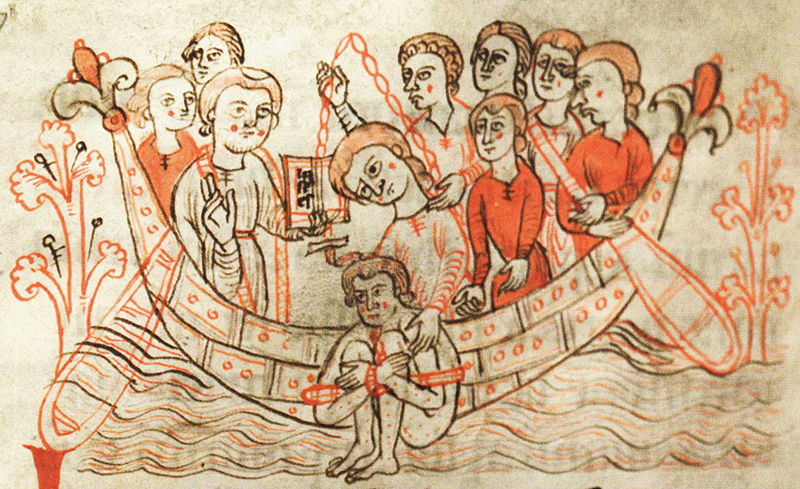


.jpg "It looks like the inmates in this cell block only got a C in not-raping.")


!["As long as you're looking, can you find [insert name of unpopular sports player]'s talent?"](https://commons.wikimedia.org/wiki/Category:Microscopes_in_art#/media/File:Santiago_Ram%C3%B3n_y_Cajal_(8691434507).jpg "\"As long as you're looking, can you find [insert name of unpopular sports player]'s talent?\"")


_-_Custom_House.jpg "This was a year after Chester Arthur was fired as New York's Collector of Customs. The scandal was so great that Arthur ended up as President. He had to pull a sword out of a stone, or was that a different Arthur?")


,_da_un_modello_ellenistico_del_III_sec._ac.jpg)
