Category: Health Care

  • Come See The Evil that Regulation Can Do.

    I have often thought I have burned out all the absolute rage in my life….sometime after leaving Iraq. I heard a particularly powerful sermon at church on, yes, you guessed it….loving one’s enemies. After tears, contemplation and talking to the pastor…the last of the burning rage I felt… left me. But I felt an ominous stirring of the old rage, because of it. What is “it”? A story that illustrates actual evil, made possible by regulation.

    A bit of background – I am from the city of Rockford. I grew up there in the 1970s and 1980s, when it went from a stodgy, stolid middle class town based on tool and die and specialty industry (and the band Cheap Trick!) the second largest city in Illinois….to a shrinking, crumbling city, fighting as hard as it can to hold on. The city had three hospitals – my father worked at one of them (not the one hurt in this story). So I was pleasantly surprised to hear the old home town had a hospital that was going to build:

    The health system unveiled plans in April for a four-story, $70 million structure to serve women and children that would include an intensive care unit upgraded to the highest-rated level of care for newborns. Other upgrades would include the addition of 10 psychiatric beds, an expansion of the emergency department, and additions to the surgery and catheterization lab areas of the hospital.

    But, we cannot have an increase in the ability to heal the sick, care for the newborn or the mentally ill!  Heavens no!

    “The applicants have exceeded the State standard size requirements” for six of 14 expansion-development areas, according to review board documents. Those areas include a nursery, emergency and surgery departments, medical-surgical inpatient unit, cath-angiography unit, and neonatal intensive care unit.

    This was a shock, since:

    The board in June OK’d SwedishAmerican’s plan to develop the highest-level neonatal intensive care unit, which is expected to open in the hospital’s current tower location in 2019, Kirby said. The plan is to relocate it to the new women’s and children’s tower. The board is “asking for a resubmission of our modernization project, which includes our women’s and children’s tower plan,” Kirby said.

    There was no written opposition to SwedishAmerican’s expansion plan and no public testimony in opposition. More than two dozen supporters formally backed the plan, including City Council members and other elected officials.

    Oh, and…

    In 2015, the board approved Mercyhealth’s request to build a 188-bed hospital on 263 acres in far east Rockford. Construction is underway on the $505 million project.

    OSF Saint Anthony Medical Center in Rockford is adding 78 single-patient rooms as part of an $85 million expansion expected to be completed in spring 2018.

    So how in the absolute rage inducing Hell could this vital boost to a hurting city get stopped? Why, politics, of course!

    The “how” – we see what many libertarians have railed against, Illinois has a “Certificate of Need” law. Want to punch a wall while screaming in rage, vomiting and crying at the same time?  Check this little intro out:

    The Health Facilities Planning Act (Act) (20 ILCS 3960), established Illinois’ certificate of need (CON) program. The CON program promotes the development of a comprehensive health care delivery system that assures the availability of quality facilities, related services, and equipment to the public, while simultaneously addressing the issues of community need, accessibility, and financing. In addition, it encourages health care providers to engage in cost containment, better management and improved planning.

    No, you sanctimonious shitheels, it allows you to stop people from building hospitals, clinics, nursing homes and other useful things, so you can protect established players in the field from competition. Period.

    So, if nobody “publicly” spoke out in opposition…how did this get beat (for now)? Well, you need 5 of 7 members voting to approve. In our case here:

    Members Present: Chair, Kathy Olson; Senator Deanna Demuzio; Joel Johnson; John McGlasson, Sr.; Marianne E. Murphy; Richard Sewell
    Member Absent: Senator Brad Burzynski

    So there were only 6 present – Senator Brad Burzynski happened to skip out. Now why would he do that? Maybe, just maybe a good friend of his, Senator Dave Syverson, asked him to skip out? Gosh, why would he want a member to miss the meeting, and reduce the available votes? Maybe take a peek at his biography. See something at the bottom of the page…

     He also serves on the Mercyhealth System Board

    My oh my…on the board of a competitor health system?!  I am shocked, shocked to find this out! He also just may have asked backers of the plan to withdraw their support, so I was told.

    So who voted “no”? The record does not say, and the reporter I conversed with has tried to find out, with numerous calls unreturned. Maybe the chair, who happens to be on staff at local clinic? So why would it matter that she was on the staff of another local provider (other than obvious competition concerns)? Oh, lookie here!

    I am in touch with a reporter (I am going to leave names out for this for now) and will do my best to find out the exact no votes. Right now this is only educated guesswork on my part. But I sure seem to have found some terrible looking coincidences, eh?

    But no matter the who, and the why – the very existence of something like the “Certificate of Need” is a monstrous evil, serving only to hurt.

  • Wednesday Afternoon ULTRALINKS

    It appears that Brett is actually working for a living…I know, right? (jesse: my Brett joke was…less kind) So, while I idle away on the fondue plantation, I have managed to scrape a few links together….at the same time, Jesse wanted to help. So with two sets of links done, we did the only proper thing…combine them for ULTRALINKS!

    Links….COMBINE!
    • So…this sounds about par for the course.
    • Mr. Arkwright say make Nigerian students no worry!
    • A cop…guilty?! Look what it takes to actually get a cop in trouble. [Alternate title: SugarFree scripts a cop drama episode?]
    • A reminder, that while there are still checks in the book…we are broke.
    • Get this man a presidency: Justin Amash wrangles broad bipartisan support for rolling back Jeff Sessions’ rolling back of an Obama-era curtailment of asset forfeiture. *takes deep breath*
    • Speaking of presidencies: Sanders will introduce universal health care, backed by 15 Democrats. There’s your field for the next election cycle. Now for three years of attrition and attempts to out lefticate each other with proposals that will turn us into Venezuela if enacted.
    • Nun with a chainsaw“, a phrase sure to instill terror in hearts of Catholic school graduates, is the surprise feel-good story of the day.
    • Katie Quackenbush, you haven’t heard of her yet, but her music career is gonna be huuuuuuge…at least after she finishes serving time for assault with a deadly weapon.
    • This one even has Old Man With Candy scratching his head. “No be di uncle get di pickin.”

    Bonus Link: Drunk European says “who needs you anyways?!”

    Them’s the links. Now go take on the day.


  • California Dream’n


    Ten years ago, there were numerous articles written about the poor financial state of California during the governorship of Gray Davis and, later, Arnold Schwarzenegger. The State’s financial position deteriorated to the point that bond rating agency Moody’s downgraded the state to the ‘BBB’ range, or just above ‘junk bond status’. This was the first time in the post-Great Depression era that a US state was assigned such a low rating. Since that time, the State has raised taxes to stabilize its finances, and Illinois’ poor financial position has become the topic of conversation. However, California still faces some obstacles going forward, which are primarily driven by its massive Medicaid system (estimates suggest that one in three Californians are enrolled in the Medicaid system) and the State’s reliance on capital gains taxes.

    California’s Current Financial Position

    I’m sure this is so battered because it’s been used a lot…

    As of the end of the 2016 fiscal year, the State boasted a positive General Fund balance. This is the first time that the State has recorded a positive fund balance in more than ten years and represents a marked improvement from the State’s weakest financial position in fiscal year 2012, when it held a General Fund balance representing negative 26% of total revenue.

    The State’s largest source of revenue is its personal income tax which represents 46% of total revenues. Intergovernmental revenue, which is primarily revenue provided by the federal government (mainly Medicaid funding), represents 42% of total revenue and sales taxes represents 12% of total revenue. For the current fiscal year, the State forecasts a slight increase in sales tax receipts and no growth for income tax and intergovernmental revenues. Those projections are 2% lower than previous estimates.

    The State’s largest expenditure is Health and Human Services (Medicaid) which represents 52% of total expenditures. Education represents 32% of total expenditures and is the State’s second largest expenditure. For the current fiscal year the State now forecasts total expenditures to grow by 2.5% over previous projections, including 4% growth for Medicaid and 2% growth for education.

    The State’s largest pension system, the State Teacher’s Retirement System, is 63% funded. Total pension, other post-employment benefits, and debt service costs account for 10% of total State expenditures, which is an average fixed cost. Due to recently passed legislation, the State, local communities, and school districts will face increased pension contributions going forward. At 3.2%, the State’s debt levels, in comparison to other states, are above average.

    Current and Projected Deficits

    Deficit projections for the current fiscal year come in between $400 million to $1.6 billion (representing roughly 1% of total revenues). Additionally, budget estimates for the upcoming fiscal year are forecasting another deficit. The projected imbalances are being driven by the above-referenced flat to possibly declining income tax revenues coupled with growth in the State’s Medicaid system.

    Declining income tax revenues are driven primarily by declines in the State’s capital gains tax (which accounts for 10% of the State’s revenue). Over the past two years capital gains revenue has dropped more than 7%. California’s reliance on capital gains taxes has long made the state susceptible to the variability of market conditions and any economic downturn is expected to negatively impact the State’s overall revenues.

    Spending reduction is for chumps

    Growth in State expenditures is largely being driven by tremendous growth in the State’s Medicaid system. After the passage of federal healthcare reform in 2010 California’s Medicaid system has seen substantial enrollment growth, including a 14% increase in enrollment between 2013 and 2016. Current estimates suggest that one in three Californians are enrolled in the State Medicaid system. Any federal funding reductions to Medicaid would have a substantial negative impact on the State’s financial position.

    To address these budget imbalances Governor Brown has proposed reductions in State revenues for local school districts and state universities. In the past, the State has pursued a similar strategy to address budget deficits. The reductions in State revenue are expected to have a disproportionate impact on school districts that rely heavily on state funding and are already financially weak. These school districts likely will face state funding reductions combined with state mandated increases in pension payments.

    Conclusion

    The State’s financial position remains adequate, though some financial deterioration may occur in the near term. Local California governments that would be most impacted by reduced state funding would be local school districts that are already reliant on state support and have already been experiencing financial strain. Proposed federal funding reductions for the State Medicaid system would pose a significant challenge for California and would further exacerbate expected deficits.

    If no federal reductions in Medicaid occurs, the State’s financial position is expected to remain adequate, but deficits are likely in the near term. Local school districts (which are heavily reliant on state funding) are most likely to be effected by any State deficits going forward.

  • My Take on the Obamacare Repeal – For Me, It’s Personal

    In the early 00’s things were different for me. I had gotten out of college a few years earlier, and taken a job as a software developer doing contract work for steel mills and other industry. While it was a good way to make money, my heart was still into art and design, so I set forth finding a way to combine art and technology into a new career. Enter the Internet. I started a web and print design company on the side as I worked my full time job. I had steady income, and my employer was paying my health insurance premiums. I wasn’t on the company plan because I knew someday I’d want to leave that job and work on my business full time, and having my own policy would make that transition seamless. My employer took out the premiums from my paycheck pre-tax and sent in the premiums for me. So far so good.

    Then things went downhill fast. My employer was accused of not depositing 401(k) contributions from employees. He was also involved in a discrimination lawsuit by an employee he fired. And finally, I was notified by my insurance company that the employer hadn’t paid my insurance premiums even though he’d taken the money out of my paycheck. This was the third time he’d done that, so my insurance company dropped my policy. I attempted to re-apply, but because I have a preexisting condition (I was born with spina bifida), I was rejected by my insurance company and all the others to which I applied. One agent told me that there was an unofficial “black list”, and once one insurance agency rejects your application, your information goes into a database where other insurance companies can see the rejection, and they will also reject you.

    I promptly quit my job and called a few lawyers. Because my employer had given me a check to cover the money he took out of my paychecks, I wasn’t technically “out” anything tangible as far as the law was concerned. There was nothing they could do. I was self-employed, and my wife, one of my three kids, and I were uninsured. (Two of my kids were adopted through foster care so they were still on Medicaid). I was no longer living the dream, I was pretty much screwed.

    I continued on with the business, making a decent living but still under the constant threat of losing everything in the event of a medical emergency. I had hoped to grow the business so that I could create an insurance group, but that never happened. After five years, I shut down the business and took a full time job as a software developer, which is where I sit today as I write this. My dream of working for myself had come to an end.

    The Great Red Hope

    In those five uninsured years, I was not without hope. I had joined the NFIB (National Federation of Independent Business Owners) when I started my business. This was during the first years of George W. Bush, when the Republicans controlled everything much like they do today. NFIB was pushing some changes to insurance laws that would have benefited me greatly. With the Republicans in office, they felt they had a chance. They proposed:

    1. Allowing insurance companies to sell policies across state lines.

    2. Allowing trade groups and clubs, such as NFIB, to create insurance groups that members could be insured through instead of having to get insurance through an employer.

    Either of those options could have solved my insurance problem. I could look for a policy in another state with fewer limits on preexisting conditions, or that allowed policies that only covered catastrophic events. Or, I could have just gotten insurance through NFIB. I contributed cash, wrote letters, and filled out petitions. In the end, the Republicans did… nothing. The next election they lost seats the Democrats, and their monopoly on power was over. I became bitter and angry, vowing never to vote Republican again. A few Ron Paul articles later, I turned to the dark side of the political spectrum. I was officially a libertarian.

    Enter Obamacare

    When Obamacare was being debated, I was livid. You’d think that I’d love it, considering that I have a preexisting condition and the law was supposed to make sure everyone could get insurance. But everything proposed by the Democrats was the complete opposite of what I knew would work for me and others like me. They would make insurance more expensive, more complicated, and more of a bureaucratic nightmare.

    My ideal solution would be the above two items, to which I would have added a third:

    3. Provide another way for people with preexisting conditions, who were working but could not get insurance elsewhere, to get a policy through Medicare or some other program.

    That’s it. Almost everyone would then have access to health insurance, and the extra competition between states would bring down prices. Of course, this wouldn’t require a huge government program, so the Democrats wouldn’t even consider it. When Obamacare became law, I saw that my initial thoughts were right. If I were still self-employed, there is no way I would be able to afford those premiums.

    The Repeal

    So here we are today, waiting for the Republicans to repeal Obamacare and set things straight, which isn’t happening. While I’m disappointed, I’m not surprised. The Republicans have been here before. They’ve had a chance to use their power to make things better for many people. Whether it’s lack of intelligence, spinelessness, or something else, who knows? But every day I see more proof that neither of the major parties has any intention of doing what’s right or helpful. Democrats just want to create bigger government programs that cement their power, and Republicans want to do pretty much nothing, for fear of pissing someone off and not getting elected next cycle.

    As for me, I’m still sitting behind a desk working for someone else, and I think I’ll be here for a while. The cost of insurance, and the amount of time, effort, and money required to follow regulations required to run a business are more than I’d like to deal with.

  • Single Payer Healthcare – Part 2

    (Part 1)

    Introduction

    Once it is determined who is granted access to the system and how this system is going to be paid for, the next step is discovering how these health care services are going to be delivered.  After all, the point of our nation becoming part of the noble cadre of nations that recognize access to health care for all citizens as a civil right of some kind is to actually treat sick people.  Sounds like a given, but how do they go about doing it?

    Primary Care – The PACT Model

    The key to delivery in the VA is through the Primacy Care Provider (PCP).  There is one doctor (MD), or nurse practitioner (NP) that is charged with providing the basis to all services to an individual Veteran.  The team also has a small cadre of Registered Nurses (RN), Licensed Practical Nurses (LPN),

    Nursing Assistants and Medical Support Assistants (MSA) that work in support of the PCP.  This is in effect, a small clinic that operates similar to many health care systems and even at private clinics.

    What the PACT team does, is provide the Veteran with general services, also a given since the MD is typically a general practitioner.  This team should handle routine services, and also does the grunt work in terms of keeping track of medical history.  They provide this based on particular medical criteria designed to stay abreast of common health factors affecting the given population.  As noted in the previous essay, most of the Veteran population is older and male.  

    This means the PACT can focus on the types of issues older men typically face.  Examples of such conditions include obesity, hypertension, diabetes or any condition that will worsen over time if a relationship with a physician is not maintained.  If a condition worsens, the PCP will know about it and be in a good position to alter his or her plan of care.  This proactive approach is often pointed out by advocates of single payer health care systems as a feature of these systems since most of the time healthcare in the United States is a reactive proposition.  Reactive in the sense that most people will simply wait until that bump gets bigger, or that knee becomes too unbearable to walk on, or it hurts too much to urinate in the morning before finally making an appointment to see a doctor.  

    Symptoms may not appear until it is too late for treatment to be effective for many fatal diseases; the system is more likely to catch an underlying condition while it is most effective to treat in this proactive system.  Catching these conditions early on has the added benefit that it is often more cost effective than catastrophic treatment (6).

    There are studies that Longman cites in his book that suggest a correlation to this approach leading to better outcomes versus the patient waiting until the symptoms get too unbearable (6).  There are some studies that go so far as to say that VA patients live a longer life, in spite of disability, alcoholism, PTSD, et cetera, being more frequent than in the general population.  Even studies with outcomes in specific areas cited as performing better than the private sector (6).  The overall cost of such a system also has a tendency to be lower than the fee for service model.  One study from 2004 suggested all VA services provided during FY 99 if reimbursed at Medicare rates would be result in an estimated 17% higher cost to the taxpayer (1).

    Specialty Care

    This is where things get a little more complicated.  Consider what many third party insurers require of their customers to see a specialist.  Typically, if a customer wants their insurance to pay for specialty care they will have to first go to a primary care clinic to initiate a referral.  What this does for the insurer, is inform them the requested service is medically necessary.  This necessity is important to insurers because specialty care providers have a tendency to provide services that are more expensive than their general counterparts.  Similarly, in order to see a specialist, a Veteran must first see their PCP.  This step allows the PCP to discuss all of the options available to the Veteran and if their condition truly warrants the expertise of a specialist they will initiate a consult.  

    The consult is essentially a documented source of communication between the PCP and the specialist.  Once the PCP enters the consult, the specialist is notified via a provider alert on the Electronic Health Record (EHR) Software.  They will review the PCP notes, review the Veteran’s charts if necessary, and if the specialist agrees the service is necessary the specialty clinic’s MSA will contact the Veteran to schedule an appointment.  At this point, the treatment varies with the Veteran’s circumstances.  It could be an evaluation, a noninvasive outpatient treatment or perhaps a surgery needs to be scheduled with an inpatient stay.  All of these specific circumstances are documented on the consult.  Once the service is provided, the specialist will document their findings in the EHR to be ultimately reviewed by the PCP.  If the specialist does not agree the services are needed, the reason why is documented and the consult is discontinued.  If the specialist needs more information, a lab for instance, this will be documented and sent back to the PCP, this way the specialist has every resource available to make an informed decision.

    Drugs–the legal variety.

    The reason often cited for the efficacy of VHA versus private sector hospitals is the VistA EHR system. It allows a somewhat simple integration between clinics as discussed in the previous sections.  It also allows medical data to be stored easily, and later used for research purposes.  During the Clinton administration, Ken Kizer, the SecVA at the time, implemented a prescription drug formulary by researching this data as well as recognizing that once Veterans go to the VA they typically stay there.  For whatever reason why they stay, they identified they were there for life.

    ‘If you are going to have your patients for five years, ten years, fifteen years, or life,’ explains Kizer, ‘there are both good economic and health reasons why you would want to use the more expensive drugs.  You have a population of patients who are at high risk for sclerotic heart disease, and you’ve got them for life.  You make a different decision about what’s on your drug formulary than you might if you knew you only had them for a year or two.’ (6)

    What the researchers were able to do with this was create a formulary that determined what drugs worked long term.  When the FDA approves a drug, there typically is no long term research into the drug’s efficacy, only if it does what it claims and if it is safe for use.  What this means is the VA will only prescribe drugs that have well-known, established effects, but also have been around long enough to be on the generic market.  If a new prescription drug treatment hits the market, it is almost certain the VA will not add it to their formulary, even if the drug is truly is a medical breakthrough, as discovered with the new Hepatitis C drug (7).   While it was later approved, it required a cost/benefit analysis on the cost of treatment at the VA for hepatitis C before they were able to add it to the formulary.  The result is a system that according to the Heritage Foundation costs significantly less than Medicare Part D but presents its patients with no choice whatsoever in their prescriptions (3).

    The VA formulary is created through access restrictions on drugs. For drugs to be covered on the formulary, their makers must list all of their drugs on the Federal Supply Schedule (FSS) for federal purchasers at the price given to the most favored nonfederal customer under comparable terms and conditions.  Additionally, drug makers must offer the VA a price lower than a statutory federal price ceiling (FPC), which mandates a discount of at least 24 percent off the non-federal average manufacturer price (NFAMP), with a rebate if price increases exceed inflation (3).

    Otherwise, the VA negotiates pricing based on volume, as they are the largest health care provider in the country. The drug companies that sell to the VA recognize that it is a closed system and there is little chance of market distortions from below market priced VA drugs.  It is also small enough as a portion of the entire health care market, that they are able to break even by selling non-generic prescription drugs elsewhere (3).

    Scheduling

    Everything in the previous sections of this essay is utterly meaningless if Veterans cannot get an appointment.

    The thing is, most major hospital systems and private practices do not worry too much about whether or not they are able to schedule patients in a timely manner.  The reason being, they have many fixed costs that are baked into their operating budgets.  Paying for the cost of operations requires treating patients.  If they can’t get patients into beds, they go under–kind of like when airlines have no passengers. The private sector is also large enough at the moment that if a patient cannot be seen at one place, they can find another.  In the grand scheme of things it is about as difficult to schedule an HVAC technician as it is to schedule an appointment with a private doctor—it just depends on where you live, and the local supply and demand for services.

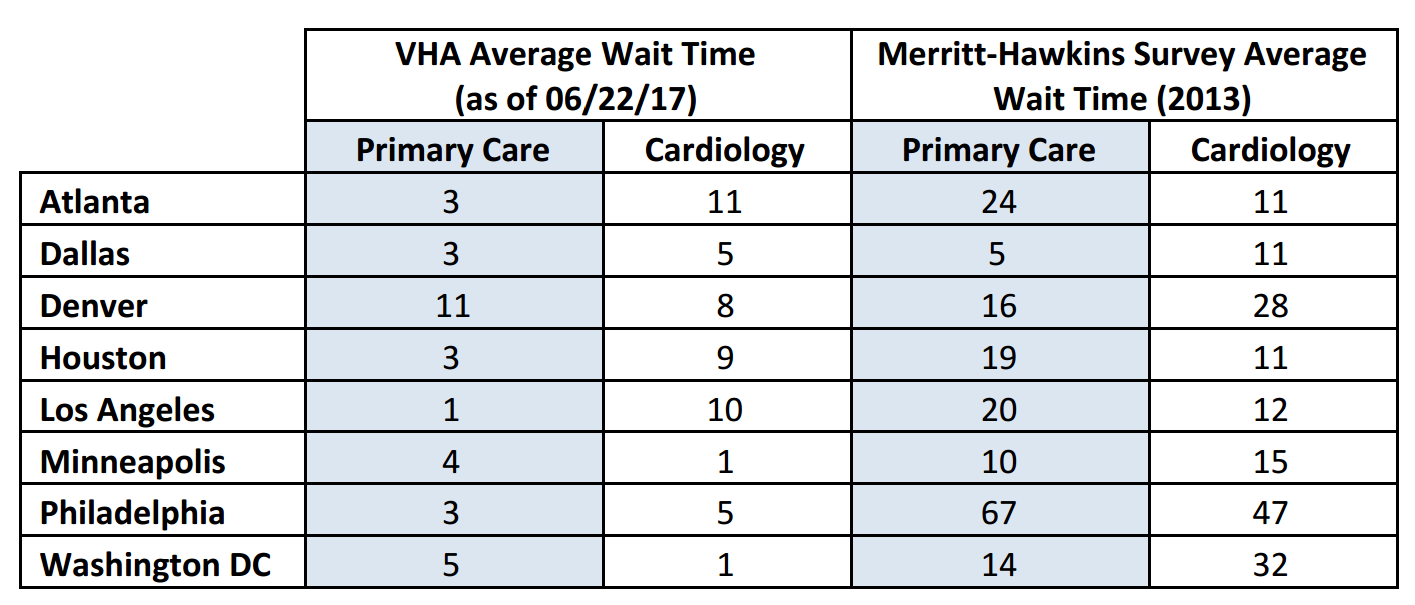
    Because of this, it is often difficult to find an apples to apples comparison for scheduling times.  In 2014, Merritt-Hawkins published a survey on Medicare/Medicaid acceptance rates and average wait times for a number of US Metropolitan areas (2).  Unfortunately, their survey uses 2013 data and is limited to a few clinic types.  The VA does have a public website that currently presents average wait times at all their facilities, for a similar number of clinic types (4).  For purposes of brevity, only Primary (or Family) Care and Cardiology average wait times will be displayed here by number of days.  The references section has links to both resources in case further research is desired.


    Ruminations on Primary Care, Specialty Care, Drugs and Scheduling

    While the scheduling numbers in the area listed appear comparable or better than their private sector counterparts there is something that should be mentioned here:  these data were made available as a result of a well-known scandal involving the manipulation of the wait times first identified in Phoenix, but later found to be endemic of the system as a whole.  Here are a few other examples:

    Tucson:  https://www.va.gov/oig/pubs/VAOIG-14-02890-72.pdf

    VISN 6 (VA, NC):  https://www.va.gov/oig/pubs/VAOIG-16-02618-424.pdf

    Houston:  https://www.va.gov/oig/pubs/VAOIG-15-03073-275.pdf

    Colorado Springs: https://www.va.gov/oig/pubs/VAOIG-15-02472-46.pdf

    Providence: https://www.va.gov/oig/pubs/VAOIG-15-05123-254.pdf

    Cincinnati: https://www.va.gov/oig/pubs/VAOIG-15-04725-272.pdf


    The VAOIG website is full of these. Unfortunately, bottlenecks within the system can occur.  With a large number of people congregating into urban areas, it is very likely to happen in a hypothetical single payer system.  Keep in mind the VA only provides care for a small minority of Americans (around 9 million) and scaling the system for the entire population is unlikely to make it work any faster, this is the practical experience in other countries as well.  There is also the question of coordinating care with a specialist.  So to recap the consult management practice goes like this:

    AH! ➔ Appointment with PCP ➔ PCP Agrees and writes up a consult ➔Specialist receives consult and reviews ➔ Specialist accepts and schedules appointment ➔ Treatment ➔ Specialist documents treatment ➔ Specialist informs PCP of treatment ➔ Re-evaluation by PCP if needed.  

    Each of these steps requires human input; miss a step and the entire process stops.  Stop early enough and treatment may never be given at all.  One of the findings from an investigation determined there was little oversight at the time of the investigation of the process at all, which likely lead to unnecessary deaths (6).  The prevailing issue with government systems such as these is lack of accountability.

    In terms of prescription drug pricing, the VA formulary only works because it is a closed system.  Scaling it up will create a massive market distortion that according to the Heritage Foundation, will only drive up costs (3).  Consider the formulary is based on restricting the drugs it will pay for, and what doctors can prescribe.  This will result in shifting costs to new medications for those willing to pay for it.  There is also the matter of the formulary’s insistence on using generics.  Generic drugs are made by a limited number of manufactures and if the only thing the hypothetical single payer will pay for are generics and the physician is required by law to only prescribe generics, it will only result in a temporary shortage due to the spike in demand.   When coupled with the price controls it is probably going to take these companies longer to increase their manufacturing capacity due to limited funding.  Of course if their lobbyists are half as good as they are rumored to be, they might avoid that.  Not to mention the obvious result of, “billions of dollars in averted research and development expenditures by drug makers, forgone investment in an untold number of new drugs, and the considerable loss of valuable research and science jobs (3).”

    Finally, there is little evidence that profit motive automatically results in poor outcomes.  An informed pedant might throw out Roemer’s law.  Which postulates that in the for profit model with an insured patient population, every hospital bed will be full.  If the hospital finds that they are not balancing their books with primary care, they will simply shift their resources to providing a higher paying specialty—like cardiology.  It is in this way they can maintain their patient population and continue to keep their revenue streams in place.  If a patient needs a cardiac catheterization, they are probably going to be comforted by the fact the hospital they are at performs the procedure thousands of times a year.  Given the procedure involves a surgeon threading a device through a vein in the groin and then insert a device into or near the heart, the patient might think of this as a feature rather than a bug.  Finally, even if there are benefits to the “proactive” approach the VA system currently uses that can materialize in a hypothetical single payer, the argument this can only be achieved with a state-run system without the profit motive is made out of ignorance of the industry or dishonesty.  

    Why? Because there happens to be a similar for-profit system, that apparently made $504 million in Q1 2016 (8).  While they are only available in a few areas, it just so happens they specialize in the same type of fully integrated, proactive approach to care that is touted as the feature of state run systems.   

    Their EHR isn’t a relic from the 1970s either.


    References

    1. Nugent, Gary et al.  Value for Taxpayers’ Dollars:  What VA Care Would Cost at Medicare Prices.  Medical care Research and Review, Vol. 61 No. 4 (December 2004) pages 495-508. http://journals.sagepub.com/doi/pdf/10.1177/1077558704269795
    2. Merritt-Hawkins. 2014 Physicians Appointment Wait Times and Medicaid and Medicare Acceptance Rates.  (2014) pages 1-32. https://www.merritthawkins.com/uploadedFiles/MerrittHawkings/Surveys/mha2014waitsurvPDF.pdf
    3. Angelo, Greg.  The VA Drug Pricing Model:  What Senators Should Know.  The Heritage Foundation, No. 1420 (April 11, 2007) 1-4. http://s3.amazonaws.com/thf_media/2007/pdf/wm1420.pdf
    4. Department of Veterans Affairs.  How Quickly Can My VA Facility See Me? http://www.accesstocare.va.gov/Healthcare/Timeliness
    5. Longman, Phillip.  Best Care Anywhere.  Polipoint Press, February 2007.
    6. U.S. Government Accountability Office (GAO).   Report 14-808 VA Health Care Management and Oversight of Consult Process Need Improvement to Help Ensure Veterans Receive Timely Outpatient Specialty Care.  http://www.gao.gov/assets/670/666248.pdf
    7. Reid, Chip. VA can’t afford drug for veterans suffering from hepatitis C. http://www.cbsnews.com/news/va-cant-afford-drug-for-veterans-suffering-from-hepatitis-c/ (06/22/2017)
    8. Rauber, Chris.  Kaiser Permanente:  First quarter profits down, but revenue and enrollment up.  http://www.bizjournals.com/sanfrancisco/blog/2016/05/kaiser-permanente-healthcare-50-percent-drop.html (06/22/2017)
  • Single Payer Healthcare – What It Could Look Like

    Introduction

    The lamentable position that is often tossed around this site as well as others, including this site’s precursor, is that single payer healthcare will be implemented within the lifetime of the current generation. While the majority of the intended audience may not fall into this demographic, others here will probably experience this for themselves. This series of essays is not necessarily intended to be an advocacy piece. This is intended to provide a snapshot of a healthcare system that is currently in place in the United States today, that embodies everything a single payer system in a ‘civilized’ nation such as those in Western Europe, Canada and elsewhere. Governments tend not to be innovative, and instead will opt for a solution with a historical basis for which an ‘educated’ opinion can be determined. In other words, if and when this happens it will not be a brand new system but one which will be based on prior experience and there is only one American system today that has the capacity, scope and history for which to base a single payer system. The problem of course, is the system in question is only available for an surprisingly small group of Americans and many who may argue against such a system are not likely to have experienced it for themselves. As Sun Tsu once postulated in order to defeat the enemy, one must know the enemy better than they know themselves.

    If advocates of free markets, Federalism and personal responsibility are to define coherent arguments against such a system it is best they first understand what the future may look like. While the practical experience in Western Europe should provide enough ammunition, it is likely these systems will be used as arguments for single payer systems. It should however be noted, the experience in these countries are unlikely to be comparable to the United States, because these governments historically are more enthusiastic(?) in their approach to governance. Not to mention the centralized nature of the population and demographic homogeneity make it easier for these socialized systems to be implemented. An American example is needed–and fortunately is available for interpretation. It is this way freedom advocates will know, and knowing is half the battle.

    This is the Veterans Health Administration (VHA). As interpreted by a mid-level GS employee with direct experience at the VISN (regional) and Facility level.

    Eligibility

    The first thing any health care system will need to determine is the eligibility requirements to utilize the services provided by the system. Without boundaries, there will be no limitations to the extent these services are rendered.

    In conceptual terms, eligibility is the first form of control. This is to determine who gets in, and among those, what can be allocated.

    First thing first, nearly everyone using VHA services are Veterans but not all are combat veterans. There are Veterans that were given a disability for other reasons, such as injuries during peacetime, asthma or sexual trauma, which unlike its counterpart on college campuses actually did happen to a good extent in the past. There even are some annoying situations where Veterans of some wars are simply viewed as better than others. WWI and the Mexican Border War Veterans for example, assuming there are any living examples, by law are currently allowed unlimited access to all services at any VHA facility (1). While Eddie Rickenbacker does not need to worry about paying for a colonoscopy, there are others with ailments such as Agent Orange or Gulf War Syndrome that were affiliated with wars that were determined by popular culture to be unpopular from a political standpoint, and were thus swept under the rug.

    For good reason, with his hat tilted the wrong way and his hands conspicuously in his pocket, America’s first ace has the kind of swagger that will drive a Sgt. Major to the brink of insanity. Most can only dream of such awesomeness. Therefore Mr. Rickenbacker should not need to worry about his access to quality healthcare and he is not at all worried–because he is dead.

    For everyone else, it is a process that begins at a recruiting station when nobody is old enough, or even cognizant of the future’s possibility. Nobody discusses VHA benefits with a recruiter, because quite frankly even the recruiter does not know because he or she is not to that point in their life either. This process starts at the end of an enlistment or near retirement. Once a retiree drops the paperwork at the personnel office or upon signing the separation paperwork, they are eligible to apply for disability. The math on this is not what most consider to be math to begin with.

    For most sane individuals with the most rudimentary of education, 10+10+20=40, right?

    Wrong!

    The VA uses a descending efficiency scale (2). What this means, is the government decided that math was too straightforward and made a system of it. Essentially, a service member shows up at the recruiting office at 100% because most of the recruiting process is determining medical qualifications. The military is quite efficient at weeding out those that are not at 100%. It is assumed the service member will incur some type of injury that will negatively affect the rest of his or her life. For instance, asthma as previously mentioned will net the service member a 30% disability. Hearing loss is another 10% resulting in a total of 30% disability. How? Asthma reduced him to 70% of his initial ability. Now that he can only hear in his left ear, reduces that 70% by another 7%, because 10% of seventy is seven.

    30+7=37 rounded down to the nearest 10 is 30. Get it?

    Most Veterans will fall into the trap where they tell a doctor something hurts, therefore it affects them negatively. This is not how it works. The doctor performing a Compensation & Pension Examination is concerned about how the condition will inhibit your ability to function from a quality of life standpoint. In other words does it keep you from getting a job? Back pain does not prevent one from working the concierge desk at the local Marriott, nor does being wheelchair bound keep one from working at a bank. It will keep them from working a high paying job on a oil rig, railroad or construction site. The post industrial job market, the Montgomery (later Post 9/11) GI Bill and the Americans with Disability Act do provide some relief for those alternatively abled. In order to help the Veteran handle his pain physically, the VHA has a well negotiated prescription drug formulary. It is designed to control the cost of medication, and thus facilitate a solution for pain relief.

    Now this service connection will net the service member (now considered a Veteran) a disability payment that will need to be paid monthly as long as the Veteran lives. Per the numbers ran by the associated press the last time Veterans were used as a political hot potato during the Sen. Ted Cruz led government shutdown of 2013, this is around $5 billion–monthly (3).

    Once a Veteran has a service connected disability (SC), they are deemed eligible for VHA healthcare–even if that disability is 0%.

    Why is eligibilty so important? The system needs to know how many it must serve. The health insurance industry also has a concept tossed around from time to time known as ‘moral hazard.’ What this means is the more an individual is insulated from the costs of the services being paid for, the more likely they will use the service. This needs to be accounted for in order to control their costs. In other words, people will not care if it is not their money at stake. This is a concept familiar to many free-market aficionados. There is also the small issue of Veterans and non-Veterans alike in abusing the system to enrich themselves financially(4) . Most of these are, hopefully, outliers but abuses to the system also lead to inefficiencies caused by programs within the system designed to ensure the program’s solvency, which leads to Veteran’s waiting a long time for their eligibility paperwork to be processed.

    This SC rating translates to how a VA Medical Center (VAMC) is funded.

    Funding

    If only it were simple to explain how a VAMC is funded: Congress does not write into a budget that VAMC Tom, Dick and Harry shall receive $X. The system is designed so that the Veteran population can be in flux and the allocation can reflect how ‘sick’ that particular population is and how often it is used. It is based on disability, age and other factors, like if a Veteran received a Medal of Honor, a Purple Heart, was a Prisoner of War, and the like. Sgt. Dakota Meyer has two out of the three mentioned, and that ain’t bad. Then again, so does Sen.
    John McCain.

    The bottom line is, the more service connected the Veteran is and the greater resources it would theoretically take to treat the Veteran individually, the more money the VAMC receives from Washington. This is not just for the big things like, a prosthetic or a cochlear implant that are SC, this also works for little things like flu shots and almost everything else Veterans use that is not SC. The dirty secret is, most services Veterans use at a VAMC are not SC, even if he or she is 100%. This funding system is called Veteran’s Equitable Resource Allocation (VERA).

    The cited report from the Rand Corporation is predictably thorough in its methodology, analysis and description of the VERA system. The highest VERA category is about $70,000/year. This is designed to put a higher value on Veterans that need the care versus the ones that may not, and cover the cost difference of the former with the latter. A Las Vegas oddsmaker works in a similar fashion. It should be pointed out, Rand’s overall assessment of the system and its efficiency is highly dependent upon the Veterans that are also eligible for Medicare(5) . In short, the overall cost of care for Veterans is largely uncertain for any that are over 65. The reason being, VHA is unable to bill Medicare for services, much like one does not bill their spouse for services performed around the house. Ultimately, the proceeds from such a transaction are coming from and going to the same budget. Since many Veterans are part of this demographic or soon will be, it is likely the cost to providing Veterans health care is going to be skewed by this factor. What makes this more difficult to quantify, is HIPAA and that Medicare providers are under no obligation to provide VHA with medical records for services that are not provided under VHA auspices.

    In fact, this factor was cited by Longman as an argument to save costs on Medicare. It is estimated VHA has a lower overall cost of care due to the VHA ownership in facilities and control of the services in terms of medical necessity, by about ⅔ the cost of Medicare. In a CBO report reviewing costs from 2007-2015, it was estimated that putting Veterans qualifying for Medicare back on VHA would save $29.5 Billion over the time period, with $4.8 Billion saved from Medicaid(1) .

    Third party revenue can also be captured by VHA. This is allowed under the Balanced Budget Act of 1997(6) where the VAMC can code and bill a private insurance company the same way as any health system. The difference being they are only able to bill if the Veteran has other health insurance and are financially capable of paying a $15 or $50 copay. Under the PPACA, the IRS will automatically notify VHA if the Veteran has other health insurance. This accounts for 10-20% of a VAMC budget.

    There are other ways to fund specific programs such as prescription drugs, durable medical equipment, real estate, furniture and NonVA Care. These however, are largely allocated to VAMC a with a specific purpose. There is some discretion on how VERA funds can be allocated between facilities, but this is for the most part, a reaction to the present circumstances and typically planned within a fiscal a year. This is how a VAMC can install millions of dollars worth of solar panels in the parking lot but somehow fall short of their budgetary obligations with few repercussions.

    Ruminations on Eligibility and Funding

    From experience with eligibility, a moral case can be made on determining who is eligible. Some questions that may be raised include:

    – Does a minority, or anyone from a supposedly aggrieved demographic deserve more or less than a white male between the ages of 18-55?
    – Does an individual with late stage cancer receive a higher allocation than a single mother with 4 kids?
    – The VA currently will not pay for the surgeries necessary for one to transition to the opposite gender, will this hypothetical American single payer cover this cost, and how?

    All are questions that Congress would have to address in any hypothetical piece of legislation. It is unfortunate that questions like these that were once easy to answer, might now be more difficult because of the social concerns that dominate the current political parties. This will lead to needless fights in justifying why one is more deserving of the other. Much like Eddie Rickenbacker is eligible for VHA benefits automatically, but an OIF/OEF Veteran must justify why he or she is deserving. Such duplicity does not bode well for those arguing that healthcare is a right. Furthermore, shifting the costs to the system for the oldest, and therefore most likely the sickest patients to Medicare illustrates a practice for a medical system designed to control costs simply by determining who is eligible through at best, arbitrary criteria. At worst, it may be determined by politically insidious criteria.

    Such a practice in a hypothetical single payer system designed to cover all citizens is hardly equitable.

    In terms of funding, there is no way to determine how much this will truly cost. Simply scaling up VHA to the present population is only a rough estimate and does not account for demographics. Simply put, most VHA eligible beneficiaries are men, between the ages of 55-65. This demographic has very specific and more importantly predictable needs which easily control costs, but are hardly indicative of the entire American population. Coupled with the unknown costs shifted to Medicare/Medicaid, any quantification that will be presented is simply dishonest.

    For the audience which this piece is intended however, the moral case is simple: In order to participate in such a medical system an individual will necessarily need to justify the labor from skilled professionals while simultaneously reimbursing those professionals through appropriation made possible only by other individuals coerced into doing so. This is immoral as the previous sentence is a bunch of words more concisely described as theft. In the case of Veterans, at the very least they can point to a record where this appropriation was earned; the merits of which are understandably debatable for some and for others unjustified.

    Eligibility for existing within a politically determined border, what kind of earned merit is that?

    References

    1) Longman, Phillip. Best Care Anywhere. Polipoint Press, February 2007. Pages 102-106.

    2) Guina, Ryan. Funny Math–VA Disability Ratings. When 30+20 Doesn’t Always Equal 50. http://themilitarywallet.com/va-math-combined-disability-ratings/. 06/19/2017.

    3) Zoroya, Greg. Shutdown holding up military, VA benefits.
    https://www.usatoday.com/story/nation/2013/10/08/shutdown-casualties-combat-benefits -unpaid-pentagon/2941809/ 06/19/2017.

    4) Dinan, Stephen. Veterans caught triple-dipping on benefits.
    http://www.washingtontimes.com/news/2014/oct/30/veterans-caught-triple-dipping-on-benefits/ 06/19/2017.

    5) Wasserman, Jeffery et al. Understanding Potential Changes to the Veterans Equitable Resource Allocation (VERA) System. http://www.rand.org/pubs/monographs/MG163.html.

    6) Office of Inspector General. Report of Audit Congressional Concerns over Veterans Health Administration’s Budget Execution. https://www.va.gov/oig/52/reports/2006/VAOIG-06-01414-160.pdf.