Don Swissxote checking in on Catalonia… Hmmm. Looks like anothervote. When last we left this mess, the former Catalan Regional President, Carles Puigdemont, had fled to Belgium, to avoid the fate of other members of the regional government – imprisonment (which didn’t stop campaigning. *Chicago area politicians perk up*). Note, however, that the international warrant for Puigdemont was withdrawn (should he go back to Spain, I have no doubts the handcuffs would be on him in seconds).
The scenarios for post-vote Catalonia are numerous. I will glibly lay out what they are:
On the one hand, voters have been scared off from independence – by the use of force by Madrid (cops beating down people voting in the October referendum) or the number of business HQ’s fleeing Barcelona, or having second thoughts about being wholly responsible for themselves (in a national sense) now. So, they end up with MILFy Ines Arrimadasin charge….the independence movement returns to Quebec or Scotland levels of annoying/festering.
On the other hand, independence favoring parties win small – but squabble while trying to form a coalition to govern, and accomplish little to nothing before collapsing and needing new elections (see post-war Italian and Belgian governments). Being the cynical SOB that I am, I think this will end up happening… and the sound of cans being kicked down the road will echo for years.
Or, on the gripping hand, independence parties end up winning bigger – people get a case of the “fuck off, slaver” and one of the three independence parties gets enough of a mandate to lead a coalition….from exile, from jail or in Socialist person. Madrid would again suspend the regional government, send in the coppers and we would reach a decision point… give up under the force employed? Turn into a Basque style guerrilla type conflict? Start Civil War 2.0?
Costa Brava, Catalonia
As a libertarian type, I want force avoided. But, it ain’t my country/language/culture/self-determination at stake. I am not ready to go off and join the Reconstituted Abraham Lincoln Brigade as of yet. But this will be worth watching one way or the other.
P.S. For those that Twitter, follow #catalonia for all sorts of opinion and news.
Two and a half years after coming home from Afghanistan (and 4 months later, getting sent to New Orleans after Katrina) I was called back up, in 2007, to go to Iraq. This was displeasing. I had anticipated returning to Afghanistan in 2009. This was early, and I knew some Dari and had a good understanding of how Afghanistan worked (or didn’t). I didn’t know Arabic, and I had just started working for my Swiss Overseers a few months earlier.
“We finally get to leave Fort Riley?!”
But, I made the best of it I could. I crammed Arabic for a couple of months, and learned as much as I could ahead of time. One small advantage I had was that a decent amount of my work for my B.A. and M.A. was in Middle Eastern History. So I had some idea of the big doo-doo pile I was about to step into as an “adviser” to the Iraqi army. A bit of extra training and I got dumped off with the Iraqi Army 10th Division.
Luxury facilities at Tallill, Iraq
Oh boy. This was going to be work, but at least it was only moderately dangerous in their Area of Operations (not counting the 3 KIA we had the first week I was there). That lasted 3 weeks. The Iraqis had gotten sick of not controlling the second largest city in their country, and decided to do something about it. It was pretty much an Iraqi show, but the US decided it would at least lend them a bit of air support, some Special Forces to advise their Iraqi counterparts…and me.
I was taken from the 10th Division, and sent to go “help” the Iraqi Army 14th Division. They needed help. They were a relatively new unit, and had just finished initial training and were not fully equipped yet. But the knucklehead in charge, Iraqi 3 star General Mohan, launched them into the the fray immediately. One brigade saw a lot of its members walk away, since they were from Basrah itself, to go home and take care of business there. Fortunately, the Iraqi 1st Division (some serious killers) and a brigade of National Police (similar to European Gendarmes) as well a tank unit had been sent down too.
The other forces in the area were British, as this was their area…on the map. They had pretty much given up trying, had handed over “military control” to the Iraqis and were huddled in in their base at the airport. However, they did have a team of advisers with the 14th Division. So, I jumped out to join them and “advise”.
Thank you for flying the RAF. Welcome to Mahmud al-Kasim.
In the meantime, the Iraqis had gotten serious. They kicked Mohan upstairs to the “Basrah Operations Command”and put a general in charge of the 14th who had been to both the US and Australian Staff Colleges. He was a good leader, who was angry about how his troops had been handled, and their equipment and support. The Prime Minister and the Interior Minister showed up and suddenly red tape vanished – units could get fuel, ammo, whatever they were short. They even brought some more police with them.
I am not sure we can fix that one….dragged back from downtown Basrah, eh?
All I had to worry about was the $&%#ing Jaish al-Mahdi’s version of Davey Crockett blowing me up with a 107mm rocket. He got really close. But he still missed, in the end (I think one night after the nearest miss, someone asked where the Hell was that large bell was that had just rung…I explained that it was no bell, just my sphincter slamming shut so hard it sounded like one). The Iraqis kicked the Jaish al-Mahdi’s ass, and their Iranians handlers too. When the first three prisoners were brought in, I asked why I couldn’t understand anything they said. The Iraqi soldiers looked at me and said “They are speaking Farsi, they are Persians” (The Iraqis always called them ‘Persians’, never Iranians). Whoopsie. Oh, and up yours, IRGC!
I was really, really tired, after going through a lot of 16 hour days – but the end of this phase was in sight. So, a Brit officer and I huddled up with the staff of the 14th DIV and asked what was next. The Iraqis said they were going to chase the baddies out of the last part of town they held – and it was close to the only available bridge across the Euphrates. I was as pleased as Zardoz directing a brutal hunt.
We set up a plan where the Iraqis would drop a company by helicopter on the far side of the river, and set up strong points at both ends of the bridge across the river. I told the 14th DIV CoS (Chief of Staff ) that they could trap every one of the bad guys, and make them surrender, or be killed. He agreed it would work, and I shuffled off to sleep.
“Heading into town. Got Jaish al-Mahdi to beat down.”
The next morning I went to the DIV HQ to see how things were going. The staff looked pleased, and the Brigadier I had talked with smiled. I asked him how things were going and he said “Good, they are all running away!” I was a bit bemused. As we had blocked the bridge, where were they running? “Oh, we let them go. They are running to the Persian side.” I about has a stroke on the spot. Did we not plan to BLOCK them from getting away?! What was the Division doing, letting them get away to Iran?!
While I was asking this, apparently I had gotten a bit … excited. I realized that I had backed the Iraqi General almost literally into a corner of his office. He had his hands up a bit and was saying “They are finished, it is no problem!” And I was urging him to kill every one of them because they would be back, causing trouble. I was trying to perpetuate a junior version of the Marianas Turkey Shoot.
The Iraqis took the word of Americans quite seriously. We had booted their asses, hard, a couple of times in the past 15 years, and they respected our opinions. Here I was urging slaughter of the fleeing enemy…and the Iraqi CoS said “no”. I calmed down, pretty quick once I realized what I was doing. I told the general “it is your country, I hope you do not have to deal with them later.” I saluted, and I left.
Greetings from scenic Camp Wessam!
I often wonder if I had badgered him into calling the strong points and saying “light ’em up”…It would have been triple digit KIAs at the least – and despite the guys running away, we had killed a few dozen. It bothered me for years. It also took me years to tell anyone. I finally told my most trusted buddy, an NCO who I had previously been with in Afghanistan (after a few whiskies, I spilled it out – oh, and you should have heard what he ended up telling me!) and my pastor at church. Now, I can reflect back on this and only wince a bit.
I think it says something sort of good about the US Army that I managed to reel it in, before pushing it too far. And for that, I will toast Brigadier Baseem today, and his backbone…and that I did manage to rein it in, in the end.
Happy Veteran’s Day, Glibs. I am off to the local tap room for a couple of strong ones.
Looks like PM Rajoy has decided to crack down on Catalonia. [forestalling our commenters, I will ask…”You know who else cracked down on Catalonia?”]
Catalan separatists respond with a good bye vote in Parliament [Note: this vote was boycotted by opposition parties, the result was : 70 in favor, 10 against and two blank ballots out of a 135-member parliament].
So now what? The Catalan vote appears to be a reaction to the Spanish Central Government moving to impose direct rule over the area (Article 155 of the Spanish Constitution). Some interesting notes in this story.
To those who think this is simply a bunch of Lefties who want to prog harder than Madrid:
Marta Ribas of the leftist Catalonia Yes We Can party said “two grave errors” were being committed Friday.
“First, the Article 155 which will take away our rights and impact all the country. But it is a grave error to respond to that barbarity with an even bigger error,” she said. “The unilateral declaration of independence won’t protect us against Article 155, you will only make the majority of people suffer.”
One of the demonstrators in Barcelona was quoted as saying:
“I am here today because we will start the Catalan Republic,” said 68-year-old protester Jordi Soler. “Madrid is starting with total repression — and there is no longer any (other) option.”
So now we will have to see what Madrid will do when it invokes Article 155. I am expecting the National Police (the headcrackers from the referendum) to go in and arrest everyone they can. The Catalonian provincial police’s reaction will be key – if they resist, the Army will go in next, and I think it will get bloody.
Does any of this change the view of a libertarian? To this minarchist, I am slowing moving further and further into the Catalan camp.
UPDATE: Things moving along. Here is a good timeline. Article 155 invoked, looks like Madrid will at least charge Catalan President Puigdemont with “rebellion” (insert “You Rebel Scum” here)
Things in Catalonia could be coming to a head, soon. Actually, tomorrow. The central government in Madrid has not been shy about making somewhat pointed threats. As with any political strife, there are lots of stresses involved, beyond borders, laws and trade. Rumblings from some news sourcesare pinning this recent drive on the Left. But a small far-Left movement would not be enough to push this over the line, into a full blown secession. There appears to be a sizable part of the populace in the region does appear to want out of Spain.
What this will end up looking like will have a possibly large impact on “Europe” – the EU, NATO and the like. I will be watching for several things:
Will Madrid use force to prevent any formal breakaway? If so, in what manner – send in the Army and National Police, or just arrest the political leadership and lay off the ordinary people?
If force is used, what do the Catalan people do in response?
If force is employed, what will France do? [keeping in mind that the Basque ETA used to cross the border and hide in France]
If Catalonia does break away – would the EU, NATO, et al ask them in? [Slovenia, as an example, comes to mind].
Will crazed soccer fans demand that FC Barcelona continue to play in the Spanish League?
Here is hoping the whole thing ends up a non-story and there is no violence…but that ain’t the way I am betting.
17 years ago I asked my future father in law for his daughter’s hand in marriage. Surprisingly or suspiciously, he quickly offered it up and then we spent the rest of the night drinking beer and sake. The next step was to introduce me to the relatives, so a family reunion was arranged at the grandmother’s farmhouse in Chiba. Aunts, uncles, and cousins came from Tokyo, Kyoto, and Shikoku to meet me, the goofy American that would soil their gene pool.
Grandmother was a semi-retired rice farmer and had taken care of the farm ever since grandfather had died of a stroke some 30 years earlier. As we pulled into the dirt driveway, we saw her standing in the doorway, cane in hand and flashing us a smile that exposed two of her remaining three teeth. It was a large, traditional Japanese house with a small garden attached and a few persimmon trees on the western side. Mother quickly waddled from the car and gave grandmother a succession of quick bows. No hugging. This is Japan where you could go a decade as an adult and not even realize you haven’t touched either of your parents. Father gave a formal bow to his mother-in-law and my wife followed with the same. Of course, I did likewise, but to me the grandmother flashed a grin and chuckled slightly.
Finally, all the relatives showed up and we had a dinner of hairy crab, shabu shabu, vegetables from the garden and beer from the liquor store. Lots of beer from the liquor store because father likes to drink on vacation. A little prodding about where I was from and my natto abilities by the relatives, but otherwise they treated me like a new member of the family. I only wish I had understood more than 8% of what they were telling me.
Around nine o’clock grandmother was ready for bed. The uncles, aunts and cousins left to stay at a nearby hotel and mother and my wife went off to bed after taking a bath. Father, God bless him, stayed up drinking with me until 11pm before his head got wobbly. I helped father up and asked him where I was sleeping. Not being technically married yet meant that my wife and I couldn’t sleep in the same room even though we were living together in Tokyo. Grandmother’s house, grandmother’s rules. Father gathered his wits enough to make zero sense, so I had no idea what room to go to.
I walked down the hallway and saw my luggage stacked neatly in front of a fusuma, so I slid it open to see if that was my room for the next two nights. The curtains were open so the moonlight shone into the tatami room. I couldn’t find the light switch, so it took a few moments for my eyes to adjust. In the center of the room was a perfectly made up futon and pillow. The only other thing on the floor was a butsudan against the wall with a black and white framed picture of a man that must have been grandpa. About two thirds up the wall were dozen framed pictures of scowling men, some of them in WW2 soldier uniforms. They were hung in a manner that allowed them to lean forward and it seemed like they were all staring directly at the pillow. Right where I, the American who was banging one of theirs, was to sleep.
Rural Chiba in the winter is dead silent at night. No streetlights or passing cars to flash in the window allowed for the perfect environment for the moon to do its business on the room. I undressed and crawled under the futon and spread out on my back, scanning the men who were obsessed with me. This was grandma’s prayer room and she had decided this is where I needed to sleep.
The scowling men weren’t really scowling I figured out after staring back at them for a few minutes. These were Japanese men of the early 20th century and you didn’t smile in pictures then. These were men whose lives were necessary for me to have the wife I have. Even the soldiers, at whom I first recoiled at upon seeing, became human. One of them was about 30, which was my age at the time. He had on the flat Japanese army hat and a few medals pinned to his chest. All of them were dead now and grandma was praying for them every morning.
Do I hate what Japan did in WW2? Without hesitation. But I didn’t realize until then that I didn’t really hate the average Japanese person who lived at that time. These were fathers and sons that had been sucked from their rice farms to kill other men on the whims of their government. Should all the memories from the Japanese that died in the war be locked into a museum like some kind of eternal prison of shame for China and Korea to wield like a baton for political advantage? I watch what’s happening in the U.S. and the scorn and hatred for Southern heritage and think, “Why can’t they honor their dead?”
The 2017 Oktoberfest will start in Munich, Bavaria, Germany on the 16th of September at noon Central European Time and will run until the 3rd of October. It is the world’s largest beer festival with roughly six million attendees annually, but it is more than just beer. There is food, carnival rides, and shooting competitions.
There are other Oktoberfest celebrations around the world. The Munich Oktoberfest is the oldest, largest, and the subject of this article.
I went to Oktoberfest in 2016. It was not my first time in Munich, but it was my first time at Oktoberfest. Unfortunately, I missed the shooting competitions, but I drank, ate, and enjoyed myself.
First, a little mood music from the Rockaholix Buam where they sing about Bavaria in the Bavarian dialect to the tune of an Irish drinking song while driving around the Bavarian countryside in an American made pick-up truck flying a pirate flag and flags with the Bavarian coat of arms.
Oktoberfest History
To summarize the Oktoberfest Wikipedia article, the first Oktoberfest was held in front of the Munich city gates on October 12th, 1810. It celebrated the marriage of Crown Prince Ludwig of Bavaria to Princess Therese of Saxe-Hildburghausen. The location was named Theresienwiese (Theresa’s Meadow) and is commonly known today as Wiesn. The celebration included horse races, food, and drink. The celebration turned into an annual event. As the event grew and became more popular, the festival moved to September to take advantage of better weather. With only a few exceptions due to war and epidemics, the festival has been an annual tradition. This year’s Oktoberfest is the 184th Oktoberfest.
Oktoberfestbier
The most common beer served at Oktoberfest is a Märzen. The style name comes from the fact that the beer was traditionally brewed in March then stored in cellars and caves over the summer. The beer was brewed in March because brewing was prohibited in Bavaria between April and September. Early Oktoberfestbier was darker than modern Oktoberfestbier. The beer’s alcohol by volume will vary from 5.5% to 6.2%.
The Modern Oktoberfest
The modern day Oktoberfest starts in September and runs until either the first weekend in October or German Unity Day (October 3rd) if the first Sunday in October is either the 1st or the 2nd. The festival lasts 16 to 18 days.
The only beers served are beers brewed in Munich that comply with the Rheinheitsgebot. Currently, the brewers who meet those criteria are Augustiner (the locals’ favorite), Paulaner, Spaten, Hacker-Pschorr, Löwenbräu, and Hofbräu.
There are 14 large beer tents and many smaller tents. The tents are torn down and rebuilt each year. The big tents have indoor seating capacities from 1,000 to 8,400 people and many have outdoor seating areas. The smaller tents have indoor seating capacities in the hundreds and most do not have outdoor seating.
Each tent has one brewer’s beer available. Oktoberfestbier is only available in one liter glasses called Maß. The official price list for a Maß of Oktoberfestbier is here. Hefeweizens, where available, come in half liter glasses. There are tents that sell wine, and one of the big tents specializes in wine.
The tents have food available. Each tent has its own menu. A few examples of the variety of food:
• ox at the Ochsenbraterei
• seafood at the Fisch-Bäda
• veal at the Hochreiter’s Kalbsbraterei
• fresh baked goods at Cafe Mohrenkopf
The atmosphere is different in each tent. Locals like the Augustiner-Festhalle. Hofbräu Festzelt is popular with American, Australian, and New Zealander tourists. Bräurosl hosts a gay and lesbian party on the first Sunday of the festival, see Rosa Wiesn, in German only, for more information.
There are also a wide variety of carnival rides and games. The Teufelsrad seems to be rather popular. The goal is to stay on a wheel spinning with increasing speed while the staff try to knock you off the wheel.
Before we talk about the shooting competitions at Oktoberfest, let’s talk a little about guns, shooting clubs, and shooting festivals in Germany.
Gun Laws in Germany
This paper from the Library of Congress has one of the best English language summaries of German gun laws I’ve seen. Germany is not a good place to be a gun owner. This article says the current system traces its roots to 1928. The current system mandates separate licenses for acquiring, possessing, or carrying a firearm. Obtaining a license is not easy. There are storage requirements for firearms. Except for the national registry of firearms, current legislation is implemented by the German states even though the legislation is federal.
According to the registry, there are about 5.5 million legal privately owned firearms in Germany and about 1.4 million legal gun owners. In 2013, Der Spiegel published an analysis of the registry breaking down gun ownership by state. Bavaria has the most registered firearms (1.1 million) but only comes in second on a per capita basis (9.2 per 100 residents). Rhineland-Palatinate has the highest per capita rate of gun ownership (9.7 per 100 residents).
No one knows how many illegal firearms are in circulation in Germany. The Der Spiegel article I linked above includes an estimate of 20 million illegal firearms. In my research for this article, I’ve seen estimates as high as 40 million illegal firearms. Unfortunately, none of the articles I’ve been able to find include a methodology.
Shooting Clubs and Shooting Festivals
There are shooting clubs all over Germany. Many are affiliated with the Deutscher Schützenbund (DSB). The DSB was established in 1861 and reestablished in 1951. The DSB has regional organizations, and clubs are under the regional organizations. Total membership is about 1.4 million. Their English language website is here. Their website has historical information about German shooting clubs from their start until to the Second World War; however, almost all of the history is in German. With some help from Google translate as my German is not good enough to read all the historical information, I will summarize.
German shooting clubs trace their roots to Medieval times. German towns were defended by militia companies armed with crossbows. Over time the companies took on a broader view of protection and defense, and started acting as mutual aid societies. Their practices grew into social events, which over time turned into modern Schützenfests (shooting festivals).
As European armies switched over to firearms, the shooting clubs switched as well. The shooting festivals and clubs began receiving municipal funds. Winning competitions became quite prestigious. In the 17th and 18th centuries, the reliance on shooting clubs for defense declined; however, the clubs’ and festivals’ existence continued. In the mid-19th century, clubs in Gotha, Frankfurt am Main, and Bremen worked on centralizing and standardizing clubs. This work culminated in the founding of the DSB in 1861.
In the late 19th century, with the rise of the German Empire, the DSB declined again. The reason is that competition shooting with military arms grew. The DSB did not allow use of these arms as they wanted to stay apolitical. The DSB stayed apolitical until the rise of the Nazis, whom they initially supported in hopes the Nazis would end the internal disputes and disunity of Germany. On the other hand, the Nazis did not like the DSB and tried to shut it down. The DSB could not show a clear Germanic origin for traditions like shooting birds, and the DSB did not want Nazi paraphernalia at their shooting ranges.
Germany has many, and hosts the largest in the world, which takes places annually in late June to early July in Hanover, Lower Saxony. The 2018 Schützenfest runs from Jun 29th through July 8th. The Hanover Schützenfest opens with a parade of shooters from all over the world, though I’ve read that not all take part in the shooting. According to the festival’s website, in 2017 12,000 shooters took part in the parade. The website says there were 148 million attendees, but based on other sources I think that is a typo. 1.48 million attendees in 2017 is probably the correct number. The festival includes beer tents and carnival rides.
Shooting at Oktoberfest
Oktoberfest is not a Schützenfest, it is a folk and beer festival. However, there are some elements of the shooting festivals at Oktoberfest and it has two shooting competitions. One competition involves air pistols and air rifles. The other uses crossbows.
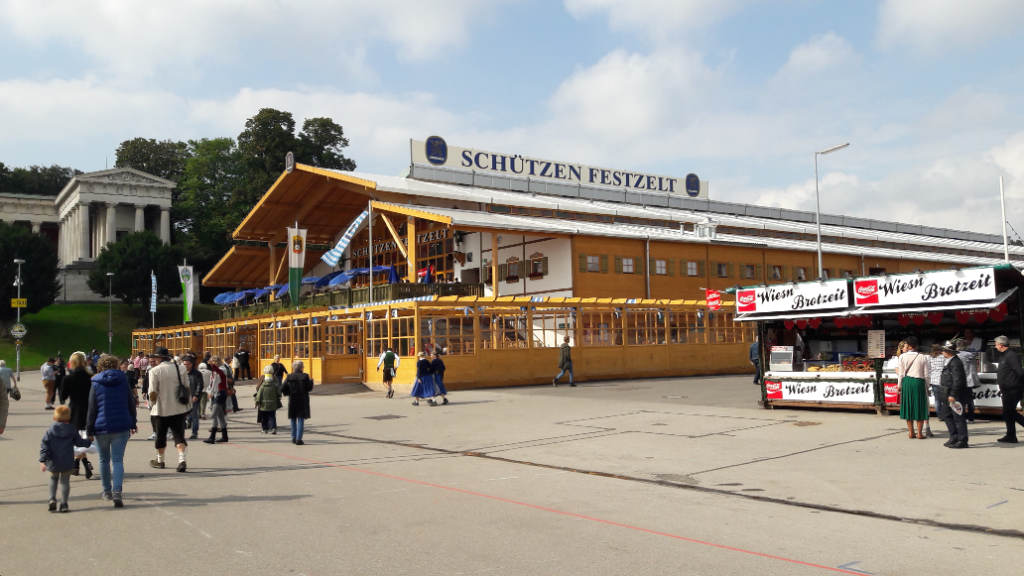
The first Sunday of the festival, there is a parade of rifleman. After the parade, the shooting competitions may begin. At the end of Oktoberfest, there is a ceremony at the Bavaria statue near the Schützenfestzelt to recognize the Landesschützenkönige (loosely translated as the shooting champion).
The rifle competition is held at the Schützenfestzelt (Shooter’s Party Tent, website here). The competition is run by the Bayerischer Sportschützenbund e.V. (Bavarian Sport Shooting Association, BSSB, German only website). The competition uses air guns at a distance of 10 meters (roughly 11 yards). There are 110 shooting stands in the Schützenfestzelt. I have not been inside the Schützenfestzelt, but supposedly it is possible to watch the shooting. The BSSB’s website says the general public, aged 12 and older, is allowed to take part in the competition; however, only members of the BSSB are eligible to be Landesschützenkönig. The shooting hours are 8 AM through 5 PM on the Saturdays and Sundays of the festival, except the last Sunday when shooting stops at 2:30 PM. Weekdays shooting is on Wednesday, Thursday, and Friday between 10 AM and 5 PM. Entry fee for air rifle shooting is 18.50 Euros for adults and 7.50 Euros for students and children. Entry fee for air pistols is 12.50 Euros for adults and 5.50 Euros for students and children. There is prize money available, from tens of Euros to low hundreds of Euros.
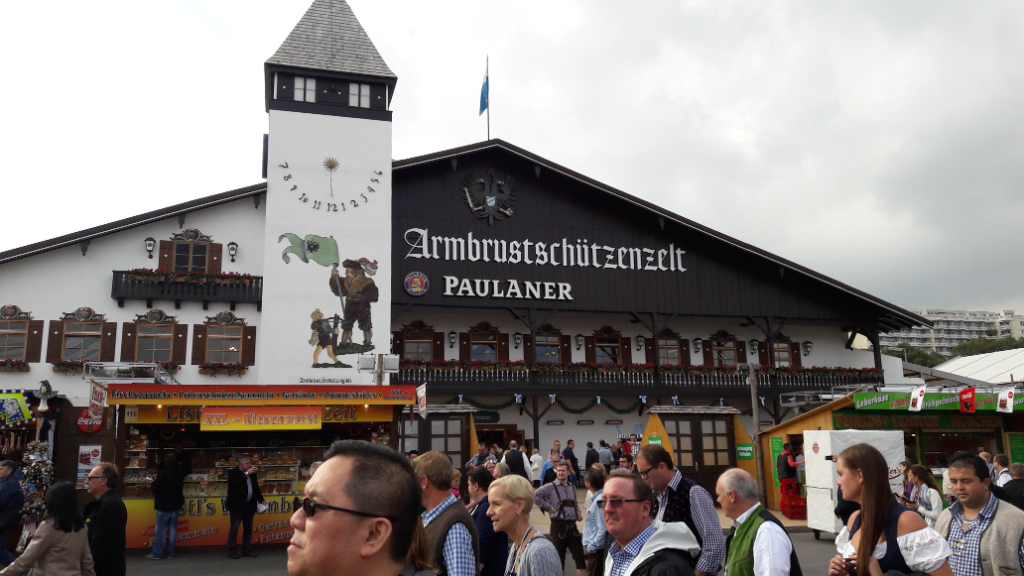
The crossbow shooting competition is held in the Armbrustschützenzelt (Crossbow Shooter’s Tent, website here). I’ve been inside the Armbrustschützenzelt, but I could not find where the competition occurs. The Winzerer Fähndl, a crossbow guild, built the original Armbrustschützenzelt after moving out of the Winzerer Fähndl tent. I cannot find much information about this competition beyond that it dates back to 1895 and this brief video.
When You Go
• Book early. When I went in 2016, I looked for hotels in February 2016. Most hotels were already booked.
• Munich locals agreed with me when I told them my plans: Skip the weekends and go to Oktoberfest during the week. The weekends are too crowded and it is too difficult to get into a tent. If you do go on the weekend, expect the tents to fill up in the early afternoon. The weekdays are much quieter and the tents fill up in evening instead of early afternoon. Note that some tents have family days during the week where families get discounts; however, anyone is welcome in the tent.
• I’ve heard that some tents accept credit cards, but I didn’t see any acceptance of credit cards when I was there. Expect Oktoberfest to be strictly cash-only, and pay as you go.
• It’s OK to stand or dance on the benches, but keep your feet off the tables.
• You can reserve tables in the tents, but only for large groups (usually eight or more people). Reservations fill up early, so like with hotels, reserve early. If a table isn’t reserved and isn’t full, ask if you can join. Most locals will gladly let you join them if there is room for your party. In almost every tent, you won’t be served unless you are seated.
• If you decide to wear a Dirndl or Lederhosen, spend money (a few hundred Euros from what I hear) to get good stuff. Otherwise you will stick out as a tourist. Ladies, the Dirndl apron knot goes on your left front if you are available, the center front if you are a virgin, right front if you are not available, and back if you are a widow or a waitress.
• I didn’t get a car while I was there. I relied on public transit. German public transit is good. The Münchner Verkehrs-und Tarifverbund (MVV, Munich’s public transit system) English language website includes schedules, maps, fare information, and trip planners. There is an U-bahn (subway) station at the Wiesn for the U4 and U5 lines, which is sometimes closed during Oktoberfest due to security concerns. The Hauptbahnhof (Main Train Station) is a fifteen minute or so walk from the Wiesn. All S-bahn lines except the S20 go through the Hauptbahnhof. The S1 and S8 go to the airport. To go from the Hauptbahnhof to the Wiesn, follow the signs. There are signs at the Wiesn which will direct you to both the U-bahn station and the Hauptbahnhof.
• Due to increased security, you won’t be allowed to take large bags into the Wiesn. The Wiesn is now fenced off, and you can only enter and exit at certain points.
• Don’t drink too much unless you want to end up on the Munich Barfs web page or in Youtube videos like this one.
If you go, I hope you have a good time. Oktoberfest is a lot of fun.
Postscripts
For those that like looking at men
I’m a straight guy, so I am a bit clueless about what those that like looking at men are attracted to, but I think the pictures I found of men in Lederhosen won’t work. Instead, have a video of Bavarian Stone Lifting, which does not take place at Oktoberfest.
Editor’s Note: DEG is already deep into the spirit of Oktoberfest, so to speak, so he’ll check in for comments, questions, and general applause on Monday.
People seemed to enjoy the discussion in the original article, so I’m going to expand on it based on some of the conversation we had in the comments. As noted in the comments, August is employing the Socratic method. In real life, August is a classmate from law school who was a philosophy major. He and I enjoy sipping bourbon, smoking pipes, and talking politics, philosophy, and theology.
In the original article, I made the assertion that rights are meaningless outside of a relationship. I also asserted that rights are definitions of the boundaries of authority between co-equal entities (man to man; man to human institution). In this article, I will address some of the points brought up in the comments: conflicting rights, objective v. subjective rights, negative v. positive rights, how rights flow from self-ownership.
The conversation picks up at the end of the prior article:
AUGUST: So if rights are based on authority and the equality of man, are you saying that rights are attempts to prevent inequity between men and between man and institutions created by man?
OSCAR: Yes! As with any co-equal relationship, there are certain things solely in the domain of the first, other things that are solely in the domain of the second, and some things that are in an overlapping domain between the two. For example, parenting.
AUGUST: So, in this Venn Diagram description, your domain is your rights with respect to me, my domain is my rights with respect to you, and the shared domain is collective rights between us and conflicting rights between us. How can rights conflict if they are natural?
OSCAR: Well, this is more of a semantic difference. Either you can paint with broad strokes (“right to life; right to play loud music; right to swing your arms”) and deal with conflicts of the rights (“my right to swing my arm ends at your nose”), or you can paint more carefully (“right to swing your arms in open portions of your personal space”) and not have to deal with conflicts. Either way, there is a limit to the extent of your rights where you begin to infringe somebody else’s rights.
AUGUST: This still seems fuzzy. How do you know when you’re infringing somebody else’s rights?
OSCAR: Well, we need to know how to identify a right in order to be able to tell if we’re infringing on rights. There are two things called “rights” these days. One is negative rights, and the other is positive rights. Positive rights are largely a misnomer in the context of strangers (including the government). The only relationship in which positive rights make sense is the dependent/caretaker relationship. This is why people refer to the “Nanny State” when government enshrines positive rights in law. Negative rights, however, are natural rights. They derive from self-ownership. Negative rights are things whose direct, tangible consequences are felt only by the rights owner and consenting others. In essence, you are the sovereign of your own domain; only you have the authority to make decisions that result in consequences to only you. Thus, you are infringing on somebody else’s rights when you do something that keeps them from exercising sovereignty over themselves and their property.
AUGUST: Direct, tangible consequences? Like economic externalities, emotional effects, and social consequences?
OSCAR: No, usually rights violations are one of three categories: force, fraud, and coercion. Nobody forces you to feel a certain way. Nobody coerces the market to ripple when you make a transaction. Nobody forces society to react to your actions. All of these consequences to the exercise of rights may be of concern to people and to society at large, but they are outside of the authority of strangers and the government to resolve by infringing on the free exercise of rights.
AUGUST: But we discussed before that there are times when you can use force, like in self-defense. It seems like you can’t use force until you can.. it’s all very arbitrary sounding.
OSCAR: Not at all. There is a basic principle that you can respond to immoral force with force of your own, but you cannot initiate immoral force: the non-aggression principle.
AUGUST: Ah, so when my neighbor accidentally steps on my side of the property line, I get to kill him?
OSCAR: No, the NAP is better seen as a negative limitation than a positive one. The NAP tells you when you CAN’T use force, but doesn’t dictate HOW you can use force when it is not immoral to do so. There are rules of proportionality that are outside the scope of rights.
AUGUST: That is all well and good, but I’m still not convinced that negative rights are a necessary consequence of self-ownership.
OSCAR: Ownership implies control. If you own yourself, you have control over your actions. Ownership also implies exclusivity as to strangers. There can be co-owners of something, but co-ownership implies a consenting relationship. You cannot be a co-owner with a complete stranger. Therefore, absent consensual abdication of your self-ownership, your claim to your own body and to your actions is exclusive. As previously discussed, the only time this changes is when your actions cause direct, tangible consequences to non-consenting others.
Part of your actions include your labor. You are the owner of your labor, including the economic value of your labor. Economic value of your labor can be traded for physical property, which makes you exclusive owner of capital. Throughout this entire chain, your exclusive ownership and control has not been severed unless consensually negotiated for. Therefore, self-ownership implies control over your actions, your labor, and your property, up to the point where you cause direct, tangible consequences to non-consenting others. It is important to note here that the direct, tangible consequences need to be caused against a legitimate claim of the non-consenting other. If I buy the Mona Lisa, I deprive you of being able to see it. However, you have no legitimate claim to the Mona Lisa because you have no grounds to claim ownership of the Mona Lisa.
AUGUST: What’s the point of all of this if a “might makes right” government comes in and imposes its will on you?
OSCAR: Rights are not subjective. Negative rights are natural outcroppings from the physical reality of self-ownership. Positive rights are natural outcroppings of the duties that are inherent in a caretaker role. Practical infringements of rights do not affect the ethical reality of rights.
AUGUST: Do you have the right to do something that is wrong?
OSCAR: In my definition of rights as authority boundaries between co-equal entities, the question is somewhat irrelevant. If your “wrong” thing does not involve using force, fraud, or coercion on a non-consenting other, then government has no rightful authority to stop you. However, this says nothing of the inherent morality of your actions. You could perpetrate a horrible evil against yourself (or against God, for those who believe), and it would no more be within the government’s rightful authority than if you did a great good for yourself (or for God, for those who believe).
For a detailed treatment of this question and other related topics, I turn it over to Milton Friedman (1 hr youtube vid).
I love coffee. I’m drinking a hot cup while I pen this article. Roasting and grinding coffees from around the world is my hobby. Experimenting with different brewing methods in search of the perfect cup of Joe is my holy grail. I even researched planting my own coffee trees here in Orlando so that I could experience the whole process from soil to cup. A hero of mine, Heriberto Lopez, had the same idea in 1985. Mr. Lopez, who owned a coffee plantation in Venezuela, came to the United States so his son could receive treatment for a rare heart condition. He gambled some of his family fortune on growing coffee in south Florida, so that he could work in the U.S. while his son got the treatment he needed. The experts said it would never work. Heinz Wutsher, a researcher with the U.S. Department of Agriculture laboratory in Orlando said, ”I think the whole thing is a crackpot idea.” Well you know what? They were right. It failed. Coffee grows best in the bean belt, 25 degrees north, 30 degrees south latitude. Florida is technically in the belt, but has a deficiency of mountains on which to plant coffee. Mr. Lopez and I had our caffeine fueled dreams thwarted by geography and economics, but I still enjoy learning about coffee. Reading “Uncommon Grounds” by Mark Pendergrast, I was horrified to learn that coffee had been prohibited in various countries at different times. Why ban a harmless drink? Who could be so cruel? Don’t they know coffee is the elixir of Life? Well my friends, let us dive into when, where and why coffee was banned in history.
1511, Kha’ir Beg, the governor of Mecca, was cruising past a Mosque and saw some dudes getting their caffeine on so they could do some endurance praying–much like some of you would do with Mountain Dew and an all night Dungeons and Dragons session. Beg got bent out of shape for some reason, so he banned coffee under the power given to him by the Koran prohibiting wine. I know you are thinking, “How in the hell is coffee, a stimulant, anything like wine, a depressant?” I’m sure the Saudis were thinking the same thing. So Kha’ir goes to some local Persian doctors, the Hakimani brothers, and buys some expert testimony. The Hakimani boys claimed that coffee was harmful and had no legitimate medical use–a conflict of interest since coffee was used as a natural, inexpensive cure for depression as opposed to whatever expensive pharmaceuticals they were selling. Finally, the Sultan of Cairo stepped in because people were getting cranky without their morning coffee, and declared governor Beg had exceeded his authority to ban coffee and the people rejoiced. Happily, Kha’ir was caught embezzling money and was executed. I guess he skipped the part in the Koran about stealing.
Continuing in the 16th century, the next group anxious to wield the banhammer are the Italians. Christian Europe had been brawling with the Muslim Ottomans since 1591 and were a little salty. The Pope’s advisors wanted to ban coffee as the “bitter invention of Satan” because the drink was popular with the Turks. Ironic, considering coffee was banned in Mecca less than one hundred years before. Pope Clement the VIII requested a cup so that he may see what all this devilry was about and declared, “This Satan’s drink is so delicious that it would be a pity to let the infidels have exclusive use of it.” The Pope also believed that coffee was less harmful than alcohol and thus blessed the bean. Thanks to the Coffee Pope, modern Italians are free to sip espressos while riding vespas saying, “Ciao.”
The 17th century saw a new Muslim anti-coffee zealot, this time in Constantinople. In 1623, Murad IV claimed the throne of the Ottoman empire, famous for making little couches you put your feet on. So Murad quattro was a new king and usually you become king by screwing people over and crushing dissent. Coffee has been blamed/credited with fueling rabble rousers, as the king was aware. In fact, one of the HQs for planning the American Revolution took place in the “Green Dragon,” a coffee house in Boston. Americans switched to coffee from tea because screw England, and the founding fathers would drink caffeine and write kick-ass constitutions. Back to Constantinople, Murad knew coffee angers-up the blood and fuels revolutions so he banned coffee. Turns out, people really love coffee and kept drinking it despite the first offense: catching a beating. Second timers got sewn into a bag and thrown into the Bosphorus. Even with these severe punishments, Murad still had no trouble going undercover with his big ass sword, surprise beheading people he caught drinking Java. The ban ended when Murad decided to have a one man drinking contest and died of alcohol at the ripe old age of 28. Maybe he should have had coffee instead.
Coffee-making paraphernalia in Coffee World museum near Cairns.
Moving into the next century, 1746 Sweden not only banned coffee, but coffee paraphernalia because people were abusing coffee. I don’t know how you abuse coffee other than by leaving a pot of coffee on a burner until it turns to tar. Gustav the third, king of Sweden, ordered a pseudoscience twin study to prove the harmful effects of coffee. One twin drank tea, the other coffee. They didn’t wait around to get the results because the twins lived into their 80’s. So the Swedes sent goons around anyways, kicking in doors and smashing coffee pots and confiscating coffee beans for evidence (totally not for them to consume or resell). Shockingly, people continued to consume coffee in spite of the ban. Eventually the Swedish government decided enforcement was unmanageable and repealed the bans in the 1820’s. Today Sweden has one of the highest per capita coffee consumption rates in the world.
Another jerk from the 18th century is Frederick “the Great” of Prussia. In 1777, Fred was concerned that coffee consumption was cutting into the beer profits. Beer was a local product so profits stayed in Prussia. Coffee, being an import good, caused money to flow out of the country. So he proclaimed coffee banned and told the proles to go back to drinking beer for breakfast. In true Top Man fashion, nobles were allowed to continue to drink coffee. Fred liked to drink his coffee made with champagne instead of water, in true baller fashion. Rappers take note, that is how you stupidly waste money. Drinking a hot champagny cuppa in front of the people you are telling don’t drink coffee doesn’t inspire people to respect the ban. I thought ordering a bunch of Germans to drink beer for breakfast was an easy sell, but Fred screwed it up somehow. Freddie had to rescind his order and allow the Prussians their coffee.
An article about coffee prohibition wouldn’t be complete without mentioning America, the largest coffee market in the world. Multiple attempts by moral scolds and busy bodies to shut down coffee have been mounted, but, luckily for us, they have all failed so I won’t bore you with the details. However, one man was moderately successful in cutting into American coffee consumption, C. W. Post. Post was not a mentally stable person, to put it mildly. He believed in all the quack cures of the day and Grandpa Simpson diagnoses. C.W. suffered from nervous breakdowns and became
student of John Kellogg, another cereal Barron, that taught him the dark arts of healthy eating to cure his imbalanced humours. Kellogg was a Seven Day Adventist and shunned caffeine and advised C.W. to give up coffee. C.W. became a titan of the breakfast food world because he was the first to understand the power of advertising. He spent a tremendous amount of money pushing his health foods on the public using clever ads that weren’t always completely true. Post started an ad campaign warning about the dangers of coffee and how it is basically killing you every time you take a sip. Unbeknownst to the public, C.W. couldn’t start his day without his big mug of bean juice. That didn’t stop him from telling everyone else to drink Postum, the coffee substitute made from wheat bran, wheat, and molasses. Bizarrely the slogan of Postum was “There’s a Reason.” I guess that did something for the chumps of the 20th century because they bought the stuff. Postum sales surged during WWII as coffee was diverted to the front lines, because nothing kills Nazis better than a conscripted 18 year old with coffee jitters and a M1 garand. If you would like to try this
abomination of a drink, you can still purchase Postum on Amazon.
21st century America has not banned coffee, thank the Coffee Pope, but we do have prohibition of drugs. The arguments for caffeine prohibition of the past are the same arguments used to prohibit drugs today: “The money flows out of the country;” “ It makes God angry when you use an intoxicant;” “Undesirables use it and listen to music I find offensive;” “ It causes crime and dissent among the masses;” “Drugs have no legitimate medical use.” These arguments are as hollow now as they were 500 years ago and the banners are as big of hypocrites as ever. Three out of our four past presidents are known to have used drugs and yet happily continued the war on drugs. The true reason for drug prohibition is power and that is one hell of a drug. Currently in the 103rd year of drug prohibition, America has been slow to reverse course, but public opinion is changing and that is what ultimately lead to the reversal of coffee prohibition in Mecca, Sweden, and Prussia. So the next time you’re in the breakroom having a cup of coffee with a coworker, share what you have learned about the tyrants that banned the drink they are enjoying. Maybe you’ll help turn the tide of public opinion.
This article goes over the more common and interesting long arms used during the American Revolutionary War in what is now Canada and the United States. If I tried to cover all weapons used in anywhere the war was fought, this would be a very long article.
The American Revolutionary War turned into a global conflict. As the war in the American Colonies progressed, France and Spain entered the war on the Colonial side. Both France and Spain wanted revenge on Britain for past losses. Spain did not recognize the United States’ independence due to concerns that Spain’s colonies would get ideas about themselves becoming independent. France thought that supporting American independence would give France leverage over Britain. The Dutch colony of Sint Eustatis became a major shipment point for goods going between the American Colonies and their supporters. Angry at the Dutch support for the American Colonists, Great Britain declared war on the Dutch in 1780. The expansion of the conflict led to fighting in the Caribbean, Central America, Europe, and India.
With such a wide ranging war, and with such a large number of combatants, there is a huge variety of arms used by all sides in the American Revolution. Some examples:
• American militia men equipped themselves with firearms and a secondary bladed weapon. Requirements for those weapons from each colony’s militia system could be vague.
• Some British sergeants still carried halberds, and some British officers carried spontoons.
• Indian forces used rockets against British troops in Mysore.
So, to try and keep the article to a reasonable length, I’m going to write only about long arms used in what is now Canada and the United States.
Flintlocks
First, a description of flintlocks for those aren’t familiar with them. All long arms covered in this article are flintlocks. A flintlock uses a piece of flint, held in a hammer, to strike a piece of metal called the frizzen to create sparks. Underneath the frizzen is a small pan which holds gunpowder. There is a hole in the pan leading to the chamber with the powder and ball. When the flint strikes the frizzen, the sparks ignite the gunpowder in the pan. The sparks travel down the hole to ignite the powder, firing the weapon. Since the powder in the pan was exposed to the elements, flintlocks were useless if it was raining. The flintlock’s lock brings all the pieces (hammer, frizzen, pan, and barrel) together. This short animation shows a flintlock in action.
Muskets
Muskets were the most common type of long arm used during the American Revolutionary War. Muskets are muzzleloading, smooth bore firearms.
“I need a good source for how fast someone can shoot a musket… Oh shit.”
Muskets could be reloaded and fired quickly. The best on-line source, a re-enactor’s work, I can find states that a rate of 3-4 rounds per minute come from 18th century live fire studies, but doesn’t mention the studies. The British Manual of Arms for a soldier to reload and fire a musket consist of 15 steps. If each can be done in a second, then there is a theoretical limit of four rounds per minute.
Black powder residue would foul rifling; however, the residue would even buildup in smooth bores, eventually making reloading difficult despite the smooth bore. To increase the amount of time before fouling made loading difficult, musket balls were generally smaller than the musket’s bore size, which hurt accuracy. Muskets of the period did not have sights, though some had sighting grooves and bayonet lugs on the top of the barrel that could be used as sights. Muskets had an effective range from 50 to 80 yards, depending on the musket.
I’ve read that if you use a tight enough fitting ball, a smooth bore musket can be fairly accurate, rivaling rifles of the time. I have not found any tests which show this.
As a result, tactics of the time emphasized speed of loading and mass fire over accuracy. Hand-to-hand combat with fixed bayonets finished the battle.
American Made Muskets
In 1775, “Committees of Safety” placed orders with gunsmiths to produce muskets for Colonial forces. Few of these muskets survived. Most had no identifying markings due to fear of prosecution from Royal authorities. Soon the states superseded the local committees. As the war went on, Congress centralized production, storage, and repair of arms in six arsenals: Philadelphia, PA; Carlisle, PA; Lancaster, PA; Head of Elk, MD; Albany, NY; and Manchester, VA.
Early in the war, American made muskets were loosely based on the “Brown Bess” muskets. Later in the war, production shifted towards French designs. However, there was no standard design pattern. American gunsmiths used whatever parts they could get their hands on. Many parts were imported because, despite British blockade, it was easier and cheaper to import whole components. Those parts which American made tended to be cruder and more cheaply made than imported parts.
“Brown Bess”
“Brown Bess” is the nickname for the British Land Pattern Musket. The “Brown Bess” traces its roots to 1713, when the Royal Board of Ordnance began standardizing weapons production for the British Army. Entrenched interests in favor of the existing arms procurement system opposed these changes. The Board persevered, and in 1722 released the “King’s Pattern” musket. Political pressure and the lack of wartime pressure delayed the new musket’s production until 1728. The new musket was first issued in 1730 as the “Long Land” pattern musket. There are many explanations for how the musket received its nickname, none of which are convincing to me. The earliest reference to the name I can find, courtesy of George Neumann’s work, is in the “Connecticut Courant” newspaper in 1771.
The musket is .75 caliber and has a walnut stock. The stock ends before the muzzle to allow for a bayonet. Attached accessories were made of brass. The musket weighed 10 to 11 pounds. The barrel was held to the stock with heavy pins. The musket’s bayonet lug could be used as a front sight and there was a groove at the rear which could be used as a rear sight. There were many variations of the musket. The two broad variations were the “Long Land” which had a 46 inch barrel and the “Short Land” which had a 42 inch barrel. There are several sub variations which were developed based on war time experience with the musket and to ease production.
British, American Colonial, Loyalists, and Hessian troops all used the Brown Bess. Generally, only the British forces used the newer variants. American Colonial forces used whatever Brown Bess muskets they had at the beginning of the war or could capture as the war progressed. The British equipped Loyalist and Hessian forces with older Brown Bess muskets which were being replaced by newer muskets shipped in from England.
Here is a video of Australian re-enactors demonstrating Brown Bess accuracy using standard loads.
Charleville Musket
The French infantry musket was standardized in 1717. The musket became known as the Charleville musket, after one of the many arsenals which produced the musket, even though Charleville was never an official name for the musket. I did not find any official naming for the musket beyond it being identified by the year a variation was introduced. Most of the variations were to lighten the musket and make maintenance easier. The musket used a .69 caliber ball to reduce weight in the field. The stock is walnut. The barrel and stock were held together with three lightweight bands. The musket throughout its life was lighter than the Brown Bess.
The French sent 200,000 of these muskets of various types to American Colonial forces. American Colonial forces received the Model 1763, Model 1766, and the Model 1774. Post-war, the Model 1766 heavily influenced the design of the American Springfield Musket of 1795. The Model 1763 was shorter than previous models and had a different lock. The Model 1766 was a lightened version of the Model 1763. The Model 1774 had more lock modifications and had a modified stock.
The French kept the Model 1777 for their own forces. The Model 1777 stayed in use in the French military through the Napoleonic Wars. The Model 1777 supported a new type of bayonet, had a cheek rest in the stock comb, among other variations.
Quebec militia units probably used left-over Model 1728 muskets while defending against American Colonial invasion.
German Mercenary Muskets
The British, for various reasons, found it cheaper and easier to hire German mercenaries than to raise more troops for the British Army. The British hired about 30,000 mercenaries from various German states for combat in America. As a side note, George III, who was also King of Hanover, leased some of his Hanoverian soldiers to Britain for use during the American Revolution. The Hanoverian troops remained in Europe. Roughly half of those that went to America came from Hesse-Kassel, which is why the mercenaries are known in America known as Hessians. In addition to Brown Bess muskets from the British, the mercenaries’ muskets came from all over Germany. While American colonists captured many Hessian muskets during the war, only a few hundred were listed in American post-war inventories.
M1752 Musket
The Spanish Army’s first standardized firearm was the M1752 musket. Spanish Colonial forces were armed with this musket when they attacked British forces at Pensacola. Spain sold between 10,000 and 12,000 of these muskets to American Colonial forces.
Rifles
Rifles are a long arm with a rifled bore. Rifling is the process of cutting spiral grooves into the bore. The rifle’s projectile, when fired, grips these grooves as it travels down the bore. The spin stabilizes the projectile, improving the weapon’s range and accuracy. Muzzle loading rifles of the time were slower to load than muskets due a tighter fighting ball and were more prone to problems with powder fouling. Rifles of the time could not be fitted with bayonets.
The American Revolutionary War was the first war with widespread use of rifles. German mercenaries, American Colonial forces, and British forces all used rifles.
Use of rifles was fairly new to the British Army. British rifles corps were small.
American Colonists and German Jäger troops were familiar with rifles. Hunting was a common past time among both groups.
The range of rifles of the time is disputed, but there are accounts of effective fire from 200 to 300 yards. I’ve searched for information on the longest rifle shot in the Revolutionary War, and found nothing definitive. Timothy Murphy’s killing of General Simon Frasier comes up most often. The range for that shot varies between 300 and 500 yards, depending on the source. Unfortunately, it is impossible to verify.
Ferguson Rifle
Major Patrick Ferguson was a Scot who joined the British Army. During his time the British Army, he developed a breech-loading flintlock rifle. This was the first breech-loading firearm adopted by a military, but it was not the first breech-loading firearm. Maj. Ferguson based his rifle on the French Chaumette.
The Ferguson rifle relied on a screw mechanism to open the breech. The riflemen would turn the trigger guard, which worked the screw, and opened the breech. The rifleman could fire four to six rounds a minute, as fast or faster than the muskets of the time. The rifle was expensive, difficult, and slow to make. The rifle also used a special powder, which was more expensive than regular musket powder.
Only about 100 or so Ferguson rifles were made. These rifles equipped an experimental unit which was under Ferguson’s command. They arrived in America in May, 1777. Ferguson was killed at the Battle of King’s Mountain. His unit was disbanded afterwards.
Among the mercenaries from Hesse-Kassel were Jäger troops. These troops were armed with rifles, and they covered advances and withdrawals. Their rifles were made in Schmalkalden (a town in present day Thuringia). Their rifles had 29 inch long barrels whose external shape was octagonal. The rifle bore was .65 caliber.
Long Rifle
The Long Rifle dates to the early 1700s when German immigrant gunsmiths began making rifles in Lancaster County, PA. The rifles were based on German patterns and there is a good bit of variation between rifles. Generally their bore is between .45 and .60 caliber, and the barrels long. American Colonists used the rifles to engage in hit and run tactics and to snipe at British officers, which the British considered “ungentlemanly.”
Pattern 1776 Infantry Rifle
The Pattern 1776 rifle was another British attempt to equip troops with rifles in order to counter American rifleman. About 1,000 were made. They were made in Germany and by four different manufacturers in England. Nine are known to survive to this day, and some had been modified after the Revolution. Loyalist American rifle companies were among the units which received the rifles.
Sources
Allison, Robert, “The American Revolution: A Very Short Introduction”
Chavez, Thomas E., “Spain and the Independence of the United States: An Intrinsic Gift”
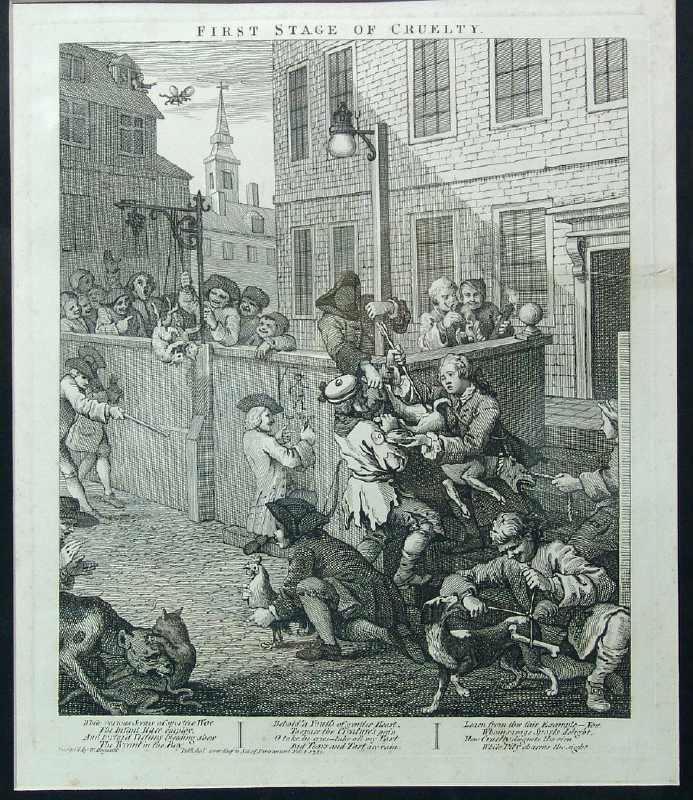
Before the abject pussification of the world through animal welfare regulation, there was a time when a man could bring his wife and children out on the town for an exciting evening of the finest blood sport. Perhaps as ritualistic payback for the all the millenia Homo sapiens sapiens and to spend huddling in caves, naked and afraid, hiding from roaming beasts, from at least the time of the Roman venatio, for much of human history, entertainment meant seeing some animal get crushed or disemboweled, because fuck animals. This article recounts four such bad-ass entertainments, now lost to us, that could return in a more (g)libertarian world.
Cock Throwing
“Cock Throwing” is currently just what jesse.in.mb calls “Tuesday”; however, cock throwing was once also a popular British pastime until the early 19th century. The game was brilliant in its simplicity: a rooster is tied to a pole and then people throw sticks at it until it dies. A variation of cock throwing was basically “hit the piñata,” but with a live chicken instead of papier-mâché and blood and viscera instead of candy. Regardless of this, according to historians cock throwing was quite popular with children. Cock throwing was also a hallowed ritual associated with Shrove Tuesday, because Jesus Christ demands the blood of chickens offered in sacrifice.
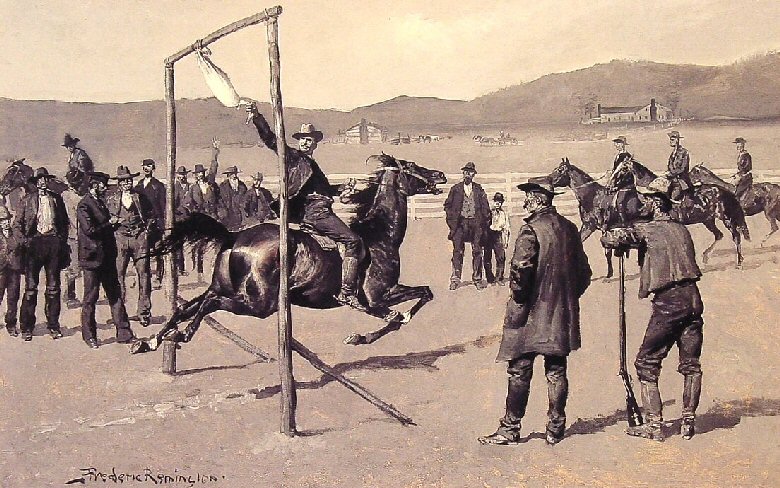
While originating in Spain, until about 150 years ago, goose pulling was the favorite sport of the Dixie. George Washington and Thomas Jefferson most likely participated in goose pulling. Indeed, contemporary reports detail that a goose pulling was one of the few social events in which the entire spectrum of society, from slave to plantation aristocracy, could be found participating together.
“A Gander-Pull” by Fredric Remington (1894)
So, just what is goose pulling? As further evidence that Christianity is actually a demonic cult focused on blood sacrifice and cannibalism, as part of Easter celebrations, a live goose with its neck greased was tied to a pole so that it hung head-first over a road. Competitors on horseback rode through the road at full gallop while attempting to pull the head off the goose’s body. Sometimes, obstacles would be placed on the path. According to one account, riders had to ride through a gauntlet of whips on their way to the pole. Spectators would bet on the proceedings and drinking copious amounts of whisky was expected.
In the United States, goose pulling would fade into obscurity after the Civil War. Thanks, Lincoln!
As evidenced by their pornography, the Germans are fucking lunatics. As it turns out, such lunacy has a long and storied tradition. Fuchsprellen, or fox tossing, was a popular sport among the aristocracy of Europe during the 17th and 18th centuries. Fox tossing involved using a giant slingshot to launch foxes and other animals into the air. Whoever tossed the animal the furthest won. Of course, you can imagine it wouldn’t be easy to keep a snarling, scratching and biting fox in place for long so that you could send it flying to its doom. Despite that, expert fox tossers could launch an animal 24 feet into the air. According to Wikipedia’s article on the sport, “Augustus II the Strong, the King of Poland and Elector of Saxony, held a famous tossing contest in Dresden at which 647 foxes, 533 hares, 34 badgers and 21 wildcats were tossed and killed. Augustus himself participated, reportedly demonstrating his strength by holding the end of his sling by just one finger, with two of the strongest men in his court on the other end.” Whereas goose pulling was seen as a test of one’s manliness, fox tossing was considered a fun party game where couples paired off to compete with one another.
As if death by slingshot wasn’t indignity enough, sometimes the animals would be decorated with “bits of cardboard, gaudy cloth and tinsel” as part of a masquerade.
Good ol’ boys and their punkin’ chunkin’ ain’t nothing but pussies.
If goose pulling was the national sport of Dixie, then baiting was the sport of Victorian Britain. Baiting involves pitting a pack of dogs against a chained animal in a fight to the death while spectators bet on the outcome. Pretty much every combination could be found, bear-baiting, bull-baiting, duck-baiting, etc.. And since we’ve all wondered who would win in a fight, 10 toddlers or 1 pit bull, it wasn’t long before someone had the idea to pit a human versus a dog to find out. In 1807, The Sporting Times reported on one such human-baiting match:
A fight between a man and Bull Dog took place some time ago to settle a bet. With its first charge the Bull Dog already succeeded in throwing and pinning its opponent. Although the dog’s jaws were nearly closed by a muzzle, it succeeded in sinking its teeth into the man’s body. Had the dog not been pulled away immediately, it would have disemboweled the man.
If this depiction is to scale, the outcome is understandable:
Not content to let the collective honor of our species be forever sullied, other human vs. dog deathmatches were organized. In 1874, a dwarf who went by the name of Brummy, agreed to fight a bulldog named Physic on account of a bet to prove Brummy’s claim that “no dog could lick a man.” The fight went 11 rounds, in which Brummy suffered several deep bite wounds to his arms, and the dog received so many blows to the head that it lost 2 of its teeth and one eye was swollen shut. Brummy won by knockout.
Another account of human-baiting comes from 1892, where a man by the name of James Oxley went 22 minutes against a dog named Crib. As one of the many previous lives of Mike Tyson, in this incarnation, Crib won the match by jumping over Oxley’s left shoulder, clamping on to his right ear, and slamming him to the ground. Oxley forced the dog to release his grip through a choke-hold, but at the cost of the upper part of his ear.


 Grandmother was a semi-retired rice farmer and had taken care of the farm ever since grandfather had died of a stroke some 30 years earlier. As we pulled into the dirt driveway, we saw her standing in the doorway, cane in hand and flashing us a smile that exposed two of her remaining three teeth. It was a large, traditional Japanese house with a small garden attached and a few persimmon trees on the western side. Mother quickly waddled from the car and gave grandmother a succession of quick bows. No hugging. This is Japan where you could go a decade as an adult and not even realize you haven’t touched either of your parents. Father gave a formal bow to his mother-in-law and my wife followed with the same. Of course, I did likewise, but to me the grandmother flashed a grin and chuckled slightly.
 The scowling men weren’t really scowling I figured out after staring back at them for a few minutes. These were Japanese men of the early 20th century and you didn’t smile in pictures then. These were men whose lives were necessary for me to have the wife I have. Even the soldiers, at whom I first recoiled at upon seeing, became human. One of them was about 30, which was my age at the time. He had on the flat Japanese army hat and a few medals pinned to his chest. All of them were dead now and grandma was praying for them every morning.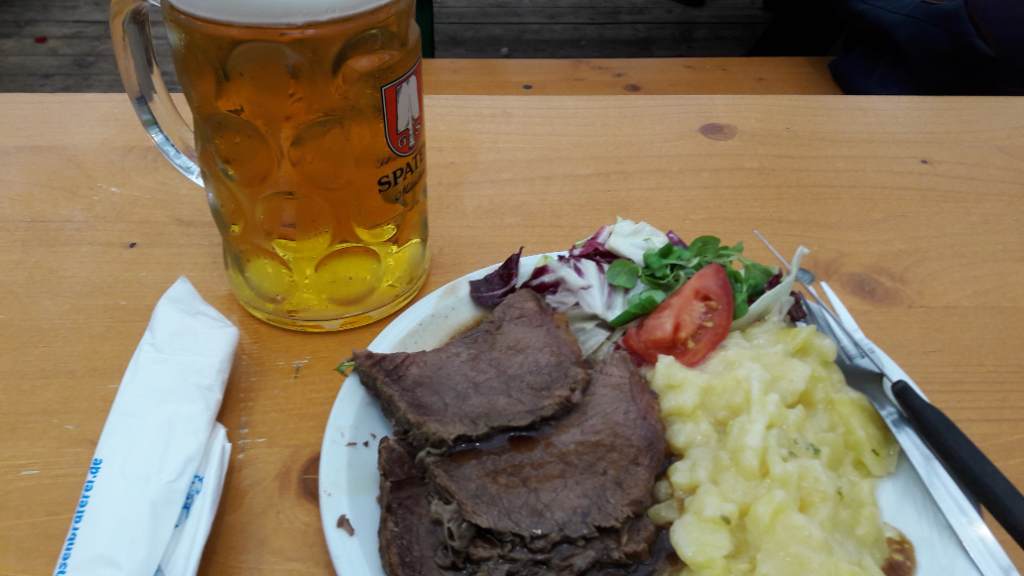
 classmate from law school who was a philosophy major. He and I enjoy sipping bourbon, smoking pipes, and talking politics, philosophy, and theology.
 domain; only you have the authority to make decisions that result in consequences to only you. Thus, you are infringing on somebody else’s rights when you do something that keeps them from exercising sovereignty over themselves and their property.

 21st century America has not banned coffee, thank the Coffee Pope, but we do have prohibition of drugs. The arguments for caffeine prohibition of the past are the same arguments used to prohibit drugs today: “The money flows out of the country;” “ It makes God angry when you use an intoxicant;” “Undesirables use it and listen to music I find offensive;” “ It causes crime and dissent among the masses;” “Drugs have no legitimate medical use.” These arguments are as hollow now as they were 500 years ago and the banners are as big of hypocrites as ever. Three out of our four past presidents are known to have used drugs and yet happily continued the war on drugs. The true reason for drug prohibition is power and that is one hell of a drug. Currently in the 103rd year of drug prohibition, America has been slow to reverse course, but public opinion is changing and that is what ultimately lead to the reversal of coffee prohibition in Mecca, Sweden, and Prussia. So the next time you’re in the breakroom having a cup of coffee with a coworker, share what you have learned about the tyrants that banned the drink they are enjoying. Maybe you’ll help turn the tide of public opinion.