I intend to take the Smoot-Hawley Tariff, which has been mocked again and again as the very epitome of boringness, and I will make the subject…anyone?…I will make the subject interesting.
To start with, I won’t call it the Hawley-Smoot Tariff, because…anyone?…because my focus is on Smoot, not Hawley. So I’ll put Smoot’s name first.
The Smoot in Smoot-Hawley was Reed Smoot, a Republican U. S. Senator from…anyone?…Utah. We first learned about Senator Smoot in Part One, in which Senator Smoot’s…anyone?…credentials were challenged because of the whole polygamy thing. After the Mormon church, of which Smoot was a leader, dropped the practice of polygamy, the U. S. Senate decided to…anyone?…decided to let Smoot keep his seat in the Senate, to which he was repeatedly re-elected, even after Senatorial elections were taken away from the state legislatures and given to the voters.
Now, class, can anyone tell me what the Smoot-Hawley Tariff was all about? You can? And here I thought you weren’t paying attention. From your spittle-flecked responses, I can see that you can identify the Smoot-Hawley Tariff as a protectionist law passed by Congress in 1930, in the depths of the Depression, and that this law has generally been blamed for making the Depression worse. In the unlikely event there’s anyone here who doesn’t already know this stuff, here’s a Wikipedia article.
After Smoot got together with Hawley, things went downhill
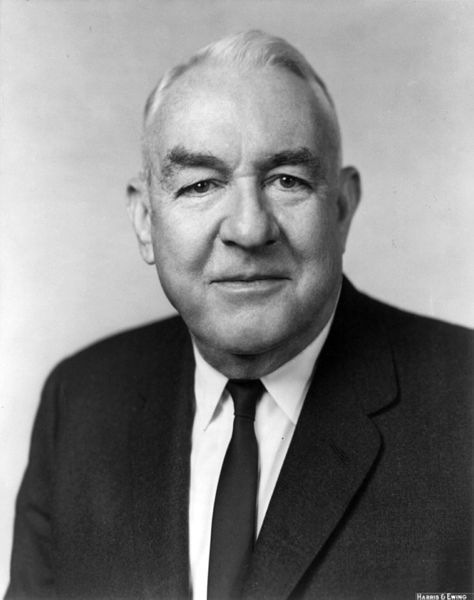
Ha ha, seriously, here’s Smoot and Hawley:
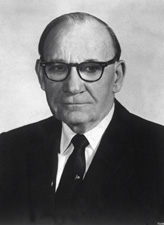
Senator Smoot is…anyone?…the one with the glasses. And the pocket with pens in it. Why can’t you students be more like Smoot, and less like that Bueller fellow? Where is Bueller, anyway?
The dynamic duo of Smoot and Hawley put forward their protectionist bill in 1929, and it passed in 1930. It is a key event in economic history, and Smoot, a hard worker with one of the best heads for figures in Congress, was proud of his work, even though it didn’t save him from a Democratic sweep shortly thereafter which put him out of the Senate.
But the Smoot-Hawley Tariff has also gotten a good deal of attention in the history of literature. To explain, let’s go back a bit.
Congress tightened up the obscenity laws in 1873, thanks to the lobbying efforts of this man, who was promptly made a postal inspector to help enforce the law. Can you identify him, class?
Yes, it was Anthony Comstock (1844 – 1915).
But this isn’t a history of postal censorship, so let’s move on from Comstock and look at the U. S. Customs.
Groundhog Day? No, not that kind of U. S. customs.
This kind:
U. S. Custom House, New York City, 1879.
I chose the New York City customs house for my illustration because New York City was a key point of entry for foreign literature coming into the country – or trying to come in (Los Angeles and Chicago were also key ports of entry). Until 1873, Customs officials policed a federal ban on the importation of obscene pictures and photos, but not books. The Comstock Act of 1873, in addition to dealing with the Post Office, added books and pamphlets to the list of obscene material that was to be banned. Local customs inspectors – or sometimes their superiors in Washington – had to read potentially obscene books to decide whether to ban them.
“At least inspecting this is less boring than inspecting other types of goods.”
The Comstock law passed despite some grumbling that “I do not know whether it can be left to employees of a custom house to determine with safety what kind of literature or what sort of matter is to be admitted.” This Congressman finally decided to support the bill once he concluded that the decision on whether a work was obscene would be left to the courts, not customs officials.
In practice, judicial review was limited and rarely used, and the final decision on what could be imported was made by Customs officials.
The Smoot-Hawley tariff, as introduced, would have kept the existing Customs ban on obscene books. It looked like a fairly noncontroversial item, continuing the law in force, until Republican Senator Bronson Cutting of New Mexico piped up. Cutting was an arty type of Republican, indignant when he learned that a friend of his hadn’t been able to import D. H. Lawrence’s novel about adultery, Lady Chatterley’s Lover. Lawrence was actually in favor of censoring pornography, he simply didn’t think he (Lawrence) was a pornographer. He was an artist, not the same thing. Cutting agreed.
Senator Cutting [insert pun about “Cutting remarks”] proposed to take away Customs’ power to ban books on obscenity grounds. Such censorship, if it was to exist, should be exercised by the post office and by state and local governments, plus the church and the family. What qualifications did Customs people have in this area?
The Senate, in Committee of the Whole, actually accepted Cutting’s amendment. This took Smoot by surprise, and it shocked him to his core.
Smoot biograper Milton Merrill says that Smoot’s objection to dirty books was not due to some kind of repressed prurience or similar factor. Dirty books were dirty and gross, and it made no difference whether the author was some kind of artist or a good writer. There was also the fact that, as a Mormon whose moral qualifications to sit in the Senate had been attacked, Smoot was extra alert to any opportunity to rebut suspicions of dirty-mindedness.
The humorless Smoot decided to demonstrate the dangers of allowing a flood of porn to enter the country and corrupt the people, especially the youth. From the Customs officials, Smoot got copies of some of the worst porn he could find to show his fellow-Senators, many of whom perhaps were pruriently interested in this legislative documentation.
Smoot was genuinely outraged. The Senator known for his calm and detailed analyses of economic legislation spoke at the top of his voice, denouncing smutty writers like Lawrence as black-hearted villains.
When the Senate, as a Committee of the Whole, reported the bill back to itself, Smoot had a chance to challenge the obscenity provision. He wanted to reinstate the ban on importing obscene books. To be fair, this ban dated back to 1873, and Smoot hadn’t anticipated that his beloved tariff measure would be the vehicle his colleagues chose to make what he deemed a pro-smut gesture. Couldn’t Congress just keep the obscene-books ban which had been in place for over half a century, and go back to the important business of protecting legitimate American industries from unfair foreign competition?
So the poet Ogden Nash was being unjust when, in a much-cited poem, he sarcastically praised Smoot as if the Senator was inventing a new book-banning law:
Senator Smoot ( Republican, Ut. )
Is planning a ban on smut.
Oh root-ti-toot for Smoot of Ut.
And his reverent occiput.
With his outbursts of indignation, Smoot helped turn the Senate back to supporting a customs ban on dirty books. But as an experienced legislator, Smoot knew that his colleagues seemed to believe that Customs was going too far and hurting the importation of genuine, non-obscene literature. To conciliate this skepticism about Customs’ literary capacities, Smoot decided to yield somewhat and allow some reform.
For one thing, Smoot would accept an amendment by which the Treasury Secretary (as boss of the Customs Service) could allow “so-called” classics, even dirty ones, into the country on a non-commercial basis. Smoot also accepted a plan endorsed by, among others, future Supreme Court Justice Hugo Black – former Klansman and currently known as the saner of Alabama’s two Senators (this guy was the other). The Black plan would provide that the final decision on whether an imported book was obscene would be made by a federal court, in a jury trial. That ought to meet the objection that random bureaucrats were making literary decisions – the book would get a full due-process trial.
“Hey, they mutilated a copy of the Marquis de Sade’s classic Justine just so they could smuggle cigarettes!”
The Smoot-Hawley Tariff passed with the amendments somewhat softening the Customs ban on obscene books. The first true tests case involved Ulysses.
No wonder they wanted to ban Ulysses – he’s stark naked!
Customs believed that James’ Joyce’s now-classic work was obscene, but after the Smoot-Hawley Tariff, the publisher, Random House, insisted on taking the case to trial. Waiving a jury, Random House had the issue decided by federal district Judge James Woolsey. Both Woolsey and the literature-friendly Second Circuit appeals court said the book was not obscene and could be freely imported (at least as far as the Customs laws were concerned). Woolsey’s opinion is probably more famous than the more authoritative Second Circuit opinion because Woolsey had a gift for words and Random House put his opinion at the beginning of Ulysses.
The Ulysses case was historic because the influential Second Circuit, followed by other courts, rejected an old English case known as Regina v. Hicklin. In that case, an opinion by Chief Justice Cockburn said that a work could be condemned as obscene based only on isolated passages, based on the assumption that susceptible people might be harmed by these passages without regard to the surrounding material.
(Hicklin wasn’t the alleged pornographer, he was a lower-court judge who had tried to legalize the alleged pornography; the pamphlet in question was issued in the name of the Protestant Electoral Union.)
The Ulysses decision said that in deciding whether a book is obscene it must be looked at as a whole. Just because there were, say, sex scenes in a book didn’t automatically make it illegal – the entire book had to be dirty, not just a few bits and pieces.
Because the Ulysses case was so historic, and was decided under the supposedly literary-friendly provisions of the Smoot-Hawley Act, some people got the impression that winning court hearings for books Customs wanted to ban represented an advance for literature, making censorship tougher. In reality, importers rarely challenged Customs decisions in court, since legal challenges are quite expensive and it would simply be easier, if possible, to cut out the offensive bits designated by Customs.
Customs liberalized its treatment of books (and movies), not because of Smoot-Hawley, but because of a gentleman named Huntington Cairns. A lawyer, litterateur, and later counsel for the National Gallery of Art, Cairns informally advised the Customs service on disputed works, generally erring in favor of letting the works into the country, at a time when the Post Office and many local censors were stricter against alleged porn.
So Smoot’s “concession” wasn’t what protected literature against Customs overreach – maybe Smoot wasn’t as dumb as they thought.
Works Consulted
Paul S. Boyer, Purity in Print: The Vice-Society Movement and Book Censorship in America. New York: Charles Scribner’s Sons, 1968.
Milton R. Merrill, Reed Smoot: Apostle in Politics. Logan, Utah: Utah State University Press, 1990.
James C. N. Paul and Murray L. Schwartz, Federal Censorship: Obscenity in the Mail. New York: The Free Press of Glencoe, 1961.
This post is based on a talk by Evan Sayet some years ago called “Understanding How Modern Liberals Think.” After giving his talk, Sayet received numerous comments that he had discovered the grand unified theory of liberalism. The talk is good, although he goes off on a few too many Team Red tangents for my taste. So this is my modified version of his idea.
When hearing prog opinions, the natural reaction of everyone else is to think that progs must be evil or stupid to believe such things. True, some of them are. But there is a problem here. For example, whatever you think about Michael Moore, he is definitely not stupid. Stupid people don’t make millions of dollars with documentaries. And whatever else you think about Ben Cohen and Jerry Greenfield, they are not evil. They make ice cream with silly names.
Alright, so if they aren’t evil and they aren’t stupid, what is going on? As it turns out, the heart of it is an extremely convoluted thought process that goes like this: of all the different systems people have tried over history, none have created a society devoid of crime, poverty, war, and so on. So, the modern prog concludes from this that the desire to be right is the source of evil. For if no one thought they were right, no one would argue or fight or go to war and so on. If people gave up the search for truth and right, we could all join hands and live happily ever after in the Kindergarten of Eden.
So if no one is better than anyone else, if someone *is* better than someone else, it must be because that they cheated somehow. Therefore, the prog will always side with what is evil, failed, and wrong over what is good, right, and successful. It’s like life is a big roulette wheel, and if the same number comes up over and over, it must be that the wheel is biased.
And the more successful a person or group is, then the greater they must have cheated to get there. This is explains the great hatred most progs have for the US. Only a prog could look at the US, the most prosperous society in history, and see nothing but poverty. Only a prog could look at the US, the least racist society in history, and see nothing but bigotry. Only a prog could look at the US, the most technologically advanced society in history, and see nothing but ignorance. Only a prog could look at the US, the least sexist society in history, and see nothing but misogyny.
How did such an idiotic idea gain widespread adherence? Well, for most of history, you had to be smart and/or lucky to avoid hunger, disease, and poverty. After WW2, these things were largely banished. An entire generation in the US grew up under the illusion that the near paradise they were born into was a fallen world instead of the result of thousands of years of intense effort and numerous setbacks. And even more incredibly, they thought that this state of affairs was so bad that it had to be demolished. That generation has been in charge of the the US government, media, and academia for about 30 years now.
There is hope however. Since progs will inevitably make a mess of things wherever they have control (Sweden, California, Zimbabwe, Venezuela, Detroit, Greece…), it is only a matter of time before their rule crumbles.
So take heart, my friends. For though the progs may seem mighty now, they planted the seeds of their own destruction long ago. And those seeds are beginning to sprout.
Many people believe that roads, and hence transport, would not exist without a strong central government, and so therefore limited government is impractical.
It’s important to know why roads exist in the first place. Ancient empires like the Persia and Rome built roads to make it easier to move their armies around and also to speed communication between distant cities. These roads were irrelevant to the vast majority of people because, for most of history, it was rare for a person to travel more than a few miles from where they were born. Only a small fraction of people like soldiers, explorers and traders would routinely travel long distances on land. The only practical way to travel long distances for most of history was by horse, and most people couldn’t afford horses.
For most of history, only capital cities had paved roads because kings wanted their cities to look more beautiful. Building roads is expensive now, but it was even more expensive when everything had to be done by hand.
And what roads did exist were usually privatized. The Romans planted olive trees next to their roads and auctioned off sections. Whoever owned the section got to keep the olives in exchange for maintaining the road.
In England, most roads were locally owned or toll roads until the mid 19th century. A typical owner would only own a few miles of road, which was usually nothing more than a gravel path wide enough for a wagon.
In the early years of the US, most roads were built and owned by private companies that sold stock to raise capital, like Pennsylvania’s 1795 Lancaster Turnpike Company. Later, most long distance travel was by rail and canal, the vast majority of which was built and owned by corporations. Competition from rails and canals led to the bankruptcy of many toll roads which became the property of the states.
Since the states lacked money to maintain these roads, they deteriorated.
All the way up until the advent of cars in the early 20th century, most of the roads in the US were unpaved. Outside the cities, roads were dirt or sometimes gravel. They turned to mud in the winter and dust in the summer. Travel on these roads was slow and unpleasant even in the best conditions.
So to recap the history of roads:
1. Paved roads were rare.
2. Most people didn’t travel long distances on roads.
3. Roads were mainly built to aid the movement of armies.
4. Most roads were privately owned.
The better roads we have now are mainly the result of two inventions: the car (invented by Karl Benz in 1885) and tarmac (invented by Edgar Hooley in 1902). Both these came from the free market. If they didn’t exist, the modern roads we have today would not exist, regardless of what the government did.
It’s also worth pointing out that governments around the world do a poor job of maintaining roads. Of the 25 largest cities in the US, about half the roads have been rated as poor. The city governments have plenty of money to fix roads, but for some reason, they never get around to it.
The best roads are generally found in places with low taxes and government spending. The state with the best roads is Indiana, whose government privatized its highways in 2006. In contrast, San Francisco was rated as having the worst roads in the country despite a city budget of almost $9 billion. Indiana, which has 8 times as many people as San Francisco has a budget of about $12 billion and has had a surplus every year since privatizing its highways.
So rather than being a slam dunk for government, roads are yet another example of how something works better when it is left to the market.
A President elected based on a grassroots sentiment completely misunderstood by New England elites. A faction agitating for war with a hereditary rival. Another faction egging on increased hostilities with a weak and belligerent country, the conflict stemming from a disputed piece of land lost in a revolution. A mass of troops stationed at the southern border. A long-lasting war against a wide-spanning network of stone-age terrorists. Domestic strife based around the treatment of persons of color.
It could be a description of President Trump’s first few months in office, but it also applies to James K. Polk’s presidency. Back then, phrases like “Manifest Destiny” were bandied about, representing the conquering spirit of the American people in the mid-19th century. Agitators were pushing aggressive postures against Great Britain (over the Oregon Territory) and Mexico (over Texas and California) so that the US could claim a great swath of the Western Frontier. Polk was also engaged in a generations’ long battle that he inherited from his predecessors, a smoldering fight against the Indians. Some Indians, like the Seminoles, had resorted to indiscriminate violence against all infidels Americans. People traveling between towns would be snatched off the highway, tortured, and have their brains bashed in. Further, the tinderbox of slavery was awaiting a spark before igniting the Civil War. Interestingly, Polk’s acquisition of California was one of the biggest destabilizing events in the mid-19th Century that made the Civil War inevitable.
I’ve been listening (audiobook) to a biography of General Sherman, and his connection to the politics of this time is fascinating. As a Lieutenant looking to get a taste of the glory of war and a promotion, Sherman’s near-exile to Monterrey, California during the Mexican War was excruciating. However, he was right in the middle of history, being one of the first people to know of gold in California. It’s interesting to see the reaction of Americans to border disputes in territories far away from the states themselves. People seemed to have the same”go get ’em” attitude when it came to 19th century imperialism as when it comes to 21st century nation building.
After the newly-founded religion of the Latter Day Saints, under the leadership of Brigham Young (successor to the martyred Joseph Smith), moved to Utah, it presented the federal government with some problems, as soon as the United States had acquired the area from Mexico. Young and other Mormon leaders announced a revelation from God – Mormon men were strongly encouraged (to put it mildly) to marry multiple wives. Joseph Smith had been doing this in private but starting around 1852 the revelation was out in the open.
Mormon theologians and polemicists made clear that their “principle” – polygamy – was far superior to monogamy. The great patriarchs in the Old Testament had done it with God’s approval. Polygamous unions supposedly produced healthy children. Men with many wives were not tempted, like monogamists, to frequent prostitutes or engage in fornication or adultery, thus polygamy was an answer to these social ills.
Opponents of Mormon polygamy – whom historian Stephen Prothero calls “conservatives” although the critics included prominent feminists – denounced polygamy as barbarous, oppressive to women, and a practice which had harmed civilization in other continents.
At first the federal government’s solution to the Mormon question was to make Brigham Young the governor of Utah. After all, Utah was a federal territory, most of its settlers were Mormons, and they’d obey Young.
There was another consideration. To be sure, polygamy was problematic, but should Congress be telling the people of the territories what domestic institutions they should have? Southerners and their Northern Democratic allies said no – thinking of course of slavery. But polygamy was a domestic institution, too, so if Congress started banning it, people might get ideas about banning territorial slavery, also.
Indeed, the Republican platform in 1856 said Congress should ban polygamy and slavery in the territories, calling the two institutions “twin relics of barbarism.”
Twin relics of barbarism
Democrat James Buchanan defeated the Republican candidate, on a platform of keeping Congress from meddling in the question of territorial slavery. Buchanan did meddle with the Mormons just a little bit in Utah, to the extent of deciding that Utah wasn’t the Papal States, and the religious leader shouldn’t double as the head of the civil government. So Buchanan fired Young as civil governor and replaced him with a non-Mormon.
Mormons referred to non-Mormons as “Gentiles,” and it wasn’t meant as a compliment. Rather than submit to the Gentile governor, the Mormons launched a guerrilla war, but the rebellion was put down with the help of U. S. general Albert Sydney Johnston.
Monument to Albert Sydney Johnston in his U. S. Army uniform, sternly determined to crush all rebels against the United States…hey, wait a minute, that’s not a U. S. Army uniform!
OK, so General Johnston and a bunch of other people waged a Civil War, and for our purposes the result was that most of the Southerners left Congress, leaving a Republican majority which passed laws against both slavery and polygamy, the twin relics, in the federal territories. The Morrill Act of 1862 prescribed punishments for polygamists, but was rarely enforced. President Lincoln, though he signed the law, suggested leaving the polygamists alone, telling a folksy tale about a farmer plowing around a stump which was too big for him to remove. Or maybe Lincoln told the story about the salesman and the farmers’ three daughters – who cares what joke he told, Mormon-majority juries didn’t convict people under the law even if the local officials cared enough to prosecute.
Still, the Mormon leadership wanted a test case to show the polygamy was part of their religious freedom, protected by the First Amendment’s guarantee of the free exercise of religion. So they got a guy named Reynolds to get prosecuted and to appeal his conviction to the U. S. Supreme Court.
The Supreme Court, in Reynolds’ case, decided that Congress could ban polygamy in federal territories. There was no First Amendment right to engage in such a practice – polygamy was a blot on civilization. The true meaning of the First Amendment was spelled out in President Thomas’ Jefferson’s 1802 letter to the Danbury Baptists – the First Amendment erected “a wall of separation between Church & State.” The phrase (which isn’t in the Constitution) is fairly controversial, but for the Mormons the bottom line was that polygamy was on the state’s side of the wall, not religion’s side.
My name is Reynolds and here is my rap / They put me in prison but it is all crap / It’s wrong to put me in this dungeon / When it comes to wives I want more than one
Now it was time to put some teeth in the anti-polygamy laws. It was the 1880s, and Congress wasn’t down with Mormons marrying multiple ladies. So Congress tightened the screws in 1882 and again in 1887. Prosecuting polygamists – both for their multiple marriages and for “unlawfully cohabiting” with their surplus wives – was made easier through keeping polygamists off the juries. Gentile juries began convicting Mormon patriarchs, and the federal pen started looking crowded.
Polygamist Mormons in the federal penitentiary in Utah
Plus Congress took the vote away from many polygamists, and seized the property of the Mormon church for its defiance of the polygamy law. Some polygamists went underground, trying to evade detection from the sex police. Others went to the recently-established Mormon colonies in Mexico. While I don’t think Mexican law allowed polygamy, there wasn’t the same level of legal repression as in the United States.
Gaskell Romney with his children. Gaskell grew up in a Mormon colony in Mexico, son of a Mormon polygamist refugee from the United States (Miles Park Romney). Fourth from left is Gaskell’s son George. George would move to the United States and have an anchor baby named Mitt.
The Mormon leaders thought enough was enough. It was time for Utah to be its own state, so that under the Constitution, it would no longer be subject to federal morals laws. The Mormon leadership began a campaign to persuade the public that the whole polygamy thing was exaggerated, and that the Mormons were turning away from the practice. This wasn’t strictly true, but the Mormons had found some new friends, wealthy railway companies and railroad promoters, who were willing to spread the wealth around among newspapers and Congress members to create a favorable climate of opinion for the Mormons. If Utah ended up as a state, these railway interests expected that the government would be dominated by grateful Mormons, happy to pay back their benefactors.
To help with the public-relations campaign, boss Mormon Wilford Woodruff issued a declaration in 1890 suggesting that he would hereafter urge his flock to adhere to the federal antipolygamy laws and not to contract new polygamous marriages.
Wilford Woodruff’s house from way back when the Mormons were in Nauvoo, Illinois – before they fled to Utah. The house is now a historic site maintained by the Mormons.
The new declaration basically indicated a new determination to keep the polygamy on the down low. Men who already had multiple wives (married before 1890) would not be hassled by the church for continuing to cohabit. If men wanted extra wives after 1890, they could go to one of the Mexican settlements – there was nothing in United States law against being a polygamist in Mexico (or keeping extra wives there).
The Mormons and their allies could now claim (with some truthiness) to have gone beyond polygamy. Another step was necessary. Hitherto, the political parties in Utah had been divided between the (Mormon) People’s Party and the (Gentile) Liberal Party. The Mormon leadership decided to make Utah competitive between Democrats and Republicans, dangling before the two major parties the prospect of Senators, Congressmen, and electoral votes. It was a delicate operation, since the traditional Republican support of anti-polygamy laws made Mormons Democratic by inclination – and the leadership wanted a politically-competitive state which neither party could write off or take for granted. So the leaders sent the word out that those of the faithful who hadn’t already become Democrats should become Republicans, thus setting up the needed balance.
These various underhanded tactics worked – Congress agreed in 1894 that if Utah adopted an anti-polygamy state constitution, it could become a state in 1896. The voters complied, and the state of Utah entered the Union in 1896. Polygamy was a crime on the books, but that was a state law, and the state law wasn’t enforced with the same vigor as the old federal anti-polygamy law had been. The railroad interests were disappointed that they didn’t get the keys to the state treasury – they thought they deserved at least that much at the hands of the new Mormon-dominated government in exchange for advocating statehood. But the deed was done.
Then something happened to bring the whole polygamy issue back into unwelcome public attention.
In 1903, the Utah Legislature chose the Republican Reed Smoot for U. S. Senate. Smoot was a successful, hardworking businessman, and a monogamist. He was also one of Mormonism’s 12 Apostles – part of the top leadership of the Mormon Church, and it soon transpired that not all of the church leadership shared Smoot’s personal preference for monogamy.
The Senate provisionally gave Smoot a seat, then its Committee on Privileges and Elections held hearings on Smoot’s qualifications. The issue at hand was whether the top Mormon leadership, of which Smoot was a member, encouraged polygamy.
During about three years of hearings, it transpired that the top Mormon leadership was riddled with polygamy. President Joseph F. Smith – the boss Mormon – had several wives. The practice was still widespread.
President Smith was grilled by the Senate Committee
This was a problem because it was the Progressive era, and reforming society was the “in” thing once again. While the progressives were not so deluded and mad with power lust as to think they could simply pass morals legislation to supersede the laws of the states, there were rumblings about an anti-polygamy amendment to the U. S. Constitution. The Mormon leadership decided that it was time for the other shoe to drop. In 1890 they’d put their polygamous practices on the down-low, no longer advertising them. Now in the early 20th century they stopped polygamy for real.
Fortunately, previous Mormon criticisms of monogamy turned out to be exaggerated. When they became monogamists, Mormon men didn’t rush off en masse to the brothels. To this day, Mormon family life, while subject to imperfections and scandals like anything human, has compared favorably with family life in other communities.
Congress had banned the immigration of polygamists in 1891. In the Progressive era, they banned the advocates of polygamy from immigrating. This caused diplomatic tension with the Ottoman Empire, which was indignant at the idea that Muslims – even monogamist Muslims – might be kept out of the United States merely for believing that the Muslim faith says about polygamy sometimes being OK. In practice, there was no Muslim ban, and only those who actually called for the introduction of polygamy into the U. S. were hit with the ban. In 1990, Congress decided that advocates of polygamy could immigrate here, just so long as they weren’t polygamists themselves.
By this time, all of this had grown irrelevant to mainstream Mormonism, though one still hears of the splinter Mormon sects.
As far as the mainstream Mormons are concerned – that is, most adherents to the religion – a contemporary Mormon apologist summed up polygamy this way: “here are the facts: yes we did and no we don’t.”
As to Reed Smoot, we will meet him again, but for now let me mention the possibly-true story about Senator Boies Penrose, who allegedly said he preferred a polygamist who didn’t polyg to a monogamist who didn’t monag.
Works Consulted
Kathleen Flake, The Politics of American Religious Identity: The Seating of Senator Reed Smoot, Mormon Apostle. Chapel Hill, University of North Carolina Press, 2004.
C. Carmon Hardy, Solemn Covenant: The Mormon Polygamous Passage. Urbana: University of Illinois Press, 1992.
Edward Leo Lyman, Political Deliverance: The Mormon Quest for Utah Statehood. Urbana: University of Illinois Press, 1986.
Charles S. Peterson and Brian Q. Cannon, The Awkward State of Utah: Coming of Age in the Nation, 1896-1945. Salt Lake City: University of Utah Press, 2015.
Stephen Prothero, “The Mormon Question,” in Why Liberals Win the Culture Wars(Even When They Lose Elections). New York: HarperOne, 2016, pp. 99-137.
Thomas Cottam Romney, The Mormon Colonies in Mexico. Salt Lake City: Deseret Book Company, 1938.
Claire A. Smearman, “Second Wives’ Club: Mapping the Impact of Polygamy in U.S. Immigration Law,” Berkeley Journal of International Law
Volume 27, Issue 2, Article 3 (2009).
Today I won’t focus on Wartime Abraham Lincoln, the Emancipator…
Francis Carpenter, “First Reading of the Emancipation Proclamation of President Lincoln” (1864)
…but on Peacetime Lincoln, circa 1854-1860, the gradualist opponent of slavery.
Campaign photo, 1860
I’m going to suggest that during this period, Lincoln’s antislavery views made a good deal of sense.
Let’s look at 1858, when Lincoln famously laid out his views in the Lincoln-Douglas debates. On the surface, Lincoln and Douglas both seemed to be on the same side. Both Senatorial candidates – the incumbent Stephen Douglas and the upstart ex-Congressman Lincoln – wanted the territory of Kansas to be a free state, and both opposed President James Buchanan’s efforts to have Kansas admitted as a slave state under the proslavery Lecompton Constitution.
Constitution Hall, Lecompton, Kansas
But the two candidates took different routes to reach their respective conclusions.
Douglas believed that the important thing was to let the white settlers of Kansas decide the slavery issue for themselves. Since most white settlers didn’t want slavery in Kansas, that should end the matter. Buchanan’s people had tried to rig the elections so that proslavery whites dominated over the antislavery white majority, and this was the scandal, Douglas said.
Lincoln said that it went beyond what the white people in the territory wanted. Federal territories should be free of slavery. Lincoln claimed that the Founding Fathers had wanted to keep slavery from spreading – confining it to the states in which it already existed but not allowing slavery to be brought into the federally-controlled territories. The nation could not endure half slave and half free, but, said Lincoln, a proslavery plot, including both Southerners and northern collaborators like Douglas, was on foot to overturn the Founders’ vision and extend slavery everywhere – ultimately, perhaps, into the free states like Illinois.
Douglas said that this was all nonsense. He appealed to the racism of his audience and said that the rights of black people meant nothing, that it was only the will of the white majority – whether that majority was proslavery or antislavery – which mattered in any given territory. The founders contemplated a diverse country, with slavery in some states and territories, and not in others, based on local whites’ assessment of local needs, free from any foolishness about rights for black people.
Lincoln made clear that, while he was a racist, he was less racist than Douglas. While Lincoln didn’t want black people to vote, and he was even open to resettling them out of the country (biases that he began overcoming during the coming war), Lincoln defended the right of any person, regardless of color, to own his own labor and not to have the fruits of their labor stolen by anyone else. This was the famous Republican “Free Labor ideology” much mocked by modern historians for its naive belief in the ability of hardworking people to rise in the world if given the chance to do so.
In the debates with Douglas and elsewhere, Lincoln made some exceptions to the right of free labor. For one thing there was the positive law of the Constitution, which required fugitive slaves from the South to be sent back to slavery. Lincoln supported this part of the Constitution as part of his loyalty to constitutional government. In that specific case, the positive-law provisions for slavery overcame the natural right to be free. Likewise, Lincoln recognized the validity of Southern laws providing for the enslavement of most of their black population – thus he denounced the John Brown raid seeking to overturn slavery by violence.
So Lincoln’s thought was: be careful to respect slavery where it existed, but don’t let it spread beyond the existing slave states.
Lincoln himself gave the best summary of his ideas, in a speech in New Haven:
If I saw a venomous snake crawling in the road, any man would say I might seize the nearest stick and kill it; but if I found that snake in bed with my children, that would be another question. [Laughter.] I might hurt the children more than the snake, and it might bite them. [Applause.] Much more if I found it in bed with my neighbor’s children, and I had bound myself by a solemn compact not to meddle with his children under any circumstances, it would become me to let that particular mode of getting rid of the gentleman alone. [Great laughter.] But if there was a bed newly made up, to which the children were to be taken, and it was proposed to take a batch of young snakes and put them there with them, I take it no man would say there was any question how I ought to decide! [Prolonged applause and cheers.]
As for slavery where it existed, it should be allowed to wither away with time, as was bound to happen if it wasn’t allowed to spread.
Father Time waits for the slaves to be free
John Brown, of course, didn’t go in for that sort of gradualism.
Brown thought slaves were oppressed now, and they should be freed now. Just before he was hanged, Brown said that America’s sin of slavery would only be washed out with blood.
Not a historically accurate painting
But Lincoln was, I believe, right about the Founders and the replacement of the Founders’ wisdom with an aggressive proslavery consensus among Southern leaders and their allies
The Founders may have been hypocrites, they may have been naive about slavery gradually withering away, they may not have knocked themselves out fighting against slavery, but they did mostly realize that slavery was wrong and that it was incompatible with the principles of the Declaration of Independence.
They set up the biggest anti-slavery territory in the world with the Northwest Ordinance. They got rid of the institution in the Northern states. They banned the importation of slaves from Africa into the United States. And at least in theory, they banned U. S. citizens and U. S. ships from taking part in the slave trade from Africa to Latin America.
Statue of Alexander Hamilton, National Constitution Center, Philadelphia
George Mason was a Virginia slaveholder whose papers contained considerable denunciation of slavery.
George Mason
George Mason’s grandson James, a Virginia Senator, wrote in 1857 that poor old Grandpa George had been unduly harsh on slavery, but should be excused because of the circumstances of the time, when going all-out for freedom was the fashionable thing. Senator Mason told the historian George Bancroft not to use the antislavery stuff in Grandpa George’s papers, because even poor deluded Grandpa George wouldn’t want his slavery-bashing writings to come into “profane or depraved hands” (probably meaning opponents of slavery).
Senator James Murray Mason
John C. Calhoun, one of the foremost supporters of slavery, admitted that the language in the Preamble to the Declaration of Independence was inconvenient to the proslavery cause:
We now begin to experience the danger of admitting so great an error to have a place in the Declaration of our Independence. For a long time it lay dormant; but in the process of time it began to germinate, and produce its poisonous fruits. It had strong hold on the mind of Mr. Jefferson, the author of that document, which caused him to take an utterly false view of the subordinate relation of the black to the white race in the South, and to hold, in consequence, that the latter, though utterly unqualified to possess liberty, were as fully entitled to both liberty and equality as the former, and that to deprive them of it was unjust and immoral. To this error his proposition to exclude slavery from the territory northwest of the Ohio may be traced, and to that the ordinance of ’87, and through it the deep and dangerous agitation which now threatens to ingulf, and will certainly ingulf, if not speedily settled, our political institutions, and involve the country in countless woes.
John C. Calhoun statute, Statuary Hall, Capitol building, Washington, D. C.
So it seems Lincoln was onto something when he said that slavery apologists in his time were abandoning the pro-freedom ideals of the Founders.
As for a conspiracy to spread slavery – perhaps it should be called a competition among pro-slavery forces rather than a conspiracy. The various slavery supporters were at the time vying with each other to show proslavery voters in the South that they were more proslavery than the other guys.
So with these limitations – allowing that he did not recognize human equality to the same extent as did abolitionists, allowing that his wartime behavior raises a whole new set of issues, allowing that he had a background (and a future) as a Whiggish pro-big-government guy, we can say that the Lincoln of 1854-1860 was right.
Right, that is, about two specific things: (a) The Founders didn’t like slavery, and looked forward to a day when slavery didn’t exist in the U. S., and (b) there was by Lincoln’s time a strong faction which rejected the Founders’ wisdom and was committed to spreading slavery.
On October 7, 1873, the new American ambassador to Japan met emperor Mutsuhito and showed his credentials.
A high-level Japanese delegation, headed by Iwakura Tomomi, the minister responsible for foreign affairs, had in the previous month returned from a lengthy foreign journey, which had included the United States. The Iwakura Mission had sought to alert the West to Japan’s complaints about the “unequal treaties” forced on the country under the prior Japanese regime, the Shogunate.
After the United States “opened up” Japan in 1853-54, the U.S. and several European powers had negotiated treaties with the Shogun’s regime. Many Japanese patriots considered the treaties to be unfair and humiliating. In the 1860s, Japan went through a civil war. The victorious faction had overthrown the Shogunate and established the “Meiji Restoration” regime in 1868. The Meiji government, which ruled in the Emperor’s name, believed its predecessor had been too weak in the face of foreign pressure.
The new American minister plenipotentiary would adopt a conciliatory approach regarding Japan’s grievances.
John Armor Bingham
John A. Bingham was a former member of the U.S. House of Representatives, but the local leaders of Bingham’s own Republican party had denied him renomination the previous year. Bingham had left Congress under something of a cloud. He’d had dubious dealings with the crooked Crédit Mobilier company, and on his way out the door he joined his Congressional colleagues in voting themselves a retroactive pay increase (known as the “Salary Grab”). But despite some grumbling, the Grant administration and the Senate had approved him as minister to Japan.
Bingham had once been an important legislator and prosecutor when America, like Japan, was enduring civil strife in the 1860s. Bingham supported laws to conscript men, suspend habeas corpus, and to take other steps allegedly needed to win the war. During a two-year interval after he had been rejected by the voters in the Democratic surge of 1862, Bingham served as a military prosecutor. His cases included the controversial court-martial of Surgeon General William A. Hammond during the war, and the also-controversial military trial of the alleged Lincoln assassination conspirators at the war’s end.
Accused of violating the Bill of Rights with his wartime actions, Bingham replied that in the dire emergency posed by the war, civil liberties would have to be set aside.
Bingham’s constituents sent him back to the House in time for him to serve in the postwar Congress as it grappled with Reconstruction. Bingham seemed to have been chastened by his defeat in 1862 – a believer in equal rights, he’d been reminded that he could only go so far ahead of his white racist constituents. He began showing comparative caution on race – at least he was cautious in comparison to Thaddeus Stevens, whose unswerving commitment to racial equality, combined with his anger at the ex-Confederates, earned him the title “Radical.”
Thaddeus Stevens
Re-elected in 1864, Bingham became a member of the powerful committee on Reconstruction when Congress started its postwar deliberations in December 1865. Bingham wanted to keep military rule in the occupied South until the former Confederate states adopted a new constitutional amendment – the Fourteenth. Bingham would at first be content with that, without obliging the states to enfranchise the former slaves. But Bingham, and Congress, ultimately decided that the defeated Southern states would have to reorganize themselves with governments chosen by black and white voters, in addition to ratifying the new Amendment. After taking these steps, the rebellious states would be restored to the Union.
Bingham helped shape the Fourteenth Amendment, particularly its provisions about civil liberties (Sections One and Five), as expressed in language about the privileges and immunities of citizens, due process, and equal protection. Section One was “the spirit of Christianity embodied in your legislation,” Bingham assured his constituents. Concerning the evils which the amendment would prevent, Bingham said:
Hereafter the American people can not have peace, if, as in the past, states are permitted to take away the freedom of speech, and to condemn men, as felons, to the penitentiary for teaching their fellow men that there is a hereafter, and a reward for those who learn to do well.
In this and other remarks, Bingham suggested that the Fourteenth Amendment provided federal enforcement to the Bill of Rights in the states. At one point, Bingham suggested that the 1833 decision in Barron v. Baltimorehad simply denied that the feds could enforce the Bill of Rights in the states – the Court had not denied that the states were bound by the Bill of Rights. The Fourteenth Amendment would arm the federal government with the needed enforcement tools.
The Supreme Court indicated that it might ruin everything by requiring civil trials for subversive elements in the ex-Confederacy. To ensure that the U. S. military could punish ex-Confederate obstructionists without a jury trial, Bingham helped strip the Supreme Court of jurisdiction in those sorts of cases. The Supreme Court acquiesced. Bingham thought it would be time enough to allow full constitutional rights after the South had accepted the terms of Congressional Reconstruction.
When President Andrew Johnson tried to obstruct the Congressional Reconstruction program, the House impeached him. Bingham was one of the “managers” (prosecutors) in the impeachment trial, which ended with the Senate acquitting Johnson with a nailbiting margin of one vote.
With the former slaves enfranchised and the Fourteenth Amendment ratified, Congress readmitted the former Confederate states into the Union and restored civil government. Bingham kept an eye on the South, supporting the Fifteenth (voting rights) Amendment and pushing for a bill to prosecute white supremacist terrorists like the Klan. After the Klan prosecutions seemed to cripple that organization, the Reconstruction process, and the transition to a peacetime regime of full constitutional liberties, seemed complete.
Meanwhile, in the year Bingham arrived in Japan, the Japanese government took various reform and modernization measures with a view of catching up with the West. In 1873, the government, in an attempt to bolster its military, adopted conscription. Bingham would be familiar with conscription, which he pushed during the Civil War, but Japanese conscription was initiated in peacetime (though a dissident faction unsuccessfully pushed for a war in Korea in that same year).
1873 also marked Japan’s adoption of the Gregorian calendar and the legalization of the previously-banned religion of Christianity. Bingham would certainly have applauded the latter measure, even though many of the newly-legalized Christians were Catholics, not members of the zealous Presbyterian “Covenanter” denomination to which Bingham belonged. Around the same time that it made Christianity legal, the Japanese government was supervising the building of new shrines for the official Shinto religion, which focused its devotional energies on the Emperor.
As ambassador, Bingham tried to free Japan from the tentacles of the “unequal treaties”…
…agreeing in 1878 that the United States would renounce any rights under these treaties if the European powers could be induced to do so, too. Bingham wished to treat the Japanese government with respect instead of throwing his weight around and stomping through Tokyo like a giant fire-breathing lizard.
That lizard is YUUUGE!
In 1878, as Bingham was showing his willingness to get Japan out from the “unequal treaties,” the secretary to minister Iwakura Tomomi published a journal of the Iwakura Mission from a few years before. The secretary, Kume Kunitake, discussed the American part of the delegation’s journey in the first of his five volumes.
Japanese foreign minister Iwakura Tomomi with several key members of his delegation
The delegates were not exactly giddy as schoolgirls about their 1872 trip through the U. S….
What kind of image did you think I was going to put here?
They were not simply sightseers. As Kume’s official journal showed, the delegates wanted to find out what they could about the United States so that they could turn that information to good use in their own country. The publication of the journal in 1878 indicated that the Japanese public was expected to learn these lessons, too.
Readers of Kume’s journal learned that the delegation visited many Western and Northern states, with the visits to the ex-Confederacy limited to Washington’s home in Mount Vernon, VA. Perhaps they wanted to learn from the Civil War’s winners, not its losers. Delegation members studied the schools in Oakland, CA (“a famous educational centre in the western United States”), observed some Native Americans in Nevada (“Their features display the bone structure often seen among our own base people and outcasts”), visited Salt Lake City (“According to Mormon beliefs, if a man does not have at least seven wives he cannot enter Heaven”), visited Chicago in the wake of its recent fire (“said to have been the worst fire since the city was founded”), mixed sightseeing and diplomacy in Washington, D.C., where they reflected on the turbulence of the Presidential election (“Merchants forgot their calculations; women stayed their sewing needles in mid-stitch”), visited the naval academy in Annapolis, MD (“In America, women are not forbidden from entering government buildings”), went to see New York City’s Bible Society and YMCA (“We were suspicious of the tears of those who prayed before a man condemned to death for heresy, whom they acclaim as the son of a celestial king”), checked out West Point (“Those who fail are shamed before their relatives, but, on the other hand, this may serve as a spur to them”), and “attended a concert at the World Peace Jubilee and International Music Festival” in Boston (“Now the world is at peace, with not a speck of dust stirring”).
Kume’s journal frequently paused in its descriptions to inform the readers of the lessons the Japanese should learn from what was being described. After recounting how the delegates were able to hire an American company to ship packages to Japan, Kume added these reflections: “When Japanese merchants think of the West, they imagine some distant galaxy. When western merchants view the world, however, they see it as a single city. With that attitude, they cannot fail to prosper.” Recounting the death of Horace Greeley “of a broken heart” after he lost the Presidential election in 1872, Kume wrote: “This reveals how Westerners are willing to throw their whole heart into the pursuit of their convictions, and if they do not realise them, they are even willing to sacrifice their lives. Without such extreme virtue and endurance, it is hard to expect success in this world.”
Horace Greeley, before he died for honor
Kume’s account of the American Civil War also seemed to point to a moral for the Japanese to follow. After describing the strength of the proslavery forces before the war, Kume’s journal said: “Faced with such determination, the abolitionists looked into their hearts and fought harder.”
Kume described how, after the war, many black people had achieved success in business and politics, thus showing that skin color was unconnected to intelligence. After noting the surge in the establishment of black schools, Kume’s journal added: “It is not inconceivable that, within a decade or two, talented black people will rise and white people who do not study hard will fall by the wayside.” Kume was marking out a path to success for any people whom whites were trying to marginalize.
The North had won the American Civil War in the name of the supremacy of the federal government. But from the standpoint of centralized Japan, the U. S. still had broad respect for states’ rights: “With its own legislature, each state maintaining its autonomy and assumes the features of a genuine independent state within the federal union….the federal government derives its power from the states; the states are not created by the federal government.”
By 1878, when Japanese readers were reading about the lessons of the Iwakura Mission’s American travels, the U. S. had already dropped a notch or two since 1872 when it came to civil liberties. President Rutherford B. Hayes, to shore up support for his contested election victory, agreed to withdraw federal troops from the South at the very time that white terrorism was resuming against the former slaves. The Supreme Court narrowed the scope of the Fourteenth Amendment, denying it the broad liberty-affirming meaning which Bingham had once attributed to it (the process had started with the Slaughterhouse decision shortly before Bingham departed for Japan in 1873).
To nationalists like Kume and his bosses in the Japanese government, civil liberties as such were not a concern. To them, Japan could not afford much Western-style individualism. As Bingham left his post in 1885 – removed from office by an incoming Democratic administration – Japanese leaders were preparing a Constitution which did not exactly embody Bingham’s vision of peacetime civil liberties. That constitution came out in 1889, and it centered political authority in the Emperor, not in the people. Civil liberties were generally subject to being restricted by law. The one similarity with Bingham’s ideas was a provision that the Emperor could operate without regard to constitutional rights during war or “national emergency.”
After his diplomatic service, Bingham told Americans that he was impressed by Japan’s Meiji leadership. Like Bismarck (and like himself, Bingham might have added), the Japanese rulers had centralized and modernized a great country. Bingham did worry about one thing – the propensity of the Japanese leadership for foreign aggression.
In his old age, Bingham fell into poverty and was apparently deteriorating mentally. His friends in Congress proposed to award him a Civil War pension based on his wartime service as a military prosecutor. To sweeten the pill for the now-resurgent Southern Democrats, Bingham’s supporters magnified his clashes with Thaddeus Stevens, whose memory the Southern leaders execrated. Bingham, the scourge of Southern “traitors,” became, in the feel-good glow of retrospect, an apostle of moderation and kindness to the white South. The pension bill was adopted. Bingham died in 1900 at age 85.
What rescued Bingham from comparative obscurity was the debate over the meaning of the Fourteenth Amendment – specifically, the question of whether the Fourteenth Amendment required the states to obey the Bill of Rights – a doctrine known as “incorporation.” Supporters of incorporating the Bill of Rights portray Bingham as a James Madison figure who shaped the Fourteenth Amendment and whose vision was adopted by the people. Opponents of incorporation pay attention to Bingham for the purpose of minimizing his role or portraying him as legally ignorant.
One of Bingham’s key scholarly opponents was Raoul Berger, who referred to Bingham’s “sloppiness” in reasoning, and called him a “muddled thinker, given to the florid, windy rhetoric of a stump orator, liberally interspersed with invocations to the Deity.” Berger said Bingham was “utterly at sea as to the role of the Bill of Rights.”
Berger’s discussion of Bingham was included in his book Government by Judiciary, published in 1977. This book is a key event in the history of originalist Constitutional thought. The book took aim at key Warren Court’s decisions, in which the Court invoked the Fourteenth Amendment to justify remaking state laws regarding criminal justice, legislative apportionment, welfare rights, education, and so on. Berger presented evidence that the Fourteenth Amendment, if read according to intent of the framers of that amendment, did not achieve what the Warren court said it did.
Some of Berger’s claims proved highly contentious, even among his fellow originalists. For instance, Berger said that the Fourteenth Amendment was never meant to abolish segregated schools or to apply the Bill of Rights to the states.
Supporters of the Warren Court, the sort of folks who had loved Berger’s works on impeachment and executive privilege, took issue with Berger’s conclusions on the Fourteenth Amendment.
“We would like to address some disagreements we have with your work.”
Conservatives, on the other hand, liked Berger’s main points, and Berger’s book became the jumping-off point for the movement of legal originalism, which conservatives liked because it exposed the bad Supreme Court decisions they opposed as illegitimate.
Ronald Reagan’s Attorney General, Edwing Meese, took up the theme of originalism in the 1980s, including criticism of the incorporation of the Bill of Rights.
Edwin Meese (center) in 1981 In 1989, Berger doubled down on his contention that the Fourteenth Amendment does not incorporate the Bill of Rights. Berger had even more epithets for Bingham – the Congressman was “[i]ntoxicated by his own rhetoric,” his “confused utterances must have confused his listeners,” he was wrong about Barron v. Baltimore.
To many originalists, who liked much of what Berger had to say, attacking the incorporation of the Bill of Rights (and attacking the Brown decision) represented a step too far. It was one thing to criticize made-up rights like welfare rights and the right to abortion, but there was nothing made-up about the Bill of Rights or about its applicability to the states.
Bill of Rights on left, bad Supreme Court precedents on right
Berger’s claim, briefly, was that the relevant provisions of the Fourteenth Amendment had been intended to validate the Civil Rights Act of 1866. This law guaranteed that with respect to certain basic rights (like property ownership and access to the courts), all native-born citizens would have the same rights as white citizens. Thus, so long as the states had the same laws for black people as for white people, it didn’t matter whether they obeyed the Bill of Rights.
Berger’s opponents said, with John Bingham, that the Fourteenth Amendment was intended to force the states to obey at least the rights spelled out in the Bill of Rights, and maybe other rights of citizenship as well.
The debate continues.
“You’ve got your Bill of Rights in my Civil Rights Bill!” “You’ve got your Civil Rights Bill in my Bill of Rights!”
Berger, who had regarded himself as a good progressive, wasn’t sure he liked the praise he was getting from the likes of Ronald Reagan, but he did not back down, defending his work in speeches and numerous articles – and even in more books.
He died in 2000 at the age of 99.
Works Consulted
Raoul Berger, Death Penalties: The Supreme Court’s Obstacle Course. Harvard University Press, 1982.
___________, The Fourteenth Amendment and the Bill of Rights. Norman, OK: University of Oklahoma Press, 1989.
___________, Government by Judiciary: The Transformation of the Fourteenth Amendment. Cambridge, MA: Harvard University Press, 1977.
Marius B. Jansen, The Making of Modern Japan. Cambridge, MA: The Belknap Press of Harvard University Press, 2000.
Kume Kunitake (Chushichi Tsuzuki and R. Jules Young eds.), Japan Rising: The Iwakura Embassy to the USA and Europe. Cambridge: Cambridge University Press, 2009.
Walter LaFeber, The Clash: A History of U. S. – Japan Relations. New York: W. W. Norton, 1997.
Gary L. McDowell, “The True Constitutionalist. Raoul Berger, 1901-2000: His Life and His Contribution to American Law and Politics.” The Times Literary Supplement, no. 5122 (May 25, 2001): 15.
Gerald N. Magliocca, American Founding Son: John Bingham and the Invention of the Fourteenth Amendment. New York: New York University Press, 2013.
Johnathan O’Neill, Originalism in American Law and Politics: A Constitutional History.Baltimore: The Johns Hopkins University Press, 2005.
“Raoul Berger, Whose Constitution Writings Helped To Sink Nixon,” Boston Globe, reprinted in Chicago Tribune, September 28, 2000, http://articles.chicagotribune.com/2000-09-28/news/0009280256_1_executive-privilege-writings-constitutional
Now that you’ve read Part One and Part Two of my discussion of the career of Raoul Berger, it’s time for the part with Nixon in it.
In the late 1960s, impeachment (accusation by the House of Representatives, followed by trial in the Senate) was thought of primarily as a means of getting rid of crooked federal judges, who could not otherwise be removed from office. Still, there had been some dramatic impeachment trials in the distant past, and there were many legal controversies left over from those trials.
One issue was the definition of “high Crimes and Misdemeanors,” the constitutional description of the grounds for impeaching members of the U. S. government. Some advocated a narrow definition, by which only the commission of an indictable crime would justify impeachment.
Professor Raoul Berger, after diving into the source material, decided that the Founders meant the term to mean something besides indictable misconduct. Any serious misconduct or official oppression by an officeholder, Berger argued, was impeachable.
Berger’s discussion went through a good many points, but let’s look at one case Berger studied: The impeachment trial of Supreme Court Justice Samuel Chase in 1805.
Samuel Chase
Conventional historiography portrayed the U. S. Senate’s acquittal of Justice Chase as a defeat for Thomas Jefferson’s Republican (now Democratic) Party and a victory for judicial independence. Had Jefferson’s Republican backers in Congress managed to remove Chase, ran the standard narrative, then other Federalist judges who stood in the way of Republican policies – people like Chief Justice John Marshall – would have been knocked down like ninepins. Only the Federalist minority in the Senate, backed by a courageous group of Republicans who put principle above party, had saved judicial independence by voting Chase Not Guilty. Such was the conventional wisdom.
Berger had a different take. He believed that the Senate should have convicted Chase and removed him from office for numerous acts of judicial oppression. None of these acts were indictable, but they were the type of official misconduct which was impeachable under the Founders’ principles, principles which a partisan minority had violated by letting Chase get away with his behavior.
Chase’s judicial misconduct, as Berger saw it, took place while Chase was presiding at trials of various enemies of the Federalist party (which held office before 1801, becoming a minority party afterward). Berger, just as Congress had in 1805, gave particular attention to the 1800 treason trial of John Fries, who is shown here:
Seriously, though, Fries (proper pronunciation: “freeze”), an auctioneer in eastern Pennsylvania, was one of the leaders of groups of discontented German-American farmers who resisted federal taxes and tax assessments on their houses and land. The 1798 house tax was graduated or, in modern terms, “progressive,” so as to impose higher burdens on wealthy homeowners. But those paranoid Germans – despite their generally moderate income – thought that higher taxes could be in the offing unless the trend was nipped in the bud. Plus, the new taxes were too reminiscent of the oppressive taxes their ancestors had faced in Germany (an early example of Godwin’s Law). Fries, a Revolutionary War veteran, rallied his supporters to drive out some of the tax assessors from his town. Then he and his forces went to demand bail for fellow-resisters who had been arrested nearby, and to insist that these defendants be tried by a local jury rather than in distant Philadelphia (about fifty miles away). When federal officials didn’t meet these demands, Fries freed the prisoners.
Auction Hero? John Fries, auctioneer and tax resister, detained some tax assessors at Enoch Roberts’s Tavern (now the Red Lion Inn) in Quakertown, PA. Fries attempted (somewhat successfully) to stop his drunken followers from beating up the tax men. Justice Chase planned to have Fries hanged in front of the tavern, but a Presidential pardon prevented that from happening.
The federal government put Fries and others on trial for treason – the trials were in Philadelphia. The first prosecution ended in a mistrial, and Chase presided at Fries’ second trial. Before he could hear from the defendant’s lawyers, Chase issued a ruling that Fries’ actions, if proven, constituted treason, and that the defense would not be allowed to argue otherwise to the jury. Fries’ lawyers withdrew from this farce of a trial, despite Chase’s efforts to walk back his behavior. Fries managed his own defense as best he could. Fries was convicted and sentenced to hang, only to be saved in the last minute when President John Adams pardoned Fries and other “rebels.” (This pardon was the final provocation which led Alexander Hamilton – who wanted Fries hanged – to break with Adams.)
Alexander Hamilton
(Incidentally, for what it’s worth, here is Murray Rothbard praising an earlier tax revolt, the Whiskey Rebellion in western Pennsylvania. Interestingly enough, Fries had served in the militia to suppress that revolt.)
Chase had engaged in oppressive behavior toward defendants in other trials, too, including the seditious libel trial of James Callender. Chase pressed, with more than judicial zeal, for Callender’s conviction for the “crime” of publishing a critical pamphlet about President Adams. (Judging from Callender’s “biography” on the Web page of the Federal Judicial Center – an agency of the federal judiciary – it seems that there may still be some hard feelings toward Callender in official circles.)
Basically, Berger portrayed Chase as a classic case of an impeachable official. Presumably, Berger hoped that the next time someone in the federal government committed comparably grave misconduct, they wouldn’t get away with it as Chase had.
By around 1971, Berger had completed work on his book, Impeachment: The Constitutional Problems. His publisher, Harvard University Press, didn’t exactly rush the book into print, delaying the publication of this boring treatise until 1973. By that time Berger had resumed his research on executive privilege in preparation for a book on that subject, Executive Privilege: A Constitutional Myth, which came out in 1974.
In the publishing industry, this is known as “good timing.”
Impeachment hit the shelves as President Richard Nixon was in the middle of the Watergate scandal, and the public eagerly bought up copies of this suddenly very relevant book. When Executive Privilege came out, that book was popular too, due to Nixon’s claim that he could withhold information from Congress and the courts. As the title suggests, Berger thought executive privilege was a myth cooked up by modern Presidents in defiance of the Founders’ intentions.
After his impeachment book came out, Berger became a popular Congressional witness for Nixon’s opponents, testifying about the legal standards for impeachment. He also testified about executive privilege, pressing Congress to have the courage to demand the necessary Watergate information from the Nixon administration, in the face of Nixon’s resistance.
The executive branch under Nixon (see alt text for punch line)
Berger was a celebrity with a message which was welcome to the media and many parts of the public: Congress had the power to investigate Nixon for abuse of power, and Nixon should be impeached. Berger appeared on a Bill Moyers special on PBS, and on Pacifica Radio.
And there was a flattering profile in the New York Times, which commenced with some really classy ethnic humor: “Raoul Berger thinks of himself as a Dutch housemaid sweeping out dark corners of the Constitution….Every few months he lays his broom aside long enough to testify before a Congressional committee, transforming himself from Dutch housemaid into Dutch uncle.”
I looked for an image of a Dutch maid, but all I found was this painting of a French kitchen maid peeling turnips
Anyway, Berger got a lot of favorable attention from the media and Congressional foes of Nixon, emboldening them in their determination to remove him from office.
(One of Berger’s stances might have been helpful to Nixon – Berger said that the U. S. Supreme Court could review impeachment cases, so that even if the Senate had convicted Nixon, Berger’s view was that Nixon could have taken the matter up to the Supreme Court. The Supreme Court itself would reject this position in 1993, in the case of another Nixon – Walter Nixon, a district judge who was impeached and removed from office. The Senate’s decision was final, said the Court.)
The end came when the U. S. Supreme Court – under Chief Justice Warren Burger, who had been appointed by Nixon…
Warren Burger
…ruled that Nixon’s claim of executive privilege would have to yield to the need of the courts for information. Shortly after that, Nixon resigned under threat of impeachment.
But as Professor Berger noted in the UCLA Law Review, the Court had simply assumed that the President possessed some level of executive privilege which might, in other circumstances (not involving Watergate) justify withholding information from the courts or Congress. Professor Berger complained that the Supreme Court had not even considered his scholarship refuting the idea of executive privilege.
But for the moment, thanks to Watergate and Nixon’s disgrace, broad constitutional claims of executive power and executive privilege were for a time discredited. As Baked Penguin has reminded me, this was the era of a strengthened Freedom of Information Act, allowing individual citizens to go to court to demand information in the custody of the executive branch. Judges, not executive officials, make the final decision about whether citizens get to see the material – though there are numerous grounds the executive can give in court for not releasing the documents (privacy, national security, etc.). (When someone does a full-blown biography of Berger, including looking at his papers at Harvard, his role in FOIA and other developments of the time can be more fully described.)
The seeds of a backlash were already being planted. Just as progressives, faced with Republican Presidents and Democratic Congresses, had become more alarmed about executive power than they had been under Democratic Presidents, so too many conservatives were reversing their former support of Congressional power and coming to see a strong Presidency as a counterbalance to a liberal Congress. In this context, conservative Yale law professor Ralph K. Winter, Jr., wrote a scathing review of Berger’s Executive Privilege. To Winter, Berger was an over-hyped academic whose views on executive privilege were not worthy of serious consideration.
Perhaps Winter grouped Berger among the leftists who (Winter believed) were trying to hamper the Presidency, now that Congressional power had become a progressive cause. To Winter, left-wingers were bitching about the growth of Presidential power because they were looking for scapegoats for the failures of the Great Society.
(Winter was later appointed to the Second Circuit court by Ronald Reagan, and in the 2000’s he served on the Foreign Intelligence Surveillance Court of Review – the FISA appeals court. In the latter position, Winter showed his sympathies with broad executive-branch surveillance. Perhaps privacy is something the President needs but not something the President has to respect when snooping on others?)
Winter’s criticism of Berger was the exception. As Nixon left office in disgrace, most of the intelligentsia and the media praised Berger for his meticulous legal scholarship and his willingness to speak truth to power.
“A toast – to a stout-hearted champion of the Constitution!”
It was time for Berger to turn to another research project. This time, he decided, he would tackle the Fourteenth Amendment.
Works Consulted
Raoul Berger, , Executive Privilege: A Constitutional Myth. Cambridge, MA: Harvard University Press, 1974.
___________, Impeachment: The Constitutional Problems. Cambridge, MA: Harvard University Press, 1973.
___________, “The Incarnation of Executive Privilege,” 22 UCLA L.R. 1 (October 1974), pp. 4-29.
Gary L. McDowell, “The True Constitutionalist. Raoul Berger, 1901-2000: His Life and His Contribution to American Law and Politics.” The Times Literary Supplement, no. 5122 (May 25, 2001): 15.
Paul Douglas Newman, Fries’s Rebellion: The Enduring Struggle for the American Revolution. Philadelphia: University of Pennsylvania Press, 2004.
Johnathan O’Neill, Originalism in American Law and Politics: A Constitutional History. Baltimore: The Johns Hopkins University Press, 2005.
Israel Shenker, “Expert on the Constitution Studies Executive Privilege,” New York Times, July 26, 1973, online at http://www.nytimes.com/1973/07/26/archives/expert-on-the-constitutionstudiesexecutive-privilege-became.html
“Raoul Berger, Whose Constitution Writings Helped To Sink Nixon,” Boston Globe, reprinted in Chicago Tribune, September 28, 2000, http://articles.chicagotribune.com/2000-09-28/news/0009280256_1_executive-privilege-writings-constitutional
“Watergate, Politics and the Legal Process,” American Enterprise Institute Round Table, March 13-14, 1974.
In Part One, we started following the life of Raoul Berger (1901-2000).
Now in Part Two, we pick up where we left off last time. We find Berger, recently widowed, in his sixties as the Sixties got started. He took a job teaching law at the University of California at Berkeley.
“Berkeley, here I come! California sun, hippies, free love, rock and roll, marijuana, taking over the dean’s office…I hope they don’t make too much noise enjoying those things while I’m at the library studying constitutional history.”
Holding his views about the importance of history to nailing down the meaning of the Constitution, Berger was now in a position to flesh out that history. He began the first of several historical research projects seeking the meaning of the Constitution as understood by those who framed and adopted it.
Berger produced a two-part article about executive privilege in the UCLA Law Review in 1964 and 1965. These articles vehemently attacked the executive privilege doctrine, both on practical grounds and on the grounds of the intent of the Framers of the Constitution.
Executive privilege is basically part of a double standard cooked up by lawyers in the Cold War executive branch. At a time when the executive branch was engaged in massive intrusions into the privacy of the American people (with or without the approval of Congress and Congress), Presidential lawyers suggested that neither Congress nor the courts could see the private and confidential records of the executive branch or obtain testimony about the executive’s affairs, unless the President approved. The justification was that, if the President’s advisers feared having their confidential advice being disclosed to Congress and the courts, it would make them timid. Welcome to the world the rest of us have to live in – a world where things we thought were private can be revealed to the government via subpoenas and snooping.
For the supporters of “executive privilege,” one of the rhetorically most effective arguments involved former Senator Joseph McCarthy (R-WI), who flourished from 1950 to 1954. As a powerful subcommittee chairman from 1953 to 1954, McCarthy had been able to subpoena various government departments (such as the Army) for testimony and documents about possible Communist infiltration and the adequacy of existing procedures for keeping Communists out of the government. When we realize that McCarthy’s subcommittee was the Permanent Subcommittee on Investigations of the Committee on Government Operations, we can see how utterly irrelevant McCarthy’s subpoenas were to anything in which Congress or the public had an interest (note the sarcasm). The Eisenhower administration had ducked and defied the subpoenas and had justified its behavior by reference to executive privilege. McCarthy’s censure in 1954 had seemed to justify the Eisenhower administration’s stance. (To be sure, the censure denounced McCarthy, not for abusing his Senate investigative powers, but for obstructing Senate committee investigations into his own conduct). Given McCarthy’s reputation as a reckless demagogue who targeted innocent people, executive privilege could be portrayed (though it was a stretch) as a necessary protection against Congressional prying into the executive branch’s affairs.
“Now, Mr. Hendrix, remembering that you are under oath, answer my questions: Are you experienced? Have you ever been experienced?”
Berger’s article said that “One who would espouse the claim of Congress to be fully informed must face up to the fact that the rampant excesses of the McCarthy Senate investigations left the process in bad odor.”
Congress had every right, said Berger, to demand information from the executive branch. The President and the bureaucracy were seeking “immunity from congressional inquiry except by executive leave.” This was wrong as a matter of policy because the executive branch had too much power already, and Congress was entitled to get information about the operation of the laws it passed and the spending of the money it appropriated. Executive privilege wasn’t necessary to protect the executive, as shown by the fact that the Kennedy administration had greatly curtailed the use of executive privilege, without any noticeable harm. The issue had not yet been settled however. The current President, Lyndon Johnson, still claimed the right to invoke executive privilege even though, like Kennedy, he was not exercising it very much. “[I]t may be doubted in light of the past, whether future successors who lack [Kennedy and Johnson’s] legislative experience will” be as deferential to Congressional demands for information.
To show the unconstitutional nature of executive privilege, Berger gave a lengthy review of “parliamentary and colonial history prior to the adoption of the Constitution, without which ‘the language of the Constitution cannot be interpreted safely.’” (the internal quotation is from this case). This history, Berger argued, demonstrated that the Constitution did not confer on the executive branch the unlimited privilege of withholding information from Congress.
“History,” Berger proclaimed, is “the traditional index of constitutional construction.” Berger did not insist that historical analysis would trump all practical considerations, but he added that there was no conflict between history and practicality when it came to the executive privilege question. “For present purposes, it suffices to regard historical evidence, not as conclusive, but as a necessary beginning upon which we can rely until, in Holmes’ phrase, ‘we have a clear reason for change.’” In a footnote, Berger reiterated his belief in the historical approach: “the Constitution was designed as a bulwark for minorities; and it can be sapped by freewheeling interpretation.” Berger commented in another footnote: “On any theory it is incompatible with the lofty role of the Constitution to ‘expand’ it as waywardly as an accordion.”
Berger’s solution was to have the courts review Congressional demands for information from Congress. This would avoid giving the final decision to the executive, and it would avoid the dangers of an opposite problem of unlimited Congressional power.
During the mid-sixties, executive privilege was a strictly back-burner subject. It was of interest to legal scholars like Berger, but as Berger himself had mentioned in his article, Presidents Kennedy and Johnson had dialed back on the exercise of the privilege. Of course, Kennedy and Johnson still insisted they had the right to block Congressional inquiries, but this sort of abstract question was not the sort of thing which would get most people excited. Certainly not in the left-progressive community, which for the moment was comfortable with the idea of broad Presidential power. With the White House occupied by Democrats who were more leftist than the Congressional leadership, progressives had no urgent need to curtail the President’s prerogatives. So they thought.
Berger left Berkeley in 1965. He ended up at Harvard, where he would become the Charles Warren Senior Fellow in American Legal History.
Harvard Gate, with its low-key, modest inscription
The fruits of Berger’s next research project came out in 1969. His work was based on a desire to find out whether judicial review – the power of federal courts to declare laws unconstitutional – was actually based in the original understanding of the Constitution. Berger also wanted to know whether Congress could limit the power of the U. S. Supreme Court to hear appeals from lower courts. In Congress v. The Supreme Court, Berger answered the first question with a yes (the original understanding justified judicial review) and the second question with a no (Congress did not have the power to limit the Supreme Court’s appellate jurisdiction).
These particular topics certainly resonated in 1969, given then-recent history. To review this history, given that my ultimate topic is the Bill of Rights, let me discuss what happened with the Bill of Rights in the 1960s, and let me in particular direct the reader to the dog that didn’t bark.
Awww…cute little doggie! Now, what was I saying?
In a series of decisions in the 1960s, the Supreme Court under Chief Justice Earl Warren said that the states were required, under the Fourteenth Amendment, to obey several provisions of the Bill of Rights from which the Court had previously exempted them.
You may remember Earl Warren as the author of a California law by which a criminal defendant’s refusal to take the stand could be considered evidence of guilt. The Supreme Court had upheld that provision in 1947, based on the idea that the states didn’t have to respect the privilege against self-incrimination. In 1964, the Supremes said that actually, the states couldn’t force criminal defendants to incriminate themselves.
(In 1965 the Supremes clarified that this made Earl Warren’s old law unconstitutional – a defendant’s refusal to testify could not be used against him. Warren did not take part in this decision due to his authorship of the law the Court was striking down).
States now had to obey the Fifth Amendment’s self-incrimination clause. States also had to obey a bunch of other clauses which had formerly been optional for them: the Sixth Amendment’s right to trial by jury, the Eighth Amendment’s ban on cruel and unusual punishments, the right to counsel (even for the poor), the Fifth Amendment’s ban on double jeopardy, and some others. By the time the Court was finished, only a few Bill of Rights provisions remained optional for the states – minor things like the Second Amendment and the grand jury clause.
If applying parts of the Bill of Rights to the states had been all the Warren Court had done, the Justices probably wouldn’t have provoked a lot of fuss. The reason that opposition to the Warren Court grew in the 1960s wasn’t because of the Bill of Rights, it was because of the Court’s controversial interpretations of the Bill of Rights.
Specifically, the court gave three controversial decisions – Escobedo v. Illinois, Miranda. v. Arizona, and United States v. Wade. Under these decisions, federal, state, county, and city cops had to follow certain standards when investigating or questioning suspects or else their police work wouldn’t hold up in court. The cops had to allow a suspect have his lawyer with him during questioning or during a post-indictment lineup. The cops had to inform a suspect of his rights, including the right not to talk to the cops at all. If the cops ignored a suspect’s newly-enunciated rights, then any confession they obtained would have to be excluded from the suspect’s trial. In the case of post-indictment lineups held without the suspect’s lawyer, a witness who had been tainted by such a lineup wouldn’t be allowed to identify the defendant in court.
These decisions may well have been the right call, but what I want to emphasize is the nature of the opposition these decisions provoked. Opponents didn’t say that it was an outrage that the Supremes imposed parts of the Bill of Rights on the states. They didn’t object in principle, they claimed, to the right against self-incrimination or the right to a lawyer. What they objected to was the broad interpretation the Supremes had given to these rights, an interpretation so broad (opponents claimed) that it improperly assisted criminals against society’s “peace forces” (to quote Richard Nixon, who began his Presidential campaign around this time). To the critics, a suspect’s confession could be perfectly voluntary even if the police hadn’t given an explicit Miranda warning in advance of questioning, and a witness who said (s)he recognized the suspect from a lineup should be able to say so in court even if the cops hadn’t allowed the suspect’s lawyer to attend the lineup.
So here is “the dog that didn’t bark.” Whether the opponents of the Warren Court were right or wrong, what irked the critics wasn’t that the Court had imposed parts of the Bill of Rights on the states. The critics simply interpreted the Bill of Rights differently than the Court did, and they claimed that the Court’s interpretation was excessively pro-defendant.
This distinction can be shown by an anti-Warren-Court proposal put forward by two influential Senators, John McClellan (D-Arkansas)
Senator John McClellan
and Senator Sam Ervin (D-North Carolina).
Senator Sam Ervin
McClellan and Ervin proposed to strip…
…the U. S. Supreme Court of its jurisdiction in certain cases. Specifically, McClellan and Ervin proposed that if a state trial court found a confession to be voluntary or decided to admit eyewitness testimony, and if a state appeals court agreed with the trial court, the U. S. Supreme Court would not have any jurisdiction to hear any challenge to the confession or the testimony (and the lower federal courts wouldn’t have jurisdiction, either). To McClellan and Ervin, this was not an attack on the Bill of Rights because properly interpreted, the Bill of Rights did not force the courts to ignore what the Senators deemed to be voluntary confessions and reliable eyewitness testimony.
(In contrast, one might question whether a confession given in police custody, by someone who hasn’t been told of their rights, is truly voluntary; one may also question whether eyewitness testimony is reliable if the witness was influenced by an unfair lineup, especially when the suspect’s lawyer wasn’t there to double-check the process. Anyway, this is a debate on the meaning of the Bill of Rights, not on its applicability to the states.)
McClellan and Ervin said their proposal was constitutional because the Constitution specifically empowered Congress to make “Exceptions” to the appellate jurisdiction of the Supreme Court.
While McClellan and Ervin failed in their attempt to limit the Supreme Court’s jurisdiction, the controversy was still in the memory of Berger’s readers in 1969. In Congress v. The Supreme Court, Berger seemed to take the side of the Warren Court against its critics. Berger’s take on the intent of the founding generation was that they fully meant the U.S. Supreme Court to be able to exercise judicial review of state and federal laws. As to attempts to strip the Supremes of jurisdiction, Berger said this was unconstitutional. His analysis of the Founders’ intent took priority over what one would think was the clear constitutional language about “Exceptions.”
In the debate over ratification, Berger explained, the “Exceptions” clause only came up with respect to the issue of jury verdicts. Opponents of the Constitution had said that the Supreme Court might arbitrarily overrule jury decisions on factual issues, and the Constitution’s supporters cited the “Exceptions” clause to show that Congress could protect jury fact-finding from Supreme Court meddling. In contrast, nothing in the ratification debates indicated that Congress would be able to close off particular legal issues from the Supremes, as McClellan and Ervin had attempted to do. Allowing such action would contradict the Founders’ concerns about the dangers of Congressional overreach and the need for judicial checks on such overreach.
Berger concluded his book by rejecting the ideas of some Warren Court supporters that the U.S. Supreme Court should serve a policy-making role. Many progressives, unable to get their favorite policies enacted in the states and Congress, rejoiced to see Earl Warren and his colleagues impose such policies on the country in the name of the Constitution. Shouldn’t an enlightened Supreme Court provide “leadership” to a country in dire need of it? Berger said no, the U. S. Supreme Court was intended by the Founders to be a strictly legal tribunal, not a policy-making body.
The progressives were willing to forgive Berger for opposing their vision of a policy-making Supreme Court. After all, didn’t Berger’s scholarship show that the Supreme Court was constitutionally protected against the reactionaries who would hobble the Court’s ability to do justice? So Berger got a good deal of praise in progressive circles.
Now Berger turned to another obscure legal topic: impeachment.
To Be Continued…
Works Consulted
Raoul Berger, Congress v. The Supreme Court. Cambridge, MA: Harvard University Press, 1969.
___________, “Executive Privilege v. Congressional Inquiry,” Part I, 12 UCLA L. Rev. 1043 1964-1965.
___________, “Executive Privilege v. Congressional Inquiry,” Part II, 12 UCLA L. Rev. 1287 1964-1965.
Adam Carlyle Breckenridge, Congress Against the Court. Lincoln, NE: University of Nebraska Press, 1970.
Carl E. Campbell, Senator Sam Ervin, Last of the Founding Fathers. Chapel Hill: University of North Carolina Press, 2007.
Richard C. Cortner, The Supreme Court and the Second Bill of Rights. Madison: University of Wisconsin Press, 1981.
Gary L. McDowell, “The True Constitutionalist. Raoul Berger, 1901-2000: His Life and His Contribution to American Law and Politics.” The Times Literary Supplement, no. 5122 (May 25, 2001): 15.
Johnathan O’Neill, Originalism in American Law and Politics: A Constitutional History. Baltimore: The Johns Hopkins University Press, 2005.
David A. Nichols, Ike and McCarthy: Dwight Eisenhower’s Secret Campaign Against Joseph McCarthy. New York: Simon and Schuster, 2017.
Israel Shenker, “Expert on the Constitution Studies Executive Privilege,” New York Times, July 26, 1973.
Not a real photo of Raoul Berger – scroll down and click his name to see a real photo
Charles Jones and C. A. Cecil were Jehovah’s Witnesses from Mount Lookout, West Virginia. On June 28, 1940, they came to the nearby town of Richwood. Richwood’s dominant local industries relied on harvesting the high-quality (or “rich”) wood from local forests. Jobs working wood and coal helped swell Richwood to about 4,000 inhabitants. That represented a lot of doorbells to ring and souls to save. Simultaneously with spreading their spiritual message, Jones and Cecil wanted to get signatures on a petition against the Ohio State Fair, which had cancelled its contract to host a national convention of Witnesses.
Downtown Richwood, West Virginia, 2006
Under the dictatorial direction of their boozy but efficient leader, Joseph Franklin Rutherford, the Jehovah’s Witnesses had become a society of evangelizers. All members were required to spend time spreading Christian truth to their neighbors (in time which they spared from their day jobs). Basically, as many people as possible needed to be rescued from the diabolical world system, dominated by evil governments and the “racketeering” clergy of other religious groups. The end times were imminent, or had already arrived – the exact details changed with time, but the urgency of the situation did not change. Witnesses had to descend on communities like “locusts” – Rutherford’s term – and turn people to God’s ways.
The true nature of the current wicked system must be made clear in publications, speeches, and even phonograph records. Certain sinful behavior must be shunned. In 1935, Rutherford had made clear that saluting the U. S. flag was idolatry – Rutherford compared it to the Nazi salute. (To be fair, until the end of 1942, the American flag salute was uncomfortably similar to the Nazi salute – and German Witnesses were killed or put in concentration camps for their defiance.) Young Witness men must not sign up for the draft because all Witnesses – not just the leaders – were ministers and entitled to the draft law’s exemption for clergy.
In World War I, before Rutherford took over, the antiwar teachings of the Witnesses (then called Bible Students) had been so provocative that it was persecuted in many countries including the U.S. And as a new world war was underway, Rutherford had ratcheted up the confrontation between his group and the forces of mainstream American society. A new era of persecution was dawning as mainstream American fought back in often-ugly ways.
Jones and Cecil were picked up by the police, who took them to state police headquarters, where cops and members of the American Legion (a nationalistic veterans’ group, more militant at the time than it is today) interrogated them. Martin Louis (or Lewis) Catlette was a twofer, a Legionnaire and a deputy sheriff. This sort of overlap between American Legion vigilantes and law enforcement was common in the attacks on the Witnesses.
Catlette and others accused Jones and Cecil of being spies and Fifth Columnists and gave them four hours to get out of town. The two Witnesses returned to Mount Lookout, but came back to Richwood the next day, June 29, with seven more members of their sect.
Their enemies were waiting. The Legionnaires had searched the boarding house where Jones and Cecil had stayed, finding some very suspicious items, like maps (of homes the Witnesses intended to canvass), and literature about refusing to salute the flag or serve in the military. It was time to teach these subversives a lesson.
Catlette and his Legionnaire friends got the Witnesses together in the Mayor’s office, holding them prisoner there while Richwood Chief of Police Bert Stewart guarded the door. Catlette took off his badge, proclaiming that what he was going to do would be as a private citizen, not as a law officer.
A local doctor was among the Legionnaires, and he was not very mindful of the Hippocratic Oath. He brought some castor oil, which the mob forced the prisoners to drink.
Castor oil was then considered a useful medicine for intestinal distress if administered in small doses. If given in large doses, as in this case, it induces severe diarrhea. One of the Witnesses, who got an extra dose because he tried to resist, had bloody urine.
Forced dosing with castor oil had a notorious history. Mobs in Fascist Italy often poured castor oil down the throats of political opponents or people suspected of anti-social activities, as a humiliating lesson for anyone who dared resist fascism.
The Witnesses’ ordeal was not over. Catlette and his associates tied the Witnesses’ left arms together and paraded their prisoners through the streets and tried to force them to salute the U. S. flag (with their free arms). Then the vigilante mob marched the Witnesses to their cars, which had been vandalized, and ordered them out of town again.
Incidents like this were erupting throughout the country. The Germans had just overrun France and the Low Countries, and the public was on high alert for “Fifth Columnists” – Nazi agents undermining morale in preparation for an invasion. The Witnesses aroused suspicion because of their aggressive proselytizing, their vehement denunciation of the government (and every other religion but their own), and their refusal to salute the flag. The U. S. Supreme Court had just issued an opinion that public schools could force Jehovah’s Witness pupils to salute the flag (an opinion the Court would overturn three years later, saying compulsory flag-salutes violated the Witnesses’ freedom of religion). As in many countries, both Allied and Axis, the Witnesses were considered as a subversive influence and persecuted as such.
Attorney General Francis Biddle, in 1941, publicly denounced the “cruel persecution” of the Witnesses, but his Justice Department didn’t seem to be acting against the persecutors. Indeed, the feds didn’t mind doing some persecuting of its own, prosecuting Witnesses for resisting the draft.
(And after Pearl Harbor, there was the persecution of Japanese-Americans, as well as of the prosecution of certain critics of the war – but we’re getting away from the subject, which is how concerned the U. S. Justice Department was about the rights of minorities.)
You might say that the Goddess of Justice was disarmed
In West Virginia, the local federal prosecutor, Lemuel Via, recommended against bringing charges in the Richwood case. The recently-formed Civil Rights Section of the Justice Department pressed for prosecution. By 1942, the Civil Rights Section had won out, and Via was instructed to take the case to the grand jury. Via asked the Justice Department to send one of its lawyers to assist him. This would show “that this case was being prosecuted by the Department of Justice, rather than the United States Attorney.” In other words, Via wanted to signal to the community that if it were up to him, he wouldn’t be harassing the local patriots simply for giving the Witnesses what they deserved.
So the Justice Department sent one of its recent hires, Raoul Berger, to help Via out and take the responsibility off of him.
Raoul Berger was born in 1901 in a town near Odessa, now in Ukraine but then in the Tsarist Russian Empire. The Berger family was Jewish, and there was lots of anti-Semitic agitation in the empire. Also, according to Raoul’s later recollection, his father Jesse predicted (correctly) an impending war between Russia and Japan.
So it was time to emigrate. Jesse came to the United States in 1904, initially, perhaps, without his family. In 1905, Russia experienced the predicted war with Japan, a revolution, and an anti-Jewish pogrom in Odessa.
A Jewish shop destroyed in the Odessa pogrom, 1905
This may have reinforced Jesse’s wish to bring his wife Anna, little Raoul, and his sister Esther, to the United States, which Jesse did no later than 1907 (if he had not done it already).
Jesse worked as a cigarmaker in the West Side of Chicago. He wanted his son to study engineering, but Raoul was taken with music. Raoul acquired a violin, learned some gypsy tunes, and began more formal musical studies under a private tutor. After he got out of high school, Raoul went to New York City to study at the Institute of Musical Art, now Julliard. His teacher was Franz Kneisel, a rigorous and stern instructor. Raoul later reflected on how, in studying the violin, he learned “patience and rigorous attention to detail,” which stood him in good stead throughout his life.
After an unsuccessful sojourn in Berlin to study under Carl Flesch, Berger came back to New York to finish his studies with Kneisel. Then it was on to Philadelphia to play violin for the Philadelphia Orchestra. The conductor was Leopold Stokowski, whom Berger recalled as vain and insufferable, albeit a genius.
Leopold Stokowski
Berger lasted a year under Stokowski, and then went to Cleveland to become second concertmaster of the Cleveland Orchestra, under Artur Rodzinsky.
After two years at this job, Berger got a position in Cincinnati as associate concertmaster to the conductor Fritz Reiner. With three others in the orchestra, Berger formed the Cincinnati String Quartet. In Berger’s telling, Reiner was dictatorial without the compensating advantage of genius like Stokowski.
Fritz Reiner
Around this time, Berger stopped being a professional musician and started looking around for another line of work. Berger’s son Carl, in a brief account of his father’s musical career, suggests that there may have been financial considerations: Berger’s new wife was the daughter of a big-shot doctor, and Berger may have wanted to give his bride a better lifestyle than a Depression-era violinist could afford. By Berger’s own account, the problem wasn’t money, but the dictatorial conductors he worked under, which led him to reconsider his musical career choice.
After the sight of a dissecting room scared him away from medicine, Berger went to law school at Northwestern and Harvard. At Harvard he was a student of Felix Frankfurter, who remained as a mentor figure after Berger’s graduation.
Felix Frankfurter
With excellent credentials, the new attorney tried to get a position in a big law firm, but none of them would hire him because he was Jewish. The firms he applied to had either filled their Jewish quota, or their quota was zero. Not even the intervention of Felix Frankfurter helped.
Fortunately, the head of the Securities and Exchange Commission (SEC) was a friend of the dean at Northwestern, so Berger began working as a government attorney. The Department of Justice hired Berger away from the SEC, and now they dropped the Richwood castor-oil case in his lap. Berger later said, probably correctly, that his bosses didn’t like this case, and expected to lose, so they handed it off to Berger who was the “low man on the totem pole.”
OK, fine, here’s the real Felix Frankfurter
Berger took the case to the grand jury. The Jehovah’s Witness victims testified about what happened to them. In a memorandum, Berger described how the grand jurors responded with hostile questions “about the particulars of their religion, their refusal to bear arms, their invasion of Richwood in search of ‘trouble.’” No indictments were forthcoming.
Since the grand jury refused to indict Catlette and Stewart, felony charges were not an option. Instead, the prosecutors filed an information charging Catlette and Stewart with the misdemeanor of denying the Witnesses’ civil rights “under color of law.” By seizing and mistreating the Witnesses, the charges said, the two lawmen had violated the Witnesses’ rights under the Fourteenth Amendment of the U. S. Constitution, including “the exercise of free speech”…
…and the right “to practice, observe and engage in the tenets of their religion.”
U. S. Supreme Court precedent at the time held that the First Amendment rights of free speech and free exercise of religion were also protected by the Fourteenth Amendment, and thus could not be violated by state officials. The Supreme Court had exempted the states from most of the Bill of Rights, but not from these key provisions.
(The charges also said that the defendants’ behavior had violated due process and equal protection, which are specifically protected by the Fourteenth Amendment.)
The trial was held in early June 1942 in Charleston, WV. Federal District Judge Ben Moore presided. In his argument to the jury, as Berger later summarized it, “I played one string” – American boys were overseas fighting Mussolini, and these defendants were engaging in Mussolini-style behavior right here in the United States.
The jury gave its verdict: Both defendants were guilty.
Catlette was sentenced to a year in prison and a $1,000 fine. Stewart got away with a $250 fine, which he paid. Catlette appealed his conviction to the federal Fourth Circuit court. Berger helped argue the appeal on the government’s behalf.
While Berger was fighting to keep Catlette in prison, the University of Chicago Law Review published an article Berger had written in his private capacity. The U. S. Supreme Court had just given an opinion saying the public had a broad right to criticize judges, a right which neither the federal government nor the states could take away. In his article, Berger indicated that he was sympathetic to a broad vision of free speech, but – in an elaborate historical analysis – Berger argued that the historical meaning of the First Amendment allowed judges to punish their critics.
Speaking as a good New Deal liberal, Berger was glad that the Court was no longer imposing economic liberty on the country in the name of constitutional rights. These discredited conservative precedents (as he saw them) had led to “a generation of sweated labor and unchecked industrial piracy” from which the country was just recovering. But now that New Dealers controlled the Supreme Court, would they impose their left-wing activism on the constitution the way earlier courts had (allegedly) practiced right-wing activism? ” [I]t is easier to preach self-restraint to the opposition than to practice it oneself,” Berger reminded leftists.
What the Supreme Court ought to do, wrote Berger, was adhere strictly to the historical meaning of the Constitution, even if this sometimes produced results leftists disliked. Some advocates of judicial activism said judges should adapt the Constitution to modern circumstances. But “an ‘unadapted’ Constitution may be the last refuge of minorities if a national Huey Long comes to power.” (To Berger, it was Long, not FDR, who served as an example of a tyrannical populist demagogue.)
And in a foretaste of things to come, Berger included a brief footnote in his article noting the Supreme Court’s inconsistency on whether the First Amendment even applied to the states.
For now, though, Berger was seeking to apply the First Amendment to the states by locking up Martin Catlette.
In January 1943, the Fourth Circuit upheld Catlette’s conviction, rejecting Catlette’s claim that by removing his badge he had turned himself into a private citizen and was not acting “under color” of state law as the charges against him alleged.
The judges made short work of Catlette’s efforts to dodge responsibility:
We must condemn this insidious suggestion that an officer may thus lightly shuffle off his official role. To accept such a legalistic dualism would gut the constitutional safeguards and render law enforcement a shameful mockery.
We are here concerned only with protecting the rights of these victims, no matter how locally unpalatable the victims may be as a result of their seeming fanaticism. These rights include those of free speech, freedom of religion, immunity from illegal restraint, and equal protection, all of which are guaranteed by the Fourteenth Amendment.
The conviction of Catlette and Stewart represented the only successful prosecution in the country of anti-Witness vigilantism.
Catlette served his sentence in the Mill Point, WV, federal prison camp. As befitted someone who had only been convicted of a misdemeanor, Catlette did not live under a very harsh prison regime. Maureen F. Crockett, daughter of the prison’s parole officer, later wrote:
The minimum-security prison on top of Kennison Mountain had no locks or fences, and minimal supervision. Inmates stayed inside the white posts spaced every 40 feet around the perimeter. Escape was as easy as strolling into the nearby woods, but the staff took a head count every few hours. During the [twenty-one] years it was open, the prison had only 20 escapes.
Local lore says so few prisoners left because they thought the local woods were haunted.
For whatever reason, Catlette did not run off. He served eleven months of his twelve-month sentence before being paroled (and the court excused him from paying the fine). During his incarceration, he probably had the chance to meet some of the convicted draft resisters who were entering Mill Point at this time, including Jehovah’s Witnesses.
Berger continued his career as a government lawyer. His jobs included working at the Office of the Alien Property Custodian.
After his stint in government service, Berger went into private practice.
In 1958, Berger was devastated by the death of his wife. He considered what to do with the rest of his life. Perhaps, he thought, he could return to being a musician. He went to Vienna and gave a violin performance.
To illustrate the idea of Vienna, here are some Vienna sausages
As Berger told it, he was deterred from resuming his musical career when he read a review in the Vienna press, saying that he played the violin very well…for a lawyer.
Berger began a new career as a law professor. Eventually, his research would lead him to the conclusion that the states did not have to obey the Bill of Rights.
How would Martin Catlette react if he knew that one of the prosecutors who sent him to prison for violating freedom of speech and religion would later claim the states were exempt from the Bill of Rights?
But before Berger got to that point, he had a date with destiny in the form of a crooked President.
Works Consulted
Cecil Adams, “Did Mussolini use castor oil as an instrument of torture?” A Straight Dope classic from Cecil’s store of human knowledge, April 22, 1994, http://www.straightdope.com/columns/read/965/did-mussolini-use-castor-oil-as-an-instrument-of-torture
Raoul Berger, “Constructive Contempt: A Post-Mortem,” University of Chicago Law Review: Vol. 9 : Iss. 4 , Article 5 (1942).
Available at: http://chicagounbound.uchicago.edu/uclrev/vol9/iss4/5
James Penton, Apocalypse Delayed: The Story of Jehovah’s Witnesses (Third Edition). Toronto: University of Toronto Press, 2015.
Shawn Francis Peters, Judging Jehovah’s Witnesses: Religious Persecution and the Dawn of the Rights Revolution. Lawrence: University Press of Kansas, 2000.
Chuck Smith, “Jehovah’s Witnesses and the Castor Oil Patriots: A West Virginia Contribution to Religious Liberty,” West Virginia History, Volume 57 (1998), pp. 95-110.
_________, “The Persecution of West Virginia’s Jehovah’s Witnesses and the expansion of legal protection for religious liberty,” Journal of Church and State 43 (Summer 2001).
Note – There’s a Martin Lewis Catlette (1896-1965) buried in the Richwood Cemetery. I can’t say for sure if this is the same person as the deputy Sheriff (the appeals court gives the deputy’s middle name as “Louis”). The person in the cemetery seems to have served in the Navy in both world wars, and his wife died in 1943, the year that the deputy would have gotten out of prison. If this is the same person as the deputy, I would be able to add a paragraph about the widower, newly freed from prison, soothing his grief by returning to military service.


_-_Custom_House.jpg "This was a year after Chester Arthur was fired as New York's Collector of Customs. The scandal was so great that Arthur ended up as President. He had to pull a sword out of a stone, or was that a different Arthur?")


,_da_un_modello_ellenistico_del_III_sec._ac.jpg)

 Polk’s presidency. Back then, phrases like “Manifest Destiny” were bandied about, representing the conquering spirit of the American people in the mid-19th century. Agitators were pushing aggressive postures against Great Britain (over the Oregon Territory) and Mexico (over Texas and California) so that the US could claim a great swath of the Western Frontier. Polk was also engaged in a generations’ long battle that he inherited from his predecessors, a smoldering fight against the Indians. Some Indians, like the Seminoles, had resorted to indiscriminate violence against all
 #/media/File:Budweiser,_Beck%E2%80%99s_2012.jpg)

.jpg "That was pretty awful, wasn't it?")


#/media/File:George_Mason.jpg "\"Have you looked inside one of my patented jars?\"")


_-_panoramio.jpg "These treaties were a national calamari, I mean calamity")


_(14780845575).jpg "\"Wait, so I'm some kind of kamikaze pilot? Yeah, I'll show you a 'divine wind' - breathe deeply!\"")

![[insert joke with Jar-Jar Binks accent here]](https://commons.wikimedia.org/wiki/File:The_Troika_1981.jpg "[insert joke with Jar-Jar Binks accent here]")


.jpg "Like an old-fashioned ladies' locker room, there were no subpoenas allowed")