Anyone who has done yoga, stepped on a cardio machine at the gym, or flipped a tractortire over repeatedly at CrossFit owes a nod to Physical Culture. The idea had bubbled up previously but began coming together as a movement in the mid-1800s as people realized that sitting at a desk all day probably wasn’t that good for you. Because 19th century Europe, all of this got tied in fairly neatly with nationalism and we’ve never quite escaped a sense that the physical fitness of the people is a reflection of the health of the nation. Physical Culture and the various ways it’s been en vogue or out of fashion for the past ~175 years is fascinating and you can learn more from Dr. Warty’s paired courses “Physical Culture: an anthropology of manly strength and nations at war” T, Th 8-10am and “Squat more, fleshy thing, I am disgusted by your weakness” M, W, F at the same time. Or of course you can check Wikipedia for the ultra abbreviated version or The Art of Manliness for a sweeping gloss of the issue.
One of Mizer’s models
Because it’s Manly Mondays, we’re mostly here for the skin and so we turn to the case of Bob Mizer. Mizer was a Los Angeles based photographer with ready access to the burgeoning muscle culture of Muscle Beach in Santa Monica in the mid-1940s. He founded the Athletic Model Guild, which published Physique Pictorial one of the earliest beefcake magazines of the post-war period. By the mid-1950s the implication of nudity under the posing pouches he was using on his models had drawn the ire of the USPS and he was charged with obscenity and did a 9 months stint in a work camp. The obscenity charge only served to make him more well known and he became a primary source for photographic records of muscle culture in Santa Monica/Venice Beach through the ’60s and ’70s. You’ve potentially seen some of his art with old photos of the Governator showing off.
Unforutantely for you all, copyright is a strange beast and I’d prefer not to get trampled under foot, so I’m just going to send you looking elsewhere including a fairly Safe For Work Bob Mizer Foundation Kickstarter campaign from 2012 to help raise money for properly archiving some of Mizer’s work. The less safe for work, but safer-than-a-Mapplethorpe-exhibition, galleries hosted by the Bob Mizer Foundation, and of course potentially NSFW depending on your Safe Search settings: GIS or Bing Images.
Also bonus footage from Muscle Beach back in the 1950s heyday that has nothing to do with Mizer, but is part of his milieu.
In my discussion of the mad violinist, I mentioned an interview which Judge Roger Pryor gave to the New York Times in 1911. Now let us go back fifty years. Cue the scene-shifting special effects.
It’s early in the morning of April 12, 1861. Pryor, now only in his early 30s, is on James Island in the harbor of Charleston, South Carolina. He’s standing next to the Confederate batteries aimed at federally-occupied Fort Sumter. Guns in the James Island batteries have been ordered to start the firing on Fort Sumter. The captain commanding the battery offers Pryor the opportunity to fire the first shot.
A young Roger Pryor
Pryor was a perfectly logical candidate for the honor of firing the first shot in the Civil War. Born in the Petersburg, Virginia area he had become a Virginia lawyer but instead of practicing, he worked at several newspapers, where he provided an editorial voice in favor of slavery and secession. He served in the House of Representatives in the 36th Congress, from 1859 to 1861, where he used his national platform to make himself famous as a “fire-eating” Southerner. That is, he thought that if the North continued its hostility to slavery, that the South’s downright peculiar institution could no longer be safe inside the United States. Thus the Southern states would have to leave the Union and form their own country.
Pryor thought the election of Abraham Lincoln in 1860 was the last straw. Since his own state of Virginia wouldn’t yet commit itself to secession, Pryor came to a state which had committed itself – South Carolina, which soon was joined by other “deep South” states to form the Confederacy. Virginia still remained in the Union, a technicality which somewhat bothered Pryor, so even though he accompanied a Confederate delegation to demand the surrender of Sumter’s federal commander, Major Anderson, Pryor stayed at a distance during the actual meeting with Anderson. But the delegation, including Pryor, decided that Anderson had not offered suitable surrender terms, so war it must be.
But when offered the chance to literally start the war, Pryor held back for some reason. Another Virginian, even more fanatical than Pryor himself, was chosen to fire the first shot, this was Edmund Ruffin, an editor who had been crusading for years for more efficient agriculture…and a Southern republic.
Interior of Fort Sumter 1860s
Having helped start the war, Pryor decided he should fight in it, too. This decision, unusual for pro-war politicians today, was common among ambitious and/or patriotic statesmen on both sides of the Civil War. Pryor became one of the Confederacy’s “political generals” who made the transition from tough talk to actual battle. Like many other political generals, North and South, Pryor left something to be desired when it came to tactical skill, but there was no doubt of his bravery. He shunned none of the risks his men took, fighting courageously on the soil of his home state which had become the theater of much of the war.
Pryor’s Confederate superiors were not satisfied with his generalship, and they transferred him to Richmond where he cooled his heels as a general without portfolio. He found this unsatisfying, and so he resigned his commission. Then he did something unusual among politicians-turned-soldiers: He rejoined the ranks not as an officer but as a private.
Private Pryor was still able to show his battlefield courage without being responsible for tactical decisions which weren’t necessarily his forte. A true gentleman, he believed in fighting hard and playing hard. Just because he and the Yankee soldiers were trying to kill each other didn’t mean they couldn’t get along civilly – it was a civil war, after all. So Pryor sometimes ventured into the no-man’s land between the armies, chatting with the Northern soldiers and trading Southern papers for Northern ones so each side could keep up with the news. Pryor had been in the newspaper biz, remember.
One day, while Pryor was in no-man’s land, some unchivalrous Northerners took the opportunity to capture him – like he was an enemy or something. And he wasn’t treated like an ordinary private, because the North hadn’t forgotten his role as a leading secessionist. Pryor was brought to the prison fortress of Fort Lafayette in New York harbor.
The editor of the Cincinnati Enquirer visited Secretary of War Edwin Stanton to try and get Pryor released. Stanton had Bessie, his baby daughter, on his knee, and the Enquirer editor appealed to the Secretary’s paternal sympathies, suggesting that Pryor too had children who loved him. That sort of sentimental guff didn’t fly with Stanton. “He shall be hanged! Damn him!” Stanton said of Pryor. But President Lincoln, in these waning months of the war, agreed to release Pryor on “parole,” back to his home in Petersburg. Lincoln was apparently influenced by Pryor’s kindly treatment, back when he was a general, of Northern prisoners from Second Bull Run.
With the Confederate defeat, Pryor was in a bad position. He didn’t despair like Edmund Ruffin, who had started the war when Pryor shied away from doing so. Ruffin killed himself rather than live under Yankee rule again. Pryor didn’t go to that extreme, but he faced poverty, he and his wife having pretty much lost, or had to sell off, all their possessions during the war.
Pryor went to New York City on a visit, which changed into a permanent move. The city which the Confederates had tried to burn seemed a poor environment for him to get a friendly reception, or to get clients – for Pryor decided he would study to become a New York lawyer. In reality, though there were plenty of Gothamites embittered against the South, New York City still provided perhaps the friendliest environment in the North for ex-Confederates. With its prewar commercial ties to the South, and its status as a destination for wealthy Southern visitors, it isn’t surprising that the city had a large population of Southerners, Southern sympathizers and of “copperheads” Democrats who had opposed the Northern war effort (Teddy Roosevelt’s mother Martha, for example, was a Southerner and a Confederate sympathizer, which may explain why Teddy’s father bought himself a draft exemption rather than fight against his wife’s side).
After being admitted to the New York bar, Pryor began building his practice. He initially had to fight the prejudice against “rebels,” but he got sympathy and help from some of the former “copperheads,” as well as from other Southerners who were moving to New York City at the time. The migrants, the so-called “Confederate carpetbaggers,” found that there were more opportunities in this Southern-leaning Northern metropolis than in the war-wracked South. It also helped that most Gothamites were Democrats like Pryor, though there were plenty of elite Republicans to win over as well.
In 1868 Pryor was hit by what many white Southerners considered one of the most demeaning of the Reconstruction measures: The Fourteenth Amendment. Section Three of that amendment said that people who had held office before the war, and who then joined the Confederacy, were forbidden from holding state or federal office in the future. Within four years, Congress restored the political rights of most people covered by Section Three, but there were some exceptions. Pertinent to Pryor, people like him who had joined the Confederacy after service in the 36th Congress, the last peacetime Congress, would be denied office holding rights. This exception was aimed at fire-eating Southerners like Pryor, whose rhetoric on the House floor had exacerbated the divisions which led to the war. Supposedly all this wouldn’t make a difference to Pryor, who assured the public that he had no political ambitions and simply wanted to practice his profession, and to work – as a private citizen – for unity between North and South.
In his speeches and writings, Pryor took a more conciliatory tone than he had before the war, suggesting that the North and South should get along better. Pryor conceded that his former divisive speeches had been less than helpful. He was even able to give a let’s-be-friends speech to a suspicious audience of members of the Grand Army of the Republic – the Union veterans’ organization. His reputation was considerably improving.
Henry Ward Beecher
Pryor was able to raise his profile among Northerners, and get in some thwacks against an old enemy of the white South, when he was retained in the famous Henry Ward Beecher/Theodore Tilton case of 1874-75. The powerful Protestant preacher Beecher had sermonized against slavery and for the Northern war effort. Now, Beecher was accused of seducing one of his parishioners – the wife of Pryor’s client Theodore Tilton. The country was fascinated by a saga of alleged adultery and even blackmail involving a top man of the cloth. The jury could not agree on a verdict, but the public’s verdict was that Pryor had displayed great professional skill.
Pryor’s new profile – as a learned lawyer-statesman who had become acclimatized to the North – became significant because one of his neighbors was Winfield Scott Hancock, a former Northern general. The wives of the two men became fast friends, and when Hancock became the Democratic nominee for President in 1880 there were rumors that Pryor might be Attorney General of the United States under a Hancock administration. Congress passed a special resolution to finally restore Pryor’s office holding rights, so the Fourteenth Amendment was no longer a problem. What was a problem was that Hancock lost the election, and so Pryor remained in private practice.
Visiting London on business in 1883, Pryor rescued a young American woman who was being attacked by hoodlums. The young lady’s name was Bessie Stanton, the grown-up edition of the baby whose father had vowed to hang Pryor.
Haymarket Flier
And now we go to Chicago, at or around Haymarket Square, where on May 4, 1886, the police were trying to break up a labor demonstration. Someone lobbed a bomb at the police, and when the bomb went off it killed eleven people, seven of whom were policemen. Several anarchists, mainly German but including an Englishman, were tried for murder, supposedly for inciting and helping the killings. Several death sentences resulted, and the Illinois Supreme Court upheld the convictions. Supporters of the defendants, who believed they had been denied a fair trial, collected some money to bring the case to the U.S. Supreme Court. Top-flight attorneys were hired, Pryor being one. There was an important attorney, Benjamin Butler, brought in as well. Butler, a former Union general, wasn’t popular in the South and was regarded as a war criminal, but Pryor maintained professional relations with him.
It would be an uphill struggle to get the Supreme Court to interfere. Pryor placed his hopes in the very Fourteenth Amendment which had formerly branded him unfit to hold office. Section One of that amendment, of course, guaranteed due process of law and protected the privileges and immunities of American citizenship. So Pryor and his colleagues would argue that the trial of the anarchists had violated the Fourteenth Amendment by denying them an impartial jury, using illegally-seized evidence, and so forth. Trouble was, over the past decade the Supreme Court had interpreted the Fourteenth Amendment quite narrowly, failing to include the rights in the Bill of Rights among the privileges or immunities of American citizens (which Pryor’s clients weren’t in any case). Nor had the Supremes been very vigorous in using due process to guarantee that state trials met Bill of Rights standards.
In its decision, the Supreme Court reiterated its narrow view of the Fourteenth Amendment. But the Justices went on to say that even if a more rigorous review of the case were required, the trial would still have been fair. Of eight defendants, four were hanged, one blew himself up before he could be hanged, and three were later pardoned by governor John Peter Altgeld based on the governor’s criticism of the trial’s fairness.
Louis Lingg set a smuggled blasting cap off in his mouth while in prison
As for the guilt of the defendants, historians have tended to view the trial as unfair or even as a frame-up, but historian Timothy Messer-Kruse changed his mind after reviewing the record and decided that the defendants were guilty (not to mention that at least one defendant – the one who blew himself up – had some knowledge of using bombs for deadly purposes).
Pryor defended the innocence of his clients by attributing chivalry to them: “If there were a plot in existence, do you suppose that they would have had their wives and children [at the demonstration]?”
At the end of his career Pryor got a Supreme Court (trial) judgeship through the influence of Tammany Hall, of which he was an ally. He retired but was still around to tell the New York Times that the U.S. Supreme Court (as Pryor knew too well) was not a big fan of making the states obey the Bill of Rights
Citations
Richard C. Cortner, The Supreme Court and the Second Bill of Rights: The Fourteenth Amendment and the Nationalization of Civil Liberties. Madison: University of Wisconsin Press, 1981.
Jonathan Truman Dorris, Pardon and Amnesty under Lincoln and Johnson: The Restoration of the Confederates to their Rights and Privileges, 1861-1898. Westport, Conn: Greenwood Press, 1977.
Barbara Goldsmith, Other Powers: The Age of Suffrage, Spiritualism and the Scandalous Victoria Woodhull. New York: Alfred A. Knopf, 1998. [contains details of the Beecher-Tilton scandal]
Robert S. Holzman, Adapt or Perish: The Life of General Roger A. Pryor, C. S. A. Hamden, Conn: Archon, 1976.
Timothy Messer-Kruse, The Trial of the Haymarket Anarchists: Terrorism and Innocence in the Guilded Age. New York: Palgrave MacMillan, 2011.
In May 1907, Timothy D. “Big Tim” Sullivan, a key leader in the powerful Tammany Democratic organization in New York City, spoke to a reporter from the New York Herald. “Help your neighbor, but keep your nose out of his affairs,” said Big Tim, seemingly libertarian-ly.
Timothy Sullivan
The former New York state legislator, who had recently resigned from Congress but not from his role as Tammany power-broker, wasn’t actually endorsing libertarianism. He was talking about his no-questions-asked policy of distributing charity to the poor who lived in the Bowery district – poor people whom the Democrats relied on to get elected and re-elected. Sullivan held an annual daylong summer extravaganza of food and entertainment for grateful voters and their families, and an annual Christmas dinner, too, plus clothing giveaways. He literally bailed out people who got in legal trouble, and helped job-seekers get employed in government or the private sector.
A businessman who had ownership interests in saloons and theaters, Sullivan probably chipped in some of his own money for his charitable efforts. But he didn’t have to rely solely on the contents of his own pocketbook. Sullivan took a “regulate and tax” approach to gambling, liquor, and other kinds of vice – if by “tax” you mean payoffs to himself and his friends, plus help for his poor constituents.
Often charged with being “King of the Underworld,” Sullivan denied it. He particularly denied shaking down prostitutes. At one point, in order to forcibly, as it were, rebut the allegations, Sullivan’s people raided some brothels and beat up some pimps.
Sullivan was even more enthusiastic about practicing violence against Republican poll-watchers. To take one example: when political reformer William Travers Jerome in 1901 threatened to employ poll watchers in Sullivan’s territory, Big Tim told the press: “If Jerome brings down a lot of football playing, hair-mattressed college athletes to run the polls by force, I will say now that there won’t be enough ambulances in New York to carry them away.”
And if Big Tim had to recruit from the criminal underworld to accomplish his dirty work, he would do so. As Professor Daniel Czitrom put it: “The Sullivan machine occasionally employed rival gangs for strong-arm support at election time, especially during the rare but bruising intra-Tammany primary fights. The largest and most notorious of these were the Jewish Monk Eastman gang and the Italian Paul Kelly Association, whose bitter feuding sometimes exploded into gunfire on Lower East Side streets.”
Shortly after Sullivan gave his comments about keeping one’s nose out of people’s affairs, a prestigious Quaker school in Washington, D. C., held its graduation ceremonies. Friends School, as it was known, was presided over by the husband-and-wife team of Thomas and Frances Sidwell, after whom the school would later be renamed. The graduates were to be addressed by a very important, albeit non-Quaker figure: President Theodore Roosevelt, whose son went to the school (Roosevelt, incidentally, was an old adversary of Sullivan’s).
While waiting for Roosevelt and his wife to arrive, the graduation crowd listened to a Friends School alumnus and Harvard graduate, who had studied in Berlin and Vienna to be a professional violinist and now shared his talent with the audience with solos by Vieuxtemps, Elgar, and Bazzini.
The violinist, Fitzhugh Coyle Goldsborough, was from a Southern family as distinguished as his name sounded. His doctor-father had financed his education and was probably relieved that Fitzhugh seemed to have settled down to a regular job. Fitzhugh’s sometimes strange and disturbing behavior made him unpleasant to have around the family home.
President Roosevelt arrived and gave his speech. Goldsborough remained during the speech, as we know from a photograph of the event showing the violinist standing on the President’s right. A later search of Goldsborough’s notebook showed the violinst describing the Rough Rider as “An example of evolution from Politics to Barbarism,” but despite this, perhaps Goldsborough found something in Roosevelt’s speech worth listening to. Roosevelt gave a version of one of his favorite speeches, “The American Boy” (the graduating class had a handful of girls as well as boys). Roosevelt proclaimed: “When a boy grows up, I want him to be of such a type that when somebody wrongs him he will feel a good, healthy desire to show the wrongdoers that he can not be wronged with impunity.”
With these not-fully-Quakerish sentiments echoing in their ears, the graduates, the President, and Goldsborough went their separate ways. Goldsborough got work playing first violin for the Pittsburgh Orchestra. He had undeniable musical talent. But he was not a talented poet. This was unfortunate, since Goldsborough insisted on reading his poetry to other members of the orchestra. His colleagues put up with it, until one day a fellow-musician said that Goldsborough’s poetry was terrible. Goldsborough broke his violin over the other musician’s head.
[insert “sax and violins” joke here]
Soon after this, in 1910, Goldsborough left Pittsburgh, explaining everything in a brief note so that nobody would worry: “The Pittsburgh smoke has driven me crazy. You will never see me again.”
David Graham Phillips
On January 23, 1911, around New York City’s Gramercy Park, the novelist David Graham Phillips was taking his regular walk in the high-toned neighborhood. Phillips was a “muckracker,” a term coined by President Roosevelt to describe writers like Phillips who focused on corruptions and abuses in society. Phillips had written several novels denouncing political abuses, and he had also written a novel of manners, The Fashionable Adventures of Joshua Craig, mocking the upper crust.
One of the young ladies in the Joshua Craig novel was described as follows: “To her luxurious, sensuous nature every kind of pleasurable physical sensation made keen appeal, and she strove in every way to make it keener.” Someone had recently been bombarding Phillips with letters complaining that this character was a satire on his (the correspondent’s) sister. This was not true, and Phillips had rightly concluded that the letter-writer was a nut, but what Phillips didn’t know was that the letter-writer had taken up lodging nearby in order to stalk Phillips and seek “revenge.”
And now the letter-writer, Fitzhugh Coyle Goldsborough, was coming up to Phillips, shooting the novelist and then himself. Goldsborough died promptly; Phillips died the following day.
Phillips’ murder was quite helpful to a bureaucrat named George P. LeBrun, a gun-control zealot who got together a coalition for a more restrictive firearms law. LeBrun recruited a committee consisting of John D. Rockefeller and other bigshots – the committee called itself the Legislation League for the Conservation of Human Life, of which LeBrun became secretary.
To sponsor the gun law, LeBrun recruited Big Tim Sullivan, who by this time was back in the state Senate. Sullivan, who now represented in the Lower East Side, piously told LeBrun about the need to stop murderous gang rivalry. (Cynics to this day suggest that Sullivan wanted a legal weapon to keep his allies well-armed while disarming his adversaries, but what possible basis can there be for such a supposition?) Sullivan took the floor on behalf of his bill, which would require permits for concealable guns. The legislature voted with Sullivan and the bill became law.
LeBrun credited Phillips’ murder: “Four shots fired by a maniac caused me to become the father of the Sullivan Law…” This law, of course, restricts the arms-bearing rights of perfectly sane people. Unless they have connections, like Big Tim Sullivan’s allies.
The New York Times reported Sullivan’s reassurances: “Senator Sullivan said that householders and business men who desired to keep weapons in their homes and places of business as a measure of protection would not be inconvenienced by the new law.” As reported in the Times, Sullivan was sure of the law’s constitutionality because he had “consulted a Supreme Court Justice [i. e., state trial judge] in preparing it.”
This justice may or may not have been the retired judge – and Tammany ally – Roger A. Pryor, who in an interview with the Times assured the reporter that the law was constitutional, because the state of New York did not have to obey the Second Amendment – “it is settled by uniform adjudication that [the Second Amendment] is a limitation on the authority and power of the Federal Government only….Senator Sullivan is entirely right and his critics are all wrong.”
Judge Pryor had certainly come a long way since that April day in Charleston harbor half a century before, when he and others discussed whether to fire on Fort Sumter…but that is a story for another time.
As for Sullivan, he was elected to Congress again in 1912, but went mad, and died mysteriously in 1913.
Commencement Exercises and President Roosevelt’s Address, May 24, 1907. Friends School, Washington, D.C.
Richard C. Cortner, The Supreme Court and the Second Bill of Rights: The Fourteenth Amendment and the Nationalization of Civil Liberties. Madison: University of Wisconsin Press, 1981.
Daniel Czitrom, “Underworlds and Underdogs: Big Tim Sullivan and Metropolitan Politics in New York, 1889- 1913.” The Journal of American History, Vol. 78, No. 2 (Sep., 1991), pp. 536-558
Friends’ Intelligencer, Sixth month [June] 8, 1907, p. 366.
George P. Le Brun, as told to Edward D. Radin, call me if it’s murder! New York: Bantam, 1965, pp. 69-77.
One of my guilty pleasures is listening to Hate Radio during drivetime (and being stuck in the Chicago area, that’s a lot of time for remarkably short distances). In theory, I should be laughing equally at the remarkable stupidity of both brands of Hate Radio, but I have to admit that, at least here, Team Red seems to field radio hosts that are… well…. dull. The Team Blue Hate Radio is funnier, much less focus on the personality cult of the host and much more actual unhinged ranting.
In any case, the Team Blue Hate Radio guy in the morning seems to obsess a lot about Ronald Reagan and Reaganomics, especially how this drives today’s events. Now, despite the fact that Reagan left office almost 30 years ago, apparently everything, EVERYTHING, that’s wrong with our economy devolves back to him and his policies, the Universal Cause. Apparently, he destroyed the middle class through tax cuts, slashes in government spending, reduction of government size, and dramatic scaling back of entitlements. Lots of dark references to “trickle down” and “gutting of social programs to put money in the pockets of the wealthy.”
On the flip side, Reagan has been all but canonized by Team Red for all these same reasons- the man who slew the dragon of big government and reified the conservatism of forebears like Barry Goldwater. One would think that this should make him into a hero for libertarians: let us conveniently forget the ramping of the Drug War, the institution of urine collection, the expansion of the carceral state, the prosecution of media dealing with sex- all can be forgiven because of the economics, right? Team Red Hate Radio may be boring, but they never miss an opportunity to long for the fiscally conservative days of the pre-Alzheimer’s Gipper.
Since both Teams and their respective Hate Radio chimps seem to agree that Reagan was the Great Small Government Conservative, let’s look at the data, since in our modern world, we have the ability to make charts and graphs at will with just the click of the mouse. And here, thanks to the radio guy rants, I’ll look at taxes and spending only, putting aside that mysteriously disappearing middle class. One of the common tropes, Red and Blue, is that “Reagan cut taxes.” This statement assumes that the listener is too stupid to know the difference between taxes and tax rates.
Here’s a graph of government revenues over time:
Not a map of the Matterhorn
Wow, look at how that went spiraling down in 1981-1989! Errrr… looking at all revenue must be a mistake, since there are revenue sources other than taxes. Where’s that tax graph? Oh, here it is!
Oh, that’s much better
Clearly, Saint Ronald slashed taxes because… oh, wait. Never mind. It must have been the entitlement taxes he slashed. I’m sure I have that graph around here…
Whew, that’s even better!
That’s a dramatic Reagan-era tax cut, isn’t it? Ignore the sound of the narrative collapse, who are you gonna believe, a somewhat retarded radio guy or your lying eyes?
Well, of course all of this money we took in reduced the debt, right? Because of all that spending reduction by the Team Red Saint. Here’s proof:
Wayne Gretzky would be proud
Clearly, those conservatives did a great job of watching the public purse. Well, of course, that inflection point in the debt rise has to be attributed to defense, because spending on social programs was cut unmercifully by those green-eyeshades Reaganites. Any moron can see that:
Fuck the poor! Fuck ’em I say!
Now that’s what I call spending cuts. Look at how precipitously welfare spending declined.
Clearly Team Red and Team Blue are both right- here’s a guy who galloped into battle with Leviathan and slew it, putting to rest permanently the idea of Big Government and unrestrained spending and growth of the state. I’m glad that the Hate Radio guys educated me so well.
Last Sunday morning, I went with my wife to brunch at the local churrascaria in belated celebration (due to a case of the flu) of our 12th wedding anniversary.
I mention this only because events like a wedding anniversary cause one to muse on cycles. Due to its proximity to the Sinosphere, 12th (24th, 36th, etc.) anniversaries, be they of birth or marriage, carry a certain significance in Thai culture as part of the duodecennial cycle of the East Asian zodiac and the larger sexagenary cycle of year reckoning. While a full discussion of the relationship between the linear and teleological view of Whig history and an older social cycle view of history is beyond the ambit of this article, it is worth noting that, perhaps, the truth lies in the middle as history might resemble a gyre or corkscrew.
One of the advantages of studying history, philosophy, and literature is that it provides a corrective lens to the intellectual myopia individuals possess due to the limitations of living memory as a result of the ephemeral nature of human life. Case in point, without the knowledge that comes from these disciplines, one might be forgiven for thinking that the contemporary culture war battleground of free speech on campus is somehow a new phenomenon that originates from the nefarious machinations of a shadowy cabal of Globalist-Zionist-Freemason Lizard People. In fact, free speech, higher education, and society have had a contentious relationship ever since Socrates drank that cup of hemlock. (Although, it is quite possible that the Anunnaki forebears of the Illuminati may have had something to do with that incident.)
Indeed, in examining the similarities between the situation on campuses today with those of yesteryear, it is instructive to look at an incident that occurred on the campus of Indiana University during the Spring of 1890. Much like The Onion, which was founded by two students at the University of Wisconsin in 1988, during the 19th and early 20th century, college students would publish their own satirical newspapers and broadsides. These clandestine and anonymous publications were known in the contemporary vernacular as boguses. With one particular bogus, on April 19th, 1890, the frat bros of Beta Theta Pi pulled off an epic trolling of the good people of Bloomington, Indiana that has few rivals even almost 130 years later. On that Saturday morning, the town residents awoke to find a bogus attacking certain students and faculty members of Indiana University plastered to the doors of their homes and businesses. The content of the bogus was so scandalous that several individuals complained to the university. From our perception of those more genteel times, the modern reader might be forgiven in thinking the shocking satire was along the lines of “Prof. Higgsboson is a scoundrel and a rogue who deigns to whistle the tune of “Maggie Murphy’s Home” while peddling his velocipede through the park!” Please allow me to disabuse you of that notion as I have taken the liberty of transcribing the first paragraph of the Beta Theta Pi bogus for your elucidation:
TURDS!!
In the Ass-Hole of America!
Although there are many turds in this dirtiest asshole of creation, we propose to shovel out only those that have been shit from the effects of the first dose of physic. In so much as there has been a long continued stopping of the bowels, it will be necessary to follow this dose by others at intervals of three days, until the entire gut is purged. The giant turd, the plug as it were, and the hardest to pass is a pale-faced, red-headed-son-of-a-bitch from Indianapolis. This low-lifed terrier has played with his pecker until his brains have ran out at the head of his cock. By reason of this this long continued self abuse, he became so enervated that he was not able to walk to the privy, and it was his custom to shit in the “Saline“[?] , and throw it in the stove. The next TURD, although softer in consistency, makes up what he lacks in substance by the loud tone of his stink. Saunderson, a half-assed lawyer who made an ignominious failure in that profession, thinks he is competent to teach oratory and Rhetoric, we want to inform the trustees that if his name isn’t Damnis next year, I. U, will be hissed out of state oratorical.
All right, there’s a bad hombre in that dorm who said there are only two genders. Get your shit in one bag and ROLL OUT!
It goes on for several more paragraphs, which you can read in its entirety here. The reaction of Indiana University when presented with this bogus was to hire the infamous Pinkerton National Detective Agency to track down the authors of the broadside, which would be akin to a university today hiring BlackwaterAcademi mercenaries to track down violators of its speech code. According to the archives of Indiana University, the result of the investigation was that the bogus was written and distributed by seven members of Beta Theta Pi and that one of them was a son of a university trustee. All of them were expelled from the university; however, within two years, all seven were eventually reinstated as students in good standing and five were awarded their degrees.
The language used by the Pinkerton agent in his report of the incident is evocative of the language used today by modern speech police in that he first appeals to the injurious effect the bogus had upon the greater social order:
This circular attacked some of the faculty and the most popular students of the college at this place, known at the Indiana College, and was couched in language so filthy that, if such a thing were possible, it must have shamed even the depraved author. It seems that several hundred of these circulars were distributed, and in all probability every child in the village has read them.
Second, the agent cast aspersions as to the character of the perpetrators, “To be able to join most of these Fraternities, it is necessary to possess a certain amount of intellectual ability, good standing in college and society and moral worth, but to join the Beta one must have a certain number of good suits of clothes, must dissipate and in short, must be a hail fellow well met.” It is a mindset in which readers of my last article will be familiar with, in which speech that challenges the cherished nostrums of the day is cited as evidence of moral and ethical defect.
From action to reaction, the parallels with past eras loom large. Be it the Trial of Socrates or the Beta Theta Pi bogus, speech that is considered to have the potential to upset the standing social order produces a reaction to suppress it. Those lacking a synoptic view of the human story, might read contemporary accounts of the climate surrounding freedom of speech in academia and think it to be a novel situation. Furthermore, this opinion might be strengthened through the scribblings of venal journalists attempting to fatten their paychecks through fomenting moral panic with use of hyperbolic language like ‘unprecedented crisis.’ Yet, even a cursory glance at history shows that this is actually the status quo. Indeed, it is a sign of a healthy civil institution, for as the fount from which new knowledge and ideas spring, it is to be expected that those ideas which have the potential to radically alter society will be met with such perturbation. While one should support efforts to protect the right of individuals to speak freely on campus and be concerned about efforts to suppress that right, one should not also indulge in the hyperbole that any reaction to speech is evidence that the descendants of those Beta Theta Pi brothers are cowering in the attic of 1100 North Jordan Avenue in hiding from the administrative gestapo of IU’s Academic Affairs. For as history shows, there has never been a time when there isn’t a group of students or scholars who aren’t upset about something; this is a natural side-effect of the dynamism inherent in the institution. Indeed, to point to any sign of discontent on campus, as if any state other than complete harmony is unnatural, is often the tool of tyrants.
In 221 BC, after Qin Shi Huangdi brought all of China under his control to become its first emperor, his prime minister, Li Si, began a campaign to suppress dissent known in Chinese as 焚書坑儒 (fénshū kēngrú), which is rendered into English as “Burning books and burying the [Confucianist] scholars.” Historian Sima Qian recorded in the Annals of Qin Shi Huang that:
Li Si Said: “I, your servant, propose that all historians’ records other than those of Qin’s be burned. With the exception of the academics whose duty includes possessing books, if anyone under heaven has copies of the Shi Jing [Classic of Poetry], the Shujing [Classic of History], or the writings of the hundred schools of philosophy, they shall deliver them (the books) to the governor or the commandant for burning. Anyone who dares to discuss the Shi Jing or the Classic of History shall be publicly executed. Anyone who uses history to criticize the present shall have his family executed. Any official who sees the violations but fails to report them is equally guilty. Anyone who has failed to burn the books after thirty days of this announcement shall be subjected to tattooing and be sent to build the Great Wall. The books that have exemption are those on medicine, divination, agriculture, and forestry. Those who have interest in laws shall instead study from officials.”
Dean Edger Head – Gotham University (Source: http://batman.wikia.com)
When considering the constant squabbling between the campus Lilliputians and Blefuscudians over which end of a soft-boiled egghead is best, until there is the burning of books and the burial of scholars, the proper reaction is to merely shake one’s head, be it egged or not, over the folly of youth. For it is the inherent stupidity of the 18 through 30 year-old that ensures history has its cycles as well as purging the turds in the asshole of America.
Without modern mechanized methods of farming it is necessary that humans hands perform that labor. That doesn’t mean mass human labor is necessary to become wealthy; without sophisticated machinery, daylight to dark toil is necessary just to have enough to eat. This economic reality gave rise to forcibly capturing people and coercing labor from them. It goes by the common name of slavery and it was universally practiced by all cultures on earth at one time. It was seen as a normal practice and though everyone would object to becoming a slave, neither slave nor master objected to it as an institution. It was just considered the way things are. As technology advanced and our means for creating wealth became greater, the need to co-opt the labor of others lessened. With the spread of the ideas born of the Western Enlightenment slavery quickly became regarded as less the way things are and more the way things should not be. It is now rightly reviled by Western Civilization, but in many ways its shadow hangs over us. The cost of slavery was high in lives and in moral currency. Slavery debases not just those held but the slaver as well. Slaves are deprived of their freedom and the slaver of his humanity. The stone age indigenous peoples of the Americas could not be successfully enslaved. The kind of confinement and structure it required was so alien to them that they simply died when it was imposed on them. The solution was, of course, to replace them with Africans. The slave trade was as old as time in Africa and still thrives today. Europeans desperate for labor in their new colonies eagerly stepped into that market.
I live in the deep south. The Antebellum plantations that pepper my state mostly operate as tourist attractions these days. A few are still profitable as farms but tractors perform the backbreaking work, not humans. If you drive the River Road between Natchitoches and New Orleans, braving the stifling heat and humidity to tour some of these vast forerunners of modern industrial agriculture, you will get an idea of what a monumental struggle it was to produce wealth in the wild and expansive Mississippi flood plain. If you have ever worked in agriculture, your experience will give you a better idea of the scale of the superhuman effort that required.
Of the 12-13 million Africans brought to the Americas as chattel, only a small fraction, some 400,000, were transported to the United States. Right from the start, this practice was controversial. Western European culture was more enlightened than any on earth at the time. The idea of individual liberty blossoming here and the glaring conflict that holding men as property presented with liberty was…I won’t sugarcoat it… problematic to say the least. Charles Carroll, signer of the Declaration of Independence, summed up the prevailing opinion nicely when arguing against slavery “Why keep alive the question of slavery? It is admitted by all to be a great evil.”
In the United States, the slave trade was somewhat unique in that it had strong racial overtones. Everywhere else, a person’s race had little to do with slavery. Historically, slavery was an equal opportunity employer. The slaves here, aside from those held by the indigenous people, were exclusively Africans. The feeble justification was that blacks were inherently inferior, that exposure to western civilization would improve them and advance their race.
That evil practice was ended and not just by the advent of modern machinery and cheap energy or the dawning of a new morality. The intractability of those advocating for slavery eventually had to be overcome with powder and shot. The scale of that destructive war, both in lost property and blood, exceeded anything up to that time and every war after it until WWI. With that the barbarism of enslaving human beings was extinguished in the United States.
Still, the ghost of slavery haunts us all. The advent of 1863 saw President Lincoln signing the Emancipation Proclamation, and after the war he attempted to repatriate those who had been enslaved by birthing the nation of Liberia on the west coast of Africa. Still, there are remnants of that ghastly practice with us. The gussied up corpses of those plantations are still here. Driving south from Alexandria on the old Baton Rouge highway, you will see cabins that housed slaves still standing, now housing renters. The fields and orchards are still here, worked by the relentless plodding of tractors.
At the end of the Civil War, the vast majority of those that had failed to perpetuate a primitive and outdated economy gathered what they could in wealth and property, fleeing to lands more amenable to their culture. The war had brought to a head the animosity between the conflicting cultures of enlightenment with primitivism, so they slipped away from the wrath of the victors. They would have been fools to stay and dead ones, at that. Anyone curious enough can travel to remote towns in various Latin American countries and find bizarre places where Antebellum America still lives, places where those seeking to escape revenge found a refuge to perpetuate that way of life.
Despite the reminders around us, are those ghosts really ours? There is not a person alive in the United States today who has been held in bondage, nor a person alive today who has held another in bondage. Though the struggle was great, every descendant of slaves today enjoys equal standing before the law, on paper anyway, to every other citizen. Those that care too often thrive on equal footing with every other ethnicity.
The vast majority of the white population here does not even have ancestors who held slaves. I can trace my own family back to the late seventeenth century in the Americas, and not one of those individuals held slaves. On my mother’s side, there are only abolitionists, and on my father’s side, no one wealthy enough to afford the purchase of slaves. The majority of white Americans are descended from immigrants that arrived on these shores after slavery was abolished. This is the most common legacy of white Americans today.
In history, the United States is remarkable in the social and cultural progress it has achieved. In less than 200 years, we progressed from a culture that more resembled the old world order, to one that is most unique, one that holds liberty and the sovereignty of the individual above all else. Our founding principles allow us to cast off the yoke of history and forge ahead to new, better cultural ground. In many ways we have dragged the rest of the world with us, though they still have some catching up to do.
These days, my old bones are more comfortable at home. I prefer good food, a warm fire, and, most of all, the company of my wife; but this was not always the case. I have travelled to many places in the world, and one of the things that struck me was the racism and tribalism outside of the U.S. The perception of the U.S. by the rest of the world of America as a country eaten alive with racism, appears to me to be projection. Racism as it exists here in America is mild in comparison to the rabid, virulent racism almost everywhere else.
Why, then, we still struggle so much with the question of race is an interesting and important question. Go ahead, give it your best shot.
In 2004-2005 I was part of the long and latest version of the wars in Afghanistan. I was the Civil Affairs Officer for one of the two Task Forces running around Parwan, Kapisa and part of Kabul province. My job – Go make nice with the locals, and keep your ears and eyes open.
“Daddy will be back to help in a minute”“I thought the Marines did Toys for Tots, dang it!”
At the time, the Taliban was trying to reconstitute itself and come back into the country from Pakistan. A few of them managed to straggle in, without being vaporized by A-10s or such. Where I was, the asshats were primarily the HIG. Our local friends were all former Northern Alliance members.
The fellow on the left is Haji Almos – he was a commander of one of the Northern Alliance “corps” and a man rumored to have gained his wealth through opium and other smuggling operations. He “went legit” by running for office in the Wolesi Jirga (Parliament). During a meeting, he informed those in attendance that an endorsement from a particular American military officer in the area would carry great weight, and if he got it…well, we would have a friend in the Wolesi Jirga. (I was only slightly startled, being from the Chicagoland area.) I did ask that officer if, when he was at West Point, he was ever told he would be asked to be a Kingmaker in a far off land? That got me a chuckle and a shake of the head. We politely demurred and wished him luck, nonetheless. He won office that Fall. Here was a man that had basically fought on our side, offered political support…but it was, I think, because the wind was blowing our way. His actions after taking office were not all that nice. For what it is worth, he is not in office anymore.
The man on the right is Abdul Rahman Sayedkhili. He is dead. While still alive, he was appointed provincial police chief of the province I lived in. He cleaned out the Taliban and HIG, and was asked to take an even more dangerous assignment. The Taliban killed him by suicide bomber attack. Before we got there in 2001, he had personally aided hundreds of people fleeing the Taliban, fought those same Taliban and welcomed us. He closely cooperated with NATO all the way up to his death.
The man on the left, front is Kabir Ahmad. He was the government head of the district (roughly equivalent to an American County) I lived in. He had also been part of the fight against the Taliban, but moreso keeping things on the administrative side. He found out I was a lawyer back in America, and we hit it off (he was an attorney as well as administrator). Whenever something broke bad, he would be rushing to the scene with the district police (his office was kind of a County Chairman, Sheriff and District Attorney all rolled into one). He received death threats on a regular basis from the HIG, Taliban and anyone else who resented his fairly honest and efficient work. He was a tireless advocate for help improving the area I was working – anyone or anything he could wrangle to dig a well, build an agriculture cooperative building or the like. He was a brave man, a good man.
So what, if anything did we owe them? By “we,” I mean the taxpayers and military members of the countries involved in Afghanistan (primarily the US, but the UK, Canada and others had expended a considerable effort). The US led forces had come in to bash the Taliban over the head and get the AQ folks who had set up the 9/11/2001 attacks on the US. The Northern Alliance used our air support to push the Taliban back
“Here, and no further, went the Taliban”
and some of our own forces helped finish the job. Once the head bashing was done, we stuck around, dumped in more forces, and started doing mostly occupation and rebuilding things. Did we owe anything to the Afghans that had been on our side? They fought our enemies, helped us as much as they could…some of it out of self-interest (survival, primarily), some of it out of a sense of honor, and some out of an opportunity to use us to their own ends (both good and selfishly bad).
As a soldier, I felt a debt to them. These were allies and fellow combatants – they had been killing Taliban before any of us had even heard the name. But as a budding libertarian, I felt that we were sort of hanging around when it was not so much our job any more. Why was I, a 20 year Soldier, digging wells, building schools and trying not to get blowed up real good while doing so? Was I supporting and defending the Constitution of the United States from all enemies, foreign or domestic? This is what NATO was for?
So my question to all of you, is when is the debt paid? Was there a debt to begin with? Do we owe anything to the people that risk (and sometimes lose) their lives working on behalf of our government’s stated goals?
I struggle with it, partially because part of my heart is still in the Panjshir Valley, with Kabir Ahmad, and with the Sayedkhili family. But as a libertarian, I know that if you kick in the door and get the SOB inside the house– once you fix the door back up, or give the homeowner enough to fix it themselves…it is time to leave.
Update: Yes, I once did narrow my gaze at the entirety of Northeast Afghanistan
“Don’t think I missed any of that Parwan, Kapisa, Kabul or Panjshir…you too Badakhshan.
Greetings, and welcome back to this long, meandering lecture on the history of Canada for our southern friends. When last we left off, early French attempts to colonize the New World failed spectacularly, and then they decided to take a break from the whole idea while they fought amongst themselves.
Birth of New France (1604-1635)
You know what Europeans love? Hats. You know what makes good hats? Beaver pelts. You know what Europe doesn’t have a lot of? Beavers. You know who does have a lot of beavers? French Canada.
Since Cartier’s attempts at colonization failed numerous French merchants and traders have continued to trade with the native populations for beaver pelts and have attempted to establish permanent trading posts. One merchant, Pierre de Chauvin de Tonnetuit, is granted a monopoly on the fur trade by the French Crown and attempts to build a settlement at Tadoussac. Only five men survive the winter, and it’s only due to the intervention of the natives. Chauvin forfeits his rights to the fur monopoly in 1602 and dies a year later. The fur monopoly is granted to a new merchant, Aymar de Chaste, who is approached by a man called Samuel de Champlain, who requests a place on the first voyage.
Champlain has a background that makes him extremely qualified for a position. A commoner raised in a family of mariners, he learned how to navigate and draw coastal maps at a young age. In his twenties, he served in the French Army during their religious wars, where he apparently had a reputation as an excellent marksman. In the 1590s he worked as a sailor for the Spanish, traveling to the West Indies and rigorously studying Spanish colonial ventures. When he returned to France he wrote a detailed espionage report on these ventures for King Henry IV, cementing his influence in the French court.
Chaste hires him as an observer on the voyage run by François Gravé Du Pont, the previous captain who sailed for Chauvin’s expeditions. Du Pont and Champlain soon become bros for life, the former educating the latter on the geographical nature of the St. Lawrence River. When Champlain returns to France, he’s created a detailed map of the region and believes he can explore further than Cartier did. By 1607 merchants in favour of free trade have managed to get the French Crown to cancel the fur trade monopoly, and Champlain is hired by a former employer, Pierre Dugua de Mons, to establish a permanent colony on the St. Lawrence.
Champlain has both studied the successes and failures of other colonial ventures and experienced his own failures trying to set up settlements in what becomes Nova Scotia for Dugua. So by 1608 he knows what he’s doing, and sails down the St. Lawrence with Du Pont to establish a settlement he calls ‘the Habitation’ with 28 men on what will become Quebec City. Champlain is sure to design the settlement with fortification in mind, building a large stockade and massive moat. Severe winters, famine and disease will continue to plague the Habitation for decades, but he has successfully set up the first permanent settlement along the St. Lawrence River. Meanwhile, far down south, some big English stupidheads have established their own permanent settlement at a place called Jamestown (it will never last, I’m sure).
In order to avoid the mistakes of the past, as well as to ensure that the fur trade continues, Champlain begins to negotiate with the local tribes, primarily the Algonquin and Wyandot (called the Huron by the French). The natives, interested in a long-term alliance, demand that the French assist them in their war with their longstanding rivals, the Iroquois. The Iroquois are a tribal confederacy that lived in what is now upper state New York. Champlain sets out with a war party of around three hundred Huron and travels south. Having failed to find any Iroquois, most of the party disbands, leaving Champlain, two Frenchmen, and several dozen Huron. And that’s when two hundred Iroquois attack. As the battle begins, one of Champlain’s native guides points out the chiefs of the Iroquois in their formation.
Champlain raises his arquebus and kills two of them with a single shot.
The Iroquois, horrified by both this show of European gunpowder and Champlain’s sheer badassery, flee. Little does he know it, but Champlain’s shot is the opening salvo in the next hundred and fifty years of conflict between the French and Iroquois, a likely inevitable conflict due to the Iroquois’ later alliance with the English. Champlain goes on to also fight the Mohawk, with similar results. With their major tribal rivals pushed back the Huron and Algonquin agree to an alliance that will define early French Canada.
Champlain travels back to New France and builds a fort and fur trading outpost on what will become Montreal. After returning to France to deal with some political upheaval and secure long-term funding for colonization (also, he has sex with a twelve-year-old, but I’m trying to write a hagiography here, so moving on) Champlain returns in 1613 and begins to explore west, into what is now Ontario. He travels the Ottawa River and later portages until he becomes the first European to reach the Great Lakes.
Throughout this time Champlain is using his native connections and geographical knowledge to establish a long line of trade routes reaching into the interior. In order to further solidify relations with various native groups, he has been leaving young French boys with them in order for them to learn the language and the culture. These boys will become the first coureur des bois (‘Runners of the Wood’), independent interpreters and entrepreneurs that will become a key part of the French-Indian trade system. Many coureurs will intermarry into the native populations (there’s very, very few women in New France, so it’s either native women or ‘what happens in des bois, stays in des bois’) and create long-term trade alliances that will ensure the spice…err, furs will flow. The government of New France will later prefer that the trade be directly between French merchants and native groups but will find the coureurs are a vital middleman between them. Champlain himself ends up spending an extended period of time learning native customs. In 1615 while fighting the Iroquois with native allies he ends up lost after retreating. He spends three days alone, surviving in the wilderness before wintering with Huron allies.
After returning to France once again, Champlain decides to focus on administrative matters and settles back in The Habitation. He’s managed to negotiate a peace treaty with the Iroquois, who are still reeling from his raids into their territory, and works to improve the stone fortifications of his new city. The fur trade has become an on-again-off-again monopoly based on who the king favours for the past decade, but that’s about to change. Cardinal Richelieu, the famous French statesmen, views New France as a vital colonial expansion of the French Kingdom. Thus he creates a new colonial company, the Company of One Hundred Associates, to manage the fur trade. Made up of one hundred investors, including Champlain himself, it looks like it will dominate the fur trade in the New World.
Except then the war with England starts. Part of the broader Thirty Years War in Europe, the war gives every French and English bandit, pirate and rogue a full justification to start attacking their opponents’ settlements. In 1628 two Scottish merchants, the Kirkes, show up at The Habitation and demand Champlain’s surrender. Champlain is able to bluff them into not attacking, claiming that his gunpowder supply is “HUUUUUUUUUUUGE” and that The Habitation’s walls are “the best wall, it’s fantastic, and I got the Iroquois to pay for it”. In reality, supplies are low, and Champlain writes to both the Company and the French government for support. Unfortunately, the Kirkes intercept the message, and also take over almost the entirety of the Company’s merchant fleet, permanently damaging their revenue and ensuring their decline. Champlain is forced to surrender in 1629. Three months after a peace treaty was signed.
Because bureaucracy is just as slow back then as it is now, it took three years before New France was returned to France per treaty obligations. Champlain, having spent the last few years in London demanding the English “give me my goddamn land back” is assigned the Lieutenant General of New France. By this point in time Champlain is basically the Governor of the colony, but due to his status as a commoner will never receive the title. Champlain would continue to administrate the new colony until his death in 1635, just as a new war with the Iroquois was breaking out.
Champlain is called ‘the father of New France’, and rightly so. For over two decades he managed to establish permanent colonies, ensure lasting diplomatic ties with the Huron and Algonquin, develop a complex and wide-reaching trading system, map most of what would become southern Quebec and Ontario, and vastly expand French influence in the region. In Canada today he has rivers, lakes, bridges, colleges, shopping malls, and a lake monster named after him. On a hill overlooking downtown Ottawa stands his statue, where teenagers like to make out. While he watches them. From beyond the grave. Smiling.
Have You Accepted Jesus Christ Into Your Life? *Shot with arrows* (1635-1660)
With Big Boss Sam dead, the most influential group in New France became the Catholic Church, who had been granted a great deal of land by both the French Crown and Champlain himself. The Jesuits in particular were massively expanding their operation in the region. Jesuits establish schools and chapels throughout the region and turn Champlain’s fort into an actual town called Ville Marie, the precursor to Montreal. The Jesuits in New France have come to embrace an ideal similar to the American settlers’ ‘Shining City upon a Hill’ concept. They believe that they can carve out a Catholic French-native utopia in New France.
Since the French refused to trade with any native group who wouldn’t accept missionaries, the Jesuits could always find some souls that needed saving. The Huron, in particular, became a primary focus of the Jesuits. Huron cultural practices had, over a short two decades, become completely dependent on French goods. In addition to that, European diseases have become a major problem within their communities. Jesuit sources say that many Huron believe that the Jesuits will curse you with illness unless you convert. Unsurprisingly, conversion is not solving the problem. On top of all that, the Huron need to convert in order to acquire firearms. The Iroquois have recently begun trading with the Dutch. Being the Dutch, they’ll sell you their mother if you promise to throw in a second item for half off, so they’re giving the Iroquois firearms freely, with no requirements for conversion. This is fueling Iroquois expansion, and they have a score to settle with the Huron and the French.
By the 1640s the Beaver Wars (stop laughing) begin again, as the Iroquois stage a large-scale invasion into Huron and Jesuit lands. They burn several Huron settlements and mission villages to the ground and capture several Jesuits. These missionaries are ritualistically tortured and then executed. For example, one missionary, Isaac Jogues, had his fingernails torn out and his fingers gnawed down to the bone. Then they forced him to run through a gauntlet of Iroquois beating him with sticks, kind of like that Klingon trial thing from Star Trek. Jogues, along with eight others, took their horrific torture like champs and as such are now the Canadian Martyrs in Catholic Church tradition.
Most of the Jesuit missions are leveled by the Iroquois. The Jesuit influence in New France decreased substantially as a result. Later missions will have some degree of success, but sudden Indian conflicts will always hinder their operations. The Huron did not fare much better. By 1649 they begin a scorched earth policy of burning their villages and scattering as refugees into other tribes. The remaining Huron relocated to the area around Quebec City, but by this time their influence is waning. The Huron will never be a prominent force in the region again.
Without the Huron and other tribes providing a strong buffer, the Iroquois now begin to freely attack New France. The fort at Ville Marie sits on an important strategic point on the St. Lawrence River. It is the central location of the fur trade due to its easy access to numerous inland rivers. Iroquois began to encamp along the Ottawa River and plan raids on other major settlements, such as Quebec City and a new settlement, Trois-Rivières. The natives are advising the French to use their fortresses to their advantage, but the Iroquois attacks are disrupting the fur trade. Some suggest that an offensive is needed, including the commander of Ville Marie’s militia, Adam Dollard des Ormeaux.
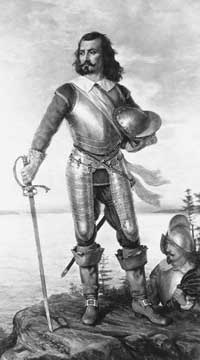
Sometimes a picture says a thousand words, so I’m not going to describe how much of a badass Adam Dollard is, I’m just going to post one of his most common depictions:
In 1660 Dollard leaves Ville Marie with around twenty men, mostly French militia, and travels to Long Sault, where he occupies an old Algonquian fort and begins to reinforce it. Several dozen Huron show up and pledge to assist him. Shortly afterward, two hundred Iroquois in war canoes are spotted traveling down the Ottawa River. Dollard lays an ambush and attacks them, killing several and forcing the remainder to land. Retreating to his fort, the Iroquois attempt to attack and are beaten off. They attempt to parley, but Dollard is here to kill Iroquois, not talk to them and refuses. In response they destroy the French militia’s undefended canoes, cutting off their only escape route.
The Iroquois attack the fort a second time and are repulsed again by musket fire, with one of their chiefs being killed. Dollard, being somewhat pissed about the whole canoe affair, leads some men outside of the fort, still fighting off the Iroquois, so they can cut off the chief’s head and mount it on their wall. A third attack follows that also fails. It’s at this point that another five hundred Iroquois come rolling down the river. This attack force was planning on assaulting Ville Marie, but now they’re going to go after the half-crazed white man in the fortress.
Unfortunately for Dollard, his luck is running out. Huron slaves in the Iroquois group call out to the Hurons in the fort and tell them that if they switch sides they will be spared. The Hurons do so, but hell hath no fury like Dollard scorned, and only five of them survive the next attack. The Iroquois have begun constructing crude wooden walls to protect themselves from musket fire as they advance. With their food supply low and their major advantage now neutralized, the Iroquois attack for a fourth and final time, hacking at the walls of the fort with axes.
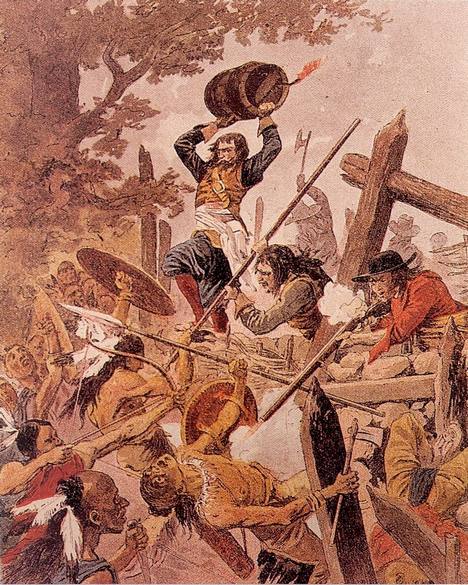
The Iroquois break through, pouring into the fort. Dollard, in a final fuck-you, lights a barrel of gunpowder and tosses it at the advancing horde. But it’s not enough. The fort is swarmed and then set on fire. Any remaining Frenchmen are too wounded to try to escape and are burned alive. Iroquois desperately search the ruins for Dollard’s massive, iron balls to keep as a trophy but fail to find them. Iroquois losses are extremely heavy, and it prevents them from attacking their initial targets. To this day Dollard is seen as a heroic figure in French Canadian history.
The Battle of Long Sault is, in many ways, a turning point for New France. Afterward, the established settlements will not be threatened by any major attacks, at least from natives. But it is still primarily a series of barely populated trading posts in the middle of vast wilderness. Following 1660, New France will undergo a transformation that will solidify it as a true colonial state in the New World.
Canada has, in the entirety of its history, gone through dramatic changes that have completely shifted its cultural and social perspective. No long standing Constitutional ideal defines Canada, its history and institutions have largely been driven by necessity, whether good or bad. Since American perceptions of Canada tend to range from this to this, these columns will be a general, not-too-serious layman’s overview of Canadian history as a whole for an American audience, touching on key elements that became grounded long-term influences on Canadian society and culture.
Norse Colonization (985 to 1014)
Because the Norse never really stuck around long enough to have any kind of influence on Canadian society, this is going to be the cliffnotes version:
According to the Icelandic Vinland Sagas, in 985 AD a guy called Bjarni Herjólfsson is blown off course and sees land to the west, which he calls Vinland (he also may have picked up two shipwrecked guys, the sagas have multiple versions). He goes to Greenland and tells a guy called Leif Erikson about it, who buys his boat and sails there to set up a winter settlement (likely on the northern tip of Labrador). After exploring a bit he goes home. Four years later, his brother Thorvald shows up at his winter settlement and decides to pick a fight with some sleeping natives, starting the first European-Indian conflict. He gets shot by an arrow and dies. Everyone else leaves.
Six years after that, a guy called Thorfinn Karlsefni, who knows about Leif’s voyage, tries to set up a permanent settlement. It does not go well. They run out of food the first winter and decide to eat a beached dead whale, causing mass illness. They also argue about who is more awesome, Thor or Jesus. Unlike Thorvald, Thorfinn is smart enough not to attack the natives, and tries to negotiate a trade deal. But then a bull shows up and scares the natives away. A few weeks later they come back and attack. The Norsemen flee when the natives throw a whistling, inflated moose bladder on a stick at them (I’m serious). Freydís, Thorfinn’s pregnant half-sister, thinks the men are being cowards, so she picks up a sword, pulls down her top and slaps her breast with it. Somehow this scares away the natives, so European steel and tits save the day. Everyone is tired of dealing with shit like this, and they go home. The only substantial contribution Thorfinn’s expedition provides is that his son Snorri is the first European born in the New World.
All of this is based on the accounts of the Sagas, which tend to have multiple versions of the same events. There are tons of arguments amongst historians about the true extent of Norse expansion into North America and even where Vinland actually is. Some say it’s Labrador (making the Norse the first and only people to ever think Newfoundland is a paradise) while others say they expanded further into the Gulf of St. Lawrence region. Archaeological evidence is primarily based around the site at L’Anse aux Meadows, which some people argue is Erikson’s winter settlement. Recently in 2015 a new site at Point Rosee was discovered, but they’re still not entirely sure if it was a permanent settlement or a mining camp. Other more debatable evidence includes the Maine Penny, an 11th century Norse coin found in Maine.
Regardless, the early Norse voyages did not leave any impact on Canadian society, and once the Medieval Warm Period ended and the Greenland colonies could no longer support themselves, the Norse’s ability to sail west was severely curtailed.
Proper European Exploration (1497 to 1534)
With the discovery of the New World by Columbus in 1492, suddenly everyone wanted to get expeditions going to see if they could find the passage to India and China that he had missed. In 1497 the English Crown funds a guy called John Cabot’s expedition to the North Atlantic. Well, his name isn’t really John Cabot, like most explorers of the period he’s actually a filthy Italian named Giovanni Caboto, but the English, like everyone else, don’t want to advertise that they’re outsourcing their work to filthy Italians. Cabot’s four journeys in the North Atlantic are actually haphazardly recorded, but we do know that he discovered land somewhere around modern day Labrador, and also found the Grand Banks fisheries.
The banks contained so much cod that when they were actually utilized by European fishermen later on the price in Europe dropped dramatically. The discovery of the fisheries ensured that Europeans would continue to be interested in the region and explore it further. Cabot’s later journeys primarily focused on trying to find the Northwest Passage, the shipping lane that would allow trade with the Far East. The search for which will lead to many expeditions, some beneficial, others massive disasters, none of them successful. Cue the Stan Rogers.
For most of the early 16th century the only people really exploring around the general location of Eastern Canada are the Portuguese. Portuguese fishermen utilize the Grand Banks and set up a few minor seasonal fishing outposts on Labrador. Unfortunately for them, under the Treaty of Tordesillas, it’s technically Spanish land, so they abandon it to focus on the more prosperous colonies in South America. With Spanish and Portuguese interests primarily in the south, Canada is open for whoever is willing to take it.
Enter the French (1534 to 1604)
It’s 1534, and France has been making a good comeback lately. After victory in the Hundred Years War they have stabilized their country and established themselves as the military superpower of Europe, a tradition that will continue until the 19th century. With a great deal of wealth, a large army, language dominance in diplomacy and other fields, and massive population in comparison to everyone else, they were set to dominate the European continent for the next century.
And then the Spanish start shipping over tons and tons of gold from their newly conquered subjects in the New World. Suddenly continental dominance isn’t going to cut it anymore; they need to expand outside of Europe in order to stay competitive. In 1534 French King Francis I tasks a man named Jacques Cartier (who is, surprisingly, not a filthy Italian) to find that wonderful Northwest Passage and, you know, if he happens to conquer any extremely rich savages along the way, they’re fine with that too.
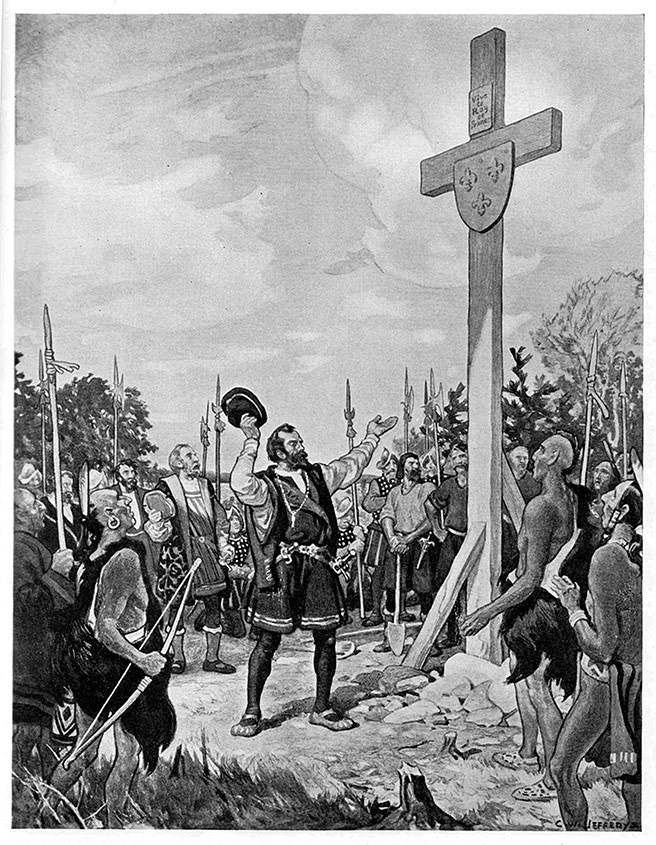
Cartier sails into the Gulf of St. Lawrence (possibly dooming a species to extinction along the way) and goes on a general tour of what would become the Maritime provinces. He establishes contact with the local aboriginal groups, likely the Mikmaq and other tribes, who are willing to trade. On the Gaspé Peninsula he plants a cross, formally claiming the land for the kingdom of France. The local natives do not appreciate this, and then he tries to kidnap a chief’s sons, but ends up negotiating to take them back to France. The entire time he thinks he’s actually somewhere in Asia.
Cartier’s second voyage back was more eventful. This time, he travels down the St. Lawrence River, what would become the primary shipping lane for the later Canadian interior. Cartier is convinced that this is the Northwest Passage…little does he know where it ends. He’s brought the chief’s sons back with him, and they take him to the capital of their native nation, Stadacona, a village near modern-day Quebec City. According to Cartier’s journals and this Heritage Moment, this is where the term ‘Canada’ is first used.
Cartier continues down the river, but is stopped at the rapids near the village of Hochelaga, on the island now known as ‘downtown Montreal’. They return to Stadacona in order to wait out the winter, but have completely failed to provision food and firewood. Cartier’s ships are frozen in place by a very harsh winter that they were not prepared for. Everyone starts to get scurvy, and to make things even more miserable, the local natives start catching European diseases and dying. The natives teach the French how to use spruce to cure scurvy, and the local chief tells Cartier about a kingdom rich with gold and jewels to the north.
So Cartier kidnaps him and brings him back to France, along with seven others (there’s a fairly consistent theme in Cartier’s voyages, can you guess what it is?). None of them ever make it back home and all but one die on the way back to France. The chief’s stories convinces Cartier that there is a great ‘Kingdom of Saguenay’ that would be ripe for the taking. By 1540 King Francis I decides that there should be an established, permanent settlement in the New World, and commissions Cartier to do it.
But within the French court, a new privateer has gained the king’s respect. By 1541 Francis has changed the plan, and now Cartier is second in command to a Huguenot, Jean-François de La Rocque de Roberval, who is named the first lieutenant general of French Canada. Roberval has spent most of his time recently dodging executions thanks to his influence over the king, so his reason for getting out of France is probably health related. They sail to the Gulf of St. Lawrence, where Roberval decides to wait for supplies and gives permission to Cartier to continue on down the river.
Cartier travels back down to Stadacona, where the natives are not happy to see him, for some reason. Regardless he sets up a colonial settlement nearby called Charlesbourg Royal. As they begin to try to set up fields for farming, the settlers (mostly convicts, by the way) begin to find what they think is diamonds and gold. Cartier is quite giddy, but still wants to go further down the river to see if he can find his mystical kingdom. The rapids stop him again, and he returns to the settlement to find hell breaking loose. The natives have attacked and killed a large number of settlers, and the situation seems desperate.
So Cartier fills his ship up with diamonds and gold and heads back out to the ocean. When Cartier’s about to meet up with Roberval, he has just abandoned his sister on a deserted island, likely for financial benefits back in France. Jacques Cartier, Master Dick of French Canada, won’t be out-dicked on his own territory, so under cover of darkness he sails past Roberval’s ships and returns to France without him. Somehow he fails to kidnap Roberval’s sister on the way by.
Almost no one in this story gets a happy ending. Cartier’s diamonds and gold turn out to be quartz and fool’s gold, and he never sails to the New World again. He dies in 1557 due to an epidemic. Roberval attempts to take over Charlesbourg, but abandons it in 1543 due to constant native attacks and lack of supply. He’s later assassinated during the start of the French Religious Wars. Roberval’s sister was rescued however, and became a bit of a minor celebrity once accounts of her story were published.
For the next fifty years, there will be few attempts to permanently colonize French Canada, and none of them will succeed. France is going through a period of instability. The logistics, geographical knowledge, finances and a willingness to not piss off the locals simply isn’t there. If only there was some man, a manly man of integrity and ability, of both diplomatic and martial skill, a mariner with a gift for administration, to get things going again.
Surely France won’t be able to produce one of those.
He begins by admitting to his tone-deafness on the issue and how he perhaps needed to have more understanding of a broad audience when speaking in a scholarly manner. He then puts out a claim that he has received many death and rape threats on him as well as his family, although he doesn’t substantiate the claim in any way, shape or form.
He then continues to spin interesting stories about what he means and that the context was completely misrepresented. He continues to explain how Muslims were actually some of the greatest abolitionists in the history of mankind and that a lot of the latter slavery in the Muslim world was misunderstood, especially much of that from the Ottoman Empire.
Read it for yourself, but I personally have a hard time taking someone seriously that says rape can actually be punished under Sharia as assault with only two witnesses as opposed to the four necessary to prove the charge of Hudud (fornication/adultery). It diminishes the rule of law in a civil society and still essentially makes women second-class citizens.