Category: Jews

  • A Very Special Jewsday Tuesday: Chanukkah Edition

    Yes, it’s that time of year again, when Jews all over the world celebrate their most treasured and most holy days… well, not really, but I’ll Jewsplain.

    First, the part everyone knows: this is supposedly the commemoration of the Maccabees doing something or other. But here’s the catch- Jews do not accept the books of the Maccabees as canonical and derive their understanding of Chanukkah and the Maccabees from the Talmud. The usual reason given is that the Macs came along too late, the canon was completed. But it may be deeper than that, so let’s start with the familiar parts.

    The whole megillah happened around 2200 years ago when I was just a wee yeled. The Middle East was a seething cauldron of petty rivalries, bloody wars, and conquests back and forth, unlike today’s quiet and civilized environment. The two major warring empires were the Ptolemies and the Seleucids, who were proxies for various swarthy European types. There were some Macedonians, Romans, and Persians in the mix as well. Like I said, it was a mess. And as usual, the Jews were right in the middle of the shit because of their geographic location and because Yahweh liked fucking with us.

    If you read through the histories of that era, it’s a confusing mess because so many of the warring monarchs had the same name, with only nicknames and numbers allowing you to tell them apart. But the overwhelming cultural bit of this was the spread of Greek civilization, which brought things like rationality, philosophy, mathematics, and science to the gibbering tribal masses of Asia and Northern Africa. Unlike the tribal kingdoms, the Greeks were very big on universal culture and values, as well as a surprising tolerance for other ways of life- they basically were the first assimilationists, and in ways that would seem very familiar to Americans.

    Now, the official story is that those awful Greeks, who at that point in history ruled over Palestine, had a culture that was so attractive that the Jews started assimilating, speaking Greek, adopting airs of tolerance, eating pork, wrestling naked, and wearing clip-on foreskins (that is not a joke, they really had them). This, of course, could not be tolerated by the Jews, goes the usual narrative. And then, in a total reversal of Greek policy, the latest tyrant, Antiochus IV (Epiphanes), was said to have outlawed Jewish religious practices and forced everyone who hadn’t adopted Greek culture and mores to do so by clipping on foreskins and chowing down on ham (anticipating the later American Jewish custom of eating pork by dismissing it as “Chinese food”). So after the usual litany of atrocities, which prominently featured defilement of the Temple in Jerusalem, they naturally rebelled. The Talmud gives its version of one of the atrocities, the story of Hannah and her sons. One at a time, Antiochus ordered each of Hannah’s sons to eat bacon, and each son in turn refused, shouted a slogan about their devotion to Yahweh, and was then killed for maintaining their religious righteousness. After watching each of her sons in turn being executed, Hannah threw herself off a building in a fit of grief and madness. An inspiring tale, nu?

    The familiar tale continues with the great Judah Maccabee leading his ragtag band of righteous Jews into a successful rebellion against the heathen Greeks, driving them out of Palestine, then rededicating the Temple by the use of various priestly rituals. Note the last. The miracle of Chanukkah was the burning of a ritual lamp in the Temple for eight days while consuming only one day’s worth of oil, which is all they had in terms of ritually pure oil.

    As a libertarian sort, I’ve learned to be a bit cynical and assume that any story like this glides past unsavory truths. I also assume that cupidity rules and is usually the driver of events. So, with that in mind…

    At that time, there were multiple schisms among the Jews- the famous Life of Brian scene about the Judean People’s Front versus the People’s Front of Judea was not entirely a joke. Three of the major factions were the Pharisees, the Sadducees, and the Hellenizers. The Pharisees and Sadducees fought over who really had control of Jewish law, with the Pharisees maintaining that the rabbis were really the ones to control things, the Sadducees insisting that it was the Temple priests, and the Hellenizers being the Reform Jews of their time, incorporating Greek practice and language into the Temple rituals and eschewing the fundamentalist interpretations of Jewish law (yes, this is an oversimplification, but the big picture always is).

    Judah Maccabee was the son of Mattathias, who was a Temple priest and a fundamentalist. Within the priesthood, the Hellenizers and fundamentalists struggled, with the Hellenizers having won out. Their priest, Menelaus, deposed the fundamentalist priest, Jason, by paying off Antiochus. This was a good investment since this gave Menelaus control of the Temple treasures and receipts. Mattathias, being a fundy allied with Jason, was clearly a loser here. In his view, anyone not following the religion in the way his faction thought proper should be executed, and they certainly did their share of killing. And indeed, one of the outcomes of the rebellion was the execution of Jason as a heretic and traitor to the One True Faith.

    So a cynical person might look at this as less of a rebellion against Antiochus, but more of an internal struggle between factions fighting for power and treasure. The winners write history, so the fact that the Greeks mostly didn’t interfere with religious practice before or after the Maccabean rebellion but somehow Antiochus was the exception and tried to wipe out Judaism could possibly be… well you know what self-serving storytellers and drama queens those Middle East folk can be. The cynic might look at historic parallels and see the Maccabees as akin to the modern Taliban, fighting against the encroachment of civilization (literal, in this case) in favor of a strict and violent fundamentalism that just coincidentally put them in power. And that’s what we celebrate for Chanukkah.

    Fun fact: the Hebrew word for a Jew who has given up strict religious practice is “apikoros,” which derives from the Greek “Epicure.”

    One more cynical observation: why the books of the Maccabees are not canonical among the Jews despite lots of slaughter and a Yahweh miracle. Although the usual excuse is timing, someone miiiiight notice that the decisions about canonicity and religious practice were made by the faction which survived and ended up controlling Judaism: the Pharisees, bitter foes of the Sadducees, the latter of whom the Maccabees, as priests who got their share of Temple treasure and tribute, were aligned. But that would be overly cynical, right?

    Fun fact: Judah Maccabee was the first Jew to make contact with the Romans, seeking assistance in his fight against the Greeks. As readers of Matthew will note, this did not end well for the Mac family.

    Fun fact: although potato latkes seem like the canonical Chanukkah food in the US and Europe, in Israel they’re almost unknown. The treat of choice is… jelly donuts. And why is that? Because the bakers in Israel have traditionally been part of state-sponsored trade unions. And although latkes are easy to make at home and best served fresh, donuts are more difficult and are much easier to pick up at a (union) bakery. Just look for the union filling.

    And speaking of latkes, here’s the way to do it right.

  • Jewsday Tuesday: Abbreviated Version

    There’s a character in the Jew Bible who ought to be better known among libertarians, yclept Adoniram (alternately Adoram). He only makes a couple of appearances, but they’re significant. Interestingly, he’s far better known among Masons and Mormons (and the latter is certainly a result of the former) than among the more common religious folk.

    Adoniram (the name translates to “my lord has exalted”) makes his first appearance in 2 Samuel as a functionary for King David:

    Now Joab was over all the host of Israel: and Benaiah the son of Jehoiada was over the Cherethites and over the Pelethites, and Adoniram was over the tribute, and Jehoshaphat the son of Ahilud was recorder…

    He shows up next in 1 Kings, this time working for Solomon, who was king following David’s death:

    And Ahishar was over the household, and Adoniram the son of Abda was over the tribute.

    And his job for Solomon?

    And king Solomon raised a levy out of all Israel; and the levy was thirty thousand men. And he sent them to Lebanon, ten thousand a month by courses: a month they were in Lebanon, and two months at home: and Adoniram was over the levy.

    Solomon eventually croaked, but in the manner of civil service since ancient times, Adoniram stayed on working for the next administration, under Rehoboam.

    But as for the children of Israel which dwelt in the cities of Judah, Rehoboam reigned over them. Then king Rehoboam sent Adoniram, who was over the tribute…

    So, to recap: Adoniram was in charge of collecting taxes in the form of money, goods, and involuntary servitude. Like any career civil servant, he lasted through multiple administrations and did their dirty work. What a hero! I’m sure that the Children of Israel were grateful for his efforts and paid a munificent public-sector pension.

    …and all Israel stoned him with stones, that he died. Therefore king Rehoboam made speed to get him up to his chariot, to flee to Jerusalem. So Israel rebelled against the house of David unto this day.

    OK, not so grateful. They killed him and chased away the king. But hey, this is one of the Bible stories that truly has a happy ending. And we can now understand why Adoniram is a heroic figure for the Mormons, who place great importance on coughing up money and labor for the Temple. The rest of us can look upon this as a lesson on the proper respect due to tax collectors and Selective Service officials, and how public sector pension obligations might be mitigated.

    Sometimes I’m proud to be a Jew. This is one of those times.

  • Jewsday Tuesday: True Blue Jews

    A few quotes and news items:

    “Them Jews ain’t going to let (Obama) talk to me.” -Jeremiah Wright

    ““If Jews want to get it on, tell them to pin on their yarmulkes and come over to my house.” – Al Sharpton

    “Zionists were successful in kicking me out of Congress two times.” – Rep. Cynthia McKinney (D)

    “Jews have bought everybody. Jews. Jay, Eee, Double-U, Esssss.” – Rep Billy McKinney (D)

    “I definitely have some feelings about any outside group exerting this kind of influence in a race, and I’ve been receiving angry calls from black voters all day, saying they should rally against Jewish candidates. To have non-African-Americans from around the country putting millions into a race to unseat one of our leaders for expressing her right of free speech is definitely a problem.” – Rep. Eddie Bernice Johnson (D), Chair of Democratic Black Caucus

    “That’s all Hymie wants to talk about is (sic) Israel. Every time you go to Hymietown, that’s all they want to talk about.” – Jessie Jackson (D)

    “I’m sick and tired of hearing about the Holocaust.” – Jesse Jackson (D)

    “Mark Levine is controlled by Jewish landlords. Jewish landlords own more than 80% of the real estate in upper Manhattan, and they are at the forefront of pushing black and Latino people out of upper Manhattan. Together, if we organize, we can defeat Mark Levine, we can defeat Donald Trump, and we can defeat the Jewish landlords that are pushing black and Latino people out of Washington Heights and the Upper West Side.” – Thomas Lopez-Pierre (D)

    “There has been a steady [stream], almost like termites can get into a residence and eat before you know that you’ve been eaten up and you fall in on yourself, there has been settlement activity that has marched forward with impunity and at an ever increasing rate to the point where it has become alarming… You see one home after another being appropriated by Jewish people who come in to claim that land just because somebody did not spend the night there. The fact is the Israeli government, which is the most right-wing government ever to exist in the state of Israel in its history, the most right wing government, you got a guy like Trump who is now the minister of defense in Israel calling the shots on defense.” – Rep. Hank Johnson (D)

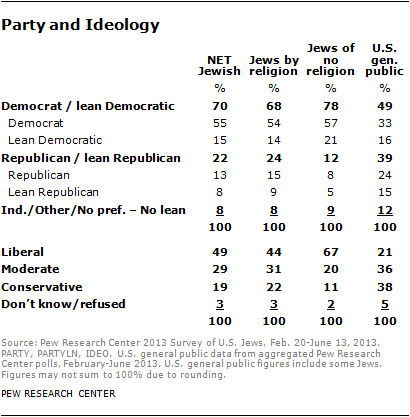
    Note the common thread: the “D.” So clearly, Jews wouldn’t vote D, would they? Only at percentages similar to blacks, Puerto Ricans, San Franciscans, and residents of Washington, DC. Even a vicious antisemite and complete incompetent like Carter got 10% more of the Jewish vote than his Team Red opponent. And despite his immersions in a racist and Jew-hating church, and spending taxpayer money meddling in the Israeli election, Obama collected 80% and 70% of the Jewish vote in his two presidential runs. Here’s the party registration breakdown:

    Why this totally counter-intuitive electoral tendency? There are several explanations, all of which are part of the truth. But to me, the interesting part is the inevitable conclusion.

    1. History: The majority of American Jews are descendants of  immigrants in the late 19th and early 20th century, mostly originating from Eastern Europe and Russia. They learned quickly that their succor and support came from the big city political machines like Tammany Hall, which were all Democrat.

    2. Sociology: At the time of large Jewish immigration, the Republicans indeed were the party of business and country clubs. The democrats were the party of unions, and Jews were extremely active in unions. Our backgrounds were also mercantile, so things like hunting were not ingrained into us. As a consequence, there’s not many Jews in the NRA, and I’ve never actually met another one at a range. So the regard for Second Amendment rights, which doesn’t impact us (so we think!), tends to be low. We fear crime and want the police to protect us. Self-sufficient weapons handlers abound in Israel, so it’s really more a feature of Eastern European and (later) American Jewish culture than Jewish culture in general.

    3. Politics: There’s long been a streak of socialism among secular and Reform Jews, who comprise a majority of American Jews (about 65%). At one time, this was also true of (religious) Conservative and Orthodox Jews, but the latter increasingly have moved toward a (political) conservatism, with nearly 60% of Orthodox Jews identifying as Republican and 70% of Reform and secular Jews identifying as Democrat. My own family was heavily involved in the unionist movements of the 1920s and 1930s, and when I was a kid, the beach we went to in the summer was owned by the Arbeiter Ring (and was one of the very few beaches that would allow Jews in). Many of my family were avowed communists, and an examination of the McCarthy-era blacklists shows a disproportionate Jewish presence. And there’s FDR, who did for the Jews what LBJ did for the blacks- put us in fealty for at least a century.

    4. Religion: There’s no question that there is far more philosemitism and support of Zionism among white Evangelicals than just about any other ethno-religious bloc. But the sad reality is, they make us uncomfortable. Evangelism is foreign to us (we do not attempt to convert anyone and pretty much actively discourage it), intermarriage is essentially blotting out American Jewry (more of us marry goyim than other Jews, me being no exception), and Evangelicals generally don’t really understand us and in social situations tend to overcompensate (“We used to have a Jew in our town, a Dr. Goldstein, nice fellow. Do you know him?”). Frankly, they make us nervous. That may be unfair, but it’s reality. So as white Evangelicals moved into the Republican coalition, this put Jews off even further. Statements like, “America is a Christian nation,” and support of school prayer (not ours, of course) further alienate Jews.

    5. Tikkun Olam: That’s a Jew phrase meaning “Healing the World,” and it’s central to our culture, especially the Ashkenazi culture which overwhelmingly dominates American Judaism. As with many other people, Jews tend to conflate “helping other people” with “having the government help other people.” Part of that harks back to our experiences with Tammany that I previously mentioned. I gave some egregious examples a few weeks ago in my High Holidays post, and these are not atypical- activism means government activism and that means leftist politics.

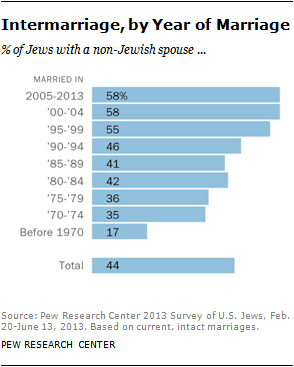
    6. Assimilation: I talk about this a lot as a peculiarly American phenomenon, and Jews have certainly been no exception. I mentioned intermarriage above and put up a chart below to show how incredibly pervasive this is. And the movement to reform and secular Judaism, which are indistinguishable from Progressive Protestantism is also key to understanding (((our))) voting patterns. The destruction of American Jews as a distinct ethnic group will not come about by extermination; on the contrary, we’re being loved into extinction. And since we are overwhelmingly over-represented in the professional classes and entertainment industry, which skew left, naturally, we’ve accepted that milieu as what’s right and natural.

    And now for the dog that didn’t bark: Israel.

    One thing that unites Right and Left in this country is a suspicion that Jews have a dual loyalty and that those perfidious Hebes often put Israel’s needs ahead of the US’s. One the one hand, it’s nice that Keith Ellison and Pat Buchanan can find common ground. On the other, it’s a dangerous canard and makes us painfully aware that we’re often under suspicion. But here’s the reality: most American Jews who actually feel loyalty to Israel move there. On the list of issues that motivate American Jews, Israel is far, far down. According to the Pew Research Center, only 30% of American Jews feel emotionally attached to Israel, a much lower number than that for white Evangelicals. American Jews tend to feel that things like “social justice” are far more important than Israel, and in fact feel somewhat uncomfortable that, despite being the one place in the Middle East that doesn’t execute gays, heretics, and dissidents, Israel identifies explicitly as a Jewish state. American Jews did not by and large support the US involvement in Iraq and very much do not want the US to fight wars on behalf of Israel (to be fair, Israelis also don’t want the US to fight wars on their behalf).

    So contrary to popular opinion, when it comes to Israel, we just don’t care. And that’s why disguising antisemitism as anti-Zionism has been an effective tactic for Team Blue to keep us from escaping their labor camps; we’re willing to pretend that this isn’t a problem for the Left in exchange for their political involvement in welfare, anti-discrimination, and charity.


  • Jewsday Tuesday: Happy New Year and Pay for Pray


    It’s funny what happens when I start on one of these little essays- sometimes it goes just as planned, but often while researching a topic, I get sidetracked and write about something entirely different than what I intended. This is one of those times. We’re in the midst of the Jew holiday rush, with Rosh Hashana (New Year), Yom Kippur (Day of Atonement), and Sukkos (something about plants and booths, don’t ask) in a Centipede-like series, with the first two sort of lumped together as the High Holidays and Sukkos being an afterthought. So I figured, let’s do a history of Rosh Hashana and Yom Kippur, and discuss their decidedly non-Biblical nature, and contrast it with Sukkos (the white people of Jewish holidays), which is culturally rather minor but is actually Biblical.

    And there I made my fatal mistake: I googled local High Holiday services at the nearest shuls and that sent me down an unexpected path.

    The first shul that came up was Beth Emet (House of Truth) in Evanston. They bill themselves as “The Free Synagogue.” This is a (((Jew))) trick, there’s nothing free about it.

    Wow, a synagogue with no fees? We tease, but the word “free” in our names holds a strong significance that shapes the foundation of our congregation. It means that we unequivocally support the freedom to express a full range of ideas from our bima (pulpit) and within our community. More than half a century ago, our founding members chose a name that symbolized a commitment to truth and open expression.

    Attending High Holiday services will set you back $500 per head, no reserved seating. Of course, members will get a hefty discount, assuming you’ve coughed up the $1200 per person that they charge as the introductory rate for membership (the website appears to be silent on what the yearly fee is after the first year).

    I note the the Catholic church down the street here doesn’t charge to join. Silly goyim, you’re leaving money on the shulchan!

    But the “full range of ideas” they espouse seems to be directly lifted from the Democratic National Committee and, judging from their website and their rabbi’s blog, spans the full gamut from left to extreme left. Here’s a sample of a sermon by their rabbi (female, of course, a few millennia of traditions cannot substitute for woke-ness, and CS Lewis’s gate is all oppressive and shit):

    Racism in the United States may no longer be de jure, but with statistics such as these can we claim with confidence that it has been eradicated? This summer the Supreme Court’s undermining of the Voting Rights’ Act and George Zimmerman’s acquittal in the death of Trayvon Martin exposed the still raw wound of racial tension in our country. After the verdict, President Obama, in his most candid remarks about race, spoke about the racism that he has faced in his life. He talked about purses being clutched and car doors locked as he walked by. He acknowledged that racial profiling by the police has undermined their trust in the black community, making them less effective in reducing violence. And he spoke about the importance of people of different races engaging in dialogue with one another in order to gain greater understanding and empathy of what it’s like to walk in a black person’s shoes.

    As President Obama challenged us, we need a real conversation on race in our country that allows us to develop relationships and understand one another better before we cast aspersions and affix blame.

    They also affiliate with other similarly-minded organizations. From their site:

    Bend the Arc
    Bend the Arc is building the power and passion of the progressive Jewish movement in America by bringing together Jews from across the country to advocate and organize for a more just and equal society. It is the only national Jewish organization that is focused solely on promoting these values here in the U. S. Two community meeting shave been held in the Chicago area. Work groups have been established along three distinct strategies:
    • Supporting endangered populations– Muslims, immigrants, LGBTQ communities
    • Encouraging Democrats and approachable Republicans to resist the Trump agenda
    • Working for a shift in power by mobilizing for the 2018 and 2020 elections.

    I’m sure they’re big on separation of church and state, right? Yes, clearly they take a strong stand against religion being involved in partisan politics. It makes (((me))) proud. They also link to something entitled “Jewish Tradition Speaks to Need for This Proposed Law”

    In the 114th Congress, I-VAWA was re-introduced by Representative Jan Schakowsky (D-IL) and Senator Barbara Boxer (D-CA). The bill, which received bipartisan support, mandated that an Office of Global Women’s Issues be instituted by the Secretary of State and led by an Ambassador-at-Large for Global Women’s Issues. The bill would have inaugurated a Senior Coordinator for Gender Equality and Women’s Empowerment for the U.S. Agency for International Development (USAID). The goal was to push the U.S. government to swiftly propose and enact creative solutions for violence prevention and that those plans be revised annually for five years.

    Whew, for a moment I thought they were going to say that Judaism mandates taxpayer-funded sinecures and luxury travel for some well-connected bureaucrats and academics.

    I suspect that their inclusivity and diversity would not include me.

    Ah well, let me try the next hit on Google, which is Beth Am (The People’s House) in Buffalo Grove. And to their credit, they don’t claim to be “free.” And indeed they’re not, with yearly memberships running $3000-4000, which makes the People’s House some pricey real estate. Want to go to services for the High Holidays? $500 per head for Rosh Hashana, another $750 each for Yom Kippur. I don’t know what Easter Sunrise services cost at our local Catholic church, but I suspect that it’s a whole lot less- likely free. I may have my foreskin sewed back on.

    And once again, the congregation is led by a female rabbi who is as woke as it gets. Here’s a delightful excerpt from one of her sermons:

    This sermon will not be a rebuke of conservative political ideology or sentiment. Let’s be clear, there has been a virtually unanimous voice from the Conservative establishment decrying the overt or covert support of racist fringe movements and this is a sermon purposed on the necessity for us to Wake Up and Rise Up during a period in our history where white supremacists have a direct line to the Whitehouse (sic).

    Whew, for a moment I thought she might get partisan. Here’s her morning-after-the-election sermon:

    The feelings of anger and despair I have will in time morph into action and revolutionary love. We are strong and courageous and in this together and right and there are too many people who need us. We need us. It is not easy, but I don’t think we have any choice but to F.E.A.R: Face Everything And Rise. This is the only answer now and always…one breath at a time.

    I searched in vain for her denunciations of Keith Ellison or Al Sharpton, as well as the rabbi’s exposure of the fake hate crimes she cites. I suppose I need more Jew in me to understand that there’s Nazis at the door, and that we’re only inches from being sent to American concentration camps.

    Today I speak words of protest, joining hundreds of my Reform rabbinic colleagues across the nation in fulfillment of our sacred obligation. We will not be silent. We will, without hesitation, decry the moral abdication of the President who fuels hatred and division in our beloved country. This is not a political statement.

    Of course it isn’t. And of course, the good rabbi sermonized about The Women’s March:

    My 12 year old says she doesn’t feel well and is not going to march. Her sister says the same thing and their brother says they must go. He yells at them, “All our rights are at stake!”
    …We get to the rally. We get pins that say, “Girl Power” and “Love Trumps Hate” and other slogans that I won’t write here…. (OMWC: The photo on her post shows that her son was wearing a button with the very spiritual slogan “FUCK THE PATRIARCHY!”) The kids are excited to be a part of this historic event, proud to be speaking up and out! Periodically, my son spontaneously yells into the crowd “I’m mad as hell and we aren’t going to take it anymore!!” He gets applause and high-fives. He smiles and keeps on walking. My daughters chant about immigration rights and each feels free enough to shout her own slogans about rights and freedom and we walk together with hundreds of thousands of people.

    You know who ELSE had hundreds of thousands of marchers shouting slogans… By the way, I note that the good rabbi is silent about the exclusion of Jews from Chicago’s Gay Pride parade, but I suppose that’s consistent with her silence about leftist BDS. It’s all about Team. I’m guessing that you wear a pink pussy hat instead of a yarmulke during services.

    I can’t leave this topic without linking this classic.

    OK, to wrap this up, now the serious part. These really were the first two things to come up when I was looking for a shul for the High Holidays. It’s distressing to me that a 4000 year old tradition has been perverted and co-opted as a partisan political movement, that as a religious obligation, (((we))) are expected to cheer the yielding of power, autonomy, and agency to government.  It distresses me that not only have synagogues become overtly political, they are also exclusionary- there is no room for classical liberalism, conservatism, or libertarianism, not to mention people of limited financial means. There seems to be no dissenting voices allowed. Nor is there any hint that perhaps religion ought to keep itself focused on Yahweh and not on Nancy Pelosi. If one of the goals of organized Judaism is to bring the non-observant and secular back into the fold, the synagogues around here are certainly doing the opposite for those of (((us))) who believe in liberty and would like to have some part of our lives separate from partisan politics.

  • Tuesday Jewsday: Ruminations on the Existence of G-d

    IFLS!  I love it so much in fact that I spent (wasted?) the years from age 5-29 pursuing higher education; finally culminating in a PhD in Physics.  I can send you a copy of my thesis if you’re suffering from insomnia.  This has nominally trained me to be a scientist.  The purpose of obtaining a PhD in a hard science is not to learn a lot of facts, though I did do that (not that I can remember very many of them).  No, the true purpose of an education in scientific research is to inculcate a certain mindset amenable to critical thinking and weighing of evidence.  To retread an already tired cliché, it teaches you how to think.  So why, you may ask yourself, would an over-educated Gen X failure with a PhD in Physics still believe in G-d?  Aren’t all nominal scientists and educated people atheists?  If you’ve built a life around obtaining evidence, why would you put faith in something for which there is no proof; even worse something that is likely unprovable, the true hobgoblin of the scientific mind?  Well, my friends, wonder no more.  Take another shot and join me on a wonderful journey in which we discuss the Question.  The only Question that really matters.

    Historical Approaches

    Many people much smarter than I have tried to do the unlikely, prove the existence of G-d.  Trying to even paraphrase the massive amount of work already done in this area over the course of human history would not only be impossible here, but it would be arrogant for a peon like myself to lecture as a layman.  To that end, I will just put forth (extremely) brief summaries of some of the most well-known arguments.

    The very concept of G-d is quite malleable and before even forming an argument, some basic understanding of what you’re arguing for needs to be established.  I will be discussing a prototypical Western perception of G-d as a single, transcendent, metaphysically supreme being; the antecedent and origin of everything.  This typically encompasses a being with omnipotence and omniscience and with some semblance of freedom of action and will.  The trick is avoiding anthropomorphizing so I’ll try to be very general.  I also won’t delve into the Trinity or other tricky, paradoxical concepts.  I’m also not going to try and cross over between Abrahamic conceptions of G-d with those of deism, as I personally find many of the tenets from both to not be mutually exclusive.

    The ontological argument is one of the most famous, basically positing that the existence of G-d is confirmed by the fact that the concept of G-d can be held.  If such a concept can be held in the mind, even by a non-believer, then such a being must exist in reality.  Descartes was a big fan of this theory and published it in several different ways arguing in favor of G-d’s existence.  Kant, on the other hand, rejected this argument by saying that the ontological argument is actually encapsulating two separate entities, the concept of G-d and G-d Himself and the argument only addresses the former.  Aquinas also rejected this argument for the reason that G-d *cannot* be conceived of, as He is, by His nature, unknowable to the mortal mind.  Finally, strict empiricists hold that the argument is not an argument at all because there is no evidence either for or against such a claim.

    Empirical arguments, of which Aquinas’ are the most famous, argue G-d’s existence from physically observable phenomena.  The elegance of the laws of nature encompass one such argument; ie, it’s so improbable that Planck’s constant should be exactly what it is, and the fact that if it were just slightly different life could not exist as we know it, must imply the existence of a supreme being controlling it.  Also considered an empirical argument is the unmoved mover argument.  Arguing that tracing backward from effect to cause eventually reaches some initial effect for which no cause exists; therefore the only way that such an effect could happen is if it comes from some transcendent unmoved mover that puts into motion the machinery of existence.

    What does this have to do with (((you))) and your pretentious way of writing His name?

    First, the pretentiousness: carrying around my own cultural baggage dictates the writing of His name as G-d in English.  This is homage to the “Adonai” placeholder in Jewish scripture.  The unpronounceable tetragram is meant as a way of demonstrating G-d’s unknowable true nature.  This is, in my opinion, a (possibly unintentional) refutation of the ontological argument; it basically agrees with Aquinas in a superficial way.  To me, it’s a way of showing respect for that which is beyond our petty lives and meager understanding.  I see it as a gesture of humility.

    I’m no deep thinker.  I love guns, titties, scotch and jalapeno poppers.  I like to cogitate on these things from time to time, but I’m a mental midget in comparison to the likes of Aquinas, Hume, Nietzsche and Descartes.  So what does this have to do with me?  Well, I believe strongly in the Aristotelian imperative of living an examined life.  To me, that implies at least some effort to tackle the Big Question, at least to my own satisfaction.

    Get to the point.

    Alright, jeez.  Gimme a break.  My belief in G-d’s existence doesn’t really break down to a rigorously structured argument a-la the classic thinkers.  I have a few bread crumbs all emulsified and held together by the egg yolk of faith and meaning.  First off, I do not ascribe to Pascal’s wager at all.  I think that’s a coward’s way out.  Stop playing the odds.  Further, and related to my rejection of Pascal’s wager, I’m undecided on the existence of an afterlife, upon which Pascal’s wager hinges.  I certainly believe we are immortal in that the coalesced energy that constitutes the matter of our bodies will not be destroyed, it will just change form in one way or another.  By that same token, I think it’s pretty unlikely that when you croak you get transported to a beautiful garden filled with awesome food from Chili’s and unlimited copulation with underwear models of your particular gender preference.  Still, I do believe in a soul.  Modern cognitive science and neural network models seem to be on the verge of identifying how thoughts propagate in our brains.  Similarly, we also know from incidences of brain injury that physical changes to the brain can have a profound impact on the mind.  However, stealing from Stan in South Park, that explains the how and not the why.  While such studies are fascinating and useful, they do not answer the pertinent question; where do the thoughts originate?  Where is the unmoved mover in our own brains?  To me, this is the image of Himself from which G-d made us.  That is the spark of divinity in each of us, not, as some have argued, the crude orgasmic procreation.  To me, the seat of free will, the ultimate gift given, is in that unmoved mover inside us.

    Further, I posit that even if G-d did not exist, it would have been necessary for us to invent him.  I have seen arguments that a functioning set of ethics could be constructed without appeal to G-d.  This may be true in a strictly theoretical sense, but I have difficulty believing that it could work in practice.  It can easily devolve into relativism and, ultimately, nihilism.  Nietzsche struggled with this all his life.  If G-d doesn’t exist, then what are the implications for ethical decision-making?  Again, I’m not going to try, even if I could (which I can’t), and reinvent the wheel with Nietzsche’s arguments.  Suffice it to say that I never found he could adequately overcome the handicap of not having G-d in trying to create a code of ethics.  To put it simply, there must be an authority outside the realm of human debate when it comes to the actions of ultimate ethical import.  Would anyone have taken Moses seriously if he came down from Mt. Sinai and said “Hey guys!  I came up with these rules and you’ve gotta follow them.  And some of them you’re not gonna like cause you’ll have to stop banging your buddy’s wife then stealing his money behind his back.”  Let’s just say it carries a lot more weight to say “G-d is telling you to do this, not me.”  How do we know Moses didn’t just write that stuff down on his own and pull a fast one?  I don’t suppose we can know for sure.  However, based on the fact that the rules given seem to work really well, and make intuitive sense to the overwhelming majority of people, that’s a pretty good start.  If you’re not a Ten Commandments fan, you can always default back to the Golden Rule (also supposedly provided by G-d).

    I can see you Glibs already, hunkered down in front of your computer, television in the background mellifluously serenading you with the latest episode of Game of Thrones, a large, mostly empty bottle of something precariously perched next to the computer.  You’re thinking, “this guy hasn’t proven anything, he hasn’t even really argued anything!  I came here expecting answers and he’s just given me pablum!”  Well, I never claimed to have any answers or even an argument.  It all, in the end, comes down to faith and how it applies to your individual life.  To quote Dr. House, “there’s no conclusive science. My choice has no practical relevance to my life, I choose the outcome I find more comforting.”  Dr. House chooses to believe that life isn’t a “test” and thus confirms his atheism.  Dr. House’s conception of life (and the way in which much religion is sold) is that life doesn’t have meaning in and of itself; it’s just a staging area where, if you make the right decisions, once you shuffle from the mortal coil, you’ll be tapping Adriana Lima’s ass while scarfing an Awesome Blossom.  I similarly choose to believe this is not a test but come to different conclusions.  Rather than a test, it is a gift and I find it more comforting to believe that this gift was bestowed by some benevolent force rather than by a strictly random set of circumstances.  One atom was set in motion, which precipitated down to pond scum on Earth which precipitated down to mammals and primates and eventually Adriana Lima.  And G-d saw that she was good.

  • Jewsday Tuesday: Shakshuka, Rattle, and Roll

    First, at the request of several of our beloved commenters, a Mom update: “We were eating English muffins, but then the power came back. Arlene and I went down to Publix, but they were out of roasted chicken. Can you imagine? Well, they’ll have more this afternoon, that’s what they told me. And it’s sunny and beautiful here, I don’t know what all this fuss is about. No, I haven’t seen any alligators coming out of the pond, I don’t know why you keep asking me about that.”

    OK, now to the Jewsday. In this week’s Torah stories, Moses is still rattling on, but we’re getting close to the part where, mercifully, he dies. So instead of the Torah crap, I want to talk a bit about culture and food. I’ve made no secret about my utter contempt for those who fret about “cultural appropriation.” I had always attributed my attitude to being American, and having been raised in an immigrant household where assimilation was considered a virtue. But perhaps it runs deeper in my DNA than that. Maybe that’s why yesterday I was delighted to see my next-door neighbor (an immigrant from Honduras) working with an immigrant from Bulgaria to crush and destem a few hundred pounds of Cabernet Sauvignon grapes from California to make a Bordeaux-style wine…

    Anyway, here’s how all of this line of thought started: I wanted to post a recipe for one of my favorite Jewish dishes, shakshuka, which is part of the Holy Trinity of Israeli cuisine (I covered falafel, another of the trio, a few weeks ago). In researching the variations of this wonderful dish, I stumbled upon a trove of controversy, which led me to research some of my family background as well. So, let me start there, and no more Publix roast chicken references in this post.

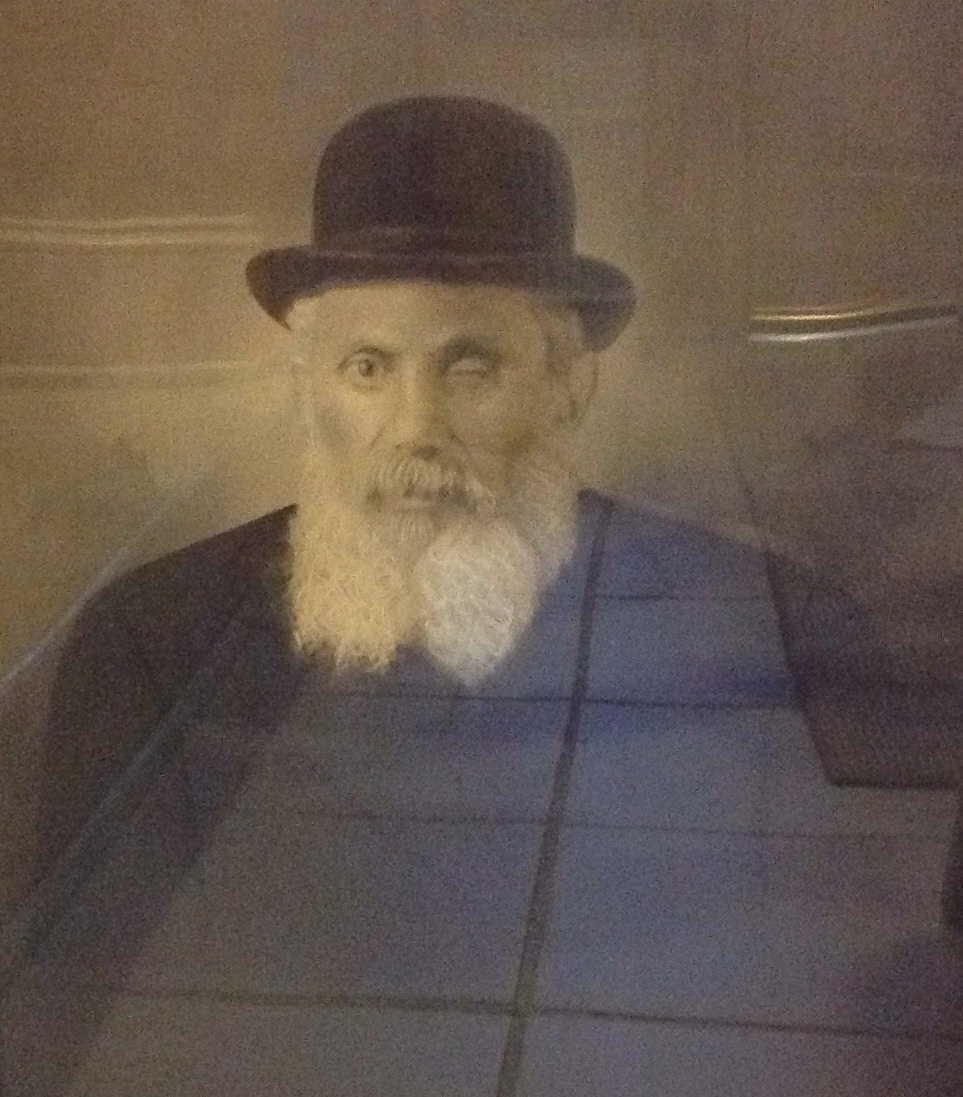
    Note the family resemblance, though I still have both my eyes.

    The (((world))) is often thought of as comprising two sorts of us, Ashkenazim (generally, descendants of people who hailed from Europe, with “ashkenaz” associated with an area in the Holy Roman Empire ) and Sephardim (generally descendants of people who came from Spain, “sephard” in Hebrew). But as with everything else, it’s not that simple. Although we all originated from the Middle East, our exit paths when we were expelled by colonizers took multiple directions and timing. So despite the fact that Jews who escaped to (for example) Morocco never saw the Iberian shores, they are lumped in as Sephardim.

    My own family went eastward and north, eventually settling in Trebizond, a Turkish port on the Black Sea, planted on the trade route between the Middle East (especially Persia) and Europe. Because of the influences of Persians, Turks, Arabs, Italians, and actual Caucasians, the mixing of language, culture, and cuisine was extreme. For some reason, people of that era and place weren’t terribly woke, so no-one seemed offended by the mingling of ideas, literature, food, and music. No-one whined that something was “stolen” from their heritage. Because of these circumstances, my family was Sephardic even though they never got within a thousand miles of Spain.

    As if this weren’t enough to rev my family’s appreciation of cultural intermingling, in the mid-19th century, most of the Jews of that area were expelled by the always-tolerant Muslims. My family escaped by skirting along the Black Sea and ended up in a Jewish refuge in Ukraine or Russia or Poland, depending on the month, called Kupel (or variously Kupil, Kipl, or Kippel). Things have to be pretty bad when Czarist Russia is an improvement. But not much of one. Frankly, even the local Jews, who were Ashkenazim, looked down on us, and renamed us with a Yiddish term that roughly translates as “Your shit’s all retarded and you talk like a fag,” likely because we weren’t Yiddish speakers and they figured we wouldn’t know better. Anyway, shortly after my family arriving in Kupel, my great grandfather was born. Forty years later, my grandfather was also born there, and at that point, the family had enough of the Czars and the asshole Ashkenazim who tagged them with a funny name, so they packed up my grandpa and did the Ellis Island thing in 1900. I’m not sure what possessed them to hie south and end up in Baltimore, but let’s just say we didn’t have a great track record of picking places to live. So that is how I became one of the rare Sephardim to have ended up in the US of A. (Trivia: one other escapee from Kupel was a fellow named Chomsky, whose son you may have heard of…)

    What is not well-appreciated by Americans is the predominance of the Sephardim (especially the so-called Mizrahi) in Israel, mostly because the vast majority of American Jews are Ashkenazi. What most Americans think of as stereotypical Jewish food (knishes, bagels, brisket, chicken noodle soup, kreplach, cholent, kishke…) are adaptations of Eastern European peasant food, and hence remarkably dreary. Despite the leftist sneers about European colonialists in Israel (ignoring that the Ashkenazim were also Middle Eastern in origin, they just went right instead of left), the majority of the Israeli population was Sephardi until just a few years ago. Israeli Hebrew is Sephardic, not Ashkenazi. And so is Israeli food, thankfully- Sephardic food is vibrant, flavorful, and spicy, reflecting the tastes of the region whence it was influenced. Real Jewish food, with flavors and ingredients from our homeland, not the crappy pseudo-Polish stuffed cabbage shit that those fucking Ashkenazis call food.

    OK, all that past us, let’s return to shakshuka, a great Sephardic dish which is basically eggs poached in a spicy tomato sauce. Like so many great Jewish foods, there’s no lack of controversy about its origins. The name is claimed to derive from the Hebrew term for “shaken up,” but is also claimed to be Arabic for “mixed together.” And as with falafel, politics intrudes, and there’s no shortage of controversy. The Moroccans say that they invented it and that the Jews stole it. The Tunisians claim that they invented it and that the Jews stole it. The Turks say they invented it (“menemen”) and that everyone stole it. And almost the same dish is found in Italy (“uova in purgatorio”), so I’ll say that (((we))) invented it and the dirty wops stole it.

    Of course, two of the main ingredients, tomatoes and peppers, originate from the New World, so any claims to antiquity are automatic bullshit. Shakshuka is inherently appropriation, and that’s a great thing, but it does tangle up the origins. Without going into the details of the research I did, it appears most likely that it was originated by Mizrahi Jews in Tunisia, who brought it to Israel after they fled Muslim persecution in the late 1940s. As with many dishes from the region, the Sephardic Israelis adopted it with gusto. And also as with many dishes from the region, everybody has a different version, and everyone claims theirs is the Real Deal. Of course, everyone is wrong- MINE is the one and true correct way to do things. And I’ve done a few different versions recently just to convince myself that mine really is the best. And it is. I have eschewed the commonly-used onions to let the flavors focus on the tomatoes and peppers. And no way I’m going to tart this up with eggplant, olives, crumbled cheese, or other horrors to which I have seen this dish subjected. The flavors here should be direct, strong, and focused, not a mish-mash.

    Fair warning: don’t even think about using shitty grocery store tomatoes, use late summer fresh-from-the-farmstand tomatoes. If you absolutely can’t find those, you could substitute Muir Glen whole peeled fire-roasted tomatoes, poured into a bowl and broken up with your fingers. Avoid the pre-diced canned tomatoes or you’ll get a shitty texture.

    Old Man With Candy’s Only True Shakshuka

    4-5 cloves of garlic, minimum (more is better) thinly sliced (not chopped)

    more olive oil than you think is healthy

    1 red bell or red ancient pepper, diced (I also will add some hot chiles like fresh arbol, but admittedly, I have an asbestos anus)

    1 tsp freshly ground cumin

    2 tbsp paprika

    1/2 tsp smoked paprika or pimenton

    2-3 tbs harissa

    4-5 fresh ripe tomatoes, diced

    salt and pepper

    6 eggs

    1 tbs chopped parsley

    Heat the olive oil on low. When it’s up to temp, stir in the sliced garlic- the oil should be hot enough to see some mild bubbles but not to sizzle the garlic too quickly. We’re trying to extract and mellow the garlic, not really fry it (if you’ve made aglio e olio properly, that’s the idea). Let the garlic cook for 10 minutes or so, giving it a stir now and then, until it’s soft and aromatic and oh-so-slightly golden. Then increase the heat to medium, add the cumin, paprika, and pimenton, and cook for a minute or so. Then add the harissa, cook for half a minute, and add the diced bell pepper. Cook while stirring until the pepper has softened a bit, then dump in the tomatoes. Salt generously, increase the heat to medium-high, and stir. Continue stirring from time to time to prevent burning and cook until the tomatoes are falling apart and the sauce has thickened a bit. Check for salt and seasoning- feel free to add some hot chile powder at this point if the harissa didn’t raise the heat level to where you want it.

    Reduce the heat to a simmer, then using a large spoon, make a dent in the top of the sauce and crack in an egg. Repeat for the other five eggs, then cover the pan and cook until the whites are set, the top of the yolks has filmed over, but the yolks are still runny. Remove the pan from the stove, sprinkle the chopped parsley on top, then serve from the pan, sopping things up with nice crusty bread.

    My great grandpa Itzhak would approve.

    Americans.
  • Jewsday Tuesday: Lame Excuses Thread

    OK, I had a really great theme for this week. The best theme, really. But it got away from me because it led me down some unexpected paths which need to be researched carefully. And then I got high.

    Jewsday will be back next week with my really great theme all finished. Sadly, no sex or Bible stories, but still, a really great theme, believe me.


    Anyway, here’s a video to hold you for the next week.


  • Jewsday Tuesday: News of the Weird

    I’ve been avoiding the weekly torah stories recently because Devarim (Deuteronomy) is, as the name suggests, mostly redundant. Almost all of it is Moses-as-Castro, giving an endless rambling speech. Difference is that everything Moses is saying has smiting behind it, so you gotta listen up if you’re a Hebrew. But I thought that this week’s sedra, Ki Tietze (“When you go”) was a delightfully diverse collection of laws which cover everything from rape to haberdashery, and illustrate why the Judeo part of Judeo-Christian is totally wack. Disclaimer: there’s 74 laws laid out in this sedra, so no way I’m going through all of them. I’ll give you the Reader’s Digest version, but it’s still going to be a halacha mash-up.

    Moses begins this section of rattling on with a discourse on how to treat lovely women who are captured in the endless inter-tribal battles. Now those heathen tribes, they just went ahead and raped anything with a vagina who rated over a 5. But Jews have to do it better. The law here is that you have to pen her up for a month first, shave her head, let her grow her nails, and only then, once she’s been humiliated, uglified, and left to ruminate for a month about the upcoming horror and remembering the vision of you eviscerating her parents in front of her, you can give her that good raping she’s been waiting for. Much more civilized, dontcha think?

    And being the kind and generous folk that (((we))) are, when you get tired of her shit, you have to let her go rather than sell her into slavery. Well, let’s be honest, once you drive them off the lot, they lose about half of their resale value anyway, and chances are that by then, there’s dents and scratches, further reducing the value. So no big loss.

    Moving on, as someone who loves cultural fusion and who cheerfully married a shiksa (OK, well, three different shiksas), I am completely damned under the law of kilayim. Kliayim is the prohibition of various sorts of fusion- the called out examples are donkeys and oxen in the field, wool and linen in clothing, and co-planting in vineyards (Moses was unclear about whether having grenache and mourvedre grapes together is forbidden, but very clear that you don’t plant wheat or rosebushes among the grapevines). Rabbinical interpretation has used this as a metaphor for mixed marriages (as if the Phineas story weren’t explicit enough) and I’m sure there’s some Jew redneck out there who has used it to justify keeping separate from the coloreds. But basically, if your shirt is a cotton-polyester blend, be prepared for the stoning.

    Now here’s something parents will love. Have a rebellious or otherwise shitty son? (((We))) have a solution for you! If mom and dad agree, the son is brought to the village elders. Once the parents declare that he’s an asshole, then… you guessed it, stoning! Think of it as retroactive abortion, and a precursor to modern Jewish thought that life begins when the child gets an MD or LLD.

    There’s fun and games for the (((girls))) as well, but this one has to wait until marriage. Let’s say her hubby gets sick of her shit and decides he wants a divorce. In these pre-no-fault times, a common excuse was, “Slut wasn’t a virgin when we got married.” So, she’s ripe for the stoning. But wait. If her parents show up with the sheets off the marital bed having bloodstains (don’t even ask how they got them, it was probably a Linda Tripp “save that dress” deal), the guy gets a good flogging and has to pay her parents 100 shekels. That’s not the worst part- he also is forbidden from ever divorcing her. I may bitch about my alimony, but at least I don’t have to live with my ex.

    Here’s one of the truly weird ones. Suppose you’re a married Jewess and your hubby gets into a fight with some other guy. Regardless of who started it, be careful about helping him out. If you help your hubby by grabbing the other guy by the nuts, guess what? Your hand gets amputated. They didn’t teach you about this in Sunday School? They should have.

    I bet the Sunday School teacher didn’t tell you about this one, either: if your nuts get crushed or cut off, you aren’t allowed to enter the synagogue or the Temple. Nor can you be part of a minyan (the required ten (((men))) needed to have a prayer service). So remember to always wear your cup when you do sports, and give up that lifelong dream of being a harem eunuch.

    Speaking of testicles, let’s say you have a wet dream. This does not make Yahweh happy, so if you want to avoid the stoning, you have to immediately get the hell out of the encampment (they were in the desert at the time), wait until late afternoon, take a ritual bath, then wait until sundown before you can return. Obviously, when one saw teenage boys running out of camp in the morning, the jeering would begin. And if one of the poor kids broke out in acne, he had to go to the priest for some folk remedy or other. Left untreated, this would lead to… stoning.

    By the way, if you divorce some bitch and she remarries, if the new hubby gets just as sick of her shit as you were and tosses her out, don’t even think about trying to remarry her. If you do, yep, stoning.

    OK, I saved the weirdest for last. Your brother gets married and they either have no kids or just daughters. He dies. Your duty, then, is to fuck the widow and knock her up. And keep doing so until she extrudes a boy-child. OK, nothing weird about that, it’s fairly common in tribal societies. But let’s suppose she’s an uggo, I’m talking a two-bagger, and you can’t imagine sticking your dick in it, much less be able to get it up in the first place. What then? This was desert tribes in like 1000 BCE, so turkey basters hadn’t been invented yet. Well, as you might expect, there’s ritual. The uggo pulls off one of your shoes, whacks you across the face with it, spits on you, and declares, “Thus be it to he who will not bang his brother’s widow and put sons in her belly.” And after that, the guy is referred to as “The guy who lost his shoe.”

    Seriously, you can’t make this shit up.

  • Jewsday Tuesday: My Favorite Jew

    A question I get asked constantly, ok, occasionally, oh alright, rarely, well fuck, I’ll confess, never, but I’ll say it anyway, is “Hey Pervstein, who’s your favorite Jew?” I’ll restrict my answer to Jews amongst the living, which excludes Jerome Horwitz and Richard Feynman. And with those guys out of the running, it’s an easy choice. Here’s some quotes:

    “I’m not pro-life, and I’m not pro-choice. I’m pro-football.”

    “I never apologize for the truth. And the truth here is that racists come in many different colors.”

    “I don’t apologize to people with an agenda.”

    “I am not anti-death penalty, but I’m damn sure anti-the-wrong-guy-getting-executed.”

    “If a young Richard Pryor walked into the room we couldn’t make a star of him today. We’re at that level, and it’s really too bad.”

    “I’m 67, though I read at the 69-year-old level.”

    “None of us create a fucking thing in this world. The only ones who create anything are the ones who are completely miserable.”

    “There’s a fine line between fiction and non-fiction and I think I snorted it somewhere in 1979.”

    “Politics is the only field of human endeavor where the more experience you have, the worse you get.”

    “The most dangerous thing in the world is to run the risk of waking up one morning and realizing suddenly that all this time you’ve been living without really and truly living and by then it’s too late. When you wake up to that kind of realization, it’s too late for wishes and regrets. It’s even too late to dream.”

    How can you not love this guy? To put the kosher cherry on the egg cream, 40 years before the current wave of PC thuggery trying to silence anyone whose speech lies outside of the boundaries of the Righteous, he was set upon by a mob of feminists who were so offended by his idea of humor and wisdom that violently silencing him was their idea of true self-defense. If I am ever elected (((President))), he’s my #1 pick for the Medal of Freedom. A musician, a novelist, a political candidate, he’s done it all.

    Ladies and Gentlemen, The Greatest Living Jew:


  • Jewsday Tuesday: Politics Ruins Everything

    Falafel is one of the greatest junk food items in the world and quintessentially Jewish- real Jew, that is, not dumbed-down Eastern European blandness. I discovered it in 1970 when I was a teenager on a trip to Israel not long after the 1967 war. Hashish was cheap, American teenage girls were numerous and loose, and it was easy to work up an appetite, even for something that strange and unfamiliar to me, a rather conservative and unadventurous eater. It was, to use the cliche, love at first bite. Crunchy, salty, greasy, spicy, it hits everything that I love in food. The portability and customizability took it from wonderful to perfection. When I was traveling and living in Europe during the 1990s and 2000s, I sought out the best examples- and the easy winner was the Maoz shop in Amsterdam near Leidseplein (the other Maoz in town wasn’t nearly as good). It says a lot that it was always my first stop after landing at Schipol, even before the coffee shops or checking into my hotel.

    In my experience, food does more to bring people together than anything else I can think of. But as with anything great, the dark side is the assholes who insist on politicizing it, to scream about cultural appropriation, and to make wild and sweeping claims to support whatever narrative they’re invested in. Falafel is particularly prone to this because of the drama-queen tendencies of certain sects of Middle Easterners. Here’s some examples:

    From a prominent Israeli leftist:

    To some extent, then, Israeli cuisine reflects the violence of the Israeli state and the appropriation of Arab and Palestinian foods. Regional foods are not so much integrated as taken over. Seemingly traditional Arab foods like falafel and hummus are written into the Israeli culinary narrative at the expense of erasing their status as Arab or Palestinian.

    There is nothing trivial about being deprived of the ability to claim a food as your own. Food has important cultural meanings, and the ways in which we identify different foods both shape and reflect our understandings of each other. To appropriate another people’s food is to undermine their culture and is an act of violence. For Israel to claim regional dishes as its own serves a political process, and raises the question of whether or not any cuisine can legitimately be called Israeli.


    From Al Jazeera:

    … in Falafel Road, a project that stemmed from an art residency with the London-based Live Arts Development Agency, (Palestinian artist and filmmaker Larissa) Sansour, in collaboration with Israeli artist Oreet Ashery, visits London eateries, recording what they call “the falafel experience”.Although the duo predominately visited Arab-run falafel restaurants, they also encountered Israeli-run eateries. In a visit to a restaurant operated by Iraqi Jews, Sansour and Ashery talk about about their discomfort upon hearing militant Israeli music being played in the restaurant.

    “This genre of music came from the era of Israeli military bands, and whilst they might sound ‘innocent’ to everyday Israeli listeners, they are steeped in military and Zionist overtones, and are part of the brain-washing machine that the Israeli national project is. If we had any doubts earlier as to how politicised falafel was, this experience put an end to them,” writes Ashery on the Falafel Road blog.

    So even the Muzak is part of the Zionist conspiracy.

    From Gulf News:

    My niece, Irene, called me a few days ago indignant that some of her American friends, including some Jews, keep describing typical Arab foods such as falafel, hummus and shawarma, among others, as Israeli. She wanted to know how she can convince them this is not the case. I am quite familiar with this problem since many Americans have been aware of this undeclared war at many unsuspecting restaurants specialising in Mediterranean cuisine, or coverage in the media.

    …To cite but one of many distortions and claims about the authenticity of Israeli cuisine, Joan Nathan, author of The Foods of Israel and whose writings and recipes appear on MyJewishLearning.com, maintains that falafel is “the ultimate Israeli food”.

    The author then pivots to tie this in with further Zionist conspiracies:

    In an Op-Ed column published in The Washington Post, Nina Shea complains about the alleged “cleansing campaign” now underway against non-Muslim minorities in Iraq. Shea, director of the Hudson Institute’s Centre for Religious Freedom and a commissioner on the US Commission on International Religious Freedom, saw this action as similar to what happened “sixty years ago (to) Iraq’s flourishing Jewish population, a third of Baghdad, (that) fled in the wake of coordinated bombing and violence against them”. Of the 125,000 only 6,000 remained in Iraq and the remainder settled in Israel.

    You would think that Shea would have checked her facts before making these outrageous and disputed allegations.

    Naeim Giladi, an Iraqi Jew who fled to Israel and later settled in the US, maintains in an article that appeared in The Link (April – May 1998) and his book, Ben Gurion’s Scandals: How the Haganah & the Mossad Eliminated Jews that “the terrible truth is that the grenades that killed and maimed Iraqi Jews and damaged their property were thrown by Zionist Jews”. He also pointed out that Wilbur Crane Eveland, a former senior officer in the Central Intelligence Agency (CIA), wrote in his book, Ropes of Sand, published in 1980, that “in attempts to portray the Iraqis as anti-American and to terrorise the Jews, the Zionists planted bombs in the US Information Service library and in synagogues (and) soon leaflets began to appear urging Jews to flee to Israel.”

    Uhhh, OK.

    A contrarian view that falafel is a modern invention:

    Pita pockets were made possible by European baking technology likely only about 100 years old, (Prof. Shaul Stampfer) notes. The falafel balls themselves are also not as ancient as some sources imply: While many state that the origin of falafel is in Egypt, where it was made with fava beans by the Coptic community as early as the 4th century, falafel and its fava equivalent ta’amiyeh start appearing in Egyptian literature only after the British occupation in 1882, he found. Oil would have been too expensive before the modern era for deep frying, Stampfer told Haaretz in a recent interview. Falafel became popular in Beirut and Mandate Palestine in the mid-1930s, and was common in Israel by 1949, he says.

    Even tomatoes are a new-world food, and not indigenous to the Middle East, reaching the region only at the end of the 19th century, he adds.
    …Some argue that falafel was an Arab dish that was appropriated by Israeli Jews – an act of cultural appropriation said to mirror other forms of Israeli violence against Palestinians. This argument rests on the assumption that falafel has a long history in the Arab world, and that Jewish immigrants to the Middle East have attempted to disregard or erase its Arab or Palestinian roots by calling it an Israeli food. Until now, a common counter argument was that many Israeli Jews are originally from Arab nations, and their ancestors therefore made falafel, too.

    But Stampfer says that these arguments rest on claims that are simply incorrect. Falafel is too recent a development to have been appropriated by anyone, he writes. Yet many Israelis have accepted the Palestinian claim “that the Jews living in Israel illegitimately adopted a food of another population.”

    “The eating of falafel in a sandwich was very possibly an innovation of Jews living in Jaffa or Jerusalem,” he speculates in his essay.

    OK, so bottom line is, who the fuck knows, and really, who cares? At least if, like me, you love the food first, are delighted by the interchange and mingling of cultures, and think that our strength as humans is in communication and adaption- and this is, I think, particularly true of Jews. So, when you think “Israeli food,” you think “falafel” in the same reflexive way you think “Italian” when you hear “pasta,” Marco Polo notwithstanding.

    So every time I hear about “appropriation,” I figuratively punch the moron in the pants. Well, usually. Sometimes literally.

    Now, the best part, making these delights. There’s about a zillion variations, and like pizza, vociferous defenders and detractors of each choice. What kind of beans, fava or garbanzo? What greens, parsley or cilantro? What frying oil, olive or peanut? I have my own opinions, of course, and everyone else is wrong.


    Old Man With Candy’s Most Excellent Jew Falafel

    1 cup dried garbanzos

    1-1/2 tsp baking soda

    3 cloves of garlic, minced

    1 small onion, minced

    1/2 cup chopped parsley

    1/4 cup chopped cilantro (optional- I live with a cilantro hater, so leave it out when I’m cooking for her)

    1 tsp cumin seeds

    1 tsp coriander seeds

    1-1/2 tsp salt

    1 tsp freshly ground pepper

    1 ripe tomato, diced

    1 cup shredded romaine hearts

    1 cucumber, peeled, seeded, and diced

    tahini sauce

    Soak the garbanzos for at least 24 hours in 3 cups of tap water with 1 tsp baking soda. Drain thoroughly. Grind the cumin and coriander seeds (I keep a spare Braun coffee grinder for spice use- you should too, it’s easier than a mortar and pestle), then add the soaked and drained beans, the cumin, coriander, garlic, onion, cilantro, parsley, salt, pepper, and the remaining 1/2 tsp baking soda to a food processor with the metal blade. Pulse on and off, scraping down the bowl, until the mixture is the consistency of very coarse sand.

    If you’re tempted to use canned garbanzos, don’t. You can also use dried fava beans or a mix of fava and garbanzo- this is more of the Egyptian style, and let’s face it, Egypt is a shithole with the military prowess and bravery of France.

    Heat oil in a deep fryer to 360°F. I prefer a blend of corn oil and peanut oil, but wouldn’t argue with some refined olive oil. Don’t use canola unless you want everything to smell like a lesbian locker room. Form the falafel patties- some do it by hand, I go the pro route and use a falafel scoop, a nifty spring-loaded device pictured on the left, which gives me rapid and consistent molding. I dip it in cold water between patties for good release. Mine was a gift from a Palestinian lady whose son worked for me; she was apparently grateful that I hadn’t murdered him or appropriated his house and land. Her falafel is stunningly good, but I haven’t gotten her to cough up her secrets yet- the Mossad should eventually come through for me. Nonetheless, my version is still better than 99% of the restaurant ones I’ve had.

    Deep fry the patties for 5 minutes or so until medium brown and crispy. Drain. Serve stuffed into pita with the tomato, romaine, and cucumber, drizzled with tahini sauce. For the last, blend tahini with pureed garlic, salt, lemon juice, cayenne (I substitute sriracha just for a little more appropriation), and enough water to form a smooth sauce.

    If you really want to twist the knife, this goes great with a nice bottle of Chateau Musar Blanc, a Lebanese wine made from a blend of merwah and obaideh grapes. Or, frankly, a fine Belgian ale. Piss off those Muslims good and hard.