Category: Markets

  • A Deep Dive into Cryptocurrencies and Their Operation: Part 1

    What this is

    An in depth perspective on how blockchain and cryptocurrencies work, along with a running commentary on social value, libertarianism, and whatever the heck fits my fancy. I’m attempting to write this at a high school comprehension level so that those who haven’t sat through 4 years of computer engineering classes can make sense of all of this.

    What this isn’t

    A primer on Bitcoin, an economic treatise, or a how-to. (Although, elements of all of those things will appear)

    For those who don’t feel like scrolling through pages and pages of my ramblings, here’s the TL;DR. Blockchain is a bunch of messages with security built into them. The security isn’t perfect, but each message is increasingly secure as time passes. The list of messages is saved on every computer that participates in the blockchain, and the lists are constantly being compared for agreement. Blockchain relies on a bit of a gambit. They essentially say “you may be able to break the security on one node, or even a few, but after a few the increased security that comes with time passing will catch up with you, and you’ll be stuck well before you come close to succeeding in fraud.”


    A Survey of Computer Science

    Numbers in an Array

    Computers are complex and simple at the same time. It takes millions of lines of code and tens of thousands of man-hours to put together the latest Windows or OSX version, and yet everything a computer does is simply a whole bunch of numbers saved in an array called memory.

    Let’s look at an example computer memory:

    Whaaaaaaaa??

    Let’s ignore all of the writing for a moment and discuss what we’re looking at. Memory is “byte-addressable,” which means that you can access information 8 bits (there are 8 bits in a byte; a bit is a single value of “1” or “0”) at a time. If I want to access the byte at address 0, I write some code that properly references address 0, and I have access to the value in that address of memory. If all data was 8 bits long (e.g. a number between 0 and 255), then we’d have a pretty easy go of accessing data. Just remember the order you put it in, and you just call the number that you put it in (minus 1 because the addresses start at 0).

    However, as shown in the above image, data can be much larger than 8 bits. The yellow 2-byte data is a short integer (e.g. a value between 0 and 65,535). The purple 4-byte data is an integer (e.g. a value between 0 and ~4.3 billion). There are other types of data that are even longer, like decimal numbers (called floating point numbers). Here’s more info on memory and how it works. Now it gets a bit more complicated to remember where things are in memory.

    Arrays: A Simple Way to Store Large Amounts of Data

    When dealing with simple data, like an integer, storing it in memory is relatively simple. As long as you know what address it starts at and how long that type of data is, you can access and retrieve the data. However, what are we to do when there is a bunch of related data?

    For example, what if we want to store the daily profits for the week from our monocle and top hat shop? Now we don’t have just one piece of data to deal with, but seven. We could just toss each day’s profit into memory as we encounter it, but the accounting program we’re running may store additional info in memory: temporary values, user credentials, and other information needed by the program will also reside in memory.

    We can remember each address for each individual day’s profit data, but these values are related, and it’s hard to manage access information on seven values, let alone 70 or 700 or 700,000. Treating each value individually doesn’t scale.
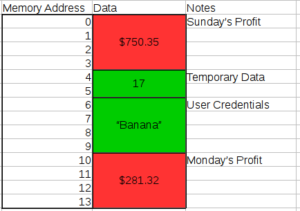
    As shown above, Sunday’s Profit is separated from Monday’s Profit (both in red) by intervening unrelated data (in green). In order to access the week’s profit, you need to know the address of each and every day’s profit, and you have to individually retrieve each data point.

    In comes a better way to handle such data: Arrays! Much like memory is an array with addresses referencing each byte, array data structures store related information sequentially so that each piece of information can be referenced with an array address.
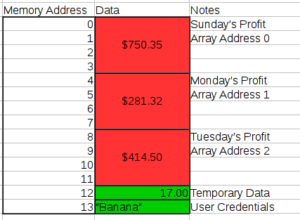
    The difference is clear. The array groups the related data together, and you can simply reference the array to get to any of the data. Array address 0 is Sunday’s profit, which is located in memory addresses 0-3. Array address 1 is Monday’s Profit and is located in memory addresses 4-7. Rather than needing to remember all of the memory addresses for each day’s profit, you can simply remember the starting memory address of the array, and use the array address to calculate where each piece of information in the array is located. For example, array address 1 translates to the array starting memory address (0) plus one array element (which is 4 bytes long), resulting in a memory address of 4. If you look at the above image, array address 1 starts at memory address of 4. NOTE: I haven’t included all 7 days of profit in the above image so that it won’t get too complicated and confusing. Here is some additional information on arrays.

    However, you can also see a limitation in the above image. It works great if you know exactly how much data you need to store, but look at where the Temporary Data and User Credentials are stored. If you need to include one more piece of information in the array, you’re hosed. Either you have to start moving a bunch of stuff around in memory to make room (which is not ideal), or you have to continue the array somewhere else in memory and keep track of 2 array portions (which is also not ideal).

    Linked Lists: Good for dynamic data

    You may be wondering what the point of all of this is. We’re talking about blockchain, not about memory management, right? I promise, this is where we connect to blockchain.

    Let’s see if we can combine the best of both worlds. Writing each day’s profit to memory separately allows you to add additional days without having to shuffle data around in the memory. On the other hand, preserving the relationship between all of the days’ profits without having to keep track of each day’s memory address allows you to scale up to large amounts of data without overcomplicating things.

    One of the “best of both worlds” solutions is called a linked list. A linked list operates much like writing each day’s profit to memory separately, but preserves the relationship between the different days by including an additional bit of information pointing to the location of another day’s profit in memory.
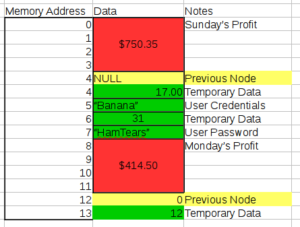
    As you can see, we have expanded Sunday’s profit and Monday’s profit from 4 bytes to 5 bytes. The additional byte (in yellow) points to the previous node. Since Sunday’s profit is the first node, its previous node is NULL (meaning it doesn’t have a previous node). Since Monday’s profit is the second node, it points back to Sunday’s profit. Previous Node 0 points to the starting memory address of Sunday’s profit.

    Visualized another way, the linked list looks like this:

    This is the basis of blockchain. A data structure with a payload and a reference to the previous block in the chain. Now let’s talk about security.

    Hashes: Breakfast for the Masses

    I dunno about y’all, but I’m sick of reading. Let’s take a quick break before getting into hashes by enjoying some pictures

    Breakfast Hash and some red meat for the audience.


    Hashes: Preserving Relationships and Security

    Alright, back out of your bunks. Time for some more learnin’. Hashes are conceptually simple, but mathematically complicated. Since we’re not diving into the math, this section should be a breeze!

    No, not that kind of Brees!

    Let’s take a look at the array again:

    If we call Array[0] we get Sunday’s Profit, and if we call Array[1] we get Monday’s profit. However, we don’t always have a situation where we know exactly what order the data will be put into the array. Imagine, for a moment, that instead of 3 days of profits, we have 3 years of profits, entered manually by an employee who isn’t guaranteed to get everything perfectly in order. How do we find Monday’s Profit in that deluge of data?

    The traditional way is to search for the data in the array. Here is some more information on searching.

    The fun way is to use hashing! How about we use some relevant characteristic of the data to access the data instead of the array index (“index” is another term for array address number). All you need is two math equations: one to determine the hash from the data, and another to determine a memory location from the hash.
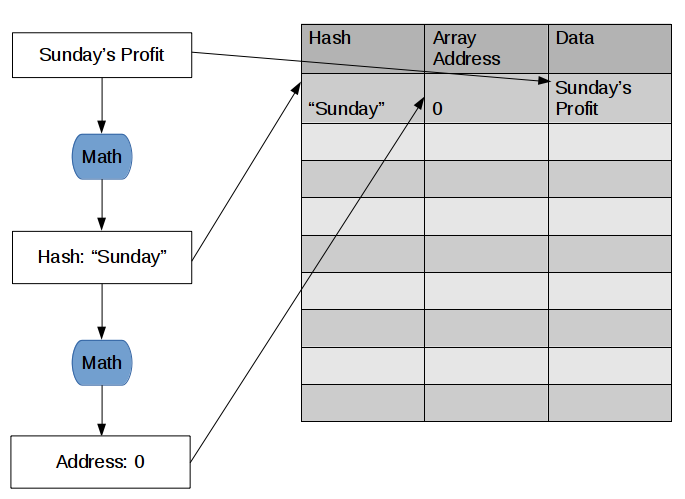
    As you can see, Sunday’s Profit data was hashed to “Sunday”, which is a characteristic of the data (specifically, the day of the week), and “Sunday” was computed to be connected to array address 0. Now, instead of accessing Sunday’s Profit data by loading Array[0], you can access Sunday’s Profit data by loading HashArray[“Sunday”].

    If this is a bit confusing, another simple hashing algorithm that appears in everyday life may clarify things. Placing medical records in alphabetical order by the first letter of the last name is another hashing algorithm. If the last name is SMITH, the “algorithm” for obtaining the hash involves looking at the first letter of the last name, “S”. Then, the hash “S” points to a specific shelf in the fileroom (the “S” shelf, for lack of a better name). SMITH’s folder is placed on the “S” shelf. When I want to retrieve a folder starting with “S”, I pull a folder off the “S” shelf, and I have SMITH’s folder.

    But there are many people with a last name starting with “S”. What happens when SMITH’s folder is stored on the “S” shelf and I want to store Slaver’s folder? This is called a “hash collision.” Depending on the specific situation, a hash collision is either an inevitability or a disaster. In cases where hash collisions are expected, we could simply change the data stored. Rather than just storing one piece of data for each hashed value, we can store the data for each hash in a linked list. Now, the “S” shelf looks like this (pointer is just a fancy term for the memory address):
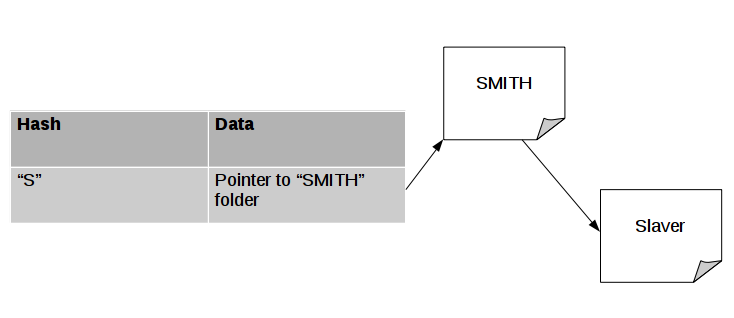
    This is great for categorization hashes like the alphabetical sorting of medical records, but isn’t the best for cryptographic hashes like are used in blockchains. Instead, cryptographic hashes rely on another protection from hash collisions, small data density.

    Bitcoin and most other cryptocurrencies use what is called SHA-256 hashing. In SHA-256, a message of any* size is hashed using really fancy math into a 256 bit number, which means there are 2^256 possible hashes (1.1×10^77 for you scientific notation folks, or roughly 1/10 of the total number of atoms in the universe). Hash collisions are so rare under SHA-256 as to be practically nonexistent.

    *Technically, there is a maximum length of message, but it’s enormous.

    But I mentioned above that hashes are based on characteristics of the data. “S” is the first letter of SMITH, and it’s fairly easy to see the relation. What is the relation between some seemingly random 256 digit number and a Bitcoin block? Well, it has to do with math well beyond my ken, but you can go here for a bit of an explanation (as well as a look ahead). In essence, the math takes all of the data, divides it into chunks, and does a mathematical transformation on each chunk before assembling the results into the hash.

    Okay, assuming you’re following along so far, you understand how categorization hashes work and that cryptographic hashes are different, but how do cryptographic hashes work?

    Cryptographic hashes work on the principle that it’s much easier to do the math to hash the data than to derive the data from the hash. Let’s look again at the medical records example for a picture of how this works. If you’re given the last name SMITH and told that the hashing function (fancy term for the math to calculate the hash) is the first letter of the last name. It’s trivial to calculate a hash of “S” from the data “SMITH.” However, let’s go the other direction… if all I give you is “S”, you have thousands of last names to choose from. The chance of you guessing “SMITH” is extremely low.

    The same principle applies to SHA-256 hashes. It’s relatively easy for a computer to calculate the hash from the original data, but (practically) impossible to derive the original data from the hash.

    We’ll discuss the specific way cryptographic hashes are used in blockchains later on.

    Let’s take another break. Things are getting a bit intense. In the spirit of the glib baby pics from a while back, here’s me in a sombrero.

    Cultural Appropriation from a Young Age

    How about some relaxing pics from a backpacking trip I took a long time ago?

    Public Key Cryptography

    Alright, back to talking security! We’ve laid the groundwork for explaining the structure and security of the blocks in a blockchain, but let’s talk about individual currency transactions and how they’re secured. If I want to send 50 bitcoins to ZARDOZ, we create a transaction to transfer the bitcoins from my wallet to his. The details will be covered later, but it’s important to notice that without any security, STEVE SMITH could read the transaction, and use the information contained in the transaction to create a fake transaction to send the 50 bitcoins to him instead of ZARDOZ.

    What sort of security is used on these transactions? Public key cryptography! Public key cryptography uses the same concept of “one way” algorithms, just like the cryptographic hashes. In fact, in some cases, the mathematics for generating cryptographic hashes is used in public key cryptography.

    How does it work? Let’s assume I want to send a secret message to ZARDOZ. I’m sending it over the Internet, which isn’t a particularly trustworthy place. I can’t just send the text in the open. ZARDOZ decides to generate two “keys.” In this context, one of the keys is used in combination with fancy math to encrypt the message so that it can’t be read by STEVE SMITH. The other key is used in combination with more fancy math to decrypt the message. The cool thing about public key cryptography is that you can’t figure out the decrypting key by looking at the encrypting key or at an encrypted message. This is called asymmetric cryptography.

    In contrast, symmetric cryptography can be “broken” by looking at the encryption key and the encrypted message. Of course, that means you shouldn’t broadcast your symmetric encryption key on an insecure channel. For example, if my encryption algorithm is addition of the encryption key to the data, and my encryption key is 4, then if my data is the number 10, the encrypted data is the number 14 (10+4 = 14). I send 14 across the unsecured network to ZARDOZ, who uses the symmetric decryption key (the number 4), and the decryption algorithm of subtraction of the decryption key from the data, and ZARDOZ gets the original data, the number 10 (14 – 4 = 10).

    Seems secure enough, especially when we use something more complicated than “add 4” as an encryption. But why are we talking about asymmetric cryptography instead? Well, because we have a problem. The Internet isn’t particularly secure, and we’re not gonna VPN with the entire bitcoin network, most of whom we don’t trust, to send them our secret key. With asymmetric cryptography, the encryption key (called the public key) can be known by everybody. It doesn’t matter if half the world can encrypt messages intended for you. As long as they’re not able to decrypt those encrypted messages, the system is secure. That’s why the decryption key is called the private key. The private key must be kept secret by the receiver of the message.
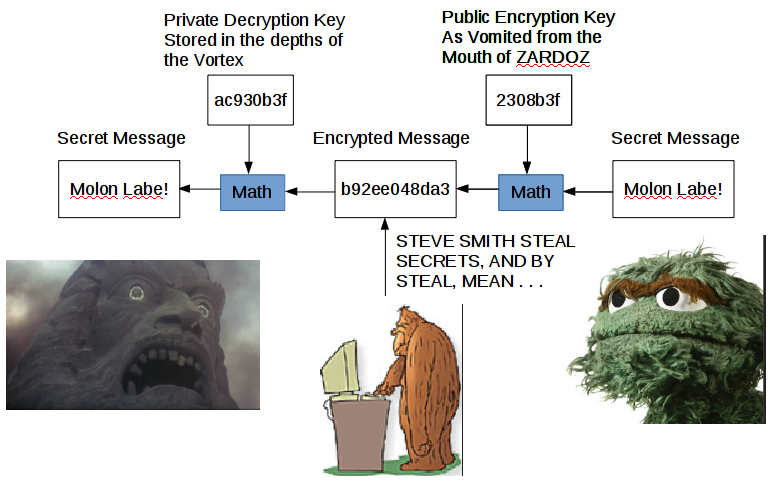
     

    As shown above, I have sent ZARDOZ the message “Molon Labe!” ZARDOZ has vomited forth (published) his public key, which allowed me to encrypt my message and send it across the Internet securely. As you can see, STEVE SMITH can try his hardest to intercept my message to ZARDOZ, but all he gets is a bunch of gibberish. Then, once ZARDOZ receives the encrypted message, he uses his private decryption key (secreted away in the Vortex where nobody can access it except ZARDOZ) to decrypt the message and read “Molon Labe!”

    Now, this is great and all, but isn’t blockchain about publicly accessible data and verification instead? Well, yes. Let’s take this public key encryption and flip it around. Now, instead of keeping the data secret, we want to make sure the data is from the right person. I’m expecting a message from ZARDOZ, and want to make sure that it’s legitimately from ZARDOZ and not from STEVE SMITH.
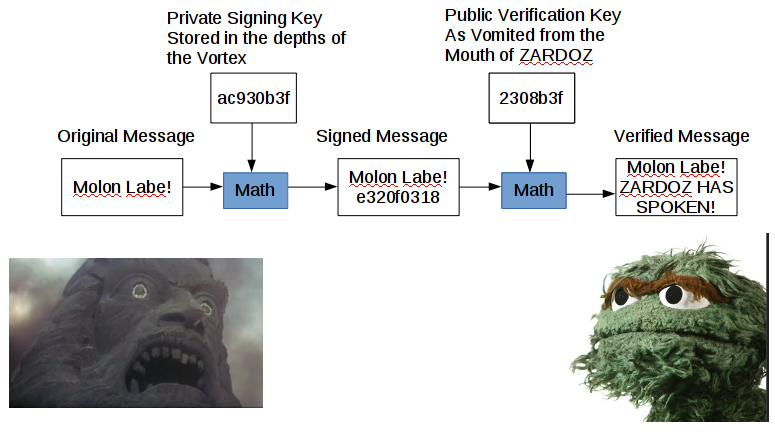
    As you can see, the message stays public the entire time, but there is extra data added based on ZARDOZ’s private key. This is called a signature. Upon receipt, anybody can verify the authorship of the message by using the public key.

    What happens when STEVE SMITH tries to meddle again?
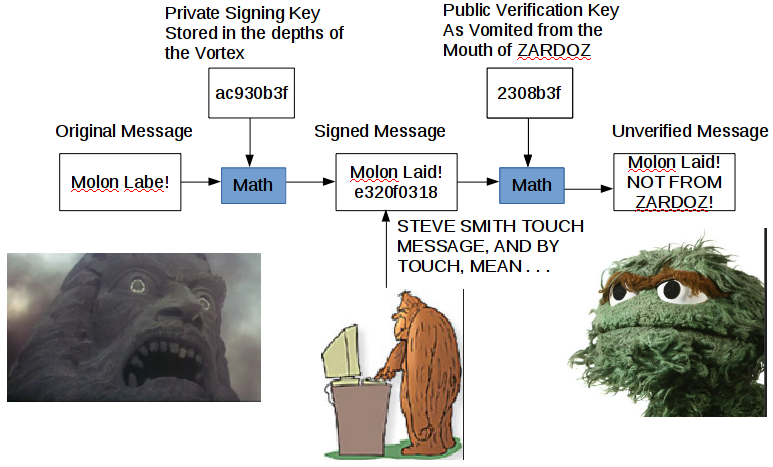
    As you can see, STEVE SMITH, in his ham fisted way, has altered the message before I have received it. When I try to verify the message’s authorship, I find out that it’s not from ZARDOZ, and thus it’s a suspect message to be ignored.

    This is the basis for verifying cryptocurrency transactions. We’ll put all of this book learning together into a workable model in the next article or two, but this article explains most of the theoretical underpinnings of blockchain and cryptocurrencies.

  • End of The Road – Truckers are soon to be replaced by Robots, but the State has already been Roboticizing The Driver


    Much has been made in recent years of the looming replacement of human drivers with Robots Self-Driving Trucks.  I, for one, welcome our new Overlords of The Road, and my concerns lie less in the inevitable evolution of technology, and more in how the state, and large, corporatist, Legacy Carriers, have been slowly chipping away at the autonomy of the individual, Over The Road, Long Haul Trucker.  In this article I hope to illustrate the history and recent trajectory of this trend, and explain the extent to which the regulation of the Trucker has destroyed a once honored and noble occupation, and caused me to give up on it for good …  even though I’ve had a pretty successful 20 year run in the business.  Perhaps, if you wonderful Glibs will have me back, I might comment on why I think those robot trucks are a bit further away than their cheerleaders anticipate, and give some insight as to why certain sectors of the business will probably never be fully automated.

    Jimmy Carter Deregulates The Business End of Trucking

    Back in “The Old Days”, getting into the trucking business was extremely difficult.  A prospective trucker had to seek a license, much like a taxi medallion, to even operate, and any rates you negotiated with your customers were mandated to be public knowledge, and could be interfered with by the Interstate Commerce Commission.  Most trucking was done by in-house transport; many shippers had their own trucking fleets, or hired lease operators who had to run exclusively under those shippers’ operating licenses.  Of course, this lead to unnecessary inefficiencies, inflated rates, and a rather noncompetitive marketplace.  And that’s not even considering the effects of one James Riddle Hoffa. *(Warning, shameless plug for one of my favorite commentators and pod-casters, well known to the readers of this site.

    All of this mess in the marketplace was somewhat corrected, and the field further opened to competition, by the passage of The Motor Carrier Act of 1980, signed into law by President Jimmy Carter on July 1, 1980.  Similar legislation followed, both provincially and federally, in my homeland of The People’s Soviet Republic of Canuckistan.

    Of course, this momentous bit of de-regulation was met with howls of protest by the dominant legacy carriers, who were now losing their oligopolies, and, to this day, is also complained about by that portion of the truck driving community who do not understand what free markets actually mean in practice.  God knows I’ve been wincing at their economically illiterate commentary since I was a kid, especially given that de-regulation allowed for once small, independent operators, like my former employers here, to grow from a tiny, family run operation, to having a fleet of nearly 100 tractors and 300+ trailers, a warehousing division, and to such size that they now employ over 200 people.

    That’s the good news part of this article.

    Any Action Will Be Met With an Equal and Opposite Reaction

    The late 1980’s and early 1990’s saw a massive increase in the competition in the trucking marketplace, which also saw the growth of 3PL’s, also known as load brokers.  Many more new companies were opening, many more independent owner/operators were hitting the roads, and the marketplace continued to evolve.  Things at the operational end of the business, however, were also evolving, and not always in a good way.

    The state, as it is want to do, can never leave a good enough thing alone, and major increases in roadside enforcement operations began to take place.  One thing that had not changed over this period of de-regulation of the marketplace was the hours-of-service (HOS) rules governing the amount of time a Trucker could work, how much rest was required, and when.  What had also not changed, since their introduction in the 1950’s, was the use of paper log books, by which truckers were supposed to record their driving hours, location, odometer readings, commodity being hauled, and base of operations, such that enforcement personnel could keep an eye on us.  The Nanny State was not satisfied with this arrangement, and through fits and starts in the early 2000’s they began to dismantle a regulatory framework, which, when matched with the ‘pliability’ of paper logs, allowed for an easier to manage compliance situation for most drivers smart enough to work with, through, or around the rules.

    From the linked wiki –

    Between 1962 and 2003, there were numerous proposals to change the HOS again, but none were ever finalized. By this time, the ICC had been abolished, and regulations were now issued by the FMCSA. The 2003 changes applied only to property-carrying drivers (i.e., truck drivers). These rules allowed 11 hours of driving within a 14-hour period, and required 10 hours of rest.[9] These changes would allow drivers (using the entire 14-hour on-duty period) to maintain a natural 24-hour cycle, with a bare minimum 21-hour cycle (11 hours driving, 10 hours rest). However, the retention of the split sleeper berth provision would allow drivers to maintain irregular, short-burst sleeping schedules. 

    The most notable change of 2003 was the introduction of the “34-hour restart.” Before the change, drivers could only gain more weekly driving hours with the passing of each day (which reduced their 70-hour total by the number of hours driven on the earliest day of the weekly cycle). After the change, drivers were allowed to “reset” their weekly 70-hour limit to zero, by taking 34 consecutive hours off-duty. This provision was introduced to combat the cumulative fatigue effects that accrue on a weekly basis, and to allow for two full nights of rest (e.g., during a weekend break).[2] 

    In 2005, the FMCSA changed the rules again, practically eliminating the split sleeper berth provision. [10]  Drivers are now required to take a full 8 hours of rest, with 2 hours allowed for off-duty periods, for a total of 10 hours off-duty. This provision forced drivers to take one longer uninterrupted period of rest, but eliminated the flexibility of allowing drivers to take naps during the day without jeopardizing their driving time. Today’s rule still allows them to “split” the sleeper berth period, but one of the splits must be 8 hours long and the remaining 2 hours do not stop the 14-hour on-duty period. This rule is confusing and impractical for most drivers, resulting in the majority of drivers taking the full 10-hour break. 

    The split sleeper provision, such as it was, was the tool in our HOS regimen which gave us the flexibility to meet the demands of life on the road, shipping schedules, traffic, you name it.  If you were held up at a customer, unpaid and with nothing you could possibly do about it, as is a common practise and endless source of frustration for the average trucker, you could at least log that time in the bunk, and make up the driving time later.  No more.

    In 2005, the FMCSA changed the rules again, practically  eliminating the split sleeper berth provision.

    This rule change, as well as the introduction of satellite linked electronic log devices, or ELDs, which become the law of the land this month have pretty much eliminated the possibility of most truckers being able to work around any schedules, traffic, weather, or this little thing called ‘life’; and to my great disgust, further remove any autonomy one might have as a trucker.  As has been posted here in a thread by yours truly a few weeks back, this is certainly not good news to the over 3 million truckers in North America who are being affected by these changes.  I mean, who doesn’t want Uncle Sam riding shotgun with you, telling you when you can eat, sleep, or shit, or undermining your fourth amendment rights against your privacy?  Sounds like fun, doesn’t it?

    Some anecdotes from my last trucking job about how that effects your life on the road –

    Situation a – I am dispatched from my former employers home base in Syracuse, New York, to a trailer manufacturer in Cheeseheadville, Wisconsin, to pick up a brand new trailer.  Around midnight, I get tired, and pull in to the Petro Truck Stop at Angola, Indiana.  No problem, right?  Yours truly wakes up at a little after 630am, pre-trips the truck, has breakfast, and is ready to roll at 730.  But according to Uncle Sam, and the mandated logging device in my truck, I cannot go anywhere til 10am, when the minimum required 10 hour break is up.  So I have 2 and a half hours to catch up on the fun and excitement to be found here at Glibertarians Dot Com, but not make any fucking money, all because some enlightened public servants pieces of shit at the FMCSA have deemed that my sleep patterns must fit into what they believe is a proper regimen of rest.

    Situation b – Yours truly is on his way back to Syracuse, on a similar trailer retrieval mission as situation a.  Approaching Cleveland, I am about to run out of available driving hours, and pull into the last service plaza on the Ohio Turnpike prior to the 90 splitting off into the west side of Cleveland.  Guess when my ten hour rest period allows me to drive again?  Right in the middle of morning rush hour.  Under the old regimen of paper logs and the split sleeper provision, or if I worked in a civilized place that allows for 16 hour (or more) windows for your drive time to be completed, or allow more driving time (such as Canada, where it is 13 hours, or Western Australia, which is quite similar), I could have kept driving through Cleveland in the evening, and parked on the east side of town, thus avoiding contributing to rush hour traffic.  The next time you are sitting in traffic in some major metropolitan area, and you’re wondering why all of these trucks are on the road at the same time, you know who to blame.

    And there are millions of situations like this taking place every day, in every subdivision of the trucking industry.  Imagine being a cattle hauler, and you have a full load of calves on board, and it’s winter time.  You run out of your 11 hours driving time, and have to stop, in the middle of winter, most likely at a location where you can’t unload your cargo and get them inside somewhere where they won’t freeze to death.  Or imagine that you are me, or one of the many other people who used to run The Ice up North (remember this stupid piece of crap of television?), and your run basically can’t be done, because it’s 16 hours from Yellowknife to the mine under optimal conditions.  In fact, there are so many of these situations, that dozens and dozens of industry groups that depend greatly on trucking are lining up and begging for exemptions to the rules.

    And the trucking industry continues to wrestle with a driver turnover problem, that, although it has decreased slightly through 2015, appears to be on the rise again.  Gee, I wonder why?

    It also seems that many of the older guys on the road, gents who have been trucking for many decades and are used to managing their own schedules, regardless of what Uncle Sam has to say about it, are going to take early retirement or find something else to do.

    At Werner, as Leathers explained, the number of drivers in the 60-67 age group had held steady for “a long, long time,” as a few would retire and about an equal number would move up. 

    In the 90 days leading up to the hours-of-service change, that number fell by half.

    “It’s my belief that’s a representative sample across the industry of drivers who just said, ‘I’m out. I’m done. Thanks, but I’m moving on,’” Leathers said. “That’s been the silent victim of these changes: The drivers that are probably some of the most-qualified we have are saying, ‘I’ve had enough and I’m not going to do it.’ That’s concerning.” 

    Steve Gordon, COO of Gordon Trucking Inc., offered a similar take. 

    “The thing that’s most unfortunate is we’ve worked very hard to build a better lifestyle for our drivers – more out-for-a-week, home-for-a-weekend opportunities. The new restart has been most painful for those folks,” Gordon said. “They can’t leave the house until after 5 a.m. If they get hung up somewhere, they lose that time the next week. So the very people we’re trying to tell, ‘we’re going to do right by you, we’re going to get you home to see your family,’ they’re the ones paying the price.” 

    Think about this for a minute.  A job which attracts people who typically want to be left alone, or have some kind of ‘adventure’, or at very least not be  under the nose of their boss all day, is being regulated to a degree which gives you very little room to schedule your day, virtually dictates your sleeping patterns, penalizes you for taking naps or otherwise attempting to make the most efficient use of your time, and provides the government with an instantly accessible record about where you have been, 24/7, and gives them unlimited access to review your HOS compliance and issue fines at will.  WHERE DO I SIGN UP?

    Where Do We Go From Here?

    For the liberty minded professional driver, the situation looks bleak.  I doubt very highly that the FMCSA is ever going to change the HOS regulations to match more humane and productive provisions in places like Canada or New Zealand, where a guy can drive 13 hours a day and, at least in Canada, has a bit more flexibility with shifting hours around.  And I also doubt very highly that the FMCSA or any state level DOT is going to give up on the rolling cash cows that are ELDs.  If you are an owner operator and you have a truck with a model year older than 2000, you are exempt from the ELD mandate, but that doesn’t help with the stupid HOS regs, and many large carriers won’t take on owner operators who choose to run older equipment.  (And don’t get me started on the EPA rules and how they have completely screwed up the engine marketplace, such that Caterpillar quit making on-highway diesel engines.  Another article entirely …. )   Trucking is an ultra-competitive marketplace for rates, and the little guy has an enormous hill to climb in competing against legacy carriers, who benefit both from economics of scale, and being large enough to enjoy the privileges of regulatory capture.  Hell, some of these arseholes, through cronyist organizations like The American Trucking Association, go right along with all of these stupid laws because they know they can comply with them.  The Provinces of Ontario and Quebec instituted mandatory truck speed limiters, restricting trucks to 105km/h (65mph) by law, even for carriers not based there.  These rules were not proposed by the Ontario Ministry of Transport, or it’s analogs in Quebec; they were proposed by mega-carriers like Challenger Motor Freight, and their crony mouthpieces in the Ontario Trucking Association.

    So what’s a guy to do?  As reported above, many older drivers who were already close to retirement are just going to pack it in.  Some, like myself, are young enough to move into other fields of pursuit, and some, perhaps, already have training or qualifications in other fields.  Unfortunately, due to the nature of the business, and the demographics of people who it typically draws from, this is not the case for the majority of people behind the wheel.  What are they going to do?   What was once considered a free-wheeling, adventurous, decent paying gig, looks more and more like a rolling prison from which many may not escape.

  • An Introduction to Bitcoin

    There’s a scene in Neal Stephenson’s “The Baroque Cycle” in which the 17th Century English economy is described as almost completely run from lists of debts due to the lack of circulating coinage. Welcome to the wonderful world of Bitcoin!

    There is no such thing as a bitcoin. When someone says “I own a bitcoin,” what they mean is “I know the code or codes that can authorize the transfer of up to one bitcoin.” If you buy a “loaded” physical token for 0.01 bitcoin on eBay, the token contains a code. Neither the token nor the code is “bitcoin,” but the code enables you to transfer amounts adding up to 0.01 bitcoin to other accounts.

    Bitcoin’s foundation is a public transaction ledger called the blockchain. Every bitcoin transaction is recorded on the blockchain and anyone can inspect the transaction history going back to the creation of the first block of the chain. Because the blockchain is public, bitcoin transactions are not as anonymous as some people currently in prison had hoped. Every new account is anonymous, but that anonymity will probably be compromised by the first transfer of bitcoin into it because the bitcoins in the source account probably have a history–and there are companies whose business plan is to delve through the blockchain to link accounts to owners and sell the information.

    Here’s how the blockchain works: people with codes that control bitcoin create transactions. Transactions can have one or more input accounts and one or more output accounts. Newly created transactions are sent to the cloud of computers running bitcoin protocol clients and added to a list of pending transactions. Anyone can download a bitcoin protocol client and run it on their computer, but running a full “node” takes a lot of disk storage space and Internet bandwidth.

    Some of the computers running bitcoin protocol clients are “mining” bitcoin. To mine bitcoin, one selects transactions from the pending list and packs them together into a binary blob called a “block”. The block is then scanned to create a “hash” value. The last digit of a 16 digit credit card number is a hash value calculated from the first 15 digits. This is how web sites can automatically determine if you’ve mistyped a credit card number.

    The hash value created by scanning a block isn’t a single digit. It’s 78 digits long, and it’s unlikely that the first hash value created for a block will “mine” the block because there’s a trick. The bitcoin protocol tries to make it so that a block is mined every 10 minutes. To do this, the protocol periodically adjusts the difficulty of mining by specifying a maximum value for the hash value. In addition to the selected transactions, the block contains a counter. When a block is first created, the counter value is zero. The block’s hash value is calculated. If the hash value is less than the current maximum value, then the block is “mined.” If the hash value is greater than the current maximum, then the counter is incremented and a new hash value is calculated. Subsequent hash values created by incrementing the counter are essentially random values from zero to 1.16×10^77. The process of mining a block is repeatedly incrementing the block’s counter and calculating the next hash value until the hash value is less than the current maximum value.

    “… What?”

    When a hash value is less than the maximum value, the winning block/counter/hash combination is sent to the cloud of computers running bitcoin protocol clients, and the block is added to the end of the blockchain. The transactions in the block are considered complete and removed from the pending list.  All the miners start the process over again, create a new block from transactions in the pending list, and commence mining it.

    As incentive to mine, the account of a miner who successfully mines a block is credited with (as of this writing) 12.5 bitcoins. This is how new bitcoins are created. The number of bitcoins created for each successfully mined block declines slowly over time. Miners can also keep any change left over from a transaction. If a transaction specifies an input account that contains one bitcoin and specifies the output account should get 0.99 bitcoin, then the remaining 0.01 bitcoin is kept by the miner. This is incentive for miners to include the transaction in their blocks.

    Most mining is done by groups of miners who join together in a mining “pool.” A central computer creates the block which is sent to the members of the pool. Each member mines using a different initial value of the counter.  If a pool member mines the block, the result is sent to the central computer and the pool members share the reward in proportion to their effort. Anyone can buy a mining rig on eBay and join a mining pool.

    Bitcoin mining is almost exclusively done by specialized mining equipment, and the price of bitcoin is directly related to the cost of the electricity required to mine blocks. If the exchange value of bitcoin rises to the point where it’s very profitable to mine, then existing miners buy more equipment or new mining pools are created. This makes mining faster and blocks are mined more frequently than every 10 minutes. This makes the bitcoin protocol increase the mining difficulty by decreasing the maximum hash value. This means miners have to mine longer to mine a block using more electricity and reducing profits. Miners must sell some of their new bitcoins to pay for the electricity used, so the price of bitcoin is ultimately related to the cost of electricity.

  • Manly Monday – Cooking With Bears

    Back by (surprisingly) popular demand, but probably on an irregular basis!

    My boyfriend has been marketed to: a British honey producer—Rowse Honey—asked their advertising firm for something interesting and challenging and someone came up with selling honey with bears…gay bears, three of them…and porridge. Unlike the BF, my preferences do not begin and end with “is a bear,” but the ads contain three hirsute men of varying beefiness preparing oats, doing yoga, and chopping wood and they’re charming as all get-out. Rowse is available on Amazon, but not with Prime shipping (boo!)

    https://youtu.be/KSZJ8yH_u2Q

    Part of the problem with doing Manly Monday is that I start GISing something topical like “scruffy men in aprons” (hey, it’s Thanksgiving week*) and then have a difficult time finishing the task at hand my post. It’s fun how a simple image search can lead one to #bearnakedchef a web series of Adrian De Berardinis cooking in just an apron (often just over his nethers). *Except in Canada where y’all already blew your Thanksgiving wad

    Or that there’s a combination photo/cookbook of Italian bears cooking healthy Italian cuisine (one of whom looks suspiciously like a doctor/former chef I work with).

    And then you might stumble on scruffy pizza chef, Daniel Gutter who goes by @Pizza_Gutt on Instagram and makes (wait for it) deep dish pizza in Philly, and was harassed online because his username was too close to #Pizzagate (wtf is wrong with people?)

    http://www.instagram.com/p/BMfUSZdDab4

    All that said, I need to kill the GIS window, don a full body hair net and get some cooking of my own done.

  • Intersectionality

    My friend told me about a new used car dealership that opened up in town over by the railroad tracks. The owner decided he’d revolutionize the used car industry by offering cars at their true  market value plus a 5% bump for overhead and salary. He’d make up for the lower margins with volume.

    Possibly the woman who was the inspiration for this story.

    I strolled into his lot and started kicking tires. A 2009 Honda Fit caught my eye. 17K miles and the body looked perfect. “Why don’t you take it for a spin?” the owner asked as he flipped me the keys. It had responsive steering, supple brakes and decent power for such a small engine. “We’ve checked around and this model with this mileage and condition goes for $7,200, so we’re offering it for $7,530.”

    I stood there thinking about it for a long while. I had only $7,100 to spend. Of course, I needed the car for work and my job was essential to put food on the table, so I knocked $200 off his price in my head. Being a woman, it was obvious that I could be raped walking around at night, so I sliced another $300 of the price. Really, how much would it cost society to deal with another rape? And, isn’t this owner part of the raping gender? Also, I’m nearing fifty years old, so I’ll need money for retirement. If I don’t have enough for my old age, I’ll be a burden on society. I knocked another $500 off his price. Raised by a single mother: $600. Genetically prone to obesity: $450. Lesbian experience in college: $150. Bad teeth, left handed, bad at math, more than five vowels in my last name. The numbers were flashing through my head like John Nash working on differential geometry.

    Finally, I had my answer. “I’ll take the car. According to my calculations, you owe me the car and $2,600.” As I listed my deductions, the left side of the dealer’s face started twitching. When I reeled off the last deduction, he reached out his shaking arm and handed me the title.

    . . .

    She pulled out of the dealership in the purple Honda Fit and turned up the song that came on the radio. She had loved Alanis Morissette ever since she had heard it playing in the background while eating out her college roommate. She looked in the rear view mirror and saw the dealer waving good bye, some pinkish liquid running down his forearm. She thrust her arm out the window and flipped him off. “Fuck your white patriarchy!” she yelled and stomped on the gas.

    . . .

    BAAAAAAAM! “Hey, Boss. What was that?” the young mechanic shouted from the Fiat he was under. “No problem, kid. Just means the train was on time.” He started wiping off the brake fluid on his arm, proud of himself for not mansplaining to the lady that brake lines were bad.

  • Mother Theresa Makes $4/hr at Burger King

    By compgrokker

    This is from a long, far-ranging discussion of economics and politics a former friend and I had on Facebook, and this post was originally written in 2013. I think this still stands up well, but this is not a new post.

    My friend has a BA in Business Administration, hence the reference at least once to his business degree, and presumed cluefulness about how businesses operate and how business owners think. This jumps into the middle, and I’d rather just post this as-is, so I’ll paraphrase his points leading up to this. We wandered over to minimum wage via government regulation (which in turn stemmed from a discussion of the incestuous relationship between business and government); I’d said that most regulations are obsolete and hurt business, he pointed out that yes, some are obsolete, but others are there to protect people, and voila, minimum wage is an example of protecting workers.

    My response:

    You and I are coming from the minimum wage question from 2 completely different angles. You believe in (federal) government protection of workers. I believe in the (federal) government sticking to the Constitution… and minimum wage isn’t in the Constitution, even under the commerce clause (what Joe Shmoe is paid in Wichita, KS, has nothing to do with a different franchise in Kenosha, WI, selling their burgers). If it was a state minimum wage, it’d be a different thing… although I’d still be against it, the “it’s not a role of government” argument wouldn’t apply.

    However, setting that argument aside, I’m still coming at it from the side of “personal responsibility”. You have 3 options as a burger flipper: either find an employer who will pay you what you think a burger flipper is worth at whatever quality of burger flipper you are (I’d assume shoddy, since you feel you need some kind of protectionism to get paid a ‘decent’ wage, but I may be wrong and you may just be ignorant and unaware that you can switch jobs without your world shattering), be the best damn burger flipper you can be and justify that raise you’re asking for (what everyone making over minimum wage does when they want/need to make more money), or learn a skilled trade or get a higher education in something and stop being a burger flipper and start being something like a carpenter or architect.

    Again, I’m not talking out my ass, or in theoretical terms about things I only vaguely observe from some mystical ivory tower somewhere… I have the t-shirt. In high school and through college (and after college for a couple years, because of the recession) I worked really crappy jobs. Food Lion and Walmart didn’t pay minimum wage (even McDonald’s doesn’t), but it was bloody close. After I moved out, I didn’t make enough most of the time to cover my gas and such (I was in college by the time I moved out)… so I did the best job I could do and got raises every year. When I could, I got promotions. And when I found a job that paid me well and needed my skill set, I changed jobs and came to work at my current job. I didn’t ask the government to make anyone pay me more, or wish minimum wage was $12/hr… I made myself a better employee and justified the money I was getting, and went above and beyond so raises and promotions would be justified as well.

    And since you have a BA, I assume you know as well as I do that businesses aren’t charities– they aren’t there to give workers the money they ‘want’, or deserve for being a special snowflake human being. Businesses exist to make money, and as a side effect pay people to make money for the business… and that pay is in proportion to a person’s value as an employee. If Mother Teresa sucks at flipping burgers, then dang it, Mother Teresa deserves minimum wage… or to be fired. It doesn’t matter to Burger King that she’s Mother flippin’ Teresa, man. She’s a terrible employee, and her pay reflects that.

    Also worth noting is the point he’d made earlier about employees being replaced by automation if they get too expensive to employ. This is a very valid point that most minimum wage workers and people who advocate for them don’t seem to understand. Again, people own businesses to make themselves money. If they can’t make enough money, something’s got to give. And when there’s no more non-employee overhead to cut, they need to start cutting people. As a general rule of thumb, it costs about twice an employee’s gross pay to employ them (given employer shares of FICA, certain states’ income tax, worker’s comp, benefits, etc.)… so that $10k/yr employee actually costs the business owner around $20k. I’d imagine Obamacare penalties and/or post-obamacare insurance premiums have upped that 2:1 ratio. So if it costs less than $20k/yr to set up an automated ordering kiosk and a burger flipping robot, guess what a business owner is going to do?

    And then there’s the economic effects of raising the minimum wage. Less than 10% of workers make minimum wage, so this would have very little direct positive effect on people. However, in short order, it would have great negative effects on a large number of people. Artificially raising the wages of one segment of the population increases cost for certain businesses, they raise their prices, which raises costs for other businesses, and so on down the line until prices have increased across the board, and we’re right back where we were. This is how raising the minimum wage is a driver of inflation.

    In this country, like most countries in the world, we have a fiat currency; that is, a currency whose value is not linked to a commodity (like gold, silver, or salt), but is based on the trust that the country issuing the currency can pay its bills. By its nature, fiat currencies are subject to almost constant inflation through devaluation of the currency. Especially when the country in question is engaging in… let’s say non-optimal monetary and economic practices. In our case, budget deficits, a high national debt, and things like quantitative easing. It’s part of the reason everyone’s parents have stories of “I remember when gas was $0.35!” (for my generation’s parents) or “I remember when gas was $0.98!” (the story I get to tell if/when I have kids and they’re old enough to be regaled with tales of ‘the good old days’). Another factor in inflation is artificially raising wages– you’ve arbitrarily decided that the dollar is worth less than it is, so people need more of them. And by deciding that one segment of the population needs more, less valuable dollars, everyone else needs to have and spend more, less valuable dollars to keep up with the sudden devaluation of a dollar for a certain segment of the population.

    So, with a rough idea of how inflation works in mind, it makes sense that raising the minimum wage (or even having one, I would argue) is detrimental to the economy as a whole, and you end up chasing your own tail. What happens when inflation catches right back up to you again? The cycle of artificial inflation begins again, and the minimum wage is raised, devaluing the currency and forcing business costs to go up, rippling down the supply chain, raising costs of end-consumer goods, etc. We aren’t going to rein in fiat-based inflation any time soon, but we can stop wage-induced inflation by not raising the minimum wage.

  • Minimum Wage and the Youths

    Alright, here’s what’s gonna happen, I’m gonna start out with a story from my job, talk about minimum wage and why kids don’t work today, then end with a gripe.

    Foreseeable consequences are not unintended.

    So I was busing tables for my $1.50 an hour, you know just watering and cutting bread, when this kid, and when I say kid, I mean a guy who was 23 and had never had a job, who was simultaneously well groomed and unkempt walks in. I thought to myself, “Oh God, fine I’ll water you and cut, whatever.” So I continue on and water him and all that. He was rude to me and the server who I’m friends with so I didn’t like this kid, but fine again, whatever. So as the night picked up, I passed by his table a few times until eventually he drops this line on his parents, “As long as we have a middle class in america we can’t have equality.” Now I had to water and cut bread so I didn’t hear more. But this made me so angry that it almost ruined my night, a night which already had a lot going wrong recently.

    Alright, story time’s over, now it’s time to talk about the minimum wage. Now this is already a loaded topic so I’m not going to step into what is so intricate about it, but instead I’ll cut right to the meat of my argument. It’s not the only reason why kids can’t get jobs now. Much of the refusal to hire kids is due to the following two reasons:

    1. Kids are now less willing to work and are thus less reliable workers who employers are willing to hire
    2. And kids provide a whole slew of issues, to the point where even if they are willing to work, they are not allowed to work in certain places

    But let’s break both of these down. Amongst kids there is a lot of pressure to not only socialize, but also to play structured sports, to the point where they have no time to spare between homework and extracurriculars. The extracurriculars are mostly used by parents earlier in the kid’s life to signal their wealth. These extracurriculars tend to then continue later into the kid’s life until we have the current situation. But what about the liability issues? Well, they primarily start around the following two laws “kids under 16 may not work with food” and “kids under 16 may not handle cash.” I don’t know if these are federal or state, but it meant that until I was 16 I couldn’t get an actual job. There are also safety issues which mean that kids can’t be involved with heavier labor like landscaping unless they get expensive medical testing. This renders most jobs unavailable for kids.

    Now onto the gripe. I don’t earn $1.50 an hour on my actual paycheck, instead it’s $5.50 an hour plus tips. But the payroll tax is so utterly fucked, to the point where out of every $5.50 I never see $4. That’s $4 which goes to the fedgov and not me. Fuck payroll and income taxes together. Anyway, y’all let me know if you have any stories of your own.

  • Grow Weed They Said. It’ll be easy, they said.*

    *Okay, no one said that.  But this is the story of my getting into the pot business (sorry, no Mexicans and only tangential references to ass sex) and commentary on regulatory issues from a libertarian perspective.

    1. Just doing some market research

      Organic, Hydroponic, Outdoor, Indoor (Why weed, philosophical considerations)

    My career has been in IT, Operations, and Finance for Food & Beverage manufacturing.  I’ve got a bunch of certifications that prove I can manage a project and make improvements and create models.  But the winter of 2016 was one of discontent. I realized that if I continued working in a cubicle / office at a large corporation, I was going to splatter someone’s brains all over the beige fabric cube walls.  And since I am too ornery for suicide and too pretty for prison, I decided to get out of Cubeville. My performance had suffered, and I wasn’t fitting culturally at work anyway, so when they offered me a chance to leave, I took it.

    My business partner is a friend from the kink community.  His career has mostly been IT startups.  And two years ago he started doing research into becoming a canna-business owner.  When I lost my last job, he invited me over to hang out, showed me the operation, and then talked to me about my plans.  At that point I wanted to simply take a month off; period.  I haven’t had a vacation except for family visits, in over 5 years.

    I started helping with his small med grow just to have something to do and get out of the house.  The month elapsed and we started discussing it in earnest.  What it would take to get involved money wise, plans, the pot market itself, the various options and strategies.  I started thinking about it more and doing some of my own research.  I had, by that time, decided I wanted to start my own business and this seemed like a good opportunity.

    I’m not a pot user.  In 42 years old and I’ve used pot maybe 10 times, all within the last few months.  But that’s okay.  I see its uses for both recreation and medicine as valid.  One needs pleasures in one’s life, and while I think pursuing them in some moderation is better, others may have different priorities.  I think that whatever risks come with using marijuana are small enough and manageable enough that I am satisfied morally about selling it as a legal product.  Were, say, heroin to be legalized, I wouldn’t feel the same way as there does not seem to be a way for one to use that drug and stay productive.  That was critical for my personal decision making – can people use pot and still function or even improve their functioning?  I think so.

    I also realized I was enjoying myself when I was helping out my friend (and now business partner).  We were building things, figuring out how to get things working, digging in the dirt.  I’d come home tired and dirty and happy.  I spent 20 years trying to get away from anything agricultural because I grew up in a rural area and thought success was wearing a 3 piece suit.  But success is enjoying your life and the people in it.

    On a business level, cannabis is at an interesting place.  I worked in the craft beer industry for a few years and investigated the craft distilling industry as a potential business and I found the history informative.  Those families that acquired distributor licenses when the 22nd Amendment was repealed have businesses now that that are worth 100s of millions of dollars.  They got in early and they are still reaping the rewards generations later.  It’s also interesting to look at wine in the late 70s – early 80s, craft beer in the 80s and early 90s, and craft distilling since the early 2000s.  The early movers into those markets are doing well and have strong businesses.  Now’s the time for getting into the legal cannabis market.

    1. Growing Cannabis; Clone to Flower (Startup Life, Entrepreneurship)

    I didn’t chose the startup life, the startup life choose me.  I use that quip sometimes when I have a play partner ask when I can tie her up again and I have to beg off due to running the business.  It’s true that running your own business can suck; your boss is usually a dick that rarely wants to give you any time off, and sometimes the sonovabitch doesn’t even pay you, you have to pay him.

    My wife and I have always been white collar folks, making excellent money.  Further, we lived well within our means and don’t have kids.  Which translated to us rarely having to worry about money.  We made way more than we spent, even after savings, so we had a huge cushion.  Part of being an entrepreneur is that I’ve had to give that up a little bit.  My wife still has her white collar job and makes enough to support us easily.  But that carries its own struggles with it.

    First and foremost I was brought up to, at the least, do my fair share for my family, to be the breadwinner.  Yes, yes, I’m a cis-het shitlord.  Whatever.  So there’s some ego issues with being dependent on the wife’s income for the bills.  Also, since she is fascinated by arcane Jewish rules despite not being a Jewess, she claims that since I am technically unemployed, I owe her sex twice a day. I do my best to fulfill that obligation despite not being Jewish, so that keeps her happy with the arrangement. Be that as it may, it’s also a calculated risk, that if this hits as well as it could, in a few years the business will support us in a way that would mean a lifestyle of wealth and time to enjoy that wealth.  In the meantime, we are budgeting and making sure we continue to live within our means and it is well worth it.

    And that calculated risk I mention does have a huge potential payoff.  This is something an entrepreneur has to learn to deal with; risk calculation.  Which sounds kind of scary, but is fairly simple if you understand a little math.  What’s the potential worst case scenario?  What’s the best case?  What are the odds of each?  Apply dollar amounts to the first two and multiply them by the answer to the last question.  If there are things you can do to improve the odds adjust for that, then compare your values and that should help make the decision.

    I don’t want to get into specifics of how much I’ve invested, but I’ll walk through the math.  I’ll also talk a little about where the investment money came from.  We moved to Portland 4 years ago and bought a house at a relative low in the market.  A couple of years later we moved out to the suburbs but kept the original house.  Due to the house’s location, when we sold it this spring, we made a substantial sum of money.  The profit was about 5x of what we expected to make in that period of time. Even after paying off some remaining grad school loans, tucking some away to fatten up the retirement account, the amount needed to invest was less than the remainder.  It’s essentially a large windfall, or as I refer to it, we’re playing with house money.

    So even if we lose that money it doesn’t damage us long term.  There’s an opportunity cost, of course.  We could have put that money into paying down our existing house, or invested it in some other enterprise.  But anything we do with it would have some risk.  The other potential cost is the salary I’m forgoing for the next two years while I try to launch this.  That’s my downside number.  Let’s call it $100k just to use a round number.

    The upside, of course, is if the operation is successful.  Since the partnership is 50/50, I simply need to calculate what the expected revenue will be over the next two years and what the profit is going to be.  Right now, even the really poorly run ops are making about a margin that is about twice what a well-run food manufacturer makes, and about 25% more than a well-run alcohol producer.  For the sake of discussion we’ll put the amount of money I can expect from the profits at $1.5mm.  Again, not a real number, but it is proportional to the real number.  This also ignores the longer term, and options for integrating the vertical by spinning up a processor and our own retail outlets, as well as some other strategies we have for expansion.

    Alright, the risk is losing $100k versus winning $1.5mm.  So what are the odds of each happening?  That’s the real important part of the decision.  Let’s assume the failure rate is 90%.  In reality about 67% of cannabis businesses in Oregon have failed.  The vast majority were due to failure to comply with either reporting requirements or basic shit like tracking your employees’ hours and properly paying them, which even some fresh off the boat immigrant can manage when starting a restaurant.  So that failure rate is low, but for determining expected value, I think it’s a good number.

    Multiply $100k times .9 and that’s $90k.  Multiple $1.5mm times .10 and you get $150k.  Subtract the $90k from the $150k and my expected value is $60k more than if I don’t take the gamble.  That makes it a risk worth taking.   That ignores that it is difficult to value the experience of trying to start my own business and the freedom and flexibility it provides me.

    Any entrepreneur needs to think in those terms, and unless you are starting a lifestyle business, you also need to think of terms of longer term potential.  My guess, taking in the past closest benchmark industries (alcohol, primarily), looking at the current demand, and at the future possibilities is that this can be huge.

    The market for legal recreational and medical marijuana is massive.  In Oregon at least, the demand is higher than the current level of supply.  That gap is closing, but it’s going to take a few years for several reasons.  Most of the early entrants were black market or med growers who had been growing enough to make a house payment.  They are good growers and make some excellent weed.  But their business sense is limited.  They’d get hooked up with an outside investor that had the money, but no knowledge of growing or interest in being intimately involved.  They could smell the opportunity, but didn’t want to be heavy lifting investors.  So they wrote a check for $1mm or $2mm.  And in a year, they are out of business because the grower burned through the cash.  Or they can’t comply with the regulations.

    We think our competitive advantage is that my partner and I have grown the product and developed our basic process along with an experienced grower.  We believe that we can bring an analytic, process based approach to growing that few others can.  Which will allow us to get big enough so that when the market hits saturation and prices start falling down to commodity levels, we have higher margins than average and are able to weather those changes while also scooping up smaller grows.  The margins decreasing will only help us as it puts pressure on less well-run organizations.

    We also plan to invest heavily in vertical integration.  Once the first Tier 1 is fully operational, we’ll open a processor.  Then we’ll start the franchise part of the business.  There are lots of good growers that either don’t have the cash to get the land, or don’t have much business sense and know it.  While we can’t own more than one license of the same type, we can lease the land and provide services to other growers and/or investors.  We’re working on the details of that, but it lets us expand legally.  Within five years we expect to have our Tier 1 grow, a piece of 3-5 more Tier 1 grows, a processor, and some retail outlets and a testing lab all under our umbrella.  We have specific landmarks and decision points along the way.  But we are building an enterprise.

    Which brings us to exit strategy.  Which is venture-speak for ‘how are you going to really get paid off for this investment?’  Are you going to sell it to someone else? Keep running and growing it? Own it but let someone else run it?  The answer is; we have plans for each eventuality.  I’ll talk more about this in the last section.

    1. A little spindly, innit?

      Medium and Nutrition (Specifics about Weed growing)

    Cannabis is a weed.  So it should be easy to grow.  And that’s true.  You really only need some dirt, some water, and some light and you can grow a marijuana plant.  But there is a difference between growing a single plant and running a farm, both in terms of quantity and quality.  It takes skill, art, and science to grow large quantities of high quality product in a given space.  Like any other similar enterprise, it’s all about yield.  And keeping costs down for each pound you produce.

    So every ounce of marijuana starts as either a seed or a cutting.  Either way, once the seed or the cutting has roots, it’s placed in a growth medium.  That can be soil or hydroponic.  We grow in a soil like medium called Tupur.  It’s made primarily from shredded coconut shells.  It provides a medium for the roots of the plant, but no nutritional value like various other types of soil.  The advantage of that is that we can feed more often than if it were in soil and at lower PPM of the nutrients.

    That helps in the next stage which is vegetation.  The objective in this stage is to grow the plant and strengthen it to prepare it to go into flower.  Flowering is determined by the number of hours of darkness the plant experiences each day.  The plant will stay in veg as long as it has more than about 13 hours of sunlight.  There are some differences between strains and the easy way is to just keep them under the right kind of lights 18-24 hours a day.  The longer in veg the bigger the individual plants become and the more they’ll yield when they go into flower.  It also allows for different styles of growing; trees (tall), pineapple (bushy), or various types of trellising.  There is a trade-off; the longer spent in veg, the longer until you get your final flower.  So there’s some balancing we’re still figuring out on that.

    Once it is time to go into flower, the grower needs to see that the plants are in total darkness for a certain amount of time.  Usually 12-13 hours.  This is the natural state of things in the fall when the plants normally flower on their own.  But it can be induced artificially outdoors by having green houses with systems for blacking out the green house, or indoors by simply turning off the lights.  Flower usually lasts for about 8-9 weeks.   Though for some pure sativa strains that time can as much as double.

    In flower is where the bud begins to form and grow.  The signs one is looking for are solid, dense buds, for the trichs or sugar on the leaves close to the buds and the buds themselves, and looking for other signs on the buds related to the color and density in the buds.  There is some art to this and if you harvest too soon it can impact the levels of THC and CBDs, as well as the taste and the quality of the smoke.  Harvest too soon and the smoke can be not as smooth or be “speedy” meaning you get amped up instead of relaxed.

    When the bud is ready, it is time to harvest.  This involves cutting down the plants so that the buds can be dried and cut away from the branches and remove the unwanted stems and leaves.  The bud also needs to cure a little while to make it the smoke smooth and maximize flavor.  Each bud has to be trimmed and the old school way is to hand trim it so you leave just the right amount.  For large harvests though, machines are used.  Slightly lower quality, but much more efficient even than orphans. Once the cure is finished, it is time to sell.

    Selling for a producers is wholesale.  You’re usually selling pounds at a time to dispensaries.  There’s some sales effort involved, but much of that is simply taking samples to the buyer at a dispensary, smoking it with them, and then arranging the order and delivery.  The three biggest factors are the amount of THC and CBDs, the way it looks when displayed (bag appeal), and lastly how it actually smokes.

    1. Insect & Pest Prevention (Taxes, Regulation, and Weed)
    When you wait too long to harvest…

    Regulations surrounding weed are interesting.  They fall broadly into three types in the state I’m in.  First are the types of license, second are zoning related for getting your license, and the rest are operational regulations for keeping your license and being able to sell your product legally.  The industry is over regulated, but then, virtually every industry is.  And in some ways, pot is less regulated than beer, wine, and liquor if you put aside Federal laws.  It’s also less regulated than the food manufacturing industry.  The regs are cumbersome and immoral because FYTW and god forbid people actually /enjoy/ themselves, but that’s true for many products.  In this section I’ll try to review the basic regulations and how they interfere liberty and some of the unintended consequences I think they bring about.

    License Types – One can have either a med license or a recreational license.  With med you pay an extra fee on your med card and designate a grower.  Depending on where you are, you are allowed a certain number of plants in flower at any given time.  There is no real limit on the number not in flower or on the amount produced.  You can stack cards, meaning get someone with a card to designate you as a grower, but there are limits on the maximum number of cards you can stack.  Other than that, there is not much regulation or reporting required.  And if someone reports you, the cops have to call and schedule an inspection when it is convenient for you.

    Recreational is a different game.  It is more complex and brings with it more reporting and regulatory oversight.  But that plant limit goes away and is replaced with square footage limits. In Oregon, there are no limits on the number of people who can have a recreational cannabis license for any of five categories; Producer, Processor, Wholesaler, Retailer, or Research.  The same person or group can have all five if they like.  And there are different types of sub-businesses.  For example, a seed bank is considered a producer.  A lab is considered a processor.  A home delivery service is a retailer.  The exact same ownership group can’t own more than one license of the same type, but there are ways to burn that bridge.

    Zoning – The way zoning plays into is that each county is able to have its own zoning regulations related to the various types of licenses.  So they can designate various zoning types as allowing only producers and whether it is only indoor or outdoor producers.  Any interesting side thing is that the difference between indoor and outdoor is whether the structure has lights.  So if you have a greenhouse with no lights, it is an outdoor grow.  If you add lights, you are an indoor grow.  The reason that matters is both zoning and that a Tier 1 license (the current largest) allows for 40k sq ft of canopy in flower outdoors.  Indoors each sq ft of canopy counts for 4 of those sq ft.  So effectively it is 10k sq ft. of indoor space allowed.  Or you can do a mix of say 5k indoor and 20k outdoor.

    There are also zoning laws related to minimum property size, how close to the property line the grow can be, what kind of odor remediation has to be done, visibility of lights, and the kind of fencing and access control that are required.  Those all vary for the different kinds of rec licenses.  There are other oddities such as you can have a Producer license for land that is considered Agriculture only and it will satisfy that requirement, but you can’t count the income from that toward your tax status.  This is one area where the zoning is slightly more complicated than other agri businesses.

    Operational – The real regulations come in as part of applying for the license and keeping it.  The biggest are all around reporting.  The weed has to be tracked individually by plant, including the state of life it is in, and any changes made to it.   So, for example, plant 001 has to be trimmed.  You have to account for the weight of how much of that is disposed, and if any clones are made from it, you have to track that as well.  Once harvested the weight of the flower and any waste or other byproducts have to be tracked.  All those numbers have to be reported to the agency monitoring compliance, the OLCC.  When you sell any product to another rec license holder, you have to track that as well, so that there is ‘seed to sale’ visibility and prevent weed going into the black market.  This is actually common in the food, beverage, and alcohol industries, at least the tracking if not the reporting.

    To add to that, the entire grow operation has to be covered by cameras that run 24/7.  Again, this is to make sure you aren’t slipping stuff out the back door into the black market.  The recordings have to be made available to the OLCC at their request for spot checks.  It’s also security for the rec operation as it helps with dealing with any thefts. Slipping stuff out the back door is really dumb.  As we all know, the back door is for going in.  *ahem* When people do this, they are risking 100s of thousands of dollars of revenue for a couple of extra grand by selling to the black market.

    The last of the big three are testing requirements.  For every 15 pounds of product, you have to take random samples and send them to a lab for testing.  The testing provides proof that you haven’t used any banned pesticides and that your weed is ostensibly safe to consume (compared to literal Mexican ditch weed, most of the stuff on the banned list could be safely used).  It also provides information on THC and CBD content that has to be placed on labels for packaging.

    There are some other minor things related; you can’t have barb wire on your fencing, you can only have so many visitors per year to a grow operation, and a few other things.  But the other three are the big ones.  Compared to other industries, they are a little intrusive, but not as complicated.

    From a libertarian perspective, the zoning, the size limits and the like are all ridiculous.  Those are things which can be worked out by individuals. The monitoring to prevent the black market is, of course, ridiculous.  Any adult who wants to buy should be able to buy however much they want from anyone willing to sell it.  And the testing reqs are things the free market would demand anyway.  So they simply add cost to the entire enterprise without much real value.

    1. Harvest, Trim, Cure and Sell (Where I think this is leading)

    From a macro perspective, I think full legalization of marijuana / cannabis is on the horizon.  While Sessions has a hard-on about it, I am not particularly worried that he’ll go after legal producers in states where it recreational is legal.  Oregon makes far too much tax money from weed to cooperate if the feds go after their legal producers.  But the state does have incentive to cooperate in going after black market producers.  Which allows Sessions to beat off about stopping the demon weed and the states to force more of the black market producers toward getting legal so they can get that sweet, sweet lucre.  Extortion 101.

    Beyond that, the real question is when it will be removed from Schedule 1.  My estimate is sometime in the next 8-12 years.  We’re down to only 2 states where marijuana possession is fully criminalized.  All the rest range from being fully legal for both medical and recreational (8 states) to simple decriminalization.  The holdouts are really the Midwest and the south east.  My guess is that once Texas and/or Florida allows rec or one of the south east states (NC, SC, VA, TN, AL, GA) allows med and/or rec that’ll be the final nail in the coffin.

    There’s also growing pressure from various corporate interests.  Monsanto is huge in the space at providing lights and nutrients and the rest of the infrastructure and equipment.  There is interest from the tobacco companies as well, but they can’t get involved until it is legal nationally.  Pharma is opposed at the moment, but I think if you ever see Merck or Bayer get onboard that could help speed up the change.

    As I mentioned earlier, cannabis wholesale prices are going to fall as more competitors enter the market.  As that happens, you’ll see the standard consolidation.  The enterprises that are well run and forward looking will start opening operations in new states that open up their laws.  They won’t be able to transfer between states, but they’ll be well positioned to gobble up the smaller operations that have good growers, but poor business practices.  And the ones that survive that sorting out and are large enough to be operating profitably once national legalization happens will be acquisition targets for the Monsantos and Mercks and RJRs.

    I don’t think the regulations will ever be less than they are now.  Unfortunately, I simply don’t see a libertarian moment occurring that will bring the overall level of regulation down.  The best the cannabis industry can hope for is a similar level of regulation to the alcohol industry, unfortunately.   Which proves we don’t live in the best of all possible worlds, but it would be an improvement over the current situation.

  • 81) #Metoo

    By Just a thought not a sermon

    Because this is exactly what it’s like, amiright?

    81) The thing about this #metoo crap is that it implicitly seems to accept that sexual harassment or discrimination is something primarily experienced by women. My own life contradicts this. I have experienced sexual harassment and discrimination multiple times, and so far as I can tell, my incidents occurred with no less frequency than for the average woman. The difference is, I’ve never tried to make myself out to be a victim.

    When I was in high school, a girl I wasn’t interested in pinched my ass in the hallways several times. #metoo? No, I got tired of it and told her to knock it off, so she did.

    Another time in high school, a substitute teacher in my drama class sat on my lap and put her arm around me. I was NOT interested and found the whole thing embarrassing. #metoo? No, a little embarrassment didn’t hurt me, and I just rolled my eyes about it later.

    When I was in college and graduate school, there were several occasions when girls I wasn’t interested in would come on to me, a couple times accompanied by unwelcome touching, at least one persisted even after I politely tried to turn her down. #metoo? No, not here, either. Somehow I managed to escape these situations without permanent psychic damage. That sometimes someone is attracted to another person and expresses that in an awkward way seemed sufficient explanation to me.

    Before moving on, I’d just like to point out that I’m a reasonably good-looking guy who stays in shape, but I’m no Adonis. I don’t have a flirtatious or outgoing personality. There’s no special reason I should receive more romantic attention than other guys, and I don’t believe I do. I think nearly every man could tell similar stories to the above.

    On a more serious level, I had an internship at an academic non-profit in downtown D.C. when I was in graduate school. Their financial officer was a loud feminist, and also a recent divorcee who never hesitated to put in a bad word about her ex—or men in general. Every once in a while, we used to have sessions where everybody would go to the conference room and we’d stuff hundreds of envelopes with invitations for upcoming events. These were usually good times when everybody got a chance to chat, unless the finance lady was there, as she would dominate the conversation with her bad-mouthing of men.

    One day a staffer asked me to make copies of resumes for academics applying to be fellows at this institute—there were thirty or forty applications, and each required dozens of copies, which had to assembled into packages. It was an all-afternoon job of busywork. Ms. Man-Hater came in to the copy room, took a long look at what I was doing, mumbled something under her breath, and left. Later that week, I found a reprimand in my mailbox from the intern director for using institute resources for my personal use.

    I had no idea what the reprimand was referring to, but eventually I put two and two together and had the staffer who’d given me the job explain to the intern director that I’d been doing something work-related. But why had the finance lady not just asked me directly if I was doing something work-related? The obvious explanation is that I was a man so she automatically assumed I must be up to no good.

    Later, I learned one of the other interns I worked with (a woman) received an offer for a staff job there. Why not me? I’d done everything she had done, and was a good employee by any measure.

    #metoo? I wonder. Had I chosen to pursue it, I think I would have had a very good case for sexual discrimination against this non-profit—hostile atmosphere, passed over for promotions, false accusations of wrong-doing likely based on my gender.

    But no, not #metoo here, either. I was free to leave anytime I wanted, and in fact did leave after this incident, as soon as I had another job lined up. And why shouldn’t a company be able to hire whomever it wants, even if its main criterion is not being an icky man? It’s not like this place had any monopoly on jobs. (Actually, I should send Ms. Man-Hater a thank you note for keeping me off the low-paying non-profit path.)

    Humans are sexual and carry around sexually-related desires and pains that don’t stop when they enter the school or workplace. Our interactions are full of impure motives, biases, and logic errors, and trying to police them in an impossible battle to end harassment and discrimination is foolish. This is true of both men and women. If anything, teaching women they are victims makes them feel helpless to address problems that could easily be solved simply be speaking up and making it clear if they feel they’re being harassed.

    As far as discrimination in the workplace, the best way to address that is not to pile up regulations or increase legal jeopardy for sexual discrimination—that only makes businesses less likely to hire women in the first place. The best solution (for men and women) is a vibrant jobs market that allows unhappy employees to easily find another job. Don’t like the atmosphere where you work—sexually discriminatory, racist, or you just plain hate the other people? If it’s easy to find another job, this is hardly a problem.

  • A Comparison of Cabotage Maritime Regulations Worldwide – Part 3 (of 3)

    Continuing to elaborate upon my previous themes on Maritime Regulation/Deregulation. (here, here and here).

    Part 1
    Part 2

    Asia – China and Taiwan.

    The focus of the paper by Lee, Wu and Lee (2011) is on the liberalization of trade between Taiwan and the PRC as a result of the Economic Cooperation Framework Agreement (ECFA) which was signed and came into effect in mid-2010 – and the resulting expected adjustments in trade surpluses. The removal of import/export tariffs (excepting agricultural goods) reveals an increasing trade imbalance favoring Taiwan over the PRC, but the article does include some interesting notes on the cabotage policies between the nations. Specifically, while historically trade between the PRC and Taiwan was routed through third party ports in Japan, Korea and Hong Kong, as a result of liberalization, since 2008 direct trade has been permitted – although only by PRC and Taiwanese flagged ships (Lee, 186).

    As part of the PRC’s overarching “One China” policy, direct trade between the PRC and Taiwan is considered “domestic” trade and only permitted by “domestically” flagged vessels – which in this case is comprised of ships flagged by either the PRC or Taiwan. Although the authors resist speculating on this point, the resulting trade imbalance previously referenced appears to be an acceptable calculated loss on the part of the PRC leadership as it allows them opportunities to speak to the “One China” policy and include both the imports and exports under the greater Chinese economic umbrella and perhaps the establishment of further precedents through trade routes and associated dependencies (Lee, 187).

    ASEAN

    In researching barriers to effective and efficient shipping services in the inter-ASEAN region, Tongzon and Lee (2016) conducted a series of interviews with various representatives of trade organizations, shipping corporations (government and privately owned) and associated logistics service providers. To limit the scope of the study, three countries were selected as representatives to be extrapolated from – Malaysia for the more developed economies, followed by Vietnam and Myanmar to represent the least developed countries (Tongzon, 410).

    Cabotage legislation is specifically identified as a contributing barrier to increased maritime trade over the course of the discussions – and as the authors note, while Malaysia and Vietnam both employ cabotage policies, they are considered market-responsive. Malaysia is specifically noted for making exceptions for container traffic to and from Port Klang, as well as permitting shippers to opt out of restrictions by paying certain taxes and fees – although these may also be exempted if there is no Malaysian vessel available meeting the requirements (Tongzon, 416).

    It should be noted that while acknowledged, cabotage policies as an average are less of a concern amongst the interviewees responding on behalf of the three featured countries than port infrastructure limitations or shortages of trained personnel. Similarly, while Malaysia is a more traditionally and historically a maritime nation due to geographic concerns than Vietnam or Myanmar, neither of the archipelagic nations of Indonesia or the Philippines were reviewed in this paper. The recent contrasting legislation passed in each of those countries – increasingly strict cabotage limitations in Indonesia over the past several years following the initial passage of Maritime Law No 17 of 2008 (Yee), and the amending in 2015 of the Jones Act-esque “Republic Act of 1937” in the Philippines (Yee), which opened up domestic traffic to international carriers in the process of importing or exporting goods – would provide an interesting counterpoint for future research.

    Conclusion

    In reviewing the current literature available on the topic, there does not appear to be a large volume of academic research addressing the specifics of individual nations’ cabotage policies or legislation. As a matter of self-interest, this topic appears to be of more value to various stakeholders, special interest groups and associated government partners who tend to commission their own studies as a means of influencing policymakers (MARAD).

    While there is literature advocating new policies and technologies for shippers to implement – framed in public policy theory terms, the authors are in some cases unwilling or unable to recommend policy stances that would strengthen the persuasiveness of their arguments and give more rationale for reasonable implementation – Perakis and Denisis (2008), and Medda and Trujillo (2010). In contrast, Brooks and Frost (2004) are fully cognizant of the limitations imposed by the current regulatory frameworks and openly recommend changes that would prove efficient and beneficial to multiple parties – in keeping with the pre-existing trade arrangements.

    Traditionally, countries have tended to be protectionist to industries considered critical to national security, but in the 21st century as manufacturing efficiencies have been diversified and shipping specialties have been outsourced, that argument has grown increasingly stale, particularly when considering the comparatively small groups that benefit from associated protectionism at the expense of nearly the entire whole. As a function of free trade agreements in particular, the removal of cabotage restrictions between partners should be a serious consideration from this point forward.

    In approaching future research considerations on this topic, it would be valuable to first collate all outstanding cabotage legislation on a country by country basis and utilize that as a framework for determining economic impacts – along a framework similar to that utilized by Lewis (2013). Although there are obvious distinctions and variations between countries, a common database would allow comparison between data points such as ship flagging requirements, crewing requirements, maintenance or operation taxes and other economic [dis]incentives. With that information available to hand, it would be a simpler matter to correct for comparative gains and losses associated with these policies and recommend more specific or targeted policy adjustments with accuracy.

    Some links don’t work based on library links – article information provided in case anyone else wants to look them up later:

    Lee, Tsung-Chen, Chia-Hsuan Wu and Paul T.-W Lee.  “Impacts of the ECFA on Seaborne Trade Volume and Policy Development for Shipping and Port Industry in Taiwan.”  Maritime Policy and Management.  Vol 38: No. 2, (2011): 169-189.  Web.  12 Jun. 2016.

    < www-tandfonline-com.proxy.lib.odu.edu/doi/full/10.1080/03088839.2011.556674#abstract>

    Tongzon, Jose L. & Sang-Yoon Lee.  “Achieving an ASEAN Single Shipping Market: Shipping and Logistics Firms’ Perspective.”  Maritime Policy and Management.  Vol 43: No. 4,     (2016): 407-419.  Web.  11 Jun. 2016.

    <www-tandfonline-com.proxy.lib.odu.edu/doi/full/10.1080/03088839.2015.1105393#abstract>