Category: Markets

  • Who are the protectionists?

    Shortly after President Trump’s election there were commentators who bemoaned the effect that the new president would have on free trade. And there were reasons for concern. One of the first acts of the administration was to end the Trans Pacific Partnership- a long negotiated free trade pact. This was followed in short order by the administration threatening economic consequences to businesses outsourcing their operations. The president also took to Twitter attacking China as a currency manipulator and reiterated his desire to ‘re-negotiate’ NAFTA. The president also surrounded himself with noted trade protectionists, such as Daniel DiMicco, who is currently a trade representative in the administration. Through his words and actions, President Trump has shown that he is no fan of free trade.

    But the same people who once worried about a revival of high tariffs and onerous sanctions on trade partners are now some of the most vocal proponents of more trade restrictions. To be sure, they are advocating that trade restrictions only be imposed on the right ‘bad guy’ (Iran, North Korea, and particularly Russia) with a bipartisan bill quickly moving through Congress. The bill is unique, in the fact that Congress, which has historically ceded trade authority to the executive branch, has imposed a caveat in this legislation that would prevent the president from unilaterally lifting the trade sanctions. Certainly, the fair weather free traders that support ‘sanctions for me and not for thee’ assert that these three countries pose a unique military threat to the United States and its allies. North Korea is an erratic dictatorship that possesses nuclear weapons; Iran is getting closer to developing its own nuclear weapons (so we’re told); and Russia continues to occupy parts of Ukraine, along with having ‘interfered’ in the most recent presidential election. Respectable society has decided that free trade is important, but not with those who pose an existential threat to our nation.

    Ignoring the question of whether or not these three ‘bad guys’ actually pose a threat to the United States, it’s glaringly obvious that the justification for these economic sanctions, coupled with opposition to others, is rooted in pure hypocrisy. These same ‘free traders’ were just recently lecturing the administration that we should not retreat from opening trade with Cuba, even though that country remains a despotic hell-hole and props up the man-made disaster that is Venezuela by providing arms and personnel. These were the same people that were alarmed every time President Trump talked about penalizing China for currency manipulation and supporting the Kim regime in North Korea. If North Korea poses a unique military threat to the United States, then why are we imposing more meaningless sanctions on that state, while ignoring its Chinese benefactor?

    The response regarding China and Cuba from these selective ‘free traders’ is always the same: engagement is more successful than isolation. Then why doesn’t that philosophy apply to North Korea, Iran, and Russia? It’s clear that neither President Trump, nor his detractors, are particularly keen on actual ‘free trade’. Each one wants to trade with some, while excluding others. The only difference is in who they don’t want to trade with and why. The president, as if ignorant of David Ricardo, wants to restrict trade with countries that enjoy trade surpluses with the United States, while his opponents want to restrict trade with countries identified as the ‘baddies’ by The Weekly Standard. Even those who have whittled the notion of ‘libertarianism’ down to nothing more than ‘free trade and free migration’ seem to be embracing The Weekly Standard mentality. So, since it is obvious to any casual observer that we are all trade protectionists now, can we stop pretending as if the president is the only one that threatens liberal trade?

  • Single Payer Healthcare – Part 2

    (Part 1)

    Introduction

    Once it is determined who is granted access to the system and how this system is going to be paid for, the next step is discovering how these health care services are going to be delivered.  After all, the point of our nation becoming part of the noble cadre of nations that recognize access to health care for all citizens as a civil right of some kind is to actually treat sick people.  Sounds like a given, but how do they go about doing it?

    Primary Care – The PACT Model

    The key to delivery in the VA is through the Primacy Care Provider (PCP).  There is one doctor (MD), or nurse practitioner (NP) that is charged with providing the basis to all services to an individual Veteran.  The team also has a small cadre of Registered Nurses (RN), Licensed Practical Nurses (LPN),

    Nursing Assistants and Medical Support Assistants (MSA) that work in support of the PCP.  This is in effect, a small clinic that operates similar to many health care systems and even at private clinics.

    What the PACT team does, is provide the Veteran with general services, also a given since the MD is typically a general practitioner.  This team should handle routine services, and also does the grunt work in terms of keeping track of medical history.  They provide this based on particular medical criteria designed to stay abreast of common health factors affecting the given population.  As noted in the previous essay, most of the Veteran population is older and male.  

    This means the PACT can focus on the types of issues older men typically face.  Examples of such conditions include obesity, hypertension, diabetes or any condition that will worsen over time if a relationship with a physician is not maintained.  If a condition worsens, the PCP will know about it and be in a good position to alter his or her plan of care.  This proactive approach is often pointed out by advocates of single payer health care systems as a feature of these systems since most of the time healthcare in the United States is a reactive proposition.  Reactive in the sense that most people will simply wait until that bump gets bigger, or that knee becomes too unbearable to walk on, or it hurts too much to urinate in the morning before finally making an appointment to see a doctor.  

    Symptoms may not appear until it is too late for treatment to be effective for many fatal diseases; the system is more likely to catch an underlying condition while it is most effective to treat in this proactive system.  Catching these conditions early on has the added benefit that it is often more cost effective than catastrophic treatment (6).

    There are studies that Longman cites in his book that suggest a correlation to this approach leading to better outcomes versus the patient waiting until the symptoms get too unbearable (6).  There are some studies that go so far as to say that VA patients live a longer life, in spite of disability, alcoholism, PTSD, et cetera, being more frequent than in the general population.  Even studies with outcomes in specific areas cited as performing better than the private sector (6).  The overall cost of such a system also has a tendency to be lower than the fee for service model.  One study from 2004 suggested all VA services provided during FY 99 if reimbursed at Medicare rates would be result in an estimated 17% higher cost to the taxpayer (1).

    Specialty Care

    This is where things get a little more complicated.  Consider what many third party insurers require of their customers to see a specialist.  Typically, if a customer wants their insurance to pay for specialty care they will have to first go to a primary care clinic to initiate a referral.  What this does for the insurer, is inform them the requested service is medically necessary.  This necessity is important to insurers because specialty care providers have a tendency to provide services that are more expensive than their general counterparts.  Similarly, in order to see a specialist, a Veteran must first see their PCP.  This step allows the PCP to discuss all of the options available to the Veteran and if their condition truly warrants the expertise of a specialist they will initiate a consult.  

    The consult is essentially a documented source of communication between the PCP and the specialist.  Once the PCP enters the consult, the specialist is notified via a provider alert on the Electronic Health Record (EHR) Software.  They will review the PCP notes, review the Veteran’s charts if necessary, and if the specialist agrees the service is necessary the specialty clinic’s MSA will contact the Veteran to schedule an appointment.  At this point, the treatment varies with the Veteran’s circumstances.  It could be an evaluation, a noninvasive outpatient treatment or perhaps a surgery needs to be scheduled with an inpatient stay.  All of these specific circumstances are documented on the consult.  Once the service is provided, the specialist will document their findings in the EHR to be ultimately reviewed by the PCP.  If the specialist does not agree the services are needed, the reason why is documented and the consult is discontinued.  If the specialist needs more information, a lab for instance, this will be documented and sent back to the PCP, this way the specialist has every resource available to make an informed decision.

    Drugs–the legal variety.

    The reason often cited for the efficacy of VHA versus private sector hospitals is the VistA EHR system. It allows a somewhat simple integration between clinics as discussed in the previous sections.  It also allows medical data to be stored easily, and later used for research purposes.  During the Clinton administration, Ken Kizer, the SecVA at the time, implemented a prescription drug formulary by researching this data as well as recognizing that once Veterans go to the VA they typically stay there.  For whatever reason why they stay, they identified they were there for life.

    ‘If you are going to have your patients for five years, ten years, fifteen years, or life,’ explains Kizer, ‘there are both good economic and health reasons why you would want to use the more expensive drugs.  You have a population of patients who are at high risk for sclerotic heart disease, and you’ve got them for life.  You make a different decision about what’s on your drug formulary than you might if you knew you only had them for a year or two.’ (6)

    What the researchers were able to do with this was create a formulary that determined what drugs worked long term.  When the FDA approves a drug, there typically is no long term research into the drug’s efficacy, only if it does what it claims and if it is safe for use.  What this means is the VA will only prescribe drugs that have well-known, established effects, but also have been around long enough to be on the generic market.  If a new prescription drug treatment hits the market, it is almost certain the VA will not add it to their formulary, even if the drug is truly is a medical breakthrough, as discovered with the new Hepatitis C drug (7).   While it was later approved, it required a cost/benefit analysis on the cost of treatment at the VA for hepatitis C before they were able to add it to the formulary.  The result is a system that according to the Heritage Foundation costs significantly less than Medicare Part D but presents its patients with no choice whatsoever in their prescriptions (3).

    The VA formulary is created through access restrictions on drugs. For drugs to be covered on the formulary, their makers must list all of their drugs on the Federal Supply Schedule (FSS) for federal purchasers at the price given to the most favored nonfederal customer under comparable terms and conditions.  Additionally, drug makers must offer the VA a price lower than a statutory federal price ceiling (FPC), which mandates a discount of at least 24 percent off the non-federal average manufacturer price (NFAMP), with a rebate if price increases exceed inflation (3).

    Otherwise, the VA negotiates pricing based on volume, as they are the largest health care provider in the country. The drug companies that sell to the VA recognize that it is a closed system and there is little chance of market distortions from below market priced VA drugs.  It is also small enough as a portion of the entire health care market, that they are able to break even by selling non-generic prescription drugs elsewhere (3).

    Scheduling

    Everything in the previous sections of this essay is utterly meaningless if Veterans cannot get an appointment.

    The thing is, most major hospital systems and private practices do not worry too much about whether or not they are able to schedule patients in a timely manner.  The reason being, they have many fixed costs that are baked into their operating budgets.  Paying for the cost of operations requires treating patients.  If they can’t get patients into beds, they go under–kind of like when airlines have no passengers. The private sector is also large enough at the moment that if a patient cannot be seen at one place, they can find another.  In the grand scheme of things it is about as difficult to schedule an HVAC technician as it is to schedule an appointment with a private doctor—it just depends on where you live, and the local supply and demand for services.

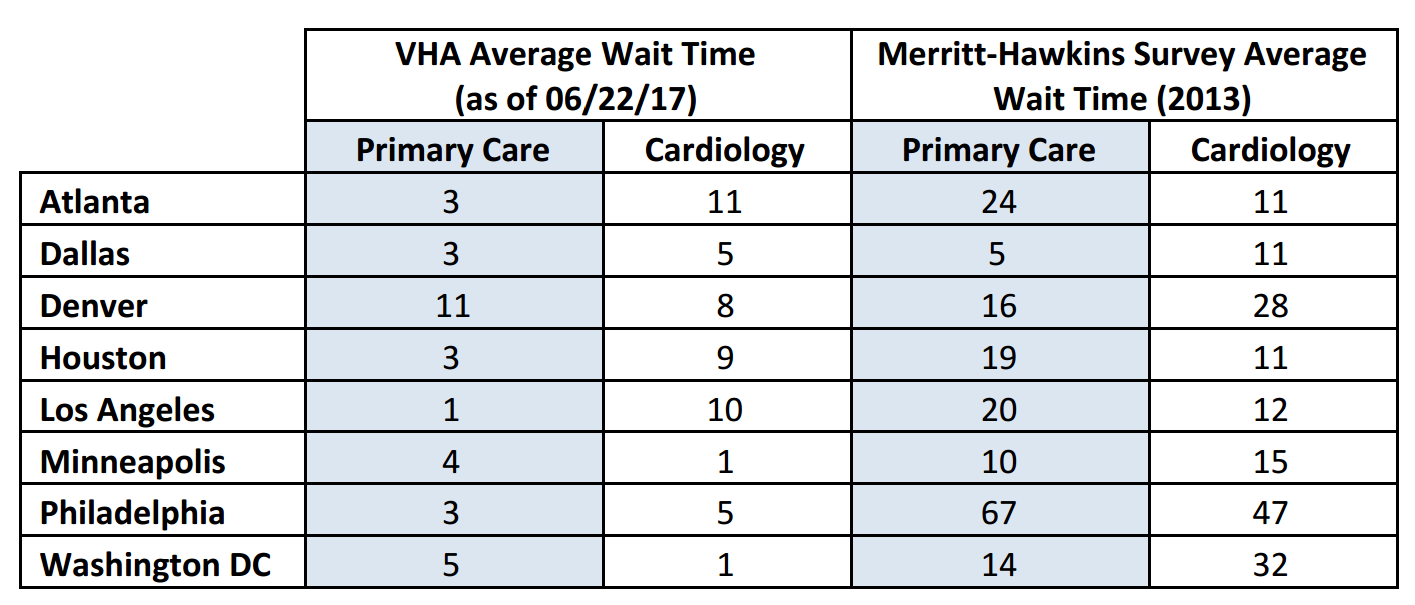
    Because of this, it is often difficult to find an apples to apples comparison for scheduling times.  In 2014, Merritt-Hawkins published a survey on Medicare/Medicaid acceptance rates and average wait times for a number of US Metropolitan areas (2).  Unfortunately, their survey uses 2013 data and is limited to a few clinic types.  The VA does have a public website that currently presents average wait times at all their facilities, for a similar number of clinic types (4).  For purposes of brevity, only Primary (or Family) Care and Cardiology average wait times will be displayed here by number of days.  The references section has links to both resources in case further research is desired.


    Ruminations on Primary Care, Specialty Care, Drugs and Scheduling

    While the scheduling numbers in the area listed appear comparable or better than their private sector counterparts there is something that should be mentioned here:  these data were made available as a result of a well-known scandal involving the manipulation of the wait times first identified in Phoenix, but later found to be endemic of the system as a whole.  Here are a few other examples:

    Tucson:  https://www.va.gov/oig/pubs/VAOIG-14-02890-72.pdf

    VISN 6 (VA, NC):  https://www.va.gov/oig/pubs/VAOIG-16-02618-424.pdf

    Houston:  https://www.va.gov/oig/pubs/VAOIG-15-03073-275.pdf

    Colorado Springs: https://www.va.gov/oig/pubs/VAOIG-15-02472-46.pdf

    Providence: https://www.va.gov/oig/pubs/VAOIG-15-05123-254.pdf

    Cincinnati: https://www.va.gov/oig/pubs/VAOIG-15-04725-272.pdf


    The VAOIG website is full of these. Unfortunately, bottlenecks within the system can occur.  With a large number of people congregating into urban areas, it is very likely to happen in a hypothetical single payer system.  Keep in mind the VA only provides care for a small minority of Americans (around 9 million) and scaling the system for the entire population is unlikely to make it work any faster, this is the practical experience in other countries as well.  There is also the question of coordinating care with a specialist.  So to recap the consult management practice goes like this:

    AH! ➔ Appointment with PCP ➔ PCP Agrees and writes up a consult ➔Specialist receives consult and reviews ➔ Specialist accepts and schedules appointment ➔ Treatment ➔ Specialist documents treatment ➔ Specialist informs PCP of treatment ➔ Re-evaluation by PCP if needed.  

    Each of these steps requires human input; miss a step and the entire process stops.  Stop early enough and treatment may never be given at all.  One of the findings from an investigation determined there was little oversight at the time of the investigation of the process at all, which likely lead to unnecessary deaths (6).  The prevailing issue with government systems such as these is lack of accountability.

    In terms of prescription drug pricing, the VA formulary only works because it is a closed system.  Scaling it up will create a massive market distortion that according to the Heritage Foundation, will only drive up costs (3).  Consider the formulary is based on restricting the drugs it will pay for, and what doctors can prescribe.  This will result in shifting costs to new medications for those willing to pay for it.  There is also the matter of the formulary’s insistence on using generics.  Generic drugs are made by a limited number of manufactures and if the only thing the hypothetical single payer will pay for are generics and the physician is required by law to only prescribe generics, it will only result in a temporary shortage due to the spike in demand.   When coupled with the price controls it is probably going to take these companies longer to increase their manufacturing capacity due to limited funding.  Of course if their lobbyists are half as good as they are rumored to be, they might avoid that.  Not to mention the obvious result of, “billions of dollars in averted research and development expenditures by drug makers, forgone investment in an untold number of new drugs, and the considerable loss of valuable research and science jobs (3).”

    Finally, there is little evidence that profit motive automatically results in poor outcomes.  An informed pedant might throw out Roemer’s law.  Which postulates that in the for profit model with an insured patient population, every hospital bed will be full.  If the hospital finds that they are not balancing their books with primary care, they will simply shift their resources to providing a higher paying specialty—like cardiology.  It is in this way they can maintain their patient population and continue to keep their revenue streams in place.  If a patient needs a cardiac catheterization, they are probably going to be comforted by the fact the hospital they are at performs the procedure thousands of times a year.  Given the procedure involves a surgeon threading a device through a vein in the groin and then insert a device into or near the heart, the patient might think of this as a feature rather than a bug.  Finally, even if there are benefits to the “proactive” approach the VA system currently uses that can materialize in a hypothetical single payer, the argument this can only be achieved with a state-run system without the profit motive is made out of ignorance of the industry or dishonesty.  

    Why? Because there happens to be a similar for-profit system, that apparently made $504 million in Q1 2016 (8).  While they are only available in a few areas, it just so happens they specialize in the same type of fully integrated, proactive approach to care that is touted as the feature of state run systems.   

    Their EHR isn’t a relic from the 1970s either.


    References

    1. Nugent, Gary et al.  Value for Taxpayers’ Dollars:  What VA Care Would Cost at Medicare Prices.  Medical care Research and Review, Vol. 61 No. 4 (December 2004) pages 495-508. http://journals.sagepub.com/doi/pdf/10.1177/1077558704269795
    2. Merritt-Hawkins. 2014 Physicians Appointment Wait Times and Medicaid and Medicare Acceptance Rates.  (2014) pages 1-32. https://www.merritthawkins.com/uploadedFiles/MerrittHawkings/Surveys/mha2014waitsurvPDF.pdf
    3. Angelo, Greg.  The VA Drug Pricing Model:  What Senators Should Know.  The Heritage Foundation, No. 1420 (April 11, 2007) 1-4. http://s3.amazonaws.com/thf_media/2007/pdf/wm1420.pdf
    4. Department of Veterans Affairs.  How Quickly Can My VA Facility See Me? http://www.accesstocare.va.gov/Healthcare/Timeliness
    5. Longman, Phillip.  Best Care Anywhere.  Polipoint Press, February 2007.
    6. U.S. Government Accountability Office (GAO).   Report 14-808 VA Health Care Management and Oversight of Consult Process Need Improvement to Help Ensure Veterans Receive Timely Outpatient Specialty Care.  http://www.gao.gov/assets/670/666248.pdf
    7. Reid, Chip. VA can’t afford drug for veterans suffering from hepatitis C. http://www.cbsnews.com/news/va-cant-afford-drug-for-veterans-suffering-from-hepatitis-c/ (06/22/2017)
    8. Rauber, Chris.  Kaiser Permanente:  First quarter profits down, but revenue and enrollment up.  http://www.bizjournals.com/sanfrancisco/blog/2016/05/kaiser-permanente-healthcare-50-percent-drop.html (06/22/2017)
  • Single Payer Healthcare – What It Could Look Like

    Introduction

    The lamentable position that is often tossed around this site as well as others, including this site’s precursor, is that single payer healthcare will be implemented within the lifetime of the current generation. While the majority of the intended audience may not fall into this demographic, others here will probably experience this for themselves. This series of essays is not necessarily intended to be an advocacy piece. This is intended to provide a snapshot of a healthcare system that is currently in place in the United States today, that embodies everything a single payer system in a ‘civilized’ nation such as those in Western Europe, Canada and elsewhere. Governments tend not to be innovative, and instead will opt for a solution with a historical basis for which an ‘educated’ opinion can be determined. In other words, if and when this happens it will not be a brand new system but one which will be based on prior experience and there is only one American system today that has the capacity, scope and history for which to base a single payer system. The problem of course, is the system in question is only available for an surprisingly small group of Americans and many who may argue against such a system are not likely to have experienced it for themselves. As Sun Tsu once postulated in order to defeat the enemy, one must know the enemy better than they know themselves.

    If advocates of free markets, Federalism and personal responsibility are to define coherent arguments against such a system it is best they first understand what the future may look like. While the practical experience in Western Europe should provide enough ammunition, it is likely these systems will be used as arguments for single payer systems. It should however be noted, the experience in these countries are unlikely to be comparable to the United States, because these governments historically are more enthusiastic(?) in their approach to governance. Not to mention the centralized nature of the population and demographic homogeneity make it easier for these socialized systems to be implemented. An American example is needed–and fortunately is available for interpretation. It is this way freedom advocates will know, and knowing is half the battle.

    This is the Veterans Health Administration (VHA). As interpreted by a mid-level GS employee with direct experience at the VISN (regional) and Facility level.

    Eligibility

    The first thing any health care system will need to determine is the eligibility requirements to utilize the services provided by the system. Without boundaries, there will be no limitations to the extent these services are rendered.

    In conceptual terms, eligibility is the first form of control. This is to determine who gets in, and among those, what can be allocated.

    First thing first, nearly everyone using VHA services are Veterans but not all are combat veterans. There are Veterans that were given a disability for other reasons, such as injuries during peacetime, asthma or sexual trauma, which unlike its counterpart on college campuses actually did happen to a good extent in the past. There even are some annoying situations where Veterans of some wars are simply viewed as better than others. WWI and the Mexican Border War Veterans for example, assuming there are any living examples, by law are currently allowed unlimited access to all services at any VHA facility (1). While Eddie Rickenbacker does not need to worry about paying for a colonoscopy, there are others with ailments such as Agent Orange or Gulf War Syndrome that were affiliated with wars that were determined by popular culture to be unpopular from a political standpoint, and were thus swept under the rug.

    For good reason, with his hat tilted the wrong way and his hands conspicuously in his pocket, America’s first ace has the kind of swagger that will drive a Sgt. Major to the brink of insanity. Most can only dream of such awesomeness. Therefore Mr. Rickenbacker should not need to worry about his access to quality healthcare and he is not at all worried–because he is dead.

    For everyone else, it is a process that begins at a recruiting station when nobody is old enough, or even cognizant of the future’s possibility. Nobody discusses VHA benefits with a recruiter, because quite frankly even the recruiter does not know because he or she is not to that point in their life either. This process starts at the end of an enlistment or near retirement. Once a retiree drops the paperwork at the personnel office or upon signing the separation paperwork, they are eligible to apply for disability. The math on this is not what most consider to be math to begin with.

    For most sane individuals with the most rudimentary of education, 10+10+20=40, right?

    Wrong!

    The VA uses a descending efficiency scale (2). What this means, is the government decided that math was too straightforward and made a system of it. Essentially, a service member shows up at the recruiting office at 100% because most of the recruiting process is determining medical qualifications. The military is quite efficient at weeding out those that are not at 100%. It is assumed the service member will incur some type of injury that will negatively affect the rest of his or her life. For instance, asthma as previously mentioned will net the service member a 30% disability. Hearing loss is another 10% resulting in a total of 30% disability. How? Asthma reduced him to 70% of his initial ability. Now that he can only hear in his left ear, reduces that 70% by another 7%, because 10% of seventy is seven.

    30+7=37 rounded down to the nearest 10 is 30. Get it?

    Most Veterans will fall into the trap where they tell a doctor something hurts, therefore it affects them negatively. This is not how it works. The doctor performing a Compensation & Pension Examination is concerned about how the condition will inhibit your ability to function from a quality of life standpoint. In other words does it keep you from getting a job? Back pain does not prevent one from working the concierge desk at the local Marriott, nor does being wheelchair bound keep one from working at a bank. It will keep them from working a high paying job on a oil rig, railroad or construction site. The post industrial job market, the Montgomery (later Post 9/11) GI Bill and the Americans with Disability Act do provide some relief for those alternatively abled. In order to help the Veteran handle his pain physically, the VHA has a well negotiated prescription drug formulary. It is designed to control the cost of medication, and thus facilitate a solution for pain relief.

    Now this service connection will net the service member (now considered a Veteran) a disability payment that will need to be paid monthly as long as the Veteran lives. Per the numbers ran by the associated press the last time Veterans were used as a political hot potato during the Sen. Ted Cruz led government shutdown of 2013, this is around $5 billion–monthly (3).

    Once a Veteran has a service connected disability (SC), they are deemed eligible for VHA healthcare–even if that disability is 0%.

    Why is eligibilty so important? The system needs to know how many it must serve. The health insurance industry also has a concept tossed around from time to time known as ‘moral hazard.’ What this means is the more an individual is insulated from the costs of the services being paid for, the more likely they will use the service. This needs to be accounted for in order to control their costs. In other words, people will not care if it is not their money at stake. This is a concept familiar to many free-market aficionados. There is also the small issue of Veterans and non-Veterans alike in abusing the system to enrich themselves financially(4) . Most of these are, hopefully, outliers but abuses to the system also lead to inefficiencies caused by programs within the system designed to ensure the program’s solvency, which leads to Veteran’s waiting a long time for their eligibility paperwork to be processed.

    This SC rating translates to how a VA Medical Center (VAMC) is funded.

    Funding

    If only it were simple to explain how a VAMC is funded: Congress does not write into a budget that VAMC Tom, Dick and Harry shall receive $X. The system is designed so that the Veteran population can be in flux and the allocation can reflect how ‘sick’ that particular population is and how often it is used. It is based on disability, age and other factors, like if a Veteran received a Medal of Honor, a Purple Heart, was a Prisoner of War, and the like. Sgt. Dakota Meyer has two out of the three mentioned, and that ain’t bad. Then again, so does Sen.
    John McCain.

    The bottom line is, the more service connected the Veteran is and the greater resources it would theoretically take to treat the Veteran individually, the more money the VAMC receives from Washington. This is not just for the big things like, a prosthetic or a cochlear implant that are SC, this also works for little things like flu shots and almost everything else Veterans use that is not SC. The dirty secret is, most services Veterans use at a VAMC are not SC, even if he or she is 100%. This funding system is called Veteran’s Equitable Resource Allocation (VERA).

    The cited report from the Rand Corporation is predictably thorough in its methodology, analysis and description of the VERA system. The highest VERA category is about $70,000/year. This is designed to put a higher value on Veterans that need the care versus the ones that may not, and cover the cost difference of the former with the latter. A Las Vegas oddsmaker works in a similar fashion. It should be pointed out, Rand’s overall assessment of the system and its efficiency is highly dependent upon the Veterans that are also eligible for Medicare(5) . In short, the overall cost of care for Veterans is largely uncertain for any that are over 65. The reason being, VHA is unable to bill Medicare for services, much like one does not bill their spouse for services performed around the house. Ultimately, the proceeds from such a transaction are coming from and going to the same budget. Since many Veterans are part of this demographic or soon will be, it is likely the cost to providing Veterans health care is going to be skewed by this factor. What makes this more difficult to quantify, is HIPAA and that Medicare providers are under no obligation to provide VHA with medical records for services that are not provided under VHA auspices.

    In fact, this factor was cited by Longman as an argument to save costs on Medicare. It is estimated VHA has a lower overall cost of care due to the VHA ownership in facilities and control of the services in terms of medical necessity, by about ⅔ the cost of Medicare. In a CBO report reviewing costs from 2007-2015, it was estimated that putting Veterans qualifying for Medicare back on VHA would save $29.5 Billion over the time period, with $4.8 Billion saved from Medicaid(1) .

    Third party revenue can also be captured by VHA. This is allowed under the Balanced Budget Act of 1997(6) where the VAMC can code and bill a private insurance company the same way as any health system. The difference being they are only able to bill if the Veteran has other health insurance and are financially capable of paying a $15 or $50 copay. Under the PPACA, the IRS will automatically notify VHA if the Veteran has other health insurance. This accounts for 10-20% of a VAMC budget.

    There are other ways to fund specific programs such as prescription drugs, durable medical equipment, real estate, furniture and NonVA Care. These however, are largely allocated to VAMC a with a specific purpose. There is some discretion on how VERA funds can be allocated between facilities, but this is for the most part, a reaction to the present circumstances and typically planned within a fiscal a year. This is how a VAMC can install millions of dollars worth of solar panels in the parking lot but somehow fall short of their budgetary obligations with few repercussions.

    Ruminations on Eligibility and Funding

    From experience with eligibility, a moral case can be made on determining who is eligible. Some questions that may be raised include:

    – Does a minority, or anyone from a supposedly aggrieved demographic deserve more or less than a white male between the ages of 18-55?
    – Does an individual with late stage cancer receive a higher allocation than a single mother with 4 kids?
    – The VA currently will not pay for the surgeries necessary for one to transition to the opposite gender, will this hypothetical American single payer cover this cost, and how?

    All are questions that Congress would have to address in any hypothetical piece of legislation. It is unfortunate that questions like these that were once easy to answer, might now be more difficult because of the social concerns that dominate the current political parties. This will lead to needless fights in justifying why one is more deserving of the other. Much like Eddie Rickenbacker is eligible for VHA benefits automatically, but an OIF/OEF Veteran must justify why he or she is deserving. Such duplicity does not bode well for those arguing that healthcare is a right. Furthermore, shifting the costs to the system for the oldest, and therefore most likely the sickest patients to Medicare illustrates a practice for a medical system designed to control costs simply by determining who is eligible through at best, arbitrary criteria. At worst, it may be determined by politically insidious criteria.

    Such a practice in a hypothetical single payer system designed to cover all citizens is hardly equitable.

    In terms of funding, there is no way to determine how much this will truly cost. Simply scaling up VHA to the present population is only a rough estimate and does not account for demographics. Simply put, most VHA eligible beneficiaries are men, between the ages of 55-65. This demographic has very specific and more importantly predictable needs which easily control costs, but are hardly indicative of the entire American population. Coupled with the unknown costs shifted to Medicare/Medicaid, any quantification that will be presented is simply dishonest.

    For the audience which this piece is intended however, the moral case is simple: In order to participate in such a medical system an individual will necessarily need to justify the labor from skilled professionals while simultaneously reimbursing those professionals through appropriation made possible only by other individuals coerced into doing so. This is immoral as the previous sentence is a bunch of words more concisely described as theft. In the case of Veterans, at the very least they can point to a record where this appropriation was earned; the merits of which are understandably debatable for some and for others unjustified.

    Eligibility for existing within a politically determined border, what kind of earned merit is that?

    References

    1) Longman, Phillip. Best Care Anywhere. Polipoint Press, February 2007. Pages 102-106.

    2) Guina, Ryan. Funny Math–VA Disability Ratings. When 30+20 Doesn’t Always Equal 50. http://themilitarywallet.com/va-math-combined-disability-ratings/. 06/19/2017.

    3) Zoroya, Greg. Shutdown holding up military, VA benefits.
    https://www.usatoday.com/story/nation/2013/10/08/shutdown-casualties-combat-benefits -unpaid-pentagon/2941809/ 06/19/2017.

    4) Dinan, Stephen. Veterans caught triple-dipping on benefits.
    http://www.washingtontimes.com/news/2014/oct/30/veterans-caught-triple-dipping-on-benefits/ 06/19/2017.

    5) Wasserman, Jeffery et al. Understanding Potential Changes to the Veterans Equitable Resource Allocation (VERA) System. http://www.rand.org/pubs/monographs/MG163.html.

    6) Office of Inspector General. Report of Audit Congressional Concerns over Veterans Health Administration’s Budget Execution. https://www.va.gov/oig/52/reports/2006/VAOIG-06-01414-160.pdf.


  • A charlatan, a Bagdhad Battery and a six year old pixie

    While I was at work, I was given a menial task requiring that I extract medical documentation for an audit. Given the mindless nature I decided I needed some background noise and I wasn’t really up for music at that point in the day so I pulled up YouTube and came across this video from Stefan Molyneux titled, “Why I was wrong about Libertarians.”

    Yeah, I know. So here’s where I engage a bit in a little virtue signaling over Molyneux. He is basically a personified version of Mike Hihn. No, I am not saying he is a 68 year old shell of a person, waiting for a male nurse to change his diaper while still living in his mother’s basement. What I am saying are his arguments and his approach to principle requires such rigid adherence, it is nearly impossible to apply it in the real world. Nobody can realistically live to such a standard. That said, many of his arguments are very well researched and he does put a lot of effort in building the logical framework to support his conclusions.

    I should warn you, it’s mostly him staring into the camera 12 inches from his face in his steely-eyed, condescending, bald white guy with an accent, shtick. Watch the video, (or don’t) but fair warning: it’s almost an hour long.

    https://www.youtube.com/watch?v=HZzeC06hVvA

    Since nobody clicks links around here, here’s the Cliff’s Note’s version: In general, we have so little influence over the culture that we seem to believe it, gives us a pass for not living up to principle. Actions speak louder than words, as they say. If we are to preach NAP, but don’t live it, nobody will take us seriously. I’m a Federal worker, so I am very much guilty of this myself. I won’t get mad if you call me a mexican slaver, it’s probably true. To his credit, he does give an example or two where we can make such a change.

    Specifically what hit me is around the 6:30 mark where he talks about spanking your children.

    Does spanking violate NAP? Molyneux seems to think so. I find this a bit problematic because I have spanked my children in the past, mostly because I was spanked as well. I approached libertarianism from the cultural right like many. Yes, like nearly all Hispanics (or whatever adjective you prefer), I am Catholic and that authoritarian “there are rules to life” attitude, coupled with a patriarchal culture, generally means corporeal punishment fell neatly into the child rearing toolbox. Plus, since I was often around 18-19 year olds in the Air Force and working on high voltage power lines, it was a handy tool as an NCO, as well, because NCOs are often surrogate parents. It’s quick, to the point, and most importantly, the idea that you did something wrong has a tendency to stick around for a while—quite literally, because it hurts. Great for that stupid Airman looking to get himself electrocuted. I also go for hand slapping, and egregious offenses (mostly Airman) got a hand to the occipital bone; they recover quickly.

    Yet, violence begets violence. While nobody died on my worksite, a fact I am still somewhat proud of given the tendency for high voltage military assets to explode due to operator error, I could have easily been charged with assault. I was called to my son’s school when he punched a kid for reasons he still won’t tell me. Growing up, one of the few memories of my dad was my being scared to death after I talked back. My youngest son is now the same age I was from that memory. I could be a terrifying figure as he is one tenth my size.

    The easiest way to create another libertarian is to be one in front of your children; chances are they will emulate you, so to make a long story short, that douchebag has a point.

    Which brings me to last Saturday. My oldest son has a book filled with random projects he can build with household items. One of them he was interested in was the classic, potato powered light bulb. We decided to take it a step further by assembling a small lamp powered by a Bagdhad Battery.

    Off to the hardware store we go with my six year old daughter deciding to tag along. Now, my relationship with my daughter is much different than my two sons. I don’t believe children bond with their parents as an infant; it comes about 3-4 months later when they begin to walk and interact with the world. I was in Iraq while my oldest son was that age so there is something…missing. That same thing is missing between my wife and daughter, as my wife was in Afghanistan while she was that age–my daughter and I are very close. So we get to Ace Hardware, I pay for our material, we hop back in the Jeep, and head home.

    She took a long time hopping out of the Jeep and had a curious gait walking back into the house. I stopped her, and asked what she was hiding and she says, “Nothing.” I asked again, pointing out she has a square item hidden under her dress, that she is holding in her hand and she again replied, “Nothing.” I pull up her dress (don’t go there) and reveal a small tin of Altoids. She then proceeded to tell me that my sister gave her that and said she could eat it in the car.

    Bullshit. NOBODY EATS IN MY CAR.

    Oddly enough, when I told my wife what happened she told me that she shoplifted on occasion until the age of ten, which added another WTF to my weekend.

    Eventually, I got it out of my daughter that she found it at the hardware store in the impulse buy section and she slipped it under her dress while the cashier and I were verifying that I cut my body length of stranded, #14 AWG copper wire, exactly 71 inches, priced appropriately at $0.49/foot. I could’ve slapped her hand then but I decided not to. You people are always complaining that there are no libertarian women, so maybe I’ll try to do my part. Don’t get any bad ideas OMWC…

    I first told her since she was going to steal from the store, I was going to steal from her. I had her pick her favorite shoes (she likes shoes) and set them in a box. I then considered this was non-productive because her favorite shoes are silver boots, and since we live in Phoenix she won’t wear them until October, anyway. This also creates a double standard a six year old can recognize. I settled for making her watch her brothers eat strawberry shortcake that evening.

    This upset her, so I took her to her room and explained to her why she wasn’t getting cake. The lesson however, was the can of mints was an item for sale. Selling the mints means the store gets money for the mints. If the store has money, they can continue to stay open and sell more mints for people that want them. If enough people want or need mints, the store will have to hire people to be able to stock and sell these mints. To sum it up for a 6 year old, she was stealing from the workers, because the mints pay their salary. She was stealing from the store owner (ACE is a franchise, it’s why I shop there), the cranky old man in the back that makes keys, because the mints help pay his lease and his livelihood. Finally, she was stealing from me, because all crime is the theft of something valuable. In this case, she stole my trust.

    She was crying after that so in a way, maybe I did hit her. She recovered fairly quickly and is still a six year old pixie.

    How’d I do?

  • Take That For Data

    I’ve been mulling over a segment focusing on statistics and data for a while now. But since I suffer from (highly likely) ADHD and can’t seem to find time to properly give such a segment justice, I’ve sat on it. Aieee, sit on it, Potsie!

    With that sparkling opening introducing a new feature, enjoy these “Take that for data!”

    Ever wonder who the ‘drinkiest’ people in the world are?

    Worry no more. 

    What goes best with pizza? I know. Infographs!

    I did notice a foul habit in one of the graphs. 36% of Americans dip the crust in….ranch dressing?

    Two hours has passed since my last link. It seems I fainted and hit my head on the fall leaving me woozy after reading that stat.

    Sitting in a meeting about things relating to my business – I think. I forget – I wondered, who are the biggest producers of cured meats in the world? 

    Holland is 2nd? La-dee-daw.

    I’m not sure what contract I signed.

    Moving along. Here are countries with the highest self-employment rates. Please note, racists, graph is in White but text is in Italian.

    Greeks top the list. Us Nerf Americans languish at the bottom. Meh. How many entrepreneurs do you need, right Comrade Bernie?

    How many parasites do we need sucking off the productive classes, Grandpa Gulag? Eh? Hm?

    World’s healthiest countries. 


    And now for some sports.

    It’s been put forth the New England Patriots benefit from being in a weak AFC east. So I investigated. 

    Let’s start in the AFC north with the Steelers and Ravens. In the Belichick era: The Patriots are 6-3 against the Steelers in regular season play and 4-0 in the playoffs. They’re 5-1 against the Ravens but are 2-2 in the post-season facing them. Nonetheless, it’s a dominant edge for New England.

    Moving onto to the AFC south. The key team there are the Colts (who played in the AFC east for two seasons). Regardless, different team and division same result. New England is 12-5 against the Colts in the regular seasons and 5-1 in the playoffs. Again. Dominant.

    The only team to give them a run are the Broncos out in the AFC west. The Pats are 7-5 against them in the regular season but 1-3 in the playoffs.
     
    All-combined the Pats are 23-10 against those teams in the regular season and 12-6 in the playoffs. 35-16 overall.
     
    Not enough to weaken Graca’s argument you say?
     
    Check this out. Since 2000 the Patriots are:
     
    77-29 against all AFC east divisional teams – .726%
    70-26 against the AFC – .729%
    53-17 against the NFC – .757%
     
    That’s a .737% winning percentage for those of you scoring at home.
     
    That’s a lot of cheating, eh?
     
    Anyway. They won 74% of their games in the Brady/Belichick era. In addition, they’ve compiled a 25-9 record in the playoffs (.735%). In other words, they maintain their excellence in the playoffs.
     
    The New England Patriots would likely be just as successful no matter what division they played in. The only division that *could* conceivably halted the is the NFC east. It’s historically a ferociously competitive division with strong teams at different intervals. Alas, they’re not an NFC team. 
     
    They’re AFC.
     
    And they’re dominant.
  • Deregulating the Maritime Domain – Part 3

    Legislative Hurdles To National Security In The Civil Maritime Domain

    Ie.  A *Starting Point* for Maritime Deregulation

    Part 3.

    5. Inefficient Cargo Preference Requirements

    Turning again to the regulations in question and their relevance in twenty first century operations, it is important to examine the specific national security concerns they addressed at the time of their introduction.

    • While the Military Cargo Preference Act of 1904 (10 USC 2631) specifies that all cargoes purchased by the armed forces must be carried on a US flagged vessel – excepting where unavailable due to resources and/or costs are unreasonable – it does not require a great deal of effort to justify the use of a foreign-flagged vessel in the case of an emergency.  In a situation not dissimilar to the previous contradiction noted with the crewing differences between military and civilian operators, 31 of the 46 Ready Reserve Force ships maintained by the military for emergency transport of materiel in case of war, were constructed outside the United States and are therefore ineligible for any use domestically were they to be sold to a US-flagged operator in the future.
    USNS Supply resupplies a Danish Navy frigate and USS George H.W. Bush

    In an amendment to the Merchant Marine Act of 1936, passed in 1954, at least 50% of all general US government cargo must also be carried by US-flagged vessels.  The type of cargo specified in this legislation has generally focused on high volume products like food aid to be delivered overseas – and this amendment was further modified to 75% specifically in relation to food aid deliveries in 1985.  While it is not hard to fault the original intent of the legislation at the time it was developed, it appears to have very little utility in everyday operation – and in fact is more harmful than beneficial.  In the case of a real emergency or wartime situation, the military already has large amounts of munitions and materiel pre-staged.  During routine operations, there are far fewer routine shipments needed for military support than earlier in the 20th century – which makes sense given the smaller numbers of vessels involved as well.  Naval resupply for instance is predominantly conducted underway between Naval vessels and Maritime Sealift Command (MSC) auxiliaries – commercial vessels never enter the equation.  An exception to this from recent years has been the drawdown of military materiel following the formal end of hostilities in Iraq and to a lesser extent, Afghanistan.

    In general, Cargo Preference to date is limited to emergency food aid and similar emergency aid programs.  The utility of this program has deteriorated greatly due to the increasing variability of international harvesting results.  Even Federal Aid Agencies are becoming less likely to utilize these programs – even when still required to by law – it can be far more efficient both in time and money to purchase the necessary aid or in the vicinity of the emergency and have it transported locally – rather than paying to have it acquired and shipped internationally on a ship that may not immediately be available when needed.

    • These acts and the issues they embody are further reflected by MARAD’s Maritime Security Program.  Out of 110 US-flagged vessels participating in international commerce, a full 60 are enrolled in the Maritime Security Program.  By participating in this program, the operators acknowledge that the ships will be made available to the US government at the earliest possible convenience in the event of an emergency or wartime situation.  In exchange for this availability, these operators receive a cash allotment of about $3.1 million per vessel per year or about $8500 per day.  While initially appearing to be a significant amount, as the PwC MARAD report demonstrates, that amount only covers about 2/3 of the daily differential in operating costs between US and foreign-flagged vessels. [But it’s still your taxpayer dollars being shelled out]

    6. Security Issues Specific to the Jones Act

    • Returning to the Jones Act as a commercial speed bump, it is possible to force exceptions through, but the process is cumbersome and time intensive and requires action at the congressional level.  This includes a considerable number of cases where vessels have been repaired or refurbished overseas but have been certified by the Coast Guard that their refurbishments did not exceed reasonable limits as established by the Second Proviso of the Jones Act – currently listed in 46 CFR 67.177.  This issue is complicated enough on the surface – attempting to calculate the mass differentials from multiple pieces of equipment out of a very large vessel – but it often becomes far more politicized as commercial competitors will attempt to challenge each other on the legality of any foreign repairs.  Leaving aside that the repairs have already activated the Ad Valorem duty by default, if a corporation can prove that more than, say 7.5% of a competitor’s vessel’s steelweight has been repaired or worked on, that would potentially void the Jones Act eligibility that vessel for future operations.  Bearing in mind that the National Vessel Documentation Center is the only fully civilian staffed command under the Coast Guard – and possesses neither the resources nor qualified manpower to inspect the ships during refits to verify the claims made by the companies – which by and large have proven accurate under penalty of law.  This is also a sort of situation open to abuse in that in a number of cases, decisions by the Coast Guard have been retroactively reversed or thrown out by courts based on these corporate complaints, although the Coast Guard assessments have been conducted in good faith in accordance with their established legal precedents.  It is difficult in many cases to determine whether any US jobs are currently being lost by work conducted overseas due to the timing involved and the limited number of active shipyards – estimates and guesses are freely distributed by both sides of the argument, but there are no solid numbers available.
    • The legislative limitations of the Jones Act are also such that those situations in which the casual observer would expect common sense to address swiftly, become political footballs.  US Coast Guard icebreakers for instance are an extremely valuable asset, but as there are only three currently active (between six and ten would be required to adequately meet all current operational goals), a waiver was required from the Department of Homeland Security (DHS) in order to resupply Nome, Alaska, after a Russian ice-class tanker was forced to take on fuel from Dutch Harbor to deliver to Nome as weather prevented the intended pickup in a Japanese port.  This situation among others, verges on the legal absurdity of applying a near-century old law in a blanket format with no available consideration for logic.
    Just tuggin’ along…

    In another situation, an oil drilling company which had previously been granted a Jones Act Waiver by DHS (under National Security auspices) to transport an oil rig from Texas to Alaska using a foreign built, foreign owned vessel was told that the waiver had been revoked and would require a new application.  Although the company halted the transit in Vancouver and used a US towing company to take the rig the remainder of the way, they were still fined $15 million – the equivalent value of the rig itself – for breaking the coastwise trades portion of the Jones Act.  This was in spite of a lack of available Jones Act eligible vessels needed for a timely transit and the fact that DHS refused to review their appeal in regardless of Congressional support, although – for example – 56 Jones Act Waivers were granted in the period of July-August 2011 (utilizing the identical national security rationales to allow private companies to transport oil from the Strategic Petroleum Reserve).  As the largest fine of its type to date, it’s also something of a precedent in that the company was charged the full value of the vessel being transported even though as an actual vessel it was argued that it should not be treated like ordinary cargo or merchandise being transported from one port to another port.  [Because FYTW]

    This scenario does bring up a related question that has yet to be addressed, but which also further exposes the limitations of the Jones Act.  Recently, vast reserves of natural gas have been located offshore of Alaska.  These reserves are easily exploitable, and would benefit the state and country immensely – but for one issue.  Even if there are new Liquid Natural Gas terminals constructed on the west coast, it will be impossible for any LNG tanker to qualify for the Jones Act – in part due to the limitations discussed previously, the US simply does not possess the shipbuilding capability to construct one.  Given the legal precedents already established, it is unlikely that any corporation or vessel would receive a blanket waiver for the life of one or more foreign-built vessels to engage in Alaska to West Coast deliveries.  That basically means that under current legal rulings, Alaska will be required to transport and export all their natural gas internationally, with no net gain to national energy security.

    7. Potential Corrective Legislative Actions

    So, returning to legislative actions that would provide a net gain to national security utilizing Mahan’s rationale, each previously discussed act will be reviewed.

    • The Military Cargo Preference Act of 1904 and all the follow-on associated legislation should be scrapped in full.  The US military already maintains its own Ready Reserve Force in addition to the federally operated Maritime Sealift Command ships.  Any needs beyond that in time of emergency should be addressed as needed – utilizing appropriate contingency planning and the best vessel available at the time of the requirement – without excessive micromanagement or favoritism.  Security concerns would obviously be observed and dealt with accordingly as necessary.  In the case of non-military cargoes, the respective federal agencies and departments should again be free to negotiate for the best available carrier to transport their cargo.  In this time of skyrocketing deficits – it is important to provide the best possible deal for the taxpayer.
    • The Ad Valorem duty portion of the Tariff Act should be fully rescinded.  It functions simply as a punitive tax on companies that have very few options to begin with, while not providing any actual incentive to have repair work conducted in a US shipyard.  A better alternative might be to provide tax breaks for operators – US-flagged and otherwise – who do conduct their maintenance availabilities and repairs in US shipyards.  Additionally it is far too arbitrary in its enforcement – between the precedent-based measurements conducted by the Coast Guard, and the irregular legal reversals in the courts.
    • Regarding the Jones Act itself, depending on the legislative process it might be easier to address the various issues in individual amendments, as opposed to replacing the entire piece carte blanche.  For instance, the citizen crew requirement should be removed immediately – at least for the seamen – although it would be worth reviewing in further detail whether that citizenship requirement should be left fully in place for ship officers.  Similarly, it should be examined further whether there is any inherent harm in removing the right to sue from a seaman injured onboard a vessel.  If insurance provided by the operator is adequate, in accordance with the routine union protections, there ought not to be any loss suffered by the seaman.  Again, there are precedents set for this that can be reviewed – both as a matter of routine policy for all US service members, but also for the seamen employed by non-US-flagged operators.
    • Coast Guard to the rescue!

      Finally, regarding the Coastwise Trade requirements of the Jones Act – it is reasonable to maintain the existing regulations for trade on the inland waterways of the United States – to include the Great Lakes – the precedents and general operating procedures established there are not in dispute.  However, at this time, given the existing restrictions and limitations on US shipyards, it makes no sense to maintain the US-flagged requirements for all trade between mainland ports, with particular emphasis on trade between the mainland and Alaska, Hawaii, Guam and Puerto Rico.  Like the Ad Valorem Duty issues, it is a regulation that has outgrown its utility in the last century and causes more considerably more economic hardship than benefit for both the operators and customers.  [A number of estimates place the cost of shipping a container from San Diego to Hawaii at 10 times the cost of shipping the same container from San Diego to Shanghai.  Numbers have fluctuated a little over the years.]

    8. Conclusion

    Reducing or eliminating these regulations should not be carried out in a vacuum, but in conjunction with providing more incentives to operators and service providers.  As with other industries, it should be the goal of the government to make normal business operations easier, not more difficult – whether in developing or maintaining a shipyard, transporting cargo and passengers, or anything else.   These are all capital-intensive industries that provide a very large number of secondary and tertiary jobs and business opportunities across the country – which in turn provide far more tax revenue in net gains.  It is possible to restore and revitalize our nation’s maritime tradition, but the way forward involves far less government interference and legislation, not more.


    Part One; Part Two

  • Deregulating the Maritime Domain – Part 2

    Legislative Hurdles To National Security In The Civil Maritime Domain

    Ie.  A *Starting Point* for Maritime Deregulation

    Part 2.

    3. Commercial Shipbuilding Obstacles Hamstringing Maritime Development

    The second area in which existing legislation could be amended in order to affect a significant increase in national economic well-being is related to shipbuilding and maintenance policies.  Over the years, it is clear that the nation has allowed our shipbuilding capability to deteriorate to levels that severely impact our overall national security.  Simply in order to meet the requirements of the Jones Act, a vessel must be flagged in the US and have an all-citizen crew.  Additionally, the ship must have been built in the United States.

    Of the 126 active, registered shipyards operating in the United States, only 20 are recognized as capable of building large ships – and as demonstrated by the numbers, 10 out of 12 deep-draft vessels delivered in 2014 were ordered by the federal government.  In fact, taking into account the ongoing long-term Naval and Coast Guard construction and modernization projects, over 70% of total shipbuilding and repair revenues come strictly from military orders.  For further comparison, out of 1067 total shipyard deliveries in 2014, only 11 were made to the federal government.

    In short, while there is clearly a robust system for constructing and delivering smaller craft tailor-made to operate in the littoral region and inland waterways of the United States, the national capability to construct large vessels has vastly deteriorated since the second World War.

    • As a point of contrast, consider the shipbuilding industry in South Korea. Reviewing a report from 2015, in 2006 the industry employed approximately 150,000 people directly – but that number should be extrapolated higher over the intervening decade considering the increasing number of deliveries.  By comparison, MARAD recorded a little over 110,000 people directly involved in the domestic shipbuilding industry in 2013 (rising to 400,000 when including secondary jobs associated with the industry).  At the same time, for the year 2013, US shipbuilders delivered 227 ships and commercial vessels of which only 28 were above 2000 gross tonnage (GT) (including government orders) – and of those 21 were offshore support vessels or ocean-going barges.  By comparison, South Korean shipyards delivered at least 301 vessels measuring 5000 GT or more each in 2013, including offshore support vessels.  That there are several magnitudes of difference in production in spite of the numbers of employees involved in both cases reflects several issues.

    An improvement in the economy of scale is a goal to aspire to for any nation – and while the United States was previously capable of great strides in shipbuilding during specific periods such as World War II with the Liberty and Victory class freighters, at this date, delays and cost overruns are common – both in military and civilian shipbuilding.  A new cargo vessel can cost up to three times as much from a US commercial shipyard as one built overseas, while taking significantly longer.  Additionally, a common belief held by commercial carriers and operators is that US shipbuilders contribute to these factors by refusing to commit to fixed price contracts or delivery by a fixed date.

    Liberty Class Freighter

    While these commercial failings are frustrating, they can in turn be attributed in part to  the continuously growing burden of governmental regulations and standards placed on domestic companies, which will be discussed further below.  Traditionally, critics have pointed to lower environmental standards, salaries and costs of living in shipbuilding countries like China and South Korea – but as has been proven repeatedly before, a rising tide lifts all ships and we are rapidly seeing all of those factors approaching the western world – particularly in South Korea.  Simultaneously, examining the governmental policies of South Korea also provides an interesting contrast to the US.  While initially operating on several policies not dissimilar from the US regulations discussed here, by the mid 1980s, the government realized that corporate competition on an international scale was sufficient to allow domestic shipbuilding corporations to operate on their own under free market principles without excessive governmental support – and rescinded several key acts.  Additionally during a recession in the early 90s and periodically since then, the government has recognized the need to make additional capital available for expansions or upgrades of facility but these have been acts of limited duration with the intents of the measures highly specified.  These policies stand in contrast to the domestic regulations discussed here – some of which have been established for over a century and have consequently become that much more ingrained in the political consciousness – and accordingly difficult to address in a reasonable manner.

    • The issue of shipbuilding capabilities touches on several specific factors.  To begin with, it is a very capital-intensive industry.  Unlike building construction, which takes place from the ground up at the desired location – often utilizing a wide variety of mobile, easily transportable equipment and tools, shipbuilding requires very large, very expensive pieces of equipment that must be fixed in place (or potentially very costly to move in a limited fashion) in a set location.  In order to incentivize stakeholders to maintain or upgrade – or even develop and build – these facilities, there must be clearly achievable economic benefits to doing so.  Specifically, they must have an expectation of future orders on which to predicate continue operation – and in turn employee manning, secondary and tertiary orders and subcontracting requirements.
    Vancouver Wharves

    More to the point of this paper – once a company becomes insolvent or determines that the shipbuilding portion of their portfolio is no longer economical, mothballing or shuttering operations is a decidedly final step for equipment and facilities.  Without constant use or maintenance much related equipment – particularly dry-docking facilities or cranes – rapidly deteriorates, and the prime waterfront real estate these facilities occupy can be disposed of equally efficiently.  At this juncture, given the political realities – taking into account environmental regulations, particularly with finding an appropriate location, it would likely be very difficult to build, establish and open a new shipyard domestically without expending an extremely large amount of capital.

    As previously stated, there are well over 100 shipyards currently operating in the United States and many of them operate on a much smaller scale.  The geography of the United States with its myriad rivers and lakes, supports a broader, shallower base of smaller vessels that must still be built to detailed specifications in order to meet Jones Act requirements – which in turn do employ large numbers of employees.  Korea in contrast, builds virtually exclusively for blue-water operations, taking into account that over 90% of deliveries were for international buyers.

    Which consequently introduces the second issue regarding shipbuilding in the United States – to put it bluntly, there is no competitive advantage whatsoever for a corporation to construct a ship domestically.  Even if a company wanted to order large cargo vessels domestically in order to participate in Jones Act commerce, the turnaround time for almost any order would be significant, measured in years at a minimum.  This assumption is predicated strictly on the limited numbers of available domestic shipyards capable of actually constructing a large, ocean-going vessel.  One report commissioned by the US Navy in 1991 estimated that from conception to delivery, a new 42,000 DWT single shaft commercial cargo vessel would take approximately 57 months.  Of those numbers, the 12 month concept development window is the portion that would most likely be reduced – significantly – by the various technological advances that have taken place since the report was generated.  The 15 month contracting period and the 30 month construction period still appear largely accurate under the current industrial environment – although if the vessel was constructed in a shipyard owned by a parent corporation, that would probably result in a reduction in time as well.  While that situation is not rare to see in South Korea, at this date, none of the current US flagged shipping operators maintain their own shipyard facilities – although given the numbers involved, it is clearly not a surprise.

    While MARAD does run a number of incentive programs offering competitive loans and even grants for shipyard and port modernization and fleet upgrades to private corporations, it is telling that only a limited number of carriers reported direct experience with these loans, and that the surface consensus appeared to be that approval was overly complex.  Similarly, the official website for the Small Shipyard Grant program hasn’t been updated since 2013 and as of its last update, reported nearly $10 million in outstanding grant funding.

    (*NOTE*: site has been updated since this article was drafted in 2015 and reports there is no funding currently available – yay – and frankly – who really wants to be on the hook to Uncle Sugar?)

    4. Onerous Tax Burdens

    • One other legislative antique is the Ad Valorem duty on overseas ship repairs for US flagged ships – associated with the Tariff Act of 1930.  In short, for any repair work conducted on a US flagged vessel beyond emergent work necessary for safe operation – that is to say, routine overhaul maintenance or upgrades involving rebuilding more than a certain percentage of the superstructure or replacement of equipment measured in tonnage, must be conducted in a US shipyard or else face a 50% tax on the dollar value of the work.  While this measure was established to direct more work to US shipyards and US jobs, it is difficult to see at this juncture what its value is to the overall economy.  Indeed shipping companies report that even after paying the Ad Valorem duty, they are still saving a significant amount of money over the amount they would pay for the work to be conducted domestically.  This is to say nothing of the time involved waiting for an available shipyard to open up.  With so few large shipyards capable of handling larger cargo vessels, it becomes increasingly difficult to schedule availabilities in a timely manner.  [NOTE:  From my Navy experience the past 7 years, including multiple maintenance periods two of which were in dry-dock (both of which ran multiple months longer than originally scheduled) – this is an understatement if anything.] Different companies have different maintenance standards and while some may schedule repairs and refurbishments in advance of actual faults, in accordance with the tight budgets and timeframes of the shipping industry, others will gladly continue operation until forced otherwise.  In these cases in particular, the lack of an immediately available, affordable shipyard is a key factor in deciding to conduct necessary work overseas.


    Part one here


  • Deregulating the Maritime Domain – Part 1

    The following article is adapted and abridged from a term paper I submitted for a Port Logistics and Management Course back in 2015.  If anyone is interested in seeing the full article or a complete list of references, just ask. For obvious structural reasons, rather than stick with my original footnote format, I will be linking directly to the references where appropriate (but not linking to the same article multiple times).


    Legislative Hurdles To National Security In The Civil Maritime Domain

    Ie.  A *Starting Point* for Maritime Deregulation

    Part 1.

    In 1890, RADM Alfred Thayer Mahan wrote, “The necessity of a navy, in the restricted sense of the word, springs from peaceful shipping, and disappears with it, except in the case of a nation which has aggressive tendencies, and keeps up a navy merely as a branch of the military establishment.”  This belief was shared by many legislators in the early twentieth century as the United States expanded its sphere of influence in the world and took a greater role in world affairs.  During that period, such pieces of legislation as are discussed below, played an important part in the development of our national maritime heritage – and set the stage for greater involvement on the world stage in the following years.  However, at this point in the 21st century, many of these regulations have outlived their original, stated (if not intended) purpose and serve now as barriers to greater economic expansion and security, while benefiting only a few vocal supporters at the expense of the greater population.

    The goal of this paper is to examine the potential costs and benefits of repealing the Jones Act and similar associated regulations.  Not in a strictly economic sense looking at the potential trade [im]balances, but more focused on the security aspects originally envisioned by the act and how relevant they remain nearly a century later and how they could potentially be improved for a net gain for the operators, government, and taxpayers.  A strictly economic consideration of the impact of rescinding the Jones Act previously published estimates a minimum net gain of approximately $700 million annually.  [NOTE:  This is an excellent, well-researched paper on the whole – although if anything it’s a little conservative on the economic benefits re: Alaska and Hawaii.  It also makes some good points re: previous deregulation of the trucking and rail industries and economic growth that followed as examples.  Recommended reading!]

    Although the Jones Act is the most well-known regulation limiting players in domestic water-borne trade, it is just one of a number of over-reaching regulations, which operate in concert to limit economic opportunities and growth – while similarly acting as potential barriers to improving national security options.  Upon closer consideration, legislation affecting the Jones Act alone will not in and of itself resolve some of the most pressing long-term national security considerations.

    To begin with, it is necessary to define the specific characteristics of the Jones Act and the associated pieces of legislation to be discussed below.

    • Merchant Marine Memorial

      The Merchant Marine Act of 1920 (46 USC), also known as the Jones Act.  This piece of legislation is centered on domestic commercial shipping utilizing the common term of cabotage.  Specifically, the Jones Act placed formal restrictions on the nature of all vessels engaged in trade on US waterways and between domestic ports.  This trade can only be conducted by vessels constructed, owned, and flagged in the United States registry and all crew must be US citizens.  The definition of domestic ports includes not only facilities in Hawaii and Alaska, but also the territories of Guam and Puerto Rico – although additional territories such as the Virgin Islands and Greater Marianas islands have been granted waivers.  Additionally, the Jones Act grants specific rights and privileges to seamen employed by US carriers.

    • The Merchant Marine Act of 1936 (46 USC 27) – contrary to popular belief regarding the Jones Act – in part due to its official title, this piece of legislation formally created a National Merchant Marine service for the United States – a formal federal service auxiliary that could be called upon to support national defense for transportation/logistics purposes in time of war or critical need – while the vessels themselves were owned and operated by private interests.
    • The Tariff Act of 1930 (19 CFR 1466) – a subordinate portion of the overarching Smoot-Hawley Tariff Act of 1930 specifically addresses limitations regarding the repair and refurbishment of Jones Act-qualified vessels. Excepting emergencies, only minor repairs are permitted in non-US shipyard facilities and operators violating this provision are required to pay a 50% tax on all work-related expenses.
    • The Maritime Security Program (MSP) of 1996 (46 CFR 296) – A program administered by the United States Maritime Administration (MARAD) providing funding to US flagged vessels in exchange for ensuring their availability for necessary military requirements in time of war or emergency.
    • The Military Cargo Preference Act of 1904 (10 USC 2631) requires all military materiel owned or procured by the military services of the United States to be transported by US flagged vessels where possible.

    In the cases of most pieces of legislation, including the sample posted above, it is possible to amend portions of the regulations without discarding the full law, but in many of these cases, we have reached a position in which it is significantly more beneficial to scrap the entirety of the regulation.

    2. Specific Limitations Associated with Crewing Practices on US-Flagged Vessels

    • A study by Price Waterhouse Coopers (PwC) on behalf of MARAD conducted a survey of US-flagged operators and non-US-flagged operators in order to determine the primary disparities in operating costs.  The primary determination was that the largest delta in expenses came from crewing costs.  Under the Jones Act, all vessels involved in cabotage and coast-wise trade must employ all US citizens.  That in and of itself is not particularly surprising given that the vast majority of the cabotage trade takes place on the inland waters of the United States, including the Great Lakes.  Somewhat more eye-opening is that, under the current regulations, every ship registered and flagged by the United States must demonstrate a 100% Citizen Crew Requirement, even those involved solely in international trade.

    Unsurprisingly, this policy is considered by a majority of commercial carriers to be a significant barrier to flagging a ship under the United States registry.  Not only is the pool of available employees significantly smaller – or shallower in this case – but the costs are vastly higher.  Between cost of living expenses, standard wages, insurance rates – inflated by Jones Act protections and benefits, and union fees, the average crewing cost of a US flagged vessel is well over five times as much as a comparable non-US-flagged vessel.

    There is one major counter to this policy, and it does provide an interesting contrast to the current civil regulations.  Both the US Navy and US Coast Guard allow (and have allowed since their inception) non-citizens to serve in enlisted roles throughout their surface forces.  This practice has multiple benefits not limited to providing an accelerated path to citizenship for qualified legal permanent residents (aka the kind of legal immigration we should continue to encourage), in addition to providing a steady source of ready, willing and able seamen to fill critical billets on all surface vessels.

    Although this has been a longstanding practice in the sea services (and likewise all the other military services), there has never been an outcry against volunteer non-citizen permanent resident service members taking away jobs and pay from citizens.  Traditionally permanent residents have strong ties to their communities locally wherever they are stationed – and the salary they receive would traditionally not leave the country aside from the case of remittances sent overseas in support of family.  Accordingly, it is difficult to envision any real loss of capital were all other Merchant Marine jobs opened to qualified, eligible, non-citizens and the Citizen Crew requirement for US flagged vessels rescinded.

    2. Continued Specific Limitations Associated with Crewing Practices on US-Flagged Vessels

    • An additional consideration in terms of lowering overall crew expenses is to re-examine the insurance requirements and labor union policies enforced by the Jones Act and similar pieces of legislation.  As in many other industries over the past few years, the evolving nature of operations has reduced the need for the union coverage and assistance.  Since the advent of the law – and increasingly rapidly in part due to containerization (beginning in the early ’50s) and more recent safety features introduced, the environment aboard vessels at sea has grown considerably safer and less hazardous on the whole – while specific vessel-types and operations obviously remain inherently risky by the nature of their locations and missions.  On a ship as anywhere else in our progressively more wired world, the optics of hazardous operations or personnel accidents are nearly instantaneously visible to newsrooms and shareholders alike – increasing the incentive to prioritize crew safety over equipment and profits.  Under the Jones Act however, a crewman retains the right to sue the carrier employing them – a practice which has raised insurance rates for US-flagged carriers far above the international average.
    Northeast Marine Pilot boat docked in Newport, RI

    One response to this may be found in a report made by the Cedar River Group on behalf of the Washington State Legislature.  This report was commissioned to examine the cost differentials to the state between state employees covered by the Jones Act working on Washington State Ferries and those other state employees covered by state Industrial Insurance.  The case of Washington state is unique compared to the other states operating state ferry systems (including Texas, North Carolina, Oregon, Alaska, and New York) because Washington alone has chosen not to invoke sovereign immunity and can therefore be sued by Jones Act eligible employees.  In a detailed summary, the numbers presented demonstrate that covering Jones Act eligible seamen by state Industrial Insurance would save the state money over the court costs and lawsuits brought under the Jones Act, but would also benefit the employees by providing insurance benefits in a far timelier manner than following the long wait associated with a lawsuit.  While the total dollar amount a seaman will receive may be less, the utility of receiving regular payments in a timely manner is far higher.

    While this solution would not currently be relevant to a private firm engaged in similar operations, the numbers do provide a valuable, practical, realistic sampling to use for comparison.  This is the sort of precedent that could be used to demonstrate adequate coverage and model updated insurance costs should the Jones Act be revised to better meet current national requirements.  It must be noted however, that all the forecast estimates were based on pre-existing cases and developed prior to full passage and implementation of the Affordable Care Act – a key variable which will require additional review.

  • Space Law

    Space is big. You just won’t believe how vastly, hugely, mind-bogglingly big it is. I mean, you may think it’s a long way down the road to the chemist’s, but that’s just peanuts to space.

    Douglas Adams, The Hitchhiker’s Guide to the Galaxy

    Of all the great adventures that humanity can embark on in the near future, none has captured the popular imagination quite like space exploration. Since before the time that humanity launched the first artificial satellite, we have dreamed of what it might be like to set foot on other worlds. Where dreams lead, however, the bureaucrats are sure to be lurching close behind. Passing judgment and crafting policy has long been the pleasure of the professional statist. In man’s adventure into space, such a creature was given a rare gift: A virgin field, unframed by any law save those of nature. Before even the first V-1 was launched, there were those who contemplated both exploration and policy.  Theodore von Kármán, one of the founders of Aerojet, an early rocket company, had this to say in 1942, just after the incorporation of the company, “Now, Andy, we will make the rockets – you must make the corporation and obtain the money. Later on you will have to see that we behave well in outer space…After all, we are the scientists but you are the lawyer, and you must tell us how to behave ourselves according to law and to safeguard our innocence.[i]” There were, at that time, no laws on the books to describe allowable action, inactions, and responsibilities that would accompany space flight. But in the next two decades, such a field would develop.  Andrew Haley would be one of the main crafters of space law[ii], even coining a term for it, ‘metalaw.’

    The laws that would be crafted were largely a creation of their time when the UN was paralyzed between cold warriors. As such, they are imbued with a certain neutrality and compromise. The most famous and overarching of these regulatory documents was the 1967 ‘Outer Space Treaty.’ This treaty laid down some basic conventions which are still honored today, such as Article V forbidding the placement of WMD’s in orbit, on the Moon, or in any sort of stationary platform or satellite. There are gaps, though; the treaty mentions WMD’s but not conventional weapons, so in theory, orbital bombardment is still allowed. Another gap in the treaty, one that is becoming increasingly relevant, is the use of resources in space. At the time the treaty was written, the idea of commercial entities who could perform their own launches or exploit resources was inconceivable. Now there are at least eighteen competing commercial space companies. That’s only counting ones working on launch vehicles. There are many other companies that specialize in other areas and more being created every day. That would come as a grand surprise to the many bureaucrats who were stuck in a binary view of policy, who could never imagine advances beyond what they saw before them. Even more pressing today: the treaty does not allow any nation to claim territory in space. The moon, asteroids, and all other stellar bodies are seen as communally owned and for the benefit of all mankind[iii].  That might come as news to the several space mining companies that are looking to exploit the potential trillions of dollars of precious metal and rare earth elements that are locked in the numerous asteroids in the solar system[iv].

    Indeed, as much the way that regulators were unable to predict the rise of disruptive technology online or in new media, they were equally unable to foresee the rise of a whole industry based around the idea of exploiting the resources present in the solar system and beyond. In attempting to placate the powers of the time, they left no room for innovators to build on the fantastic possibilities of space exploration. This has meant that those who wish to dream of riches from beyond the world must go to antiquated documents written in a time before we had even set foot on the moon. Even when the push against regulation comes, one must also wonder how hard the early pioneers of space exploitation will try to close the door behind them in order to throttle competition. In a truly free market, companies would not have to go hat in hand to the national regulators to get launch permission, then comb the international laws looking for a loophole to exploit in their quest for mineral exploitation. Rather, it would only be a matter of capital investment and an entrepreneurial spirit that would lead the way. Of course, as the race for asteroid wealth increases pace it is certain that some enterprising person will find a way around the laws, even if it means approaching their state looking for succor to reach around international regulations.

    Space is big, but governments currently control the sky that separates us from heavenly riches. There will undoubtedly come a time when the exploitation of space resources becomes a common practice. It is important for the allies of economic liberty to push for the reforms needed to open up a truly free market, so when that success comes, it will be that much harder for the bureaucrats to take the credit for the success that their laws would have nearly strangled in the crib.

    ________________________________________________
    [i] Andrew G. Haley (1963) Space Law and Government, page xii, Appleton-Century-Crofts
    [ii] Daniel Lang and Brendan Gill (December 29, 1956) The Talk of the Town, “Metalaw”, The New Yorker, p. 19
    [iii] Jennifer Frakes, (2003) The Common Heritage of Mankind Principle and the Deep Seabed, Outer Space, and Antarctica: Will Developed and Developing Nations Reach a Compromise? Wisconsin International Law Journal, 21, at 409
    [iv] Webster, Ian “Asterank” Asterank

  • Modeling U.S. Energy Policy

    Part One

    “The fact that the polynomial is an approximation does not necessarily detract from its usefulness because all models are approximations. Essentially, all models are wrong but some are useful. However, the approximate nature of the model must always be borne in mind.”

    George Box*

    • Modeling U.S. Energy Policy
    Professor Tomain

    By observing the impact of the Carter and Regan administration’s reciprocal attempts to affect national energy policy with a historical understanding of the FFCA as the genesis of Federal energy policy, we develop a model of energy policy in terms of legislative goals. Then, with an appropriate model, we are able to undertake realignment toward new political ends. Fortunately, much of the heavy lifting has been done via Professor Tomain’s “Dominant Model of United States Energy Policy,” a handy tool to explain past and current trends in energy policy and regulation.[1]  Inherent in this model are the economic assumptions that: 1) the Gross National Product (GNP) is linked to energy production, and 2) economies of scale in energy production are achievable.[2]  These assumptions are well supported, in as much as energy is necessary input for Gross Domestic Product (GDP) growth, although the direction of causality between energy production and GDP growth has been difficult to ascertain and appears unidirectional for certain periods.[3]  Importantly, these two assumptions suggest a national energy policy which “favors large-scale, high technology, capital-intensive, integrated, and centralized producers of energy.”

    According to Tomain, the Dominant model has six goals, but, for our purposes, these are better distilled into two primary objectives for the lawmaker: 1) ensure an abundant supply of both primary and secondary energy 2) ensure reasonable and stable prices for energy.[4]  There are many legislative options to achieve these objectives, but only a few selections appear to be currently supported.  Consider, as evidence, the other goals Tomain identifies as complimentary mechanisms: i.e. limiting market power of large firms, promoting competition between fuels and between producers, generally subsidizing only mainstream energy sources, and allowing for both federal and state control of energy policy.[5]  Whether legislators identify these as the means to the end of stable energy prices and abundant energy supplies or as ends – in and of themselves – has determinative impact on what objectives are actually achievable.  If the real objective of Federal energy policy is to achieve carbon free energy independence in the United States, then a transition to non-carbon primary energy sources is a necessary condition. Policy ends which limit market power of firms, allow for decentralized control, increase competition, and subsidize current producers would, therefore, sit in conflict with that objective.

    • Contemporary Legislation Does Little to Support a Transition Toward Energy Independence

    For all the talk of an energy independent or carbon free future, the most recent series of energy policy acts, the Energy Policy Act of 2005, the Energy Independence and Security Act (EISA) of 2007, and the American Recovery and Reinvestment Act (ARRA) of 2009, all conform to the Dominant Model.  The Energy Policy Act of 2005 contains significant subsidies and incentives for traditional carbon primary energy producers.[6]  Coal producers receive $1.6 billion of assistance.[7] They receive a further $1.7 billion for upgrading generation equipment and emplace advanced combustion processes.[8]  Oil and gas producers are offered large production incentives and suspensions of royalty payments.[9]  Tax incentives are provided to an array of carbon primary energy including coal projects,[10] oil and natural gas,[11] and biofuels.[12]  All in all, some $85 billion of appropriations and relief is provided for in the acts with the bulk of funds directed at carbon based primary energy producers.[13]  This support is consistent with Dominant Model goals of subsidies for mainstream energy, promoting abundant energy supplies, favoring large producers, and large capital projects.

    Several steps omitted

    The EISA, by attempting to promote competition between fuels and between producers in order “to move the United States toward greater energy independence and security” and “increase the production of clean renewable fuels” with hopes to secure secondary energy supplies, is predicated on Dominant Model goals.[14]  To achieve these goals, the EISA adopts the dual mechanisms of emplacing production quotas for carbon dependent biofuels and subsidizing US biofuel producers to the point that blending biofuels with traditional fuels becomes affordable to consumers.[15]  Unfortunately, this does nothing to address the very real difference in the costs of production between biofuels and traditional fossil fuel producers.[16]  Setting aside the questionable economics of biofuel subsidies, foreign oil producers will remain profitable at price levels where expenditure for biofuel subsidies is politically unjustifiable.  It is also important to note, by focusing legislative effort on biofuel, the EISA targets sources of secondary energy without addressing the primary energy input inherent in the manufacture of biofuels, the origin of that primary energy, or the conversion rate of primary energy to secondary energy.  Without looking at primary energy sources, there is little hope of any affecting energy independence through legislative means.

    Fortunately, both the Energy Policy Act of 2005 and later amendments added by the ARRA do make efforts at addressing primary energy.  For example, the 2005 Act eased certain requirements of the federal licensing process for hydroelectric dams.[17]  The 2005 Act extended and enhanced tax credits to ‘renewable’ primary energy sources such as hydropower, wind, solar, and geothermal.[18] Importantly, the 2005 Act sets an objective of “increasing the conversion efficiency of all forms of renewable energy through improved technologies.”[19]  In support of this objective, the 2005 Act provides $2.227 billion for “renewable energy research, development, demonstration, and commercial application activities.”[20]  These provisions are buttressed by the ARRA which amends Title XVII of the 2005 Act to provide an additional $6 billion of loan guarantees for renewable energy projects.[21]

    Furthermore, the 2005 Act provides support for the largest alterative producer of non-carbon primary energy, in the event of construction delays caused by regulators or by litigation, by extending funding to builders of nuclear generating stations to cover regulatory costs.[22]  Additionally, the 2005 Act sets aside $1.25 billion for a prototype hydrogen generating nuclear reactor and reauthorizes the limitation of liability on nuclear plant operators provided under the Price Anderson Act.[23]  Between the 2005 Act and the ARRA, some $41.7 billion are allocated across energy markets and technologies with the bulk of subsidies going to the largest producers.[24]  While stimulus helps shift the competitive landscape to make minor producers and alternatives to carbon primary energy more attractive to consumers, the allocations are simply too diffuse to tip the balance in favor of any producer or technology thus preserving the current competitive landscape.  This outcome suggests achieving energy independence entirely on non-carbon sources using policy and legislation keeping with the mechanisms of the Dominant Model will be ineffective and will require a reordering and rebalancing.  Owing to the favorable economics of oil prices under the Dominant Model it appears that US energy independence “is more a political slogan than an actual policy objective.”[25]  If however there were sincere efforts at achieving energy independence in the US what might they look like? We will explore this question in our next installment.


    * George Box and Norman Draper, Empirical Model-Building and Response Surfaces 424 (1987).

    [1] Joseph P. Tomain, The Dominant Model of United States Energy Policy, 61 U. Colo. L. Rev. 355, 355 n. 4 (1990).

    [2] Id. at 374-75.

    [3] The authors note, unsurprisingly, that the differing results are influenced significantly by the differing regulatory environments.  Jaruwan Chontanawat et al., Causality Between Energy Consumption and GDP: Evidence from 30 OECD and 78 Non-OECD Countries, SEEDS 113 (June 2006), http://www.seec.surrey.ac.uk/research/SEEDS/SEEDS113.pdf; see also Eden S. H. Yu and Been-Kwei Hwang, The Relationship Between Energy and GNP, 6 Energy Economics 186 (1984).

    [4] Tomain, supra note 1, at 375

    [5] Id. at 375-76.

    [6] Energy Policy Act of 2005, Pub. L. No. 109-58, 119 Stat. 594 (2005).

    [7] Id at  § 401.

    [8] Id at § 3103.

    [9] Id at § 341-57.

    [10] Id at § 1307.

    [11] Id at § 1321-29.

    [12] Id at § 1342-47.

    [13] Michael Grunwald and Juliet Eilperin, Energy Bill Raises Fears About Pollution, Fraud, The Washington Post (Jul. 30, 2005) http://www.washingtonpost.com/wp-dyn/content/article/2005/07/29/AR2005072901128.html.

    [14] Energy Independence and Security Act of 2007, Pub. L. No. 110-140, 121 Stat. 1492, 1492 (2007).

    [15] Id at § 201-48.

    [16] Jonathan Kingsman, Oil Price Fall Adds to Biofuel’s Woes, The Financial Times (Jan. 9, 2015), http://www.ft.com/cms/s/0/22bbd5ba-975f-11e4-be9d-00144feabdc0.html#axzz3csqAQnGr.

    [17] Energy Policy Act, supra note 6, at § 241.

    [18] Id. at § 202-03.

    [19] Id. at § 931.

    [20] Id.

    [21] American Recovery and Reinvestment Act, Pub. L. No. 111-5, 123 Stat. 115, 140, 145 (2009) (codified as amended 42 U.S.C. § 16516).

    [22] Energy Policy Act, supra note 6, at § 638

    [23] Id. at § 601-10, 645.

    [24] American Recovery and Reinvestment Act of 2009, Wikipedia (May 23, 2015), https://en.wikipedia.org/wiki/American_Recovery_and_Reinvestment_Act_of_2009#Energy_infrastructure; Energy Policy Act of 2005, Wikipedia (Sept. 23, 2014), https://en.wikipedia.org/wiki/Energy_Policy_Act_of_2005.

    [25] The Oil Drum, China Energy Outlook: China’s Energy Strategy for the Future, Oilprice.com (Nov. 18,2012), http://oilprice.com/Energy/Energy-General/China-Energy-Outlook-Chinas-Energy-Strategy-for-the-Future.html.