This is an open thread to discuss your favorite podcasts. Below I’ve listed some of my recent favorites. As you can see I stay away from the political and instead enjoy history and true crime.
History on Fire – Daniele Bolelli is an author, history professor, and martial artist who was influenced heavily by Dan Carlin’s Hardcore History. If you want your history fix, and can get by Bolelli’s noticeable Italian accent, then History on Fire is a good place to go. Based on the podcasts I’ve listened to he doesn’t veer off from historical sources but still doesn’t come off as unbearably dry. Instead he explores the bloodier chapters of the past without fear of offending modern sensibilities.
A History of the World in 100 Objects – this is aural popcorn, short 14 minute episodes about the meaning of objects along with the hows and whys they were constructed. Neil MacGregor, the presenter, has a stuffy (as in head cold) British accent that hustles through the material, along with a few short interviews. The material spans the very ancient to the modern day.
Casefile True Crime – if you like Australian accents, then Casefiles is for you. This anonymous podcaster touches on cases all over the English speaking world, going through evidence including available recordings that are presented to the listener. Some of the material is chilling, especially the 911 calls. The cases range from old historical pieces, to well-known serial killers, and even child abductions. Not for the faint of heart.
True Crime Garage – Nic and the Captain explore cases both old and new, all while consuming a reviewed beer. Some very rare anti-gun proselytizing does occur, but the musings on the suspects and motives is always interesting. The focus is mostly on American crimes, and sometimes the episodes veer into odd tangents of humor, but it’s never a boring ride. I rate this a little lower than Casefile but still worth a listen, especially for the deep dives into modern cases that have only just faded from the headlines.
Breakdown – Over the course of a season, Breakdown will concentrate on one case. The listener will hear the evidence, including the police interviews, and opinions of lawyers not directly associated with the case. Given the title name the podcast mostly concentrates on wrongful convictions with improper police procedures and evidence tampering. Since it is produced by the Atlanta Journal Constitution, journalistic standards (remember those?) are high.
Look, I assume every glib is thinking, if we wanted to see Romanian commercials we would have beaten them out of you. Well no need for violence, stout yeomen! I decided that I will enact your labor for you (whether you want it to or not) and present the following. I tried to use a selection which reveal a bit of Romanian spirit, a bit of Romanian flavor. The video quality is not great and mostly there are no English subtitles. But it matters not, as they send their message across just fine.
In case you don’t want to actually watch the video
First we start with Rom Tricolor, a candy bar that is, like many cheap candy bars, mediocre overall, but for some reason you want to eat it. Rom is rum, so it is chocolate on the outside and a rum essence cocoa cream in the inside. This is enhanced by nostalgia, as for me it tastes of childhood. Their campaign was based on a slogan “Romanian sensations since 1964”
Two of the commercials go into communist nostalgia and the good old days when the actual fashion police came a calling, because “We will not tolerate such attire for the socialist youth”
The third is a modern view of certain less than ideal aspects of Romanian culture, centered on the person of the Cocalar – which I have no idea how to translate in American. It is what the English might call a chav. This one is for Q as it briefly contains a female in a bathing suit.
A different commercial focusing on history is for a painkiller called Algocalmin, which has been since made prescription only in most countries, even banned in some, as it contains a substance called metamizole, which is actually bad. Now in my family we didn’t really use Algocalmin as a painkiller, but there was nothing like it to break a very high fever. Worked like magic for that purpose.
Next couple are for detergent – DERO comes from “Detergent Românesc” (Romanian Detergent) –which is no longer Romanian, but a brand of Unilever. The commercials are basically a couple talking about the kind of stains DERO removes –ciorba de burta (tripe soup) and coal dust.
Now we have one showing the fabled Romanian construction workers in their natural environment, for cheap rotgut liquor with the slogan “Unde’s multi puterea creste” – basically Strength in numbers. (The name is Unirea, or Unification, and the slogan was the one during the unification of Wallachia and Moldovia)
The spark for this rant came from this piece on Oprah.com called “The New Midlife Crisis.” Though this one focused specifically on Gen X women, I’ve seen the details before in articles about millennials of both genders, about working people, about teenagers (Gen Z or whatever the heck we’re calling them), on and on: people are stressed. Diagnoses of depression and anxiety are at all-time highs. Humanity is in crisis, be it mid-life or quarter-life or whatever. Everyone is unhappy and no one knows why.
I don’t deny that people are more stressed, depressed, and anxious. I’ve witnessed it firsthand. I’ve experienced it personally. Every article has a different theory: it’s because of the economy, it’s because of white supremacy, it’s because of capitalism, it’s the damn Republicans’ fault. But I think I know the answer and, in fact, I can almost guarantee that my theory is right.
IT’S THE INTERNET.
There are a lot of hand-wringing articles about younger millennials and the next generation growing up on the internet and spending most of their time on it. But no one seems to acknowledge the fact that older people use the internet too, you know. I am a millennial but I’m a bit of an older one (1985), so my family didn’t have a PC until I was in around fifth or sixth grade; we had no internet until freshman year of high school, and there was no such thing as smartphones until I was already out of college.
I did spend quite a bit of my formative years on the internet, but it was in the “Web 1.0” era. Slow internet speeds, basic web pages and no social media. I made a lot of friends online, but the settings were very similar to those at Glib: we all interacted under screen names. Very few people knew my real name or what I looked like. I spent time on fandom message boards, LiveJournal, fanlistings and the very occasional IRC chat room. We’d leave comment threads pertaining to a specific topic, such as whether those who watched dubbed anime should be burned at the stake or not. (Full disclosure: I am a dubbie, not a subbie. Feel free to shun the nonbeliever.) The friends I made in those places didn’t know every single detail of my life—we’d just talk about Sailor Moon or video games or whatever. It was an escape from reality, a nice way to de-stress when I got home from school. Building fanlistings was a fun way to teach myself web design and Photoshop as a creative outlet. It was a more innocent age.
Since the rise of MySpace and then Facebook, the internet has evolved, and you can easily see that the ways it has encroached more and more steadily into our lives is a recipe for stress overload. Moving away from the previous online culture of anonymity and limited sharing, social media has encouraged us to SHARE MOAR! SHARE MOAR! SHARE EVERY SINGLE DETAIL OF YOUR LIFE!
People live on social media, blurting out every little thing that comes to mind. Status updates for every second of every day. Everyone knows the second you start dating someone, the second you break up, when you get a job and when you lose one, what time you get up in the morning and what time you go to bed. Photos of every meal, every drink from a bar or a coffee shop, every outfit, every haircut. Family drama gets aired like dirty laundry. And don’t even talk to me about people with kids. Every milestone in life gets a professional photographer involved. Proposal photos, engagement photos, wedding photos, anniversary photos, pregnancy announcement photos, shower photos, gender reveal photos, photos with a chalkboard saying whatever week you’re at in your pregnancy, BIRTH photos—women are literally having someone glam them up while they’re in the damn hospital and posing with the baby on their naked chests. I could make a collage of these. They all look the same. And then once the kid’s popped, it’s annual family photos, holiday photos, first-day-of-school photos, the photo cycle never ends.
People get on Facebook Live or Instagram Stories or myriad other video sharing platforms even while they’re driving their damn cars and fill the empty space with the sound of their voices. It’s performance art. People are building an audience, whether they are looking for strangers to become their followers or just subjecting their family and friends to it.
So many people, saying so much…
Every second of everyone’s life is on display. And it seems like the general public is only acknowledging that this as a problem for the teens and young millennials. But I’ll tell you what, these Gen X women? I have gotten to know a number of women around ten to fifteen years older than me since I started publishing, which means that I’m seeing a bunch of moms whose kids are graduating high school and going to college, and HO-LY SHIT. These women have the millennial moms with the toddlers beat. They won’t shut up about their kids, and they’re tagging the kids in the status updates. One woman the other day posted a public Facebook post calling out a girl her college freshman daughter was friends with, shaming her for being ‘a backstabber’. AND SHE TAGGED THE DAUGHTER IN IT, so now all the daughter’s friends will see it.
This is just one example of the pervasive oversharing that’s going on thanks to social media. But it’s not just the cringe factor that’s the problem. From all these pro photo shoots for every moment of someone’s life to the professional networking aspect of social media, social media is encouraging unhealthy levels of competition. I’d be the first to admit that some competition is a good thing, as it encourages people to excel; but there needs to be some moderation. Before the internet, competitiveness was limited to face-to-face interaction or specific tasks. With the internet, it’s 24/7. People are lying in bed trying to sleep at night looking at their phones and seeing Sally Supermom coifed and made up like a model in a hospital bed with baby number three posed tenderly on her bare chest. #blessed #wokeuplikethis
When everyone around you seems like they’ve got their shit together and you feel like you don’t, it can be very difficult to ignore feelings of helplessness or desperation that ensue.
For me personally, it’s very, very hard for me to be around other authors. Especially with the rise of indie publishing, there are a lot of Type A personality authors who are obsessed with maximizing productivity, and they can be overwhelming. “I wrote 50,000 words this week but I think I can get it up to 75,000 if I use dictation software so I can ‘write’ while I do chores and use my exercycle.” “I’ve been feeling a bit drained recently, so I’ve been doing thirty minute bursts of mindful meditation after every 5000 words, and I’ve found it lets me get my productivity up even higher—I’m averaging 30,000 words a day!” “You’re never going to make it in this industry if you don’t put a book out at least once every three months, so you need to focus on ways to write faster while also maintaining a well-balanced social life, running five miles every day so you’re not a fatty, raising 2.5 children and experiencing spiritual enlightenment through the teachings of Zen Buddhist monks!”
American politics
And you’ll notice I’ve not even mentioned politics at this point. Because I think we all know what the state of politics is like thanks to the internet. It would take a whole separate article to talk about that trash fire.
My point is: I’m not surprised at all that stress, depression and anxiety are at all-time highs. And there’s a solution, as difficult as it is to accept—if you want to feel better, you’ve got to get off the internet. I know it’s hard. And sometimes you don’t have a choice, especially if you have a job that requires social media marketing. But we as individuals all need to make a conscious choice to cut back. If you can’t deactivate Facebook entirely, use it sparingly, and don’t be afraid to unfollow every person who says something stupid. Same thing goes for Twitter, Instagram, and every other form of social media. I’ve noticed a marked improvement in my mood since blanket-muting just about every author on Twitter and only having exposure to William Shatner, Emergency Kittens and my local branch of the National Weather Service. The other day, I took the day off and did nothing but play video games and comment on Glib, and I felt so relaxed and unstressed afterwards (probably because it was a day that Derpetologist didn’t post).
Want to solve the “crisis” crisis? Be you man or woman, a Gen X-er, a millennial, or someone older or younger, try cutting out or cutting back on social media. I can guarantee you that you will feel much better in a very short amount of time.
Sometimes I like to write stream-of-consciousness posts when I’m procrastinating on more research intensive articles. This is yet another one of those situations. (Crafting a Narrative Pt. 3 will be ready soon)
Let’s have some fun together tearing apart this whole NFL v. Trump shitshow piece by agonizing piece. If we do this right, we’ll trigger literally everybody.
First, let’s address the elephant in the room. The entire frickin kneeling protest is an unorganized shitshow. When Kapernick started kneeling, it was vaguely in support of Black Lives Matter, but even BLM is a fucking mess of intersectional leftism. I’m not going to kill brain cells by going to their website again, but there was shit about ableism and transgenderism last time I went. On top of that, now everybody is kneeling for a thousand different reasons. Some are civil rights LARPing, some are protesting police brutality, some just hate Trump, and most of them have no fucking clue why they’re kneeling except for the fact that it pisses Trumphitler off.
Why the hell are you kneeling during the national anthem? Cops are employees of the state and local governments. They’re not even affiliated with the American flag, let alone somehow symbolizing it .Of course, if you’re smart, you don’t take the kneelers’ stated intentions at face value. The reality is that this protest against “systematic injustice” is really just a bunch of rich idiots being played like marionettes by no-kidding communists. Kapernick is in neck-deep with the commies, and his totalitarian milieu has polluted the NFL as a whole.
Why are you biting the hand that feeds you? We’ll get to the ridiculous reaction from fans in a minute, but it was a quite predictable reaction. Most football fans lean conservative and working class. Most conservative and working class folks are quite patriotic. They tend to either be veterans or know quite a few veterans. Disrespecting the flag is seen by them as pissing on their service and sacrifice. Any idiot can see this dynamic, and any idiot could have predicted the backlash that was created by these overprivileged multimillionaires disrespecting the flag.
It’s virtue signalling at its finest. There’s nothing accomplished by kneeling during the anthem. Not one cop is going to think twice about shooting some black kid just because some NFL player kneeled during the national anthem. Rather, the NFL is sending the message that they play ball with the SJW left. Unfortunately, the SJW left has resoundingly ignored the NFL… y’know because contact sports are icky and boring and not artisanal enough.
What of the boycotters? If there’s anything more pathetic than protesting a symbol that has nothing to do with the supposed object of your ire, it’s the people who are acting offended because other people won’t play patriotism olympics with them. By all means, boycott the NFL if you don’t like the message they’re sending. Hell, I’m watching much less NFL because I’m sick of all the personal interest stories, the “special interest here” month this and that, every other commercial being a PSA for some stupid cause, CTEs, and lefty virtue signalling around every corner (*cough* Bob Costas *cough*). What happened to football being about men in pads hitting one another? At the end of the day, though, respect or disrespect of the flag is a pretty stupid reason to change your entertainment habits. Why?
Because modern patriotic nationalism sucks. I completely get the connection between the flag and the service of our soldiers and veterans. I completely respect their courage and sacrifice. This is why I stand for the national anthem, even though I don’t participate. However, if there’s one thing that gets and eye roll from me in record time, it’s the old tired line of “freedom isn’t free. They fought and died for your freedoms.” Sorry, but when were my freedoms last threatened by a foreign power? Maybe WWII? That’s really stretching it, because the biggest threat to my freedoms in that era was FDR (internment camps, threatening the supreme court if they didn’t rule favorably, etc.). Maybe one could argue that the actions in Afghanistan were preserving our freedoms after 9/11, but again, the Patriot Act, TSA, and DHS are much bigger threats to my liberty than Al-quaeda has ever been. In my opinion, it’s completely appropriate to honor those who fought and died in the name of our nation without bullshitting us by saying that they were “fighting for our freedoms.” If anything, that cheapens their legacy, because it paints a paper thin GI Joe veneer over a much more complicated and difficult situation.
Beyond this, why the hell do we need to sing the national anthem at sporting events in the first place? What a stupid and ridiculous tradition that is! We don’t sing the national anthem before music concerts or starting the workday or before the movie starts at the theater. The idolatry that passes as patriotism these days would have the founding fathers rolling so hard they’d power the entire country’s electric grid.
Speaking of violently spinning founders, let’s talk about the bullshit that is both sides of the police brutality argument. On one side, you have the SJWs and civil rights LARPers who think this is Birmingham in 1958. On the other side, you have law & order conservatives who think this is Mayberry in 1965. Both are laughably wrong, but there’s no adult in the room to tell them to stop being idiots.
Cops aren’t heroes, at least not all cops are heroes. Cops are not tyrants, at least not all cops are tyrants. I’m not a strict individualist. I believe that you can assign generalities to individuals of a group. However, I think that you have to pursue such generalizations very carefully. By and large, people apply generalities too strongly and too broadly. That is the case here, as well.
The BLM agitators are notorious for swinging and missing every. single. time. Trayvon Martin? *whiff* Michael Brown? *pbfffft* The few cases that were actually open and shut abuse cases were completely ignored by BLM. Why? Because their end goal isn’t ending police abuse. Their end goal is stirring up racial strife in order to elevate their political (and financial) clout.
Cops aren’t walking targets in urban areas. Despite what some would have you believe, most folks don’t get their rocks off by taking pot shots at pigs. Save for one major incident, and a handful of one-off incidents per year, most people who have an issue with cops simply try to run away. This aura painted by the right of embattled cops struggling to make it home to their wives and 2.5 kids is completely made up.
Questioning the motives of cops is very patriotic. Police are armed enforcers of the state. They do good things (like handling outlaws), but they’re also the single quickest path to authoritarianism. The rapid militarization of police over the past 2 decades, paired with lax due process protections and highly aggressive tactics has turned policing from an Andy Taylor/Barney Fife context to a wannabe soldier context. The conservatives are happy to play along, grouping “first responders” with veterans in the exalted ranks of “heroes” to be honored with the flag.
Before this gets too long, I’ll wrap it up with a few quick hits.
If cops were heroes, they’d be held to a higher standard than the public. Instead, they’re held to a lower standard.
Qualified immunity has been abused and distorted to cover a cop’s every action. If it were “right sized,” any escalation by the cop would fall outside of qualified immunity.
The fact that BLM and other civil rights griefers are even treated as legitimate shows how absolutely fucked up our media is.
If the NFL players wanted to kneel before the thing that destroyed the black community, they’d find the nearest Medicaid office and kneel there. Then they’d join Antifa in tearing down all the LBJ statues.
Nothing about the treatment of urban blacks is going to change until their culture changes. Holding police accountable for their overreaches isn’t going to fix the “systematic” issues. Only a massive cultural shift will do that.
The NFL and Goodell are utter dumbasses. They should’ve nipped this in the bud a year ago, but they were sympathetic with Kapernick, and now they’re getting their asses bit for it.
Notice I haven’t even mentioned Trump’s or Pence’s reaction. That’s because they have nothing substantive to add to the conversation. They’re charlatans playing the controversy for political points.
The all-encompassing nature of mass media is relatively new to the human experience. By and large, humans throughout history have only been immersed in the “news” of their family and their neighbors. News, in the regional, national, and global sense, was a triviality ridden into town on the back of a camel, a donkey, or a horse. It wasn’t until the 19th century that reliable, near-real-time national media coverage was normalized through national daily newspapers. It wasn’t until the mid-20th century that the nation, and later the world, was shrunk down and neatly packaged in a tiny box in every family’s living room. That growing scope of awareness, combined with the growth of media titans created what is now known as the “mainstream media.”
Run aground
These days, the power of the mainstream media wanes. Internet-based alternatives have exposed people to stories that the mainstream media deemed “unfit to print.” Gaffe after gaffe has eroded the trust society once had in the mainstream media. However, Rome didn’t fall in a day, nor will the mainstream media. Their power to craft narratives still exists, and is still quite powerful.
What power does the media hold over society and voters?
There are essentially two theories about the level of power the media holds over their customers. The Agenda-Setting Theory asserts that media can set the cultural agenda. They can’t control what people think, but they can control what people think about. For any observant consumer of media, this is obvious. It’s quite curious how Confederate statues that have been standing for a century are all of a sudden a “crisis.” People in the real world are talking about racism because the media has been hammering on the “alt-right nazis” incessantly for months. On the other hand, hardly anybody is talking about the looming debt ceiling issue? Of course, once the Nazi crisis subsides, the debt ceiling will become front-page news, and Trump will be “leading from behind” and “holding the American people hostage” and a dozen other focus group tested insults with no substance.
That leads into the second theory, the Framing Theory, which asserts that media can alter people’s opinions on topics by “framing” the issue in a way that lends toward one conclusion. In the past, subtle framing was required. The media would put a “thumb on the scale.” These days, the “mask has slipped,” and media sets a whole body-positive intersectional feminist on the Progressive side of the scale. Framing can work in many ways, but two of them are the favorites of mainstream media outlets. “Telegraphing” is the use of value biased terms and phrases in the description of an issue, subtly (or not so subtly) telling consumers who the “good guys” and the “bad guys” are.
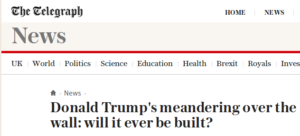
For example, let’s contrast CNN’s coverage of Trump’s struggles getting the wall funded with the Telegraph’s coverage:
Two articles from two news services. Both critical of Trump. CNN sows dissent between GOP leadership and Trump. The Telegraph highlights Trump’s lack of leadership on getting the wall built. CNN’s framing of the issue furthers their narrative that “even the right-wingers think Trump’s unhinged.” It fuels the “fractures within the party” narrative that is tied to the “Trump’s unhinged” one.
In contrast, The Telegraph is pushing the narrative that Trump is a loose cannon, and can’t actually get anything done. The “impotent president” narrative is disfavored in US media right now (because he needs to be seen as a potent purveyor of racism given the crisis du jour), but in the UK media, the “impotent president” narrative is king.
Media is showing that the Framing Theory is correct. They can not only set the agenda, but they can also influence the beliefs of their consumers. People are seeing Nazis under their bed, and the media are the ones who are fueling this hallucination.
Narrative Crafting Tactic #1: “Scientific” “Credibility” through “Experts” and “Studies”
Mad Scientist
Many people can see right through the transparent BS of a commentator spewing their unsupported opinions. Only the true believers are swayed by an emotional screed (pathos… speech 101). However, a well-sourced and dispassionately asserted scientific truth is compelling to a neutral audience (logos… again, speech 101). The media have leveraged this to the utmost, using “experts” and “studies” to push their social and political goals in a way that compels the neutral audience. As libertarians, we tend to be skeptical of the BS social science journalism that ends up filling a 30 second segment at the end of the nightly news. However, the diseaseismuchmorewidespreadthanthat.
Let’s do a case study. I’ve pulled a random health article from CNN.com.
(CNN)Despite a 23-year campaign urging that babies be put to bed on their backs, only 43.7% of US mothers report that they both intend to use this method and actually do so all the time, according to a new study.
This sounds like an epidemic!!! Well, let’s go to the study:
RESULTS: Of the 3297 mothers, 77.3% reported they usually placed their infants in the supine position for sleep
Wait, what?? What’s the difference here? Well, the devil is in the details.
Only 43.7% of mothers reported that they both intended to and then actually placed their infants exclusively supine.
So, this article is based on the fact that mothers only usually placed babies on their back, but didn’t always do so. In order to warrant an article in the health section of an esteemed news outlet like CNN, the risk from babies sleeping on their stomachs must be enormous!
There were about 3,700 sudden unexpected infant deaths in the US in 2015, according to the CDC. SIDS account for 1,600of those while 1,200 are due to unknown causes and 900 were due to accidental suffocation and strangulation while in bed.
Douchebag Frat Bro and the Federal Reserve Chairman
1600 babies per year (39.4 deaths per 100,000 live births) isn’t a lot, and it’s not clear how many of those babies would have survived if they slept on their back (and how many of those SIDS babies were sleeping on their back). See, SIDS is not particularly well understood, so it’s quite unclear how safe or unsafe babies are by sleeping on their backs. Even assuming that EVERY. SINGLE. SIDS. DEATH. was because the baby was on their stomach instead of their back, babies are 0.039% safer than they were when mothers were less concerned with their baby’s sleeping position. Yet somehow, the title of the article SCIENTIFICALLY asserts that MOMS ARE ENDANGERING THEIR CHILDREN by putting them to sleep unsafely.
This is but one way that media crafts a narrative by abusing scientific studies to push a social goal or undercurrent (in this case, it’s the insufficiency of mothers in taking care of their children without TOP MEN overseeing them). This doesn’t even get into the perverse incentives between government bureaucracy, the media, and university social science departments.
In Part Two, I’ll discuss Narrative Crafting Tactic #2: “Contributors” and other talking heads as intellectuals.
Julien Thomas Schuessler, 20, was charged with a hit and run, reckless driving, failing to maintain lane control and was released.
Schuessler, posted a video at 2:24 p.m. the day of the primary election, and shows him intentionally pulling off of the road and slamming through a Trump sign. When asked why he would intentionally pull off the road to hit a Trump campaign sign in such a dangerous maneuver, the driver said:
“I did what I felt was morally right. Spread love, not hate.”
Now that Team Red has demonstrated their utter hackery by suddenly changing their minds about dismantling the government-controlled health insurance system and demonstrating their deep and abiding love for expansive government, the next ripe target is so-called “tax reform.” Team Blue is already manning the ramparts in the certain fear that any adjustments in the tax code will be away from their moneybags and toward the Team Red moneybags (we know for certain that actually cutting taxes and pushing all the moneybags away from the trough is as likely as the sudden heat death of the Universe).
So it was with that thought in mind that I approached a Vox article written by the reliably mendacious Matt Yglesias as a general hit-piece on Trump. The article doesn’t disappoint, it was the expected (and at this point yawn-inducing) brew. The section on taxes drew my attention: as expected, the well-past-damn-lies use of statistics, cherry-picked quotes, emotional appeals, and the Diana Moon Glampers view of the purpose of economic manipulation.
Back on the policy front, Trump says of his tax plan that “if you add what the people are going to save in the middle income brackets, if you add that to what they’re saving with health care, this is like a windfall for the country, for the people.”
Trump’s actual tax plan would raise taxes on millions of Americans while delivering a windfall to the rich…
According to the Tax Policy Center, the average American family would see its after-tax income rise by about $760, while families in the top 1 percent of the income distribution would see their incomes rise by about $175,000 — more than triple the total household income of the median American. Trump’s plan also features a big corporate tax cut.
Now, being the sort of suspicious and cynical guy that I am, and admittedly not a news junkie, I wondered if the part about “would raise taxes on millions of Americans” was complete bullshit, the usual dishonest conflation of “tax rates” with “taxes,” or even “millions of Americans” being people in the dreaded 1%. So I followed the links to the source, the Tax Policy Center, which according to Wikipedia is “non-partisan.” From the article:
Without those revenue-raisers, nearly all US households would get a tax reduction, averaging about $4,400. The tax cuts would be highly regressive, with high income households getting much more than those with low- or middle-incomes. However, if a half-dozen tax hikes are included in a revenue package, the average tax cut would shrink to about $2,300 and about one-in-five households would pay more tax than under current law.
OK, this was the expected mendaciousness- the tax cuts are significant, and surprise surprise! the folks who pay more taxes get proportionately more reduction (i.e., the rate would be the same or smaller, but applied against a larger number). I guess that’s what they mean by “regressive.”
It was the very next several paragraphs which floored me:
TPC could not model an actual Trump tax plan since far too many critical details are unknown. For instance, the Administration has been sending mixed signals about whether it wants a tax bill to raise as much revenue as current law or whether it prefers a version that reduces overall taxes and add to the deficit.
Beyond those threshold questions, the White House outline left out many critical details. For instance, during the campaign, candidate Trump said he’d increase the standard deduction but eliminate both the personal exemption and head of household filing status. The April outline repeated the promise to boost the standard deduction but was silent on the two revenue-raisers.
In other words, “We have no idea of what the plan we’re criticizing actually is.” But it gets better:
As a result, TPC created a stylized version of what the key elements of a Trump plan might look like. It first analyzed the tax cuts that the White House outlined in April, adding key assumptions to fill in unspecified details. For instance, TPC assigned income ranges to the proposed tax brackets, which the Administration did not.
In other words, WE JUST MADE THIS SHIT UP OURSELVES. And THAT was what got cited, and Yglesias still had to apply the usual lying sack of shit spin and misquotation to it.
“No state shall make or enforce any law which shall abridge the privileges or immunities of citizens of the United States…” – Fourteenth Amendment, U. S. Constitution
“No person shall be held to answer for a capital, or otherwise infamous crime, unless on a presentment or indictment of a grand jury, except in cases arising in the land or naval forces, or in the militia, when in actual service in time of war or public danger…” – Fifth Amendment, U. S. Constitution
We saw in Part One how, according to the Supreme Court, the Fourteenth Amendment doesn’t require the states to obey the grand-jury clause of the Fifth Amendment. Most of the Bill of Rights has been applied to the state – “incorporated” is the technical term – but not this part.
(In its incorporation cases, the Supreme Court likes to talk in terms of “due process,” but here’s Justice Clarence Thomas explaining how the Privileges and Immunities Clause is what we should be looking at.)
For the most part, when the U. S. Supreme Court exempts the states from part of the Bill of Rights, most states don’t take advantage of this. With some exceptions, the states chose on their own to obey the Bill of Rights, even when the Supremes wouldn’t hold them to it – state courts would sometimes interpret some rights differently than the federal courts, but they admitted the rights were applicable, if only as a matter of state law.
That’s not the case with the grand-jury clause. Here, the Supremes opened the door for the states to disobey this clause, and the states rushed through the open door.
Between the Civil War and the end of the First World War, many American states amended their constitutions so that suspects could go to trial for serious crimes without the approval of a grand jury (Michigan had started the ball rolling on the eve of the Civil War). This analysis summarizes the situation as of 2014. In most cases, grand juries were kept in reserve in case the prosecutors, in their discretion, wanted to use the grand jury procedure. Only two states – Pennsylvania and Connecticut (I would probably add Michigan) – banned grand juries even as an option (apart from extraordinary cases). Twenty-three holdout states still mandated that certain serious crimes be reviewed by grand juries, at least if the suspect demanded it.
Rather than give a comprehensive history of the victories of “reformers” who curtailed grand-jury rights in state after state, let me attempt to give some historical vignettes, and tie these vignettes together with some semblance of narrative coherence. Then later, I’ll give an account of the triumph of the reformers in their battle against the grand jury.
The Plessy Judge vs. Grand Juries
U. S. Supreme Court Justice Henry Billings Brown came to the Court too late to take part in the Hurtado case, which said the states could limit or abolish the right of a suspect to have his case considered by a grand jury. But Brown was one of the many would-be reformers of that era who wanted the institution of the grand jury largely abolished.
Justice Henry Billings Brown
Brown gave a speech to the Ohio Bar Association in 1892 that included the judge’s discussion of this issue. Getting rid of grand juries, said Brown, would make criminal procedure more simple and efficient. Brown noted that he had begun his legal career in Connecticut, where grand-jury indictments were only required for crimes punishable with death or life imprisonment. Then Brown boasted of his fifteen-year legal career in Michigan (1860-1875), where grand juries were rarely used and were never required before a defendant could be brought to trial.
Brown suggested that grand juries may have been necessary in England to protect suspects against false charges by private accusers, but this problem didn’t exist in America. In America there were public prosecutors to bring charges and judges to rule on probable cause, and with these steadfast public servants on the job, Brown triumphantly concluded, grand juries were no longer necessary to shield suspects from wrongful accusations.
Brown went on to praise trial juries for their power of nullification – they could spare a guilty defendant, if punishing him went against local community norms. Of course, grand juries could perform that function too, sparing worthy but technically guilty suspects from the ordeal of a trial, not to mention saving them many legal expenses. That did not seem to occur to the Justice. “I think the question whether a man in a particular case should be punished for a crime is a question that is properly left to the public,” Brown said. But under Brown’s scheme, the nullification of an unfair charge would have to wait until the end of an excruciating trial for the suspect, since “the public” would only be able to get a word in edgewise after the trial was over. The public would be kept out of the decision of whether to bring charges in the first place.
Another defect in Brown’s logic is apparent with the growth of the plea-bargaining system, which requires a defendant to gamble on the possibility of a higher sentence if he wants to try his luck with a trial jury.
Brown concluded his speech with a boast that “[t]he Anglo-Saxon is a slow-moving race, but it rarely takes a step backward. It makes mistakes, but its progress has been in the right direction. No serious mistakes have yet been made.”
Speaking of serious Anglo-Saxon mistakes: four years after his speech, Brown again showed his ability to have things both ways and to spin nice-sounding legal theories which were oppressive in practice. Brown gave the Supreme Court’s decision in Plessy v. Ferguson. States could pass Jim Crow legislation separating blacks and whites, Brown’s opinion declared, so long as the separate facilities were “equal” (Justice John Marshal Harlan dissented in the Plessy case – Harlan had also defended the right to a grand jury in his dissent in the Hurtado case). Brown had affirmed the importance of equal protection under the law, while negating this principle in practice with his endorsement of racial segregation. In a similar manner, Brown had praised trial juries for their power of nullification, while calling for the abolition of grand juries which were in the best position to nullify charges against a suspect before he could be dragged through the court system.
Plaque on Homer Plessy’s tomb, New Orleans
Grand juries as scapegoats for police abuse
The fact that one of the most infamous racists in American judicial history wanted to abolish grand juries hasn’t stopped modern, hip and woke activists from throwing the racism charge at grand juries themselves.
In Minnesota, a proposed state constitutional amendment on the 1904 ballot would abolish the right to a grand jury and empower the legislature to decide how prosecutions were to be initiated – and it was correctly anticipated that the legislature would allow the elected county prosecutors to bring charges without grand jury approval. This concerned an anonymous “Voter,” who wrote to The Princeton Union to warn against the amendment. This voter was more skeptical about the professionalism of prosecutors than Justice Brown had been:
The grand jury is a body of citizens who are selected regardless of political belief or creed….[T]he law throws around them secrecy in their actions and they are entirely removed from all political taint or influence. It very often happens that county attorneys are not men wholly competent to exercise powers ordinarily delegated to a grand jury. Much of our politics is run on the “good fellow” plan and sometimes men are kept in office for being good fellows or for various reasons, regardless of qualifications or fitness for office….[County attorneys] are human and to say that their judgment in a case would be as good as as that of the members of a grand jury would be to make an extravagant statement.
The “good fellow” plan
A majority of Minnesotans went ahead and approved the amendment despite these arguments, and the legislature proceeded to give county attorneys the option of bringing charges without using grand juries. Grand juries would still be held in reserve if the prosecutor wanted to employ them, but suspects would no longer have the right to have their cases considered by grand juries. The optional system necessarily gives grand juries a bad odor – prosecutors who use grand juries when they don’t have to do so are often hiding behind the grand jurors’ skirts in order to pass the buck for controversial decisions. And sometimes the public falls for it.
In 2015, two Minneapolis cops confronted and shot Jamar Clark, who died of his injuries. The fact that Clark was black made the issue particularly volatile. Protesters demanded that the county attorney, Mike Freeman, investigate the shooting without involving a grand jury. Freeman had this option thanks to the voters’ decision back in 1904.
Minneapolis protesters in the Clark case
The protesters got their wish. Freeman announced that his office would no longer use grand juries when investigating shootings by police. The president of the Minneapolis NAACP, Nekima Levy-Pounds, said:
I am overjoyed that in this instance Mike Freeman decided to do the right thing. Mike Freeman is fully aware that the grand jury process has been ineffective here and nationally in holding officers accountable. I believe sustained community pressure played a huge role in Mike Freeman’s decision.
Then Freeman, without the help of a grand jury, announced he wouldn’t be bringing charges. The omission of a grand jury didn’t placate the protesters. An NAACP spokesperson (not Levy-Pounds) said, “You, Mr. Freeman, did not give a fair and accurate portrayal…and let me tell you: If the city burns, it’s on your hands.”
Last I heard, Minneapolis was still standing, though the shooting did provoke some protests. Nevertheless, cutting the grand jury out of the loop in the Clark case didn’t ease community tensions, or lead to charges being filed (assuming for the sake of argument that charges ought to have been filed).
The opposition to grand juries was exacerbated when a grand jury in Missouri failed to charge Officer Darren Wilson for shooting Michael Brown. The grand jury’s decision sparked riots. But the Obama/Holder Justice Department, examining the evidence against Wilson, also decided not to bring charges, and there was no grand jury involvement in that decision. So a grand jury took the rap for taking the same position on a racially-charged police shooting as the country’s two top-ranked race-baiters.
(Click here for an article about a controversy over using grand juries in police-abuse cases in California.)
Grand juries came first
The grand jury system was itself created through the actions of a would-be reformer, Henry II of England. The ruler who encouraged St. Thomas Becket’s assassination…
…was not a civil libertarian, but he “built better than he knew” in creating the grand jury. Henry was thinking more in terms of law and order when he decreed that panels of his subjects would be summoned and commanded to report about crime in their localities. What Henry wanted was to root out criminals who had managed to evade justice. Before Henry’s decree, bringing alleged criminals to trial in the secular courts required a private accuser to voluntarily come forward, risking punishment if he failed to prove his charge – and risking retaliation from the criminal. Henry knew that there were criminals running around who were known to the general public, but not known to the courts, since nobody had the guts to make a formal accusation. Not to mention that England was an occupied country whose rulers spoke a foreign language (French) and might not be au courant with the news circulating among their English-speaking subjects.
So Henry II’s early versions of grand juries were required to name people in their area who were believed by the public to be guilty of serious crimes. The grand jurors were not making their own investigations or reaching their own conclusions, but were reporting what was widely believed among their neighbors. Malicious local gossip need not be reported – just the solid consensus of public opinion.
King Henry, the scourge of the Church, was actually adapting a procedure used in England’s Church courts. The Church’s jurists and reformers borrowed from Roman law the maxim that the public interest required crime to be punished. This was in contrast to the Germanic idea of using the justice system to mitigate blood feuds. The descendants of the Germans who conquered the Western Roman Empire wanted people who had mortal grudges against each other to resolve their differences without dragging entire clans into Hatfield/McCoy style, multigenerational cycles of reprisal and counter-reprisal. So if angry relatives came seeking an alleged murderer, the matter would be settled with a trial by battle (if the feud was among aristocrats) or by some form of ordeal (if the feud was among the lower orders) – putting your hand on a burning piece of iron, getting thrown in water to see if you floated, trying to swallow a morsel of bread after boasting of your innocence (choking=guilt). If these methods didn’t identify the criminal with 100% accuracy, at least it was an agreed-upon method, presided over by priests, to settle the feud and move on. And if a crime didn’t spark a feud, or if the victim or their would-be champions were too weak, then it was like “OK, forget about it and let’s have some more mead.”
The Church’s reformers noticed that a lot of crime was overlooked in this way, and that trial procedures left something to be desired in terms of accuracy. So the Church courts, at least in England, came up with a procedure which seemed to inspire Henry II. Instead of waiting for a private individual to take the initiative and prosecute, the Church’s judges would identify a suspect and summon a panel of the suspect’s neighbors to see if public opinion regarded the person as a criminal. If the community wasn’t fairly solid in believing that the suspect committed the crime in question, that was the end of the matter – or rather, any crimes would have to be settled in the “internal forum” (the confessional). But if the community witnesses were like, “yeah, everyone thinks he did it,” then that counted as “fama” – the equivalent of a formal accusation – and a trial would begin.
King Henry thought that was a good idea, so he created his early version of the grand jury to report to the secular courts about those people whom local public opinion identified as serious criminals. If a person was so reported, the accused would undergo an ordeal – apparently the throw-them-in-water-to-see-if-they-drown ordeal – because the criminal trial jury hadn’t been invented yet. Yes, in criminal cases there was only one jury, and that was the ancestor of the grand jury – and unless you put your reliance in the cold-water ordeal, you better hope that public opinion, as reflected by the grand jury’s accusation, was accurate.
“So if the water receives my body, I’m innocent? And if I float, I’m guilty, and you execute me? It’s a good thing the grand jury correctly identified me as the murderer, otherwise I’d be really annoyed at this whole procedure.”
The creation of the English criminal jury was kind of forced on England by the Church. The Fourth Lateran Council in 1215, decided that priests should not preside at ordeals – because priests shouldn’t be shedding blood and because ordeals were not always reliable anyway. Without priests to bless the water ordeal, the practice fell into disuse, and so the English started using trial juries to decide the guilt or innocence of people who had been charged by grand juries with serious crimes.
Another important decision of the Fourth Lateran Council was in clarifying how church courts would go about ascertaining whether a suspect had a reputation as a criminal, so that the court could proceed in the absence of an individual accuser. It wasn’t enough if the rumors against the suspect were generated by “enemies and slanderers” – the public accusations had to come from “prudent and honest persons, not once only, but often.” Commentators gave Biblical examples: the clamor against the sinners of Sodom and Gomorrah, which prompted God to investigate (Genesis 18:20), and the complaints against the steward in Luke 16:1, which prompted the master to demand an accounting from the steward.
Since the creation of secular grand juries in England had probably been prompted by church-court procedure, it is not surprising that grand juries, acting on the same principles as the Fourth Vatican Council, undertook to distinguish between true and false public opinion. As the grand jury evolved, it came to do its own investigation, not simply reporting what their neighbors believed. Grand jurors were becoming the representatives of responsible public opinion by acting as “prudent and honest persons” and seeking reliable evidence about suspects.
But at least people who were accused by grand juries could now look forward to a full trial by another jury, not simply an arbitrary procedure like the water ordeal where one prevails only through blind good fortune. Even today, a small proportion of those who are indicted by grand juries go on to have their cases heard by a trial jury (the rest, of course, resolve their cases by plea-bargains, where the result totally isn’t arbitrary).
Works Consulted
Bab(b)ington Family – Descendants of John de Babington, http://members.iinet.net.au/~billeah/babingdesc.html
Henry Billings Brown, “Justice Brown’s Address,” in Proceedings of the Ohio State Bar Association, 13:35-51 (July, 1892).
Rebecca V. Colman, “Reason and Unreason in Early Medieval Law,” Journal of Interdisciplinary History, 4.4 (Spring, 1974), 571-591.
Nathan T. Elliff, “Notes on the Abolition of the English Grand Jury,” Journal of Criminal Law and Criminology, Volume 29,Issue 1 (May-June) Summer 1938.
Richard M. Fraher, “The Theoretical Justification for the New Criminal Law of the High Middle Ages: ‘Rei Publicae Interest, Ne Crimina Remaneant Impunita’” (1984). Articles by Maurer Faculty. 1854.
http://www.repository.law.indiana.edu/facpub/1854
Richard. H. Helmholz, “The Early History of the Grand Jury and the Canon Law,” 50 University of Chicago Law Review 613 (1983), online at http://chicagounbound.uchicago.edu/cgi/viewcontent.cgi?article=2484&context=journal_articles
Finbarr McAuley, “Canon Law and the End of the Ordeal.” Oxford Journal of Legal Studies, Vol. 26, Issue 3, pp. 473-513, 2006.
Kenneth Pennington, “Introduction to the Courts,” in Wilfried Hartmann and Kenneth Pennington (eds.), The History of Courts and Procedure in Medieval Canon Law. Washington, D. C.: Catholic University of America Press, 2016.
“Proposed Amendments to the Constitution of Minnesota,” Cook County Herald (Grand Marais, Minn)., Oct. 22, 1904, p. 8, column 1.
“Shall we abolish the grand jury,” The Princeton union, October 06, 1904, p. 3, column 2, http://bit.ly/2strpg7
Suja A. Thomas, The Missing American Jury: Restoring the Fundamental Constitutional Role of the Criminal, Civil, and Grand Juries. New York: Cambridge University Press, 2016.
___________, Nonincorporation: The Bill of Rights after McDonald v. Chicago, Notre Dame Law Review, Vol. 88, 2012.
Richard D. Younger, The people’s panel: the Grand Jury in the United States, 1634-1941. Providence, RI: American History Research Center, Brown University Press, 1963.
The book is done. The art is done. Thanks to help from the Glibertariat, the blurb is done. Now I come to the hardest part of writing – selling. In the spirit of free enterprise, this article is nothing more than an exhortation to read my books and tell other people to do the same. I’m not going to sneak around and pretend to be saying anything else, so let’s get that out there right from the start.
The history in the real world:
Comic books are strange places. You have aliens, magic, psychics and completely unexplained superpowers running amok alongside superscience and fantastical creatures. Sometimes they get silly, sometimes they get serious, but oh the tales you can tell. As someone who likes the art of storytelling, there was an appeal to the possibilities presented.
Back before 2012, I had started work on a science fiction piece which drew deliberate inspiration from the superhero genre. With it I was trying to skirt the edges of the conventions, trying to not sink too deeply into them. This book had a working title of ‘Three of Swords’ and only got to about half-done before it stalled so badly I had to storm away. On May 8th I began working on a less dark tale that fully embraced the conventions of the genre. I spent every evening and weekend writing, as I kept up my day job full-time. By June 8th, I’d churned out over a hundred thousand words and had a completed draft of ‘Shadowboy’. I had no plan going into the book, indeed, I wasn’t sure I was even going to finish it. But I had a complete novel. It then sat on a thumb drive.
Sometime around this time I was also trying to sell works to a publishing house in the UK. So I made two trips to attend conventions they were hosting. At the second convention, I got to attend a dinner with authors currently published by the company. Most of the discussions, while fascinating, are not relevant to this ramble. But one thread was. William King spoke about the changes he’d seen over the years in the publishing industry. He went into how even a reliable, established name like him had trouble convincing places to take his work because the big houses had started looking only for blockbusters. Anyone who didn’t reliably turn out blockbusters was quietly sidelined. Since he could still reliably move books, he had taken to independent publishing. Now, prior to this discussion, independent publishing still had the stigma of the old vanity press in my mind. If no one remembers vanity presses, they were companies who would print editions of works for a fee regardless of the quality and then the author could try to hawk them. Usually, it meant the work was crap because the publishing house standard was not “is this a blockbuster” but “will this sell enough to be worth the cost”.
But technology and the shift in the traditional publishing houses had changed that. In chasing the blockbuster, the old guard was ignoring a great many otherwise worthwhile works. With eBooks and print on demand technology, these authors could still get their books to market, without the overhead of the old methodology. So, I went down this road. It did mean I had to find an editor and cover artist and foot the bill for their services out of my own pocket. But I did so for ‘Shadowboy’. That book had some pains, as I needed to expunge the typographical errors from the text, and even with two editors having picked over it, I still get the nagging feeling I missed some. You’ve seen me type, I’m lousy at it.
The first book
But apparently, I spin a good yarn as even people I didn’t badger into reading the book were bugging me for a sequel.
I started on ‘Gruefield’ immediately after having finished the draft of ‘Shadowboy’. It took a year to finish and got a name change to ‘Shadowdemon’ along the way. I made a big mistake in storytelling, as my focus in the story was inside the narrator’s head. The tale I thought I was telling was about Travis’ character, and I treated the day to day hero work as things that were happening while the story was going on. I should have made a greater effort to at least echo some of what was going on inside Travis’ head, along with more adequately covering the All-Star Elementals. Most only got Cameos despite the entire separate story circling them. Perhaps I can revisit their tale in a future spin-off.
That’s when Travis’ tale hit a snag. I had too many contradictory ideas for tales to tell, and being contradictory meant Travis couldn’t follow them all. I also had ideas for yarns not involving Travis. So while I tried to put together a third book, I was also writing a mess of other works of varying lengths. It was a good way to use ideas that didn’t fit for Travis. So while content piled up for an anthology, I struggled to get the third book together. I tried to tell Doctor Rudra’s tale of revenge, but it didn’t work. I couldn’t get my head around the plan or the sequence of events it would unfold. So, I set that aside and started another. ‘Dirge of Carcosa’ was supposed to be book three, and I sliced out pieces from the previous draft to add to it. But the tale ran its course, and I ran out of ideas to continue it around novella length. It ended up as the tail end of the Anthology instead. ‘Lucid Blue (and Other Tales Too)’ was not intended to be book three, but Amazon doesn’t like fractional volume numbers, and it worked better tied to the other books. Besides, ‘Lucid Blue’ itself is more than forty thousand words, which is novel length by some metrics.
The quick turnaround sequel
So I went back to the drawing board again, trying to write ‘Book Three’ even though a third volume was already on the shelves. I took those pieces from Doctor Rudra’s tale that were not in ‘Dirge of Carcosa’ and reworked them with a new thread. I so wanted to have it out in 2016, but it was less than half done when the value of $CURRENT_YEAR changed. For the longest time it didn’t have even a working title, but eventually gained the moniker of ‘Shadowrealm’. As a story, I decided to make ‘Shadowrealm’ more streamlined, reducing the proliferation of side plots that had made ‘Shadowdemon’ a bit of a slog to write. The downside of downsizing the number of plots was that I couldn’t just start updating a different one when I needed to think on the current plot’s progress. But in the end, I think the book is better for it.
The history in the fake world:
Magic and the number of people with unusual powers has waxed and waned over the millennia. In some periods, both are scarce, and reports of previous centuries are dismissed as superstitious claptrap. In others their commonality increases so that people once again believe. In the dawn of the modern age, there was a rare confluence of both rapid technological advance and a resurgence of powers. Some who had remarkable ability decided to exploit it for their personal gain. Others concluded that the best way to stop the first was for similarly powered people to step up and intervene. In the mid nineteen thirties, a band of these vigilantes founded a mutual aid society for helping out their fellows who were not as solvent after the expenses of fighting crime. The Community Fund largely acted as an insurance company and resource pool.
Initially, the Fund placed no rules on the membership beyond those of society at large. So long as they weren’t criminals, members could approach problems in whatever manner they saw fit. The use of lethal force was not expressly prohibited, though some chose to refrain from personal moral decisions. This was the Golden Age of the community. Members could and did operate under their own names, and the term ‘Hero’ got draped upon them like a mantle. When war broke out, many were quick to volunteer to fight the Axis powers. A “powers arms race” sparked renewed research into the source of these abilities, and new methods of uncovering people with latent abilities. Every one was needed to counteract the advances made by the other side. In the end, it was conventional arms in Europe and nuclear arms in Asia that ended the war.
With so many returning Heroes bolstering the ranks of the Community Fund’s membership, the Federal Government became concerned about their potential as a seditious force. As such, congressional hearings into the activities of the Community Fund began, ostensibly to root out Communists from among their ranks. The Golden Age was over.
A wider look around the world
In the midst of the hearings, First Contact was made. It was not the first time nonhuman intelligences had visited the Earth, but it was the first recorded, open contact. The Scyan Theocracy existed to spread the faith to the unenlightened of the galaxy. Fortunately, the tenets of their faith required an open and honest embrace by the convert. Force could not be used as this did not save the heathen and sullied the souls of the Scya who’d done it. Thus they came to preach. Their arrival sparked a crisis of faith among many, and cults proliferated. Few were in any way tied to the alien religion, but the number of such groups was massive. Needing to deal with Communists, Cultists and Alien threats, Congress decided that killing the Community Fund would not be the best move. So they regulated it, and legislated the Bureau of Hero Affairs into existence. As an appeasement, the Community Fund issued its first code of conduct, with Rule One being a prohibition on the use of lethal force.
The BHA took over the licensure and insurance of Heroes, under the pretext that there should not be a private monopoly on the matter. The Community refocused on helping with the Cults, Communists and Creatures of Extraterrestrial Origin, gliding into it’s Silver Age. Flamboyant and outrageous gimmicks became common among criminals. Sometimes edging into the absurd, and it became almost a non-issue to see young trainees in the field against such almost comical criminals. The sidekick became a semi-permanent fixture, with the apprenticeship proving useful for their later careers. This Silver Age died when the friends and families of licensed heroes stopped being out of bounds for criminals. A new defense was required – anonymity. Nicknames became codenames, and real names disappeared from the public discourse. A few had no choice but to retire, unable to put on a mask, and afraid for the safety of their loved ones.
Darkness crept in as the colorful criminals of the Silver Age were captured or disappeared, and a more brutal set replaced them. There were some who agitated for a removal of the prohibition on lethal force, as their opponents grew ever more brutal. The worst of it subsided as the new millennium dawned, but there were few who would dare operate openly under their real names. Continuing it’s own scope creep, the BHA took over the regulation of codenames, and the registration of anyone who was powered, regardless of their interest in becoming a licensed Hero. At the same time, the Community Fund proper has diversified, expanding into finance, manufacturing, healthcare, research and development, real estate and a bevvy of other fields.
The newest entry (to date)
It is into this world, with the following lament that we are introduced to the world:
“Bureaucracy. I’d rather take a fist to the face than have to deal with the Bureau of Hero Affairs, but then I’d end up having to fill out one of the innumerable BHA forms” — Travis Colfax, Shadowboy, Opening Lines
Final plea.
Even if you don’t want to read my stuff personally, should you happen to know anyone who might like some literary entertainment, point them in this direction. Also, feedback is much appreciated, even if it’s negative. I’ll bask in the positive, laugh at the abusive and contemplate the negative.
Random un-Fun Facts
The Greelers with speaking parts were based on pastiches of internet communities, but their actual words got toned down because they were unrealistic.
The acknowledgments were deliberately made somewhat odd because I didn’t expect anyone to read them – then someone lamented their absence in Lucid Blue.
You lot got acknowledged at least twice…
I had to cut Birdstrike’s takedown of his mother’s behavior because it distracted from the tone of the story.
Doctor Lindenbaum’s office was visually inspired by the office of a similar professional in the series Monk.
I didn’t even know the name of the city in Shadowboy until about the halfway point. I still don’t know the state.
Doctor Omicron was hard to write for because I wanted him to avoid the classic villain mistakes.
I wish I could write more scenes of Hephaestus III snarking at Social Justice types.
The character of Shiva was based entirely off a bad joke – one which the Shiva itself makes in Shadowdemon.
Dan Fullbright has found a supplier of audio cassette tapes…
…and was inspired by a mystery-solving gentleman burglar, though he is no gentleman.
No one has yet pointed out that the time of Shadowboy was obviously not the first trip the Ygnaza made to Earth. The evidence is in the text.
I did not expect the audiobook narrator to be able to pronounce Uta|la||tek|li, but he managed.
Ranger Roy is afraid of robots.
The UnCivilServant avatar is the Shadowrealm-era Doctor Omicron.
Let’s take it down a notch and have a little fun this week. This… is Carnik Con.
https://www.youtube.com/watch?v=YFpvY1lIp4g
Carnik con is what you would get if you took Homestar Runner, added a class 3 FFL, and served it on top of some Monty Python. It is hands down the absolute funniest and most awesome gun related youtube channel, probably of all time. Carnik con was created by Dugan Ashley, who also starred in, directed, and edited the videos as well. It launched in 2013 and quickly gained popularity in the circles of the ballistically inclined for its humor, slick production quality, and fuckton of awesome guns. What’s notable is the sheer variety of different types of content produced. There’s general gun knowledge:
https://www.youtube.com/watch?v=h0ACX6ZcqTU
Insightful firearms reviews:
https://www.youtube.com/watch?v=gZTRjXD7AVU
Tactical training for operators:
https://www.youtube.com/watch?v=ZepJFmFB7BE
Historical Content:
https://www.youtube.com/watch?v=dqpHU0oLG2Y
And of course, the musical smash hit ‘Hold an AK’, whose single went triple platinum mere days after release.
https://www.youtube.com/watch?v=dgpEuCUm6SE
Sadly, we will never realize the full potential of this bold visionary. Dugan ended the Carnik con program near the end of March 2015, which I have determined to be the cruelest and most effective April fools prank in history. Thankfully the videos are still up, and despite the last video airing almost 2 years ago it still has over 100,000 subscribers.
Just when it seems darkest, however, a light appears on the horizon. The torch may have been passed to a new generation. Allow me to introduce Firepower United, starring Phuc Long:
Marvel at his tactical skills:
Gaze in awe at his mastery of common vernacular:
Be dazzled by his historical knowledge:
Phuc’s videos lack the polish and finesse of his sweater clad predecessor, but I find his videos wildly entertaining nonetheless. Needless to say, I recommend you check out both channels.


 I did spend quite a bit of my formative years on the internet, but it was in the “Web 1.0” era. Slow internet speeds, basic web pages and no social media. I made a lot of friends online, but the settings were very similar to those at Glib: we all interacted under screen names. Very few people knew my real name or what I looked like. I spent time on fandom message boards, LiveJournal, fanlistings and the very occasional IRC chat room. We’d leave comment threads pertaining to a specific topic, such as whether those who watched dubbed anime should be burned at the stake or not. (Full disclosure: I am a dubbie, not a subbie. Feel free to shun the nonbeliever.) The friends I made in those places didn’t know every single detail of my life—we’d just talk about Sailor Moon or video games or whatever. It was an escape from reality, a nice way to de-stress when I got home from school. Building fanlistings was a fun way to teach myself web design and Photoshop as a creative outlet. It was a more innocent age.


 Because modern patriotic nationalism sucks. I completely get the connection between the flag and the service of our soldiers and veterans. I completely respect their courage and sacrifice. This is why I stand for the national anthem, even though I don’t participate. However, if there’s one thing that gets and eye roll from me in record time, it’s the old tired line of “freedom isn’t free. They fought and died for your freedoms.” Sorry, but when were my freedoms last threatened by a foreign power? Maybe WWII? That’s really stretching it, because the biggest threat to my freedoms in that era was FDR (internment camps, threatening the supreme court if they didn’t rule favorably, etc.). Maybe one could argue that the actions in Afghanistan were preserving our freedoms after 9/11, but again, the Patriot Act, TSA, and DHS are much bigger threats to my liberty than Al-quaeda has ever been. In my opinion, it’s completely appropriate to honor those who fought and died in the name of our nation without bullshitting us by saying that they were “fighting for our freedoms.” If anything, that cheapens their legacy, because it paints a paper thin GI Joe veneer over a much more complicated and difficult situation.

 The all-encompassing nature of mass media is relatively new to the human experience. By and large, humans throughout history have only been immersed in the “news” of their family and their neighbors. News, in the regional, national, and global sense, was a triviality ridden into town on the back of a camel, a donkey, or a horse. It wasn’t until the 19th century that reliable, near-real-time national media coverage was normalized through national daily newspapers. It wasn’t until the mid-20th century that the nation, and later the world, was shrunk down and neatly packaged in a tiny box in every family’s living room. That growing scope of awareness, combined with the growth of media titans created what is now known as the “mainstream media.”





.jpg "\"Please take away rights from these people we don't like!\"")