Category: Obamacare

  • My Take on the Obamacare Repeal – For Me, It’s Personal

    In the early 00’s things were different for me. I had gotten out of college a few years earlier, and taken a job as a software developer doing contract work for steel mills and other industry. While it was a good way to make money, my heart was still into art and design, so I set forth finding a way to combine art and technology into a new career. Enter the Internet. I started a web and print design company on the side as I worked my full time job. I had steady income, and my employer was paying my health insurance premiums. I wasn’t on the company plan because I knew someday I’d want to leave that job and work on my business full time, and having my own policy would make that transition seamless. My employer took out the premiums from my paycheck pre-tax and sent in the premiums for me. So far so good.

    Then things went downhill fast. My employer was accused of not depositing 401(k) contributions from employees. He was also involved in a discrimination lawsuit by an employee he fired. And finally, I was notified by my insurance company that the employer hadn’t paid my insurance premiums even though he’d taken the money out of my paycheck. This was the third time he’d done that, so my insurance company dropped my policy. I attempted to re-apply, but because I have a preexisting condition (I was born with spina bifida), I was rejected by my insurance company and all the others to which I applied. One agent told me that there was an unofficial “black list”, and once one insurance agency rejects your application, your information goes into a database where other insurance companies can see the rejection, and they will also reject you.

    I promptly quit my job and called a few lawyers. Because my employer had given me a check to cover the money he took out of my paychecks, I wasn’t technically “out” anything tangible as far as the law was concerned. There was nothing they could do. I was self-employed, and my wife, one of my three kids, and I were uninsured. (Two of my kids were adopted through foster care so they were still on Medicaid). I was no longer living the dream, I was pretty much screwed.

    I continued on with the business, making a decent living but still under the constant threat of losing everything in the event of a medical emergency. I had hoped to grow the business so that I could create an insurance group, but that never happened. After five years, I shut down the business and took a full time job as a software developer, which is where I sit today as I write this. My dream of working for myself had come to an end.

    The Great Red Hope

    In those five uninsured years, I was not without hope. I had joined the NFIB (National Federation of Independent Business Owners) when I started my business. This was during the first years of George W. Bush, when the Republicans controlled everything much like they do today. NFIB was pushing some changes to insurance laws that would have benefited me greatly. With the Republicans in office, they felt they had a chance. They proposed:

    1. Allowing insurance companies to sell policies across state lines.

    2. Allowing trade groups and clubs, such as NFIB, to create insurance groups that members could be insured through instead of having to get insurance through an employer.

    Either of those options could have solved my insurance problem. I could look for a policy in another state with fewer limits on preexisting conditions, or that allowed policies that only covered catastrophic events. Or, I could have just gotten insurance through NFIB. I contributed cash, wrote letters, and filled out petitions. In the end, the Republicans did… nothing. The next election they lost seats the Democrats, and their monopoly on power was over. I became bitter and angry, vowing never to vote Republican again. A few Ron Paul articles later, I turned to the dark side of the political spectrum. I was officially a libertarian.

    Enter Obamacare

    When Obamacare was being debated, I was livid. You’d think that I’d love it, considering that I have a preexisting condition and the law was supposed to make sure everyone could get insurance. But everything proposed by the Democrats was the complete opposite of what I knew would work for me and others like me. They would make insurance more expensive, more complicated, and more of a bureaucratic nightmare.

    My ideal solution would be the above two items, to which I would have added a third:

    3. Provide another way for people with preexisting conditions, who were working but could not get insurance elsewhere, to get a policy through Medicare or some other program.

    That’s it. Almost everyone would then have access to health insurance, and the extra competition between states would bring down prices. Of course, this wouldn’t require a huge government program, so the Democrats wouldn’t even consider it. When Obamacare became law, I saw that my initial thoughts were right. If I were still self-employed, there is no way I would be able to afford those premiums.

    The Repeal

    So here we are today, waiting for the Republicans to repeal Obamacare and set things straight, which isn’t happening. While I’m disappointed, I’m not surprised. The Republicans have been here before. They’ve had a chance to use their power to make things better for many people. Whether it’s lack of intelligence, spinelessness, or something else, who knows? But every day I see more proof that neither of the major parties has any intention of doing what’s right or helpful. Democrats just want to create bigger government programs that cement their power, and Republicans want to do pretty much nothing, for fear of pissing someone off and not getting elected next cycle.

    As for me, I’m still sitting behind a desk working for someone else, and I think I’ll be here for a while. The cost of insurance, and the amount of time, effort, and money required to follow regulations required to run a business are more than I’d like to deal with.

  • Overheard in the Grocery Store

    Checker to Older Couple: Can you believe what they are doing to Obamacare?! I wish they would go after the Affordable Care Act instead!

    Older Woman: Sweetie, it’s the same thing.

    Checker: What? It can’t be! There are so many things I love in Obamacare and so many things I hate in the Affordable Care Act!

    Older Man: Welcome to the world of legislation and politics!

    Checker *shaking her head*: It just can’t be the same law.

    Older Woman to Older Man: Bless her heart.

  • Understanding Insurance

    “Harrumph, harrumph,” grumbled the crowd, “This place used to be better when you could beat the waiters.”

    The purpose of insurance is to provide protection from low-risk, high-cost events like car accidents and medical emergencies. The first major insurance company was Lloyd’s of London in 1688. It began in a coffee shop popular with sailors and merchants, so it was a good place to get news on sea trade. The sea was a dangerous place at that time (hint: AARGH! SHIVER ME TIMBERS!) and merchants wanted protection from losses. Speculators began offering to pay for potential losses according to the perceived risk in exchange for fees from the merchants. Basically, they were gambling on which ships would sink. If the ship sank, the merchant won, and if it didn’t, the speculator won. This practice later spread to other activities. Then the government got involved – with predictable results. Crop insurance came to the US in 1938 and flood insurance in 1968. Like everything else the government does, its insurance programs are costly and heavily in debt. More on this later.

    Insurance companies work only as long as the value of the claims paid is less than the revenue (premiums) they get from their customers. In short, there are only so many things they can pay for and stay in business. If the government required car insurance companies to pay for oil changes, car insurance would become much more expensive and every car insurance companies would go bankrupt. And it would be impossible to find a mechanic on Saturday.

    This situation is similar to what has been happening with health insurance. Most people do not spend much on healthcare between the ages of 1 and 60. For an average person in the US, about $9,000 is spent on healthcare in the first year of life, and about $3,000 per year until the age of 60. Costs rise steeply after that. For a typical American, about 30% of all the money spent on healthcare in their life is spent in their last year of life and about 80% in their last 15 years of life. For this reason, in countries with government-run healthcare, old and seriously ill people often face very long wait times for medical treatment. The bureaucrats hope that they will die before the government must pay for their treatment. This isn’t a conspiracy theory. Britain’s National Healthcare Service freely admits to rationing care such as cancer drugs and hip replacements to fix the hole in its budget.

    Dr Mark Porter, leader of the British Medical Association, said: “The NHS is being forced to choose between which patients to treat, with some facing delays in treatment and others being denied some treatments entirely. This survey lays bare the extreme pressure across the system and the distress caused to patients as a result.”

    Those of us in the US hear constantly about how greedy heartless health insurance companies are because they won’t pay for this or that (often a highly questionable this or that, Sandra Fluke). But it’s important to realize that NO insurance system, whether private or public, can pay for everything. The whole point of insurance is that many people pay in some often and a few take out a lot rarely. This isn’t politics. It’s arithmetic. And for those who claim that Britain or Canada’s system is better because it is cheaper, the reason it is cheaper is not because it is more efficient. It’s because they decide in advance how much to spend each year. It’s easy to keep costs down when you decide you will only spend so much and keep people waiting for as long as possible.

    Again, insurance can only work when it is used for low-risk, high-cost events. For health insurance, this means that the only things that ought to be covered are things like surgeries and expensive medicines. Some people might choose to buy extra health insurance, just as some people with pricey cars buy extra car insurance. But if you drive a regular car, there is no point to fancy car insurance, and if you are healthy, you do not need fancy health insurance. In short, if you want to fix America’s healthcare system, the best thing to do would be to let consumers buy whatever level of coverage they want. For most people, this would mean a cheap plan with a high deductible–the so-called substandard and junk policies.

    President Obama has repeatedly referred to the 4.7 million discontinued policies as “substandard.”[3] When the President announced his administrative “fix” that attempted to allow those with canceled plans to keep their existing plans for another year, Senator Tom Harkin (D–IA) said he was still “concerned about people having policies which don’t do anything. They’re just junk policies.”[4]

    The only kind of junk insurance is the kind you can’t afford and are forced to buy.

    Now let’s go back to the US government’s insurance programs. The US govt flood insurance program is currently $25 billion in debt. If it was a private company, it would have gone bankrupt decades ago. The Federal Crop Insurance program has done better since it was partially privatized in 1980. The government is still paying about 60% of its $12 billion cost.

    The lesson: whatever the good or service, it is always cheaper and better through the market than through the government.

  • Why You’re Wrong about Healthcare

    There are few things in the world more frustrating than talking to average people about healthcare, but surely one of them is talking to fellow libertarians about the problems with our healthcare system.  This goes beyond frustration with the typical libertarian infighting.  Part of it is that there are so many things terribly wrong with our healthcare system, any libertarian can point to most any aspect of the system and find some legitimate confirmation that their favorite peeve is, in fact, a problem.  However, even though there are numerous contributing factors to our healthcare woes, there is one evil to rule them all—but very few libertarians seem to understand what that is.  The purpose of this analysis is to identify the ultimate cause of our problems, show why most libertarians’ favorite solution doesn’t really address it, and show why the Ryan plan is a hell of a lot better than most libertarians seem to appreciate.

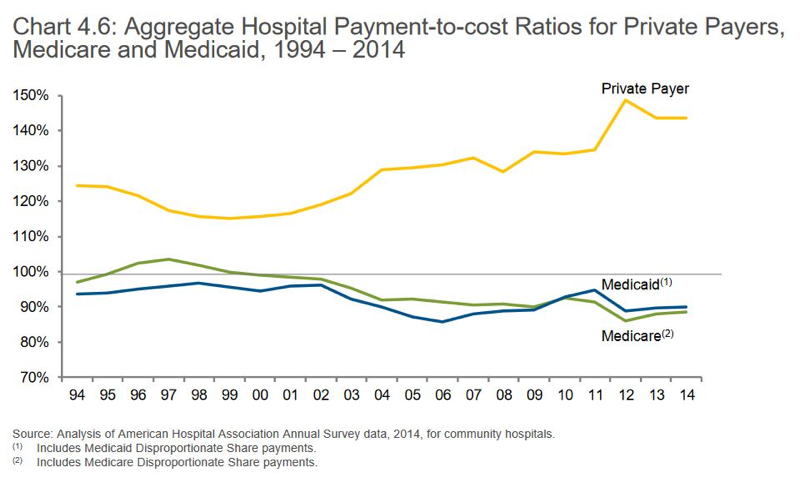
    What the Chart Does and Doesn’t Say

    So, here is the ultimate source of the problem—Medicare and Medicaid only pay for a fraction of the cost of care.  Providers are left to gouge private insurers and out of pocket patients for all the money they lose treating Medicare and Medicaid patients.  According to the chart, hospitals are charging private pay patients about 150% of cost.

    There are two major implications of this that people don’t generally appreciate.  More charts would probably only make things more confusing, just understand two things: 1) Medicare and Medicaid patients are more expensive than private pay patients, and 2) the unfunded costs of Medicaid aren’t evenly distributed across the country.

    What the hell does that mean?

    • Medicare and Medicaid patients tend to cost more than private pay patients. People on Medicare are older and need more in the way of expensive treatments—heart surgeries, terminal illnesses, etc.  Poor people on Medicaid, likewise, tend to have more babies, more health problems, and may generally be more expensive to treat than private pay patients.

    So, don’t be confused by the averages in the chart—Medicare and Medicaid are covering 85% of the costs (on average), but they’re also covering more expensive costs.  In other words, if the average private pay patient goes to the hospital once a year for an MRI scan, when the insurer pays 150% of that relatively small cost, they’re reimbursing that provider for the tens of thousands of dollars the provider lost performing heart surgery on someone with Medicaid or Medicare.

    • The unfunded costs of Medicaid are not evenly distributed, and that points to another problem caused by Medicare and Medicaid only reimbursing providers for a fraction of the cost of care. Medicaid is for poor people, and poor people aren’t evenly distributed in your city, much less your state.

    Hospitals are like retailers in that they serve a local community and that community has a particular income level.  If the hospital is in an area with a disproportionate percentage of poor people, then there are few private pay patients in that community on insurance to make up for the shortfall.  That means where the chart says that the average private pay patient is paying 150% of cost vs. Medicare/Medicaid’s 85%, it assumes that the patient mix is the national average.

    In other words, if the hospital is an area where the local population only has 10% private pay patients and 90% Medicare and Medicaid patients, then that 150% percent of cost figure for private pay patients is going to be much, much higher–and those kinds of patient mix numbers are not uncommon in urban poor areas.

    Sensitivity Analysis

    The part where you all get mad at me!

    Usually, a sensitivity analysis would show how taking the Medicare and Medicaid reimbursement rate up higher would impact the local cost of care.  This sensitivity analysis is more about how the system would improve relative to various solutions.  How would doing x, y, or z improve the situation?

    For instance, wouldn’t the system be better if individuals and insurers formed the market instead of getting insurance through employers? I suppose it would be better, but that solution doesn’t address the real cause of the problem.  Insurers would still be competing to sell you a policy that covers 150% of the cost of care (national average).

    What about removing the “Cadillac” tax, getting the AMA to stop limiting class sizes of nurses and doctors, making pricing transparent, or making policies portable across state lines?  Without getting into too much detail, transparency and portability are extremely complicated because of Medicaid, and even if those things were possible—what would any of them do about the fact that insurers are still paying 150% of cost (national average)?

    Solutions

    I suppose a lucid progressive might suggest taxing productive workers to take Medicaid’s and Medicare’s reimbursement rate up to 100%, but 1) raising people’s taxes so they can afford to buy insurance is just playing an especially stupid shell game with costs, 2) Medicare and Medicaid spending already make up almost a third of the federal budget, 3) the Medicare rolls are already set to increase as baby boomers continue to retire, and 4) that might be an extra $300 billion a year in real payouts—something like the size of our national interest payment.

    The ultimate solution is to cut these programs.

    Medicare is more politically sensitive, and Medicaid is especially responsible for driving up the cost of private insurance in economically distressed areas.  Certainly, rolling back the ObamaCare Medicaid expansion is a necessary step before we can cut back the rest of Medicaid—and did you know there is a plan being considered in Congress, right now, that gets rid of the ACA Medicaid expansion after 2019?

    Whatever else the Ryan plan isn’t, it’s one of those rare situations in which the actual cause of the problem is actually being addressed.