Category: Opinion

  • What are we reading? June 2017

    *looks up from book* Oh, it’s you. *frowns slightly, returns to reading*

    SugarFree

    Finished Mira Grant‘s Newsflesh trilogy–Feed, DeadlineBlackout–and the various in-universe short stories collected in Rise. All the novels and a few of the shorter pieces in Rise were nominated for Hugo awards so there has been quite a bit of buzz about this series since Feed came out in 2010, but they are set in a post-zombie apocalypse and I have been suffering rather severe zombie-fatigue. Set 20 years or so after a viral zombie outbreak that killed around a 1/3 of Americans, crusading bloggers are chosen to be in the press pool for a charismatic young Senator running for President of the United States. The CDC basically runs the country through strict containment laws and thick layers of security theater. Complications on the campaign trail ensue, as they always do.

    The set-up is a bit derivative, stealing a bit of Bug Jack Barron via Transmetropolitan, but Grant does a pretty good job convincing even a cynic that such a thing as a honest reporter can exist. And that a public who is trying to survive in a much more deadly world would actually care what a reporter had to say. But in a literary universe where the dead walk, some suspension of belief is required up front. And the general anti-government and individualist outlook of the work will be pleasing to the libertarian mindset.

    Grant is a pseudonym for Seanan McGuire, who also publishes under her real name. The Newsflesh material is her one big hit and the in-universe short stories show her milking it for all it’s worth, and as a result the stories are generally-enjoyable-shading-to-disposable. But, overall, I look forward to reading more of her work.

    jesse.in.mb

    Peter Reinhart’s Artisan Breads Every Day: Always looking to up my baking game a bit, especially since the doctor I work for (a former professional chef) was convinced by his partner to get back into baking. I was actually led to Reinhart by Warty suggesting I make a struan. That shit’s tasty, yo. Artisan Breads Every Day does a solid job of simplifying some of the techniques he presented in The Bread Baker’s Apprentice although I’d like more details on prepping a wet sourdough starter into a stiffer biga or pâte fermentée. It’s times like this I was working with a paper book so I could math in the margins.

    Ender’s Game Alive: A solid full-cast recording of Ender’s Game, I listened to this while frittering time in a Tucson hotel. It’s been a long-ass time since I read Ender’s Game and it made me want to try reading Speaker for the Dead again, but I remember picking it up getting bored as fuck and putting it back down almost immediately last time, so maybe not. Bonus points for it being under Audible’s gratis options.

    Beach Lawyer by Avery Duff: This ended up being my Kindle Firsts choice and it was ideal airplane reading. The two attractive male alpha lawyers jockeying for position plot was a bit tired, but it’s always fun reading a novel that’s set in your stomping grounds and Duff’s descriptions of locale are vivid and right on.

    JW

    JW is currently reading his palm…wait, that’s not reading! Jesus, dude, get a room.

    Old Man With Candy

    SP gifted me with a copy of Steven Pinker’s The Better Angels of our Nature, which has been reviewed and discussed so  many times… wait a minute, it looks like she’s talking about it below. Damn, I can’t step on her toes or I’ll be catbutted.

    And I am plowing into a couple of sci fi books that SugarFree gave me, starting with Up the Line by Robert Silverberg, a time travel novel which, unlike Heinlein’s later efforts, does not involve sex with the protagonist’s mother and daughters. But there IS plenty of sex because, after all, Robert Silverberg. The writing is slick and vivid.

    Riven

    In our last installment, I mentioned that I was still working on cracking the cover of Dead Witch Walking by Kim Harrison, recommended to me by SugarFree. I have since read every book and short story in “The Hollows” series except the lately published prequel, The Turn, which I only just started yesterday morning. It was a fun and satisfying series: fantasy elements made modern, tastefully written smut scenes that only occasionally take place in bedrooms, and a bit of a who-dun-it feel. I haven’t been able to put them down since I started–even the short stories are compelling. The characters don’t always act in predictable ways (to the reader or to other characters) and wacky hijinks abound from misunderstandings, magical anomalies, and the like. You could argue that the books tend to be a little formulaic as time goes on: trouble rears its ugly head, tension builds, our plucky protagonist Rachel finds that the trouble is actually worse than we’d previously thought, but somehow, someway… everything ends up being alright. Or, y’know, especially difficult problems get carried over into the next book. Ongoing issues don’t just fade away; Harrison neatly wraps them up, sometimes in a book or three, sometimes spanning the entire series. Overall, this was a grand adventure of a series, full of capers and intrigue, a principled protagonist who stuck to her guns, and I’m sorry to see it end–even though I know it can’t go on forever, which is a lasting message from the series, itself.

    Brett L.

    I slogged my way through The Rise and Fall of D.O.D.O.: A Novel  by Neal Stephenson and Nicole Galland and — how can I put this… Take the least interesting parts of The Cryptonomicon and The Baroque Cycle and all of the knowledge dumping of Seveneves without the cool final two chapter payoff and that’s this book. If you have the rest of the summer to kill and don’t mind wandering through poor staging/narrator choices and far too many nerd jokes, this is a two-star effort from a five-star writer. The short, non-spoilerish version is that magic waned until a bright MIT guy invented a chamber where the quantum wave function can’t collapse (for those of you who know quantum mechanics, just stick with me here) like the Schroedinger Gedankenerfahrung that everyone has heard enough about to use as a plot device. Anyhow, time travel, not nearly enough adventure, and quasi-immortal German bankers. Its actually worse than it sounds. Seriously, don’t read it.

    On the other hand, I just picked up Mark Lawrence’s latest work Red Sister, which is already better. If you’re not familiar with his post-apocalyptic, semi-magical Europe double trilogy (two trilogies telling two complete, but overlapping stories), I highly recommend them. Look for a more complete review next month.

    SP

    This month I’m deep into The Better Angels of Our Nature: Why Violence Has Declined by Steven Pinker. I’ve followed Pinker for many years on edge.org and he’s always fascinating.

    Also reading The Haywire Heart by Chris Case, John Mandrola MD (an electrophysiologist I follow online), and Lennard Zinn. This is a very interesting look at how intense physical training can bring on arrhythmias in endurance athletes as they age. (I don’t personally need to worry about this particular problem.)

    And, YEA!, the new Scot Harvath novel, Use of Force, from Brad Thor arrived. You should get it.

    sloopyinca

    Sloop is reading The Neverending Story and contemplating Xeno’s paradox.

    Gojira

    Gojira gets enough fiction from movies, and is currently re-reading one of his top 3 favorite non-fiction books, The Empire of the Steppes: A History of Central Asia.

    Heroic Mulatto

    Summer reading for an upcoming project:

    Hands-On Machine Learning with Scikit-Learn and TensorFlow: Concepts, Tools, and Techniques to Build Intelligent Systems and Natural Language Processing with Python: Analyzing Text with the Natural Language Toolkit.

    WebDominatrix

    I am currently re-reading The Dictator’s Handbook, which has shifted the way I approach business and marketing, as I’ve seen a lot similarities in the business world.

    I’m also reading Hit Makers about how trends happen.

  • Single Payer Healthcare – Part 2

    (Part 1)

    Introduction

    Once it is determined who is granted access to the system and how this system is going to be paid for, the next step is discovering how these health care services are going to be delivered.  After all, the point of our nation becoming part of the noble cadre of nations that recognize access to health care for all citizens as a civil right of some kind is to actually treat sick people.  Sounds like a given, but how do they go about doing it?

    Primary Care – The PACT Model

    The key to delivery in the VA is through the Primacy Care Provider (PCP).  There is one doctor (MD), or nurse practitioner (NP) that is charged with providing the basis to all services to an individual Veteran.  The team also has a small cadre of Registered Nurses (RN), Licensed Practical Nurses (LPN),

    Nursing Assistants and Medical Support Assistants (MSA) that work in support of the PCP.  This is in effect, a small clinic that operates similar to many health care systems and even at private clinics.

    What the PACT team does, is provide the Veteran with general services, also a given since the MD is typically a general practitioner.  This team should handle routine services, and also does the grunt work in terms of keeping track of medical history.  They provide this based on particular medical criteria designed to stay abreast of common health factors affecting the given population.  As noted in the previous essay, most of the Veteran population is older and male.  

    This means the PACT can focus on the types of issues older men typically face.  Examples of such conditions include obesity, hypertension, diabetes or any condition that will worsen over time if a relationship with a physician is not maintained.  If a condition worsens, the PCP will know about it and be in a good position to alter his or her plan of care.  This proactive approach is often pointed out by advocates of single payer health care systems as a feature of these systems since most of the time healthcare in the United States is a reactive proposition.  Reactive in the sense that most people will simply wait until that bump gets bigger, or that knee becomes too unbearable to walk on, or it hurts too much to urinate in the morning before finally making an appointment to see a doctor.  

    Symptoms may not appear until it is too late for treatment to be effective for many fatal diseases; the system is more likely to catch an underlying condition while it is most effective to treat in this proactive system.  Catching these conditions early on has the added benefit that it is often more cost effective than catastrophic treatment (6).

    There are studies that Longman cites in his book that suggest a correlation to this approach leading to better outcomes versus the patient waiting until the symptoms get too unbearable (6).  There are some studies that go so far as to say that VA patients live a longer life, in spite of disability, alcoholism, PTSD, et cetera, being more frequent than in the general population.  Even studies with outcomes in specific areas cited as performing better than the private sector (6).  The overall cost of such a system also has a tendency to be lower than the fee for service model.  One study from 2004 suggested all VA services provided during FY 99 if reimbursed at Medicare rates would be result in an estimated 17% higher cost to the taxpayer (1).

    Specialty Care

    This is where things get a little more complicated.  Consider what many third party insurers require of their customers to see a specialist.  Typically, if a customer wants their insurance to pay for specialty care they will have to first go to a primary care clinic to initiate a referral.  What this does for the insurer, is inform them the requested service is medically necessary.  This necessity is important to insurers because specialty care providers have a tendency to provide services that are more expensive than their general counterparts.  Similarly, in order to see a specialist, a Veteran must first see their PCP.  This step allows the PCP to discuss all of the options available to the Veteran and if their condition truly warrants the expertise of a specialist they will initiate a consult.  

    The consult is essentially a documented source of communication between the PCP and the specialist.  Once the PCP enters the consult, the specialist is notified via a provider alert on the Electronic Health Record (EHR) Software.  They will review the PCP notes, review the Veteran’s charts if necessary, and if the specialist agrees the service is necessary the specialty clinic’s MSA will contact the Veteran to schedule an appointment.  At this point, the treatment varies with the Veteran’s circumstances.  It could be an evaluation, a noninvasive outpatient treatment or perhaps a surgery needs to be scheduled with an inpatient stay.  All of these specific circumstances are documented on the consult.  Once the service is provided, the specialist will document their findings in the EHR to be ultimately reviewed by the PCP.  If the specialist does not agree the services are needed, the reason why is documented and the consult is discontinued.  If the specialist needs more information, a lab for instance, this will be documented and sent back to the PCP, this way the specialist has every resource available to make an informed decision.

    Drugs–the legal variety.

    The reason often cited for the efficacy of VHA versus private sector hospitals is the VistA EHR system. It allows a somewhat simple integration between clinics as discussed in the previous sections.  It also allows medical data to be stored easily, and later used for research purposes.  During the Clinton administration, Ken Kizer, the SecVA at the time, implemented a prescription drug formulary by researching this data as well as recognizing that once Veterans go to the VA they typically stay there.  For whatever reason why they stay, they identified they were there for life.

    ‘If you are going to have your patients for five years, ten years, fifteen years, or life,’ explains Kizer, ‘there are both good economic and health reasons why you would want to use the more expensive drugs.  You have a population of patients who are at high risk for sclerotic heart disease, and you’ve got them for life.  You make a different decision about what’s on your drug formulary than you might if you knew you only had them for a year or two.’ (6)

    What the researchers were able to do with this was create a formulary that determined what drugs worked long term.  When the FDA approves a drug, there typically is no long term research into the drug’s efficacy, only if it does what it claims and if it is safe for use.  What this means is the VA will only prescribe drugs that have well-known, established effects, but also have been around long enough to be on the generic market.  If a new prescription drug treatment hits the market, it is almost certain the VA will not add it to their formulary, even if the drug is truly is a medical breakthrough, as discovered with the new Hepatitis C drug (7).   While it was later approved, it required a cost/benefit analysis on the cost of treatment at the VA for hepatitis C before they were able to add it to the formulary.  The result is a system that according to the Heritage Foundation costs significantly less than Medicare Part D but presents its patients with no choice whatsoever in their prescriptions (3).

    The VA formulary is created through access restrictions on drugs. For drugs to be covered on the formulary, their makers must list all of their drugs on the Federal Supply Schedule (FSS) for federal purchasers at the price given to the most favored nonfederal customer under comparable terms and conditions.  Additionally, drug makers must offer the VA a price lower than a statutory federal price ceiling (FPC), which mandates a discount of at least 24 percent off the non-federal average manufacturer price (NFAMP), with a rebate if price increases exceed inflation (3).

    Otherwise, the VA negotiates pricing based on volume, as they are the largest health care provider in the country. The drug companies that sell to the VA recognize that it is a closed system and there is little chance of market distortions from below market priced VA drugs.  It is also small enough as a portion of the entire health care market, that they are able to break even by selling non-generic prescription drugs elsewhere (3).

    Scheduling

    Everything in the previous sections of this essay is utterly meaningless if Veterans cannot get an appointment.

    The thing is, most major hospital systems and private practices do not worry too much about whether or not they are able to schedule patients in a timely manner.  The reason being, they have many fixed costs that are baked into their operating budgets.  Paying for the cost of operations requires treating patients.  If they can’t get patients into beds, they go under–kind of like when airlines have no passengers. The private sector is also large enough at the moment that if a patient cannot be seen at one place, they can find another.  In the grand scheme of things it is about as difficult to schedule an HVAC technician as it is to schedule an appointment with a private doctor—it just depends on where you live, and the local supply and demand for services.

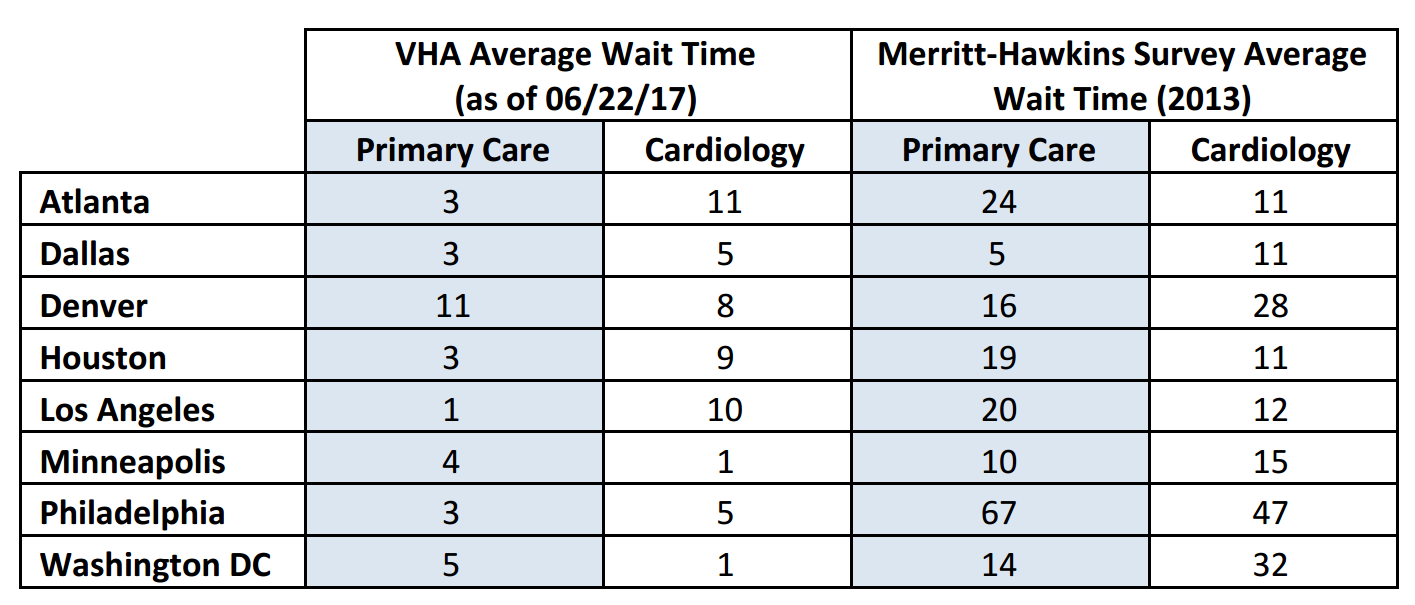
    Because of this, it is often difficult to find an apples to apples comparison for scheduling times.  In 2014, Merritt-Hawkins published a survey on Medicare/Medicaid acceptance rates and average wait times for a number of US Metropolitan areas (2).  Unfortunately, their survey uses 2013 data and is limited to a few clinic types.  The VA does have a public website that currently presents average wait times at all their facilities, for a similar number of clinic types (4).  For purposes of brevity, only Primary (or Family) Care and Cardiology average wait times will be displayed here by number of days.  The references section has links to both resources in case further research is desired.


    Ruminations on Primary Care, Specialty Care, Drugs and Scheduling

    While the scheduling numbers in the area listed appear comparable or better than their private sector counterparts there is something that should be mentioned here:  these data were made available as a result of a well-known scandal involving the manipulation of the wait times first identified in Phoenix, but later found to be endemic of the system as a whole.  Here are a few other examples:

    Tucson:  https://www.va.gov/oig/pubs/VAOIG-14-02890-72.pdf

    VISN 6 (VA, NC):  https://www.va.gov/oig/pubs/VAOIG-16-02618-424.pdf

    Houston:  https://www.va.gov/oig/pubs/VAOIG-15-03073-275.pdf

    Colorado Springs: https://www.va.gov/oig/pubs/VAOIG-15-02472-46.pdf

    Providence: https://www.va.gov/oig/pubs/VAOIG-15-05123-254.pdf

    Cincinnati: https://www.va.gov/oig/pubs/VAOIG-15-04725-272.pdf


    The VAOIG website is full of these. Unfortunately, bottlenecks within the system can occur.  With a large number of people congregating into urban areas, it is very likely to happen in a hypothetical single payer system.  Keep in mind the VA only provides care for a small minority of Americans (around 9 million) and scaling the system for the entire population is unlikely to make it work any faster, this is the practical experience in other countries as well.  There is also the question of coordinating care with a specialist.  So to recap the consult management practice goes like this:

    AH! ➔ Appointment with PCP ➔ PCP Agrees and writes up a consult ➔Specialist receives consult and reviews ➔ Specialist accepts and schedules appointment ➔ Treatment ➔ Specialist documents treatment ➔ Specialist informs PCP of treatment ➔ Re-evaluation by PCP if needed.  

    Each of these steps requires human input; miss a step and the entire process stops.  Stop early enough and treatment may never be given at all.  One of the findings from an investigation determined there was little oversight at the time of the investigation of the process at all, which likely lead to unnecessary deaths (6).  The prevailing issue with government systems such as these is lack of accountability.

    In terms of prescription drug pricing, the VA formulary only works because it is a closed system.  Scaling it up will create a massive market distortion that according to the Heritage Foundation, will only drive up costs (3).  Consider the formulary is based on restricting the drugs it will pay for, and what doctors can prescribe.  This will result in shifting costs to new medications for those willing to pay for it.  There is also the matter of the formulary’s insistence on using generics.  Generic drugs are made by a limited number of manufactures and if the only thing the hypothetical single payer will pay for are generics and the physician is required by law to only prescribe generics, it will only result in a temporary shortage due to the spike in demand.   When coupled with the price controls it is probably going to take these companies longer to increase their manufacturing capacity due to limited funding.  Of course if their lobbyists are half as good as they are rumored to be, they might avoid that.  Not to mention the obvious result of, “billions of dollars in averted research and development expenditures by drug makers, forgone investment in an untold number of new drugs, and the considerable loss of valuable research and science jobs (3).”

    Finally, there is little evidence that profit motive automatically results in poor outcomes.  An informed pedant might throw out Roemer’s law.  Which postulates that in the for profit model with an insured patient population, every hospital bed will be full.  If the hospital finds that they are not balancing their books with primary care, they will simply shift their resources to providing a higher paying specialty—like cardiology.  It is in this way they can maintain their patient population and continue to keep their revenue streams in place.  If a patient needs a cardiac catheterization, they are probably going to be comforted by the fact the hospital they are at performs the procedure thousands of times a year.  Given the procedure involves a surgeon threading a device through a vein in the groin and then insert a device into or near the heart, the patient might think of this as a feature rather than a bug.  Finally, even if there are benefits to the “proactive” approach the VA system currently uses that can materialize in a hypothetical single payer, the argument this can only be achieved with a state-run system without the profit motive is made out of ignorance of the industry or dishonesty.  

    Why? Because there happens to be a similar for-profit system, that apparently made $504 million in Q1 2016 (8).  While they are only available in a few areas, it just so happens they specialize in the same type of fully integrated, proactive approach to care that is touted as the feature of state run systems.   

    Their EHR isn’t a relic from the 1970s either.


    References

    1. Nugent, Gary et al.  Value for Taxpayers’ Dollars:  What VA Care Would Cost at Medicare Prices.  Medical care Research and Review, Vol. 61 No. 4 (December 2004) pages 495-508. http://journals.sagepub.com/doi/pdf/10.1177/1077558704269795
    2. Merritt-Hawkins. 2014 Physicians Appointment Wait Times and Medicaid and Medicare Acceptance Rates.  (2014) pages 1-32. https://www.merritthawkins.com/uploadedFiles/MerrittHawkings/Surveys/mha2014waitsurvPDF.pdf
    3. Angelo, Greg.  The VA Drug Pricing Model:  What Senators Should Know.  The Heritage Foundation, No. 1420 (April 11, 2007) 1-4. http://s3.amazonaws.com/thf_media/2007/pdf/wm1420.pdf
    4. Department of Veterans Affairs.  How Quickly Can My VA Facility See Me? http://www.accesstocare.va.gov/Healthcare/Timeliness
    5. Longman, Phillip.  Best Care Anywhere.  Polipoint Press, February 2007.
    6. U.S. Government Accountability Office (GAO).   Report 14-808 VA Health Care Management and Oversight of Consult Process Need Improvement to Help Ensure Veterans Receive Timely Outpatient Specialty Care.  http://www.gao.gov/assets/670/666248.pdf
    7. Reid, Chip. VA can’t afford drug for veterans suffering from hepatitis C. http://www.cbsnews.com/news/va-cant-afford-drug-for-veterans-suffering-from-hepatitis-c/ (06/22/2017)
    8. Rauber, Chris.  Kaiser Permanente:  First quarter profits down, but revenue and enrollment up.  http://www.bizjournals.com/sanfrancisco/blog/2016/05/kaiser-permanente-healthcare-50-percent-drop.html (06/22/2017)
  • Single Payer Healthcare – What It Could Look Like

    Introduction

    The lamentable position that is often tossed around this site as well as others, including this site’s precursor, is that single payer healthcare will be implemented within the lifetime of the current generation. While the majority of the intended audience may not fall into this demographic, others here will probably experience this for themselves. This series of essays is not necessarily intended to be an advocacy piece. This is intended to provide a snapshot of a healthcare system that is currently in place in the United States today, that embodies everything a single payer system in a ‘civilized’ nation such as those in Western Europe, Canada and elsewhere. Governments tend not to be innovative, and instead will opt for a solution with a historical basis for which an ‘educated’ opinion can be determined. In other words, if and when this happens it will not be a brand new system but one which will be based on prior experience and there is only one American system today that has the capacity, scope and history for which to base a single payer system. The problem of course, is the system in question is only available for an surprisingly small group of Americans and many who may argue against such a system are not likely to have experienced it for themselves. As Sun Tsu once postulated in order to defeat the enemy, one must know the enemy better than they know themselves.

    If advocates of free markets, Federalism and personal responsibility are to define coherent arguments against such a system it is best they first understand what the future may look like. While the practical experience in Western Europe should provide enough ammunition, it is likely these systems will be used as arguments for single payer systems. It should however be noted, the experience in these countries are unlikely to be comparable to the United States, because these governments historically are more enthusiastic(?) in their approach to governance. Not to mention the centralized nature of the population and demographic homogeneity make it easier for these socialized systems to be implemented. An American example is needed–and fortunately is available for interpretation. It is this way freedom advocates will know, and knowing is half the battle.

    This is the Veterans Health Administration (VHA). As interpreted by a mid-level GS employee with direct experience at the VISN (regional) and Facility level.

    Eligibility

    The first thing any health care system will need to determine is the eligibility requirements to utilize the services provided by the system. Without boundaries, there will be no limitations to the extent these services are rendered.

    In conceptual terms, eligibility is the first form of control. This is to determine who gets in, and among those, what can be allocated.

    First thing first, nearly everyone using VHA services are Veterans but not all are combat veterans. There are Veterans that were given a disability for other reasons, such as injuries during peacetime, asthma or sexual trauma, which unlike its counterpart on college campuses actually did happen to a good extent in the past. There even are some annoying situations where Veterans of some wars are simply viewed as better than others. WWI and the Mexican Border War Veterans for example, assuming there are any living examples, by law are currently allowed unlimited access to all services at any VHA facility (1). While Eddie Rickenbacker does not need to worry about paying for a colonoscopy, there are others with ailments such as Agent Orange or Gulf War Syndrome that were affiliated with wars that were determined by popular culture to be unpopular from a political standpoint, and were thus swept under the rug.

    For good reason, with his hat tilted the wrong way and his hands conspicuously in his pocket, America’s first ace has the kind of swagger that will drive a Sgt. Major to the brink of insanity. Most can only dream of such awesomeness. Therefore Mr. Rickenbacker should not need to worry about his access to quality healthcare and he is not at all worried–because he is dead.

    For everyone else, it is a process that begins at a recruiting station when nobody is old enough, or even cognizant of the future’s possibility. Nobody discusses VHA benefits with a recruiter, because quite frankly even the recruiter does not know because he or she is not to that point in their life either. This process starts at the end of an enlistment or near retirement. Once a retiree drops the paperwork at the personnel office or upon signing the separation paperwork, they are eligible to apply for disability. The math on this is not what most consider to be math to begin with.

    For most sane individuals with the most rudimentary of education, 10+10+20=40, right?

    Wrong!

    The VA uses a descending efficiency scale (2). What this means, is the government decided that math was too straightforward and made a system of it. Essentially, a service member shows up at the recruiting office at 100% because most of the recruiting process is determining medical qualifications. The military is quite efficient at weeding out those that are not at 100%. It is assumed the service member will incur some type of injury that will negatively affect the rest of his or her life. For instance, asthma as previously mentioned will net the service member a 30% disability. Hearing loss is another 10% resulting in a total of 30% disability. How? Asthma reduced him to 70% of his initial ability. Now that he can only hear in his left ear, reduces that 70% by another 7%, because 10% of seventy is seven.

    30+7=37 rounded down to the nearest 10 is 30. Get it?

    Most Veterans will fall into the trap where they tell a doctor something hurts, therefore it affects them negatively. This is not how it works. The doctor performing a Compensation & Pension Examination is concerned about how the condition will inhibit your ability to function from a quality of life standpoint. In other words does it keep you from getting a job? Back pain does not prevent one from working the concierge desk at the local Marriott, nor does being wheelchair bound keep one from working at a bank. It will keep them from working a high paying job on a oil rig, railroad or construction site. The post industrial job market, the Montgomery (later Post 9/11) GI Bill and the Americans with Disability Act do provide some relief for those alternatively abled. In order to help the Veteran handle his pain physically, the VHA has a well negotiated prescription drug formulary. It is designed to control the cost of medication, and thus facilitate a solution for pain relief.

    Now this service connection will net the service member (now considered a Veteran) a disability payment that will need to be paid monthly as long as the Veteran lives. Per the numbers ran by the associated press the last time Veterans were used as a political hot potato during the Sen. Ted Cruz led government shutdown of 2013, this is around $5 billion–monthly (3).

    Once a Veteran has a service connected disability (SC), they are deemed eligible for VHA healthcare–even if that disability is 0%.

    Why is eligibilty so important? The system needs to know how many it must serve. The health insurance industry also has a concept tossed around from time to time known as ‘moral hazard.’ What this means is the more an individual is insulated from the costs of the services being paid for, the more likely they will use the service. This needs to be accounted for in order to control their costs. In other words, people will not care if it is not their money at stake. This is a concept familiar to many free-market aficionados. There is also the small issue of Veterans and non-Veterans alike in abusing the system to enrich themselves financially(4) . Most of these are, hopefully, outliers but abuses to the system also lead to inefficiencies caused by programs within the system designed to ensure the program’s solvency, which leads to Veteran’s waiting a long time for their eligibility paperwork to be processed.

    This SC rating translates to how a VA Medical Center (VAMC) is funded.

    Funding

    If only it were simple to explain how a VAMC is funded: Congress does not write into a budget that VAMC Tom, Dick and Harry shall receive $X. The system is designed so that the Veteran population can be in flux and the allocation can reflect how ‘sick’ that particular population is and how often it is used. It is based on disability, age and other factors, like if a Veteran received a Medal of Honor, a Purple Heart, was a Prisoner of War, and the like. Sgt. Dakota Meyer has two out of the three mentioned, and that ain’t bad. Then again, so does Sen.
    John McCain.

    The bottom line is, the more service connected the Veteran is and the greater resources it would theoretically take to treat the Veteran individually, the more money the VAMC receives from Washington. This is not just for the big things like, a prosthetic or a cochlear implant that are SC, this also works for little things like flu shots and almost everything else Veterans use that is not SC. The dirty secret is, most services Veterans use at a VAMC are not SC, even if he or she is 100%. This funding system is called Veteran’s Equitable Resource Allocation (VERA).

    The cited report from the Rand Corporation is predictably thorough in its methodology, analysis and description of the VERA system. The highest VERA category is about $70,000/year. This is designed to put a higher value on Veterans that need the care versus the ones that may not, and cover the cost difference of the former with the latter. A Las Vegas oddsmaker works in a similar fashion. It should be pointed out, Rand’s overall assessment of the system and its efficiency is highly dependent upon the Veterans that are also eligible for Medicare(5) . In short, the overall cost of care for Veterans is largely uncertain for any that are over 65. The reason being, VHA is unable to bill Medicare for services, much like one does not bill their spouse for services performed around the house. Ultimately, the proceeds from such a transaction are coming from and going to the same budget. Since many Veterans are part of this demographic or soon will be, it is likely the cost to providing Veterans health care is going to be skewed by this factor. What makes this more difficult to quantify, is HIPAA and that Medicare providers are under no obligation to provide VHA with medical records for services that are not provided under VHA auspices.

    In fact, this factor was cited by Longman as an argument to save costs on Medicare. It is estimated VHA has a lower overall cost of care due to the VHA ownership in facilities and control of the services in terms of medical necessity, by about ⅔ the cost of Medicare. In a CBO report reviewing costs from 2007-2015, it was estimated that putting Veterans qualifying for Medicare back on VHA would save $29.5 Billion over the time period, with $4.8 Billion saved from Medicaid(1) .

    Third party revenue can also be captured by VHA. This is allowed under the Balanced Budget Act of 1997(6) where the VAMC can code and bill a private insurance company the same way as any health system. The difference being they are only able to bill if the Veteran has other health insurance and are financially capable of paying a $15 or $50 copay. Under the PPACA, the IRS will automatically notify VHA if the Veteran has other health insurance. This accounts for 10-20% of a VAMC budget.

    There are other ways to fund specific programs such as prescription drugs, durable medical equipment, real estate, furniture and NonVA Care. These however, are largely allocated to VAMC a with a specific purpose. There is some discretion on how VERA funds can be allocated between facilities, but this is for the most part, a reaction to the present circumstances and typically planned within a fiscal a year. This is how a VAMC can install millions of dollars worth of solar panels in the parking lot but somehow fall short of their budgetary obligations with few repercussions.

    Ruminations on Eligibility and Funding

    From experience with eligibility, a moral case can be made on determining who is eligible. Some questions that may be raised include:

    – Does a minority, or anyone from a supposedly aggrieved demographic deserve more or less than a white male between the ages of 18-55?
    – Does an individual with late stage cancer receive a higher allocation than a single mother with 4 kids?
    – The VA currently will not pay for the surgeries necessary for one to transition to the opposite gender, will this hypothetical American single payer cover this cost, and how?

    All are questions that Congress would have to address in any hypothetical piece of legislation. It is unfortunate that questions like these that were once easy to answer, might now be more difficult because of the social concerns that dominate the current political parties. This will lead to needless fights in justifying why one is more deserving of the other. Much like Eddie Rickenbacker is eligible for VHA benefits automatically, but an OIF/OEF Veteran must justify why he or she is deserving. Such duplicity does not bode well for those arguing that healthcare is a right. Furthermore, shifting the costs to the system for the oldest, and therefore most likely the sickest patients to Medicare illustrates a practice for a medical system designed to control costs simply by determining who is eligible through at best, arbitrary criteria. At worst, it may be determined by politically insidious criteria.

    Such a practice in a hypothetical single payer system designed to cover all citizens is hardly equitable.

    In terms of funding, there is no way to determine how much this will truly cost. Simply scaling up VHA to the present population is only a rough estimate and does not account for demographics. Simply put, most VHA eligible beneficiaries are men, between the ages of 55-65. This demographic has very specific and more importantly predictable needs which easily control costs, but are hardly indicative of the entire American population. Coupled with the unknown costs shifted to Medicare/Medicaid, any quantification that will be presented is simply dishonest.

    For the audience which this piece is intended however, the moral case is simple: In order to participate in such a medical system an individual will necessarily need to justify the labor from skilled professionals while simultaneously reimbursing those professionals through appropriation made possible only by other individuals coerced into doing so. This is immoral as the previous sentence is a bunch of words more concisely described as theft. In the case of Veterans, at the very least they can point to a record where this appropriation was earned; the merits of which are understandably debatable for some and for others unjustified.

    Eligibility for existing within a politically determined border, what kind of earned merit is that?

    References

    1) Longman, Phillip. Best Care Anywhere. Polipoint Press, February 2007. Pages 102-106.

    2) Guina, Ryan. Funny Math–VA Disability Ratings. When 30+20 Doesn’t Always Equal 50. http://themilitarywallet.com/va-math-combined-disability-ratings/. 06/19/2017.

    3) Zoroya, Greg. Shutdown holding up military, VA benefits.
    https://www.usatoday.com/story/nation/2013/10/08/shutdown-casualties-combat-benefits -unpaid-pentagon/2941809/ 06/19/2017.

    4) Dinan, Stephen. Veterans caught triple-dipping on benefits.
    http://www.washingtontimes.com/news/2014/oct/30/veterans-caught-triple-dipping-on-benefits/ 06/19/2017.

    5) Wasserman, Jeffery et al. Understanding Potential Changes to the Veterans Equitable Resource Allocation (VERA) System. http://www.rand.org/pubs/monographs/MG163.html.

    6) Office of Inspector General. Report of Audit Congressional Concerns over Veterans Health Administration’s Budget Execution. https://www.va.gov/oig/52/reports/2006/VAOIG-06-01414-160.pdf.

  • Firearms Friday: Printed Pistols and other Peculiarities

    So, confession time: It is more difficult to keep up a weekly column than I originally thought it would be. When I took this on, I noticed that many of the weekly columns had burned out, and I decided to show these layabouts what a real weekly column looked like. None of this ‘three or four articles and then I’m done’ garbage. Firearms Friday would become a cornerstone of the Glibertarian community; A stalwart pillar representing the foundation of our proud website. Well, to those I privately disparaged, I apologize. It is not as easy to keep up a regular article as I anticipated, even one that has as much depth and variety as a gun themed screed. Nevertheless, I will persist with this as long as I can manage, which means you are stuck with me for the time being. This week, by popular demand, I will look into the business of making your own firearms yourself. Much hullabaloo has been raised and many gallons of digital ink spilled in reference to DIY guns, namely 3D printed guns and so called 80% receivers. Most of this ink has been accompanied by an equally copious amount of feces lining the panties of the writers of these various articles over the idea that anyone, ANYONE AT ALL, could build their own functional firearm in the comfort of their own home or garage with just a few simple tools or an inexpensive printer and a roll of plastic filament. Well, I am going start out up front with some bad news: you aren’t going to pop a working M60 out of your makerbot anytime soon, or probably ever.

    Complete lower on top, 80% lower on bottom.

    Before I drop too many turds into this 3D printed punch bowl (so far this article has enough poop references to be a SugarFree piece) lets back up a bit and define some of these ideas more clearly. First off: What makes a gun a gun? Obviously it requires a specific quantity and type of parts as well as certain mechanical abilities, but at what point is it no longer just a pile of steel and wood? Legally, in America a gun is defined as the part designated as the frame or receiver. Every other part of the gun, including the barrel, trigger, stock, etc. is merely a part and can be bought and sold as freely as a toaster. The receiver, however, is always considered a firearm regardless of it’s functionality. It must be engraved with a unique serial number and is subject to all rules and regulations regarding working firearms. This means that you can buy all of the parts necessary to build a gun without any sort of paperwork or background check, except for the receiver which must be purchased either from a gun store (thus requiring a background check) or face to face from another resident of your home state (subject to local restrictions). At some point, some wise ass got to building a receiver, stopped before he drilled the last hole, and said “So this doesn’t count as a gun, right? LOL!” This pissed the ATF off, I’m sure, at which point they declared that almost a receiver IS a receiver, and then probably shot the guy’s dog. Well eventually people started asking questions about this ‘almost a receiver’ crap. Is a halfway finished receiver still a gun? How about a solid block of raw billet? The ATF realized they needed a concrete point at which a receiver was actually considered a firearm. They came out with a set of guidelines concerning what machining and manufacturing operations constituted a finished receiver, and guns meeting this definition were considered ‘finished’. You can take a piece of metal up to that point and it’s still just a piece of metal, but if you go one cunt hair over that line it is considered a receiver and you better have your papers in order. This is known as the 80% rule (considering most guns are black they probably should have called it the 4/5ths rule) and it is where the term ‘80% receiver’ comes from. By far the most common 80% receivers are for AR 15s, but you can also get them for AKs, 1911s, Glocks, and a whole slew of other guns.

    An 80% lower in a jig. The jig is used as a guide for correct hole placement and pocket depth.

    So what does this mean for you? Well, it means you can buy one of these 80% receivers, finish it at home using a mill and/or other tools, buy the rest of the parts online, and build yourself a working baby killing death machine without any kind of background check or paper trail. At least, that’s what some people with an above average supply of tinfoil say. I personally am not so sure (more on that later). Confession #2, I have absolutely no working experience with 80% lowers or 3D printed firearms. I do, however, have some experience with CNC milling and additive manufacturing (3D printing), so I am aware of what is involved and what each is capable of. There are 2 common materials used in 80% AR lowers: polymer and aluminum. Polymer is not as strong or as stiff but is much lighter and much easier to shape. Polymer80 is the most well known of polymer AR lowers, and they sell a kit which will let you make a polymer lower using a drill press and a dremel. They also make 80% Glock frames as well. The other option is aluminum. Aluminum is much stronger but also heavier and not as forgiving to machine. 80% Arms has a kit for finishing an aluminum lower using a routing tool commonly used for woodworking. If you already have one then this is probably your best bet, or you can pick one up for about $80. An aluminum lower is going to take much longer to complete than a polymer one, but the end result should be much better quality. The initial cost for these kits are relatively high, but once you have them you can purchase more 80% lowers for cheap and finish them up for essentially free.

    Seriously, this image belongs on a shirt.
    Cody Wilson: American Hero

    The big problem, however, is that these kits take a) time, b) a workspace, and c) a modicum of skill. Some people lack one or more of these items, making an 80% build problematic. Fortunately, there is a solution. For those of you on here who have not heard of Cody Wilson, shame on you. Turn your libertarian card in at the door, you just failed the purity test. Cody Wilson is basically the ancap equivalent of Che Guevara. At the age of 24, he founded a company called Defense Distributed. I am pretty sure he picked that name only because ‘Fuck the Police’ was already being used. His first order of business was to develop and release CAD models of a fully functional 3D printed handgun called the liberator, which I will discuss a little later. This caused such an uproar that the government forcibly took down and banned the files, citing ITAR infringement. He is currently suing the state department over the matter. Not one to rest on his laurels, he started his next big project, called the ghost gunner. The name comes from the term ‘ghost gun’, which California state senator Kevin De Leon made famous in a hilariously incoherent cringe inducing speech he made on the subject. The ghost gunner is a purpose built CNC mill specifically designed to machine AR lowers. Simply drop in an 80% lower of your choice, push a few buttons, and in about 2 hours a finished, working AR lower pops out. For a mere $1500, you too can crank out as many unregistered, untraceable AR lowers as your little heart desires. If $1500 seems a bit steep, I can assure you it is a pittance compared to what a traditional CNC mill will run, and the added software which makes finishing lowers as easy as running your microwave is a nice bonus.

    This image belongs on a target.
    Kevin De Leon: Pants on head retarded.

    I can already hear some of (((you))) now “$1500?! I can’t afford that! Isn’t there a cheaper way of doing it?” I’m glad you asked. For those of you that can’t afford the wonderful ghost gunner mentioned above, there is a slightly more economical option. With a suitable 3D printer and good quality polymer, you can, in fact, print an AR lower. There are working examples on the internet, and a decent 3D printer runs in the $200-$500 range. Now, don’t think it’s going to be as simple as pushing a button, or that you will get a working lower on your first try. I know from my experience with 3D printing that it is usually a trial and error process, and that it takes a very long time to print anything. Don’t expect to it to look great or be terribly durable either. I expect no more than a few thousand rounds out of a printed lower, tops. It does work however, and if you break it you can always print another one.

    This is a working metal 3D printed gun. It costs about $12,000 each. And yes, they named it ‘Reason’.

    But there is a flaw with all of this. Ostensibly the point of making your own gun is to keep da gubmint from knowing about your ballistic proclivities. But does making an AR lower yourself actually do that? Technically Uncle Sugar is forbidden from maintaining a database of firearms purchases. I highly doubt anyone here actually believes that they do not, myself included. If we concede that the government is willing to break its own explicit laws to keep track of gun owners, however, then our logic eats itself. Remember that these lowers are not functional firearms themselves. You still have to buy quite a few components and assemble them. Unless you pay cash (or bitcoin) for every part of your gun and all of your ammo, then you’re already on the list. What about 3D printing, you ask. What about it? The only working gun that I am familiar with that can be 100% printed is the liberator, which is a single shot 380 pistol with no rifling. Half the time these explode when they are fired…. not exactly military grade. There are metal 3D printers, but they are hundreds of thousands of dollars and you can’t simply order one off of Amazon. In short, 3D printing is simply not a viable strategy for building a working gun, at least at the moment.

    So, if you’re doing this to try to stay below the radar, then you’re probably better off simply buying a gun off of armslist from a private seller. If, however, you’re doing it cause you’re worried about a gun ban at some point down the road and you want your instruments of insurrection… well, you’re still boned, because I really doubt you’re going to be able to run down to Cabelas and pick up a lower parts kit and a barreled upper, no matter how many lowers you crank out. If you’re just doing it for funsies and to put a middle finger to the law, then have at it, my devious little anarchists! There is way too much ground to cover on this one topic in just a short article like this, so I highly recommend you do your own research if you’re interested in making your own guns.

    The future is steel…. and about 4 inches long.

    Before I go, there is one upcoming product that I do want to mention, because I believe it is going to have a serious impact on the future of 80% firearms. Most of you are familiar with the Sig P320, but for those that are not, it is a striker fired handgun that was recently selected as the new issue sidearm for the US army, and probably all of the military will be issuing it in a few years. What makes the P320 unique is that the registered part of the gun, the part that makes it a gun, is not the frame. The P320 is built on a removable stamped steel chassis that allows you to change out grips and slides quickly and easily with no tools. You can switch out a broken frame for a new one in the field, or simply change your full sized pistol into a compact or subcompact one in a few minutes. A company called Ghost Guns (notice a pattern?) recently announced that they are releasing an 80% receiver for the P320. This has vast implications for a multitude of reasons. First off, the receiver of a P320 is remarkably simple. From looking at the videos released by ghost guns, a person should be able to finish a P320 80% lower with nothing more than a file and a hand drill, something most people already have and almost anyone can afford. Secondly, because the fire control group is removable as a single unit, that means that there is nothing limiting the chassis from being used in other guns. Imagine if a company released a rifle body that took AR magazines and used the P320 chassis as the trigger. Someone could buy one of these 80% kits, make themselves a P320 chassis, then install it into this rifle and have a working fighting gun, without ever doing a background check or even leaving the house. That is just one possibility for this system. I believe that we could be seeing the beginning of a whole new future for firearms development, and it is quite an exciting prospect.

  • The Auld Syte

    By EDG reppin’ LBC

    The Auld Syte may be the best band you never heard of. Formed in Los Angeles during the Summer of Love, the five-piece was influenced, of course, by the psychedelics of that summer, but also by something darker that haunted LA’s urban canyons. Guitarist Carlo Lentini (ex-Doorknobs) and bassist Sal Zummo (ex-Cymbians) met at an acid party at legendary producer Kim Fowley’s Laurel Canyon pad. The two musicians shared a love of psychedelics, and also shared the love of singer Lauren Huitema. The Auld Syte added rhythm guitarist Alan Paris and drummer Blair Brinsley, and by Autumn of 1967, they were a fixture in the clubs of Sunset Strip. Playing alongside contemporaries Sagittarius, and Arthur Lee, The Auld Syte combined baroque pop three part harmonies with acid edged guitars and sometimes sinister song subjects. Played live, the twelve-minute long “Apollyan” was a crowd favorite with its rhythmic chant that produced a locust swarm on more than one occasion. Another crowd favorite was the psychedelic rocker “Man’s Son”, featuring the mamba-like intertwining of Lentini and Zummo’s guitar and bass.

    However, by late Spring of 1968 tensions within the band began to tear The Auld Syte apart. Lentini and Zummo came to blows over the love for Huitema. Tragically, Lentini shattered every bone in his left hand when he punched Zummo, and was never able to play guitar again. Zummo and Huitema were married in a pagan ritual in Big Sur in the Summer of 1968. Huitema left Zummo three days later and opened an occult bookstore in Sherman Oaks. Zummo continued to play music in the San Francisco scene and became a successful floor refinisher. Alan Paris later formed the soft rock duo Paris and Rome with wife Sylvia Rome. The duo had some minor success with their 1974 adult contemporary hit “Blue for You”. Brinsley joined a cult located in the Mojave Valley and was implicated in a number of bank robberies throughout the Southwest.

    The Auld Syte never recorded in a studio, and any live recordings of their sets have yet to surface. Here are some songs from The Auld Syte’s contemporaries:

    Sagittarius “Song to the Magic Frog”
    The Seeds “Pushing Too Hard”

  • Father’s Day Stories

    Old Man With Candy:

    My dad was a professional artist, and a highly talented one. And being raised by artists is pretty much the same thing as being raised by wolves, which likely shows in my writing. In any case, despite being the artsy type, he was not at all flighty, but was a deep and serious thinker. Our house was filled with books on all subjects, and we kids were not restricted in any way from reading what we liked, no matter the content. I’ve noted before that he started me on my R. Crumb fanboyism when I was about 12 by plopping down a copy of Zap Comix and noting, “This is great art.” Not exactly a traditional dad in the 1960s.

    He spent much time teaching me how to think rather than what to think. He encouraged me to say stupid shit which he would then casually dissect, and that was certainly a life lesson. But where he really drove things home was how he would think things through in a very logical “if-then” way, not unlike how scientists look at hypotheses and derive experiments to demonstrate (or refute) their consequences.

    Here’s my favorite Dad story that illustrates the way he thought and what he imparted to me.

    It was 1970 and I had just finished tenth grade. I will admit that as a student, I was not exactly a public school teacher’s dream, and I knew they badly wanted to get rid of me. And finally, with some new rules put in place as part of the spirit of Nixon’s then-new War On Drugs, they saw their chance. The principal instructed me to have my father come to the school with me the next day.

    We came to the school, then sat in the principal’s office while he shuffled some papers. After a minute of this, he looked up and said to Dad, “I’m sorry to tell you that we are forced to expel your son.”

    Dad asked, “For what reason?”

    “We have reason to believe that your son is dealing drugs,” the principal gravely responded.

    Dad looked very thoughtful for several seconds, then said, “Huh. He seems to be doing a fine job of covering up the money.”

    That way of thinking has stayed with me for a lifetime. Dad died suddenly when I was in my 20s, and now, almost 40 years later, not a day goes by without me thinking about him. A lot. I’ll admit to a few tears flowing as I write this. Must be the onions SP is chopping.


    Swiss Servator

    I grew up in a comfortable upper middle class home – not the type my Dad had growing up. He came from if-not-quite-poverty, something close to it. I was fairly oblivious to this as a youngster. However, one day I was telling my Dad how they had started teaching us how to use .22 rifles at camp (this was the early 1970s in the Midwest). He was pleased, as he had wanted me to start learning (busy doctors don’t often find time – He had pulled himself up by his bootstraps, and was running the lab of a middle sized hospital, and also teaching medicine at the local branch of the state university). He asked if we had used short rounds or super short rounds. I asked what a super short round was – and he explained they were just strong enough that you could shoot a bird off a roof, or a beam inside a barn, and not do any real damage if you missed. I asked why you would shoot birds like that and his face hardened a bit and he simply said “to eat”. That sank in … not sport hunting, not choosing delicious game – but shooting pigeons to be able to eat some nights. I have often thought about how hard he worked (he is retired now) and how much he provided … not just material things, but an example of work and self improvement and giving opportunity to your family.

  • Firearms Friday: Silencer Suppositions

    America, in general, is a great place for libertarians. It is not perfect, of course, but to my knowledge, it is the only place on earth you can legally buy an ounce of weed and an AR 15 in the same day (although you may not want to publicly declare it since the weed is still federally regulated). In particular, our gun laws are some of the most permissive in the world, for better or worse, and we can own damn near anything we like. Our silencer laws, however, bite ass. For those that just woke up out of an extended coma or are learning English as a second language, silencers are long tubes you screw or clamp onto the muzzle of a gun which reduce the deafening boom accompanying a shot down to a more manageable level. They are also called suppressors or mufflers, the latter being probably the most accurate description since they function very much like the muffler of a car. They are primarily used for safety and comfort, since it is much nicer to not go deaf from your hobbies, and ear muffs can be uncomfortable and ineffective, along with other downsides. “Those sound like great inventions” you’re probably thinking. They are. Too bad they are damn near illegal here.

    Pictured: Shit you can’t have.

    You see, about 80 years ago, a bunch of politicians decided to take their first really big shit on the second amendment, and boy did they deliver. It’s called the National Firearms Act. You may have heard me talk about it once or twice, and I promise I will mention it again in the future because you will never love a woman (or man, if that’s your bag) as much as I hate that piece of legislation. The NFA put a de facto ban on a whole bunch of fun, useful, and constitutionally protected items, including silencers. The silencer regulation was particularly painful because it affects all silencers, for all guns, for all reasons. There is absolutely no way you can own or possess one without going through the NFA. There’s no decibel threshold for what constitutes a silencer, either. If it reduces the sound signature of a firearm in any noticeable way, it is considered a silencer. You literally cannot legally make your gun quieter. I don’t think it’s difficult to grasp how infuriatingly asinine it is to prohibit an item that is dangerously loud from being made safer to use. What really puts the corn kernels in this shit sandwich is that, by itself, a silencer is completely harmless. They’re regulating ownership of an overpriced piece of sewer pipe. In terms of lethality, it’s somewhere above a metal spatula and below a large flashlight.

    Could you keep it down? I'm trying to shoot here!
    If only the chainsaw was a little louder, we could have had a chance.

    The thinking (and I use that word as loosely as possible) behind it is that criminals use silencers to muffle their murderous gunshots during crimes, thereby delaying or avoiding police intervention. Sounds reasonable, right? Except that it’s 100% horseshit. A silencer doesn’t actually silence anything, it simply reduces the sound of the gunshot down to hearing safe levels, and even with a silencer many guns still do require hearing protection. A silenced gun is still about as loud as a chainsaw or an ambulance siren. I don’t hear any morons in congress talking about making those louder for safety. Imagine if a law was introduced severely restricting mufflers on passenger vehicles in order to reduce collisions. It would be laughed right out of Congress, but change ‘cars’ to ‘guns’ and suddenly it’s common sense regulation!

    To put this in perspective, a number of countries with significantly more restrictive firearm laws not only allow but encourage ownership and usage of silencers on firearms. Places like Norway, New Zealand, and Poland have essentially no restrictions at all on silencers, and even the gun hating utopia of the UK is relatively lax in their silencer ownership laws. When you’re doing worse than the UK at something gun related, you know you’ve got problems.

    See this guy? FUCK THIS GUY! FUCK HIM RIGHT IN THE EAR!

    There is, however, some hope on the horizon. a few years ago some politicians got together and introduced the Hearing Protection Act, a name which puts a big trollish grin on my face every time I read it. The HPA would take silencers out of the purview of the NFA and treat them like a gun, requiring only a 4473 and a background check to purchase. It had fairly broad support in Congress, but never went anywhere because chocolate Jesus would have vetoed it on the spot. That all changed when Big Donny Sixgun came to town, though. With orange being the new black, the HPA has a real shot at getting passed. That shot got a little bit louder (or is it quieter?) recently when some clever fellow in Congress (oxymoron, I know) decided to roll all of the major provisions of the HPA into an otherwise boring little piece of paper called the ‘Sportsmen Heritage and Recreational Enhancement Act’ or SHARE Act. I wonder how much they pay people to come up with names for these bills. Is that where greeting card writers go after they’re promoted? Anywho, the bill was scheduled for a hearing on Wednesday, but some fucking dicknose bernie bro douche canoe had to go and put bullet holes in a couple of politicians that morning, and the hearing has been canceled until further notice. So, if that was your ultimate goal, you fuckstick, then mission accomplished. I am going to break my foot off in your ass when I see you in hell.

  • Jesus and The Gini Coefficients

    “Jeder nach seinen Fähigkeiten, jedem nach seinen Bedürfnissen.” – Karl Marx

    Corrado Gini

    “Again, it will be like a man going on a journey, who called his servants and entrusted his wealth to them. To one he gave five bags of gold, to another two bags, and to another one bag, each according to his ability. [Wealth Gini Coefficent=.333] Then he went on his journey. The man who had received five bags of gold went at once and put his money to work and gained five bags more. So also, the one with two bags of gold gained two more. But the man who had received one bag went off, dug a hole in the ground and hid his master’s money.

    “After a long time the master of those servants returned and settled accounts with them. The man who had received five bags of gold brought the other five. ‘Master,’ he said, ‘you entrusted me with five bags of gold. See, I have gained five more.’

    “His master replied, ‘Well done, good and faithful servant! You have been faithful with a few things; I will put you in charge of many things. Come and share your master’s happiness!’

    “The man with two bags of gold also came. ‘Master,’ he said, ‘you entrusted me with two bags of gold; see, I have gained two more.’

    “His master replied, ‘Well done, good and faithful servant! You have been faithful with a few things; I will put you in charge of many things. Come and share your master’s happiness!’

    “Then the man who had received one bag of gold came. ‘Master,’ he said, ‘I knew that you are a hard man, harvesting where you have not sown and gathering where you have not scattered seed. So I was afraid and went out and hid your gold in the ground. See, here is what belongs to you.’ [Wealth Gini Coefficent=.400]

    “His master replied, ‘You wicked, lazy servant! So you knew that I harvest where I have not sown and gather where I have not scattered seed? Well then, you should have put my money on deposit with the bankers, so that when I returned I would have received it back with interest.

    “‘So take the bag of gold from him and give it to the one who has ten bags. [Wealth Gini Coefficent=.489] For whoever has will be given more, and they will have an abundance. Whoever does not have, even what they have will be taken from them. And throw that worthless servant outside, into the darkness, where there will be weeping and gnashing of teeth.’ — Matthew 25:14-30, New International Version, bolding and bracketed comments blasphemously added by robc

    Jesus seems to go against Marx from the beginning, as the rich man gives his servants money to take care of according to their abilities. The inequalities start then, but are relatively low at a Gini Coefficient (GC) of .333. Due to the men’s work investing the money, the GC increases to .400 by the time the wealthy man returns from his journey. And when the one man fails to invest properly, the GC is increased by taking his gold away. And not only is it then given to someone wealthier, but to the wealthiest of the servants, increasing the GC up to .489.

    While there was an increase in inequality due to the malinvestment by the last servant, there was an even larger change increase in inequality by the redistribution from the poorest to the wealthiest.

    And people say that Jesus was a communist?

  • Reviews You’ll Never Use: The Boy

    Greetings once again, boils and ghouls, and welcome to the final regular installment of Reviews You’ll Never Use. I regret to announce that the column will be ending as a recurring piece, though may reappear now and again in the future.

    Our topic tonight is a film that I followed with some interest through its development, The Boy. Often with horror films, writers and/or directors will have a short film, a treatment, or sometimes even a fully finished movie (though usually badly in need of editing), but cannot get distribution. It’s a fairly common phenomenon that affects most low-budget filmmakers when they’re just getting started. Such was the case with director Craig William Macneill. The Boy was only his second full-length feature as a director, and I recall reading some years ago about how he was trying to drum up financing to turn his short, Henley, into a full-fledged movie. The concept he outlined was to do a trilogy, following the life of a serial killer through early childhood, into young adulthood, and then as an older man. I thought it was an interesting idea, and looked forward to the first installment. Certainly the whole, “what makes a serial killer tick” shtick has been done before – even Rob Zombie took his reboot of Halloween in that direction (though for my money, nothing has yet topped the excellent Henry: Portrait of a Serial Killer). However, it had never been done over the course of three films (unless you count the trials and tribble-ations of Anakin Skywalker). Eventually, the movie saw the light of day due in large part to Chiller Films, which is part of that horror-dedicated cable channel I mentioned a couple of weeks ago.

    A boy and his deer. Would have been creepier if it didn’t remind me of that scene in Freddy Got Fingered. At least the antlers come in handy later.

    Truth be told, that was a few years back, and I’d kind of forgotten about the whole thing until recently when I saw it for sale on the cheap at Movie Trading Company. So I brought that bastard home & popped it in the ye olde Blu-Ray player. And an hour and forty-five minutes later, I awoke with a start as something finally fucking happened at the end of the movie.

    So let’s get this out of the way right off the bat: the director, bless his heart, had more brains and artistic chutzpah than your average trash low-budget horror filmmaker and didn’t want to do another throw-away slasher. Okay, cool, I get it, more power to you. But I think he goes a bit off the rails in trying just so damned hard to make you take this film seriously, and to not lurch into being a stereotypical horror film. Camera angles are static, the background sounds are exaggerated for effect (with no background music through the entirety, except what characters play on their stereo), and there are just too many cock-tease moments before the final payoff.

    We open in 1989, at a crappy roadside motel run by David Morse, and his troubled son, Jared Breeze. The motel is clearly dying, and Morse has taken counsel of despair and despondency. He does pay his son a quarter per carcass to keep roadkill scraped up off the highway, I suppose to make the place less creepy-seeming to passersby. Breeze is stultified by this life, never interacting with other children except when the increasingly scarce guests happen to have their own crotch-fruit. His father, though going through the motions, seems to have checked out of having any sort of vitality, and his mother ran off years ago with one of the guests.

    Rainn Wilson and Jared Breeze, shooting the breeze. Yeah, I went there. This movie is that fucking boring.

    Eventually, curiosity gets the best of him, and instead of simply waiting for the highway to provide his income, he decides in true capitalist fashion to go out and make shit happen. So he seeds the middle of the road with potato chips & chicken feed, to draw animals that will then be hit by cars. This plan goes slightly awry when Rainn Wilson (I always hated that fucking first name) hits a deer and totals his car, causing him to have to stay at the motel. The titular Boy grows close to Rainn over a number of days, though the reluctant guest gives plenty of clues to us in the audience that he may not be a wholesome person. Another couple with a little boy stop in, and Breeze disables their car so that they’ll stay an extra day (and almost drowns their son while playing in the swimming pool). Our little protagonist (antagonist?) displays unusual behaviors, such as stealing Rainn’s dead wife’s ashes and looming over the guests in their beds at night.

    By the end of the film, he’s managed to coerce Rainn into chasing him through a junkyard where he laid a tarp over a deep pit, trapping a severely wounded Rainn presumably for forced boy-on-man sex at a later date. He also cops a feel off a drunk girl at a prom party that has rented out a few of the motel rooms. The boys at the party kick his ass pretty bad, and his drunk father only yells at him for having disturbed the guests. So Breeze takes things into his own hands, waits until everyone is passed out asleep, and burns the fucking motel to the ground while everyone screams inside.

    Fucking FINALLY something happens. The kid takes the antlers his dad sawed off the carcass, wires them to his head, and kills a bunch of people by burning them alive. He was inspired by heated political rhetoric.

    I don’t want to bash this movie. It was ambitious, to do a slow-burn think piece as your first big horror film, and that takes both guts and some level of thinking above and beyond what most hacks in this field are capable of. So I applaud Mr. Macneill for that. I would much rather someone make this attempt and not quite succeed than give in to the siren song of doing Friday the 13th Part Eleventy. The problem is, up until the end, the entire fucking thing is nothing but an hour and thirty minutes of atmosphere and set-up, and by the time you finally get to the payoff, it’s too damned late. Nobody cares anymore. Shit fucking fire, I’d fallen asleep in my (admittedly very comfortable) Lay-Z-Boy. The vanishingly few non-superhero films that are being made anymore should find their strength in being the opposite of Fortress Mouse and its motto of “There Is No Such Thing As Too Many Overwrought CGI Battles”. These movies should take their time with pace, and rely on solid performances and writing to build engagement with the characters and situations. And this film does that. Both Morse and little Jared turn in quite good renditions of their bleak characters, never going into absurd “look how awful our lives are” hyperbole. But it does it too fucking much. At this point, I realize I’m starting to sound like a crank, but it really is like Goldilocks stealing the porridge from those fucking pedobears. Just because some things are too much one way, and you quite rightly realize that a correction is in order, doesn’t mean that you necessarily go a full 100 mph in the exact opposite direction until you hit a wall. It’s okay to go partway. Just the tip. It won’t make you gay, and you never have to tell anyone else about it if you don’t want to.

    Anyway, I think Macneill has promise. My criticisms are harsher because I perceive the film to have so much more potential than what was realized. There’s honestly a really good movie lurking in their editing room somewhere, and that’s nothing to sneeze at considering what most young auteur horror directors crank out. This one just doesn’t quite rise to the occasion.

    I typically read a lot of other reviews online to try and help focus my own sense of how I view the films I write about, and also to make sure my criticisms aren’t solidly addressed by some aspect that I might have just plain missed. I found one that seems to echo my thoughts entirely, only better written.

    Weighing in at 105 minutes, “The Boy” traps itself in a corner by giving its sights, sounds, and story so much room to breathe that the suspense ratchet cannot retain its tightness.  The movie has more time than it needs to get where it wants to go, giving excess duration free reign to defuse dread with unfulfilled setups and unnecessary asides.

    Preach it. I award this film two Pretty Marines and one Cat out of three possible of the former, and two possible of the latter.

  • Tuesday Afternoon Links – The Lordly Links: Visiting the Underbelly of the World

    Just Walk Away

    There are two worlds we inhabit: one a sunlit land of opportunity, cheap guzzoline, and giggling children; the other filled with Florida Man, junkies (I repeat myself), ghosts, cheap diners, and silly roadside attractions.  You see ever since I was a kid, I had a real love for the roads less traveled, whether it be punk rock shows, partying with misfits, or trying to find meaning in things where very little meaning exists.

    Why do I have this love for the obscure?  Perhaps it comes from growing up in a boring backwater of suburban wasteland where dreary people lived dreary little lives.  Or maybe it was the TV series In Search of…, my reading of Chariot of the Gods, Star Blazers, comic books, or anything else that was outside of the normal day-to-day routine found in Nowheresville.

    It’s too bad that age has taught me that the supernatural and such mysteries are more product of the human imagination that reality.  A world with haunted houses, STEVE SMITH Sasquatch, Warty and his time suit, and vampires would certainly be a lot more interesting, but it sure would be hell on insurance rates.  But for just a moment let’s cast away our sensible and rational brains so we can explore – with childlike wonder – what is going on in the “other” world.

    So enough Joseph Campbell-like musings, let’s get on with some links:

    Hunting Bigfoot in the Upper Peninsula – STEVE SMITH doesn’t strike me as a Yooper, but perhaps there is something about the denizens of the UP that draws the attention of the world’s most famous Rapesquatch, eh?

    Red-faced ghost hunter exploring a ‘haunted’ witches’ prison is scared out of his wits by a TEDDY BEAR (the use of all caps is a dead giveaway that this is a Daily Mail link) – I once knew a haunted teddy bear.  It had been molested for years by tomcat who had sexual feelings for the poor thing.   You could see the dead stare on the teddy bear’s face.  Sad!

    Real-Life Vampire Couple Says Sucking Blood Is Better Than Sex – there’s something very, very wrong with a hipster beard “vampire.”

    For $125K, you can own a ‘haunted house’ in Texas – “A client got literally nauseously ill and thought she was going to pass out and ran out,” Foley said. “She kept saying, ‘I can’t go back in there. Something hit me the moment you opened the door. I cannot go back in there.’”  That Tex-Mex cooking will get ya every time.

    UFO sightings on the rise in Philly and PA – “Volunteers even logged a sighting during an Obama rally at the Art Museum.”  At least this makes some sense.  I, for one, welcome our new lizard overlords.

    Mysterious shoes on Napoleon Avenue: Anybody got an explanation? – “I’ve been told for years that the explanation for tennis shoes thrown over utility wires indicates a place to buy drugs. Maybe this dealer is a diva.”

    And there ends our cruise through the backwaters of this country, or some other country, or maybe even another planet.