Category: Opinion

  • Blud is Thicker than Boden

    Libertarians discussing anything.

    Recently, within the Liberty-o-sphere, much hay was made over a speech by Jeff Deist, president of the Mises Institute, titled “For a New Libertarian.” Steve Horowitz, Professor of Economics at St. Lawrence University took issue with Deist’s employment of the phrase “blood and soil,” calling it a “clearly racist and anti-Semitic Nazi-era phrase.” Reaction to Horowitz ranged from pointing at him and hissing ‘Jew!’ to more measured responses. From my reading of the speech, I find claiming Deist’s employment of the phrase to be “clearly racist and anti-Semitic” to be uncharitable. However, I do find the defense of “Blut und Boden” being first coined by 19th century German romantic nationalists to be a bit odd in this context, as I wonder why the president of an ostensibly anarcho-capitalist think tank would choose as his cri du coeur a phrase that was the very center of the ideological foundations of the modern nation-state. Indeed, lost in all the back-and-forth over whether or not “For a New Libertarian” is Mein Kampf redux is the larger question: Is thin libertarianism dead?

    Horowitz, as a self-styled “Bleeding Heart Libertarian,” is a proponent of what is known as thick libertarianism. That is, the belief that libertarianism entails certain social and political beliefs, namely a lukewarm 20th century humanist liberalism. Thickists argue that a society (or an individual) is not truly libertarian unless there is a general belief in egalitarianism, tolerance, democracy, etc.. On the other hand, Rothbardian anarcho-capitalists argue for thin libertarianism, which is defined as the belief that libertarianism equals the non-aggression principle – nothing more, nothing less. At least they did until Deist’s speech two and a half weeks ago. When Deist argued that “[i]n other words, blood and soil and God and nation still matter to people. Libertarians ignore this at the risk of irrelevance,” it is an explicit rejection of thin libertarianism; he is saying that there is more to libertarianism than the NAP. However, contrary to the Bleeding Heart Libertarians, Deist and others now argue that it entails some flavor of traditionalist social conservatism.

    As an anarcho-capitalist, I’m quite used to completely execrable human beings advocating for positions I share, which is why I believe Deist’s recent gambit to be wrong-headed. In the name of attempting to make liberty more appealing to people, Deist is, in fact, limiting and delimiting the movement extremely narrowly. Deist claimed “Mecca is not Paris, an Irishman is not an Aboriginal, a Buddhist is not a Rastafarian, a soccer mom is not a Russian,” yet here I am, the son of a Rastafarian and a Jew who converted to Buddhism at the age of 24. Thin libertarianism is what allows me to stand ranks with Deist against ever-encroaching statism. I need not agree with Deist’s new penchant for romantic nationalism, but as long as he respects the NAP, we can co-exist in the liberty sphere. It’s a shame the moonshine is so good that Deist keeps wanting to be invited to all those yokeltarian hootenannys down in Auburn, for with the death of thin libertarianism, the liberty movement may have suffer a self-inflicted dolorous blow from which it will not recover. Contra Deist, what will, in actuality, doom libertarianism to irrelevancy is fracturing the movement along 1,000 little stupid country mouse/city mouse pissing matches.

    Thicc Libertarianism on the other hand…
  • What Should Be Said About Charlottesville

    By John Kluge

    Item originally published here.  Republished with author’s consent.

    Not Robert E. Lee.

    Let me say up front I am not a Nazi, a white nationalist, or a sympathizer of them. I am a military history buff who knows a lot about the Civil War and am firmly pro-union and very unsympathetic to the southern cause. I don’t buy a word of the lost cause or other mythologizing of the old south. So, anyone reading this can please not waste their time accusing me of being a white nationalist or confederate sympathizer. I am most certainly not.

    Second, before we get onto the important work of using the events of yesterday to slander our political enemies, I think we might want to at least look at the facts as we know them. The facts are, as best I can tell, as follows. A white nationalist organization known as Unite the Right decided to have a national rally in Charlottesville, VA, to protest the removal of the city’s Robert E. Lee statue.

    After months of work and hype on social media, Unite the Right managed to get 200 marchers to show up in Charlottesville Friday. On Friday night they marched around with tiki torches and waved flags without incident. On Saturday a group of Antifa counter protesters showed up. The counter protesters proceeded to attack the Unite the Right Marchers and a riot broke out.

    According the the Virginia ACLU, the Charlottesville police stood down and did nothing to control the situation. During this riot, a supporter of the march, it is unclear if he is a member of any of the organizations there, slammed his car into a crowd of counter protesters, killing one person and injuring 19 others. It is unclear if the driver had planned to do this to any counter protesters before the march or if he just took the riot as an excuse to do it.

    Those are the facts as we know them currently. What they mean can be debated. Any debate about this subject should be based upon facts, not assumptions or hasty generalizations. What can we reasonably conclude from the known facts? Three things, I think.

    First, the white nationalist movement is still the same small, insignificant movement it always has been. Despite months of hype and work, the Unite the Right rally drew 200 people. The white nationalist KKK movement has been able to draw a couple hundred people at a national rally for my entire lifetime. So let’s stop with the nonsense about this being some significant rally or that the white nationalists are any more popular or emboldened today than they ever have been. They are not. It’s the same small group of morons that have always been there. The proof of that is in the numbers. If there had been 10,000 people at that rally, I might reconsider that. But there wasn’t.

    Second, what played out yesterday in Charlottesville is just a repeat of what happened in Berkeley, Middleburg, NYU, and other places over the last year and a half. Some group Antifa finds objectionable has a speech or a rally. Then Antifa shows up and starts assaulting people and the police stand down, let them do it, and let the riot happen. That is exactly what happened yesterday. It should surprise no one that one of these riots has now resulted in someone’s death. The fact that the death was the result of the actions of the enemies of Antifa, rather than Antifa itself, changes nothing. This was going to happen eventually.

    Third, this is exactly what Antifa wanted. Their plan is always to attack their enemies hoping they fight back and then get blamed for the resulting violence. And time and again the police let them do it. Every time some self-righteous writer like David French gets up and talks about this being the result of the “alt right,” whatever that is, they are doing nothing but emboldening Antifa and encouraging this to happen more in the future.

    You want this stuff to stop, and you should, don’t waste your time virtue signaling about the dreaded Virginia Nazis. They are an insignificant group that are defended by no one and whose only use seems to be to allow Democrats and writers like David French to slander their political opponents. Prosecuting and condemning the person who did this is an essential start. But you can’t undo the harm he did and you can’t deter or prevent the actions of truly violent people.

    What can be done is to hold local police accountable for doing their jobs and preventing situations like the one in Charlottesville from happening in the first place. As the President said, the solution to this is for police to restore law and order. There are no other answers or deeper lessons here. It is just that simple.

    Editor’s note (8:32 pm central): there are several people involved at Glibs. I took it upon myself personally and without discussion to post this article. I thought it was well-written and would provoke a respectful and engaging discussion from the readers. It is in no way the consensus opinion of everyone involved and shouldn’t be considered such.      -sloopyinca

  • Firearms Friday: Recalls and Recalibrations

    After a week off, I’m back on the beat. There really was nothing of import going on last week in the gun world. My what a difference seven days make! Lets get right into it.

    Glock also gets a well played for this post. Everyone’s a comedian.

    The first big story is that the Sig P320 apparently gets a little shooty if you drop it. So shooty in fact that Sig has temporarily halted production while they sort things out. You may recall that this particular firearm (or, more specifically a very close derivative thereof) was recently chosen as the successor to the Beretta M9 for the primary sidearm of the US Army. According to Sig, the military versions do not suffer the same problems, and Sig is releasing a free ‘voluntary upgrade’ on Monday for all current P320 owners that will put the civilian models on par with the Army guns. You may also recall that yours truly happens to be one of the suckers people that bought said pistol. I actually did my own drop test on my gun and managed to drop it twice onto my back patio without it going off. I would have tested it more but it’s really not that easy to intentionally ruin a $500 gun you paid for yourself. In any case I will keep you up to date on the story as it develops.

    The second big story also involves in the military, but in a more direct way. The US Army is apparently going back to it’s ex, cause it has officially released a solicitation for a 7.62 caliber battle rifle to replace the M4. They claim this is because the proliferation of modern body armor has led to the obsolescence of the 5.56mm round currently used. Now, I have never been in the military but I do know that 7.62 weighs a lot more for both the rifle and the ammo. I don’t know where or how they plan to make up the weight difference between the two loadouts, but I have a feeling they don’t either. Any of our local military experts want to weigh in on this?

    Oh yeah, and then there’s this epic troll making the rounds:

    Well played, asshole customer and/or employee. You win this round.

    I also think I figured out a way to get Juvenile Bluster into guns. Maybe John Titor too. Stay weird and under-sexed, Japan. We like you just the way you are!

    HM, please come get your kid. 

    I will leave you today with some sage words from the wise(and lovable) Clint Smith.

    P.S.: Tiny Guns.

  • Offense, harm and free speech – a confederacy of wimps

    10″The trouble with fighting for human freedom is that one spends most of one’s time defending scoundrels. For it is against scoundrels that oppressive laws are first aimed, and oppression must be stopped at the beginning if it is to be stopped at all.” – H. L. Mencken

    Let’s start with a couple of quick, short, non-scholarly definitions. What is free speech? I would say the right to express whatever you goddamn feel like. Wait a damn minute! “Obscene speech is not free speech!” (it like totally is), “hate speech is not free speech!” (I beg to differ) or “you can’t yell “fire!” in a crowded theater!” (I tried it once, it seems I could).

    Great Balls of You Cant Say That

    Is hate speech really free speech? Mea culpa, as the ancient Dacians used to say. There is, in fact, no such thing as hate speech, as there is no possible objective definition of it. There is no such thing as obscene speech, intolerant speech, and offensive speech. All these things are in the ear of the behearer (yes, I know it’s not a word, it be jokes). There is, in fact, such a thing as fire.

    To support speech which is free is specifically about the one you personally find offensive and disagreeable. It’s no great feat, no feat at all, to graciously allow speech you agree with. The whole goddamn point is to defend the “bad speech”. And I do not mean “a bit rude, but makes a good point”. I mean gratuitously stupid and offensive speech, the one that is nowhere near a good point, which is offensive just to be offensive, just to push boundaries, contradictory and half-baked, vile and inflammatory. This is the litmus test of free speech. Respecting speech when you just can’t even.

    Here is a good place to state that I am one of the good guys, an ally (Or is it axis? I get confused) and I do not agree with any speech anyone might find offensive, although I think they have the right to say it, and please buy me cocktails – nothing too sweet and girly, mind, an old fashioned works, or maybe a Sazerac. I had a decent cocktail once with rye whiskey, bitters and something called Sirop de Picon, but this is all besides the point.

    The main issue of free speech is not of theaters, but of government. Whether private individuals can set rules in their private sphere – I can kick you out of my home if I don’t like what you say – government should not attempt to ban speech in the public sphere. This is understood by some, not by others.

    But! There is often a but, and this one is sort of thicc. The fact you can avoid speech you don’t like, doesn’t mean it’s a good idea to do so. It is good to strive towards a society where the government respects freedom and expression by law and private parties respect it by custom. Yes, twitter/youtube/facebook can and often do police speech on their platforms, as is their right. But maybe, just maybe, it is a bad idea to do so. And while it is not directly a right infringement, they can be criticized for this.

    I Had the Right to Remain Silent…But I Didn’t Have the Ability”  – Ron White

    Private actors, people and companies, can deny a “platform” to speech they don’t like, but I believe people should have the default view of: let’s hear the asshole out. If you are confident in your opinion, you can listen to another one, no matter how shitty. One grows by being exposed to as many ideas as possible, as opposed to avoiding anything different, while screaming to lung capacity about how stupid or ignorant or hateful others are. I always found it quite amazing how certain some are of the superiority of their views, when they refuse to even attempt to understand others. It is like the view you developed in high school, probably the very first one you came across, was perfect and there is no need for further inquiry.

    Just shake it off, or something

    All that being said, it is every snowflake’s right to insulate xerself in whatever echo chamber xir chooses. I think it is stupid, but you do you and like whatever. Fine, but–ehm–how about speech that is violence and promotes actual harm? I feel threatened! That tweet is literally violence! Check mate, free speechers!

    I do not have much shit to give in general, but sometimes I worry about our society and the people in it. How, well… soft everyone is becoming, how delicate, how fragile, how lacking in introspection and self-awareness some people are. Like or loath Nassim Taleb, there is something to be said of antifragility. Or resilience.

    In the new intersectional reality, it has become a mark of social status to claim victimhood. Everyone wants as many oppression brownie points as possible. I do not understand this and do not think it is healthy. Time was, it was a matter of pride to overcome adversity. You had it real tough and you made, conquered every obstacle. Now it seems to be the opposite. This is not the way forward. Victim status was something to be avoided and conquered, not celebrated, because the individual gains most from overcoming adversity, not whining about it.

    The most annoying thing is that for a good number of these people there is no adversity. They try so hard to claim oppression – the very thing one should overcome – when none exists. But what are the optics of that? How does it help women, for example, when some feminist screams hysterically about everything? Makes ’em look real rational, doesn’t it? Claiming you can’t handle even mildly offensive speech. I get they are professional activists and this is their bread and butter – screaming hysterically and grievance mongering – and most likely they don’t give a shit beyond themselves, but do they think it is a good look?

    How weak are you, how pathetic, if I may be a little harsh, to claim online speech is literally violence and caused you real harm? And this is not about credible threats. It rarely is. How incapable of self-control are we if hearing an opinion – no matter how bad it may be – makes us feel threatened, fearing for our safety? Or causes a breakdown? Or mental illness, PTSD, whatever. Rotting in a trench and hearing bad things are basically the same.

    Look a bit at human history. I’ll wait. People have gone through some bad shit. War, famine, disease, genocides, gulags, torture and suffering we cannot fathom. And we get all up in arms about tweets? Seriously? Of course, each society has its problems and things to improve. I am not saying that because we have it better than 100 years ago, we should never complain or not try to improve things. Constant improvement is a goal. But just a wee bit of perspective here and there does not hurt. And you hurt no one as much as yourself by being a snowflake.

    Safety used to mean you are not in imminent danger of bodily harm. Now it somehow means not hearing what you don’t want to hear. How did society get to that point? How the hell can opinions trigger PTSD in people with no imaginable reason to have PTSD? And if they do have it, we need to see how in the modern world people are so mollycoddled as to get PTSD for no apparent reason.

    Now, I perfectly realize all this shit is massively over-represented over the interwebs and it is not a representation of general society. Yet. But it is growing and should be nipped in the bud. And sadly, it is growing more than usual in schools.

    Offense is purely subjective, and it is taken meaninglessly in most contexts. Being offended – and this goes for most people – is bullshit 99% of the damn time, and it leads to a lot of unnecessary drama. Just shake it off, as the philosophers say. And this comes from someone who is very far from the stereotypical tough guy.  Seriously. Some asshole said this and that? Fuck him, who cares?

  • Forget it–it’s Chicagotown


    You may have read about the City of Chicago’s financial difficulties. More often than not, the news coverage on this issue often looks for a single cause of the problem, such as pension underfunding or the fact that Democrats are uniquely bad at math. This commentary is too simplistic and overlooks the fact that major cities are complex. Yes, Chicago’s pension system is woefully underfunded, but this doesn’t explain the City’s consistent budget deficits (pensions are long-term liabilities and current costs are relatively small in comparison to other expenditures). Yes, Democrats are astonishingly bad at understanding arithmetic, but this wasn’t always true about ‘Chicago Democrats’ (RIP) who, unlike their Midwestern peers (St. Louis, Cleveland, Milwaukee, etc.), cobbled together strong financial performance during the 1970’s and 1980’s while manufacturing jobs and population declined precipitously in the City.

    I have provided a very brief summary of the issues contributing to the City’s poor financial position, along with providing an overview of the financial difficulty faced by Chicago Public Schools (which is a separate government from the City of Chicago).

    Deficits and Debt

    For over ten years, the City has maintained a budgetary imbalance. Though these deficits have declined over the past four years, they are still expected to continue for the foreseeable future.

    The result of these deficits has been a significant decline in reserves, with the City currently holding just 4% of its revenue in reserve. In general, a local government is considered to be fiscally healthy if it holds no less than 10% of its revenue in reserve. For the current fiscal year, the City of Chicago is projecting to completely exhaust all of its reserves.

    The City has also issued debt to close its budget gaps over a period of several years. This has resulted in an $8.3 billion debt load for the City ($3,080 per resident), which represents a 75% increase in debt between 2005 and 2014. The use of debt to correct these budget imbalances has also increased the City’s fixed costs. For fiscal year 2016 nearly a quarter of all revenue will be used for the payment of debt service. Most local governments with healthy finances dedicate no more than 10% of revenue toward the payment of debt. Historically to manage this large debt load, the City has often employed financial gimmicks such as ‘scoop and toss’, whereby new debt is issued with a longer maturity to repay existing debt outstanding. For the 2016 fiscal year the City has avoided employing this tactic.

    Significant Long-Term Pension Liability

    The City manages four pension systems: the Municipal Employees Fund (MEF), the Laborers Fund (LF), the Policemen Fund (PF), and the Firemen Fund (FF). These pension systems’ current funding levels are 41%, 64%, 26%, and 23%, respectively (actuaries consider a pension system ‘healthy’ if funding levels are at or above 80%). The poor funding ratio and large combined liability of $20 billion is due to the City having failed to adequately contribute the full annual cost to its pension systems since the mid-1990s, due in large part to the unrealistic 7.75% rate of return assumptions in these pension systems (returns have averaged just under 6%).

    To rectify this situation, the City enacted modest pension reform to reduce the annual contribution and slightly reduce the long-term liability for only the MEF and LF pension systems. This reform legislation was eventually ruled to be unconstitutional by the Illinois Supreme Court.

    In order to make its annual contribution to its pension systems, the City raised its property taxes and instituted a 29.5% utility tax. The tax on water and sewer services will be incremental with a 7.7% increase occurring in 2017; an 8.4% increase in 2018; an 8.2% increase in 2019, and a 5.2% increase in 2020.

    Chicago Public Schools

    The City’s school system, Chicago Public Schools (CPS), is also financially weak. At the end of fiscal year 2015, CPS had operating reserves representing roughly 7% of total revenue and liquidity representing roughly ten days cash-on-hand. In general a school district is considered to be financially healthy if it holds no less than 10% of its revenues in reserve and liquidity is at least fifty days cash-on-hand.

    Additionally, CPS faces challenging demographic issues similar to those that face the city (below). Enrollment at CPS schools has dropped roughly 5% between 2000 and 2010. Further, the percentage of school-aged children in the City (ages 0-19) has declined 17% between 2000 and 2010 suggesting that enrollment is unlikely to grow in the future. In 2016, CPS reported a decline of 3.5% from the previous year. In spite of these enrollment declines, CPS’ total expenditures increased 10% between 2010 and 2015.

    Many of the rising costs that CPS faces are connected to labor contracts that limit classroom sizes and mandate costly employee healthcare and retirement benefits. These labor contracts exert the most pressure on CPS underfunded pension system. In fiscal year 2016, CPS will have to make a $676 million pension contribution which will consume 10% of its total budget. This cost will continue to rise as CPS is under a state mandate to achieve 90% funding in its pension system (which is currently only 58% funded) by 2058.

    To a large extent, the underfunding of the pension system has been due to CPS failing to make its annual contribution payments in recent years. As recently as 2001, CPS’ pension system was more than 100% funded.

    CPS faces labor unrest due to the school district seeking concessions from its teachers’ labor union. Points of contention primarily center on pay increases, health insurance benefits, and teacher pension contributions. Currently, teachers only contribute 2% of their salary in pension contributions while CPS would like to increase that amount to 9% of a teacher’s salary. The teachers’ union went on strike in 2012 over these concession demands.

    Declining Demographic Trends

    Currently the City’s unemployment rate is higher than both the State average and the national average. Additionally the City has experienced declining population for five of the past six decades. Between 2000 and 2010, the City’s population declined by 6.9%. Estimates since the 2010 Census indicate that the City is experiencing one of the largest population declines of the twenty-five largest cities in the country. A high unemployment rate and declining population will further constrain the City’s financial health as it loses taxpayers.

  • The (Small-l) Libertarian Case For a Non-Libertarian President

    What is libertarianism’s best strategy to gain a legitimate amount of power nationally (and then happily cede it to the people)?  Libertarians of the small-l and big-L varieties have sought to gain power by either co-opting one of the major political parties (See; Ron Paul Revolution that the GOP squashed) or by finding candidates to run as a Libertarian that appeal to establishment voters (see: Aleppo).  But I believe there is a third, and overlooked, option: get a candidate who does some libertarian things that irritate the major parties and the deep state apparatus, and allow those actions to result in political hysterics from ultra-partisans while average Americans see no net loss from the actions and in many cases a serious net gain.  I believe this will continue to set in motion a series of events where the government can be shrunk to a level that’s at least tolerable to minarchists and other run-of-the-mill libertarians.

    How libertarian is President Donald Trump?

    The answer is: not very. I think that’s been established.  The man swam in a pool of cronyism sharks his entire professional life. He, through desire or necessity, has been a rent-seeker. He has used eminent domain to further his projects. He has sought special treatment from political entities both domestic and foreign to further his interests.  The man is no altruist. But does that make him distasteful, or does it make the system in which he operated distasteful?  Personally, I will rarely fault someone for utilizing the same processes his competition would use, so long as it does not originate from a position of government authority.  And Trump never held office before his inauguration.  In other words, he never utilized political office for financial gain by, say, orchestrating government access to foreign actors that overwhelmingly donated to your personal foundation or for trade groups and banks that hired your unqualified husband to give speeches at ridiculously over-inflated fees.  In other words, I don’t hate the player, I hate the game.

    And yes,  Trump is allowing Jeff Sessions to wage the drug war, which is a sticking point to a lot of libertarian minds. But I ask you, is it better to wage a drug war and uphold the concepts of equal protection and the rule of law (while allowing Congress to do their job and vote to legalize drugs the right way)? Or is it better to arbitrarily enforce duly enacted laws based on the geography of a person and/or their willingness to bend a knee to the state and support legalization with a ton of unlibertarian strings attached?

    The sadder these people are, the happier I get.

    Some policy positives already achieved and in the works:

    So now we come to Donald Trump’s libertarianism or lack thereof.  The man, no doubt, will continue some of our military adventurism overseas.  But he has already stopped our policy of running guns to terrorists and terrorist-sympathizers in Libya and Syria after the previous admin established those programs and destabilized an entire region, while thoroughly destroying the likelihood that a rogue regime would abandon its weapons programs and try to re-enter the international community (read: we came, we saw, he died). There has been no resurrection of the programs nthe last two administrations ran to ship guns into Mexico through the drug cartels, for different motives yet still in gross violation of Mexican sovereignty.  And perhaps he will continue to not carry out targeted assassinations of American citizens that have never been charged with a crime, which the prior admin was all too happy to do in gross violation of the Fourth Amendment.  Furthermore, he has already started to roll back our country’s association with liberty-robbing agreements like the Paris Climate Accord and the Trans-Pacific Partnership. Both of those agreements undercut the ability for American companies and consumers to freely negotiate what they were willing to exchange goods and services for. Removing our name from them is a step in the right direction, especially if it’s followed up with free trade agreements that haven’t existed in a century or more. That action is yet to be seen, but at least someone had the audacity to upset the globalist apple cart and stop a little bit of the insanity those agreements put us further along the path to.

    Get us out of this circus, please!

    As for civil liberties, Trump is still an unknown quantity.  His statement about “roughing up” suspects is problematic to say the least. And I can only hope it was hollow bluster. But even so, it sets a very poor example and he should correct it immediately.  Now, having said that, he has not furthered Obama’s policy of killing Americans without due process, but that’s not going to be enough.  His willingness to stop going after businesses that exercise what should be a fundamental right to free association looks good so far. As do his overtures to Second Amendment causes. As does his willingness to tackle Affirmative Action and Title IX insanity.  Holy crap, I just realized he’s been the best president on civil liberties we’ve had in recent memory. People that overlook the substance of these actions due to his boorishness need to reassess what their priorities are, in my opinion.

    Furthermore, our business climate has benefited greatly from having an outsider installed as the head of the regulatory apparatus.  Trump has already vowed, and started to carry out, a dismantling of the bureaucracies that stifle economic growth and freedom for Americans.  From the onerous EPA regulations to CAFE standards being rolled back or passed to the states, there has been a serious uptick in confidence from the business and manufacturing sectors that Trump will get the government out of the way of prosperity.  The hilarious irony there is that Trump was a crony his entire life, as I mentioned earlier.  But perhaps he had no choice but to play the game the only way that could lead to success: do what the government tells you and push others out.  Now, when given the reins, he seems to be more than willing to eliminate programs that he personally benefited from but that create barriers to entry for others.  Yes, he could have opposed the system while benefiting from it. But let’s not pretend he’s some awful hypocrite because he played the hand he was dealt. Business “leaders” like Elon Musk, Mark Bezos, Mark Zuckerberg, Bill Gates, etc, etc, etc have done the same thing and so did their forefathers like Ford, Carnegie, Mellon, and others on back through the ages as long as there was a government agent with a hand in their pocket.  So I’m willing to forgive that.

    Be happy for this.

    And lastly, he put what appears to be a strict constructionist on the Supreme Court in Neil Gorsuch.  That is a marked improvement on any names mentioned by establishment candidates on either side of the aisle during the last campaign.

    The other intangible positive results of a Trump presidency:

    Another thing libertarians have always sought is a diminished reverence for elected officials and other “public servants” whose goals are often at odds with those of the people.  Trump’s mere presence has caused probably 2/3 of the political spectrum to demand the reverence for the office be scaled back.  They are now calling for more power in the hands of the states or localities and even ::gasp:: the people, on occasion.  These are people that have been statists to the core. They are the Big Government democrats and NeoCon statist Republicans.  And they are finally unified in an effort to diminish the role of the Executive Branch.  This serves to re-establish the separation of powers that has become all-too-muddy with much of the congressional responsibilities being passed to Executive Branch agencies in an attempt to deflect responsibility and ensure easy reelection for entrenched politicians.  The more responsibility that is pushed back into the laps of our directly elected officials and down to the state or local level, the better for us.  It helps us create a more diverse political environment where “laboratories of democracy” are able to compete for ideas and human investment, rather than an all-powerful centralized state controlling everything. And one need look no further than minimum wage laws (since we have them, I’ll address it) to realize a top-down approach where the minimum wage “needed” in New York is imposed on small towns in New Mexico or Wyoming, where the cost of living doesn’t even come close, is a horrific idea.  The Trump era is returning us to an ideal the founders embraced in that respect.

    And he is returning us to another ideal the founders cherished: temporary service from business-people and non-careerist politicians.  The flood of people on Trump’s coattails from all sides of the political spectrum is refreshing. Sure, many are moneyed and or celebrity candidacies. But so what?  Its a step in the right direction any time we start to end political dynasties and careerists that sit in the Senate for 30 years as they grow further and further out of touch from average Americans.  More turnover from political novices has a much better potential upside of shrinking our government than does further entrenching those who have pushed us to near financial ruin and reduced individual liberty.

    Pucker up!

    The net result so far (in my opinion):

    So let us all embrace the non-libertarian president. For one of these reasons or for another I might have missed. But embrace it nonetheless, because it has already borne libertarian fruit, and I suspect it will continue to do so for many of the right and some of the wrong reasons. Its the best we could have hoped for and probably the most libertarian moment in America for a hundred years.

  • This is why there are no female libertarians – feminism and liberty

    I was thinking of starting a quick discussion about libertarianism and feminism and how the two go together, because well it could be rather entertaining.

    Disclaimer: I am white, male, Romanian, and an engineer, with a huge penis. I mean massive. You should see this thing. So I maybe do not have the full nuances of Americanese society or the blessing of an education in intersectionality at a social sciences college. Which I think is a good thing, as I talk general principle not the particularities of this or that society. Onwards, then.
    Also disclaimer: while I use terms like men and women in the article, it goes without saying I do so for the sake of brevity, do add how many ever other identifications in there.

    Feminists for liberty

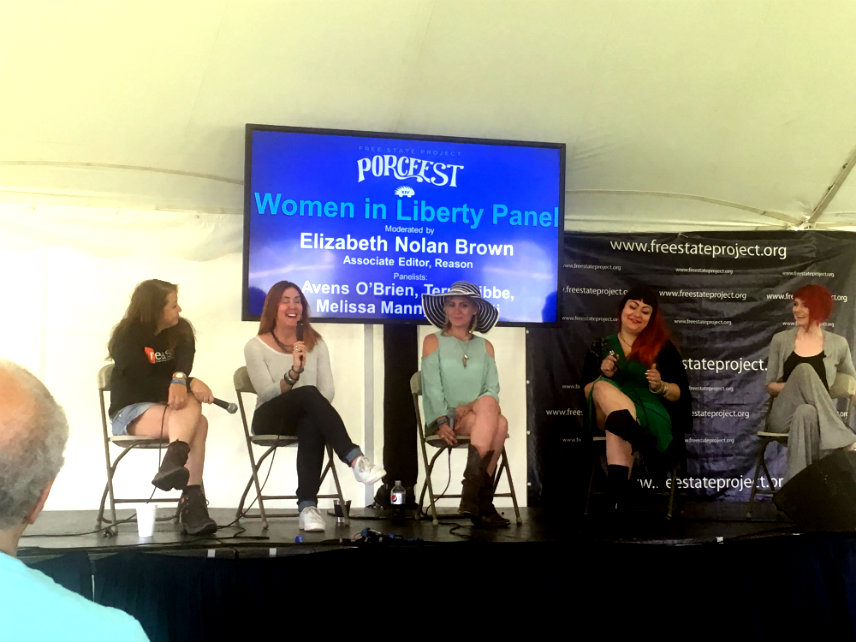
    So let’s get ready to rumble. In the blue corner we have a lot of libertarians who are against the concept of feminism, for a wide variety of reasons (from philosophy to actual misogyny). In the red (well pinko mostly) corner, feminists like good ol’ Lizzie NB from you know which site, who says feminism is part of libertarianism, I think. She has that whole feminist for liberty thing going.

    Personal view: I am not a feminist. I do support full liberty and rights for women. I do not believe men/women are superior/inferior in any way, though I believe there are some biological differences. Those differences are irrelevant from a philosophical point of view. Beyond the State and the Law, the main concerns of libertarianism, I think people should respect each other and treat each other as equals.

    So what is my disagreement with feminism? And to be clear, I do not qualify this by stating third wave/radical/intersectional/postmodern/critical theory/whatever feminism. Feminism period. Well, it is the same with my disagreement with any form of identity politics. Any form of group politics, group rights. The way I see it, it is quite inherent in identity politics to devolve into tribalism and collectivism. It is just human nature. In the end, these movements will fill with self-interested people who profit from them and with people with various ideological ideas beyond the scope of the movement. These people will be interested in grievance mongering, keeping conflicts, and hijacking the movements for other reasons. Inevitably, the demand for positive rights or privileges appears.

    Women were not equal to men throughout history. The fact that I believe feminism is not a solution does not mean I discount the problem. Saying communism was a disaster for Russia is not saying Tsarist Russia was just great. I think actually advocating liberty for all is the solution, without going down the path of identity politics. I am sympathetic to arguments that liberty for all is fine, but a certain group’s liberty is more restricted/infringed than other groups, and it should be highlighted, but, in the long term, doing this via identity politics can be counterproductive. You can highlight it strongly without different terms for this. The liberty movement has a long history of supporting equal rights, and can attack a particular injustice without attaching it to identity terminology.

    Unlike feminists for sharia

    Also, it goes without saying that most of these movements – sex, sexual orientation, race – will be inevitably taken over by ideological leftist – which is the standard left MO – and high jacked for entirely different purposes. The reaction of the left-wing press to organizations like Pink Pistols is quite relevant. Or the environmental movement dominated by watermelons (you know, green on the outside, red on the inside). In the end capitalism is the true problem, because of course. It always is.

    Now Lizzie, or people like Christina Hoff Sommers, may say at this point that there is plenty she disagrees with from left feminists and they claim they want a different type of feminism, which is in fact about equal rights and liberty. But that, to me, is like saying oh we don’t want the current big bureaucratic state, we want a competent efficient big bureaucracy. Not gonna happen, as the problems are inherent in bureaucracy and will inevitably reach this point. The same goes for feminism. What the world needs is not more labels and groups and tribalism.

    I do not want to suggest that people who identify as libertarian feminists are not real libertarians or something like that. Just that the second label is unneeded and can be quite counterproductive.

    About sexism, it is quite important to define it because “anything some feminist does not like is sexism” is bullshit. To give an example, I have heard many a feminist call sexism that a man tells another man a joke that a woman overhears and finds offensive, even if not directed at that woman. Well, tough shit. I my-very-self sometimes like to tell improper jokes, transgressive, or jokes which are offensive just for the sake of being offensive. Jimmy Carr built a very lucrative career on this. If you are bothered, that is your problem and none of mine. I will have to go with the thicker skin thing here. I mean honestly, the world is a nasty place, and it ain’t gonna change soon. So I think a thicker skin is universally useful advice.

    Patrice was offensive to women, but it was funny

    That is offensive to women, is an oft heard claim. Which women? Are all women offended by the same thing? Who made someone official spokespersons for all women (good gig if you can get it)? Another thing is men will not behave towards women exactly like they behave towards other men and the same goes for women. This is not sexism, it is just nature. It is, as they say, OK.

    Is there sexism in the libertarian movement? Well yes, like everywhere. Except the US Democratic party, where there are zero sexists. Furthermore libertarianism attracts a lot of… let’s say non mainstream people, due to not wanting laws against non-violent behavior, irrespective of how in poor taste that behavior may be. Can libertarian men change towards being less sexist / offensive to some women? Sure, probably some of them could.

    But here is the problem: I hear many claim casual sexism is what turns women from libertarianism. I am sorry, but this is nonsense. If casual sexism puts you off your principles, your principles were not strong in the first place, and inevitably you would repent and write for Salon about being an ex-libertarian. A community is nice and all, but principles should somewhat transcend that.

    Now, of course, ideas reaching people is important. If someone is exposed to libertarian ideas they may become interested in researching further and thinking about it, and in the end developing the principles, so it is important not to turn people off directly. This can use some work for libertarians, including better outreach towards womenfolk. Also, it should be a basic goal in life not to be a complete asshole, sexism or otherwise.

    Sadly, the notion that libertarianism is not popular mostly because of marketing issues rings hollow to me. Most people, men and women, do not really have strong principles, do not really research and think about why they believe what they believe. They are just not interested in what libertarians are selling. The movement is small and even doubling the numbers will keep it small. And better marketing will sadly not change much. Looking at the major challenges of spreading libertarianism, casual sexism is not one. Which is sad because it would probably be easier to fix. Of course, that does not change the premise of trying not to be offensive for no apparent reason. This is basic politeness.

    Anyway. Thoughts? Do share…

  • My Take on the Obamacare Repeal – For Me, It’s Personal

    In the early 00’s things were different for me. I had gotten out of college a few years earlier, and taken a job as a software developer doing contract work for steel mills and other industry. While it was a good way to make money, my heart was still into art and design, so I set forth finding a way to combine art and technology into a new career. Enter the Internet. I started a web and print design company on the side as I worked my full time job. I had steady income, and my employer was paying my health insurance premiums. I wasn’t on the company plan because I knew someday I’d want to leave that job and work on my business full time, and having my own policy would make that transition seamless. My employer took out the premiums from my paycheck pre-tax and sent in the premiums for me. So far so good.

    Then things went downhill fast. My employer was accused of not depositing 401(k) contributions from employees. He was also involved in a discrimination lawsuit by an employee he fired. And finally, I was notified by my insurance company that the employer hadn’t paid my insurance premiums even though he’d taken the money out of my paycheck. This was the third time he’d done that, so my insurance company dropped my policy. I attempted to re-apply, but because I have a preexisting condition (I was born with spina bifida), I was rejected by my insurance company and all the others to which I applied. One agent told me that there was an unofficial “black list”, and once one insurance agency rejects your application, your information goes into a database where other insurance companies can see the rejection, and they will also reject you.

    I promptly quit my job and called a few lawyers. Because my employer had given me a check to cover the money he took out of my paychecks, I wasn’t technically “out” anything tangible as far as the law was concerned. There was nothing they could do. I was self-employed, and my wife, one of my three kids, and I were uninsured. (Two of my kids were adopted through foster care so they were still on Medicaid). I was no longer living the dream, I was pretty much screwed.

    I continued on with the business, making a decent living but still under the constant threat of losing everything in the event of a medical emergency. I had hoped to grow the business so that I could create an insurance group, but that never happened. After five years, I shut down the business and took a full time job as a software developer, which is where I sit today as I write this. My dream of working for myself had come to an end.

    The Great Red Hope

    In those five uninsured years, I was not without hope. I had joined the NFIB (National Federation of Independent Business Owners) when I started my business. This was during the first years of George W. Bush, when the Republicans controlled everything much like they do today. NFIB was pushing some changes to insurance laws that would have benefited me greatly. With the Republicans in office, they felt they had a chance. They proposed:

    1. Allowing insurance companies to sell policies across state lines.

    2. Allowing trade groups and clubs, such as NFIB, to create insurance groups that members could be insured through instead of having to get insurance through an employer.

    Either of those options could have solved my insurance problem. I could look for a policy in another state with fewer limits on preexisting conditions, or that allowed policies that only covered catastrophic events. Or, I could have just gotten insurance through NFIB. I contributed cash, wrote letters, and filled out petitions. In the end, the Republicans did… nothing. The next election they lost seats the Democrats, and their monopoly on power was over. I became bitter and angry, vowing never to vote Republican again. A few Ron Paul articles later, I turned to the dark side of the political spectrum. I was officially a libertarian.

    Enter Obamacare

    When Obamacare was being debated, I was livid. You’d think that I’d love it, considering that I have a preexisting condition and the law was supposed to make sure everyone could get insurance. But everything proposed by the Democrats was the complete opposite of what I knew would work for me and others like me. They would make insurance more expensive, more complicated, and more of a bureaucratic nightmare.

    My ideal solution would be the above two items, to which I would have added a third:

    3. Provide another way for people with preexisting conditions, who were working but could not get insurance elsewhere, to get a policy through Medicare or some other program.

    That’s it. Almost everyone would then have access to health insurance, and the extra competition between states would bring down prices. Of course, this wouldn’t require a huge government program, so the Democrats wouldn’t even consider it. When Obamacare became law, I saw that my initial thoughts were right. If I were still self-employed, there is no way I would be able to afford those premiums.

    The Repeal

    So here we are today, waiting for the Republicans to repeal Obamacare and set things straight, which isn’t happening. While I’m disappointed, I’m not surprised. The Republicans have been here before. They’ve had a chance to use their power to make things better for many people. Whether it’s lack of intelligence, spinelessness, or something else, who knows? But every day I see more proof that neither of the major parties has any intention of doing what’s right or helpful. Democrats just want to create bigger government programs that cement their power, and Republicans want to do pretty much nothing, for fear of pissing someone off and not getting elected next cycle.

    As for me, I’m still sitting behind a desk working for someone else, and I think I’ll be here for a while. The cost of insurance, and the amount of time, effort, and money required to follow regulations required to run a business are more than I’d like to deal with.

  • Life and economics on an escort forum

    This may not be a fully appropriate subject on such a family friendly blog, but I think that information gleaned on an escort forum can give some minor insight into markets, human nature, and general understanding of the economy, which might explain why libertarianism makes little headway in the world – not that this is some great mystery.

    I have to start this by the unambiguous disclaimer, which goes without saying, that not me, but a friend of mine, visited an online escort forum over a period of time, for purely economics and psychology research purposes. An in-depth look at such a website, like many other forums, to be honest, can be seen as a microcosmos of a lot of what goes on in general society.
    But wait! Escorting is very illegal in Romania. A reasonable person might ask: why is there a forum for something that does not exist? So, lo and behold, the first bit of insight, based on the very existence of the forums, and the quite significant activity involved, is that maybe, just maybe, prohibition might not always work. It may be that, perish the thought, extensive black markets fill the void. Black markets with the works, full option if you will, organized crime, dangers for both buyers and sellers, shoddy product. I, myself, am shocked. I need my smelling salts right now.

    Of course, as any fool knows, and by fool I mean libertarian, the market, black or otherwise, has always been here and always will be. The market is a generic term for human economic interaction; it is a fundamental expression of human nature. Government may screw with it, but won’t get rid of it. So where are we at this point? Well, we have established at least one thing: there is a market for sex (and even married men use it, to the chagrin of certain Catholics who visit this fair blog). And where there is a sale, there is ehm… information asymmetry let’s call it, which needs to be addressed. Quality control is the name of the game and was usually done, I assume for thousands of years, through let’s say word of mouth.

    Enter the mighty internet, which makes things a lot easier and a lot … harder at the same time. How does one quality control the quality control information? The internet has too much stuff and nonsense. Like in all markets, there is false advertising – this may come as a surprise, but not all the pictures on escort sites are of the actual escorts. A rule of thumb (or finger, if you will) would be: if it looks too good to be true, it probably is, or you can’t afford it. This is where reviews come in, but many of them are as false as the picture. Look at it this by way of analogy, if you can’t trust a yelp review what can you trust?

    Reputation on such a forum is required for both escorts and reviewers. This works up to a point, but not fully, as trusted reviewers may not be so trusted, and often end up asking for free or discount service in exchange for good reviews or by threat of bad reviews. There is also a noticeable presence of personal taste and subjective preference (ass > tits fyi), which need to be accounted for when evaluating reviews. Like in all markets.

    Quality control also has a stronger ethical component than usual, due to the inherent issues in the industry. Despite the ‘all escort customers are filthy exploiters” rhetoric, many are quite aware of sex slavery, trafficking, and pimping, and are quite actively trying to avoid such situations. It is often hard to tell, and obviously there are hits and misses – more so than if the biz was legal and upfront – but people do try. There is also the ever-present possibility of underage escorts, which most avoid like the plague, or better said avoid like 10 years in prison. There are a lot of STDs to watch out for, the risk of getting robbed as part of the deal, and much more, making a trustworthy review system essential.

    Beyond reviews, many escorts – or their respective pimps/madams – come to engage with customers on the forums, which sometimes lead to actually improved services. It seems there are escorts out there who are not trafficked or forced by various bad circumstances to offer this particular service, but choose this activity for a variety of their own reasons and want to do a good job at it. Of course, the real problem is, in fact, capitalism, which causes people to need money and as such do various things for it. In socialism, we all know, everyone would be rich and happy and poor women would not need to sell sex for cash. But alas, we do not live in the wonderful socialist utopia but under the heel of filthy capitalist pigs. But this is not the purpose of discussion.

    To sum up: the situation somewhat works. Could have been a lot better if legal, obviously, but it is what it is. Baptists (Orthodox really but the principle stands) and bootleggers (politicians on the take). Until now, this is nothing anyone didn’t know. For me, a more interesting aspect was to observe how truly economically illiterate people are, how entitled and how assholish they can behave, which explains a lot about the greater world. This is most visible when it comes to price.

    The usual deal is kind of like this: new girl in the business (or, you know, a dude, whatever floats your boat really, I did not research this, as I have heard that going to male escort websites can make you catch the gay and become ultra-gay yourself, a risk I am not willing to take). As many a beginner in a field, there is entry level price, lower than one may want, to get initial customers. If the service is of adequate quality, the number of customers increase and, drum-roll, so does price. Supply and demand, how does it work? No one knows, apparently.

    If one can get higher prices for product, in any field, one usually tries to do so. Escorts also want to carefully manage the number of customers, due to many reasons. And, to be fair, if there is one damn thing one should be able to set whatever price on, it is this, the basic human right to fuck who you want in whatever conditions you want. If the price is too high, demand dries up and signals the need for it to be lowered. Markets, man, they freak me out. Pretty standard stuff, you would think. And you would be dead wrong.

    With any and all price increases, the whinging starts, presumably by people who routinely go to their boss each year and demand a higher salary.  After the complaining, anger rears its ugly head. Of course, not by all forum members, obviously, but by a sufficient number (I have decided I do not have sufficient disclaimers in my posts). There are, I noticed, 3 main types of reactions.

    The most amusing by far it’s not fair reaction. Why does something I want cost more than I want it to cost? Why should I pay more? I don’t want to pay more! It’s not fair! It really is not! And no, I am, sadly, not joking. It’s not fair!

    The second is pure rage directed to the escort. How dare she, that good for nothing, filthy, goddamn whore. Who the hell does she think she is? As her superior, why I should get to fuck her for whatever price I want. This bitch needs to be taught a lesson. And so on and so forth. Waves of messages full of insults from people who seem to have a remarkable amount of time to spend on this subject.

    The third is anger at the other customers. Why it is clear that if all you goddamn morons would not pay, these escorts would not charge that much. Which, I used to think, is a meaningless truism. Every price is something people are willing to pay for. If people were not willing to pay top dollar for prime real-estate, why, it would not be so prime. Which, well, duh. But this is how the world works. People want something, they are willing to pay extra to get it. Who wants it more pays more. And some people will not afford it. Thems be the breaks.

    Amusingly, the very same people, before the price raise, complain about long wait times. This escort is impossible to book! Well, high demand, limited supply, prime real estate, Economics 101. And so, prices move towards and ever changing never reached equilibrium point.

    This in the end tells you a lot about the world. People entitled to get what they want for what price they want it, and unlike on escort forums, in the wide world these people can do something about it. That something being give power to some asshole or other who promises to address their grievance. Because it just isn’t fair.

  • Firearms Friday: Random Realizations

    Another links based submission for the gliberati, but I’ll add my two cents at the bottom. Quite a bit of gun related news worth discussing this week.

    Finally, is this the most retarded gun themed product ever invented? We report, you deride.

    https://www.youtube.com/watch?v=DPWuyP5AwTk

    So, just a couple of random additions from me. First, I was talking with someone in the comments about 5.7 x 28 for home defense and they mentioned that they liked the cartridge but were not a fan of the PS90. Well fret not, ladies and gentlemen, for I have not 1 but 2 solutions to your troubles. The first comes to us from the ironically named Masterpiece Arms. Their ubiquitous brick on a 2×4 mac 10 clones are now chambered in 5.7 and available as a pistol and as a carbine. I am told that despite their looks they are excellent performers. The second option is by far the more attractive one. A company called AR57 manufactures 16″ and 12″ AR uppers chambered in 5.7 that use PS90 magazines and eject out the magwell, not unlike the PS90 itself. If you’re looking for a 5.7 slinger with more traditional features and layout, you’d be hard pressed to do better.

    The other thing I want to touch on is concealed carry. I have avoided talking about ‘the best guns EVAR for concealed carry!’ because for one it has been beaten into a bloody paste by every gun blog, website, and magazine that has ever existed, and secondly because everyone is different and the gun I recommend for you probably isn’t going to work. Also, I have been open carrying for several years now and if it’s feasible in your area I recommend you give that a try. For one, it stops the fight before it starts. No criminal with even a hint of situational awareness is going to pick a fight with an obviously armed person (although it does happen occasionally). Secondly, it’s a nice conversation starter and a very simple, passive way to assert your rights in an obvious but non invasive manner. Granted, I live in the wild west where we all walk around in our Stetsons and spurred boots with six shooters on, so YMMV.

    With that out of the way, here are my suggestions for getting into concealed carry. First, expect to change your carry gun several times throughout your life until you figure out what works. I think I have gone through close to a dozen EDC guns in the last 8 years. The nice thing about guns is that they hold their value very well, so if you do choose to sell yours you should get very close to what you paid for it if you didn’t get hosed on the initial purchase. Second, expect to purchase about 3 holsters for every gun you buy. Yes, three. Holsters are like shoes, no holster will fit the two people the same, and the holster that one guy loves the next guy will hate. The holster that I finally decided on for concealed carry is from N8 squared tactical. They are affordable and well made and fit a variety of pistols.

    What I have noticed and experienced myself is that people go through phases with concealed carry. The first phase is what I call the big gun phase. This is where people try to conceal a full sized pistol as their EDC. They do this until basically they get sick of the weight and the pain of having a huge chunk of steel up their ass all day. Then they go into the tiny gun phase, where they buy the smallest little mouse gun they can slip into their speedo. This is great for actually carrying the thing, but then they go to shoot it and realize that mouse guns are tiny, weak, difficult to aim, painful to shoot, and not 100% reliable. At this point their gun size fluctuates up and down a few more times til they find the perfect sized gun, which is usually a single stack 9 or a compact/subcompact of their choice. This process is going to be different for everyone, so be prepared to buy and sell quite a few pistols until you get the one you like. I am loathe to recommend a cc pistol, but if you put a gun to my head and forced to recommend one… well I would probably shoot you for doing that, but if I was being nice I would recommend a single stack 9mm. The two that immediately spring to mind are the M&p9 Shield and the XD-S. I own an XD-S, and other than its mediocre trigger I have zero complaints. My final recommendation is to carry the biggest gun (size wise, not caliber) you can comfortably conceal. For me that is my Sig P320 carry, which is not really a CC sized gun (roughly Glock 19 size). If I have to go deep concealment I will switch to my XDs in a pocket holster. Big guns are easier to shoot, hold more ammo, are more reliable, and actually hit what you aim for. Notice that all of those actually matter if you have to pull the gun, whereas comfort while carrying doesn’t mean shit if you’re dead.