This is the world globalists want!“Green Lives Matter” – Yes, our Border Patrol actually believes this shit.
Earlier this week, President Trump delivered his second annual speech concerning his administration’s national security strategy. In it, Trump presented a Manichean world, in which America’s cultural, economic, and military hegemony must be maintained at all costs against an insidious Asiatic peril that consists of the combined forces of Cathay and the Volga Tartar. While it is encouraging to finally see recognition of the fact that “history” is far from over, with Trump specifically, and without obfuscation, declaring Russia and China as “rival” nations of which “protection” of a nebulously defined American economic interest is a prerequisite for “cooperation,” one is forced to inquire in what essential way does Trump’s national security policy deviate from the zero-sumWeltanschauung of the neoconservatives?
After all, it was Trump’s putative national security and foreign policies that were the banner Rockwellians held aloft, front and center, when declaring a ‘libertarian case for Trump’. Instead, the bill of goods sold to libertarians by Bannon, Gorka, Miller, et alia was merely the The Project for a New American Century covered with a lamina of mercantilistic trade protectionism. Thus, what we have now is a mandate to para-militarize our borders to serve the triple purposes of escalating the Wars on Drugs, Terrorism, and Illegal Immigration; increased federal spending to defense and infrastructure cronies; going all-in on the Israeli position in the Middle East, the provision of arms to Ukraine, and continued support for adventures abroad to “confront, discredit, and defeat radical Islamic terrorism and ideology.” As we have learned on Monday, there is no meaningful distinction between the Trump administration’s strategy and the six major articles of the Wolfowitz Doctrine.
Hat tip to F. Stupidity, Jr. for the brilliant idea.
jesse.in.mb
Leaning, not doctrinaire. I’ll keep a bug-out bag handy for the next round of purity purges.
Swiss Servator
Minarchist. I previously wielded government power over other people’s life, liberty and property. The experience was…enlightening. Now I shun any dominion over my fellow man, and would hope to see government power limited, severely, over everyone’s life liberty or property.
Brett L
I have an idea of what is Good for me, I have no way of proving it is Good for anyone else. I believe that every human is equally valuable and there is no “fair” way to determine which individuals or groups “deserve” something from our society (whether that be help or to be on the wrong end of the “Trolley Dilemma”). Being a somewhat social animal, people are eventually going to contend in their quest for their Good. I believe that: strong protections of property are vital, people can’t be property, intentional or negligent taking of life is the worst rights violation, and a small, impartial, rigidly process bound entity for settling rights disputes is probably necessary. I have resigned myself to the fact that taking principled stands on this will forever put me on the side of assholes and bigots — so long as they are doing so in a way that doesn’t harm anyone physically or defraud another person. I don’t know what that makes me.
Heroic Mulatto
Recognizing that in current usage the term encompass several different but related schools of thought, I do identify as libertarian. Indeed, much like a Gold Star Lesbian, from the age of 13 when I first developed some semblance of a political conscious, I have never been outside of the libertarian umbrella. My journey has taken me from Objectivist, to card-carrying member of the Libertarian Party, to where I sit now: the Voluntaryist school of anarcho-capitalism.
SugarFree
Small-l libertarian, for lack of a better term. The LP is like watching clowns slapping each other with their own dicks, but I do support them out in The Normal World because, once again, there is a lack of a better alternative. I don’t think of myself as an anarcho-whatever because I don’t believe anarchy is truly self-sustaining–some form of government is inevitable because of The Irritating Asshole Problem–so you better constrain it as long as you can, keep it weak and beaten-down. Like Nietzsche, I look for reasons not to be an out-right nihilist but often fail and slip into the blackest sort of cynicism about the nature of man.
Riven
I consider myself a libertarian. Turn-ons: property rights, contracts, limited government, free market solutions, incentives. Turn-offs: drug and firearm laws, meddling foreign policies, government contracted infrastructure, taxes, preemptive and violent action.
Old Man With Candy
Let’s see… Bill of Rights absolutist, check. Delimited government powers, check. Free market economics, check. No special privileges or restrictions on unions, check. Anti-intervention and antiwar other than defense, check. Freedom of association, check. Freedom of contract, check. No desire for “leaders” and an attitude that elected officials are the hired help, check.
Yeah, I guess I’m a libertarian.
Gojira
Far be it for me to disagree with my esteemed colleague Heroic Mulatto, but I personally don’t consider voluntaryist anarchists (which I am) to fall under the umbrella of libertarianism. I consider anarchism to be aspirational, an overarching philosophy to guide moral decision making, even if it quite possibly can never be perfectly/completely realized.
That having been said, drawing any attention to or harping on the differences between us all is like the leftists and rightists within the CPUSA duking it out in…1901. The distinctions between all anti-government thought are so slight in comparison with the differences we have with the 97% of humanity that believes passionately in CONTROL that infighting is pointless right now. Anyone who wants less government is a potential ally. We can worry about these other details after the Tsar has been overthrown.
Sloopyinca
Yeah, I think I am, in principle. I’m probably leaning a lot more conservative than most of today’s libertarians because I’m probably a little more religious than most libertarians are. And certainly more than most Libertarians are. I hate pubsec unions. I hate compelled participation in government programs. I hate the “progressive” tax system. I hate the welfare state. I hate any government spending that’s not related to protecting life and property (both militarily and police-wise), or for operating our criminal and civil court systems and jails. I’m not a big fan of drugs but don’t think it’s “society’s” business to regulate what someone puts in their own body. I don’t think we should have a federal government that regulates markets or negotiates trade policies. I believe in the natural rights of self defense, freedom of expression, free association, private property and due process and think they’ve been all but demolished by the state.
I’d be open borders if the above were implemented but realize it will continue to create massive problems if not curtailed until then.
So before I ramble on too long, I’ll just say yes, I’m as libertarian as I can be in the current climate. And if certain things our government does with its money were ended, I’d be even more libertarian.
There is a Romanian phrase, used when someone abuses a certain issue, which can be paraphrased along the line of, “Easy with the Western Culture down the stairs.” If you rush too much, you may break whatever you are rushing with, is the meaning. I feel that recently this is the case with Western Culture in the Culture/Social Justice/Whatfuckingever wars that do not seem to go away.
There are two facets to this. Well let’s not go to binary, like gender there are a million facets to this. One is that the CW/SJW thing is often little more than a massive distraction, a lot of noise to drown the signal, keep the participants busy while corrupt politicians keep doing corrupt politician shit. On the other hand, it cannot be fully ignored, because aspects of it are very dangerous. One of the main components of this was/is the late/great Western Culture. I will address this, sort of, kind of, with plenty of to be sure and wimpy language.
So let’s get ready to a-rumble… in the ehm Red (Pinko sometimes) corner we have the Progressive Left. In the Other Red corner we have the various flavours of the alt right. In the middle we have the enlightened alt centrist; the self-described non regressive left; the modern right; the cosmotarians; and a few odds and ends. In the end, we have the battle of progressives versus literal Nazis. And western culture is at the forefront, it is the gloves, if you will.
Culture or a pile of rocks?
To start with, let’s go to Wikipedia, because why not. “Western culture, sometimes equated with Western civilization, Occidental culture, the Western world, Western society, European civilization, or Judeo-Greco-Christian civilization, is a term used very broadly to refer to a heritage of social norms, ethical values, traditional customs, belief systems, political systems and specific artifacts and technologies that have some origin or association with Europe.”
So, as we can see, Western Culture is a very expansive category. It can mean many things to many people (for some The Sistine chapel, for others The Chive and the invention of the bikini), then and there, now and here. This is why I am rather wary of overusing it as some generic all-encompassing term in a debate. We must defend western culture is the rallying cry. Which one? Which parts of it? To what ends? These are questions I feel we need to keep in mind.
Just as a side note, I find the construct Judeo-Greco-Christian rather silly, and one of the things that annoys me about some modern conservatives. For most western history this was not a thing, as Christians were highly divided until recently and Jews have a long history of not being on the best terms with the mighty western culture. There is no single unified Judeo-Greco-Christian tradition. Yes, various flavors of Christian and Jew contributed to the development of the ideas behind the West, and the culture obviously developed in the context of religion. But this is not enough for this construct.
I might state that I am not religious and I see little worth to attaching so called western values to a religion or other in the present, especially since a number of the enlightenment people who developed these values, while most likely being religious themselves, did not approach philosophy from a religious angle. Judeo –Christian means in modern speak not Muslim and sometimes not secular, and it is an attempt to try to co-opt all sorts of people as a collective. It is, as we say in Romania, an ostrichcamel.
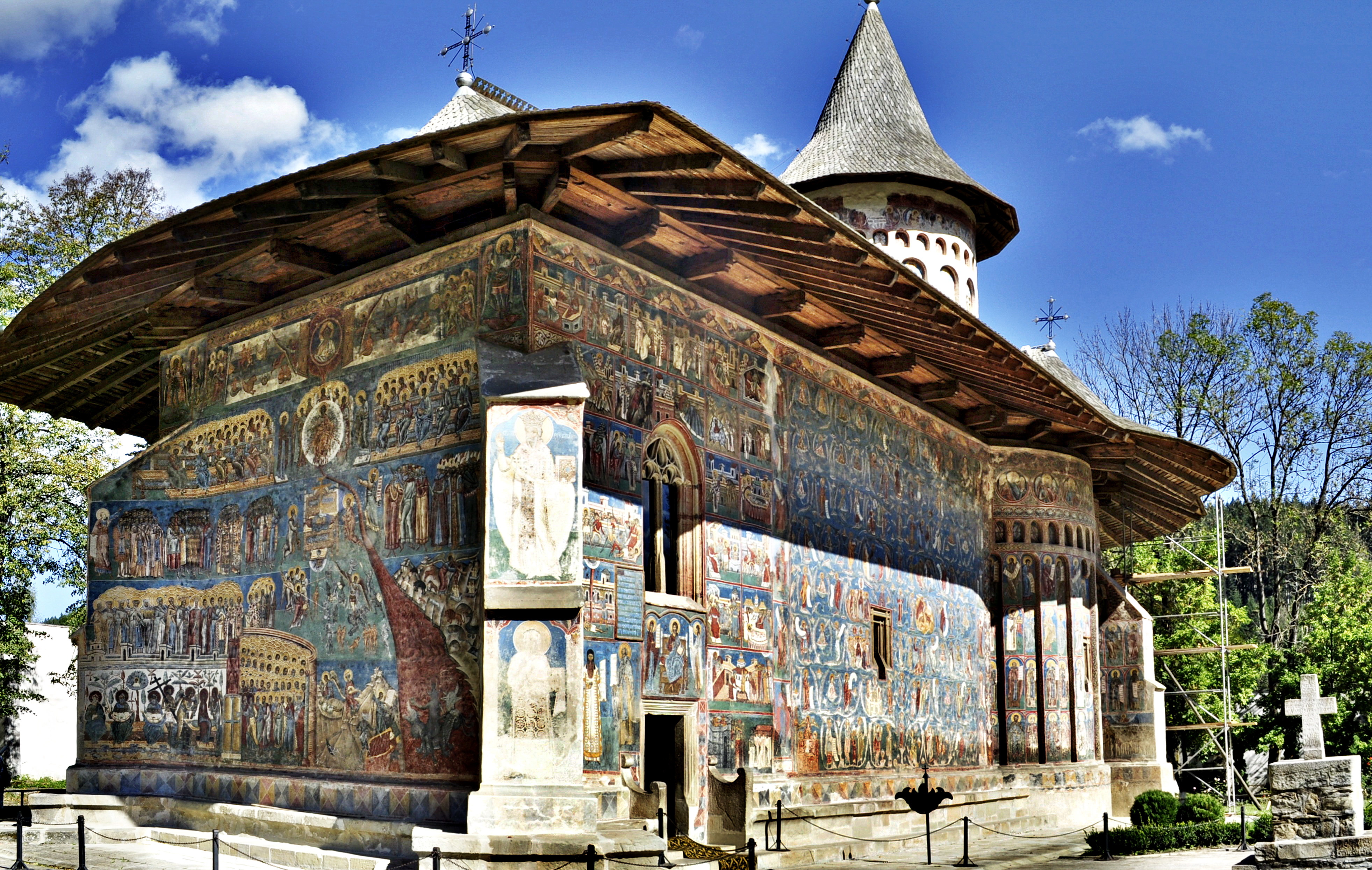
Good church need not be huge. Mind the hellfire.
Now, for a second side note, let’s get subjective, as the various warriors are wont to do. You may not have noticed, but I am a Romanian. As such, I am somewhat at the fringes of western culture. Romania was not traditionally part of it, or not fully, at least. Always scurrying along the edges, looking in. An eastern orthodox nation heavily influenced by Russian and the Ottoman Empire, the habits, mores, traditions are different. We were of course part of Christendom in the premodern era, and had elements of western and eastern culture. And many a times the leaders wanted more, Romania was always on a long slow path to being more of a part of the West. When joining the EU many said we joined Europe.
With all that said, I can say I admire many a thing about western culture, and as a modern Romanian I consider myself part of it. But I do not like to look at it as a uniform thing. As a libertarian, I like liberty and individualism. As a human I like security, prosperity and everything that comes with that. And I like the parts of Western culture that promoted those things, many then, most if not all, other human cultures. I am also critical of elements of Western Culture that did the opposite.
I do not like mindless worship of anything, including culture. And I do not like nostalgia about some long lost ideal past. There was never such a thing. All cultures need improvement and everything needs criticism. Humans, and their societies, are hardly perfect. And it looks to me like all these western culture warriors only use it as a rhetorical tool and little else.
The free speech war is a good example in this regard. One should not think rightists want to preserve free speech when they did not in the past. Just like the true face of the left free speech movement was seen after they thought they could get speech they didn’t like banned. It is also good to notice that, while free speech was a value of Western Culture and vigorously defended by many in the past, it needed vigorous defence precisely as it was constantly under attack by elements of the same culture.
One issue is that, as a libertarian, you often are accused of wanting to go back to sometime in the past because you want a reduction in taxes regulations and general involvement of the state in the economy. This is due to the fact that leftist arguing 101 is to scream racist at people, and they constantly try to equate thinking that the regulatory environment was better in the past, that the whole society was better, and that you want all aspects of that society including the racism and discrimination. This is false and should be countered, which why it is important to phrase arguments properly beyond the western culture thing.
I often sample western culture myself.
Me, I do not want to go back. I do not like the phrase going forward either to be honest. But, to take the standard analogy, going forward on the wrong road is not a good idea. I want to go down the road to more liberty. If this implies certain aspects to be more like they were in the past, it is not going back, it is going toward liberty. If I find things wrong in the past, but OK now, I want to keep them. If there was something wrong then and wrong now, I do not want to “move forward,” I want change towards liberty. But I do not appreciate keeping things as they are just because that’s how they are. If they are wrong, they must be changed.
Everyone thinks repealing laws they don’t like is progress, but repealing laws they do like is regressive. Which is natural, let’s not stop progress towards my goal. But switching targets is not regressive in itself, even if I don’t like the targets. The trick to improvement is to keep the parts that are good and change the ones that are not. Change for the sake of change is not always desirable. And not everything new is good.
With all the previous caveats, I do believe that western culture is up there with the best that human achieved, lacking as it may be. I do not judge the past based on the future, and while there are things in 1800 I find wrong, it does not in any way invalidate western culture or the achievement of those people, mostly white men who sometimes owned slaves or maybe didn’t think women should have equal rights.
Free markets and capitalism brought the biggest increase in human prosperity in history. Of course this does not mean that some industrialists did not treat their employees poorly, although governments did have something to do with constant meddling. But this does not take away the achievements of capitalism, nor does it mean that without the big government of today, conditions would have remained like in the 1800s. Society and ideas evolve, views and attitudes improve. And above all, economic and technological growth moves things in the right direction, despite what government or some of the worse industrialists would want. You do not need the benevolence of the capitalist to improve worker conditions; the market does that just fine if you let it be. But I do not glorify the 1800s.
I believe that the best development of the West was individualism and individual negative rights. This led to liberty and values that lead to a successful life. Through the tumultuous past, I see ideals of liberty as a fine wire weaved through, moving things the right way. There probably is an English expression for this but I can’t figure it out.
Be a good person. Educate yourself. Earn your keep, have stable relationships, raise you children right (should you have any), and be charitable to the less fortunate. Help your neighbours, family and friends – as long as they deserve it. Be fair, be just. Do not initiate violence. Drink good scotch. Don’t dress like a clown. This is all a part of western culture that must be not only kept but enhanced. We don’t have enough of it. But it is not necessarily exclusive to western culture and it was not, sadly, an overwhelming component of it.
The height of Western political though has been achieved
And here lies the problem that makes me somewhat more favorable towards the pro west-cult people than The Others. The right try to make of western culture something that it was not, and some sort of sacred cow. The progressive left, and even worse the postmodern left (yeah yeah I know the word postmodern gets thrown about a lot, but I believe it applies), the SJWs of the world are in fact a much bigger threat. They do want to tear down all elements of western culture. Which is stupid. It is more than stupid, it is insane. Tearing down everything means there is nothing worth keeping. This is utterly ridiculous, as they were quite obviously the most successful nations, even when it comes to the stuff leftist claim to care about such as tolerance, secularism etc. And being collectivists, they want to tear down individualism. This can only lead to disaster.
Why are these people so suicidal insane? It is hard to tell. Human nature one would suppose. They are so desperate to push their idiotic economic ideology, that they just don’t care what they destroy doing so. How someone may think this is a good idea is baffling. Fiat Socialism, pereat mundus, I suppose. Red or dead. Communism or bust.
The moderate left is timidly fighting back, and more and more. This is not just the YouTube sphere of the so called non-regressive left, but more of the mainstream. There is of course the vestige of the non-prog left, which does admit some value to western culture. These people are, of course, literally Nazis.
It is a scientific fact that Caddyshack is the best movie of the 1980’s. Not only does the movie accurately depict the summer of my junior year in college spent as a ranger on a golf course, it also showcases some of the best comedic talent of the era. Chevy Chase as Ty Webb, a simple-minded millionaire playboy with a natural gift for golf. Bill Murray as Carl Spackler, a dim-witted groundskeeper who engages in an ever-escalating war with a gopher that’s burrowing holes throughout the course. And Rodney Dangerfield as Al Czervick, a boorish millionaire whose gaudy lifestyle and off-color remarks draws the ire of the club’s blue-blood establishment, as best personified by Ted Knight’s character, Judge Smails.
Throughout the movie, our hero, caddy Danny Noonan (whose last name will forever be remembered by golfers who have heard it whispered to them mid-stroke as they putted) tries to impress the stodgy Judge Smails in order to win a caddy scholarship while also trying not to betray his true self. It is a coming-of-age morality tale interwoven between campy sexual references (“Hey everybody, we’re all getting laid tonight!”), silly, but effective, turn-of-phrases (“Thank you very little”), drug references (“Cannonball!”), and pure Bill Murray (“So I got that going for me. Which is nice”). But, the movie also highlights a clash between the nouveau riche, as embodied by Dangerfield’s character, and the established upper class, as embodied by Judge Smails. A conflict that is being played out in our national politics.
Dangerfield’s character is rude and uncouth, much like our orange-tinted president whose tastes defy gaudy and uncultured, along with his public persona being impolite and offensive. But, at the same time, the caddies and other staff on the golf course don’t seem to detest Dangerfield’s character nearly as much as they do Judge Smails. His gruff remarks convey a degree of honesty. Though he is no less a liar than Judge Smails, his lies are so clearly transparent that no one feels deceived. And his unwillingness to be polite hides no ulterior motives. Everyone knows what Dangerfield’s character thinks because he declares it for everyone to hear, much like our president via Twitter.
They were also in Tron.
In contrast to Dangerfield’s character, Judge Smails is presented as part of a self-important and corrupt establishment that cares little about people not of their class. Much like the public views the president’s enemies as dismissive of those beneath them. Smails is well polished and presents himself as someone who upholds the rules of respectable society, but in actuality, everyone knows he cheats. In much the same way that the American public at large believes that their betters are liars and cheats.
At the movie’s climax, the protagonist, Danny Noonan, is presented with an option: either help Dangerfield win a golf bet against Judge Smails and lose his college scholarship or fall in line with an established order that he detests for his own personal gain. Judge Smails advises him against helping Dangerfield, but Noonan ignores his advice, much like voters in 2016 rebuked the advice of the ruling class.
In the final scenes of the movie, the two sides of the golf bet are even. Noonan needs to sink his final putt in order for Dangerfield to win the bet. After a comically long moment of anticipation, Noonan’s putt wins the golf bet for Dangerfield and the workers at the golf course are ecstatic. Everyone from Noonan’s love interest to a fellow caddy who he has sparred with throughout the film crowd around him in a raucous celebration. The victory is actually Dangerfield’s, who was the principle of the bet against Judge Smails, but he is seemingly ignored. Dangerfield, much like our President, served as only the vehicle for these workers to register their frustrations with the golf course’s blue-blood establishment. The workers gained nothing from Judge Smails losing his bet: Noonan will not be able to afford college without the caddy scholarship that he’s forsaken and the rest of them will go back to the same jobs the next day. Their celebration is surely fleeting, but for a moment they take enjoyment in besting their betters.
Neighbor Jim Skaggs, who was the developer for the neighborhood known as Rivergreen years ago, told CNN that there has been a “long-running disagreement” between them over property maintenance. He also noted that [Rand] Paul did not like the rules of the property when they were first explained to him.
“He believes in less restrictions on property rights. He has strong beliefs on this subject,” Skaggs said. “He had to be told very sternly that he needed to follow the rules and restrictions. He did not do anything wrong. But he had to be told sternly to follow the rules. He did not like the rules.”
Skaggs said he “very much likes” both men, though he noted that Paul “is a very different character than most people.
“He’s a deep believer in his own thoughts,” Skaggs said. “And he believes his own thoughts are right — and they are right 100% of the time.”
That is the same, sometimes cantankerous, attitude that Paul displayed in Washington during fights over civil liberties, health care and taxes.
“Can you imagine living next door to that guy?” said one congressional colleague who has regularly tangled with Paul over policy. “I’m pulling for the neighbor.”
AFTER BREAKFAST AND FIRST RAPE OF DAY, STEVE SMITH PONDERING OVER SITUATION HE READ HERE.
PONDERING
AT FIRST, STEVE SMITH LAUGH AT SILLY AMATEURS…THAT NO REAL RAPE!…STEVE SMITH SHOW YOU SEXUAL ASSAULT!… BUT THEN GET TO WONDERING. OF COURSE RAPESQUATCH HAS TO BE TRUE TO SELF AND CONTINUE HIKER, CAMPER, FOREST RANGER, ANYTHING ELSE RAPE… BUT FOR SILLY PEOPLE (OR AS STEVE SMITH THINK OF THEM – “PREY”) STEVE SMITH WONDER HOW LONG THIS FALLOUT GO ON? WHO NOT GET NAMED? STEVE SMITH ONLY WANT REAL COMPETITORS NAMED! IF NOT GUILTY, THEN IT NO HELP STEVE SMITH KEEP IT REAL.
STEVE SMITH ASK FUNNY GLIBERTARIAN PEOPLE TO LOOK IN FUTURE AND TELL…WHEN STOP? WHAT LONG LASTING EFFECTS? DOES STEVE SMITH NEED TO MOVE FROM WOODS TO NEW YORK OR LA?
Looks like PM Rajoy has decided to crack down on Catalonia. [forestalling our commenters, I will ask…”You know who else cracked down on Catalonia?”]
Catalan separatists respond with a good bye vote in Parliament [Note: this vote was boycotted by opposition parties, the result was : 70 in favor, 10 against and two blank ballots out of a 135-member parliament].
So now what? The Catalan vote appears to be a reaction to the Spanish Central Government moving to impose direct rule over the area (Article 155 of the Spanish Constitution). Some interesting notes in this story.
To those who think this is simply a bunch of Lefties who want to prog harder than Madrid:
Marta Ribas of the leftist Catalonia Yes We Can party said “two grave errors” were being committed Friday.
“First, the Article 155 which will take away our rights and impact all the country. But it is a grave error to respond to that barbarity with an even bigger error,” she said. “The unilateral declaration of independence won’t protect us against Article 155, you will only make the majority of people suffer.”
One of the demonstrators in Barcelona was quoted as saying:
“I am here today because we will start the Catalan Republic,” said 68-year-old protester Jordi Soler. “Madrid is starting with total repression — and there is no longer any (other) option.”
So now we will have to see what Madrid will do when it invokes Article 155. I am expecting the National Police (the headcrackers from the referendum) to go in and arrest everyone they can. The Catalonian provincial police’s reaction will be key – if they resist, the Army will go in next, and I think it will get bloody.
Does any of this change the view of a libertarian? To this minarchist, I am slowing moving further and further into the Catalan camp.
UPDATE: Things moving along. Here is a good timeline. Article 155 invoked, looks like Madrid will at least charge Catalan President Puigdemont with “rebellion” (insert “You Rebel Scum” here)
One of the most difficult problems in current political philosophy is related to the concept of vagueness. This is a distinct phenomenon, but related to, vague communication. In common vernacular, when we say someone is “being vague”, typically we mean that individual is, purposefully or not, leaving out certain details of a concept or description that prevent it from being fully defined. The problem of formal logic I’m discussing here involves the issue of definition, but not from a communicational standpoint or a necessary lack of defining information.
Philosophically speaking, vagueness falls within the greater realm of metaphysics, a greater branch of philosophy that seeks to define the nature of reality. Clearly, in defining reality, a key exercise is understanding and categorizing objects and concepts around us. This is where vagueness kicks into gear. The classical problem of vagueness is the sorites paradox (the paradox of the heap). Start with a heap of sand, then remove one grain at a time, at what point does it cease to be a heap and become something else? Working in reverse, one grain of sand is certainly not a heap, nor two, nor three. The heap object and furthermore the concept of a heap itself is vague. Vagueness is distinct from ambiguity, which implies multiple specific, well-defined interpretations of a particular concept (eg: a problem that presents a dilemma) whereas vagueness presents difficulty in forming a well-defined interpretation at all.
What does this have to do with politics?
Problems of this type often present some of the most difficult challenges in contemporary political philosophy. After all, politics is really just philosophy applied to the question of how a society should function, and any problem which calls into question the very nature of specific pieces of reality will be particularly operose. Vagueness often lies at the core of so-called “slippery slope” arguments; if the difficulty in defining a heap is bound up in a wedge issue, then the point at which a heap ceases to be a heap becomes of critical interest.
Let’s explore examples a little closer to home. Probably the biggest problem in society currently related to vagueness is the point as which a fetus ceases to be a fetus and becomes a baby. The way that our society has currently structured the debate about abortion, it is nominally “ok” to kill a fetus because it is not defined as a human, whereas a baby is unquestionably a human and killing it would be murder. I am well aware that there are many other angles to the abortion debate and many people would say that “fetus” and “baby” is a distinction without a difference; i.e., they are the same thing and killing either one is murder. I focus on this particular framing of the abortion debate strictly for illustrative purposes.
Another issue at hand is the concept of adulthood. It is universally agreed upon that two “adults” having consensual sex with one another is acceptable (I would certainly hope so for the sake of humanity’s continued existence). However, what defines “adult”? In the context of sex, it seems to not only depend on an individual’s age, but also the disparity in ages between the two participants. Most people are OK with two 14 year-olds fucking, but would, at the very least, consider a 49 year-old male copulating with a 14 year-old female unsettling. Switch the genders. Does it make a difference? Should it? Outside the specific context of sex, the concept becomes even murkier. Much has been said that it’s unreasonable for someone to be able to legally die for his country, yet not order a beer. Why is it unreasonable? Who should decide this? These questions all arise from vagueness surrounding the concept of adulthood.
Go on…
While one can see clearly that vague definitions can have potentially disastrous consequences for policy debate, libertarianism is especially susceptible to inconsistency and hypocrisy surrounding vagueness. The reason for this is libertarianism’s special emphasis on principle and logic. Libertarians pride themselves on intellectual consistency, principle, logic and rationalism. When definitional concepts of objects themselves (say, fetuses for example) become questionable, strict rationalism becomes quite difficult.
There’s a reason why it’s a common joke/stereotype that autists are drawn to libertarianism. One of the archetypes of the autistic mind is an extreme black and white understanding of the world. If everything in the world is either black or white and everything that’s black is evil (RAAAACIST!!!) and everything that’s white is good, it’s very easy to be principled. However, once vagueness is introduced, the water is muddied.
Many philosophers have tried to solve this problem. There are three main philosophical solutions to this problem: fuzzy logic, the epistemic solution and vague object solution. In fuzzy logic, true and false are not absolute concepts. To paraphrase from the Big Bang Theory, it’s somewhat wrong to call a tomato a vegetable, it’s very wrong to call a tomato a suspension bridge. Truth or falsity of the tomato’s description is subject to gradation. The epistemic solution says that there are solid definitions and boundaries, they simply can’t be known. There is a single, discrete grain of sand that marks the boundary between “heap” and “not heap”. Finally, the vague object solution claims that the objects themselves have no firm definition and they are fungible depending on context.
SHITLORDS!
Typical of libertarian shitlordianism, usually we punt on this question. Libertarians often admit that there is no valid solution to these concerns and give the power to make such determinations back to the individual. Each individual sees the problem differently and the emphasis of libertarian philosophy is sovereignty of the individual, so each and every one of us is free to make such determinations as we see fit. The problem with this is when it clashes with commonly held beliefs (a “tyranny of the majority” problem in itself). If I arbitrarily define “human” to be someone over the age of 5, and furthermore anything below that age is fair game for barbecuing, I face no sanctions morally or otherwise for going on an cannibal killing spree in the maternity ward. Conversely, if I admit that I can’t possibly define what a “human” is, and I remain in irresolvable doubt whether a fetus of any age is human or not, it’s probably better to not kill it. I can even take this to a more absurd level and then make an unironic argument that Onan was morally reprehensible for depriving his sperm of the chance at future personhood (the “every sperm is sacred” argument).
What is to be done? I haven’t the foggiest idea. Often, we libertarians enclose ourselves in a cloak of moral superiority related to our principles. “We have logic on our side!” is our battle cry. The point of this essay is not to tear us down into the muck of progtastic postmodern nihilism; a miasma of nothingness in which nothing has any solid definition and there are no truths. The purpose is to re-examine our premises so that we may be better prepared to tackle these difficult questions when faced with opponents who debate in good faith. It also serves to explain why principles are often more difficult to keep in practice than in theory. And boobs; nothing can ever change the definition of a high-quality rack.
I thought the topic was done with. The Catalonian leadership had waffled, Madrid had growled and it looked like the whole thing was done. A bluff called and folded.
Remember, Sully, when I promised not to talk about Catalonia anymore?
But, as in many things…I was wrong. The Spanish central government appears to want this over with, once and for all. As I have been questioning – what does this matter to a libertarian? Is this a case of “When in the course of human events it becomes necessary for one people to dissolve the political bands which have connected them with another and to assume among the powers of the earth, the separate and equal station to which the Laws of Nature and of Nature’s God entitle them“? Or just a bunch of whiny Socialists saying “What do we want? Socialism! Where do we want it? Here!” Should that even matter?
And now my bid to win a Judge Napolitano Medal for Meritorious Question Marking:
A good point Playa Manhattan had brought up – at what point is enough of the populace saying “we want out” enough? The referendum that trigger this shitstorm did not see even majority of eligible voter participation. Is there a number where you can draw a line and say “OK, there it is, enough to call it just”?
What happens to someone who wants to remain Spanish? You see a lot about the Spanish Constitution saying Spain is indivisible – does that hold for people who were not even born, or of age when it was adopted?
Will Madrid’s continuing crackdown push Catalans to say “hey, maybe the independence types are right…Madrid really does want to crap on us!”?
Can we just airdrop STEVE SMITH or send Zardoz over there to solve the whole thing?
I am torn…but if pushed, I would say that I would reluctantly back the Catalans. I do truly believe that Governments are instituted among Men,deriving their just powers from the consent of the governed.But I can be convinced this is not the case here. Discuss, debate and snark, as you will.




 Dangerfield’s character is


 One of the most difficult problems in current political philosophy is related to the concept of vagueness. This is a distinct phenomenon, but related to, vague communication. In common vernacular, when we say someone is “being vague”, typically we mean that individual is, purposefully or not, leaving out certain details of a concept or description that prevent it from being fully defined. The problem of formal logic I’m discussing here involves the issue of definition, but not from a communicational standpoint or a necessary lack of defining information.
 There’s a reason why it’s a common joke/stereotype that autists are drawn to libertarianism. One of the archetypes of the autistic mind is an extreme black and white understanding of the world. If everything in the world is either black or white and everything that’s black is evil (RAAAACIST!!!) and everything that’s white is good, it’s very easy to be principled. However, once vagueness is introduced, the water is muddied.