Category: Politics

  • Nashunul Futzbull Leeg versus Murica!

    Sometimes I like to write stream-of-consciousness posts when I’m procrastinating on more research intensive articles. This is yet another one of those situations. (Crafting a Narrative Pt. 3 will be ready soon)

    Let’s have some fun together tearing apart this whole NFL v. Trump shitshow piece by agonizing piece. If we do this right, we’ll trigger literally everybody.

    First, let’s address the elephant in the room. The entire frickin kneeling protest is an unorganized shitshow. When Kapernick started kneeling, it was vaguely in support of Black Lives Matter, but even BLM is a fucking mess of intersectional leftism. I’m not going to kill brain cells by going to their website again, but there was shit about ableism and transgenderism last time I went. On top of that, now everybody is kneeling for a thousand different reasons. Some are civil rights LARPing, some are protesting police brutality, some just hate Trump, and most of them have no fucking clue why they’re kneeling except for the fact that it pisses Trumphitler off.

    Why the hell are you kneeling during the national anthem? Cops are employees of the state and local governments. They’re not even affiliated with the American flag, let alone somehow symbolizing it .Of course, if you’re smart, you don’t take the kneelers’ stated intentions at face value. The reality is that this protest against “systematic injustice” is really just a bunch of rich idiots being played like marionettes by no-kidding communists. Kapernick is in neck-deep with the commies, and his totalitarian milieu has polluted the NFL as a whole.

    Why are you biting the hand that feeds you? We’ll get to the ridiculous reaction from fans in a minute, but it was a quite predictable reaction. Most football fans lean conservative and working class. Most conservative and working class folks are quite patriotic. They tend to either be veterans or know quite a few veterans. Disrespecting the flag is seen by them as pissing on their service and sacrifice. Any idiot can see this dynamic, and any idiot could have predicted the backlash that was created by these overprivileged multimillionaires disrespecting the flag.

    It’s virtue signalling at its finest. There’s nothing accomplished by kneeling during the anthem. Not one cop is going to think twice about shooting some black kid just because some NFL player kneeled during the national anthem. Rather, the NFL is sending the message that they play ball with the SJW left. Unfortunately, the SJW left has resoundingly ignored the NFL… y’know because contact sports are icky and boring and not artisanal enough.

    What of the boycotters? If there’s anything more pathetic than protesting a symbol that has nothing to do with the supposed object of your ire, it’s the people who are acting offended because other people won’t play patriotism olympics with them. By all means, boycott the NFL if you don’t like the message they’re sending. Hell, I’m watching much less NFL because I’m sick of all the personal interest stories, the “special interest here” month this and that, every other commercial being a PSA for some stupid cause, CTEs, and lefty virtue signalling around every corner (*cough* Bob Costas *cough*). What happened to football being about men in pads hitting one another? At the end of the day, though, respect or disrespect of the flag is a pretty stupid reason to change your entertainment habits. Why?

    Because modern patriotic nationalism sucks. I completely get the connection between the flag and the service of our soldiers and veterans. I completely respect their courage and sacrifice. This is why I stand for the national anthem, even though I don’t participate. However, if there’s one thing that gets and eye roll from me in record time, it’s the old tired line of “freedom isn’t free. They fought and died for your freedoms.” Sorry, but when were my freedoms last threatened by a foreign power? Maybe WWII? That’s really stretching it, because the biggest threat to my freedoms in that era was FDR (internment camps, threatening the supreme court if they didn’t rule favorably, etc.). Maybe one could argue that the actions in Afghanistan were preserving our freedoms after 9/11, but again, the Patriot Act, TSA, and DHS are much bigger threats to my liberty than Al-quaeda has ever been. In my opinion, it’s completely appropriate to honor those who fought and died in the name of our nation without bullshitting us by saying that they were “fighting for our freedoms.” If anything, that cheapens their legacy, because it paints a paper thin GI Joe veneer over a much more complicated and difficult situation.

    Beyond this, why the hell do we need to sing the national anthem at sporting events in the first place? What a stupid and ridiculous tradition that is! We don’t sing the national anthem before music concerts or starting the workday or before the movie starts at the theater. The idolatry that passes as patriotism these days would have the founding fathers rolling so hard they’d power the entire country’s electric grid.

    Speaking of violently spinning founders, let’s talk about the bullshit that is both sides of the police brutality argument. On one side, you have the SJWs and civil rights LARPers who think this is Birmingham in 1958. On the other side, you have law & order conservatives who think this is Mayberry in 1965. Both are laughably wrong, but there’s no adult in the room to tell them to stop being idiots.

    Cops aren’t heroes, at least not all cops are heroes. Cops are not tyrants, at least not all cops are tyrants. I’m not a strict individualist. I believe that you can assign generalities to individuals of a group. However, I think that you have to pursue such generalizations very carefully. By and large, people apply generalities too strongly and too broadly. That is the case here, as well.

    The BLM agitators are notorious for swinging and missing every. single. time. Trayvon Martin? *whiff* Michael Brown? *pbfffft* The few cases that were actually open and shut abuse cases were completely ignored by BLM. Why? Because their end goal isn’t ending police abuse. Their end goal is stirring up racial strife in order to elevate their political (and financial) clout.

    Cops aren’t walking targets in urban areas. Despite what some would have you believe, most folks don’t get their rocks off by taking pot shots at pigs. Save for one major incident, and a handful of one-off incidents per year, most people who have an issue with cops simply try to run away. This aura painted by the right of embattled cops struggling to make it home to their wives and 2.5 kids is completely made up.

    Questioning the motives of cops is very patriotic. Police are armed enforcers of the state. They do good things (like handling outlaws), but they’re also the single quickest path to authoritarianism. The rapid militarization of police over the past 2 decades, paired with lax due process protections and highly aggressive tactics has turned policing from an Andy Taylor/Barney Fife context to a wannabe soldier context. The conservatives are happy to play along, grouping “first responders” with veterans in the exalted ranks of “heroes” to be honored with the flag.

    Before this gets too long, I’ll wrap it up with a few quick hits.

    • If cops were heroes, they’d be held to a higher standard than the public. Instead, they’re held to a lower standard.
    • Qualified immunity has been abused and distorted to cover a cop’s every action. If it were “right sized,” any escalation by the cop would fall outside of qualified immunity.
    • The fact that BLM and other civil rights griefers are even treated as legitimate shows how absolutely fucked up our media is.
    • If the NFL players wanted to kneel before the thing that destroyed the black community, they’d find the nearest Medicaid office and kneel there. Then they’d join Antifa in tearing down all the LBJ statues.
    • Nothing about the treatment of urban blacks is going to change until their culture changes. Holding police accountable for their overreaches isn’t going to fix the “systematic” issues. Only a massive cultural shift will do that.
    • The NFL and Goodell are utter dumbasses. They should’ve nipped this in the bud a year ago, but they were sympathetic with Kapernick, and now they’re getting their asses bit for it.
    • Notice I haven’t even mentioned Trump’s or Pence’s reaction. That’s because they have nothing substantive to add to the conversation. They’re charlatans playing the controversy for political points.
  • Catalonia Blinks

    Looks like I have my answer as to what would happen with Catalonia…the separatist administration of the Province has blinked. The Madrid government is still making sure this isn’t a cutesy effort to avoid conflict and depart later.

    So looks like we won’t get a test case to see how Europe/the EU would react to secession hitting a core state.

    Oh…This makes it 0-2 recently, with Scotland, Catalonia not jumping ship. Calexit hardest hit?

  • A Catalan Follow Up

    Things in Catalonia could be coming to a head, soon. Actually, tomorrow. The central government in Madrid has not been shy about making somewhat pointed threats. As with any political strife, there are lots of stresses involved, beyond borders, laws and trade. Rumblings from some news sources are pinning this recent drive on the Left. But a small far-Left movement would not be enough to push this over the line, into a full blown secession. There appears to be a sizable part of the populace in the region does appear to want out of Spain.

    What this will end up looking like will have a possibly large impact on “Europe” – the EU, NATO and the like. I will be watching for several things:

    1. Will Madrid use force to prevent any formal breakaway? If so, in what manner – send in the Army and National Police, or just arrest the political leadership and lay off the ordinary people?
    2. If force is used, what do the Catalan people do in response?
    3. If force is employed, what will France do? [keeping in mind that the Basque ETA used to cross the border and hide in France]
    4. If Catalonia does break away – would the EU, NATO, et al ask them in? [Slovenia, as an example, comes to mind].
    5. Will crazed soccer fans demand that FC Barcelona continue to play in the Spanish League?

    Here is hoping the whole thing ends up a non-story and there is no violence…but that ain’t the way I am betting.

    Stay tuned, as they say.


    UPDATE: Splitting from the splitters?

  • Catalonia….the silence.

    A “hot take” on Catalonia and the recent crackdown by the Spanish central government.

    The central government in Spain decided to use force to disrupt the independence referendum held by the Catalan regional government. Exact figures on the vote are not available – partially due to Spanish police seizing ballot boxes, and the lack of independent verification or accounting of the votes. However, the regional prime minister claims victory for the “yes” vote.

    The stance of the EU, normally ready to moralize at the drop of a hat, was muted at best. At worst, it was quite unhelpful. Worrying about the EU’s integrity came first. Unsurprisingly, France backed Spain. The US said something similar (NOTE: this was a bit ago, but current events have absorbed all attention here).

    The most interesting reactions, I figured, would be from Italy. Two of their regions are going after greater autonomy this month. There appears to be a bit of a split of opinion amongst the figures moving for autonomy in Italy…while the central government was quite silent.

    No official statement was made on the referendum by Italian Prime Minister Paolo Gentiloni, who told journalists the week before the vote that he considered it “a question for Spain”, or Foreign Minister Angelino Alfano.

    So we see little to no support from governments, or the extragovernmental bureaubehemoth EU. This leads me to some questions of you, the resident libertarians (or close enough to it).

    1. Should the Catalans (or Kurds or Lombards) be able to vote themselves out of the country?
    2. If their vote is not recognized, disrupted or such – what do they do next? Civil disobedience? Guerrilla warfare? Full on revolt? Grin and bear it?
    3.  What would you do if you were a Catalan, Kurd or Lombard who wanted out?


  • How to Craft a Narrative, Part 2: Setting the Center of Discussion

    Last article was a case study of how the media uses experts and studies to push its agenda. However, that is but one tactic used to sway opinion. The second is their unfettered ability to set the center of the discussion.

    In football, “setting the edge” is a term used to describe setting the bounds of the “pocket” where the quarterback can move during a play. The defensive player uses leverage to move the offensive blocker in the proper direction, and the quarterback is contained inside by the defensive player.  In essence, the defensive player has shrunk the field accessible to the quarterback.Krugman tried to break it, but it weighs over a ton

    In politics, the same thing occurs. Most of us are familiar with the Overton window, the bounds of acceptable discourse within society. The media are masters of “setting the edge” in a way that favors their agenda. By containing the public perception of events within certain bounds, the media grabs Orwellian control over the way that politics can be discussed.

    There is a psychological theory called price bracketing, where a seller offers two versions of a product to consumers. The first version is the basic version (e.g. a base model car). The second version is the premium version (e.g. a car with option packages). Consumers will buy a certain amount of the basic version (let’s say 60% of total sales) and a certain amount of the premium version (40% of total sales). However, we’re evil greedy Glibertarians, so we want to make more money, which means selling more of the premium version. Being evil and having thumbed through the latest Psychology Today, we decide to try out this price bracketing thing. In order to do that, we introduce a third version of the product on the market, a super-premium version (e.g. a car with all the option packages and even more). Then, we price it so that it’s a poor value in comparison to the premium version. After a few months, we look back at the sales and see that they have changed significantly. Now consumers are buying less of the basic version (let’s say 25% of total sales), sales of the premium version have skyrocketed (70% of total sales), and a few rubes are buying the super-premium version (5% of total sales).

    People want to feel like they’re getting a good deal, and you can trick them into thinking they’re getting a good deal by offering them a choice of a comparatively worse deal. The same trick can be played in the political realm.

    Bracketing in the Political Context

    Isn’t this how it always works out? You have two talking heads on the show, radical SJW leftist professor on one split screen, and establishment Republican think tank fellow on the other split screen. The show’s host sits in between, moderating the bloodbath. This is classic bracketing. In the eyes of the media, you have the basic version of political ideology (establishment Republican) and the super-premium version (the SJW leftist), and you have the bracketed premium version (the progressive leaning host). Inside the average person’s head, they’re thinking “Well, I want something better than the basic version, and the super-premium version costs too much, but that host is asking reasonable questions and making reasonable points.” Slowly, but surely, the culture shifts leftward as the sympathies of the media are ingrained into society.

    Contributors as Intellectuals

    Dr. Archibald Eagle, Senior Lecturer in Rodentiology and Executive Administrator of the Council for Cleaner BeaksPeople tend to defer to those that they find smart. It’s a shortcut we take that’s probably baked into our DNA. Our tribal instincts say “don’t waste your time reinventing the wheel, trust the egghead.” There’s a certain authority that comes with being deemed an intellectual. There’s also a certain condescending attitude. “Well ayctually” seems to be their verbal tic these days. This affectation seems to work because the arguments promulgated by these talking heads spread like wildfire. Their on-air preening signals to the audience that they and their opinions are important.
    Cable news networks are notorious for exploiting this natural human deference to intellectual authority. Every segment starts like this: “We’d like to welcome Dr. Ukunwe Selekala, senior research professor of East African Postmodern Banjo Studies at St. Jemima’s-Maple Tap, Vice President of Aboriginal Affairs for the Southern Tennessee Coalition for Crisis Action, and author of a new best-selling book, ‘Twangs of Heart Strings: The Lasting Impact of Colonialism in East Timor.’ Dr. Selekala, thanks for coming on. My first question is why do state governments act in such a racist manner when they’re confronted with their Confederate heritage?”

    The fact that is lost in all of the preening and groveling is that “Dr. Selekala” is no more qualified to talk about state politics RE: Confederate heritage than you or I. He’s a puppet, placed on the screen to parrot a predictable opinion with an air of intellectual authority. His last three research papers have been on Saharan ancestral music, and his book is an unreadable and poorly researched emotional screed. However, he’s a radical leftist, and he anchors the conversation in one direction. On the other side is either a withering establishment moderate or a conservative held on a very tight leash by the host. Neither talking head has any experience that is relevant to the conversation, but they play their parts and the unsuspecting viewers are pulled in by the intellectual authority signaled to them by both sides. I got nuthin.

    Success in the Small Things

    When viewed in the big picture, it seems a bit outlandish to assert that the media can drag people kicking and screaming to a new opinion. However, they don’t need to move the whole mountain. They can move it one grain at a time. Merely mixing a lie/mischaracterization/biased statement in with an otherwise completely objective statement can sway viewers. If you do this repeatedly, the lie becomes truth to the viewers. Irma is the most powerful hurricane ever in the Atlantic (except it isn’t)

    7 I win, 11 you lose.Part of our perception that the media is going nuts is the fact that they’re doubling down on their injection of lies and half-truths into the conversation. They have lost control of the populace, and they’re trying to get it back the only way they know how, through rigging the debate in their favor. The only problem is that once you load the die too much, it becomes obvious that it’s off-balance.

    Part 3 of this series will tie a neat bow on things by explaining how public opinion polling is a complete sham and how the media uses polls to sway their viewers’ opinions.

  • How to craft a narrative, Part One: The media’s use of “Experts” and “Studies”

    File:2011資訊月-安心亞1 (6486759931) (2).jpgThe all-encompassing nature of mass media is relatively new to the human experience. By and large, humans throughout history have only been immersed in the “news” of their family and their neighbors. News, in the regional, national, and global sense, was a triviality ridden into town on the back of a camel, a donkey, or a horse. It wasn’t until the 19th century that reliable, near-real-time national media coverage was normalized through national daily newspapers. It wasn’t until the mid-20th century that the nation, and later the world, was shrunk down and neatly packaged in a tiny box in every family’s living room. That growing scope of awareness, combined with the growth of media titans created what is now known as the “mainstream media.”
    An apt analogy, shipwrecked and leaning to the left
    Run aground

    These days, the power of the mainstream media wanes. Internet-based alternatives have exposed people to stories that the mainstream media deemed “unfit to print.” Gaffe after gaffe has eroded the trust society once had in the mainstream media. However, Rome didn’t fall in a day, nor will the mainstream media. Their power to craft narratives still exists, and is still quite powerful.

    What power does the media hold over society and voters?

    There are essentially two theories about the level of power the media holds over their customers. The Agenda-Setting Theory asserts that media can set the cultural agenda. They can’t control what people think, but they can control what people think about. For any observant consumer of media, this is obvious. It’s quite curious how Confederate statues that have been standing for a century are all of a sudden a “crisis.” People in the real world are talking about racism because the media has been hammering on the “alt-right nazis” incessantly for months. On the other hand, hardly anybody is talking about the looming debt ceiling issue? Of course, once the Nazi crisis subsides, the debt ceiling will become front-page news, and Trump will be “leading from behind” and “holding the American people hostage” and a dozen other focus group tested insults with no substance.

    That leads into the second theory, the Framing Theory, which asserts that media can alter people’s opinions on topics by “framing” the issue in a way that lends toward one conclusion. In the past, subtle framing was required. The media would put a “thumb on the scale.” These days, the “mask has slipped,” and media sets a whole body-positive intersectional feminist on the Progressive side of the scale. Framing can work in many ways, but two of them are the favorites of mainstream media outlets. “Telegraphing” is the use of value biased terms and phrases in the description of an issue, subtly (or not so subtly) telling consumers who the “good guys” and the “bad guys” are.

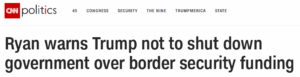
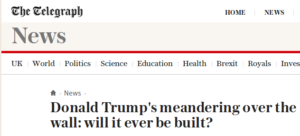
    For example, let’s contrast CNN’s coverage of Trump’s struggles getting the wall funded with the Telegraph’s coverage:


    Two articles from two news services. Both critical of Trump. CNN sows dissent between GOP leadership and Trump. The Telegraph highlights Trump’s lack of leadership on getting the wall built. CNN’s framing of the issue furthers their narrative that “even the right-wingers think Trump’s unhinged.” It fuels the “fractures within the party” narrative that is tied to the “Trump’s unhinged” one.

    In contrast, The Telegraph is pushing the narrative that Trump is a loose cannon, and can’t actually get anything done. The “impotent president” narrative is disfavored in US media right now (because he needs to be seen as a potent purveyor of racism given the crisis du jour), but in the UK media, the “impotent president” narrative is king.

    Media is showing that the Framing Theory is correct. They can not only set the agenda, but they can also influence the beliefs of their consumers. People are seeing Nazis under their bed, and the media are the ones who are fueling this hallucination.

    Narrative Crafting Tactic #1: “Scientific” “Credibility” through “Experts” and “Studies”

    Hihnnnnnnnnn
    Mad Scientist

    Many people can see right through the transparent BS of a commentator spewing their unsupported opinions. Only the true believers are swayed by an emotional screed (pathos… speech 101). However, a well-sourced and dispassionately asserted scientific truth is compelling to a neutral audience (logos… again, speech 101). The media have leveraged this to the utmost, using “experts” and “studies” to push their social and political goals in a way that compels the neutral audience. As libertarians, we tend to be skeptical of the BS social science journalism that ends up filling a 30 second segment at the end of the nightly news. However, the disease is much more widespread than that.

    Let’s do a case study. I’ve pulled a random health article from CNN.com.

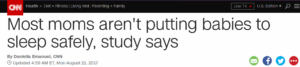
    Babies are being put to sleep unsafely according to a STUDY!!!!!

    (CNN)Despite a 23-year campaign urging that babies be put to bed on their backs, only 43.7% of US mothers report that they both intend to use this method and actually do so all the time, according to a new study.

    This sounds like an epidemic!!! Well, let’s go to the study:

    RESULTS: Of the 3297 mothers, 77.3% reported they usually placed their infants in the supine position for sleep

    Wait, what?? What’s the difference here? Well, the devil is in the details.

    Only 43.7% of mothers reported that they both intended to and then actually placed their infants exclusively supine.

    So, this article is based on the fact that mothers only usually placed babies on their back, but didn’t always do so. In order to warrant an article in the health section of an esteemed news outlet like CNN, the risk from babies sleeping on their stomachs must be enormous!

    There were about 3,700 sudden unexpected infant deaths in the US in 2015, according to the CDC. SIDS account for 1,600 of those while 1,200 are due to unknown causes and 900 were due to accidental suffocation and strangulation while in bed.

    By your powers combined, I am greatly inflated!
    Douchebag Frat Bro and the Federal Reserve Chairman

    1600 babies per year (39.4 deaths per 100,000 live births) isn’t a lot, and it’s not clear how many of those babies would have survived if they slept on their back (and how many of those SIDS babies were sleeping on their back). See, SIDS is not particularly well understood, so it’s quite unclear how safe or unsafe babies are by sleeping on their backs. Even assuming that EVERY. SINGLE. SIDS. DEATH. was because the baby was on their stomach instead of their back, babies are 0.039% safer than they were when mothers were less concerned with their baby’s sleeping position. Yet somehow, the title of the article SCIENTIFICALLY asserts that MOMS ARE ENDANGERING THEIR CHILDREN by putting them to sleep unsafely.


    This is but one way that media crafts a narrative by abusing scientific studies to push a social goal or undercurrent (in this case, it’s the insufficiency of mothers in taking care of their children without TOP MEN overseeing them). This doesn’t even get into the perverse incentives between government bureaucracy, the media, and university social science departments.

    In Part Two, I’ll discuss Narrative Crafting Tactic #2: “Contributors” and other talking heads as intellectuals.


  • Debt and Growth in America

    The United States Government is carrying a frighteningly high level of debt. However, no serious plan has been implemented, by Democrats or Republicans. This high debt will have deleterious effects on the US, including the effect on taxes, economic growth and “entitlements.”

    This article will steer clear of specific thoughts on social and political upheaval, since it is too hard to predict such trajectories, and are anyway another subject. Of course, macroeconomic trends can be just as tricky, I am sure many people will have differing opinions on how our national debt will affect the economy in the coming decades.

    First, we must cover the current liabilities, debts, and revenue streams of the Federal government. All figures presented will be based on the most recent year available- 2016 data unless otherwise noted.

    US GDP: 18.87
    Total Federal Governmental Debt: 19.98
    Interest rate: 2.232%
    Debt as % of GDP: 106%
    Interest Spending as % of GDP: 2.36%
    Long-term economic growth trend: 2% (estimated based on post-2010 data)
    Inflation: 1.26%

    Pretty dire straits when debt is above total GDP. Having a debt ratio this high is actually cataclysmic, as pointed out by Salim Furth at The Heritage Foundation due to a phenomenon known as debt drag. I believe this is a fairly intuitive concept. As national debt increases as a portion of the total GDP, it causes a corresponding decrease in the growth of GDP. My personal theory on how and why this happens is as follows: There is a ‘crowding out’ effect by taking investments away from high risk/reward private debts, but also because more and more money is spent servicing debt rather than being spent on goods and services. Why risk your cash when you can get a guaranteed return on investment?

    The exact magnitude of the effect is of course debated but is estimated at between 0.18-0.19% lower growth for every 10% GDP debt above about 84% of GDP and 0.16% lower for every 10% above 60% of GDP (see graph below). This seems to indicate that the effect of high debt is a nonlinear decrease in economic growth; however, we will represent the relationship as a tri-linear curve. For a country with debt at 106% of GDP, the effect would be about -0.82% to the annual increase in GDP. This is massive when one considers the historic growth rate of the US in modern times was close to 3%. However, we find now that the growth rate over the past 10 years has never surpassed 3% (year-long average) and is averaging much closer to 2%. This corresponds freakishly well with the increase in Federal debt. 10 years ago debt was about 60% of GDP, which based on empirical evidence does not seem to have a large effect on growth.

    Another headwind for the US will be the increasing cost of capital. During the fantastic growth of the national debt interest rates were very low, a favorable position for a debtor to be in; however, the interest rates are likely to increase with the new Fed policy to increase the benchmark rates. This means debt will become more expensive to service, and likely return closer to the historical average rate of about 5%. Debt payments will increase, further accelerating the addition of debt. With the increased debt, revenue growth will slow due to a lackluster economic growth (remember that -0.185% of growth per 10% of debt to GDP?). This all points to a rapidly accelerating downward spiral from this point on unless spending can be reined in yesterday. All evidence in recent history points to the fact that reining in spending is a political no-go, for Millennials, the fiscal hot potato has been tossed around their entire lives. Short term pain will be high if spending is to be controlled, and that only gets worse as the deficits grow.

    On top of all this bad news in terms of debt, growth and interest rates we will have acceleration in the costs of the major entitlement programs as the populace continues to age and even grow infirm before their years (some of this can be attributed to the increase in the average American’s waistline). Again, there is no political will to reform these programs. If recent events are any indication, even small cuts to unimportant programs are not possible.

    For this thought experiment, let us assume that the Fed is targeting 3% for inflation and that they get it in 3 years. For the sake of simplicity, say that means the interest rate reaches ~5% on treasuries. This is in excess of 100% increase over the current cost of servicing debt for the US. This means our outlays to service debt will increase; making our current budget, which already relies on deficit spending to go further into the red by the same amount. Last year total debt servicing was $432 billion (including interest paid to the Social Security trust fund). If we assume this will double over the next 3 years when interest rates go up, that is a debt cost of 2*$432= $864 Billion. This is still pretty cheap but will be added directly to the deficit (and thus converted to new debt) as our revenue is unlikely to increase any more than the economy does.

    Let us review our assumptions:
    • (real) Growth rate starts at 2% but is decreased with increasing debt
    • Expenditures and Revenue as a portion of GDP is constant (~3% funding gap)
    • Inflation reaches 3%
    • The interest rates on debt reaches 5%

    Now, take a theoretical person “John” he will retire in 2045 and die in 2063. When John retires in 2045, our scenario would predict a real growth rate of 1%, however, because this includes a 1%/annum growth rate in population, average living standards would cease to increase at this time. John’s kids would probably riot since no one wants to be doing only as well as their parents did. This could change our long-term assumptions, so ignore that possibility for now. In 2063 when John dies, the debt to GDP ratio would be equal to 2.7 and real growth would be -1%. Japan aside, it is not clear anyone would be willing to continue to lend to a country with such anemic growth and high-debt.

    So, right around when John retires in 2045, we’re likely to have a calamity in terms of funding the government (assuming this sort of steady-state worsening of financial conditions nationwide). We’re likely to see outlays hit, especially for social security, already projected to be something like 75% of promised benefits come 2035.

    I think it is reasonable to think that around 2035-2045 something major will change our trajectory, as the combining forces of the elderly being cut off and economic stagnation unheard of in American history caused major political and social upheaval. We will have to have increases in effective taxation rates, decreases in benefits or some kind of default around this time period (or some combination of all three). Combined those efforts would result in an effective decrease in our living standards by about 10% in 2045 without accounting for lost economic growth, which would be another 12%. That is actually a good thing, compared to waiting until 2063 to deal with debt issues when growth would be worse than stagnant, and thus the consequences of the debt carried by the government exacerbated by economic conditions. I would estimate that by waiting until 2063, the decline in living standards by the combination of more taxes and less spending would be close to 16% and an additional 40% loses due to unrealized economic growth.


    Further Reading:

    https://www.cbo.gov/ has tons of information on projections, but they are very often wrong, for example:

    In CBO’s baseline projections, the deficit in 2017 totals $693 billion, $134 billion more than CBO projected in January.

    That is a 20% error in the deficit over the course of just one year. You can find the most recent 10-year outlook from the CBO here: https://www.cbo.gov/publication/52801

    http://www.treasurydirect.gov/govt/reports/pd/feddebt/feddebt_ann2016.pdf


  • Post-Retard Gulag Part 2: To Punch A Nazi

    In the first installment I went on and on about how Charlottesville was a perfect test to preserve and protect the sanctity of freedom of speech, expression and assembly.

    I’ll let you all determine if Americans get a passing grade.

    In this post, I want to touch on a specific example of how the left is not seeing things properly when it comes to freedom of opinion.

    A recent development in left-wing dogma is the notion that if you disagree with speech you deem ‘hateful’, it doesn’t deserve First Amendment protection. In Canada, we didn’t even bother to have a debate about it and just scribbled in ‘hate speech’ laws into our Charter. Government balances free speech. It is known.

    A charter that isn’t worth shit (I can’t even bring myself to capitalize it) because when taken to its logical end, the government has final say on individual sovereignty and our rights to freedom of expression.

    In other words, you’re kinda free until you’re not in Canada.

    Sha-wing!

    Just ask Mark Steyn and Ezra Levant learned when they got their asses hauled in before the court, and unelected monstrosities like the Human Rights Commission for the crime of wrongthink.

    List of punchables please.

    HRC talking bacterial virus: “Please explain to us, dear friend, why you hate the environment, Mark? Why won’t you be a good boy and side with science? We fucking love science, so be sciencey with us! Prove to us why we shouldn’t send you to Camp Krusty.”

    The idea, if you can call it that, is grotesque for where it can all lead. One of those intellectual cul-de-sacs is thought control. For example, Smugpipi Longnanny commands, “You have white privilege ergo you’re racist but you don’t know it. You just need to accept it and this is why we’re controlling speech or else…”

    A variation of this is if you don’t denounce something they deem offensive enough, they will take the moral decision to claim you ‘tacitly accept’ insert bad thing here.

    By their admitted logic, because the left refuses to ‘tacitly denounce Islamic terrorism to the degree some may demand’, they’re terrorists. See? Fun.

    So if you dare to defend – in the context of Charlottesville – that racists have a right to free speech means you support them.

    Oh, the lazy stupidity of it all!

    Let’s keep going. I’ve read quite a few of these self-righteous zealots argue that it’s okay to punch a Nazi. Emotionally, sure. The urge to hit something you loathe is great. I loathe Marxist thinking, communist ideology and socialism because they’re illiberal ideologies with a documented track record of murder and mayhem that robs and steals humans of their soul handing it over to a bureaucracy of superiors who control your life. Nothing can be more anti-humanist than these ideologies. I also can’t handle clowns. Clowns are scary.

    It was my understanding there’d be no retaliation to the initiation of force.

    Am I justified in going to punch out such people in the street?

    Or. Let us take this accurate statement of ‘Not all Muslim are terrorists but the majority of political terrorism are committed by Islamic terrorists”. Does this accord me the right to go punch out my Muslim neighbour? No, seriously, a Muslim family live three houses me.

    And what happens if the Nazi, Muslim or any body else punches back? Have you considered those inevitable consequences?

    Moving goal posts is God’s work.

    Are they not in their right to defend themselves since you admitted throwing the first punch is a duty?

    I don’t think these people have thought things through. They just want to project and emote arrogantly setting the rules. Like a good game of Calvin Ball.

    Let me expand.

    If they’re in the moral and intellectual right, as they claim, why do they need violence then? Because history of the Nazis show this is what needs to be done? Again, can’t this be applied to Muslim terrorism? I reckon they won’t want to extend this rope to that end, right?

    Progressive visions.

    As is always the case with them, they get to determine the parameters of free speech (as we see on campuses and safe spaces). And just like they get to arbitrarily set the rules, the idea violence starts when the other side retaliates gives them one long leash to lash out with impunity.

    By not ‘tacitly’ denouncing Antifa’s own antics in Charlottesville, do I get to go punch those people out?

    How barbaric, no?

    But, Rufus, I fear your monocle is on too tight and squeezing your brain. Antifa is love and peace! They just want to spread their love!

    Pish-posh. You have not seen love until you witness the love libertarians have of their orphans.

    At best, I see ‘two wrongs make a right’ or ‘might makes right’.

    Antifa is a violent, illiterate, and problematic hate group in of itself. That they *claim* to speak for righteousness is hollow and tenuous. Witch-hunters thought they were doing good too. So do villains who feel they’ve been wronged and seek to ‘right’ a perceived injustice.

    Speaking of which, I do question the judgment of someone who claims Antifa is good. An identity group that doxxes people resulting in major consequences for the people impacted  is a misguided and misplaced act of justice.

    For a group that claims to be compassionate and humanist, how can they not see this action destroys (often) innocent lives needlessly? They may see themselves as righteous vigilantes but in effect they’re just lawless renegades with a confused moral and intellectual compass.

    How would you feel if that was your son or daughter or friend or cousin who lost their jobs to a wrongful doxxing? Humanize your actions.

    People who claim Antifa are not violent are out to lunch. Either they’re ignoring their behaviour or are just plain uninformed. Or they don’t care and aren’t admitting it. Regardless, none of it is good and not supported by documented reports of what we know about them.

    Not provoking a bear is a universal principle applied pretty much across the West. It’s basic kindergarten stuff. If you punch first, you were reprimanded. Conversely, if the person struck back, they too would be held to account for their actions.

    Even the NHL understands this basic law of nature. It’s called the ‘Instigator rule’. Don’t provoke or else you’ll get the penalty; usefulness of the rule notwithstanding. It’s believed it’s better to let the two parties have a go with the thinking it will police and sort itself out. Maybe this is what needs to be done here. Let these faux-resisters and racists keep banging each other over the heads. Eventually they’ll get the message that their actions are futile and not furthering their respective agendas. No one in the end can tolerate endless, mindless violence. Not even that degenerate, left-wing Berkeley professor who smashed that kid with a bike lock.

    Beats the Outer Banks.

    He’s a prime example of a coward who would take advantage of the instigator rule in hockey. He’d hit and run away without facing justice. Of course, if someone did hit him back, coward that he is, he’d scream like a little baby about how he faced violence and injustice. After all, this gutless coward has the moral obligation to smash people up, correct?

    If a fellow gang member comes up to you and says we need to go take care of the Ducky Boys, the gang is going to carefully consider the possible outcomes and consequences of the provocation. You all understand if you go and provoke them, they will fight back. So someone among you may say, ‘hey man, don’t go and do that. They outnumber us’. Or they’ll conclude, ‘it’s not worth it.’


    But none of the considerations are “they will just take what they have coming’.

    Only The Wanders can take on the Ducky Boys.

    It’s illogical and naive for people who think violence wasn’t inevitable in the context of Charlottesville.

    No matter how you dice this thing up, Antifa doesn’t come out looking any better.

    Worse even if you ask me.

    No, you don’t have a right to punch a Nazi because, by all accounts, you’re are not nice people and don’t hold the higher moral ground.

    Do us all a favour and stop pretending you represent the conscience of people, quit pretending you care about civil liberties and put on your blue caps. Here are some ideas you’d wear well.

  • What are Rights? An Encore

    People seemed to enjoy the discussion in the original article, so I’m going to expand on it based on some of the conversation we had in the comments. As noted in the comments, August is employing the Socratic method. In real life, August is a Being your own Socrates | sHR.classmate from law school who was a philosophy major. He and I enjoy sipping bourbon, smoking pipes, and talking politics, philosophy, and theology.

    In the original article, I made the assertion that rights are meaningless outside of a relationship. I also asserted that rights are definitions of the boundaries of authority between co-equal entities (man to man; man to human institution). In this article, I will address some of the points brought up in the comments: conflicting rights, objective v. subjective rights, negative v. positive rights, how rights flow from self-ownership.

    The conversation picks up at the end of the prior article:

    AUGUST: So if rights are based on authority and the equality of man, are you saying that rights are attempts to prevent inequity between men and between man and institutions created by man?

    OSCAR: Yes! As with any co-equal relationship, there are certain things solely in the domain of the first, other things that are solely in the domain of the second, and some things that are in an overlapping domain between the two. For example, parenting.

    AUGUST: So, in this Venn Diagram description, your domain is your rights with respect to me, my domain is my rights with respect to you, and the shared domain is collective rights between us and conflicting rights between us. How can rights conflict if they are natural?

    OSCAR: Well, this is more of a semantic difference. Either you can paint with broad strokes (“right to life; right to play loud music; right to swing your arms”) and deal with conflicts of the rights (“my right to swing my arm ends at your nose”), or you can paint more carefully (“right to swing your arms in open portions of your personal space”) and not have to deal with conflicts. Either way, there is a limit to the extent of your rights where you begin to infringe somebody else’s rights.

    AUGUST: This still seems fuzzy. How do you know when you’re infringing somebody else’s rights?

    OSCAR: Well, we need to know how to identify a right in order to be able to tell if we’re infringing on rights. There are two things called “rights” these days. One is negative rights, and the other is positive rights. Positive rights are largely a misnomer in the context of strangers (including the government). The only relationship in which positive rights make sense is the dependent/caretaker relationship. This is why people refer to the “Nanny State” when government enshrines positive rights in law. Negative rights, however, are natural rights. They derive from self-ownership. Negative rights are things whose direct, tangible consequences are felt only by the rights owner and consenting others. In essence, you are the sovereign of your own vintage seminude woman reading by MementoMori-stock on DeviantArtdomain; only you have the authority to make decisions that result in consequences to only you. Thus, you are infringing on somebody else’s rights when you do something that keeps them from exercising sovereignty over themselves and their property.

    AUGUST: Direct, tangible consequences? Like economic externalities, emotional effects, and social consequences?

    OSCAR: No, usually rights violations are one of three categories: force, fraud, and coercion. Nobody forces you to feel a certain way. Nobody coerces the market to ripple when you make a transaction. Nobody forces society to react to your actions. All of these consequences to the exercise of rights may be of concern to people and to society at large, but they are outside of the authority of strangers and the government to resolve by infringing on the free exercise of rights.

    AUGUST: But we discussed before that there are times when you can use force, like in self-defense. It seems like you can’t use force until you can.. it’s all very arbitrary sounding.

    OSCAR: Not at all. There is a basic principle that you can respond to immoral force with force of your own, but you cannot initiate immoral force: the non-aggression principle.

    AUGUST: Ah, so when my neighbor accidentally steps on my side of the property line, I get to kill him?

    OSCAR: No, the NAP is better seen as a negative limitation than a positive one. The NAP tells you when you CAN’T use force, but doesn’t dictate HOW you can use force when it is not immoral to do so. There are rules of proportionality that are outside the scope of rights.

    AUGUST: That is all well and good, but I’m still not convinced that negative rights are a necessary consequence of self-ownership.

    OSCAR: Ownership implies control. If you own yourself, you have control over your actions. Ownership also implies exclusivity as to strangers. There can be co-owners of something, but co-ownership implies a consenting relationship. You cannot be a co-owner with a complete stranger. Therefore, absent consensual abdication of your self-ownership, your claim to your own body and to your actions is exclusive. As previously discussed, the only time this changes is when your actions cause direct, tangible consequences to non-consenting others.

    Part of your actions include your labor. You are the owner of your labor, including the economic value of your labor. Economic value of your labor can be traded for physical property, which makes you exclusive owner of capital. Throughout this entire chain, your exclusive ownership and control has not been severed unless consensually negotiated for. Therefore, self-ownership implies control over your actions, your labor, and your property, up to the point where you cause direct, tangible consequences to non-consenting others. It is important to note here that the direct, tangible consequences need to be caused against a legitimate claim of the non-consenting other. If I buy the Mona Lisa, I deprive you of being able to see it. However, you have no legitimate claim to the Mona Lisa because you have no grounds to claim ownership of the Mona Lisa.

    AUGUST: What’s the point of all of this if a “might makes right” government comes in and imposes its will on you?

    OSCAR: Rights are not subjective. Negative rights are natural outcroppings from the physical reality of self-ownership. Positive rights are natural outcroppings of the duties that are inherent in a caretaker role. Practical infringements of rights do not affect the ethical reality of rights.

    AUGUST: Do you have the right to do something that is wrong?

    OSCAR: In my definition of rights as authority boundaries between co-equal entities, the question is somewhat irrelevant. If your “wrong” thing does not involve using force, fraud, or coercion on a non-consenting other, then government has no rightful authority to stop you. However, this says nothing of the inherent morality of your actions. You could perpetrate a horrible evil against yourself (or against God, for those who believe), and it would no more be within the government’s rightful authority than if you did a great good for yourself (or for God, for those who believe).


    For a detailed treatment of this question and other related topics, I turn it over to Milton Friedman (1 hr youtube vid).