Category: Politics

  • The slaver who became a champion of liberty – or did he?


    'Fun-loving" was ruled the least likely term to be used to describe him, beating out "hirsute"
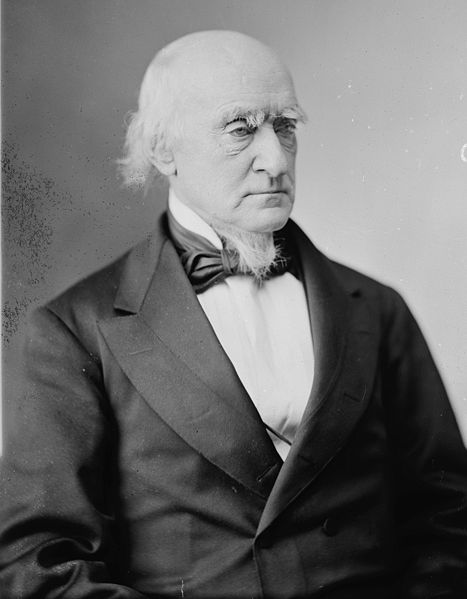
    John Archibald Campbell – between 1870 and 1880


    On March 6, 1857, a large audience crowded into a room in the U. S. Capitol to hear the justices of the Supreme Court pronounce on the fate of Dred Scott, a black man seeking a legal ruling that he was a free man. Scott claimed he had been liberated from slavery by living in federal territory where slavery had been forbidden by Congress’ Missouri Compromise law. Scott had come to the wrong place. Chief Justice Roger Brooke Taney read an opinion declaring that Scott remained a slave, that black people, slave or free, were not citizens, and that the Missouri Compromise was unconstitutional because it purported to keep slavery out of federal territories.

    The following day, Justices Benjamin Curtis and John McLean read their dissents. Not all of the Justices read their opinions on these two days, however. Justice John Archibald Campbell had a written opinion in which he agreed that Dred Scott was a slave.

    This is the story of John Archibald Campbell – a “fascinating figure” according to the actor Gregory Itzin, the guy who played Campbell in Steven Spielberg’s movie Lincoln. Of course, as an article in startrek.com noted, Itzin is “especially good at being bad, or at least being in league with the villains of too many movies and television shows to count.” So Itzin’s remark doesn’t necessarily count as a character reference. And since Spielberg only gave the Campbell character one line, there wasn’t much chance for Itzin to flesh out Campbell in detail (except through the stern gazes he directed at other characters).

    The fact is that the same John A. Campbell who ruled for slavery in the Dred Scott  case also (unsuccessfully) promoted a broad pro-liberty interpretation of the Fourteenth Amendment in the Slaughterhouse Cases.
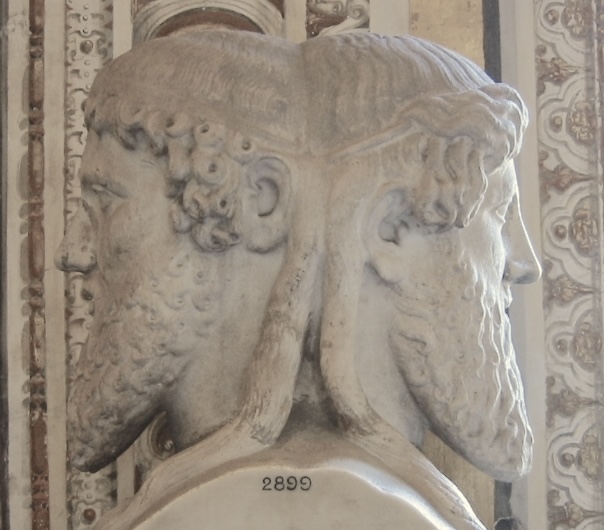
     

    I was going to insert a picture of the character Two-Face, but there was some kind of legal hang-up, so here's a statue of Janus the two-faced god.


    It’s not clear whether Campbell agreed with Taney’s view that all black people – slave or free – were categorically excluded from citizenship. Campbell’s opinion in Dred Scott focused on the other key issue of the case – slavery in the federal territories. Here Campbell reiterated views he’d held since about 1850, before he was on the Court – views which had grown mainstream among Taney and other leading Southerners. Although as recently as 1848, Campbell had admitted that Congress could ban slavery in the federal territories, two years later Campbell proclaimed the opposite doctrine.

    Concerned with Northern attacks on the South in the name of antislavery, Campbell in 1850, as in 1857,  said that a Southerner who settled in a federal territory had the right to hold his slaves there as “property,” just like a Northern settler had the Constitutional right to hold his farm implements, cows, and pigs as property. Campbell believed that this was an issue of equal rights – the Southerner must have the same right to his version of property that the Northerner had to his version. Defending slave-owning as a matter of equal rights – that’s some messed-up s*** right there – but it’s what most elite Southerners had come to believe.
     

    "So what you're saying, Judge, is that slavery is freedom."
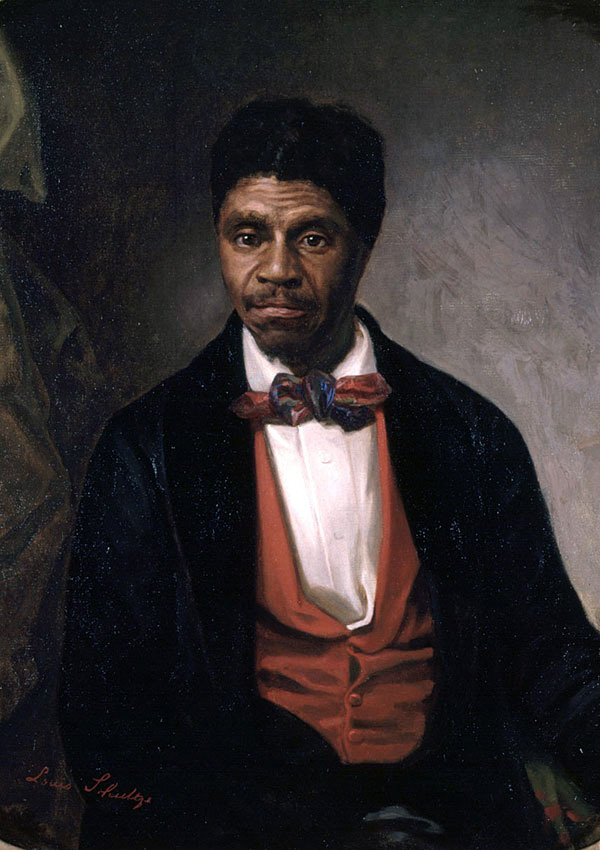
    Dred Scott (1882 painting based on 1857 photograph)


    Campbell actually thought slavery was on the way out. In articles he wrote in his pre-Court days, he said that the spirit of the age in America, as well as the South’s need to shift from agriculture to commerce and industry, would lead to the end of the Peculiar Institution. But sudden emancipation, such as urged by Northern abolitionists, would (Campbell believed) lead to bloodshed and economic disaster – as in Haiti. To gradually ease out of slavery, Campbell wrote, the Southern states – without Northern meddling – should prepare slaves for freedom by giving them at least a basic education, protecting their families from being broken up by sale, and preventing creditors from seizing an owner’s slaves. But as Northern pressure against slavery increased, Campbell believed that Southerners’ priority should be to resist this outside pressure and defend slavery against Yankee attacks.

    Before being appointed to the Supreme Court, Campbell had been a prominent attorney in Mobile, Alabama. He made his reputation by defending clients who owned valuable land next to the Mobile River. In arguments ultimately accepted by the state and federal Supreme Courts, Campbell said that Alabama, when it became a state in 1819, acquired the right to dispose of these lands regardless of interference from the federal government – a position which established Campbell’s clients’ title to the land as well as putting Campbell on the states’ rights side of a key issue.

    From 1849 to 1853, Campbell appeared many times before the U. S. Supreme Court – mostly losing his cases but impressing the Justices with the quality of his preparation and legal argument.

    Campbell was also active in the Southern Rights Association, a group which warned Southerners of the dangers posed by Northern opponents of slavery in the wake of the extensive conquests of the Mexican war. Anonymous pamphlets by Campbell (on behalf of the Mobile branch of the Southern Rights Association) warned that Northern fanatics were trying to prevent Southerners from settling in the new territories with their slaves, as was allegedly their constitutional right. A fellow-Alabamian, William Lowndes Yancey, was a leader of the Southern rights Association and had previously worked with Campbell. Yancey was a leading “fire-eating” supporter of Southern rights and of a separate Southern nation.

    Campbell put some distance between himself and Yancey at an 1850 convention of Southern leaders, held at Nashville to consider the danger posed by Northern antislavery initiatives. Many of the resolutions passed at the Nashville convention were drafted by Campbell, and took what in the political climate of the time was a conciliatory tone in comparison to Yancey’s secessionism. The Nashville Convention resolutions warned the North that it must allow slavery in the territories and otherwise respect Southern “rights.” But any talk of secession was declared premature. Compromise measures approved in Congress should be given a chance to work. The resolutions were vague on whether secession would ever be a good idea.

    When Democratic President Franklin Pierce took office in 1853, he had to fill a Supreme Court vacancy left by the death of John McKinley of Alabama. After looking around for a good nominee, Pierce selected Campbell, who came recommended by all but two Southern legislatures. Also backing Campbell, in a historically-rare endorsement, were the remaining members of the Supreme Court, who requested that the guy who had impressed them so much as an advocate should come up and sit on the bench with them. Pierce and the Senate agreed and put Campbell on the Court.

    One of Campbell’s Supreme Court would have denied citizenship…to corporations. If Campbell was correct, then the right of corporations to sue in federal court would be severely curtailed. But Campbell’s opinion was in dissent, and the Court majority, then as now, said corporations are citizens with broad rights to invoke the protection of the federal courts.

    Not that Campbell supported states’ rights in all cases. Like other Southern leaders, he turned into a virulent nationalist when it came to fugitive slaves. Campbell believed the federal government, under Congress’ strong Fugitive Slave Law, should send U. S. marshals to arrest black people in the North, give them a brief and inadequate hearing to decide if they were fugitives from slavery, and then ship them off to their alleged masters, without regard to any Northern state laws which tried to protect the civil liberties of accused black people. Campbell joined a unanimous Supreme Court opinion that state courts could not hear habeas corpus petitions from federal prisoners – including alleged fugitives and their Northern rescuers.

    To Campbell, the enforcement of the federal Fugitive Slave Act was a matter of justice which the North owed to the South. The South, meanwhile, should reciprocate by helping the feds fight filibusters.
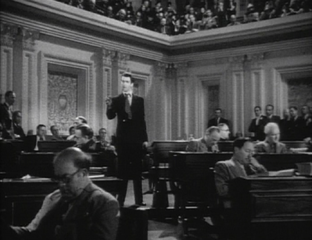
     

    Look, Wikipedia says this is in the public domain.


    No, not that kind of filibuster. More like this:

    Yo ho ho
    William Walker’s ship in battle near Nicaragua, 1856


    Private American “filibuster” armies were organizing throughout the country, particularly in the South, in order to invade Latin American territory. Campbell thought the “filibuster” leaders were seeking to expand slavery and add new slave territories – like Spanish-held Cuba – to the United States.

    In those days, Supreme Court justices had duties as trial judges, and Campbell was assigned to hear federal cases in Mobile, Alabama, and in New Orleans in neighboring Louisiana. So when Campbell came to New Orleans in 1854, he told the federal grand jury to go after the filibusters, particularly former Mississippi governor John Quitman and his associates, who were plotting an attack on Cuba.

    Campbell indicated the concerns which motivated him. He told the grand jury that just as Southerners rightly demanded that Northerners put aside their antislavery feelings and let the Fugitive Slave Law be enforced, Northerners rightfully demanded that Southerners let the federal Neutrality Acts be enforced against the filibusters.

    Quitman and his associates were summoned to testify before the grand jury, but they took the Fifth, and the grand jury didn’t indict anyone. But Campbell put the kibosh on Quitman’s Cuban raid by forcing the would-be filibusters to post large money bonds – the money would be forfeit if Quitman and crew waged private wars against other countries. Quitman had to give up his plans, and he spared no invective against Campbell for his allegedly oppressive actions. Campbell later tried to take proceedings against the filibuster William Walker, but did not stop Walker from ruling Nicaragua as a slave country (until he got shot, which wasn’t Campbell’s fault).

    The filibuster-sympathizers in the South, of whom there were many, grew hostile to Campbell.

    Campbell became distressed at what he considered a conspiracy of Southern disunionists. These conspirators, in Campbell’s telling, started plotting secession around 1858. According to Campbell, filibusters joined up with supporters of a revived African slave trade in a scheme to set up a slave republic in the Southern United States and the Latin American territories they conquered. There was certainly one person thinking along these lines – William Yancey, Campbell’s former political ally from Alabama. But  Yancey wanted to break up the Union, while Campbell wanted to keep the country together, so long as this could be accomplished peacefully.

    After President Lincoln was elected in November 1860, Campbell wrote what he thought were some private letters declaring that secession was at best premature. Lincoln’s election was not in itself an act of aggression against the South, and if the federal government seemed about to adopt antislavery measures, the Southern states could consult together as they had in 1850, rather than getting into a mad rush to secede. Campbell’s “private” letters were published, exacerbating the hostility against him from red-hot secessionists in Mobile and elsewhere.

    Alabama voted to secede in January 1861,  joining several other Southern states. Campbell decided not to resign from the Supreme Court, but to stay in Washington, D.C., and try to broker some kind of compromise which would avoid war. After Abraham Lincoln took office in March, Campbell, sometimes backed up by his Court colleague Samuel Nelson of New York, offered his good offices in soothing tense relations between North and South.

    The new Confederate States of America had sent commissioners to Washington, but the Lincoln administration would not recognize them. So Campbell (and sometimes Nelson) served as go-betweens between the commissioners and William Henry Seward, the Secretary of State. Seward had been the country’s most prominent Republican before Lincoln came on the scene, and the former New York governor saw himself as basically Lincoln’s prime minister. Seward also saw himself as a peacemaker – by conciliatory gestures, he thought he could isolate the secessionists and rally support among Union-loving Southerners.

    Seward gave assurances to Campbell and Nelson that the federal authorities would soon evacuate Fort Sumter, the federal fort whose presence in Charleston Harbor had become a source of serious friction between the two sides. With Seward’s permission, Campbell conveyed the Secretary’s assurances to the Confederate commissioners and to Jefferson Davis. Later, when Fort Sumter was obviously not being evacuated, Seward told Campbell that Lincoln was under pressure from hardliners not to withdraw, but at least the feds would give advance warning before resupplying the fort. What had actually happened is that Lincoln had made clear that he, not Seward, was President, and that Seward’s peace overtures were unauthorized. Seward retained considerable power in the administration, but no longer as an independent policymaker.

    In the end, the Confederates concluded that United States forces wouldn’t leave Fort Sumter unless they were forced out, and thus the Civil War began.
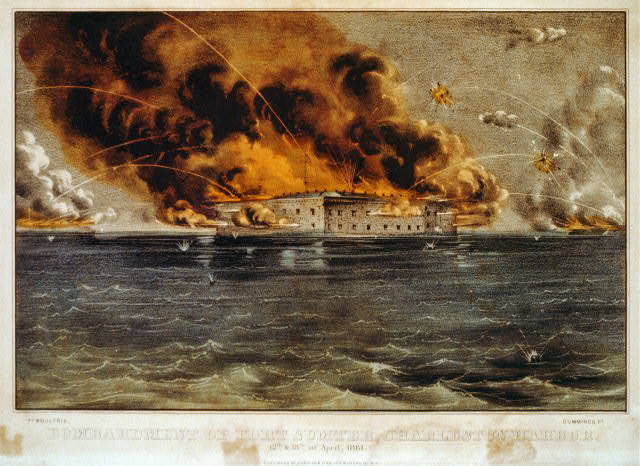
     

    "This would never have happened if Seward had pulled out when he said he would."
    Bombardment of Fort Sumter, Charleston Harbor: 12th & 13th of April, 1861


    Campbell, understandably feeling duped by Seward, concluded that his usefulness as a peacemaker was at an end, and that his place was with the South. He resigned from the Supreme Court and moved to New Orleans, a friendlier city to him than Mobile. Campbell planned to resume private law practice.

    New Orleans was an important Southern port. It also had some serious public health problems, though Campbell didn’t know the future relevance of this fact to his career. People dumped their garbage and excrement in the streets and in parts of the Mississippi which fed the municipal water pipes. Butchers dumped carcasses and offal in the river or even used their waste to fill holes in the street. Physicians and the various public-health boards before the war had issued repeated warnings that this situation was linked to the periodic outbreaks of cholera and yellow fever which almost routinely hit the city, endangering residents who weren’t well-off enough to evacuate until the infection ran its course.

    The war temporarily improved the situation, though Campbell probably didn’t appreciate the way the improvements happened. In 1862, Union forces conquered the city, and General Benjamin Butler became the Union commander in occupied New Orleans. A bad general, Butler could be a good administrator and, at least in the North, a good politician. His harsh measures against Confederate sympathizers (treating rebel-sympathizing women like prostitutes, for instance) made him hated in New Orleans, but Butler did the Crescent City a favor with vigorously-enforced sanitary regulations.

    Sanitary or not, Campbell for his part didn’t want to be in a Union-occupied city, and he moved to Richmond, VA, the Confederate capital. It is possible that, due to Campbell’s fame as a U.S. Supreme Court Justice, President Jefferson Davis might have appointed Campbell to the Confederate Supreme Court. However, there was no Confederate Supreme Court to which Campbell could have been appointed. The Confederate Congress refused to authorize such a Supreme Court, concerned that such a body would diminish the powers of the state courts. Another factor might have been that many of the solons didn’t like Campbell and didn’t want him to be a Justice again.

    Instead, Campbell got a position as Assistant Secretary of War. He would help the War Department in its administrative work, provide legal opinions, and administer the Confederate conscription program.

    The most significant part of Campbell’s legacy at the Confederate War Department was his campaign to protect the rights of conscientious objectors. Here Campbell manifested a sense of justice toward religious pacifists who refused to be drafted into the Confederate army. The conscription statute allowed members of recognized peace sects – Quakers, Mennonites, Dunkers – to be exempt from service upon payment of a hefty fee. Some pacifists could not or would not pay the fee, while others got screwed around by military authorities and were dragged into the army where the statute no longer protected them.

    Campbell worked assiduously to make sure that religious pacifists had the chance to pay their commutation fees, and to receive civilian assignments which were consistent with their consciences, and even to get discharged from the army if they had been forcibly mustered in – this latter initiative on Campbell’s part went beyond the letter of the conscription statute. Lobbyists for the various peace sects knew who to call when any of their members faced draft problems. This was useful because the Quakers, in particular, could not necessarily count on sympathy with Confederate authorities due to the well-known Quaker opposition to slavery. Campbell for one was happy to help Quakers, and he had a good working relationship with John Bacon Crenshaw, a Quaker leader in the Richmond area who brought the cases of both Quakers and non-Quakers to Campbell’s attention.


    In Pringle's case Campbell couldn't do much because Pringle was drafted by the North. But President Lincoln eventually relented and released Pringle and two companions who were suffering similarly.
    Self-portrait of Cyrus Pringle, American botanist and Quaker pacifist – he was tortured during the Civil War for refusing to submit to conscription. John A. Campbell tried to protect people like Pringle from being persecuted for their consciences. (click the picture or see the alt-text for punch line)


    Campbell drew the line at draft-dodgers who merely pretended to be religious pacifists – the Quakers and others saw an upsurge in membership applications at this time. Campbell warned officials not to recognize phony pacifists in religious clothing.

    Campbell also fumed that certain state courts were ordering the release of conscripts deemed improperly drafted. Getting in touch again with his inner nationalist, Campbell denied that state courts could interfere with Confederate prisoners, just as he had denied that state courts could interfere with U.S. prisoners.

    At one point, a would-be assassin wrote the War Department, offering his services in bumping off Lincoln. A good bureaucrat, Campbell routinely forwarded the letter to the appropriate official, and the assassination plan was ignored.

    Working in the Confederate War Department was not nearly as lucrative as private law practice in the South or a Supreme Court justiceship in Washington. With a salary measured in Confederate currency, and with inflation in Richmond, it would not have been a comfortable existence. And the whole Confederacy was in a bad condition: attacked, blockaded, and losing territory (like New Orleans) to a richer, more populous enemy.

    By December 1864, Campbell was convinced that the Confederacy was a Lost Cause, and he wrote North to Supreme Court Justice Samuel Nelson, his former colleague, saying that an “honorable peace” should be worked out. Nelson replied that peace talks were already in the works.

    President Lincoln was being pressured by an influential supporter, the old Jacksonian Francis Preston Blair, to seek peace talks with the South. Lincoln couldn’t afford to alienate Blair, so he allowed Blair to sound out Confederate President Jefferson Davis, who seemed quite receptive.

    The Confederacy was collapsing all around Jefferson Davis, morale was low, and Davis was being criticized from all quarters. Yet Davis had not had a Steiner Moment. He still thought the war was winnable, if only he could rally the people behind one more grand effort. What better way to revive the public’s patriotism than to show that Lincoln was seeking a complete, humiliating surrender? And what better way to get the necessary proof of Lincoln’s evil intentions than by sending a delegation of known peaceniks to attempt negotiations with Lincoln? That would show Davis’ domestic opposition that there was no way forward except continuing the war under Davis’ leadership.

    So the Confederate President responded to Blair’s initiative. Davis picked three peace commissioners known for their opposition to his war policy: Confederate Vice President Alexander Stephens, Confederate Senator R. M. T. Hunter…and Campbell. The three commissioners crossed Union lines and met Lincoln and Seward aboard the boat River Queen near Hampton Roads, Virginia.

    "Let's sing a classic riverboat song...how about 'Waiting for the Robert E. Lee'?"
    The River Queen


    There followed four hours of friendly conversation, but the two sides were far apart. Lincoln was committed to negotiate peace in “our one common country,” while Davis’ instructions spoke of negotiating peace between “the two countries.” Campbell, pragmatically, didn’t adhere to Davis’ delusions and instead raised practical issues about the terms of a Northern victory. Would Reconstruction of the former Confederate states be harsh or lenient? Would Southerners who had lost property – not just phony “property” like slaves but honest to goodness property like land, farm animals, and so on – get restitution or compensation?

    Campbell’s realism contrasted with the time-wasting weirdness of others. Hunter said Lincoln should negotiate with his domestic foes like Charles I did, virtually inviting Lincoln’s zinger that Charles had lost his head. Stephens and Seward mulled over Francis Blair’s Quixotic plan for a joint Union-Confederate expedition against the French in Mexico. Lincoln insisted that the Confederates would have to stop fighting and rejoin the Union. The meeting ended with everyone on good terms, but they were no closer to a peace deal.

    As the commissioners were departing, Seward had a black sailor row a boat over to give the commissioners a gift of some champagne. In a remark worthy of Blanche Knott’s Truly Tasteless Jokes, Seward called out to the commissioners to “keep the champagne, but return the Negro.” (This incident didn’t make it into Spielberg’s movie.)

    Davis, as he had probably planned all along, sought to rally the public by telling them of Lincoln’s intransigence. These pep talks didn’t stop the inevitable.

    Soon after Campbell’s return to Richmond, the Confederate government evacuated the city. Campbell remained behind as federal troops moved in, and the ex-Justice again tried to take up a peacemaking role. Campbell hoped that Lincoln would let the old Confederate states keep their existing governments once they rejoined the union, and that these states would be spared military rule.

    Lincoln came to Richmond on a visit, giving Campbell a chance to take the matter up with the President in person. Campbell suggested that if the pro-Confederate Virginia legislature agreed to put Virginia back in the Union, soldiers from Virginia would lay down their arms. Lincoln liked this, and he gave orders that the legislature could meet under Union protection for the purpose of pulling Virginia troops out of the war. This suggested at least a de facto recognition of the Virginia legislature, a key step toward mild Reconstruction and hopefully, Campbell thought, serving as a precedent for other states.

    Campbell had out-negotiated Lincoln, but it made no difference, since Lincoln had the guns and could alter the agreement at will. After Lee surrendered at Appomattox, Lincoln, facing denunciation for his softness toward the rebels, reconsidered the deal with Campbell and blocked the meeting of the Virginia legislature.

    After Lincoln’s assassination, Secretary of War Edwin Stanton believed that the killing had been plotted by Confederate higher-ups. So when a search of captured Confederate archives found that Campbell had bureaucratically handled a letter from a would-be assassin, that was enough motive to order Campbell’s arrest. Not to mention that Campbell had embarrassed Northern hardliners by trying to get Lincoln to endorse a mild reconstruction. So Campbell was imprisoned without trial at Fort Pulaski, in the harbor of Savannah (GA), for several months.

    "I'm beginning to get sick and tired of these federally-occupied forts." ALTERNATE JOKE: "Hey, Fort Pulaski is on Cockspur Island, huh huh."
    Fort Pulaski jail

    Several influential people supported Campbell’s freedom in petitions to the new President, Andrew Johnson. The Dunkers praised Campbell’s protection of the rights of conscientious objectors. The Quakers, after overcoming reservations about supporting freedom for a “traitor,” joined in appealing for the release of their former benefactor. Campbell’s old Supreme Court colleague Benjamin Curtis, who had disagreed with Campbell in the Dred Scott case, added his voice in favor of Campbell’s release.

    Finally, the feds let Campbell return to Mobile. The local citizenry was still mad at him for supposedly being a traitor to the South, so Campbell got federal permission to relocate to New Orleans, where he began building a successful law practice. He did this through his usual work ethic and by attention to the details of his cases, ultimately rebuilding the wealth he had lost during the war.

    At first Campbell’s practice was limited to state courts, because Congress required lawyers who wanted to practice in federal court swear they had never supported the Confederacy. Campbell, of course, could not swear this. The U. S. Supreme Court, however, said that Congress’ law was unconstitutional, so Campbell could practice in federal courts again.

    A prominent New Jersey lawyer wrote his daughter from New Orleans in April 1867, when he was paying a brief visit to the city. “Everybody here, of the old residency, is secessionist in feeling,” in the view of Joseph Bradley. The former slaves, stirred up to new levels of assertiveness by the federal Freedman’s Bureau, were refusing to work at rates the plantation owners could afford, and without black workers “the plantations will become a desert waste.” Back up North, Bradley dropped those sad musings when supporting General Ulysses Grant’s successful campaign for President in 1868. Bradley said that electing Grant was necessary to stamp out the “destestable heresy” of states’ rights and affirm the “paramount sovereignty” of the federal government.

    Around the time Campbell regained his right to practice in federal courts, he lost his right to hold public office. Congress adopted the harsh Reconstruction policy which Campbell had tried to avert. The former Confederate states were put under military rule until they adopted modern constitutions, allowed black men to vote, and ratified a new constitutional amendment, the Fourteenth. The Fourteenth Amendment, adopted in 1868, provided in Section 3 that prewar officeholders who joined the Confederacy would be forbidden from holding state or federal office. Campbell remained a private citizen, doing his part to oppose the new order of things.

    Louisiana elected carpetbagger Henry Clay Warmoth as governor and a Republican-majority legislature containing numerous black members. Writing to his daughter Katherine, Campbell said that “[w]e have the Africans in place all about us” as “jurors, post office clerks, customhouse officers, and day-by-day they barter away their obligations and duties.” It doesn’t take a diversity-training course to recognize this as racism – Campbell was casting reflections on the capacity of black people for self-government.

    Many of the clients Campbell took on in New Orleans filed challenges to various parts of the legislative program of the Reconstruction legislature. Campbell spearheaded the legal offensive against these laws passed by what he deemed an illegitimate government. Campbell’s initial strategy was to seek out sympathetic trial judges in New Orleans and obtain injunctions against the policies he was challenging. A Republican state Supreme Court would ultimately overturn the injunctions and allow the laws in question to be enforced, but that allowed for a good interval in which Reconstruction policies were inoperative. The legislature got wise to Campbell’s tactics and created a trial court with the exclusive responsibility of handling these challenges to Reconstruction. This was Judge Henry C. Dibble’s court, which we’ve encountered in the account of the Sauvinet case.

    During this time, Campbell took on his most famous case.

    After the U. S. military stopped enforcing General Butler’s sanitary regulations, prewar filthiness returned to New Orleans, including the return of epidemics. The Reconstruction legislature took a crack at reform, borrowing an idea used in many other big cities. The slaughtering of animals was to be confined to a particular location, a system deemed safer than letting butchers dump carcasses and offal just about anywhere.

    Under the statute, butchers would have to slaughter their animals at the specified location, at a slaughterhouse run by a state-chartered private corporation. This corporation was limited in the fees it could charge the butchers, but even so, it possessed a government-granted monopoly. Ronald M. Labbé and Jonathan Lurie, historians otherwise sympathetic to sanitary reform in New Orleans and to the Louisiana Reconstruction government, say that the company’s leaders used corrupt methods to get the needed votes in the legislature.

    "OK, let's discuss how to address the grave public-health problems of this city without infringing on basic civil liberties...guys, quiet down, I'm trying to have a serious discussion here."

    The butchers hired Campbell to challenge the slaughterhouse monopoly . Campbell claimed the law basically enslaved the butchers by requiring them to use a particular slaughterhouse. Campbell, the former defender of slavery, was prepared to invoke the Thirteenth Amendment on behalf of his clients.

    Campbell also urged a broad reading of the Fourteenth Amendment, with a definition of the privileges and immunities of citizenship broad enough to protect the right to earn an honest living. With the Fourteenth Amendment so broad, it would also protect the rights in the Bill of Rights.

    Campbell’s clients lost in the Louisiana Supreme Court in April 1870, so Campbell got permission to take the case to the United States Supreme Court. On May 15, Campbell’s daughter Mary Ellen died suddenly, probably from one of New Orleans’ yellow-fever outbreaks. Campbell had little time to mourn, because on June 9, he was in the federal circuit court then meeting in New Orleans. Campbell wanted the circuit court to issue an injunction, so that the slaughterhouse law wouldn’t be enforced until the U. S. Supreme Court could weigh in on the case.

    The circuit court consisted of Judge William B. Woods and the newest Supreme Court Justices, Joseph Bradley. The New Jersey lawyer had been commissioned as a Justice in March, and Bradley was responsible for riding circuit in Louisiana and five other Southern states, though his experience with the South was limited to his 1867 visit.

    Bradley granted the injunction, giving an opinion which indicated where he stood on the case. After initial hesitation, Bradley said that the privileges and immunities of United States citizenship under the Fourteenth Amendment included the right to earn a living, free from government monopolies such as the one the Louisiana legislature had created.

    In a case of true irony (Alanis Morissette take note), Bradley’s main client in private practice had been a railway monopoly in New Jersey. The so-called Joint Companies had the exclusive right to carry passengers and freight north and south through the state. New Jersey got a cut of the profits, allowing state taxes to remain low. The ones to suffer from the arrangement were other companies, and the travelers and shippers who could have benefited from more competition. Bradley had zealously defended the Joint Companies’ monopoly as a lawyer/lobbyist, invoking states’ rights arguments to prevent the federal government from establishing competing railroad lines, even during the war emergency. Now like Prince Hal with Falstaff, Bradley had cast off his association with the Joint Companies upon becoming a Justice.

    Campbell had to go to Washington to argue the Slaughterhouse Cases. And he had other reasons to come to Washington besides appearing before the Supreme Court. After the Louisiana elections of 1872, rival candidates for governor and other offices declared themselves elected. Campbell was part of a “nonpartisan” committee whose members happened to be Democrats. The committee complained about how the Republicans had stolen the election from the Democrats with the aid of the Grant administration and the federal courts. It was no use – Federal troops continued to back the Louisiana Republicans.

    Meanwhile, Benjamin Butler, now a member of the U.S. House of Representatives, put a bill through Congress restoring political rights to most of the ex-Confederates who had been affected by Section 3 of the Fourteenth Amendment. The bill kept a few categories of people under political disabilities, including prewar federal judges who had joined the Confederacy. Campbell came under this ban, and though he could have applied for an individual pardon from Congress, he contemptuously declined to do so, focusing on his legal practice and his Democratic political activism (these two things were linked).

    In his Supreme Court argument, Campbell said that compelling the butchers to use a specific slaughterhouse was a form of slavery or involuntary servitude, contrary to the 13th Amendment. Probably aware that the 14th Amendment argument would get taken more seriously, Campbell put particular emphasis on it, especially the clause protecting the privileges and immunities of citizenship from state infringement.

    The Fourteenth Amendment had been adopted just in time, argued Campbell, because as the franchise was extended, there were more ignorant voters.

    The force of universal suffrage in politics is like that of gun powder in war, or steam in industry. In the hands of power, and where the population is incapable or servile power will not fail to control it, it is irresistible. Whatever ambition, avarice, usurpation, servility, licentiousness, or pusillanimity needs a shelter will find it under its protection influence.

    Campbell suggested that in places like Louisiana, crooked politicians manipulated the support of ignorant voters to push through bad, self-interested laws.

    The 14th Amendment was “not confined to any race or class,” Campbell argued.

    It comprehends all within the scope of its provisions. The vast number of laborers in mines, manufactories, commerce, as well as the laborers on the plantations are defended against the unequal legislation of the States. Nor is the amendment confined in its application to the laboring men.

    Businessmen – including butchers – were protected as well.

    [C]an there be any centralization more complete or any despotism less responsible than that of a State legislature concerning itself with dominating the avocations, pursuits and modes of labor of the population; conferring monopolies on some, voting subsidies to others, restraining the freedom and independence of others, and making merchandise of the whole?

    In the Court’s internal deliberations, Justice Bradley argued the cause of a broadly-construed Fourteenth Amendment. Bradley’s adversary was Justice Samuel Freeman Miller. Both Bradley and Miller had been appointed by President Lincoln, but their judicial philosophies were very different.

    Miller viewed the Confederates – specifically including Campbell – as unreliable traitors, and he backed the Fourteenth Amendment as necessary to protect blacks and white Unionists from Southern oppression. But Miller didn’t think states’ rights were a Confederate monopoly. In his home state of Iowa, Miller saw what happened when the federal government trampled on states’ rights.

    Before the war, many Iowa communities, including Miller’s hometown of Keokuk, issued bonds to build railroads. Rail commerce was supposed to be an economic boon, but Keokuk and other places found the whole thing economically a bust. The bondholders still wanted their money. Iowa’s highest court said the bonds had been forbidden by state law, so the taxpayers were off the hook. The U. S. Supreme Court, however, said that Iowa law did authorize the bonds.

    Miller dissented because interpreting state law is the business of state courts, not federal courts – but as a trial judge Miller felt reluctantly bound to enforce his colleagues’ majority decision. This meant putting municipal officials in prison for standing up for the taxpayers and refusing payment on bonds which Iowa courts considered illegal. You didn’t have to be a Confederate to object to that sort of federal overreaching (which the Supreme Court itself repudiated a couple generations later). Perhaps one thing Miller may have agreed with the prewar Campbell about was that corporations could do much mischief if given broad access to the federal courts.

     

    "This railroad will basically pay for itself in the end, but for now we just need a little subsidy."


    Miller developed a hostile attitude to “capitalists,” whom he defined as “those who live solely by interest and dividends.” Apparently Miller blurred the distinction between crony capitalists and honest capitalists.

    As if that weren’t enough to make Miller skeptical of the butchers’ claims, Miller used to be a country physician in Kentucky, and had seen the effects of cholera, including the deaths of two of his law partners. Miller linked disease outbreaks to unhealthy slaughterhouse disposal practices.

    One of Miller’s less desirable characteristics, according to his generally sympathetic biographer Michael A. Ross, is that “Miller adjusted his legal arguments to meet practical political and economic ends, rather than adhering to a consistent judicial ideology.”

    The Supreme Court divided 4-4 on the Slaughterhouse Cases, the ninth Justice being Samuel Nelson, who had once joined Campbell in trying to play peacemaker between North and South. The elderly Nelson left the court in 1872, so the Court reconsidered the Slaughterhouse Cases once President Grant had appointed Nelson’s replacement. This replacement was Ward Hunt, a New Yorker backed by political boss Roscoe Conkling. The undistinguished Hunt later became so incapacitated that Congress awarded him a full pension in exchange for his immediate retirement. But in the first year of his term, Hunt sided with Miller and upheld the Louisiana slaughterhouse law.

    Justice Miller delivered the opinion. To Miller, Campbell’s broad view of the Fourteenth Amendment would make the Supreme Court into a “perpetual censor” on state legislation. Miller said that the Amendment had been passed to protect freed slaves and their descendants and would probably be only rarely invoked for any other purpose. The privileges and immunities protected by the Fourteenth Amendment, Miller said, were rights of United States citizenship, not of state citizenship – the latter rights were subject to state regulation. The privileges and immunities of U. S. citizenship did not include the right to earn an honest living – business regulation was a state matter. But there were some privileges and immunities of federal citizenship, and Miller listed a few traditional civil liberties.

    Justice Bradley repeated and expanded on the views he had expressed in 1870, and in the course of arguing for a broad definition of Fourteenth Amendment rights, he indicated that these included the right to earn an honest living as well as the rights mentioned in the Bill of Rights:

    The Constitution, it is true, as it stood prior to the recent amendments, specifies, in terms, only a few of the personal privileges and immunities of citizens, but they are very comprehensive in their character. The States were merely prohibited from passing bills of attainder, ex post facto laws, laws impairing the obligation of contracts, and perhaps one or two more. But others of the greatest consequence were enumerated, although they were only secured, in express terms, from invasion by the Federal government; such as the right of habeas corpus, the right of trial by jury, of free exercise of religious worship, the right of free speech and a free press, the right peaceably to assemble for the discussion of public measures, the right to be secure against unreasonable searches and seizures, and above all, and including almost all the rest, the right of not being deprived of life, liberty, or property without due process of law. These and still others are specified in the original Constitution, or in the early amendments of it, as among the privileges and immunities of citizens of the United States, or, what is still stronger for the force of the argument, the rights of all persons, whether citizens or not.

    While Campbell lost the Slaughterhouse Cases, Miller’s narrow interpretation of the Fourteenth Amendment was helpful in another case Campbell took on. Here, Campbell’s clients were prosecuted for their part in a massacre.

    In Grant Parish (Grant County as non-Louisianans might call it), two rival candidates for sheriff claimed to have won the election. Black residents supported the Republican claimant, and white residents supported the Democratic/Warmothite (Fusion) claimant. Both groups of supporters, deputized by their respective candidates, faced off against each other. The better-armed whites defeated the blacks and massacred many of the survivors. The “Colfax Massacre” raised enough outrage that the Grant administration prosecuted some white perpetrators for violating the blacks’ constitutional rights, including the right to bear arms (the whites had demanded the blacks disarm) and the right to assemble peacefully.


    The Bill of Rights also suffered a lot of damage
    “The Louisiana Murders—Gathering The Dead And Wounded” – published in Harper’s Weekly May 10, 1873, page 397 after the Colfax massacre in Colfax on April 13, 1873.

    The white defendants were convicted, and Campbell was one of the lawyers who prepared their appeal. Campbell made free use of the Slaughterhouse precedent. The rights to peaceful assembly and bearing arms were not privileges and immunities of United States citizenship, argued Campbell, but of state citizenship only, hence not protected by the Fourteenth Amendment. Also, the crimes were private acts by private persons, and not committed by a state, and the 14th Amendment did not apply.

    Justice Bradley, one of the judges hearing the case at trial, reaffirmed that the privileges and immunities of citizenship includes the rights in the Bill of Rights, such as peaceful assembly and bearing arms. But Bradley went on to say that the violators were acting as private actors, not on behalf of the state, and that private actions could not be punished unless motivated by racism (which the indictment didn’t specifically allege).

    The Supreme Court agreed in the Cruikshank decision and went further than Bradley. There was no federal right to bear arms, the Court said. As for the right to assemble, that was only a federal right if you assemble to petition the federal government for a redress of grievances. The Court’s views on the Bill of Rights were narrower than Bradley’s, but this time Bradley did not protest, for whatever reason.

    When Democrat Samuel Tilden ran against Republican Rutherford Hayes for the Presidency in 1876, the results of the election turned on competing results from several states, including Louisiana. Campbell defended Louisiana Democrats in the Electoral Commission which had been appointed to resolve the crisis. While the Republican state government in Louisiana had certified Hayes the winner, Campbell said Congress should not defer to the states. Again putting on his nationalist hat, Campbell said Congress should overrule the Louisiana authorities and discard fraudulent Republican votes. The Commission declared Hayes the winner by an 8-7 margin. Hayes’ 8 votes came from the Republican members of the Commission, including Justices Joseph Bradley and Samuel Miller, who were voting on the same side for once.

    The South agreed to accept Hayes’ election as President in exchange for Hayes withdrawing federal troops from the South. This betrayal upset Justice Miller, who unburdened himself in a letter: Miller said he had “rendered fifteen years of faithful irreproachable service” to the Republican Party since his appointment to the bench in 1862. But now Miller was so disappointed in the Republicans that “I shall hereafter feel myself at perfect liberty to oppose or disapprove of any may or any measure as my judgment may dictate.” Better late than never, I guess.

    Without federal troops to support the Republicans, Louisiana was “redeemed” (taken over by racist Democrats).

    Campbell moved to Baltimore where he could better conduct a legal practice which focused on appearances before the Supreme Court. He died in 1889.

    If Campbell had held on for another nine years, he would have finally had his political rights restored in 1898, when a Congress flush with bro-hugging patriotism during the Spanish-American war gave an amnesty to all living ex-Confederates who still needed it. Subsequent action by Congress indicates that Campbell’s legal disabilities are still in force: In 1978 a Congressional resolution restored the office-holding rights of Jefferson Davis who, like Campbell, had died unpardoned before the 1898 amnesty. But I am not aware of any such posthumous resolution being enacted for Campbell’s benefit. Therefore, as far as Congress is concerned, Campbell is still barred from holding office under the terms of the Fourteenth Amendment.
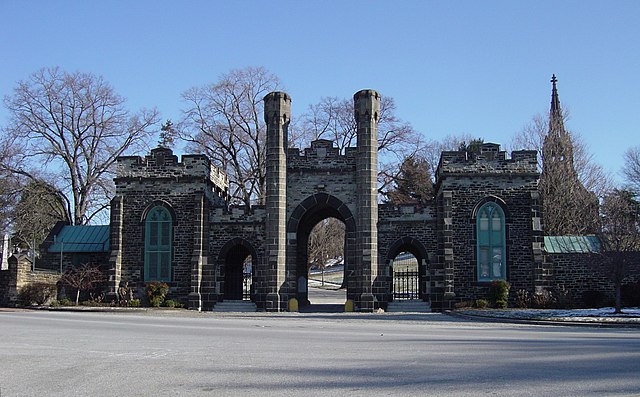
     

    Remember, he's not legally permitted to hold office.
    Green Mount Cemetery in Baltimore, burial place of John A. Campbell


    Congress did name the federal district courthouse in Mobile after Campbell in 1981. In 1983, the local U. S. magistrate published an article to enlighten Alabama lawyers with a brief account of the “varied” career of the man after whom the federal courthouse was named. Probably for the sake of emphasizing the positive, the article summarized Campbell’s Supreme Court career this way: “The Supreme Court decisions of Justice Campbell are of little interest to us, but it is accurate to say that they are well-written and reflect his consistent strict-constructionist and state’s rights views.”

    Another federal courthouse building is currently being added, and the Campbell building is being renovated, so that the two buildings will make a “campus” where justice will be even more justice-ier.


    At least they didn't name it after Woodrow Wilson
    The John Archibald Campbell United States Courthouse in Mobile, Alabama, 9 September 2012. Photo by Chris Pruitt


    Works Cited

    “An Act to Designate the John Archibald Campbell United States Courthouse.” Public Law 97-126, December 29, 1981, 95 Stat. 1674. Online at https://www.gpo.gov/fdsys/pkg/STATUTE-95/pdf/STATUTE-95-Pg1674.pdf.

    David A. Bagwell, “The John Archibald Campbell United States Courthouse in Mobile,” 44 Ala. Law. 154 1983 (May 1983).

    Peter Brock, Pacifism in the United States: From the Colonial Era to the First World War. Princeton, NJ: Princeton University Press, 1968.

    “Catching up with Frequent Star trek Guest Gregory Itzin, August 2, 2012, http://www.startrek.com/article/catching-up-with-frequent-trek-guest-gregory-itzin

    Richard C. Cortner, The Supreme Court and the Second Bill of Rights: The Fourteenth Amendment and the Nationalization of Civil Liberties. Madison: University of Wisconsin Press, 1981.

    John B. Crenshaw Papers, Hege Library, Guilford College, Greensboro, NC, available online at http://library.guilford.edu/c.php?g=210067&p=1385778

    Richard Nelson Current, Those Terrible Carpetbaggers. New York: Oxford University Press, 1988.

    Jonathan Truman Dorris, Pardon and Amnesty under Lincoln and Johnson: The Restoration of the Confederates to Their Rights and Privileges, 1681-1898. Chapel Hill: University of North Carolina Press, 1953.

    John Witherspoon DuBose, The life and times of William Lowndes Yancey. A history of political parties in the United States, from 1834 to 1864; especially as to the origin of the Confederate States, volume 2. New York: Peter Smith, 1942.

    Don E. Fehrenbacher, Slavery, Law, and Politics: The Dred Scott Case in Historical Perspective. New York: Oxford University Press, 1981.

    Shelby Foote, The Civil War: A Narrative: Red River to Appomattox. New York: Vintage Books, 1986.

    General Services Administration, “Mobile Courthouse Groundbreaking,” March 25, 2016, https://www.youtube.com/watch?v=DQ9nxC01zeA

    Ronald M. Labbé and Jonathan Lurie, The Slaughterhouse Cases: Regulation, Reconstruction, and the Fourteenth Amendment. Lawrence: University Press of Kansas, 2003.

    Charles Lane, The Day Freedom Died: The Colfax Massacre, The Supreme Court, and the Betrayal of Reconstruction. New York: Henry Holt, 2008.

    Charles McClain, California Carpetbagger: The Career of Henry Dibble, 28 QLR 885 (2009), Available at: http://scholarship.law.berkeley.edu/facpubs/660.

    Russell McClintock, Lincoln and the Decision for War. Chapel Hill: University of North Carolina Press, 2008.

    Robert E. May, John A. Quitman: Old South Crusader. Baton Rouge: Louisiana State University Press, 1985.

    ____________, Manifest Destiny’s Underworld: Filibustering in Antebellum America. Chapel Hill: University of North Carolina Press, 2002.

    Justin A. Nystrom, New Orleans after the Civil War: Race, Politics, and a New Birth of Freedom. Baltimore: Johns Hopkins University Press, 2010.

    William H. Rehnquist, The Supreme Court: How it Was, How it is. New York: William Morrow, 1987.

    Michael A. Ross, Justice of Shattered Dreams: Samuel Freeman Miller and the Supreme Court During the Civil War Era. Baton Rouge: Louisiana State University Press, 2003.

    ­­­­­­­______________, “Obstructing reconstruction: John Archibald Campbell and the legal campaign against Louisiana’s Reconstruction Government,” Civil War History, September 2003, pp. 235-53.

    Robert Saunders, Jr., John Archibald Campbell, Southern Moderate, 1811-1889. Tuscaloosa, The University of Alabama Press, 1997.

    Steven Spielberg (dir.), Lincoln. Dreamworks Pictures, 2013.

    Walter Stahr, Seward: Lincoln’s Indispensable Man. New York: Simon and Schuster, 2012.

    Eric H. Walther, The Fire-Eaters. Louisiana State University Press, 1992.

    “Ward Hunt,” https://www.oyez.org/justices/ward_hunt

    Robert Penn Warren, Jefferson Davis Gets His Citizenship Back. University Press of Kentucky, 1980.

    Ruth Ann Whiteside, “Justice Joseph Bradley and the Reconstruction Amendments,” PhD Thesis, Rice University, 1981.

    Edward Needles Wright, Conscientious Objectors in the Civil War. New York: Perpetua, 1961.

  • The Derponomicon: Part 2

    "Please kill me," the book of the dead wailed.
    I’ll swallow your derp!

    On the name Derponomicon: it is a combination of derp and the Greek words nomos (law) and ikona (image). Thus, the name may be translated as “an image of the laws of the dumb.”

    A few years ago, I compiled The Derponomicon from a series of dialogs with a prog who was by far the most infuriatingly stupid person I have ever known. His responses are below. I did not correct his typos.

    In this excerpt, his topic was the following quote from Augustine of Hippo:

    “Justice being taken away, then, what are kingdoms but great robberies? For what are robberies themselves, but little kingdoms? The band itself is made up of men; it is ruled by the authority of a prince, it is knit together by the pact of the confederacy; the booty is divided by the law agreed on. If, by the admittance of abandoned men, this evil increases to such a degree that it holds places, fixes abodes, takes possession of cities, and subdues peoples, it assumes more plainly the name of a kingdom, because the reality is now manifestly conferred on it, not by the removal of covetousness, but by the addition of impunity. Indeed, that was an apt and true reply which was given to Alexander the Great by a pirate who had been seized. For when that king had asked the man what he meant by keeping hostile possession of the sea, he answered with bold pride, ‘What thou meanest by seizing the whole earth; but because I do it with a petty ship, I am called a robber, whilst thou who dost it with a great fleet art styled emperor.’”

    As far at the Augustine of Hippo quote, it is most certainly in reference to a mideval kingdom system of government. Equating a mideval kingdoms system of government to the modern day US government is once again, like comparing apples and hippos. In modern day US, tax dollars pay for roads, bridges, air traffic safety, clean air, clean water, inspected food, the military, satellites, the infrastructure of plumbing/electric/utilities/etc. we all enjoy, and about a zillion other things. In a kingdom, the people were lucky to get a water source. You literally cannot exist in modern society without taking advantage of what society (I.e. The government) provides. When you step on a sidewalk, or use electricity, or drive on a street in a car that isn’t exploding, etc. You are taking advantage of what the government provided to you.

    Ignorance of history, a conflation of society with govt, and an argument from ignorance.

    A response to my favorite Sowell quote:

    “The first lesson of economics is scarcity: there is never enough of anything to fully satisfy all those who want it. The first lesson of politics is to disregard the first lesson of economics.”

    -Thomas Sowell

    On the Thomas Sowell quote, As I have mentioned before, he is a favorite of the white supremacist crowd, which really says a lot about who he speaks to. Of course the lesson of economics is a finite amount of everything, otherwise no one would need to buy it. But that general statement isn’t new casserole true. The first lesson of economics is laziness. People will pay for anything that requires the least amount of work. When people are given the choice between growing their own food for free in their backyard, or buying food at a restaurant or a prepared meal, what will most people choose? When given the choice between paying for produce and meat and making food yourself, and ordering a pizza, what will most people choose? MOST aspects of our economy are built on taking advantage of people’s laziness. People are willing to pay for any product or service that will make their life easier. So generally speaking there is pretty much an unlimited amount of goods and services that Americans are willing to buy if they can afford it, from a service that cleans up dog shit in your yard, to custom hats for your baby. So in America that rule doesn’t really apply. What does however have a finite amount to go around is wealth, and the more wealth we hand up to the top percentages, who know how to manipulate and hide it, in the most literal way takes from everyone else. There are only so many slices of the pie to go around, and when the richest people get the most pieces of pie, that leaves nothing but a slice and some crumbs for everyone else to fight over.

    More baseless smears, more deflection, more yammering that the economy is a zero-sum game. The denial of scarcity is the cherry on top.

  • Horace Flack – The state official whose scholarship pressured the states to obey the Bill of Rights (with Southern Gothic backstory)

    By: The Fusionist

    On April 27, 1947, the Baltimore Sun profiled Horace Edgar Flack, “a placid, unassuming, kindly doctor” – meaning he had a Ph.D. from Johns Hopkins in political science. As head of the Department of Legislative Reference for both Baltimore and for the entire state of Maryland, Flack helped draft bills for the lawmakers and gave them information about similar legislation in Maryland and in other states. Flack had been described as “a walking encyclopedia” – “If you want a bill drawn up on any subject, he can oblige in about fifteen minutes, provided the matter is not too complicated. If it is complicated, it takes a few minutes longer.” Flack was so indispensable that “[w]hen he leaves the Department of Legislative Reference for even a matter of minutes, the business of lawmaking all but comes to a standstill.” His staff credited him with drafting eighty percent of the state’s laws since he took the job thirty years before.

    (Insert libertarian joke about taking Flack on a long, relaxing Caribbean cruise)

    Flack and his wife shuttled between Baltimore and – when the legislature was in session – Annapolis. In both places, Flack’s office desk was “[n]ever piled higher than six inches with a remarkable assortment of papers[.]” The desk “is all but buried by the end of a legislative session.” Yet Flack could “put his hand into the heap and come up with any desired document with unerring accuracy.”

    No wonder state politicians were anxious as Flack, who had been born in 1879, neared the mandatory retirement age: “The thought of his impending retirement two years hence causes shudders among Maryland officials, who are sure there will never be another like him.”

    The readers of this laudatory article wouldn’t know of the old civil servant’s family difficulties as his daughter became estranged from her soldier-husband – a war hero who had perhaps been spending more time in French territory than was compatible with maintaining family life. Not to mention that within two months of the article, Horace Flack was going to become even better known to members of the legal establishment throughout the country. This time, he would not be known as a facilitator of new state laws, but as a potential obstacle to them. A scholarly paper he published as a young man, arguing that the states had to obey the Bill of Rights, was about to get drawn into a debate over the relationship between state power and individual liberties.

    These were heady times for a man the Baltimore Sun said “has been called…‘the greatest man that ever came out of the hillbilly country of North Carolina.’” Now, Flack had never fully “come out” of rural Rutherford County in the southwest of the Tarheel state. Horace owned the ancestral farm (formerly co-owned with his late brother Roswell, a physician) and visited the farm when he could screw Tom Wolfe. What Horace had left behind in North Carolina was a fairly shocking family secret which went back half a century.

    While Horace Flack was growing up, his family were small farmers and not often well-rewarded for their exhausting labor. Horace’s father Millard reportedly told a nephew “you can continue to raise cotton if that is what you want to do, but I never expect to plant another cotton seed as long as I live.”

    Millard Flack certainly did not plan for his son Horace to be a farmer. Making what must have been a considerable sacrifice, Millard sent Horace to Wake Forest College (now Wake Forest University) in Winston-Salem, NC. (Horace’s brother Roswell also pursued higher learning at this time).

    Horace’s uncle, Mills Flack, was more enthusiastic about the farming life, but did not like the economic decline of small family farms like his, a phenomenon for which he blamed sinister plutocratic forces (“Shylocks”). Mills Flack served in the North Carolina legislature in the 1890s, during a brief interval during which agrarian Populist radicals like himself combined their votes with the votes of black Republicans to displace the Democrats and set up a Populist/Republican “Fusion” government.

    At Wake Forest, Horace joined the Euzelian literary society, one of two such societies to which students were required to belong. The literary societies, rather than the faculty, punished student misconduct such as “trampling the grass…spitting on floors of chapel and classrooms and halls, and library, or keeping firearms, or throwing water from the windows.”

    The Euzelian society and its counterpart, the Philomathesian society, conducted regular debates. The topic in February 1900 was “Resolved: That England was not justified in making war upon the Boers.” Flack took the negative, apparently meaning that he argued England was justified in fighting against the white farmers who ran the Boer Republics in South Africa (I haven’t read Flack’s paper but it’s in Wake Forest’s archives).

    Speaking of giant power-hungry entities trying to absorb white farmers…the Democratic Party in 1900 resolved to completely destroy the Fusion coalition and establish a political monopoly. The Democrats did this by proposing a state constitutional amendment to disenfranchise large numbers of black voters, without whom nothing stood in the way of a solid Democratic majority. Democrats harped on White Supremacy, and the disenfranchisement amendment passed, securing one-party Democratic rule for several decades. In the wake of the excitement of the White Supremacist agitation in Rutherford County, there was a murder and a lynching, and Horace Flack’s uncle Mills Flack was at the center of it.

    Mills Flack had a dispute (over peaches) with a black sharecropper or tenant, Avery Mills, and the tenant’s wife, Raney. Avery Mills threw a rock, Mills Flack shot Avery Mills and tried to take Avery Mills’ gun, and Avery Mills fatally shot Mills Flack. A lynch mob making up about a quarter of the local population (by the widow Raney Mills’ estimate) took Avery Mills out of police custody and killed him. The only person convicted in the affair was Raney Mills, who was promptly pardoned. Mills’ family tradition says there were warrants out for two of the alleged lynchers – sons of Mills Flack, and therefore cousins of Horace Flack. According to tradition, the cousins hid out for a time until the authorities seem to have lost interest and dropped the matter. Some of the lynchers seem to have had second thoughts when they realized that Mills Flack had fired the first shot, but by then the deed was done.

    Young Horace left North Carolina, leaving his family’s scandal behind. He went north, but not beyond the Mason-Dixon Line. He became a graduate student at Johns Hopkins in Baltimore, Maryland, studying political science. The political science department at the time was one man, Westel Woodbury Willoughby. Professor Willoughby suggested a couple research projects for Flack to work on.

    The first project, published in 1906, was about the recent Spanish-American war. Flack was skeptical about the American justification for the war, which had been based in part on alleged atrocities the Spaniards committed in fighting a Cuban rebellion. Flack said that the Northern forces committed atrocities against the South during the Civil War, and European powers wouldn’t have been justified in interfering on such grounds. “War is bad at its best, and when it assumes its worst form, General Sherman’s definition [of war as hell] does not seem inappropriate.”

    Willoughby’s next assignment for Flack was a study of the origins of the Fourteenth Amendment, a key U. S. constitutional provision pushed through by Northern Republicans after the Civil War. Willoughby was working on a book about U.S. constitutional law and probably wanted to commission a study which would help with his own work. It was a delicate project for Flack to undertake, since if black lynching victims received “equal protection of the laws” as the Fourteenth Amendment required, some of Horace Flack’s relatives would probably be in prison or hanged.

    But Horace Flack applied himself to his task, looking up old Congressional debates from the Reconstruction era when Northern Republican politicians, like Congressman John Bingham, discussed their ideas for constitutional protection of the freed slaves and Unionist white Southerners in the former Confederate states. Flack’s conclusion: The history of the debates on the 14th Amendment showed a purpose to make the states obey the first eight amendments to the Constitution – the “Bill of Rights” (possibly minus the 9th and 10th amendments). The privileges and immunities of American citizenship – protected by Section One of the Fourteenth Amendment – included the rights in the first eight amendments. If anything, Flack’s research did not go far enough – there was no Internet in those days, so Flack missed some key newspaper articles of the Reconstruction era agreeing with the interpretation Flack was advancing.

    Flack’s book, The Adoption of the Fourteenth Amendment, did not exactly cause a big splash at the time. In the same year the book was published – 1908 – the U.S. Supreme Court issued a key decision, consistent with earlier precedents, that  only a few parts of the Bill of Rights are applied to the states on an arbitrary, feelz-based basis. Most of the rights in the Bill of Rights – in the 1908 case, the freedom from self-incrimination – were simply optional on the states, which could ignore them if they wanted. Likewise with the right to trial by jury, in civil and criminal cases, and the right to have one’s case heard by a grand jury, and some other rights – the states could observe these rights or ignore them, based only on their own constitutions.

    But having completed his doctorate, Flack now had to find work. While he had thought about working in North Carolina, he changed his mind when he met Edith Henning, a Baltimore belle whom he married, and he decided to make Maryland his home. The city of Baltimore had just created a Department of Legislative Research to provide nonpartisan assistance to local lawmakers, and Flack was the first person appointed to this new position – and there wouldn’t be another appointment for almost fifty years.

    Based on his experience, Flack wrote a paper for the American Political Science Association, singing the praises of legislative reference bureaus like his. Private interests had their staffs of lobbyists who researched and drafted bills to benefit their clients, and then tried to get the legislatures to pass such bills. Shouldn’t the public be served by draftsmen researchers with no allegiance except to the common good? Such draftsmen and researchers should have long terms of service to give them experience and provide for developing good institutional memory. Other states were using reference bureaus, to good effect. It was just a matter of hiring good people for these positions and then letting them do their jobs.

    The Maryland legislature got the hint and appointed Flack as the head its own legislative reference bureau. Now Flack was working for both Maryland and the city of Baltimore.

    An outside project Flack did in 1920 might have given him a chance to get some influence on the Supreme Court, but it doesn’t seem to have worked that way. Former President William Howard Taft, a leader of the prestigious League to Enforce Peace which sought to avoid another world war, published a volume of his writings and speeches about peace, and Horace Flack was one of the editors of the project. Taft was a supporter of the League of Nations, just like President Woodrow Wilson and the Democratic Party in general. The Republican candidate for President, Warren Harding, didn’t like the League, which the U.S. Senate had rejected. The ambitious Taft wanted to be Chief Justice, a job no Democrat would give him, so he threw his support behind Harding with some pious hopes that Harding would end up being for the League. That didn’t happen, but in 1921, Harding made Taft the Chief Justice of the United States. But if Flack had been in touch with Taft about Flack’s Fourteenth Amendment book, Taft gave no sign of it, focusing his constitutional jurisprudence on the protection of strictly economic rights while being wishy-washy and vague on applying the Bill of Rights to the states (Taft’s colleagues indicated that freedom of speech and the press might apply to the states, after first denying that they did).

    In the 1930s, Flack spoke to Parent-Teacher associations about education and to the League of Women Voters about voter registration and voting machines. When the 1935 legislature adjourned, the Baltimore Sun ran an admiring article about how Flack and his staff spent five days, together with near-sleepless nights, making sense of the legislature’s work and organizing it for publication. Horace Flack was circulating in highly respectable circles – he had gone far for a country boy.

    Flack even earned a mention in the New York Times – via the social pages – when his daughter Marialice married Lieutenant Lee Carl Miller on October 14, 1936.

    The following day, October 15, a jury in Connecticut convicted Frank Palko of first-degree murder for killing two police officers during a robbery. Earlier in the year, a jury had rejected a first-degree verdict and convicted Palko of second-degree murder for the offense. A state appeals court ruled that the trial judge had made errors in Palko’s favor, warranting a new trial. This sort of procedure was unusual – most jurisdictions, including most states and the federal courts, hold that once a jury refuses to convict on a charge, the defendant cannot be retried on that charge. After Palko got a death sentence at his second trial, Palko’s lawyer, David Goldstein, took the case to the U. S. Supreme Court, claiming that Palko’s second conviction violated the constitutional right not to be subject to “double jeopardy” for the same crime.

    Goldstein discovered Flack’s book on the Fourteenth Amendment, and relied heavily on the book in his Supreme Court arguments. Goldstein referred to The Adoption of the Fourteenth Amendment as “a scholarly document which, to counsel’s knowledge, has not hitherto been called to the court’s attention.” If the Bill of Rights applied to the states, via the Fourteenth Amendment, then Frank Palko had been subject to unconstitutional double jeopardy.

    Goldstein’s argument didn’t work. The Court, which had already taken a lot of grief from New Dealers and progressives for overturning “democratically enacted legislation,” wasn’t going to take such a radical step as to force the states to obey the Bill of Rights. Sure, there were a few provisions of the Bill of Rights which were important to “ordered liberty” – free speech, free press, and the right to just compensation – and those parts of the Bill of Rights applied to the states. But other parts of the Bill of Rights were not so fundamental: jury trial, the right against self-incrimination, and the right not to be subject to double jeopardy. Palko was executed. Justice Hugo Black had apparently learned about Flack’s book from Goldstein, and began to ponder the work.

    Meanwhile, the forces of organized do-goodery in California were chipping away at another right in the Bill of Rights. The district attorney of Alameda County, an ambitious fellow named Earl Warren, got several “law ’n order” measures on the 1934 ballot, including a provision that if a criminal defendant failed to take the stand in his own defense, the prosecutor could use the defendant’s silence as an argument in favor of guilt, never mind the Fifth Amendment right not to incriminate yourself. Warren’s measures were supported by civic groups and the press. The Sausalito News said that the self-incrimination provision would mean “a better administration of criminal law.” The self-incrimination provision and the other ballot measures easily passed by two to one margins, becoming part of the California constitution.

    California prosecutors had the chance to use this self-incrimination law against an alleged murderer named Dewey Adamson. Adamson was accused of breaking into the house of a Los Angeles widow and beating and strangling her to death. After the prosecution gave its case, Adamson said nothing and produced no witnesses – Adamson had a criminal record which would have been brought up if he’d testified. Summing up to the jury, the prosecutor taunted Adamson by saying “it would take about twenty or fifty horses to keep someone off the stand if he was not afraid.” Adamson was convicted and sentenced to death. Adamson’s lawyer claimed that California had violated the right against self-incrimination, and that this right was binding on the states via the Fourteenth Amendment.

    Up to the U.S. Supreme Court the case went, just as personal feuds and antagonisms among the Justices were sharpening their philosophical differences.

    The Justices were all New Deal progressives, appointed by the late Franklin Roosevelt to purge the Constitution of federalism and economic freedom in the interest of a federal welfare/warfare state. But having put that triumph under their belts, the Justices were split into quarrelling factions, having bitter catfights with each other.

    One faction was associated with Felix Frankfurter, shown here, oops I mean here, no, seriously folks, here.

    Frankfurter was a zealous New Dealer from before there even was a New Deal. As a Harvard professor, he had supplied advice and personnel to the Roosevelt administration. He took judicial progressivism to its logical conclusion: Frankfurter believed that, having killed off economic rights by agreeing to the laws the majority wanted, it was time for the Supremes to defer to all parts of the democratic process. Why should noneconomic rights, like the stuff in the Bill of Rights, be considered more important than economic rights? These issues should largely be left to the voters and their elected representatives except in extreme cases where (as assessed by Frankfurter) the democratic process went Too Far. But at the state level, violating the Bill of Rights was not, in and of itself, Too Far. States should be free to experiment with such “reforms” as abolishing juries and grand juries, allowing the prosecutor to appeal acquittals, and compelling suspects to incriminate themselves.

    The other faction was associated with Hugo Black, a former Alabama Senator who had developed a genuine attachment to some civil liberties. Black agreed with Frankfurter that the courts should not protect economic liberties, but where non-economic rights were concerned, Black thought the way to preserve freedom was to uphold the entire Bill of Rights against the states, not just a few selected parts of the Bill of Rights. Focusing on the first eight amendments would keep the courts from being arbitrary in picking and choosing which freedoms to value.

    Black had been researching the intent of the Fourteenth Amendment, relying to a great extent on Flack’s research. The Adamson case provided an opportunity for Black to show his conclusions. Black found three other Justices to agree with his view that the states had to obey the Bill of Rights.

    The other five Justices were not impressed. On June 23, 1947, the Court decided that, whatever Black’s research might say, the precedents were against the Bill of Rights. The states didn’t have to respect the right against self-incrimination. Adamson was executed.

    Despite his victory, Frankfurter was dissatisfied. Outvoting Black was not enough, Black had to be attacked and refuted on a scholarly level. Frankfurter, not Black, was supposed to be the intellectual leader of the Court. Frankfurter was the learned scholar, the ex-Harvard professor. Black was some hick cracker who was simply too dumb to appreciate good scholarship if it bit him on the ass. If only one of Frankfurter’s former students could step up to the plate…

    Fortunately, a friend and ex-student of Frankfurter’s did precisely that, apparently without any prompting from the Justice. Professor Charles Fairman of Columbia Law School was just starting up his school’s law journal. What a great venue to highlight a scholarly rebuttal to Black…and of course to Flack.

    Naïve as he was, Flack had believed that it would be Southerners who would object to the implications of his scholarship, which gave a broad interpretation to the Fourteenth Amendment which the Southern leadership had tried to prevent being passed in the first place. Flack did not anticipate that certain highly-placed Northern progressives would in effect put on their Confederate flag trucker hats and raise the biggest stink about Flack’s work.

    Fairman lacked Flack’s respect for the framers of the Fourteenth Amendment. To Fairman, as to Frankfurter, the Reconstruction Republicans were vindictive fanatics who needlessly antagonized the South. To Fairman, the Northern Republicans’ Southern allies under Reconstruction consisted of “the Negroes, the carpetbaggers…and a few long-suffering Southern Unionists – a combination which was weak, inexperienced, often corrupt.” (And Frankfurter showed his sympathies when he referred to the “vengeful spirit which to no small degree envenomed the Reconstruction era.”)

    In his 1949 article, Fairman dived into his defense of Frankfurter…with relish. Coincidentally, Fairman found exactly what he thought he would find: historical evidence backing up Frankfurter’s views. The Fourteenth Amendment was never meant to apply all of the Bill of Rights to the states. The true meaning of the Amendment was vague, which as Fairman later explained, meant that it was up to the federal courts to work out the details of what the states could or could not do.

    The bottom line for Fairman was that Flack’s scholarship was no good, and Black had embarrassed himself by relying on Flack’s work.

    In 1948, Flack’s statutorily-mandated retirement was approaching – he would reach the retirement age of 70 in 1949. Governor William P. Lane, Jr., wrote to the state Attorney General, asking for legislation to allow Flack to stay in office beyond 1949. “Knowing the esteem in which Dr. Flack is held by all of those who come in contact with him on official business of the state,” the governor wrote, “I am sure the General Assembly will give this proposal favorable consideration.” The mayor of Baltimore likewise wanted to keep Flack in his city position.

    In 1949, the same year as Fairman’s article skewering Flack as a scholar, the Maryland legislature passed a law which the governor cheerfully signed, allowing Flack to serve past the normal retirement age.

    After three more years’ service in office, Flack had a heart attack and a stroke in 1952, putting an end to his career. After four years in retirement, he died in 1956. He is buried in his native Rutherford County.

    The Supreme Court has yet to accept Flack’s conclusions about the Bill of Rights, reinforced as those conclusions have been by subsequent scholarship. While adhering to the pick-and-choose philosophy, the Supremes have decided to apply a few more Bill of Rights provisions to the states, such as double jeopardy and self-incrimination – though it was a bit too late for Palko and Adamson. In 2010, the Supremes applied the Second Amendment to the states, over voluble progressive protest. Other rights, like civil juries and grand juries, are still up to the states to observe or not, at their discretion.


    Works Cited

    Richard L. Aynes, Charles Fairman, Felix Frankfurter, and the Fourteenth Amendment – Freedom: Constitutional Law, 70 Chi.-Kent. L. Rev. 1197 (1995).

    Available at: http://scholarship.kentlaw.iit.edu/cklawreview/vol70/iss3/10

    “The Ballot Propositions,” Sausalito News, No. 43, Oct. 26, 1934, http://bit.ly/2mL5xgK

    1. Timothy Cole, The Forest City Lynching of 1900. Jefferson, NC: McFarland, 2003.

    Richard C. Cortner, The Supreme Court and the Second Bill of Rights: The Fourteenth Amendment and the Nationalization of Civil Liberties. Madison: University of Wisconsin Press, 1981.

    Ed Cray, Chief Justice: A Biography of Earl Warren. New York: Simon and Schuster, 2008, p. 72.

    “Dr. Flack Finally Finds Out Just What Assembly Did,” The Baltimore Sun, Apr 7, 1935, p. 9.

    “Dr. Flack To Address League: Women Voters to Hear Talk On A Permanent Registration And Voting,” The Baltimore Sun, Nov 22, 1936, p. SC17

    “Dr. H. E. Flack, Ex-Law Data Chief, Dies: Linked with Government Machinery in City from 1907 to 1952,” The Baltimore Sun, Jun 27, 1956, p. 38.

    “Dr. Horace E. Flack; A Capable State and City Official,” The Baltimore Sun, Jan 1, 1943, p. 12

    “Dr. Horace E. Flack To Speak,” The Baltimore Sun, May 19, 1933, p. 9.

    Entries for Horace Edgar Flack and his various relatives, findagrave.com.

    Charles Fairman, “Does the Fourteenth Amendment Incorporate the Bill of Rights? The Original Understanding,” Stanford Law Review, Vol. 2, No. 1 (Dec., 1949), pp. 5-139.

    Noah Feldman, Scorpions: The Battles and Triumphs of FDR’s Great Supreme Court Justices. New York: Twelve, 2010.

    Horace Edgar Flack, The Adoption of the Fourteenth Amendment. Baltimore: The Johns Hopkins Press, 1908.

    ________________, “Resolved: That England was not justified in making war upon the Boers” . Anniversary speech, Negative. Jr. Thesis, (Feb. 16, 1900. 1900.), Wake Forest Archives, Junior and Senior Theses Record Group, see https://wakespace.lib.wfu.edu/handle/10339/28081

    ________________, Flack, Horace Edgar.  “Resolved: That the South Carolina Dispensary System is Unwise”. Speech and Sr. Thesis for Master’s Degree. (1901.) Wake Forest Archives, Junior and Senior Theses Record Group, see https://wakespace.lib.wfu.edu/handle/10339/28081

    ________________, “Scientific Assistance in Law Making,” The Proceedings of the American Political Science Association, 1913-1914, pp. 215-221.

    ________________, Spanish-American Diplomatic Relations Preceding the War of 1898. Baltimore: The Johns Hopkins Press, 1906.

    “Flack, Horace Edgar,” in Who’s Who in America, vol. VII, 1912-13, Chicago: A. N. Marquis, p. 707.

    Carol Forbes, “Business: Looking Up,” The Baltimore Sun, Apr 27, 1947, p. SM6.

    “Horace E. Flack, PH.D.,” in History of North Carolina: Volume VI: North Carolina Biography. Chicago: Lewis Publishing Company, 1919, pp. 332-33.

    Lewis L. Gould, Chief Executive to Chief Justice: Taft Betwixt the White House and the Supreme Court. Lawrence: University Press of Kansas, 2014

    “Lee C. Miller 1934,” http://apps.westpointaog.org/Memorials/Article/10021/

    “Legislative Council Honors Dr. H. E. Flack, Veteran Aide,” The Baltimore Sun, Dec 31, 1942, p. 5

    “Legislative Unit Nears End of Task,” The Baltimore Sun, Dec 6, 1940, p. 6.

    Maryland Manual 1950, Volume 163, p. 160t, http://aomol.msa.maryland.gov/000001/000163/html/am163–160t.html

    Maryland Session Laws 1949, Chapter 19, March 4, 1949, pp. 20-21, online at http://aomol.msa.maryland.gov/megafile/msa/speccol/sc2900/sc2908/000001/000590/html/am590–20.html

    Louis [sic?] J. O’Donnell, “Printer May Have Dropped Lost ‘Streetcar’, Flack Says,” The Baltimore Sun, Feb 1, 1946, p. 26.

    “MillerFlack,” New York Times, October 15, 1936.

    NC Executions, 1901-1930, http://deathpenaltyusa.org/usa1/state/north_carolina2.htm [execution was by hanging until 1910, when the method switched to electrocution]

    Thomas J. O’Donnell, “School Fund Bill’s Origin Still Veiled,” The Baltimore Sun, Jan 21, 1947, p. 30.

    George Washington Paschal, History of Wake Forest College, Volume II: 1865-1905. Wake Forest, NC: Wake Forest College, 1943.

    William Howard Taft (Theodore Marburg and Horace Edgar Flack, eds.) Taft Papers on League of Nations. New York: MacMillan, 1920.

    Bryan H. Wildenthal, “Nationalizing the Bill of Rights: Revisiting the Original Understanding of the Fourteenth Amendment in 1866–67,” 68 Ohio State Law Journal 1509 (2007).

    Westel Woodbury Willoughby, The Constitutional Law of the United States, Vol. I. New York: Baker, Voorhis and Company, 1910, pp. 175-76.

    “Would Retain Dr. H. E. Flack: Lane Wants Him Kept After He Reaches Retirement Age,” The Baltimore Sun, Dec. 12, 1948, p. 22.

  • When the Iron Laws Turn on Regulators

    The aggressive attempts by the Trump administration to dismantle one of their perceived political enemies’ power bases by the same “pen and phone” Executive Order fiat that substantially built that base is a fascinating example of RC Dean’s Iron Laws at work. Somehow the step-children of the Republican Party, the wallflowers too ugly to get asked to dance, ended up miraculously winning many a geek’s high-school fantasy. Nearly unlimited power and no reason not to take it out on their enemies. What happens when the people running the Executive Branch decide that the rank and file of many of the agencies they administer are the enemy?

    Well, you start by naming other Republican misfit/misanthrope types to run several departments that you believe are hostile to your cause. Putting an O&G guy in charge of the State Department, a Federalist in charge of the EPA, a voucher advocate in charge of the Department of Education, a black brain-surgeon who thinks that public housing stints should be brief in charge of HUD, and a man who once couldn’t even be bothered to remember the name of the Department of Energy (but knew he wanted to cut it) to direct it. Whoever is pulling the strings in the Trump administration, they did an excellent job of putting “qualified” individuals at the helm who wanted to wreck the progressive agenda that the type of people who use the words “Deep State” believe these agencies promote.

    After you finish setting out to sow confusion in the board room, you move on to proposing that a bunch of the rank and file (especially in departments you perceive to be most hostile) no longer work for you:

    He’s worried about the administration’s proposed 37 percent cut to the State Department, which he says would put U.S. diplomats serving abroad at risk.The Environmental Protection Agency, the Energy Department, the Commerce Department and the Department of Housing and Urban Development are also facing steep cuts. Foreign Policy reported Monday that the administration wants to cut funding for United Nations programs by 50 percent to 60 percent.

    But everyone knows that the type of middle-manager who carves out their own little bureaucratic fiefdom and burrows in like a tick on a dog is going to avoid falling to those cuts. They have to keep their job because they are the Deputy Assistant Director for Left-Handedness in Prairie Voles and that exists on an org chart, so they can’t be fired because who would direct that work? Anyone who has worked for a giant organization that has experienced organic growth knows that the only way to get rid of that type of person is a reorg. Oh wait, did someone say reorg?

     
    RC Dean’s Iron Laws are being used against the regulatory state here to great effect. Perhaps the one that seems to be biting most painfully is me today, you tomorrow. Presidents have been stretching the edges of their power since Washington, but in the current century it seems to have become particularly egregious. Driven by the combination of Congress’s ceding of statutory rule-making to the Executive Branch, the Chevron precedent in 1984 telling Federal Courts to side with administrative rule-makers at all costs, and the broad adoption of the computer, we have seen the Executive agencies under each president make regulations that constrain the ordinary citizen from engaging in just about anything. It is interesting to watch a populist who cares only for ratings and a bunch of people who have been marginalized in the Republican party for years suddenly find themselves using the power to dismantle parts of the state that libertarians dislike. Of course, they are also bulking up the parts that libertarians hate most. I don’t see a lot of love in the comments for the TSA and Border Patrol, nor much will to reinvigorate the military so that we can fight all the rest of the world at once, but that appears to be happening as well.


    The Trump Administration also appears to have taken the Iron Law you get more of what you reward and less of what you punish to heart as well. For both good and ill to the broad libertarian view. Rarely have we had the opportunity to experience the impartial laws of government work in any context that could even broadly be described as not entirely horrible. You might have to go all the way back to the Carter presidency to find someone who accidentally struck a blow for not quite as effective citizen enslavement. Trump’s administration will not be a friend of libertarians, but as long as the wind of “fuck government regulators” keeps blowing, he might be a slightly mitigated disaster.

  • What Does the BBC Call “Serious Crime” Anyway?

    According to an article published by the BBC, Technology behind ‘all serious crime’, per analysis of a report by Europol, the European Union’s law enforcement agency. It ought to come as no surprise that a rise in technology us–in general–should correspond to a rise in tech-savvy criminals. However, what categories of crime were covered by the report itself, and is the headline of the piece warranted or sensationalized?

    I'm not saying it's ninjas, but it's ninjas.
    Europe’s depiction of the culprits.

    What did the report include as serious crime; murder, rape, human trafficking? Only the third category was mentioned in the report at length but didn’t make the BBC’s summary. The BBC focused on increased technology use to facilitate burglaries, black market drug trade, and ransomware.

    For instance, said the report, drones were now being used to transport drugs and many burglars now track social media posts to work out when people are away from their home.

    It’s long-established libertarian doctrine that the violence related to the drug trade accompanies resistance to the enforcement of laws prohibiting drugs. Mark Thornton’s analysis of alcohol Prohibition (a fair proxy for comparison) in the United States published by the Cato Institute, described it as a “miserable failure on all counts.” His analysis includes a graph of homicide rates depicting a steady rise during the Prohibition era and the precipitous drop in murders after Prohibition’s repeal in 1933.

    Can anyone say, 'unintended consequences'?
    Source: Cato Institute Policy Analysis No. 157: Alcohol Prohibition Was a Failure, pg. 7.

    Given libertarians’ stringent belief in self-ownership and the fact that drug use itself is a victimless crime, drug addiction cannot be rightly called a “serious” crime. Exchange of contraband items, provided that no people are exploited or otherwise harmed in the exchange, is similarly not of a serious nature.

    It stands to reason that with the rise in the use of drones, or quadcopters as many aficionados prefer to call them, for drug delivery, one might expect an accompanying decrease in drug-related violence. Fewer contacts between human beings–drug traffickers and law enforcement as well traffickers with one another–may correspond to fewer homicides to protect drug profits kept artificially high by prohibition.

    An increase in home burglaries corresponding to use of social media to determine times when the victims are unlikely to be home is concerning, and invasion of homes are of a more serious nature than petty thefts and shoplifting. However, it also seems reasonable that a decrease in violence due to burglars encountering residents unexpectedly may occur. Property crimes are, of course, of a less serious nature than homicides and other forms of physical violence. An investigation is required. An overall rise in burglaries may also negate any reduction in burglary-related homicides, should the rise in technology use prove causative for the increased rate of burglaries.

    Much of the Europol report focuses on organized crime activities that facilitate drug trafficking and further organized crime (e.g. document fraud, money laundering, etc.), which strains credibility to characterize as “serious” in their own right. The intersection between technology use and human trafficking may have been omitted from the BBC’s summary for a reason. Europol’s 2016 situation report, Trafficking in human beings in the EU, did show a rise in reports of human trafficking, but it doesn’t necessarily demonstrate an increase in human trafficking itself. In that report, Europol says:

    No distinctive trend in this variation of data was recognised as linked to any particular fact. A possible reason could be that Europol is increasingly being addressed by MS law enforcement for the provision of operational support during cross-border THB investigations.

    Thus, the rise may simply be an increase in reporting to Europol itself rather than a bona fide increase in human trafficking.

    The brevity of the BBC summary of the Europol report may be subtle justification for expanded law enforcement intrusion into citizens’ privacy under the pretense of reducing crime. The UK government has an interest in softening widespread hostility to the recently-implemented Investigatory Powers Act of 2016, or “Snoopers’ Charter” as opponents have popularly characterized it. The report itself doesn’t warrant that conclusion, as it is unclear whether technology use in crime is causative of the increase of crimes like burglaries or tracking a trend that accompanies higher immigration, drops in economic prosperity, and other factors known to influence crime levels. Too many issues are simply not addressed by the BBC article or Europol in its report to form any conclusions about whether technology use itself has increased serious crime regardless of the definition of “serious crime” they’re using.

  • Transmogrification and Projection

    What was once a humorous but true observation has become a blatant tactic with the Left: everything they do is about projection.

    The 24-minute news cycle is currently obsessed with transsexual and transgender rights because the President rescinded an awful “Dear Colleague” letter that was fraught with more danger than just who uses what bathroom.  Naturally, of course, the Right, being stupid, latched immediately onto talking about who uses what bathroom, but I digress.

    The Left fell in love with the term and promptly used it obsessively, wrongly, and beat its usefulness into the turf.  The Left accuses anyone who dares questions the rationality or wisdom of a “victim’s” feelings of “gaslighting” that person. Gaslighting, however, is not about refuting or mocking the fee-fees of a humorless 19-year-old twat (gender neutral) on Twitter.   Gaslighting is actually a systematic form of abuse which causes the victim to question his own memory, his own recollection of facts, his own judgment and perception.  When I think of a campaign to systematically undermine known facts, rational thought processes, and good judgment, one political and cultural group stands out to me.

    Naturally, the Left is whinging about gaslighting (without using the term correctly) while actually gaslighting the American public about gender and sexuality.  If you are one of those crazy regressives who thinks there are two biological sexes, and those two sexes (male and female) happen to correspond neatly to “socialized” gender roles (men and women) that have evolved over thousands of years and generally hold true across cultures and civilizations, boy are you in for it.  The Left is willing to Madred you until you squeal, “There are 1,000 genders!” We have actually come to the point where it is considered bigoted and awful to repeat biological, historical, psychological, and sociological facts.

    I am sure, to no one’s surprise, my feelings on transgenderism and transsexuality will make me first against the wall when the First Internationale – United States Edition convenes its Comintern. I am a semi-educated layman on psychological disorders, and Gender Identity Disorder — I mean, Gender Dysphoria — fits fairly neatly into the class of problems called psychotic disorders.  I am not the only one to think so, and the evidence is pretty compelling.  For example, a study conducted in the Netherlands, a country notably “progressive” on this issue, found that GID/GD was the primary diagnosis in only 39% of psychologists’ patients.  For the other 61%, it turned out,  “cross-gender identification was comorbid with other psychiatric disorders.”  Another paper in The Journal of Psychiatric Research found that 71% of GID sufferers had or currently have an Axis I psychological disorder, and wrote, “Lifetime psychiatric comorbidity in GID patients is high, and this should be taken into account in the assessment and treatment planning of GID patients.” The paper rightly points out this may be a chicken-egg problem:  are GD sufferers’ additional psychiatric symptoms caused by the high stress of having GD, or does the comorbidity of Mood and Dissoaciative Disorders with GD prove GD is a kind of psychosis that “travels along” with mentally ill patients?  Given the aforementioned Dutch study, where only 39% of GD sufferers had it as a primary diagnosis, I know which side I’m taking.

    Science!

    It’s important to note GD remarkably mirrors Body Integrity Identity Disorder.  If I were a conspiracy theorist, I would say it is rather convenient the DSM-V renamed Gender Identity Disorder at around the same time Body Integrity Identity Disorder was named as such, but fortunately for you, I’m off Alex Jones duty this week.

    All kidding aside, the parallels between GID/GD and BIID are obvious.  You suffer from a delusion, despite biological and social evidence, that your body is “wrong” somehow, and the only way to fix it is to radically alter it.

  • Derponomicon: Part 1

    My pimp hand is strong.
    Bastiat

    I compiled The Derponomicon a few years ago based on a dialogue I had with a prog who was by far the most infuriatingly stupid person I have ever known. I gave him a quote or a video and asked him what he thought about it. His responses are in italics. I did not correct his typos. Here are a few:

    A response to my favorite Bastiat quote:

    “If the natural tendencies of mankind are so bad that it is not safe to permit people to be free, how is it that the tendencies of these organizers are always good? Do not the legislators and their appointed agents also belong to the human race? Or do they believe that they themselves are made of a finer clay than the rest of mankind?”

    ― Frédéric Bastiat, The Law

    I was having that very discussion with my right leaning friend/employee the other day. Yes, humans tend to be selfish dicks that only look out for themselves. When it comes to groups of people, corporations, seeking only to maximize profits, that aspect of humanity is often exacerbated by the facelessness of a big corporation where the people in charge are insulated from the consequences of their decisions, whether it’s laying off 200 people the week before Christmas, or intentionally releasing a product that they KNOW will kill people but they calculate the profits outweighing the settlements and do it anyway. These are facts of life, and large groups of people acting as corporations are willing to take risks like that because they can always pass the blame off on some patsy and get away with their golden parachutes Scott free. So yes, these things need to be regulated, and unfortunately the regulators are also human, and therefor susceptible to the same corruption which is inevitable. Perhaps there needs to be an even higher regulatory power that keeps the regulators in check, like internal affairs in a police department. Or perhaps regulators need to be vetted and tested just like FBI agents and Secret Service hires are. Perhaps these regulatory agencies need to be held to a higher standard and simply hire only those who can be vetted and have a low risk of corruptability. One thing is for sure though, NO oversight or regulation whatsoever never reduced incidents and problems. Even a shifty substitute teacher is better than leaving a roomful of children to their own devices.

    So the solution to corrupt government is to have an even more powerful organization oversee it, because what could go wrong then? And adults are like disobedient children who need the supervision of the government in order to behave. And, of course, the possibility of reducing regulation is equated to anarchy. Derptacular.

    …………………..

    I asked him whether taxes were voluntary. He said:

    Not obeying a law is a choice and therfore voluntary. ….you might get away with it, you might have to suffer the consequences. Pretty simple logic.

    When I asked him whether a mugging is voluntary, he said:

    You could also turn and run. Any choice we make is voluntary.

    It’s one thing to deny coercion, but this guy acts like it doesn’t even exist.

    ……………………


    A response to this quote from Keynes:

    “If the Treasury were to fill old bottles with banknotes, bury them at suitable depths in disused coalmines which are then filled up to the surface with town rubbish, and leave it to private enterprise on well-tried principles of laissez faire to dig the notes up again . . . there need be no more unemployment. . . . It would indeed be more sensible to build houses and the like; but if there are political and practical difficulties in the way of this, the above would be better than nothing.”

    John Maynard Keynes, The General Theory, p. 129.

    SATAN!!11!

    So I am supposed to discuss the idea of burying bottles of money under garbage and putting people to work digging them up? Was this a serious idea, or just intentional hyberbole. The idea that the unemployment problem can be solved simply by employing people to do whatever menial busy work and whatever wage is kind of silly. It’s not just that people need jobs, people need good paying jobs that will actually allow them to be independent and be able to eat, pay bills, and rent. Simply removing the minimum wage, or manufacturing low level jobs for people to work isn’t solving the problem. Unemployment could be at zero, and it wouldn’t make a luck of difference is the same amount of people still qualified for food stamps and welfare. Removing food stamps and welfare, would just mean that people starve, or turn to crime and violence to provide for their families. The problem today is that no one is invested in America anymore. During WW2 it was a prosperous time, because everyone worked for the war effort (arguably the last legitimate war the US was ever in) building things, recycling scrap, buying war bonds, whatever it took. Every one was invested, everyone took part, everyone reaped the rewards. Nowadays all of that stuff is outsourced to no bid politically connected multi-national corporations that could give two shits about America, or Americans. Of the trillions pissed away on Afghanistan and Iraq, barely any of that money is ever coming back to the US. The US used to be a community, where everyone tried to help each other prosper…until Reagan changed all that. Now it’s every man for himself, fuck the greater good, and make as much profit as possible at whoever’s expense.

    Note the lack of awareness for the rationing of most goods during WW2. And again we see the lie that people would turn to crime if not for food stamps and welfare. Finally, we have an obligatory shout-out to the great Satan Ronald Reagan.

  • If Blazing Saddles Were a Serious Legal Drama

    by The Fusionist

    Here is a case resembling the plot of Blazing Saddles – if Blazing Saddles were a serious legal drama. The case, based on the “right” to compel service from a private business, ended up denying the right to jury trial.

    Just like this, but totally different

    It started in Reconstruction-era New Orleans, where the sheriff and a couple of his buddies faced a dilemma: it was around noon, and they hadn’t had any booze. One of the sheriff’s finicky friends, named Finnegan, said there wasn’t any good booze in the French Quarter, so the party decided to try the Bank Coffeehouse on Royal Street. They couldn’t get service there, and the Sheriff, Charles St. Albin Sauvinet, believed he knew the reason. The proprietor of the Bank Coffeehouse, Joseph A. Walker, had allegedly discovered the mixed-race heritage of the white-looking Sauvinet and didn’t want to serve the Sheriff for fear of alienating racist white customers.

    So Sauvinet sued Walker, accusing him of racial discrimination in violation of the constitution and laws of Louisiana.

    The state of Louisiana had certainly changed from prewar tines, when white people were a dominant caste and most black people were considered property. In the middle was a class of gens de couleur – free people of color, partly black and partly white. It was probably the French influence, and a Gallican “we understand zees things” tolerance in sexual matters, but there was a quasi-official system where white men took black or mixed-race mistresses and tried to set up their children in life – without all the privileges of the whites but also without the all-out slavery and oppression meted out to blacks.

    Charles Sauvinet was born into this community of gens de couleur, the son of a white father and black mother. Charles was provided with an extensive education, including learning several languages. This plus his white appearance gave him more than a foot in the white world. So when Louisiana seceded, Charles Sauvinet joined a Confederate military unit made up of free people of color from New Orleans – in which metropolis that community generally lived.

    Sauvinet didn’t have the chance to do much fighting – at least not on the Confederate side. When Union troops occupied New Orleans in 1862, Sauvinet and other free people of color joined the Union side. Sauvinet was first a translator for the occupiers and then an officer of black troops. Sauvinet apparently passed for white, because he was well-treated at a time when only the white officers were allowed much authority or respect. Sauvinet also registered his children as white.

    Henry C. Warmoth

    After the war, former slaves joined with the free persons of color and “Radical” whites to form the state Republican Party. Two young white Northerner lawyers who had been in the Union army – Henry Clay Warmoth and Henry C. Dibble – became leaders in this party, in which Sauvinet was also active. Warmoth became governor of a Reconstructed Louisiana. Dibble, while remaining an active Republican, was appointed judge of a trial court which the Republican legislature had created to hear challenges to the Republican program of Reconstruction. Dibble’s role – which he fulfilled ably – was to reject Democratic suits against Reconstruction laws.

    Sauvinet was elected as the civil sheriff in New Orleans. His job included serving and collecting rent from people in receivership, such as the landlord of the Bank Coffeehouse. It was while Sauvinet was collecting rent from Joseph A. Walker that the latter supposedly asked Sauvinet not to come to get served.

    The case got to Judge Dibble’s court, where a jury weighed the evidence. Walker claimed that Sauvinet wasn’t even black, and had professed to be white. Sauvinet replied that he’d been treated as black when whites wanted to oppress him.

    When the jury couldn’t agree on whether Walker had practiced illegal discrimination, Judge Dibble stepped in. A recent statute empowered the judge to give a verdict in a public-accommodation case if the jury couldn’t agree. Dibble, as it happened, knew Sauvinet, but this would certainly not have affected his impartiality. Dibble ruled against Walker and imposed $1,000 in damages, which was hardly loose change in those days.

    The case ended up in the U. S. Supreme Court. Walker said he’d been deprived of his constitutional right to a trial by jury in civil cases – a right spelled out in the Seventh Amendment: “In suits at common law, where the value in controversy shall exceed twenty dollars, the right of trial by jury shall be preserved…” This right was now part of the privileges and immunities of citizenship, and of due process of law, claimed Walker. Suits for damages, like Sauvinet’s, were generally considered suits at common law.

    Throughout Reconstruction, Louisiana politics was marred by often-deadly violence (on the part of white-supremacist Democrats) and fraud (on the part of Republicans). Elections were often disputed, leading to rival claimants for office and even rival legislative bodies.

    In the 1872 elections, Warmoth led a faction of Louisiana Republicans into coalition with the Democrats, while other “regular” Republicans still opposed the Democrats and stood up for Reconstruction principles. Judge Dibble stood with the regular Republicans and sought to block some of the actions of the Warmoth/Democratic faction. Writing to Warmoth, Dibble justified his position and made a fairly revealing remark – “in every act where I can justly and properly exercise discretion I will be found with the [R]epublican party.”

    In the mid-1870s, as Reconstruction was winding down, the Supreme Court ruled for Sauvinet, claiming that the states didn’t have to obey the Seventh Amendment. This was part of a series of decisions giving a narrow interpretation to the Fourteenth Amendment. These decisions tended to come from Louisiana cases, probably reflecting the politico-legal turmoil in that state.

    Henry C. Dibble

    Dibble’s term of office had come to an end in 1872, and the ex-judge moved out West, becoming a prominent attorney and California state legislator (sponsoring an antidiscrimination law), and writing a western.

    The white-supremacist Louisiana Democrats took back the state from the Republicans and got rid of the public-accommodations laws. Their motive was pretty clearly racism rather than libertarianism, given that Louisiana’s Democratic government later supported forced segregation, not freedom of association. Sauvinet’s Supreme Court victory was fairly Pyrrhic: a short-lived triumph for equal accommodation was won at the expense of an important right of American citizenship, namely jury trial.

    Sauvinet later killed himself when his son became mortally ill during one of New Orleans’ periodic epidemics, not really the kind of amusing ending Mel Brooks would have gone for.

    Walker became head of an organization defending the right to do business on Sunday.

    Law professor Paul D. Carrington praised the Walker decision a century later – “it would have been somewhat ironic in the name of due process of law to command the states to employ an institution [the civil jury] designed in part to introduce elements of non-rational emotionalism into the making of decisions purporting to enforce the law.” Yet in the very case Carrington praises, the presiding judge whose rationality and impartiality supposedly excelled the emotionalism of the jury was a zealous Republican partisan scarcely twenty-five years old. Judge Dibble commendably set his face against white supremacy, but he was hardly judicious or evenhanded.


    Works Cited:

    Paul D. Carrington, “The Seventh Amendment: Some Bicentennial Reflections,” 1990 University of Chicago Legal Forum 33-86 (1990).

    “The Bank Coffeehouse: Sauvinet v. Walker,” Documentary & Oral History Studio, Loyola University New Orleans, https://docstudio.org/2016/01/02/the-bank-coffeehouse/

    Richard C. Cortner, The Supreme Court and the Second Bill of Rights: The Fourteenth Amendment and the Nationalization of Civil Liberties. Madison: University of Wisconsin Press, 1981.

    Richard Nelson Current, Those Terrible Carpetbaggers. New York: Oxford University Press, 1988.

    Charles McClain, California Carpetbagger: The Career of Henry Dibble, 28 QLR 885 (2009),

    Available at: http://scholarship.law.berkeley.edu/facpubs/660.

    Justin A. Nystrom, New Orleans After the Civil War: Race, Politics, and a New Birth of Freedom. Baltimore: Johns Hopkins University Press, 2010.

    Michael A. Ross, “Obstructing reconstruction: John Archibald Campbell and the legal campaign against Louisiana’s Reconstruction Government,” Civil War History, September 2003, pp. 235-53, at 248.

    Walker v Sauvinet, 92 U.S. 90

  • Detroit: Progressive Paradise

    Take it, Detroit.

    There is a city in the US that has not had a Republican mayor since 1962 and no Republicans on its city council since 1994. Not surprisingly, this city is a beacon of prosperity and a shining example of the triumph of progressive public policy. I am speaking, of course, of Detroit.

    Detroit did everything right: they have a high minimum wage, a large and well-paid public sector workforce, strong unions, high education spending, and a tax system that makes sure the rich pay their fair share. Is it any wonder that Detroit has the lowest rates of poverty and unemployment in the nation?

    Detroit’s strong gun laws have also made it America’s safest city. It has the lowest homicide and crime rate of any city in the country. Detroit’s high education spending has led to it having the nation’s lowest high school drop-out rate, as well as the lowest rate of illiteracy. For these reasons, people have been flocking to Detroit and its real estate market is booming. This teeming metropolis is also a bastion of racial harmony with its many mixed neighborhoods.

    The city’s car factories are thriving as well, thanks to the UAW, which helped make GM America’s top exporter. In 2008, GM did so well that it donated several billion dollars to the government to help pay down the national debt. Detroit itself is debt free thanks to the sound fiscal policies of the Democrats.

    Other cities and states have decided to follow Detroit’s example. California has been booming ever since it enacted Detroit’s policies. People continue to flock there away from poorly-governed Republican strongholds like Texas.

    Despite Detroit’s obvious success, many are reluctant to try the winning formula. So in the next election, remember to vote only for progressives. A vote for progressives is a vote for a strong middle class, good education, and low crime.

    Just like Detroit.

  • America’s First War in the Middle East

    “A Barbary pirate,” Pier Francesco Mola, 1650

    By Derpetologist

    The first war the US fought in the Middle East was in 1801. This was also the first time the US sent its military overseas. The enemy were pirates based in Tripoli, in what is now Libya. It began when the pirates began attacking US ships and taking the crews hostage. They did this because the US government refused to pay tribute for safe passage. At the time, every other nation, including powerful ones like Britain and France, was paying tribute to these pirates.

    US ships sailed to Tripoli and bombarded the city. During this time, one ship ran aground and was captured. It was later burned in a commando raid by US marines to prevent the pirates from using it. This raid is the origin of the words “to the shores of Tripoli” in the US Marine Corps hymn.

    William Eaton (1764-1811)

    After this incident, the US government began a long series of negotiations with the pirate government, led by a man named Yusuf Karamanli. He was a Pasha, or military governor, of the Islamic Ottoman Empire which controlled the area. At the same time, an American army officer and diplomat named Willam Eaton worked to overthrow Yusuf. Yusuf had gained power by overthrowing his brother Hamet. Eaton’s plan was to help Hamet regain the throne and then Hamet would release the American hostages and sign a treaty with the US.

    Eaton and Hamet raised an army and marched on Derna, Yusuf’s capital city. With help from the US navy, they captured the city after a bloody battle and forced Yusuf to flee. A few months later, the US government announced that it had signed a treaty with Yusuf which freed the US hostages in exchange for a large ransom. Eaton was recalled and Hamet was forced into exile again. Eaton drank himself to an early death out of bitterness at the outcome.

    But on a positive note, the war made a strong impact on public memory, and the US never again waged a fruitless war in the Middle East.