I have been avoiding writing about this style for a while now. It’s pretty much everywhere and people seem to either love it or hate it. People that love it are often accused of lying about it to look like they are “with it.” Even though what “it” is, is scary, smells like a barber shop when the AC breaks down and tastes like spiked piss. Then this happened:
[…]
My TI: Flight!
Me: Kill! (Parade Rest)
My TI: Attention!
Me: Osama! (Attention)
Sorry about that. Back to your regularly scheduled programing.
True. Also discussed in this thread is if Whole Foods Girl is attractive with gauged earlobes. The short answer is, maybe.
I did no such thing.
Screw it. This is my review of Bear Republic Racer 5 India Pale Ale. Hat Tip: Sean, Tundra, Playa(Hate-ah)Manhattan, et al.
Ready your rotten cabbage, ladies.
For the record, I found this one as a single at Total Wine but I have seen it in numerous places like Fry’s(Kroger), Safeway and BevMo. Since I am in Arizona, this wide distribution is likely due to my location and thus cannot speak to how far their reach is. This isn’t the first time I have had this one, but it has been a long time. Since there are so many California brands in my area, there is a fair bit of difficulty in keeping up with all of them. Then there are the local brands which for the most part are as good or better, but the Arizona brewers tend to focus on styles that aren’t this extreme. The reason? When it’s hot out the last thing I want is an IPA and I don’t think I’m alone.
India Pale Ale tends to lose its potency over time. The oils and aromatics in the hops that dominate the style break down, particularly when it comes in contact with light. Yes, even if it is stored in a brown bottle. Because of this, I always recommend finding a local brewer that makes a good version of the style, for me that’s Four Peaks Hop Knot. Fresh beer is always better and somebody that makes it nearby will likely give you the best version available for the style. Don’t have a good one? The Stone “Enjoy Before” series is your best bet. It’s not always available, but they give you the date specifically because that is the date they recommend will meet their quality standards. The idea behind this style is they over-hopped the beer in England back in the day so it could make it to their English customers in India and still taste like a traditional Pale Ale.
I tried this once when I came across a Stone Ruination IPA at a gas station about a year ago. Note, I did not say Ruination 2.0, this was the original still sitting in the corner on the bottom shelf of the refrigerator at an Arco station. It was old, and quite frankly there is proof of concept as it tasted like a terrible pale ale. If you come across this one with the green label, avoid it.
Racer 5 is pretty good for the type of style it is. Without looking it up, I would guess it is the Cascade/Centennial Hop combination that I mentioned before. It’s made in the dry-hopped “West Coast” style that seems to generate the polarizing views. I’ve been drinking a lot of balanced or malty beers lately, so it was quite the experience and even cleared my sinuses. Very fragrant in the glass but it seemed to leave a dry, bitter feeling afterwards. There are a lot of citrus notes, and it is definitely not malty. Overall, it’s a good example of the West Coast IPA style so if this is the style you like, you will enjoy it. I’m not always up for it though. Bear Republic Racer 5 India Pale Ale: 3.2/5. Other good examples include the aforementioned Four Peaks Hop Knot. Of the nationally distributed brands Sam Adams Rebel IPA, Dogfish 60 or 90 Minute IPA, Stone Ruination IPA 2.0, New Belgium Ranger IPA, Elysian Immortal IPA and if you have Avery in your area, most of their versions are very good as well.
Winner winner, drink a Pinner!
The alternative is finding one that pays homage to the traditional English version. Oskar Blues Pinner IPA is a good example. They don’t list the hops used on their website (surprise!) but I believe they lean heavily on traditional English hops. Interestingly enough, they were going for something else entirely when they made it. This one is very light, and it does not have a lot of body to it but it does taste more malty than what one would normally find from this style. The head in the photo disappeared rather quickly but to be fair, this is something I have found in all this brand’s styles.
I will say this one is almost sweet compared to Racer 5. Oskar Blues Pinner IPA: 3.2/5. Another version to consider is Firestone Walker Union Jack IPA, and if you look closely in the import section at Total Wine you will find actual English IPA from time to time. Not many other examples from the US come to mind.
Today, I am going to talk a bit about the opposite of guns. What is the opposite of a gun, you might ask. Peace? Love? Puppies? No morons, it’s body armor. For those of you just unfrozen from a 200 year cryo sleep, body armor stops bullets before they can enter your meatspace and STEVE SMITH you to death. And no, I don’t know who would know about STEVE SMITH but not understand the concept of body armor, but I’m sure if he exists he’s reading this at some point. There are 5 official levels of body armor as defined by the National Institute of Justice: NIJ level IIa, II, IIIa, III, and IV. III and IV are hard armor plates rated for rifle rounds, while everything else is soft armor only rated for handguns. Soft armor is what is usually used by police officers since it is lighter and flexible and can be worn more comfortably for long periods of time, while plates are worn by military for their ability to stop rifle rounds. I do not know much about soft armor since I don’t own it and I have never used it, but I would only recommend soft armor if you need to wear it for long periods of time or need to do a lot of walking while wearing it and don’t anticipate rifle fire. For most civilians I cannot think of a case that would justify wearing soft armor as part of your everyday loadout, and since it would be inferior in a SHTF situation, I don’t recommend it at all. If there is some situation where you need to wear armor inconspicuously then soft armor is probably the only thing that will work, but again I cannot think of many realistic situations outside of police work that would warrant it. There is another reason why I don’t recommend soft armor: It deforms when hit. Unlike a hard plate, soft armor will bulge to absorb the impact of the bullet. That means that while the bullet won’t actually enter your body, it will still feel like you got punched in the gut by Mike Tyson. Stopping the first bullet is no good if you’re laying there gasping for air immediately afterwards.
So that leaves hard plates. There are two commonly available types of plates: Ceramic and steel. Ceramic plates are the more traditional variety. These are sometimes referred to as SAPI or ESAPI plates, although that technically is a specific brand used by the US military. The advantages to ceramic plates are low weight and no spalling (I’ll get to that in a minute). Ceramic plates usually weigh half as much as equivalent steel plates, which means less weight for you to have to carry around. The disadvantages are cost, shelf life, and durability. Ceramic plates break when hit. That’s how they stop the bullet. But that also means they cannot take 2 hits in the same place. A ceramic plate can only withstand a few hits before it becomes completely worthless. Ceramic plates can also break if dropped onto a hard surface or if something heavy is dropped on top of them.
Steel plates are the newer variety of plates, and they come from a bit of good old redneck engineering. See people were looking for reusable targets they could shoot. Some people tried mild steel like you find at the hardware store but they figured out that rifles will punch holes clean through that stuff. They eventually found out that abrasion resistant steel (known as AR500 steel) was strong enough to stop most rifle rounds and they started making targets from them. Eventually someone realized you could make some very inexpensive plates that could stop a lot of bullets. The advantages of steel plates are price and durability. Theoretically, a steel plate can take hundreds of hits without failing and there are videos showing level 3 plates taking upwards of 90 rounds before failing. The disadvantages are weight and spalling. Steel is heavy, and lugging big heavy steel plates around is going to suck. These plates usually weigh around 8 pounds a piece, which works out to 15-30 pounds per set. The other issue with steel is spalling. As I said before, ceramic plates break when hit. Steel plates actually shatter the bullet, but when that happens it makes a bunch of high velocity shards spray out from the face of the plate. These shards probably won’t kill you but they will hurt, and if you get hit with enough of them in a soft vital spot like your neck it can make your day pretty bad. To help mitigate this, all decent plates come with a layer of spall coating on them to help catch the fragments. It’s usually a modified version of truck bed liner. I tried making my own plates using roll on bed liner and it didn’t go so well, so I recommend buying them pre coated. It may cost a little more but it’s worth it.
Now let’s go into protection levels. I told you before that there are 2 levels of hard plates, III and IV. That’s not entirely true. There is a third category that has come out recently called III+. III+ is not an official NIJ rating. It was created by manufacturers as a bridge between level III and IV plates. So what is III+? Well, level 3 plates stop normal rifle rounds and level 4 plates stop armor piercing rounds. Some normal rifle rounds are armor piercing under certain circumstances, however. Level 3 plates are designed to stop 5.56, 7.62×39, 30 06, and 308. However, M193, which is considered a non armor piercing 5.56 round, will defeat a standard level 3 plate. To remedy this, companies came out with 3+ plates, which will stop everything level 3 plates will stop, plus M193. Level 4 plates are designed to stop everything short of hardcore rounds like 300 win mag, 338 lapua, and 50 bmg. Level 4 armor will stop any normal gun. To my knowledge, level 4 armor is only available in ceramic, but I could be mistaken.
So what should you buy? Before we go into this I want to remind people that this is my opinion and you may find contradicting info elsewhere. Just remember that I am not trying to sell you anything. With that in mind, my answer on what you should buy is: it depends. I will tell you that because of the widespread proliferation of AR 15s and M193 ammo I strongly recommend not using anything below a 3+ rating. Beyond that, its a question of budget and desires. If you want to be able to stop basically any bullet fired at you, then level 4 is the only way to go. Remember though, you will only be able to take a few hits before the plate is compromised. If extreme durability is more important to you, a 3+ steel plate is probably your best bet. If you have a bit of money to spend and want a lightweight setup, 3+ ceramic plates are going to be your recommended option. Personally I run 3+ steel plates in my carriers. AR500 armor currently has level 3+ plates starting at 90 bucks a piece and level 4 plates at $115. It doesn’t get much cheaper than that for brand name armor.
One final piece of advice: Get a curved front plate. Curved plates are much more comfortable, especially if you’re a little round yourself, like me. You only need 1 curved plate. Back plates can be flat. Women should run 2 flat plates (this info came directly from an AR500 salesman). Their, uh… features make flat plates more comfortable.
*Okay, no one said that. But this is the story of my getting into the pot business (sorry, no Mexicans and only tangential references to ass sex) and commentary on regulatory issues from a libertarian perspective.
My career has been in IT, Operations, and Finance for Food & Beverage manufacturing. I’ve got a bunch of certifications that prove I can manage a project and make improvements and create models. But the winter of 2016 was one of discontent. I realized that if I continued working in a cubicle / office at a large corporation, I was going to splatter someone’s brains all over the beige fabric cube walls. And since I am too ornery for suicide and too pretty for prison, I decided to get out of Cubeville. My performance had suffered, and I wasn’t fitting culturally at work anyway, so when they offered me a chance to leave, I took it.
My business partner is a friend from the kink community. His career has mostly been IT startups. And two years ago he started doing research into becoming a canna-business owner. When I lost my last job, he invited me over to hang out, showed me the operation, and then talked to me about my plans. At that point I wanted to simply take a month off; period. I haven’t had a vacation except for family visits, in over 5 years.
I started helping with his small med grow just to have something to do and get out of the house. The month elapsed and we started discussing it in earnest. What it would take to get involved money wise, plans, the pot market itself, the various options and strategies. I started thinking about it more and doing some of my own research. I had, by that time, decided I wanted to start my own business and this seemed like a good opportunity.
I’m not a pot user. In 42 years old and I’ve used pot maybe 10 times, all within the last few months. But that’s okay. I see its uses for both recreation and medicine as valid. One needs pleasures in one’s life, and while I think pursuing them in some moderation is better, others may have different priorities. I think that whatever risks come with using marijuana are small enough and manageable enough that I am satisfied morally about selling it as a legal product. Were, say, heroin to be legalized, I wouldn’t feel the same way as there does not seem to be a way for one to use that drug and stay productive. That was critical for my personal decision making – can people use pot and still function or even improve their functioning? I think so.
I also realized I was enjoying myself when I was helping out my friend (and now business partner). We were building things, figuring out how to get things working, digging in the dirt. I’d come home tired and dirty and happy. I spent 20 years trying to get away from anything agricultural because I grew up in a rural area and thought success was wearing a 3 piece suit. But success is enjoying your life and the people in it.
On a business level, cannabis is at an interesting place. I worked in the craft beer industry for a few years and investigated the craft distilling industry as a potential business and I found the history informative. Those families that acquired distributor licenses when the 22nd Amendment was repealed have businesses now that that are worth 100s of millions of dollars. They got in early and they are still reaping the rewards generations later. It’s also interesting to look at wine in the late 70s – early 80s, craft beer in the 80s and early 90s, and craft distilling since the early 2000s. The early movers into those markets are doing well and have strong businesses. Now’s the time for getting into the legal cannabis market.
Growing Cannabis; Clone to Flower (Startup Life, Entrepreneurship)
I didn’t chose the startup life, the startup life choose me. I use that quip sometimes when I have a play partner ask when I can tie her up again and I have to beg off due to running the business. It’s true that running your own business can suck; your boss is usually a dick that rarely wants to give you any time off, and sometimes the sonovabitch doesn’t even pay you, you have to pay him.
My wife and I have always been white collar folks, making excellent money. Further, we lived well within our means and don’t have kids. Which translated to us rarely having to worry about money. We made way more than we spent, even after savings, so we had a huge cushion. Part of being an entrepreneur is that I’ve had to give that up a little bit. My wife still has her white collar job and makes enough to support us easily. But that carries its own struggles with it.
First and foremost I was brought up to, at the least, do my fair share for my family, to be the breadwinner. Yes, yes, I’m a cis-het shitlord. Whatever. So there’s some ego issues with being dependent on the wife’s income for the bills. Also, since she is fascinated by arcane Jewish rules despite not being a Jewess, she claims that since I am technically unemployed, I owe her sex twice a day. I do my best to fulfill that obligation despite not being Jewish, so that keeps her happy with the arrangement. Be that as it may, it’s also a calculated risk, that if this hits as well as it could, in a few years the business will support us in a way that would mean a lifestyle of wealth and time to enjoy that wealth. In the meantime, we are budgeting and making sure we continue to live within our means and it is well worth it.
And that calculated risk I mention does have a huge potential payoff. This is something an entrepreneur has to learn to deal with; risk calculation. Which sounds kind of scary, but is fairly simple if you understand a little math. What’s the potential worst case scenario? What’s the best case? What are the odds of each? Apply dollar amounts to the first two and multiply them by the answer to the last question. If there are things you can do to improve the odds adjust for that, then compare your values and that should help make the decision.
I don’t want to get into specifics of how much I’ve invested, but I’ll walk through the math. I’ll also talk a little about where the investment money came from. We moved to Portland 4 years ago and bought a house at a relative low in the market. A couple of years later we moved out to the suburbs but kept the original house. Due to the house’s location, when we sold it this spring, we made a substantial sum of money. The profit was about 5x of what we expected to make in that period of time. Even after paying off some remaining grad school loans, tucking some away to fatten up the retirement account, the amount needed to invest was less than the remainder. It’s essentially a large windfall, or as I refer to it, we’re playing with house money.
So even if we lose that money it doesn’t damage us long term. There’s an opportunity cost, of course. We could have put that money into paying down our existing house, or invested it in some other enterprise. But anything we do with it would have some risk. The other potential cost is the salary I’m forgoing for the next two years while I try to launch this. That’s my downside number. Let’s call it $100k just to use a round number.
The upside, of course, is if the operation is successful. Since the partnership is 50/50, I simply need to calculate what the expected revenue will be over the next two years and what the profit is going to be. Right now, even the really poorly run ops are making about a margin that is about twice what a well-run food manufacturer makes, and about 25% more than a well-run alcohol producer. For the sake of discussion we’ll put the amount of money I can expect from the profits at $1.5mm. Again, not a real number, but it is proportional to the real number. This also ignores the longer term, and options for integrating the vertical by spinning up a processor and our own retail outlets, as well as some other strategies we have for expansion.
Alright, the risk is losing $100k versus winning $1.5mm. So what are the odds of each happening? That’s the real important part of the decision. Let’s assume the failure rate is 90%. In reality about 67% of cannabis businesses in Oregon have failed. The vast majority were due to failure to comply with either reporting requirements or basic shit like tracking your employees’ hours and properly paying them, which even some fresh off the boat immigrant can manage when starting a restaurant. So that failure rate is low, but for determining expected value, I think it’s a good number.
Multiply $100k times .9 and that’s $90k. Multiple $1.5mm times .10 and you get $150k. Subtract the $90k from the $150k and my expected value is $60k more than if I don’t take the gamble. That makes it a risk worth taking. That ignores that it is difficult to value the experience of trying to start my own business and the freedom and flexibility it provides me.
Any entrepreneur needs to think in those terms, and unless you are starting a lifestyle business, you also need to think of terms of longer term potential. My guess, taking in the past closest benchmark industries (alcohol, primarily), looking at the current demand, and at the future possibilities is that this can be huge.
The market for legal recreational and medical marijuana is massive. In Oregon at least, the demand is higher than the current level of supply. That gap is closing, but it’s going to take a few years for several reasons. Most of the early entrants were black market or med growers who had been growing enough to make a house payment. They are good growers and make some excellent weed. But their business sense is limited. They’d get hooked up with an outside investor that had the money, but no knowledge of growing or interest in being intimately involved. They could smell the opportunity, but didn’t want to be heavy lifting investors. So they wrote a check for $1mm or $2mm. And in a year, they are out of business because the grower burned through the cash. Or they can’t comply with the regulations.
We think our competitive advantage is that my partner and I have grown the product and developed our basic process along with an experienced grower. We believe that we can bring an analytic, process based approach to growing that few others can. Which will allow us to get big enough so that when the market hits saturation and prices start falling down to commodity levels, we have higher margins than average and are able to weather those changes while also scooping up smaller grows. The margins decreasing will only help us as it puts pressure on less well-run organizations.
We also plan to invest heavily in vertical integration. Once the first Tier 1 is fully operational, we’ll open a processor. Then we’ll start the franchise part of the business. There are lots of good growers that either don’t have the cash to get the land, or don’t have much business sense and know it. While we can’t own more than one license of the same type, we can lease the land and provide services to other growers and/or investors. We’re working on the details of that, but it lets us expand legally. Within five years we expect to have our Tier 1 grow, a piece of 3-5 more Tier 1 grows, a processor, and some retail outlets and a testing lab all under our umbrella. We have specific landmarks and decision points along the way. But we are building an enterprise.
Which brings us to exit strategy. Which is venture-speak for ‘how are you going to really get paid off for this investment?’ Are you going to sell it to someone else? Keep running and growing it? Own it but let someone else run it? The answer is; we have plans for each eventuality. I’ll talk more about this in the last section.
A little spindly, innit?
Medium and Nutrition (Specifics about Weed growing)
Cannabis is a weed. So it should be easy to grow. And that’s true. You really only need some dirt, some water, and some light and you can grow a marijuana plant. But there is a difference between growing a single plant and running a farm, both in terms of quantity and quality. It takes skill, art, and science to grow large quantities of high quality product in a given space. Like any other similar enterprise, it’s all about yield. And keeping costs down for each pound you produce.
So every ounce of marijuana starts as either a seed or a cutting. Either way, once the seed or the cutting has roots, it’s placed in a growth medium. That can be soil or hydroponic. We grow in a soil like medium called Tupur. It’s made primarily from shredded coconut shells. It provides a medium for the roots of the plant, but no nutritional value like various other types of soil. The advantage of that is that we can feed more often than if it were in soil and at lower PPM of the nutrients.
That helps in the next stage which is vegetation. The objective in this stage is to grow the plant and strengthen it to prepare it to go into flower. Flowering is determined by the number of hours of darkness the plant experiences each day. The plant will stay in veg as long as it has more than about 13 hours of sunlight. There are some differences between strains and the easy way is to just keep them under the right kind of lights 18-24 hours a day. The longer in veg the bigger the individual plants become and the more they’ll yield when they go into flower. It also allows for different styles of growing; trees (tall), pineapple (bushy), or various types of trellising. There is a trade-off; the longer spent in veg, the longer until you get your final flower. So there’s some balancing we’re still figuring out on that.
Once it is time to go into flower, the grower needs to see that the plants are in total darkness for a certain amount of time. Usually 12-13 hours. This is the natural state of things in the fall when the plants normally flower on their own. But it can be induced artificially outdoors by having green houses with systems for blacking out the green house, or indoors by simply turning off the lights. Flower usually lasts for about 8-9 weeks. Though for some pure sativa strains that time can as much as double.
In flower is where the bud begins to form and grow. The signs one is looking for are solid, dense buds, for the trichs or sugar on the leaves close to the buds and the buds themselves, and looking for other signs on the buds related to the color and density in the buds. There is some art to this and if you harvest too soon it can impact the levels of THC and CBDs, as well as the taste and the quality of the smoke. Harvest too soon and the smoke can be not as smooth or be “speedy” meaning you get amped up instead of relaxed.
When the bud is ready, it is time to harvest. This involves cutting down the plants so that the buds can be dried and cut away from the branches and remove the unwanted stems and leaves. The bud also needs to cure a little while to make it the smoke smooth and maximize flavor. Each bud has to be trimmed and the old school way is to hand trim it so you leave just the right amount. For large harvests though, machines are used. Slightly lower quality, but much more efficient even than orphans. Once the cure is finished, it is time to sell.
Selling for a producers is wholesale. You’re usually selling pounds at a time to dispensaries. There’s some sales effort involved, but much of that is simply taking samples to the buyer at a dispensary, smoking it with them, and then arranging the order and delivery. The three biggest factors are the amount of THC and CBDs, the way it looks when displayed (bag appeal), and lastly how it actually smokes.
Insect & Pest Prevention (Taxes, Regulation, and Weed)
When you wait too long to harvest…
Regulations surrounding weed are interesting. They fall broadly into three types in the state I’m in. First are the types of license, second are zoning related for getting your license, and the rest are operational regulations for keeping your license and being able to sell your product legally. The industry is over regulated, but then, virtually every industry is. And in some ways, pot is less regulated than beer, wine, and liquor if you put aside Federal laws. It’s also less regulated than the food manufacturing industry. The regs are cumbersome and immoral because FYTW and god forbid people actually /enjoy/ themselves, but that’s true for many products. In this section I’ll try to review the basic regulations and how they interfere liberty and some of the unintended consequences I think they bring about.
License Types – One can have either a med license or a recreational license. With med you pay an extra fee on your med card and designate a grower. Depending on where you are, you are allowed a certain number of plants in flower at any given time. There is no real limit on the number not in flower or on the amount produced. You can stack cards, meaning get someone with a card to designate you as a grower, but there are limits on the maximum number of cards you can stack. Other than that, there is not much regulation or reporting required. And if someone reports you, the cops have to call and schedule an inspection when it is convenient for you.
Recreational is a different game. It is more complex and brings with it more reporting and regulatory oversight. But that plant limit goes away and is replaced with square footage limits. In Oregon, there are no limits on the number of people who can have a recreational cannabis license for any of five categories; Producer, Processor, Wholesaler, Retailer, or Research. The same person or group can have all five if they like. And there are different types of sub-businesses. For example, a seed bank is considered a producer. A lab is considered a processor. A home delivery service is a retailer. The exact same ownership group can’t own more than one license of the same type, but there are ways to burn that bridge.
Zoning – The way zoning plays into is that each county is able to have its own zoning regulations related to the various types of licenses. So they can designate various zoning types as allowing only producers and whether it is only indoor or outdoor producers. Any interesting side thing is that the difference between indoor and outdoor is whether the structure has lights. So if you have a greenhouse with no lights, it is an outdoor grow. If you add lights, you are an indoor grow. The reason that matters is both zoning and that a Tier 1 license (the current largest) allows for 40k sq ft of canopy in flower outdoors. Indoors each sq ft of canopy counts for 4 of those sq ft. So effectively it is 10k sq ft. of indoor space allowed. Or you can do a mix of say 5k indoor and 20k outdoor.
There are also zoning laws related to minimum property size, how close to the property line the grow can be, what kind of odor remediation has to be done, visibility of lights, and the kind of fencing and access control that are required. Those all vary for the different kinds of rec licenses. There are other oddities such as you can have a Producer license for land that is considered Agriculture only and it will satisfy that requirement, but you can’t count the income from that toward your tax status. This is one area where the zoning is slightly more complicated than other agri businesses.
Operational – The real regulations come in as part of applying for the license and keeping it. The biggest are all around reporting. The weed has to be tracked individually by plant, including the state of life it is in, and any changes made to it. So, for example, plant 001 has to be trimmed. You have to account for the weight of how much of that is disposed, and if any clones are made from it, you have to track that as well. Once harvested the weight of the flower and any waste or other byproducts have to be tracked. All those numbers have to be reported to the agency monitoring compliance, the OLCC. When you sell any product to another rec license holder, you have to track that as well, so that there is ‘seed to sale’ visibility and prevent weed going into the black market. This is actually common in the food, beverage, and alcohol industries, at least the tracking if not the reporting.
To add to that, the entire grow operation has to be covered by cameras that run 24/7. Again, this is to make sure you aren’t slipping stuff out the back door into the black market. The recordings have to be made available to the OLCC at their request for spot checks. It’s also security for the rec operation as it helps with dealing with any thefts. Slipping stuff out the back door is really dumb. As we all know, the back door is for going in. *ahem* When people do this, they are risking 100s of thousands of dollars of revenue for a couple of extra grand by selling to the black market.
The last of the big three are testing requirements. For every 15 pounds of product, you have to take random samples and send them to a lab for testing. The testing provides proof that you haven’t used any banned pesticides and that your weed is ostensibly safe to consume (compared to literal Mexican ditch weed, most of the stuff on the banned list could be safely used). It also provides information on THC and CBD content that has to be placed on labels for packaging.
There are some other minor things related; you can’t have barb wire on your fencing, you can only have so many visitors per year to a grow operation, and a few other things. But the other three are the big ones. Compared to other industries, they are a little intrusive, but not as complicated.
From a libertarian perspective, the zoning, the size limits and the like are all ridiculous. Those are things which can be worked out by individuals. The monitoring to prevent the black market is, of course, ridiculous. Any adult who wants to buy should be able to buy however much they want from anyone willing to sell it. And the testing reqs are things the free market would demand anyway. So they simply add cost to the entire enterprise without much real value.
Harvest, Trim, Cure and Sell (Where I think this is leading)
From a macro perspective, I think full legalization of marijuana / cannabis is on the horizon. While Sessions has a hard-on about it, I am not particularly worried that he’ll go after legal producers in states where it recreational is legal. Oregon makes far too much tax money from weed to cooperate if the feds go after their legal producers. But the state does have incentive to cooperate in going after black market producers. Which allows Sessions to beat off about stopping the demon weed and the states to force more of the black market producers toward getting legal so they can get that sweet, sweet lucre. Extortion 101.
Beyond that, the real question is when it will be removed from Schedule 1. My estimate is sometime in the next 8-12 years. We’re down to only 2 states where marijuana possession is fully criminalized. All the rest range from being fully legal for both medical and recreational (8 states) to simple decriminalization. The holdouts are really the Midwest and the south east. My guess is that once Texas and/or Florida allows rec or one of the south east states (NC, SC, VA, TN, AL, GA) allows med and/or rec that’ll be the final nail in the coffin.
There’s also growing pressure from various corporate interests. Monsanto is huge in the space at providing lights and nutrients and the rest of the infrastructure and equipment. There is interest from the tobacco companies as well, but they can’t get involved until it is legal nationally. Pharma is opposed at the moment, but I think if you ever see Merck or Bayer get onboard that could help speed up the change.
As I mentioned earlier, cannabis wholesale prices are going to fall as more competitors enter the market. As that happens, you’ll see the standard consolidation. The enterprises that are well run and forward looking will start opening operations in new states that open up their laws. They won’t be able to transfer between states, but they’ll be well positioned to gobble up the smaller operations that have good growers, but poor business practices. And the ones that survive that sorting out and are large enough to be operating profitably once national legalization happens will be acquisition targets for the Monsantos and Mercks and RJRs.
I don’t think the regulations will ever be less than they are now. Unfortunately, I simply don’t see a libertarian moment occurring that will bring the overall level of regulation down. The best the cannabis industry can hope for is a similar level of regulation to the alcohol industry, unfortunately. Which proves we don’t live in the best of all possible worlds, but it would be an improvement over the current situation.
You’d drink it, too, if she handed it to you.“Guinness is the best beer in the world. Hands down.” – Me, 2003.
Like anything else, the more you’re exposed to different things the more likely your attitudes will change over time. I was first exposed to Guinness in college, when a friend of mine picked up an 8-pack of Guinness Draught cans. His dad was an F-16 pilot stationed at Aviano AB, Italy so he was a product of DODS and traveled all over Europe during his formative years. It made him an interesting person to converse with but somehow or another he wound up in China in his late 20s. I hear from him once every two years now, possibly when the Chicom government lets him check Facebook. At any rate, he was fresh off a trip to Ireland with his dad and at the time we all thought it was the coolest thing in the world. The can contained a “widget,” that charged the beer with nitrogen and when opened, will release its charge, mimicking what the beer would taste like if it came off tap. Who else but the Irish would be at the forefront of beer drinking technology?
The problem is, at the time I didn’t know much better. My exposure to beer was limited to Bud Light, Corona and the like. I will credit my friend with forcing me to try something different from time to time, after all the beer is black and sometimes requires a spoon, when it’s supposed to be yellow, watery and sometimes requires a funnel and some surgical tubing. This lead to me drinking a Fat Tire, which lead to me drinking damn near everything else.
If we rag on the InBev brands for the ubiquity, their marketing campaigns and their trivial associations with pop culture, it shouldn’t be too much of a leap to come to the same conclusion about Guinness as we do with them. Need an example?
Is Obama cool because Obama gets jacked on Guinness or is Guinness cool because Obama gets jacked on Guinness?
But it’s different, because Guinness is tasty! Okay, maybe it is. It has a nice texture, the head is certainly something to be desired and it is definitely better than 90% of the mass produced beers on Earth, but that is a bar low enough to trip over. Its ingredients are to a large extent, trade secret—except for fish bladder, until recently. Because of its popularity, there is probably no beer on Earth that has as many “secrets” and “insights” that are intended mainly to make people look cool drinking it. Such as:
Secret: Tapping a spoon against the glass. This is to determine whether the beer finished dissipating and the head has settled. The glass should make a dull clacking sound when tapped with a spoon—now it’s ready! This is silly, as the glass makes a similar sound when filled with almost any liquid.
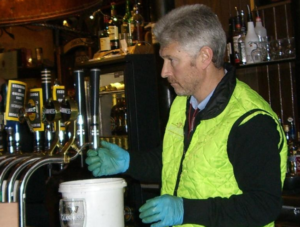
Secret: It’s better in Ireland. This is mostly designed as a segue to the, “Oh you’ve been to Ireland, are the comely lasses really that comely?” conversation. The former is somewhat true and there are a few explanations as to why. The first being that for most Irish, drinking is a social event therefore they drink it in pubs, so it isn’t bottled. Bottling and canning beer often requires pasteurization which can alter the taste of beer by denaturing the proteins and enzymes that you might find tasty and otherwise not get out of the can. Also, the Irish drink so much of the stuff that once it’s brewed it’ll get consumed in a few weeks, so they might not be too concerned about it spoiling and thus won’t sully it with preservatives. I’m not certain of the veracity of this one, since I doubt Guinness wants a lawsuit from their beer getting people sick. Another practice in Ireland is Guinness will send a worker out to pubs with a distribution contract to purge the lines at 21 day intervals. This ensures the lines are clean and thus do not contain foreign contaminants. That’s what this guy is doing.
It sounds like a good business practice on Guinness’ part to control quality but if I’m the pub owner I might question how much beer that wastes because depending on the length of the lines, there might be a gallon or more of beer in there that I can no longer sell which means its 17 gallons/tap/year—you do the math. The beer is fresher in Ireland, pubs are required to let Guinness maintain their taps, it may or may not be safe for drinking, and it is almost always served off the tap. Couple this with the fact that for most Americans, it’s a special occasion they find themselves in Ireland and therefore a novelty, it’s no surprise everyone says it’s better in Ireland.
Secret: Drinking Guinness is good for you. Apparently, Guinness contains antioxidants and polyphenols like red wine, and in moderation the benefits outweigh the alcohol content. This is also ridiculous, as anybody drinking Guinness, like the stereotypical red wine drinker, is not going to be drinking it in moderation.
Use a Guinness Branded Glass. Preferably a clean glass.
Pour at a 45-degree angle, aim for the harp in the Guinness logo. Pull aft on the tap.
Stop pouring when it reaches about halfway across the harp in the Guinness logo.
Leave the glass to settle for 119.5 seconds.
Once ready fill the remainder, pushing fore on the tap rather than aft, holding the glass plumb.
Serve. The foam should be domed like the crystal on a well-made watch.
Not only that, there is a specific way to drink a perfect pint of Guinness and that is by drinking it in quarters. In other words, gulping it rather than sipping it, thus leaving three foam lines in the glass. Order a whisky between gulps 2 and 3. DO NOT drink the whisky before finishing the beer. This whole thing sounds ridiculous to a rational observer, but I’m not about to argue with it beyond not telling me how to drink my beer.
In the end, Guinness benefits from a legend they realistically cannot live up to and a cultural status that seems to feed upon itself—like Harley-Davidson. There are better, more flavorful stouts out there that also have the nitrogen charged widget. Want me to name one? Okay.
I suppose the pedants among us will point out this isn’t an Irish Stout.
My sister recently had a birthday and I was voluntold to pick up a set of cupcakes from a baker specializing in cupcakes, and only cupcakes with ganache frosting. I found out they only make a certain amount during the day and will close when they run out. So when I arrived after they closed I still needed some cupcakes, and unfortunately for me there was only one place in the immediate area that would have what I needed to pick up.
I love how nobody at Whole Foods ever looks like their file photos…normally they look homeless yet somehow drive a Mercedes Benz Genändewagen. I know what you’re thinking, don’t you like money? Why are you shopping there? Well they had what I needed that day and their beer section is stocked with a disturbing level of variety. I picked this one up while I was there since the last time I bought from this brewery was in college.
This brand has probably one of the more visually elaborate labels out there. All of their beers are adorned with art deco style and obvious cues to 1920-1930’s era gangsters, gazing narrowly upon us from the refrigerator. The beer itself doesn’t disappoint either. It’s an American Amber Ale, which is a style that was popularized on the west coast and is probably the most ubiquitous style in the craft industry not called IPA. Do you like Fat Tire, Alaskan Amber Ale, Full Sail Amber Ale, Avery Redpoint Ale, Northcoast Red Seal Ale, etc? All fine examples of American Amber Ale. This one is a hazy, deep red-brown color that finishes with a nice foamy head. Cascade hops which is the norm but not exclusive for this type of beer, give it a citrus like aroma but not particularly floral–when it is cold.
Want
Cascades are a strain of hops that was derived at the University of Oregon on a USDA grant in 1956 that was determined to create a species of hop resistant to downy mildew. It originated from an open seed collection that comprises of English Fuggle, Russian Serebrianker, and “an unspecified male hop variety.” The name of course, comes from the mountain range that runs through the area. In the event you run into a non-GMO type at a bar drinking a Full Sail Amber, be sure to point out this fact and provide a Dixie Cup to purge xirself of this vile example of patriarchy that displeases Gaia.
Speakeasy’s version is a bit more fun, as it warms to room temperature it takes a different character, allowing the dark toffee malts to be more evident. The malts balance out the hops, which is probably why this style is as popular as it is—it isn’t made to suit an extreme. They also mix in another hop, Centennial, which is similar to the Cascade, but manifests itself better at optimum beer drinking temperature and does not taste so much like grapefruit. This twist gives it a bit of complexity and lends itself specifically to the American standard of drinking beer while it’s near freezing. Beer should be served around 55 F, which is something in C, I just don’t care to do the math for it.
Speakeasy Prohibition Amber Ale easily rates at 3.5/5 or better depending on your glass of choice and if you are the type that prefers some balance. I had it in a chalice but you can use a pilsner glass or other wide mouth glass for a good effect. Otherwise if you read everything I just wrote about hops and determined it is another example of putrid, overpriced, over hopped, grapefruit flavored swill, there isn’t anything I can say that will convince you otherwise. So I’ll just leave this here for you:
Look, I assume every glib is thinking, if we wanted to see Romanian commercials we would have beaten them out of you. Well no need for violence, stout yeomen! I decided that I will enact your labor for you (whether you want it to or not) and present the following. I tried to use a selection which reveal a bit of Romanian spirit, a bit of Romanian flavor. The video quality is not great and mostly there are no English subtitles. But it matters not, as they send their message across just fine.
In case you don’t want to actually watch the video
First we start with Rom Tricolor, a candy bar that is, like many cheap candy bars, mediocre overall, but for some reason you want to eat it. Rom is rum, so it is chocolate on the outside and a rum essence cocoa cream in the inside. This is enhanced by nostalgia, as for me it tastes of childhood. Their campaign was based on a slogan “Romanian sensations since 1964”
Two of the commercials go into communist nostalgia and the good old days when the actual fashion police came a calling, because “We will not tolerate such attire for the socialist youth”
The third is a modern view of certain less than ideal aspects of Romanian culture, centered on the person of the Cocalar – which I have no idea how to translate in American. It is what the English might call a chav. This one is for Q as it briefly contains a female in a bathing suit.
A different commercial focusing on history is for a painkiller called Algocalmin, which has been since made prescription only in most countries, even banned in some, as it contains a substance called metamizole, which is actually bad. Now in my family we didn’t really use Algocalmin as a painkiller, but there was nothing like it to break a very high fever. Worked like magic for that purpose.
Next couple are for detergent – DERO comes from “Detergent Românesc” (Romanian Detergent) –which is no longer Romanian, but a brand of Unilever. The commercials are basically a couple talking about the kind of stains DERO removes –ciorba de burta (tripe soup) and coal dust.
Now we have one showing the fabled Romanian construction workers in their natural environment, for cheap rotgut liquor with the slogan “Unde’s multi puterea creste” – basically Strength in numbers. (The name is Unirea, or Unification, and the slogan was the one during the unification of Wallachia and Moldovia)
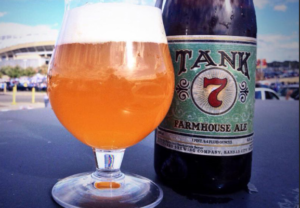
This is my review of Tank #7 Farmhouse Ale, by Boulevard Brewing Company.
Here is my mistake. I mentioned in passing what I will be reviewing next and somebody tells me there is a standard to these things that I am overlooking.
*pours beer down the sink*
Okay, fine. They didn’t have it at the Fry’s I shop at that used to be Smitty’s, therefore it’s the ULTIMATE FRY’S. I instead went to BevMo–no dice. Finally, I found it at Total Wine, which was the last bottle they had on the shelf.
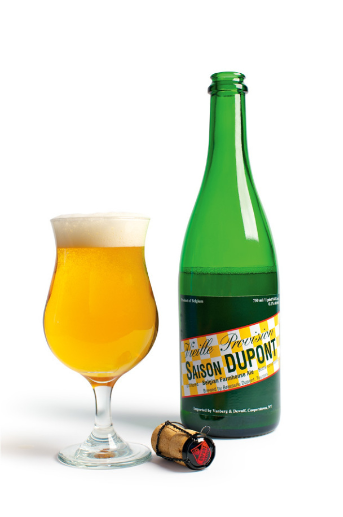
This is my review of Saison Dupont Brasserie. Hat Tip: Nephilium.
Holy shit. This almost costs $14, including the $1.39 worth of state legitimized theft levied on beer, wine and spirits. This reminds me of the time I was shopping for a new vehicle and I checked out the Toyota Tacoma. For what Toyota charges people for the privilege of being labeled tough enough to drive a Taco; in comparison to some of its competitors in the light truck market it better be an amazing truck. By golly, the Taco it is an amazing truck. Is it amazing enough to justify buying it over a comparably priced, but used full sized? Saison Dupont reminds me of this quandary. It is expertly crafted, has a lot of body which is evident in the way the foam coats the inside of the glass. It is bottle conditioned and continuously fermented, which is why it is sealed with a cork similar to the ones used to bottle champagne. The smell is reminiscent of a crisp summer evening in the countryside, in a place where the pavement will not burn your bare feet.
Why is it called Saison? Those of you that speak French will probably tell me the word itself means season. This is indeed true; Belgians like the Germans and nearly every other traditional beer culture adopted the practice of brewing beer seasonally in the time before refrigeration. Part of the reason it is typically done in the colder months is that small insects hibernate and won’t infest the wort. The other part is consistency in temperature. Germans took this to another level in developing lagers, which is not nearly as resistant to temperature fluctuations as most ale, by brewing underground. This is not why it’s called Saison.
It was explained to me once the reason lunch is dinner and dinner is supper in the Midwest is due to the type of meal that a farm hand might have. If one sits down for a large midday meal at a table it is more likely to be referred to as dinner. This is how they referred to it in the dining facility at the Air Force base I was stationed at in South Carolina. Typically, the meal was large as I was hungry at the time since I last ate around 0400 so that I can complete the airfield lighting check prior to the start of the ops day. Lunch on the other hand, is often a much smaller meal. When I think of lunch today, I am normally sitting at my desk munching on something small. Be it a sandwich, or salad for example, the intent is to simply keep me going until the end of the day. It is this type of meal that Midwesterners might refer to as lunch, just something small they can provide a farm hand that they won’t have to worry about their workers going hungry*. Back in the day, Belgian farmers would provide beer to their farm hands, known as Saisonniers, with this type of beer in part as a meal replacement but also because one gets rather thirsty when working in the fields. This explains why it is often called Farmhouse Ale.
*I realize this might be the most controversial statement I make in this entire article, but this is how it was explained to me.
Like I said before, it is expertly crafted with a lot of body in the traditional manner that defines the style. It has a thick texture with a heavy citrus aftertaste. To make this even more confusing, it is highly carbonated but it dissipates in the glass (foam) leaving a pleasant aroma and does not leave you feeling bloated. Like most beers of this type, you must be into it to like it. Wheat beers in general have a polarizing effect on people and not everybody is into it. If you are, you will certainly appreciate its charms but perhaps will not appreciate its price tag. Saison Dupont Brasserie 4.0/5.
If Brasserie is the master, Boulevard is its apprentice. Like many American Brewers, they are quite adept at creating a worthy copy. Often the argument against the craft industry is that they can never make the traditional ales made in Europe. Is it the same? No, it’s not a carbon copy, and that isn’t the point, but it certainly holds its own given the more affordable price tag. Boulevard Brewing Co. (Kansas City), Tank #7 Farmhouse Ale 3.9/5.
In honor of the NL Wild Card, I picked up this one I never heard of as—a wild card.
This one is not terrible. Considering the fact that I turn into an emotional wreck watching playoff baseball, particularly when it is my team…I might have to try this one again. I was hardly objective at the time… There is less body than expected and it is a little more sour than many would like but it is not bad. It is not one to go toe to toe with a traditional European product but it does what it does well. Prairie Artisan Ales Merica Farmhouse Ale 3.0/5
A word on fruit
This is a libertarian website, it is in this spirit that I say that if you add a slice of orange to this type of beer, so be it. To call that apostasy would make me no different than those pushing a social campaign that insists men ignore their natural preferences for women and accept them as is–i.e. real men like women that_______ or with_______. This is hogwash; real men like whatever the fuck they want. If you like Belgian farm girls picking strawberries, go right ahead.
You can only pick one!So choose wisely
If you like female Belgian soldiers…You might have issues, but go for it.
If you want to add an orange because you like it, because it makes you happy, I am not going to say you are wrong. I will not say that you should not add fruit to your beer and you may as well go to Morton’s and ask for ketchup with your steak. It’s an immoral stance to take and I will not entertain an argument to the contrary. Do what you like.
Having said that, this is a libertarian website and since I have been graciously provided a platform for free speech I will state my personal opinion: if you add orange to a well-crafted Saison–you are wrong. Go wash your mouth with a revolver.
Pumpkin Ale suffers from the indignity of being associated with hipster culture in that it only seems to come out at the time of year where everyone and everything gets excited for all things pumpkin. Pumpkin cider, pumpkin parfaits, pumpkin cookies ….
….even pumpkin spice M&Ms. It’s to the point where one can trigger an emotional response by telling a 28 year old woman in vintage glasses, a turtleneck sweater and wool scarf that she lives in Arizona, it is 96 degrees, there is no reason to dress like that and there is no reason for me to give two shits about your pumpkin spice latte. Pumpkin ale however, I think is unfair to associate with these people to some degree.
Pumpkins, like chocolate, corn, potatoes, and beans are indigenous to the Americas and like the other food mentioned was traded around the globe as a result of the Columbian exchange. Native Americans initially ate only the seeds, because that was the only palatable part. Later varieties were cultivated so that the flesh could also be consumed. This became a staple in the diet of many native cultures, as indicated by the number of European explorers that wrote about pumpkins and the distance between the parts of North America they explored. Jacques Cartier in Canada, to Alvar Nuñez Cabeza De Vaca in Florida, and John Smith in Virginia all wrote about the abundance of the gourds. At the beginning of the colonial period, settlers were unable to grow the same type of crops they could grow in Europe, therefore is should be no surprise pumpkin became a staple of these early settlers. If you want to know more about Pumpkins, click here.
Beer/ale at the time was a necessity because the fermentation process made water potable, this has been true since the medieval period. Being that there was at first, no barley to make it the colonists had to make due with something to make water drinkable and help them forget they were probably going to die during the winter—guess what happened to be around in great quantity? Pumpkin ale fell out of favor after the civil war and cultivation made it more lucrative for farmers to supply a decorative element that rots on my porch overnight after the 1970s. It was only a recent development that everybody with the means could put the stuff to market as part of the annual hipster pumpkin craze. In other words, this is something those snooty, technocratic, Euro-weenies cannot claim because it is a uniquely American beverage with unique American heritage. Europe can go suck it.
Modern Pumpkin Ale comes in two types: The type that wants to be a severely over-spiced, gluten-free Dunkel and the other that wants to be liquid pumpkin pie. Fat Jack is the former. It comes at over 8% ABV so it is prudent you operate machinery or firearms while drinking this. It is also handy to have around when Carson Palmer wants to embarrass himself by muffing the snap in an attempt to come back in the 4th quarter. Way to go dumbass, it’s now 3rd & 20 and my only solace is a thick, hearty ale, with a flavor heavily influenced by ginger, cinnamon, ginger, cloves, ginger, allspice and ginger. Did I mention Ginger?
In fairness, they had to balance out the pumpkin somehow and with the high ABV, there is a lot of pumpkin in there. This one is still pretty good but is not one to chug. 3.5/5
If you are looking more towards the liquid pumpkin pie end of the spectrum, a good example is Elysian Night Owl Pumpkin Ale.
Same spices as Fat Jack, just not as intense, and a much lighter ale with less body as you can probably discern from what is indeed my photo. It has a faint, pumpkin bitterness in the back which is kind of nice. 3.8/5
This one is absolutely amazing. Last time I had it in Colorado the guy at the liquor store asked that I not purchase more than 2 packs of it at a time. The reason is because he typically sold out of it within the day. This has a faint vanilla along with the usual pumpkin spices, so it actually tastes like pumpkin pie, like the kind your mom made. If you happen to be in Colorado, and you happen to come across a liquor store in the fall pick some up, cowboy. 4.5/5
This movie plays on the stereotypes and misconceptions that Americans have about Oktoberfest, particularly the ones that have never attended. For the uninitiated, it’s pretty much viewed as a bunch of singing drunks served by this lady.
I have no way of legitimately commenting on the accuracy of the portrayal of Oktoberfest, drinking contests, the German people, the Bier Garden wait staff, or sexual activity among amphibians in this film. For that, I will direct you to a much better source previously posted by another guest contributor. Hat Tip: DEG.
While Hefeweizen is served at Oktoberfest, I will not get into these. To be sure, my aversion to German wheat beer has absolutely nothing to do with a drunk Native American that failed to recognize that I hailed from the big tribe in the south, and that I am not a homosexual. Apparently in Northern Arizona, Hefeweizen is a calling card for gay men; I also happen to be more of a fan of the Belgian varieties of wheat beer.
That leaves us with Marzen but since this is a somewhat saturated marked, where to begin?
Paulaner Oktoberfest Marzen
Unfortunately, this is a German entity therefore we must concede the standard must be set by them. Other well-known German brewers such as Spaaten, Warsteiner, and Becks all put their own version to market and none of them are bad. As you can tell from what is once again, not my photo, Paulaner’s offering is copper in color, a nice light lager with caramel notes and a nutty finish. It is lightly carbonated so it will not stop you from knocking back several liters at a time. The only problem, as mentioned in the comments section at other dark corners of this website, German beer does not travel well, particularly lagers. German Beer Purity laws may have something to do with that but even given the proviso that it may be a hair on the skunky side, it is still quite good. Too bad we can’t all go to Germany. 3.8/5
Since going to the source is not always feasible, that leaves us with the American Craft industry to pick up the slack.
Left Hand Brewing Co. Oktoberfest – Longmont, CO
As you can tell from what is once again, not my photo, Left Hand’s offering is copper in color, a nice light lager with caramel notes and a nutty finish. It is lightly carbonated so it will not stop you from knocking back several liters at a time. Yes, I just repeated what I wrote about Paulaner’s. Am I really that lazy? Perhaps, but repeating myself might be the best compliment I can make about it. This is as good a copy you can get in the mountain west, and for many of us that is as good as it gets. The reduced travel time and the Colorado snow met make this one slightly more enjoyable than waiting on the import to arrive. 4.0/5
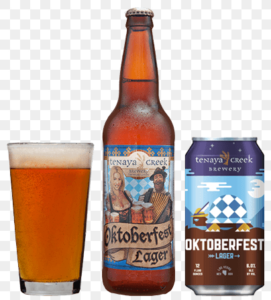
Tenaya Creek Brewery Oktoberfest – Las Vegas, NV (Right)
Another one I’ve had recently is from Tenaya Creek Brewery in Las Vegas. Not as malty as I like but given its source it is also a fair bit lighter than the norm for this type of beer. If you feel the need to enter a drinking competition this might be a good choice. 3.5/5
Goose Island Oktoberfest – Chicago, IL (Left)
The next one is from Goose Island from Chicago. It could just be the batch I got; this might have been bottled sometime the previous year and left in a warehouse somewhere in Phoenix with questionable climate control. Whatever it is, this one should be better but it is not. I want to give them the benefit of the doubt, but after briefly researching on ratebeer.com others seem to agree. If you are in the area, please explain this if you like because I will not extend more mental energy to find out where they went wrong. After all the definition of pizza in that town is apparently up for their interpretation. My only regret is I bought a 12 pack. 2.5/5.
San Tan Brewing Co. – Chandler, AZ
The last one is a local (to me), from San Tan. This is probably going to be discounted as bias but I will say my local offering is pretty damn good! My pick for this genre is still from Left Hand out of CO but it stacks up well. The biggest difference is the nuttiness in this one gives is a slightly thicker texture than Left Hand’s. It could also be the local water, as it is notorious for its mineral content. 3.8/5
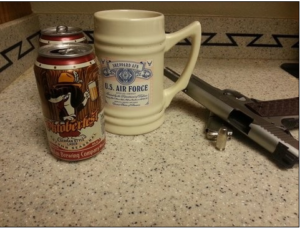
Whether it is glass or ceramic, serve in a mug of some kind like above. Bonus points if you have a boot.
I wasn’t going to even do a FF this week since there wasn’t much to talk about, but I’m sitting here at work not wanting to work so I figured fuck it, let’s go for it.
The big story: D.C. will officially be ‘shall issue’ come next week. Unless of course they try to weasel out of it, which they will, so don’t hold your breath. Interestingly not a single judge on the panel voted for En Banc. A sign of the times?
The big non-story: The SHARE act did not come up for a vote this week (at least not of this writing). So a big fuck you very much to congress, who once again can’t do shit that everyone wants. No link, cause how can you link to something NOT happening?
The PMag is now authorized for requisition by the US Army at a unit level, putting it one step away from mass adoption as GI equipment for the entire US military. Yes, I know how unimportant this is in the broad scheme of things. It’s a slow week.
Bass Pro Shops officially closes the deal on the buyout of Cabelas for $4 billion dollars. I always liked Cabelas more than Bass Pro so I don’t have high hopes for this one.
Finally today, I leave you with a sad bit of news. It is with deep emotion that I announce that CarnikCon is officially dead. The channel and all of the videos have been officially removed from Youtube by the creator, Dugan Ashley.
https://www.youtube.com/watch?v=84WcNJNkU0Y
Goodnight, sweet prince; And flights of angels sing thee to thy rest.
Luckily someone was smart enough to archive all of the videos for posterity. Some heroes don’t wear capes.





 India Pale Ale tends to lose its potency over time. The oils and aromatics in the hops that dominate the style break down, particularly when it comes in contact with light. Yes, even if it is stored in a brown bottle. Because of this, I always recommend finding a local brewer that makes a good version of the style, for me that’s Four Peaks Hop Knot. Fresh beer is always better and somebody that makes it nearby will likely give you the best version available for the style. Don’t have a good one? The Stone “Enjoy Before” series is your best bet. It’s not always available, but they give you the date specifically because that is the date they recommend will meet their quality standards. The idea behind this style is they over-hopped the beer in England back in the day so it could make it to their English customers in India and still taste like a traditional Pale Ale.
 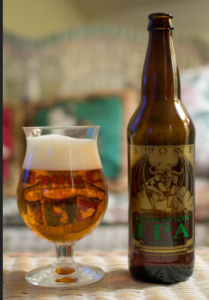 I tried this once when I came across a Stone Ruination IPA at a gas station about a year ago. Note, I did not say Ruination 2.0, this was the original still sitting in the corner on the bottom shelf of the refrigerator at an Arco station. It was old, and quite frankly there is proof of concept as it tasted like a terrible pale ale. If you come across this one with the green label, avoid it.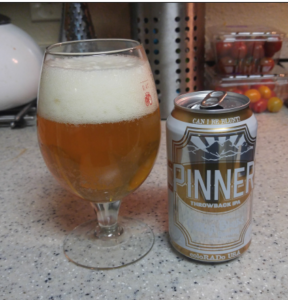
 Today, I am going to talk a bit about the opposite of guns. What is the opposite of a gun, you might ask. Peace? Love? Puppies? No morons, it’s body armor. For those of you just unfrozen from a 200 year cryo sleep, body armor stops bullets before they can enter your meatspace and STEVE SMITH you to death. And no, I don’t know who would know about STEVE SMITH but not understand the concept of body armor, but I’m sure if he exists he’s reading this at some point. There are 5 official levels of body armor as defined by the National Institute of Justice: NIJ level IIa, II, IIIa, III, and IV. III and IV are hard armor plates rated for rifle rounds, while everything else is soft armor only rated for handguns. Soft armor is what is usually used by police officers since it is lighter and flexible and can be worn more comfortably for long periods of time, while plates are worn by military for their ability to stop rifle rounds. I do not know much about soft armor since I don’t own it and I have never used it, but I would only recommend soft armor if you need to wear it for long periods of time or need to do a lot of walking while wearing it and don’t anticipate rifle fire. For most civilians I cannot think of a case that would justify wearing soft armor as part of your everyday loadout, and since it would be inferior in a SHTF situation, I don’t recommend it at all. If there is some situation where you need to wear armor inconspicuously then soft armor is probably the only thing that will work, but again I cannot think of many realistic situations outside of police work that would warrant it. There is another reason why I don’t recommend soft armor: It deforms when hit. Unlike a hard plate, soft armor will bulge to absorb the impact of the bullet. That means that while the bullet won’t actually enter your body, it will still feel like you got punched in the gut by Mike Tyson. Stopping the first bullet is no good if you’re laying there gasping for air immediately afterwards.
 So what should you buy? Before we go into this I want to remind people that this is my opinion and you may find contradicting info elsewhere. Just remember that I am not trying to sell you anything. With that in mind, my answer on what you should buy is: it depends. I will tell you that because of the widespread proliferation of AR 15s and M193 ammo I strongly recommend not using anything below a 3+ rating. Beyond that, its a question of budget and desires. If you want to be able to stop basically any bullet fired at you, then level 4 is the only way to go. Remember though, you will only be able to take a few hits before the plate is compromised. If extreme durability is more important to you, a 3+ steel plate is probably your best bet. If you have a bit of money to spend and want a lightweight setup, 3+ ceramic plates are going to be your recommended option. Personally I run 3+ steel plates in my carriers.
 First and foremost I was brought up to, at the least, do my fair share for my family, to be the breadwinner. Yes, yes, I’m a cis-het shitlord. Whatever. So there’s some ego issues with being dependent on the wife’s income for the bills. Also, since she is fascinated by arcane Jewish rules despite not being a Jewess, she claims that since I am technically unemployed, I owe her sex twice a day. I do my best to fulfill that obligation despite not being Jewish, so that keeps her happy with the arrangement. Be that as it may, it’s also a calculated risk, that if this hits as well as it could, in a few years the business will support us in a way that would mean a lifestyle of wealth and time to enjoy that wealth. In the meantime, we are budgeting and making sure we continue to live within our means and it is well worth it.

 Harvest, Trim, Cure and Sell (Where I think this is leading)
 Is Obama cool because Obama gets jacked on Guinness or is Guinness cool because Obama gets jacked on Guinness?
 It sounds like a good business practice on Guinness’ part to control quality but if I’m the pub owner I might question how much beer that wastes because depending on the length of the lines, there might be a gallon or more of beer in there that I can no longer sell which means its 17 gallons/tap/year—you do the math. The beer is fresher in Ireland, pubs are required to let Guinness maintain their taps, it may or may not be safe for drinking, and it is almost always served off the tap. Couple this with the fact that for most Americans, it’s a special occasion they find themselves in Ireland and therefore a novelty, it’s no surprise everyone says it’s better in Ireland.
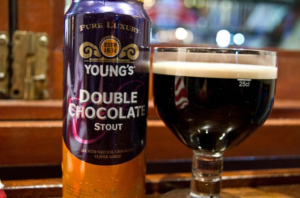 Not only that, there is a specific way to drink a perfect pint of Guinness and that is by drinking it in quarters. In other words, gulping it rather than sipping it, thus leaving three foam lines in the glass. Order a whisky between gulps 2 and 3. DO NOT drink the whisky before finishing the beer. This whole thing sounds ridiculous to a rational observer, but I’m not about to argue with it beyond not telling me how to drink my beer.
 I love how nobody at Whole Foods ever looks like their file photos…normally they look homeless yet somehow drive a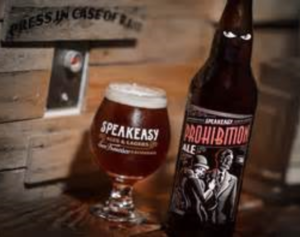


 This is my review of Tank #7 Farmhouse Ale, by Boulevard Brewing Company.
 This is my review of Saison Dupont Brasserie. Hat Tip: Nephilium.



 ….even pumpkin spice M&Ms. It’s to the point where one can trigger an emotional response by telling a 28 year old woman in vintage glasses, a turtleneck sweater and wool scarf that she lives in Arizona, it is 96 degrees, there is no reason to dress like that and there is no reason for me to give two shits about your pumpkin spice latte. Pumpkin ale however, I think is unfair to associate with these people to some degree.
 Beer/ale at the time was a necessity because the fermentation process made water potable, this has been true since the medieval period. Being that there was at first, no barley to make it the colonists had to make due with something to make water drinkable and help them forget they were probably going to die during the winter—guess what happened to be around in great quantity? Pumpkin ale fell out of favor after the civil war and cultivation made it more lucrative for farmers to supply a decorative element that rots on my porch overnight after the 1970s. It was only a recent development that everybody with the means could put the stuff to market as part of the annual hipster pumpkin craze. In other words, this is something those snooty, technocratic, Euro-weenies cannot claim because it is a uniquely American beverage with unique American heritage. Europe can go suck it.
  If you are looking more towards the liquid pumpkin pie end of the spectrum, a good example is Elysian Night Owl Pumpkin Ale.
  This one is absolutely amazing. Last time I had it in Colorado the guy at the liquor store asked that I not purchase more than 2 packs of it at a time. The reason is because he typically sold out of it within the day. This has a faint vanilla along with the usual pumpkin spices, so it actually tastes like pumpkin pie, like the kind your mom made. If you happen to be in Colorado, and you happen to come across a liquor store in the fall pick some up, cowboy. 4.5/5
 This movie plays on the stereotypes and misconceptions that Americans have about Oktoberfest, particularly the ones that have never attended. For the uninitiated, it’s pretty much viewed as a bunch of singing drunks served by this lady.
  Paulaner Oktoberfest Marzen
 Tenaya Creek Brewery Oktoberfest – Las Vegas, NV (Right)
 Goose Island Oktoberfest – Chicago, IL (Left)
 San Tan Brewing Co. – Chandler, AZ