Category: Regulation

  • Grow Weed They Said. It’ll be easy, they said.*

    *Okay, no one said that.  But this is the story of my getting into the pot business (sorry, no Mexicans and only tangential references to ass sex) and commentary on regulatory issues from a libertarian perspective.

    1. Just doing some market research

      Organic, Hydroponic, Outdoor, Indoor (Why weed, philosophical considerations)

    My career has been in IT, Operations, and Finance for Food & Beverage manufacturing.  I’ve got a bunch of certifications that prove I can manage a project and make improvements and create models.  But the winter of 2016 was one of discontent. I realized that if I continued working in a cubicle / office at a large corporation, I was going to splatter someone’s brains all over the beige fabric cube walls.  And since I am too ornery for suicide and too pretty for prison, I decided to get out of Cubeville. My performance had suffered, and I wasn’t fitting culturally at work anyway, so when they offered me a chance to leave, I took it.

    My business partner is a friend from the kink community.  His career has mostly been IT startups.  And two years ago he started doing research into becoming a canna-business owner.  When I lost my last job, he invited me over to hang out, showed me the operation, and then talked to me about my plans.  At that point I wanted to simply take a month off; period.  I haven’t had a vacation except for family visits, in over 5 years.

    I started helping with his small med grow just to have something to do and get out of the house.  The month elapsed and we started discussing it in earnest.  What it would take to get involved money wise, plans, the pot market itself, the various options and strategies.  I started thinking about it more and doing some of my own research.  I had, by that time, decided I wanted to start my own business and this seemed like a good opportunity.

    I’m not a pot user.  In 42 years old and I’ve used pot maybe 10 times, all within the last few months.  But that’s okay.  I see its uses for both recreation and medicine as valid.  One needs pleasures in one’s life, and while I think pursuing them in some moderation is better, others may have different priorities.  I think that whatever risks come with using marijuana are small enough and manageable enough that I am satisfied morally about selling it as a legal product.  Were, say, heroin to be legalized, I wouldn’t feel the same way as there does not seem to be a way for one to use that drug and stay productive.  That was critical for my personal decision making – can people use pot and still function or even improve their functioning?  I think so.

    I also realized I was enjoying myself when I was helping out my friend (and now business partner).  We were building things, figuring out how to get things working, digging in the dirt.  I’d come home tired and dirty and happy.  I spent 20 years trying to get away from anything agricultural because I grew up in a rural area and thought success was wearing a 3 piece suit.  But success is enjoying your life and the people in it.

    On a business level, cannabis is at an interesting place.  I worked in the craft beer industry for a few years and investigated the craft distilling industry as a potential business and I found the history informative.  Those families that acquired distributor licenses when the 22nd Amendment was repealed have businesses now that that are worth 100s of millions of dollars.  They got in early and they are still reaping the rewards generations later.  It’s also interesting to look at wine in the late 70s – early 80s, craft beer in the 80s and early 90s, and craft distilling since the early 2000s.  The early movers into those markets are doing well and have strong businesses.  Now’s the time for getting into the legal cannabis market.

    1. Growing Cannabis; Clone to Flower (Startup Life, Entrepreneurship)

    I didn’t chose the startup life, the startup life choose me.  I use that quip sometimes when I have a play partner ask when I can tie her up again and I have to beg off due to running the business.  It’s true that running your own business can suck; your boss is usually a dick that rarely wants to give you any time off, and sometimes the sonovabitch doesn’t even pay you, you have to pay him.

    My wife and I have always been white collar folks, making excellent money.  Further, we lived well within our means and don’t have kids.  Which translated to us rarely having to worry about money.  We made way more than we spent, even after savings, so we had a huge cushion.  Part of being an entrepreneur is that I’ve had to give that up a little bit.  My wife still has her white collar job and makes enough to support us easily.  But that carries its own struggles with it.

    First and foremost I was brought up to, at the least, do my fair share for my family, to be the breadwinner.  Yes, yes, I’m a cis-het shitlord.  Whatever.  So there’s some ego issues with being dependent on the wife’s income for the bills.  Also, since she is fascinated by arcane Jewish rules despite not being a Jewess, she claims that since I am technically unemployed, I owe her sex twice a day. I do my best to fulfill that obligation despite not being Jewish, so that keeps her happy with the arrangement. Be that as it may, it’s also a calculated risk, that if this hits as well as it could, in a few years the business will support us in a way that would mean a lifestyle of wealth and time to enjoy that wealth.  In the meantime, we are budgeting and making sure we continue to live within our means and it is well worth it.

    And that calculated risk I mention does have a huge potential payoff.  This is something an entrepreneur has to learn to deal with; risk calculation.  Which sounds kind of scary, but is fairly simple if you understand a little math.  What’s the potential worst case scenario?  What’s the best case?  What are the odds of each?  Apply dollar amounts to the first two and multiply them by the answer to the last question.  If there are things you can do to improve the odds adjust for that, then compare your values and that should help make the decision.

    I don’t want to get into specifics of how much I’ve invested, but I’ll walk through the math.  I’ll also talk a little about where the investment money came from.  We moved to Portland 4 years ago and bought a house at a relative low in the market.  A couple of years later we moved out to the suburbs but kept the original house.  Due to the house’s location, when we sold it this spring, we made a substantial sum of money.  The profit was about 5x of what we expected to make in that period of time. Even after paying off some remaining grad school loans, tucking some away to fatten up the retirement account, the amount needed to invest was less than the remainder.  It’s essentially a large windfall, or as I refer to it, we’re playing with house money.

    So even if we lose that money it doesn’t damage us long term.  There’s an opportunity cost, of course.  We could have put that money into paying down our existing house, or invested it in some other enterprise.  But anything we do with it would have some risk.  The other potential cost is the salary I’m forgoing for the next two years while I try to launch this.  That’s my downside number.  Let’s call it $100k just to use a round number.

    The upside, of course, is if the operation is successful.  Since the partnership is 50/50, I simply need to calculate what the expected revenue will be over the next two years and what the profit is going to be.  Right now, even the really poorly run ops are making about a margin that is about twice what a well-run food manufacturer makes, and about 25% more than a well-run alcohol producer.  For the sake of discussion we’ll put the amount of money I can expect from the profits at $1.5mm.  Again, not a real number, but it is proportional to the real number.  This also ignores the longer term, and options for integrating the vertical by spinning up a processor and our own retail outlets, as well as some other strategies we have for expansion.

    Alright, the risk is losing $100k versus winning $1.5mm.  So what are the odds of each happening?  That’s the real important part of the decision.  Let’s assume the failure rate is 90%.  In reality about 67% of cannabis businesses in Oregon have failed.  The vast majority were due to failure to comply with either reporting requirements or basic shit like tracking your employees’ hours and properly paying them, which even some fresh off the boat immigrant can manage when starting a restaurant.  So that failure rate is low, but for determining expected value, I think it’s a good number.

    Multiply $100k times .9 and that’s $90k.  Multiple $1.5mm times .10 and you get $150k.  Subtract the $90k from the $150k and my expected value is $60k more than if I don’t take the gamble.  That makes it a risk worth taking.   That ignores that it is difficult to value the experience of trying to start my own business and the freedom and flexibility it provides me.

    Any entrepreneur needs to think in those terms, and unless you are starting a lifestyle business, you also need to think of terms of longer term potential.  My guess, taking in the past closest benchmark industries (alcohol, primarily), looking at the current demand, and at the future possibilities is that this can be huge.

    The market for legal recreational and medical marijuana is massive.  In Oregon at least, the demand is higher than the current level of supply.  That gap is closing, but it’s going to take a few years for several reasons.  Most of the early entrants were black market or med growers who had been growing enough to make a house payment.  They are good growers and make some excellent weed.  But their business sense is limited.  They’d get hooked up with an outside investor that had the money, but no knowledge of growing or interest in being intimately involved.  They could smell the opportunity, but didn’t want to be heavy lifting investors.  So they wrote a check for $1mm or $2mm.  And in a year, they are out of business because the grower burned through the cash.  Or they can’t comply with the regulations.

    We think our competitive advantage is that my partner and I have grown the product and developed our basic process along with an experienced grower.  We believe that we can bring an analytic, process based approach to growing that few others can.  Which will allow us to get big enough so that when the market hits saturation and prices start falling down to commodity levels, we have higher margins than average and are able to weather those changes while also scooping up smaller grows.  The margins decreasing will only help us as it puts pressure on less well-run organizations.

    We also plan to invest heavily in vertical integration.  Once the first Tier 1 is fully operational, we’ll open a processor.  Then we’ll start the franchise part of the business.  There are lots of good growers that either don’t have the cash to get the land, or don’t have much business sense and know it.  While we can’t own more than one license of the same type, we can lease the land and provide services to other growers and/or investors.  We’re working on the details of that, but it lets us expand legally.  Within five years we expect to have our Tier 1 grow, a piece of 3-5 more Tier 1 grows, a processor, and some retail outlets and a testing lab all under our umbrella.  We have specific landmarks and decision points along the way.  But we are building an enterprise.

    Which brings us to exit strategy.  Which is venture-speak for ‘how are you going to really get paid off for this investment?’  Are you going to sell it to someone else? Keep running and growing it? Own it but let someone else run it?  The answer is; we have plans for each eventuality.  I’ll talk more about this in the last section.

    1. A little spindly, innit?

      Medium and Nutrition (Specifics about Weed growing)

    Cannabis is a weed.  So it should be easy to grow.  And that’s true.  You really only need some dirt, some water, and some light and you can grow a marijuana plant.  But there is a difference between growing a single plant and running a farm, both in terms of quantity and quality.  It takes skill, art, and science to grow large quantities of high quality product in a given space.  Like any other similar enterprise, it’s all about yield.  And keeping costs down for each pound you produce.

    So every ounce of marijuana starts as either a seed or a cutting.  Either way, once the seed or the cutting has roots, it’s placed in a growth medium.  That can be soil or hydroponic.  We grow in a soil like medium called Tupur.  It’s made primarily from shredded coconut shells.  It provides a medium for the roots of the plant, but no nutritional value like various other types of soil.  The advantage of that is that we can feed more often than if it were in soil and at lower PPM of the nutrients.

    That helps in the next stage which is vegetation.  The objective in this stage is to grow the plant and strengthen it to prepare it to go into flower.  Flowering is determined by the number of hours of darkness the plant experiences each day.  The plant will stay in veg as long as it has more than about 13 hours of sunlight.  There are some differences between strains and the easy way is to just keep them under the right kind of lights 18-24 hours a day.  The longer in veg the bigger the individual plants become and the more they’ll yield when they go into flower.  It also allows for different styles of growing; trees (tall), pineapple (bushy), or various types of trellising.  There is a trade-off; the longer spent in veg, the longer until you get your final flower.  So there’s some balancing we’re still figuring out on that.

    Once it is time to go into flower, the grower needs to see that the plants are in total darkness for a certain amount of time.  Usually 12-13 hours.  This is the natural state of things in the fall when the plants normally flower on their own.  But it can be induced artificially outdoors by having green houses with systems for blacking out the green house, or indoors by simply turning off the lights.  Flower usually lasts for about 8-9 weeks.   Though for some pure sativa strains that time can as much as double.

    In flower is where the bud begins to form and grow.  The signs one is looking for are solid, dense buds, for the trichs or sugar on the leaves close to the buds and the buds themselves, and looking for other signs on the buds related to the color and density in the buds.  There is some art to this and if you harvest too soon it can impact the levels of THC and CBDs, as well as the taste and the quality of the smoke.  Harvest too soon and the smoke can be not as smooth or be “speedy” meaning you get amped up instead of relaxed.

    When the bud is ready, it is time to harvest.  This involves cutting down the plants so that the buds can be dried and cut away from the branches and remove the unwanted stems and leaves.  The bud also needs to cure a little while to make it the smoke smooth and maximize flavor.  Each bud has to be trimmed and the old school way is to hand trim it so you leave just the right amount.  For large harvests though, machines are used.  Slightly lower quality, but much more efficient even than orphans. Once the cure is finished, it is time to sell.

    Selling for a producers is wholesale.  You’re usually selling pounds at a time to dispensaries.  There’s some sales effort involved, but much of that is simply taking samples to the buyer at a dispensary, smoking it with them, and then arranging the order and delivery.  The three biggest factors are the amount of THC and CBDs, the way it looks when displayed (bag appeal), and lastly how it actually smokes.

    1. Insect & Pest Prevention (Taxes, Regulation, and Weed)
    When you wait too long to harvest…

    Regulations surrounding weed are interesting.  They fall broadly into three types in the state I’m in.  First are the types of license, second are zoning related for getting your license, and the rest are operational regulations for keeping your license and being able to sell your product legally.  The industry is over regulated, but then, virtually every industry is.  And in some ways, pot is less regulated than beer, wine, and liquor if you put aside Federal laws.  It’s also less regulated than the food manufacturing industry.  The regs are cumbersome and immoral because FYTW and god forbid people actually /enjoy/ themselves, but that’s true for many products.  In this section I’ll try to review the basic regulations and how they interfere liberty and some of the unintended consequences I think they bring about.

    License Types – One can have either a med license or a recreational license.  With med you pay an extra fee on your med card and designate a grower.  Depending on where you are, you are allowed a certain number of plants in flower at any given time.  There is no real limit on the number not in flower or on the amount produced.  You can stack cards, meaning get someone with a card to designate you as a grower, but there are limits on the maximum number of cards you can stack.  Other than that, there is not much regulation or reporting required.  And if someone reports you, the cops have to call and schedule an inspection when it is convenient for you.

    Recreational is a different game.  It is more complex and brings with it more reporting and regulatory oversight.  But that plant limit goes away and is replaced with square footage limits. In Oregon, there are no limits on the number of people who can have a recreational cannabis license for any of five categories; Producer, Processor, Wholesaler, Retailer, or Research.  The same person or group can have all five if they like.  And there are different types of sub-businesses.  For example, a seed bank is considered a producer.  A lab is considered a processor.  A home delivery service is a retailer.  The exact same ownership group can’t own more than one license of the same type, but there are ways to burn that bridge.

    Zoning – The way zoning plays into is that each county is able to have its own zoning regulations related to the various types of licenses.  So they can designate various zoning types as allowing only producers and whether it is only indoor or outdoor producers.  Any interesting side thing is that the difference between indoor and outdoor is whether the structure has lights.  So if you have a greenhouse with no lights, it is an outdoor grow.  If you add lights, you are an indoor grow.  The reason that matters is both zoning and that a Tier 1 license (the current largest) allows for 40k sq ft of canopy in flower outdoors.  Indoors each sq ft of canopy counts for 4 of those sq ft.  So effectively it is 10k sq ft. of indoor space allowed.  Or you can do a mix of say 5k indoor and 20k outdoor.

    There are also zoning laws related to minimum property size, how close to the property line the grow can be, what kind of odor remediation has to be done, visibility of lights, and the kind of fencing and access control that are required.  Those all vary for the different kinds of rec licenses.  There are other oddities such as you can have a Producer license for land that is considered Agriculture only and it will satisfy that requirement, but you can’t count the income from that toward your tax status.  This is one area where the zoning is slightly more complicated than other agri businesses.

    Operational – The real regulations come in as part of applying for the license and keeping it.  The biggest are all around reporting.  The weed has to be tracked individually by plant, including the state of life it is in, and any changes made to it.   So, for example, plant 001 has to be trimmed.  You have to account for the weight of how much of that is disposed, and if any clones are made from it, you have to track that as well.  Once harvested the weight of the flower and any waste or other byproducts have to be tracked.  All those numbers have to be reported to the agency monitoring compliance, the OLCC.  When you sell any product to another rec license holder, you have to track that as well, so that there is ‘seed to sale’ visibility and prevent weed going into the black market.  This is actually common in the food, beverage, and alcohol industries, at least the tracking if not the reporting.

    To add to that, the entire grow operation has to be covered by cameras that run 24/7.  Again, this is to make sure you aren’t slipping stuff out the back door into the black market.  The recordings have to be made available to the OLCC at their request for spot checks.  It’s also security for the rec operation as it helps with dealing with any thefts. Slipping stuff out the back door is really dumb.  As we all know, the back door is for going in.  *ahem* When people do this, they are risking 100s of thousands of dollars of revenue for a couple of extra grand by selling to the black market.

    The last of the big three are testing requirements.  For every 15 pounds of product, you have to take random samples and send them to a lab for testing.  The testing provides proof that you haven’t used any banned pesticides and that your weed is ostensibly safe to consume (compared to literal Mexican ditch weed, most of the stuff on the banned list could be safely used).  It also provides information on THC and CBD content that has to be placed on labels for packaging.

    There are some other minor things related; you can’t have barb wire on your fencing, you can only have so many visitors per year to a grow operation, and a few other things.  But the other three are the big ones.  Compared to other industries, they are a little intrusive, but not as complicated.

    From a libertarian perspective, the zoning, the size limits and the like are all ridiculous.  Those are things which can be worked out by individuals. The monitoring to prevent the black market is, of course, ridiculous.  Any adult who wants to buy should be able to buy however much they want from anyone willing to sell it.  And the testing reqs are things the free market would demand anyway.  So they simply add cost to the entire enterprise without much real value.

    1. Harvest, Trim, Cure and Sell (Where I think this is leading)

    From a macro perspective, I think full legalization of marijuana / cannabis is on the horizon.  While Sessions has a hard-on about it, I am not particularly worried that he’ll go after legal producers in states where it recreational is legal.  Oregon makes far too much tax money from weed to cooperate if the feds go after their legal producers.  But the state does have incentive to cooperate in going after black market producers.  Which allows Sessions to beat off about stopping the demon weed and the states to force more of the black market producers toward getting legal so they can get that sweet, sweet lucre.  Extortion 101.

    Beyond that, the real question is when it will be removed from Schedule 1.  My estimate is sometime in the next 8-12 years.  We’re down to only 2 states where marijuana possession is fully criminalized.  All the rest range from being fully legal for both medical and recreational (8 states) to simple decriminalization.  The holdouts are really the Midwest and the south east.  My guess is that once Texas and/or Florida allows rec or one of the south east states (NC, SC, VA, TN, AL, GA) allows med and/or rec that’ll be the final nail in the coffin.

    There’s also growing pressure from various corporate interests.  Monsanto is huge in the space at providing lights and nutrients and the rest of the infrastructure and equipment.  There is interest from the tobacco companies as well, but they can’t get involved until it is legal nationally.  Pharma is opposed at the moment, but I think if you ever see Merck or Bayer get onboard that could help speed up the change.

    As I mentioned earlier, cannabis wholesale prices are going to fall as more competitors enter the market.  As that happens, you’ll see the standard consolidation.  The enterprises that are well run and forward looking will start opening operations in new states that open up their laws.  They won’t be able to transfer between states, but they’ll be well positioned to gobble up the smaller operations that have good growers, but poor business practices.  And the ones that survive that sorting out and are large enough to be operating profitably once national legalization happens will be acquisition targets for the Monsantos and Mercks and RJRs.

    I don’t think the regulations will ever be less than they are now.  Unfortunately, I simply don’t see a libertarian moment occurring that will bring the overall level of regulation down.  The best the cannabis industry can hope for is a similar level of regulation to the alcohol industry, unfortunately.   Which proves we don’t live in the best of all possible worlds, but it would be an improvement over the current situation.

  • Firearms Friday: Mandalay Massacre

    I was hoping I would bring you triumphant news of the SHARE act passing a vote in congress this week. Instead I am writing you on the heels of a legit massacre and hoping we don’t have more gun control crammed up our asses by Thanksgiving. For those of you that just awoke from a coma, a guy took an actual arsenal to the 32nd story of the Mandalay Bay Casino and rained death into a crowd of 22 thousand country music fans. Roughly 60 dead, 500 injured. The perpetrator of what has now become the worst mass murder in modern American history? 64 year old Stephen Paddock: accountant, gambler, lover of old Filipino women, and millionaire. Yes, you read that right. This guy was loaded. Regularly dropped bills in Vegas, and had no problem clearing his tab. So why murder a bunch of drunk white people? Good question! If you know, please call your local libertarian gun blogger and let me in on it, cause right now it’s driving me insane.

    I’m not going to mince words about it: this one is bad. In terms of optics this is the worst shooting in history. This wasn’t an easily explained case of schizophrenia or Islamic terrorism. This guy was the model gun owner. He passed every background check and followed every law, right up until he didn’t. How bad was this shooting? Let me just say that it made even me briefly question my belief in the second amendment. If that doesn’t make you nervous then you aren’t paying attention.

    The focus now has shifted onto the guns the killer used. More specifically, the stocks. He had 12 rifles equipped with slide fire stocks. If you’re unfamiliar with them, I went over the particulars in one of my previous articles here. Basically, it’s almost full auto, and it allowed the shooter to crank out hot lead in record time. Bills have already been introduced to ban them, and it turns out the NRA are who we thought they were in the words of the immortal Dennis Green because they have decided to completely abandon their principles and throw gun owners right under the public opinion bus. You can do what you want, but when the NRA asks me to renew my membership I am going to tell them I spent the money on a slide fire and then tell them to get fucked.

    I am not here to argue about the various efficacies of the proposed bills nor am I going to wax on about the effectiveness of full auto or bump fire in a combat scenario. Quite frankly, I have no answers this time. What do you say to someone to defend private gun ownership after an attack this heinous? Do you simply state #notallgunowners? Do you argue about personal responsibility and individual liberty to someone that was shot through the stomach at this event? What can you even say that doesn’t make you sound like Satan’s personal defense attorney?

  • A Comparison of Cabotage Maritime Regulations Worldwide – Part 3 (of 3)

    Continuing to elaborate upon my previous themes on Maritime Regulation/Deregulation. (here, here and here).

    Part 1
    Part 2

    Asia – China and Taiwan.

    The focus of the paper by Lee, Wu and Lee (2011) is on the liberalization of trade between Taiwan and the PRC as a result of the Economic Cooperation Framework Agreement (ECFA) which was signed and came into effect in mid-2010 – and the resulting expected adjustments in trade surpluses. The removal of import/export tariffs (excepting agricultural goods) reveals an increasing trade imbalance favoring Taiwan over the PRC, but the article does include some interesting notes on the cabotage policies between the nations. Specifically, while historically trade between the PRC and Taiwan was routed through third party ports in Japan, Korea and Hong Kong, as a result of liberalization, since 2008 direct trade has been permitted – although only by PRC and Taiwanese flagged ships (Lee, 186).

    As part of the PRC’s overarching “One China” policy, direct trade between the PRC and Taiwan is considered “domestic” trade and only permitted by “domestically” flagged vessels – which in this case is comprised of ships flagged by either the PRC or Taiwan. Although the authors resist speculating on this point, the resulting trade imbalance previously referenced appears to be an acceptable calculated loss on the part of the PRC leadership as it allows them opportunities to speak to the “One China” policy and include both the imports and exports under the greater Chinese economic umbrella and perhaps the establishment of further precedents through trade routes and associated dependencies (Lee, 187).

    ASEAN

    In researching barriers to effective and efficient shipping services in the inter-ASEAN region, Tongzon and Lee (2016) conducted a series of interviews with various representatives of trade organizations, shipping corporations (government and privately owned) and associated logistics service providers. To limit the scope of the study, three countries were selected as representatives to be extrapolated from – Malaysia for the more developed economies, followed by Vietnam and Myanmar to represent the least developed countries (Tongzon, 410).

    Cabotage legislation is specifically identified as a contributing barrier to increased maritime trade over the course of the discussions – and as the authors note, while Malaysia and Vietnam both employ cabotage policies, they are considered market-responsive. Malaysia is specifically noted for making exceptions for container traffic to and from Port Klang, as well as permitting shippers to opt out of restrictions by paying certain taxes and fees – although these may also be exempted if there is no Malaysian vessel available meeting the requirements (Tongzon, 416).

    It should be noted that while acknowledged, cabotage policies as an average are less of a concern amongst the interviewees responding on behalf of the three featured countries than port infrastructure limitations or shortages of trained personnel. Similarly, while Malaysia is a more traditionally and historically a maritime nation due to geographic concerns than Vietnam or Myanmar, neither of the archipelagic nations of Indonesia or the Philippines were reviewed in this paper. The recent contrasting legislation passed in each of those countries – increasingly strict cabotage limitations in Indonesia over the past several years following the initial passage of Maritime Law No 17 of 2008 (Yee), and the amending in 2015 of the Jones Act-esque “Republic Act of 1937” in the Philippines (Yee), which opened up domestic traffic to international carriers in the process of importing or exporting goods – would provide an interesting counterpoint for future research.

    Conclusion

    In reviewing the current literature available on the topic, there does not appear to be a large volume of academic research addressing the specifics of individual nations’ cabotage policies or legislation. As a matter of self-interest, this topic appears to be of more value to various stakeholders, special interest groups and associated government partners who tend to commission their own studies as a means of influencing policymakers (MARAD).

    While there is literature advocating new policies and technologies for shippers to implement – framed in public policy theory terms, the authors are in some cases unwilling or unable to recommend policy stances that would strengthen the persuasiveness of their arguments and give more rationale for reasonable implementation – Perakis and Denisis (2008), and Medda and Trujillo (2010). In contrast, Brooks and Frost (2004) are fully cognizant of the limitations imposed by the current regulatory frameworks and openly recommend changes that would prove efficient and beneficial to multiple parties – in keeping with the pre-existing trade arrangements.

    Traditionally, countries have tended to be protectionist to industries considered critical to national security, but in the 21st century as manufacturing efficiencies have been diversified and shipping specialties have been outsourced, that argument has grown increasingly stale, particularly when considering the comparatively small groups that benefit from associated protectionism at the expense of nearly the entire whole. As a function of free trade agreements in particular, the removal of cabotage restrictions between partners should be a serious consideration from this point forward.

    In approaching future research considerations on this topic, it would be valuable to first collate all outstanding cabotage legislation on a country by country basis and utilize that as a framework for determining economic impacts – along a framework similar to that utilized by Lewis (2013). Although there are obvious distinctions and variations between countries, a common database would allow comparison between data points such as ship flagging requirements, crewing requirements, maintenance or operation taxes and other economic [dis]incentives. With that information available to hand, it would be a simpler matter to correct for comparative gains and losses associated with these policies and recommend more specific or targeted policy adjustments with accuracy.

    Some links don’t work based on library links – article information provided in case anyone else wants to look them up later:

    Lee, Tsung-Chen, Chia-Hsuan Wu and Paul T.-W Lee.  “Impacts of the ECFA on Seaborne Trade Volume and Policy Development for Shipping and Port Industry in Taiwan.”  Maritime Policy and Management.  Vol 38: No. 2, (2011): 169-189.  Web.  12 Jun. 2016.

    < www-tandfonline-com.proxy.lib.odu.edu/doi/full/10.1080/03088839.2011.556674#abstract>

    Tongzon, Jose L. & Sang-Yoon Lee.  “Achieving an ASEAN Single Shipping Market: Shipping and Logistics Firms’ Perspective.”  Maritime Policy and Management.  Vol 43: No. 4,     (2016): 407-419.  Web.  11 Jun. 2016.

    <www-tandfonline-com.proxy.lib.odu.edu/doi/full/10.1080/03088839.2015.1105393#abstract>

  • A Comparison of Cabotage Maritime Regulations Worldwide – Part 2 (of 3)

    Continuing to elaborate upon my previous themes on Maritime Regulation/Deregulation. (here, here and here).

    Part 1

    Canada (aka America’s Hat)
    As the title so aptly states, “Short Sea Shipping: A Canadian Perspective” by Brooks and Frost (2004) approaches the topic of short sea shipping from a Canadian perspective – but gives due consideration to the association with the United States – particularly in connection with NAFTA. In that, Brooks and Frost provide a valuable summary of existing regulations – as of 2004 – in the US, Canada, and Europe while examining what legislative functions would need to be modified in order to broaden acceptance of short sea shipping as a viable transportation method. Significantly, one highlight of existing policies in North America is that NAFTA as a general agreement, made no dispensations for existing cabotage regimes either with respect to the Jones Act in the US or additional, similar regulations in Canada or Mexico – although the latter two countries did sign an additional bilateral treaty to address the issue. Tellingly, given the geographic and port situations between the two countries, it has had far less tangible effect than a liberalization of policies by the US would have produced across the board (Brooks, 399). The basic domestic cabotage policy requirements for Canadian shippers are also similar to those imposed by the Jones Act with respect to flagging, construction, and crewing requirements – and the potential tax liabilities for failing to meet those requirements. In some cases, however, the regulations appear somewhat more piecemeal – and potentially contradictory – than the all-encompassing Jones Act (and accompanying legislation) in the US. For instance, Canadian safety standards for new vessels are reportedly more onerous and expensive to meet than the internationally accepted IMO standards – while at the same time, a number of existing Canadian flagged ropax vessels would not meet the IMO standards if they were formally accepted as a baseline by the Canadian government (Brooks, 399). While Brooks and Frost appear to be in favor of expanding short sea shipping as an alternative to trucking – particularly in the congested I-5 and I-95 corridors – much the same as Perakis and Denisis – they are cognizant that there is no financial incentive (big surprise) to shippers utilizing current technologies – under the current regulatory regime. In order to develop a competitive alternative, particularly focusing on international traffic between Canada and the US – a market with growth potential on the East and West Coasts – both the US and Canada would need to amend their regulatory structure in order to remove port and cabotage restrictions (Brooks, 401). It bears mentioning additionally, that while the EU historically has a more robust short sea shipping sector – even following loosening of EU regulations – the service still fails to meet the just in time requirements for many shippers who continue to prefer rail or truck services for efficiency – even in light of carbon taxes or greater fuel expenditures (Brooks, 398).


    The EU
    Similar in tone and content to Perakis and Denisis (2008), Medda and Trujillo (2010) provide another set of good arguments in favor of short sea shipping – while in turn referencing the current policies in place across the globe – but are forced to acknowledge that a number of the current structural and economic disadvantages are still unable to be overlooked without new incentives.
    While on the surface the advantages still appear to outweigh the weaknesses, particularly when it comes to public perception and environmental considerations, the fact that these issues do not necessarily have any impact on concerns espoused by shippers has severely hampered the implementation of short sea shipping in regions where it does not have a historically strong foothold. Medda and Trujillo are also careful to point out that governments to date have neither provided sufficient incentives for shippers utilizing short sea shipping or disincentives for road and rail transportation. Additionally, they are careful to note that in the EU at least, decreasing some road traffic would result in significantly decreased tax revenues for localities relying on said funds for structural maintenance and general welfare – a decidedly negative and potentially unforeseen consequence of implementing more short sea shipping (Medda, 293).

    Noting the importance of efficient shipping technologies within the more limited scope of short sea shipping, the authors also recommend directing more attention towards Roll-On/Roll-Off (RO-RO) and Float-On/Float-Off (FLO-FLO) cargoes as the sort that shippers would see the most efficiencies from backing – in these early stages – in spite of the larger initial capital expenditures (Medda, 296). Similarly, many smaller ports still require significant infrastructure improvements in order to meet shippers requirements for speedy cargo handling – container or otherwise – to justify the increased focus on short sea shipping as a time-efficient alternative to road or rail transport (Medda, 297).

    Paixao and Marlow (2001) provide a detailed chronological summary of EU (and prior to that, the EEC) shipping policies – addressing the various organizations and policy directives that were promoted as the Union expanded and developed. A significant amount of detail is utilized in reviewing the distinctions between mainland Europe and the outlying, more insular regions – and the need to tailor policy accordingly. In a familiar refrain, the adoption of a cabotage system or short sea shipping policy by the EU was reactive rather than proactive in response to the first expansion which added several non-continental members (Paixao, 188). Furthermore, it wasn’t until after several Northern European nations had already established free shipping agreements between themselves that the EU even began to review an official uniform trade policy on cabotage (Paixao, 192). Similarly, the short sea shipping concepts that function efficiently in some regions don’t work as well compared with trucking or rail transport in other regions.


    Australia and New Zealand
    The timing of Everett and Robinson’s (1998) research is set in a period in the mid to late 90s during which the Australian government was examining options on modernizing or updating its policies and does not reflect a true change in status or legislation. Additionally, the focus is more on the nationalized state of the largest domestically flagged lines – the Australian National Line (ANL) – and their inefficiency – more than any specific examination of cabotage. Everett and Robinson provide a general history of the Australian National Line and its relationship with the national government, and as a general rule, the observed inefficiencies fall along lines similar to associated protected industries in other nations (Everett, 270).

    Operating from a protected position domestically, the ANL historically posted losses in spite of traditional trade barriers via cabotage policies and favorable government treatment and subsidies. At the time this article was written, several policies had been passed to increase competitiveness by shrinking mandatory crewing requirements, but there were no definitive adjustments to the established cabotage restrictions on the domestic coasting trade (Everett, 283). To date, there have been no loosening of restrictions in this market, although following the recommendations made through the Harper Competition Policy Review, there is a better likelihood of a shift towards more flexibility in response to the markets in an effort to increase market competition and greater benefits to the domestic community (Thompson).

    Cavana’s (2004) study of New Zealand contrasts significantly with other countries reviewed for this paper. (Refreshing!) New Zealand’s existing cabotage laws were formally removed in 1995 – although international ships transporting cargo between domestic ports must still have delivered imports or picked up exports (Cavana, 182). After almost a decade of unrestricted trade, Cavana was commissioned by the government of New Zealand to determine whether there was any inherent benefit to reintroducing a cabotage program in whole or part. This paper was the end result of analytical discussions reviewing 83 stakeholder submissions to the Shipping Industry Review team assisting in determining how best to increase participation in the New Zealand shipping industry (Cavana, 179).

    As a smaller, more isolated country largely dependent on imports while primarily exporting commodities, New Zealand is in a different position than the US and Canada – although the cabotage policy shifts reflect only a portion of a larger effort to become more of an “open economy” (Cavana, 182). By the time of this paper in 2004, market estimates indicated that international shippers had captured approximately 10-15% of the domestic coastwise shipping market, but even those estimates are difficult to quantify due to the fact that a portion of the resulting increase in traffic also appears to come from international shippers transshipping internationally bound containers between domestic ports for convenience. In this article the practice is referred to as “hubbing” – where one ship will drop off containers at a central port for another ship owned by the same company to pick up – or use feeder services to move to another port for pickup. Container traffic rose approximately 5% per annum between 1995 and the publication of this article in 2004. Accordingly, some of the smaller domestic shippers saw additional traffic as they are received more business participating in the movement of tranship containers between domestic ports (Cavana, 185-186).

    Although the sample sizes are small, initial numbers during the period encompassed by this paper indicate that domestic shipper container shipping costs dropped by as much as 50% and at least one domestic shipper saw a 100% increase in volume. The shipping cost decreases vary greatly depending on the routes, however – due to the fact that most international shipping traffic utilizes a north to south route along the coast. Similarly, in a limited case scenario provided, farmers in one region see a much better return on grain sales due to the cheaper shipping options offered. The low transportation rates offered by coastwise shipping (domestic and international) force railroad and trucking services to maintain low prices to stay competitive (Cavana, 187)
    Consequently, at the time of publication, Cavana recommended against reintroducing cabotage but suggested leaving it open as a future option subject to economic climate shifts. Over a decade after this assessment, cabotage has not yet been reintroduced by the government of New Zealand (NZIER, 45) .

    Some links don’t work based on library links – article information provided in case anyone else wants to look them up later:

    Brooks, Mary R. & James D. Frost. “Short Sea Shipping: A Canadian Perspective.” Maritime Policy and Management. Vol 31: No. 4, (2004): 393-407. Web. 11 Jun. 2016.

    Medda, Francesca and Lourdes Trujillo. “Short-Sea Shipping: An Analysis of Its Determinants.” Maritime Policy and Management. Vol. 37: No. 3, (2010): 285-303. Web. 31 July.

    Paixao, A.C. & P.B. Marlow. “A Review of the European Union Shipping Policy.” Maritime Policy and Management. Vol 28: No. 2, (2001): 187-198. Web. 11 Jun. 2016.

    Everett, Sophia and Ross Robinson. “Making the Australian Flag Fleet Efficient: Dysfunctional Policy Processes and the ‘Play of Power’.” Maritime Policy and Management. Vol 25: No. 3, (1998): 269-286. Web. 12 Jun. 2016.

    Cavana, Robert. “A Qualitative Analysis of Reintroducing Cabotage onto New Zealand’s Coasts.” Maritime Policy and Management. Vol 31: No. 3, (2004): 179-198. Web. 11 Jun. 2016.

  • Come See The Evil that Regulation Can Do.

    I have often thought I have burned out all the absolute rage in my life….sometime after leaving Iraq. I heard a particularly powerful sermon at church on, yes, you guessed it….loving one’s enemies. After tears, contemplation and talking to the pastor…the last of the burning rage I felt… left me. But I felt an ominous stirring of the old rage, because of it. What is “it”? A story that illustrates actual evil, made possible by regulation.

    A bit of background – I am from the city of Rockford. I grew up there in the 1970s and 1980s, when it went from a stodgy, stolid middle class town based on tool and die and specialty industry (and the band Cheap Trick!) the second largest city in Illinois….to a shrinking, crumbling city, fighting as hard as it can to hold on. The city had three hospitals – my father worked at one of them (not the one hurt in this story). So I was pleasantly surprised to hear the old home town had a hospital that was going to build:

    The health system unveiled plans in April for a four-story, $70 million structure to serve women and children that would include an intensive care unit upgraded to the highest-rated level of care for newborns. Other upgrades would include the addition of 10 psychiatric beds, an expansion of the emergency department, and additions to the surgery and catheterization lab areas of the hospital.

    But, we cannot have an increase in the ability to heal the sick, care for the newborn or the mentally ill!  Heavens no!

    “The applicants have exceeded the State standard size requirements” for six of 14 expansion-development areas, according to review board documents. Those areas include a nursery, emergency and surgery departments, medical-surgical inpatient unit, cath-angiography unit, and neonatal intensive care unit.

    This was a shock, since:

    The board in June OK’d SwedishAmerican’s plan to develop the highest-level neonatal intensive care unit, which is expected to open in the hospital’s current tower location in 2019, Kirby said. The plan is to relocate it to the new women’s and children’s tower. The board is “asking for a resubmission of our modernization project, which includes our women’s and children’s tower plan,” Kirby said.

    There was no written opposition to SwedishAmerican’s expansion plan and no public testimony in opposition. More than two dozen supporters formally backed the plan, including City Council members and other elected officials.

    Oh, and…

    In 2015, the board approved Mercyhealth’s request to build a 188-bed hospital on 263 acres in far east Rockford. Construction is underway on the $505 million project.

    OSF Saint Anthony Medical Center in Rockford is adding 78 single-patient rooms as part of an $85 million expansion expected to be completed in spring 2018.

    So how in the absolute rage inducing Hell could this vital boost to a hurting city get stopped? Why, politics, of course!

    The “how” – we see what many libertarians have railed against, Illinois has a “Certificate of Need” law. Want to punch a wall while screaming in rage, vomiting and crying at the same time?  Check this little intro out:

    The Health Facilities Planning Act (Act) (20 ILCS 3960), established Illinois’ certificate of need (CON) program. The CON program promotes the development of a comprehensive health care delivery system that assures the availability of quality facilities, related services, and equipment to the public, while simultaneously addressing the issues of community need, accessibility, and financing. In addition, it encourages health care providers to engage in cost containment, better management and improved planning.

    No, you sanctimonious shitheels, it allows you to stop people from building hospitals, clinics, nursing homes and other useful things, so you can protect established players in the field from competition. Period.

    So, if nobody “publicly” spoke out in opposition…how did this get beat (for now)? Well, you need 5 of 7 members voting to approve. In our case here:

    Members Present: Chair, Kathy Olson; Senator Deanna Demuzio; Joel Johnson; John McGlasson, Sr.; Marianne E. Murphy; Richard Sewell
    Member Absent: Senator Brad Burzynski

    So there were only 6 present – Senator Brad Burzynski happened to skip out. Now why would he do that? Maybe, just maybe a good friend of his, Senator Dave Syverson, asked him to skip out? Gosh, why would he want a member to miss the meeting, and reduce the available votes? Maybe take a peek at his biography. See something at the bottom of the page…

     He also serves on the Mercyhealth System Board

    My oh my…on the board of a competitor health system?!  I am shocked, shocked to find this out! He also just may have asked backers of the plan to withdraw their support, so I was told.

    So who voted “no”? The record does not say, and the reporter I conversed with has tried to find out, with numerous calls unreturned. Maybe the chair, who happens to be on staff at local clinic? So why would it matter that she was on the staff of another local provider (other than obvious competition concerns)? Oh, lookie here!

    I am in touch with a reporter (I am going to leave names out for this for now) and will do my best to find out the exact no votes. Right now this is only educated guesswork on my part. But I sure seem to have found some terrible looking coincidences, eh?

    But no matter the who, and the why – the very existence of something like the “Certificate of Need” is a monstrous evil, serving only to hurt.

  • A Comparison of Cabotage Maritime Regulations Worldwide – Part 1 (of 3)

    Continuing to elaborate upon my previous themes on Maritime Regulation/Deregulation. (here, here and here).

    <The paper these articles were drafted from was original written Spring 2016 – it has not been updated for any modifications or new developments taking place since then.>

    The practice of cabotage – defined by Merriam Webster as “trade or transport in coastal waters or airspace or between two points within a country” has been a key legal aspect of trade for centuries around the world. In the strictly maritime realm, this practice is often referenced using the term “short sea shipping” to refer to coastwise traffic and inland waterways, while “cabotage” is being utilized more frequently in reference to the associated regulatory policies.

    Although there has historically been a potential for international conflict arising from government-imposed restrictions, the last century is notable for both the imposition and review of unwise or shortsighted economic policies that are arguably responsible for net economic losses in a country’s domestic population in spite of documented evidence.

    The United States and the Jones Act (quick recap on themes referenced in previous articles)

    “I used to be a maritime shipper like you…”

    Recognized worldwide simply by name, the Jones Act – formally The Merchant Marine Act of 1920 – has become synonymous some of the most with severe restrictions on trade emanating from a government-mandated cabotage policy. From a strictly legal background, Yost (2013) (excellent paper – HIGHLY recommended for anyone looking for more legal discussion) begins with a detailed review of the Jones Act – and examines the degree that legal decisions have deviated from the original stated intent of the legislation (big surprise?) in the aim of maintaining apparently protectionist stances that have generally been harmful to the overall economy. As a matter of perspective, the author is careful to note that the Jones Act by itself is not a formal tariff (technically-speaking – “the best kind of ‘speaking’”), but functions in a similar fashion as a barrier to entry, limiting competition and protecting the existing participants. (Yost, 62) The higher capital costs lead to higher costs for the customers across the board. While noting that Jones Act compliant shippers are not receiving formal federal subsidies in the way that Amtrak does (specific to the Jones Act alone, not considering additional federal retainer payments), Yost recognizes that the barriers to entry are so steep that the handful of companies providing shipping services to Alaska, Hawaii, and Puerto Rico are essentially operating as government-sponsored monopolies protected from competition. (Yost, 66) In an interesting comparison, the author demonstrates that the current protectionist aspects and legal restrictions are not dissimilar from that of the PRC or Japan and serve no positive purpose towards stimulating domestic economic growth, and in turn advocates transitioning towards a middle-ground policy between Australia’s licensed shipping cabotage policies and the trucking cabotage policies of the EU (Yost, 76).

    Approaching the issues raised by the Jones Act with respect to their economic consequences, Lewis (2013) (referenced in previous articles – highly recommended again) relates a number of studies on various aspects of the Jones Act and related legislation. Through his own calculations, he determines that the net domestic gain through repeal would be between $578 million and $685 million annually. While there would be a significant loss of domestic mariner jobs initially, many of those would be replaced by a steep intake of port services jobs around the country. A clear distinction is recognized between the inland waterways shipping industry – in which a healthy domestic competition has developed, and the vastly more capital-intensive coastal and overseas routes, including Hawaii, Alaska and Puerto Rico in which a very small number of companies have developed near-monopolies due to the restrictions imposed by the Jones Act and associated legislation (Lewis, 83). Lewis is also quick to note that while the trucking and railroad industries both faced heavy regulations earlier in the 20th century, the loosened restrictions in the last several decades vastly increased market participation while simultaneously driving down costs to shippers and consumers and there is no reason to doubt a similar outcome from addressing the maritime regulatory environment (Lewis, 92).

    <Although here again, we’ve recently seen how “re-regulating” the trucking industry is potentially going to lead to a loss of all those gains.>

    Finally, Lewis, like Yost, points to the EU’s maritime deregulations regarding coastal commerce as an example to be considered in adjusting long-term policies – keeping in mind the government’s push to incentivize and increase short sea shipping as a counterpoint to increased road and rail traffic (Lewis, 101).

    Perakis and Denisis (2008) provide a compelling summary of the benefits of short sea shipping as an alternative to road and rail transportation in the United States. The primary concern of the authors here is to present it as both economically and environmentally efficient – with a focus on the intermodal aspects of such transportation – shifting the containers arriving from overseas from the central coastal ports to more local shipping facilities. There are two types of short sea shipping considered – one involving direct loading of containers (TEU (20 Foot Equivalent Units) or FEU (40 Foot Equivalent Units)) onto barges or similar vessels to be transported for further distribution, and the other involving direct roll-on/roll-off movement of 53ft semi-trailers (Perakis, 593). In both cases, the end state is intended to significantly decrease traffic congestion both in the vicinities of the ports, but also on the feeder interstates associated with the ports. Further assumed benefits include decreased air and noise pollution, decreased expenses associated with infrastructure repair in addition to fuel cost savings in moving tonnage further by shipping than trucking or trains (Perakis, 605).

    On the whole, this analysis appears to be largely predicated from the public policy perspective. The majority of the arguments appear to be focused on decreasing activities that affect public spending outlays negatively or that represent potential public backlash for local or state governments. The actual economic functions as they apply to individual companies potentially more concerned with costs or scheduling are largely relegated to shorter discussions at the end of the paper. Indeed, there is no mention of the Jones Act – much less any other current legislative barriers – aside from its inclusion in a listing of potential obstacles hindering short sea shipping (Perakis, 608). To their credit, the authors do recognize in their conclusion that “SSS needs customized solutions for every emerging transportation market in congested trade corridors. A ‘one-size-fits-all’ approach is unlikely to be effective.” (Perakis, 612).

    Some links don’t work based on library links – base article information provided in case anyone else wants to look them up later:

    Perakis, Anastassios N. & Athanasios Denisis. ” A Survey of Short Sea Shipping and Its Prospects in the USA.” Maritime Policy and Management. Vol 35: No. 6, (2008): 591- 614. Web. 23 Jul. 2016.

  • Wednesday Afternoon ULTRALINKS

    It appears that Brett is actually working for a living…I know, right? (jesse: my Brett joke was…less kind) So, while I idle away on the fondue plantation, I have managed to scrape a few links together….at the same time, Jesse wanted to help. So with two sets of links done, we did the only proper thing…combine them for ULTRALINKS!

    Links….COMBINE!
    • So…this sounds about par for the course.
    • Mr. Arkwright say make Nigerian students no worry!
    • A cop…guilty?! Look what it takes to actually get a cop in trouble. [Alternate title: SugarFree scripts a cop drama episode?]
    • A reminder, that while there are still checks in the book…we are broke.
    • Get this man a presidency: Justin Amash wrangles broad bipartisan support for rolling back Jeff Sessions’ rolling back of an Obama-era curtailment of asset forfeiture. *takes deep breath*
    • Speaking of presidencies: Sanders will introduce universal health care, backed by 15 Democrats. There’s your field for the next election cycle. Now for three years of attrition and attempts to out lefticate each other with proposals that will turn us into Venezuela if enacted.
    • Nun with a chainsaw“, a phrase sure to instill terror in hearts of Catholic school graduates, is the surprise feel-good story of the day.
    • Katie Quackenbush, you haven’t heard of her yet, but her music career is gonna be huuuuuuge…at least after she finishes serving time for assault with a deadly weapon.
    • This one even has Old Man With Candy scratching his head. “No be di uncle get di pickin.”

    Bonus Link: Drunk European says “who needs you anyways?!”

    Them’s the links. Now go take on the day.


  • The (Small-l) Libertarian Case For a Non-Libertarian President

    What is libertarianism’s best strategy to gain a legitimate amount of power nationally (and then happily cede it to the people)?  Libertarians of the small-l and big-L varieties have sought to gain power by either co-opting one of the major political parties (See; Ron Paul Revolution that the GOP squashed) or by finding candidates to run as a Libertarian that appeal to establishment voters (see: Aleppo).  But I believe there is a third, and overlooked, option: get a candidate who does some libertarian things that irritate the major parties and the deep state apparatus, and allow those actions to result in political hysterics from ultra-partisans while average Americans see no net loss from the actions and in many cases a serious net gain.  I believe this will continue to set in motion a series of events where the government can be shrunk to a level that’s at least tolerable to minarchists and other run-of-the-mill libertarians.

    How libertarian is President Donald Trump?

    The answer is: not very. I think that’s been established.  The man swam in a pool of cronyism sharks his entire professional life. He, through desire or necessity, has been a rent-seeker. He has used eminent domain to further his projects. He has sought special treatment from political entities both domestic and foreign to further his interests.  The man is no altruist. But does that make him distasteful, or does it make the system in which he operated distasteful?  Personally, I will rarely fault someone for utilizing the same processes his competition would use, so long as it does not originate from a position of government authority.  And Trump never held office before his inauguration.  In other words, he never utilized political office for financial gain by, say, orchestrating government access to foreign actors that overwhelmingly donated to your personal foundation or for trade groups and banks that hired your unqualified husband to give speeches at ridiculously over-inflated fees.  In other words, I don’t hate the player, I hate the game.

    And yes,  Trump is allowing Jeff Sessions to wage the drug war, which is a sticking point to a lot of libertarian minds. But I ask you, is it better to wage a drug war and uphold the concepts of equal protection and the rule of law (while allowing Congress to do their job and vote to legalize drugs the right way)? Or is it better to arbitrarily enforce duly enacted laws based on the geography of a person and/or their willingness to bend a knee to the state and support legalization with a ton of unlibertarian strings attached?

    The sadder these people are, the happier I get.

    Some policy positives already achieved and in the works:

    So now we come to Donald Trump’s libertarianism or lack thereof.  The man, no doubt, will continue some of our military adventurism overseas.  But he has already stopped our policy of running guns to terrorists and terrorist-sympathizers in Libya and Syria after the previous admin established those programs and destabilized an entire region, while thoroughly destroying the likelihood that a rogue regime would abandon its weapons programs and try to re-enter the international community (read: we came, we saw, he died). There has been no resurrection of the programs nthe last two administrations ran to ship guns into Mexico through the drug cartels, for different motives yet still in gross violation of Mexican sovereignty.  And perhaps he will continue to not carry out targeted assassinations of American citizens that have never been charged with a crime, which the prior admin was all too happy to do in gross violation of the Fourth Amendment.  Furthermore, he has already started to roll back our country’s association with liberty-robbing agreements like the Paris Climate Accord and the Trans-Pacific Partnership. Both of those agreements undercut the ability for American companies and consumers to freely negotiate what they were willing to exchange goods and services for. Removing our name from them is a step in the right direction, especially if it’s followed up with free trade agreements that haven’t existed in a century or more. That action is yet to be seen, but at least someone had the audacity to upset the globalist apple cart and stop a little bit of the insanity those agreements put us further along the path to.

    Get us out of this circus, please!

    As for civil liberties, Trump is still an unknown quantity.  His statement about “roughing up” suspects is problematic to say the least. And I can only hope it was hollow bluster. But even so, it sets a very poor example and he should correct it immediately.  Now, having said that, he has not furthered Obama’s policy of killing Americans without due process, but that’s not going to be enough.  His willingness to stop going after businesses that exercise what should be a fundamental right to free association looks good so far. As do his overtures to Second Amendment causes. As does his willingness to tackle Affirmative Action and Title IX insanity.  Holy crap, I just realized he’s been the best president on civil liberties we’ve had in recent memory. People that overlook the substance of these actions due to his boorishness need to reassess what their priorities are, in my opinion.

    Furthermore, our business climate has benefited greatly from having an outsider installed as the head of the regulatory apparatus.  Trump has already vowed, and started to carry out, a dismantling of the bureaucracies that stifle economic growth and freedom for Americans.  From the onerous EPA regulations to CAFE standards being rolled back or passed to the states, there has been a serious uptick in confidence from the business and manufacturing sectors that Trump will get the government out of the way of prosperity.  The hilarious irony there is that Trump was a crony his entire life, as I mentioned earlier.  But perhaps he had no choice but to play the game the only way that could lead to success: do what the government tells you and push others out.  Now, when given the reins, he seems to be more than willing to eliminate programs that he personally benefited from but that create barriers to entry for others.  Yes, he could have opposed the system while benefiting from it. But let’s not pretend he’s some awful hypocrite because he played the hand he was dealt. Business “leaders” like Elon Musk, Mark Bezos, Mark Zuckerberg, Bill Gates, etc, etc, etc have done the same thing and so did their forefathers like Ford, Carnegie, Mellon, and others on back through the ages as long as there was a government agent with a hand in their pocket.  So I’m willing to forgive that.

    Be happy for this.

    And lastly, he put what appears to be a strict constructionist on the Supreme Court in Neil Gorsuch.  That is a marked improvement on any names mentioned by establishment candidates on either side of the aisle during the last campaign.

    The other intangible positive results of a Trump presidency:

    Another thing libertarians have always sought is a diminished reverence for elected officials and other “public servants” whose goals are often at odds with those of the people.  Trump’s mere presence has caused probably 2/3 of the political spectrum to demand the reverence for the office be scaled back.  They are now calling for more power in the hands of the states or localities and even ::gasp:: the people, on occasion.  These are people that have been statists to the core. They are the Big Government democrats and NeoCon statist Republicans.  And they are finally unified in an effort to diminish the role of the Executive Branch.  This serves to re-establish the separation of powers that has become all-too-muddy with much of the congressional responsibilities being passed to Executive Branch agencies in an attempt to deflect responsibility and ensure easy reelection for entrenched politicians.  The more responsibility that is pushed back into the laps of our directly elected officials and down to the state or local level, the better for us.  It helps us create a more diverse political environment where “laboratories of democracy” are able to compete for ideas and human investment, rather than an all-powerful centralized state controlling everything. And one need look no further than minimum wage laws (since we have them, I’ll address it) to realize a top-down approach where the minimum wage “needed” in New York is imposed on small towns in New Mexico or Wyoming, where the cost of living doesn’t even come close, is a horrific idea.  The Trump era is returning us to an ideal the founders embraced in that respect.

    And he is returning us to another ideal the founders cherished: temporary service from business-people and non-careerist politicians.  The flood of people on Trump’s coattails from all sides of the political spectrum is refreshing. Sure, many are moneyed and or celebrity candidacies. But so what?  Its a step in the right direction any time we start to end political dynasties and careerists that sit in the Senate for 30 years as they grow further and further out of touch from average Americans.  More turnover from political novices has a much better potential upside of shrinking our government than does further entrenching those who have pushed us to near financial ruin and reduced individual liberty.

    Pucker up!

    The net result so far (in my opinion):

    So let us all embrace the non-libertarian president. For one of these reasons or for another I might have missed. But embrace it nonetheless, because it has already borne libertarian fruit, and I suspect it will continue to do so for many of the right and some of the wrong reasons. Its the best we could have hoped for and probably the most libertarian moment in America for a hundred years.

  • Entertainment, red in tooth and claw

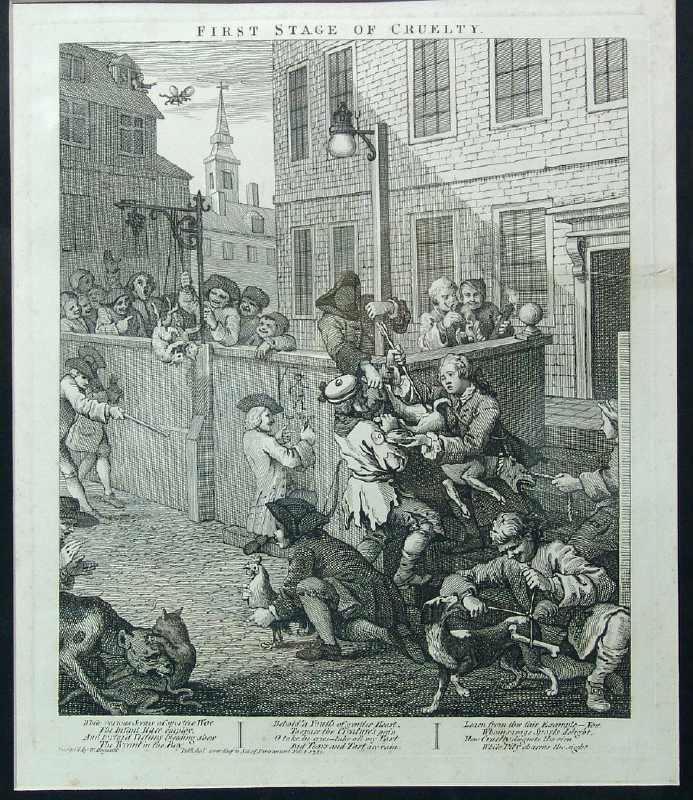
    Before the abject pussification of the world through animal welfare regulation, there was a time when a man could bring his wife and children out on the town for an exciting evening of the finest blood sport. Perhaps as ritualistic payback for the all the millenia Homo sapiens sapiens and to spend huddling in caves, naked and afraid, hiding from roaming beasts,  from at least the time of the Roman venatio, for much of human history, entertainment meant seeing some animal get crushed or disemboweled, because fuck animals. This article recounts four such bad-ass entertainments, now lost to us, that could return in a more (g)libertarian world.

    Cock Throwing

    “Cock Throwing” is currently just what jesse.in.mb calls “Tuesday”; however, cock throwing was once also a popular British pastime until the early 19th century. The game was brilliant in its simplicity: a rooster is tied to a pole and then people throw sticks at it until it dies. A variation of cock throwing was basically “hit the piñata,” but with a live chicken instead of papier-mâché and blood and viscera instead of candy. Regardless of this, according to historians cock throwing was quite popular with children. Cock throwing was also a hallowed ritual associated with Shrove Tuesday, because Jesus Christ demands the blood of chickens offered in sacrifice.

    Goose Pulling

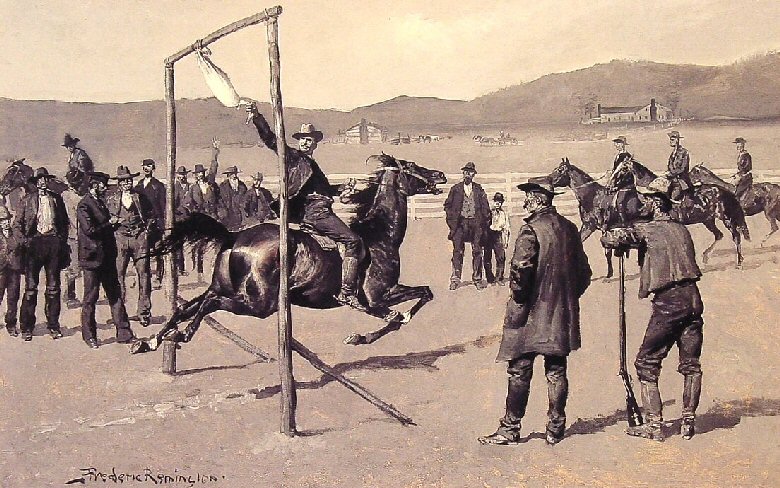
    While originating in Spain, until about 150 years ago, goose pulling was the favorite sport of the Dixie. George Washington and Thomas Jefferson most likely participated in goose pulling. Indeed, contemporary reports detail that a goose pulling was one of the few social events in which the entire spectrum of society, from slave to plantation aristocracy, could be found participating together.

    “A Gander-Pull” by Fredric Remington (1894)

    So, just what is goose pulling? As further evidence that Christianity is actually a demonic cult focused on blood sacrifice and cannibalism, as part of Easter celebrations, a live goose with its neck greased was tied to a pole so that it hung head-first over a road. Competitors on horseback rode through the road at full gallop while attempting to pull the head off the goose’s body. Sometimes, obstacles would be placed on the path. According to one account, riders had to ride through a gauntlet of whips on their way to the pole. Spectators would bet on the proceedings and drinking copious amounts of whisky was expected.

    In the United States, goose pulling would fade into obscurity after the Civil War. Thanks, Lincoln!

    Fuchsprellen

    A pic from the last Glibertarians meet-up

    As evidenced by their pornography, the Germans are fucking lunatics. As it turns out, such lunacy has a long and storied tradition. Fuchsprellen, or fox tossing, was a popular sport among the aristocracy of Europe during the 17th and 18th centuries. Fox tossing involved using a giant slingshot to launch foxes and other animals into the air. Whoever tossed the animal the furthest won. Of course, you can imagine it wouldn’t be easy to keep a snarling, scratching and biting fox in place for long so that you could send it flying to its doom. Despite that, expert fox tossers could launch an animal 24 feet into the air. According to Wikipedia’s article on the sport, “Augustus II the Strong, the King of Poland and Elector of Saxony, held a famous tossing contest in Dresden at which 647 foxes, 533 hares, 34 badgers and 21 wildcats were tossed and killed. Augustus himself participated, reportedly demonstrating his strength by holding the end of his sling by just one finger, with two of the strongest men in his court on the other end.” Whereas goose pulling was seen as a test of one’s manliness, fox tossing was considered a fun party game where couples paired off to compete with one another.

    As if death by slingshot wasn’t indignity enough, sometimes the animals would be decorated with “bits of cardboard, gaudy cloth and tinsel” as part of a masquerade.

    Good ol’ boys and their punkin’ chunkin’ ain’t nothing but pussies.

    Human-Baiting

    If goose pulling was the national sport of Dixie, then baiting was the sport of Victorian Britain. Baiting involves pitting a pack of dogs against a chained animal in a fight to the death while spectators bet on the outcome. Pretty much every combination could be found, bear-baiting, bull-baiting, duck-baiting, etc.. And since we’ve all wondered who would win in a fight, 10 toddlers or 1 pit bull, it wasn’t long before someone had the idea to pit a human versus a dog to find out. In 1807, The Sporting Times reported on one such human-baiting match:

    A fight between a man and Bull Dog took place some time ago to settle a bet. With its first charge the Bull Dog already succeeded in throwing and pinning its opponent. Although the dog’s jaws were nearly closed by a muzzle, it succeeded in sinking its teeth into the man’s body. Had the dog not been pulled away immediately, it would have disemboweled the man.

    If this depiction is to scale, the outcome is understandable:

    Not content to let the collective honor of our species be forever sullied, other human vs. dog deathmatches were organized. In 1874, a dwarf who went by the name of Brummy, agreed to fight a bulldog named Physic on account of a bet to prove Brummy’s claim that “no dog could lick a man.” The fight went 11 rounds, in which Brummy suffered several deep bite wounds to his arms, and the dog received so many blows to the head that it lost 2 of its teeth and one eye was swollen shut. Brummy won by knockout.

    Another account of human-baiting comes from 1892, where a man by the name of James Oxley went 22 minutes against a dog named Crib. As one of the many previous lives of Mike Tyson, in this incarnation, Crib won the match by jumping over Oxley’s left shoulder, clamping on to his right ear, and slamming him to the ground. Oxley forced the dog to release his grip through a choke-hold, but at the cost of the upper part of his ear.

  • Expats in Korea Get Drunk, Gamble. Evan Wins Cash, Bitches

    It’s funny how everything illegal is universal. Drugs, gambling, prostitution. Making a law to fight it doesn’t snuff it out. It’s just a reality. It’ll be done somehow, someway.

    I live in Daejeon, South Korea. I went north to Seoul to see my friends off for their going-away party. It’s about an hour away on the fast train.

    At the bar we banter and celebrate our friends’ imminent departure. Shockingly fast, the games began.

    강남스타일

    My friend took out five dice and tossed them onto the pool table. We’re gonna play Threes. I didn’t know how to play but learned fast. Skin in the game incentivizes immediate understanding. You roll the dice up to five times. Low score is the winner. Every roll you have to keep at least one die. A three is worth zero and everything else is face value. A score of four is respectable and under is gravy.

    We started out low stakes, a buck a player. The rounds came and went, winner taking seven or eight per. One game went particularly long—twenty bucks to me. I’m up $15.

    We ratcheted up. Buy-in went from a buck to ten. It really is remarkable how the changing stakes heightens your focus.

    We’re not high-rollers. We’re poor-ish English teachers. Every game now is worth close to $100. Green notes stacked on the felt, this is serious money for us. And I hate losing.

    I lost a few rounds and was very near to bowing out. I throw ten bucks in anyway. I played conservatively and won the pot. Eighty bucks to me.

    That was the end of my line, for the most part. I had to float my friend $20 for two bets and enough-is-enough after they raised the stakes to $20 a roll. I later learned that one of the players was a bit of a gambling addict. The Madness had set in as I wisely stepped out. I became an accepted spectator. The last few games netted the winner something like $180 each.

    The bar turned a blind eye to all of this. They were excited for the business. The game was organic and started of its own accord. The people who wanted to play flocked to the table and those that didn’t did not. People who didn’t want to put money down still could watch and bought drinks to entertain themselves whilst vicariously living through our wallets. No one gave a shit. It was glorious.

    It struck me during the game how we all instantly agreed to the rules. People came together to play a stupid game for a shot at making some money. And those that won and lost understood that the rules to play were arbitrary. But they were agreed to. If it’s arbitrary for one and all then it’s not so arbitrary after all. A beautiful system with no leaders, no kings—simply a mutual understanding between blokes, a glint in the eye for some weekend cash.

    We self-regulated. There was no muscle involved, but we all understood that if someone tried some fuckery, there were plenty of eyes and arms to make sure the money didn’t flee unjustly. Having money on the felt makes one very mindful.

    No police; no guards; no threats; no violence; no force. Just fun.

    I ended up $26 even after I gave the twenty to my friend. Damn good in my book, paying for the entertainment and festivity for three hours and still ending up in the green. Another fun foray into the life of “sin” that people wrongfully cast shade upon.

    At least half of the fun is the seediness of it all. Adrenaline and cash naturally make up the rest. That’s what the government can’t ever learn: That which is illegal is inherently desirable. Tell people that they can’t do something and a portion of the population is going to say “Fuck off” simply to thumb their nose.

    I know I do.

    It was a beautifully organic experience. Out of sight from the law, and everyone regulating each other voluntarily. Curious how that seems to work out.

    And I’m still in the green.