Category: Subsidies

  • Socialized Sports: A Microcosm of a Diseased Ideology

    There are a thousand examples that could be used to show the rot caused by the invidious tenets of socialism in our sports these days. The most illustrative, in my opinion, is that of IndyCar. For the first 75 years of the Indianapolis 500, the race and the supporting series were based on a free-market-style “run what you brung” model, resulting in a rich and storied tradition. Stories of turbine cars, diesels, close finishes, and 1000 HP rocketships on wheels echo through from the past. Before NASCAR, the various iterations of Indycar (CART, USAC, AAA, etc.) were king in the United States. Until the late 90s, IndyCar was a half-step behind Formula 1 for international popularity.

    Today, IndyCar is circling the drain. They had a race in Phoenix last weekend with 7,000 attendees and a few hundred thousand, at most, watching on TV. Why such a precipitous drop from rivaling F1 to now being on the brink of failure? Beyond the basic ineptitude and competitive failures that doom any venture, the problem can be summed up in one word: socialism.

    In the early 90s, CART (as IndyCar was called at the time) was king. Names like Unser, Andretti, and Foyt were touring North America, racing custom built race cars in front of packed stands. The Indy 500 would have 350k+ on hand for the annual culmination of a monthslong celebration of speed. Most years, certain qualifying days would have well over 100k people on hand. In 1994, the fastest qualifying speed was a hair over 228 MPH. Today, almost 25 years later, the cars do the same speed, the crowds are down and the hallowed Month of May has become a week and a half.

    Then, in response to escalating costs and a perceived shift away from the small-town American dirt track racers to foreign racers in the F1 minor leagues, the owners of the Indianapolis Motor Speedway started the IRL, which based its operating model on a top-down financing of the racing efforts of smaller teams. There are a bunch of other factors in the decadal decline of IndyCar, including a split into two series, series-wide emphasis on safety over speed, and the rise of NASCAR, but the biggest factor was the susceptibility to the allure of socialism.

    In the attempt to contain costs and attract smaller teams, the IRL and, later, IndyCar continued with two core principles that will sound familiar to all of you who are versed in the language of the socialist. First, IndyCar established a phonebook’s worth of technical regulations meant to curtail engineering costs. This resulted in the last 10+ years being run with a single allowable chassis each year. They have allowed limited competition in the engine, suspension, and aerodynamics, but the days of building your own mousetrap are over. Second, IndyCar established what’s called the “Leader’s Circle,” which is an alternative to the traditional purse system. Instead of the winner getting a zillion dollars and last place going home with a pittance, anybody who runs a certain percentage of the annual schedule is paid a salary for each full-time race car run, and winners are given a nominal sum as a prize.
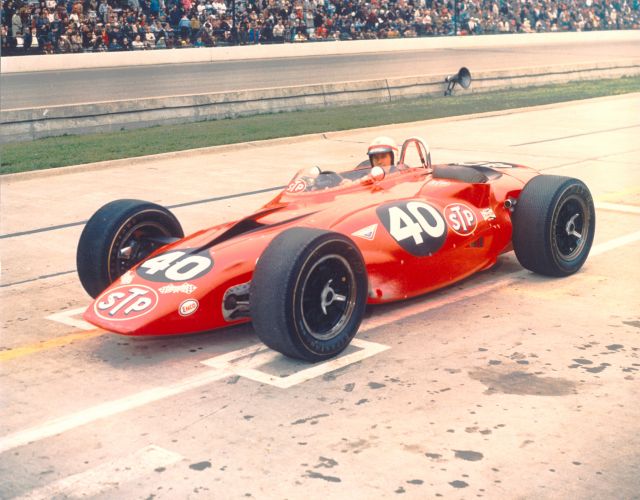
    As can be easily predicted by those of us familiar with the stories of Soviet Russia, Venezuela, Cuba, and North Korea, IndyCar has been suffering from poor racing, fewer teams, fewer race cars, and an utter collapse of the fanbase. Besides a single day per year burning off 75 years of tradition, American Open-Wheel Racing is on life support. Of course, these are “bad economic times” and “motorsports is on a decline” and “we can’t afford competition.” The excuses have been flying since 1996 when they first headed down this path. Every half-hearted, feeble attempt to introduce a market influence is quickly undone. The toe in the water is withdrawn as soon as they realize it’s wet.

    The path to success is simple and quite obvious. Undoing 25 years of stupid will hurt, but, as Venezuela is figuring out right now, the pain is inevitable. IndyCar will wither into nothing unless it reintroduces the competitive spirit of the free market into the sport. The excuses of the boot-lickers in the sport are all based on some nugget of truth, but IndyCar isn’t failing because motorsports are unpopular or because the economy is bad. IndyCar is failing because socialism is more than just painful to live under, it’s also painful to watch.

    It’s sad to see such a great tradition go down in flame, but these days even our sports act as a cautionary tale against socialism and all its variants.


  • Modeling U.S. Energy Policy

    Part One

    “The fact that the polynomial is an approximation does not necessarily detract from its usefulness because all models are approximations. Essentially, all models are wrong but some are useful. However, the approximate nature of the model must always be borne in mind.”

    George Box*

    • Modeling U.S. Energy Policy
    Professor Tomain

    By observing the impact of the Carter and Regan administration’s reciprocal attempts to affect national energy policy with a historical understanding of the FFCA as the genesis of Federal energy policy, we develop a model of energy policy in terms of legislative goals. Then, with an appropriate model, we are able to undertake realignment toward new political ends. Fortunately, much of the heavy lifting has been done via Professor Tomain’s “Dominant Model of United States Energy Policy,” a handy tool to explain past and current trends in energy policy and regulation.[1]  Inherent in this model are the economic assumptions that: 1) the Gross National Product (GNP) is linked to energy production, and 2) economies of scale in energy production are achievable.[2]  These assumptions are well supported, in as much as energy is necessary input for Gross Domestic Product (GDP) growth, although the direction of causality between energy production and GDP growth has been difficult to ascertain and appears unidirectional for certain periods.[3]  Importantly, these two assumptions suggest a national energy policy which “favors large-scale, high technology, capital-intensive, integrated, and centralized producers of energy.”

    According to Tomain, the Dominant model has six goals, but, for our purposes, these are better distilled into two primary objectives for the lawmaker: 1) ensure an abundant supply of both primary and secondary energy 2) ensure reasonable and stable prices for energy.[4]  There are many legislative options to achieve these objectives, but only a few selections appear to be currently supported.  Consider, as evidence, the other goals Tomain identifies as complimentary mechanisms: i.e. limiting market power of large firms, promoting competition between fuels and between producers, generally subsidizing only mainstream energy sources, and allowing for both federal and state control of energy policy.[5]  Whether legislators identify these as the means to the end of stable energy prices and abundant energy supplies or as ends – in and of themselves – has determinative impact on what objectives are actually achievable.  If the real objective of Federal energy policy is to achieve carbon free energy independence in the United States, then a transition to non-carbon primary energy sources is a necessary condition. Policy ends which limit market power of firms, allow for decentralized control, increase competition, and subsidize current producers would, therefore, sit in conflict with that objective.

    • Contemporary Legislation Does Little to Support a Transition Toward Energy Independence

    For all the talk of an energy independent or carbon free future, the most recent series of energy policy acts, the Energy Policy Act of 2005, the Energy Independence and Security Act (EISA) of 2007, and the American Recovery and Reinvestment Act (ARRA) of 2009, all conform to the Dominant Model.  The Energy Policy Act of 2005 contains significant subsidies and incentives for traditional carbon primary energy producers.[6]  Coal producers receive $1.6 billion of assistance.[7] They receive a further $1.7 billion for upgrading generation equipment and emplace advanced combustion processes.[8]  Oil and gas producers are offered large production incentives and suspensions of royalty payments.[9]  Tax incentives are provided to an array of carbon primary energy including coal projects,[10] oil and natural gas,[11] and biofuels.[12]  All in all, some $85 billion of appropriations and relief is provided for in the acts with the bulk of funds directed at carbon based primary energy producers.[13]  This support is consistent with Dominant Model goals of subsidies for mainstream energy, promoting abundant energy supplies, favoring large producers, and large capital projects.

    Several steps omitted

    The EISA, by attempting to promote competition between fuels and between producers in order “to move the United States toward greater energy independence and security” and “increase the production of clean renewable fuels” with hopes to secure secondary energy supplies, is predicated on Dominant Model goals.[14]  To achieve these goals, the EISA adopts the dual mechanisms of emplacing production quotas for carbon dependent biofuels and subsidizing US biofuel producers to the point that blending biofuels with traditional fuels becomes affordable to consumers.[15]  Unfortunately, this does nothing to address the very real difference in the costs of production between biofuels and traditional fossil fuel producers.[16]  Setting aside the questionable economics of biofuel subsidies, foreign oil producers will remain profitable at price levels where expenditure for biofuel subsidies is politically unjustifiable.  It is also important to note, by focusing legislative effort on biofuel, the EISA targets sources of secondary energy without addressing the primary energy input inherent in the manufacture of biofuels, the origin of that primary energy, or the conversion rate of primary energy to secondary energy.  Without looking at primary energy sources, there is little hope of any affecting energy independence through legislative means.

    Fortunately, both the Energy Policy Act of 2005 and later amendments added by the ARRA do make efforts at addressing primary energy.  For example, the 2005 Act eased certain requirements of the federal licensing process for hydroelectric dams.[17]  The 2005 Act extended and enhanced tax credits to ‘renewable’ primary energy sources such as hydropower, wind, solar, and geothermal.[18] Importantly, the 2005 Act sets an objective of “increasing the conversion efficiency of all forms of renewable energy through improved technologies.”[19]  In support of this objective, the 2005 Act provides $2.227 billion for “renewable energy research, development, demonstration, and commercial application activities.”[20]  These provisions are buttressed by the ARRA which amends Title XVII of the 2005 Act to provide an additional $6 billion of loan guarantees for renewable energy projects.[21]

    Furthermore, the 2005 Act provides support for the largest alterative producer of non-carbon primary energy, in the event of construction delays caused by regulators or by litigation, by extending funding to builders of nuclear generating stations to cover regulatory costs.[22]  Additionally, the 2005 Act sets aside $1.25 billion for a prototype hydrogen generating nuclear reactor and reauthorizes the limitation of liability on nuclear plant operators provided under the Price Anderson Act.[23]  Between the 2005 Act and the ARRA, some $41.7 billion are allocated across energy markets and technologies with the bulk of subsidies going to the largest producers.[24]  While stimulus helps shift the competitive landscape to make minor producers and alternatives to carbon primary energy more attractive to consumers, the allocations are simply too diffuse to tip the balance in favor of any producer or technology thus preserving the current competitive landscape.  This outcome suggests achieving energy independence entirely on non-carbon sources using policy and legislation keeping with the mechanisms of the Dominant Model will be ineffective and will require a reordering and rebalancing.  Owing to the favorable economics of oil prices under the Dominant Model it appears that US energy independence “is more a political slogan than an actual policy objective.”[25]  If however there were sincere efforts at achieving energy independence in the US what might they look like? We will explore this question in our next installment.


    * George Box and Norman Draper, Empirical Model-Building and Response Surfaces 424 (1987).

    [1] Joseph P. Tomain, The Dominant Model of United States Energy Policy, 61 U. Colo. L. Rev. 355, 355 n. 4 (1990).

    [2] Id. at 374-75.

    [3] The authors note, unsurprisingly, that the differing results are influenced significantly by the differing regulatory environments.  Jaruwan Chontanawat et al., Causality Between Energy Consumption and GDP: Evidence from 30 OECD and 78 Non-OECD Countries, SEEDS 113 (June 2006), http://www.seec.surrey.ac.uk/research/SEEDS/SEEDS113.pdf; see also Eden S. H. Yu and Been-Kwei Hwang, The Relationship Between Energy and GNP, 6 Energy Economics 186 (1984).

    [4] Tomain, supra note 1, at 375

    [5] Id. at 375-76.

    [6] Energy Policy Act of 2005, Pub. L. No. 109-58, 119 Stat. 594 (2005).

    [7] Id at  § 401.

    [8] Id at § 3103.

    [9] Id at § 341-57.

    [10] Id at § 1307.

    [11] Id at § 1321-29.

    [12] Id at § 1342-47.

    [13] Michael Grunwald and Juliet Eilperin, Energy Bill Raises Fears About Pollution, Fraud, The Washington Post (Jul. 30, 2005) http://www.washingtonpost.com/wp-dyn/content/article/2005/07/29/AR2005072901128.html.

    [14] Energy Independence and Security Act of 2007, Pub. L. No. 110-140, 121 Stat. 1492, 1492 (2007).

    [15] Id at § 201-48.

    [16] Jonathan Kingsman, Oil Price Fall Adds to Biofuel’s Woes, The Financial Times (Jan. 9, 2015), http://www.ft.com/cms/s/0/22bbd5ba-975f-11e4-be9d-00144feabdc0.html#axzz3csqAQnGr.

    [17] Energy Policy Act, supra note 6, at § 241.

    [18] Id. at § 202-03.

    [19] Id. at § 931.

    [20] Id.

    [21] American Recovery and Reinvestment Act, Pub. L. No. 111-5, 123 Stat. 115, 140, 145 (2009) (codified as amended 42 U.S.C. § 16516).

    [22] Energy Policy Act, supra note 6, at § 638

    [23] Id. at § 601-10, 645.

    [24] American Recovery and Reinvestment Act of 2009, Wikipedia (May 23, 2015), https://en.wikipedia.org/wiki/American_Recovery_and_Reinvestment_Act_of_2009#Energy_infrastructure; Energy Policy Act of 2005, Wikipedia (Sept. 23, 2014), https://en.wikipedia.org/wiki/Energy_Policy_Act_of_2005.

    [25] The Oil Drum, China Energy Outlook: China’s Energy Strategy for the Future, Oilprice.com (Nov. 18,2012), http://oilprice.com/Energy/Energy-General/China-Energy-Outlook-Chinas-Energy-Strategy-for-the-Future.html.

  • Why You’re Wrong about Healthcare

    There are few things in the world more frustrating than talking to average people about healthcare, but surely one of them is talking to fellow libertarians about the problems with our healthcare system.  This goes beyond frustration with the typical libertarian infighting.  Part of it is that there are so many things terribly wrong with our healthcare system, any libertarian can point to most any aspect of the system and find some legitimate confirmation that their favorite peeve is, in fact, a problem.  However, even though there are numerous contributing factors to our healthcare woes, there is one evil to rule them all—but very few libertarians seem to understand what that is.  The purpose of this analysis is to identify the ultimate cause of our problems, show why most libertarians’ favorite solution doesn’t really address it, and show why the Ryan plan is a hell of a lot better than most libertarians seem to appreciate.

    What the Chart Does and Doesn’t Say

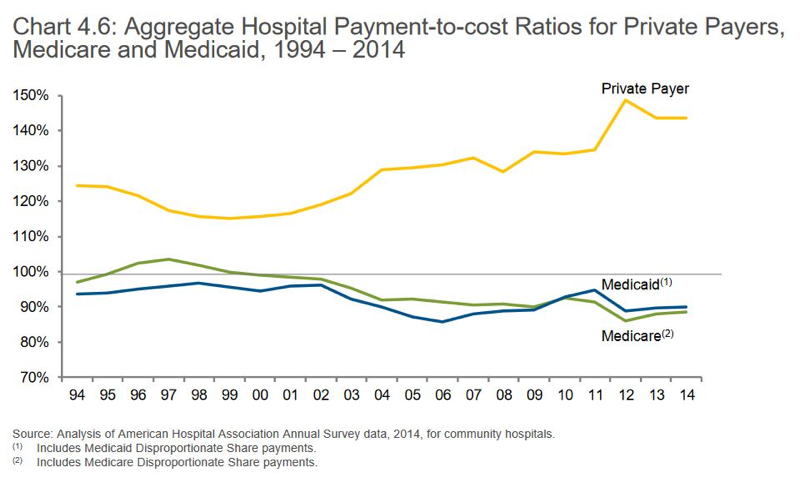
    So, here is the ultimate source of the problem—Medicare and Medicaid only pay for a fraction of the cost of care.  Providers are left to gouge private insurers and out of pocket patients for all the money they lose treating Medicare and Medicaid patients.  According to the chart, hospitals are charging private pay patients about 150% of cost.

    There are two major implications of this that people don’t generally appreciate.  More charts would probably only make things more confusing, just understand two things: 1) Medicare and Medicaid patients are more expensive than private pay patients, and 2) the unfunded costs of Medicaid aren’t evenly distributed across the country.

    What the hell does that mean?

    • Medicare and Medicaid patients tend to cost more than private pay patients. People on Medicare are older and need more in the way of expensive treatments—heart surgeries, terminal illnesses, etc.  Poor people on Medicaid, likewise, tend to have more babies, more health problems, and may generally be more expensive to treat than private pay patients.

    So, don’t be confused by the averages in the chart—Medicare and Medicaid are covering 85% of the costs (on average), but they’re also covering more expensive costs.  In other words, if the average private pay patient goes to the hospital once a year for an MRI scan, when the insurer pays 150% of that relatively small cost, they’re reimbursing that provider for the tens of thousands of dollars the provider lost performing heart surgery on someone with Medicaid or Medicare.

    • The unfunded costs of Medicaid are not evenly distributed, and that points to another problem caused by Medicare and Medicaid only reimbursing providers for a fraction of the cost of care. Medicaid is for poor people, and poor people aren’t evenly distributed in your city, much less your state.

    Hospitals are like retailers in that they serve a local community and that community has a particular income level.  If the hospital is in an area with a disproportionate percentage of poor people, then there are few private pay patients in that community on insurance to make up for the shortfall.  That means where the chart says that the average private pay patient is paying 150% of cost vs. Medicare/Medicaid’s 85%, it assumes that the patient mix is the national average.

    In other words, if the hospital is an area where the local population only has 10% private pay patients and 90% Medicare and Medicaid patients, then that 150% percent of cost figure for private pay patients is going to be much, much higher–and those kinds of patient mix numbers are not uncommon in urban poor areas.

    Sensitivity Analysis

    The part where you all get mad at me!

    Usually, a sensitivity analysis would show how taking the Medicare and Medicaid reimbursement rate up higher would impact the local cost of care.  This sensitivity analysis is more about how the system would improve relative to various solutions.  How would doing x, y, or z improve the situation?

    For instance, wouldn’t the system be better if individuals and insurers formed the market instead of getting insurance through employers? I suppose it would be better, but that solution doesn’t address the real cause of the problem.  Insurers would still be competing to sell you a policy that covers 150% of the cost of care (national average).

    What about removing the “Cadillac” tax, getting the AMA to stop limiting class sizes of nurses and doctors, making pricing transparent, or making policies portable across state lines?  Without getting into too much detail, transparency and portability are extremely complicated because of Medicaid, and even if those things were possible—what would any of them do about the fact that insurers are still paying 150% of cost (national average)?

    Solutions

    I suppose a lucid progressive might suggest taxing productive workers to take Medicaid’s and Medicare’s reimbursement rate up to 100%, but 1) raising people’s taxes so they can afford to buy insurance is just playing an especially stupid shell game with costs, 2) Medicare and Medicaid spending already make up almost a third of the federal budget, 3) the Medicare rolls are already set to increase as baby boomers continue to retire, and 4) that might be an extra $300 billion a year in real payouts—something like the size of our national interest payment.

    The ultimate solution is to cut these programs.

    Medicare is more politically sensitive, and Medicaid is especially responsible for driving up the cost of private insurance in economically distressed areas.  Certainly, rolling back the ObamaCare Medicaid expansion is a necessary step before we can cut back the rest of Medicaid—and did you know there is a plan being considered in Congress, right now, that gets rid of the ACA Medicaid expansion after 2019?

    Whatever else the Ryan plan isn’t, it’s one of those rare situations in which the actual cause of the problem is actually being addressed.

  • Medical Mondays – “The Meaning of Fear…” (Part 1 of 2)

    The thyroid. Parathyroid. Bilateral axillary. Breasts and the areolas. Almost the entirety of the abdomen – stomach, liver, spleen, intestines, and pancreas. Rectus & tranversus abdominis. External & internal obliques. Linea alba & umbilicus. Inguine. Rectum & anus. All of these within my domain and scope of practice. I am a general surgeon, FACS; qualified in bariatrics, robot assisted and minimally invasive surgery (MIS), and primary care with emphasis on underserved rural communities. I have also been on-call for ER surgical, and served as alternate house physician for a large, privately run, Independent & Assisted Living/Skilled Nursing retirement facility. I have practiced medicine for almost 17 years, including surgical residency. With the exceptions of two teenaged food service jobs and one (mercifully brief) stint as a rental car call center rep (“Try Harder”? Whatta crock!); medicine is what I know.

    The uterus. Cervix. Fallopian tubes. Ovaries. Babies, intra and post partum. Colpus, internal and external. The kidneys. Ureters. Bladder. Testes. Urethra. My wife is also a physician; her scope of practice is just as vast, yet in very different areas. She is a dual specialised medical surgeon, trained and served at the behest of state and private medical agencies. She has been sent to many places in Eastern Europe and Asia, including cities in her ancestrally native Ukraine, Belarus, Russia (she was born in Kamchatka in Russia), and Chechnya, for medical missions (some of them in declared zones of conflict), and has practiced for a little over 13 years. Her childhood dream was to be a professional ballerina to see the world, and has worked entirely in the medical field. She was also the captain of her chess team during her medical training, and was a champion level competitor (a rather sore winner, she is; and, an exceptionally sore loser, to boot). Her father, a high ranking military officer, specifically encouraged her to study medicine as a way to serve her country without military enlistment.

    The job of a physician is very simple: To diagnose and treat disease. Simple, yet so very complex. Made even more complex by the very people we strive to help, and often worsened by those ostensibly charged to help them on their behalf, moreso those in the public sector, but the private sector can be just as frustrating. What we hope to accomplish in this series is to pull back the curtain and give you an idea of what we do and our respective points of view with regard to practice and overall ethos that informs our respective approaches to care.

    For example, I am of the firm belief that medical care is not an inherent, plenary, human right. Period. Full Stop. End of Story. I own my skills totally, and determine who and who does not receive them. This is, of course, subject to contract at the pleasure of an employer and/or third party payer, though I will inform them upfront that there are certain non-negotiable lines that simply won’t be crossed.

    My wife, who for now shall be referred to as Zhena Groovova (Жена Грувова – literally, “wife of Groovus”), her views were and are informed by the fact she has witnessed the dissolution of the Soviet Union, The Orange Revolution in 1991 (Ukraine’s Independence), and, most recently, The Maidan Revolution and subsequent Donbass Invasion in 2014 (we had the poor fortune to witness that one firsthand in Donetsk, and will most likely include medical experiences from that time). She received almost all her training in Ukraine post-independence, as when it was part of the Soviet Union, the job of the country was to make planes and tanks, grow wheat, and educate doctors and train nurses (Soviet Command Economy). She believes that basic medical care access is an inherent, plenary, human right, though the physician determines the limits of his or her labour by right of education and station.

    Suffice it to say, we do believe that, regardless of system, payment scheme, and even patient demands, we own our education and skills – there are ethical and personal lines we simply will not cross. Many of our anecdotes and reflections will stem directly from these competing philosophies.

    That said, the types of things we’ll cover in Medical Mondays and Супер Среда (Super Wednesdays) are:

    1. The lighter things, such as humorous patient anecdotes, medical education bloopers and blunders, and intra-office pranks (Of which there are legion; ever put SuperGlue on the Med Students’ pens and clipboards, or saran wrap the Charge Nurse’s desk?);

    2. “A Day in The Life,” and other fly on the wall vignettes, providing answers to the oft wondered, “Why is everything taking so long,” “Do you ever go to the bathroom,” “With all the gross stuff you see, how do you even have a sex life?” “Are your kids your personal lab rats?” “How do you get along with other doctors?” “How much sex and sleaze goes on in a hospital?”;

    3. More contemporary issues with regard to medical freedom, such as: records privacy in the digital age, licensure, billing, Charity Care, the roles of rising adjuncts like ARNPs, PAs, and Allied Health (like respiratory therapists, pharmacists, medical technologists, and paramedics/EMS), scope of practice, continuity of care, tele-medicine, robotics and autonomous bots, regulations, DNA and heredity, charting and dictation, “know-it-all-WebMD patients,” and other unique stressors for us that patients don’t ever see, and so much more from the doctor’s perspective;

    4. The much more serious side of medicine, such as how we deal with: patient deaths; stillborn births; preemies; birth defects; performing a surgical abortion; going to jail for freedom of conscience and religion; assessing possible sexual assault & completing a rape kit; industry drug abuse; being sued; the worst and most gruesome ER cases; war injuries, crimes, and pathologies; when to remove, and removal of, life support; attending patient’s funerals; having the Jonathan Kent/”Superman” moment (“All these powers, why couldn’t we save them?”) and other extremely emotionally draining, personally destructive, and unpleasant aspects of medicine, where no one asks what we feel or think, how it affects us and our psyches, or has never even given it a first thought, forget a second one. “Prick us, do we not bleed”?

    5) Solutions to the current medical care delivery woes, and how both technology and human conditions can improve it; conversely, addressing legal liability costs and concerns in this almost literal, Post Mendelian, “Brave New World.”

    What we don’t want is some run of the mill malady/cure column extolling the virtues of folk remedies (though many work, actually), nor throwing abstracts in your face a la Pub Med Ninjas. The InnerToobz is already bursting at the seams with advice columns; if you are hoping for a column on which is better, Vick’s Vap-o-Rub v. Lamisil, for toe fungus, BORING! (FTR, Vick’s is cheaper, no side effects, OTC, and takes not much longer than Lamisil. Wash and dry your feet, apply Vick’s to the cuticle for about three weeks. Trim nails as needed. Works wonders for thick, cracking toenails, too. OK, we may throw in a few tips…)

    The other thing we ask: Be respectful to us. We hope many of you will like us, some find us an absolute scream, know others will find us about the level of watching paint dry, know some will (and do already) hate us, and know most hate the systems as they are. If we see such comments such as, “PERMISSION SLIP!”, “CARTEL!”, “GUILD MAN!”, and other stuff we already know grinds your gears, we’re out, and we will take down our posts and comments with them.

    OMWC and SP, and The Founders here, gave us this forum out of the goodness of their hearts to entertain and educate, not be punching bags and pinatas. We get enough legit abuse to last many lifetimes over. We are here for you, but won’t hesitate for a second to keep you at arm’s length – the time we spend with you, is the time we could be spending treating paying patients, making filthy doctor lucre, and spending time with our three children…

    Our greatest fear, at this moment, is failing to meet your expectations.

    *Hangs Up “Out” Shingles*

    Be Well.