Category: Technology

  • UnCivil Reviews – Dawn of War III

    Hello, my name is UnCivilServant, and I have a problem with Plastic Crack – I simply don’t have enough time to assemble and paint the thousands of dollars worth of miniatures I’ve acquired. But that is not important right now. What’s important is that the latest entry in the long-running Warhammer 40k video game series Dawn of War has recently dropped. The first entry was released way back when I was still in college, and I own the whole set. It was the gateway by which I took up the tabletop game. Entries came out fairly regularly until Dawn of War II: Retribution. After which things went quiet, and the publisher THQ went bankrupt. Not because of Dawn of War, but because the people running the company were a bunch of gits.

    For those of you unfamiliar with Warhammer, here is a quick exposition dump of backstory. In the beginning, there was a company that made miniatures for fantasy roleplaying games. Citadel looked at their books and went “We need to find a way to sell more miniatures.” Someone had the idea of writing a ruleset to fight tabletop battles with their miniatures. And thus Warhammer Fantasy Battles was born. People who wanted to have bigger armies would have to buy more miniatures, and most of their existing stock could be worked into the product line. At some point around here, Citadel changed their name to Games Workshop but kept the brand for some of their products, like paint.

    So they looked at their books and said: “We need to find a way to sell more miniatures.” Someone had the idea of “Let’s do more Warhammer, but IN SPACE!” And so Warhammer 40,000 was born. Being the eighties, there was a lot of cocaine-fueled insanity included, including outright rip-offs of other works given a new coat of Citadel paint, and it was good. Over the years they fed the Space Dwarfs to the Space Bugs and introduced the Space Weaboo Communists, but it developed an aesthetic distinct and yet familiar.

    So they looked at their books and said: “We need to find a way to sell more miniatures.” Someone had the idea of licensing their totally original and not a shameless amalgam of ideas to these newfangled video game producers. After all, gamers were the same geeks who buy their main product lines, so there was money to be had. And if there is anything Games Workshop likes, it’s money. Dawn of War was not the first of these titles. But it is a contender for having the most entries. It depends on how you count expansions and DLCs.

    Let’s get to talking about this particular entry.

    I open it up and find out that the opening cinematic was used as the announcement trailer. Disappointing, but it’s still fun to watch an Imperial Knight knock a Wraithknight off its feet like a linebacker that took a wrong turn and broke a referee in half. And then it asks me to either sign in to or create a Relic account. Being an antisocial git, I refuse and see if there’s a way to ignore it. Fortunately, this proved to be optional, and it hasn’t asked me again. Finding out there was a tutorial, I decided to start there. I always play the tutorial missions as it gives me an idea of the developer’s attitudes. We start out telling some Blood Ravens to wander about.

    After bossing around the generic, nameless tactical and scout marines for a bit, I get told to summon Gabriel Angelos to the battle. Gabe first appeared way back in the original Dawn of War. Where he proceeded to make an awful mess of things that the Imperial Guard had to come in and clean up. To be fair, he did try to make things right, but he got beat down by the mess he made. But since he was the last Captain left not interred in a Dreadnought or self-demoted to the chaplaincy, he became Chapter Master by default. Anyway, we teleport him in and he arrives wearing a shiny suit of Cataphractii armor – and he’s freaking huge! Now Cataphractii armor is bulky, but this is not Cataphractii big, he’s the size of an original XBox. Compare him to the regular tactical marines:

    I mean his head is bigger than their helmets. He’s supposed to be able to wear that same armor.

    I thought maybe this was part of the new visual direction for the game. Make the hero units bigger so they stand out. But here’s the Eldar hero:

    She’s the same size as the rest of her people.

    Maybe the artists Relic hired mistook Gabe for an Ork. Orks do allot authority by size, so it’s perfectly reasonable for Gorgutz to be three times the height of the boyz around him.

    This Git – Gorgutz

    Since I brought them up, let’s talk about the Space Elves and Space Orks. The Eldar are like politicians, they lie and change sides so much that no one trusts them. They’ve even been known to lie when the truth would have worked better. They also have a tendency to get eaten by a Chaos god after they die, so it evens out. The Orks are the exact opposite. They are direct – engineered for fighting they’re happy to fight anybody, including each other. There is one batch of Orks stuck on a Daemon world that gets resurrected each morning to fight an eternal battle against the native inhabitants. They’ve gone to Orky heaven.

    A thousand words in and I now get to the game proper. Outside of the fact that Gabe is fuckoff huge and somehow able to make giant leaps in Cataphractii armor (a suit which in the tabletop has the special rule “Slow and Purposeful”), I haven’t yet really had much to complain about. The first real irritant was in finding that you get one active campaign at a time. To start from scratch you have to delete the existing one. But there is not much reason to do so, since you can replay levels at will, and your advances are independent of the campaign. Indeed you can even get them through skirmish and multiplayer games. This still irritates me. It means that if you have a computer shared between more than one person, they don’t get to keep separate save games and thus separate progress. I don’t personally have this problem now, but I remember when I did.

    Anyway, on to the campaign. The next irritant is that it is only one unified campaign that rotates between factions. It had started with the cycle “Space Marine – Ork – Eldar” but on chapter seven, it skipped Space Marine and went to Ork. So I’m not even sure if there is a pattern. You can’t play just a Space Marine campaign or just and Ork campaign. The story bounces around between the factions and you have to play the other guys to unlock the next mission for your chosen group. Fortunately, it doesn’t pretend to be anything but linear. Despite being called a “Campaign Map” in the game, here is what pops up:

    The units depicted change by which faction the selected mission is for.

    Each of those flags is either a mission color coded to the faction or a cinematic. It’s not so bad since they admit it’s linear and don’t try to pretend otherwise. The interface remains consistently meh as we progress through the mission briefing to choosing which elite units we’ll be able to deploy.

    I have no idea where this room is.

    The screen is not terribly intuitive, and it took a while to figure out how to unlock the other elite options for each faction. Definitely a place for improvement. We’re finally to the gameplay proper. Base building is back, but there is a dearth of defensive turrets. And they screwed up the cover system. I didn’t want to complain about the bubble system, but there’s not even an in-game excuse for capturable cover locations. Earlier incarnations had dynamic cover systems where objects on the field could be used depending on where the enemy was. Now you have to capture a cover point, and it soaks up some incoming ranged damage. Anything else on the battlefield is just there to obstruct movement. Bolt shells will fly through it without a problem – for the shooter at least.

    The basics are stock standard RTS mechanics, with the attempts to be “more tactical” in terms of unit special abilities. The problem is the actual fights degrade into blobs of combatants. Figuring out who was in the correct position to use a special ability tactically is not terribly straightforward, so it ends up being hero abilities and items like jump packs for mobility assists. Personally, I don’t take umbrage at it, as even in earlier iterations I found that problems went away when locally overwhelming numbers were applied to the enemy positions.

    Why yes, I am an Imperial Guard player in tabletop 40k, why do you ask?

    The story is well, no more or less deep than other Dawn of War titles. The voice acting is middle of the road to decent. The change in voice actors for Gabe from the previous game is the most noticeable. But it’s not that the new guy is doing anything wrong, he just doesn’t sound right. In all, the game is just all right. The worst thing I can say about it is that it was too easy to get up and walk away. There have been times where I’ve had to call into work on the day after a release because I got hooked and could not rip myself away. There was no risk of that here. Given the addictiveness of other entries, this is a bit of a letdown. A low mark in the franchise, but not beyond salvation.

    I give it seven of ten skulls for the skull throne.

  • Space Law

    Space is big. You just won’t believe how vastly, hugely, mind-bogglingly big it is. I mean, you may think it’s a long way down the road to the chemist’s, but that’s just peanuts to space.

    Douglas Adams, The Hitchhiker’s Guide to the Galaxy

    Of all the great adventures that humanity can embark on in the near future, none has captured the popular imagination quite like space exploration. Since before the time that humanity launched the first artificial satellite, we have dreamed of what it might be like to set foot on other worlds. Where dreams lead, however, the bureaucrats are sure to be lurching close behind. Passing judgment and crafting policy has long been the pleasure of the professional statist. In man’s adventure into space, such a creature was given a rare gift: A virgin field, unframed by any law save those of nature. Before even the first V-1 was launched, there were those who contemplated both exploration and policy.  Theodore von Kármán, one of the founders of Aerojet, an early rocket company, had this to say in 1942, just after the incorporation of the company, “Now, Andy, we will make the rockets – you must make the corporation and obtain the money. Later on you will have to see that we behave well in outer space…After all, we are the scientists but you are the lawyer, and you must tell us how to behave ourselves according to law and to safeguard our innocence.[i]” There were, at that time, no laws on the books to describe allowable action, inactions, and responsibilities that would accompany space flight. But in the next two decades, such a field would develop.  Andrew Haley would be one of the main crafters of space law[ii], even coining a term for it, ‘metalaw.’

    The laws that would be crafted were largely a creation of their time when the UN was paralyzed between cold warriors. As such, they are imbued with a certain neutrality and compromise. The most famous and overarching of these regulatory documents was the 1967 ‘Outer Space Treaty.’ This treaty laid down some basic conventions which are still honored today, such as Article V forbidding the placement of WMD’s in orbit, on the Moon, or in any sort of stationary platform or satellite. There are gaps, though; the treaty mentions WMD’s but not conventional weapons, so in theory, orbital bombardment is still allowed. Another gap in the treaty, one that is becoming increasingly relevant, is the use of resources in space. At the time the treaty was written, the idea of commercial entities who could perform their own launches or exploit resources was inconceivable. Now there are at least eighteen competing commercial space companies. That’s only counting ones working on launch vehicles. There are many other companies that specialize in other areas and more being created every day. That would come as a grand surprise to the many bureaucrats who were stuck in a binary view of policy, who could never imagine advances beyond what they saw before them. Even more pressing today: the treaty does not allow any nation to claim territory in space. The moon, asteroids, and all other stellar bodies are seen as communally owned and for the benefit of all mankind[iii].  That might come as news to the several space mining companies that are looking to exploit the potential trillions of dollars of precious metal and rare earth elements that are locked in the numerous asteroids in the solar system[iv].

    Indeed, as much the way that regulators were unable to predict the rise of disruptive technology online or in new media, they were equally unable to foresee the rise of a whole industry based around the idea of exploiting the resources present in the solar system and beyond. In attempting to placate the powers of the time, they left no room for innovators to build on the fantastic possibilities of space exploration. This has meant that those who wish to dream of riches from beyond the world must go to antiquated documents written in a time before we had even set foot on the moon. Even when the push against regulation comes, one must also wonder how hard the early pioneers of space exploitation will try to close the door behind them in order to throttle competition. In a truly free market, companies would not have to go hat in hand to the national regulators to get launch permission, then comb the international laws looking for a loophole to exploit in their quest for mineral exploitation. Rather, it would only be a matter of capital investment and an entrepreneurial spirit that would lead the way. Of course, as the race for asteroid wealth increases pace it is certain that some enterprising person will find a way around the laws, even if it means approaching their state looking for succor to reach around international regulations.

    Space is big, but governments currently control the sky that separates us from heavenly riches. There will undoubtedly come a time when the exploitation of space resources becomes a common practice. It is important for the allies of economic liberty to push for the reforms needed to open up a truly free market, so when that success comes, it will be that much harder for the bureaucrats to take the credit for the success that their laws would have nearly strangled in the crib.

    ________________________________________________
    [i] Andrew G. Haley (1963) Space Law and Government, page xii, Appleton-Century-Crofts
    [ii] Daniel Lang and Brendan Gill (December 29, 1956) The Talk of the Town, “Metalaw”, The New Yorker, p. 19
    [iii] Jennifer Frakes, (2003) The Common Heritage of Mankind Principle and the Deep Seabed, Outer Space, and Antarctica: Will Developed and Developing Nations Reach a Compromise? Wisconsin International Law Journal, 21, at 409
    [iv] Webster, Ian “Asterank” Asterank

  • Wednesday Afternoon Links

    It’s Wednesday afternoon and your favorite contributor (I AM your favorite, am I not?) is taking an unusual turn at the helm of the Afternoon Links. I promise this will have 93.76% less hunky content than my normal posting.


    Alliterative assertions allay apostatic angst
    Proper Papal palace
    • TED Talks 2017 is officially a techno-rite church service in communion with the Roman Papacy (I was hoping they’d join up with the Pope in Exile in Avignon, but apparently that’s not a thing anymore, so whatevs). CNN summarizes, “Essentially, he told the academics and innovators, scientists and techies, there is no ‘you,’ without an ‘us.’” full transcript with link to the ~20 minutes sermon talk here.
    • Jeff Goldblum is planning to reprise his role as Dr. Ian Malcolm. The internet responds with a vexing amount of genital moistness, which confuses this author, but I’m certainly not going to yuck someone else’s yum.
    • Side of English beef, Ben Cohen, may soon be single. His professional dancer lady love wants a Hollywood career, but he wants her to stay in jolly ol’ England. *tidies cave, polishes club* I’ll be right back.
    • Passenger found dead after United flight from Heathrow to O’Hare. Passenger was rabbit on track to be a world record holder for size, owner was a former model turned rabbit breeder. Fuck it just click through it’s all weird.
    • Serge Brin apparently wishes he was as interesting as Sir Richard Branson and is “reportedly building his own secret airship,” which “apparently looks like a classic zeppelin.” While it isn’t partying naked with my favorite ginger prince on a private island, we at Glibertarians welcome our Steampunk zeppliney future with open arms and freshly brushed top hats and polished monocles and brass doodads.

      Go 'way, touching myself inappropriately while dressed as a Victorian dandy
      Not pictured: Brin’s airship
  • UnCivil Doesn’t Like Anything – DRM

    Intellectual Property is a thorny subject around here. I have trouble discussing it from an abstract philosophical standpoint because I have a financial stake in the matter. Being a content creator, I like knowing there is legal recourse if someone began reselling my work or passing it off as their own. How likely this is to ever happen is unknown, and it is far more likely there will be pirated copies running around instead. It is the issue of content piracy that is central to my complaints today. Early copyright law was essentially an avenue of redress for content piracy, though when the concept was introduced, making additional copies required more of an investment of resources than it does now. As such, purveyors of pirated works would have to sell them to recoup their investment.

    With the insignificant marginal cost of digital copies, the financial element has largely receded into an equally insignificant fraction of the market in pirated content. However, the perception of lost revenue remains. Since the people who are doing the copying are difficult to track down and often have little in the way of money to extract, large content distributors have to look elsewhere to assuage their fears. Thus they invest ludicrous sums in Digital Rights Management technologies. DRM to anyone who doesn’t want to write out the whole darn thing every time. The premise behind DRM is that it will increase the opportunity cost to the pirates with regards to the additional effort required to make a usable or viewable copy.

    There is just one not so tiny problem with this theory. With no financial gain from a successful crack, the motive for pirating has to be something else. Opportunity cost does not exist when the pirates tackle the task of cracking DRM for the challenge of breaking it. As a result, DRM technologies have ended up being measured in time to crack, with the presumption that they will be cracked and that this delay is the window of exclusive profits for the distributor. However, this does not hold true when the content market is examined. The content most commonly associated with DRM is video games. A number of publishers have re-examined the premise upon which the use of DRM has been predicated. They have distributed some of their top titles without DRM ‘protection’ and found no loss in sales. Surprisingly, the user base is still more than willing to pay for quality content from their favorite development houses. Most of the people who pirated these games were either never going to buy them in the first place or could not afford to. And the dubious protection of DRM was worth less than the cost to implement or license it.

    This piece was not inspired by video game DRM, however; it was Amazon’s streaming video DRM requirement. As a paying customer (both a Prime member and someone who’s bought digital video content through that marketplace), I have a contractual right to view the content I’ve paid for. The problem is, I am morally opposed to DRM. I do not like the idea of someone with a (metaphorical) boot on my back telling me what I can and cannot do with the copy I have purchased just because someone, somewhere, might try to distribute it for free. The irony is, after my spat with the computer screen, I ended up going to the pirates to get a copy of the content I already paid for because it was easier. What is the point when the people you are trying to shut out not only get the content on the day of release but provide a better customer experience?

    On a personal note, for as long as I have the option, none of the digital versions of my books will have DRM. If I could, I would also disable it on the audio versions, but Amazon does not give me that option. I’m not terribly worried about pirated versions wandering about. In fact, if someone asks nicely, I’ll usually give them a copy with the only caveat being ‘let me know what you think’. How does this mesh with the statement at the beginning? Well, as I said, digital pirates don’t typically sell it and don’t tend to change the credits.

  • What Does the BBC Call “Serious Crime” Anyway?

    According to an article published by the BBC, Technology behind ‘all serious crime’, per analysis of a report by Europol, the European Union’s law enforcement agency. It ought to come as no surprise that a rise in technology us–in general–should correspond to a rise in tech-savvy criminals. However, what categories of crime were covered by the report itself, and is the headline of the piece warranted or sensationalized?

    I'm not saying it's ninjas, but it's ninjas.
    Europe’s depiction of the culprits.

    What did the report include as serious crime; murder, rape, human trafficking? Only the third category was mentioned in the report at length but didn’t make the BBC’s summary. The BBC focused on increased technology use to facilitate burglaries, black market drug trade, and ransomware.

    For instance, said the report, drones were now being used to transport drugs and many burglars now track social media posts to work out when people are away from their home.

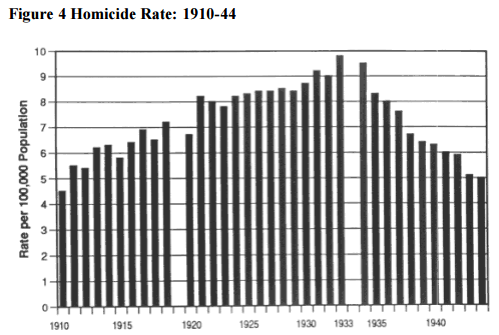
    It’s long-established libertarian doctrine that the violence related to the drug trade accompanies resistance to the enforcement of laws prohibiting drugs. Mark Thornton’s analysis of alcohol Prohibition (a fair proxy for comparison) in the United States published by the Cato Institute, described it as a “miserable failure on all counts.” His analysis includes a graph of homicide rates depicting a steady rise during the Prohibition era and the precipitous drop in murders after Prohibition’s repeal in 1933.

    Can anyone say, 'unintended consequences'?
    Source: Cato Institute Policy Analysis No. 157: Alcohol Prohibition Was a Failure, pg. 7.

    Given libertarians’ stringent belief in self-ownership and the fact that drug use itself is a victimless crime, drug addiction cannot be rightly called a “serious” crime. Exchange of contraband items, provided that no people are exploited or otherwise harmed in the exchange, is similarly not of a serious nature.

    It stands to reason that with the rise in the use of drones, or quadcopters as many aficionados prefer to call them, for drug delivery, one might expect an accompanying decrease in drug-related violence. Fewer contacts between human beings–drug traffickers and law enforcement as well traffickers with one another–may correspond to fewer homicides to protect drug profits kept artificially high by prohibition.

    An increase in home burglaries corresponding to use of social media to determine times when the victims are unlikely to be home is concerning, and invasion of homes are of a more serious nature than petty thefts and shoplifting. However, it also seems reasonable that a decrease in violence due to burglars encountering residents unexpectedly may occur. Property crimes are, of course, of a less serious nature than homicides and other forms of physical violence. An investigation is required. An overall rise in burglaries may also negate any reduction in burglary-related homicides, should the rise in technology use prove causative for the increased rate of burglaries.

    Much of the Europol report focuses on organized crime activities that facilitate drug trafficking and further organized crime (e.g. document fraud, money laundering, etc.), which strains credibility to characterize as “serious” in their own right. The intersection between technology use and human trafficking may have been omitted from the BBC’s summary for a reason. Europol’s 2016 situation report, Trafficking in human beings in the EU, did show a rise in reports of human trafficking, but it doesn’t necessarily demonstrate an increase in human trafficking itself. In that report, Europol says:

    No distinctive trend in this variation of data was recognised as linked to any particular fact. A possible reason could be that Europol is increasingly being addressed by MS law enforcement for the provision of operational support during cross-border THB investigations.

    Thus, the rise may simply be an increase in reporting to Europol itself rather than a bona fide increase in human trafficking.

    The brevity of the BBC summary of the Europol report may be subtle justification for expanded law enforcement intrusion into citizens’ privacy under the pretense of reducing crime. The UK government has an interest in softening widespread hostility to the recently-implemented Investigatory Powers Act of 2016, or “Snoopers’ Charter” as opponents have popularly characterized it. The report itself doesn’t warrant that conclusion, as it is unclear whether technology use in crime is causative of the increase of crimes like burglaries or tracking a trend that accompanies higher immigration, drops in economic prosperity, and other factors known to influence crime levels. Too many issues are simply not addressed by the BBC article or Europol in its report to form any conclusions about whether technology use itself has increased serious crime regardless of the definition of “serious crime” they’re using.