Blog

  • Reviews You’ll Never Use: House

    Oh boy, where to begin with this one. Forgive me for running long, but this film deserves the digital ink.

    Let us start with this: if I were to receive some moderate sum of money, and be given complete creative control, House is the film that I would make. Please note that I am not necessarily saying this is a good thing.

    This also gives you a pretty good idea about how this movie is going to go, i.e. FUCKING CRAZY.
    Promo Image

    House is unlike anything you’ve ever seen. It’s a big (by the standards of late 70s Japanese cinema) budget art-house experiment horror-but-maybe-not-kind-of-black-comedy. To properly understand this film, you must ingest consciousness-altering substances. Drop some acid, rip as much as you can out of a bong 10 times, eat some mushrooms, get drunk, whatever you have to do to open your mind to the higher mysteries – just do it.

    Looking wistfully across the sea at the success of Jaws, in 1975 director Nobuhiko Obayashi was approached by Toho Films (makers of my favorite franchise, Godzilla) to produce a treatment for a summer thriller blockbuster. While only being a director of commercials, he was known as a creative eccentric who had produced films on the art-house circuit years before. Working with his friend Chiho Katsura, they quickly turned in a script for a haunted house film.

    The gag was, Obayashi had gone to his 10-year-old daughter and asked her for ideas of what frightened her. So impressed by the creativeness of what scares a little girl, he decided to treat the entire picture as if it was from the perspective of a young girl. This meant the inclusion of nonsensical plot elements, shallow archetypes, purposefully hokey effects and animations, all tied together with traditional Japanese ghost story elements.

    Toho green-lit the project and shopped the script for two years, but no director would touch it because they all thought it would ruin their careers. That’s how off the wall this film already was. Fearing that it would never be produced, Obayashi asked the studio if he could at least announce that it had been green-lit. They agreed, and the wild-haired filmmaker began a two-year media blitz to promote the film. He shot promo pictures with the cast, commissioned and released the soundtrack, and even had the film novelized and performed as a radio drama, all for a film that didn’t exist yet!

    That's a weird glory hole.
    So…that just happened.

    Eventually bowing to public pressure in 1977, Toho agreed to allow Obayashi to direct the film himself, even though he had only helmed commercials as a professional, and he wasn’t under contract with the studio (a highly unusual move for a Japanese studio to take at that time). His cast primarily consisted of a gaggle of 17-year-old girls who had been in his commercials previously.

    Without giving away too many details of the plot, our heroines Fantasy, Gorgeous, Melody, Mac, Sweet, Prof, and Kung Fu are slowly consumed by the house, as personified by its evil avatar, a fluffy cat named Blanche. We have an attack by a severed head from a well, which bites one girl in the rear, then vomits blood and throws itself back down the well. We have attacks by chandeliers, attacks by flying log piles, attacks by mirrors, attacks by cannibalistic pianos, attacks by futons and linens, and attacks by telephones. By the end, the house has regenerated itself, showing shades of Burnt Offerings, which had come out in the United States the year before (if you get the chance to see it, Burnt Offerings is a passable haunted house film mostly notable for being mediocre despite a fantastic cast including Oliver Reed, Karen Black, Bette Davis, and even a few minutes of Burges Meredith playing, shockingly, a curmudgeonly old man).

    The plot, though, is not the point of this film. This film is entirely focused on the telling, rather than the tale. The Austin Chronicle perhaps said it best, “there’s surprisingly little to recommend House as a film. But as an experience, well, that’s a whole other story.” We have scenes in which one character tells the others a story, which is shown as a sepia-tone film reel which the other girls can see and comment on. One girl describes a mushroom cloud as looking like cotton candy. There are animations, matte paintings, animals that are clearly being thrown at the actors from off screen, a man who mysteriously turns into a pile of bananas, and several scenes involving 17-year-old girl titties…sometimes disembodied and floating around.

    Obayashi went on to a prolific film career, and eventually in 2009 earned the Order of the Badge of the Rising Sun for contributions to Japanese culture. However, he never managed to match the beautiful insanity of his first effort. The film was a hit in Japan, due to being a breath of fresh air in a completely stagnant industry (by this time, most Japanese directors were churning out Toro-san rip-offs or pinku eiga, which is softcore porn).

    And yes, you get to see some of their little girl titties
    Our intrepid band of potential victims

    The Criterion Collection DVD has several excellent bonus features, including Obayashi’s 1966 experimental film Emotion, a lengthy interview with the director, and a retrospective by Ti West, director of House of the Devil. I had quite liked that film, but Mr. West comes across as somewhat of a smug film-school student spouting platitudes about “challenging the audience”.

    To sum up, I cannot recommend this film highly enough – if you’re a person like me, who takes most of your personal philosophy concerning the nature of existence from the Joker. If you’re a Very Serious Person who likes to Seriously Discuss Very Serious Things, and have a silly hang-up by which you insist that your films follow a coherent narrative structure and conventional character arcs, then…have an adventure and watch it anyway. But get really fucking high or drunk first. It’s worth it.

    I rate this film 8 drug-using dogs out of 10.

    Image result for crazy Image result for crazy Image result for crazy Image result for crazy Image result for crazy Image result for crazy Image result for crazy Image result for crazy

  • Thicc Thursday

    Shapely, Voluptuous, Bombshell, Stacked – in times past, this week’s selection would have been called by any of those.

    However, in these modern times, it is suffice to say that Ms. Vicki Li is thicc.

    https://www.instagram.com/p/5n1qVxlNIy

    https://www.instagram.com/p/5i0Ll9lNFl

    https://www.instagram.com/p/3Fy1ARlNIE

    https://www.instagram.com/p/1zfe2-FNCX

    https://www.instagram.com/p/BQteRy7B2NK/

    https://youtu.be/xGr7R53DqG4

    Bonus: Police Brutality

  • Thursday Afternoon Links

    I guess we’re going to do a sexy-link day to get everyone ready for Thicc Thursday.

    Does anyone else read that an OK state senator was caught paying for sex with a boy, and then find out the boy was actually a 17 year-old young man, that they may have been smoking the marijuana before hand, and the first question was to wonder if the younger man was of Mexican origin? Rep. Shortey, if you’re one of ours, please drop us a note in the Leads/Submissions and we’ll let you tell your side.

    Man, is the Tokyo Daily Star going to be popular here. First, a trip to where your Real Doll was made. Tell us which picture is your girlfriend.

    Born-Again Virgins? Sure baby. If you want to stay a “virgin” we can find other things to do.

    And just a tip to all you nonconsensualists out there — modern trunks have escape levers on the inside.

    Click thru for more fun
  • The New Iraqi Army, Take Two?

    It appears that the Iraqi Army is going to retake Mosul. It has been slow going, and they have had to use the US and other Air Forces (plus some ..um, irregulars) to finish the job.  How, after so many years of training and arming the Iraqi Army, did this state of affairs come to pass?

    First, a little background. The Iraqi Army at the beginning of 1979 was of respectable size, and it was fully equipped with Soviet export-grade equipment. Its doctrine and training were the usual crude aping of Soviet doctrine. Heavy reliance on numbers and artillery with tanks. Not very flexible and individual initiative was all but non-existent. The Iraqi Air Force was similarly Soviet armed and organized. The 8 year war with Iran 1980-1988 degraded this force significantly.

    Then the Iraqis really got their arses kicked. An exhausted and broken army faced the peak Cold War ready forces of the US, UK, France, and others. The results, in retrospect, were what should have been expected (I chuckle remembering Edward Luttwak and other “experts” warning that the “battle hardened” Iraqi Army would be a tough fight). Cut to a dozen years later, and they were in even worse shape – while their enemies were fielding even more advanced forces. What was left of the Iraqi Army was clubbed down, faded away, and the country was occupied in 2003. Long story short – this was not a history of success, no tradition of excellence, or a force that could adapt, change, and improve. So that was the situation when we decided to put a hand to it (or a foot in it, your choice).

    The new Iraqi government (2005 edition) started the rebuilding of the Army (and other branches) from scratch. With heavy US and Allied assistance, the Army started to build Infantry Divisions, and take over responsibility for more and more parts of the country. In 2008, the new Iraqi military faced its first major test – retaking Basra from the Jaish al Mahdi and various Iranian handlers and IRGC groups. The Iraqi Operation Charge of the Knights did not start off too well. One brigade, fresh from initial training and only partly equipped, was shoved into the fight too early and quietly saw 50% of its troops melt away. That is when it got personal…

    Yes, the Merlin pilot is going to sandblast you
    Welcome to scenic Mahmud al Kasim!

    I got sent from a semi-backwater, helping advise the Iraqi Army 10th Division, to advising the 14th Division (they were fighting in Basra). A handful of Brits, two Americans, and one Australian were going to give advice and do a little coordination with a company of US Apache helicopters and the British who were nearby.

    OK, that comes out to about 2,000 Iraqis each
    We few, we happy few

    The Iraqis brought in their best – the 1st IA Division (later renamed the 1st QRF – Quick Reaction Force) to join the 14th, some other bits and pieces, and a Brigade of freshly trained and equipped National Police (similar to European Gendarmerie). They also had the Prime Minister, Interior Minister, and various fixers show up to smooth over the sluggish supply situation (10 stamps and signatures to get ammo, 13 if it was 14.5 mm or higher).  It worked. Some really long hours, one really loud artillery barrage, several 107 mm rockets seeming to have my name on them, and meeting some Iranian prisoners later – Basra was cleared. A triumph, right?  Actually it was the peak and start of the decline of that iteration of the Iraqi Army.

    With simultaneous operations going on in Baghdad (Hi there, Sadr City!) and Basra – the Iraqis had really put the boot to internal enemies. The necessity of having this combat force, needed to protect against existential threats, began to pale in comparison to the drive to crony up the Army.  Before I left at the end of 2008, we were getting grumbling from authorities in the Kurdish area that the Iraqi Defense Ministry was replacing competent Kurdish commanders with crony Shias. The Sunni had a related beef that they were getting shut out of opportunities as part of score settling by the Shia dominated Government. Fuel, pay and supply pilferage, embezzlement, theft, and black marketeering had been a problem, even in 2008 (we used to watch the 10th Division get its fuel allotment and line up their own civilian vehicles, family members, and various connected or bribe bearing people to fill up in long line….then bitch they didn’t have enough fuel to conduct operations).  Without nosy Americans asking where things were, looking at records, and checking inventories, it went to pot – and don’t expect a fix to be fast.

    By the time we had (temporarily, as it worked out) left Iraq, the seeds of decline were starting to bloom. Once ISIS kicked their way into Iraq, the post-2003 Iraqi Army had become unable to hold a large chunk of its own country.

    After all this, the US looks like it will be back in the business of training the Iraqi Army once more. NOTE: This isn’t a “partisan” issue, as both Obama and Trump Administrations have committed.

    What is the libertarian take on this?

    The first reaction = “none of our business, goodbye.” Why should American taxpayers pay for training a foreign army? Internal squabbles on the other side of the world are not our business, nor our duty to settle.  A less hands-off reaction might be “better to train them than have US forces doing the fighting.” “ISIS is a threat to us, and they have made it clear they want to bring it everywhere – better to fight them over there, with locals, than wait for them to send the next truck to plow through a crowd, or some guys with nail-packed bomb vests take out a mall.”

    Practically speaking, it appears that the Iraqis have not yet made the commitment to maintaining a capable force, even if we do rebuild it yet again. If they want to have us train them – fine, pay for it completely. See you at Fort Polk for training and humidity! Come on, guys NTC should be like home! Same goes for equipment… All you can buy! But going to the US Taxpayer well, once again, is not a very palatable option.

    What are your thoughts, Glibs? In for a penny, in for a pound? We broke it, we fix it? Fuck off slaver? No, fuck you, cut spending?


  • When the Iron Laws Turn on Regulators

    The aggressive attempts by the Trump administration to dismantle one of their perceived political enemies’ power bases by the same “pen and phone” Executive Order fiat that substantially built that base is a fascinating example of RC Dean’s Iron Laws at work. Somehow the step-children of the Republican Party, the wallflowers too ugly to get asked to dance, ended up miraculously winning many a geek’s high-school fantasy. Nearly unlimited power and no reason not to take it out on their enemies. What happens when the people running the Executive Branch decide that the rank and file of many of the agencies they administer are the enemy?

    Well, you start by naming other Republican misfit/misanthrope types to run several departments that you believe are hostile to your cause. Putting an O&G guy in charge of the State Department, a Federalist in charge of the EPA, a voucher advocate in charge of the Department of Education, a black brain-surgeon who thinks that public housing stints should be brief in charge of HUD, and a man who once couldn’t even be bothered to remember the name of the Department of Energy (but knew he wanted to cut it) to direct it. Whoever is pulling the strings in the Trump administration, they did an excellent job of putting “qualified” individuals at the helm who wanted to wreck the progressive agenda that the type of people who use the words “Deep State” believe these agencies promote.

    After you finish setting out to sow confusion in the board room, you move on to proposing that a bunch of the rank and file (especially in departments you perceive to be most hostile) no longer work for you:

    He’s worried about the administration’s proposed 37 percent cut to the State Department, which he says would put U.S. diplomats serving abroad at risk.The Environmental Protection Agency, the Energy Department, the Commerce Department and the Department of Housing and Urban Development are also facing steep cuts. Foreign Policy reported Monday that the administration wants to cut funding for United Nations programs by 50 percent to 60 percent.

    But everyone knows that the type of middle-manager who carves out their own little bureaucratic fiefdom and burrows in like a tick on a dog is going to avoid falling to those cuts. They have to keep their job because they are the Deputy Assistant Director for Left-Handedness in Prairie Voles and that exists on an org chart, so they can’t be fired because who would direct that work? Anyone who has worked for a giant organization that has experienced organic growth knows that the only way to get rid of that type of person is a reorg. Oh wait, did someone say reorg?

     
    RC Dean’s Iron Laws are being used against the regulatory state here to great effect. Perhaps the one that seems to be biting most painfully is me today, you tomorrow. Presidents have been stretching the edges of their power since Washington, but in the current century it seems to have become particularly egregious. Driven by the combination of Congress’s ceding of statutory rule-making to the Executive Branch, the Chevron precedent in 1984 telling Federal Courts to side with administrative rule-makers at all costs, and the broad adoption of the computer, we have seen the Executive agencies under each president make regulations that constrain the ordinary citizen from engaging in just about anything. It is interesting to watch a populist who cares only for ratings and a bunch of people who have been marginalized in the Republican party for years suddenly find themselves using the power to dismantle parts of the state that libertarians dislike. Of course, they are also bulking up the parts that libertarians hate most. I don’t see a lot of love in the comments for the TSA and Border Patrol, nor much will to reinvigorate the military so that we can fight all the rest of the world at once, but that appears to be happening as well.


    The Trump Administration also appears to have taken the Iron Law you get more of what you reward and less of what you punish to heart as well. For both good and ill to the broad libertarian view. Rarely have we had the opportunity to experience the impartial laws of government work in any context that could even broadly be described as not entirely horrible. You might have to go all the way back to the Carter presidency to find someone who accidentally struck a blow for not quite as effective citizen enslavement. Trump’s administration will not be a friend of libertarians, but as long as the wind of “fuck government regulators” keeps blowing, he might be a slightly mitigated disaster.

  • Thursday Morning Links

    The caption wrote itself!

    Thursday.  Not only Thursday, but the least productive Thursday of the year.  Good luck if you’re participating in a basketball pool.  (I promised not to plug ours again here.)  Now let’s get down to business.

  • Weird Wednesday: Canadian Music Edition

    In 1998, I did some ecstasy but forgot that I had to work the next morning. This was a mistake. You aren’t really hungover after a night of X, but you are very, very, very tired. I was working in a college bookstore, stocking the shelves before the fall semester started. My friend Artie had gotten me the job. I really loved Artie, but he was a hippie and everyone else working there was a hippie except for me and this older lady who was always trying to start fights about religion with everyone. I managed to make it into work on time the morning after the ecstasy, despite a deep weariness and a headache that felt like a rat running around in my skull.

    The Smashmouth of Canada

    Since the store was closed while we stocked, we were playing music over the sound system. Hippie music. I was getting by, hunched over in misery, until this hippie girl decided to play a Barenaked Ladies concert bootleg. It was pretty bad, but then most loud music would have been pretty bad in the circumstance. I wanted quiet and a bed and an aspirin the size of a Frisbee. But then it got to the BNL masterpiece “If I Had $1000000,” which–for those who are unfamiliar with the twenty-minute live jam version–involves the two singers alternately repeating “If I Had $1000000…” back and forth to each other over and over again.

    “If I Had $1000000…”
    “If I Had $1000000…”
    “If I Had $1000000…”
    “If I Had $1000000…”
    “If I Had $1000000…”

    And my headache got worse and the books I was moving got heavier.

    “If I Had $1000000…”
    “If I Had $1000000…”
    “If I Had $1000000…”
    “If I Had $1000000…”
    “If I Had $1000000…”

    And my headache got worse and the books I was moving got heavier and anger rose in me.

    “If I Had $1000000…”
    “If I Had $1000000…”
    “If I Had $1000000…”
    “If I Had $1000000…”
    “If I Had $1000000…”

    And finally, I yelled, loud enough to drown out the music and for the entire store of employees to hear, “IF I HAD A MILLION DOLLARS I’D PAY TO HAVE THIS ENTIRE FUCKING BAND BEATEN TO DEATH WITH A HAMMER!”

    The bootleg tape clicked off and we worked the rest of the day in silence.

  • Wednesday Afternoon Links

    I don’t know about you all, but I love a good fuck you story. I’m not sure whether my favorite part is the guy getting the 27th Amendment passed in response to getting a C on a good paper, that his original teacher got shitcanned in the intervening years, or that the University engineered a grade change and trying to promote this as something they had a part in. Full disclosure, I am member of the U of Texas Former Students Organization — and I’m not giving them any money for this

    It looks like many of our commenters were right — Trump once again successfully played his antagonists in the news media into scoring an own goal. CNBC rushes to join in the kicking of their sister network.

    $200 drone shot down by $3M Patriot missile. Raytheon executives were seen high-fiving and ordering new yachts.

    In an ongoing local story, Tom Cruise has been trotted out to pave the way for the Church of Scientology’s takeover of Clearwater, FL. If only they had some sense of architectural style beyond… faux.

    Oh noes, yoga pants are killing the oceans. Goodbye, fish. I have made my choice.

    And speaking of oceans, it appears our Cthulonic majesties are wakening.

    Literally killing the oceans
  • Use This One Weird Trick to Create Your Own Monopoly

    By: We Are Tulpa

    The Good

    Why is it whenever critics discuss monopolies they rarely mention Google? You know Google, the company with a market cap of over $500 billion that controls around 80% of the search market, about 30% of the worldwide digital ads market, and provides its Android operating system to almost 90% of all smartphones used by roughly 25% of all websites, including this one! We can’t forget about the behemoth Apple either. They control 10% to 20% of the smartphone market at any given time, and are the most valuable company in the world! And when your Facebook friends unleash a screed against monopolies they ironically fail to realize that their message is made possible by a company that enjoys 42% of visits to social media platforms.

    How is it critics continue to ignore these monopolies, preferring to poke at other sores? Truth is, these are the good monopolies. From Amazon to Uber, many of these relatively new tech companies have achieved enormous gains over incumbents due to superior service to customers. Yet when Bloomberg blames monopolies for income inequality, worker exploitation, slow productivity growth and a lack of business dynamism (whatever the hell that means), they conveniently fail to discuss these good monopolies.

    Now I’m not saying the tech world is an ideal model for worker-employer relationships: In fact I think many tech companies, like Amazon, are screwing themselves long-term with their burn-out cultures; but these monopolies were elevated to their positions by doing it better than the rest, and that inconvenient truth destroys the “all monopolies are worse than Hitler” narrative often supported by the right and the left.

    As a quick note, I’m using the term monopoly to include monopolistic competition and oligopolies in addition to monopolies. Let the commentariat eviscerate any uncharitable pedants who fail to understand this.

    The Bad

    So why are consumer outcomes so bad in industries like finance, utilities, and healthcare? How is it that consolidation in these industries just seems to make things more painful for consumers, while tech monopolies have reached dominance by making customers happy?

    My Libertarian comrades may be inclined to say “it’s the regulatory environment dumbass” and they have a point. A free-market for internet providers would remove many of the regulatory obstacles to deployment. It would also reduce regulatory risk, or the uncertainty of future regulations that could instantly destroy the earning potential of a new billion-dollar internet provider. A recent example of this risk materialized with Net Neutrality, a policy which limits how internet service providers can respond to bandwidth hogs like Netflix. A free-market, or something close to it, results in lower barriers to entry and less regulatory risk, thus encouraging more competitors to enter the marketplace in a direct assault on entrenched bad monopolies. After all, it’s really not that hard to beat Comcast, if you have lots of cash and a fair playing field.

    However, while onerous regulations explain how bad monopolies retain their market position while providing terrible service, it doesn’t fully explain why consolidation is occurring in industries like healthcare. To understand that we have to add one more factor to our model of how bad monopolies are born…consumer irrationality.

    The Ugly

    Our journey to the center of government meddling in healthcare starts with this contemptible creation:

    The food pyramid was brought to life in 1992, thanks to the generous assistance of many food industry groups, and in the face of enormous criticism. Despite that, American’s seemed to jump on board with the “screw fats” and “carbs are good” recommendations it pushed: After the new guidelines were released the average calories from fat became significantly lower. Further, the pyramid influenced a wide range of policies and recommendations from meals in public schools, to dietary guidelines for expectant mothers.

    Today we know better. Fats are not an evil that should be avoided at all costs, and many experts are questioning whether saturated fats (long considered the worst of the worst) are actually linked to obesity or heart disease. Meanwhile, those glorious carbohydrates that formed the base of the mighty food pyramid have been sidelined in most modern nutrition programs.

    Back to the ’90s, after the government’s food innovation, something very interesting and entirely predictable happened. We got fat. Obesity rates begin to increase sharply in the mid to late ’90s. It was a perfect storm really. Nixon’s corn subsidies had reduced the price of corn products including high-fructose corn syrup. Food suppliers seized on this and offered cheap junk food. Then came the food pyramid, which told us massive intakes of carbs are a good thing. So whether you jumped on the cheap junk food bandwagon, the carbo-load bandwagon, or somewhere in between, your new diet was influenced by good ole Uncle Sam.

    Of course with rising obesity rates came rising rates of heart disease, stroke, diabetes, and more. Doctors advocated for taking in less fat and sugar to combat the problem. Cholesterol became a key indicator of your risk for many obesity-related diseases and cholesterol-lowering drugs.

    But were doctors targeting the wrong cause all this time? Several new studies have found no or negative relationships between cholesterol and heart disease. Plus, we already covered the growing body of evidence that saturated fats aren’t really bad after all. Of course, if true, it means that thousands of lives have been lost in preventable deaths, billions of dollars wasted, and many lives forever transformed because our favored solutions were about as useful as a Libertarian purity test.

    This begs the question how much influence did government nutrition guidelines have on health recommendations? How much did government actions contribute to the obesity epidemic? These are hard questions to answer, but they’re even harder when you’re not looking. Take a glance at some of the major websites weighing in on the obesity epidemic and you’ll be lucky to see a reference to corn subsidies. Don’t bother looking for the government’s promotion of terrible diet advice. Apparently, that bit of history has already been forgotten by most.

    Of course, this is the perfect opportunity for a Libertarian moment – a shining example that science and government policy should exist independently, not in direct reliance on one another. Don’t get your hopes up. Salon argues that the government’s newest food meddling innovation, My Plate, still over promotes carbs. But the apparent cause is we just didn’t have the right top men. HuffPo answers the gov food failings by pointing the finger at the evil food industry. After all crony capitalism isn’t a problem inherent in governance; the problem lies in capitalist actors using greed against the noble politicians. How can our great politicians resist the influence of these evil capitalists?

    This is our first glimpse of consumer irrationality: Reliance on government health guidelines and demanding more government to fix the problem it created in the first place. I don’t fault consumers for buying more corn-based products after subsidies were introduced. That’s perfectly rational behavior. But thinking big papa government has your nutrition covered, seems a bit foolish given it’s track record.

    The Uglyer

    Through the 1990s on, consumers generally preferred health insurance to paying for health care themselves. There is more history here including government exempting employer-based health benefits from income taxes and wage controls after WWII, but the point is consumers preferred health insurance and the employer-sponsored variety was especially appealing. Health care costs had been increasing disproportionately to inflation for decades, and health providers looked for ways to stay profitable. The answer…consolidation.

    The first major consolidation in health care occurred in the 1990s, followed by another wave in 2010 forward. Proponents of consolidation claimed it would reduce costs, result in a higher quality of care and improve the health of affected populations. Studies showed otherwise. Consolidation leads to substantial increases in price and evidence suggests it harms the quality of care. So what is the real reason for consolidation? Consolidation gives hospitals more bargaining power in a local market. In consolidated markets, fees increase anywhere from 20% to 60%. These fees are passed on to the insurer who in turn pass the cost increases on to employers or directly to enrollees. Contrast this with non-consolidated markets where participants cut costs since they lack bargaining power to simply raise fees. So basically consolidation is a way for hospitals to maintain profitability against a rising tide of regulation and cost increases.

    The Uglyerer

    The Affordable Care Act (ACA) helped along consolidation too. Some claim recent ACA-related consolidation was to combat regulatory uncertainty and that may be true, but many Ocare requirements directly contributed to consolidation and the elimination of small providers.

    Under Obamacare medical coding changed to the ICD-10 standard. This meant switching from a standard with 13,000 medical billing codes to a standard with 70,000! The shocking result… cost increases. Survey results show a wide range of implementation costs for small practices, anywhere from $8,000 to over $100,000! There is also continued controversy over whether the new coding will reduce or increase billing costs. Early results indicate a higher rate of claim denials and about 25% less productivity under ICD-10. Additionally, in a survey of 38 medical billing companies, three went out of business due to problems in implementing ICD-10. [Applaud here]

    Now, in all fairness, some of these ICD-10 codes are quite good. Imagine a group of healthcare professionals, sitting around a conference table, coming up with gems like:

    Bitten by a turtle – W5921XS

    Hit or struck by falling object due to accident to canoe or kayak – V9135XA

    Struck by macaw – W6112XA

    Hurt walking into a lamppost – W2202XA (Who would actually admit this?)

    Pedestrian on foot injured in collision with roller-skater, subsequent encounter – V0001XD

    Spacecraft crash injuring occupant – V9542XA (Seriously?)

    Burn due to water-skis on fire – V9107XA (Has this happened even one time, ever?)

    Struck by duck, subsequent encounter – W6162XD

    Hurt at the library – Y92241

    Sucked into jet engine, subsequent encounter – V9733XD (Twice?)

    Unspecified balloon accident injuring occupant – V9600XS (Does this include accidents involving OMWC’s “balloon animals”?)

    Hurt at the opera – Y92253

    Bizarre personal appearance – R461 (…you talk like a fag, and your shit’s all retarded.)

    Problems in relationship with in-laws – Z631

    Stabbed while crocheting – Y93D1 (Why not stabbed by crochet needle?)

    Prolonged stay in weightless environment – X52

    Unspecified event, undetermined intent – Y34 (I’ll bet this one gets used a lot in ERs)
    At least these people can do better than the SNL writing staff, so credit where credit’s due!

    Of course, a sane person would wonder why it makes a difference whether you were bitten by a Macaw or a Sea Lion; or whether you suffered injuries during the re-entry of your spacecraft or a hard landing in a hot air balloon. Why doesn’t coding simply focus on injuries and treatment because that’s kind of the basis for billing? But that’s why I’m not a medical billing and coding expert I guess.

    Other claims about ICD-10 include cost savings from fewer errors, due to the more “granular” coding structure. But that claim is a bit difficult to swallow as one would logically think adopting tens of thousands of more specific codes would result in higher error rates, not lower. ICD-10 is also supposed to reduce fraud by combating over-coding. If anything ICD-10 provides more opportunities to squeeze the system. A fraudster could use closely-related codes, and if called on the gambit, simply claim they didn’t understand the minor difference between one code and the other: A very plausible explanation given a catalog of 70,000 codes to sort through.

    Ocare also included mandates for electronic medical records. The average cost of implementation for a single physician practice is a lowly $163,765. There are operational costs too, not to mention the cost of replacement systems when the old ones outlive their usefulness.

    Aside from costs, the complexity of implementing electronic medical records (EMR) is causing some doctors to close their practices entirely, opting for direct or concierge pay. Meanwhile, many doctors that comply with EMR are getting burned out, spending time filling out useless forms, troubleshooting computer problems, and typing information into screens. The result is more time spent on compliance and less time with patients.

    Large hospitals haven’t been immune from headaches over EMRs either. It turns out that digitizing someone’s entire medical history and putting it on a server is going to attract hackers. In 2015, 253 breaches exposed 113 million patient records. The number of breaches increased in 2016 to 450, while the total number of compromised records decreased to 27.3 million.

    One of the big incentives for hackers to target medical records is the potential payoff. While a stolen credit card number may fetch $1 to $3, a stolen EMR goes for around $60! That’s because these records contain such a detailed and diverse amount of information that they can be used in all kinds of schemes. Personally, I find the hacking trend surprising, considering how knowledgeable health care administrators and staff are of IT security.

    It’s Bad

    In a bid to one-up cancer, the ACA included even more hits for the health care industry. One issue is non-payment by Obamacare enrollees. Doctors have faced difficulty verifying whether a patient with Ocare actually paid their premium or not. Office staff either have to spend upwards of an hour on the phone to try to verify a premium is paid, or take the risk of not getting reimbursed for care. This is all thanks to the 90-day grace period under ACA.

    ACA included hefty cuts to Medicare and Medicaid payouts too. The former had average payouts reduced by 21.2% while the latter faced a 42.8% decrease in average payouts. I bet you’ll never guess what happened next! Shockingly, many doctors stopped accepting new Medicaid and Medicare patients, or just outright refused patients with the offending coverage. But while the little guys were either stuck with lower payouts or saying no to patients, good old market consolidation provided a great way for the big guys to make up the shortfalls. In consolidated markets, hospitals simply passed the lost reimbursement fees on to private insurance. What a way to win: Government saves money from entitlement programs by passing it on to private insurance, thanks to consolidated markets, which they helped enable. Win-win!

    Of course, there was also the obligatory dose of crony capitalism in ACA, but hell, that doesn’t seem very important when weighed against the other effects. And no Ocare criticism would be complete without mentioning that restricting insurers from considering pre-existing conditions, increased costs for everyone. It effectively punished healthy people for those that treat their bodies like progressives treat a black Republican, but let’s get back to consolidation.

    So to recap, consumers push for health insurance which kicks off the first big industry consolidation in the ’90s. Health care costs continue to rise and the light-bringer gives us Ocare, which pushes many small providers out of the market, and fuels even more consolidation of the big players. But maybe you’re not convinced consumers were really acting irrationally here. After all, if your employer is going to cover half of your health insurance cost, isn’t that better than trying to pay in cash? No.

    Health insurance by its very nature increases cost. First, you are pooling risk so healthy people pay for less healthy ones. There is nothing wrong with this for catastrophic coverage if you share costs with other responsible parties. However, when you’re paying for my uncle who drinks nothing but diet Coke and Vodka, you’re wasting your money. Then there is the expense of medical billing and coding, claim processing, customer service, all sorts of other administrative costs, and then profit. When you accept health insurance, you accept all the expensive baggage that goes with it.

    There is absolutely no sane reason to have health insurance cover your regular doctor’s visit or a trip to urgent care to get checked out for strep throat! If more people paid in cash, everyone would pay less. Of course, I’m aware of the challenges in trying to go all-in cash in today’s marketplace. Many providers just don’t get it and will offer you little to no discounts for cash payments, even though creating an insurance claim is costlier. So that’s the mess rational actors have to deal with. But, it boggles the mind how many Americans cannot grasp this principle: Insurance does not reduce costs, it increases them. Use it for the bankruptcy-inducing stuff only! I think it’s time to end this mental exercise and replace it with empirical evidence.

    Exhibit 1:

    Salvation lies in Oklahoma City, just off the 77. This is where Libertarianism is winning hearts, minds, and wallets. The Surgery Center of Oklahoma boasts of a praiseworthy 4.4 stars on Google Places and big savings on many surgical procedures. The savings are so big that Oklahoma’s public employee’s insurance fund covers 100% of the cost of any procedure performed there. Take that insurance to a regular a hospital and you’ll pay the deductible and co-pay. That’s because the prices at area hospitals are so much more expensive, the state will still pay more even if an employee covers the deductible and co-pay!

    Exhibit 2:

    If you are godly or care to fake it, cost-sharing ministries offer huge savings! Under Medi-Share a 30-year old would pay only $132 a month for medical sharing with a $5,000 annual household portion (basically a deductible). If you meet their health requirements your monthly payment drops to $117. Meanwhile, your average bronze plan on Obamacare has an average deductible of $6,000, an out-of-pocket maximum of $6,900, and a monthly premium of $311. Want to take a step up in coverage? An Ocare gold plan with a $1,200 deductible and a $4,900 out-of-pocket maximum, on average, costs $460 a month. But if the power of Christ compels you to buy a cost-sharing plan with a $1,250 annual household portion, you’ll pay only $235 a month, $207 if healthy. Bear in mind with cost sharing plans once you hit your annual household portion, covered medical procedures are 100% covered. Under normal insurance, once you hit your deductible, you’ll have to pay something like 20% of all medical costs until you hit the out-of-pocket maximum. That means with cost-sharing, you are saving in monthly costs and saving on big procedures!

    In a rational world, consumers would look at health sharing ministries and ask what are they doing to get costs that low? But alas, this is not a rational world. Insert one tale of corruption and another legitimate contract dispute, both of which can easily be settled in the courts, and politicians scream “see we must regulate.” Professor Tim Jost of Lee University School of Law is particularly “concerned that you have people joining because they’re trying to find cheap coverage or because they’re ideologically opposed to the Affordable Care Act, or people who aren’t committed.” Oh, the horror. In fact, the health sharing ministry, Medi-Share, ran into problems operating in Kentucky. Apparently, the issue was that all users were paying into one shared fund. Medi-Share solved the problem by having people pay into their own individual funds and then transferring money between accounts to cover medical expenses. Good thing government was there to avert that crisis. Imagine the horror of using one account instead of tens of thousands, to manage the same money.

    In a rational world, consumers would demand catastrophic coverage or none at all. In rationale world, employees would swamp HR departments and managers demanding they cut out insurance and save everyone some money. In a rational world, people would completely reject Obamacare and demand congress to allow secular medical sharing programs. In a rational world, those with extreme health conditions that can’t pay would rely on the charity of others to cover their bills, not government force. Irrationality is all around us.

    For decades economists assumed real humans acted perfectly rational, but behavioral economics won that debate. Today, we have many examples of human irrationality. Sometimes, people just don’t do the math. It seems this is one of those times.

    I think it’s time for one last recap: So government contributed to the obesity epidemic, which increased health care costs and probably increased demand for managed health care (health insurance). The gov’s food innovations seemingly influenced doctors to use the wrong solutions which cost a lot of money and a lot of lives. Consumers irrationally continued to view health insurance as the best way to pay for health care, even though if they did the math, cash-based options and catastrophic plans would have left them richer. Hospitals responded to increased costs and increased use of health insurance through consolidation: Consolidation gave them the power to demand higher fees from insurers, which insurers passed on to employers and private insurance enrollees. With costs on the rise, and the masses all in for health insurance or free coverage, Chocolate Jesus gave us all the STD known as the Affordable Care Act. This resulted in health insurance cost increases and more consolidation. So now we have a lower quality of care at a higher price with fewer options. But before you belligerently swear at Obama on your front lawn, remember to give a shout out to all the pricks that never realized health insurance was a bad deal. If people would have preferred direct or concierge pay options, with a little bit of catastrophic coverage, our health care landscape could like a lot more like the Surgery Center of Oklahoma Center, and a lot less like Lena Dunham.

    Irrationally Libertarian

    Many of us accepted Libertarianism into our hearts through logic and rational analysis. It could be a pragmatic perspective that government top men are incapable of making better decisions than individuals and free markets; and have completely failed to move the needle in a positive direction on society’s biggest problems. Or perhaps it is a strategic approach: The realization that the best way to deal with conflicting conservative and liberal ideologies, each wanting to impose their own views on everyone else, is to maximize freedom for all. Or it could be a moral approach, based on the fundamental right that no man has the right to rule over another. The point is most of us are driven to Libertarianism due to rationality. Irrationality is our enemy.

    A good test of consumer irrationality is what I like to call the Walmart test: How many people complain about Walmart’s use of foreign labor, worker exploitation, and terrible customer service, but refuse to take their money anywhere else? This disassociation in cause and effect is a huge problem for Libertarians, as many of these consumers will then call on government to solve the problems in which they believe the oppressed consumer is powerless to address directly. This is the Achilles’ heel to Libertarian governance, an ever-present desire to create utopia through big government. For sustainable Libertarian governance to work, we must have buy-in from a critical mass of mostly rational actors that understand their dollars and time are votes in a free market! The case of health insurance consolidation shows us that most irrationalities don’t see less government as a solution; they simply want a different flavor of government solutions.

    With this in mind, Libertarianism cannot succeed by responding to emotional appeals and inane political rhetoric in kind. Instead, we must continue to support logic and rational thought. Only that will fully convert the unbelievers and help us build a rational barricade against bubbles and government intervention, as we march for free markets. Simply getting regulatory victories is not enough. If we could enact a limited government tomorrow, in line with the original intent of the Constitution, the backlash would quickly destroy our gains in freedom. The people are not ready for Libertarianism. Joseph de Maistre said it best, “Every nation gets the government it deserves.” If we deserved Libertarian governance, we’d have it.

    Now bow before the best-sourced article in all of Glibertaria! I assume my honorary degree from Columbia is in the mail.

  • What Does the BBC Call “Serious Crime” Anyway?

    According to an article published by the BBC, Technology behind ‘all serious crime’, per analysis of a report by Europol, the European Union’s law enforcement agency. It ought to come as no surprise that a rise in technology us–in general–should correspond to a rise in tech-savvy criminals. However, what categories of crime were covered by the report itself, and is the headline of the piece warranted or sensationalized?

    I'm not saying it's ninjas, but it's ninjas.
    Europe’s depiction of the culprits.

    What did the report include as serious crime; murder, rape, human trafficking? Only the third category was mentioned in the report at length but didn’t make the BBC’s summary. The BBC focused on increased technology use to facilitate burglaries, black market drug trade, and ransomware.

    For instance, said the report, drones were now being used to transport drugs and many burglars now track social media posts to work out when people are away from their home.

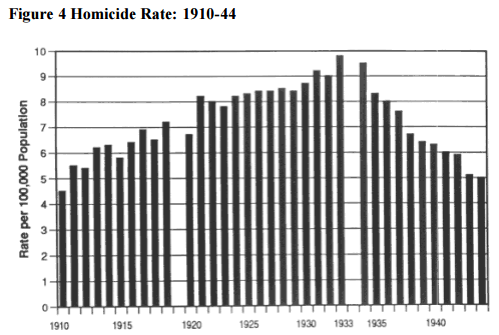
    It’s long-established libertarian doctrine that the violence related to the drug trade accompanies resistance to the enforcement of laws prohibiting drugs. Mark Thornton’s analysis of alcohol Prohibition (a fair proxy for comparison) in the United States published by the Cato Institute, described it as a “miserable failure on all counts.” His analysis includes a graph of homicide rates depicting a steady rise during the Prohibition era and the precipitous drop in murders after Prohibition’s repeal in 1933.

    Can anyone say, 'unintended consequences'?
    Source: Cato Institute Policy Analysis No. 157: Alcohol Prohibition Was a Failure, pg. 7.

    Given libertarians’ stringent belief in self-ownership and the fact that drug use itself is a victimless crime, drug addiction cannot be rightly called a “serious” crime. Exchange of contraband items, provided that no people are exploited or otherwise harmed in the exchange, is similarly not of a serious nature.

    It stands to reason that with the rise in the use of drones, or quadcopters as many aficionados prefer to call them, for drug delivery, one might expect an accompanying decrease in drug-related violence. Fewer contacts between human beings–drug traffickers and law enforcement as well traffickers with one another–may correspond to fewer homicides to protect drug profits kept artificially high by prohibition.

    An increase in home burglaries corresponding to use of social media to determine times when the victims are unlikely to be home is concerning, and invasion of homes are of a more serious nature than petty thefts and shoplifting. However, it also seems reasonable that a decrease in violence due to burglars encountering residents unexpectedly may occur. Property crimes are, of course, of a less serious nature than homicides and other forms of physical violence. An investigation is required. An overall rise in burglaries may also negate any reduction in burglary-related homicides, should the rise in technology use prove causative for the increased rate of burglaries.

    Much of the Europol report focuses on organized crime activities that facilitate drug trafficking and further organized crime (e.g. document fraud, money laundering, etc.), which strains credibility to characterize as “serious” in their own right. The intersection between technology use and human trafficking may have been omitted from the BBC’s summary for a reason. Europol’s 2016 situation report, Trafficking in human beings in the EU, did show a rise in reports of human trafficking, but it doesn’t necessarily demonstrate an increase in human trafficking itself. In that report, Europol says:

    No distinctive trend in this variation of data was recognised as linked to any particular fact. A possible reason could be that Europol is increasingly being addressed by MS law enforcement for the provision of operational support during cross-border THB investigations.

    Thus, the rise may simply be an increase in reporting to Europol itself rather than a bona fide increase in human trafficking.

    The brevity of the BBC summary of the Europol report may be subtle justification for expanded law enforcement intrusion into citizens’ privacy under the pretense of reducing crime. The UK government has an interest in softening widespread hostility to the recently-implemented Investigatory Powers Act of 2016, or “Snoopers’ Charter” as opponents have popularly characterized it. The report itself doesn’t warrant that conclusion, as it is unclear whether technology use in crime is causative of the increase of crimes like burglaries or tracking a trend that accompanies higher immigration, drops in economic prosperity, and other factors known to influence crime levels. Too many issues are simply not addressed by the BBC article or Europol in its report to form any conclusions about whether technology use itself has increased serious crime regardless of the definition of “serious crime” they’re using.