Blog

  • Do you really think we are going to pay for it?

    Hold on, Mom. I’ll be there as fast as I can.

    It has been said that the Y generation is the most selfish generation there ever was. The “Selfie” generation. Yet, this is one generation that is growing up to face one of the most burdensome public debt in history.

    A few years ago, after she watched some sad sob story on some Canadian Bs Channel, my mother (boomer born in the 50’s) complained to me that old people were left alone and that none of their many children ever came to see them in their old people’s home. Now I do love my mom very much (she can still drain the life out of you with her first world problems), but yet my first thought was “Well… maybe they deserved it. Maybe they screwed up their children so bad that those children don’t care about them anymore.”

    I kind of had the same thought yesterday when I watched this clip from Molyneux.

    He makes references about Y generations kids still living in their parent’s basement, and that the reason they are stuck in their parents’s basement is because their parents had the good life while shoveling public debt down to their kids. Now their kids are stuck with the bill and can’t afford a basement by themselves anymore.

    It led me to go back to my days working in finance and check how was the dear Regime des Rentes du Quebec going. (Quebec Social Security fund if you’d prefer).

    Sad to see. I’m pretty sure it’s the same for all Social Security types of regimes around the Western World. Those Social Security schemes are going dry as we speak.

    Denouncing this as a Ponzi Scheme is no news to any of the people hanging around here. I am well aware that you won’t need any new fainting couches.

    But, knowing all we know about the snowflake generation, do the boomers still think that the Y generation, their kids, that always bring the tab to them, won’t bring the tab to them once the funds run off? Do you really think the Y are going to pay for it? The X might, but if the Y won’t, no one else will. What will you do then, at 80?

    Now it’s the thing that makes me wonder the most about all the public debt accumulation. The boomers seem to think the younger generations will subsidize their lifestyle forever. I’m just a late X, early Y, and I have agreed in my life to play the card I was dealt with, but I can tell you one thing, I don’t think the Y will.

  • Millennials and Socialism

    Joel Kotkin at the Daily Beast has a new article up about Millennials: The Screwed Generation Turns Socialist.  And they appear to be the most leftward since the Great Generation.

    In this past election, those over 45 strongly favored Trump, while those younger than that cast their ballots for Clinton. Trump’s improbable victory, and the more significant GOP sweep across the country, demonstrated that the much-ballyhooed Millennials simply are not yet sufficiently numerous or united enough to overcome the votes of the older generations.

    Yet over time, the millennials —arguably the most progressive generation since the ’30s—could drive our politics not only leftward, but towards an increasingly socialist reality, overturning many of the very things that long have defined American life. This could presage a war of generations over everything from social mores to economics and could well define our politics for the next decade.

    And some broad political generalizations ensue about the voting patterns of the existing generations.  For the sake of brevity we will skip this and get right to the meat of the article:

    Millennials’ defining political trait is their embrace of activist government. Some 54 percent of millennials, notes Pew, favor a larger government, compared to only 39 percent of older generations. One reason: Millennials face the worst economic circumstances of any generation since the Depression, including daunting challenges to home ownership. More than other generations, they have less reason to be enamored with capitalism.

    These economic realities, along with the progressive social views, has affected their voting behavior. Millennials have voted decisively Democratic since they started going to the polls, with 60 percent leaning that direction in 2012 and 55 percent last year. They helped push President Obama over the top, and Hillary Clinton got the bulk of their votes last year. But their clear favorite last year was self-described socialist Bernie Sanders, who drew more far millennial votes in the primaries than Clinton and Trump combined.

    And Socialism – everyone’s favorite zombie ideology lives on:

    Roughly half of Millennials  have positive feelings about socialist, twice the rate of the previous generation. Indeed, despite talk about a dictatorial Trump and his deplorables, the Democratic-leaning Millennials are more likely to embrace limits on free speech and are far less committed to constitutional democracy than their elders. Some 40 percent, notes Pew, favor limiting speech deemed offensive to minorities, well above the 27 percent among the Xers, 24 among the boomers, and only 12 percent among silents. They are also far more likely to be dismissive about basic constitutional civil rights, and are even more accepting of a military coup than previous generations.

    But fear not there is some hope:

    Other factors could slow the lurch to the left. There is a growing interest in third party politics, not so much Green but libertarian; 8 percent of Millennials voted for Third Party candidates, twice the overall rate. Overall, Tufts finds that moderates slightly outpace liberals, although conservatives remain well behind. Millennials, note Winograd and Hais, also dislike “top down” solutions and may favor radical action primarily at the local level and more akin to Scandinavia than Stalinism.

    As Millennials grow up, start families, look to buy houses, and, worst of all, start paying taxes, they may shift to the center, much as the Boomers did before them. Redistribution, notes a recent Reason survey, becomes less attractive as incomes grow to $60,000 annually and beyond. This process could push them somewhat right-ward, particularly as they move from the leftist hothouses of the urban core to the more contestable suburbs.

    As the old saying goes, read the article for yourself to get all of the details.  There is also a warning to the Republican Party, suggesting they abandon socially conservative ideas that offend Millennials.


    My analysis: Political generalization are often broad, and many writers assume that the parties are static and will only become fossilized as the next generational wave comes roaring in.  And maybe there is a lag in time before the voters trust an ostracized party again, one that I believe the Democrats are going through now, and the Republicans went through after Bush the Second.  Of course, Trump’s election may be a political outlier; we shall see how much he upsets the DC apple cart.  Based on past history I don’t give him much chance against the Bureaucratic State.

    Regarding Millennials – I see some of them drifting rightward as time and their incomes rise.  Some may keep their idealism, but reality has a funny way of destroying that.  Perhaps this is a chance for libertarians or even the Big-L Libertarian Party?  I have little trust in the latter, but some distant hope for the former.  We have to find ways to educate, and dare I say, gain some political leverage during this strange Trump intermezzo.  It remains to be seen whether that means the slow take-over of the Republican Party, or splitting off on our own.  Based on the current two-party dynamic, I’m guessing the first.  But if that brand image is forever tainted, then maybe a strong Libertarian party is the way to go.


  • Politically Incorrect Canadian History, Part 2: Of Manly Men and Priests

    Greetings, and welcome back to this long, meandering lecture on the history of Canada for our southern friends. When last we left off, early French attempts to colonize the New World failed spectacularly, and then they decided to take a break from the whole idea while they fought amongst themselves.

    Birth of New France (1604-1635)

    You know what Europeans love? Hats. You know what makes good hats? Beaver pelts. You know what Europe doesn’t have a lot of? Beavers. You know who does have a lot of beavers? French Canada.

    Since Cartier’s attempts at colonization failed numerous French merchants and traders have continued to trade with the native populations for beaver pelts and have attempted to establish permanent trading posts. One merchant, Pierre de Chauvin de Tonnetuit, is granted a monopoly on the fur trade by the French Crown and attempts to build a settlement at Tadoussac. Only five men survive the winter, and it’s only due to the intervention of the natives. Chauvin forfeits his rights to the fur monopoly in 1602 and dies a year later. The fur monopoly is granted to a new merchant, Aymar de Chaste, who is approached by a man called Samuel de Champlain, who requests a place on the first voyage.

    Champlain has a background that makes him extremely qualified for a position. A commoner raised in a family of mariners, he learned how to navigate and draw coastal maps at a young age. In his twenties, he served in the French Army during their religious wars, where he apparently had a reputation as an excellent marksman. In the 1590s he worked as a sailor for the Spanish, traveling to the West Indies and rigorously studying Spanish colonial ventures. When he returned to France he wrote a detailed espionage report on these ventures for King Henry IV, cementing his influence in the French court.

    Chaste hires him as an observer on the voyage run by François Gravé Du Pont, the previous captain who sailed for Chauvin’s expeditions. Du Pont and Champlain soon become bros for life, the former educating the latter on the geographical nature of the St. Lawrence River. When Champlain returns to France, he’s created a detailed map of the region and believes he can explore further than Cartier did. By 1607 merchants in favour of free trade have managed to get the French Crown to cancel the fur trade monopoly, and Champlain is hired by a former employer, Pierre Dugua de Mons, to establish a permanent colony on the St. Lawrence.

    Champlain has both studied the successes and failures of other colonial ventures and experienced his own failures trying to set up settlements in what becomes Nova Scotia for Dugua. So by 1608 he knows what he’s doing, and sails down the St. Lawrence with Du Pont to establish a settlement he calls ‘the Habitation’ with 28 men on what will become Quebec City. Champlain is sure to design the settlement with fortification in mind, building a large stockade and massive moat. Severe winters, famine and disease will continue to plague the Habitation for decades, but he has successfully set up the first permanent settlement along the St. Lawrence River. Meanwhile, far down south, some big English stupidheads have established their own permanent settlement at a place called Jamestown (it will never last, I’m sure).

    In order to avoid the mistakes of the past, as well as to ensure that the fur trade continues, Champlain begins to negotiate with the local tribes, primarily the Algonquin and Wyandot (called the Huron by the French). The natives, interested in a long-term alliance, demand that the French assist them in their war with their longstanding rivals, the Iroquois. The Iroquois are a tribal confederacy that lived in what is now upper state New York. Champlain sets out with a war party of around three hundred Huron and travels south. Having failed to find any Iroquois, most of the party disbands, leaving Champlain, two Frenchmen, and several dozen Huron. And that’s when two hundred Iroquois attack. As the battle begins, one of Champlain’s native guides points out the chiefs of the Iroquois in their formation.

    Champlain raises his arquebus and kills two of them with a single shot.

    The Iroquois, horrified by both this show of European gunpowder and Champlain’s sheer badassery, flee. Little does he know it, but Champlain’s shot is the opening salvo in the next hundred and fifty years of conflict between the French and Iroquois, a likely inevitable conflict due to the Iroquois’ later alliance with the English. Champlain goes on to also fight the Mohawk, with similar results. With their major tribal rivals pushed back the Huron and Algonquin agree to an alliance that will define early French Canada.

    Champlain travels back to New France and builds a fort and fur trading outpost on what will become Montreal. After returning to France to deal with some political upheaval and secure long-term funding for colonization (also, he has sex with a twelve-year-old, but I’m trying to write a hagiography here, so moving on) Champlain returns in 1613 and begins to explore west, into what is now Ontario. He travels the Ottawa River and later portages until he becomes the first European to reach the Great Lakes.

    Throughout this time Champlain is using his native connections and geographical knowledge to establish a long line of trade routes reaching into the interior. In order to further solidify relations with various native groups, he has been leaving young French boys with them in order for them to learn the language and the culture. These boys will become the first coureur des bois (‘Runners of the Wood’), independent interpreters and entrepreneurs that will become a key part of the French-Indian trade system. Many coureurs will intermarry into the native populations (there’s very, very few women in New France, so it’s either native women or ‘what happens in des bois, stays in des bois’) and create long-term trade alliances that will ensure the spice…err, furs will flow. The government of New France will later prefer that the trade be directly between French merchants and native groups but will find the coureurs are a vital middleman between them. Champlain himself ends up spending an extended period of time learning native customs. In 1615 while fighting the Iroquois with native allies he ends up lost after retreating. He spends three days alone, surviving in the wilderness before wintering with Huron allies.

    After returning to France once again, Champlain decides to focus on administrative matters and settles back in The Habitation. He’s managed to negotiate a peace treaty with the Iroquois, who are still reeling from his raids into their territory, and works to improve the stone fortifications of his new city. The fur trade has become an on-again-off-again monopoly based on who the king favours for the past decade, but that’s about to change. Cardinal Richelieu, the famous French statesmen, views New France as a vital colonial expansion of the French Kingdom. Thus he creates a new colonial company, the Company of One Hundred Associates, to manage the fur trade. Made up of one hundred investors, including Champlain himself, it looks like it will dominate the fur trade in the New World.

    Except then the war with England starts. Part of the broader Thirty Years War in Europe, the war gives every French and English bandit, pirate and rogue a full justification to start attacking their opponents’ settlements. In 1628 two Scottish merchants, the Kirkes, show up at The Habitation and demand Champlain’s surrender. Champlain is able to bluff them into not attacking, claiming that his gunpowder supply is “HUUUUUUUUUUUGE” and that The Habitation’s walls are “the best wall, it’s fantastic, and I got the Iroquois to pay for it”. In reality, supplies are low, and Champlain writes to both the Company and the French government for support. Unfortunately, the Kirkes intercept the message, and also take over almost the entirety of the Company’s merchant fleet, permanently damaging their revenue and ensuring their decline. Champlain is forced to surrender in 1629. Three months after a peace treaty was signed.

    Because bureaucracy is just as slow back then as it is now, it took three years before New France was returned to France per treaty obligations. Champlain, having spent the last few years in London demanding the English “give me my goddamn land back” is assigned the Lieutenant General of New France. By this point in time Champlain is basically the Governor of the colony, but due to his status as a commoner will never receive the title. Champlain would continue to administrate the new colony until his death in 1635, just as a new war with the Iroquois was breaking out.

    Champlain is called ‘the father of New France’, and rightly so. For over two decades he managed to establish permanent colonies, ensure lasting diplomatic ties with the Huron and Algonquin, develop a complex and wide-reaching trading system, map most of what would become southern Quebec and Ontario, and vastly expand French influence in the region. In Canada today he has rivers, lakes, bridges, colleges, shopping malls, and a lake monster named after him. On a hill overlooking downtown Ottawa stands his statue, where teenagers like to make out. While he watches them. From beyond the grave. Smiling.


    Have You Accepted Jesus Christ Into Your Life? *Shot with arrows* (1635-1660)

    With Big Boss Sam dead, the most influential group in New France became the Catholic Church, who had been granted a great deal of land by both the French Crown and Champlain himself. The Jesuits in particular were massively expanding their operation in the region. Jesuits establish schools and chapels throughout the region and turn Champlain’s fort into an actual town called Ville Marie, the precursor to Montreal. The Jesuits in New France have come to embrace an ideal similar to the American settlers’ ‘Shining City upon a Hill’ concept. They believe that they can carve out a Catholic French-native utopia in New France.

    Since the French refused to trade with any native group who wouldn’t accept missionaries, the Jesuits could always find some souls that needed saving. The Huron, in particular, became a primary focus of the Jesuits. Huron cultural practices had, over a short two decades, become completely dependent on French goods. In addition to that, European diseases have become a major problem within their communities. Jesuit sources say that many Huron believe that the Jesuits will curse you with illness unless you convert. Unsurprisingly, conversion is not solving the problem. On top of all that, the Huron need to convert in order to acquire firearms. The Iroquois have recently begun trading with the Dutch. Being the Dutch, they’ll sell you their mother if you promise to throw in a second item for half off, so they’re giving the Iroquois firearms freely, with no requirements for conversion. This is fueling Iroquois expansion, and they have a score to settle with the Huron and the French.

    By the 1640s the Beaver Wars (stop laughing) begin again, as the Iroquois stage a large-scale invasion into Huron and Jesuit lands. They burn several Huron settlements and mission villages to the ground and capture several Jesuits. These missionaries are ritualistically tortured and then executed. For example, one missionary, Isaac Jogues, had his fingernails torn out and his fingers gnawed down to the bone. Then they forced him to run through a gauntlet of Iroquois beating him with sticks, kind of like that Klingon trial thing from Star Trek. Jogues, along with eight others, took their horrific torture like champs and as such are now the Canadian Martyrs in Catholic Church tradition.

    Most of the Jesuit missions are leveled by the Iroquois. The Jesuit influence in New France decreased substantially as a result. Later missions will have some degree of success, but sudden Indian conflicts will always hinder their operations. The Huron did not fare much better. By 1649 they begin a scorched earth policy of burning their villages and scattering as refugees into other tribes. The remaining Huron relocated to the area around Quebec City, but by this time their influence is waning. The Huron will never be a prominent force in the region again.

    Without the Huron and other tribes providing a strong buffer, the Iroquois now begin to freely attack New France. The fort at Ville Marie sits on an important strategic point on the St. Lawrence River. It is the central location of the fur trade due to its easy access to numerous inland rivers. Iroquois began to encamp along the Ottawa River and plan raids on other major settlements, such as Quebec City and a new settlement, Trois-Rivières. The natives are advising the French to use their fortresses to their advantage, but the Iroquois attacks are disrupting the fur trade. Some suggest that an offensive is needed, including the commander of Ville Marie’s militia, Adam Dollard des Ormeaux.

    Sometimes a picture says a thousand words, so I’m not going to describe how much of a badass Adam Dollard is, I’m just going to post one of his most common depictions:
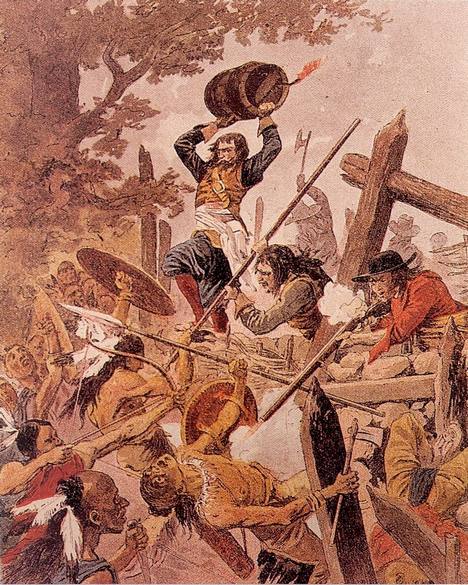
    In 1660 Dollard leaves Ville Marie with around twenty men, mostly French militia, and travels to Long Sault, where he occupies an old Algonquian fort and begins to reinforce it. Several dozen Huron show up and pledge to assist him. Shortly afterward, two hundred Iroquois in war canoes are spotted traveling down the Ottawa River. Dollard lays an ambush and attacks them, killing several and forcing the remainder to land. Retreating to his fort, the Iroquois attempt to attack and are beaten off. They attempt to parley, but Dollard is here to kill Iroquois, not talk to them and refuses. In response they destroy the French militia’s undefended canoes, cutting off their only escape route.

    The Iroquois attack the fort a second time and are repulsed again by musket fire, with one of their chiefs being killed. Dollard, being somewhat pissed about the whole canoe affair, leads some men outside of the fort, still fighting off the Iroquois, so they can cut off the chief’s head and mount it on their wall. A third attack follows that also fails. It’s at this point that another five hundred Iroquois come rolling down the river. This attack force was planning on assaulting Ville Marie, but now they’re going to go after the half-crazed white man in the fortress.

    Unfortunately for Dollard, his luck is running out. Huron slaves in the Iroquois group call out to the Hurons in the fort and tell them that if they switch sides they will be spared. The Hurons do so, but hell hath no fury like Dollard scorned, and only five of them survive the next attack. The Iroquois have begun constructing crude wooden walls to protect themselves from musket fire as they advance. With their food supply low and their major advantage now neutralized, the Iroquois attack for a fourth and final time, hacking at the walls of the fort with axes.

    The Iroquois break through, pouring into the fort. Dollard, in a final fuck-you, lights a barrel of gunpowder and tosses it at the advancing horde. But it’s not enough. The fort is swarmed and then set on fire. Any remaining Frenchmen are too wounded to try to escape and are burned alive. Iroquois desperately search the ruins for Dollard’s massive, iron balls to keep as a trophy but fail to find them. Iroquois losses are extremely heavy, and it prevents them from attacking their initial targets. To this day Dollard is seen as a heroic figure in French Canadian history.

    The Battle of Long Sault is, in many ways, a turning point for New France. Afterward, the established settlements will not be threatened by any major attacks, at least from natives. But it is still primarily a series of barely populated trading posts in the middle of vast wilderness. Following 1660, New France will undergo a transformation that will solidify it as a true colonial state in the New World.


  • A History Of American Public Education: Part 4 in a 4 Part Series

    Click here for Part 1, Part 2,  and Part 3

    Part 4: It’s Broke, so let’s Fix It

    Secularization of Public Schools

    While the Progressive Protestants did get the generic Protestant education implemented in the public schools, it was clear that this arrangement could only be temporary. There was no way that the increasingly heterogeneous United States founded on the Enlightenment Era principle of separating Church and State would allow the State sanctioned public schools to be de facto cathedral schools of the Protestant denominations.

    By the 1940s, the writing was on the wall. The increasing secularization of the school materials had reached a pinnacle. The Supreme Court was about to step in and begin cleaning house of this “non-sectarian” Protestant bias that inherent in the public schools of the 19th century. The case was Everson v. Board of Education, and the issue was public funding of transportation to religious schools. While the case came out in favor of these reimbursements, the precedential concept of a “wall of separation between church and state” was set, and would never be undone. A waterfall of cases followed, including Zellers v. Huff in 1948 (religious teachings banned in public schools, including religious garb and other religious assistance), Engel v. Vitale in 1962 (prayer in public school banned), and Abington v. Schempp in 1963 (Bible readings banned in public school). By the 1970s, the public school system in the United States was unrecognizably secular, a complete turn from the results of the Bible Wars in the 19th century.

    The Modern Landscape

    The Progressive Protestants rigged the system to beat back the temporary immigration of Irish, Italian, and German Catholics, only to have it predictably backfire. To this day the conflict still rages, the ideological progeny of the 19th century Progressive Protestants, the Social Conservatives, still fight tooth and nail for those last few scraps of religiosity in the public schools. Whether it’s prayer at the flagpole, a banner with a Bible verse, or a prayer before a football game, these Social Conservatives are motivated to fight the same losing fight, trying to keep the Church in power over the schools despite the State’s administrative authority.

    The other, more secular, and eponymous descendants of the 19th century Progressives are the ones who wield the power of the State over the School these days. With this control, they are attempting to revive some of the methods of the past. Public schools were and are seen as a place to mold the children of America, pulling them away from the habits and beliefs of their parents, and integrating the children into American society. However, with the growth of charter schools, private schools, online schools, and homeschooling, it is not as simple to impose a worldview as it was to Protestantize the immigrant Catholics of 125 years ago.

    To this end, however, there are public policy murmurs of again requiring public school education. Articles have floated the same ideas of the past such as “If You Send Your Kid to Private School, You are a Bad Person: A Manifesto” and “Banning Homeschooling does not Violate Rights: U.S. Attorney General’s Office”, both published in 2013, along with an article from the Washington Post that focused on Warren Buffett’s idea to solve problems in urban education: “Make private schools illegal and assign every child to a public school by random lottery.” Even President Obama recently weighed in with a mild rebuke of private schooling, saying “Those who are doing better and better, more skilled, more educated, – luckier – having greater advantages are withdrawing from the commons. Kids start going to private schools, kids start working out at private clubs instead of the public parks, an anti-government ideology then disinvests from those common goods and those things that draw us together.”

    Perhaps today’s Progressives have taken a page from Martin Luther’s playbook. Perhaps they are attempting to use today’s public schools to establish their worldview as the dominant one in modern American society, much like Luther used the German schools to solidify Protestantism as the dominant religion of Germany. Does this imposition of worldview fit in a modern post-Enlightenment nation as well as it fit in 16th century Europe? Do laws such as the bill proposed in Michigan that requires social worker (or other authority figure) supervision of homeschooled children go too far, especially in light of alleged abuses of similar supervision in New Jersey?

    Where to go From Here

    It strikes me, almost two years after most of these words were written, how predictable the response from the Left is to any critique of their little pet. Also predictable are the results of the ever-growing public education system. The ire of the do-gooders may have shifted from poor Irish and Italian Catholics to poor Blacks, but the same impulse is there. They must grab the children and indoctrinate them for their own good. To allow the children to escape from the grasp of the Leviathan is unacceptable, and every dirty trick in the playbook is fair game. To let a child learn in a private, charter, or homeschool setting is akin to letting a slave escape the plantation.

    This is the quintessential libertarian issue for the next 50 years. If we were to focus all of our efforts on freeing children from the yoke of public education, it wouldn’t be enough. You cannot have a free society, a liberty-loving nation, when generation after generation is inculcated from age 5 (or before) in the ideology of the State. Liberty has no hope in a country where the Republicans are beholden to the religious faction of the Progressive Party and the Democrats are beholden to the secular faction of the Progressive Party.

    I also must mention the perversion of the relationship between the State and the Family. It is not an unforeseen consequence that the family has collapsed over the past 50-70 years. This was an express goal of the Progressives who designed the modern public school system. See, when the school has complete control over a child’s every move, their family can’t impart icky views on them.

    Libertarians should prioritize this issue for the sake of future liberty. Only unyielding activism in this area will give children the hope of escaping the yoke of the State. To reiterate something I wrote in a comment a while back, this issue really gets me going because I can’t stand child abusers!

  • Thursday Morning Links

    Happy Close-Enough-to-Friday

    Climate models warming twice as fast as reality.

    Sex on a motorcycle at speed? Lots of people want to die having sex, but having your scrotum ablated off should be optional.

    As if NYPD cops need their commissioner to tell them to ignore the law.

    …And the best part is, he’s learning!

    Sploosh!
    ….He’s learning
  • Late Night Anti-Muslim Bigotry Post

    A hottie Muslim pre-school teacher (if that’s the correct term for pre-school; it’s what the news is using here, so I’ll stick with their phrasing) in Arlington, Texas, has been fired.

    The reason? A recently discovered series of disgusting tweets making Holocaust jokes and encouraging others to kill Jews, made mostly in 2013. The tweets from Nancy Salem were uncovered by a group called Canary Mission, with the stated purpose of exposing antisemitism on college campuses. According to Canary Mission, Salem was one of a group of 24 antisemetic students at the Univeristy of Texas Arlington, who were described as anti-Israeli activists.

    https://canarymission.org/wp-content/uploads/photo-gallery/Salem_Nancy/Nancy_Salem_cm02_Facebook_Jan_5_2017.jpg
    Nancy Salem

    In a plot twist, the university states that Salem was never a student there, and that they are not familiar with Canary Mission.

    This raises an interesting question in living in a free society: the pre-school is not publicly funded. In the digital world of today, where everything everyone says is on the record forever provided an intrepid enough researcher devotes the time and resources to uncovering it, where is the line beyond which non-work related banter becomes fodder for public sanction, including in the workplace? This particular case is easy enough; the tweets can certainly cause reputational harm (NSFW) to the Children’s Courtyard, where Salem was employed. However, looking beyond the odious nature of this story, can the same be said of political affiliations? If the parents have a right to know that their children are being watched over by a gorgeous jihad-supporter, do parents in San Francisco have the right to know that the person watching their children might be, *gasp*, a Republican, and therefore an evil bigoted white shitlord? Is there a point at which no one will ever be able to say anything online for fear of only being hired at ideologically sympathetic companies? Will I begin to write posts comprised entirely of questions, like a certain Judge?

    This possibility is directly related to enterprises being hounded out of business by radical leftist activists if said enterprise is not discovered to be friendly enough to gay marriage, to use a recent example. In a world where everything is made political, everything is made of shit.


  • Wednesday Evening Links

    • Millions waste the afternoon fondly daydreaming of getting the hell away from other humans
      Millions waste the afternoon fondly daydreaming of getting the hell away from other humans.

      If one was curious as to how one might bury a major breach notification, check here. According to RSA, the victims included five major defense contractors; four major telecommunications providers; 10+ western military organizations; more than two dozen Fortune 500 companies; 24 banks and financial institutions; and at least 45 higher educational institutions.


    • The San Diego district attorney’s office has allegedly missed a deadline to file foreclosure on the funds seized from Med-West, and from the personal accounts of company owner James Slavic, his wife and two step-daughters. The law affords them one year to do so, and in California Superior Court on November 15, 2016, deputy district attorney Jorge Del Portillo told judge Jay Bloom that the state had until February 2017 to file a petition of forfeiture against the money in bank accounts belonging to James Slatic and his family. The DA’s position has since changed. “We believe it is the seizure that starts the [statute of limitations] clock and not the freeze order,” says Tanya Sierra, DA spokesperson. “We do not consider [a search warrant to freeze a bank account] a ‘process’ within the meaning of asset forfeiture laws.”


    • According to White House officials, McCain is believed to have somehow gained access to the content of President Donald Trump’s private, classified telephone calls with world leaders. “He has been given transcripts or actually listened to the calls and is sharing what he has heard,” an administration insider said. “There is no doubt. He is one of the major leaks.”


    • After spending $24 billion on infrastructure and hosting for the 2016 Olympics, at the cost of de-valuing the Brazilian currency via unsupported inflation, Brazil’s new sporting venues stand empty and are rotting to ruins. Current figures may not include future upkeep and maintenance costs.


    • And in the really important news: MLB arranges to change intentional walk to a dugout signal. The thunderous shaking you felt across the internet were a million voices suddenly raised in Bronx cheers, and suddenly silenced. I fear something terrible has happened.


  • Give Me Your Poems, Your Rants, And Poorly Worded Essays Yearning To Breathe Free

    As you might have noticed, many of our articles are published under “Guest Contributor”.  You might be asking yourself, “are you assholes crazy enough to be accepting writing submissions from us?”  Yes, yes we are. And you too can get in on the action.  Please use the leads/submissions form, easy to locate at the top of the page, and one of three lovely ladies, or sloopy will respond.

    Triune bitch, guardian of hell
    More likely than three lady libertarians, amirite?

    You might be asking yourself “Holy shit, did that crazy bitch just say three lovely ladies?”  Yes, all three libertarian women in existence have volunteered their time to review what you send us, process it, shine it up real pretty-like, and publish for Glibertaria to mock and/or have virtual fist fights over.  Please keep in mind that these three, lovely ladies are volunteering their time, out of the goodness of their cold, shriveled libertarian hearts, so please be patient and appreciative.

    So please, give me your poems, your rants, and poorly worded essays yearning to breathe free…and possibly mocked.


  • HR 610 and the Conundrum of School Choice


    The full text of HR 610 may be found here.

    H.R.610 – To distribute Federal funds for elementary and secondary education in the form of vouchers for eligible students and to repeal a certain rule relating to nutrition standards in schools.

    HR 610 is a seemingly dry and dusty bill currently with the House Committee on Education and the Workforce; but HR 610 has the potential to fundamentally re-shape publicly funded education in the US. Previously I covered the “nutrition standards” aka school lunch part of this bill. Now let’s dive in to the delicious libertarian puzzle that is the voucher part of HR 610.

    Section 102 repeals the The Elementary and Secondary Education Act of 1965, which was part of President Lyndon Johnson’s War on Poverty. The 1965 act in it’s much-amended form tips the federal education dollars scales towards poor students by net funding poor students at a higher rate than non-poor, which creates perverse incentives failing students.

    Repeal of the 1965 act is coupled in Sec 102 (b) with a limitation on the authority of the US Secretary of Education:

    The authority of the Secretary under this title is limited to evaluating State applications under section 104 and making payments to States under section 103. The Secretary shall not impose any further requirements on States with respect to elementary and secondary education beyond the requirements of this title.

    So, still federal funding of local schools but no more micromanagement. We may fully expect the delicious irony of critics of this carping about the lack of accountability when the consistent position of those critics has been more money, always more money, while the schools continue to fail. Presumably there is some large number of net jobs in in public education whose only function is to collect the figures for the US DoEd so as to keep those block grants coming. Those jobs would suddenly become superfluous, as would the jobs at DoEd to check those figures and approve the block grants.

    Section 103 is the real meat of the bill. Currently block grants to schools are awarded according to multiple criteria. At the most basic level is per-child funding to Local Education Agencies (school boards), then the extra poor-kid funding as outlined above, and various other shenanigans. The new legislation would entirely flatten the federal block grant program to proportional per-child funding. True equality.

    Section 104 states that to be eligible for block grants that various states must make it lawful for parents of an eligible child to elect to enroll their child in any public or private elementary or secondary school in the State; or to home-school their child. So, a soft mandate on the states, but a mandate the states may avoid by foregoing federal block grants.

    Section 105 contains a mandate that states who wish to receive federal block grants must establish a voucher program:

    (5) DISTRIBUTION TO PARENTS.—


    (A) IN GENERAL.—From the amounts allocated under paragraph (3), each local educational agency that receives funds under such paragraph shall distribute a portion of such funds, in an amount equal to the amount described in paragraph (2), to the parents of each eligible child within the local educational agency’s geographical area who elect to send their child to a private school or to home-school their child (as the case may be) and whose child is included in the count of such eligible children under paragraph (1)(A), which amount shall be distributed in a manner so as to ensure that such payments will be used for appropriate educational expenses.


    (B) RESERVATION.—A local educational agency described in this paragraph may reserve not more than 1 percent of the funds available for distribution under subparagraph (A) to pay administrative costs associated with carrying out the activities described in such subparagraph.


    There you have it. Federal tax dollars going to icky religious schools, objectively evil for-profit schools and slack-jawed fundamentalist home-schoolers. And the act doesn’t say anything about whether those schools must be accredited by anyone. Someone bring the fainting couch.

    Treating everyone the same? Sounds suspiciously like A-N-A-R-C-H-Y. Also, triple word score.

    There is a one percent rakeoff for local education agencies for administrative purposes which is not unreasonable. The voucher payments are not to be considered as income to the child or his parents. The act also contains the interesting definition: The term “eligible child” means a child aged 5 to 17, inclusive. So, no federally funded Pre-K, and no federal funding for kids who were “held back” for a year or two. Everyone gets thirteen years of federal education block grant money.

    But now let’s look at what the act doesn’t do. It doesn’t require the states to setup a voucher program using state funds. Some states may become so cross at Congress that they forego federal grant money altogether rather than pass any money through to competitors or home-schoolers. And the act does not address funding; congress will still budget a line item for those block grants, but hopefully will reduce that amount as states drop off.

    The House Committee on Education and the Workforce, where HR 610 currently resides, has twenty two Republican members including Chairwoman Virginia Foxx (NC), Vice Chairman Joe Wilson (SC) and Tea Party star Dave Brat (Virginia).  The committee also includes seventeen Democrats. It will be interesting to see if the Republican members really do have the stomach to upset the apple cart. But they have cover for HR 610 which is far less extreme than HR 899 (Massie, KY) which outright eliminates the DoEd.

  • Impeach Them All, God Will Know His Own

    Matthew Continetti, EIC of The Washington Free Beacon (which you should be reading regularly), has a fantastic column about the Deep State titled “Who Rules The United States“. I cannot endorse the entire piece, because I find Mr. Continetti’s inclusion of the judiciary to be out of place in an article about the Deep State, and strangely tone-deaf in attacking lifetime judicial appointments. That said, it is remarkable Mr. Continetti took a shot at the judiciary, as I am hoping it heralds conservatives ditching their veneration of the “Nazgul” and recognizing reality: the judiciary is nothing more than a branch of government. Getting conservatives to put down their Holy Judiciary Hymnals is an important first step in embracing a Constitutional remedy to bad judges: impeachment and removal.

    Judges deserve impeachment and removal (and threatened with impeachment and removal) far more than it happens, which is effectively never. Judge Robart, who “wrote” the TRO against President Trump’s EO on immigration, needs removing. The three-judge panel that affirmed Robart’s ghastly TRO is asking for an Impeachment Party. To be clear, I am not supportive* of Trump’s EO, but regardless of politics, people of good faith across the political spectrum recognize these bums took advantage of the spotlight and decided to make names for themselves. In doing so, and mirroring my previous post about the Intelligence Community, they abused the trust and fairly unwavering adulation the Public has given them to self-aggrandize. It’s unfortunate it is impossible to get 2/3rds of the Senate to do something as minor as confirm the Secretary of {Whatever Useless Agency}, let alone impeach a judge, but so it goes. We should make these judges their sinecures are by no means a sure thing.

    Speaking of dormant Constitutional powers that never get used, I sincerely hope the House of Representatives gets an infusion of sack from the White House this go around and rediscovers the power of the purse. I have a few co-workers I would like to see become the recipient of the Holman Rule. At a minimum, Congress should find those civil “servants” who think they are more important than duly-elected officials and tell them their paycheck is $1, take it or leave it. Even if my impeachment of the judiciary does not work out, maybe Congress can cut the judiciary’s allotment for some of the cushier judicial perks like staff, clerks, heating, water, whatever!

    * because it does not go far enough. hee hee.