Blog

  • The Jerbs Curve

    (Business 101: Pretty graphs make everything better)

    Imagine, if you will, a country or city-state called Libertopia.  We have just overthrown our evil socialist masters and made a new government from scratch.  By some magic video game miracle, we don’t start with any debt, outside enemies, and have a fully functioning market-driven farming and industrial base that trades all over the world.  There will be no empty bellies in Libertopia tonight (except for the orphans who aren’t working hard enough in the monocle polishing factory).

    In my imaginary country only property owners can vote.   So after the revolution we get together, review the collected works of SugarFree, hem and haw, drink our fill of mead. and decide to go with the idea of keeping our borders closed to the nearby Outsiders.  We are, after all, a tight community with a shared background.

    What would happen?

    At first not much at all.  Business would go on as usual, and we would stay competitive with our neighbors.  But under the “nativist” model, as time goes on, domestic market limitations and labor issues start.  The heads of industry and farming may start to clamor for more talent and workers.

    The voters finally listen and get together.  After a few rounds of brandy and the feasting on deep-dish pizza, we decide to open our borders just a little bit; letting in a yearly allotment to meet our needs.  To keep things simple, these Outside workers aren’t citizens, nor do they have a vote or receive welfare (which doesn’t exist in our country, comrade!).  This “restrictionist” model, however, still causes worker shortages, especially if the economy starts heating up.

    Business is doing great – so great that more Outside workers are needed to meet demand.  Once again the voters get together, do a few squats, and finish off a keg or two.  We decide to open the borders all the way, allowing everyone who wants to come in.  After all, things are looking fantastic for business.

    But we begin to notice that the citizens are starting to get angry.  There are protests and labor strikes because they have to compete with the Outsides for jobs.

    Now what’s the point of this simplified and rather silly story?  Using the scenarios above I’m trying to minimize input variables for the idea of something like the Laffer Curve, but instead of dealing with taxation, we are touching on immigration.  I imagine such an idea has already been explored before, but hey, I’m no economist (we can tell! – ed).  This is not an economic model either, but something soft and political science-y.

    Is there an optimum rate of immigrants – we’ll call it the “Jerbs Curve” – before the citizens get resentful (the Resentment Index?) with having to compete for wages with the Outsiders?  See Chinese rail workers or the Irish immigrants as an example.  And is there a point where they get angry enough at this perceived unfairness that they revolt and put in a new leader?  Or in a real world case, have enough electoral votes to put in someone like Trump?

    If there is such a thing as a Jerbs Curve, it would only skew the line in one direction or another: adding in welfare, illegal immigration, race, identity politics, war, the state of the economy, political party dynamics, and countless other variables.

    Perhaps the conclusion to all of this, if we can make one, it is that the world is a complicated place that often defies the most simple of models. Something as dynamic as a highly populous country with millions of inputs, variations, outputs, needs, and whatnot is impossible for anyone to predict. As far as intellectual exercises go, you can create models that are perfectly logical, but do they reflect the real world at all? How would they be when implemented or exposed to the real world?

    Comments and insults are welcome.

    edited by Elspeth Flashman

  • HR 610 – Restoring Parental Freedom to Pack Lunches, Etc.

    Congressman Steve King (R, IA) has introduced HR 610, titled Choices in Education Act of 2017. The bill does two things – establishes a nationwide voucher program and tinkers with the school lunch regulations. I’ll cover the voucher program at length in another article. Here’s a brief walk-through of the the school lunches part.

    Hey! Teachers! Leave them kids alone!

    Section 9(a)(1)(A)(i) of the Richard B. Russell National School Lunch Act (42 U.S.C. 1758(a)(1)(A)(i)) is amended by inserting before the semicolon the following: “, to establish a calorie maximum for individual school lunches, or to prohibit a child from eating a lunch provided by the child’s parent or legal guardian”.

    That would amend §1758 to read as follows (changes in bold):

    • 1758. Program requirements

    (a) Nutritional requirements

    (1)(A) Lunches served by schools participating in the school lunch program under this chapter shall meet minimum nutritional requirements prescribed by the Secretary on the basis of tested nutritional research, except that the minimum nutritional requirements-

    (i) shall not be construed to prohibit the substitution of foods to accommodate the medical or other special dietary needs of individual students, to establish a calorie maximum for individual school lunches, or to prohibit a child from eating a lunch provided by the child’s parent or legal guardian; and

    (ii) shall, at a minimum, be based on the weekly average of the nutrient content of school lunches.

    So, no calorie maximums and no confiscations of lunches sent from home. Not that the Congress has any business meddling in education in the first place, but this is not the typical unfunded mandate to take positive action which Congress has traditionally imposed upon public schools.

    Public education priority. All your lunch are belong to us.


    The no-calorie-maximums part will doubtlessly cause hysterics among the usual suspects, but in practicality will free the school lunch folks from having to worry about going over the limit by one calorie and incurring the wrath of US DoEd retribution.  And while this is indeed micromanagement of the schools by Congress, it is a net gain because it rolls back existing onerous federal regulations; regulations which should not exist, of course. The US Secretary of Education would still be in the business of  prescribing minimum nutritional requirements for school lunches.

    The second part is a huge win for parents – no confiscation of lunches sent from home. HR 610 may also override the peanut butter bans in place in many schools.  While still meddling in education, this is a more libertarian-friendly form of meddling as it articulates an individual right which the government may not infringe – much like the First Amendment.


    The House Committee on Education and the Workforce, where HR 610 currently resides, has twenty two Republican members including Chairwoman Virginia Foxx (NC), Vice Chairman Joe Wilson (SC) and Tea Party star Dave Brat (Virginia).  The committee also includes seventeen Democrats. It will be interesting to see what they do with this.

  • Politically Incorrect Canadian History, Part 1: Abandon All Hope, Ye Who Enter Here

    Canada has, in the entirety of its history, gone through dramatic changes that have completely shifted its cultural and social perspective. No long standing Constitutional ideal defines Canada, its history and institutions have largely been driven by necessity, whether good or bad. Since American perceptions of Canada tend to range from this to this, these columns will be a general, not-too-serious layman’s overview of Canadian history as a whole for an American audience, touching on key elements that became grounded long-term influences on Canadian society and culture.

    Norse Colonization (985 to 1014)

    Because the Norse never really stuck around long enough to have any kind of influence on Canadian society, this is going to be the cliffnotes version:

    According to the Icelandic Vinland Sagas, in 985 AD a guy called Bjarni Herjólfsson is blown off course and sees land to the west, which he calls Vinland (he also may have picked up two shipwrecked guys, the sagas have multiple versions). He goes to Greenland and tells a guy called Leif Erikson about it, who buys his boat and sails there to set up a winter settlement (likely on the northern tip of Labrador). After exploring a bit he goes home. Four years later, his brother Thorvald shows up at his winter settlement and decides to pick a fight with some sleeping natives, starting the first European-Indian conflict. He gets shot by an arrow and dies. Everyone else leaves.

    Six years after that, a guy called Thorfinn Karlsefni, who knows about Leif’s voyage, tries to set up a permanent settlement. It does not go well. They run out of food the first winter and decide to eat a beached dead whale, causing mass illness. They also argue about who is more awesome, Thor or Jesus. Unlike Thorvald, Thorfinn is smart enough not to attack the natives, and tries to negotiate a trade deal. But then a bull shows up and scares the natives away. A few weeks later they come back and attack. The Norsemen flee when the natives throw a whistling, inflated moose bladder on a stick at them (I’m serious). Freydís, Thorfinn’s pregnant half-sister, thinks the men are being cowards, so she picks up a sword, pulls down her top and slaps her breast with it. Somehow this scares away the natives, so European steel and tits save the day. Everyone is tired of dealing with shit like this, and they go home. The only substantial contribution Thorfinn’s expedition provides is that his son Snorri is the first European born in the New World.

    All of this is based on the accounts of the Sagas, which tend to have multiple versions of the same events. There are tons of arguments amongst historians about the true extent of Norse expansion into North America and even where Vinland actually is. Some say it’s Labrador (making the Norse the first and only people to ever think Newfoundland is a paradise) while others say they expanded further into the Gulf of St. Lawrence region. Archaeological evidence is primarily based around the site at L’Anse aux Meadows, which some people argue is Erikson’s winter settlement. Recently in 2015 a new site at Point Rosee was discovered, but they’re still not entirely sure if it was a permanent settlement or a mining camp. Other more debatable evidence includes the Maine Penny, an 11th century Norse coin found in Maine.

    Regardless, the early Norse voyages did not leave any impact on Canadian society, and once the Medieval Warm Period ended and the Greenland colonies could no longer support themselves, the Norse’s ability to sail west was severely curtailed.

    Proper European Exploration (1497 to 1534)

    With the discovery of the New World by Columbus in 1492, suddenly everyone wanted to get expeditions going to see if they could find the passage to India and China that he had missed. In 1497 the English Crown funds a guy called John Cabot’s expedition to the North Atlantic. Well, his name isn’t really John Cabot, like most explorers of the period he’s actually a filthy Italian named Giovanni Caboto, but the English, like everyone else, don’t want to advertise that they’re outsourcing their work to filthy Italians. Cabot’s four journeys in the North Atlantic are actually haphazardly recorded, but we do know that he discovered land somewhere around modern day Labrador, and also found the Grand Banks fisheries.

    The banks contained so much cod that when they were actually utilized by European fishermen later on the price in Europe dropped dramatically. The discovery of the fisheries ensured that Europeans would continue to be interested in the region and explore it further. Cabot’s later journeys primarily focused on trying to find the Northwest Passage, the shipping lane that would allow trade with the Far East. The search for which will lead to many expeditions, some beneficial, others massive disasters, none of them successful. Cue the Stan Rogers.

    For most of the early 16th century the only people really exploring around the general location of Eastern Canada are the Portuguese. Portuguese fishermen utilize the Grand Banks and set up a few minor seasonal fishing outposts on Labrador. Unfortunately for them, under the Treaty of Tordesillas, it’s technically Spanish land, so they abandon it to focus on the more prosperous colonies in South America. With Spanish and Portuguese interests primarily in the south, Canada is open for whoever is willing to take it.

    Enter the French (1534 to 1604)

                    It’s 1534, and France has been making a good comeback lately. After victory in the Hundred Years War they have stabilized their country and established themselves as the military superpower of Europe, a tradition that will continue until the 19th century. With a great deal of wealth, a large army, language dominance in diplomacy and other fields, and massive population in comparison to everyone else, they were set to dominate the European continent for the next century.

    And then the Spanish start shipping over tons and tons of gold from their newly conquered subjects in the New World. Suddenly continental dominance isn’t going to cut it anymore; they need to expand outside of Europe in order to stay competitive. In 1534 French King Francis I tasks a man named Jacques Cartier (who is, surprisingly, not a filthy Italian) to find that wonderful Northwest Passage and, you know, if he happens to conquer any extremely rich savages along the way, they’re fine with that too.

    Cartier sails into the Gulf of St. Lawrence (possibly dooming a species to extinction along the way) and goes on a general tour of what would become the Maritime provinces. He establishes contact with the local aboriginal groups, likely the Mikmaq and other tribes, who are willing to trade. On the Gaspé Peninsula he plants a cross, formally claiming the land for the kingdom of France. The local natives do not appreciate this, and then he tries to kidnap a chief’s sons, but ends up negotiating to take them back to France. The entire time he thinks he’s actually somewhere in Asia.
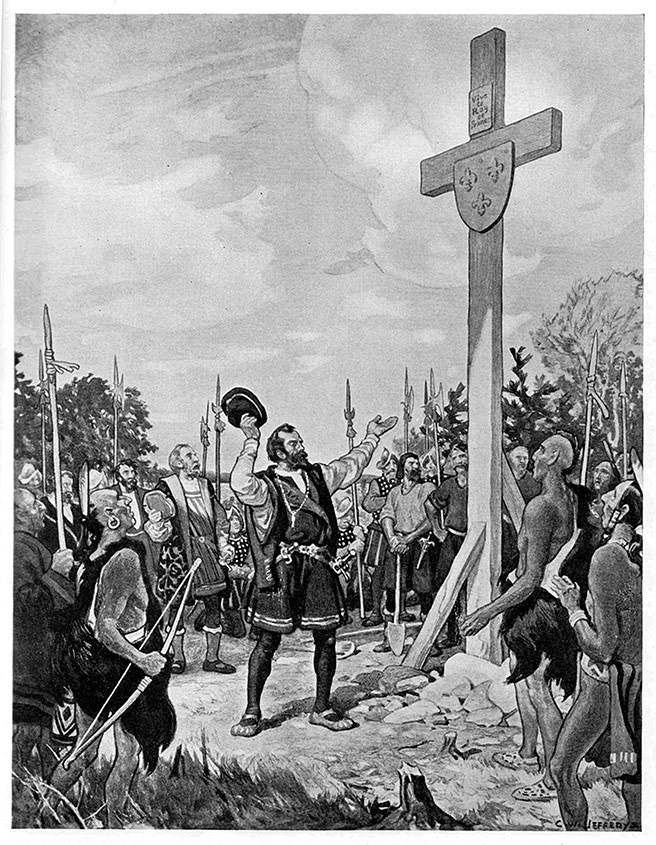
    Cartier’s second voyage back was more eventful. This time, he travels down the St. Lawrence River, what would become the primary shipping lane for the later Canadian interior. Cartier is convinced that this is the Northwest Passage…little does he know where it ends. He’s brought the chief’s sons back with him, and they take him to the capital of their native nation, Stadacona, a village near modern-day Quebec City. According to Cartier’s journals and this Heritage Moment, this is where the term ‘Canada’ is first used.

    Cartier continues down the river, but is stopped at the rapids near the village of Hochelaga, on the island now known as ‘downtown Montreal’. They return to Stadacona in order to wait out the winter, but have completely failed to provision food and firewood. Cartier’s ships are frozen in place by a very harsh winter that they were not prepared for. Everyone starts to get scurvy, and to make things even more miserable, the local natives start catching European diseases and dying. The natives teach the French how to use spruce to cure scurvy, and the local chief tells Cartier about a kingdom rich with gold and jewels to the north.

    So Cartier kidnaps him and brings him back to France, along with seven others (there’s a fairly consistent theme in Cartier’s voyages, can you guess what it is?). None of them ever make it back home and all but one die on the way back to France. The chief’s stories convinces Cartier that there is a great ‘Kingdom of Saguenay’ that would be ripe for the taking. By 1540 King Francis I decides that there should be an established, permanent settlement in the New World, and commissions Cartier to do it.

    But within the French court, a new privateer has gained the king’s respect. By 1541 Francis has changed the plan, and now Cartier is second in command to a Huguenot, Jean-François de La Rocque de Roberval, who is named the first lieutenant general of French Canada. Roberval has spent most of his time recently dodging executions thanks to his influence over the king, so his reason for getting out of France is probably health related. They sail to the Gulf of St. Lawrence, where Roberval decides to wait for supplies and gives permission to Cartier to continue on down the river.

    Cartier travels back down to Stadacona, where the natives are not happy to see him, for some reason. Regardless he sets up a colonial settlement nearby called Charlesbourg Royal. As they begin to try to set up fields for farming, the settlers (mostly convicts, by the way) begin to find what they think is diamonds and gold. Cartier is quite giddy, but still wants to go further down the river to see if he can find his mystical kingdom. The rapids stop him again, and he returns to the settlement to find hell breaking loose. The natives have attacked and killed a large number of settlers, and the situation seems desperate.

    So Cartier fills his ship up with diamonds and gold and heads back out to the ocean. When Cartier’s about to meet up with Roberval, he has just abandoned his sister on a deserted island, likely for financial benefits back in France. Jacques Cartier, Master Dick of French Canada, won’t be out-dicked on his own territory, so under cover of darkness he sails past Roberval’s ships and returns to France without him. Somehow he fails to kidnap Roberval’s sister on the way by.

    Almost no one in this story gets a happy ending. Cartier’s diamonds and gold turn out to be quartz and fool’s gold, and he never sails to the New World again. He dies in 1557 due to an epidemic. Roberval attempts to take over Charlesbourg, but abandons it in 1543 due to constant native attacks and lack of supply. He’s later assassinated during the start of the French Religious Wars. Roberval’s sister was rescued however, and became a bit of a minor celebrity once accounts of her story were published.

    For the next fifty years, there will be few attempts to permanently colonize French Canada, and none of them will succeed. France is going through a period of instability. The logistics, geographical knowledge, finances and a willingness to not piss off the locals simply isn’t there. If only there was some man, a manly man of integrity and ability, of both diplomatic and martial skill, a mariner with a gift for administration, to get things going again.

    Surely France won’t be able to produce one of those.
  • A Little Help From Your Friends

    Feed me your sorrows

    You, yes you, <user_ID>, should unload your problems, concerns and worries about life and love on us so that we might advise you.

    Is your spouse a progressive? Has one of your orphans picked up Das Kapital and a concerning amount of facial hair? Do your coworkers know that you’re a lunatic gun nut and avoid inviting your to their children’s birthday parties?

    Tell us your woes and help us help you!

    Send your submissions to advice@glibertarians.com today! (Letters may be edited for length, clarity or to make you look like an idiot)

    [It won’t be me, but the solution to your problem may be a 55 gallon drum of personal lubricant for $1,468.80 on Amazon now. The staff makes no promises. –jesse.in.mb]

  • Saturday Morning Links

    Since we seem to have quite the weekend audience, some moar lynx to keep y’all commenting (please note, there may or may not be Saturday PM Links – buyer is not being given any warranty, express or implied by the use of the word “Morning”….*extended legalese*;

    Chicago PD railroaded a group of 4 men (hard to imagine!!!!) – the last of them just got out of prison,

    It isn’t just cops doing no-knock raids that get the wrong address,

    You want to see journalism under attack – don’t watch a DC presser, read this,

    Orphan drug designation = FDA asshattery?


    h/t OMWC on the journalism story, *mimes a thank-you to JW for the FDA story*

  • Ford’s Dozing Engineers Side With Google in Full Autonomy Push

    The future is here and the future is going to be sleepy:

    As Ford Motor Co. has been developing self-driving cars, the U.S. automaker has started noticing a problem during test drives: Engineers monitoring the robot rides are dozing off.

    Company researchers have tried to roust the engineers with bells, buzzers, warning lights, vibrating seats and shaking steering wheels. They’ve even put a second engineer in the vehicle to keep tabs on his human counterpart. No matter — the smooth ride was just too lulling and engineers struggled to maintain “situational awareness,” said Raj Nair, Ford’s product development chief.

    Maybe a taser collar or a spike to the bottom would help.  And such technology would also help the S&M market to really take off.

    “These are trained engineers who are there to observe what’s happening,” Nair said in an interview. “But it’s human nature that you start trusting the vehicle more and more and that you feel you don’t need to be paying attention.”

    The struggle to prevent snoozing-while-cruising has yielded a radical decision: Ford will venture to take the human out of the loop by removing the steering wheel, brake and gas pedals from its driverless cars debuting in 2021. That sets Ford apart from most automakers including Audi and General Motors Co., which believe drivers can be counted on to take the wheel if an accident is imminent.

    I’m an old Luddite when it comes to cars.  I don’t even trust an automatic transmission to find the right gear, and prefer to row my own.  Even carburetors have their limited upsides –  like simplicity if you’re a home wrencher.  But I’m also the sort of guy who hates driving long distance, so in the future a self-driving luxury barge could be added to my fleet.

    BMW, Mercedes-Benz and Volkswagen AG’s Audi plan to roll out semi-autonomous cars starting next year that require drivers to take over with as little as 10 seconds notice. On a scale embraced by the U.S. government, these cars would qualify as Level 3 — more capable than cars where drivers do everything, but short of full automation.

    Ford plans to skip that level altogether. The automaker has aligned with Alphabet’s Inc’s Waymo, which made similar discoveries related to human inattention while researching Google’s driverless car.

    …snip…

    “There’s evidence to suggest that Level 3 may show an increase in traffic crashes,” Nidhi Kalra, co-director of the Rand Center for Decision Making Under Uncertainty, said this week during a U.S. congressional hearing. “I don’t think there’s enough evidence to suggest that it should be prohibited at this time, but it does pose safety concerns.”

    Well that fills me with good cheer.  I can already imagine hordes of self-driving cars skittering into an ice storm as the passengers sleep, smoke the Devil’s Weed, or fornicate.  On second thought maybe paradise has finally come to Earth.

    One matter both sides agree on is that too many requests for human intervention could wreck the autonomous experience.

    As part of its testing, Ford used sensors that monitor facial expression and track eye movement to determine if a driver was alert and ready to take over. This led to an unenviable experience in which drivers felt they were being constantly reminded to pay attention. “The car is actually yelling at you all the time,” Nair said.

    My Mother The Car comes true!  My dream has been broken.  Now the roads will be filled with cranky passengers who just want to sleep, fuck, or smoke but instead are being badgered by the Nanny Car.  Maybe it would be better to just pay someone to drive me around.  Now I know where the Open Borders folks are coming from.

  • Friday Night Links


    Slate rates every sex scenes in Girls based on their inherent Girlsness. It’s the last season, you guys. There might only a few more hundred times for Lena’s boobs to make you sad.

    Finally, the patriarchy has allowed a transgender doll to be made of a transgender teen activist. I assume it’s like a Mr. Potato Head in the junk–just snap on the parts you want and let’s go! [digs out penis, two buttholes and sunglasses out of the box]

    Finally, the patriarchy has allowed a transgender doll to be made of a transgender teen activist. No, wait. That’s just the new American Girls doll. Who’s a boy. The American girl boy is named Logan Everett and he plays drums in a band. And his parents died of dysentery.

    That’s it. You just get three links. Be joyful.

    And no alt text. You just haven’t earned it yet.

  • Psychopathic Exhibition On the Menu


    Making the rounds on the outrage circuit is this latest update into the continuing saga of Trump – Oh, What An Ass.

    ‘‘This is what it’s like to be with Trump,’’ Christie said. ‘‘He says, ‘There’s the menu, you guys order whatever you want.’ And then he says, ‘Chris, you and I are going to have the meatloaf.’’’

    The big take-away we’re supposed to have is that Trump is such dickhead. How Dare He. The choice of supper entree for an enormous fat man already the subject of one failed lap banding is none of your business, sir – he has agency, you know!

    Pardon me if I hesitated to clutch my pearls. As many times as this story has been passed from shocked ear to shocked ear, people missed what I found to be the pertinent lede to the story, which defined a damning study in character itself.

    Trump and Christie discussed the nation’s opioid epidemic during the lunch.

    Christie on Wednesday signed a series of bills he requested to address the crisis, including a five-day limit on initial prescriptions for opioids and mandating state-regulated insurance plans cover treatment.

    I’m sorry, were we discussing agency here? The agency of someone afflicted with a self-inflicted morbidity known to cause early death, disorder and severe limitations on quality of life?

    Oh yes. I went there.


    Chris Christie believes there is an opioid epidemic. Is he correct? Possibly. To what ends? His own. If the opioid epidemic were a problem for the consumers of opioids, they’d be proposing their own solutions. They might even be doing so – we don’t know, since Top Men and the mainstream media do not appear to have invited them to the discussion. But the real problem here is that Christie ate meatloaf when he might have chosen something else. Sure.

    As detailed in my earlier article, Finding the Why, humans have a talent for spotting malfunction as defined through their own worldview. We apply self-serving corrections, and then when our best-laid plans end up tattered wrecks, we blame everyone else for the failure.

    I, personally, believe Chris Christie needs to put the snacks down and take the stairs more often. I am fully confident that if he does not do so, his life will be needlessly shortened and suffer a loss of quality. I might even be right. So, tell me, America – at what point do I get to override Governor Christie’s agency in order to apply my corrections to his choices?

    In my opinion, I don’t.


    If he wants to be a great big fat bastard, that’s his problem. Nothing to do with me. But what about his elevated healthcare costs, due specifically to his bad lifestyle choices and now foisted onto the backs of taxpayers? Who, exactly, paid for Governor Christie’s surgery; the one that didn’t work?


    Red herring. If we all eat enough of them, we’ll be thin as rails. The problem isn’t that Christie has a sweetheart Cadillac healthcare plan exempted from Obamacare’s onerous health-damaging idiocies, at the expense of people who lack such privilege. The problem isn’t even that he uses this sweet privilege to rectify the self-inflicted abuse of his body. The problem is that government picks my pocket to enrich people who think lunch should be not merely free, but an all-you-can-eat buffet. Those who rob Peter to pay Paul, will always have the support of Paul.

    Is the analogy too subtle? Perhaps it is. In the abundance of articles about poor, poor Christie’s stolen agency, not one thus far to mine eyes has pointed out these astonishing parallels. Christie is upset at the loss of his own agency, while taking others’ agency away with both hands and the expectation of applause.

    Governor Christie is the very thing against which he rails. He merely has trouble seeing this clearly, since he is as convinced of his own narrative rightness as every other human on the planet. He is the good guy, because that’s what his head tells him is so.

    Being the good guy isn’t a side, a team. It doesn’t come with the proper hand-waving to paper over what you did with a thin veneer of respectability and concern. It’s an action. Those who do bad things are not the good guys. Everything from there is rationalization.

    Prediction: If an opioid epidemic exists, it will not be cured by talking at opioid consumers coupled with the proper removal of just exactly the right set of agencies from the correct people, handing that power over to some bureaucrat whose claim to fame is a bachelors degree in fine arts and a cushy job divorced from the requirement for functional results. What we’ll get then is another set of dysfunctions, and more people insistent that more money and and more power to the people who caused the new problems are the next sole best solution.

    If there is an opioid epidemic, we’d be best served to start with finding the why.

    Why are more people consuming more opioids? If consumption has reached levels causing individual health concerns, why has that individual come to the conclusion that this was the most effective cure for their pain despite the risk-reward calculation? Lest anyone labor under the delusion that only people making good and proper social normie choices make risk-reward calculations, allow me to disabuse them of that notion. Everyone makes risk-reward calculations. The man drinking himself to death knows it. This choice nevertheless appears, to his mind, to be the most effective option available. If this calculation fails to make sense, I’d suggest asking him to explain it rather than assuming we know everything about the matter and can solve that problem for him.

    Chris Christie post-surgery is still grossly obese. If you want to know why, don’t ask his surgeon; ask Christie.

    Therein lies our real solutions. Taking away the proper agencies and handing more power and money to people ill-equipped to use them will solve nothing. Such actions have, in fact, gotten us to this state of disorder and chaotic whack-a-mole with accompanying enormous and rising costs; both fiscal and societal.

    We need to start involving those who we purport to assist. Not at them and to them, but with them, will these problems be solved. Every individual has agency, and re-labeling people as sub-human and otherwise lesser-than to excuse our actions in taking away their individuality does not make us the good guys.

    It makes us psychopaths.

    The… characteristics referred to as antisocial personality in the FBI report were as follows: sense of entitlement, unremorseful, apathetic to others, unconscionable, blameful of others, manipulative and conning, affectively cold, disparate understanding of behavior and socially acceptable behavior, disregardful of social obligations, nonconforming to social norms, irresponsible. These… were not simply persistently antisocial individuals who met DSM-IV criteria for ASPD; they were psychopaths- remorseless predators who use charm, intimidation and, if necessary, impulsive and cold-blooded violence to attain their ends.

    We are eating the very people we claim to help because it feeds our narrative and increases power and money in one direction only. The stated goals are never reached, and the subjects loathe us for our efforts; this is natural, since we are not helping them, that’s just our rationalization of our bad choices. This is tribal monkey behavior with evolved vocabulary, not civilized humanity.

    Civilization is a choice. Let’s choose it.

  • Protect Us from Our Gadgets!

    I happen to be a gadget guy who likes tinkering with electronics. I’ve built computers, 3D printers, a primative blindspot warning device, and a sous vide cooker that worked. I’ve done plenty of wiring and harness changes, too. So this Right to Repair legislation is close to my heart. If I can’t tinker with it, I don’t own it. I understand that I am voiding the warranty and assuming risk. Thank you.

    (more…)