Author: Gojira

  • Being An Account of My Most Arduous Attempts to Establish a Relationship with International Jewry

    Gather round, young children, and I’ll tell you a tale. A tale full of treachery and intrigue, mighty heroes and dastardly villains, sung to the tune of the USA PATRIOT Act’s Section 326. A harrowing account of your intrepid author’s attempts to perform a simple act, made not-so-simple by the never-ending meddling of the federal government.

    Over the last several weeks, it has been my sworn and sacred duty to set up a small business banking account for our Glibertarian enterprise. Setting up a bank account should, in theory, be an easy enough exercise. One waltzes into a bank; puts hands on hips in the lobby and demands in a loud, commanding voice, “Ho, there! I require the services of a money lender! Make haste, for I have pressing affairs to attend to with the apothecary upon the satisfactory conclusion of our business!”; gives some information; and deposits some money. That is precisely how things worked the last time I had to open a bank account.

    Of course, preliminary research had to be conducted. Only one of us is actually made of money (I’ll let you try to guess who!), so the majority of my time was spent on the internet and over the phone with different institutions trying to find an actually free small business checking account. The majority advertise themselves as free, but once you get into the weeds a bit during the enrollment process, it turns out they are free only so long as you meet a variety of requirements, none of which are likely to occur with our current business model.

    Pictured here: a banker

    And yet, I persisted. Finally landing upon a local bank that, so far as I could tell, had actual, honest-to-Zardoz free small business checking, I gallantly sacrificed my entire lunch break to go speak with these generous merchants of monetary services. I walked into the lobby which, being the middle of a weekday, was largely empty. A thick-set manager in an off-the-rack suit quickly hurried over to me, vigorously shook my hand, and assured me that his underling would be able to attend to our needs. When asking what our business was, I explained that we run a website giving political and pop culture commentary. Why how wonderful! Did you know that the manager was a journalism major? It’s so important for there to be as many voices as possible giving great, down-the-line political commentary, to fight the nefarious tide of fake news!

    Bolstered by his enthusiasm and feeling mightily proud of myself for helping to selflessly bring the hard, unvarnished truth to a grateful readership (though given some of the comments made during his rambling glad-handing, I suspect he would not have been so generous with praise if he knew the direction in which our political commentary flows), I sat down comfortably with his associate to begin the process.

    Now, as you may or may not know, the leadership of our merry band is scattered across these United States. I explained that not only myself, but a handful of other individuals in various states would need to be signatories on this account. I thought this could be accomplished through digital signatures, faxes, etc. It is here that the first act closes, and the central conflict begins.

    The banker looked at me with a nervous smile. “Is there any chance of your associates being able to come in to one of our branches?”

    “None at all,” I replied, “and frankly I think it quite racist of you to ask*.”

    “I’ll need to speak to my manager. Please excuse me for a moment.”

    *thundering denunciation* “YES, YOU SPEAK WITH YOUR MASTER, VULGAR HIRELING, AND TELL HIM THAT I WOULD SPEAK WITH HIM FORTHWITH!”

    Some five minutes pass in hushed consultation. There are no other customers in the bank. I nonchalantly begin to inspect the windows and doors at the edge of my vision, to plan my escape, if it turns out that my growing suspicions are true, and I have wondered into a clan of vampires or ghouls using a regional bank as a front to draw in potential victims.

    Meaty Manager avalanches back across the room, with an exasperated look upon his reddened ground chuck face.

    “I’m sorry, but I’m afraid we’ll not be able to meet your needs.”

    “Excuse me?” I replied, momentarily dumbstruck.

    “It’s the PATRIOT Act, you see…” and he then begins to tell me of a curse that the Great Tribe has laid upon he and all his kind.

    In 2001 of the Western reckoning of years, as many of you may recall, our great nation was paid a friendly visit by some rather motivated Mohammedans who, through a series of peculiar mishaps, wound up killing thousands of innocent people. The immediate and predictable response to this, was for our Federal Government, Beloved by All, to pass an enormous omnibus bill full of things like indefinite detention and a host of new regulations on a wide variety of industries. If they hated us for our freedom, we had found a most ingenious method by which to defuse their wrath – simply get rid of the offending freedoms.

    Image result for patriot act
    Fox News graphic of PATRIOT ACT, heroically standing in front of the sigil of the glorious Department of Homeland Security

    In this behemoth of a law lies section 326, dealing with the establishment of what is known as a Customer Identification Program. Now before establishing accounts, banks are required to, and held liable for, making strong efforts to establish the identify of their customers. The exact methods by which they do this are left up to the individual institutions. According to the text of the act itself, it sounds easy enough to perform using only legal documents. However, Meaty Manager explained to me that practically all banks, particularly those who are only regional players and who cannot afford to buy off entire branches of government, generally are held to much tighter restrictions by their compliance departments, lest they find themselves on the wrong end of a federal inquiry. And so, without having the opportunity to actually see each of the individuals face to face and have a chat with them, they simply could not pass muster using their bank’s particular CIP rules. There was no way, you see, for them to have faith that we were not drug dealers or terrorists (he mentioned those two professions explicitly, showing an interesting creep from Fighting Terrorism to Eh, the Tool is Already There, Might As Well Use It to Fight Drugs).

    Gathering what dignity remained to me, I indignantly declared to him that such was foolishness in the age of internet business, and that surely a great catastrophe (in the form of lack of growth) would befall his institution if it continued in this folly. Meaty Manager could only smile and give me a Gallic shrug, as if to suggest that, if such were the vicissitudes of fate, then he would suffer what he must.

    On my way out the door, Meaty Manager did offer one piece of parting advice. He suggested to consult with a bank whose reach extends across all the lands, so that there would be outposts near any person that we decided needed official access. Perhaps then, could their identities be properly ascertained to the King’s satisfaction.

    Thoroughly demoralized at this point, your dogged author decided to follow the suited mound’s advice and talk to a big bank. And so, this past Saturday morn, I found myself in the lobby of a Major National Bank. After waiting for some time, I was finally introduced to Paul**, the small business banking representative. I explained to him right away the issue I had had previously, and he agreed it was an obstacle.

    There followed two hours, and I am not kidding or engaging in hyperbole there, in which I was interrogated by Paul and his Manager (I was by now convinced that every man who works in a bank has the exact same physical build). I explained more than once what our business did. I showed them the site. I explained about the concept of the Internet, and how it came to be that many different people, only a few of whom have ever met in person, can reside in different states and still all have interest in a shared venture. I was asked more than once some questions that sounded suspiciously like they were going to lead to “gotcha!” moments had I answered differently, some about drugs and some about terrorism. It was, frankly, ludicrous.

    I asked why I was being treated this way. Same story, different day: PATRIOT Act, section 326. We don’t Know you. How can we Know your compatriots when they aren’t even here? Was I aware how deeply suspicious this entire thing was? Why, did I know that some young dissidents have used otherwise seemingly innocuous websites to sell the Devil’s own concoctions? What nerve had I, to come in here proclaiming my own innocence, when all of my actions so clearly speak to the contrary!

    I shall not bore you with further details; suffice to say that due to some stern negotiations and my resolve to not leave without a deal in hand, one hour after the bank closed, I left with a newly established account, and a series of addendums that I could mail to my compatriots that which, upon completion in front of a notary, would then suffice to establish identity for banking purposes. You see, the Financial Crimes Enforcement Network’s FAQ on the CIP allows for a bank to rely on the good offices of a third party for purposes of establishing identity. However, the bank is held responsible if the third party’s methods are found to be insufficient or unsound. As such, few banks are willing to take such a risk. However, when it comes to dislodging an agitated libertarian from your place of business after the automatically timed overhead lights have already extinguished, it appears they were willing to make an exception.

    TL;DR version: apparently starting a small business with partners in different states is now considered to essentially be drug-running or terrorism related unless and until proven otherwise. This helps to preserve our freedom after 9/11. Be grateful the King is there to see all, and to protect us from the evils that lurk in the dark.

    Image result for patriot act
    Production poster for The Patriot Two: After the Apocalypse.

    All information used to write this article that was not gleaned from my personal experience was obtained here and here, if you want to ruin your Sunday afternoon reading through it. Having already done so, I wouldn’t recommend it.

    *conversations may not have occurred precisely as recounted
    **names have been changed to protect the barely competent

  • Reviews You’ll Never Use: Kong: Skull Island

    I’m going to break one of my own rules established when I began this review column and provide a review for a new, mainstream blockbuster film. In a broad sense, I’m doing this simply because I can; admin power is not worth having unless it is wielded capriciously. But in a much more focused sense, I’m doing this because this film falls firmly in my wheelhouse. It is an American kaiju eiga, and there are damned few bigger fans of this genre in the world than your intrepid author.

    I hope that it is not too much of a letdown when I tell you that even as someone radically predisposed to enjoying this sort of film, I found Kong: Skull Island to be an unsatisfying experience. Let’s delve a little into what brought this film about, and see where things went wrong.

    Image result for kong skull island
    Promotional poster for the film

    This movie is a direct result of the existence of Marvel Comics. More specifically, the new Hollywood craze of “shared universe” largely instituted by the success of the Marvel films, beginning with 2008’s Iron Man. Shared universes existed previously, of course, mostly in linear sequels which often only obliquely referenced the events of prior films in the series. Perhaps the most famous and successful shared universe pre-Marvel was the Star Wars franchise. However, Marvel took it to an entirely new level, with cross-over cameos, and explicit tie-ins canonically linking each movie into a specific place and event sequence in the universe, and where actions in each film had direct repercussions upon the subsequent films in other lines (Agent Smith’s capture of the Tesseract in the first Captain America story having a direct influence not only on the first Avengers movie, but also creating the overarching story of the hunt for the Infinity Gems/Stones, as they are called in the comics and film series, respectively). This level of cross-promotional bonanza was unheard of before the wild success enjoyed by Marvel, and other studios have been scrambling to catch up ever since (and mostly failing – suck it, Warner Bros.!). Even one of the previews for this film is for another franchise-starter for a shared universe, The Mummy. Universal is hoping to rehash all their classic monsters in new, gritty films in which the monsters will all presumably eventually work together. This will lead to a steaming pile of crap, OR possibly be one of the greatest movies ever made.

    Never ones to pass up an opportunity to copy something else more successful, studio after studio began planning sessions on which properties they could franchise into endless streams of summer blockbusters in shared universes. In 2010, Legendary Entertainment had acquired the rights from Toho Co. for a big-budget American Godzilla film. This led to the Gareth Edwards 2014 film, titled simply, Godzilla. I thought it was very well done, but I’ll not say more lest you heathens receive two reviews for the price of one.

    After the success of that film, in which Legendary partnered with Warner Bros. for financing and distribution, some bright bulb thought to check and see if WB had or could secure the rights to our own homegrown giant monster, King Kong. Sure enough, they did, and Shared Universe Mania did the rest.

    Image result for king kong vs. godzilla
    What this is all ultimately leading up to. Read on!

    However, you can’t simply launch straight into a two-marquee monster mash-up without the mortar of the shared universe structure, which in the industry is called universe building. A more prosaic term might be “let’s see how many of these cash-grabs we can shit out before having to get to the main event”. And so Kong: Skull Island was born in their small, fevered minds.

    Our story takes place in 1973. Fancy-pants cryptozoologist (fun fact: Microsoft Office does not recognize that as a real word, just like it isn’t a real job) John Goodman has discovered a new island in the South Pacific, where he believes be dragons. He fakes an interest in cartography and securing any unknown natural resources of this island before the Soviets can get their red claws on it, and manages to convince the gub’mint to provide him with an Air Cav escort led by regular-pants Samuel L. Jackson. Jackson is an officer who is bitter over America’s seeming defeat in the Vietnam War, and looking for one last mission to find meaning in an otherwise meaningless age.

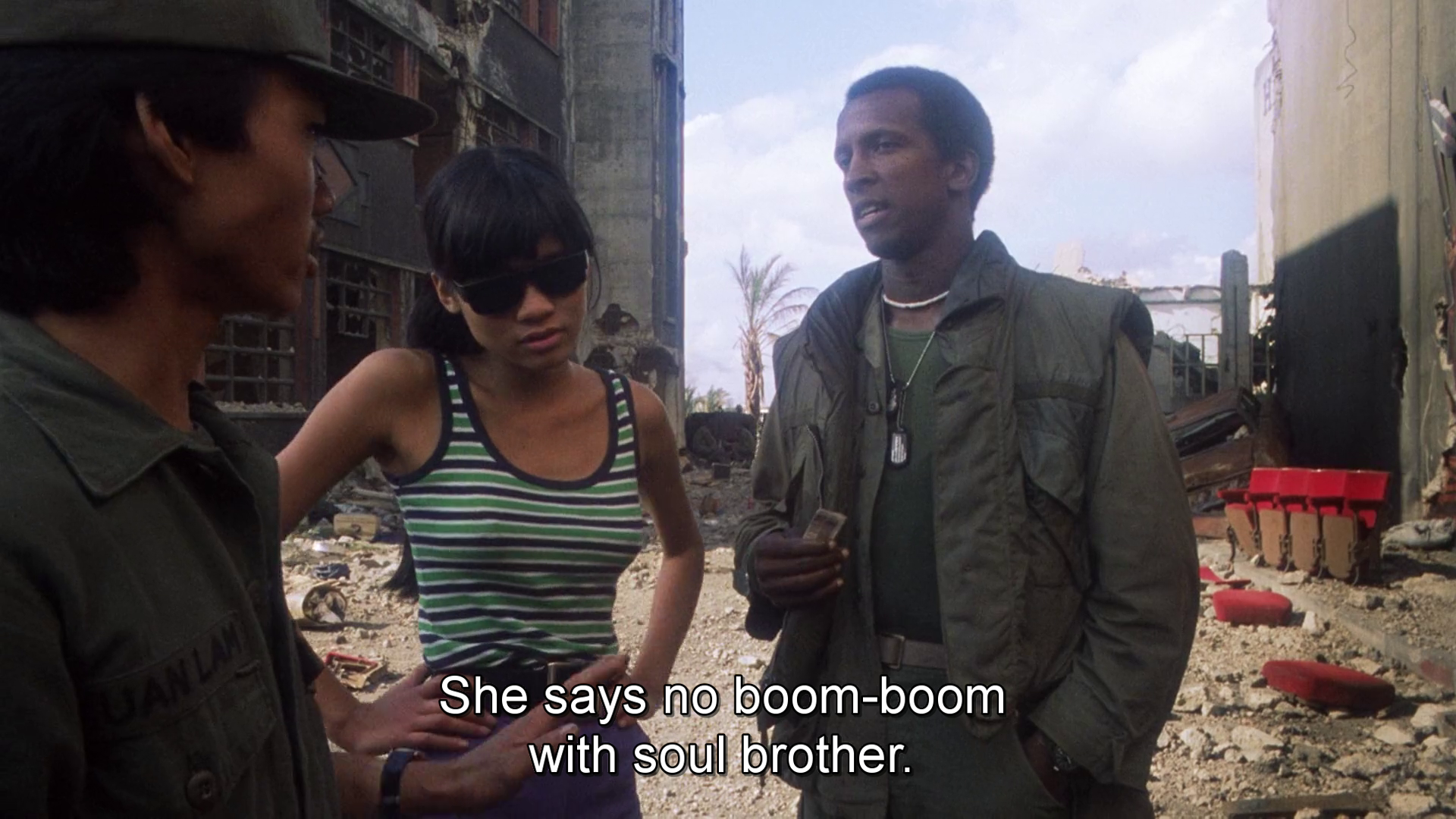
    Image result for full metal jacket hooker
    Pictured here: all you need to know about Vietnam

    With Too Tall and Snake Shit in tow (damn, wrong movie), along with stock issue anti-war journalist Brie Larson, and drunken burned out former SAS devastatingly handsome devil-may-care mercenary Tom Hiddleston, the stage is set. Upon flying over Skull Island on an investigatory bombing run (yes, I meant what I typed: it’s part of a geological survey cover story so preposterous I don’t want to spoil it for you), the entire force is knocked out of the sky by Kong. The remainder of the film is the story of groups of survivors trying to make their way to a pre-planned rendezvous with a resupply mission from the cargo ship they arrived in. Jackson wants to kill Kong to avenge his dead soldiers, whereas the civilians are only worried about getting the hell off the island. Various giant beasties make their usually violent appearances, and we meet the taciturn natives of the island, who have taken in stranded World War II fighter pilot John C. Reilly.

    It’s a hell of a cast. Legendary obviously was willing to spend All Of The Money to make this thing work. The problems, though, begin to surface early.

    First, I honestly thought that Goodman and Reilly turned in the only worthwhile performances in this film, and even then barely. The characters are written so thinly that they all come across as clichéd archetypes, from the Handsomely Brooding Very Serious Hiddleston to Jackson’s bitter war vet, played by the actor shockingly against type as a loud badass angry black man. Reilly is genuinely funny as the comic relief, though there’s nothing in his performance that you haven’t seen before, so if you weren’t a fan of him in Talladega Nights or Step Brothers, there won’t be much for you here.

    Director Jordan Vogt-Roberts seems to be aware of the paucity of actual artistic effort going into this movie, and we’re introduced to the titular giant ape extremely early in the film. I suppose he knows why people are coming to see this movie, and it isn’t just to find out it was a fucking sled from his fucking childhood (I still get angry thinking about that, at random times throughout the day). His only other full-length efforts prior to this were the indy film The Kings of Summer, and 49-minute runtime made-for-tv movie Cocked. Being given the keys to the kingdom on such a large production so early in one’s career paid off handsomely with an at-the-time still relatively unknown Gareth Edwards and Godzilla (Gareth got that job on the really quite good indy alien invasion film, Monsters, before using his kaiju success to then land the plum directorial job for Rogue One), but here Vogt-Roberts’s fails to bring life to an already torpid script.

    A small sampling of my personal Godzilla memorabilia collection, and every film except for the 1998 Matthew Broderick abortion.

    The effects, always of paramount concern in a film such as this, are passable. It is, of course, a CGI crap-fest, but since that is the future of all film, I suppose I have to rein in my old man frustration and forever bury my man-crushes for the masters of the practical. If the names Tom Savini, Rick Baker, and Rob Bottin mean nothing to you, you are a sad, deprived little person.

    There are call-backs to Jurassic Park (Mr. Jackson tells his men to, “Hold on to your butts!”), the original King Kong Vs. Godzilla (giant octopus fight scene), and universe building with the 2014 Godzilla. The secretive government-sponsored Monarch Corporation is a prime player, and Godzilla-related past events shown in the earlier film are referenced again in this one.

    Already announced: the next film to be released will be Godzilla: King of the Monsters (2019), followed by Godzilla vs. Kong (2020). Hold on to your butts.

    Ultimately I rate Kong: Skull Island 12 Bags of Cat Food out of a possible 20.

  • Reviews You’ll Never Use: Zardoz

    ZARDOZ SPEAKS TO YOU, HIS CHOSEN ONES.

    He speaks to you of his wonderful, magical, infuriating, nonsensical, visually bounteous film.

    This review is the direct result of a number of comments noticed by Your Friendly Ruling Council of Eternals Admins which indicate that a disturbing number of you may not have seen this film. The original plan was to write the entire review as Zardoz, and post it using the Zardoz account. However, I tried it out for a paragraph, and trust me…as a reader, that gimmick has its limits.

    Image result for zardoz
    The Flying Stone Head of Zardoz

    The 1974 movie Zardoz is a passion project tossed as a bone to director, screenwriter, and producer John Boorman in appreciation of his wild success with the 1972 classic, Deliverance. If you haven’t yet seen that one, I’m afraid it’s a tad too conventional for Reviews You’ll Never Use. Deliverance is a completely mainstream film, and so will find no place in this column.

    Zardoz marks only the second post-Bond film of Sean Connery. The actor was apparently having some trouble with typecasting, and not only accepted the role, but became fast friends with Boorman. Our other leading thespian is the beautiful Charlotte Rampling, a prolific actress known for many roles over the years, but perhaps best remembered by trash cinema & horror fans from her turn in the 1977 Richard Harris vehicle Orca, a brutally unsubtle Jaws knock-off.

    Given carte blanche, Boorman oversaw every aspect of the film, from writing to post-production. In his director commentary it is obvious that he reflects on the film fondly but admits that he perhaps stretched too far. To which your humble author would reply, Ah, but a man’s reach should exceed his grasp, Or what’s a heaven for? Indeed what Mr. Boorman considers an ultimately flawed product, is still so delightful in myriad ways that I shudder to think what would have come about if he had succeeded in bringing the totality of his vision to the screen.

    Somehow I don't think this guy believes that the penis is evil.
    I wasn’t kidding about the drawn-on facial hair.

    Our film opens in the year 2293 with a floating head providing exposition (explained by Boorman to be an ultimately unsuccessful attempt tacked on in post-production to reduce audience confusion). Interestingly, this narrator is fully self-aware and refers to his understanding that he is a fictional construct of the writer/director. The head inexplicably has a thin drawn-on mustache and goatee. We cut to a giant flying head that vomits guns and commands the “Brutals” worshiping it to go forth and kill, because, “the penis is evil” and overbreeding brings about a plague of men.

    One particularly clever Brutal, our protagonist Zed, stows away in the flying head and is taken to a realm preserved out of time, where the enlightened scientific remnants of advanced humanity live eternal lives of unspeakable drudgery. Punishment in this society is conducted by forced aging, the senile being sent to live in what appears to be an endless New Year’s Eve party ala TGI McScratchy’s. Others simply give up caring about life, and become Apathetics, standing around catatonic and being given green bread on which to sustain themselves. The self-styled Eternals view themselves as the preservers of the past, collapsed civilization, and their Eden is run by a supercomputer known as the Tabernacle.

    Yep, you get to see dem titties, along with a wonderful assortment of others.
    Charlotte Rampling
    Hard pass.
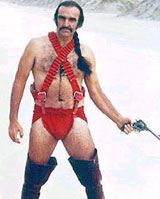
    The famous costume that Sean Connery wore to his wedding, and still wears to all public functions to this very day.

    The Eternals capture Zed and decide to study him, to find out how the vulgar strain of humanity has changed over the last two hundred years. One thing leads to another, as things inevitably tend to do in a story, and ultimately the Eternals find the answer to their weary prison of never-ending life.

    This film feels like something that was going to be, supposed to be, could have been, a great artistic achievement. Boorman’s self-directed criticism is on solid ground; it’s all simply too much. The visuals are wonderful. The costumes, the colors, the backgrounds, are all rich and help to bring this very interesting world to life. The problem is that this world is so very rich, that it becomes simply impossible to do it justice while remaining focused on progressing the plot. Who cleans up the Apathetics and the prematurely aged Renegades? They’re all quite spotless. Where do these non-functioning individuals relieve themselves? How on earth do the Eternals plan to cope when, inevitably, everyone slips up and commits transgressions resulting in forced aging into senility? The psychological scenes, in particular, seem over-wrought, as one begins to slip the line of confusing complexity for its own sake and nonsensicality with an artistic statement.

    For all that, I cannot find it in my heart to say this is a bad film. Imperfect? Surely. Plot holes you could drive a reasonably-priced sedan through? Absolutely. But the film is so lovely, the acting so involved, the entire production handled with such obvious love and hope, that it wins you over. Boorman is a good enough director to take what in anyone else’s hands would have become a tangled mess, and turn it into a modern bizarro masterpiece. While it lacks the raw insanity of House, it is obviously the vision of a man who knows exactly what he wants to express, and how he wants to express it, and that vision is sublime. Unfortunately, due to the limitations of time, budget, technology, etc, it is up to you as an audience member to take a step forward and meet the film halfway by taking the parts of that vision which are offered and completing it with your own mind and soul.

    And yes, there are a fair number of titties.

    I award this film 10 Severed Feet out of a possible 13.

  • Reviews You’ll Never Use: House

    Oh boy, where to begin with this one. Forgive me for running long, but this film deserves the digital ink.

    Let us start with this: if I were to receive some moderate sum of money, and be given complete creative control, House is the film that I would make. Please note that I am not necessarily saying this is a good thing.

    This also gives you a pretty good idea about how this movie is going to go, i.e. FUCKING CRAZY.
    Promo Image

    House is unlike anything you’ve ever seen. It’s a big (by the standards of late 70s Japanese cinema) budget art-house experiment horror-but-maybe-not-kind-of-black-comedy. To properly understand this film, you must ingest consciousness-altering substances. Drop some acid, rip as much as you can out of a bong 10 times, eat some mushrooms, get drunk, whatever you have to do to open your mind to the higher mysteries – just do it.

    Looking wistfully across the sea at the success of Jaws, in 1975 director Nobuhiko Obayashi was approached by Toho Films (makers of my favorite franchise, Godzilla) to produce a treatment for a summer thriller blockbuster. While only being a director of commercials, he was known as a creative eccentric who had produced films on the art-house circuit years before. Working with his friend Chiho Katsura, they quickly turned in a script for a haunted house film.

    The gag was, Obayashi had gone to his 10-year-old daughter and asked her for ideas of what frightened her. So impressed by the creativeness of what scares a little girl, he decided to treat the entire picture as if it was from the perspective of a young girl. This meant the inclusion of nonsensical plot elements, shallow archetypes, purposefully hokey effects and animations, all tied together with traditional Japanese ghost story elements.

    Toho green-lit the project and shopped the script for two years, but no director would touch it because they all thought it would ruin their careers. That’s how off the wall this film already was. Fearing that it would never be produced, Obayashi asked the studio if he could at least announce that it had been green-lit. They agreed, and the wild-haired filmmaker began a two-year media blitz to promote the film. He shot promo pictures with the cast, commissioned and released the soundtrack, and even had the film novelized and performed as a radio drama, all for a film that didn’t exist yet!

    That's a weird glory hole.
    So…that just happened.

    Eventually bowing to public pressure in 1977, Toho agreed to allow Obayashi to direct the film himself, even though he had only helmed commercials as a professional, and he wasn’t under contract with the studio (a highly unusual move for a Japanese studio to take at that time). His cast primarily consisted of a gaggle of 17-year-old girls who had been in his commercials previously.

    Without giving away too many details of the plot, our heroines Fantasy, Gorgeous, Melody, Mac, Sweet, Prof, and Kung Fu are slowly consumed by the house, as personified by its evil avatar, a fluffy cat named Blanche. We have an attack by a severed head from a well, which bites one girl in the rear, then vomits blood and throws itself back down the well. We have attacks by chandeliers, attacks by flying log piles, attacks by mirrors, attacks by cannibalistic pianos, attacks by futons and linens, and attacks by telephones. By the end, the house has regenerated itself, showing shades of Burnt Offerings, which had come out in the United States the year before (if you get the chance to see it, Burnt Offerings is a passable haunted house film mostly notable for being mediocre despite a fantastic cast including Oliver Reed, Karen Black, Bette Davis, and even a few minutes of Burges Meredith playing, shockingly, a curmudgeonly old man).

    The plot, though, is not the point of this film. This film is entirely focused on the telling, rather than the tale. The Austin Chronicle perhaps said it best, “there’s surprisingly little to recommend House as a film. But as an experience, well, that’s a whole other story.” We have scenes in which one character tells the others a story, which is shown as a sepia-tone film reel which the other girls can see and comment on. One girl describes a mushroom cloud as looking like cotton candy. There are animations, matte paintings, animals that are clearly being thrown at the actors from off screen, a man who mysteriously turns into a pile of bananas, and several scenes involving 17-year-old girl titties…sometimes disembodied and floating around.

    Obayashi went on to a prolific film career, and eventually in 2009 earned the Order of the Badge of the Rising Sun for contributions to Japanese culture. However, he never managed to match the beautiful insanity of his first effort. The film was a hit in Japan, due to being a breath of fresh air in a completely stagnant industry (by this time, most Japanese directors were churning out Toro-san rip-offs or pinku eiga, which is softcore porn).

    And yes, you get to see some of their little girl titties
    Our intrepid band of potential victims

    The Criterion Collection DVD has several excellent bonus features, including Obayashi’s 1966 experimental film Emotion, a lengthy interview with the director, and a retrospective by Ti West, director of House of the Devil. I had quite liked that film, but Mr. West comes across as somewhat of a smug film-school student spouting platitudes about “challenging the audience”.

    To sum up, I cannot recommend this film highly enough – if you’re a person like me, who takes most of your personal philosophy concerning the nature of existence from the Joker. If you’re a Very Serious Person who likes to Seriously Discuss Very Serious Things, and have a silly hang-up by which you insist that your films follow a coherent narrative structure and conventional character arcs, then…have an adventure and watch it anyway. But get really fucking high or drunk first. It’s worth it.

    I rate this film 8 drug-using dogs out of 10.

    Image result for crazy Image result for crazy Image result for crazy Image result for crazy Image result for crazy Image result for crazy Image result for crazy Image result for crazy

  • Another Day, Another IP Think-Piece. We’re Such Party Animals Here At Glibertarians.com!

    Greetings!

    Some time ago, I brought you a piece the primary function of which was to provide a free resource to understand the radical notion, largely held only in libertarian circles, that IP laws are not compatible with libertarian principles. You can find a link to that earlier piece here.

    I’d like to direct you now to a piece that I perhaps should have led off with. It is still by Stephan Kinsella, a Houston, TX patent attorney*, Executive Editor of Libertarian Papers and Director, Center for the Study of Innovative Freedom (c4sif.org). However, it is a smaller, more condensed version of his primary argument, and is rife with excellent citations and thorough notes that any budding libertarian or anarchist theorist will find invaluable.

    Those aren't creations of the mind, they're creations of a fucking factory. What are you, Q?
    There aren’t many useful pictures that come up when you search “Intellectual Property Images”

    In the article Law and Intellectual Property in a Stateless Society, Mr. Kinsella takes the reader through a very brief but illuminating explanation of the evolution of the view of self-ownership and how property rights are inherent to this concept. He then goes on to reiterate how IP laws contradict those property rights, which argument those of you who read Against Intellectual Property will already be familiar with.

    The portion that I think our small army of arm-chair commenter-philosophers will find most interesting and conducive to discussion is the latter part of the article. Mr. Kinsella discusses what an IP regime might look like in a stateless society. This directly addresses those who dismiss an idea as being too radical, or unworkable, if no direct formulation is provided of how the idea might play out in a practical fashion.

    When downloaded, the PDF shows a length of 44 pages, but due to the voluminous notes, there is really only about 25 or so pages of narrative text. You can read it over your lunch break! Assuming you work for a weak-kneed progressive who actually allows you to not be working for a precious few minutes in order to eat. No true libertarian master would ever permit such indulgence among his (and I do exclusively use the male pronoun when discussing both libertarians, and business owners) chattel.


    *Don’t we have a commenter who is also an attorney in Houston? If you disagree with Mr. Kinsella’s positions, you should meet him for lunch and fight to the death. It’s the only way to prove which one is right.

  • Reviews You’ll Never Use: Dark House

    Hello, and welcome to (what may be) the first in an on-going series of film reviews. These will not be your ordinary film reviews, oh no sir, for your humble reviewer is no ordinary cis-gendered heteropatriarchal man. Much as our dear friend the Derpetologist plumbs the depths of the interwebz to bring you only the derpiest in modern derp, I, too, am an explorer in dangerous environs. My particular faculty, however, lies in obscure, campy, poorly made, misunderstood, niche horror and sci-fi films.

    Let us begin with the most recent horror film I have seen – Darin Scott’s Dark House. This appears at first glance to be a meaningless addition to the already rich canon of poorly acted, poorly written, cheap computer FX DTV (direct to video) horror library. However, as our parents should have taught us, looks can be deceiving.

    Some scant years ago, at a small private orphanage, a small gaggle of children are butchered by their insane caretaker, who then takes her own life in suitably gruesome fashion. Cutting to the present, a group of acting students at the local community college are approached by haunted house impresario Walston Rey to act as a skeleton crew for a press run of his new haunted attraction. The attraction is, of course, located in the previously seen massacre house, which over the years took on a “haunted” reputation in the local community. One of the students, Claire, is strangely eager to go. It turns out Claire had a terrifying experience there, and her shrink thinks spending time in the house would unlock her repressed trauma. Unable to go it alone, she believes this will be the perfect opportunity to revisit the house in a safe environment. Thankfully for us viewers, her supposition about the safety of said house turns out to be hideously wrong.

    https://images-na.ssl-images-amazon.com/images/M/MV5BMTU3NDQxMTAxOV5BMl5BanBnXkFtZTcwOTE0Njg1Mw@@._V1_UY268_CR4,0,182,268_AL_.jpg
    Box cover. I swear, sweet 80s VHS box covers are a lost art. We will discuss this, AT LENGTH, in a future post.

    The film starts off in a very paint-by-numbers fashion (for low-budget horror) and is saved by the timely arrival of Walston, played by the always delightful Jeffrey Combs. Seriously, I would pay money to watch Jeffrey Combs read the Calcutta phone book. Many of you may know him from his recurring roles in various Star Trek series, notably both as the Vorta Weyoun and the Andorian Shran. True horror connoisseurs, though, will always think of him as Dr. Herbert West in the immortal and perfect in every way Re-Animator. Since Mr. Combs takes the stage (literally) while in a scene featuring the entire rest of the cast, the immediately noticeable gap between his talent, and that of the remainder, is almost jarring. It is here that we are introduced to Claire, played by Meghan Ory. This Canadian actress’s screen credits are ample, if mostly guest shots on TV shows. She plays the role of slightly nutsy Claire adequately, if not with any great enthusiasm. When the rest of her class expresses skepticism, she has some wonderful meta-lines about how many famous actors got their start in low-budget horror. For our readers who may not be aware, this is an actual fact, and will perhaps be the focus of a future post.

    Our intrepid team of would-be actors (and I do mean that in both an in-universe sense and in a real life sense) show up to learn their roles for the press opening of the haunted attraction. Something unnatural goes wrong with the computer controlling the effects and…well, if you’ve ever seen a horror movie in your life, you know where this is headed. Thankfully Mr. Combs is not the first to go, as so often happens in these sorts of films when they spend the money to trot out a fan favorite, but can’t really afford to give their character more than minimal screen time.

    It is at the ending that the film makes its first real attempt to separate itself from the pack. Without giving away too much, what appears to be the closing scene contains a plotting element that comes just…this…close to being interesting and at least a little different. That is something that many of you have no idea how hard it is to find in this genre of film: anything different.

    OH SHIT SON!!!
    Creative Commons image that comes up when you search, “horror”. That’s right, I’m lazy. Screw you.

    Unfortunately, the filmmaker then completely shits it all away with an extra few minutes that wake us violently from the beautiful dream of a low-budget horror film that doesn’t feel like one has wasted 90 minutes of one’s life in viewing, and plants us firmly back in the reality in which most low-budget horror films feel like you’ve just wasted 90 minutes of your life in viewing. A real shame, honestly. This was only director Darin Scott’s second film, so he may be forgiven for not having fully developed his instincts yet. That’s what a good editor is for. He later helmed several other horror films, which you can find on IMDB if you are so inclined, and also directed what I’m sure was an underrated classic, House Party: Tonight’s the Night. That’s right, a House Party sequel, in 2013. When I’m having a hard time slogging through a particularly bad horror movie, I can look back on that fact and remind myself that it could always be worse.

    I award Dark House two-and-a-half Naked Asian Batmen out of five. Image result for pixelated dicks  Image result for pixelated dicks Image result for pixelated dicks

  • Late Night Anti-Muslim Bigotry Post

    A hottie Muslim pre-school teacher (if that’s the correct term for pre-school; it’s what the news is using here, so I’ll stick with their phrasing) in Arlington, Texas, has been fired.

    The reason? A recently discovered series of disgusting tweets making Holocaust jokes and encouraging others to kill Jews, made mostly in 2013. The tweets from Nancy Salem were uncovered by a group called Canary Mission, with the stated purpose of exposing antisemitism on college campuses. According to Canary Mission, Salem was one of a group of 24 antisemetic students at the Univeristy of Texas Arlington, who were described as anti-Israeli activists.

    https://canarymission.org/wp-content/uploads/photo-gallery/Salem_Nancy/Nancy_Salem_cm02_Facebook_Jan_5_2017.jpg
    Nancy Salem

    In a plot twist, the university states that Salem was never a student there, and that they are not familiar with Canary Mission.

    This raises an interesting question in living in a free society: the pre-school is not publicly funded. In the digital world of today, where everything everyone says is on the record forever provided an intrepid enough researcher devotes the time and resources to uncovering it, where is the line beyond which non-work related banter becomes fodder for public sanction, including in the workplace? This particular case is easy enough; the tweets can certainly cause reputational harm (NSFW) to the Children’s Courtyard, where Salem was employed. However, looking beyond the odious nature of this story, can the same be said of political affiliations? If the parents have a right to know that their children are being watched over by a gorgeous jihad-supporter, do parents in San Francisco have the right to know that the person watching their children might be, *gasp*, a Republican, and therefore an evil bigoted white shitlord? Is there a point at which no one will ever be able to say anything online for fear of only being hired at ideologically sympathetic companies? Will I begin to write posts comprised entirely of questions, like a certain Judge?

    This possibility is directly related to enterprises being hounded out of business by radical leftist activists if said enterprise is not discovered to be friendly enough to gay marriage, to use a recent example. In a world where everything is made political, everything is made of shit.


  • Intellectual Property and You: An Introduction

    Hello libertarians, anarchists, minarchists, fellow travelers, and those who just kind of experimented in college but have been curious ever since.

    Today we bring up a subject only slightly less contentious among the aforementioned ideological groups than abortion or deep-dish pizza. I am speaking, of course, of intellectual property laws.

    Many commenters in the precious few articles we have seen on this issue in our previous lives expressed a desire to rein in the perceived outrages and over-application of IP, without necessarily wanting to throw the baby out with the bathwater, as it were.

    Texas Tech's football coach looks like this. I am a huge booster of Texas Tech Football. What I'm saying is that I want to have gay sex with Kliff Kingsbury.
    Texas Tech’s football coach looks like this. I am a huge booster of Texas Tech Football. What I’m saying is that I want to have gay sex with Kliff Kingsbury.

    Linked here is a free copy of a book, Against Intellectual Property, that I hope you will take the time to read. The author, Stephan Kinsella, is a critical voice in the current milieu of libertarian, anti-state, anarchist, and minarchist thought, and even when I disagree, I always enjoy his thorough and rigorous logic.

    I believe the title tells you where Mr. Kinsella stands on the topic, however, for those of you uncertain either of the practical or ideological underpinnings of IP as it currently exists and why the system should be abolished rather than merely reformed, I hope that you take the time to grapple with the presented material and hone your own thoughts and arguments.

  • The SJW Went Down To Georgia

    Here’s an interesting article by noted American musician Charlie Daniels which is warning of the possibility for a second Civil War, over the protesting & rioting we’ve seen in recent weeks.

    I find this an interesting thing to ponder. There certainly seems to be more civil unrest than there has been in my lifetime (I’m 34 years old, to give that statement some context). That’s obviously alarming, particularly with the emergence of the SJW contingent on college campuses, the bizarre radicalization of the BLM movement into some sort of neo-marxist drivel, and the recent wave of leftists who openly make the argument that freedom cannot be afforded to those who disagree with them.

    On the other hand, things have been much worse in this country before, without a total societal breakdown of the type which Mr. Daniels is alluding to. In the late 60s and early 70s, a number of American cities burned. There were actual full-on race riots, anti-Vietnam War riots, anti-hippie riots, leftist bombings, all of which dwarfed the recent Berkeley fiasco. And yet, no civil war.

    So my question to you, intrepid readers, is this: are we really headed towards an abyss, or is this a product of recency bias? Were the 80s & 90s actually so good, so stable, so peaceful, and so generally awesome (outside of a few well-known events, such as Waco & the Oklahoma City bombing) that it lulled us into a false sense of complacency, where any street level unrest looks far more alarming than it actually should be, given the historical context?


    Related image

  • Prepping & Survivalism

    So I read a book recommended to me by a nice dealer at the Lewisville Gun Show a few weekends back: Patriots: A Novel of Survival in the Coming Collapse, by James Wesley Rawles. I’ll give a brief review, then I thought it might be interesting to open up the comments to ideas on prepping and survivalism, since these are recurrent themes in a lot of the circles that radical constitutionalists and libertarians run in.

    I am sorry to say the book disappoints. The writing is didactic in the extreme. People regularly refer to their gear by both the brand and model number, and their weapons by brand, model, and caliber. In casual conversation. I don’t think at any point during my time in the Army National Guard did I ever refer to my equipment by anything more than it’s most generic name, i.e., “Hey hand me my LBE”. The names of specific companies where supplies were purchased are given, and even the names of the clerks at the companies that the protagonists deal with, only to never be used throughout the rest of the story. The author goes into agonizing detail on how to weld steel shutters over your windows, set up traps, etc. Frankly it reads more like the author wanted to write a how-to manual on setting up your own Cwazy Compund, but decided to do it through the medium of a novel.

    There are, of course, the usual fringe-right fever dreams. The villains are cardboard cutouts: the UN, lead by nefarious Europeans, wants to conquer America because they simultaneously hate/envy us because we’re free, and two traveling communists are found to be literally eating children. Only religious people can be moral, and one of the most important things you ask refugees when you first meet them is if they’re Christian. It’s formulaic: everyone who has a Bible or mentions going to Bible study is found to be a good-guy, and the ones who don’t, well…see the second sentence of this paragraph. There is a Jew who is one of the main protagonists, though he several times reminds the group that they worship the same God. Their Christianity is repeatedly invoked as being the reason they don’t go around raping and pillaging. The main protagonist is leery of leaving two young people alone at his compound, because he won’t tolerate “fornication”, but his wife assures him that as Good Christians they can be trusted to be celibate until they are married. And the Waco and Ruby Ridge killings by the government are described as specifically being the massacre of Christians who just want to be left alone. Would those incidents have been less tragic if they were Buddhists?

    There is a happy ending – a Libertarian gets elected president! Hooray! But aside from that, I’m afraid it doesn’t resonate with a person like myself, who is taking sensible precautions for a several week disruption of supplies and services (accompanied by potential looters or attempts at street violence by bolsheviks), but doesn’t have the time or money needed to create your own private Fortress of Solitude in rural Idaho. Even if it sounds like a fun project, I have no doubt that a divorce would be in my near future should I attempt the thing!

    That brought me the idea for the post: if you’re reading this, presumably you, too, are of a libertarian-ish bent. That means that it is likely that you have thought about prepping in some form or other. Personally, I have several weeks worth of water and non-perishable food stored, a bug-out bag with the usual contents, and a variety of weapons in several common calibers, with a few hundred spare rounds for each.

    So I’ll open it up to the comments: do you consider yourself a “prepper”? What thought, if any, have you given it? What preparations have you made? What’s in your bug-out bag? What’s your main plan (bug-out, bug-in, etc.)? Perhaps we can have future articles on BOB prep, good fall-back locations, tips & tricks on making do without utility service, etc.


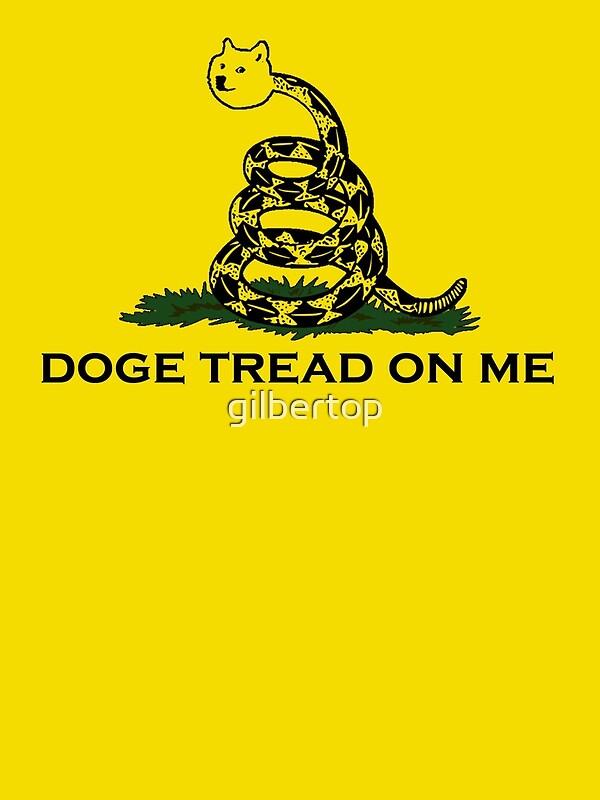
    Image result for doge meme