Category: Animals

  • #Mewtwo

    First time I can remember being assaulted and forced into a Poké Ball I was only in my first evolutionary form. I told no one and lived with the shame and guilt, thinking all along that I, a Psychic-type, was somehow responsible for the actions of a 10-year old boy from Pallet Town. I had to see this “trainer” on a daily basis for years to come. He would shout my name and expel me from the pocket dimension I was trapped in, and I would be forced outside, my blood running cold, my guts carrying the burden of what only he and I knew — that he expected me to shut my mouth and fight other “monsters” in grudge matches until one of us was beaten into unconsciousness. When I was not fighting, I was forced to breed with the other “monsters” in his stable and our offspring would eventually be taken from us to be traded with other “trainers”.

    #Mewtwo

  • Animal Rights and Libertarianism


    I was reminded the other day that the Ringling Bros. and Barnum & Bailey Circus had closed recently, and it got me to thinking about animal rights, particularly from a libertarian perspective.

    Ringling Brothers…no more.

    First, a bit about where I stand: I eat meat; I’m fine with employing animals for their labor; I’m also fine with keeping animals for companionship. We have an English bulldog who’s pretty awesome, if occasionally stubborn and flatulent. I hunt and fish, and I don’t have a problem with killing an animal that I’m not emotionally attached to for food. But, I don’t want to cause any unnecessary suffering to any animal, and I don’t think anyone else should, either. If someone intentionally hurt my dog, I’d inflict as much pain as possible on them, and maybe on their children, too. Ideally, I’d eat free range meat, but I haven’t done my research yet to figure out what that entails (or even means) and how to go about it.

    Circuses are out for me. I don’t want animals to be kept in captivity for my entertainment. Zoos require some nuance. Some zoos exist purely for entertainment, and there are many examples of cases in which the animals in these zoos aren’t treated well. However, there are also many zoos (and aquaria) which have multiple functions of research, education, and, entertainment. I’ve had the privilege of visiting some excellent ones, including the San Diego Zoo and Safari Park, the Monterey Bay Aquarium, and the Vancouver Aquarium. These zoos have biologists on staff who conduct studies to better understand the animals, as well as biologists charged with the care and well-being of the animals. As an added benefit, those of us who aren’t biologists can visit and learn about, and, yes, be entertained by the animals.

    I’m torn on medical experimentation on animals. While I realize that medical experimentation can cause suffering to animals, I recognize that it can also relieve the suffering of humans.

    Now, on to the perspectives on animals rights that I was aware of beforehand. One perspective is that animals are not humans, and thus have no rights. Another is that there’s no special sauce that distinguishes humans from other living creatures (indeed, we share an overwhelming percentage of our genetic material with most other living organisms), and thus animals should have the same rights as humans. I think that these are both extreme views.

    Given that western civilization is heavily influenced by Judeo-Christian values, it’s not a coincidence that the origins of some western values on animal rights can be traced to the Bible. Genesis 1:26 says “And let them have dominion over the fish of the sea and over the birds of the heavens and over the livestock and over all the earth and over every creeping thing that creeps on the earth.”

    Saint Francis preachin’ it.

    However, there are also many examples in Judaism and Christianity that hold that humans should care for and protect animals (see Francis of Assisi, patron saint of animals, and the analogy of Jesus as the shepherd). (Aside: ZARDOZ seems mostly concerned with grain production, but what does He command about animal rights?)

    So, what are the libertarian perspectives on animal rights? It seems to me that a libertarian’s view on animal rights is largely dependent on whether one views animals as “individuals” that are afforded rights, or property, which has no rights of its own. In this respect, libertarian viewpoints on animal rights parallel libertarian viewpoints on abortion (which come down to whether one believes that a fetus has rights). My research seems to indicate that, as with abortion, the majority of libertarians seem to come down on the side of animals having no rights, but it’s certainly not unanimous.

    NAP! NAP!

    What say you, Glibertarians?

  • Tails of the Teufelhund: Part 3

    Baby Bella

    Belly and I have always played throw and return, and she’s finally starting  to return things I throw: rope, baseballs, etc. And this is good for her as I have almost no yard for her to play in. We walk every day, and the dog park is down the street, so there’s that. When Belly was about 3 months old, I bought her a toy which she immediately lost, and 7 months later, today, I found SQUEAKY TOY!

    We have spent the entire afternoon playing and throwing SQT around and B is having a blast.

    SQT is a fluorescent, orange rubber bone-shaped thing that squeaks. Yummy!

    I have read that the reason dogs love SQTs is because they love to hear their prey scream. Sounds about right for Bella. And so delicious, I can only wonder what cats think about it; after all, they are the gangsters of Pet World.

    Cats: yes, I have one. Eighteen years old and still kicks Bella’s ass. A real nice kitty.

    My son actually found her on a rainy night, and I said, “If she lives, keep her,” thinking this poor thing wouldn’t make the night. Happily, I was wrong. Kittah is tiny but real tough. Full grown only about 6 lb–truly a runt like my Bella, and a fucking trooper. Been through 3 dogs and handled them all. Go Kittah!

    Maybe this should be Tales of the Kittah


    Cats are Canaries in Coalmines

    Pets are opportunistic,

    Dogs are free Security

    Like people,

    Pets are not Children

    Most are just as stupid

    And must be Guided

    God Bless the Doggies and Kittahs.

    I’m a Sucker

         +          =     

  • Tails of the the Teufelhund, PT II, Poison!

    A few Sundays ago I decided to spend the afternoon with my best friend, discussing composing, arrangement, engineering and various audio stuff, when my phone rings.

    My Wife is calling in a panic because Bella is having a major seizure and come home NOW!, but continues rambling so I just hang up, and say, “Chuck, dog’s seizing, gotta go,” and I’m out.

    As I drive the 6 blocks to my house I’m wondering, “Poison? How? I can’t even leave for a few hours without someone killing my Dog?”

    5 minutes later as I walk through the door, my 25 yr old Son is acting like a 10 yr old sniveling version of Hillary, no help at all, so I go find my Dog.

    Poor baby is sitting in a corner of my office, drooling, spaced the fuck out, and the pollen is falling heavily. I just try to love on Her, but she won’t let me touch her, at first. So I go looking for poison. My office, clear. Bedroom, clear. Kitchen, clear. Then the back yard.

    She found my extra Roundup on top of a 5 foot shelf and knocked it over. She loves to open bottles you see. At this point I walk inside and pronounce, “She drank Roundup, she lives or dies,” being Her Daddy and the heartless motherfucker I am.

    An hour goes by and She drinks some milk. Another hour, then a puppy treat. And then finally eats dog food, THANK GOD!

    After my Wife explained that my son put her out back instead of my office, I knew what happened. Bella doesn’t stay alone unless she is in her den (my office) and panicked, or she was just mad because the People left her alone.

    We often give her milk for a treat, and she had some just prior to drinking Herbicide. Maybe this helped? But she apparently voided from all orifices, while screaming in pain, probably scary as fuck, and I’m glad I didn’t have to witness it. She is fine now, but lesson learned:

    Puppies Will Find Trouble.

    Secure all poison, take no chances.

    I almost lost my Belly.

    Take Care of your puppies, Glibs

  • You Can’t Put a Price on Good Pussy


    I’m an immigrant to the United States, originally from the tiny Scandinavian kingdom of Denmark. I moved here as an adult, not to better my financial situation, but to marry my American girlfriend and improve my emotional life. It was hard to leave a secure job with good pay; it was a risk of the unknown, but I thought well worth the love of a good woman. After settling in, I managed to find a job in the same field, with an almost identical income. Financially my life should be the same, except it quickly became apparent that I have more disposable income here. A lot more.

    It can be difficult to understand the impact that such an increase in disposable income can have on a person’s life, without a tangible example. Americans shrug it off because they take it for granted. They can’t understand what it’s like living paycheck to paycheck or saving up for something trivial on an otherwise decent income. My Danish friends and family can’t understand the difference either. They think what I’m about to tell you shows how irresponsible or foolish I am with money, because spending money in this way is simply not possible without upsetting your financial life for months or years.

    Literal disposable income

    You get the idea: disposable income is nice, it allows you to be more carefree and buy nice things. But it’s also about more than being able to afford luxuries, and it can mean the difference between life and death for those you love. The main take away from the events you’ll read about here is this: had they played out in my native Denmark, I wouldn’t have been able to afford the medical care that saved my friend’s life. I probably wouldn’t even have been able to find anyone to provide the care because there is no market for something people cannot afford. He would have been killed humanely at my expense instead.

    My friend’s name is “BJ.” Scratch that, BJ is more than a friend, he’s family. He also happens to be a cat. We didn’t really plan on getting another pet, but he was irresistibly cute – a real scrapper. He was a skinny little thing and had a lot of scars and scabs, but he was exceptionally outgoing and had very high spirits. His personality is likely why he evaded being killed at least twice while passing through high kill shelters in the first 6 months of his young life. He miraculously found himself in a no-kill shelter near us, and we found him in a pet store that features locally adoptable cats.

    BJ had a clean bill of health from the shelter, and we decided to give him a chance. Having lost another cat recently, we decided to protect ourselves from heart-ache by offering to foster him, with the option of later adopting him. Yeah right. We decided to keep him within a couple of weeks. He quickly gained a bit of weight, his scabs healed, and his fur filled in. He got along with our 3 other rescue cats and was living a good life in his new home. He worked his way into our hearts, became part of the family, and we became inseparable.

    Cats are prone to upper respiratory infections; they result from a herpes-like virus that is in virtually all cats. Like cold sores in humans, it lays dormant most of the time, but when it flares up the symptoms are a runny nose, sneezing, and maybe a fever. All our cats would suffer from this occasionally, but BJ caught it really bad after having lived in our home for a couple of years. His symptoms were much worse and he didn’t really seem to spring back from it as easily as our other cats. One day last year after a bout of this, he started to drool a lot and bleed out of his mouth. We panicked and took him to a vet immediately

    It turned out he had several bad teeth, and one had to be removed. He was also presenting with enough other strange symptoms that the vet decided to do a few routine tests. BJ tested positive for FIV, the feline equivalent of HIV, and on top of that he was severely anemic. Because of the anemia it was uncertain if he also had the FeLV virus, which causes leukemia in cats. Shelters test for these viruses, but a cat can test negative for months after infection, so there are no guarantees.

    So cute!

    We were devastated. He was quickly getting worse, and we took him to an emergency animal hospital an hour away with an internist on staff. Honestly, it was uncertain if he was going to make it. BJ stayed in the hospital for several days, where he had two blood transfusions, a bone marrow biopsy, and a bunch of other tests and treatment. He was very sick, but through the whole thing he was friendly and alert, and you could tell the staff was rooting for him and giving him extra attention because of his personality. Being cute is a real survival skill for this little guy.

    Thankfully he didn’t have FeLV, instead the anemia was caused by something called a “mycoplasma.” This bug had a field day because his immune system was compromised by the FIV virus. It can be easily cured, but was damaging his bone marrow and keeping him from producing and sustaining viable blood cells. He was getting a cocktail of antibiotics to kill the mycoplasma, and steroids/immune-suppressing drugs to give his bone marrow a chance to heal and produce new blood cells and to slow down the FIV. To complicate matters, the steroid made him diabetic, a risk we accepted, and he needs insulin injections twice daily. For months we were taking it one day at a time. BJ will always be sick, but thanks to our ability to provide this care for him, he can feel happy and healthy. He pays us back every day.

    It wasn’t cheap–it cost us thousands of dollars, and he still needs medications and frequent trips to the vet. But it was our choice. If BJ lived with me in Denmark, that choice – and consequently his life – would have been extremely limited by how others think my income should be spent. BJ would have died to pay for an artist’s paint, a politician’s plane ticket, and the Queen’s morning cup of organic fair-trade coffee.

    Tophat-tip to Animal for the title.

  • The Tail of the Teufelhund

    She was a wee child, they said she was born of Pit, but no.
    My pictures tell me so,
    I fed her and got her shots,
    And she eats food, lots,
    and everything She can Find,
    She it a chewer of the worst kind,
    The Wife ordered new furniture Thank God,
    Because all of our old stuff was eaten by the Dog,
    We have a fence, She will not cross,…… Oh Fuck it She’s attacking me again, I’ll get back to You guys, AGGGHGH!

    Puppy: Code name Bella
    Task: to destroy all Furniture
    Optional: eat everything else

    My Pup was born on 1/21/17 and was advertised as a “pure” Pit Bull, which we were in fact looking for; brindle, female, we were happy. Not a Pit, though; she is a kind of weird shape and the clinic called her a Belgian Hunting Dog but you tell me. I call her a Teufful Hund, and my granddaughter (7 years old) calls her a Chupacabra Dog. She is currently eating a piece of poster-board.

    At 7 months, she is mellowing out a bit, but what a handful. Sometimes her name is No!Bella!.

    She should finish out at 80 pounds or so, but until then, The Great Adventures of Bella! the Eater!

  • Entertainment, red in tooth and claw

    Before the abject pussification of the world through animal welfare regulation, there was a time when a man could bring his wife and children out on the town for an exciting evening of the finest blood sport. Perhaps as ritualistic payback for the all the millenia Homo sapiens sapiens and to spend huddling in caves, naked and afraid, hiding from roaming beasts,  from at least the time of the Roman venatio, for much of human history, entertainment meant seeing some animal get crushed or disemboweled, because fuck animals. This article recounts four such bad-ass entertainments, now lost to us, that could return in a more (g)libertarian world.

    Cock Throwing

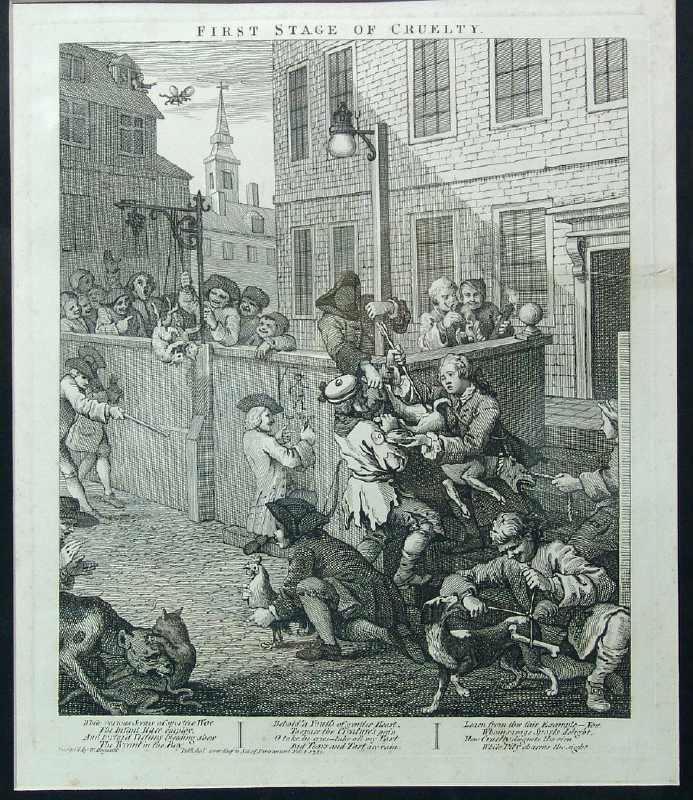
    “Cock Throwing” is currently just what jesse.in.mb calls “Tuesday”; however, cock throwing was once also a popular British pastime until the early 19th century. The game was brilliant in its simplicity: a rooster is tied to a pole and then people throw sticks at it until it dies. A variation of cock throwing was basically “hit the piñata,” but with a live chicken instead of papier-mâché and blood and viscera instead of candy. Regardless of this, according to historians cock throwing was quite popular with children. Cock throwing was also a hallowed ritual associated with Shrove Tuesday, because Jesus Christ demands the blood of chickens offered in sacrifice.

    Goose Pulling

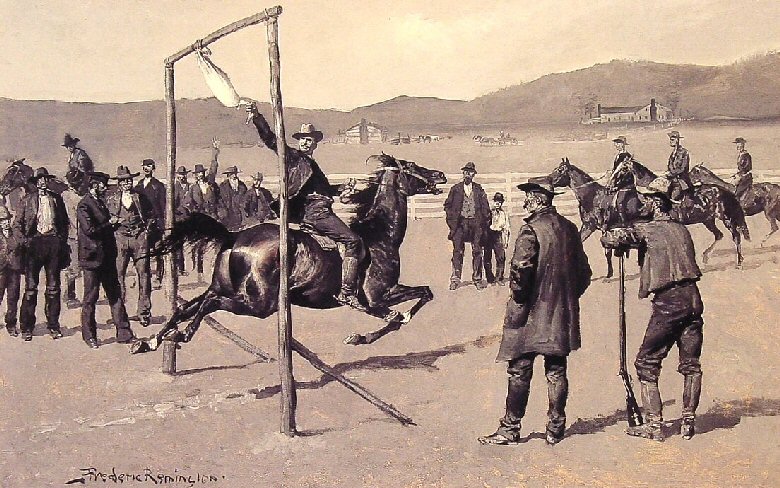
    While originating in Spain, until about 150 years ago, goose pulling was the favorite sport of the Dixie. George Washington and Thomas Jefferson most likely participated in goose pulling. Indeed, contemporary reports detail that a goose pulling was one of the few social events in which the entire spectrum of society, from slave to plantation aristocracy, could be found participating together.

    “A Gander-Pull” by Fredric Remington (1894)

    So, just what is goose pulling? As further evidence that Christianity is actually a demonic cult focused on blood sacrifice and cannibalism, as part of Easter celebrations, a live goose with its neck greased was tied to a pole so that it hung head-first over a road. Competitors on horseback rode through the road at full gallop while attempting to pull the head off the goose’s body. Sometimes, obstacles would be placed on the path. According to one account, riders had to ride through a gauntlet of whips on their way to the pole. Spectators would bet on the proceedings and drinking copious amounts of whisky was expected.

    In the United States, goose pulling would fade into obscurity after the Civil War. Thanks, Lincoln!

    Fuchsprellen

    A pic from the last Glibertarians meet-up

    As evidenced by their pornography, the Germans are fucking lunatics. As it turns out, such lunacy has a long and storied tradition. Fuchsprellen, or fox tossing, was a popular sport among the aristocracy of Europe during the 17th and 18th centuries. Fox tossing involved using a giant slingshot to launch foxes and other animals into the air. Whoever tossed the animal the furthest won. Of course, you can imagine it wouldn’t be easy to keep a snarling, scratching and biting fox in place for long so that you could send it flying to its doom. Despite that, expert fox tossers could launch an animal 24 feet into the air. According to Wikipedia’s article on the sport, “Augustus II the Strong, the King of Poland and Elector of Saxony, held a famous tossing contest in Dresden at which 647 foxes, 533 hares, 34 badgers and 21 wildcats were tossed and killed. Augustus himself participated, reportedly demonstrating his strength by holding the end of his sling by just one finger, with two of the strongest men in his court on the other end.” Whereas goose pulling was seen as a test of one’s manliness, fox tossing was considered a fun party game where couples paired off to compete with one another.

    As if death by slingshot wasn’t indignity enough, sometimes the animals would be decorated with “bits of cardboard, gaudy cloth and tinsel” as part of a masquerade.

    Good ol’ boys and their punkin’ chunkin’ ain’t nothing but pussies.

    Human-Baiting

    If goose pulling was the national sport of Dixie, then baiting was the sport of Victorian Britain. Baiting involves pitting a pack of dogs against a chained animal in a fight to the death while spectators bet on the outcome. Pretty much every combination could be found, bear-baiting, bull-baiting, duck-baiting, etc.. And since we’ve all wondered who would win in a fight, 10 toddlers or 1 pit bull, it wasn’t long before someone had the idea to pit a human versus a dog to find out. In 1807, The Sporting Times reported on one such human-baiting match:

    A fight between a man and Bull Dog took place some time ago to settle a bet. With its first charge the Bull Dog already succeeded in throwing and pinning its opponent. Although the dog’s jaws were nearly closed by a muzzle, it succeeded in sinking its teeth into the man’s body. Had the dog not been pulled away immediately, it would have disemboweled the man.

    If this depiction is to scale, the outcome is understandable:

    Not content to let the collective honor of our species be forever sullied, other human vs. dog deathmatches were organized. In 1874, a dwarf who went by the name of Brummy, agreed to fight a bulldog named Physic on account of a bet to prove Brummy’s claim that “no dog could lick a man.” The fight went 11 rounds, in which Brummy suffered several deep bite wounds to his arms, and the dog received so many blows to the head that it lost 2 of its teeth and one eye was swollen shut. Brummy won by knockout.

    Another account of human-baiting comes from 1892, where a man by the name of James Oxley went 22 minutes against a dog named Crib. As one of the many previous lives of Mike Tyson, in this incarnation, Crib won the match by jumping over Oxley’s left shoulder, clamping on to his right ear, and slamming him to the ground. Oxley forced the dog to release his grip through a choke-hold, but at the cost of the upper part of his ear.

  • On reading old books – The Compleat Angler

    The title is taken from C S Lewis I think, although it has been used multiple times on multiple people. I like the sound of it and the message – old books can be quite underrated these days. First of all, there is something purely of age, as people like old things. At the very least withstanding the test of time shows that there is a bit of quality. But mostly, if one is interested in humanity and human nature, it is a small view in the minds of past people.

    History taught in Romania schools can be very limited from my point of view, concentrating on some major events which are considered notable. It is mostly rulers, battles, and lots of dates to be remembered for no particular reason. Also dates must be constantly converted from Julian to Gregorian calendars, because why the hell not. As a result most children don’t like history class and often do not learn history at all. I like history, but learned most of it outside school. School history annoyed me like it did most of my mates. And I always liked to read what was known for a given time period about how people lived and though, the laws the culture the economy. Not whoever was the big boss.


    Old books can help a lot in understanding past people, sometimes more than histories. History books, while valuable, can be highly biased. Most chroniclers were paid by this king or that lord and wrote to please the patron. There is much boasting, exaggeration, and general nonsense.

    Now, while it may be interesting to have actual old books, dusty ancient tomes of forgotten lore (I just wanted to use the word lore) around, I do not have any. But there is project Guttenberg and a new invention of the ebook reader. So making due.

    Case in point:
    http://www.gutenberg.org/ebooks/683

    Many or more accurately most old books that were written and survived to our modern days are religious or philosophical texts, myths or epics, chronicles of whole nations. But once in a while there is a book that is none of that stuff. But a quiet book, more reduced in scope but not in insight. It is simply on how to fish and live well, a fragment of Merry Olde England, of the 1650s, give or take. Which is why I like it, being a non-fishermen and all. Fishing, to be blunt is boring. It takes a long time and you don’t catch anything. But it can be of use if catching is not the point, but it is more of a form of meditation. I like to stare at a lake or river sometimes, to empty my thoughts, but usually I skip the rod in the water bit.

    Now where was I? Right, back to the book. The author is one Izaak Walton, an innkeeper ‘s son by origin, an ironmonger by trade, and a writer by vocation. He lived through the English Civil War, a somewhat hectic and troubled time – oft covered by the standard histories and history classes. You learn of the Roundheads and their 7 game series against the Cavaliers, you learn dates and battles, laws and beheadings. Of Cromwell (MVP) and parliaments, and maybe what happened in Ireland. But what do you learn of the correct way to snag a trout or cook a chub, I ask you?

    After said hectic times, old Izaak retired to the countryside, and spoke about the slow life, calm, quiet, contemplative. Fly fishing was an art and a form of quiet meditation. Also, to paraphrase the philosopher Ron Swanson, you get to kill something.

    The book is, mind you, a bit pastoral fantasy, a walk through the countryside of the time that is more than slightly idealized.

    There really is a lot about fish.  Which time of year a certain type bites, what bait to use, how to make artificial lures (apparently, duck feathers work differently from pheasant feathers.) He talks also of over-fishing and environmental protection, and references the tragedy of the commons – a problem, he states, with rivers being that which belongs to all belongs to none. He also covers the subtle difference between making and enforcing legislation– there were types of fishing nets that were illegal to fish with since 1400s, but still were sold in most markets.

    The book is in the form of a conversation, and it is not, to be fair, what one would call an easy read, if one does not like the style. It is the type of conversation where many lines are actually long speeches, so it is not necessarily a natural conversation, unless that is how people conversed at the time. The main characters are the fisherman Piscator and the hunter Venator meet early in the morning while walking from the city towards the countryside, and are glad of company and conversation, as the road can be lonely. The plot –so to speak- is Piscator teaching Venator angling, after the hunter was somewhat dismissive of the fisherman’s pastime, considering his passion more noble and interesting. By the way of conversation on the road he is won over by the angler, who begins teaching craft and life philosophy (and why otters should be made extinct, as they eat too much fish).

    Throughout the book they travel the English countryside, looking for good bits of river and good clean houses, with honest landladies. A good house had clean rooms, clean bed-sheets smelling of lavender, and the landlady should be able dress (as in cook) your fish and make good ale. Ale was essential back then and not made industrially. Each house made its own ale. These houses were not the large inns of fantasy literature or RPGs, but smaller affairs with a few rooms to rent, and each traveller knew a few good ones.

    As always, not all fish were appreciated in 1600s England, the trout and eel being considered the best, the chub one of the worst. This is where cooking- how to dress your fish- became important, as almost any fish could become a good meal if you knew how. The key, as far as I understood it reading the book, was lots of butter – a quarter pound or more – and some fragrant herbs, maybe some wine in the sauce. But mostly butter.

    For each fish covered, chub or perch, trout or carp, eel or pike, the standard chapter tells you when it is in season, how to catch it and how to cook it. Maybe braised in wine, baked in the oven should one be available, or roasted on a spit, often stuffed with herbs and mushrooms and oysters. Do remember the quarter pound of butter though.

    I liked reading about the European carp, as it is a very widely eaten fish in present day Romania, and some of the things in the book still apply. It is mentioned that the fish caught in running water is better than from still water. At Romanian fish mongers, the price and quality ranks are similar, wild caught carp is better than farmed, river caught is better than lake/pond fish. The best is considered the Danube carp, usually at least twice more expensive the farmed one. Another thing casually mentioned in the book as anecdote is how Jews eat the carp roe because their religion forbids them sturgeon roe. I understand from this that Englishmen did not eat carp roe, but present day Romanians do, usually mixed with mayo and onion. Althoug pike roe is proffered for this preparation.

    In the book mister Walton speaks highly of good ale, but also on the importance of moderation. He usually has one glass in the morning as his breakfast drink, and he will not drink another until dinner (midday meal), and maybe one or two more in the evening, with good company and good conversation. In the beginning of the book, the travelers plan a stop for the morning pint at a good, honest house – you needed to know of one nearby anywhere you were – before heading to the fishing grounds.

    Anyway I shouldn’t go on about it too much. I recommend the book, it is free and available, and so give it a read if it sounds good to you, might be an interesting view of 350 years ago, give or take.