“Harrumph, harrumph,” grumbled the crowd, “This place used to be better when you could beat the waiters.”
The purpose of insurance is to provide protection from low-risk, high-cost events like car accidents and medical emergencies. The first major insurance company was Lloyd’s of London in 1688. It began in a coffee shop popular with sailors and merchants, so it was a good place to get news on sea trade. The sea was a dangerous place at that time (hint: AARGH! SHIVER ME TIMBERS!) and merchants wanted protection from losses. Speculators began offering to pay for potential losses according to the perceived risk in exchange for fees from the merchants. Basically, they were gambling on which ships would sink. If the ship sank, the merchant won, and if it didn’t, the speculator won. This practice later spread to other activities. Then the government got involved – with predictable results. Crop insurance came to the US in 1938 and flood insurance in 1968. Like everything else the government does, its insurance programs are costly and heavily in debt. More on this later.
Insurance companies work only as long as the value of the claims paid is less than the revenue (premiums) they get from their customers. In short, there are only so many things they can pay for and stay in business. If the government required car insurance companies to pay for oil changes, car insurance would become much more expensive and every car insurance companies would go bankrupt. And it would be impossible to find a mechanic on Saturday.
This situation is similar to what has been happening with health insurance. Most people do not spend much on healthcare between the ages of 1 and 60. For an average person in the US, about $9,000 is spent on healthcare in the first year of life, and about $3,000 per year until the age of 60. Costs rise steeply after that. For a typical American, about 30% of all the money spent on healthcare in their life is spent in their last year of life and about 80% in their last 15 years of life. For this reason, in countries with government-run healthcare, old and seriously ill people often face very long wait times for medical treatment. The bureaucrats hope that they will die before the government must pay for their treatment. This isn’t a conspiracy theory. Britain’s National Healthcare Service freely admits to rationing care such as cancer drugs and hip replacements to fix the hole in its budget.
Dr Mark Porter, leader of the British Medical Association, said: “The NHS is being forced to choose between which patients to treat, with some facing delays in treatment and others being denied some treatments entirely. This survey lays bare the extreme pressure across the system and the distress caused to patients as a result.”
Those of us in the US hear constantly about how greedy heartless health insurance companies are because they won’t pay for this or that (often a highly questionable this or that, Sandra Fluke). But it’s important to realize that NO insurance system, whether private or public, can pay for everything. The whole point of insurance is that many people pay in some often and a few take out a lot rarely. This isn’t politics. It’s arithmetic. And for those who claim that Britain or Canada’s system is better because it is cheaper, the reason it is cheaper is not because it is more efficient. It’s because they decide in advance how much to spend each year. It’s easy to keep costs down when you decide you will only spend so much and keep people waiting for as long as possible.
Again, insurance can only work when it is used for low-risk, high-cost events. For health insurance, this means that the only things that ought to be covered are things like surgeries and expensive medicines. Some people might choose to buy extra health insurance, just as some people with pricey cars buy extra car insurance. But if you drive a regular car, there is no point to fancy car insurance, and if you are healthy, you do not need fancy health insurance. In short, if you want to fix America’s healthcare system, the best thing to do would be to let consumers buy whatever level of coverage they want. For most people, this would mean a cheap plan with a high deductible–the so-called substandard and junk policies.
President Obama has repeatedly referred to the 4.7 million discontinued policies as “substandard.”[3] When the President announced his administrative “fix” that attempted to allow those with canceled plans to keep their existing plans for another year, Senator Tom Harkin (D–IA) said he was still “concerned about people having policies which don’t do anything. They’re just junk policies.”[4]
The only kind of junk insurance is the kind you can’t afford and are forced to buy.
Now let’s go back to the US government’s insurance programs. The US govt flood insurance program is currently $25 billion in debt. If it was a private company, it would have gone bankrupt decades ago. The Federal Crop Insurance program has done better since it was partially privatized in 1980. The government is still paying about 60% of its $12 billion cost.
The lesson: whatever the good or service, it is always cheaper and better through the market than through the government.
To begin, I’m as much a lawyer as Charlie Kelly is; I just prefer to focus on beer law instead of bird law. The after effect of the terrible experiment in alcohol prohibition in the United States is the cause of most of these bizarre and strange laws. Before prohibition, the peak number of breweries in the US was over 4,100 (1873). While consolidation was already happening previous to the 18th amendment being ratified, once it was passed it started forcing breweries to close. By the time the 21st amendment was ratified, less than 750 breweries remained active. The number of breweries continued to decline as consolidation continued until we reached the nadir of less than 100 breweries in the 1970’s.
Thankfully, Jimmy Carter did something great, and he legalized homebrewing on the national level in 1978 (although it was not legal on the state level in all states until 2013). Once homebrewing became legal, it allowed for experimentation with styles and techniques that led to small independent breweries opening up (at the time called micro-breweries, now referred to as craft beer). It took until 1994 for craft beer to even make up 1% of the US market in volume. Two years later, the US had over 1,000 active breweries, and then it took until 2011 for the US to pass 2,000 active breweries. After that, growth exploded, reaching 3,000 active breweries in 2014 and reaching over 4,100 in 2015 (while now making up 10% of the US market).
If you are unaware, after prohibition a three tier system was put into place to extract taxes and still allow regulation of alcohol production and distribution. These tiers are regulated on the state level, meaning that we have a rare opportunity to look at each of the states, and compare the results of their regulations over the 30 years since small breweries started opening. Thankfully, the Mercatus Center has done this, with a focus on two factors:
Self-distribution – Allowing breweries to sell their beer directly to retailers instead of going through a distributor
Beer franchise laws – Which determine when a brewery can terminate their deal with a distributor
The study finds that allowing breweries to self-distribute and to get out of contracts with distributors they are having issue with leads to more breweries and a higher volume of production. This leads to more jobs, more options for consumers, and more taxes for the state (they’ll always take their cut).
It’s a common refrain that drugs should be legalized and treated like alcohol. If we want to regulate drugs like alcohol, the study by the Mercatus Center shows us that we should have less regulation if we want people to have more options. These options do not always need to be for stronger and more potent items. Two of the current fads in the craft beer world are session beers and sour beers. Both of which are generally lower in alcohol than your average beer.
Of course, we’ll also want to try to avoid some of the more terrible laws that exist currently in some states. People are generally used to the alcohol laws in their state: they know if they have to go to a special store to buy some things, or if they need to make sure to stock up on Saturday; however, they generally don’t know the laws in the states around them. These laws vary wildly state to state, with some states being relatively good (California and Oregon come to mind) and some states just bad (Utah and Pennsylvania, I’m looking at you)
Some of the more bizarre laws from the more moderate locations include:
Georgia is just this year passing a law that will allow breweries to sell directly to visitors. Note, not just beer to-go, but beer in general. Currently you need to purchase a “tour” that will come with samples of beer and sometimes a “gift” you can take home with you.
Minnesota allows to-go sales at breweries, at least until they get too big (section 4.2), where too big is 250,000 barrels (barrels are 31 fl. gallons) of beer a year.
To show that the breweries aren’t always the good guys: Indiana, which forbids beer sales on Sundays, allows an exception for breweries.
Thankfully, in this area things are getting better. In doing the research for this, I ran across several laws that have already been repealed/updated. Last year included quite a few sweeping changes to alcohol laws through the states. Almost every one of those laws was opposed by the various groups who had profited by the regulations that were in place (liquor stores, distributors, and AB InBev/SABMiller), and yet the changes continue. It helps that craft beer is still a growing industry. In my home state of Ohio, there are currently 57 active applications for new brewery licenses, and there have been only a handful of breweries that closed their doors in the past year.
If you’re interested in keeping up with the current laws and changes that are being proposed the Brewers Association is a good start, as is your local brewery.
On March 6, 1857, a large audience crowded into a room in the U. S. Capitol to hear the justices of the Supreme Court pronounce on the fate of Dred Scott, a black man seeking a legal ruling that he was a free man. Scott claimed he had been liberated from slavery by living in federal territory where slavery had been forbidden by Congress’ Missouri Compromise law. Scott had come to the wrong place. Chief Justice Roger Brooke Taney read an opinion declaring that Scott remained a slave, that black people, slave or free, were not citizens, and that the Missouri Compromise was unconstitutional because it purported to keep slavery out of federal territories.
The following day, Justices Benjamin Curtis and John McLean read their dissents. Not all of the Justices read their opinions on these two days, however. Justice John Archibald Campbell had a written opinion in which he agreed that Dred Scott was a slave.
This is the story of John Archibald Campbell – a “fascinating figure” according to the actor Gregory Itzin, the guy who played Campbell in Steven Spielberg’s movie Lincoln. Of course, as an article in startrek.com noted, Itzin is “especially good at being bad, or at least being in league with the villains of too many movies and television shows to count.” So Itzin’s remark doesn’t necessarily count as a character reference. And since Spielberg only gave the Campbell character one line, there wasn’t much chance for Itzin to flesh out Campbell in detail (except through the stern gazes he directed at other characters).
The fact is that the same John A. Campbell who ruled for slavery in the Dred Scott case also (unsuccessfully) promoted a broad pro-liberty interpretation of the Fourteenth Amendment in the Slaughterhouse Cases.
It’s not clear whether Campbell agreed with Taney’s view that all black people – slave or free – were categorically excluded from citizenship. Campbell’s opinion in Dred Scott focused on the other key issue of the case – slavery in the federal territories. Here Campbell reiterated views he’d held since about 1850, before he was on the Court – views which had grown mainstream among Taney and other leading Southerners. Although as recently as 1848, Campbell had admitted that Congress could ban slavery in the federal territories, two years later Campbell proclaimed the opposite doctrine.
Concerned with Northern attacks on the South in the name of antislavery, Campbell in 1850, as in 1857, said that a Southerner who settled in a federal territory had the right to hold his slaves there as “property,” just like a Northern settler had the Constitutional right to hold his farm implements, cows, and pigs as property. Campbell believed that this was an issue of equal rights – the Southerner must have the same right to his version of property that the Northerner had to his version. Defending slave-owning as a matter of equal rights – that’s some messed-up s*** right there – but it’s what most elite Southerners had come to believe.
Dred Scott (1882 painting based on 1857 photograph)
Campbell actually thought slavery was on the way out. In articles he wrote in his pre-Court days, he said that the spirit of the age in America, as well as the South’s need to shift from agriculture to commerce and industry, would lead to the end of the Peculiar Institution. But sudden emancipation, such as urged by Northern abolitionists, would (Campbell believed) lead to bloodshed and economic disaster – as in Haiti. To gradually ease out of slavery, Campbell wrote, the Southern states – without Northern meddling – should prepare slaves for freedom by giving them at least a basic education, protecting their families from being broken up by sale, and preventing creditors from seizing an owner’s slaves. But as Northern pressure against slavery increased, Campbell believed that Southerners’ priority should be to resist this outside pressure and defend slavery against Yankee attacks.
Before being appointed to the Supreme Court, Campbell had been a prominent attorney in Mobile, Alabama. He made his reputation by defending clients who owned valuable land next to the Mobile River. In arguments ultimately accepted by the state and federal Supreme Courts, Campbell said that Alabama, when it became a state in 1819, acquired the right to dispose of these lands regardless of interference from the federal government – a position which established Campbell’s clients’ title to the land as well as putting Campbell on the states’ rights side of a key issue.
From 1849 to 1853, Campbell appeared many times before the U. S. Supreme Court – mostly losing his cases but impressing the Justices with the quality of his preparation and legal argument.
Campbell was also active in the Southern Rights Association, a group which warned Southerners of the dangers posed by Northern opponents of slavery in the wake of the extensive conquests of the Mexican war. Anonymous pamphlets by Campbell (on behalf of the Mobile branch of the Southern Rights Association) warned that Northern fanatics were trying to prevent Southerners from settling in the new territories with their slaves, as was allegedly their constitutional right. A fellow-Alabamian, William Lowndes Yancey, was a leader of the Southern rights Association and had previously worked with Campbell. Yancey was a leading “fire-eating” supporter of Southern rights and of a separate Southern nation.
Campbell put some distance between himself and Yancey at an 1850 convention of Southern leaders, held at Nashville to consider the danger posed by Northern antislavery initiatives. Many of the resolutions passed at the Nashville convention were drafted by Campbell, and took what in the political climate of the time was a conciliatory tone in comparison to Yancey’s secessionism. The Nashville Convention resolutions warned the North that it must allow slavery in the territories and otherwise respect Southern “rights.” But any talk of secession was declared premature. Compromise measures approved in Congress should be given a chance to work. The resolutions were vague on whether secession would ever be a good idea.
When Democratic President Franklin Pierce took office in 1853, he had to fill a Supreme Court vacancy left by the death of John McKinley of Alabama. After looking around for a good nominee, Pierce selected Campbell, who came recommended by all but two Southern legislatures. Also backing Campbell, in a historically-rare endorsement, were the remaining members of the Supreme Court, who requested that the guy who had impressed them so much as an advocate should come up and sit on the bench with them. Pierce and the Senate agreed and put Campbell on the Court.
One of Campbell’s Supreme Court would have denied citizenship…to corporations. If Campbell was correct, then the right of corporations to sue in federal court would be severely curtailed. But Campbell’s opinion was in dissent, and the Court majority, then as now, said corporations are citizens with broad rights to invoke the protection of the federal courts.
Not that Campbell supported states’ rights in all cases. Like other Southern leaders, he turned into a virulent nationalist when it came to fugitive slaves. Campbell believed the federal government, under Congress’ strong Fugitive Slave Law, should send U. S. marshals to arrest black people in the North, give them a brief and inadequate hearing to decide if they were fugitives from slavery, and then ship them off to their alleged masters, without regard to any Northern state laws which tried to protect the civil liberties of accused black people. Campbell joined a unanimous Supreme Court opinion that state courts could not hear habeas corpus petitions from federal prisoners – including alleged fugitives and their Northern rescuers.
To Campbell, the enforcement of the federal Fugitive Slave Act was a matter of justice which the North owed to the South. The South, meanwhile, should reciprocate by helping the feds fight filibusters.
No, not that kind of filibuster. More like this:
William Walker’s ship in battle near Nicaragua, 1856
Private American “filibuster” armies were organizing throughout the country, particularly in the South, in order to invade Latin American territory. Campbell thought the “filibuster” leaders were seeking to expand slavery and add new slave territories – like Spanish-held Cuba – to the United States.
In those days, Supreme Court justices had duties as trial judges, and Campbell was assigned to hear federal cases in Mobile, Alabama, and in New Orleans in neighboring Louisiana. So when Campbell came to New Orleans in 1854, he told the federal grand jury to go after the filibusters, particularly former Mississippi governor John Quitman and his associates, who were plotting an attack on Cuba.
Campbell indicated the concerns which motivated him. He told the grand jury that just as Southerners rightly demanded that Northerners put aside their antislavery feelings and let the Fugitive Slave Law be enforced, Northerners rightfully demanded that Southerners let the federal Neutrality Acts be enforced against the filibusters.
Quitman and his associates were summoned to testify before the grand jury, but they took the Fifth, and the grand jury didn’t indict anyone. But Campbell put the kibosh on Quitman’s Cuban raid by forcing the would-be filibusters to post large money bonds – the money would be forfeit if Quitman and crew waged private wars against other countries. Quitman had to give up his plans, and he spared no invective against Campbell for his allegedly oppressive actions. Campbell later tried to take proceedings against the filibuster William Walker, but did not stop Walker from ruling Nicaragua as a slave country (until he got shot, which wasn’t Campbell’s fault).
The filibuster-sympathizers in the South, of whom there were many, grew hostile to Campbell.
Campbell became distressed at what he considered a conspiracy of Southern disunionists. These conspirators, in Campbell’s telling, started plotting secession around 1858. According to Campbell, filibusters joined up with supporters of a revived African slave trade in a scheme to set up a slave republic in the Southern United States and the Latin American territories they conquered. There was certainly one person thinking along these lines – William Yancey, Campbell’s former political ally from Alabama. But Yancey wanted to break up the Union, while Campbell wanted to keep the country together, so long as this could be accomplished peacefully.
After President Lincoln was elected in November 1860, Campbell wrote what he thought were some private letters declaring that secession was at best premature. Lincoln’s election was not in itself an act of aggression against the South, and if the federal government seemed about to adopt antislavery measures, the Southern states could consult together as they had in 1850, rather than getting into a mad rush to secede. Campbell’s “private” letters were published, exacerbating the hostility against him from red-hot secessionists in Mobile and elsewhere.
Alabama voted to secede in January 1861, joining several other Southern states. Campbell decided not to resign from the Supreme Court, but to stay in Washington, D.C., and try to broker some kind of compromise which would avoid war. After Abraham Lincoln took office in March, Campbell, sometimes backed up by his Court colleague Samuel Nelson of New York, offered his good offices in soothing tense relations between North and South.
The new Confederate States of America had sent commissioners to Washington, but the Lincoln administration would not recognize them. So Campbell (and sometimes Nelson) served as go-betweens between the commissioners and William Henry Seward, the Secretary of State. Seward had been the country’s most prominent Republican before Lincoln came on the scene, and the former New York governor saw himself as basically Lincoln’s prime minister. Seward also saw himself as a peacemaker – by conciliatory gestures, he thought he could isolate the secessionists and rally support among Union-loving Southerners.
Seward gave assurances to Campbell and Nelson that the federal authorities would soon evacuate Fort Sumter, the federal fort whose presence in Charleston Harbor had become a source of serious friction between the two sides. With Seward’s permission, Campbell conveyed the Secretary’s assurances to the Confederate commissioners and to Jefferson Davis. Later, when Fort Sumter was obviously not being evacuated, Seward told Campbell that Lincoln was under pressure from hardliners not to withdraw, but at least the feds would give advance warning before resupplying the fort. What had actually happened is that Lincoln had made clear that he, not Seward, was President, and that Seward’s peace overtures were unauthorized. Seward retained considerable power in the administration, but no longer as an independent policymaker.
In the end, the Confederates concluded that United States forces wouldn’t leave Fort Sumter unless they were forced out, and thus the Civil War began.
Bombardment of Fort Sumter, Charleston Harbor: 12th & 13th of April, 1861
Campbell, understandably feeling duped by Seward, concluded that his usefulness as a peacemaker was at an end, and that his place was with the South. He resigned from the Supreme Court and moved to New Orleans, a friendlier city to him than Mobile. Campbell planned to resume private law practice.
New Orleans was an important Southern port. It also had some serious public health problems, though Campbell didn’t know the future relevance of this fact to his career. People dumped their garbage and excrement in the streets and in parts of the Mississippi which fed the municipal water pipes. Butchers dumped carcasses and offal in the river or even used their waste to fill holes in the street. Physicians and the various public-health boards before the war had issued repeated warnings that this situation was linked to the periodic outbreaks of cholera and yellow fever which almost routinely hit the city, endangering residents who weren’t well-off enough to evacuate until the infection ran its course.
The war temporarily improved the situation, though Campbell probably didn’t appreciate the way the improvements happened. In 1862, Union forces conquered the city, and General Benjamin Butler became the Union commander in occupied New Orleans. A bad general, Butler could be a good administrator and, at least in the North, a good politician. His harsh measures against Confederate sympathizers (treating rebel-sympathizing women like prostitutes, for instance) made him hated in New Orleans, but Butler did the Crescent City a favor with vigorously-enforced sanitary regulations.
Sanitary or not, Campbell for his part didn’t want to be in a Union-occupied city, and he moved to Richmond, VA, the Confederate capital. It is possible that, due to Campbell’s fame as a U.S. Supreme Court Justice, President Jefferson Davis might have appointed Campbell to the Confederate Supreme Court. However, there was no Confederate Supreme Court to which Campbell could have been appointed. The Confederate Congress refused to authorize such a Supreme Court, concerned that such a body would diminish the powers of the state courts. Another factor might have been that many of the solons didn’t like Campbell and didn’t want him to be a Justice again.
Instead, Campbell got a position as Assistant Secretary of War. He would help the War Department in its administrative work, provide legal opinions, and administer the Confederate conscription program.
The most significant part of Campbell’s legacy at the Confederate War Department was his campaign to protect the rights of conscientious objectors. Here Campbell manifested a sense of justice toward religious pacifists who refused to be drafted into the Confederate army. The conscription statute allowed members of recognized peace sects – Quakers, Mennonites, Dunkers – to be exempt from service upon payment of a hefty fee. Some pacifists could not or would not pay the fee, while others got screwed around by military authorities and were dragged into the army where the statute no longer protected them.
Campbell worked assiduously to make sure that religious pacifists had the chance to pay their commutation fees, and to receive civilian assignments which were consistent with their consciences, and even to get discharged from the army if they had been forcibly mustered in – this latter initiative on Campbell’s part went beyond the letter of the conscription statute. Lobbyists for the various peace sects knew who to call when any of their members faced draft problems. This was useful because the Quakers, in particular, could not necessarily count on sympathy with Confederate authorities due to the well-known Quaker opposition to slavery. Campbell for one was happy to help Quakers, and he had a good working relationship with John Bacon Crenshaw, a Quaker leader in the Richmond area who brought the cases of both Quakers and non-Quakers to Campbell’s attention.
Self-portrait of Cyrus Pringle, American botanist and Quaker pacifist – he was tortured during the Civil War for refusing to submit to conscription. John A. Campbell tried to protect people like Pringle from being persecuted for their consciences. (click the picture or see the alt-text for punch line)
Campbell drew the line at draft-dodgers who merely pretended to be religious pacifists – the Quakers and others saw an upsurge in membership applications at this time. Campbell warned officials not to recognize phony pacifists in religious clothing.
Campbell also fumed that certain state courts were ordering the release of conscripts deemed improperly drafted. Getting in touch again with his inner nationalist, Campbell denied that state courts could interfere with Confederate prisoners, just as he had denied that state courts could interfere with U.S. prisoners.
At one point, a would-be assassin wrote the War Department, offering his services in bumping off Lincoln. A good bureaucrat, Campbell routinely forwarded the letter to the appropriate official, and the assassination plan was ignored.
Working in the Confederate War Department was not nearly as lucrative as private law practice in the South or a Supreme Court justiceship in Washington. With a salary measured in Confederate currency, and with inflation in Richmond, it would not have been a comfortable existence. And the whole Confederacy was in a bad condition: attacked, blockaded, and losing territory (like New Orleans) to a richer, more populous enemy.
By December 1864, Campbell was convinced that the Confederacy was a Lost Cause, and he wrote North to Supreme Court Justice Samuel Nelson, his former colleague, saying that an “honorable peace” should be worked out. Nelson replied that peace talks were already in the works.
President Lincoln was being pressured by an influential supporter, the old Jacksonian Francis Preston Blair, to seek peace talks with the South. Lincoln couldn’t afford to alienate Blair, so he allowed Blair to sound out Confederate President Jefferson Davis, who seemed quite receptive.
The Confederacy was collapsing all around Jefferson Davis, morale was low, and Davis was being criticized from all quarters. Yet Davis had not had a Steiner Moment. He still thought the war was winnable, if only he could rally the people behind one more grand effort. What better way to revive the public’s patriotism than to show that Lincoln was seeking a complete, humiliating surrender? And what better way to get the necessary proof of Lincoln’s evil intentions than by sending a delegation of known peaceniks to attempt negotiations with Lincoln? That would show Davis’ domestic opposition that there was no way forward except continuing the war under Davis’ leadership.
So the Confederate President responded to Blair’s initiative. Davis picked three peace commissioners known for their opposition to his war policy: Confederate Vice President Alexander Stephens, Confederate Senator R. M. T. Hunter…and Campbell. The three commissioners crossed Union lines and met Lincoln and Seward aboard the boat River Queen near Hampton Roads, Virginia.
The River Queen
There followed four hours of friendly conversation, but the two sides were far apart. Lincoln was committed to negotiate peace in “our one common country,” while Davis’ instructions spoke of negotiating peace between “the two countries.” Campbell, pragmatically, didn’t adhere to Davis’ delusions and instead raised practical issues about the terms of a Northern victory. Would Reconstruction of the former Confederate states be harsh or lenient? Would Southerners who had lost property – not just phony “property” like slaves but honest to goodness property like land, farm animals, and so on – get restitution or compensation?
Campbell’s realism contrasted with the time-wasting weirdness of others. Hunter said Lincoln should negotiate with his domestic foes like Charles I did, virtually inviting Lincoln’s zinger that Charles had lost his head. Stephens and Seward mulled over Francis Blair’s Quixotic plan for a joint Union-Confederate expedition against the French in Mexico. Lincoln insisted that the Confederates would have to stop fighting and rejoin the Union. The meeting ended with everyone on good terms, but they were no closer to a peace deal.
As the commissioners were departing, Seward had a black sailor row a boat over to give the commissioners a gift of some champagne. In a remark worthy of Blanche Knott’s Truly Tasteless Jokes, Seward called out to the commissioners to “keep the champagne, but return the Negro.” (This incident didn’t make it into Spielberg’s movie.)
Davis, as he had probably planned all along, sought to rally the public by telling them of Lincoln’s intransigence. These pep talks didn’t stop the inevitable.
Soon after Campbell’s return to Richmond, the Confederate government evacuated the city. Campbell remained behind as federal troops moved in, and the ex-Justice again tried to take up a peacemaking role. Campbell hoped that Lincoln would let the old Confederate states keep their existing governments once they rejoined the union, and that these states would be spared military rule.
Lincoln came to Richmond on a visit, giving Campbell a chance to take the matter up with the President in person. Campbell suggested that if the pro-Confederate Virginia legislature agreed to put Virginia back in the Union, soldiers from Virginia would lay down their arms. Lincoln liked this, and he gave orders that the legislature could meet under Union protection for the purpose of pulling Virginia troops out of the war. This suggested at least a de facto recognition of the Virginia legislature, a key step toward mild Reconstruction and hopefully, Campbell thought, serving as a precedent for other states.
Campbell had out-negotiated Lincoln, but it made no difference, since Lincoln had the guns and could alter the agreement at will. After Lee surrendered at Appomattox, Lincoln, facing denunciation for his softness toward the rebels, reconsidered the deal with Campbell and blocked the meeting of the Virginia legislature.
After Lincoln’s assassination, Secretary of War Edwin Stanton believed that the killing had been plotted by Confederate higher-ups. So when a search of captured Confederate archives found that Campbell had bureaucratically handled a letter from a would-be assassin, that was enough motive to order Campbell’s arrest. Not to mention that Campbell had embarrassed Northern hardliners by trying to get Lincoln to endorse a mild reconstruction. So Campbell was imprisoned without trial at Fort Pulaski, in the harbor of Savannah (GA), for several months.
Fort Pulaski jail
Several influential people supported Campbell’s freedom in petitions to the new President, Andrew Johnson. The Dunkers praised Campbell’s protection of the rights of conscientious objectors. The Quakers, after overcoming reservations about supporting freedom for a “traitor,” joined in appealing for the release of their former benefactor. Campbell’s old Supreme Court colleague Benjamin Curtis, who had disagreed with Campbell in the Dred Scott case, added his voice in favor of Campbell’s release.
Finally, the feds let Campbell return to Mobile. The local citizenry was still mad at him for supposedly being a traitor to the South, so Campbell got federal permission to relocate to New Orleans, where he began building a successful law practice. He did this through his usual work ethic and by attention to the details of his cases, ultimately rebuilding the wealth he had lost during the war.
At first Campbell’s practice was limited to state courts, because Congress required lawyers who wanted to practice in federal court swear they had never supported the Confederacy. Campbell, of course, could not swear this. The U. S. Supreme Court, however, said that Congress’ law was unconstitutional, so Campbell could practice in federal courts again.
A prominent New Jersey lawyer wrote his daughter from New Orleans in April 1867, when he was paying a brief visit to the city. “Everybody here, of the old residency, is secessionist in feeling,” in the view of Joseph Bradley. The former slaves, stirred up to new levels of assertiveness by the federal Freedman’s Bureau, were refusing to work at rates the plantation owners could afford, and without black workers “the plantations will become a desert waste.” Back up North, Bradley dropped those sad musings when supporting General Ulysses Grant’s successful campaign for President in 1868. Bradley said that electing Grant was necessary to stamp out the “destestable heresy” of states’ rights and affirm the “paramount sovereignty” of the federal government.
Around the time Campbell regained his right to practice in federal courts, he lost his right to hold public office. Congress adopted the harsh Reconstruction policy which Campbell had tried to avert. The former Confederate states were put under military rule until they adopted modern constitutions, allowed black men to vote, and ratified a new constitutional amendment, the Fourteenth. The Fourteenth Amendment, adopted in 1868, provided in Section 3 that prewar officeholders who joined the Confederacy would be forbidden from holding state or federal office. Campbell remained a private citizen, doing his part to oppose the new order of things.
Louisiana elected carpetbagger Henry Clay Warmoth as governor and a Republican-majority legislature containing numerous black members. Writing to his daughter Katherine, Campbell said that “[w]e have the Africans in place all about us” as “jurors, post office clerks, customhouse officers, and day-by-day they barter away their obligations and duties.” It doesn’t take a diversity-training course to recognize this as racism – Campbell was casting reflections on the capacity of black people for self-government.
Many of the clients Campbell took on in New Orleans filed challenges to various parts of the legislative program of the Reconstruction legislature. Campbell spearheaded the legal offensive against these laws passed by what he deemed an illegitimate government. Campbell’s initial strategy was to seek out sympathetic trial judges in New Orleans and obtain injunctions against the policies he was challenging. A Republican state Supreme Court would ultimately overturn the injunctions and allow the laws in question to be enforced, but that allowed for a good interval in which Reconstruction policies were inoperative. The legislature got wise to Campbell’s tactics and created a trial court with the exclusive responsibility of handling these challenges to Reconstruction. This was Judge Henry C. Dibble’s court, which we’ve encountered in the account of the Sauvinet case.
During this time, Campbell took on his most famous case.
After the U. S. military stopped enforcing General Butler’s sanitary regulations, prewar filthiness returned to New Orleans, including the return of epidemics. The Reconstruction legislature took a crack at reform, borrowing an idea used in many other big cities. The slaughtering of animals was to be confined to a particular location, a system deemed safer than letting butchers dump carcasses and offal just about anywhere.
Under the statute, butchers would have to slaughter their animals at the specified location, at a slaughterhouse run by a state-chartered private corporation. This corporation was limited in the fees it could charge the butchers, but even so, it possessed a government-granted monopoly. Ronald M. Labbé and Jonathan Lurie, historians otherwise sympathetic to sanitary reform in New Orleans and to the Louisiana Reconstruction government, say that the company’s leaders used corrupt methods to get the needed votes in the legislature.
The butchers hired Campbell to challenge the slaughterhouse monopoly . Campbell claimed the law basically enslaved the butchers by requiring them to use a particular slaughterhouse. Campbell, the former defender of slavery, was prepared to invoke the Thirteenth Amendment on behalf of his clients.
Campbell also urged a broad reading of the Fourteenth Amendment, with a definition of the privileges and immunities of citizenship broad enough to protect the right to earn an honest living. With the Fourteenth Amendment so broad, it would also protect the rights in the Bill of Rights.
Campbell’s clients lost in the Louisiana Supreme Court in April 1870, so Campbell got permission to take the case to the United States Supreme Court. On May 15, Campbell’s daughter Mary Ellen died suddenly, probably from one of New Orleans’ yellow-fever outbreaks. Campbell had little time to mourn, because on June 9, he was in the federal circuit court then meeting in New Orleans. Campbell wanted the circuit court to issue an injunction, so that the slaughterhouse law wouldn’t be enforced until the U. S. Supreme Court could weigh in on the case.
The circuit court consisted of Judge William B. Woods and the newest Supreme Court Justices, Joseph Bradley. The New Jersey lawyer had been commissioned as a Justice in March, and Bradley was responsible for riding circuit in Louisiana and five other Southern states, though his experience with the South was limited to his 1867 visit.
Bradley granted the injunction, giving an opinion which indicated where he stood on the case. After initial hesitation, Bradley said that the privileges and immunities of United States citizenship under the Fourteenth Amendment included the right to earn a living, free from government monopolies such as the one the Louisiana legislature had created.
In a case of true irony (Alanis Morissette take note), Bradley’s main client in private practice had been a railway monopoly in New Jersey. The so-called Joint Companies had the exclusive right to carry passengers and freight north and south through the state. New Jersey got a cut of the profits, allowing state taxes to remain low. The ones to suffer from the arrangement were other companies, and the travelers and shippers who could have benefited from more competition. Bradley had zealously defended the Joint Companies’ monopoly as a lawyer/lobbyist, invoking states’ rights arguments to prevent the federal government from establishing competing railroad lines, even during the war emergency. Now like Prince Hal with Falstaff, Bradley had cast off his association with the Joint Companies upon becoming a Justice.
Campbell had to go to Washington to argue the Slaughterhouse Cases. And he had other reasons to come to Washington besides appearing before the Supreme Court. After the Louisiana elections of 1872, rival candidates for governor and other offices declared themselves elected. Campbell was part of a “nonpartisan” committee whose members happened to be Democrats. The committee complained about how the Republicans had stolen the election from the Democrats with the aid of the Grant administration and the federal courts. It was no use – Federal troops continued to back the Louisiana Republicans.
Meanwhile, Benjamin Butler, now a member of the U.S. House of Representatives, put a bill through Congress restoring political rights to most of the ex-Confederates who had been affected by Section 3 of the Fourteenth Amendment. The bill kept a few categories of people under political disabilities, including prewar federal judges who had joined the Confederacy. Campbell came under this ban, and though he could have applied for an individual pardon from Congress, he contemptuously declined to do so, focusing on his legal practice and his Democratic political activism (these two things were linked).
In his Supreme Court argument, Campbell said that compelling the butchers to use a specific slaughterhouse was a form of slavery or involuntary servitude, contrary to the 13th Amendment. Probably aware that the 14th Amendment argument would get taken more seriously, Campbell put particular emphasis on it, especially the clause protecting the privileges and immunities of citizenship from state infringement.
The Fourteenth Amendment had been adopted just in time, argued Campbell, because as the franchise was extended, there were more ignorant voters.
The force of universal suffrage in politics is like that of gun powder in war, or steam in industry. In the hands of power, and where the population is incapable or servile power will not fail to control it, it is irresistible. Whatever ambition, avarice, usurpation, servility, licentiousness, or pusillanimity needs a shelter will find it under its protection influence.
Campbell suggested that in places like Louisiana, crooked politicians manipulated the support of ignorant voters to push through bad, self-interested laws.
The 14th Amendment was “not confined to any race or class,” Campbell argued.
It comprehends all within the scope of its provisions. The vast number of laborers in mines, manufactories, commerce, as well as the laborers on the plantations are defended against the unequal legislation of the States. Nor is the amendment confined in its application to the laboring men.
Businessmen – including butchers – were protected as well.
[C]an there be any centralization more complete or any despotism less responsible than that of a State legislature concerning itself with dominating the avocations, pursuits and modes of labor of the population; conferring monopolies on some, voting subsidies to others, restraining the freedom and independence of others, and making merchandise of the whole?
In the Court’s internal deliberations, Justice Bradley argued the cause of a broadly-construed Fourteenth Amendment. Bradley’s adversary was Justice Samuel Freeman Miller. Both Bradley and Miller had been appointed by President Lincoln, but their judicial philosophies were very different.
Miller viewed the Confederates – specifically including Campbell – as unreliable traitors, and he backed the Fourteenth Amendment as necessary to protect blacks and white Unionists from Southern oppression. But Miller didn’t think states’ rights were a Confederate monopoly. In his home state of Iowa, Miller saw what happened when the federal government trampled on states’ rights.
Before the war, many Iowa communities, including Miller’s hometown of Keokuk, issued bonds to build railroads. Rail commerce was supposed to be an economic boon, but Keokuk and other places found the whole thing economically a bust. The bondholders still wanted their money. Iowa’s highest court said the bonds had been forbidden by state law, so the taxpayers were off the hook. The U. S. Supreme Court, however, said that Iowa law did authorize the bonds.
Miller dissented because interpreting state law is the business of state courts, not federal courts – but as a trial judge Miller felt reluctantly bound to enforce his colleagues’ majority decision. This meant putting municipal officials in prison for standing up for the taxpayers and refusing payment on bonds which Iowa courts considered illegal. You didn’t have to be a Confederate to object to that sort of federal overreaching (which the Supreme Court itself repudiated a couple generations later). Perhaps one thing Miller may have agreed with the prewar Campbell about was that corporations could do much mischief if given broad access to the federal courts.
Miller developed a hostile attitude to “capitalists,” whom he defined as “those who live solely by interest and dividends.” Apparently Miller blurred the distinction between crony capitalists and honest capitalists.
As if that weren’t enough to make Miller skeptical of the butchers’ claims, Miller used to be a country physician in Kentucky, and had seen the effects of cholera, including the deaths of two of his law partners. Miller linked disease outbreaks to unhealthy slaughterhouse disposal practices.
One of Miller’s less desirable characteristics, according to his generally sympathetic biographer Michael A. Ross, is that “Miller adjusted his legal arguments to meet practical political and economic ends, rather than adhering to a consistent judicial ideology.”
The Supreme Court divided 4-4 on the Slaughterhouse Cases, the ninth Justice being Samuel Nelson, who had once joined Campbell in trying to play peacemaker between North and South. The elderly Nelson left the court in 1872, so the Court reconsidered the Slaughterhouse Cases once President Grant had appointed Nelson’s replacement. This replacement was Ward Hunt, a New Yorker backed by political boss Roscoe Conkling. The undistinguished Hunt later became so incapacitated that Congress awarded him a full pension in exchange for his immediate retirement. But in the first year of his term, Hunt sided with Miller and upheld the Louisiana slaughterhouse law.
Justice Miller delivered the opinion. To Miller, Campbell’s broad view of the Fourteenth Amendment would make the Supreme Court into a “perpetual censor” on state legislation. Miller said that the Amendment had been passed to protect freed slaves and their descendants and would probably be only rarely invoked for any other purpose. The privileges and immunities protected by the Fourteenth Amendment, Miller said, were rights of United States citizenship, not of state citizenship – the latter rights were subject to state regulation. The privileges and immunities of U. S. citizenship did not include the right to earn an honest living – business regulation was a state matter. But there were some privileges and immunities of federal citizenship, and Miller listed a few traditional civil liberties.
Justice Bradley repeated and expanded on the views he had expressed in 1870, and in the course of arguing for a broad definition of Fourteenth Amendment rights, he indicated that these included the right to earn an honest living as well as the rights mentioned in the Bill of Rights:
The Constitution, it is true, as it stood prior to the recent amendments, specifies, in terms, only a few of the personal privileges and immunities of citizens, but they are very comprehensive in their character. The States were merely prohibited from passing bills of attainder, ex post facto laws, laws impairing the obligation of contracts, and perhaps one or two more. But others of the greatest consequence were enumerated, although they were only secured, in express terms, from invasion by the Federal government; such as the right of habeas corpus, the right of trial by jury, of free exercise of religious worship, the right of free speech and a free press, the right peaceably to assemble for the discussion of public measures, the right to be secure against unreasonable searches and seizures, and above all, and including almost all the rest, the right of not being deprived of life, liberty, or property without due process of law. These and still others are specified in the original Constitution, or in the early amendments of it, as among the privileges and immunities of citizens of the United States, or, what is still stronger for the force of the argument, the rights of all persons, whether citizens or not.
While Campbell lost the Slaughterhouse Cases, Miller’s narrow interpretation of the Fourteenth Amendment was helpful in another case Campbell took on. Here, Campbell’s clients were prosecuted for their part in a massacre.
In Grant Parish (Grant County as non-Louisianans might call it), two rival candidates for sheriff claimed to have won the election. Black residents supported the Republican claimant, and white residents supported the Democratic/Warmothite (Fusion) claimant. Both groups of supporters, deputized by their respective candidates, faced off against each other. The better-armed whites defeated the blacks and massacred many of the survivors. The “Colfax Massacre” raised enough outrage that the Grant administration prosecuted some white perpetrators for violating the blacks’ constitutional rights, including the right to bear arms (the whites had demanded the blacks disarm) and the right to assemble peacefully.
“The Louisiana Murders—Gathering The Dead And Wounded” – published in Harper’s Weekly May 10, 1873, page 397 after the Colfax massacre in Colfax on April 13, 1873.
The white defendants were convicted, and Campbell was one of the lawyers who prepared their appeal. Campbell made free use of the Slaughterhouse precedent. The rights to peaceful assembly and bearing arms were not privileges and immunities of United States citizenship, argued Campbell, but of state citizenship only, hence not protected by the Fourteenth Amendment. Also, the crimes were private acts by private persons, and not committed by a state, and the 14th Amendment did not apply.
Justice Bradley, one of the judges hearing the case at trial, reaffirmed that the privileges and immunities of citizenship includes the rights in the Bill of Rights, such as peaceful assembly and bearing arms. But Bradley went on to say that the violators were acting as private actors, not on behalf of the state, and that private actions could not be punished unless motivated by racism (which the indictment didn’t specifically allege).
The Supreme Court agreed in the Cruikshank decision and went further than Bradley. There was no federal right to bear arms, the Court said. As for the right to assemble, that was only a federal right if you assemble to petition the federal government for a redress of grievances. The Court’s views on the Bill of Rights were narrower than Bradley’s, but this time Bradley did not protest, for whatever reason.
When Democrat Samuel Tilden ran against Republican Rutherford Hayes for the Presidency in 1876, the results of the election turned on competing results from several states, including Louisiana. Campbell defended Louisiana Democrats in the Electoral Commission which had been appointed to resolve the crisis. While the Republican state government in Louisiana had certified Hayes the winner, Campbell said Congress should not defer to the states. Again putting on his nationalist hat, Campbell said Congress should overrule the Louisiana authorities and discard fraudulent Republican votes. The Commission declared Hayes the winner by an 8-7 margin. Hayes’ 8 votes came from the Republican members of the Commission, including Justices Joseph Bradley and Samuel Miller, who were voting on the same side for once.
The South agreed to accept Hayes’ election as President in exchange for Hayes withdrawing federal troops from the South. This betrayal upset Justice Miller, who unburdened himself in a letter: Miller said he had “rendered fifteen years of faithful irreproachable service” to the Republican Party since his appointment to the bench in 1862. But now Miller was so disappointed in the Republicans that “I shall hereafter feel myself at perfect liberty to oppose or disapprove of any may or any measure as my judgment may dictate.” Better late than never, I guess.
Without federal troops to support the Republicans, Louisiana was “redeemed” (taken over by racist Democrats).
Campbell moved to Baltimore where he could better conduct a legal practice which focused on appearances before the Supreme Court. He died in 1889.
If Campbell had held on for another nine years, he would have finally had his political rights restored in 1898, when a Congress flush with bro-hugging patriotism during the Spanish-American war gave an amnesty to all living ex-Confederates who still needed it. Subsequent action by Congress indicates that Campbell’s legal disabilities are still in force: In 1978 a Congressional resolution restored the office-holding rights of Jefferson Davis who, like Campbell, had died unpardoned before the 1898 amnesty. But I am not aware of any such posthumous resolution being enacted for Campbell’s benefit. Therefore, as far as Congress is concerned, Campbell is still barred from holding office under the terms of the Fourteenth Amendment.
Green Mount Cemetery in Baltimore, burial place of John A. Campbell
Congress did name the federal district courthouse in Mobile after Campbell in 1981. In 1983, the local U. S. magistrate published an article to enlighten Alabama lawyers with a brief account of the “varied” career of the man after whom the federal courthouse was named. Probably for the sake of emphasizing the positive, the article summarized Campbell’s Supreme Court career this way: “The Supreme Court decisions of Justice Campbell are of little interest to us, but it is accurate to say that they are well-written and reflect his consistent strict-constructionist and state’s rights views.”
Another federal courthouse building is currently being added, and the Campbell building is being renovated, so that the two buildings will make a “campus” where justice will be even more justice-ier.
The John Archibald Campbell United States Courthouse in Mobile, Alabama, 9 September 2012. Photo by Chris Pruitt
Richard C. Cortner, The Supreme Court and the Second Bill of Rights: The Fourteenth Amendment and the Nationalization of Civil Liberties. Madison: University of Wisconsin Press, 1981.
Richard Nelson Current,Those Terrible Carpetbaggers.New York: Oxford University Press, 1988.
Jonathan Truman Dorris, Pardon and Amnesty under Lincoln and Johnson: The Restoration of the Confederates to Their Rights and Privileges, 1681-1898. Chapel Hill: University of North Carolina Press, 1953.
John Witherspoon DuBose, The life and times of William Lowndes Yancey. A history of political parties in the United States, from 1834 to 1864; especially as to the origin of the Confederate States, volume 2. New York: Peter Smith, 1942.
Don E. Fehrenbacher, Slavery, Law, and Politics: The Dred Scott Case in Historical Perspective. New York: Oxford University Press, 1981.
Shelby Foote, The Civil War: A Narrative: Red River to Appomattox. New York: Vintage Books, 1986.
Ronald M. Labbé and Jonathan Lurie, The Slaughterhouse Cases: Regulation, Reconstruction, and the Fourteenth Amendment. Lawrence: University Press of Kansas, 2003.
Charles Lane, The Day Freedom Died: The Colfax Massacre, The Supreme Court, and the Betrayal of Reconstruction. New York: Henry Holt, 2008.
Russell McClintock, Lincoln and the Decision for War. Chapel Hill: University of North Carolina Press, 2008.
Robert E. May, John A. Quitman: Old South Crusader. Baton Rouge: Louisiana State University Press, 1985.
____________, Manifest Destiny’s Underworld: Filibustering in Antebellum America. Chapel Hill: University of North Carolina Press, 2002.
Justin A. Nystrom, New Orleans after the Civil War: Race, Politics, and a New Birth of Freedom. Baltimore: Johns Hopkins University Press, 2010.
William H. Rehnquist, The Supreme Court: How it Was, How it is. New York: William Morrow, 1987.
Michael A. Ross, Justice of Shattered Dreams: Samuel Freeman Miller and the Supreme Court During the Civil War Era. Baton Rouge: Louisiana State University Press, 2003.
______________, “Obstructing reconstruction: John Archibald Campbell and the legal campaign against Louisiana’s Reconstruction Government,” Civil War History, September 2003, pp. 235-53.
Robert Saunders, Jr., John Archibald Campbell, Southern Moderate, 1811-1889. Tuscaloosa, The University of Alabama Press, 1997.
Steven Spielberg (dir.), Lincoln. Dreamworks Pictures, 2013.
Walter Stahr, Seward: Lincoln’s Indispensable Man. New York: Simon and Schuster, 2012.
Eric H. Walther, The Fire-Eaters. Louisiana State University Press, 1992.
In this installment, I asked the prog about Detroit and the case of Abner Schoenwetter, whose story was featured on the John Stossel special “Illegal Everything”.
I am not really well versed enough in the policies or politics of Detroit or much of upper Michigan for that matter. Conservatives like to claim that Detroit is a failure of liberal policies because of the rampant crime and poverty prevalent there. But a lot of Detroit’s problems are rooted in the fact that it was built around the auto industry, and the auto industry took a big hit with the advent of the foreign car boom in the early 70s. In fact, if you look at the popularity of foreign cars and their rise, you can see a correlating decline of the US auto industry, and with it, Detroit. Detroit also used to have a booming music industry. The issue is, in most of these major cities that are crumbling, is the industries that were once holding them up, abandoned them. And for every example of “liberal failures” that conservatives love to harp on so much, look to all the southern red states. Your home state of West Virginia for instance, has the worst education and poverty in the country yet the coal industry is thriving there. Mississippi, Georgia, Louisiana, Alabama, etc. Are all failures as well. In fact there are more rural whites in red states on welfare and food stamps than any other group. For every Detroit, there is an entire red state that is failing due to the polar opposite policies of suppressing workers rights, civil rights, education, minimum wage, etc. Perhaps the answer is in a healthy balance.
He sort of punted on this one, but at least he hinted that Team Blue may not have all the answers. He correctly traces the problem to industries leaving cities but never elaborates as to why. Better just to pivot to a tu quoque, I guess.
As many have noticed, this guy can barely put a sentence together without making a fallacy. I tried many, many times to explain what he was doing wrong but it never took. I even tried to boil it down to something simpler. I told him there are many ways to argue dishonestly, but the only ways to argue honestly are to show the errors in your opponent’s facts or logic.
The video reports the case of seafood businessman Abner (Abbie) Schoenwetter. He was charged, convicted, and sent to prison for 6 1/2 years by federal prosecutors because he used plastic instead of cardboard to ship lobsters, which violated an obscure Honduran regulation.
So here is my response to the Stossel piece: While it is true there are likely dozens and dozens of superfluous and burdensome laws on the books, they are almost never acted upon by law enforcement. Very rarely if ever will police officers waste their time enforcing lemonade stand or girl scout cookie sales kids soliciting laws unless there is a complaint, or several complaints from other citizens. Just like police would never on their own accord enforce a noise ordinance unless there was a complaint. So it is not superfluous and burdensome laws that are to blame in these situations, but asshole citizens who want to ruin everyone else’s fun and just need to complain about something. Every neighborhood has that one nosy, crochety, old asshole that has nothing to do all day but call the police on skateboarders and teens talking to loudly as they walk through the neighborhood. You, I, and everyone that was ever a child has fell victim to these types of people, who basically annoy the police into enforcing dumb laws that exist that they would rather not enforce. And in general soliciting laws, and I am sure lobster container laws, exist for a purpose….
For instance, to keep every street corner from having guys selling everything from knockoff bags and jewelry to stereos and socks put of their vans on every street corner. Here in Chicago you have probably seen the many street carts of fried foods, ice cream, and pickup trucks selling fruit on the side of North Avenue. Almost none of those people have licenses to sell that stuff, or have passed proper health inspections, but even in a revenue hungry city like Chicago, the police drive right past them and don’t bother wasting their time, unless of course, some old bored asshole calls to complain.
I must say I was stunned that he would even attempt to justify the govt’s actions shown in the video. When I pressed him if he really thought a man should go to jail over lobster boxes, he said this:
Sure it is, but like I said, things like that don’t happen without reason usually. Perhaps the guy was warned or fined time and time again and continued to skirt the law. In some cities you can be arrested for not mowing your lawn if you continue to ignore the ordinance and refuse to pay associated fines. Do I think that’s dumb? Yes. Sure. But these types of examples are extreme and rare. I mean I wouldn’t say I was a victim of the system, but I certainly believe their should be a distinction between grabbing girls asses, and child rape. Or that a 19 year old dating a 17 year old should be charged with statutory rape. More often than not, when these things happen, it’s because the person on the receiving end pissed off the wrong person. In my case for instance, one of my victims, was the court stenographers daughter, and the prosecutor was a rape victim. So they really wanted to throw the boom at me and pretty much saddled me with as much as the could for misdemeanors. But that doesn’t mean I believe there shouldn’t be sex offender registration or laws for these kinds of things. In most cases, the system just needs to be revised and amended, not torn down. If your boat is leaking, you try to patch the leak, not sink the whole damn thing.
I forgot to mention this guy is convicted sex offender. He spent the ages from 17 to 20 grabbing the asses of dozens of random women. Yet last time on I checked, he spends most of his time virtue-signalling on Derpbook. Go figure.
There is a saying that a thief thinks everybody steals. Maybe it’s the same with him. That is, the only thing that keeps him in line is punishment so he assumes everyone else is the same way, and that is why he supports harsh laws and punishments despite being a criminal himself.
I’ve recently become aware of the American Community Survey. And I am outraged at this overreach of government and violation of Constitutional principles and protections.
If you are blissfully ignorant of the ACS, as was I, allow me to disrupt your pleasant Sunday afternoon by sharing the gory details with you. Oh, take a moment to pour an adult beverage first. You’ll need it.
“Results from this survey are used to decide where hospitals and fire stations are needed.”Each year, approximately 3.5 million US households are randomly selected by the US Census Bureau to receive the ACS. It arrives in your mailbox in a large official envelope bearing the legend YOUR RESPONSE IS REQUIRED BY LAW. There have been some efforts to make it voluntary in the past, but it remains mandatory as of this writing.
“If it’s voluntary, then we’ll just get bad data,” said Kenneth Prewitt, a former director of the census who is now at Columbia University’s School of International and Public Affairs. “That means businesses will make bad decisions, and government will make bad decisions, which means we won’t even know where we actually are wasting our tax dollars.” NY Times, 20 May 2012
So what is it?
As you are undoubtedly aware, Article I, Section 2, Clause 3 of the Constitution requires a decennial census for a very express purpose. This purpose is limited to enumeration to determine the apportionment of “Representatives and direct Taxes.” That’s it. This, of course, began to be perverted quite early on.
Started in 2005, the ACS “replaces” the long-form census questionnaire that was formerly randomly assigned to households during the regular census years. This survey contains an amazing range of intrusive questions. Here are just a few of them, and please note that these are summaries of the very detailed layered queries:
Seriously? Don’t ALL 5 year olds have difficulty bathing and dressing?
your name and phone number
gender (only the traditional male and female are given check boxes)
age and birth date
race
relationship of all persons living in the home
year the building was constructed
actual sales from agricultural products from the property
does the dwelling have hot and cold running water
does the dwelling have a refrigerator
does any resident have a computer, including mobile devices
how do you get ‘net access
how much were all your various utility bills last month
does anyone receive Food Stamps or SNAP
do you have a mortgage or home equity line, and how much is your payment
what is the market value of your home
what are your property taxes
what time did you leave for work LAST WEEK (emphasis theirs)
what is your income from all sources, including child support
for whom do you work, what is the address of your employer and what do you do for them
how much education did you receive and in what major is your degree
where did you live a year ago – provide complete address
how many times have you been married and what’s your current marital status
in what year did you last get hitched
are you raising grandchildren
do you have a disability
do you have difficulty climbing stairs or bathing
number of persons living in the home
(Wait, what? They actually ask a question for which they have authority? Or anyway, they would have authority to ask it were this a decennial census.)
All of these questions, by the way, must be answered for each and every person living in the home. 28 pages in all, if there are five household members.
The Census Bureau freely admits that this entire process is a time-and-hassle burden (FYTW!), providing a “burden estimate” of 40 minutes right on the back of the form and in the brochures accompanying the letter from John H. Thompson, the director of the CB. If one were to actually provide accurate information for the detailed financial questions, it would require gathering of documents and calculations and would take far longer than 40 minutes if your papers are not perfectly ordered. (My total water bill for the last 12 months? Um….)
What happens to the data?
Legit?Now, all other considerations aside, filling out this form and popping it into the mail seems like a field day for an identity thief. In fact, the ACS seems so intrusive and shady to so many people who receive it, that consumer hotlines regularly get phone calls and emails asking reporters to look into it. Austin’s Bob Cole asked Politifact to check it out when he received it. Even the bureaucrats at the Census Bureau realize it sounds suspicious! (See the second question on their own website at right.)
If you are concerned about mailing a form with all this info, you can simply respond to the survey online using the code on your form and a PIN they will assign you when you start the process. Yes, answering invasive government questionnaires from your personal computer seems like a fine idea.
But, hey, don’t worry. The Census Bureau is keeping your information confidential! We all know there has never been a problem with information security in government. Even the tags on FAQs on the ACS website seek to reassure you. “Keywords: security, online, safe, legitimate.”
Surely, too, there has never been a case of a government worker misusing their access. After all, the very pretty “Frequently Asked Questions” brochure that accompanies the form in the mail tells you that every Census Bureau employee has taken an oath and is subject to jail, fines, or both if they disclose “ANY information that could identify you or your household.” I feel better already.
How is the data used?
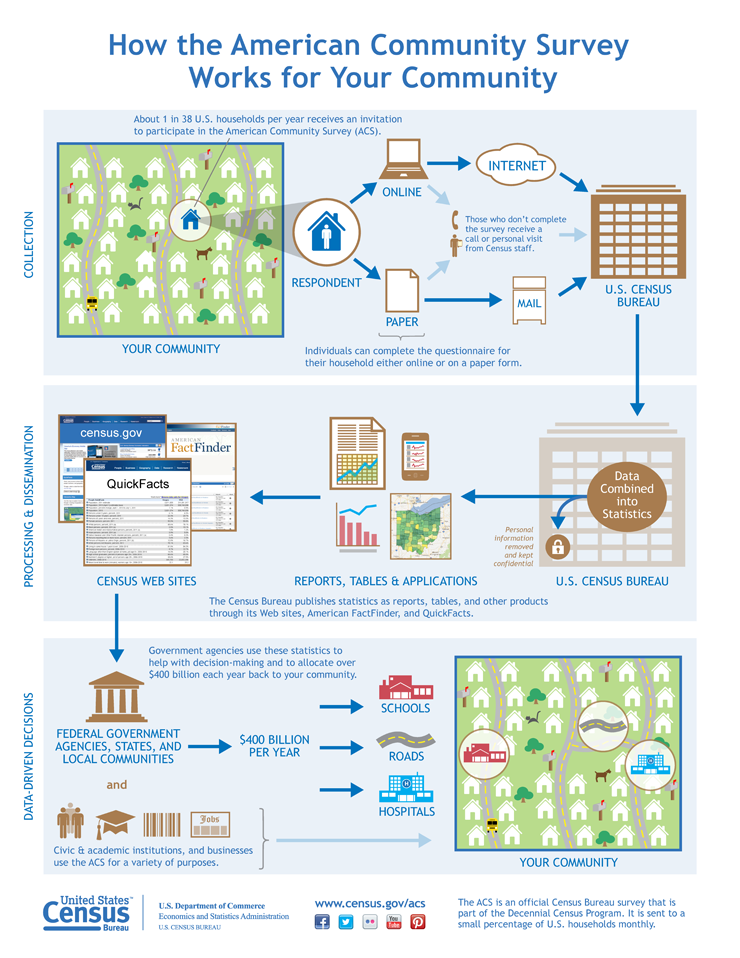
1 in 38 households receives an “invitation” to participate. (click to enlarge)“The American Community Survey helps local officials, community leaders and businesses understand the changes taking place in their communities. It is the premier source for detailed information about the American people and workforce.
“When you respond to the ACS, you are doing your part to help your community plan hospitals and schools, support school lunch programs, improve emergency services, build bridges, and inform businesses looking to add jobs and expand to new markets, and more.”
Yep, that means Starbucks is using this data to decide where to erect another tribute to burnt coffee. Which, you know, means jobs for your neighborhood hipsters and convenient access to overpriced coffee for you.
The Rutherford Institute has a handy article which expands a bit on the ACS and how the data is put to use:
“The Bureau lists 35 different categories of questions on its website and offers an explanation on how the information is to be used. For 12 of those categories, the information is used to assist private corporations. For another 22, the information is used to aid advocacy groups, and in nine of those cases, the Census Bureau states that the responses will be used by advocacy groups to ‘advocate for policies that benefit their groups,’ including advocacy based on age, race, sex, and marital status.”
Help me out here. I’m a little rusty on the Constitution. Which Article covers Target and Home Depot using the government to do their market research for them at the expense of citizens? And certainly the advocacy groups must be in there somewhere, too….
What are the penalties for refusing the invitation to participate?
According to Title 18 U.S.C Section 3571 and Section 3559 you can be fined up to $5,000 and/or imprisoned. However, nobody seems to have been penalized for failing to attend this particular soiree.
It is far more likely that you will simply be hounded and harassed by Census Bureau field agents.
In order to collect the required American Community Survey (ACS) data, we use a multi-part strategy, including Internet, mail, telephone calls, and personal visits.
First, we send a letter to let you know your address has been selected for the ACS.
Then most respondents receive instructions to complete the ACS online. If the survey is not completed, we send you a replacement questionnaire in about two weeks.
If we still do not receive a completed survey, we may attempt to call you from one of our call centers. You may also receive a telephone call if you completed the survey, but clarification is needed on the information you provided.
If we cannot reach you by phone, we may send a Census interviewer to your address to complete the interview in person.
If you think this sounds fairly benign, read through the 900+ comments on this article. Even discounting the, er, less stable commenters, there is a clear pattern of harassment for not playing along and voluntarily giving up your privacy.
What can you do about it?
See how happy we can all be if you just get with the program?This is certainly a perfect opportunity to be a thorn in the side of your Congress humans. Not that I think they will care one little bit. Unless perhaps your Representative happens to be Daniel Webster, Jeff Duncan, or Justin Amash.
You can try simple avoidance techniques, but those field agents are a wily bunch and very determined not to let your privacy remain intact. Perhaps it’s better to take the advice of the Rutherford Institute and hit it head on. They’ve provided strategies in the article linked above and have created a form letter that you may send off to the Census Bureau.
The aggressive attempts by the Trump administration to dismantle one of their perceived political enemies’ power bases by the same “pen and phone” Executive Order fiat that substantially built that base is a fascinating example of RC Dean’s Iron Laws at work. Somehow the step-children of the Republican Party, the wallflowers too ugly to get asked to dance, ended up miraculously winning many a geek’s high-school fantasy. Nearly unlimited power and no reason not to take it out on their enemies. What happens when the people running the Executive Branch decide that the rank and file of many of the agencies they administer are the enemy?
Well, you start by naming other Republican misfit/misanthrope types to run several departments that you believe are hostile to your cause. Putting an O&G guy in charge of the State Department, a Federalist in charge of the EPA, a voucher advocate in charge of the Department of Education, a black brain-surgeon who thinks that public housing stints should be brief in charge of HUD, and a man who once couldn’t even be bothered to remember the name of the Department of Energy (but knew he wanted to cut it) to direct it. Whoever is pulling the strings in the Trump administration, they did an excellent job of putting “qualified” individuals at the helm who wanted to wreck the progressive agenda that the type of people who use the words “Deep State” believe these agencies promote.
After you finish setting out to sow confusion in the board room, you move on to proposing that a bunch of the rank and file (especially in departments you perceive to be most hostile) no longer work for you:
He’s worried about the administration’s proposed 37 percent cut to the State Department, which he says would put U.S. diplomats serving abroad at risk.The Environmental Protection Agency, the Energy Department, the Commerce Department and the Department of Housing and Urban Development are also facing steep cuts. Foreign Policy reported Monday that the administration wants to cut funding for United Nations programs by 50 percent to 60 percent.
But everyone knows that the type of middle-manager who carves out their own little bureaucratic fiefdom and burrows in like a tick on a dog is going to avoid falling to those cuts. They have to keep their job because they are the Deputy Assistant Director for Left-Handedness in Prairie Voles and that exists on an org chart, so they can’t be fired because who would direct that work? Anyone who has worked for a giant organization that has experienced organic growth knows that the only way to get rid of that type of person is a reorg. Oh wait, did someone say reorg?
RC Dean’s Iron Laws are being used against the regulatory state here to great effect. Perhaps the one that seems to be biting most painfully is me today, you tomorrow. Presidents have been stretching the edges of their power since Washington, but in the current century it seems to have become particularly egregious. Driven by the combination of Congress’s ceding of statutory rule-making to the Executive Branch, the Chevron precedent in 1984 telling Federal Courts to side with administrative rule-makers at all costs, and the broad adoption of the computer, we have seen the Executive agencies under each president make regulations that constrain the ordinary citizen from engaging in just about anything. It is interesting to watch a populist who cares only for ratings and a bunch of people who have been marginalized in the Republican party for years suddenly find themselves using the power to dismantle parts of the state that libertarians dislike. Of course, they are also bulking up the parts that libertarians hate most. I don’t see a lot of love in the comments for the TSA and Border Patrol, nor much will to reinvigorate the military so that we can fight all the rest of the world at once, but that appears to be happening as well.
The Trump Administration also appears to have taken the Iron Law you get more of what you reward and less of what you punish to heart as well. For both good and ill to the broad libertarian view. Rarely have we had the opportunity to experience the impartial laws of government work in any context that could even broadly be described as not entirely horrible. You might have to go all the way back to the Carter presidency to find someone who accidentally struck a blow for not quite as effective citizen enslavement. Trump’s administration will not be a friend of libertarians, but as long as the wind of “fuck government regulators” keeps blowing, he might be a slightly mitigated disaster.
How is it critics continue to ignore these monopolies, preferring to poke at other sores? Truth is, these are the good monopolies. From Amazon to Uber, many of these relatively new tech companies have achieved enormous gains over incumbents due to superior service to customers. Yet when Bloomberg blames monopolies for income inequality, worker exploitation, slow productivity growth and a lack of business dynamism (whatever the hell that means), they conveniently fail to discuss these good monopolies.
Now I’m not saying the tech world is an ideal model for worker-employer relationships: In fact I think many tech companies, like Amazon, are screwing themselves long-term with their burn-out cultures; but these monopolies were elevated to their positions by doing it better than the rest, and that inconvenient truth destroys the “all monopolies are worse than Hitler” narrative often supported by the right and the left.
As a quick note, I’m using the term monopoly to include monopolistic competition and oligopolies in addition to monopolies. Let the commentariat eviscerate any uncharitable pedants who fail to understand this.
The Bad
So why are consumer outcomes so bad in industries like finance, utilities, and healthcare? How is it that consolidation in these industries just seems to make things more painful for consumers, while tech monopolies have reached dominance by making customers happy?
My Libertarian comrades may be inclined to say “it’s the regulatory environment dumbass” and they have a point. A free-market for internet providers would remove many of the regulatory obstacles to deployment. It would also reduce regulatory risk, or the uncertainty of future regulations that could instantly destroy the earning potential of a new billion-dollar internet provider. A recent example of this risk materialized with Net Neutrality, a policy which limits how internet service providers can respond to bandwidth hogs like Netflix. A free-market, or something close to it, results in lower barriers to entry and less regulatory risk, thus encouraging more competitors to enter the marketplace in a direct assault on entrenched bad monopolies. After all, it’s really not that hard to beat Comcast, if you have lots of cash and a fair playing field.
However, while onerous regulations explain how bad monopolies retain their market position while providing terrible service, it doesn’t fully explain why consolidation is occurring in industries like healthcare. To understand that we have to add one more factor to our model of how bad monopolies are born…consumer irrationality.
The Ugly
Our journey to the center of government meddling in healthcare starts with this contemptible creation:
The food pyramid was brought to life in 1992, thanks to the generous assistance of many food industry groups, and in the face of enormous criticism. Despite that, American’s seemed to jump on board with the “screw fats” and “carbs are good” recommendations it pushed: After the new guidelines were released the average calories from fat became significantly lower. Further, the pyramid influenced a wide range of policies and recommendations from meals in public schools, to dietary guidelines for expectant mothers.
Back to the ’90s, after the government’s food innovation, something very interesting and entirely predictable happened. We got fat. Obesity rates begin to increase sharply in the mid to late ’90s. It was a perfect storm really. Nixon’s corn subsidies had reduced the price of corn products including high-fructose corn syrup. Food suppliers seized on this and offered cheap junk food. Then came the food pyramid, which told us massive intakes of carbs are a good thing. So whether you jumped on the cheap junk food bandwagon, the carbo-load bandwagon, or somewhere in between, your new diet was influenced by good ole Uncle Sam.
Of course with rising obesity rates came rising rates of heart disease, stroke, diabetes, and more. Doctors advocated for taking in less fat and sugar to combat the problem. Cholesterol became a key indicator of your risk for many obesity-related diseases and cholesterol-lowering drugs.
But were doctors targeting the wrong cause all this time? Several new studies have found no or negative relationships between cholesterol and heart disease. Plus, we already covered the growing body of evidence that saturated fats aren’t really bad after all. Of course, if true, it means that thousands of lives have been lost in preventable deaths, billions of dollars wasted, and many lives forever transformed because our favored solutions were about as useful as a Libertarian purity test.
This begs the question how much influence did government nutrition guidelines have on health recommendations? How much did government actions contribute to the obesity epidemic? These are hard questions to answer, but they’re even harder when you’re not looking. Take a glance at some of the majorwebsites weighing in on the obesity epidemic and you’ll be lucky to see a reference to corn subsidies. Don’t bother looking for the government’s promotion of terrible diet advice. Apparently, that bit of history has already been forgotten by most.
Of course, this is the perfect opportunity for a Libertarian moment – a shining example that science and government policy should exist independently, not in direct reliance on one another. Don’t get your hopes up. Salon argues that the government’s newest food meddling innovation, My Plate, still over promotes carbs. But the apparent cause is we just didn’t have the right top men. HuffPo answers the gov food failings by pointing the finger at the evil food industry. After all crony capitalism isn’t a problem inherent in governance; the problem lies in capitalist actors using greed against the noble politicians. How can our great politicians resist the influence of these evil capitalists?
This is our first glimpse of consumer irrationality: Reliance on government health guidelines and demanding more government to fix the problem it created in the first place. I don’t fault consumers for buying more corn-based products after subsidies were introduced. That’s perfectly rational behavior. But thinking big papa government has your nutrition covered, seems a bit foolish given it’s track record.
The Uglyer
Through the 1990s on, consumers generally preferred health insurance to paying for health care themselves. There is more history here including government exempting employer-based health benefits from income taxes and wage controls after WWII, but the point is consumers preferred health insurance and the employer-sponsored variety was especially appealing. Health care costs had been increasing disproportionately to inflation for decades, and health providers looked for ways to stay profitable. The answer…consolidation.
The first major consolidation in health care occurred in the 1990s, followed by another wave in 2010 forward. Proponents of consolidation claimed it would reduce costs, result in a higher quality of care and improve the health of affected populations. Studies showed otherwise. Consolidation leads to substantial increases in price and evidence suggests it harms the quality of care. So what is the real reason for consolidation? Consolidation gives hospitals more bargaining power in a local market. In consolidated markets, fees increase anywhere from 20% to 60%. These fees are passed on to the insurer who in turn pass the cost increases on to employers or directly to enrollees. Contrast this with non-consolidated markets where participants cut costs since they lack bargaining power to simply raise fees. So basically consolidation is a way for hospitals to maintain profitability against a rising tide of regulation and cost increases.
The Uglyerer
The Affordable Care Act (ACA) helped along consolidation too. Some claim recent ACA-related consolidation was to combat regulatory uncertainty and that may be true, but many Ocare requirements directly contributed to consolidation and the elimination of small providers.
Under Obamacare medical coding changed to the ICD-10 standard. This meant switching from a standard with 13,000 medical billing codes to a standard with 70,000! The shocking result… cost increases. Survey results show a wide range of implementation costs for small practices, anywhere from $8,000 to over $100,000! There is also continued controversy over whether the new coding will reduce or increase billing costs. Early results indicate a higher rate of claim denials and about 25% less productivity under ICD-10. Additionally, in a survey of 38 medical billing companies, three went out of business due to problems in implementing ICD-10. [Applaud here]
Now, in all fairness, some of these ICD-10 codes are quite good. Imagine a group of healthcare professionals, sitting around a conference table, coming up with gems like:
Bitten by a turtle – W5921XS
Hit or struck by falling object due to accident to canoe or kayak – V9135XA
Struck by macaw – W6112XA
Hurt walking into a lamppost – W2202XA (Who would actually admit this?)
Pedestrian on foot injured in collision with roller-skater, subsequent encounter – V0001XD
Burn due to water-skis on fire – V9107XA (Has this happened even one time, ever?)
Struck by duck, subsequent encounter – W6162XD
Hurt at the library – Y92241
Sucked into jet engine, subsequent encounter – V9733XD (Twice?)
Unspecified balloon accident injuring occupant – V9600XS (Does this include accidents involving OMWC’s “balloon animals”?)
Hurt at the opera – Y92253
Bizarre personal appearance – R461 (…you talk like a fag, and your shit’s all retarded.)
Problems in relationship with in-laws – Z631
Stabbed while crocheting – Y93D1 (Why not stabbed by crochet needle?)
Prolonged stay in weightless environment – X52
Unspecified event, undetermined intent – Y34 (I’ll bet this one gets used a lot in ERs)
At least these people can do better than the SNL writing staff, so credit where credit’s due!
Of course, a sane person would wonder why it makes a difference whether you were bitten by a Macaw or a Sea Lion; or whether you suffered injuries during the re-entry of your spacecraft or a hard landing in a hot air balloon. Why doesn’t coding simply focus on injuries and treatment because that’s kind of the basis for billing? But that’s why I’m not a medical billing and coding expert I guess.
Other claims about ICD-10 include cost savings from fewer errors, due to the more “granular” coding structure. But that claim is a bit difficult to swallow as one would logically think adopting tens of thousands of more specific codes would result in higher error rates, not lower. ICD-10 is also supposed to reduce fraud by combating over-coding. If anything ICD-10 provides more opportunities to squeeze the system. A fraudster could use closely-related codes, and if called on the gambit, simply claim they didn’t understand the minor difference between one code and the other: A very plausible explanation given a catalog of 70,000 codes to sort through.
Ocare also included mandates for electronic medical records. The average cost of implementation for a single physician practice is a lowly $163,765. There are operational costs too, not to mention the cost of replacement systems when the old ones outlive their usefulness.
Aside from costs, the complexity of implementing electronic medical records (EMR) is causing some doctors to close their practices entirely, opting for direct or concierge pay. Meanwhile, many doctors that comply with EMR are getting burned out, spending time filling out useless forms, troubleshooting computer problems, and typing information into screens. The result is more time spent on compliance and less time with patients.
Large hospitals haven’t been immune from headaches over EMRs either. It turns out that digitizing someone’s entire medical history and putting it on a server is going to attract hackers. In 2015, 253 breaches exposed 113 million patient records. The number of breaches increased in 2016 to 450, while the total number of compromised records decreased to 27.3 million.
One of the big incentives for hackers to target medical records is the potential payoff. While a stolen credit card number may fetch $1 to $3, a stolen EMR goes for around $60! That’s because these records contain such a detailed and diverse amount of information that they can be used in all kinds of schemes. Personally, I find the hacking trend surprising, considering how knowledgeable health care administrators and staff are of IT security.
It’s Bad
In a bid to one-up cancer, the ACA included even more hits for the health care industry. One issue is non-payment by Obamacare enrollees. Doctors have faced difficulty verifying whether a patient with Ocare actually paid their premium or not. Office staff either have to spend upwards of an hour on the phone to try to verify a premium is paid, or take the risk of not getting reimbursed for care. This is all thanks to the 90-day grace period under ACA.
ACA included hefty cuts to Medicare and Medicaid payouts too. The former had average payouts reduced by 21.2% while the latter faced a 42.8% decrease in average payouts. I bet you’ll never guess what happened next! Shockingly, many doctors stopped accepting new Medicaid and Medicare patients, or just outright refused patients with the offending coverage. But while the little guys were either stuck with lower payouts or saying no to patients, good old market consolidation provided a great way for the big guys to make up the shortfalls. In consolidated markets, hospitals simply passed the lost reimbursement fees on to private insurance. What a way to win: Government saves money from entitlement programs by passing it on to private insurance, thanks to consolidated markets, which they helped enable. Win-win!
Of course, there was also the obligatory dose of crony capitalism in ACA, but hell, that doesn’t seem very important when weighed against the other effects. And no Ocare criticism would be complete without mentioning that restricting insurers from considering pre-existing conditions, increased costs for everyone. It effectively punished healthy people for those that treat their bodies like progressives treat a black Republican, but let’s get back to consolidation.
So to recap, consumers push for health insurance which kicks off the first big industry consolidation in the ’90s. Health care costs continue to rise and the light-bringer gives us Ocare, which pushes many small providers out of the market, and fuels even more consolidation of the big players. But maybe you’re not convinced consumers were really acting irrationally here. After all, if your employer is going to cover half of your health insurance cost, isn’t that better than trying to pay in cash? No.
Health insurance by its very nature increases cost. First, you are pooling risk so healthy people pay for less healthy ones. There is nothing wrong with this for catastrophic coverage if you share costs with other responsible parties. However, when you’re paying for my uncle who drinks nothing but diet Coke and Vodka, you’re wasting your money. Then there is the expense of medical billing and coding, claim processing, customer service, all sorts of other administrative costs, and then profit. When you accept health insurance, you accept all the expensive baggage that goes with it.
There is absolutely no sane reason to have health insurance cover your regular doctor’s visit or a trip to urgent care to get checked out for strep throat! If more people paid in cash, everyone would pay less. Of course, I’m aware of the challenges in trying to go all-in cash in today’s marketplace. Many providers just don’t get it and will offer you little to no discounts for cash payments, even though creating an insurance claim is costlier. So that’s the mess rational actors have to deal with. But, it boggles the mind how many Americans cannot grasp this principle: Insurance does not reduce costs, it increases them. Use it for the bankruptcy-inducing stuff only! I think it’s time to end this mental exercise and replace it with empirical evidence.
Exhibit 1:
Salvation lies in Oklahoma City, just off the 77. This is where Libertarianism is winning hearts, minds, and wallets. The Surgery Center of Oklahoma boasts of a praiseworthy 4.4 stars on Google Places and big savings on many surgical procedures. The savings are so big that Oklahoma’s public employee’s insurance fund covers 100% of the cost of any procedure performed there. Take that insurance to a regular a hospital and you’ll pay the deductible and co-pay. That’s because the prices at area hospitals are so much more expensive, the state will still pay more even if an employee covers the deductible and co-pay!
Exhibit 2:
If you are godly or care to fake it, cost-sharing ministries offer huge savings! Under Medi-Share a 30-year old would pay only $132 a month for medical sharing with a $5,000 annual household portion (basically a deductible). If you meet their health requirements your monthly payment drops to $117. Meanwhile, your average bronze plan on Obamacare has an average deductible of $6,000, an out-of-pocket maximum of $6,900, and a monthly premium of $311. Want to take a step up in coverage? An Ocare gold plan with a $1,200 deductible and a $4,900 out-of-pocket maximum, on average, costs $460 a month. But if the power of Christ compels you to buy a cost-sharing plan with a $1,250 annual household portion, you’ll pay only $235 a month, $207 if healthy. Bear in mind with cost sharing plans once you hit your annual household portion, covered medical procedures are 100% covered. Under normal insurance, once you hit your deductible, you’ll have to pay something like 20% of all medical costs until you hit the out-of-pocket maximum. That means with cost-sharing, you are saving in monthly costs and saving on big procedures!
In a rational world, consumers would look at health sharing ministries and ask what are they doing to get costs that low? But alas, this is not a rational world. Insert one tale of corruption and another legitimate contract dispute, both of which can easily be settled in the courts, and politicians scream “see we must regulate.” Professor Tim Jost of Lee University School of Law is particularly “concerned that you have people joining because they’re trying to find cheap coverage or because they’re ideologically opposed to the Affordable Care Act, or people who aren’t committed.” Oh, the horror. In fact, the health sharing ministry, Medi-Share, ran into problems operating in Kentucky. Apparently, the issue was that all users were paying into one shared fund. Medi-Share solved the problem by having people pay into their own individual funds and then transferring money between accounts to cover medical expenses. Good thing government was there to avert that crisis. Imagine the horror of using one account instead of tens of thousands, to manage the same money.
In a rational world, consumers would demand catastrophic coverage or none at all. In rationale world, employees would swamp HR departments and managers demanding they cut out insurance and save everyone some money. In a rational world, people would completely reject Obamacare and demand congress to allow secular medical sharing programs. In a rational world, those with extreme health conditions that can’t pay would rely on the charity of others to cover their bills, not government force. Irrationality is all around us.
For decades economists assumed real humans acted perfectly rational, but behavioral economics won that debate. Today, we have many examples of human irrationality. Sometimes, people just don’t do the math. It seems this is one of those times.
I think it’s time for one last recap: So government contributed to the obesity epidemic, which increased health care costs and probably increased demand for managed health care (health insurance). The gov’s food innovations seemingly influenced doctors to use the wrong solutions which cost a lot of money and a lot of lives. Consumers irrationally continued to view health insurance as the best way to pay for health care, even though if they did the math, cash-based options and catastrophic plans would have left them richer. Hospitals responded to increased costs and increased use of health insurance through consolidation: Consolidation gave them the power to demand higher fees from insurers, which insurers passed on to employers and private insurance enrollees. With costs on the rise, and the masses all in for health insurance or free coverage, Chocolate Jesus gave us all the STD known as the Affordable Care Act. This resulted in health insurance cost increases and more consolidation. So now we have a lower quality of care at a higher price with fewer options. But before you belligerently swear at Obama on your front lawn, remember to give a shout out to all the pricks that never realized health insurance was a bad deal. If people would have preferred direct or concierge pay options, with a little bit of catastrophic coverage, our health care landscape could like a lot more like the Surgery Center of Oklahoma Center, and a lot less like Lena Dunham.
Irrationally Libertarian
Many of us accepted Libertarianism into our hearts through logic and rational analysis. It could be a pragmatic perspective that government top men are incapable of making better decisions than individuals and free markets; and have completely failed to move the needle in a positive direction on society’s biggest problems. Or perhaps it is a strategic approach: The realization that the best way to deal with conflicting conservative and liberal ideologies, each wanting to impose their own views on everyone else, is to maximize freedom for all. Or it could be a moral approach, based on the fundamental right that no man has the right to rule over another. The point is most of us are driven to Libertarianism due to rationality. Irrationality is our enemy.
A good test of consumer irrationality is what I like to call the Walmart test: How many people complain about Walmart’s use of foreign labor, worker exploitation, and terrible customer service, but refuse to take their money anywhere else? This disassociation in cause and effect is a huge problem for Libertarians, as many of these consumers will then call on government to solve the problems in which they believe the oppressed consumer is powerless to address directly. This is the Achilles’ heel to Libertarian governance, an ever-present desire to create utopia through big government. For sustainable Libertarian governance to work, we must have buy-in from a critical mass of mostly rational actors that understand their dollars and time are votes in a free market! The case of health insurance consolidation shows us that most irrationalities don’t see less government as a solution; they simply want a different flavor of government solutions.
With this in mind, Libertarianism cannot succeed by responding to emotional appeals and inane political rhetoric in kind. Instead, we must continue to support logic and rational thought. Only that will fully convert the unbelievers and help us build a rational barricade against bubbles and government intervention, as we march for free markets. Simply getting regulatory victories is not enough. If we could enact a limited government tomorrow, in line with the original intent of the Constitution, the backlash would quickly destroy our gains in freedom. The people are not ready for Libertarianism. Joseph de Maistre said it best, “Every nation gets the government it deserves.” If we deserved Libertarian governance, we’d have it.
Now bow before the best-sourced article in all of Glibertaria! I assume my honorary degree from Columbia is in the mail.
I imagine STEVE SMITH looking something like this when shaved
Traitor. Hero. Scoundrel. Saint. Whistleblower. Disgruntled. Those who leak classified information are labeled and categorized before the impact of their revelations are even known. In essence, there are three views of a leaker (none of which are satisfying). The first view is that leaking is traitorous and wrong in every circumstance. These law & order types tend to say things like “they should’ve gone through proper channels.” The second view is that leaking is heroic and right in every circumstance. These anti-government types tend to say things like “governments shouldn’t have secrets.” The third view is that leaking is good when it benefits the person’s TEAM and bad when it exposes the person’s TEAM. These political neanderthals are worth no more electrons than have already been spilt on them.
I’m in a fourth camp, one that I have seen espoused by some other libertarians from time to time. I believe that the virtuosity of the leak is dependent on the information being leaked. To take a quick intellectual shortcut, the ends justify the means when it comes to leaks.
The distinction is clear when viewing Edward Snowden in comparison to Bradley/Chelsea Manning. On one side we have a person who collected and released targeted information about unconstitutional spying programs against US citizens with the intent to inform the citizenry for the good of the country. On the other side we have a person who collected and released a wide assortment of information without any particular rhyme or reason for the purpose of getting back at an employer who wasn’t providing the person’s preferred benefits. Snowden is a hero. Manning is a disgruntled traitor.
At the end of the day, I don’t think we can judge a leaker until we are able to assess the information being leaked. However, there is not enough nuance in the American political realm to allow such a subtle distinction. Either the leaker is good because they’re stickin’ it to the man, or they’re bad because ‘murica.
Cast your mind back to 2006. It wasn’t a good year for the Republicans; not with George W and his muddled and seemingly endless war. This was the time when a New Republic article came out – one that is still referenced today – concerning the supposed new political fusion called Liberaltarians. There were, of course, several responses to this. Lost in the mix was John Derbyshire’s take. This was before his expulsion from Nation Review for saying, to put it kindly, less than politically correct things about African-Americans. But I won’t dwell on that, but will instead cover his idea of Libertarianism in One Country which, as to be expected, involves immigration restriction.
First some snippets to put this in context:
A liberal, in the current sense of the term, is a person who favors a massive welfare state, expansive and intrusive government, high taxation, preferential allocation of social goods to designated “victim” groups, and deference to international bureaucracies in matters of foreign policy.
It is not difficult to see why such a person would favor lax policies towards both legal and illegal immigration. Immigration, legal or otherwise, concerns the crossing of borders, and a liberal regards borders, along with all other manifestations of the nation-state, with distaste. “International” trumps “national” in every context. The preferences a citizen might have for his own countrymen over foreigners, for his own language over other tongues, for his own traditions and folkways over imported ones, are all, in the minds of a modern liberal, manifestations of ugly, primitive, and outdated notions — nativism, xenophobia, racism. The liberal proudly declares himself a citizen of the world, and looks with scorn and contempt on those narrow souls who limit their citizenly affections to just one nation.
This is some pretty strong proto-alt-right stuff. Viewed eleven years on it prophesied, though to what degree is uncertain, of the rise of Trumpism. There are several issues that I have with this description of liberalism, but let’s move on to the meat of his problem with libertarians.
The affection of liberals for mass immigration, both legal and illegal, is thus very easy to understand. Why, though, do libertarians favor it? And why do I think they are nuts to do so?
So far as the first of those questions is concerned, I confess myself baffled. I think that what is going on here is just a sort of ideological overshoot. Suspicion of state power is of course at the center of classical libertarianism. If the state is making and enforcing decisions about who may settle in territories under the state’s jurisdiction, that is certainly a manifestation of state power, and therefore comes under libertarian suspicion. Just why libertarians consider it an obnoxious manifestation — well, that’s where my bafflement begins. (That some exercises of state power are necessary and un-obnoxious is conceded by nearly all libertarians.)
After some quotes from Charles Murray, Derbyshire continues:
As to why I think libertarians are nuts to favor mass uncontrolled immigration from the third world: I think they are nuts because their enthusiasm on this matter is suicidal to their cause. Their ideological passion is blinding them to a rather obvious fact: that libertarianism is a peculiarly American doctrine, with very little appeal to the huddled masses of the third world. If libertarianism implies mass third-world immigration, then it is self-destroying. Libertarianism is simply not attractive either to illiterate peasants from mercantilist Latin American states, or to East Asians with traditions of imperial-bureaucratic paternalism, or to the products of Middle Eastern Muslim theocracies.
And here lies, at least to my eyes, the battle of Open Borders within the (American) libertarian community. What is the effect of culture on an individual? Is there something about American Dynamism that is unique in our historical place? Or, to put it another way, are the concepts of freedom, liberty, and, most importantly of all, individualism truly universal? This outlook, one started by the Reformation, created in the firestorm of 18th century European philosophy, and finally crystallized in the American Revolution may be unique in history. Or maybe not. I’ll let the commentators hash that one out since I know I don’t have an answer.
Now Mr. Derbyshire goes a bit off the rails. I wouldn’t let Stalin run a lemonade stand because he would do more than squeeze the lemons.
The people who made Russia’s Communist revolution in 1917 believed that they were merely striking a spark that would ignite a worldwide fire. They regarded Russia as a deeply unpromising place in which to “build socialism,” her tiny urban proletariat and multitudinous medieval peasantry poor material from which to fashion New Soviet Man. Their hope was that the modern industrial nations of the world would take inspiration from them — that the proletarians of those nations would rise up against their capitalist masters and inaugurate a new age of world history, coming to the aid of the Russian pioneers.
When it was plain that none of this was going to happen, the party ideologues got to work revising the revolutionary dogmas. One of them — it was actually Joseph Stalin — came up with a new slogan: “Socialism in One Country!”
Derbyshire’s final point:
I think that libertarians should take a leaf from Stalin’s book. They should acknowledge that the USA is, of all nations, the one whose political traditions offer the most hospitable soil for libertarianism. Foreigners, including foreigners possessed of the urge to come and settle in modern, welfare-state America, are much less well-disposed towards libertarianism.
If less than one in seven American voters is inclined to libertarianism, then there is much missionary work to be done among present-day American citizens. To think that this missionary effort will be made any easier by a steady stream of arrivals from foreign parts, most of which have never known rational, consensual government, is highly unrealistic, to the point of delusion.
That is why I say that libertarians who favor mass immigration are nuts. If there is any hope at all for libertarianism, it rests in the libertarianism of my title: libertarianism in one country.
What say you? Is libertarianism a unique strain of political thought that resides most strongly in American tradition? Or is it universal – something that transcends across time and culture? If one was to magically transport to Xia Dynasty in China, or to the height of the Roman Empire, would the citizens there understand individualism and freedom in the ways that we do? Or, to put it in more modern terms, would a person with a tribal background, let’ say from the depths of Borneo, understand the basics of the philosophy? (Am I beginning to sound like a certain judge?)
Revelations from Wikileaks have far deeper implications than have been covered by the media as yet. The CIA has lost control of not only a trove of documents about the organization’s cyber warfare capabilities. It’s lost control of the weapons themselves.
WikiLeaks has dropped a bomb on the CIA
In digital warfare, there exists the concept of a zero-day exploit. In hacker/information security parlance, a zero-day is an undisclosed vulnerability in software that has been discovered. Ordinarily, watchdog groups and the organizations that produce software have procedures in place to discuss vulnerabilities and issue patches before releasing details of exploits to the general public. Only in the extreme circumstance of an organization deliberately ignoring reports by security researchers of exploitable weaknesses do ethical hackers resort to releasing details of the attack to the general public. The obvious ramification of knowledge being openly available before a patch is released is that anyone can use it prior to patching.
There is the obvious issue, raised by Wikileaks itself, that the CIA has duplicated the functions of the NSA, but very likely with even less oversight for the use of their arsenal. This is not only a waste of taxpayers’ money, but possibly a revelation that unconstitutional attacks on the privacy of American citizens may be taking place by more than one government agency. If that is the case, it is a clear violation of the CIA’s mission, as laid out by Congress.
The ultimate effect of losing this digital arsenal, which may now be in the hands of anyone, is that literally any digital evidence may be called into question. The scope of who may have access to it is completely unknown, and this genie cannot be put back into its bottle. The evidentiary value of criminal activity stored on computers could be disclaimed as planted evidence. This has wide-ranging implications not only for cases under consideration, but for future cases which may be brought.
The CIA now has an obligation to the American people to disclose all of the methods of its infiltration to software developers in advance of the coming storm. It must shatter the weapons it created and, if Congress deems it necessary, it may rebuild a new arsenal.
Furthermore, Congress must probe the agency deeply and potentially reform the country’s spying agencies completely. There is evidently far too much overlap for which the taxpayer is expected to foot the bill. It is also evident that there is too little civilian oversight and too much delegation of powers in the name of national security, a long-standing problem which has now become an emergency. Ethical considerations of spying on foreign powers aside, this lapse has made it clear that our own spying agencies are as much a danger to our own citizens as they are to the rest of the world.


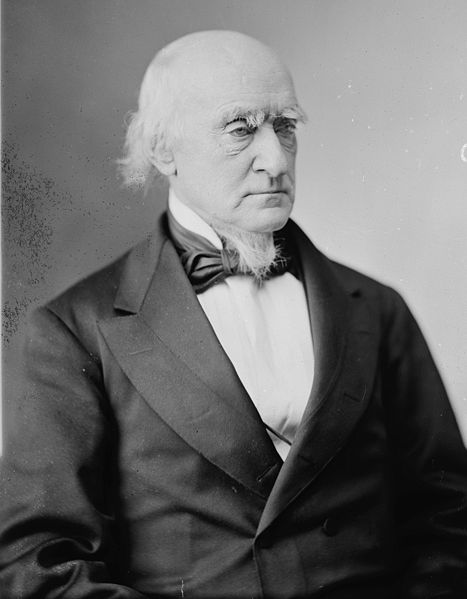

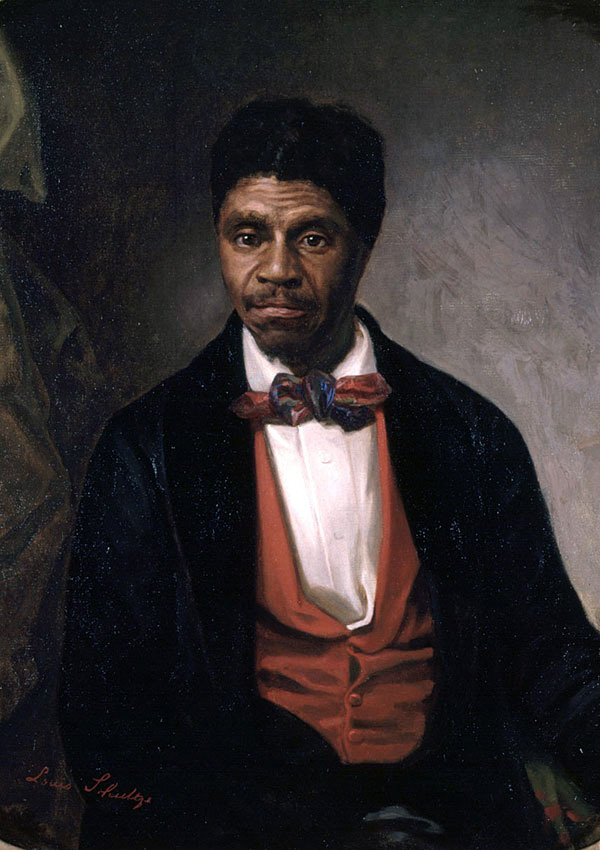

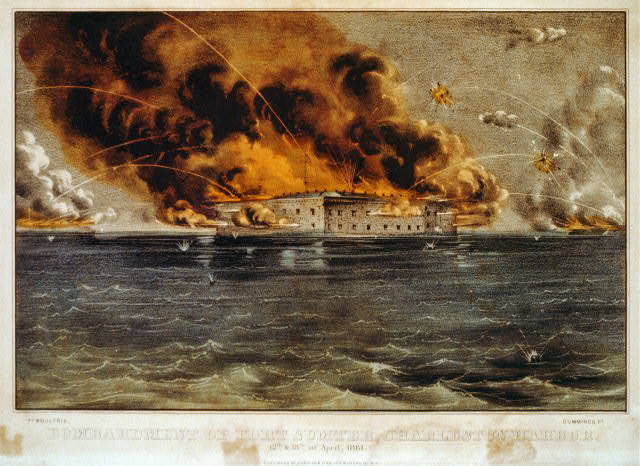






 In this installment, I asked the prog about Detroit and the case of Abner Schoenwetter, whose story was featured on the John Stossel special “Illegal Everything”.
 I forgot to mention this guy is convicted sex offender. He spent the ages from 17 to 20 grabbing the asses of dozens of random women. Yet last time on I checked, he spends most of his time virtue-signalling on Derpbook. Go figure.