Category: Economy

  • The inn-arrr light – Quakers and Pirates, Part 3: The pirates of Penn…sylvania

    In Part One, we followed the adventures of a pacifist Quaker sailor captured by pirates.

    In Part Two, we saw the Quakers, helped by William Penn, defeat an attempt by their religious opponents in the 1790s to have them prosecuted as blasphemers.

    But by the late 1690s, William Penn was no longer feeling his oats.

    File:William Penn.png

    He wasn’t getting any younger, he wasn’t getting the revenue he had expected from being Proprietor of Pennsylvania, and his finances were in a bad condition thanks to his un-thrifty, un-Quakerly spending habits. Worst of all, Gulielma, his beloved wife of twenty-two years, had died in 1694.

    File:Grass on hill.jpg
    “As for man, his days are as grass: as a flower of the field, so he flourisheth. For the wind passeth over it, and it is gone; and the place thereof shall know it no more.” – Psalm 103, 15-16 (KJV)

    But there was no time for Penn to sit around feeling sorry for himself….

    File:Mattheus van Helmont - Old Man Drinking.jpg
    Hey, what did I just say?

    The Board of Trade, the bureaucracy which oversaw the English Empire, had been receiving complaints that England’s Caribbean and North American colonies were tolerating pirates, with Pennsylvania among the worst of the lot. Other complaints about Pennsylvanians were that they were buying and selling goods without regard to the arbitrary British trade restrictions – this voluntary commerce in honest goods was to British imperial authorities about as much of a sin as trafficking in stolen pirate goods. Plus the antiwar views of the colonists meant the Empire wasn’t getting a lot of help from Pennsylvanians in the struggle with France.

    As far as the Board of Trade was concerned, the worst of the pirates was Henry Every.


    Seriously? An umbrella? That seems kind of effete for a pirate, if you ask me. And what about the poor umbrella holder?
    Henry Every (under the umbrella)

    Every led a mutiny and took over an English ship in Spain. Renaming the ship the Fancy, Every sought plunder in the Indian Ocean, the latest popular destination for greedy sea-robbers. These East Indies pirates were based in what is now called the Ile Ste Marie off the east coast of Madagascar. From this island the pirates sailed forth against the richly-loaded ships which carried goods and treasure from the Orient.

    They'll go no more a-roving. ALTERNATE ALT-TEXT: I don't want to be buried in a Pet Sematary, I don't want to live my life again, I don't want to be buried in a Pirate Sematary, I just want to sail upon the Main
    Pirate Cemetery, Ile Ste Marie, Madagascar

    Every left a message to English and Dutch merchants in the area telling them simply to identify their nationality and they would not be harmed. Like other East Indian pirates, Every targeted ships from the Muslim countries in the area (and would be happy to seize French or Spanish ships too). The Barbary Pirates who enslaved Europeans were Muslim. The Turkish armies which had jihaded their way through Europe, almost to Vienna, were Muslim. So there was a convenient conflation between the hostile Muslim powers near Europe and the not-yet-hostile Muslim powers with their tempting loot in the Indian Ocean.

    Every’s Fancy came across the Ganj-i-Sawai, a ship belonging to the powerful Mughal Emperor in India, a potentate named Aurengzeb. The Ganj-i-Sawai was part of a fleet which was returning from a Muslim pilgrimage to Mecca with many distinguished passengers and a prodigious amount of treasure.

    Every and his men captured the ship, stole the treasure and – if we are to believe the Mughal accounts and some of the pirates who later turned states’ evidence – raped the women. Every supposedly married Aurengzeb’s granddaughter, who had been on the captured ship, and she allegedly became a pirate queen.


    WHY WASN'T STEVE SMITH INVITED?
    “Hand over yer booty – we’re talking to you, ladies.”

    The problem was that Aurengzeb was not someone the English wanted to cross – England’s East India Company was beginning its penetration of the Indian subcontinent, but Aurengzeb might put a stop to that if he became angry. At the time Aurengzeb was regarded as very harsh and cruel, though recent historical revisionism suggests he wasn’t that bad (for example, “Aurangzeb protected more Hindu temples than he destroyed”). But it was unwise to provoke the Emperor’s wrath, and Aurangzeb was wrathful that ships from a supposedly friendly power had committed such aggression on his pilgrim ship. What are you going to do about it, he asked the English threateningly, as he commenced retaliating.

    Apologizing for the incident,
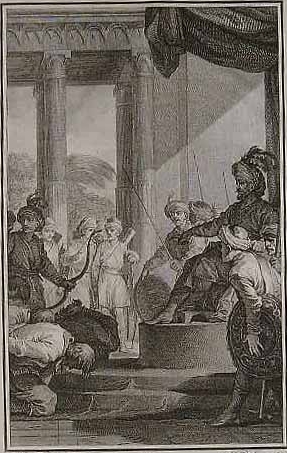
    To be fair, this is from a French book, so the authors would have an incentive to portray the English in an ignominious position
    Here are the English apologizing to Aurangzeb on an earlier occasion

    …the English tried to repair the damage by hunting for Every and his crew.

    Several of Every’s crew members were captured in Ireland, brought to London, convicted and hanged. Based on the trial and on the confessions of the captured pirates, authorities in London got a great deal of information about the friendly reception which England’s North American and Caribbean colonies gave to Every and other pirates. Reports came in of Every’s former shipmates spending and selling their loot in the colonies, bribing officials, and even settling down and becoming respectable citizens. The Board of Trade believed that Every and the remainder of his crew might be hiding out in America.

    Many people in English America were indeed friendly with the East India pirates. Many in the colonies, including many colonial officials, had personal memories of slavery at the hands of the Muslim Barbary Pirates, slavery from which they had had to be ransomed at heavy prices after enduring painful and arduous labor. The East Indies pirates were simply robbing Muslims – who were cut from the same cloth as the Barbary Pirates, the colonists thought. Speaking of cloth, calico, an Indian fabric, was very much the rage at the time, and the pirates brought calico to enliven the wardrobes even of the Boston Puritans. The stolen goods were a great stimulus to local, currency-starved economies in America.

    Reports from Rhode Island, New Jersey and Pennsylvania were particularly disturbing, at least to those willing to believe ill of the Quakers – and many English officials were willing. Tiny Rhode Island had a large measure of self-government, and the rich Quakers who ruled the colony enthusiastically cooperated with the East India pirates. New Jersey, with a heavy Quaker influence, had similar problems. Of course, the non-Quaker colonies, such as New York, Massachusetts, and the Bahamas, also provoked complaints, and these places were not Quaker-run.

    In Pennsylvania, Every’s former crew members were selling their loot and settling in that colony, like elsewhere in English America. As deputy governor of Pennsylvania, William Markham, a non-Quaker cousin of Penn’s, was responsible for wielding Penn’s powers while Penn was away in England. Markham had been in the British Navy and had taken part in a naval attack on Algiers, the Muslim pirate-state which Markham may have equated, through guilty by association, with the Muslim kingdoms of India.

    Like other American governors, Markham gave commissions to pirates for the ostensible purpose of fighting the French, who were at war with England at the time. The commissions often spoke vaguely about “the King’s enemies,” implying that the French were not the only targets. In any case, the newly-commissioned “privateers” (a term which was beginning to evolve to describe government-sanctioned pirates who fought the government’s wars) went straight to the East Indies and preyed on Muslim shipping while making the French (who didn’t have as much seizable booty) a secondary priority at best.

    Markham praised the friendliness of the pirates and the stimulus they gave to the local economy. They also seem to have brought many gifts to Markham, gifts he accepted in pretended ignorance of the givers’ piratical origins. Markham accumulated a collection of East India luxuries Although Markham arrested some of Every’s crew under pressure from London, these prisoners somehow managed to get bailed out or to simply escape. A royal official investigating Pennsylvania affairs suggested that the King wouldn’t act to suppress a rebellion against Markham, if one should develop (hint, hint). The governor of Maryland tried to stir up just such a rebellion in order to add Pennsylvania to Maryland, though that didn’t work.

    A Red Sea pirate named James Brown…

    File:JamesBrownNY87.jpg
    Come here mama…and dig this crazy scene / He’s not too fancy…but he has loot from the Red Sea / He ain’t no drag. / Papa’s got a bunch of swag

    …sailed into Philadelphia with his ill-gotten treasure, and went to see Markham, presumably with a view toward making some gifts. Brown explained to Markham about his activities, admitting that he’d sailed with the pirate Thomas Wake and also with Every, but in the latter case only as a passenger, Brown insisted. This was probably a cover story – I don’t know if Every even offered passenger service. Of the voluntary kind, that is.

    Markham’s daughter fell in love with Brown and the she married the buccaneer.


    "Where's the caterer? I'll keel-haul him!"
    “Daddy, you can tell William Penn that we totally take piracy as seriously as he does.”

    Perhaps this video will give some idea of the wedding ceremony. William Penn, however, probably did not feel good about having a pirate in the family. James Brown settled on a farm in what is now Delaware, then part of Pennsylvania.

    Penn had to balance the demands of the imperial authorities and those of his people in Pennsylvania. In 1696, Parliament passed a law increasing royal power over the colonies, including Pennsylvania, partly in the name of getting tough on piracy. Penn feared the loss of self-government and even trial by jury. Penn tried to explain to London authorities that Pennsylvanians had moved to their colony “to have more and not less freedom than at home.”

    The colonial legislature of Pennsylvania shared Penn’s concerns to an extreme degree. The Pennsylvania Quakers, as Penn had pointed out, had a longstanding suspicion of the English government, which had oppressed them when they lived in England, would seize on any excuse to extend its persecuting arm across the Atlantic. Even the anti-piracy crusade might be a pretext for colonial officials to mistreat Pennsylvanians. Robert Quarry, the admiralty judge sent to Pennsylvania to crack down on piracy, had been removed from the governorship of South Carolina for collaboration with pirates. Now Quarry had commercial interests in Pennsylvania, which suspicious Pennsylvania officials believed would give him an incentive to use his official powers to harass rival merchants – all in the name of law and order. Quarry catechized Quaker meetings about the religious beliefs, which would have reinforced the suspicion that the anti-piracy crusade was another step in England’s long-term persecution of Quakers.

    But Quarry had his own complaints:

    All the persons that I have employed in searching for and apprehending these pirates, are abused and affronted and called enemies to the country, for disturbing and hindering honest met, as they are pleased to call the pirates, from bringing their money and settling amongst them.

    The Pennsylvania lawmakers made an “anti-piracy” law full of loopholes to shield pirates’ local accomplices. James Brown, Governor Markham’s son-in-law was elected to the legislature but didn’t show up; when he did, he suggested he hadn’t want to risk arrest for piracy. The legislature expelled Brown and Markham acted to arrest his son-in-law, while also helping him out with bail money.

    Penn came to his colony to in 1799 (bringing his second wife Hannah with him), to preside over the government in person and address the vehement complaints of the colonial officials in London. He wanted to protect Pennsylvania’s autonomy as far as he could, but he also wanted to check the unrealistic defiance of the locals against the empire. If Pennsylvanians believed themselves put-upon now, how would they like it if London took the proprietorship away from Penn (again) and administered the colony directly, removing the buffer Penn provided between his colonists and the wrath of hostile imperial bureaucrats?

    Investigating the situation, Penn found that, indeed, former pirates had settled in the colony, including his cousin William Markham’s son-in-law. Penn replaced Markham and other colonial officials who had buddied up too closely to the pirates.

    After Penn gave the colonial legislators a stern talking to…

    WILLIAM PENN SPEAKS TO YOU, HIS BROTHERS AND SISTERS. STOP DOING BUSINESS WITH PIRATES, AND IN GENERAL, PAY MORE RESPECT TO MY AUTHORITY AS PROPRIETOR OF THIS COLONY.

    …the solons repealed their defendant-friendly piracy law. Mellowing somewhat, Penn suggested that the reformed pirates who had settled in Pennsylvania be left alone, so long as they earned an honest living far from the ports and coastal areas, where they might be tempted (or tempt others) into piratical ways. Perhaps Penn was thinking of his in-law, James Brown, the pirate-turned-farmer.

    Penn left Pennsylvania in 1701, and never returned.

    "Don't worry, we'll build you some monuments after you die and pretend we loved you all along."
    “Goodbye, William, Godspeed, we will take to heart all of your solemn lectures!”

    The Board of Trade was not placated, continuing to see the North American and Caribbean colonies as refuges for pirates. The problem, the bureaucrats concluded, was that not all the colonies were governed directly by the Crown. So the Board prepared a bill for Parliament by which the proprietary colonies (like Pennsylvania) and those colonies which were self-governing based on royal charters (such as Massachusetts) would become directly ruled from London Also, the colonies would be merged into larger megacolonies – for instance, Pennsylvania would be merged with Maryland and New Jersey (PenJeryland?).

    A bill matching some of the Board’s ideas was introduced in the House of Lords. To opponents of the bill, such as Penn, this was sheer oppression, abrogating charter rights. And anyway, New York was a crown colony but its former governor, Fletcher, had been in cahoots with the pirates nonetheless (Fletcher had spent time as governor of Pennsylvania when Penn had been deprived of his proprietorship). The Quakers and other colonial agents out-lobbied the Board of Trade. Penn defended his powers as proprietor in terms their Lordships could understand: “Powers are as much Property as Soil; and
    this is plain to all who have Lordships or Mannours [manors] in England… .” The bill died in Parliament – but not before passing a second reading in the House of Lords. The Board kept pushing for its pet bill, but without success.

    There wasn’t a major crackdown on piracy in the colonies until the pirates began relocating their predatory activities to the vicinity of the colonies themselves, as opposed to the remote Indian Ocean. Then the colonists bestirred themselves, and some serious pirate hangings began, putting an end to what some call the Golden Age of Piracy.


    Works Consulted

    William C. Braithwaite, The Second Period of Quakerism. London: MacMillan and Company, 1919.

    Douglas R. Burgess, Jr., The Politics of Piracy: Crime and Civil Disobedience in Colonial America. ForeEdge, 2014.

    Leonidas Dodson, “Pennsylvania Through the Eyes of a Royal Governor,” Pennsylvania History,Vol. 3, No. 2 (April, 1936), pp. 89-97.

    Mark G. Hanna, Pirate Nests and the Rise of the British Empire, 1570-1740. Chapel Hill: University of North Carolina Press, 2015.

    Rufus M. Jones, The Quakers in the American Colonies. London: MacMillan and Company, 1911.

    John A. Moretta, William Penn and the Quaker Legacy. New York: Pearson Longman, 2007.

    Andrew R. Murphy, Liberty, Conscience and Toleration: The Political Thought of William Penn. New York: Oxford University Press, 2016.

    P. Bradley Nutting, “The Madagascar Connection: Parliament and Piracy, 1690-1701,” The American Journal of Legal History, Vol. 22, No. 3 (Jul., 1978), pp. 202-215.

    I. K. Steele, “The Board of Trade, The Quakers, and Resumption of Colonial Charters, 1699-1702,”  The William and Mary Quarterly,Vol. 23, No. 4 (Oct., 1966), pp. 596-619.

    Alexander Tabarrok, “The Rise, Fall, and Rise Again of Privateers,” The Independent Review, v., XI, n. 3, Winter 2007, pp. 565-577.

    C. E. Vulliamy, William Penn. New York: Charles Scribner’s Sons, 1934.

  • Royal Tea – Thoughts on International Trade

    When running into a bout of cognitive dissonance, the choices seem to be: sit and think it through; or shout slogans and ignore the contradiction. I have long held opinions on trade that border on the mercantilist. While puttering about, I spotted a box of “Royal Tea” sitting atop my refrigerator. Putting a kettle on, I got together the things I’d need, and waited for the water to boil. That’s when I started thinking about the items I’d gathered.

    And the tea leaves say…

    Despite the Cyrillic letters on one side and the Imperial Russian motifs (including portraits of Nicky II and his Tsarina), the tea had probably never been to Russia. It was Ceylon tea from Sri Lanka imported by way of a company in Sacramento. The kettle had been made by robots in Japan and ordered via computer. The teacups were actually crafted by Russian hands. The spoon was one of thousands stamped out en masse in China. The gas I was burning probably came out of a fracking well in this country, but not from anywhere near as close as the honey, which was collected at a maple farm two counties over. But I didn’t go there to get it. Even that was shipped in to my local store. All while I sat on my fat ass complaining how this country doesn’t make anything anymore.

    I composed a quip to share with the Glibertariat, with the ending being a play on the line “It’s good to be the King.” While I cleaned up the wording and contemplated the response I’d get from known personalities, the dissonance set in. While some people far richer than I hollered about the ‘evils’ of capitalism elsewhere, I was contemplating a cup of tea. Aside from the fact that it needed more honey, the mere fact that it was in my hands at that moment was a silent testament to the good of capitalism. More specifically, the fruits of trade. I will still argue that Ricardo was wrong regarding comparative advantage (because he was), and I still hold that it is better to be the producer and seller of goods than the buyer. But these are details of nuance, separated from the base principle that it’s good to be a capitalist.

    My gut instinct is to argue against international trade. But that is a response born of emotion and not rational reflection. Too many people I know tell the same story – their job went away but their family is still here. It was my tale, too. I ended up in the Civil Service because there was nothing else around. Everything was being made overseas. Why was it cheaper to ship halfway around the globe than build locally? Many here will reflexively blame government. That, too, is an emotional response. While not completely false, it carries the same danger of becoming over-simplified dogma as blaming the corporation. The company that had sent my last job overseas had been skirting bankruptcy because it had decayed into a bloated, inefficient conglomerate with scads of redundant departments duplicating the same functions. So, they had to restructure or die. Bye upstate New York, hello Mumbai. This was not the fault of the government who had chased out the other opportunities.

    Did (relatively) free trade cost me a job?

    Yes.

    Should I be bitter?

    Not unless I forget to add enough honey to this cup of tea, I wouldn’t even have tea without the same.

  • Modeling U.S. Energy Policy

    Part One

    “The fact that the polynomial is an approximation does not necessarily detract from its usefulness because all models are approximations. Essentially, all models are wrong but some are useful. However, the approximate nature of the model must always be borne in mind.”

    George Box*

    • Modeling U.S. Energy Policy
    Professor Tomain

    By observing the impact of the Carter and Regan administration’s reciprocal attempts to affect national energy policy with a historical understanding of the FFCA as the genesis of Federal energy policy, we develop a model of energy policy in terms of legislative goals. Then, with an appropriate model, we are able to undertake realignment toward new political ends. Fortunately, much of the heavy lifting has been done via Professor Tomain’s “Dominant Model of United States Energy Policy,” a handy tool to explain past and current trends in energy policy and regulation.[1]  Inherent in this model are the economic assumptions that: 1) the Gross National Product (GNP) is linked to energy production, and 2) economies of scale in energy production are achievable.[2]  These assumptions are well supported, in as much as energy is necessary input for Gross Domestic Product (GDP) growth, although the direction of causality between energy production and GDP growth has been difficult to ascertain and appears unidirectional for certain periods.[3]  Importantly, these two assumptions suggest a national energy policy which “favors large-scale, high technology, capital-intensive, integrated, and centralized producers of energy.”

    According to Tomain, the Dominant model has six goals, but, for our purposes, these are better distilled into two primary objectives for the lawmaker: 1) ensure an abundant supply of both primary and secondary energy 2) ensure reasonable and stable prices for energy.[4]  There are many legislative options to achieve these objectives, but only a few selections appear to be currently supported.  Consider, as evidence, the other goals Tomain identifies as complimentary mechanisms: i.e. limiting market power of large firms, promoting competition between fuels and between producers, generally subsidizing only mainstream energy sources, and allowing for both federal and state control of energy policy.[5]  Whether legislators identify these as the means to the end of stable energy prices and abundant energy supplies or as ends – in and of themselves – has determinative impact on what objectives are actually achievable.  If the real objective of Federal energy policy is to achieve carbon free energy independence in the United States, then a transition to non-carbon primary energy sources is a necessary condition. Policy ends which limit market power of firms, allow for decentralized control, increase competition, and subsidize current producers would, therefore, sit in conflict with that objective.

    • Contemporary Legislation Does Little to Support a Transition Toward Energy Independence

    For all the talk of an energy independent or carbon free future, the most recent series of energy policy acts, the Energy Policy Act of 2005, the Energy Independence and Security Act (EISA) of 2007, and the American Recovery and Reinvestment Act (ARRA) of 2009, all conform to the Dominant Model.  The Energy Policy Act of 2005 contains significant subsidies and incentives for traditional carbon primary energy producers.[6]  Coal producers receive $1.6 billion of assistance.[7] They receive a further $1.7 billion for upgrading generation equipment and emplace advanced combustion processes.[8]  Oil and gas producers are offered large production incentives and suspensions of royalty payments.[9]  Tax incentives are provided to an array of carbon primary energy including coal projects,[10] oil and natural gas,[11] and biofuels.[12]  All in all, some $85 billion of appropriations and relief is provided for in the acts with the bulk of funds directed at carbon based primary energy producers.[13]  This support is consistent with Dominant Model goals of subsidies for mainstream energy, promoting abundant energy supplies, favoring large producers, and large capital projects.

    Several steps omitted

    The EISA, by attempting to promote competition between fuels and between producers in order “to move the United States toward greater energy independence and security” and “increase the production of clean renewable fuels” with hopes to secure secondary energy supplies, is predicated on Dominant Model goals.[14]  To achieve these goals, the EISA adopts the dual mechanisms of emplacing production quotas for carbon dependent biofuels and subsidizing US biofuel producers to the point that blending biofuels with traditional fuels becomes affordable to consumers.[15]  Unfortunately, this does nothing to address the very real difference in the costs of production between biofuels and traditional fossil fuel producers.[16]  Setting aside the questionable economics of biofuel subsidies, foreign oil producers will remain profitable at price levels where expenditure for biofuel subsidies is politically unjustifiable.  It is also important to note, by focusing legislative effort on biofuel, the EISA targets sources of secondary energy without addressing the primary energy input inherent in the manufacture of biofuels, the origin of that primary energy, or the conversion rate of primary energy to secondary energy.  Without looking at primary energy sources, there is little hope of any affecting energy independence through legislative means.

    Fortunately, both the Energy Policy Act of 2005 and later amendments added by the ARRA do make efforts at addressing primary energy.  For example, the 2005 Act eased certain requirements of the federal licensing process for hydroelectric dams.[17]  The 2005 Act extended and enhanced tax credits to ‘renewable’ primary energy sources such as hydropower, wind, solar, and geothermal.[18] Importantly, the 2005 Act sets an objective of “increasing the conversion efficiency of all forms of renewable energy through improved technologies.”[19]  In support of this objective, the 2005 Act provides $2.227 billion for “renewable energy research, development, demonstration, and commercial application activities.”[20]  These provisions are buttressed by the ARRA which amends Title XVII of the 2005 Act to provide an additional $6 billion of loan guarantees for renewable energy projects.[21]

    Furthermore, the 2005 Act provides support for the largest alterative producer of non-carbon primary energy, in the event of construction delays caused by regulators or by litigation, by extending funding to builders of nuclear generating stations to cover regulatory costs.[22]  Additionally, the 2005 Act sets aside $1.25 billion for a prototype hydrogen generating nuclear reactor and reauthorizes the limitation of liability on nuclear plant operators provided under the Price Anderson Act.[23]  Between the 2005 Act and the ARRA, some $41.7 billion are allocated across energy markets and technologies with the bulk of subsidies going to the largest producers.[24]  While stimulus helps shift the competitive landscape to make minor producers and alternatives to carbon primary energy more attractive to consumers, the allocations are simply too diffuse to tip the balance in favor of any producer or technology thus preserving the current competitive landscape.  This outcome suggests achieving energy independence entirely on non-carbon sources using policy and legislation keeping with the mechanisms of the Dominant Model will be ineffective and will require a reordering and rebalancing.  Owing to the favorable economics of oil prices under the Dominant Model it appears that US energy independence “is more a political slogan than an actual policy objective.”[25]  If however there were sincere efforts at achieving energy independence in the US what might they look like? We will explore this question in our next installment.


    * George Box and Norman Draper, Empirical Model-Building and Response Surfaces 424 (1987).

    [1] Joseph P. Tomain, The Dominant Model of United States Energy Policy, 61 U. Colo. L. Rev. 355, 355 n. 4 (1990).

    [2] Id. at 374-75.

    [3] The authors note, unsurprisingly, that the differing results are influenced significantly by the differing regulatory environments.  Jaruwan Chontanawat et al., Causality Between Energy Consumption and GDP: Evidence from 30 OECD and 78 Non-OECD Countries, SEEDS 113 (June 2006), http://www.seec.surrey.ac.uk/research/SEEDS/SEEDS113.pdf; see also Eden S. H. Yu and Been-Kwei Hwang, The Relationship Between Energy and GNP, 6 Energy Economics 186 (1984).

    [4] Tomain, supra note 1, at 375

    [5] Id. at 375-76.

    [6] Energy Policy Act of 2005, Pub. L. No. 109-58, 119 Stat. 594 (2005).

    [7] Id at  § 401.

    [8] Id at § 3103.

    [9] Id at § 341-57.

    [10] Id at § 1307.

    [11] Id at § 1321-29.

    [12] Id at § 1342-47.

    [13] Michael Grunwald and Juliet Eilperin, Energy Bill Raises Fears About Pollution, Fraud, The Washington Post (Jul. 30, 2005) http://www.washingtonpost.com/wp-dyn/content/article/2005/07/29/AR2005072901128.html.

    [14] Energy Independence and Security Act of 2007, Pub. L. No. 110-140, 121 Stat. 1492, 1492 (2007).

    [15] Id at § 201-48.

    [16] Jonathan Kingsman, Oil Price Fall Adds to Biofuel’s Woes, The Financial Times (Jan. 9, 2015), http://www.ft.com/cms/s/0/22bbd5ba-975f-11e4-be9d-00144feabdc0.html#axzz3csqAQnGr.

    [17] Energy Policy Act, supra note 6, at § 241.

    [18] Id. at § 202-03.

    [19] Id. at § 931.

    [20] Id.

    [21] American Recovery and Reinvestment Act, Pub. L. No. 111-5, 123 Stat. 115, 140, 145 (2009) (codified as amended 42 U.S.C. § 16516).

    [22] Energy Policy Act, supra note 6, at § 638

    [23] Id. at § 601-10, 645.

    [24] American Recovery and Reinvestment Act of 2009, Wikipedia (May 23, 2015), https://en.wikipedia.org/wiki/American_Recovery_and_Reinvestment_Act_of_2009#Energy_infrastructure; Energy Policy Act of 2005, Wikipedia (Sept. 23, 2014), https://en.wikipedia.org/wiki/Energy_Policy_Act_of_2005.

    [25] The Oil Drum, China Energy Outlook: China’s Energy Strategy for the Future, Oilprice.com (Nov. 18,2012), http://oilprice.com/Energy/Energy-General/China-Energy-Outlook-Chinas-Energy-Strategy-for-the-Future.html.

  • Mormons and the Bill of Rights, Part Two – The dirty books episode

    I intend to take the Smoot-Hawley Tariff, which has been mocked again and again as the very epitome of boringness, and I will make the subject…anyone?…I will make the subject interesting.

    To start with, I won’t call it the Hawley-Smoot Tariff, because…anyone?…because my focus is on Smoot, not Hawley. So I’ll put Smoot’s name first.

    The Smoot in Smoot-Hawley was Reed Smoot, a Republican U. S. Senator from…anyone?…Utah. We first learned about Senator Smoot in Part One, in which Senator Smoot’s…anyone?…credentials were challenged because of the whole polygamy thing. After the Mormon church, of which Smoot was a leader, dropped the practice of polygamy, the U. S. Senate decided to…anyone?…decided to let Smoot keep his seat in the Senate, to which he was repeatedly re-elected, even after Senatorial elections were taken away from the state legislatures and given to the voters.

    Now, class, can anyone tell me what the Smoot-Hawley Tariff was all about? You can? And here I thought you weren’t paying attention. From your spittle-flecked responses, I can see that you can identify the Smoot-Hawley Tariff as a protectionist law passed by Congress in 1930, in the depths of the Depression, and that this law has generally been blamed for making the Depression worse. In the unlikely event there’s anyone here who doesn’t already know this stuff, here’s a Wikipedia article.


    File:John Lennon & Yoko Ono leave Amsterdam 3.jpg
    After Smoot got together with Hawley, things went downhill

    Ha ha, seriously, here’s Smoot and Hawley:

    File:Smoot and Hawley standing together, April 11, 1929.jpg
    Senator Smoot is…anyone?…the one with the glasses. And the pocket with pens in it. Why can’t you students be more like Smoot, and less like that Bueller fellow? Where is Bueller, anyway?

    The dynamic duo of Smoot and Hawley put forward their protectionist bill in 1929, and it passed in 1930. It is a key event in economic history, and Smoot, a hard worker with one of the best heads for figures in Congress, was proud of his work, even though it didn’t save him from a Democratic sweep shortly thereafter which put him out of the Senate.

    But the Smoot-Hawley Tariff has also gotten a good deal of attention in the history of literature. To explain, let’s go back a bit.

    Congress tightened up the obscenity laws in 1873, thanks to the lobbying efforts of this man, who was promptly made a postal inspector to help enforce the law. Can you identify him, class?


    No, I'm fairly sure his name isn't "jerkface" or any of those other, more colorful epithets you're using.

    Yes, it was Anthony Comstock (1844 – 1915).

    But this isn’t a history of postal censorship, so let’s move on from Comstock and look at the U. S. Customs.

    "Actually, this is a list of the groundhog's demands...he says his operatives are poised to burrow under elite golf courses across the nation."
    Groundhog Day? No, not that kind of U. S. customs.


    This kind:

    This was a year after Chester Arthur was fired as New York's Collector of Customs. The scandal was so great that Arthur ended up as President. He had to pull a sword out of a stone, or was that a different Arthur?
    U. S. Custom House, New York City, 1879.

    I chose the New York City customs house for my illustration because New York City was a key point of entry for foreign literature coming into the country – or trying to come in (Los Angeles and Chicago were also key ports of entry). Until 1873, Customs officials policed a federal ban on the importation of obscene pictures and photos, but not books. The Comstock Act of 1873, in addition to dealing with the Post Office, added books and pamphlets to the list of obscene material that was to be banned. Local customs inspectors – or sometimes their superiors in Washington – had to read potentially obscene books to decide whether to ban them.


    "...but inspecting these books and pamphlets is more boring than inspecting dirty pictures."
    “At least inspecting this is less boring than inspecting other types of goods.”

    The Comstock law passed despite some grumbling that “I do not know whether it can be left to employees of a custom house to determine with safety what kind of literature or what sort of matter is to be admitted.” This Congressman finally decided to support the bill once he concluded that the decision on whether a work was obscene would be left to the courts, not customs officials.

    In practice, judicial review was limited and rarely used, and the final decision on what could be imported was made by Customs officials.

    The Smoot-Hawley tariff, as introduced, would have kept the existing Customs ban on obscene books. It looked like a fairly noncontroversial item, continuing the law in force, until Republican Senator Bronson Cutting of New Mexico piped up. Cutting was an arty type of Republican, indignant when he learned that a friend of his hadn’t been able to import D. H. Lawrence’s novel about adultery, Lady Chatterley’s Lover. Lawrence was actually in favor of censoring pornography, he simply didn’t think he (Lawrence) was a pornographer. He was an artist, not the same thing. Cutting agreed.

    Senator Cutting [insert pun about “Cutting remarks”] proposed to take away Customs’ power to ban books on obscenity grounds. Such censorship, if it was to exist, should be exercised by the post office and by state and local governments, plus the church and the family. What qualifications did Customs people have in this area?

    The Senate, in Committee of the Whole, actually accepted Cutting’s amendment. This took Smoot by surprise, and it shocked him to his core.

    Smoot biograper Milton Merrill says that Smoot’s objection to dirty books was not due to some kind of repressed prurience or similar factor. Dirty books were dirty and gross, and it made no difference whether the author was some kind of artist or a good writer. There was also the fact that, as a Mormon whose moral qualifications to sit in the Senate had been attacked, Smoot was extra alert to any opportunity to rebut suspicions of dirty-mindedness.

    The humorless Smoot decided to demonstrate the dangers of allowing a flood of porn to enter the country and corrupt the people, especially the youth. From the Customs officials, Smoot got copies of some of the worst porn he could find to show his fellow-Senators, many of whom perhaps were pruriently interested in this legislative documentation.

    Smoot was genuinely outraged. The Senator known for his calm and detailed analyses of economic legislation spoke at the top of his voice, denouncing smutty writers like Lawrence as black-hearted villains.

    When the Senate, as a Committee of the Whole, reported the bill back to itself, Smoot had a chance to challenge the obscenity provision. He wanted to reinstate the ban on importing obscene books. To be fair, this ban dated back to 1873, and Smoot hadn’t anticipated that his beloved tariff measure would be the vehicle his colleagues chose to make what he deemed a pro-smut gesture. Couldn’t Congress just keep the obscene-books ban which had been in place for over half a century, and go back to the important business of protecting legitimate American industries from unfair foreign competition?

    So the poet Ogden Nash was being unjust when, in a much-cited poem, he sarcastically praised Smoot as if the Senator was inventing a new book-banning law:

    Senator Smoot ( Republican, Ut. )
    Is planning a ban on smut.
    Oh root-ti-toot for Smoot of Ut.
    And his reverent occiput.

    With his outbursts of indignation, Smoot helped turn the Senate back to supporting a customs ban on dirty books. But as an experienced legislator, Smoot knew that his colleagues seemed to believe that Customs was going too far and hurting the importation of genuine, non-obscene literature. To conciliate this skepticism about Customs’ literary capacities, Smoot decided to yield somewhat and allow some reform.

    For one thing, Smoot would accept an amendment by which the Treasury Secretary (as boss of the Customs Service) could allow “so-called” classics, even dirty ones, into the country on a non-commercial basis. Smoot also accepted a plan endorsed by, among others, future Supreme Court Justice Hugo Black – former Klansman and currently known as the saner of Alabama’s two Senators (this guy was the other). The Black plan would provide that the final decision on whether an imported book was obscene would be made by a federal court, in a jury trial. That ought to meet the objection that random bureaucrats were making literary decisions – the book would get a full due-process trial.

    File:Cigarette smuggling with a book.JPG
    “Hey, they mutilated a copy of the Marquis de Sade’s classic Justine just so they could smuggle cigarettes!”

    The Smoot-Hawley Tariff passed with the amendments somewhat softening the Customs ban on obscene books. The first true tests case involved Ulysses.

    Statua di ulisse di età antoniniana (II sec.), da un modello ellenistico del III sec. ac.jpg
    No wonder they wanted to ban Ulysses – he’s stark naked!

    Customs believed that James’ Joyce’s now-classic work was obscene, but after the Smoot-Hawley Tariff, the publisher, Random House, insisted on taking the case to trial. Waiving a jury, Random House had the issue decided by federal district Judge James Woolsey. Both Woolsey and the literature-friendly Second Circuit appeals court said the book was not obscene and could be freely imported (at least as far as the Customs laws were concerned). Woolsey’s opinion is probably more famous than the more authoritative Second Circuit opinion because Woolsey had a gift for words and Random House put his opinion at the beginning of Ulysses.

    The Ulysses case was historic because the influential Second Circuit, followed by other courts, rejected an old English case known as Regina v. Hicklin. In that case, an opinion by Chief Justice Cockburn said that a work could be condemned as obscene based only on isolated passages, based on the assumption that susceptible people might be harmed by these passages without regard to the surrounding material.

    (Hicklin wasn’t the alleged pornographer, he was a lower-court judge who had tried to legalize the alleged pornography;  the pamphlet in question was issued in the name of the Protestant Electoral Union.)

    The Ulysses decision said that in deciding whether a book is obscene it must be looked at as a whole. Just because there were, say, sex scenes in a book didn’t automatically make it illegal – the entire book had to be dirty, not just a few bits and pieces.

    Because the Ulysses case was so historic, and was decided under the supposedly literary-friendly provisions of the Smoot-Hawley Act, some people got the impression that winning court hearings for books Customs wanted to ban represented an advance for literature, making censorship tougher. In reality, importers rarely challenged Customs decisions in court, since legal challenges are quite expensive and it would simply be easier, if possible, to cut out the offensive bits designated by Customs.

    Customs liberalized its treatment of books (and movies), not because of Smoot-Hawley, but because of a gentleman named Huntington Cairns. A lawyer, litterateur, and later counsel for the National Gallery of Art, Cairns informally advised the Customs service on disputed works, generally erring in favor of letting the works into the country, at a time when the Post Office and many local censors were stricter against alleged porn.

    So Smoot’s “concession” wasn’t what protected literature against Customs overreach – maybe Smoot wasn’t as dumb as they thought.


    Works Consulted

    Paul S. Boyer, Purity in Print: The Vice-Society Movement and Book Censorship in America. New York: Charles Scribner’s Sons, 1968.

    Milton R. Merrill, Reed Smoot: Apostle in Politics. Logan, Utah: Utah State University Press, 1990.

    James C. N. Paul and Murray L. Schwartz, Federal Censorship: Obscenity in the Mail. New York: The Free Press of Glencoe, 1961.

  • Roads: The Achilles’ Heel of Libertarians?

    Many people believe that roads, and hence transport, would not exist without a strong central government, and so therefore limited government is impractical.

    It’s important to know why roads exist in the first place. Ancient empires like the Persia and Rome built roads to make it easier to move their armies around and also to speed communication between distant cities. These roads were irrelevant to the vast majority of people because, for most of history, it was rare for a person to travel more than a few miles from where they were born. Only a small fraction of people like soldiers, explorers and traders would routinely travel long distances on land. The only practical way to travel long distances for most of history was by horse, and most people couldn’t afford horses.

    For most of history, only capital cities had paved roads because kings wanted their cities to look more beautiful. Building roads is expensive now, but it was even more expensive when everything had to be done by hand.

    And what roads did exist were usually privatized. The Romans planted olive trees next to their roads and auctioned off sections. Whoever owned the section got to keep the olives in exchange for maintaining the road.

    In England, most roads were locally owned or toll roads until the mid 19th century. A typical owner would only own a few miles of road, which was usually nothing more than a gravel path wide enough for a wagon.

    In the early years of the US, most roads were built and owned by private companies that sold stock to raise capital, like Pennsylvania’s 1795 Lancaster Turnpike Company. Later, most long distance travel was by rail and canal, the vast majority of which was built and owned by corporations. Competition from rails and canals led to the bankruptcy of many toll roads which became the property of the states.

    Since the states lacked money to maintain these roads, they deteriorated.

    All the way up until the advent of cars in the early 20th century, most of the roads in the US were unpaved. Outside the cities, roads were dirt or sometimes gravel. They turned to mud in the winter and dust in the summer. Travel on these roads was slow and unpleasant even in the best conditions.

    So to recap the history of roads:

    1. Paved roads were rare.
    2. Most people didn’t travel long distances on roads.
    3. Roads were mainly built to aid the movement of armies.
    4. Most roads were privately owned.

    The better roads we have now are mainly the result of two inventions: the car (invented by Karl Benz in 1885) and tarmac (invented by Edgar Hooley in 1902). Both these came from the free market. If they didn’t exist, the modern roads we have today would not exist, regardless of what the government did.

    It’s also worth pointing out that governments around the world do a poor job of maintaining roads. Of the 25 largest cities in the US, about half the roads have been rated as poor. The city governments have plenty of money to fix roads, but for some reason, they never get around to it.

    The best roads are generally found in places with low taxes and government spending. The state with the best roads is Indiana, whose government privatized its highways in 2006. In contrast, San Francisco was rated as having the worst roads in the country despite a city budget of almost $9 billion. Indiana, which has 8 times as many people as San Francisco has a budget of about $12 billion and has had a surplus every year since privatizing its highways.

    So rather than being a slam dunk for government, roads are yet another example of how something works better when it is left to the market.

  • A Taste of Honey

    Honey is not an item one thinks about very often unless you are fermenting a tasty mead or like to use the natural sweetener (gag) on your morning toast.  But there are lessons to be learned from honey: the effects of tariffs and as a parallel to the drug war.

    Americans apparently love their bee squeezings, consuming a yearly average of 1.3 pounds per person for nearly 400 million pounds in total.  Since demand is so high, U.S beekeepers can only supply forty-eight percent of this amount, with forty-one other countries making up the rest.  But honey, like so many other market products, is controlled (to some degree as we are about to find out), and foreign imports are, in theory, kept in check by tariffs.  Chinese honey, in particular, has been targeted since the year 2001 with a stiff tariff, tripling the import duty to $2.63 per net kilogram.  This was enacted because American producers complained that the Chinese were undercutting “fair market” prices (whatever those are!), making it difficult for domestic beekeepers to compete.

    Since the tariff on Chinese honey, to no one’s surprise, the imports from other countries suddenly spiked, as Chinese producers found other means to move their product.  Honey Laundering, as it is called, happens by shipping the product from China to a neutral port, changing the country of origin, and then sending the barrels onward to the United States.  Recent estimates say that a third of the honey consumed here comes from such illegal sources.  And because of filtration methods, the pollen – used to determine the country of origin – can be scrubbed clean, creating an untraceable product.  Some Chinese producers also create fake honey – make from artificial sweeteners and mixed with other liquids to look like the real thing.

    China, as to be expected, views the tariff as a protectionist measure.  The domestic producers counter that Asian honey has antibiotics and the presence of lead; also the tariff not only protects American beekeepers but is an important health issue.  For example, in India, honey tested for export in 2010 found lead and antibiotics in twenty-three percent of the samples. These samples were assumed to have come from Chinese sources, relabeled as Indian production.

    Over the past few years, there have been indictments and arrests for honey laundering, spanning several countries.  There are federal agencies at work here, too: the Department of Justice, ICE, and the FDA, busy busting illegal importers but only making a minor dent in the flow of illegal honey.  Honey laundering continues, and will continue as long as there are incentives to do so.

    Sources: various articles found online (take that!).


  • Being An Account of My Most Arduous Attempts to Establish a Relationship with International Jewry

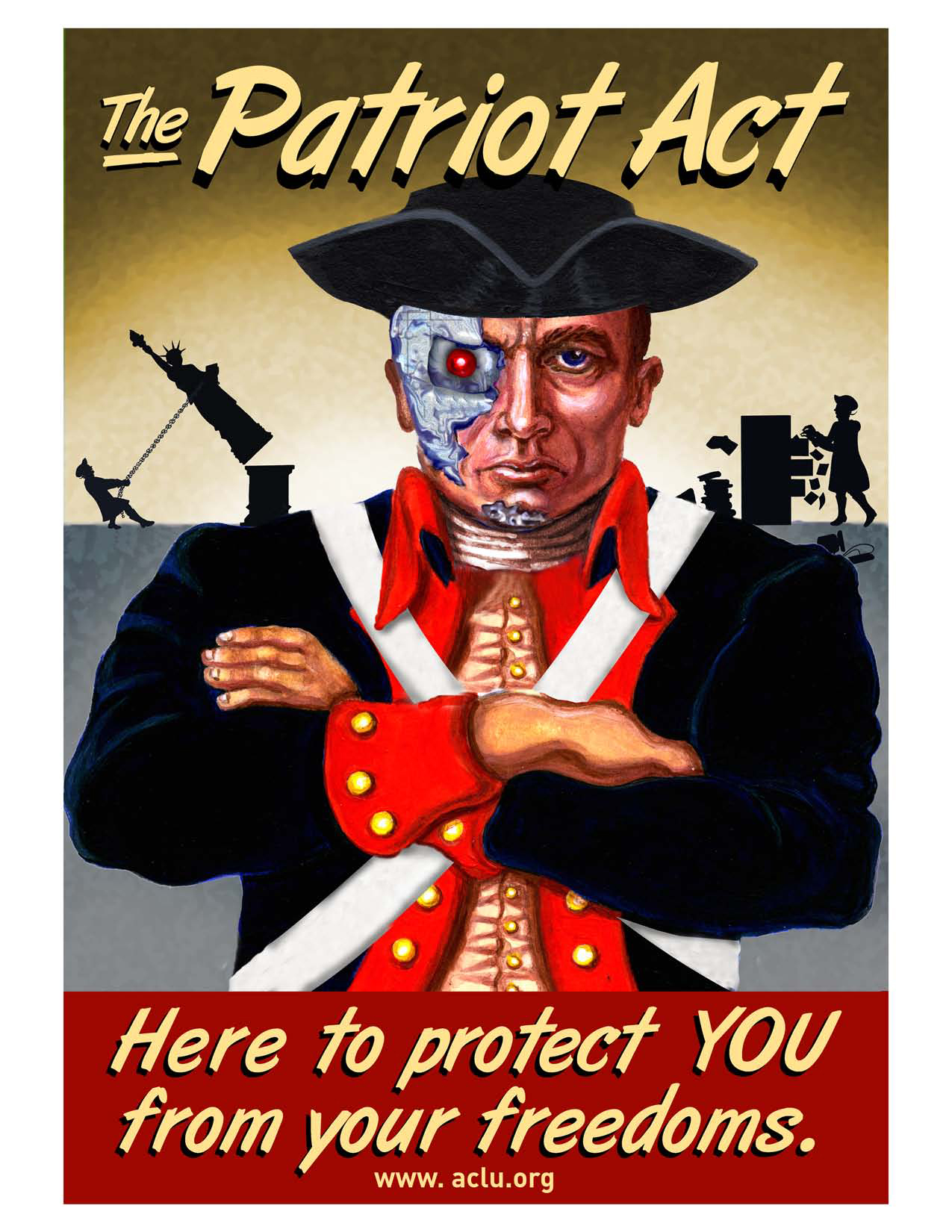
    Gather round, young children, and I’ll tell you a tale. A tale full of treachery and intrigue, mighty heroes and dastardly villains, sung to the tune of the USA PATRIOT Act’s Section 326. A harrowing account of your intrepid author’s attempts to perform a simple act, made not-so-simple by the never-ending meddling of the federal government.

    Over the last several weeks, it has been my sworn and sacred duty to set up a small business banking account for our Glibertarian enterprise. Setting up a bank account should, in theory, be an easy enough exercise. One waltzes into a bank; puts hands on hips in the lobby and demands in a loud, commanding voice, “Ho, there! I require the services of a money lender! Make haste, for I have pressing affairs to attend to with the apothecary upon the satisfactory conclusion of our business!”; gives some information; and deposits some money. That is precisely how things worked the last time I had to open a bank account.

    Of course, preliminary research had to be conducted. Only one of us is actually made of money (I’ll let you try to guess who!), so the majority of my time was spent on the internet and over the phone with different institutions trying to find an actually free small business checking account. The majority advertise themselves as free, but once you get into the weeds a bit during the enrollment process, it turns out they are free only so long as you meet a variety of requirements, none of which are likely to occur with our current business model.

    Pictured here: a banker

    And yet, I persisted. Finally landing upon a local bank that, so far as I could tell, had actual, honest-to-Zardoz free small business checking, I gallantly sacrificed my entire lunch break to go speak with these generous merchants of monetary services. I walked into the lobby which, being the middle of a weekday, was largely empty. A thick-set manager in an off-the-rack suit quickly hurried over to me, vigorously shook my hand, and assured me that his underling would be able to attend to our needs. When asking what our business was, I explained that we run a website giving political and pop culture commentary. Why how wonderful! Did you know that the manager was a journalism major? It’s so important for there to be as many voices as possible giving great, down-the-line political commentary, to fight the nefarious tide of fake news!

    Bolstered by his enthusiasm and feeling mightily proud of myself for helping to selflessly bring the hard, unvarnished truth to a grateful readership (though given some of the comments made during his rambling glad-handing, I suspect he would not have been so generous with praise if he knew the direction in which our political commentary flows), I sat down comfortably with his associate to begin the process.

    Now, as you may or may not know, the leadership of our merry band is scattered across these United States. I explained that not only myself, but a handful of other individuals in various states would need to be signatories on this account. I thought this could be accomplished through digital signatures, faxes, etc. It is here that the first act closes, and the central conflict begins.

    The banker looked at me with a nervous smile. “Is there any chance of your associates being able to come in to one of our branches?”

    “None at all,” I replied, “and frankly I think it quite racist of you to ask*.”

    “I’ll need to speak to my manager. Please excuse me for a moment.”

    *thundering denunciation* “YES, YOU SPEAK WITH YOUR MASTER, VULGAR HIRELING, AND TELL HIM THAT I WOULD SPEAK WITH HIM FORTHWITH!”

    Some five minutes pass in hushed consultation. There are no other customers in the bank. I nonchalantly begin to inspect the windows and doors at the edge of my vision, to plan my escape, if it turns out that my growing suspicions are true, and I have wondered into a clan of vampires or ghouls using a regional bank as a front to draw in potential victims.

    Meaty Manager avalanches back across the room, with an exasperated look upon his reddened ground chuck face.

    “I’m sorry, but I’m afraid we’ll not be able to meet your needs.”

    “Excuse me?” I replied, momentarily dumbstruck.

    “It’s the PATRIOT Act, you see…” and he then begins to tell me of a curse that the Great Tribe has laid upon he and all his kind.

    In 2001 of the Western reckoning of years, as many of you may recall, our great nation was paid a friendly visit by some rather motivated Mohammedans who, through a series of peculiar mishaps, wound up killing thousands of innocent people. The immediate and predictable response to this, was for our Federal Government, Beloved by All, to pass an enormous omnibus bill full of things like indefinite detention and a host of new regulations on a wide variety of industries. If they hated us for our freedom, we had found a most ingenious method by which to defuse their wrath – simply get rid of the offending freedoms.

    Image result for patriot act
    Fox News graphic of PATRIOT ACT, heroically standing in front of the sigil of the glorious Department of Homeland Security

    In this behemoth of a law lies section 326, dealing with the establishment of what is known as a Customer Identification Program. Now before establishing accounts, banks are required to, and held liable for, making strong efforts to establish the identify of their customers. The exact methods by which they do this are left up to the individual institutions. According to the text of the act itself, it sounds easy enough to perform using only legal documents. However, Meaty Manager explained to me that practically all banks, particularly those who are only regional players and who cannot afford to buy off entire branches of government, generally are held to much tighter restrictions by their compliance departments, lest they find themselves on the wrong end of a federal inquiry. And so, without having the opportunity to actually see each of the individuals face to face and have a chat with them, they simply could not pass muster using their bank’s particular CIP rules. There was no way, you see, for them to have faith that we were not drug dealers or terrorists (he mentioned those two professions explicitly, showing an interesting creep from Fighting Terrorism to Eh, the Tool is Already There, Might As Well Use It to Fight Drugs).

    Gathering what dignity remained to me, I indignantly declared to him that such was foolishness in the age of internet business, and that surely a great catastrophe (in the form of lack of growth) would befall his institution if it continued in this folly. Meaty Manager could only smile and give me a Gallic shrug, as if to suggest that, if such were the vicissitudes of fate, then he would suffer what he must.

    On my way out the door, Meaty Manager did offer one piece of parting advice. He suggested to consult with a bank whose reach extends across all the lands, so that there would be outposts near any person that we decided needed official access. Perhaps then, could their identities be properly ascertained to the King’s satisfaction.

    Thoroughly demoralized at this point, your dogged author decided to follow the suited mound’s advice and talk to a big bank. And so, this past Saturday morn, I found myself in the lobby of a Major National Bank. After waiting for some time, I was finally introduced to Paul**, the small business banking representative. I explained to him right away the issue I had had previously, and he agreed it was an obstacle.

    There followed two hours, and I am not kidding or engaging in hyperbole there, in which I was interrogated by Paul and his Manager (I was by now convinced that every man who works in a bank has the exact same physical build). I explained more than once what our business did. I showed them the site. I explained about the concept of the Internet, and how it came to be that many different people, only a few of whom have ever met in person, can reside in different states and still all have interest in a shared venture. I was asked more than once some questions that sounded suspiciously like they were going to lead to “gotcha!” moments had I answered differently, some about drugs and some about terrorism. It was, frankly, ludicrous.

    I asked why I was being treated this way. Same story, different day: PATRIOT Act, section 326. We don’t Know you. How can we Know your compatriots when they aren’t even here? Was I aware how deeply suspicious this entire thing was? Why, did I know that some young dissidents have used otherwise seemingly innocuous websites to sell the Devil’s own concoctions? What nerve had I, to come in here proclaiming my own innocence, when all of my actions so clearly speak to the contrary!

    I shall not bore you with further details; suffice to say that due to some stern negotiations and my resolve to not leave without a deal in hand, one hour after the bank closed, I left with a newly established account, and a series of addendums that I could mail to my compatriots that which, upon completion in front of a notary, would then suffice to establish identity for banking purposes. You see, the Financial Crimes Enforcement Network’s FAQ on the CIP allows for a bank to rely on the good offices of a third party for purposes of establishing identity. However, the bank is held responsible if the third party’s methods are found to be insufficient or unsound. As such, few banks are willing to take such a risk. However, when it comes to dislodging an agitated libertarian from your place of business after the automatically timed overhead lights have already extinguished, it appears they were willing to make an exception.

    TL;DR version: apparently starting a small business with partners in different states is now considered to essentially be drug-running or terrorism related unless and until proven otherwise. This helps to preserve our freedom after 9/11. Be grateful the King is there to see all, and to protect us from the evils that lurk in the dark.

    Image result for patriot act
    Production poster for The Patriot Two: After the Apocalypse.

    All information used to write this article that was not gleaned from my personal experience was obtained here and here, if you want to ruin your Sunday afternoon reading through it. Having already done so, I wouldn’t recommend it.

    *conversations may not have occurred precisely as recounted
    **names have been changed to protect the barely competent

  • Understanding Money

    New car, caviar, four star daydream, think I'll buy me a football team.
    It’s a gas

    There are a lot of people who do not understand money. This is unfortunate since it is the cause of much grief.

    The most important thing to know about money is that it has no intrinsic value. You can’t eat it, wear it, or build a house out of it. You can use it to make a fire, but people don’t usually do that unless very, very stupid people get in charge of the government. More on that later.

    Many things have been used for money, but those things all had certain features in common. To be useful, money must be durable, portable, divisible, recognizable, and most importantly, scarce.

    The reason things like gold and silver have been used as money around the world and throughout history is because they have all the above features. Recently, shoplifters have been stealing brand name laundry detergent to use as money – for the same reasons given above.

    Many people very stupidly think that since money can be exchanged for goods and services, creating money will somehow conjure more goods and services into existence. What actually happens is that price of everything goes up. This is called “inflation” and has been a problem for nearly every currency in history. The British pound, for example, is the world’s oldest continuously used currency, and it has lost about 99% of its value since 1751. You’d need 200 pounds today to buy the same amount that 1 pound did in 1751. The US dollar is even worse. It has lost about 97% of its value since 1913, the year the Federal Reserve banking system was created. The dollar lost about 2/3 of its value since 1971, the year the US officially went off the gold standard.

    The second most important thing to realize about money is that is a symbol. It is both a symbol of desire and a way of measuring it. For the only way to measure how much someone wants something is to ask what they are willing to trade for it. Money is what makes this trade possible.

    Prices are the way we measure desire. They are critical information about how much a good or service is worth and how much demand there is for it. Many very stupid people think that the government can somehow raise or lower prices by decree. The only result of such decrees is economic chaos. In countries like Venezuela and Zimbabwe, socialist governments attempting to help the poor set low prices for food and fuel. However, since they set them too low, those goods are in short supply and what goods do exist are only available on the black market for much higher prices. In Venezuela, many people earn a living by standing in line to buy goods for the official price just so they can sell it on the black market for a higher price.

    51st Emperor of The Roman Empire

    This is not the first time this has happened, 1700 years ago, a Roman emperor named Diocletian didn’t have enough money to pay for everything. He ordered the mint to decrease the amount of silver in each coin so he could buy more. It worked initially, but then prices rose because it did not take long for people to figure out the coins were worth less than before. So Diocletian then decreed that it was illegal for merchants to raise prices. One historian at the time wrote that Diocletian might as well have commanded the winds not to blow.

    Just like today, the inflation was blamed on everything except the government. Diocletian blamed speculators, money lenders, and foreigners for the inflation. Sound familiar?

    Inflation can only come from a government creating more money, and there are numerous examples of this.

    So why then does a trained economist like Paul Krugman think that minting trillion dollar coins would be a good idea? My only answer is that someone who knows economics but not history will invariably be dumber than a person who has studied neither. This is probably why Krugman also thinks the US economy could be jump-started by a fake alien invasion.

  • The Derponomicon: Part 5

    This is not the end. It is not even the beginning of the end. But it is the end of the beginning. Let us press onward. There’s another 40 miles of bad road ahead.

    In this installment, the prog responds to the broken window fallacy and the parable of the pool. The broken window fallacy was first explained by Bastiat. He said that while a broken window is beneficial for glass making and window repair, it is harmful to the owner of the window, because the owner could have spent that money on something more productive than repairing the window.

    The best recent example of the broken window fallacy was the Cash for Clunkers program, which paid people to destroy perfectly good cars in order to stimulate demand for new ones. The main result of that program is that the price of a used car rose by about $900.

    Once again, the broken window fallacy is, well, a fallacy. Another false comparison, unless of course you are speaking specifically of the Iraq/Afghanistan wars, which netted BILLIONS in taxpayer dollars for defense contractors that were providing the weaponry to blow up schools and bridges, and the contractors to repair those roads and bridges, and the private security forces to protect them at 5 times the rate of the US Military. All of which, of course was completely orchestrated and designed by said corporations, that are foreign multi-nationals, that were mapping out plans for war from day one of the Bush presidency and arguably had a hand in allowing 9/11 to happen unobstructed. Cheney’s company alone has made 50 billion+ to date and he inevitably profited handsomely from it. That is where the broken window fallacy makes sense. When it comes to roads and bridges and crumbling infrastructure or the post office or other necessary and needed services the comparison doesn’t really apply, because those things actually have to be maintained and fixed. Not to say there isn’t a lot of superfluous and unnecessary spending going on in government, but about 90% of that is on non essential military spending. Keeping troops stationed in hundreds of bases around the world and spending billions on planes and weaponry that are never going to be used and we’re never needed in the first place as well as spending billions if not trillions rebuilding countries we destroyed in the first place unnecessarily is the TRUE broken window fallacy in US government.

    So there you have it. According to him, 90% of unnecessary govt spending is for the military. Pay no attention to the fact that the military is about 20% of total US federal govt spending.

    Some background on the parable of the pool: according to the parable, trying to enrich the poor by taxing the rich is like taking water out of the deep end of a pool and pouring it into the shallow end. Just as the depths do not change, so the relative wealth of the two groups will not change. Of course, some water gets spilled along the way. This represents the indirect cost of govt transfer programs.

    On the pool analogy. Once again, a completely false and misleading comparison. Our economy is far from a pool that we are all in together. There are TRILLIONS taken out of our economy by the very wealthy and corporations every year and put in offshore investments and bank accounts. A true analogy would be that the people in the deep end are taking thousands of buckets of water a day and pouring them into a series of tanker trucks that drive away with it, whereas everyone else is slowly pouring thimbles full of water into the shallow end. Once again this “redistribution of wealth” conservatives are always screaming about isn’t about taking money from the rich and giving it to the poor, it’s about leveling the playing field that the rich constructed in their favor over the last 3 decades where all the wealth gets redistributed to THEM. This isn’t rocket science. 97% of all economic growth has gone to the top 1%, when the top half of the 99% are the ones putting in all the hard work and effort. If you can’t understand that taking more and more FROM the economy and giving less and less back to the economy causes and enormous rift, no amount of poorly constructed half baked videos are going to help you understand. Just like anything else that is alive and grows, if it is not managed properly, it dies. If you cut down all the trees in the forest, without planting new ones, guess what? The forest dies. If you keep extracting more from.the economy than you give back to it, guess what? It dies. The economy should be treated like a business of any kind, or a well.managed forest, you give back to it as you take from it to help it grow and thrive. Too many people at the top are treating it more like a strip mine, and we all know what that has done for West Virginia.

    Well, he’s right about trillions being taken out of the economy- except it’s by the govt. Sort of. Still more zero-sum game economics.

  • Completely Unwarranted Attack on the Single Land Tax (Land Value Tax) #2

    We’ve had some really good back and forth in the prior articles about the SLT/LVT, so I’m gonna poke the hornet’s next one more time.

    Rent, so much rent!!!

    This time I’m taking aim at the claim from SLTers (and other economists) that a single land tax/land value tax is the “least bad” because it incurs no “deadweight loss.”

    MASSIVE DISCLAIMER: I’m not an economist. My only formal exposure to economics was a AP micro in high school and 2 weeks of macro in college before I dropped the class. I’m prepared for somebody with knowledge in this subject matter to refute any and every premise/assertion/conclusion I make.

    First, let’s define deadweight loss. In a broad sense, deadweight loss is a measure of certain inefficiencies caused by government intervention in a market. Focusing specifically on taxes, deadweight loss represents the benefit that would’ve been had by consumers in the perfect market that is foregone in the distorted market.

    As a simple example, let’s say the perfect market would sell monocles for $1, and the government imposes a $3 luxury tax on monocles, raising their total cost to $4/monocle. There are a lot of people who would buy a monocle at $1, and a few glibertarians who would buy a monocle even at $4. Deadweight loss represents the economic benefit that the glibertarians who bought $4 monocles would have otherwise had with the $3 they ended up paying in tax.

    Using a static model, it looks like this, pictographically:

    I made a graph!!!1!1!!

    Using this model, SLTers say that the SLT has no deadweight loss because there is a fixed supply of land (a vertical supply curve). You usually see a graph like this from them:

    I've seen this one before

    However, let’s think about what this means for a moment. It means that no matter the tax on the value of the land, the consumer does not lose economic benefit. This strikes me as incorrect. In fact, upon examining the above graph, it seems a bit… off. After looking at it for a bit, it appears that the demand curve has been moved in the no deadweight loss graph. It’s showing the equilibrium for a distorted market, not for a theoretical perfect market like in the top graph. Taking that into account here’s what the graph should look like (IMO):

    What am I missing here???

    Somebody please explain to me what I’m doing wrong here. When I, a lay person, am coming to a different conclusion than the likes of Milton Friedman, I’m worried that I’m missing something very simple.

    However, just to hedge my argument a little bit, I think we need to re-examine this asymptotic economic model. Land is a somewhat unique object in that it cannot be produced. When looking at a supply curve, we’re more focused on production. Thinking about it for a moment, it seems really odd to say that, should the demand for land drop precipitously, land could go to at-or-near zero price. See, what I intuit is that some land isn’t marketable at a certain price. I think the vertical line is too simplistic and results in “technically right” answers that don’t reflect reality. The “not for sale” aspect isn’t being taken into account. Therefore, in adjusting the supply curve to reflect the marketable supply of land rather than the total supply, we get a graph that looks a bit more like the first one in this article:

    Land for a penny!