Category: Finance

  • A Deep Dive into Cryptocurrencies and Their Operation: Part 2

    In Part 1, we talked basic computer science. I highly recommend reading/re-reading Part 1 before reading this article if you don’t have a firm grasp on the basics of computer science.

    We’re going to start here in Part 2 by talking generically about some of the hurdles that cryptocurrencies have had to overcome, then we’ll define some terms, and finally we’ll put all the pieces together into a basic model of how a blockchain-based cryptocurrency works.

    Traditional Ways of Passing Data through an Untrusted Medium

    Let’s do a quick survey of a few ways that important data can be passed through an untrusted medium (i.e. the Internet). You’ll recognize some of these from Part 1.

    Encryption

    Pretend you have a secret message that you want to send from your computer to your friend’s computer. An easy example may be a message including your credit card information to purchase Glibertarians pink footie pajamas. How do you send that information from your computer, through a bunch of network devices (routers, switches, etc.) that are owned by neither you nor your friend, and to your friend without being intercepted by a nefarious third party?

    The easy answer is cryptography. Let’s change the message in a way that only your friend has the “key” to unchange it. There are many ways to do this, but one of the most common is public key cryptography. If you want more info on public key cryptography, check out Part 1.

    Secured Channels

    Sometimes, you’re sending a bunch of secret information across the network to the same place. The most common example is when you’re working from home. You’re transacting a bunch of secret information with your corporate servers, and it may be easier to just establish a secure channel between your computer and the corporate network so that you don’t have to manage the overhead of encrypting the info piecemeal. What am I describing? VPN.

    This doesn’t really have anything to do with blockchain, but it gives you a bit of context about how security can be implemented over the Internet.

    Trusted Authorities

    Trusted authorities also have nothing to do with blockchain, except to act as an opposing contrast to the way blockchain works. We talked in Part 1 about the two ways that public key cryptography can be used. One way is to securely send secret information across an untrusted link. Another way is to sign a message and validate that the message came from the person you think it did.

    What if I want to know that you’re legit before I send you all my personal information? STEVE SMITH could easily insert himself between  you and me, send me his public key, and then intercept and decrypt my response. This is called a “man in the middle” attack. Rather than just trust that the public key you supposedly sent me, I can reach out to a trusted 3rd party, who has your public key on file. I request your certificate from this trusted 3rd party (called the Certificate Authority), and compare the public key in the certificate with the public key you sent me to make sure it hasn’t been meddled with. The weakness of this method is that you have to trust the security of the Certificate Authority (the most well known CA is VeriSign).

    Blockchain uses some of the encryption technologies we have discussed, but specifically cannot use VPN or CA technology because blockchain is implemented in a completely trustless environment. Why is it a trustless environment? Because authority is distributed rather than centralized.

    Centralized, Decentralized, and Distributed: A Libertarian Way to Organize Things

    I’m going to keep this focused to the tech realm, but y’all are smart enough to expand these concepts outside the realm of computers. There are three main ways of organizing tech in order to accomplish a task. Centralized systems involve everybody reaching out to one single node (e.g. server or cluster of servers) in order to accomplish the task. Decentralized systems involve everybody reaching out to one of a small number of nodes in order to accomplish the task. Distributed systems involve everybody reaching out to everybody else in order to accomplish the task.

    Centralized

    Centralized systems are what we use on an everyday basis. I want to buy something from Amazon, so I connect to an Amazon server and make the purchase. You want something from Amazon, so you connect to an Amazon server and make your purchase. This is a centralized system*, everybody connects with an Amazon server in order to complete their transaction.

    * You could argue that Amazon runs a decentralized system, because there are Amazon servers all around the world to share the load of so many people shopping simultaneously. However, for this description, “centralized” refers to only one “entity”  being involved, no matter the number of physical servers.

    Decentralized

    Decentralized systems are less common, but are still used on a regular basis. I want to refinance my house, so I go to LendingTree or any one of the other online insurance brokers. I input my information, which is sent to a handful of banks and other lenders, and each lender returns the request individually. If one lender doesn’t respond, it’s not quite as efficient, but I still have access to all of the other lenders.

    Distributed

    What if we take it a step further? Rather than a handful of entities, everybody can be an entity and everybody interacts with everybody. For example, Uber. You submit a ride request, and other people choose whether or not they want to fulfill that request. Uber isn’t perfectly distributed, as there is a barrier to entry before you can drive for Uber, but the barrier is low enough that it’s essentially distributed for our purposes.

    How Transactions are Verified when Nobody can be Trusted

    We have two obstacles to get over before we can verify a transaction. The first obstacle is ensuring that nobody has stepped in and altered a legitimate transaction. The second obstacle is ensuring that legitimate creator of the transaction isn’t trying some funny business.

    We’ve already discussed a method for tackling the first obstacle, using public key signing. The person who is giving the money signs the transaction with their private key, and the public key is included in the transaction data. Then, anybody in the public can check the signature using the public key to make sure that the transaction was approved by the originator.

    What about the second obstacle? Well, that’s a little more complicated and involves some economic incentives. We’ll get into this in more detail in Part 3 of this series, but suffice it to say that pulling off a con to steal somebody’s cryptocurrency involves an impossibly large amount of computer resources, and an immense amount of luck. The incentive to steal is way overridden by the costs of acquiring the raw processing power required to make such a con even remotely possible.

    How does bitcoin get stolen, then? Usually some currency exchange website is hacked, and the private keys of users’ accounts (wallets) are compromised. It’s not a flaw in cryptocurrency, but in the exchange’s security. Blaming such hacks on cryptocurrency is like blaming the US Dollar because Chase’s system gets hacked.

    Definitions and Terms of Art

    Blockchain (Sometimes called distributed ledger technology) A list of connected messages that contain transaction information. The blockchain is copied to every node (computer) in the blockchain network, allowing each and every participant in the blockchain to examine the blockchain for inconsistencies.

    Cryptocurrency – A financial product that is transferred between people using a blockchain. Some people view cryptocurrencies as investment products (commodities). Others view cryptocurrencies as a currency. Many cryptocurrencies use a mathematical algorithm for “printing” new money that is rather deflationary, making them attractive long term investment vehicles.

    Bitcoin The original cryptocurrency that is trading for somewhere in the neighborhood of $11k per Bitcoin at the time of writing. You don’t have to buy full Bitcoins, but can buy as little as 0.0000001 Bitcoin.

    Smart Contract – Some uses of blockchain are less tightly coupled to currency. Ethereum, for example, is a broader use blockchain system, and includes smart contracts, which are publicly inspectable contracts that are mostly self-executing. For example, if getting the wifi password is keyed to paying your rent, the smart contract will retain the new month’s wifi password and will not release it to the tenant until rent is paid.

    Fork (of blocks in a chain) – A condition of the blockchain where two blocks are created and verified by different nodes in the network at substantially the same time. In such a situation, there is a “fork” until the next block is verified. Whichever forked block is retained by the node that verified the next block is the “winner”, ending the “fork.”

    Fork (of cryptocurrencies) – A split off of a new cryptocurrency from an old one. Usually this happens because the older cryptocurrency has some limitation or flaw that the new cryptocurrency resolves. Depending on the specific situation, the older currency may transform into the new currency.

    Merkle Tree – A type of binary tree (a hierarchical linked list where a “parent” node has at most two “children”) used to organize the cryptocurrency transactions stored within a block. Each leaf node (i.e. nodes without children) of the Merkle tree represents a transaction, and the parent nodes represent a combination of multiple transactions. Each node has a hash, with the root node (the parent of all parents) containing a transaction hash for the entire block. These hashes can be used to verify the accuracy of the transactions, and the transaction hash for the entire block is used in creating the hash for the block.

    Wallet – A data structure built around a user’s private key that retains all of the cryptocurrency that has been transferred to it.

    Exchange – A website that retains a cryptocurrency wallet for each of its users. Exchanges are like a cross between a bank and an investment broker.

    Blockchain? Is That Some New Type of Jewelry?

    Blockchain is the technical underpinning of cryptocurrencies. A blockchain is a linked list of data structures. Each data structure includes a header, a transaction ledger, and a pointer to the prior block.
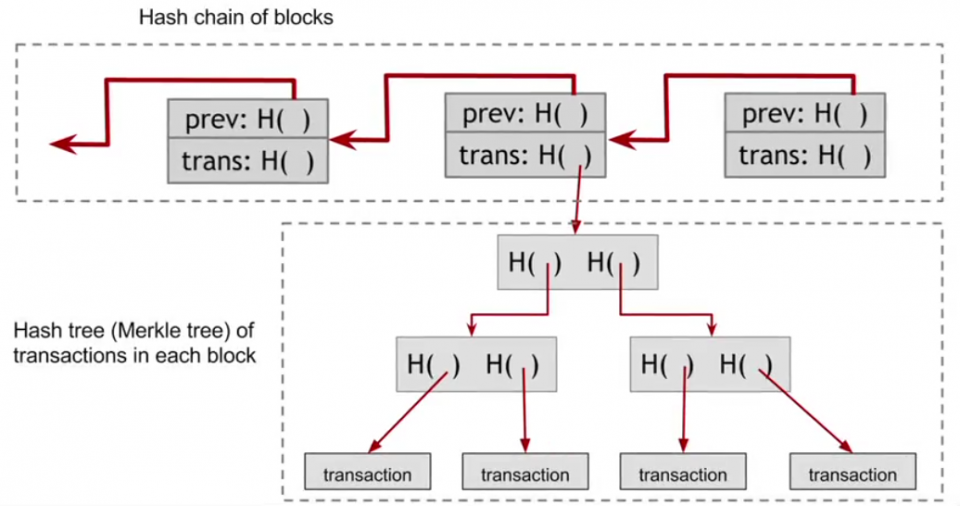
    Here is a very high-level view of what a blockchain looks like. You have ledger of transactions arranged in a tree form (a tree is a linked data structure kind of like a linked list, but with more than one relationship saved in the structure. For example, in a binary tree, each “parent” data structure has two “children”). The actual transactions are located in the leaf nodes (a leaf node has no children), and the root is the top parent node. The Merkle tree (the specific type of binary tree used for blockchain transactions) calculates the hash of each transaction, and then continues to hash the combined hashes up the tree until we get what’s called the Merkle root hash (shown as “trans: H( )”). The specifics of how all this works isn’t super important, and it’s fairly intuitive once you understand hashing. You’re essentially taking hashes of hashes until you get one single hash that represents all of the transactions in the block. Why do we want that?

    Because the hash of the block (used for security/verification purposes) isn’t the hash of the ENTIRE block, but only of the header of the block. The actual transactions and the Merkle tree are contained in the transaction ledger, and are not taken into account when calculating the hash of the block. However, the Merkle root hash (which takes into account all of the transactions) is located in the header of the block and is thus taken into account when calculating the hash of the header of the block. If a nefarious actor tried to change one of the transactions to route currency to his wallet, it would change the Merkle root hash, which would change the hash of the block, resulting in it being obvious to the blockchain network that something has been tampered with. We’ll go into more detail on this in Part 3 of the series.

    The last concept I want to bring up in this article is the increasing security over time. How does that work? Well, it has to do with the linked list of blocks. Let’s say we have three blocks that STEVE SMITH wants to corrupt in order to steal some cryptocurrency.
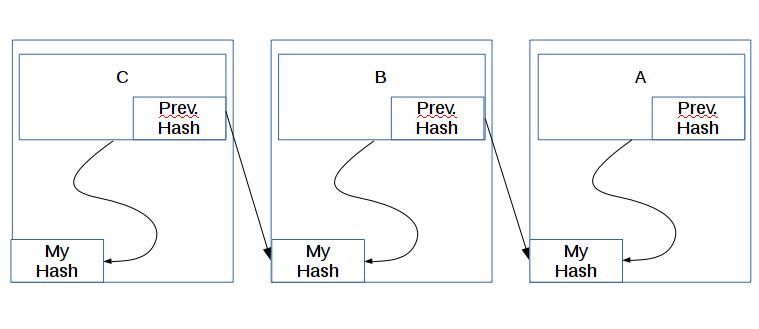
    STEVE SMITH will have the easiest time corrupting block C. Why? Because all he has to do is change the transactions and calculate the new hash for C. I say “all he has to do” as if it’s easy. We’ll talk in Part 3 about why this is nearly impossible to do. However, let’s assume for a moment that STEVE SMITH has a ton of computing resources and it isn’t quite nearly impossible to corrupt C anymore. Now, let’s see why the older a block is, the harder it is to corrupt.

    STEVE SMITH sees a huge transaction of cryptocurrency in block A and wants it for himself. In order to pull of his heist, he alters the transaction in block A, but now A’s “My Hash” is wrong (we’ll discuss tomorrow how the network knows it’s wrong). STEVE SMITH then spends a bit of time calculating A’s correct new My Hash. Once that’s done, there’s still a problem. B’s “Prev. Hash” is wrong, and the network will see the obvious inconsistency. STEVE SMITH changes B’s Prev. Hash to match A’s My Hash. Great! All fixed!

    But wait! B’s My Hash is calculated in part using B’s Prev. Hash, so now B’s My Hash is glaringly wrong. With a sigh of frustration, STEVE SMITH begins the time intensive process of calculating B’s new My Hash. STEVE SMITH, being one of the smartest of his race, sees that block C is going to have the same issue, so he quickly updates C’s Prev. Hash after figuring out B’s My Hash, and begins cranking on C’s My Hash. Finally, after a bit of time, STEVE SMITH has updated the blockchain and his crime was a success!!

    Or not. See, while he was cranking hard calculating new hashes for three blocks, the blockchain network was adding new blocks every few minutes (10 minutes for Bitcoin). His fraud sticks out like a sore thumb because blocks D through L all have the wrong hash when his “modified” blocks are included. In order for STEVE SMITH to succeed in his nefarious plan, he would need to control a significant portion of the entire world’s computing power, something on the order of 45% of the blockchain would need to be controlled to give his plan even a dismal chance.

    I’m going to stop here. We’re going to dive down to a place where giant octopi and fish with bioluminescent lures live in Part 3. We’ll discuss the details of how hashing is extensively used in the blockchain, how incentives are used to increase security through mining, how blockchain can be used outside of cryptocurrency, a description of the major cryptocurrencies and what they’re useful for, and some of the drawbacks of cryptocurrencies.

  • A Deep Dive into Cryptocurrencies and Their Operation: Part 1

    What this is

    An in depth perspective on how blockchain and cryptocurrencies work, along with a running commentary on social value, libertarianism, and whatever the heck fits my fancy. I’m attempting to write this at a high school comprehension level so that those who haven’t sat through 4 years of computer engineering classes can make sense of all of this.

    What this isn’t

    A primer on Bitcoin, an economic treatise, or a how-to. (Although, elements of all of those things will appear)

    For those who don’t feel like scrolling through pages and pages of my ramblings, here’s the TL;DR. Blockchain is a bunch of messages with security built into them. The security isn’t perfect, but each message is increasingly secure as time passes. The list of messages is saved on every computer that participates in the blockchain, and the lists are constantly being compared for agreement. Blockchain relies on a bit of a gambit. They essentially say “you may be able to break the security on one node, or even a few, but after a few the increased security that comes with time passing will catch up with you, and you’ll be stuck well before you come close to succeeding in fraud.”


    A Survey of Computer Science

    Numbers in an Array

    Computers are complex and simple at the same time. It takes millions of lines of code and tens of thousands of man-hours to put together the latest Windows or OSX version, and yet everything a computer does is simply a whole bunch of numbers saved in an array called memory.

    Let’s look at an example computer memory:

    Whaaaaaaaa??

    Let’s ignore all of the writing for a moment and discuss what we’re looking at. Memory is “byte-addressable,” which means that you can access information 8 bits (there are 8 bits in a byte; a bit is a single value of “1” or “0”) at a time. If I want to access the byte at address 0, I write some code that properly references address 0, and I have access to the value in that address of memory. If all data was 8 bits long (e.g. a number between 0 and 255), then we’d have a pretty easy go of accessing data. Just remember the order you put it in, and you just call the number that you put it in (minus 1 because the addresses start at 0).

    However, as shown in the above image, data can be much larger than 8 bits. The yellow 2-byte data is a short integer (e.g. a value between 0 and 65,535). The purple 4-byte data is an integer (e.g. a value between 0 and ~4.3 billion). There are other types of data that are even longer, like decimal numbers (called floating point numbers). Here’s more info on memory and how it works. Now it gets a bit more complicated to remember where things are in memory.

    Arrays: A Simple Way to Store Large Amounts of Data

    When dealing with simple data, like an integer, storing it in memory is relatively simple. As long as you know what address it starts at and how long that type of data is, you can access and retrieve the data. However, what are we to do when there is a bunch of related data?

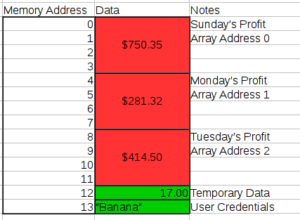
    For example, what if we want to store the daily profits for the week from our monocle and top hat shop? Now we don’t have just one piece of data to deal with, but seven. We could just toss each day’s profit into memory as we encounter it, but the accounting program we’re running may store additional info in memory: temporary values, user credentials, and other information needed by the program will also reside in memory.

    We can remember each address for each individual day’s profit data, but these values are related, and it’s hard to manage access information on seven values, let alone 70 or 700 or 700,000. Treating each value individually doesn’t scale.

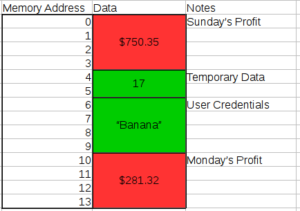
    As shown above, Sunday’s Profit is separated from Monday’s Profit (both in red) by intervening unrelated data (in green). In order to access the week’s profit, you need to know the address of each and every day’s profit, and you have to individually retrieve each data point.

    In comes a better way to handle such data: Arrays! Much like memory is an array with addresses referencing each byte, array data structures store related information sequentially so that each piece of information can be referenced with an array address.

    The difference is clear. The array groups the related data together, and you can simply reference the array to get to any of the data. Array address 0 is Sunday’s profit, which is located in memory addresses 0-3. Array address 1 is Monday’s Profit and is located in memory addresses 4-7. Rather than needing to remember all of the memory addresses for each day’s profit, you can simply remember the starting memory address of the array, and use the array address to calculate where each piece of information in the array is located. For example, array address 1 translates to the array starting memory address (0) plus one array element (which is 4 bytes long), resulting in a memory address of 4. If you look at the above image, array address 1 starts at memory address of 4. NOTE: I haven’t included all 7 days of profit in the above image so that it won’t get too complicated and confusing. Here is some additional information on arrays.

    However, you can also see a limitation in the above image. It works great if you know exactly how much data you need to store, but look at where the Temporary Data and User Credentials are stored. If you need to include one more piece of information in the array, you’re hosed. Either you have to start moving a bunch of stuff around in memory to make room (which is not ideal), or you have to continue the array somewhere else in memory and keep track of 2 array portions (which is also not ideal).

    Linked Lists: Good for dynamic data

    You may be wondering what the point of all of this is. We’re talking about blockchain, not about memory management, right? I promise, this is where we connect to blockchain.

    Let’s see if we can combine the best of both worlds. Writing each day’s profit to memory separately allows you to add additional days without having to shuffle data around in the memory. On the other hand, preserving the relationship between all of the days’ profits without having to keep track of each day’s memory address allows you to scale up to large amounts of data without overcomplicating things.

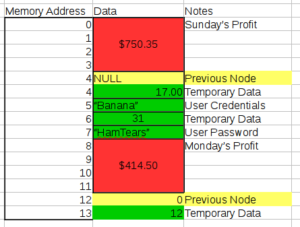
    One of the “best of both worlds” solutions is called a linked list. A linked list operates much like writing each day’s profit to memory separately, but preserves the relationship between the different days by including an additional bit of information pointing to the location of another day’s profit in memory.

    As you can see, we have expanded Sunday’s profit and Monday’s profit from 4 bytes to 5 bytes. The additional byte (in yellow) points to the previous node. Since Sunday’s profit is the first node, its previous node is NULL (meaning it doesn’t have a previous node). Since Monday’s profit is the second node, it points back to Sunday’s profit. Previous Node 0 points to the starting memory address of Sunday’s profit.

    Visualized another way, the linked list looks like this:

    This is the basis of blockchain. A data structure with a payload and a reference to the previous block in the chain. Now let’s talk about security.

    Hashes: Breakfast for the Masses

    I dunno about y’all, but I’m sick of reading. Let’s take a quick break before getting into hashes by enjoying some pictures

    Breakfast Hash and some red meat for the audience.


    Hashes: Preserving Relationships and Security

    Alright, back out of your bunks. Time for some more learnin’. Hashes are conceptually simple, but mathematically complicated. Since we’re not diving into the math, this section should be a breeze!

    No, not that kind of Brees!

    Let’s take a look at the array again:

    If we call Array[0] we get Sunday’s Profit, and if we call Array[1] we get Monday’s profit. However, we don’t always have a situation where we know exactly what order the data will be put into the array. Imagine, for a moment, that instead of 3 days of profits, we have 3 years of profits, entered manually by an employee who isn’t guaranteed to get everything perfectly in order. How do we find Monday’s Profit in that deluge of data?

    The traditional way is to search for the data in the array. Here is some more information on searching.

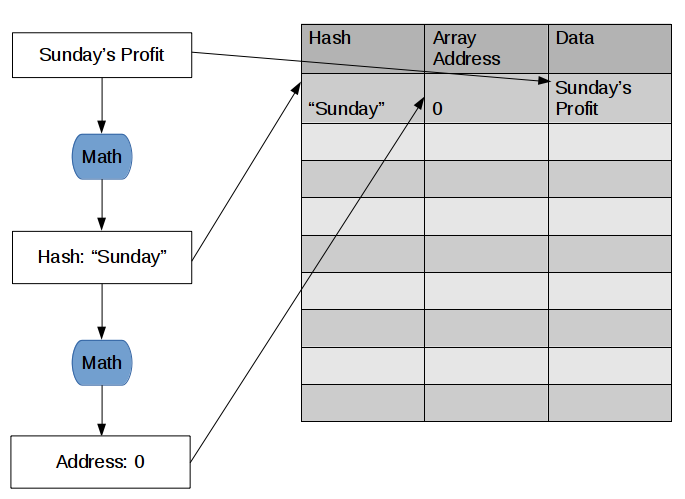
    The fun way is to use hashing! How about we use some relevant characteristic of the data to access the data instead of the array index (“index” is another term for array address number). All you need is two math equations: one to determine the hash from the data, and another to determine a memory location from the hash.

    As you can see, Sunday’s Profit data was hashed to “Sunday”, which is a characteristic of the data (specifically, the day of the week), and “Sunday” was computed to be connected to array address 0. Now, instead of accessing Sunday’s Profit data by loading Array[0], you can access Sunday’s Profit data by loading HashArray[“Sunday”].

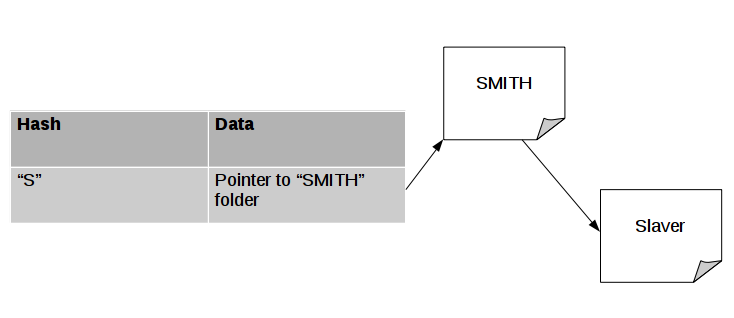
    If this is a bit confusing, another simple hashing algorithm that appears in everyday life may clarify things. Placing medical records in alphabetical order by the first letter of the last name is another hashing algorithm. If the last name is SMITH, the “algorithm” for obtaining the hash involves looking at the first letter of the last name, “S”. Then, the hash “S” points to a specific shelf in the fileroom (the “S” shelf, for lack of a better name). SMITH’s folder is placed on the “S” shelf. When I want to retrieve a folder starting with “S”, I pull a folder off the “S” shelf, and I have SMITH’s folder.

    But there are many people with a last name starting with “S”. What happens when SMITH’s folder is stored on the “S” shelf and I want to store Slaver’s folder? This is called a “hash collision.” Depending on the specific situation, a hash collision is either an inevitability or a disaster. In cases where hash collisions are expected, we could simply change the data stored. Rather than just storing one piece of data for each hashed value, we can store the data for each hash in a linked list. Now, the “S” shelf looks like this (pointer is just a fancy term for the memory address):

    This is great for categorization hashes like the alphabetical sorting of medical records, but isn’t the best for cryptographic hashes like are used in blockchains. Instead, cryptographic hashes rely on another protection from hash collisions, small data density.

    Bitcoin and most other cryptocurrencies use what is called SHA-256 hashing. In SHA-256, a message of any* size is hashed using really fancy math into a 256 bit number, which means there are 2^256 possible hashes (1.1×10^77 for you scientific notation folks, or roughly 1/10 of the total number of atoms in the universe). Hash collisions are so rare under SHA-256 as to be practically nonexistent.

    *Technically, there is a maximum length of message, but it’s enormous.

    But I mentioned above that hashes are based on characteristics of the data. “S” is the first letter of SMITH, and it’s fairly easy to see the relation. What is the relation between some seemingly random 256 digit number and a Bitcoin block? Well, it has to do with math well beyond my ken, but you can go here for a bit of an explanation (as well as a look ahead). In essence, the math takes all of the data, divides it into chunks, and does a mathematical transformation on each chunk before assembling the results into the hash.

    Okay, assuming you’re following along so far, you understand how categorization hashes work and that cryptographic hashes are different, but how do cryptographic hashes work?

    Cryptographic hashes work on the principle that it’s much easier to do the math to hash the data than to derive the data from the hash. Let’s look again at the medical records example for a picture of how this works. If you’re given the last name SMITH and told that the hashing function (fancy term for the math to calculate the hash) is the first letter of the last name. It’s trivial to calculate a hash of “S” from the data “SMITH.” However, let’s go the other direction… if all I give you is “S”, you have thousands of last names to choose from. The chance of you guessing “SMITH” is extremely low.

    The same principle applies to SHA-256 hashes. It’s relatively easy for a computer to calculate the hash from the original data, but (practically) impossible to derive the original data from the hash.

    We’ll discuss the specific way cryptographic hashes are used in blockchains later on.

    Let’s take another break. Things are getting a bit intense. In the spirit of the glib baby pics from a while back, here’s me in a sombrero.

    Cultural Appropriation from a Young Age

    How about some relaxing pics from a backpacking trip I took a long time ago?

    Public Key Cryptography

    Alright, back to talking security! We’ve laid the groundwork for explaining the structure and security of the blocks in a blockchain, but let’s talk about individual currency transactions and how they’re secured. If I want to send 50 bitcoins to ZARDOZ, we create a transaction to transfer the bitcoins from my wallet to his. The details will be covered later, but it’s important to notice that without any security, STEVE SMITH could read the transaction, and use the information contained in the transaction to create a fake transaction to send the 50 bitcoins to him instead of ZARDOZ.

    What sort of security is used on these transactions? Public key cryptography! Public key cryptography uses the same concept of “one way” algorithms, just like the cryptographic hashes. In fact, in some cases, the mathematics for generating cryptographic hashes is used in public key cryptography.

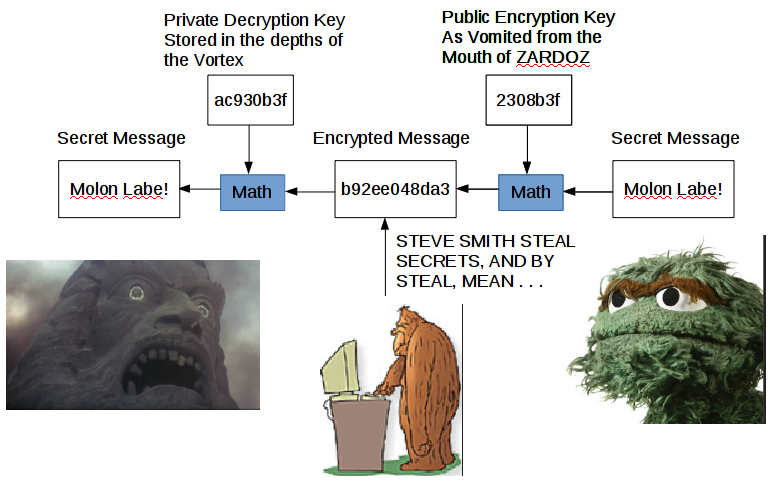
    How does it work? Let’s assume I want to send a secret message to ZARDOZ. I’m sending it over the Internet, which isn’t a particularly trustworthy place. I can’t just send the text in the open. ZARDOZ decides to generate two “keys.” In this context, one of the keys is used in combination with fancy math to encrypt the message so that it can’t be read by STEVE SMITH. The other key is used in combination with more fancy math to decrypt the message. The cool thing about public key cryptography is that you can’t figure out the decrypting key by looking at the encrypting key or at an encrypted message. This is called asymmetric cryptography.

    In contrast, symmetric cryptography can be “broken” by looking at the encryption key and the encrypted message. Of course, that means you shouldn’t broadcast your symmetric encryption key on an insecure channel. For example, if my encryption algorithm is addition of the encryption key to the data, and my encryption key is 4, then if my data is the number 10, the encrypted data is the number 14 (10+4 = 14). I send 14 across the unsecured network to ZARDOZ, who uses the symmetric decryption key (the number 4), and the decryption algorithm of subtraction of the decryption key from the data, and ZARDOZ gets the original data, the number 10 (14 – 4 = 10).

    Seems secure enough, especially when we use something more complicated than “add 4” as an encryption. But why are we talking about asymmetric cryptography instead? Well, because we have a problem. The Internet isn’t particularly secure, and we’re not gonna VPN with the entire bitcoin network, most of whom we don’t trust, to send them our secret key. With asymmetric cryptography, the encryption key (called the public key) can be known by everybody. It doesn’t matter if half the world can encrypt messages intended for you. As long as they’re not able to decrypt those encrypted messages, the system is secure. That’s why the decryption key is called the private key. The private key must be kept secret by the receiver of the message.


    As shown above, I have sent ZARDOZ the message “Molon Labe!” ZARDOZ has vomited forth (published) his public key, which allowed me to encrypt my message and send it across the Internet securely. As you can see, STEVE SMITH can try his hardest to intercept my message to ZARDOZ, but all he gets is a bunch of gibberish. Then, once ZARDOZ receives the encrypted message, he uses his private decryption key (secreted away in the Vortex where nobody can access it except ZARDOZ) to decrypt the message and read “Molon Labe!”

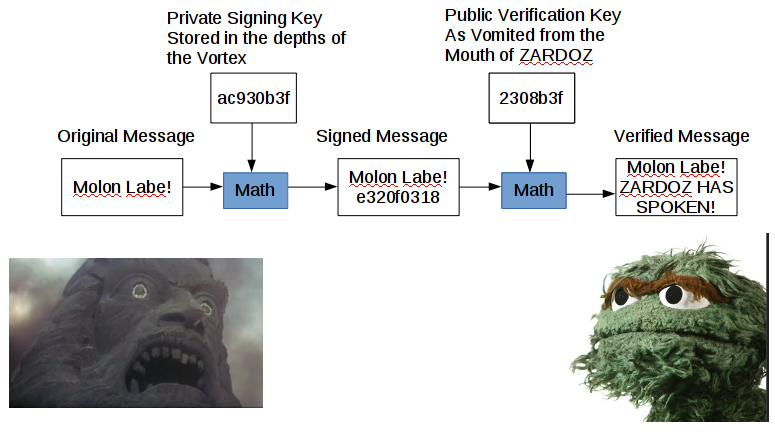
    Now, this is great and all, but isn’t blockchain about publicly accessible data and verification instead? Well, yes. Let’s take this public key encryption and flip it around. Now, instead of keeping the data secret, we want to make sure the data is from the right person. I’m expecting a message from ZARDOZ, and want to make sure that it’s legitimately from ZARDOZ and not from STEVE SMITH.

    As you can see, the message stays public the entire time, but there is extra data added based on ZARDOZ’s private key. This is called a signature. Upon receipt, anybody can verify the authorship of the message by using the public key.

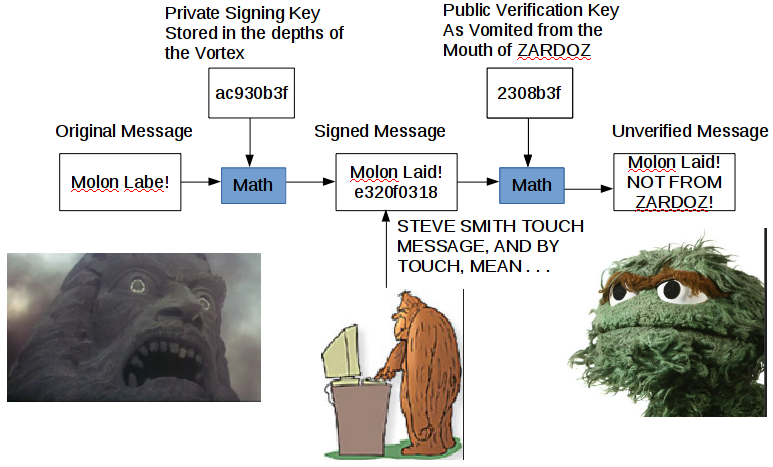
    What happens when STEVE SMITH tries to meddle again?

    As you can see, STEVE SMITH, in his ham fisted way, has altered the message before I have received it. When I try to verify the message’s authorship, I find out that it’s not from ZARDOZ, and thus it’s a suspect message to be ignored.

    This is the basis for verifying cryptocurrency transactions. We’ll put all of this book learning together into a workable model in the next article or two, but this article explains most of the theoretical underpinnings of blockchain and cryptocurrencies.

  • An Introduction to Bitcoin

    There’s a scene in Neal Stephenson’s “The Baroque Cycle” in which the 17th Century English economy is described as almost completely run from lists of debts due to the lack of circulating coinage. Welcome to the wonderful world of Bitcoin!

    There is no such thing as a bitcoin. When someone says “I own a bitcoin,” what they mean is “I know the code or codes that can authorize the transfer of up to one bitcoin.” If you buy a “loaded” physical token for 0.01 bitcoin on eBay, the token contains a code. Neither the token nor the code is “bitcoin,” but the code enables you to transfer amounts adding up to 0.01 bitcoin to other accounts.

    Bitcoin’s foundation is a public transaction ledger called the blockchain. Every bitcoin transaction is recorded on the blockchain and anyone can inspect the transaction history going back to the creation of the first block of the chain. Because the blockchain is public, bitcoin transactions are not as anonymous as some people currently in prison had hoped. Every new account is anonymous, but that anonymity will probably be compromised by the first transfer of bitcoin into it because the bitcoins in the source account probably have a history–and there are companies whose business plan is to delve through the blockchain to link accounts to owners and sell the information.

    Here’s how the blockchain works: people with codes that control bitcoin create transactions. Transactions can have one or more input accounts and one or more output accounts. Newly created transactions are sent to the cloud of computers running bitcoin protocol clients and added to a list of pending transactions. Anyone can download a bitcoin protocol client and run it on their computer, but running a full “node” takes a lot of disk storage space and Internet bandwidth.

    Some of the computers running bitcoin protocol clients are “mining” bitcoin. To mine bitcoin, one selects transactions from the pending list and packs them together into a binary blob called a “block”. The block is then scanned to create a “hash” value. The last digit of a 16 digit credit card number is a hash value calculated from the first 15 digits. This is how web sites can automatically determine if you’ve mistyped a credit card number.

    The hash value created by scanning a block isn’t a single digit. It’s 78 digits long, and it’s unlikely that the first hash value created for a block will “mine” the block because there’s a trick. The bitcoin protocol tries to make it so that a block is mined every 10 minutes. To do this, the protocol periodically adjusts the difficulty of mining by specifying a maximum value for the hash value. In addition to the selected transactions, the block contains a counter. When a block is first created, the counter value is zero. The block’s hash value is calculated. If the hash value is less than the current maximum value, then the block is “mined.” If the hash value is greater than the current maximum, then the counter is incremented and a new hash value is calculated. Subsequent hash values created by incrementing the counter are essentially random values from zero to 1.16×10^77. The process of mining a block is repeatedly incrementing the block’s counter and calculating the next hash value until the hash value is less than the current maximum value.

    “… What?”

    When a hash value is less than the maximum value, the winning block/counter/hash combination is sent to the cloud of computers running bitcoin protocol clients, and the block is added to the end of the blockchain. The transactions in the block are considered complete and removed from the pending list.  All the miners start the process over again, create a new block from transactions in the pending list, and commence mining it.

    As incentive to mine, the account of a miner who successfully mines a block is credited with (as of this writing) 12.5 bitcoins. This is how new bitcoins are created. The number of bitcoins created for each successfully mined block declines slowly over time. Miners can also keep any change left over from a transaction. If a transaction specifies an input account that contains one bitcoin and specifies the output account should get 0.99 bitcoin, then the remaining 0.01 bitcoin is kept by the miner. This is incentive for miners to include the transaction in their blocks.

    Most mining is done by groups of miners who join together in a mining “pool.” A central computer creates the block which is sent to the members of the pool. Each member mines using a different initial value of the counter.  If a pool member mines the block, the result is sent to the central computer and the pool members share the reward in proportion to their effort. Anyone can buy a mining rig on eBay and join a mining pool.

    Bitcoin mining is almost exclusively done by specialized mining equipment, and the price of bitcoin is directly related to the cost of the electricity required to mine blocks. If the exchange value of bitcoin rises to the point where it’s very profitable to mine, then existing miners buy more equipment or new mining pools are created. This makes mining faster and blocks are mined more frequently than every 10 minutes. This makes the bitcoin protocol increase the mining difficulty by decreasing the maximum hash value. This means miners have to mine longer to mine a block using more electricity and reducing profits. Miners must sell some of their new bitcoins to pay for the electricity used, so the price of bitcoin is ultimately related to the cost of electricity.

  • A Comparison of Cabotage Maritime Regulations Worldwide – Part 3 (of 3)

    Continuing to elaborate upon my previous themes on Maritime Regulation/Deregulation. (here, here and here).

    Part 1
    Part 2

    Asia – China and Taiwan.

    The focus of the paper by Lee, Wu and Lee (2011) is on the liberalization of trade between Taiwan and the PRC as a result of the Economic Cooperation Framework Agreement (ECFA) which was signed and came into effect in mid-2010 – and the resulting expected adjustments in trade surpluses. The removal of import/export tariffs (excepting agricultural goods) reveals an increasing trade imbalance favoring Taiwan over the PRC, but the article does include some interesting notes on the cabotage policies between the nations. Specifically, while historically trade between the PRC and Taiwan was routed through third party ports in Japan, Korea and Hong Kong, as a result of liberalization, since 2008 direct trade has been permitted – although only by PRC and Taiwanese flagged ships (Lee, 186).

    As part of the PRC’s overarching “One China” policy, direct trade between the PRC and Taiwan is considered “domestic” trade and only permitted by “domestically” flagged vessels – which in this case is comprised of ships flagged by either the PRC or Taiwan. Although the authors resist speculating on this point, the resulting trade imbalance previously referenced appears to be an acceptable calculated loss on the part of the PRC leadership as it allows them opportunities to speak to the “One China” policy and include both the imports and exports under the greater Chinese economic umbrella and perhaps the establishment of further precedents through trade routes and associated dependencies (Lee, 187).

    ASEAN

    In researching barriers to effective and efficient shipping services in the inter-ASEAN region, Tongzon and Lee (2016) conducted a series of interviews with various representatives of trade organizations, shipping corporations (government and privately owned) and associated logistics service providers. To limit the scope of the study, three countries were selected as representatives to be extrapolated from – Malaysia for the more developed economies, followed by Vietnam and Myanmar to represent the least developed countries (Tongzon, 410).

    Cabotage legislation is specifically identified as a contributing barrier to increased maritime trade over the course of the discussions – and as the authors note, while Malaysia and Vietnam both employ cabotage policies, they are considered market-responsive. Malaysia is specifically noted for making exceptions for container traffic to and from Port Klang, as well as permitting shippers to opt out of restrictions by paying certain taxes and fees – although these may also be exempted if there is no Malaysian vessel available meeting the requirements (Tongzon, 416).

    It should be noted that while acknowledged, cabotage policies as an average are less of a concern amongst the interviewees responding on behalf of the three featured countries than port infrastructure limitations or shortages of trained personnel. Similarly, while Malaysia is a more traditionally and historically a maritime nation due to geographic concerns than Vietnam or Myanmar, neither of the archipelagic nations of Indonesia or the Philippines were reviewed in this paper. The recent contrasting legislation passed in each of those countries – increasingly strict cabotage limitations in Indonesia over the past several years following the initial passage of Maritime Law No 17 of 2008 (Yee), and the amending in 2015 of the Jones Act-esque “Republic Act of 1937” in the Philippines (Yee), which opened up domestic traffic to international carriers in the process of importing or exporting goods – would provide an interesting counterpoint for future research.

    Conclusion

    In reviewing the current literature available on the topic, there does not appear to be a large volume of academic research addressing the specifics of individual nations’ cabotage policies or legislation. As a matter of self-interest, this topic appears to be of more value to various stakeholders, special interest groups and associated government partners who tend to commission their own studies as a means of influencing policymakers (MARAD).

    While there is literature advocating new policies and technologies for shippers to implement – framed in public policy theory terms, the authors are in some cases unwilling or unable to recommend policy stances that would strengthen the persuasiveness of their arguments and give more rationale for reasonable implementation – Perakis and Denisis (2008), and Medda and Trujillo (2010). In contrast, Brooks and Frost (2004) are fully cognizant of the limitations imposed by the current regulatory frameworks and openly recommend changes that would prove efficient and beneficial to multiple parties – in keeping with the pre-existing trade arrangements.

    Traditionally, countries have tended to be protectionist to industries considered critical to national security, but in the 21st century as manufacturing efficiencies have been diversified and shipping specialties have been outsourced, that argument has grown increasingly stale, particularly when considering the comparatively small groups that benefit from associated protectionism at the expense of nearly the entire whole. As a function of free trade agreements in particular, the removal of cabotage restrictions between partners should be a serious consideration from this point forward.

    In approaching future research considerations on this topic, it would be valuable to first collate all outstanding cabotage legislation on a country by country basis and utilize that as a framework for determining economic impacts – along a framework similar to that utilized by Lewis (2013). Although there are obvious distinctions and variations between countries, a common database would allow comparison between data points such as ship flagging requirements, crewing requirements, maintenance or operation taxes and other economic [dis]incentives. With that information available to hand, it would be a simpler matter to correct for comparative gains and losses associated with these policies and recommend more specific or targeted policy adjustments with accuracy.

    Some links don’t work based on library links – article information provided in case anyone else wants to look them up later:

    Lee, Tsung-Chen, Chia-Hsuan Wu and Paul T.-W Lee.  “Impacts of the ECFA on Seaborne Trade Volume and Policy Development for Shipping and Port Industry in Taiwan.”  Maritime Policy and Management.  Vol 38: No. 2, (2011): 169-189.  Web.  12 Jun. 2016.

    < www-tandfonline-com.proxy.lib.odu.edu/doi/full/10.1080/03088839.2011.556674#abstract>

    Tongzon, Jose L. & Sang-Yoon Lee.  “Achieving an ASEAN Single Shipping Market: Shipping and Logistics Firms’ Perspective.”  Maritime Policy and Management.  Vol 43: No. 4,     (2016): 407-419.  Web.  11 Jun. 2016.

    <www-tandfonline-com.proxy.lib.odu.edu/doi/full/10.1080/03088839.2015.1105393#abstract>

  • A Comparison of Cabotage Maritime Regulations Worldwide – Part 2 (of 3)

    Continuing to elaborate upon my previous themes on Maritime Regulation/Deregulation. (here, here and here).

    Part 1

    Canada (aka America’s Hat)
    As the title so aptly states, “Short Sea Shipping: A Canadian Perspective” by Brooks and Frost (2004) approaches the topic of short sea shipping from a Canadian perspective – but gives due consideration to the association with the United States – particularly in connection with NAFTA. In that, Brooks and Frost provide a valuable summary of existing regulations – as of 2004 – in the US, Canada, and Europe while examining what legislative functions would need to be modified in order to broaden acceptance of short sea shipping as a viable transportation method. Significantly, one highlight of existing policies in North America is that NAFTA as a general agreement, made no dispensations for existing cabotage regimes either with respect to the Jones Act in the US or additional, similar regulations in Canada or Mexico – although the latter two countries did sign an additional bilateral treaty to address the issue. Tellingly, given the geographic and port situations between the two countries, it has had far less tangible effect than a liberalization of policies by the US would have produced across the board (Brooks, 399). The basic domestic cabotage policy requirements for Canadian shippers are also similar to those imposed by the Jones Act with respect to flagging, construction, and crewing requirements – and the potential tax liabilities for failing to meet those requirements. In some cases, however, the regulations appear somewhat more piecemeal – and potentially contradictory – than the all-encompassing Jones Act (and accompanying legislation) in the US. For instance, Canadian safety standards for new vessels are reportedly more onerous and expensive to meet than the internationally accepted IMO standards – while at the same time, a number of existing Canadian flagged ropax vessels would not meet the IMO standards if they were formally accepted as a baseline by the Canadian government (Brooks, 399). While Brooks and Frost appear to be in favor of expanding short sea shipping as an alternative to trucking – particularly in the congested I-5 and I-95 corridors – much the same as Perakis and Denisis – they are cognizant that there is no financial incentive (big surprise) to shippers utilizing current technologies – under the current regulatory regime. In order to develop a competitive alternative, particularly focusing on international traffic between Canada and the US – a market with growth potential on the East and West Coasts – both the US and Canada would need to amend their regulatory structure in order to remove port and cabotage restrictions (Brooks, 401). It bears mentioning additionally, that while the EU historically has a more robust short sea shipping sector – even following loosening of EU regulations – the service still fails to meet the just in time requirements for many shippers who continue to prefer rail or truck services for efficiency – even in light of carbon taxes or greater fuel expenditures (Brooks, 398).


    The EU
    Similar in tone and content to Perakis and Denisis (2008), Medda and Trujillo (2010) provide another set of good arguments in favor of short sea shipping – while in turn referencing the current policies in place across the globe – but are forced to acknowledge that a number of the current structural and economic disadvantages are still unable to be overlooked without new incentives.
    While on the surface the advantages still appear to outweigh the weaknesses, particularly when it comes to public perception and environmental considerations, the fact that these issues do not necessarily have any impact on concerns espoused by shippers has severely hampered the implementation of short sea shipping in regions where it does not have a historically strong foothold. Medda and Trujillo are also careful to point out that governments to date have neither provided sufficient incentives for shippers utilizing short sea shipping or disincentives for road and rail transportation. Additionally, they are careful to note that in the EU at least, decreasing some road traffic would result in significantly decreased tax revenues for localities relying on said funds for structural maintenance and general welfare – a decidedly negative and potentially unforeseen consequence of implementing more short sea shipping (Medda, 293).

    Noting the importance of efficient shipping technologies within the more limited scope of short sea shipping, the authors also recommend directing more attention towards Roll-On/Roll-Off (RO-RO) and Float-On/Float-Off (FLO-FLO) cargoes as the sort that shippers would see the most efficiencies from backing – in these early stages – in spite of the larger initial capital expenditures (Medda, 296). Similarly, many smaller ports still require significant infrastructure improvements in order to meet shippers requirements for speedy cargo handling – container or otherwise – to justify the increased focus on short sea shipping as a time-efficient alternative to road or rail transport (Medda, 297).

    Paixao and Marlow (2001) provide a detailed chronological summary of EU (and prior to that, the EEC) shipping policies – addressing the various organizations and policy directives that were promoted as the Union expanded and developed. A significant amount of detail is utilized in reviewing the distinctions between mainland Europe and the outlying, more insular regions – and the need to tailor policy accordingly. In a familiar refrain, the adoption of a cabotage system or short sea shipping policy by the EU was reactive rather than proactive in response to the first expansion which added several non-continental members (Paixao, 188). Furthermore, it wasn’t until after several Northern European nations had already established free shipping agreements between themselves that the EU even began to review an official uniform trade policy on cabotage (Paixao, 192). Similarly, the short sea shipping concepts that function efficiently in some regions don’t work as well compared with trucking or rail transport in other regions.


    Australia and New Zealand
    The timing of Everett and Robinson’s (1998) research is set in a period in the mid to late 90s during which the Australian government was examining options on modernizing or updating its policies and does not reflect a true change in status or legislation. Additionally, the focus is more on the nationalized state of the largest domestically flagged lines – the Australian National Line (ANL) – and their inefficiency – more than any specific examination of cabotage. Everett and Robinson provide a general history of the Australian National Line and its relationship with the national government, and as a general rule, the observed inefficiencies fall along lines similar to associated protected industries in other nations (Everett, 270).

    Operating from a protected position domestically, the ANL historically posted losses in spite of traditional trade barriers via cabotage policies and favorable government treatment and subsidies. At the time this article was written, several policies had been passed to increase competitiveness by shrinking mandatory crewing requirements, but there were no definitive adjustments to the established cabotage restrictions on the domestic coasting trade (Everett, 283). To date, there have been no loosening of restrictions in this market, although following the recommendations made through the Harper Competition Policy Review, there is a better likelihood of a shift towards more flexibility in response to the markets in an effort to increase market competition and greater benefits to the domestic community (Thompson).

    Cavana’s (2004) study of New Zealand contrasts significantly with other countries reviewed for this paper. (Refreshing!) New Zealand’s existing cabotage laws were formally removed in 1995 – although international ships transporting cargo between domestic ports must still have delivered imports or picked up exports (Cavana, 182). After almost a decade of unrestricted trade, Cavana was commissioned by the government of New Zealand to determine whether there was any inherent benefit to reintroducing a cabotage program in whole or part. This paper was the end result of analytical discussions reviewing 83 stakeholder submissions to the Shipping Industry Review team assisting in determining how best to increase participation in the New Zealand shipping industry (Cavana, 179).

    As a smaller, more isolated country largely dependent on imports while primarily exporting commodities, New Zealand is in a different position than the US and Canada – although the cabotage policy shifts reflect only a portion of a larger effort to become more of an “open economy” (Cavana, 182). By the time of this paper in 2004, market estimates indicated that international shippers had captured approximately 10-15% of the domestic coastwise shipping market, but even those estimates are difficult to quantify due to the fact that a portion of the resulting increase in traffic also appears to come from international shippers transshipping internationally bound containers between domestic ports for convenience. In this article the practice is referred to as “hubbing” – where one ship will drop off containers at a central port for another ship owned by the same company to pick up – or use feeder services to move to another port for pickup. Container traffic rose approximately 5% per annum between 1995 and the publication of this article in 2004. Accordingly, some of the smaller domestic shippers saw additional traffic as they are received more business participating in the movement of tranship containers between domestic ports (Cavana, 185-186).

    Although the sample sizes are small, initial numbers during the period encompassed by this paper indicate that domestic shipper container shipping costs dropped by as much as 50% and at least one domestic shipper saw a 100% increase in volume. The shipping cost decreases vary greatly depending on the routes, however – due to the fact that most international shipping traffic utilizes a north to south route along the coast. Similarly, in a limited case scenario provided, farmers in one region see a much better return on grain sales due to the cheaper shipping options offered. The low transportation rates offered by coastwise shipping (domestic and international) force railroad and trucking services to maintain low prices to stay competitive (Cavana, 187)
    Consequently, at the time of publication, Cavana recommended against reintroducing cabotage but suggested leaving it open as a future option subject to economic climate shifts. Over a decade after this assessment, cabotage has not yet been reintroduced by the government of New Zealand (NZIER, 45) .

    Some links don’t work based on library links – article information provided in case anyone else wants to look them up later:

    Brooks, Mary R. & James D. Frost. “Short Sea Shipping: A Canadian Perspective.” Maritime Policy and Management. Vol 31: No. 4, (2004): 393-407. Web. 11 Jun. 2016.

    Medda, Francesca and Lourdes Trujillo. “Short-Sea Shipping: An Analysis of Its Determinants.” Maritime Policy and Management. Vol. 37: No. 3, (2010): 285-303. Web. 31 July.

    Paixao, A.C. & P.B. Marlow. “A Review of the European Union Shipping Policy.” Maritime Policy and Management. Vol 28: No. 2, (2001): 187-198. Web. 11 Jun. 2016.

    Everett, Sophia and Ross Robinson. “Making the Australian Flag Fleet Efficient: Dysfunctional Policy Processes and the ‘Play of Power’.” Maritime Policy and Management. Vol 25: No. 3, (1998): 269-286. Web. 12 Jun. 2016.

    Cavana, Robert. “A Qualitative Analysis of Reintroducing Cabotage onto New Zealand’s Coasts.” Maritime Policy and Management. Vol 31: No. 3, (2004): 179-198. Web. 11 Jun. 2016.

  • A Comparison of Cabotage Maritime Regulations Worldwide – Part 1 (of 3)

    Continuing to elaborate upon my previous themes on Maritime Regulation/Deregulation. (here, here and here).

    <The paper these articles were drafted from was original written Spring 2016 – it has not been updated for any modifications or new developments taking place since then.>

    The practice of cabotage – defined by Merriam Webster as “trade or transport in coastal waters or airspace or between two points within a country” has been a key legal aspect of trade for centuries around the world. In the strictly maritime realm, this practice is often referenced using the term “short sea shipping” to refer to coastwise traffic and inland waterways, while “cabotage” is being utilized more frequently in reference to the associated regulatory policies.

    Although there has historically been a potential for international conflict arising from government-imposed restrictions, the last century is notable for both the imposition and review of unwise or shortsighted economic policies that are arguably responsible for net economic losses in a country’s domestic population in spite of documented evidence.

    The United States and the Jones Act (quick recap on themes referenced in previous articles)

    “I used to be a maritime shipper like you…”

    Recognized worldwide simply by name, the Jones Act – formally The Merchant Marine Act of 1920 – has become synonymous some of the most with severe restrictions on trade emanating from a government-mandated cabotage policy. From a strictly legal background, Yost (2013) (excellent paper – HIGHLY recommended for anyone looking for more legal discussion) begins with a detailed review of the Jones Act – and examines the degree that legal decisions have deviated from the original stated intent of the legislation (big surprise?) in the aim of maintaining apparently protectionist stances that have generally been harmful to the overall economy. As a matter of perspective, the author is careful to note that the Jones Act by itself is not a formal tariff (technically-speaking – “the best kind of ‘speaking’”), but functions in a similar fashion as a barrier to entry, limiting competition and protecting the existing participants. (Yost, 62) The higher capital costs lead to higher costs for the customers across the board. While noting that Jones Act compliant shippers are not receiving formal federal subsidies in the way that Amtrak does (specific to the Jones Act alone, not considering additional federal retainer payments), Yost recognizes that the barriers to entry are so steep that the handful of companies providing shipping services to Alaska, Hawaii, and Puerto Rico are essentially operating as government-sponsored monopolies protected from competition. (Yost, 66) In an interesting comparison, the author demonstrates that the current protectionist aspects and legal restrictions are not dissimilar from that of the PRC or Japan and serve no positive purpose towards stimulating domestic economic growth, and in turn advocates transitioning towards a middle-ground policy between Australia’s licensed shipping cabotage policies and the trucking cabotage policies of the EU (Yost, 76).

    Approaching the issues raised by the Jones Act with respect to their economic consequences, Lewis (2013) (referenced in previous articles – highly recommended again) relates a number of studies on various aspects of the Jones Act and related legislation. Through his own calculations, he determines that the net domestic gain through repeal would be between $578 million and $685 million annually. While there would be a significant loss of domestic mariner jobs initially, many of those would be replaced by a steep intake of port services jobs around the country. A clear distinction is recognized between the inland waterways shipping industry – in which a healthy domestic competition has developed, and the vastly more capital-intensive coastal and overseas routes, including Hawaii, Alaska and Puerto Rico in which a very small number of companies have developed near-monopolies due to the restrictions imposed by the Jones Act and associated legislation (Lewis, 83). Lewis is also quick to note that while the trucking and railroad industries both faced heavy regulations earlier in the 20th century, the loosened restrictions in the last several decades vastly increased market participation while simultaneously driving down costs to shippers and consumers and there is no reason to doubt a similar outcome from addressing the maritime regulatory environment (Lewis, 92).

    <Although here again, we’ve recently seen how “re-regulating” the trucking industry is potentially going to lead to a loss of all those gains.>

    Finally, Lewis, like Yost, points to the EU’s maritime deregulations regarding coastal commerce as an example to be considered in adjusting long-term policies – keeping in mind the government’s push to incentivize and increase short sea shipping as a counterpoint to increased road and rail traffic (Lewis, 101).

    Perakis and Denisis (2008) provide a compelling summary of the benefits of short sea shipping as an alternative to road and rail transportation in the United States. The primary concern of the authors here is to present it as both economically and environmentally efficient – with a focus on the intermodal aspects of such transportation – shifting the containers arriving from overseas from the central coastal ports to more local shipping facilities. There are two types of short sea shipping considered – one involving direct loading of containers (TEU (20 Foot Equivalent Units) or FEU (40 Foot Equivalent Units)) onto barges or similar vessels to be transported for further distribution, and the other involving direct roll-on/roll-off movement of 53ft semi-trailers (Perakis, 593). In both cases, the end state is intended to significantly decrease traffic congestion both in the vicinities of the ports, but also on the feeder interstates associated with the ports. Further assumed benefits include decreased air and noise pollution, decreased expenses associated with infrastructure repair in addition to fuel cost savings in moving tonnage further by shipping than trucking or trains (Perakis, 605).

    On the whole, this analysis appears to be largely predicated from the public policy perspective. The majority of the arguments appear to be focused on decreasing activities that affect public spending outlays negatively or that represent potential public backlash for local or state governments. The actual economic functions as they apply to individual companies potentially more concerned with costs or scheduling are largely relegated to shorter discussions at the end of the paper. Indeed, there is no mention of the Jones Act – much less any other current legislative barriers – aside from its inclusion in a listing of potential obstacles hindering short sea shipping (Perakis, 608). To their credit, the authors do recognize in their conclusion that “SSS needs customized solutions for every emerging transportation market in congested trade corridors. A ‘one-size-fits-all’ approach is unlikely to be effective.” (Perakis, 612).

    Some links don’t work based on library links – base article information provided in case anyone else wants to look them up later:

    Perakis, Anastassios N. & Athanasios Denisis. ” A Survey of Short Sea Shipping and Its Prospects in the USA.” Maritime Policy and Management. Vol 35: No. 6, (2008): 591- 614. Web. 23 Jul. 2016.

  • California Dream’n


    Ten years ago, there were numerous articles written about the poor financial state of California during the governorship of Gray Davis and, later, Arnold Schwarzenegger. The State’s financial position deteriorated to the point that bond rating agency Moody’s downgraded the state to the ‘BBB’ range, or just above ‘junk bond status’. This was the first time in the post-Great Depression era that a US state was assigned such a low rating. Since that time, the State has raised taxes to stabilize its finances, and Illinois’ poor financial position has become the topic of conversation. However, California still faces some obstacles going forward, which are primarily driven by its massive Medicaid system (estimates suggest that one in three Californians are enrolled in the Medicaid system) and the State’s reliance on capital gains taxes.

    California’s Current Financial Position

    I’m sure this is so battered because it’s been used a lot…

    As of the end of the 2016 fiscal year, the State boasted a positive General Fund balance. This is the first time that the State has recorded a positive fund balance in more than ten years and represents a marked improvement from the State’s weakest financial position in fiscal year 2012, when it held a General Fund balance representing negative 26% of total revenue.

    The State’s largest source of revenue is its personal income tax which represents 46% of total revenues. Intergovernmental revenue, which is primarily revenue provided by the federal government (mainly Medicaid funding), represents 42% of total revenue and sales taxes represents 12% of total revenue. For the current fiscal year, the State forecasts a slight increase in sales tax receipts and no growth for income tax and intergovernmental revenues. Those projections are 2% lower than previous estimates.

    The State’s largest expenditure is Health and Human Services (Medicaid) which represents 52% of total expenditures. Education represents 32% of total expenditures and is the State’s second largest expenditure. For the current fiscal year the State now forecasts total expenditures to grow by 2.5% over previous projections, including 4% growth for Medicaid and 2% growth for education.

    The State’s largest pension system, the State Teacher’s Retirement System, is 63% funded. Total pension, other post-employment benefits, and debt service costs account for 10% of total State expenditures, which is an average fixed cost. Due to recently passed legislation, the State, local communities, and school districts will face increased pension contributions going forward. At 3.2%, the State’s debt levels, in comparison to other states, are above average.

    Current and Projected Deficits

    Deficit projections for the current fiscal year come in between $400 million to $1.6 billion (representing roughly 1% of total revenues). Additionally, budget estimates for the upcoming fiscal year are forecasting another deficit. The projected imbalances are being driven by the above-referenced flat to possibly declining income tax revenues coupled with growth in the State’s Medicaid system.

    Declining income tax revenues are driven primarily by declines in the State’s capital gains tax (which accounts for 10% of the State’s revenue). Over the past two years capital gains revenue has dropped more than 7%. California’s reliance on capital gains taxes has long made the state susceptible to the variability of market conditions and any economic downturn is expected to negatively impact the State’s overall revenues.

    Spending reduction is for chumps

    Growth in State expenditures is largely being driven by tremendous growth in the State’s Medicaid system. After the passage of federal healthcare reform in 2010 California’s Medicaid system has seen substantial enrollment growth, including a 14% increase in enrollment between 2013 and 2016. Current estimates suggest that one in three Californians are enrolled in the State Medicaid system. Any federal funding reductions to Medicaid would have a substantial negative impact on the State’s financial position.

    To address these budget imbalances Governor Brown has proposed reductions in State revenues for local school districts and state universities. In the past, the State has pursued a similar strategy to address budget deficits. The reductions in State revenue are expected to have a disproportionate impact on school districts that rely heavily on state funding and are already financially weak. These school districts likely will face state funding reductions combined with state mandated increases in pension payments.

    Conclusion

    The State’s financial position remains adequate, though some financial deterioration may occur in the near term. Local California governments that would be most impacted by reduced state funding would be local school districts that are already reliant on state support and have already been experiencing financial strain. Proposed federal funding reductions for the State Medicaid system would pose a significant challenge for California and would further exacerbate expected deficits.

    If no federal reductions in Medicaid occurs, the State’s financial position is expected to remain adequate, but deficits are likely in the near term. Local school districts (which are heavily reliant on state funding) are most likely to be effected by any State deficits going forward.

  • Forget it–it’s Chicagotown


    You may have read about the City of Chicago’s financial difficulties. More often than not, the news coverage on this issue often looks for a single cause of the problem, such as pension underfunding or the fact that Democrats are uniquely bad at math. This commentary is too simplistic and overlooks the fact that major cities are complex. Yes, Chicago’s pension system is woefully underfunded, but this doesn’t explain the City’s consistent budget deficits (pensions are long-term liabilities and current costs are relatively small in comparison to other expenditures). Yes, Democrats are astonishingly bad at understanding arithmetic, but this wasn’t always true about ‘Chicago Democrats’ (RIP) who, unlike their Midwestern peers (St. Louis, Cleveland, Milwaukee, etc.), cobbled together strong financial performance during the 1970’s and 1980’s while manufacturing jobs and population declined precipitously in the City.

    I have provided a very brief summary of the issues contributing to the City’s poor financial position, along with providing an overview of the financial difficulty faced by Chicago Public Schools (which is a separate government from the City of Chicago).

    Deficits and Debt

    For over ten years, the City has maintained a budgetary imbalance. Though these deficits have declined over the past four years, they are still expected to continue for the foreseeable future.

    The result of these deficits has been a significant decline in reserves, with the City currently holding just 4% of its revenue in reserve. In general, a local government is considered to be fiscally healthy if it holds no less than 10% of its revenue in reserve. For the current fiscal year, the City of Chicago is projecting to completely exhaust all of its reserves.

    The City has also issued debt to close its budget gaps over a period of several years. This has resulted in an $8.3 billion debt load for the City ($3,080 per resident), which represents a 75% increase in debt between 2005 and 2014. The use of debt to correct these budget imbalances has also increased the City’s fixed costs. For fiscal year 2016 nearly a quarter of all revenue will be used for the payment of debt service. Most local governments with healthy finances dedicate no more than 10% of revenue toward the payment of debt. Historically to manage this large debt load, the City has often employed financial gimmicks such as ‘scoop and toss’, whereby new debt is issued with a longer maturity to repay existing debt outstanding. For the 2016 fiscal year the City has avoided employing this tactic.

    Significant Long-Term Pension Liability

    The City manages four pension systems: the Municipal Employees Fund (MEF), the Laborers Fund (LF), the Policemen Fund (PF), and the Firemen Fund (FF). These pension systems’ current funding levels are 41%, 64%, 26%, and 23%, respectively (actuaries consider a pension system ‘healthy’ if funding levels are at or above 80%). The poor funding ratio and large combined liability of $20 billion is due to the City having failed to adequately contribute the full annual cost to its pension systems since the mid-1990s, due in large part to the unrealistic 7.75% rate of return assumptions in these pension systems (returns have averaged just under 6%).

    To rectify this situation, the City enacted modest pension reform to reduce the annual contribution and slightly reduce the long-term liability for only the MEF and LF pension systems. This reform legislation was eventually ruled to be unconstitutional by the Illinois Supreme Court.

    In order to make its annual contribution to its pension systems, the City raised its property taxes and instituted a 29.5% utility tax. The tax on water and sewer services will be incremental with a 7.7% increase occurring in 2017; an 8.4% increase in 2018; an 8.2% increase in 2019, and a 5.2% increase in 2020.

    Chicago Public Schools

    The City’s school system, Chicago Public Schools (CPS), is also financially weak. At the end of fiscal year 2015, CPS had operating reserves representing roughly 7% of total revenue and liquidity representing roughly ten days cash-on-hand. In general a school district is considered to be financially healthy if it holds no less than 10% of its revenues in reserve and liquidity is at least fifty days cash-on-hand.

    Additionally, CPS faces challenging demographic issues similar to those that face the city (below). Enrollment at CPS schools has dropped roughly 5% between 2000 and 2010. Further, the percentage of school-aged children in the City (ages 0-19) has declined 17% between 2000 and 2010 suggesting that enrollment is unlikely to grow in the future. In 2016, CPS reported a decline of 3.5% from the previous year. In spite of these enrollment declines, CPS’ total expenditures increased 10% between 2010 and 2015.

    Many of the rising costs that CPS faces are connected to labor contracts that limit classroom sizes and mandate costly employee healthcare and retirement benefits. These labor contracts exert the most pressure on CPS underfunded pension system. In fiscal year 2016, CPS will have to make a $676 million pension contribution which will consume 10% of its total budget. This cost will continue to rise as CPS is under a state mandate to achieve 90% funding in its pension system (which is currently only 58% funded) by 2058.

    To a large extent, the underfunding of the pension system has been due to CPS failing to make its annual contribution payments in recent years. As recently as 2001, CPS’ pension system was more than 100% funded.

    CPS faces labor unrest due to the school district seeking concessions from its teachers’ labor union. Points of contention primarily center on pay increases, health insurance benefits, and teacher pension contributions. Currently, teachers only contribute 2% of their salary in pension contributions while CPS would like to increase that amount to 9% of a teacher’s salary. The teachers’ union went on strike in 2012 over these concession demands.

    Declining Demographic Trends

    Currently the City’s unemployment rate is higher than both the State average and the national average. Additionally the City has experienced declining population for five of the past six decades. Between 2000 and 2010, the City’s population declined by 6.9%. Estimates since the 2010 Census indicate that the City is experiencing one of the largest population declines of the twenty-five largest cities in the country. A high unemployment rate and declining population will further constrain the City’s financial health as it loses taxpayers.

  • Jesus and The Gini Coefficients

    “Jeder nach seinen Fähigkeiten, jedem nach seinen Bedürfnissen.” – Karl Marx

    Corrado Gini

    “Again, it will be like a man going on a journey, who called his servants and entrusted his wealth to them. To one he gave five bags of gold, to another two bags, and to another one bag, each according to his ability. [Wealth Gini Coefficent=.333] Then he went on his journey. The man who had received five bags of gold went at once and put his money to work and gained five bags more. So also, the one with two bags of gold gained two more. But the man who had received one bag went off, dug a hole in the ground and hid his master’s money.

    “After a long time the master of those servants returned and settled accounts with them. The man who had received five bags of gold brought the other five. ‘Master,’ he said, ‘you entrusted me with five bags of gold. See, I have gained five more.’

    “His master replied, ‘Well done, good and faithful servant! You have been faithful with a few things; I will put you in charge of many things. Come and share your master’s happiness!’

    “The man with two bags of gold also came. ‘Master,’ he said, ‘you entrusted me with two bags of gold; see, I have gained two more.’

    “His master replied, ‘Well done, good and faithful servant! You have been faithful with a few things; I will put you in charge of many things. Come and share your master’s happiness!’

    “Then the man who had received one bag of gold came. ‘Master,’ he said, ‘I knew that you are a hard man, harvesting where you have not sown and gathering where you have not scattered seed. So I was afraid and went out and hid your gold in the ground. See, here is what belongs to you.’ [Wealth Gini Coefficent=.400]

    “His master replied, ‘You wicked, lazy servant! So you knew that I harvest where I have not sown and gather where I have not scattered seed? Well then, you should have put my money on deposit with the bankers, so that when I returned I would have received it back with interest.

    “‘So take the bag of gold from him and give it to the one who has ten bags. [Wealth Gini Coefficent=.489] For whoever has will be given more, and they will have an abundance. Whoever does not have, even what they have will be taken from them. And throw that worthless servant outside, into the darkness, where there will be weeping and gnashing of teeth.’ — Matthew 25:14-30, New International Version, bolding and bracketed comments blasphemously added by robc

    Jesus seems to go against Marx from the beginning, as the rich man gives his servants money to take care of according to their abilities. The inequalities start then, but are relatively low at a Gini Coefficient (GC) of .333. Due to the men’s work investing the money, the GC increases to .400 by the time the wealthy man returns from his journey. And when the one man fails to invest properly, the GC is increased by taking his gold away. And not only is it then given to someone wealthier, but to the wealthiest of the servants, increasing the GC up to .489.


    While there was an increase in inequality due to the malinvestment by the last servant, there was an even larger change increase in inequality by the redistribution from the poorest to the wealthiest.

    And people say that Jesus was a communist?

  • Being An Account of My Most Arduous Attempts to Establish a Relationship with International Jewry

    Gather round, young children, and I’ll tell you a tale. A tale full of treachery and intrigue, mighty heroes and dastardly villains, sung to the tune of the USA PATRIOT Act’s Section 326. A harrowing account of your intrepid author’s attempts to perform a simple act, made not-so-simple by the never-ending meddling of the federal government.

    Over the last several weeks, it has been my sworn and sacred duty to set up a small business banking account for our Glibertarian enterprise. Setting up a bank account should, in theory, be an easy enough exercise. One waltzes into a bank; puts hands on hips in the lobby and demands in a loud, commanding voice, “Ho, there! I require the services of a money lender! Make haste, for I have pressing affairs to attend to with the apothecary upon the satisfactory conclusion of our business!”; gives some information; and deposits some money. That is precisely how things worked the last time I had to open a bank account.

    Of course, preliminary research had to be conducted. Only one of us is actually made of money (I’ll let you try to guess who!), so the majority of my time was spent on the internet and over the phone with different institutions trying to find an actually free small business checking account. The majority advertise themselves as free, but once you get into the weeds a bit during the enrollment process, it turns out they are free only so long as you meet a variety of requirements, none of which are likely to occur with our current business model.

    Pictured here: a banker

    And yet, I persisted. Finally landing upon a local bank that, so far as I could tell, had actual, honest-to-Zardoz free small business checking, I gallantly sacrificed my entire lunch break to go speak with these generous merchants of monetary services. I walked into the lobby which, being the middle of a weekday, was largely empty. A thick-set manager in an off-the-rack suit quickly hurried over to me, vigorously shook my hand, and assured me that his underling would be able to attend to our needs. When asking what our business was, I explained that we run a website giving political and pop culture commentary. Why how wonderful! Did you know that the manager was a journalism major? It’s so important for there to be as many voices as possible giving great, down-the-line political commentary, to fight the nefarious tide of fake news!

    Bolstered by his enthusiasm and feeling mightily proud of myself for helping to selflessly bring the hard, unvarnished truth to a grateful readership (though given some of the comments made during his rambling glad-handing, I suspect he would not have been so generous with praise if he knew the direction in which our political commentary flows), I sat down comfortably with his associate to begin the process.

    Now, as you may or may not know, the leadership of our merry band is scattered across these United States. I explained that not only myself, but a handful of other individuals in various states would need to be signatories on this account. I thought this could be accomplished through digital signatures, faxes, etc. It is here that the first act closes, and the central conflict begins.

    The banker looked at me with a nervous smile. “Is there any chance of your associates being able to come in to one of our branches?”

    “None at all,” I replied, “and frankly I think it quite racist of you to ask*.”

    “I’ll need to speak to my manager. Please excuse me for a moment.”

    *thundering denunciation* “YES, YOU SPEAK WITH YOUR MASTER, VULGAR HIRELING, AND TELL HIM THAT I WOULD SPEAK WITH HIM FORTHWITH!”

    Some five minutes pass in hushed consultation. There are no other customers in the bank. I nonchalantly begin to inspect the windows and doors at the edge of my vision, to plan my escape, if it turns out that my growing suspicions are true, and I have wondered into a clan of vampires or ghouls using a regional bank as a front to draw in potential victims.

    Meaty Manager avalanches back across the room, with an exasperated look upon his reddened ground chuck face.

    “I’m sorry, but I’m afraid we’ll not be able to meet your needs.”

    “Excuse me?” I replied, momentarily dumbstruck.

    “It’s the PATRIOT Act, you see…” and he then begins to tell me of a curse that the Great Tribe has laid upon he and all his kind.

    In 2001 of the Western reckoning of years, as many of you may recall, our great nation was paid a friendly visit by some rather motivated Mohammedans who, through a series of peculiar mishaps, wound up killing thousands of innocent people. The immediate and predictable response to this, was for our Federal Government, Beloved by All, to pass an enormous omnibus bill full of things like indefinite detention and a host of new regulations on a wide variety of industries. If they hated us for our freedom, we had found a most ingenious method by which to defuse their wrath – simply get rid of the offending freedoms.

    Image result for patriot act
    Fox News graphic of PATRIOT ACT, heroically standing in front of the sigil of the glorious Department of Homeland Security

    In this behemoth of a law lies section 326, dealing with the establishment of what is known as a Customer Identification Program. Now before establishing accounts, banks are required to, and held liable for, making strong efforts to establish the identify of their customers. The exact methods by which they do this are left up to the individual institutions. According to the text of the act itself, it sounds easy enough to perform using only legal documents. However, Meaty Manager explained to me that practically all banks, particularly those who are only regional players and who cannot afford to buy off entire branches of government, generally are held to much tighter restrictions by their compliance departments, lest they find themselves on the wrong end of a federal inquiry. And so, without having the opportunity to actually see each of the individuals face to face and have a chat with them, they simply could not pass muster using their bank’s particular CIP rules. There was no way, you see, for them to have faith that we were not drug dealers or terrorists (he mentioned those two professions explicitly, showing an interesting creep from Fighting Terrorism to Eh, the Tool is Already There, Might As Well Use It to Fight Drugs).

    Gathering what dignity remained to me, I indignantly declared to him that such was foolishness in the age of internet business, and that surely a great catastrophe (in the form of lack of growth) would befall his institution if it continued in this folly. Meaty Manager could only smile and give me a Gallic shrug, as if to suggest that, if such were the vicissitudes of fate, then he would suffer what he must.

    On my way out the door, Meaty Manager did offer one piece of parting advice. He suggested to consult with a bank whose reach extends across all the lands, so that there would be outposts near any person that we decided needed official access. Perhaps then, could their identities be properly ascertained to the King’s satisfaction.

    Thoroughly demoralized at this point, your dogged author decided to follow the suited mound’s advice and talk to a big bank. And so, this past Saturday morn, I found myself in the lobby of a Major National Bank. After waiting for some time, I was finally introduced to Paul**, the small business banking representative. I explained to him right away the issue I had had previously, and he agreed it was an obstacle.

    There followed two hours, and I am not kidding or engaging in hyperbole there, in which I was interrogated by Paul and his Manager (I was by now convinced that every man who works in a bank has the exact same physical build). I explained more than once what our business did. I showed them the site. I explained about the concept of the Internet, and how it came to be that many different people, only a few of whom have ever met in person, can reside in different states and still all have interest in a shared venture. I was asked more than once some questions that sounded suspiciously like they were going to lead to “gotcha!” moments had I answered differently, some about drugs and some about terrorism. It was, frankly, ludicrous.

    I asked why I was being treated this way. Same story, different day: PATRIOT Act, section 326. We don’t Know you. How can we Know your compatriots when they aren’t even here? Was I aware how deeply suspicious this entire thing was? Why, did I know that some young dissidents have used otherwise seemingly innocuous websites to sell the Devil’s own concoctions? What nerve had I, to come in here proclaiming my own innocence, when all of my actions so clearly speak to the contrary!

    I shall not bore you with further details; suffice to say that due to some stern negotiations and my resolve to not leave without a deal in hand, one hour after the bank closed, I left with a newly established account, and a series of addendums that I could mail to my compatriots that which, upon completion in front of a notary, would then suffice to establish identity for banking purposes. You see, the Financial Crimes Enforcement Network’s FAQ on the CIP allows for a bank to rely on the good offices of a third party for purposes of establishing identity. However, the bank is held responsible if the third party’s methods are found to be insufficient or unsound. As such, few banks are willing to take such a risk. However, when it comes to dislodging an agitated libertarian from your place of business after the automatically timed overhead lights have already extinguished, it appears they were willing to make an exception.

    TL;DR version: apparently starting a small business with partners in different states is now considered to essentially be drug-running or terrorism related unless and until proven otherwise. This helps to preserve our freedom after 9/11. Be grateful the King is there to see all, and to protect us from the evils that lurk in the dark.

    Image result for patriot act
    Production poster for The Patriot Two: After the Apocalypse.

    All information used to write this article that was not gleaned from my personal experience was obtained here and here, if you want to ruin your Sunday afternoon reading through it. Having already done so, I wouldn’t recommend it.

    *conversations may not have occurred precisely as recounted
    **names have been changed to protect the barely competent