One of the questions I often ask myself (other ‘can I afford a new gun?’ and ‘Is she over 18?’) is: Why do statists hate poor people? Time and again we see how their policies disproportionately affect poor people in increasingly negative ways. Case in point: I have an internet buddy from Australia. Being Australian, he is predictably progressive, but he is the rare breed of progressive that agrees to disagree on certain political issues, so even though he hates guns and knows that I love them, we can still get along without him calling me a baby killer. I was talking to him once about various aspects of shooting, and I mentioned offhand how expensive guns and ammo have become. He responded that he would hope that guns and ammo are expensive. I asked him point blank: Should poor people not be allowed have guns? His response was a rather terse and unapologetic ‘no they should not’. And just like that, we get to one of the hidden pillars of gun control: Elitism.
While the racist roots of modern gun control stemming from post reconstruction Jim Crow laws are fairly well documented, the class warfare elements are usually glossed over or hand waved away. This is true for the ‘may issue’ concealed carry permits in places like New York and Maryland which are only accessible to the rich and powerful, but it is even more stark when you look at the case of ‘Saturday night special’ laws. For those unaware, ‘Saturday night special’ is a slang term for inexpensive mass produced and usually low caliber handguns. Such guns were very popular among the poor, especially among working class black families in high crime neighborhoods. Obviously, we can’t have affordable firearms for black poor people, lest they wander off the plantation and find a sense of agency along the way. Thus, the anti-gun politicians went after these guns under the dubious claim that criminals were using them as burner guns at a disproportionately high rate. In point of fact there is no actual basis to this claim, but why let facts stand in the way of good old fashioned civil rights infringement. The gun control act of 1968 (back when people named their bills honestly) specifically banned these cheap imports by implementing a points system requirement for imported handguns based on size, caliber, and a host of other useless and outdated features. Fun fact: imported Glocks cannot pass the import system in their factory configuration. The ones built in Austria for import to the US (which I assume is all of them) are equipped from the factory with expensive target sights, which are removed and replaced with the standard combat sights after they make it stateside. This is also why many smaller imported pistols have ridges on their triggers. Apparently the ridges make them ‘target triggers’ which give them enough points to pass importation. Same goes for those beloved finger grooves on the smaller Glocks. They are ‘target grips’ required for importation. No, I am not making a word of this up, in case you somehow think that gun control laws could not actually be this arbitrary. Oh, and government agencies are exempt from these restrictions, of course, because no real gun control law is complete without a hefty side order of cop carve outs.
What? Criminals don’t obey the law? Not even gun control laws?
The effects of these laws on the underprivileged cannot be understated. A criminal does not care about the price of a gun. He can barter for one using drugs or other contraband. He can obtain them from criminal associates. He can simply steal one from an empty house or unattended vehicle. A poor law abiding person cannot, or more precisely will not, engage in these sorts of activities, and therefore is simply artificially priced out of the market. There was even a study done that shows that mid and high priced guns are more common as crime guns than cheap burners. Apparently criminals shop for quality and caliber over price. The purpose of these laws are simple: keep the proles disarmed and unable to fight back against their betters. The ruling class would rather have the poor defenseless in the street against criminals and their own corrupt police than allow them to defend themselves and risk a riot or power struggle.
Good thing such a blatant and obvious infringement would surely attract the attention of the various professional victims minority empowerment organizations who would immediately oppose and dismantle such a racist, elitist law, wouldn’t it? You bet it would! In 2003, the NAACP filed a federal lawsuit over the availability of handguns to minority communities. Oh wait, silly me! They filed suit against a number of firearms manufacturers for making and selling so called ‘Saturday night specials’ to minority communities. Huh… kinda went the other way with that one. Surely the NAACP values the self defense rights of minorities over oppressive disarmament schemes? I mean, it’s not like the NAACP is completelymorallybankrupt or anything, right?
“One cannot legislate the maniacs off the street … these maniacs can only be shut down by an armed citizenry. Indeed bad things can happen in nations where the citizenry is armed, but not as bad as those which seem to be threatening our disarmed citizenry in this country at this time.” -Jeff Cooper
“Hear the sum of the whole matter in the compass of one brief word — every art possessed by man comes from Prometheus.” -Aeschylus, Prometheus Bound
Disclaimer!
I am NOT AN EXPERT. Any information provided below should be considered inaccurate until verified by trusted resources. When it comes to working with firearms, and especially reloading, there is an inherent risk of death or serious injury. If you are interested in taking the next step; please educate yourself and consult manufacturer data, standards bodies (http://www.saami.org/), and qualified experts such NRA-certified instruction and/or various educational organizations.
Overview
This article consists of two parts.
The first installment will cover background information to inform how to apply the mechanics of firearms and ammunition to successful handloading.
The second installment will cover the process of handloading ammunition, as well as some common techniques used to create better ammunition.
I am going to try to make this information as generic as possible to cover most common firearms and firearm types. I have no practical experience in topics of handloading shotgun shells, casting bullets, and other subjects and so will avoid any specifics of things I don’t have direct knowledge of.
If you are an experienced shooter, you may find a lot of this remedial. Tough titty, you get what you pay for.
If any of this interests you, PLEASE do your own research. The best resources for me when I started out included a mix of dedicated books (such as reloading guides published by equipment manufacturers – Lee’s “Modern Reloading” is good), internet forums dedicated to the craft (https://thefiringline.com/forums/, https://calguns.net/, etc), and manufacturers’ published specifications.
Handloading/Reloading Defined
Handloading ammunition is the process of assembling working ammunition from constituent components FOR PERSONAL USE. Unless you are willing to be liable for killing someone else due to a mistake, the ammunition you make is yours and yours alone.
Reloading is a more specific term that indicates that some of the components used in the handloading process have already been used.
Most of these terms are used interchangeably, and the process is largely the same. Depending on a number of factors including new/used components, some steps may be modified, eliminated, or added – there is no one single process that covers all types of handloading.
Why Load Your Own?
There are as many reasons people get into handloading, and there are just as many types of handloaders as there are shooters. Some of the major reasons why include:
Mechanical Inclination/Fun. This is a big one for me. I like knowing how things work, and the science/mechanics/physics behind firearms and ammunition is interesting to me. As you’ll see, there is a lot of detailed mechanics and physics that go into sending a projectile out the proper end of the gun.
Self-Sufficiency. Handloaders are less subject to the vagaries of law, policy, and availability. By being able to reuse, source, or manufacture constituent components, the handloader can more reliably produce ammunition for personal use. I originally got into handloading because I was living in California during the Obama gun panics. Factory-made ammunition became either prohibitively expensive or non-existent. However – components were somewhat more available and I was able to continue shooting pretty much as much as I wanted through the lean years.
Improved Accuracy/Control. The handloader can control the assembly process to much greater detail as compared to factory-produced ammunition. Furthermore, every individual firearm behaves differently (much more on this later), and the handloader can “tune” a specific loading to a specific firearm for a specific purpose.
Cost Savings. This is a very common reason people get into handloading. In many cases, there can be a significant cost saving but this is highly dependent on a number of variables. It’s easy to save a ton of money, but it’s easy to spend a shitload more than buying factory ammunition. I’ll get into some of these variables where appropriate.
Requirements
You can get started handloading for a relatively small investment in equipment. However, in order to be a successful handloader, you need to possess some soft skills in addition to the proper tools:
Patience. Handloading is a time-consuming activity. Even with the best, most automated equipment, you must spend time tuning, tweaking, testing, quality-controlling, etc.
Attention to Detail.A small mistake can literally blow up in your face. Checking, double-checking, and rechecking the entire process over and over again will minimize (but never eliminate) risk.
Mechanical Aptitude. If you can’t put together your Ikea end table, don’t handload. The equipment is about as mechanical as you can get; and you have to futz with things that have tolerances measured in the fifty-thousandth of a pound, thousandth of an inch, etc.
Self-Discipline. Most resources don’t talk about this much. As I’ve said above; a mistake can and will be deadly. Are you sure you charged the last 100 rounds properly? Do you decide to guess you did, or do you spend the next two hours pulling them back down to make sure? Do you let your friend shoot your reloads? What happens if his shit blows up? It’s always easy to be lazy, cut corners, or push the envelope. Don’t.
On to the Good Stuff
So what’s next? It’s easy to go online and look up “best load for .45 ACP” and get dozens of results, usually written in an arcane shorthand. But what makes a good “load”? What factors go into making one better than the other? Better for whom? What can be changed to make it better for your shooting style, goal, or gun? The details below will help explain the fundamentals upon which one can begin to answer these questions.
Basic Ammunition Components
Modern ammunition typically consists of four major components. The assembled components are called a cartridge (or shell in the case of assembled shotgun ammunition). A cartridge consists of:
Projectile. Generically, the thing that comes out of a barrel. Specifically, the projectile can be a bullet (a single projectile), a slug (a single projectile fired from a shotgun), or shot (multiple projectiles fired from a shotgun), or even more esoteric items like flares, harpoons, etc.
Charge. This is the stuff that makes the oomph that makes the thing fly.
Case or Hull. The case refers to a metallic container that holds the components together. A hull is simply a case for a shotgun shell – typically made out of plastic or paper.
Primer. The primer is the explosive bit that serves to ignite the charge.
Left to right – projectile, charge, case, primer.
Basic Firearm Components
Modern firearms consist of three major components. Handguns, shotguns, long guns, pappy’s huntin’ rifle, all have the following in common:
Barrel. This is the tube the projectile travels down on its way to where it’s going. Firearms can have one or more barrels. Think rifle, double-barrel shotgun, Gatling gun. Barrels can be smooth on the inside or have spiral grooves (cuts) and lands (metal between the grooves). Rifling imparts stabilizing spin on the projectile. Typically, shotguns are smooth, rifles and pistols are rifled.Barrel rifling is said to have a “twist” or a “speed” – meaning the tightness of the spiral will impart faster or slower spin on a projectile. Twist is usually designated as the number of inches in a single revolution (e.g., 1 in 7, 1 in 14, etc.).
Action. The part of the firearm responsible for loading, firing, and removing spent ammunition. There are many different types of action (bolt, lever, falling block, gas-operated semi-automatic, etc.).
Stock.The thing that is held onto when the firearm is fired. Can be in one or more pieces, designed to be shoulder-mounted, held in the hand, or mounted to another platform.
A basic lever-action rifle. From left to right – the Stock (wood), Action (brass), Barrel (steel)
The basic process of sending a projectile in the proper direction.
All of the following steps are common to the “firing” of a firearm, and all of them are important to the handloader.
The action secures a cartridge (or shell) into the chamber. The chamber is the void that surrounds the cartridge and is responsible for containing the products of combustion and directing those products down the proper end of the barrel.
The chamber is located at the rear (breech) end of the barrel, or in the case of a revolver, in the cylinder.
A firing pin strikes the primer, and the primer ignites. This strike may be the result of a trigger pull or an automated action.
Products of primer ignition (hot gases and flame) ignite the Charge.
The charge burns (does NOT explode). At this point, the case expands up against the chamber walls, making a tight seal, further directing the hot gases and combustion products down the barrel.
The projectile is pushed down the barrel, while the charge continues to burn, further accelerating the projectile.
The barrel may impart a spin on the projectile if the barrel is rifled.
The projectile leaves the barrel, along with combustion products (possibly including still-burning, or unburnt charge).
The Art and the Science
Handloading is an equal part art as it is science. As long as you work within established, safe boundaries, the loading options are virtually limitless.
Overview
There is a huge array of combinations of ammunition components that make up a complete, functional cartridge. Even inside the published minimum and maximum safe loads, there is a massive amount of leeway. Why is this important to the handloader? Let’s go back to the original goals:
Saving Money. Finding inexpensive components goes a long way towards controlling costs. If you get a deal on X powder or Y projectiles, you need to be able to create a safe load based on less expensive components.
Self-Sufficiency. The ability to be flexible means you have a greater chance of creating viable ammunition based on what’s available instead of the one recipe you know.
Accuracy/Control. Construct ammunition for the specific need. For example, some states require non-toxic projectiles for hunting and that shit is expensive off the shelf. Some folks load “wadcutters” for competition so they get nice, neat holes in paper. Every gun behaves slightly differently. If you want to make the most accurate ammunition, you need to “tune” your load to your gun. I will spend some time with this in Part 2.
Because it’s fun. Trying out and building up different loads is cool, dammit.
Boundaries.
Safe firearm and ammunition specifications are set by SAAMI (Sporting Arms and Ammunition Manufacturers’ Institute, Inc. http://www.saami.org/). These specifications are the de facto standard under which all firearm and ammunition manufacturers must abide.
Load Data.
The various component and handloading equipment manufacturers publish “load data” for various combinations of components. For example, Barnes is a bullet manufacturer. They provide complete cartridge load data for their specific bullets (http://www.barnesbullets.com/load-data/). Typically, this load data will contain cross-references of different component brands, types, and min/max loading limits.
The Minimum is the minimum safe loading to get the bullet out the muzzle of the barrel. Going under this can cause the bullet to lodge inside the barrel; setting you up for a catastrophic failure.
The Maximum is the max safe chamber pressure/velocity. Exceeding this can cause fatal pressures, setting you up for a catastrophic failure.
Don’t worry about the details in these charts, more will be explained below.
Handloading vs. Reloading Revisited.
Let’s talk a bit again about the sub-genre of handloading; our old friend reloading. Reloading is basically recycling already-used ammunition components.
Cases. For most reloaders, the only readily reusable component is the (brass) case or plastic hull. Since the chamber protects these from catastrophic destruction, they can be safely reused until wear makes them unsafe. There will be a whole section in the next installment about how to prepare this brass. Good thing though, as the case can be the most expensive component. AND, these can be scrounged for free at the local range. NOTE – only brass cases or plastic hulls can be reloaded. Cheap steel or aluminum cannot be reused.
Other Components. The second most common recycled component is lead for bullets. Bullet Casting is (in my opinion) a whole other topic and it represents a whole category which I know nothing about. I’ve also seen people recycle non-reusable cases for bullet jackets, but other than these two things, most everything else is single-use.
The Cartridge
Cartridge Name.
There is very little consistency in cartridge naming conventions. I’m sure you’ve seen things like “30-06 Springfield”, or “5.56 NATO”, or “38 Special”. The most I can say is that somewhere in the name is a mention of caliber – loosely meaning the diameter of the bullet that comes out the end of the barrel. So, without research, you typically know that a .45 ACP has a fatter bullet than a 7mm Remington Ultra Magnum. Which one will fuck you up more can’t be known without looking at all the other specifications of the cartridge.
The one golden rule is that a specific firearm is built for a specific cartridge. There are exceptions to even this (9mm Luger is the same nowadays as a 9mm Parabellum, as a 9×19 NATO, but is NOT a 9mm Makarov). This cartridge name can represent a combination of the shape of the case, the weight/shape/length of the projectile, maximum chamber pressure, velocity, and any set of a number of other factors.
Only load ammunition for the specific cartridge your gun is designed for. A .223 Remington cartridge will fit and fire in a firearm designed for 5.56 NATO, but you could blow yourself up because the maximum allowed chamber pressure for 5.56 NATO is LESS than for a .223 Remington even though there can be no dimensional difference in the cartridge. Know your gun and know your cartridge.
The Headstamp.
If you look at the bottom of a cartridge case, you’ll see the cartridge name stamped on the metal. If you can’t read it or there is any question as to what it is, throw it away.
Diameters – Projectile and Barrel.
In order for a successful and safe operation to occur, the projectile must fit tightly enough in the barrel to be propelled by combustion, but not so tight that it plugs up the barrel and causes an explosion. Unfortunately, there are many inconsistencies when it comes to standard measurements, the rule is as above – KNOW YOUR CARTRIDGE. It does help to know some generalities:
Caliber. This can be the measurement of bullet diameter OR barrel diameter.
American barreldiameter is measured in thousandths of an inch, measured from groove to groove. (e.g. .308)
European barreldiameter is measured in hundredths of a millimeter, measured from land to land. (e.g. 7.62mm)
Bullets are measured at their widest point, and bullet caliber may not match barrel caliber. For example, a .223 Remington barrel takes a .224 inch bullet. KNOW YOUR CARTRIDGE.
Gauge. Typically used to measure shotgun bore, gauge has an interesting background and comes from a time before we could measure things well. The gauge number represents the number of spherical lead balls that make up a pound. For example – if you made a lead ball the width of a 12 Gauge shotgun barrel, it would take 12 of them to make a pound. (The weird exception is a .410 shotgun; which is called “.410 bore” and NOT “.410 caliber” or 67.5 Gauge.)
The Projectile.
For any given Cartridge, there are a varying number of projectiles that can be used. As always, manufacturer and SAAMI specifications set the acceptable limits on what can be loaded and how, but that still leaves a very wide range of projectiles for different uses. Some of the variables include:
Weight. A heavier bullet can be less resistant to the effects of wind, can be more stable in flight depending on barrel configuration:
Twist. The faster the twist, the better at stabilizing heavier bullets
Length. The longer the barrel, the more impulse over time can be applied to the bullet. (However, a heavier projectile can be larger, requiring more energy to propel it down the barrel.)
Material. Bullets are made with a wide range of material depending on use and cost. The material affects the weight and shape of the bullet, and may or may not cause different behavior for a given loading. For example, an all-copper bullet of the same weight as a lead one is much longer, and may not be loadable in a particular Cartridge. Most typically, a bullet will have:
A Core. This core is the bulk of the mass of the bullet – usually lead, but can be steel wrapped in lead, or other metals such as all-copper, bismuth, etc.
Optional Jacket. You will see many projectiles will have full or partial coverings of copper, brass, or other ductile metal. Jackets can be used to improve aerodynamics, lethality, or safety.
Shape.Too many to list here – round nose, hollow point, flat base, boat tail, ballistic tip, wad cutter, etc. Different shapes are better for different uses (hollow points spread out on impact, making a wider wound cavity. Boat tail bullets are more aerodynamic, so are more accurate over distance). Researching manufacturers will provide more information on the types of bullets available.
Projectiles and Overall Length.
Look up any cartridge recipe and you’ll see something labeled “COAL” (Combined Overall Length) for any given bullet. This is the MINIMUM length the entire cartridge should measure. This minimum prevents the bullet from being seated too deeply inside the case; potentially causing dangerous pressure spikes/detonation due to charge compression, too much tension on the bullet, etc.
Note Maximum length is not given. When determining a maximum overall length, three rules need to be followed – 1) the bullet must be set deeply enough into the case to hold it there, 2) the cartridge should fit in the magazine or feeding device, and 3) the bullet should not touch the lands in the barrel (extend beyond the chamber. All three of these can be established while configuring your loading equipment – techniques will be provided in part 2.
Assuming you’ve picked the proper bullet and case for your Cartridge, the two other components now come into play – the Charge and the Primer. Understanding both is important in controlling the behavior of the ammunition in the gun.
The Charge – Smokeless Powder.
The component that provides the largest impetus for the projectile to travel down the barrel is the Charge. Nowadays, the charge consists of smokeless powder. They key to smokeless powder is that it BURNS, it does not EXPLODE.
There are a ton of different powder manufacturers, and each manufacturer has broad product lines. These individual powders are typically designed for a narrow range of cartridge configurations. Powder manufacturers also publish safe and recommended load data for various configurations. Some of the differences in powder include:
Burn Rate. This is HUGE. The quickest way to kill yourself is to load pistol powder into a rifle cartridge. Powder designed for pistols burns much more quickly since it needs a fast burn to exit a short barrel. However – the amount of powder loaded is drastically less. Powder designed for rifles burns slower so it applies a long, building pressure wave as the bullet travels down the barrel. Even inside the two categories, there is a wide spectrum of burn rates available. What’s more, other variables such as the choice of ignition source (Primer), if the load is compressed or not, etc. can affect the powder burn rate.
Shape. Manufacturers also extrude powder in different shapes. Some of these shapes include little sticks, spheres, or flakes. Depending on how you measure the powder into the case, some shapes work better than others.
Measurement.Smokeless Powder is measured in Grains. Load specifications are given to the tenth of a grain. There are 7000 Grains in a Pound. (There’s a silly thing called a “Dram Equivalent” listed on Shotgun Shells. It used to be that shotguns were loaded with Black Powder (which does explode), so a convention developed that equates the smokeless load to the combustive force of the defined number of drams of Black Powder.)
The Primer.
As mentioned above, this is the component that converts kinetic energy (firing pin) into chemical energy (combustion). As such, primers are PRESSURE SENSITIVE and shouldn’t be fucked with. Primer compounds can be found in:
Rimfire cartridges. This is where the primer chemicals are deposited into the rim of the base of the case. Most common in .22 rimfire cartridges. These cannot be reloaded!
Centerfire cartridges. The primer compound is self-contained in a small metallic cup that is seated at the base of the Case.
Berdan vs Boxer Priming. There are two types of centerfire primers – Berdan and Boxer. Boxer Primed cases are the most common in the US and the easiest to reload. Berdan Primed cases can be found in European surplus ammunition, and are a PIA to reload. If you plan on reloading ammunition, be careful that the cheap Czech surplus ammunition is Boxer Primed.
Note that Boxer Primer cases have the primer (gray cup) as a single, removable unit. The Berdan primer has an anvil integrated into the case, which requires special equipment to work with.
Types of Primers. There are several different types of primers designed for different cartridges and uses.
Small/Large Primers. This is the size primer that will fit into the cup at the base of the case. You don’t have a choice as to what size primer to use here – small fits small holed cases, large fits large holed cases. It used to be that larger calibers (diameter bullets) used larger primers, but nowadays it’s all over the place.
Pistol/Rifle Primers. Pistol Primers burn shorter and cooler so as not to cause a pressure spike given the small chamber and “fast” powders. Rifle Primers burn longer and hotter to ignite slower powders.
Magnum Primers. Means even hotter and even longer burn. Can be Pistol or Rifle. Magnum primers are recommended in some powder combinations, or even colder weather applications when you’ll need more heat and time to ignite cold powder, and don’t have the risk of an overpressured load.
Hard/Soft Primers. Hard primers are usually referred to by the manufacturer as “military primers”. The metallic cup that shields the primer compound can be made with varying hardness. Some rifle actions have a “floating” firing pin which can come in contact with the primer during non-firing conditions (military patterns such as the AR-15 action has a floating firing pin).
Conclusion – Part 1
That’s pretty much it at a high level. As mentioned above, there is worlds more detail to be had on this and other subjects; but I’m sure you’re all bored to tears at this point.
Part 2 will cover “practical” handloading – equipment, process, and some techniques – basically using this knowledge to put together a safe, working piece of ammunition. Happy to take questions in the comments.
This article goes over the more common and interesting long arms used during the American Revolutionary War in what is now Canada and the United States. If I tried to cover all weapons used in anywhere the war was fought, this would be a very long article.
The American Revolutionary War turned into a global conflict. As the war in the American Colonies progressed, France and Spain entered the war on the Colonial side. Both France and Spain wanted revenge on Britain for past losses. Spain did not recognize the United States’ independence due to concerns that Spain’s colonies would get ideas about themselves becoming independent. France thought that supporting American independence would give France leverage over Britain. The Dutch colony of Sint Eustatis became a major shipment point for goods going between the American Colonies and their supporters. Angry at the Dutch support for the American Colonists, Great Britain declared war on the Dutch in 1780. The expansion of the conflict led to fighting in the Caribbean, Central America, Europe, and India.
With such a wide ranging war, and with such a large number of combatants, there is a huge variety of arms used by all sides in the American Revolution. Some examples:
• American militia men equipped themselves with firearms and a secondary bladed weapon. Requirements for those weapons from each colony’s militia system could be vague.
• Some British sergeants still carried halberds, and some British officers carried spontoons.
• Indian forces used rockets against British troops in Mysore.
So, to try and keep the article to a reasonable length, I’m going to write only about long arms used in what is now Canada and the United States.
Flintlocks
First, a description of flintlocks for those aren’t familiar with them. All long arms covered in this article are flintlocks. A flintlock uses a piece of flint, held in a hammer, to strike a piece of metal called the frizzen to create sparks. Underneath the frizzen is a small pan which holds gunpowder. There is a hole in the pan leading to the chamber with the powder and ball. When the flint strikes the frizzen, the sparks ignite the gunpowder in the pan. The sparks travel down the hole to ignite the powder, firing the weapon. Since the powder in the pan was exposed to the elements, flintlocks were useless if it was raining. The flintlock’s lock brings all the pieces (hammer, frizzen, pan, and barrel) together. This short animation shows a flintlock in action.
Muskets
Muskets were the most common type of long arm used during the American Revolutionary War. Muskets are muzzleloading, smooth bore firearms.
“I need a good source for how fast someone can shoot a musket… Oh shit.”
Muskets could be reloaded and fired quickly. The best on-line source, a re-enactor’s work, I can find states that a rate of 3-4 rounds per minute come from 18th century live fire studies, but doesn’t mention the studies. The British Manual of Arms for a soldier to reload and fire a musket consist of 15 steps. If each can be done in a second, then there is a theoretical limit of four rounds per minute.
Black powder residue would foul rifling; however, the residue would even buildup in smooth bores, eventually making reloading difficult despite the smooth bore. To increase the amount of time before fouling made loading difficult, musket balls were generally smaller than the musket’s bore size, which hurt accuracy. Muskets of the period did not have sights, though some had sighting grooves and bayonet lugs on the top of the barrel that could be used as sights. Muskets had an effective range from 50 to 80 yards, depending on the musket.
I’ve read that if you use a tight enough fitting ball, a smooth bore musket can be fairly accurate, rivaling rifles of the time. I have not found any tests which show this.
As a result, tactics of the time emphasized speed of loading and mass fire over accuracy. Hand-to-hand combat with fixed bayonets finished the battle.
American Made Muskets
In 1775, “Committees of Safety” placed orders with gunsmiths to produce muskets for Colonial forces. Few of these muskets survived. Most had no identifying markings due to fear of prosecution from Royal authorities. Soon the states superseded the local committees. As the war went on, Congress centralized production, storage, and repair of arms in six arsenals: Philadelphia, PA; Carlisle, PA; Lancaster, PA; Head of Elk, MD; Albany, NY; and Manchester, VA.
Early in the war, American made muskets were loosely based on the “Brown Bess” muskets. Later in the war, production shifted towards French designs. However, there was no standard design pattern. American gunsmiths used whatever parts they could get their hands on. Many parts were imported because, despite British blockade, it was easier and cheaper to import whole components. Those parts which American made tended to be cruder and more cheaply made than imported parts.
“Brown Bess”
“Brown Bess” is the nickname for the British Land Pattern Musket. The “Brown Bess” traces its roots to 1713, when the Royal Board of Ordnance began standardizing weapons production for the British Army. Entrenched interests in favor of the existing arms procurement system opposed these changes. The Board persevered, and in 1722 released the “King’s Pattern” musket. Political pressure and the lack of wartime pressure delayed the new musket’s production until 1728. The new musket was first issued in 1730 as the “Long Land” pattern musket. There are many explanations for how the musket received its nickname, none of which are convincing to me. The earliest reference to the name I can find, courtesy of George Neumann’s work, is in the “Connecticut Courant” newspaper in 1771.
The musket is .75 caliber and has a walnut stock. The stock ends before the muzzle to allow for a bayonet. Attached accessories were made of brass. The musket weighed 10 to 11 pounds. The barrel was held to the stock with heavy pins. The musket’s bayonet lug could be used as a front sight and there was a groove at the rear which could be used as a rear sight. There were many variations of the musket. The two broad variations were the “Long Land” which had a 46 inch barrel and the “Short Land” which had a 42 inch barrel. There are several sub variations which were developed based on war time experience with the musket and to ease production.
British, American Colonial, Loyalists, and Hessian troops all used the Brown Bess. Generally, only the British forces used the newer variants. American Colonial forces used whatever Brown Bess muskets they had at the beginning of the war or could capture as the war progressed. The British equipped Loyalist and Hessian forces with older Brown Bess muskets which were being replaced by newer muskets shipped in from England.
Here is a video of Australian re-enactors demonstrating Brown Bess accuracy using standard loads.
Charleville Musket
The French infantry musket was standardized in 1717. The musket became known as the Charleville musket, after one of the many arsenals which produced the musket, even though Charleville was never an official name for the musket. I did not find any official naming for the musket beyond it being identified by the year a variation was introduced. Most of the variations were to lighten the musket and make maintenance easier. The musket used a .69 caliber ball to reduce weight in the field. The stock is walnut. The barrel and stock were held together with three lightweight bands. The musket throughout its life was lighter than the Brown Bess.
The French sent 200,000 of these muskets of various types to American Colonial forces. American Colonial forces received the Model 1763, Model 1766, and the Model 1774. Post-war, the Model 1766 heavily influenced the design of the American Springfield Musket of 1795. The Model 1763 was shorter than previous models and had a different lock. The Model 1766 was a lightened version of the Model 1763. The Model 1774 had more lock modifications and had a modified stock.
The French kept the Model 1777 for their own forces. The Model 1777 stayed in use in the French military through the Napoleonic Wars. The Model 1777 supported a new type of bayonet, had a cheek rest in the stock comb, among other variations.
Quebec militia units probably used left-over Model 1728 muskets while defending against American Colonial invasion.
German Mercenary Muskets
The British, for various reasons, found it cheaper and easier to hire German mercenaries than to raise more troops for the British Army. The British hired about 30,000 mercenaries from various German states for combat in America. As a side note, George III, who was also King of Hanover, leased some of his Hanoverian soldiers to Britain for use during the American Revolution. The Hanoverian troops remained in Europe. Roughly half of those that went to America came from Hesse-Kassel, which is why the mercenaries are known in America known as Hessians. In addition to Brown Bess muskets from the British, the mercenaries’ muskets came from all over Germany. While American colonists captured many Hessian muskets during the war, only a few hundred were listed in American post-war inventories.
M1752 Musket
The Spanish Army’s first standardized firearm was the M1752 musket. Spanish Colonial forces were armed with this musket when they attacked British forces at Pensacola. Spain sold between 10,000 and 12,000 of these muskets to American Colonial forces.
Rifles
Rifles are a long arm with a rifled bore. Rifling is the process of cutting spiral grooves into the bore. The rifle’s projectile, when fired, grips these grooves as it travels down the bore. The spin stabilizes the projectile, improving the weapon’s range and accuracy. Muzzle loading rifles of the time were slower to load than muskets due a tighter fighting ball and were more prone to problems with powder fouling. Rifles of the time could not be fitted with bayonets.
The American Revolutionary War was the first war with widespread use of rifles. German mercenaries, American Colonial forces, and British forces all used rifles.
Use of rifles was fairly new to the British Army. British rifles corps were small.
American Colonists and German Jäger troops were familiar with rifles. Hunting was a common past time among both groups.
The range of rifles of the time is disputed, but there are accounts of effective fire from 200 to 300 yards. I’ve searched for information on the longest rifle shot in the Revolutionary War, and found nothing definitive. Timothy Murphy’s killing of General Simon Frasier comes up most often. The range for that shot varies between 300 and 500 yards, depending on the source. Unfortunately, it is impossible to verify.
Ferguson Rifle
Major Patrick Ferguson was a Scot who joined the British Army. During his time the British Army, he developed a breech-loading flintlock rifle. This was the first breech-loading firearm adopted by a military, but it was not the first breech-loading firearm. Maj. Ferguson based his rifle on the French Chaumette.
The Ferguson rifle relied on a screw mechanism to open the breech. The riflemen would turn the trigger guard, which worked the screw, and opened the breech. The rifleman could fire four to six rounds a minute, as fast or faster than the muskets of the time. The rifle was expensive, difficult, and slow to make. The rifle also used a special powder, which was more expensive than regular musket powder.
Only about 100 or so Ferguson rifles were made. These rifles equipped an experimental unit which was under Ferguson’s command. They arrived in America in May, 1777. Ferguson was killed at the Battle of King’s Mountain. His unit was disbanded afterwards.
Among the mercenaries from Hesse-Kassel were Jäger troops. These troops were armed with rifles, and they covered advances and withdrawals. Their rifles were made in Schmalkalden (a town in present day Thuringia). Their rifles had 29 inch long barrels whose external shape was octagonal. The rifle bore was .65 caliber.
Long Rifle
The Long Rifle dates to the early 1700s when German immigrant gunsmiths began making rifles in Lancaster County, PA. The rifles were based on German patterns and there is a good bit of variation between rifles. Generally their bore is between .45 and .60 caliber, and the barrels long. American Colonists used the rifles to engage in hit and run tactics and to snipe at British officers, which the British considered “ungentlemanly.”
Pattern 1776 Infantry Rifle
The Pattern 1776 rifle was another British attempt to equip troops with rifles in order to counter American rifleman. About 1,000 were made. They were made in Germany and by four different manufacturers in England. Nine are known to survive to this day, and some had been modified after the Revolution. Loyalist American rifle companies were among the units which received the rifles.
Sources
Allison, Robert, “The American Revolution: A Very Short Introduction”
Chavez, Thomas E., “Spain and the Independence of the United States: An Intrinsic Gift”
After a week off, I’m back on the beat. There really was nothing of import going on last week in the gun world. My what a difference seven days make! Lets get right into it.
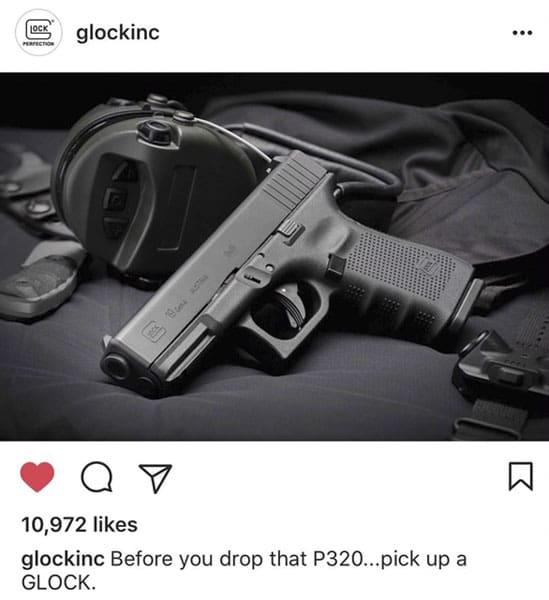
Glock also gets a well played for this post. Everyone’s a comedian.
The first big story is that the Sig P320 apparently gets a little shooty if you drop it. So shooty in fact that Sig has temporarily halted production while they sort things out. You may recall that this particular firearm (or, more specifically a very close derivative thereof) was recently chosen as the successor to the Beretta M9 for the primary sidearm of the US Army. According to Sig, the military versions do not suffer the same problems, and Sig is releasing a free ‘voluntary upgrade’ on Monday for all current P320 owners that will put the civilian models on par with the Army guns. You may also recall that yours truly happens to be one of the suckers people that bought said pistol. I actually did my own drop test on my gun and managed to drop it twice onto my back patio without it going off. I would have tested it more but it’s really not that easy to intentionally ruin a $500 gun you paid for yourself. In any case I will keep you up to date on the story as it develops.
The second big story also involves in the military, but in a more direct way. The US Army is apparently going back to it’s ex, cause it has officially released a solicitation for a 7.62 caliber battle rifle to replace the M4. They claim this is because the proliferation of modern body armor has led to the obsolescence of the 5.56mm round currently used. Now, I have never been in the military but I do know that 7.62 weighs a lot more for both the rifle and the ammo. I don’t know where or how they plan to make up the weight difference between the two loadouts, but I have a feeling they don’t either. Any of our local military experts want to weigh in on this?
Oh yeah, and then there’s this epic troll making the rounds:
Well played, asshole customer and/or employee. You win this round.
What is libertarianism’s best strategy to gain a legitimate amount of power nationally (and then happily cede it to the people)? Libertarians of the small-l and big-L varieties have sought to gain power by either co-opting one of the major political parties (See; Ron Paul Revolution that the GOP squashed) or by finding candidates to run as a Libertarian that appeal to establishment voters (see: Aleppo). But I believe there is a third, and overlooked, option: get a candidate who does some libertarian things that irritate the major parties and the deep state apparatus, and allow those actions to result in political hysterics from ultra-partisans while average Americans see no net loss from the actions and in many cases a serious net gain. I believe this will continue to set in motion a series of events where the government can be shrunk to a level that’s at least tolerable to minarchists and other run-of-the-mill libertarians.
How libertarian is President Donald Trump?
The answer is: not very. I think that’s been established. The man swam in a pool of cronyism sharks his entire professional life. He, through desire or necessity, has been a rent-seeker. He has used eminent domain to further his projects. He has sought special treatment from political entities both domestic and foreign to further his interests. The man is no altruist. But does that make him distasteful, or does it make the system in which he operated distasteful? Personally, I will rarely fault someone for utilizing the same processes his competition would use, so long as it does not originate from a position of government authority. And Trump never held office before his inauguration. In other words, he never utilized political office for financial gain by, say, orchestrating government access to foreign actors that overwhelmingly donated to your personal foundation or for trade groups and banks that hired your unqualified husband to give speeches at ridiculously over-inflated fees. In other words, I don’t hate the player, I hate the game.
And yes, Trump is allowing Jeff Sessions to wage the drug war, which is a sticking point to a lot of libertarian minds. But I ask you, is it better to wage a drug war and uphold the concepts of equal protection and the rule of law (while allowing Congress to do their job and vote to legalize drugs the right way)? Or is it better to arbitrarily enforce duly enacted laws based on the geography of a person and/or their willingness to bend a knee to the state and support legalization with a ton of unlibertarian strings attached?
The sadder these people are, the happier I get.
Some policy positives already achieved and in the works:
So now we come to Donald Trump’s libertarianism or lack thereof. The man, no doubt, will continue some of our military adventurism overseas. But he has already stopped our policy of running guns to terrorists and terrorist-sympathizers in Libya and Syria after the previous admin established those programs and destabilized an entire region, while thoroughly destroying the likelihood that a rogue regime would abandon its weapons programs and try to re-enter the international community (read: we came, we saw, he died). There has been no resurrection of the programs nthe last two administrations ran to ship guns into Mexico through the drug cartels, for different motives yet still in gross violation of Mexican sovereignty. And perhaps he will continue to not carry out targeted assassinations of American citizens that have never been charged with a crime, which the prior admin was all too happy to do in gross violation of the Fourth Amendment. Furthermore, he has already started to roll back our country’s association with liberty-robbing agreements like the Paris Climate Accord and the Trans-Pacific Partnership. Both of those agreements undercut the ability for American companies and consumers to freely negotiate what they were willing to exchange goods and services for. Removing our name from them is a step in the right direction, especially if it’s followed up with free trade agreements that haven’t existed in a century or more. That action is yet to be seen, but at least someone had the audacity to upset the globalist apple cart and stop a little bit of the insanity those agreements put us further along the path to.
Get us out of this circus, please!
As for civil liberties, Trump is still an unknown quantity. His statement about “roughing up” suspects is problematic to say the least. And I can only hope it was hollow bluster. But even so, it sets a very poor example and he should correct it immediately. Now, having said that, he has not furthered Obama’s policy of killing Americans without due process, but that’s not going to be enough. His willingness to stop going after businesses that exercise what should be a fundamental right to free association looks good so far. As do his overtures to Second Amendment causes. As does his willingness to tackle Affirmative Action and Title IX insanity. Holy crap, I just realized he’s been the best president on civil liberties we’ve had in recent memory. People that overlook the substance of these actions due to his boorishness need to reassess what their priorities are, in my opinion.
Furthermore, our business climate has benefited greatly from having an outsider installed as the head of the regulatory apparatus. Trump has already vowed, and started to carry out, a dismantling of the bureaucracies that stifle economic growth and freedom for Americans. From the onerous EPA regulations to CAFE standards being rolled back or passed to the states, there has been a serious uptick in confidence from the business and manufacturing sectors that Trump will get the government out of the way of prosperity. The hilarious irony there is that Trump was a crony his entire life, as I mentioned earlier. But perhaps he had no choice but to play the game the only way that could lead to success: do what the government tells you and push others out. Now, when given the reins, he seems to be more than willing to eliminate programs that he personally benefited from but that create barriers to entry for others. Yes, he could have opposed the system while benefiting from it. But let’s not pretend he’s some awful hypocrite because he played the hand he was dealt. Business “leaders” like Elon Musk, Mark Bezos, Mark Zuckerberg, Bill Gates, etc, etc, etc have done the same thing and so did their forefathers like Ford, Carnegie, Mellon, and others on back through the ages as long as there was a government agent with a hand in their pocket. So I’m willing to forgive that.
Be happy for this.
And lastly, he put what appears to be a strict constructionist on the Supreme Court in Neil Gorsuch. That is a marked improvement on any names mentioned by establishment candidates on either side of the aisle during the last campaign.
The other intangible positive results of a Trump presidency:
Another thing libertarians have always sought is a diminished reverence for elected officials and other “public servants” whose goals are often at odds with those of the people. Trump’s mere presence has caused probably 2/3 of the political spectrum to demand the reverence for the office be scaled back. They are now calling for more power in the hands of the states or localities and even ::gasp:: the people, on occasion. These are people that have been statists to the core. They are the Big Government democrats and NeoCon statist Republicans. And they are finally unified in an effort to diminish the role of the Executive Branch. This serves to re-establish the separation of powers that has become all-too-muddy with much of the congressional responsibilities being passed to Executive Branch agencies in an attempt to deflect responsibility and ensure easy reelection for entrenched politicians. The more responsibility that is pushed back into the laps of our directly elected officials and down to the state or local level, the better for us. It helps us create a more diverse political environment where “laboratories of democracy” are able to compete for ideas and human investment, rather than an all-powerful centralized state controlling everything. And one need look no further than minimum wage laws (since we have them, I’ll address it) to realize a top-down approach where the minimum wage “needed” in New York is imposed on small towns in New Mexico or Wyoming, where the cost of living doesn’t even come close, is a horrific idea. The Trump era is returning us to an ideal the founders embraced in that respect.
And he is returning us to another ideal the founders cherished: temporary service from business-people and non-careerist politicians. The flood of people on Trump’s coattails from all sides of the political spectrum is refreshing. Sure, many are moneyed and or celebrity candidacies. But so what? Its a step in the right direction any time we start to end political dynasties and careerists that sit in the Senate for 30 years as they grow further and further out of touch from average Americans. More turnover from political novices has a much better potential upside of shrinking our government than does further entrenching those who have pushed us to near financial ruin and reduced individual liberty.
Pucker up!
The net result so far (in my opinion):
So let us all embrace the non-libertarian president. For one of these reasons or for another I might have missed. But embrace it nonetheless, because it has already borne libertarian fruit, and I suspect it will continue to do so for many of the right and some of the wrong reasons. Its the best we could have hoped for and probably the most libertarian moment in America for a hundred years.
In extremely unexpected good news, DC has now become shall issue! I can’t wait to shoot people from the top of the Washington Monument!
An in depth, detailed analysis of why the military Top Men have their heads up their asses, part 1 and part 2.
Finally, is this the most retarded gun themed product ever invented? We report, you deride.
https://www.youtube.com/watch?v=DPWuyP5AwTk
So, just a couple of random additions from me. First, I was talking with someone in the comments about 5.7 x 28 for home defense and they mentioned that they liked the cartridge but were not a fan of the PS90. Well fret not, ladies and gentlemen, for I have not 1 but 2 solutions to your troubles. The first comes to us from the ironically named Masterpiece Arms. Their ubiquitous brick on a 2×4 mac 10 clones are now chambered in 5.7 and available as a pistol and as a carbine. I am told that despite their looks they are excellent performers. The second option is by far the more attractive one. A company called AR57 manufactures 16″ and 12″ AR uppers chambered in 5.7 that use PS90 magazines and eject out the magwell, not unlike the PS90 itself. If you’re looking for a 5.7 slinger with more traditional features and layout, you’d be hard pressed to do better.
The other thing I want to touch on is concealed carry. I have avoided talking about ‘the best guns EVAR for concealed carry!’ because for one it has been beaten into a bloody paste by every gun blog, website, and magazine that has ever existed, and secondly because everyone is different and the gun I recommend for you probably isn’t going to work. Also, I have been open carrying for several years now and if it’s feasible in your area I recommend you give that a try. For one, it stops the fight before it starts. No criminal with even a hint of situational awareness is going to pick a fight with an obviously armed person (although it does happen occasionally). Secondly, it’s a nice conversation starter and a very simple, passive way to assert your rights in an obvious but non invasive manner. Granted, I live in the wild west where we all walk around in our Stetsons and spurred boots with six shooters on, so YMMV.
With that out of the way, here are my suggestions for getting into concealed carry. First, expect to change your carry gun several times throughout your life until you figure out what works. I think I have gone through close to a dozen EDC guns in the last 8 years. The nice thing about guns is that they hold their value very well, so if you do choose to sell yours you should get very close to what you paid for it if you didn’t get hosed on the initial purchase. Second, expect to purchase about 3 holsters for every gun you buy. Yes, three. Holsters are like shoes, no holster will fit the two people the same, and the holster that one guy loves the next guy will hate. The holster that I finally decided on for concealed carry is from N8 squared tactical. They are affordable and well made and fit a variety of pistols.
What I have noticed and experienced myself is that people go through phases with concealed carry. The first phase is what I call the big gun phase. This is where people try to conceal a full sized pistol as their EDC. They do this until basically they get sick of the weight and the pain of having a huge chunk of steel up their ass all day. Then they go into the tiny gun phase, where they buy the smallest little mouse gun they can slip into their speedo. This is great for actually carrying the thing, but then they go to shoot it and realize that mouse guns are tiny, weak, difficult to aim, painful to shoot, and not 100% reliable. At this point their gun size fluctuates up and down a few more times til they find the perfect sized gun, which is usually a single stack 9 or a compact/subcompact of their choice. This process is going to be different for everyone, so be prepared to buy and sell quite a few pistols until you get the one you like. I am loathe to recommend a cc pistol, but if you put a gun to my head and forced to recommend one… well I would probably shoot you for doing that, but if I was being nice I would recommend a single stack 9mm. The two that immediately spring to mind are the M&p9 Shield and the XD-S. I own an XD-S, and other than its mediocre trigger I have zero complaints. My final recommendation is to carry the biggest gun (size wise, not caliber) you can comfortably conceal. For me that is my Sig P320 carry, which is not really a CC sized gun (roughly Glock 19 size). If I have to go deep concealment I will switch to my XDs in a pocket holster. Big guns are easier to shoot, hold more ammo, are more reliable, and actually hit what you aim for. Notice that all of those actually matter if you have to pull the gun, whereas comfort while carrying doesn’t mean shit if you’re dead.
Another week, another gun article. I’m actually impressed I have been able to keep this going for this long. I figured my ADHD and laziness would have teamed up to stop me from writing these weeks ago, yet here I am. Lucky you. This week’s topic was inspired by a brief conversation I had on our discord server. If you haven’t heard, we have a little chat room setup where you can talk to other weirdos glibs live. Here is the link if you’re interested. Anyway, a few days ago someone said to me that they would be into shooting except it is too expensive. This took me aback, because while it’s true that this sport is not exactly free, there has never been a better time to get into shooting on a budget than right now. You see, just like most of us, gun dealers and manufacturers were also expecting a Hillary coronation. As a result, dealers were buying up as much free stock as possible and manufacturers went into overdrive cranking out inventory in anticipation of the post election panic buying. When Sir Donald the Orange had his little bloodless coup it threw everyone on the gun side for a loop. Instead of surging demand and sky high prices, gun sales leveled off. This means there is a massive overstock and companies are slashing prices and offering big rebates just to move product. I have been serious into shooting for almost a decade and I can tell you I have NEVER seen gun prices this insanely low before. It really is a buyers market, IF you know where to look.
See, something I have learned about gun dealers is that in many ways they are somewhat worse than used car salesmen. When you go buy a specific brand of anything… shoes, cars, clothing, food, etc., the price is, for the most part, set. You might find one store that has it for 10, maybe 20% less, and on a blue moon you can find some really killer deals, but in general the price is stable. When it comes to guns, however, there is no such stability. I have literally found the exact same gun, in the same color, at two different stands in the same gun show with a $200, $300, even $400 price difference. Whats worse is that, unlike with most other products, the big brand name stores usually rip you off worse than the smaller mom and pop outfits. The reason I believe this happens is because much of the gun buying public is ignorant of the actual market value of the guns they purchase, which allow dealers to wallow in the profit margins. The other driving force behind this is the mistaken belief many people have that you cannot buy guns online. You absolutely can buy a gun online, you just can’t have it shipped directly to you. You must first find a registered dealer willing to accept online transfers. Most of them charge a fee for this. The fees range wildly from shop to shop and region to region. My current FFL of choice charges $20, but I have seen them as low at $10 and as high as $100+. Once you find a willing shop, you must purchase the gun online and have your shop send the seller a copy of their FFL. Once that happens they will ship the gun to your dealer, who can then run the required background check before handing over to you. It’s usually a rather painless process and it saves a ton of money.
So, how low are prices right now? What if I told you that you could have a reliable, modern handgun for $250? How about a working AR 15 for $400? Even a decent pump shotgun can be had for as little as $200. It’s all about where you look. There are 2 sites that I use to find good prices on guns. The first one is gun.deals, formerly slickguns.com. This is where I go if I just want to browse and see what guns are out there and for what prices. This is a site that accepts user submissions for good deals on guns and then lets people vote and comment on the deal. I would say the majority of my gun purchases originate from gun.deals. It doesn’t just list guns, either. Ammo, mags, accessories… pretty much everything gun related is on this site. You can sort by caliber or seach by keyword as well. Now, if you know what gun you want and you simply want to find the best price on it, then I recommend gunwatcher. Gunwatcher lets you type in the name of the gun and it will search hundreds of websites to find the best price. Like trivago, but with fewer Brad Pitt look alike pitchmen.
So, what are my personal recommendations for good cheap guns? I thought you’d never ask! This is by far not a comprehensive list, but it is a good place to start if you’re on a budget and want some firepower. For handguns, my recommendation hands down has to be the EAA SAR K2P 9mm. This is a Turkish made polymer CZ clone. It holds 17 rounds and takes standard CZ 75 magazines which are almost as ubiquitous as Glock mags. Right now you can get one for about $270 shipped, which means you should be able to get it out the door for under $300 at your local gun store. My recommendation for a good cheap rifle is a bit more complicated. AR 15s are at rock bottom prices now, but the problem is that a lot of no name companies are just slapping a bunch of parts kits together and throwing them out the door. I highly recommend checking gun.deals for the latest sales, but just skimming it right now I can see a few good ones pop up. If you absolutely have to have the cheapest thing you can get, here’s an ATI polymer lower with a keymod rail for $350. This has a polymer upper and lower which I am not a big fan of, but they get the job done and you really can’t complain about the price. The free float handguard is a nice touch too. If you want something all metal and brand name there is this Smith & Wesson M&P for $450, or this Bear Creek AR for $400, either of which would make an excellent first rifle. One of my personal favorites is this Radical Firearms AR with a free float rail for $450. I have used Radical ARs before and they are an excellent value. Finally, we come to shotguns. If you are simply looking for a good cheap gun for home defense, nothing beats a pump action 12 gauge. My personal pick is the Hawk 982. It is a Chinese copy of the venerable Remington 870 and it is actually better than the new 870s coming out of Remington right now. There are a lot of inexpensive shotguns out there so do your homework and see what you can find. That’s pretty much it. Sorry for the lack of pics this week. I’m actually writing this at my job so I gotta keep it low key.
Yeah, I don’t have a whole lot to cover this week either. I still haven’t gotten to try my new gun (although with any luck I will have by the time you read this) so I can’t talk much about that, and nothing particularly noteworthy has popped up this week that I can devote a whole topic to, so I’ll be doing more firearms links. At least these one’s are actually worth talking about.
Okay, which one of you idea stealing fuckers set this website up? I thought we had a deal!
better than the last time there were German rifles walking around Paris.
I want to talk quickly about a serious topic for a bit. There have been some high profile cases lately in which police officers have shot suspects under less than justifiable conditions and ended up found not guilty after a trial. The two that most readily spring to mind are Philandro Castile and Terrence Crutcher. My personal opinion is that both of these shooting were not justifiable, and while they may not constitute outright murder I would not hesitate to label these as involuntary manslaughter. The thread tying these two cases together is that both of the victims were either high or at least regular drug users (Crutcher tested positive for PCP while Castile tested positive for THC). A very disturbing trend I have noticed on my gun blogs (which in general run on the conservative side) are that these people somehow deserved their fate because they were drug users and therefore criminals. I get very bent out of shape when I hear people suggest that using drugs somehow justifies being murdered by a police officer because you violated a minor traffic law. It’s particularly maddening when very pro gun people, nearly all of whom carry a concealed handgun everyday, justify Castile’s shooting on the basis of ‘well he’s a drug user then by definition he’s not a legal concealed license holder’. And yes I have heard these actual arguments out of gun owners. It’s really put me off from the usual gun blogs as of late. I don’t have an answer to these problems, but it really sobers you up on the reality of traditional conservatives opening up their views on drug decriminalization.
Originally I was going to post about my experience shooting my new Mossberg Shockwave that I got this week. Unfortunately, after buying $200 worth of ammo and driving 30 minutes out into the desert I find out that it’s closed to target shooters due to extreme fire hazard. I guess all those taxes I pay don’t actually mean they go and put the fires out. Not that I’m bitter or anything. Then I thought I would celebrate Independence day and make a post about the guns of the American Revolution. It turns out that’s actually a pretty boring topic overall, with one notable exception I’ll mention below. So, I’m phoning it in this week with a hodgepodge of random gun tidbits. Think of it like the evening links, but gun themed. ZARDOZ would be proud.
The new Tavor 7. Fuck to the Yes!
The Hearing Protection Act is back! This time it’s called the SHUSH Act. That’s an acronym for Silencers Helping Us Save Hearing. I swear to god I picked the wrong line of work. No idea on the odds of this passing, but I sure hope it goes somewhere.
IWI announced they will be producing my favorite gun in 308. The new Tavor 7 will be 100% user reversible from right to left handed and be almost entirely ambidextrous. If this thing comes in at or below $2000 they are going to sell like ice water in hell.
Apparently the American Revolution was the birthplace of military sniping. Using Kentucky Long Rifles, American soldiers were able to pick off British officers from the treeline while the redcoats strutted around the open fields on horseback. There’s even one story of a particularly gifted individual making a kill shot from 400 yards, which quite frankly I would be hard pressed to do with a modern gun.
Speaking of snipers, no matter how tough you are, you aren’t as tough as this chick. I know I would have needed a new pair of depends after that.
One final thing I wanted to mention before I go. Someone mentioned this in the comments yesterday so I thought I would take a few minutes to tell you about the can cannon. It is an AR 15 upper receiver that attaches to any milspec lower and fires blanks. What good is a blank firing upper? By itself, it’s fucking useless. The can cannon, however, is designed to accept standard 12 ounce soda cans. It can launch these cans a phenomenal distance and they explode quite spectacularly at the end. It isn’t limited to cans, though. Tennis balls, apples, and just about anything you can cram into the sucker will launch when fired. They even make grappling hooks that load into the can cannon, for all your 80s ninja/mission impossible fantasies. Here’s a little demonstration video.
While these things look fun, they aren’t cheap. Right now they’re damn near $400 for the regular upper and almost $550 for the XL version. That’s a lot of scratch. I have some good news, though. If you want the fun of the can cannon but don’t have that kind of scratch, NCstar has you covered. For a mere $25 on Amazon you can pick up your very own golf ball launcher. This puppy will thread onto your AR barrel (or any barrel that uses AR threads) and let you drive those balls farther than Tiger Woods from 10 years ago. Just like with the can cannon, you can stuff whatever you want in there and see if it launches, but I would be a little more careful with this version. For one, there’s nothing stopping you from loading a live round instead of a blank, and that could cause some serious damage depending on what you have lodged in the launcher. The other issue is if something goes wrong and the gas can’t escape from the launcher it’s probably going to split your barrel, which will almost certainly wreck your day. Still, for 25 bucks you really can’t beat it, and in theory you can use it on any gun you want, not just ARs.
When you first think about it, you probably wonder why you would ever want to take a gun into space. After you think about it a little more, though, you probably wonder why you would ever not want to take a gun into space. Thousands of miles from everywhere, in a hostile environment, with no chance of escape or rescue… sounds like exactly the kind of situation to require some ballistic backup. Whether you need to un-stick a broken escape hatch or simply quell an interplanetary mutiny, a gun is a must have for any space faring humanoid. Okay, in all seriousness, some astronaut crews did take a gun into space, at least for a period of time. They weren’t designed for use during the trip, however. Well, most of them weren’t, anyway. They were for use afterwards. The thinking was that if a capsule went way off course and landed in the middle of bumfuck nowhere the ‘nauts would have a survival weapon they could use to defend from predators and forage for food until the cavalry arrived.
The Makarov. Great against spies and dissident. Useless against bears.
Shockingly, the Americans are actually not the most tooled up group of people outside of the atmosphere. I can find no record of NASA issuing or allowing any sort of guns on shuttle missions or the space station. There is a possibility that at one point they were equipped with M6 survival rifles or even Beretta 9mm pistols, but I can’t find any definitive proof of it so your guess is as good as mine. The Russians, on the other hand might as well open up a branch of the NRA on the moon, cause as far as I can tell every fucking manned spaceflight they went on had a gun on board. Originally they started out with Makarov pistols. These reliable little handguns carry 8 rounds of 9×18 (similar to .380) in a very compact package. This went on for a few years, until a mission went a bit off. One of the capsules missed it’s landing area by about 600 miles and ended up in the middle of Siberia. I don’t know if you’ve ever been to Siberia, but it’s a bit like Australia or Florida, in that everything wants to kill you. Unlike Australia or Florida, however, most of those things would laugh at you for pointing a 9mm pistol at it before mauling you and eating your steaming intestines like spaghetti while you were still alive and screaming. Thankfully, the cosmonauts survived, and one of them, Alexey Leonov, apparently developed a lasting impression of that particular feeling of terror since he mandated that a new survival weapon be developed for the space program after becoming a major general.
TP-82, with ammo and buttstock/machete.
Thus was born the first gun designed to go to space: The TP-82. I will give the commies credit, when they design a rifle they really go all out. The TP-82 is a triple barrel short barreled shotgun/rifle combo. The top two barrels are 12.5x70mm shotgun bore (roughly 38 gauge), while the bottom center barrel is chambered in 5.45×39, the common caliber of the AK 74 assault rifle. The gun has a detachable stock that doubles as a machete (no I don’t know how they fired it without cutting their arms off either) and came with birdshot, rifle rounds, and signal flares. This gun flew with all of the cosmonauts from 1986 until 2007, and even made it into the space station according to rumors. In 2007, Russia announced that there was no more shotgun ammo for the gun and no more could be produced, and the weapon was officially retired, with the cosmonauts returning to a standard semi automatic handgun. Let’s hope their search and rescue response times have gotten better.
An actual, honest to god, laser gun. Holy. Shit.
Don’t think for a second that all space weaponry was for boring old hunting and survival, though. It turns out that the reds are much more ambitious than we like to admit, because these sons of bitches went full fucking Moonraker on us and actually developed and fielded laser pistols. That’s right. Laser. Fricken. Pistols. Take THAT, John Browning! They were magazine fed and used flashbulb technology. Their reported function was to disable enemy spy satellites, but it is said that they could burn through a helmet or fry someone’s eyeballs at 60 feet. Whether or not this is actually true or a load of crap is anyone’s guess, but hats off to them for bringing energy weapons into reality.
The R-23 autocannon used on the Salyut space station.
So, what could top directed energy weapons in space? Oh I don’t know… how about an armed satellite? In the 1970s, the Soviets developed the Almaz program, which launched 3 manned reconnaissance satellites into orbit. These satellites were supposed to monitor comms traffic and do orbital imaging, but don’t think they were just for show either. Each one was fitted with a 23mm belt fed autocannon capable of 2000 rounds a minute. Of course, they didn’t carry very much ammo, but then again it doesn’t take much damage to really wreck your day in space. While they never actually attacked anything (there’s no record of it, anyway) they did successfully remotely test fire the weapon on multiple occasions.
All of this research has led me to one inescapable conclusion: The Russians will eventually own space and become fearsome interplanetary pirates, while our hopeless and disarmed astronauts fall victim to their merciless supply raids and wanton destruction. If only we hadn’t elected Trump…..