In extremely unexpected good news, DC has now become shall issue! I can’t wait to shoot people from the top of the Washington Monument!
An in depth, detailed analysis of why the military Top Men have their heads up their asses, part 1 and part 2.
Finally, is this the most retarded gun themed product ever invented? We report, you deride.
https://www.youtube.com/watch?v=DPWuyP5AwTk
So, just a couple of random additions from me. First, I was talking with someone in the comments about 5.7 x 28 for home defense and they mentioned that they liked the cartridge but were not a fan of the PS90. Well fret not, ladies and gentlemen, for I have not 1 but 2 solutions to your troubles. The first comes to us from the ironically named Masterpiece Arms. Their ubiquitous brick on a 2×4 mac 10 clones are now chambered in 5.7 and available as a pistol and as a carbine. I am told that despite their looks they are excellent performers. The second option is by far the more attractive one. A company called AR57 manufactures 16″ and 12″ AR uppers chambered in 5.7 that use PS90 magazines and eject out the magwell, not unlike the PS90 itself. If you’re looking for a 5.7 slinger with more traditional features and layout, you’d be hard pressed to do better.
The other thing I want to touch on is concealed carry. I have avoided talking about ‘the best guns EVAR for concealed carry!’ because for one it has been beaten into a bloody paste by every gun blog, website, and magazine that has ever existed, and secondly because everyone is different and the gun I recommend for you probably isn’t going to work. Also, I have been open carrying for several years now and if it’s feasible in your area I recommend you give that a try. For one, it stops the fight before it starts. No criminal with even a hint of situational awareness is going to pick a fight with an obviously armed person (although it does happen occasionally). Secondly, it’s a nice conversation starter and a very simple, passive way to assert your rights in an obvious but non invasive manner. Granted, I live in the wild west where we all walk around in our Stetsons and spurred boots with six shooters on, so YMMV.
With that out of the way, here are my suggestions for getting into concealed carry. First, expect to change your carry gun several times throughout your life until you figure out what works. I think I have gone through close to a dozen EDC guns in the last 8 years. The nice thing about guns is that they hold their value very well, so if you do choose to sell yours you should get very close to what you paid for it if you didn’t get hosed on the initial purchase. Second, expect to purchase about 3 holsters for every gun you buy. Yes, three. Holsters are like shoes, no holster will fit the two people the same, and the holster that one guy loves the next guy will hate. The holster that I finally decided on for concealed carry is from N8 squared tactical. They are affordable and well made and fit a variety of pistols.
What I have noticed and experienced myself is that people go through phases with concealed carry. The first phase is what I call the big gun phase. This is where people try to conceal a full sized pistol as their EDC. They do this until basically they get sick of the weight and the pain of having a huge chunk of steel up their ass all day. Then they go into the tiny gun phase, where they buy the smallest little mouse gun they can slip into their speedo. This is great for actually carrying the thing, but then they go to shoot it and realize that mouse guns are tiny, weak, difficult to aim, painful to shoot, and not 100% reliable. At this point their gun size fluctuates up and down a few more times til they find the perfect sized gun, which is usually a single stack 9 or a compact/subcompact of their choice. This process is going to be different for everyone, so be prepared to buy and sell quite a few pistols until you get the one you like. I am loathe to recommend a cc pistol, but if you put a gun to my head and forced to recommend one… well I would probably shoot you for doing that, but if I was being nice I would recommend a single stack 9mm. The two that immediately spring to mind are the M&p9 Shield and the XD-S. I own an XD-S, and other than its mediocre trigger I have zero complaints. My final recommendation is to carry the biggest gun (size wise, not caliber) you can comfortably conceal. For me that is my Sig P320 carry, which is not really a CC sized gun (roughly Glock 19 size). If I have to go deep concealment I will switch to my XDs in a pocket holster. Big guns are easier to shoot, hold more ammo, are more reliable, and actually hit what you aim for. Notice that all of those actually matter if you have to pull the gun, whereas comfort while carrying doesn’t mean shit if you’re dead.
Another week, another gun article. I’m actually impressed I have been able to keep this going for this long. I figured my ADHD and laziness would have teamed up to stop me from writing these weeks ago, yet here I am. Lucky you. This week’s topic was inspired by a brief conversation I had on our discord server. If you haven’t heard, we have a little chat room setup where you can talk to other weirdos glibs live. Here is the link if you’re interested. Anyway, a few days ago someone said to me that they would be into shooting except it is too expensive. This took me aback, because while it’s true that this sport is not exactly free, there has never been a better time to get into shooting on a budget than right now. You see, just like most of us, gun dealers and manufacturers were also expecting a Hillary coronation. As a result, dealers were buying up as much free stock as possible and manufacturers went into overdrive cranking out inventory in anticipation of the post election panic buying. When Sir Donald the Orange had his little bloodless coup it threw everyone on the gun side for a loop. Instead of surging demand and sky high prices, gun sales leveled off. This means there is a massive overstock and companies are slashing prices and offering big rebates just to move product. I have been serious into shooting for almost a decade and I can tell you I have NEVER seen gun prices this insanely low before. It really is a buyers market, IF you know where to look.
See, something I have learned about gun dealers is that in many ways they are somewhat worse than used car salesmen. When you go buy a specific brand of anything… shoes, cars, clothing, food, etc., the price is, for the most part, set. You might find one store that has it for 10, maybe 20% less, and on a blue moon you can find some really killer deals, but in general the price is stable. When it comes to guns, however, there is no such stability. I have literally found the exact same gun, in the same color, at two different stands in the same gun show with a $200, $300, even $400 price difference. Whats worse is that, unlike with most other products, the big brand name stores usually rip you off worse than the smaller mom and pop outfits. The reason I believe this happens is because much of the gun buying public is ignorant of the actual market value of the guns they purchase, which allow dealers to wallow in the profit margins. The other driving force behind this is the mistaken belief many people have that you cannot buy guns online. You absolutely can buy a gun online, you just can’t have it shipped directly to you. You must first find a registered dealer willing to accept online transfers. Most of them charge a fee for this. The fees range wildly from shop to shop and region to region. My current FFL of choice charges $20, but I have seen them as low at $10 and as high as $100+. Once you find a willing shop, you must purchase the gun online and have your shop send the seller a copy of their FFL. Once that happens they will ship the gun to your dealer, who can then run the required background check before handing over to you. It’s usually a rather painless process and it saves a ton of money.
So, how low are prices right now? What if I told you that you could have a reliable, modern handgun for $250? How about a working AR 15 for $400? Even a decent pump shotgun can be had for as little as $200. It’s all about where you look. There are 2 sites that I use to find good prices on guns. The first one is gun.deals, formerly slickguns.com. This is where I go if I just want to browse and see what guns are out there and for what prices. This is a site that accepts user submissions for good deals on guns and then lets people vote and comment on the deal. I would say the majority of my gun purchases originate from gun.deals. It doesn’t just list guns, either. Ammo, mags, accessories… pretty much everything gun related is on this site. You can sort by caliber or seach by keyword as well. Now, if you know what gun you want and you simply want to find the best price on it, then I recommend gunwatcher. Gunwatcher lets you type in the name of the gun and it will search hundreds of websites to find the best price. Like trivago, but with fewer Brad Pitt look alike pitchmen.
So, what are my personal recommendations for good cheap guns? I thought you’d never ask! This is by far not a comprehensive list, but it is a good place to start if you’re on a budget and want some firepower. For handguns, my recommendation hands down has to be the EAA SAR K2P 9mm. This is a Turkish made polymer CZ clone. It holds 17 rounds and takes standard CZ 75 magazines which are almost as ubiquitous as Glock mags. Right now you can get one for about $270 shipped, which means you should be able to get it out the door for under $300 at your local gun store. My recommendation for a good cheap rifle is a bit more complicated. AR 15s are at rock bottom prices now, but the problem is that a lot of no name companies are just slapping a bunch of parts kits together and throwing them out the door. I highly recommend checking gun.deals for the latest sales, but just skimming it right now I can see a few good ones pop up. If you absolutely have to have the cheapest thing you can get, here’s an ATI polymer lower with a keymod rail for $350. This has a polymer upper and lower which I am not a big fan of, but they get the job done and you really can’t complain about the price. The free float handguard is a nice touch too. If you want something all metal and brand name there is this Smith & Wesson M&P for $450, or this Bear Creek AR for $400, either of which would make an excellent first rifle. One of my personal favorites is this Radical Firearms AR with a free float rail for $450. I have used Radical ARs before and they are an excellent value. Finally, we come to shotguns. If you are simply looking for a good cheap gun for home defense, nothing beats a pump action 12 gauge. My personal pick is the Hawk 982. It is a Chinese copy of the venerable Remington 870 and it is actually better than the new 870s coming out of Remington right now. There are a lot of inexpensive shotguns out there so do your homework and see what you can find. That’s pretty much it. Sorry for the lack of pics this week. I’m actually writing this at my job so I gotta keep it low key.
Product description: From the Manufacturer The woman traveler stops by the security checkpoint. After placing her luggage on the screening machine, the airport employee checks her baggage. The traveler hands her spare change and watch to the security guard and proceeds through the metal detector. With no time to spare, she picks up her luggage and hurries to board her flight!
$254 on Amazon, yet sadly not available for international shipping.
Originally I was going to post about my experience shooting my new Mossberg Shockwave that I got this week. Unfortunately, after buying $200 worth of ammo and driving 30 minutes out into the desert I find out that it’s closed to target shooters due to extreme fire hazard. I guess all those taxes I pay don’t actually mean they go and put the fires out. Not that I’m bitter or anything. Then I thought I would celebrate Independence day and make a post about the guns of the American Revolution. It turns out that’s actually a pretty boring topic overall, with one notable exception I’ll mention below. So, I’m phoning it in this week with a hodgepodge of random gun tidbits. Think of it like the evening links, but gun themed. ZARDOZ would be proud.
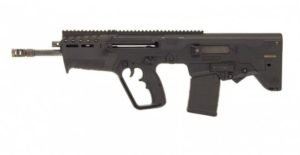
The new Tavor 7. Fuck to the Yes!
The Hearing Protection Act is back! This time it’s called the SHUSH Act. That’s an acronym for Silencers Helping Us Save Hearing. I swear to god I picked the wrong line of work. No idea on the odds of this passing, but I sure hope it goes somewhere.
IWI announced they will be producing my favorite gun in 308. The new Tavor 7 will be 100% user reversible from right to left handed and be almost entirely ambidextrous. If this thing comes in at or below $2000 they are going to sell like ice water in hell.
Apparently the American Revolution was the birthplace of military sniping. Using Kentucky Long Rifles, American soldiers were able to pick off British officers from the treeline while the redcoats strutted around the open fields on horseback. There’s even one story of a particularly gifted individual making a kill shot from 400 yards, which quite frankly I would be hard pressed to do with a modern gun.
Speaking of snipers, no matter how tough you are, you aren’t as tough as this chick. I know I would have needed a new pair of depends after that.
One final thing I wanted to mention before I go. Someone mentioned this in the comments yesterday so I thought I would take a few minutes to tell you about the can cannon. It is an AR 15 upper receiver that attaches to any milspec lower and fires blanks. What good is a blank firing upper? By itself, it’s fucking useless. The can cannon, however, is designed to accept standard 12 ounce soda cans. It can launch these cans a phenomenal distance and they explode quite spectacularly at the end. It isn’t limited to cans, though. Tennis balls, apples, and just about anything you can cram into the sucker will launch when fired. They even make grappling hooks that load into the can cannon, for all your 80s ninja/mission impossible fantasies. Here’s a little demonstration video.
While these things look fun, they aren’t cheap. Right now they’re damn near $400 for the regular upper and almost $550 for the XL version. That’s a lot of scratch. I have some good news, though. If you want the fun of the can cannon but don’t have that kind of scratch, NCstar has you covered. For a mere $25 on Amazon you can pick up your very own golf ball launcher. This puppy will thread onto your AR barrel (or any barrel that uses AR threads) and let you drive those balls farther than Tiger Woods from 10 years ago. Just like with the can cannon, you can stuff whatever you want in there and see if it launches, but I would be a little more careful with this version. For one, there’s nothing stopping you from loading a live round instead of a blank, and that could cause some serious damage depending on what you have lodged in the launcher. The other issue is if something goes wrong and the gas can’t escape from the launcher it’s probably going to split your barrel, which will almost certainly wreck your day. Still, for 25 bucks you really can’t beat it, and in theory you can use it on any gun you want, not just ARs.
The book is done. The art is done. Thanks to help from the Glibertariat, the blurb is done. Now I come to the hardest part of writing – selling. In the spirit of free enterprise, this article is nothing more than an exhortation to read my books and tell other people to do the same. I’m not going to sneak around and pretend to be saying anything else, so let’s get that out there right from the start.
The history in the real world:
Comic books are strange places. You have aliens, magic, psychics and completely unexplained superpowers running amok alongside superscience and fantastical creatures. Sometimes they get silly, sometimes they get serious, but oh the tales you can tell. As someone who likes the art of storytelling, there was an appeal to the possibilities presented.
Back before 2012, I had started work on a science fiction piece which drew deliberate inspiration from the superhero genre. With it I was trying to skirt the edges of the conventions, trying to not sink too deeply into them. This book had a working title of ‘Three of Swords’ and only got to about half-done before it stalled so badly I had to storm away. On May 8th I began working on a less dark tale that fully embraced the conventions of the genre. I spent every evening and weekend writing, as I kept up my day job full-time. By June 8th, I’d churned out over a hundred thousand words and had a completed draft of ‘Shadowboy’. I had no plan going into the book, indeed, I wasn’t sure I was even going to finish it. But I had a complete novel. It then sat on a thumb drive.
Sometime around this time I was also trying to sell works to a publishing house in the UK. So I made two trips to attend conventions they were hosting. At the second convention, I got to attend a dinner with authors currently published by the company. Most of the discussions, while fascinating, are not relevant to this ramble. But one thread was. William King spoke about the changes he’d seen over the years in the publishing industry. He went into how even a reliable, established name like him had trouble convincing places to take his work because the big houses had started looking only for blockbusters. Anyone who didn’t reliably turn out blockbusters was quietly sidelined. Since he could still reliably move books, he had taken to independent publishing. Now, prior to this discussion, independent publishing still had the stigma of the old vanity press in my mind. If no one remembers vanity presses, they were companies who would print editions of works for a fee regardless of the quality and then the author could try to hawk them. Usually, it meant the work was crap because the publishing house standard was not “is this a blockbuster” but “will this sell enough to be worth the cost”.
But technology and the shift in the traditional publishing houses had changed that. In chasing the blockbuster, the old guard was ignoring a great many otherwise worthwhile works. With eBooks and print on demand technology, these authors could still get their books to market, without the overhead of the old methodology. So, I went down this road. It did mean I had to find an editor and cover artist and foot the bill for their services out of my own pocket. But I did so for ‘Shadowboy’. That book had some pains, as I needed to expunge the typographical errors from the text, and even with two editors having picked over it, I still get the nagging feeling I missed some. You’ve seen me type, I’m lousy at it.
The first book
But apparently, I spin a good yarn as even people I didn’t badger into reading the book were bugging me for a sequel.
I started on ‘Gruefield’ immediately after having finished the draft of ‘Shadowboy’. It took a year to finish and got a name change to ‘Shadowdemon’ along the way. I made a big mistake in storytelling, as my focus in the story was inside the narrator’s head. The tale I thought I was telling was about Travis’ character, and I treated the day to day hero work as things that were happening while the story was going on. I should have made a greater effort to at least echo some of what was going on inside Travis’ head, along with more adequately covering the All-Star Elementals. Most only got Cameos despite the entire separate story circling them. Perhaps I can revisit their tale in a future spin-off.
That’s when Travis’ tale hit a snag. I had too many contradictory ideas for tales to tell, and being contradictory meant Travis couldn’t follow them all. I also had ideas for yarns not involving Travis. So while I tried to put together a third book, I was also writing a mess of other works of varying lengths. It was a good way to use ideas that didn’t fit for Travis. So while content piled up for an anthology, I struggled to get the third book together. I tried to tell Doctor Rudra’s tale of revenge, but it didn’t work. I couldn’t get my head around the plan or the sequence of events it would unfold. So, I set that aside and started another. ‘Dirge of Carcosa’ was supposed to be book three, and I sliced out pieces from the previous draft to add to it. But the tale ran its course, and I ran out of ideas to continue it around novella length. It ended up as the tail end of the Anthology instead. ‘Lucid Blue (and Other Tales Too)’ was not intended to be book three, but Amazon doesn’t like fractional volume numbers, and it worked better tied to the other books. Besides, ‘Lucid Blue’ itself is more than forty thousand words, which is novel length by some metrics.
The quick turnaround sequel
So I went back to the drawing board again, trying to write ‘Book Three’ even though a third volume was already on the shelves. I took those pieces from Doctor Rudra’s tale that were not in ‘Dirge of Carcosa’ and reworked them with a new thread. I so wanted to have it out in 2016, but it was less than half done when the value of $CURRENT_YEAR changed. For the longest time it didn’t have even a working title, but eventually gained the moniker of ‘Shadowrealm’. As a story, I decided to make ‘Shadowrealm’ more streamlined, reducing the proliferation of side plots that had made ‘Shadowdemon’ a bit of a slog to write. The downside of downsizing the number of plots was that I couldn’t just start updating a different one when I needed to think on the current plot’s progress. But in the end, I think the book is better for it.
The history in the fake world:
Magic and the number of people with unusual powers has waxed and waned over the millennia. In some periods, both are scarce, and reports of previous centuries are dismissed as superstitious claptrap. In others their commonality increases so that people once again believe. In the dawn of the modern age, there was a rare confluence of both rapid technological advance and a resurgence of powers. Some who had remarkable ability decided to exploit it for their personal gain. Others concluded that the best way to stop the first was for similarly powered people to step up and intervene. In the mid nineteen thirties, a band of these vigilantes founded a mutual aid society for helping out their fellows who were not as solvent after the expenses of fighting crime. The Community Fund largely acted as an insurance company and resource pool.
Initially, the Fund placed no rules on the membership beyond those of society at large. So long as they weren’t criminals, members could approach problems in whatever manner they saw fit. The use of lethal force was not expressly prohibited, though some chose to refrain from personal moral decisions. This was the Golden Age of the community. Members could and did operate under their own names, and the term ‘Hero’ got draped upon them like a mantle. When war broke out, many were quick to volunteer to fight the Axis powers. A “powers arms race” sparked renewed research into the source of these abilities, and new methods of uncovering people with latent abilities. Every one was needed to counteract the advances made by the other side. In the end, it was conventional arms in Europe and nuclear arms in Asia that ended the war.
With so many returning Heroes bolstering the ranks of the Community Fund’s membership, the Federal Government became concerned about their potential as a seditious force. As such, congressional hearings into the activities of the Community Fund began, ostensibly to root out Communists from among their ranks. The Golden Age was over.
A wider look around the world
In the midst of the hearings, First Contact was made. It was not the first time nonhuman intelligences had visited the Earth, but it was the first recorded, open contact. The Scyan Theocracy existed to spread the faith to the unenlightened of the galaxy. Fortunately, the tenets of their faith required an open and honest embrace by the convert. Force could not be used as this did not save the heathen and sullied the souls of the Scya who’d done it. Thus they came to preach. Their arrival sparked a crisis of faith among many, and cults proliferated. Few were in any way tied to the alien religion, but the number of such groups was massive. Needing to deal with Communists, Cultists and Alien threats, Congress decided that killing the Community Fund would not be the best move. So they regulated it, and legislated the Bureau of Hero Affairs into existence. As an appeasement, the Community Fund issued its first code of conduct, with Rule One being a prohibition on the use of lethal force.
The BHA took over the licensure and insurance of Heroes, under the pretext that there should not be a private monopoly on the matter. The Community refocused on helping with the Cults, Communists and Creatures of Extraterrestrial Origin, gliding into it’s Silver Age. Flamboyant and outrageous gimmicks became common among criminals. Sometimes edging into the absurd, and it became almost a non-issue to see young trainees in the field against such almost comical criminals. The sidekick became a semi-permanent fixture, with the apprenticeship proving useful for their later careers. This Silver Age died when the friends and families of licensed heroes stopped being out of bounds for criminals. A new defense was required – anonymity. Nicknames became codenames, and real names disappeared from the public discourse. A few had no choice but to retire, unable to put on a mask, and afraid for the safety of their loved ones.
Darkness crept in as the colorful criminals of the Silver Age were captured or disappeared, and a more brutal set replaced them. There were some who agitated for a removal of the prohibition on lethal force, as their opponents grew ever more brutal. The worst of it subsided as the new millennium dawned, but there were few who would dare operate openly under their real names. Continuing it’s own scope creep, the BHA took over the regulation of codenames, and the registration of anyone who was powered, regardless of their interest in becoming a licensed Hero. At the same time, the Community Fund proper has diversified, expanding into finance, manufacturing, healthcare, research and development, real estate and a bevvy of other fields.
The newest entry (to date)
It is into this world, with the following lament that we are introduced to the world:
“Bureaucracy. I’d rather take a fist to the face than have to deal with the Bureau of Hero Affairs, but then I’d end up having to fill out one of the innumerable BHA forms” — Travis Colfax, Shadowboy, Opening Lines
Final plea.
Even if you don’t want to read my stuff personally, should you happen to know anyone who might like some literary entertainment, point them in this direction. Also, feedback is much appreciated, even if it’s negative. I’ll bask in the positive, laugh at the abusive and contemplate the negative.
Random un-Fun Facts
The Greelers with speaking parts were based on pastiches of internet communities, but their actual words got toned down because they were unrealistic.
The acknowledgments were deliberately made somewhat odd because I didn’t expect anyone to read them – then someone lamented their absence in Lucid Blue.
You lot got acknowledged at least twice…
I had to cut Birdstrike’s takedown of his mother’s behavior because it distracted from the tone of the story.
Doctor Lindenbaum’s office was visually inspired by the office of a similar professional in the series Monk.
I didn’t even know the name of the city in Shadowboy until about the halfway point. I still don’t know the state.
Doctor Omicron was hard to write for because I wanted him to avoid the classic villain mistakes.
I wish I could write more scenes of Hephaestus III snarking at Social Justice types.
The character of Shiva was based entirely off a bad joke – one which the Shiva itself makes in Shadowdemon.
Dan Fullbright has found a supplier of audio cassette tapes…
…and was inspired by a mystery-solving gentleman burglar, though he is no gentleman.
No one has yet pointed out that the time of Shadowboy was obviously not the first trip the Ygnaza made to Earth. The evidence is in the text.
I did not expect the audiobook narrator to be able to pronounce Uta|la||tek|li, but he managed.
Ranger Roy is afraid of robots.
The UnCivilServant avatar is the Shadowrealm-era Doctor Omicron.
This model is perfect for understanding “appendicitis, bacterial colitis and adenocarcinoma, cancer, Crohn’s disease, diverticulitis, diverticulosis with adhesion, polyps, spastic colon, intestinal tubercolosis, ulcerative colitis, intussusception.”
Appendix depicts inflammation and fecal concretions.
So, confession time: It is more difficult to keep up a weekly column than I originally thought it would be. When I took this on, I noticed that many of the weekly columns had burned out, and I decided to show these layabouts what a real weekly column looked like. None of this ‘three or four articles and then I’m done’ garbage. Firearms Friday would become a cornerstone of the Glibertarian community; A stalwart pillar representing the foundation of our proud website. Well, to those I privately disparaged, I apologize. It is not as easy to keep up a regular article as I anticipated, even one that has as much depth and variety as a gun themed screed. Nevertheless, I will persist with this as long as I can manage, which means you are stuck with me for the time being. This week, by popular demand, I will look into the business of making your own firearms yourself. Much hullabaloo has been raised and many gallons of digital ink spilled in reference to DIY guns, namely 3D printed guns and so called 80% receivers. Most of this ink has been accompanied by an equally copious amount of feces lining the panties of the writers of these various articles over the idea that anyone, ANYONE AT ALL, could build their own functional firearm in the comfort of their own home or garage with just a few simple tools or an inexpensive printer and a roll of plastic filament. Well, I am going start out up front with some bad news: you aren’t going to pop a working M60 out of your makerbot anytime soon, or probably ever.
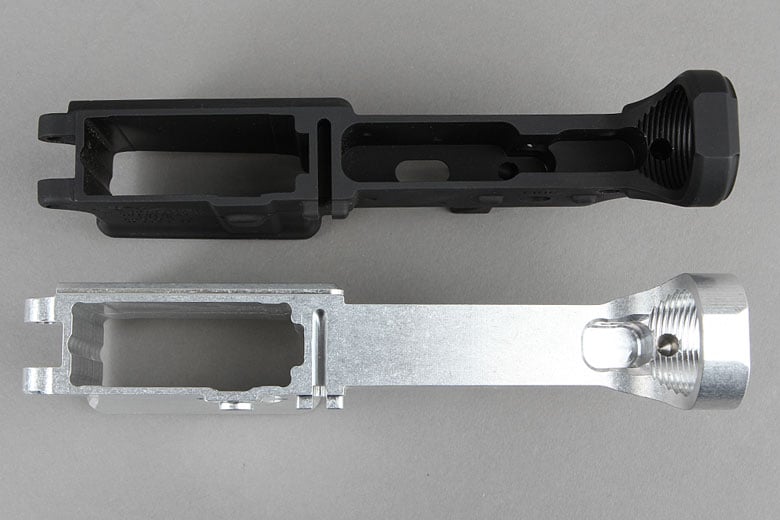
Complete lower on top, 80% lower on bottom.
Before I drop too many turds into this 3D printed punch bowl (so far this article has enough poop references to be a SugarFree piece) lets back up a bit and define some of these ideas more clearly. First off: What makes a gun a gun? Obviously it requires a specific quantity and type of parts as well as certain mechanical abilities, but at what point is it no longer just a pile of steel and wood? Legally, in America a gun is defined as the part designated as the frame or receiver. Every other part of the gun, including the barrel, trigger, stock, etc. is merely a part and can be bought and sold as freely as a toaster. The receiver, however, is always considered a firearm regardless of it’s functionality. It must be engraved with a unique serial number and is subject to all rules and regulations regarding working firearms. This means that you can buy all of the parts necessary to build a gun without any sort of paperwork or background check, except for the receiver which must be purchased either from a gun store (thus requiring a background check) or face to face from another resident of your home state (subject to local restrictions). At some point, some wise ass got to building a receiver, stopped before he drilled the last hole, and said “So this doesn’t count as a gun, right? LOL!” This pissed the ATF off, I’m sure, at which point they declared that almost a receiver IS a receiver, and then probably shot the guy’s dog. Well eventually people started asking questions about this ‘almost a receiver’ crap. Is a halfway finished receiver still a gun? How about a solid block of raw billet? The ATF realized they needed a concrete point at which a receiver was actually considered a firearm. They came out with a set of guidelines concerning what machining and manufacturing operations constituted a finished receiver, and guns meeting this definition were considered ‘finished’. You can take a piece of metal up to that point and it’s still just a piece of metal, but if you go one cunt hair over that line it is considered a receiver and you better have your papers in order. This is known as the 80% rule (considering most guns are black they probably should have called it the 4/5ths rule) and it is where the term ‘80% receiver’ comes from. By far the most common 80% receivers are for AR 15s, but you can also get them for AKs, 1911s, Glocks, and a whole slew of other guns.
An 80% lower in a jig. The jig is used as a guide for correct hole placement and pocket depth.
So what does this mean for you? Well, it means you can buy one of these 80% receivers, finish it at home using a mill and/or other tools, buy the rest of the parts online, and build yourself a working baby killing death machine without any kind of background check or paper trail. At least, that’s what some people with an above average supply of tinfoil say. I personally am not so sure (more on that later). Confession #2, I have absolutely no working experience with 80% lowers or 3D printed firearms. I do, however, have some experience with CNC milling and additive manufacturing (3D printing), so I am aware of what is involved and what each is capable of. There are 2 common materials used in 80% AR lowers: polymer and aluminum. Polymer is not as strong or as stiff but is much lighter and much easier to shape. Polymer80 is the most well known of polymer AR lowers, and they sell a kit which will let you make a polymer lower using a drill press and a dremel. They also make 80% Glock frames as well. The other option is aluminum. Aluminum is much stronger but also heavier and not as forgiving to machine. 80% Arms has a kit for finishing an aluminum lower using a routing tool commonly used for woodworking. If you already have one then this is probably your best bet, or you can pick one up for about $80. An aluminum lower is going to take much longer to complete than a polymer one, but the end result should be much better quality. The initial cost for these kits are relatively high, but once you have them you can purchase more 80% lowers for cheap and finish them up for essentially free.
Cody Wilson: American Hero
The big problem, however, is that these kits take a) time, b) a workspace, and c) a modicum of skill. Some people lack one or more of these items, making an 80% build problematic. Fortunately, there is a solution. For those of you on here who have not heard of Cody Wilson, shame on you. Turn your libertarian card in at the door, you just failed the purity test. Cody Wilson is basically the ancap equivalent of Che Guevara. At the age of 24, he founded a company called Defense Distributed. I am pretty sure he picked that name only because ‘Fuck the Police’ was already being used. His first order of business was to develop and release CAD models of a fully functional 3D printed handgun called the liberator, which I will discuss a little later. This caused such an uproar that the government forcibly took down and banned the files, citing ITAR infringement. He is currently suing the state department over the matter. Not one to rest on his laurels, he started his next big project, called the ghost gunner. The name comes from the term ‘ghost gun’, which California state senator Kevin De Leon made famous in a hilariously incoherent cringe inducing speech he made on the subject. The ghost gunner is a purpose built CNC mill specifically designed to machine AR lowers. Simply drop in an 80% lower of your choice, push a few buttons, and in about 2 hours a finished, working AR lower pops out. For a mere $1500, you too can crank out as many unregistered, untraceable AR lowers as your little heart desires. If $1500 seems a bit steep, I can assure you it is a pittance compared to what a traditional CNC mill will run, and the added software which makes finishing lowers as easy as running your microwave is a nice bonus.
Kevin De Leon: Pants on head retarded.
I can already hear some of (((you))) now “$1500?! I can’t afford that! Isn’t there a cheaper way of doing it?” I’m glad you asked. For those of you that can’t afford the wonderful ghost gunner mentioned above, there is a slightly more economical option. With a suitable 3D printer and good quality polymer, you can, in fact, print an AR lower. There are working examples on the internet, and a decent 3D printer runs in the $200-$500 range. Now, don’t think it’s going to be as simple as pushing a button, or that you will get a working lower on your first try. I know from my experience with 3D printing that it is usually a trial and error process, and that it takes a very long time to print anything. Don’t expect to it to look great or be terribly durable either. I expect no more than a few thousand rounds out of a printed lower, tops. It does work however, and if you break it you can always print another one.
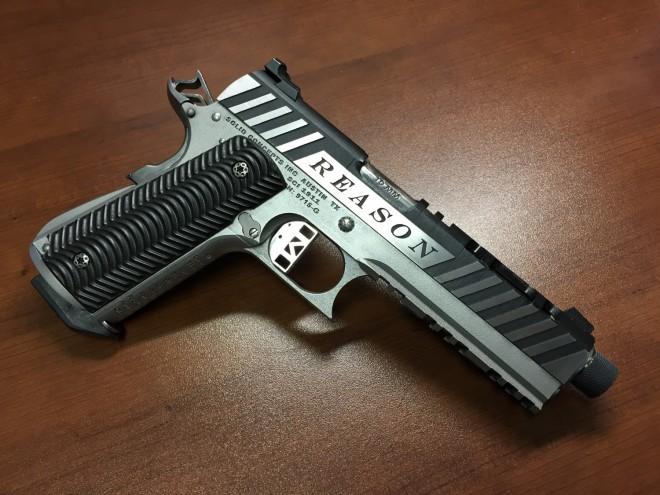
This is a working metal 3D printed gun. It costs about $12,000 each. And yes, they named it ‘Reason’.
But there is a flaw with all of this. Ostensibly the point of making your own gun is to keep da gubmint from knowing about your ballistic proclivities. But does making an AR lower yourself actually do that? Technically Uncle Sugar is forbidden from maintaining a database of firearms purchases. I highly doubt anyone here actually believes that they do not, myself included. If we concede that the government is willing to break its own explicit laws to keep track of gun owners, however, then our logic eats itself. Remember that these lowers are not functional firearms themselves. You still have to buy quite a few components and assemble them. Unless you pay cash (or bitcoin) for every part of your gun and all of your ammo, then you’re already on the list. What about 3D printing, you ask. What about it? The only working gun that I am familiar with that can be 100% printed is the liberator, which is a single shot 380 pistol with no rifling. Half the time these explode when they are fired…. not exactly military grade. There are metal 3D printers, but they are hundreds of thousands of dollars and you can’t simply order one off of Amazon. In short, 3D printing is simply not a viable strategy for building a working gun, at least at the moment.
So, if you’re doing this to try to stay below the radar, then you’re probably better off simply buying a gun off of armslist from a private seller. If, however, you’re doing it cause you’re worried about a gun ban at some point down the road and you want your instruments of insurrection… well, you’re still boned, because I really doubt you’re going to be able to run down to Cabelas and pick up a lower parts kit and a barreled upper, no matter how many lowers you crank out. If you’re just doing it for funsies and to put a middle finger to the law, then have at it, my devious little anarchists! There is way too much ground to cover on this one topic in just a short article like this, so I highly recommend you do your own research if you’re interested in making your own guns.
The future is steel…. and about 4 inches long.
Before I go, there is one upcoming product that I do want to mention, because I believe it is going to have a serious impact on the future of 80% firearms. Most of you are familiar with the Sig P320, but for those that are not, it is a striker fired handgun that was recently selected as the new issue sidearm for the US army, and probably all of the military will be issuing it in a few years. What makes the P320 unique is that the registered part of the gun, the part that makes it a gun, is not the frame. The P320 is built on a removable stamped steel chassis that allows you to change out grips and slides quickly and easily with no tools. You can switch out a broken frame for a new one in the field, or simply change your full sized pistol into a compact or subcompact one in a few minutes. A company called Ghost Guns (notice a pattern?) recently announced that they are releasing an 80% receiver for the P320. This has vast implications for a multitude of reasons. First off, the receiver of a P320 is remarkably simple. From looking at the videos released by ghost guns, a person should be able to finish a P320 80% lower with nothing more than a file and a hand drill, something most people already have and almost anyone can afford. Secondly, because the fire control group is removable as a single unit, that means that there is nothing limiting the chassis from being used in other guns. Imagine if a company released a rifle body that took AR magazines and used the P320 chassis as the trigger. Someone could buy one of these 80% kits, make themselves a P320 chassis, then install it into this rifle and have a working fighting gun, without ever doing a background check or even leaving the house. That is just one possibility for this system. I believe that we could be seeing the beginning of a whole new future for firearms development, and it is quite an exciting prospect.
America, in general, is a great place for libertarians. It is not perfect, of course, but to my knowledge, it is the only place on earth you can legally buy an ounce of weed and an AR 15 in the same day (although you may not want to publicly declare it since the weed is still federally regulated). In particular, our gun laws are some of the most permissive in the world, for better or worse, and we can own damn near anything we like. Our silencer laws, however, bite ass. For those that just woke up out of an extended coma or are learning English as a second language, silencers are long tubes you screw or clamp onto the muzzle of a gun which reduce the deafening boom accompanying a shot down to a more manageable level. They are also called suppressors or mufflers, the latter being probably the most accurate description since they function very much like the muffler of a car. They are primarily used for safety and comfort, since it is much nicer to not go deaf from your hobbies, and ear muffs can be uncomfortable and ineffective, along with other downsides. “Those sound like great inventions” you’re probably thinking. They are. Too bad they are damn near illegal here.
Pictured: Shit you can’t have.
You see, about 80 years ago, a bunch of politicians decided to take their first really big shit on the second amendment, and boy did they deliver. It’s called the National Firearms Act. You may have heard me talk about it once or twice, and I promise I will mention it again in the future because you will never love a woman (or man, if that’s your bag) as much as I hate that piece of legislation. The NFA put a de facto ban on a whole bunch of fun, useful, and constitutionally protected items, including silencers. The silencer regulation was particularly painful because it affects all silencers, for all guns, for all reasons. There is absolutely no way you can own or possess one without going through the NFA. There’s no decibel threshold for what constitutes a silencer, either. If it reduces the sound signature of a firearm in any noticeable way, it is considered a silencer. You literally cannot legally make your gun quieter. I don’t think it’s difficult to grasp how infuriatingly asinine it is to prohibit an item that is dangerously loud from being made safer to use. What really puts the corn kernels in this shit sandwich is that, by itself, a silencer is completely harmless. They’re regulating ownership of an overpriced piece of sewer pipe. In terms of lethality, it’s somewhere above a metal spatula and below a large flashlight.
If only the chainsaw was a little louder, we could have had a chance.
The thinking (and I use that word as loosely as possible) behind it is that criminals use silencers to muffle their murderous gunshots during crimes, thereby delaying or avoiding police intervention. Sounds reasonable, right? Except that it’s 100% horseshit. A silencer doesn’t actually silence anything, it simply reduces the sound of the gunshot down to hearing safe levels, and even with a silencer many guns still do require hearing protection. A silenced gun is still about as loud as a chainsaw or an ambulance siren. I don’t hear any morons in congress talking about making those louder for safety. Imagine if a law was introduced severely restricting mufflers on passenger vehicles in order to reduce collisions. It would be laughed right out of Congress, but change ‘cars’ to ‘guns’ and suddenly it’s common sense regulation!
To put this in perspective, a number of countries with significantly more restrictive firearm laws not only allow but encourage ownership and usage of silencers on firearms. Places like Norway, New Zealand, and Poland have essentially no restrictions at all on silencers, and even the gun hating utopia of the UK is relatively lax in their silencer ownership laws. When you’re doing worse than the UK at something gun related, you know you’ve got problems.
See this guy? FUCK THIS GUY! FUCK HIM RIGHT IN THE EAR!
There is, however, some hope on the horizon. a few years ago some politicians got together and introduced the Hearing Protection Act, a name which puts a big trollish grin on my face every time I read it. The HPA would take silencers out of the purview of the NFA and treat them like a gun, requiring only a 4473 and a background check to purchase. It had fairly broad support in Congress, but never went anywhere because chocolate Jesus would have vetoed it on the spot. That all changed when Big Donny Sixgun came to town, though. With orange being the new black, the HPA has a real shot at getting passed. That shot got a little bit louder (or is it quieter?) recently when some clever fellow in Congress (oxymoron, I know) decided to roll all of the major provisions of the HPA into an otherwise boring little piece of paper called the ‘Sportsmen Heritage and Recreational Enhancement Act’ or SHARE Act. I wonder how much they pay people to come up with names for these bills. Is that where greeting card writers go after they’re promoted? Anywho, the bill was scheduled for a hearing on Wednesday, but some fucking dicknose bernie bro douche canoe had to go and put bullet holes in a couple of politicians that morning, and the hearing has been canceled until further notice. So, if that was your ultimate goal, you fuckstick, then mission accomplished. I am going to break my foot off in your ass when I see you in hell.
Greetings once again, boils and ghouls, and welcome to the final regular installment of Reviews You’ll Never Use. I regret to announce that the column will be ending as a recurring piece, though may reappear now and again in the future.
Our topic tonight is a film that I followed with some interest through its development, The Boy. Often with horror films, writers and/or directors will have a short film, a treatment, or sometimes even a fully finished movie (though usually badly in need of editing), but cannot get distribution. It’s a fairly common phenomenon that affects most low-budget filmmakers when they’re just getting started. Such was the case with director Craig William Macneill. The Boy was only his second full-length feature as a director, and I recall reading some years ago about how he was trying to drum up financing to turn his short, Henley, into a full-fledged movie. The concept he outlined was to do a trilogy, following the life of a serial killer through early childhood, into young adulthood, and then as an older man. I thought it was an interesting idea, and looked forward to the first installment. Certainly the whole, “what makes a serial killer tick” shtick has been done before – even Rob Zombie took his reboot of Halloween in that direction (though for my money, nothing has yet topped the excellent Henry: Portrait of a Serial Killer). However, it had never been done over the course of three films (unless you count the trials and tribble-ations of Anakin Skywalker). Eventually, the movie saw the light of day due in large part to Chiller Films, which is part of that horror-dedicated cable channel I mentioned a couple of weeks ago.
A boy and his deer. Would have been creepier if it didn’t remind me of that scene in Freddy Got Fingered. At least the antlers come in handy later.
Truth be told, that was a few years back, and I’d kind of forgotten about the whole thing until recently when I saw it for sale on the cheap at Movie Trading Company. So I brought that bastard home & popped it in the ye olde Blu-Ray player. And an hour and forty-five minutes later, I awoke with a start as something finally fucking happened at the end of the movie.
So let’s get this out of the way right off the bat: the director, bless his heart, had more brains and artistic chutzpah than your average trash low-budget horror filmmaker and didn’t want to do another throw-away slasher. Okay, cool, I get it, more power to you. But I think he goes a bit off the rails in trying just so damned hard to make you take this film seriously, and to not lurch into being a stereotypical horror film. Camera angles are static, the background sounds are exaggerated for effect (with no background music through the entirety, except what characters play on their stereo), and there are just too many cock-tease moments before the final payoff.
We open in 1989, at a crappy roadside motel run by David Morse, and his troubled son, Jared Breeze. The motel is clearly dying, and Morse has taken counsel of despair and despondency. He does pay his son a quarter per carcass to keep roadkill scraped up off the highway, I suppose to make the place less creepy-seeming to passersby. Breeze is stultified by this life, never interacting with other children except when the increasingly scarce guests happen to have their own crotch-fruit. His father, though going through the motions, seems to have checked out of having any sort of vitality, and his mother ran off years ago with one of the guests.
Rainn Wilson and Jared Breeze, shooting the breeze. Yeah, I went there. This movie is that fucking boring.
Eventually, curiosity gets the best of him, and instead of simply waiting for the highway to provide his income, he decides in true capitalist fashion to go out and make shit happen. So he seeds the middle of the road with potato chips & chicken feed, to draw animals that will then be hit by cars. This plan goes slightly awry when Rainn Wilson (I always hated that fucking first name) hits a deer and totals his car, causing him to have to stay at the motel. The titular Boy grows close to Rainn over a number of days, though the reluctant guest gives plenty of clues to us in the audience that he may not be a wholesome person. Another couple with a little boy stop in, and Breeze disables their car so that they’ll stay an extra day (and almost drowns their son while playing in the swimming pool). Our little protagonist (antagonist?) displays unusual behaviors, such as stealing Rainn’s dead wife’s ashes and looming over the guests in their beds at night.
By the end of the film, he’s managed to coerce Rainn into chasing him through a junkyard where he laid a tarp over a deep pit, trapping a severely wounded Rainn presumably for forced boy-on-man sex at a later date. He also cops a feel off a drunk girl at a prom party that has rented out a few of the motel rooms. The boys at the party kick his ass pretty bad, and his drunk father only yells at him for having disturbed the guests. So Breeze takes things into his own hands, waits until everyone is passed out asleep, and burns the fucking motel to the ground while everyone screams inside.
Fucking FINALLY something happens. The kid takes the antlers his dad sawed off the carcass, wires them to his head, and kills a bunch of people by burning them alive. He was inspired by heated political rhetoric.
I don’t want to bash this movie. It was ambitious, to do a slow-burn think piece as your first big horror film, and that takes both guts and some level of thinking above and beyond what most hacks in this field are capable of. So I applaud Mr. Macneill for that. I would much rather someone make this attempt and not quite succeed than give in to the siren song of doing Friday the 13th Part Eleventy. The problem is, up until the end, the entire fucking thing is nothing but an hour and thirty minutes of atmosphere and set-up, and by the time you finally get to the payoff, it’s too damned late. Nobody cares anymore. Shit fucking fire, I’d fallen asleep in my (admittedly very comfortable) Lay-Z-Boy. The vanishingly few non-superhero films that are being made anymore should find their strength in being the opposite of Fortress Mouse and its motto of “There Is No Such Thing As Too Many Overwrought CGI Battles”. These movies should take their time with pace, and rely on solid performances and writing to build engagement with the characters and situations. And this film does that. Both Morse and little Jared turn in quite good renditions of their bleak characters, never going into absurd “look how awful our lives are” hyperbole. But it does it too fucking much. At this point, I realize I’m starting to sound like a crank, but it really is like Goldilocks stealing the porridge from those fucking pedobears. Just because some things are too much one way, and you quite rightly realize that a correction is in order, doesn’t mean that you necessarily go a full 100 mph in the exact opposite direction until you hit a wall. It’s okay to go partway. Just the tip. It won’t make you gay, and you never have to tell anyone else about it if you don’t want to.
Anyway, I think Macneill has promise. My criticisms are harsher because I perceive the film to have so much more potential than what was realized. There’s honestly a really good movie lurking in their editing room somewhere, and that’s nothing to sneeze at considering what most young auteur horror directors crank out. This one just doesn’t quite rise to the occasion.
I typically read a lot of other reviews online to try and help focus my own sense of how I view the films I write about, and also to make sure my criticisms aren’t solidly addressed by some aspect that I might have just plain missed. I found one that seems to echo my thoughts entirely, only better written.
Weighing in at 105 minutes, “The Boy” traps itself in a corner by giving its sights, sounds, and story so much room to breathe that the suspense ratchet cannot retain its tightness. The movie has more time than it needs to get where it wants to go, giving excess duration free reign to defuse dread with unfulfilled setups and unnecessary asides.
Preach it. I award this film two Pretty Marines and one Cat out of three possible of the former, and two possible of the latter.
“It’s unclear how gentle the pants are when zapping your legs into the right positions to attain yoga enlightenment. Here’s hoping the vibrations aren’t too intense.”