Category: Reviews

  • Caddyshack Explains Our Politics


    It is a scientific fact that Caddyshack is the best movie of the 1980’s.  Not only does the movie accurately depict the summer of my junior year in college spent as a ranger on a golf course, it also showcases some of the best comedic talent of the era.  Chevy Chase as Ty Webb, a simple-minded millionaire playboy with a natural gift for golf.  Bill Murray as Carl Spackler, a dim-witted groundskeeper who engages in an ever-escalating war with a gopher that’s burrowing holes throughout the course.  And Rodney Dangerfield as Al Czervick, a boorish millionaire whose gaudy lifestyle and off-color remarks draws the ire of the club’s blue-blood establishment, as best personified by Ted Knight’s character, Judge Smails.

    Throughout the movie, our hero, caddy Danny Noonan (whose last name will forever be remembered by golfers who have heard it whispered to them mid-stroke as they putted) tries to impress the stodgy Judge Smails in order to win a caddy scholarship while also trying not to betray his true self.  It is a coming-of-age morality tale interwoven between campy sexual references (“Hey everybody, we’re all getting laid tonight!”), silly, but effective, turn-of-phrases (“Thank you very little”), drug references (“Cannonball!”), and pure Bill Murray (“So I got that going for me.  Which is nice”).  But, the movie also highlights a clash between the nouveau riche, as embodied by Dangerfield’s character, and the established upper class, as embodied by Judge Smails.  A conflict that is being played out in our national politics.

    Dangerfield’s character is rude and uncouth, much like our orange-tinted president whose tastes defy gaudy and uncultured, along with his public persona being impolite and offensive.  But, at the same time, the caddies and other staff on the golf course don’t seem to detest Dangerfield’s character nearly as much as they do Judge Smails.  His gruff remarks convey a degree of honesty.  Though he is no less a liar than Judge Smails, his lies are so clearly transparent that no one feels deceived. And his unwillingness to be polite hides no ulterior motives.  Everyone knows what Dangerfield’s character thinks because he declares it for everyone to hear, much like our president via Twitter.

    They were also in Tron.

    In contrast to Dangerfield’s character, Judge Smails is presented as part of a self-important and corrupt establishment that cares little about people not of their class.  Much like the public views the president’s enemies as dismissive of those beneath them.  Smails is well polished and presents himself as someone who upholds the rules of respectable society, but in actuality, everyone knows he cheats.  In much the same way that the American public at large believes that their betters are liars and cheats.

    At the movie’s climax, the protagonist, Danny Noonan, is presented with an option: either help Dangerfield win a golf bet against Judge Smails and lose his college scholarship or fall in line with an established order that he detests for his own personal gain.  Judge Smails advises him against helping Dangerfield, but Noonan ignores his advice, much like voters in 2016 rebuked the advice of the ruling class.

    In the final scenes of the movie, the two sides of the golf bet are even.  Noonan needs to sink his final putt in order for Dangerfield to win the bet.  After a comically long moment of anticipation, Noonan’s putt wins the golf bet for Dangerfield and the workers at the golf course are ecstatic.  Everyone from Noonan’s love interest to a fellow caddy who he has sparred with throughout the film crowd around him in a raucous celebration.  The victory is actually Dangerfield’s, who was the principle of the bet against Judge Smails, but he is seemingly ignored.  Dangerfield, much like our President, served as only the vehicle for these workers to register their frustrations with the golf course’s blue-blood establishment.  The workers gained nothing from Judge Smails losing his bet: Noonan will not be able to afford college without the caddy scholarship that he’s forsaken and the rest of them will go back to the same jobs the next day.  Their celebration is surely fleeting, but for a moment they take enjoyment in besting their betters.

  • Review – Stouts Part 3: The English Stout

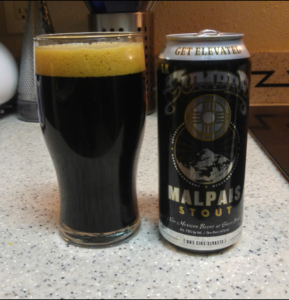
    This is my review of La Cumbre (Albuquerque, NM) Malpais Stout.

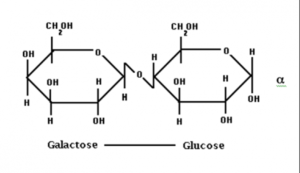
    The fun part about the English Milk Stout is that it does not contain milk, but it does contain lactose which as we all know is found in milk.  Lactose is a disaccharide known for giving people gas because of the angle of the Oxygen bonds between glucose and galactose.  That’s the O with the funny z-shaped bond that joins the monosaccharides below.  

    This bond in similar (but not identical!) to the type of bond found in the same type of polysaccharides found in dietary fiber.  Most mammals cannot process fiber on their own, even cows; they process it with the help of bacteria that is passed to the calf from its mother.  It’s also why fashion models and beauty pageant contestants eat celery.  So as not to lose my audience, here’s Miss Kansas 2014, who I am quite certain eats meat. 

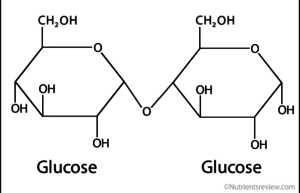
    In other words, people have issues with lactose because in a way, humans were never intended to be able to easily process the sugar beyond infancy.  The sugar most people associate with beer of course is maltose.

    Science AND beer?! What kind of site are we running, anyway?

    Looks the same?  Not quite.  While they have identical chemical formulas, the difference is the angle of the oxygen bonds between the two monosaccharides.  What does this subtle to the point where it appears to be a nearly meaningless difference between sugar have to do with beer?  It has to do with everything.  The yeast that processes these sugars must do so in a different way because of this bond but it can process both easily.  The result is a beer that tastes slightly different—sweeter and not as dry.  This is the explanation as to why milk stouts taste the way they do, and why not all stouts taste the same and thus were broken up into multiple articles.

    Another fun fact about milk stouts:  they were initially marketed to lactating women.  No wonder your mom likes it.

    So begins…the circle…of stouts!

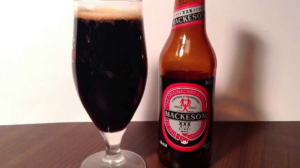
    A good example of the English Milk Stout is Mackeson Stout.

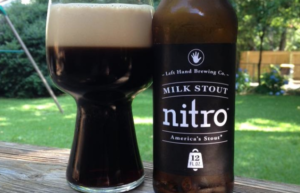
    This one is kind of hard to find in the US, so if you are looking for a good example of the English Milk Stout, check out Left Hand’s Milk Stout.  As a bonus, it is also available with the Nitrogen charged widget.

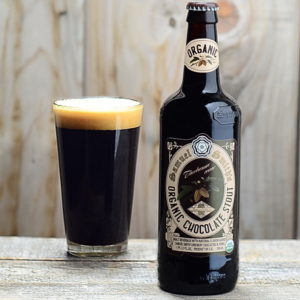
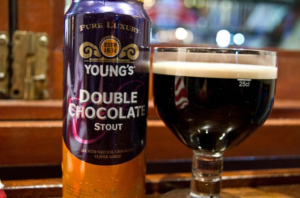
    Another type is the English Chocolate Stout.  Part 2 of this series I mentioned Young’s Double Chocolate Stout, but an arguably finer example is Samuel Smith’s Organic Chocolate Stout.

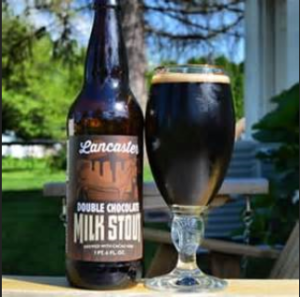
    It appears arrogant to the uninitiated yet deliberately proper, and understated–like everything else the English do well.  If you can find it, an example from the US might be Lancaster Double Chocolate Stout.  I’ve never had this one, but I have heard a lot of good things about it.  If I am wrong about it, I will recant on my deathbed.

    As for the stout featured above.  I asked everyone what kind of beer I should get on a Friday PM Links thread, and while I got an answer, I had already made my purchase by the time I checked my phone.  I picked this because for some reason all the Glibs from the Land of Enchantment seemed to show up all at once one evening.  So here is my shout out to the green chili eating weirdos to the east whose most famous resident painted pictures that my former boss has all over her office.  

    Internet points awarded to whoever actually knows who this is

    La Cumbre Malpais Stout has a ridiculous malt complexity and a subtle bite from the hops.  It’s ABV is at a healthy 7.5% and there is a slight burn to it.  This one is rather dry like an Irish stout, because it is.  Its old-world analogue is Guinness Extra Stout.  It is a solid effort, and one I would recommend.  La Cumbre Malpais Stout 3.5/5

  • Review – Racer 5 IPA and friends


    I have been avoiding writing about this style for a while now.  It’s pretty much everywhere and people seem to either love it or hate it.  People that love it are often accused of lying about it to look like they are “with it.”  Even though what “it” is, is scary, smells like a barber shop when the AC breaks down and tastes like spiked piss.  Then this happened:

    […]

    My TI:  Flight!

    Me:  Kill! (Parade Rest)

    My TI:  Attention!

    Me:  Osama! (Attention)

    Sorry about that.  Back to your regularly scheduled programing.

    True.  Also discussed in this thread is if Whole Foods Girl is attractive with gauged earlobes.  The short answer is, maybe.

    I did no such thing.

    Screw it.  This is my review of Bear Republic Racer 5 India Pale Ale.  Hat Tip:  Sean, Tundra, Playa(Hate-ah)Manhattan, et al.

    Ready your rotten cabbage, ladies.

    For the record, I found this one as a single at Total Wine but I have seen it in numerous places like Fry’s(Kroger), Safeway and BevMo.  Since I am in Arizona, this wide distribution is likely due to my location and thus cannot speak to how far their reach is.  This isn’t the first time I have had this one, but it has been a long time.  Since there are so many California brands in my area, there is a fair bit of difficulty in keeping up with all of them.  Then there are the local brands which for the most part are as good or better, but the Arizona brewers tend to focus on styles that aren’t this extreme.  The reason?  When it’s hot out the last thing I want is an IPA and I don’t think I’m alone.

    India Pale Ale tends to lose its potency over time.  The oils and aromatics in the hops that dominate the style break down, particularly when it comes in contact with light.  Yes, even if it is stored in a brown bottle.  Because of this, I always recommend finding a local brewer that makes a good version of the style, for me that’s Four Peaks Hop Knot. Fresh beer is always better and somebody that makes it nearby will likely give you the best version available for the style.  Don’t have a good one?  The Stone “Enjoy Before” series is your best bet. It’s not always available, but they give you the date specifically because that is the date they recommend will meet their quality standards.  The idea behind this style is they over-hopped the beer in England back in the day so it could make it to their English customers in India and still taste like a traditional Pale Ale.   

    I tried this once when I came across a Stone Ruination IPA at a gas station about a year ago.  Note, I did not say Ruination 2.0, this was the original still sitting in the corner on the bottom shelf of the refrigerator at an Arco station.  It was old, and quite frankly there is proof of concept as it tasted like a terrible pale ale.  If you come across this one with the green label, avoid it.

    Racer 5 is pretty good for the type of style it is.  Without looking it up, I would guess it is the Cascade/Centennial Hop combination that I mentioned before.  It’s made in the dry-hopped “West Coast” style that seems to generate the polarizing views.  I’ve been drinking a lot of balanced or malty beers lately, so it was quite the experience and even cleared my sinuses.  Very fragrant in the glass but it seemed to leave a dry, bitter feeling afterwards. There are a lot of citrus notes, and it is definitely not malty.  Overall, it’s a good example of the West Coast IPA style so if this is the style you like, you will enjoy it.  I’m not always up for it though.  Bear Republic Racer 5 India Pale Ale: 3.2/5.  Other good examples include the aforementioned Four Peaks Hop Knot.  Of the nationally distributed brands Sam Adams Rebel IPA, Dogfish 60 or 90 Minute IPA, Stone Ruination IPA 2.0, New Belgium Ranger IPA, Elysian Immortal IPA and if you have Avery in your area, most of their versions are very good as well.

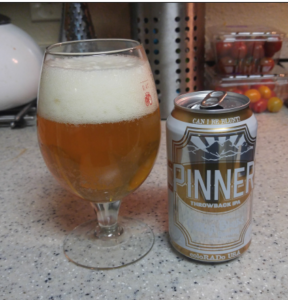
    Winner winner, drink a Pinner!

    The alternative is finding one that pays homage to the traditional English version.  Oskar Blues Pinner IPA is a good example.  They don’t list the hops used on their website (surprise!) but I believe they lean heavily on traditional English hops.  Interestingly enough, they were going for something else entirely when they made it. This one is very light, and it does not have a lot of body to it but it does taste more malty than what one would normally find from this style.  The head in the photo disappeared rather quickly but to be fair, this is something I have found in all this brand’s styles.

    I will say this one is almost sweet compared to Racer 5.  Oskar Blues Pinner IPA: 3.2/5.  Another version to consider is Firestone Walker Union Jack IPA, and if you look closely in the import section at Total Wine you will find actual English IPA from time to time.  Not many other examples from the US come to mind.

  • Review – Stouts Part 2: The Irish Stout

    You’d drink it, too, if she handed it to you.“Guinness is the best beer in the world.  Hands down.” – Me, 2003.

    Like anything else, the more you’re exposed to different things the more likely your attitudes will change over time.  I was first exposed to Guinness in college, when a friend of mine picked up an 8-pack of Guinness Draught cans.  His dad was an F-16 pilot stationed at Aviano AB, Italy so he was a product of DODS and traveled all over Europe during his formative years.  It made him an interesting person to converse with but somehow or another he wound up in China in his late 20s.  I hear from him once every two years now, possibly when the Chicom government lets him check Facebook.  At any rate, he was fresh off a trip to Ireland with his dad and at the time we all thought it was the coolest thing in the world.  The can contained a “widget,” that charged the beer with nitrogen and when opened, will release its charge, mimicking what the beer would taste like if it came off tap.  Who else but the Irish would be at the forefront of beer drinking technology?

    The problem is, at the time I didn’t know much better.  My exposure to beer was limited to Bud Light, Corona and the like.  I will credit my friend with forcing me to try something different from time to time, after all the beer is black and sometimes requires a spoon, when it’s supposed to be yellow, watery and sometimes requires a funnel and some surgical tubing. This lead to me drinking a Fat Tire, which lead to me drinking damn near everything else.

    If we rag on the InBev brands for the ubiquity, their marketing campaigns and their trivial associations with pop culture, it shouldn’t be too much of a leap to come to the same conclusion about Guinness as we do with them.  Need an example?

    Is Obama cool because Obama gets jacked on Guinness or is Guinness cool because Obama gets jacked on Guinness?

    But it’s different, because Guinness is tasty!  Okay, maybe it is.  It has a nice texture, the head is certainly something to be desired and it is definitely better than 90% of the mass produced beers on Earth, but that is a bar low enough to trip over.  Its ingredients are to a large extent, trade secret—except for fish bladder, until recently. Because of its popularity, there is probably no beer on Earth that has as many “secrets” and “insights” that are intended mainly to make people look cool drinking it.  Such as:

    Secret:  Tapping a spoon against the glass.  This is to determine whether the beer finished dissipating and the head has settled.  The glass should make a dull clacking sound when tapped with a spoon—now it’s ready!  This is silly, as the glass makes a similar sound when filled with almost any liquid.

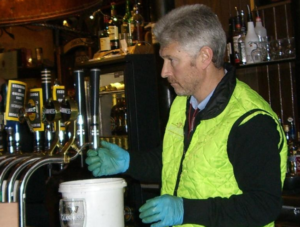
    Secret:  It’s better in Ireland.  This is mostly designed as a segue to the, “Oh you’ve been to Ireland, are the comely lasses really that comely?” conversation.  The former is somewhat true and there are a few explanations as to why.  The first being that for most Irish, drinking is a social event therefore they drink it in pubs, so it isn’t bottled.  Bottling and canning beer often requires pasteurization which can alter the taste of beer by denaturing the proteins and enzymes that you might find tasty and otherwise not get out of the can.  Also, the Irish drink so much of the stuff that once it’s brewed it’ll get consumed in a few weeks, so they might not be too concerned about it spoiling and thus won’t sully it with preservatives.  I’m not certain of the veracity of this one, since I doubt Guinness wants a lawsuit from their beer getting people sick.  Another practice in Ireland is Guinness will send a worker out to pubs with a distribution contract to purge the lines at 21 day intervals.  This ensures the lines are clean and thus do not contain foreign contaminants.   That’s what this guy is doing.  

    It sounds like a good business practice on Guinness’ part to control quality but if I’m the pub owner I might question how much beer that wastes because depending on the length of the lines, there might be a gallon or more of beer in there that I can no longer sell which means its 17 gallons/tap/year—you do the math.  The beer is fresher in Ireland, pubs are required to let Guinness maintain their taps, it may or may not be safe for drinking, and it is almost always served off the tap.  Couple this with the fact that for most Americans, it’s a special occasion they find themselves in Ireland and therefore a novelty, it’s no surprise everyone says it’s better in Ireland.

    Secret:  Drinking Guinness is good for you. Apparently, Guinness contains antioxidants and polyphenols like red wine, and in moderation the benefits outweigh the alcohol content. This is also ridiculous, as anybody drinking Guinness, like the stereotypical red wine drinker, is not going to be drinking it in moderation.

    Secret:  The Perfect Pint.  This is a six-step process

    1. Use a Guinness Branded Glass.  Preferably a clean glass.
    2. Pour at a 45-degree angle, aim for the harp in the Guinness logo.  Pull aft on the tap.
    3. Stop pouring when it reaches about halfway across the harp in the Guinness logo.  
    4. Leave the glass to settle for 119.5 seconds.
    5. Once ready fill the remainder, pushing fore on the tap rather than aft, holding the glass plumb.
    6. Serve. The foam should be domed like the crystal on a well-made watch.

    Not only that, there is a specific way to drink a perfect pint of Guinness and that is by drinking it in quarters.  In other words, gulping it rather than sipping it, thus leaving three foam lines in the glass.  Order a whisky between gulps 2 and 3.  DO NOT drink the whisky before finishing the beer. This whole thing sounds ridiculous to a rational observer, but I’m not about to argue with it beyond not telling me how to drink my beer.

    In the end, Guinness benefits from a legend they realistically cannot live up to and a cultural status that seems to feed upon itself—like Harley-Davidson.  There are better, more flavorful stouts out there that also have the nitrogen charged widget.  Want me to name one?  Okay.

    I suppose the pedants among us will point out this isn’t an Irish Stout.

    Guinness Draught:  3.0/5 (If I’m being generous)

  • Review – Speakeasy Prohibition Ale


    My sister recently had a birthday and I was voluntold to pick up a set of cupcakes from a baker specializing in cupcakes, and only cupcakes with ganache frosting.  I found out they only make a certain amount during the day and will close when they run out.  So when I arrived after they closed I still needed some cupcakes, and unfortunately for me there was only one place in the immediate area that would have what I needed to pick up.

    I love how nobody at Whole Foods ever looks like their file photos…normally they look homeless yet somehow drive a Mercedes Benz Genändewagen. I know what you’re thinking, don’t you like money?  Why are you shopping there?  Well they had what I needed that day and their beer section is stocked with a disturbing level of variety.  I picked this one up while I was there since the last time I bought from this brewery was in college.

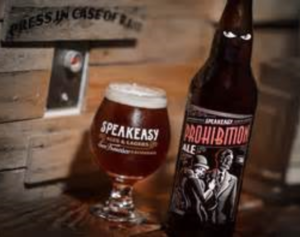
    This brand has probably one of the more visually elaborate labels out there. All of their beers are adorned with art deco style and obvious cues to 1920-1930’s era gangsters, gazing narrowly upon us from the refrigerator. The beer itself doesn’t disappoint either.  It’s an American Amber Ale, which is a style that was popularized on the west coast and is probably the most ubiquitous style in the craft industry not called IPA.  Do you like Fat Tire, Alaskan Amber Ale, Full Sail Amber Ale, Avery Redpoint Ale, Northcoast Red Seal Ale, etc?  All fine examples of American Amber Ale.  This one is a hazy, deep red-brown color that finishes with a nice foamy head.  Cascade hops which is the norm but not exclusive for this type of beer, give it a citrus like aroma but not particularly floral–when it is cold.  

    Want

    Cascades are a strain of hops that was derived at the University of Oregon on a USDA grant in 1956 that was determined to create a species of hop resistant to downy mildew.  It originated from an open seed collection that comprises of English Fuggle, Russian Serebrianker, and “an unspecified male hop variety.” The name of course, comes from the mountain range that runs through the area.  In the event you run into a non-GMO type at a bar drinking a Full Sail Amber, be sure to point out this fact and provide a Dixie Cup to purge xirself of this vile example of patriarchy that displeases Gaia.

    Speakeasy’s version is a bit more fun, as it warms to room temperature it takes a different character, allowing the dark toffee malts to be more evident.  The malts balance out the hops, which is probably why this style is as popular as it is—it isn’t made to suit an extreme.  They also mix in another hop, Centennial, which is similar to the Cascade, but manifests itself better at optimum beer drinking temperature and does not taste so much like grapefruit.  This twist gives it a bit of complexity and lends itself specifically to the American standard of drinking beer while it’s near freezing.  Beer should be served around 55 F, which is something in C, I just don’t care to do the math for it.

    Speakeasy Prohibition Amber Ale easily rates at 3.5/5 or better depending on your glass of choice and if you are the type that prefers some balance.  I had it in a chalice but you can use a pilsner glass or other wide mouth glass for a good effect.  Otherwise if you read everything I just wrote about hops and determined it is another example of putrid, overpriced, over hopped, grapefruit flavored swill, there isn’t anything I can say that will convince you otherwise.  So I’ll just leave this here for you:

  • What are we reading? October 2017

    It is time once again to pretend that we have education and class. Our one chance of getting invited to cocktail parties… Although I don’t know anyone who invites trashlit, science books, or self-improvement tomes to cocktail parties. We also want to know what you’re reading. Library Scientist or not, SF is going to run out of books to feed us some day.

    SugarFree

    October means I’m reading horror.

    Given the hype over the new movie (which I haven’t found a good copy to pirate seen yet,) I felt compelled to read It, probably for the 12th time since high school. It really is too bad about, ahem, that scene, because, without it, the huge novel could be pushed on anyone who ever wondered what Stephen King’s success was all about. It combines pretty much everything good King ever had to say with some of his best writing–even if a ruthless editor could have improved it by trimming away 100,000 words and a squicky sewer gangbang.

    On the other end of the scale, I also read Cujo. For such a King fan, I just never got around to Cujo, I think because someone warned me off of it. Whoever you were, you were totally right. Cujo is It as seen through a mirror darkly. At best a novella, the simple premise of Cujo is stretched kicking and screaming and biting and pissing itself to an unnecessary novel length with a boring cast of stock Maine characters who add nothing to the core conflict between mother, child and monster dog. The husband’s failing ad agency, the abusive father of the family that owns the dog, the hacky lottery ticket that sets up the deserted farm for the Cujo attack, the foul-mouthed drunk down the way who is Cujo’s first victim, and even the shithead who the mother had an affair with all mean nothing to the overall story. And the ham-fingered way King tries to tie a rabid dog back to Frank Dodd, the Castle Rock serial killer from The Dead Zone, only reminds the reader that they are reading a far, far inferior book (as does the attempt to bring back the third-person omniscient and time-bending narration from Carrie as an attempt at world-weariness.) Stephen King has admitted to being so out-of-his-mind drunk during this period that he has no conscious memory of writing the book whatsoever. He’s either lying to save face or alcoholism has a rare blessing after all.

    And since I was on a roll, I read two more 1970s books-to-movies (watching the movies again, of course, just like It and Cujo.) The Howling by Gary Brandner, the source novel for the 1981 movie of the same name–you know, the one where Elliot’s mom from E.T. turns into a Lhasa Apso–and Falling Angel by William Hjortsberg, made into 1987’s Angel Heart, where De Niro peels an egg while badly in need of a manicure and Mickey Rourke gives the second oldest Huxtable girl the Hottest Cosby of them all. The Howling is fairly mediocre, a they shouldn’t have gone there combined with man, rednecks are pretty creepy; the movie is far superior, with a kinky edge that the book couldn’t find even though it features much more werewolf sex. Falling Angel is very, very well written, and would have been a revelation to read in 1978, but decades of hard-boiled wizards has taken the punch out of its early fusion of Raymond Chandler and Dennis Wheatley.

    Brett L.

    I really don’t seem to have read much this month. Other than a couple of RFPs that included 180 page appendices on the unsuitability of their current system. Holy crap. Whoever did the consulting work on that study must have had a 2 page per thousand dollar rule. I’m sure they were aiming for exhaustive, but only reached exhausting. I did work my way through three of Tim Dorsey’s Serge Storms novels: The Big Bamboo, Hurricane Punch, and Atomic Lobster, because the Apple book store thingy had a collection and I had credits from some class action lawsuit. Anyhow, I enjoy the billion and one Florida facts Dorsey manages to cram into each book, and with several books taking place or passing through the Tampa Bay area, I’ve learned a lot of trivia about my local area. Also, in the last two, Dorsey took Serge back to doing what he does best: killing Florida Man inventively. These are fun leisure reading with all of the Florida and none of the sanctimony of that other Florida novelist from Miami.

    I also read The Skinner by Neal Asher, on SF’s recommendation. Not to steal any of Riven’s thunder, I’ll just say that Spatterjay is a fucked up universe. I’ll probably work my way through the whole thing eventually, but disembodied heads that skitter and giant killer space crabs are merely two of a host of violent and difficult to kill denizens. I will eventually work my way through more. Its good space opera that seems to center on “how can I buff these characters so I can kill them at least twice?” Which is actually a hell of a way to build a universe.

    I am listening to Never Split the Difference by Chris Voss based on a recommendation out of the comments (someone gave RC Dean credit, but if I’m wrong please correct me). Since everything is a hostage crisis negotiation when you have two toddlers, this may be the most helpful book I’ve ever read. The unfortunate downside is that I don’t have a SWAT team to bail me out when I make a mistake. Sometimes, I wish there was.

    jesse.in.mb

    Joe Abercrombie – The Blade Itself, so Brett read it last month and I largely agree with his assessment. I noticed several of you came to Abercrombie’s defense and I may be willing to pick up the next book in the series based on that, but there was some interesting world building and by the end of the book I wasn’t excited to see where the grand adventure would take me.

    Marie Kondo – Spark Joy is more practical than her declutterer’s manifesto The Life-Changing Magic of Tidying Up, but I’m not entirely sure that I got that much more out of it than the first book. My book collection is now about 1/4 of what it was previously (Salvation Army ended up with just shy of 200 used books this weekend), and I can actually find clothes in my cabinet and closet, so I’m kinda digging the philosophy.

    Tom Merritt – Pilot X seems to be very much a play on Doctor Who plot and themes and a few times dropped some Easter Eggs related to the show “Spoilers sweeties” and the like. The story is fun and the narrator, Kevin T. Collins does a great job of bringing the story to life. The one down side is that I couldn’t stop thinking about how much the story reminded me of a Who arc.

    JW

    JW has been reading the back of a box of Post Toasties. Did you know they have thiamine, niacin, and riboflavin?

    Old Man With Candy

    I will make two confessions: first, the most interesting book I read this month was Handbook of Ring-Opening Polymerization. From the title, I thought it would be about anal sex, but I was mistaken. Nonetheless, excellent content if you’re into this sort of thing. I am tempted to experiment with microemulsification…

    Second, I never actually did read Primary Colors when it came out. I have corrected this. It’s certainly a good cynical look inside the Clinton campaign of 1996, surprisingly so for a liberal author. But my main complaint was, not nearly cynical enough.

    Riven

    So, I’m still working through The Skinner by Neal Asher, a SugarFree recommendation. I’m only about a quarter of the way through it so far as my free time this last month has definitely been on the short side. Additionally, it took me a while to “get into” this book. I was probably 10% in before things started to click into place, and the confusion surrounding the universe in which the book is set cleared to the point I could read it enjoyably. Not to say that Asher isn’t still introducing new creatures, concepts, etc., just that I think I finally have a basic grasp of the characters (and there are a lot of them) and how they relate to each other. So far the bulk of the action has taken place on one specific world, but there are references to other characters on other worlds and there have been a few scenes set off this main world, as well. It’s making for an interesting universe so far, to say the least. There are a lot of different plots all happening at the same time, and it’s sometimes difficult to see how one or another are going to tie in together. There’s still plenty of the book left for it all to come together and make some sense, though, and I can be patient.

    SugarFree here… I made this handy chart to Neal Asher’s Polity Universe that should easily clear up any questions about continuity or reading order:


  • Review – Tank #7 Farmhouse Ale

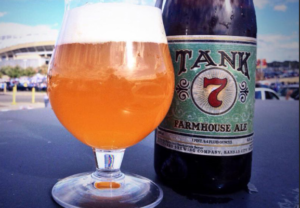
    This is my review of Tank #7 Farmhouse Ale, by Boulevard Brewing Company.

    Here is my mistake.  I mentioned in passing what I will be reviewing next and somebody tells me there is a standard to these things that I am overlooking.

    *pours beer down the sink*

    Okay, fine.  They didn’t have it at the Fry’s I shop at that used to be Smitty’s, therefore it’s the ULTIMATE FRY’S.  I instead went to BevMo–no dice.  Finally, I found it at Total Wine, which was the last bottle they had on the shelf.  

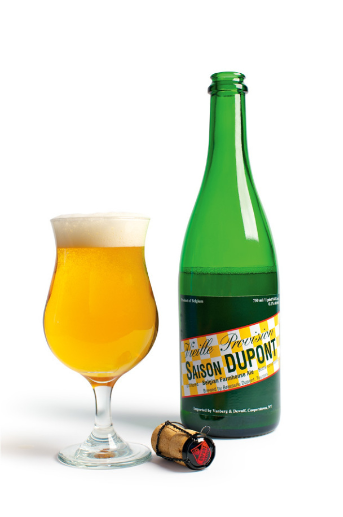
    This is my review of Saison Dupont Brasserie.  Hat Tip:  Nephilium.

    Holy shit.  This almost costs $14, including the $1.39 worth of state legitimized theft levied on beer, wine and spirits.  This reminds me of the time I was shopping for a new vehicle and I checked out the Toyota Tacoma.  For what Toyota charges people for the privilege of being labeled tough enough to drive a Taco; in comparison to some of its competitors in the light truck market it better be an amazing truck.  By golly, the Taco it is an amazing truck.  Is it amazing enough to justify buying it over a comparably priced, but used full sized?  Saison Dupont reminds me of this quandary.  It is expertly crafted, has a lot of body which is evident in the way the foam coats the inside of the glass.  It is bottle conditioned and continuously fermented, which is why it is sealed with a cork similar to the ones used to bottle champagne.  The smell is reminiscent of a crisp summer evening in the countryside, in a place where the pavement will not burn your bare feet.

    Why is it called Saison?  Those of you that speak French will probably tell me the word itself means season.  This is indeed true; Belgians like the Germans and nearly every other traditional beer culture adopted the practice of brewing beer seasonally in the time before refrigeration.  Part of the reason it is typically done in the colder months is that small insects hibernate and won’t infest the wort.  The other part is consistency in temperature.  Germans took this to another level in developing lagers, which is not nearly as resistant to temperature fluctuations as most ale, by brewing underground.  This is not why it’s called Saison.

    It was explained to me once the reason lunch is dinner and dinner is supper in the Midwest is due to the type of meal that a farm hand might have.  If one sits down for a large midday meal at a table it is more likely to be referred to as dinner.  This is how they referred to it in the dining facility at the Air Force base I was stationed at in South Carolina.  Typically, the meal was large as I was hungry at the time since I last ate around 0400 so that I can complete the airfield lighting check prior to the start of the ops day.   Lunch on the other hand, is often a much smaller meal.  When I think of lunch today, I am normally sitting at my desk munching on something small.  Be it a sandwich, or salad for example, the intent is to simply keep me going until the end of the day.  It is this type of meal that Midwesterners might refer to as lunch, just something small they can provide a farm hand that they won’t have to worry about their workers going hungry*. Back in the day, Belgian farmers would provide beer to their farm hands, known as Saisonniers, with this type of beer in part as a meal replacement but also because one gets rather thirsty when working in the fields.  This explains why it is often called Farmhouse Ale.

    *I realize this might be the most controversial statement I make in this entire article, but this is how it was explained to me.  

    Like I said before, it is expertly crafted with a lot of body in the traditional manner that defines the style.  It has a thick texture with a heavy citrus aftertaste.  To make this even more confusing, it is highly carbonated but it dissipates in the glass (foam) leaving a pleasant aroma and does not leave you feeling bloated.  Like most beers of this type, you must be into it to like it.  Wheat beers in general have a polarizing effect on people and not everybody is into it.  If you are, you will certainly appreciate its charms but perhaps will not appreciate its price tag.  Saison Dupont Brasserie 4.0/5.

    ‘Murica!

    If Brasserie is the master, Boulevard is its apprentice.  Like many American Brewers, they are quite adept at creating a worthy copy.  Often the argument against the craft industry is that they can never make the traditional ales made in Europe.  Is it the same?  No, it’s not a carbon copy, and that isn’t the point, but it certainly holds its own given the more affordable price tag. Boulevard Brewing Co. (Kansas City), Tank #7 Farmhouse Ale 3.9/5.

    In honor of the NL Wild Card, I picked up this one I never heard of as—a wild card.  

    This one is not terrible. Considering the fact that I turn into an emotional wreck watching playoff baseball, particularly when it is my team…I might have to try this one again.  I was hardly objective at the time… There is less body than expected and it is a little more sour than many would like but it is not bad. It is not one to go toe to toe with a traditional European product but it does what it does well. Prairie Artisan Ales Merica Farmhouse Ale 3.0/5

    A word on fruit  

    This is a libertarian website, it is in this spirit that I say that if you add a slice of orange to this type of beer, so be it.  To call that apostasy would make me no different than those pushing a social campaign that insists men ignore their natural preferences for women and accept them as is–i.e. real men like women that_______ or with_______.  This is hogwash; real men like whatever the fuck they want.  If you like Belgian farm girls picking strawberries, go right ahead.

    You can only pick one!
    So choose wisely

    If you like female Belgian soldiers…You might have issues, but go for it.

    If you want to add an orange because you like it, because it makes you happy, I am not going to say you are wrong.  I will not say that you should not add fruit to your beer and you may as well go to Morton’s and ask for ketchup with your steak.  It’s an immoral stance to take and I will not entertain an argument to the contrary.  Do what you like.

    Having said that, this is a libertarian website and since I have been graciously provided a platform for free speech I will state my personal opinion:  if you add orange to a well-crafted Saison–you are wrong.  Go wash your mouth with a revolver.

  • Review – Fat Jack


    This is my review of Fat Jack Double Pumpkin Ale, by Sam Adams.  

    Let’s get this out of the way right now.  Yes, it will get you drunk.  TW:  This goes on for over two minutes.

    https://youtu.be/5szRnQmyI4E

    Pumpkin Ale suffers from the indignity of being associated with hipster culture in that it only seems to come out at the time of year where everyone and everything gets excited for all things pumpkin.  Pumpkin cider, pumpkin parfaits, pumpkin cookies ….

    ….even pumpkin spice M&Ms.  It’s to the point where one can trigger an emotional response by telling a 28 year old woman in vintage glasses, a turtleneck sweater and wool scarf that she lives in Arizona, it is 96 degrees, there is no reason to dress like that and there is no reason for me to give two shits about your pumpkin spice latte.  Pumpkin ale however, I think is unfair to associate with these people to some degree.

    Pumpkins, like chocolate, corn, potatoes, and beans are indigenous to the Americas and like the other food mentioned was traded around the globe as a result of the Columbian exchange.  Native Americans initially ate only the seeds, because that was the only palatable part.  Later varieties were cultivated so that the flesh could also be consumed.  This became a staple in the diet of many native cultures, as indicated by the number of European explorers that wrote about pumpkins and the distance between the parts of North America they explored.  Jacques Cartier in Canada, to Alvar Nuñez Cabeza De Vaca in Florida, and John Smith in Virginia all wrote about the abundance of the gourds.  At the beginning of the colonial period, settlers were unable to grow the same type of crops they could grow in Europe, therefore is should be no surprise pumpkin became a staple of these early settlers.  If you want to know more about Pumpkins, click here.

    Beer/ale at the time was a necessity because the fermentation process made water potable, this has been true since the medieval period.  Being that there was at first, no barley to make it the colonists had to make due with something to make water drinkable and help them forget they were probably going to die during the winter—guess what happened to be around in great quantity?  Pumpkin ale fell out of favor after the civil war and cultivation made it more lucrative for farmers to supply a decorative element that rots on my porch overnight after the 1970s.  It was only a recent development that everybody with the means could put the stuff to market as part of the annual hipster pumpkin craze.  In other words, this is something those snooty, technocratic, Euro-weenies cannot claim because it is a uniquely American beverage with unique American heritage.  Europe can go suck it.  

    Modern Pumpkin Ale comes in two types:  The type that wants to be a severely over-spiced, gluten-free Dunkel and the other that wants to be liquid pumpkin pie.  Fat Jack is the former.  It comes at over 8% ABV so it is prudent you operate machinery or firearms while drinking this.  It is also handy to have around when Carson Palmer wants to embarrass himself by muffing the snap in an attempt to come back in the 4th quarter.  Way to go dumbass, it’s now 3rd & 20 and my only solace is a thick, hearty ale, with a flavor heavily influenced by ginger, cinnamon, ginger, cloves, ginger, allspice and ginger.  Did I mention Ginger?

    In fairness, they had to balance out the pumpkin somehow and with the high ABV, there is a lot of pumpkin in there.  This one is still pretty good but is not one to chug.  3.5/5

    If you are looking more towards the liquid pumpkin pie end of the spectrum, a good example is Elysian Night Owl Pumpkin Ale.  

    Same spices as Fat Jack, just not as intense, and a much lighter ale with less body as you can probably discern from what is indeed my photo.  It has a faint, pumpkin bitterness in the back which is kind of nice.  3.8/5

    This one is absolutely amazing.  Last time I had it in Colorado the guy at the liquor store asked that I not purchase more than 2 packs of it at a time.  The reason is because he typically sold out of it within the day.  This has a faint vanilla along with the usual pumpkin spices, so it actually tastes like pumpkin pie, like the kind your mom made.  If you happen to be in Colorado, and you happen to come across a liquor store in the fall pick some up, cowboy. 4.5/5

  • Review – Oktoberfest

    This is my review of what is arguably, the greatest beer in the world, ever.  At least according to this guy.

    https://youtu.be/MyJJZa5Q2Fw?t=25s

    This movie plays on the stereotypes and misconceptions that Americans have about Oktoberfest, particularly the ones that have never attended.  For the uninitiated, it’s pretty much viewed as a bunch of singing drunks served by this lady.
    I have no way of legitimately commenting on the accuracy of the portrayal of Oktoberfest, drinking contests, the German people, the Bier Garden wait staff, or sexual activity among amphibians in this film.  For that, I will direct you to a much better source previously posted by another guest contributor.  Hat Tip:  DEG.

    While Hefeweizen is served at Oktoberfest, I will not get into these.  To be sure, my aversion to German wheat beer has absolutely nothing to do with a drunk Native American that failed to recognize that I hailed from the big tribe in the south, and that I am not a homosexual.   Apparently in Northern Arizona, Hefeweizen is a calling card for gay men; I also happen to be more of a fan of the Belgian varieties of wheat beer.

    That leaves us with Marzen but since this is a somewhat saturated marked, where to begin?

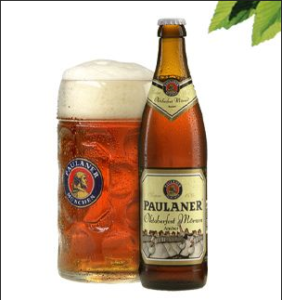
    Paulaner Oktoberfest Marzen

    Unfortunately, this is a German entity therefore we must concede the standard must be set by them.  Other well-known German brewers such as Spaaten, Warsteiner, and Becks all put their own version to market and none of them are bad.  As you can tell from what is once again, not my photo, Paulaner’s offering is copper in color, a nice light lager with caramel notes and a nutty finish.  It is lightly carbonated so it will not stop you from knocking back several liters at a time.  The only problem, as mentioned in the comments section at other dark corners of this website, German beer does not travel well, particularly lagers.  German Beer Purity laws may have something to do with that but even given the proviso that it may be a hair on the skunky side, it is still quite good.  Too bad we can’t all go to Germany. 3.8/5

    Since going to the source is not always feasible, that leaves us with the American Craft industry to pick up the slack.


    Left Hand Brewing Co. Oktoberfest – Longmont, CO

    As you can tell from what is once again, not my photo, Left Hand’s offering is copper in color, a nice light lager with caramel notes and a nutty finish.  It is lightly carbonated so it will not stop you from knocking back several liters at a time.  Yes, I just repeated what I wrote about Paulaner’s.  Am I really that lazy?  Perhaps, but repeating myself might be the best compliment I can make about it.  This is as good a copy you can get in the mountain west, and for many of us that is as good as it gets.  The reduced travel time and the Colorado snow met make this one slightly more enjoyable than waiting on the import to arrive. 4.0/5

    Tenaya Creek Brewery Oktoberfest  – Las Vegas, NV (Right)

    Another one I’ve had recently is from Tenaya Creek Brewery in Las Vegas.  Not as malty as I like but given its source it is also a fair bit lighter than the norm for this type of beer. If you feel the need to enter a drinking competition this might be a good choice. 3.5/5

    Goose Island Oktoberfest – Chicago, IL (Left)

    The next one is from Goose Island from Chicago.  It could just be the batch I got; this might have been bottled sometime the previous year and left in a warehouse somewhere in Phoenix with questionable climate control.  Whatever it is, this one should be better but it is not.  I want to give them the benefit of the doubt, but after briefly researching on ratebeer.com others seem to agree.  If you are in the area, please explain this if you like because I will not extend more mental energy to find out where they went wrong.  After all the definition of pizza in that town is apparently up for their interpretation.  My only regret is I bought a 12 pack. 2.5/5.

    San Tan Brewing Co. – Chandler, AZ

    The last one is a local (to me), from San Tan.  This is probably going to be discounted as bias but I will say my local offering is pretty damn good!  My pick for this genre is still from Left Hand out of CO but it stacks up well.  The biggest difference is the nuttiness in this one gives is a slightly thicker texture than Left Hand’s.  It could also be the local water, as it is notorious for its mineral content.  3.8/5

    Whether it is glass or ceramic, serve in a mug of some kind like above.  Bonus points if you have a boot.

  • What Are We Reading? September 2017

    SugarFree

    Finished the SPQR series by John Maddox Roberts. It stayed strong until the end of the books published so far in the series.

    To finally quiet the people demanding that I read it so we could discuss it, I read The Rise and Fall of D.O.D.O by Neal Stephenson. I don’t know what is going on with Stephenson anymore. D.O.D.O. is either a horribly-ended book (a Stephenson specialty) or the beginning of a series I’m not all that interested in continuing. It cribbed and remixed a bunch of different time-travel ideas from a bunch of much better books (most notably, The Doomsday Book by Connie Willis,) brewed it in a cauldron with a few characters that are either poorly-written or just uninteresting, poured it into an epistolary framework that did no one any favors and served the concoction indifferently as a competitor to far superior libations. A few interesting ideas flaccidly toyed with. Blah.

    I moved on to something I was more interested in, the new Charles Stross Laundry Files novel, The Delirium Brief.  Delirium Brief brings Bob back to the center of the action and a villian we thought long dead and mixes in the storyline from Mo’s stand-alone book, The Annihilation Score, and the serious political fallout from the events of The Nightmare Stacks. I get that Stross doesn’t want to write the same book over and over again–and I don’t want him to write the same book over and over again–but the mounting themes of middle-age ennui and marital strife are a drag, Chuck; “Less artsy, more fartsy” as Homer Simpson so eloquently put it.

    And then I got to the book I had been waiting for for a long time, the end of the Transformations trilogy by Neal Asher, Infinity Engine. For those who haven’t had the pleasure, Asher is just all science fiction high concept, wide-screen, technicolor blowshitupism. Unfolding from the events of Asher’s stand-alone novel, The Technician, the Transformation series covers one man’s war of revenge against an insane Artifical Intelligence implicated in a monstrous war crime of which he is the only known survivor. Complications ensue–wonderful, violent complications that involve vast swaths of the Polity universe, Asher’s playground for fifteen of his novels so far. My only complaint is a small one: the series is not a traditional trilogy and is best read as one long book published in three parts; it should have been one massive tome.

    Action-packed without being dumb, nuanced without being opaque, cosmic without disappearing up its own ass, Asher’s work is simply amazing. Read it. Read it now.

    Brett L

    I did my annual re-read of Taran Wanderer which is just about the most libertarian teen novel ever. If you have kids, or never got around to it, I highly recommend it. I also realized on this reading that I had long ago stolen a quotation from this book: “I’ve heard men complain about women’s work, and women complain about men’s work, but I’ve never heard the work complain about who does it.” I think my oldest is already tired of hearing: “the work doesn’t care who does it”.

    Then I read The Blade Itself, by Joe Abercrombie. Now maybe I’ve just completely burned out on the Sword & Sorcery genre, but I found this a completely inoffensive novel with some fun tweaks of the genre. And I have absolutely no desire to read the sequel. The once great kingdom has fallen to decadence, heroes are proven and gathered, and they are — at the end of the book, ready to set off on a Great Quest. That I don’t care about in the least.

    Old Man With Candy

    Besides the rather dull technical books that I love, I’ve been on an American writer kick. So to get myself out of that rut, I’ve returned to one of my favorite British writers, the one and only Eric Blair. Coming Up For Air was written and set in 1939 England, with the war about to engulf the island. It is structured as a memoir of a man who is living the proverbial life of quiet desperation and attempts to regain at least a small taste of the past. The wonderful thing about this novel is to see Blair becoming Orwell, with now-familiar motifs being presented in beta form. Absolutely delightful.

    Riven

    Well, I finished up the Sandman Slim series, or rather I finished reading all of the books that have been published. The end of The Kill Society would have been fine if there had been another book to pick up after it, but since that wasn’t the case, I was pretty disappointed. It was definitely not what I would consider a “real ending,” where most of the plot is wrapped up, nice and neat. I’ve heard it said that there will be more books to follow, and I do look forward to reading them. I’m hopeful the series will wrap at some point in the next couple/few books because I can’t stand when a series goes on long enough that it languishes. I have definitely enjoyed the ride, though. As I mentioned last month, I really dig the universe in which the story takes place. The fact that God and Lucifer are both just a couple of jerks, more or less, cracks me up, and all of the faith-based shenanigans and tomfoolery have been very entertaining, especially given my already tenuous grasp on the subject.

    I received two recommendations after I lamented the end of current reading material in the Sandman Slim series–one from HM and one from SF. Go ahead and guess who recommended which: The Skinner and Pimp: The Story of My Life. Usually I’m a one-book-at-a-time kind of woman, but I’m trying to read both of these at the same time. We’ll see how that goes.

    jesse.in.mb

    After last month’s WAWR I finished two more Audible audiobooks: Moby-Dick, which was 21 hours of unabridged audiobook…21 hours. I’m glad I’ve checked it off my list, but my interested waxed and waned quite while mainlining this over a few days. Much shorter was Octavia E. Butler’s Wild Seed. After chancing on a collection of essays and short stories, I’ve been not quite on a kick, but paying more attention to Butler. Her works are still fresh and different (Wild Seed came out in 1980) without being so unconventional as to be pretentious or jarring. I highly recommend.

    My Amazon’s Kindle First read was Soho Dead by Greg Keen. The novel was a light murder mystery in a seedy part of town and with seedy people who are trying to go straight.

    Marie Kondo, The Life-Changing Magic of Tidying Up: The Japanese Art of Decluttering and Organizing. So I found out that there’s a potential chain of events that might lead to me moving on short notice right before Christmas and I figured now would be the right time to read a book on debulking. My main exposure to Kondo’s books—and the KonMari method in general—has been the strong responses, both cultish fandom and revulsion to her method. I don’t know that I completely buy into her position but she has decent advice on clearing away the cruft in one’s life and her perspective on our relationship to our stuff is an oddly Shinto-inflected utilitarianism, which keeps things interesting. For those who like more pictures and less text there is now The Life-Changing Manga of Tidying Up: A Magical Story, which I’m half-tempted to read next.