Lazarus Long has sex with those girls. And probably that computer.
There is a Heinlein quote that often crops up in commentary by people around here. It comes from Time Enough For Love:
A human being should be able to change a diaper, plan an invasion, butcher a hog, conn a ship, design a building, write a sonnet, balance accounts, build a wall, set a bone, comfort the dying, take orders, give orders, cooperate, act alone, solve equations, analyze a new problem, pitch manure, program a computer, cook a tasty meal, fight efficiently, die gallantly. Specialization is for insects.
Something about it always bothered me, though for the longest time I was unable to pin it down. On the face of it, there is nothing there but a statement of a philosophical ideal. One that was given the corollary of “Self-reliance is Liberty” during a debate.
Much like the philosophical ideal of a hermit in his cave giving up physical comforts for spiritual comforts, it is one few actually attain. So why did it bother me? I finally figured it out. The issue is the last part “Specialization is for insects.” The quote itself takes the general philosophy of being well-rounded and self-reliant to the reductio ad absurdum limit and derides specialization. That was the irritant, the bombast and derision the quote taken alone carries. I think I might finally be able to articulate the key problem.
A Saxon churl was a self-reliant generalist. If there was anything that needed to be done around his farm, he was the one to do it, he had no choice. So he could do pretty much any task needed well enough to survive, albeit in a precarious state of slightly above subsistence farming. In every task, he was limited to the capability of his own two hands, and in most tasks rarely went beyond ‘good enough’ because there was other work that needed doing and he didn’t have time to waste. The one thing he had to outsource because he could not reach ‘good enough’ without devoting far too much time to the matter was blacksmithing. The skills and tools required to reach just ‘good enough’ were quite an investment in time and capital and it was not the rational choice for most churls to invest in. Especially since one smith could supply a goodly number of farms with the ironmongery they needed. Thus you had specialists. It is just one example of a pattern that repeats every societal development starting from the birth of agriculture.
There is a very simple reason specialists emerge and proliferate. The market in of itself incentivizes specialization. A specialist will always be more efficient on a marginal basis than a generalist in performing the same task. So the specialist will produce for the same effort a higher quality output, and often in less time. Thus specialization proliferates, and people drift away from churldom towards their own niche in a larger society.
This does not invalidate the ideal of being capable of handling tasks normally handed off to specialists, but it does strain the “Specialization is for insects” assertion. I know the principles and procedures on how to process an animal carcass, but I’m terribly slow, so the rational choice is to let the slaughterhouse handle that most of the time. I have enough basic woodworking skill to frame and erect a simple building, but it would never be as plumb and square as one put up by a professional carpenter. I know enough to be able to build computers from parts and design my household network. This I do because it is a very basic task within my specialization.
Now I can see a counter-argument that the quote is more about being a well-rounded person and insect specialists are incapable of even knowing the principles of other specializations. But it does not sound that way to me. Also, I can see how it might sound as if I am looking down upon those who strive for self-reliance as a principle. This is not the case. If you are able to live by your principles on such matters, I respect that. But, much like the townsfolk walking past the hermit’s cave, I could not live that way. I am a specialist because rational choices led me down that path.
There is a city in the US that has not had a Republican mayor since 1962 and no Republicans on its city council since 1994. Not surprisingly, this city is a beacon of prosperity and a shining example of the triumph of progressive public policy. I am speaking, of course, of Detroit.
Detroit did everything right: they have a high minimum wage, a large and well-paid public sector workforce, strong unions, high education spending, and a tax system that makes sure the rich pay their fair share. Is it any wonder that Detroit has the lowest rates of poverty and unemployment in the nation?
Detroit’s strong gun laws have also made it America’s safest city. It has the lowest homicide and crime rate of any city in the country. Detroit’s high education spending has led to it having the nation’s lowest high school drop-out rate, as well as the lowest rate of illiteracy. For these reasons, people have been flocking to Detroit and its real estate market is booming. This teeming metropolis is also a bastion of racial harmony with its many mixed neighborhoods.
The city’s car factories are thriving as well, thanks to the UAW, which helped make GM America’s top exporter. In 2008, GM did so well that it donated several billion dollars to the government to help pay down the national debt. Detroit itself is debt free thanks to the sound fiscal policies of the Democrats.
Other cities and states have decided to follow Detroit’s example. California has been booming ever since it enacted Detroit’s policies. People continue to flock there away from poorly-governed Republican strongholds like Texas.
Despite Detroit’s obvious success, many are reluctant to try the winning formula. So in the next election, remember to vote only for progressives. A vote for progressives is a vote for a strong middle class, good education, and low crime.
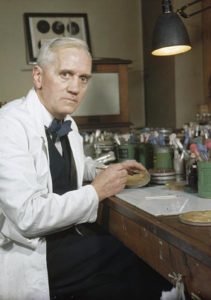
This week saw the sale of furry bit of history at auction: a glass disc containing a sample of Dr. Alexander Fleming’s original penicillin.The final sale was $14,600, which seems astonishing considering Fleming was a shameless self promoter. According to the AP:
The Scottish-born doctor likely made at least dozens of such mold mementos, derived from his original sample of the fungus.
and
[Matthew Haley, director of books and manuscripts at the auction house Bonham’s,] noted that other bits of mold were given to Pope Pius XII, Winston Churchill and Marlene Dietrich, perhaps in an effort to cement Fleming’s legacy as the discoverer of penicillin in 1928.
Sounds a bit like splinters of the one true cross for the modern age. Hats off to the hairy scientific discovery that ushered in a new age of medicine and all that.
Example of a Fleming mold disc with usage rights we could afford.
I know you’re all disappointed that this link isn’t full of naked otters (work unfriendly) or something like that.
In May 1907, Timothy D. “Big Tim” Sullivan, a key leader in the powerful Tammany Democratic organization in New York City, spoke to a reporter from the New York Herald. “Help your neighbor, but keep your nose out of his affairs,” said Big Tim, seemingly libertarian-ly.
Timothy Sullivan
The former New York state legislator, who had recently resigned from Congress but not from his role as Tammany power-broker, wasn’t actually endorsing libertarianism. He was talking about his no-questions-asked policy of distributing charity to the poor who lived in the Bowery district – poor people whom the Democrats relied on to get elected and re-elected. Sullivan held an annual daylong summer extravaganza of food and entertainment for grateful voters and their families, and an annual Christmas dinner, too, plus clothing giveaways. He literally bailed out people who got in legal trouble, and helped job-seekers get employed in government or the private sector.
A businessman who had ownership interests in saloons and theaters, Sullivan probably chipped in some of his own money for his charitable efforts. But he didn’t have to rely solely on the contents of his own pocketbook. Sullivan took a “regulate and tax” approach to gambling, liquor, and other kinds of vice – if by “tax” you mean payoffs to himself and his friends, plus help for his poor constituents.
Often charged with being “King of the Underworld,” Sullivan denied it. He particularly denied shaking down prostitutes. At one point, in order to forcibly, as it were, rebut the allegations, Sullivan’s people raided some brothels and beat up some pimps.
Sullivan was even more enthusiastic about practicing violence against Republican poll-watchers. To take one example: when political reformer William Travers Jerome in 1901 threatened to employ poll watchers in Sullivan’s territory, Big Tim told the press: “If Jerome brings down a lot of football playing, hair-mattressed college athletes to run the polls by force, I will say now that there won’t be enough ambulances in New York to carry them away.”
And if Big Tim had to recruit from the criminal underworld to accomplish his dirty work, he would do so. As Professor Daniel Czitrom put it: “The Sullivan machine occasionally employed rival gangs for strong-arm support at election time, especially during the rare but bruising intra-Tammany primary fights. The largest and most notorious of these were the Jewish Monk Eastman gang and the Italian Paul Kelly Association, whose bitter feuding sometimes exploded into gunfire on Lower East Side streets.”
Shortly after Sullivan gave his comments about keeping one’s nose out of people’s affairs, a prestigious Quaker school in Washington, D. C., held its graduation ceremonies. Friends School, as it was known, was presided over by the husband-and-wife team of Thomas and Frances Sidwell, after whom the school would later be renamed. The graduates were to be addressed by a very important, albeit non-Quaker figure: President Theodore Roosevelt, whose son went to the school (Roosevelt, incidentally, was an old adversary of Sullivan’s).
While waiting for Roosevelt and his wife to arrive, the graduation crowd listened to a Friends School alumnus and Harvard graduate, who had studied in Berlin and Vienna to be a professional violinist and now shared his talent with the audience with solos by Vieuxtemps, Elgar, and Bazzini.
The violinist, Fitzhugh Coyle Goldsborough, was from a Southern family as distinguished as his name sounded. His doctor-father had financed his education and was probably relieved that Fitzhugh seemed to have settled down to a regular job. Fitzhugh’s sometimes strange and disturbing behavior made him unpleasant to have around the family home.
President Roosevelt arrived and gave his speech. Goldsborough remained during the speech, as we know from a photograph of the event showing the violinist standing on the President’s right. A later search of Goldsborough’s notebook showed the violinst describing the Rough Rider as “An example of evolution from Politics to Barbarism,” but despite this, perhaps Goldsborough found something in Roosevelt’s speech worth listening to. Roosevelt gave a version of one of his favorite speeches, “The American Boy” (the graduating class had a handful of girls as well as boys). Roosevelt proclaimed: “When a boy grows up, I want him to be of such a type that when somebody wrongs him he will feel a good, healthy desire to show the wrongdoers that he can not be wronged with impunity.”
With these not-fully-Quakerish sentiments echoing in their ears, the graduates, the President, and Goldsborough went their separate ways. Goldsborough got work playing first violin for the Pittsburgh Orchestra. He had undeniable musical talent. But he was not a talented poet. This was unfortunate, since Goldsborough insisted on reading his poetry to other members of the orchestra. His colleagues put up with it, until one day a fellow-musician said that Goldsborough’s poetry was terrible. Goldsborough broke his violin over the other musician’s head.
[insert “sax and violins” joke here]
Soon after this, in 1910, Goldsborough left Pittsburgh, explaining everything in a brief note so that nobody would worry: “The Pittsburgh smoke has driven me crazy. You will never see me again.”
David Graham Phillips
On January 23, 1911, around New York City’s Gramercy Park, the novelist David Graham Phillips was taking his regular walk in the high-toned neighborhood. Phillips was a “muckracker,” a term coined by President Roosevelt to describe writers like Phillips who focused on corruptions and abuses in society. Phillips had written several novels denouncing political abuses, and he had also written a novel of manners, The Fashionable Adventures of Joshua Craig, mocking the upper crust.
One of the young ladies in the Joshua Craig novel was described as follows: “To her luxurious, sensuous nature every kind of pleasurable physical sensation made keen appeal, and she strove in every way to make it keener.” Someone had recently been bombarding Phillips with letters complaining that this character was a satire on his (the correspondent’s) sister. This was not true, and Phillips had rightly concluded that the letter-writer was a nut, but what Phillips didn’t know was that the letter-writer had taken up lodging nearby in order to stalk Phillips and seek “revenge.”
And now the letter-writer, Fitzhugh Coyle Goldsborough, was coming up to Phillips, shooting the novelist and then himself. Goldsborough died promptly; Phillips died the following day.
Phillips’ murder was quite helpful to a bureaucrat named George P. LeBrun, a gun-control zealot who got together a coalition for a more restrictive firearms law. LeBrun recruited a committee consisting of John D. Rockefeller and other bigshots – the committee called itself the Legislation League for the Conservation of Human Life, of which LeBrun became secretary.
To sponsor the gun law, LeBrun recruited Big Tim Sullivan, who by this time was back in the state Senate. Sullivan, who now represented in the Lower East Side, piously told LeBrun about the need to stop murderous gang rivalry. (Cynics to this day suggest that Sullivan wanted a legal weapon to keep his allies well-armed while disarming his adversaries, but what possible basis can there be for such a supposition?) Sullivan took the floor on behalf of his bill, which would require permits for concealable guns. The legislature voted with Sullivan and the bill became law.
LeBrun credited Phillips’ murder: “Four shots fired by a maniac caused me to become the father of the Sullivan Law…” This law, of course, restricts the arms-bearing rights of perfectly sane people. Unless they have connections, like Big Tim Sullivan’s allies.
The New York Times reported Sullivan’s reassurances: “Senator Sullivan said that householders and business men who desired to keep weapons in their homes and places of business as a measure of protection would not be inconvenienced by the new law.” As reported in the Times, Sullivan was sure of the law’s constitutionality because he had “consulted a Supreme Court Justice [i. e., state trial judge] in preparing it.”
This justice may or may not have been the retired judge – and Tammany ally – Roger A. Pryor, who in an interview with the Times assured the reporter that the law was constitutional, because the state of New York did not have to obey the Second Amendment – “it is settled by uniform adjudication that [the Second Amendment] is a limitation on the authority and power of the Federal Government only….Senator Sullivan is entirely right and his critics are all wrong.”
Judge Pryor had certainly come a long way since that April day in Charleston harbor half a century before, when he and others discussed whether to fire on Fort Sumter…but that is a story for another time.
As for Sullivan, he was elected to Congress again in 1912, but went mad, and died mysteriously in 1913.
Commencement Exercises and President Roosevelt’s Address, May 24, 1907. Friends School, Washington, D.C.
Richard C. Cortner, The Supreme Court and the Second Bill of Rights: The Fourteenth Amendment and the Nationalization of Civil Liberties. Madison: University of Wisconsin Press, 1981.
Daniel Czitrom, “Underworlds and Underdogs: Big Tim Sullivan and Metropolitan Politics in New York, 1889- 1913.” The Journal of American History, Vol. 78, No. 2 (Sep., 1991), pp. 536-558
Friends’ Intelligencer, Sixth month [June] 8, 1907, p. 366.
George P. Le Brun, as told to Edward D. Radin, call me if it’s murder! New York: Bantam, 1965, pp. 69-77.
Socialism, like the ancient ideas from which it springs, confuses the distinction between government and society. As a result of this, every time we object to a thing being done by government, the socialists conclude that we object to its being done at all. We disapprove of state education. Then the socialists say that we are opposed to any education. We object to a state religion. Then the socialists say that we want no religion at all. We object to a state-enforced equality. Then they say that we are against equality. And so on, and so on. It is as if the socialists were to accuse us of not wanting persons to eat because we do not want the state to raise grain.
― Frédéric Bastiat, The Law
Bastiat’s words have been quite obviously true from the day he wrote them, but the socialists and statists of today have laid bare their complete inability to distinguish between society and the State. The Orwellian newspeak of the modern left has rendered the distinction between the public sphere inhabited by the State and the one inhabited by culture difficult to describe. One example highlights an old semantics battle fought and won by the left. Over a decade ago, 17 year-old me struggled with the question posed in civics class: “What is the difference between civil rights and civil liberties?” A quick flip in the dictionary to “Civil Rights” yields this answer:
Personallibertiesthatbelong to an individual,owing to his or herstatus as a citizen or resident of a particularcountry or community.
Another quick flip to “Civil Liberties” yields this answer:
rights or freedoms given to the people by the First Amendment to the Constitution, by common law, or legislation, allowing the individual to be free to speak, think, assemble, organize, worship, or petition without government (or even private) interference or restraints. These liberties are protective in nature, while civil rights form a broader concept and include positive elements such as the right to use facilities, the right to an equal education, or the right to participate in government. (See: civil rights)
Needless to say, the competition this question was based on didn’t go well for me. However, this question has stuck in my head for years. It wasn’t until studying 14th Amendment jurisprudence in law school that the answer dawned on me. There is no difference between civil rights and civil liberties . . . but there was!
In the original formulation of the 14th Amendment, the politicians and thinkers of the time split rights into three relevant categories: civil, political, and social. Civil rights were what we would recognize today as negative rights (1st Amendment, etc.). Political rights are those limited positive rights (voting rights, etc.) that are focused on the procedural aspects of running the government. Social rights are recognized as positive rights (no private discrimination, welfare, cultural identity, etc.). However, this all seemed foreign to somebody like me who had no exposure to these classic definitions. Today, they are all lumped together as civil rights, giving us libertarians no easy “handle to grasp” when discussing these issues. It would be an easy mantra for us to say “legislate civil rights, not social rights,” but the phrase has no meaning to a modern audience.
Reflecting back on Bastiat’s quote from The Law, it is clear that libertarians have just as difficult of a time separating society from the State as statists do. Many times we jump to the conclusion that the only hurdle for “goodness” or “morality” is that something should not be legislated against by the State. We’ve all heard the slur that libertarians are just libertines. Many libertarians take a weak stance (if any at all) against encroaching cultural changes. Some even hold open disdain toward participation in the “Culture War.”
This is exactly the wrong tactic to use in defense of liberty. While the abstaining libertarians spend their time and effort staying “above the fray,” the Culture War wages on beneath them, dragging them further and further away from their end goal. Prominent libertarian thinkers sprint full-speed, grasping and lunging for the elusive Libertarian Moment. All the while, they’re stuck on a bullet train headed straight for Statist Station. Without addressing the elements of our society most hostile to liberty, any handful of progress made will be fleeting, meaningless, and overwhelmed by the dump truck load of totalitarianism that has accumulated in the same duration.
Andrew Breitbart observed that politics is downstream from culture. I believe this to be very true. The statist shift we have seen in the last 100 years isn’t because politicians have tricked well-meaning citizens into supporting growth of the State. The cause and effect is flipped. Our culture has created these politicians. Only when we internalize this can we understand the importance of the Culture War. Libertarians will be nothing until we engage in evangelism, organization, disruption, and institutional control to the level that the Progressives have for the last 100 years. No standard libertarian disclaimers apply here. We need to seize the positions of power for our culture, and we need to exert our influence on society.
This feels dirty and unlibertarian. It feels downright statist. However, this is because the line between society and the State has been so blurred. We can influence culture without abandoning our principles. Usually, this is where libertarian thinkers fall flat on their face. In courting the libertarian feels, they’ll say things like: It’s as simple as challenging somebody when they mindlessly spout off about how “there should be a law!” It’s as simple as giving a few dollars to a liberty-loving non-profit that supports victims of the State. It’s as simple as teaching your children to view government with a healthy skepticism.
If the last 100 years have taught us anything, it’s that winning back liberty isn’t that simple. Liberty loving individuals aren’t ones to use the Alinskyite playbook to get our way, but we’ve been eaten alive for a century. It’s time to ratchet things up. We need to establish the organization and infrastructure required to mount a counter-assault against the Statist-held institutions of society and the State. We need to organize on local levels to make sure that things like unfair zoning, over-restrictive HOAs, and abusive eminent domain are met with protest. We need to establish a cost-effective alternative to the public indoctrination centers so that families aren’t forced to choose between sending their kids to a daily Progressive church service and having enough money to eat. We need to offer entertainment and news that is completely detached from the legacy media, especially their agenda-setting powers. We must cover events that actually matter rather than the ones personally groomed by Statist elites. We must free the studies of history, economics, and philosophy from the shackles of postmodern leftism by better promoting libertarian academicians.
The answers to many of these problems are not imminently forthcoming, but putting our fingers in our ears and chanting “shouldn’t be illegal, not my problem” is going to lead to only one place. . . totalitarian ruin. It’s not only okay for libertarians to wade into the Culture War, it’s necessary. If we don’t, we’ll wish we were only as irrelevant as we are today. Only, we won’t have the words to describe what happened.
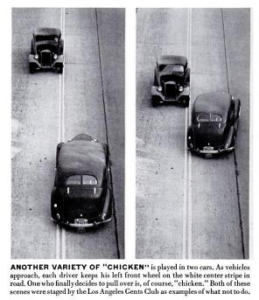
Florida Man? Pshaw! Alabama Man, not to be outdone by his panhandly (it could be a word) neighbors, decided it was a good idea to play chicken at 4:00 am. His son, rather than talk him out of the plan, decided to participate in the festivities.
This is not how they did it.
An Alabama father and son were killed in a head-on collision with each other on Saturday morning, police said.
Police said that alcohol was a factor in the crash that killed Jeffrey Morris Brasher, 50, and his son, Austin Blaine Brasher, 22, but they are continuing to investigate.
The crash occurred at around 4:10 a.m. when the 2006 Ford pickup the Brasher was driving collided with his son’s 2004 Chevrolet pickup, according to police.
Neither Brasher was wearing a seatbelt, according to reports.
A divided people are more easily conquered. The Imperialist European powers were well aware of this and commonly drew borders in their overseas colonies to encompass competing indigenous peoples so that those groups would fight with each other and not the conquering Europeans. Additionally they gained political capital by putting themselves in the position of arbiters of the disputes and alleviators of grievances for those indigenous people. The political left in the modern United States is also well aware of this strategy.
Their most powerful weapon today is identity politics and the trump card in that deck is racial identity. They actively and deliberately fan the flames of racial animus and stoke grievances among minority populations. By playing the part of arbiters and alleviators they gain loyal voter support of minorities and by cobbling together a number of those minorities seek to gain a majority. They use the threat of labeling one a racist as a gag for those that disagree with them. The problem of course is that it is injurious to our society and culture to set a common people against themselves. Fortunately it appears to be a failing strategy of late yet they are doubling down on it.
They have targeted every minority but the primary recipients have been Blacks. Until recently Black Americans were the largest minority in the United States. Constant reminders of the history of slavery, of real and imagined grievances, and relegating them to second-class citizenry have divided our country politically along racial lines. Over time and with great effort many of the rifts between Black America and the rest of the country had largely healed but they are intent on re-opening those wounds. Their post-racial America looks more like the mid-nineteenth century than the early twenty first.
My own children belong to groups of friends that include mixed couples and members of all races, including a number of Blacks. In their direct experience those rifts don’t exist, but ask them about it and they can tell you all about the ignus fatuus that animates their politics.
The left has actively and deliberately perpetrated resentment among the races for their own political gain successfully for decades. Many of them focus exclusively on that goal and profit handsomely from it. In order to do this they necessarily must cast away the very foundation of liberty – self-ownership. Self-ownership does not tolerate the assignment of collective guilt – that some are guilty of the sins of others. Personal responsibility is an anathema to those pushing to redistribute wealth from the descendants of slave holders to the descendants of slaves. No members of either group are victims or perpetrators and one of those groups barely exists at all.
Their assignment of guilt is built on the absurd assertion that one is guilty of acts they neither performed or had any hand in deciding. The inevitable conclusion of the assertion that whites are guilty by mere virtue of their skin color, something they can cannot decide or change, refutes the agency of a large portion of the human race. Simply put it is the very dehumanizing bigotry that gave rise to slavery in the first place.
How then to remedy this? What would be enough? If mere whiteness is guilt then nothing will ever be enough because we cannot change the past nor can anyone change their skin color. The repugnant answer to that question can only be total theft and extermination. Their answer is not to end oppression but to have the oppressed and oppressors exchange places. The morality of our society would decay to the primitive.
The most grotesque aspect of this strategy is that the very premises of it are smoke. Racial differences are will-o-the wisps and focusing on them distracts us from solving real problems. It deprives all of us of the benefits of solidarity with our fellow countrymen. It wastes vast amounts of human potential. It creates unnecessary strife and poverty.
The first step in solving this problem is to identify the problem. What if it turns out the problem is not a problem at all. That in a calculated way the left has manufactured straw giants and murky definitions which is a much bigger problem than race or class?
See that Black dude over there? We have a common humanity. He isn’t a Black dude. His name is John and he is my countryman. So I ask you what does race mean?
Without modern mechanized methods of farming it is necessary that humans hands perform that labor. That doesn’t mean mass human labor is necessary to become wealthy; without sophisticated machinery, daylight to dark toil is necessary just to have enough to eat. This economic reality gave rise to forcibly capturing people and coercing labor from them. It goes by the common name of slavery and it was universally practiced by all cultures on earth at one time. It was seen as a normal practice and though everyone would object to becoming a slave, neither slave nor master objected to it as an institution. It was just considered the way things are. As technology advanced and our means for creating wealth became greater, the need to co-opt the labor of others lessened. With the spread of the ideas born of the Western Enlightenment slavery quickly became regarded as less the way things are and more the way things should not be. It is now rightly reviled by Western Civilization, but in many ways its shadow hangs over us. The cost of slavery was high in lives and in moral currency. Slavery debases not just those held but the slaver as well. Slaves are deprived of their freedom and the slaver of his humanity. The stone age indigenous peoples of the Americas could not be successfully enslaved. The kind of confinement and structure it required was so alien to them that they simply died when it was imposed on them. The solution was, of course, to replace them with Africans. The slave trade was as old as time in Africa and still thrives today. Europeans desperate for labor in their new colonies eagerly stepped into that market.
I live in the deep south. The Antebellum plantations that pepper my state mostly operate as tourist attractions these days. A few are still profitable as farms but tractors perform the backbreaking work, not humans. If you drive the River Road between Natchitoches and New Orleans, braving the stifling heat and humidity to tour some of these vast forerunners of modern industrial agriculture, you will get an idea of what a monumental struggle it was to produce wealth in the wild and expansive Mississippi flood plain. If you have ever worked in agriculture, your experience will give you a better idea of the scale of the superhuman effort that required.
Of the 12-13 million Africans brought to the Americas as chattel, only a small fraction, some 400,000, were transported to the United States. Right from the start, this practice was controversial. Western European culture was more enlightened than any on earth at the time. The idea of individual liberty blossoming here and the glaring conflict that holding men as property presented with liberty was…I won’t sugarcoat it… problematic to say the least. Charles Carroll, signer of the Declaration of Independence, summed up the prevailing opinion nicely when arguing against slavery “Why keep alive the question of slavery? It is admitted by all to be a great evil.”
In the United States, the slave trade was somewhat unique in that it had strong racial overtones. Everywhere else, a person’s race had little to do with slavery. Historically, slavery was an equal opportunity employer. The slaves here, aside from those held by the indigenous people, were exclusively Africans. The feeble justification was that blacks were inherently inferior, that exposure to western civilization would improve them and advance their race.
That evil practice was ended and not just by the advent of modern machinery and cheap energy or the dawning of a new morality. The intractability of those advocating for slavery eventually had to be overcome with powder and shot. The scale of that destructive war, both in lost property and blood, exceeded anything up to that time and every war after it until WWI. With that the barbarism of enslaving human beings was extinguished in the United States.
Still, the ghost of slavery haunts us all. The advent of 1863 saw President Lincoln signing the Emancipation Proclamation, and after the war he attempted to repatriate those who had been enslaved by birthing the nation of Liberia on the west coast of Africa. Still, there are remnants of that ghastly practice with us. The gussied up corpses of those plantations are still here. Driving south from Alexandria on the old Baton Rouge highway, you will see cabins that housed slaves still standing, now housing renters. The fields and orchards are still here, worked by the relentless plodding of tractors.
At the end of the Civil War, the vast majority of those that had failed to perpetuate a primitive and outdated economy gathered what they could in wealth and property, fleeing to lands more amenable to their culture. The war had brought to a head the animosity between the conflicting cultures of enlightenment with primitivism, so they slipped away from the wrath of the victors. They would have been fools to stay and dead ones, at that. Anyone curious enough can travel to remote towns in various Latin American countries and find bizarre places where Antebellum America still lives, places where those seeking to escape revenge found a refuge to perpetuate that way of life.
Despite the reminders around us, are those ghosts really ours? There is not a person alive in the United States today who has been held in bondage, nor a person alive today who has held another in bondage. Though the struggle was great, every descendant of slaves today enjoys equal standing before the law, on paper anyway, to every other citizen. Those that care too often thrive on equal footing with every other ethnicity.
The vast majority of the white population here does not even have ancestors who held slaves. I can trace my own family back to the late seventeenth century in the Americas, and not one of those individuals held slaves. On my mother’s side, there are only abolitionists, and on my father’s side, no one wealthy enough to afford the purchase of slaves. The majority of white Americans are descended from immigrants that arrived on these shores after slavery was abolished. This is the most common legacy of white Americans today.
In history, the United States is remarkable in the social and cultural progress it has achieved. In less than 200 years, we progressed from a culture that more resembled the old world order, to one that is most unique, one that holds liberty and the sovereignty of the individual above all else. Our founding principles allow us to cast off the yoke of history and forge ahead to new, better cultural ground. In many ways we have dragged the rest of the world with us, though they still have some catching up to do.
These days, my old bones are more comfortable at home. I prefer good food, a warm fire, and, most of all, the company of my wife; but this was not always the case. I have travelled to many places in the world, and one of the things that struck me was the racism and tribalism outside of the U.S. The perception of the U.S. by the rest of the world of America as a country eaten alive with racism, appears to me to be projection. Racism as it exists here in America is mild in comparison to the rabid, virulent racism almost everywhere else.
Why, then, we still struggle so much with the question of race is an interesting and important question. Go ahead, give it your best shot.
Beggs, who reached the state tournament after two opponents forfeited, was dogged throughout the tournament by questions about whether his testosterone treatments made him too strong to wrestle fairly against girls.
The University Interscholastic League, which oversees athletics in Texas public schools, enacted the birth certificate policy Aug. 1, 2016. And while Beggs’ family has said he wanted to compete against boys, UIL deputy director Jamey Harrison, who refused to address Beggs directly, said the UIL had not received a request to change divisions from any athlete at this competition.
Girls Wrestling Champion
In a twist of irony, The above story was reported on the ESPN W outlet rather than the main site. ESPN W, which ostensibly caters to women, does not have commenting in its articles. ESPN’s main site permits it. To my recollection, it’s the first article about an athlete referred to as male throughout to appear on the “W” site. I’m sure its a coincidence
Meanwhile, the Washington Post article had commenting on and the responses largely derided Beggs being able to compete against athletes who are banned from taking the same performance-enhancing drugs Beggs is mega-dosing on in order to deliberately change body structure.
USAToday had the comments turned off for their story, which said there were “a smattering of boos” amid mostly cheers. Which is a departure from the WaPo pice which hilariously led with the words “booed and bloody”. Now perhaps Kent Babb had some insight into Beggs’s monthlies (if he’s still having them while taking mega-dowses of male hormones, I don’t know) that gives him license to use “bloody” in a description of someone that looks like they barely broke a sweat while competing against a series of opponents that are physically inferior to him in every way. Perhaps his editor added it in for color. And perhaps Babb is just full of it. Either way, no blood was visible and there were more cheers than boos.
But WaPo and other outlets have gotta fight for Team Trans rather than report honestly. After all, if just the fact were reported here: “a person taking doses of steroids that nobody else in a competition designed for females is able to take under the rules, wins the competition without breaking much of a sweat”, I’d imagine the reactions would be quite consistent.
Of course, the self-proclaimed “worldwide leader in sports” doesn’t want your reaction to be heard anyway.
A decade before her father became POTUS, Ivanka hit the town wearing an extended chinchilla family and Jezebel noticed (click through for some vintage Jezebel comments). More recently The Daily Mail tells us that PETA blasted her for using real rabbit fur for the pom-pom on a cable knit cap available for $22.97 at Nordstrom Rack (originally $45 at Nordstrom’s non-outlet locations). The Daily Mail also notes:
Fur may be murder but it looks warm
And while this particular piece does feature a ‘genuine rabbit fur’ pompom, the vast majority of Ivanka’s line is made with animal-friendly faux fur.
Well at least there’s that!
Who wore it best?
Congrats everyone you survived the inaugural Fur Friday! Come back next week for scantily clad PETA models, furries, bears or pictures of me doing barely-dressed mold remediation. The possibilities are ENDLESS.





 If the last 100 years have taught us anything, it’s that winning back liberty isn’t that simple. Liberty loving individuals aren’t ones to use the Alinskyite playbook to get our way, but we’ve been eaten alive for a century. It’s time to ratchet things up. We need to establish the organization and infrastructure required to mount a counter-assault against the Statist-held institutions of society and the State. We need to organize on local levels to make sure that things like unfair zoning, over-restrictive HOAs, and abusive eminent domain are met with protest. We need to establish a cost-effective alternative to the public indoctrination centers so that families aren’t forced to choose between sending their kids to a daily Progressive church service and having enough money to eat. We need to offer entertainment and news that is completely detached from the legacy media, especially their agenda-setting powers. We must cover events that actually matter rather than the ones personally groomed by Statist elites. We must free the studies of history, economics, and philosophy from the shackles of postmodern leftism by better promoting libertarian academicians.