This is sloopy’s mandatory link, I had hoped to replace it with “How many days since Indiana beat Ohio State” and link to a very small number, but then the second half happened.
Last weekend had some amazing games. And no, I don’t want to talk about the last one. This weekend won’t live up to it, but I could be wrong. That is why they play the games.
Dubious Rivalry of the Week
Buffalo @ Army, West Point, NY
It’s the battle for NY state, except that part that Syracuse controls. Buffalo leads the series 3-2.
Tailgate of the Week
This is what happens when someone who doesn’t follow sports “helps.”
Rice @ UTEP, El Paso, TX
This is Rice’s second trip to tailgate of the week, possibly because they are a nice side dish.
Sun Bowl Stadium is carved out of the rocks in El Paso, creating a free upper deck for fans willing to climb the hills. And this section comes with special amenities you don’t find in most stadiums.
Auburn and Clemson are the exact same school. The only way to tell them apart is to see if you can spot the lake. If so, you are in Clemson.
The all time record is a surprisingly unbalanced 34-14-2. I would tell you who leads the series, but it really doesn’t matter as most of the games were played before 19-dickety-4. Since Nixon’s reelection, they are an even 3-3.
I will point out that my choice last week was much better than the overhyped snooze fest that was being hyped by everyone else.
Top 25
The “bug” last week was not in my software, but one of my orphans screwed up the data entry. A few beatings took care of that and way are back to normal.
Vandy leads the all time series 14-3, winning the first 12 between 1915 and 1956. MTSU followed with a 3 game win streak from 2001 to 2005 before the Commodores won the last 2 years. This will only be Vanderbilt’s 3rd trip out to the suburbs, as most of the series has been played in Nashville.
Tailgate of the Week
LSU vs BYU, Houston, TX New Orleans, LA
This game has been moved due to sloopy spilling a Big Gulp outside his home, or something like that. Speaking of sloopy, here is my required link: [insert atrocity here]
Never bet against LSU on the tailgate. They know what they are doing. And now they are doing it on relatively home turf. On the other side, a BYU tailgate sounds awful. So hang out with the LSU guys.
Beer: Dixie got wiped out by Katrina and has been struggling along contract brewing since. The Saints owner has recently bought them and is rebuilding in New Orleans. Drink a Blackened Voodoo to celebrate.
Booze: Hurricane
2 oz light rum
2 oz dark rum
2 oz passion fruit juice
1 oz orange juice
Juice of ½ lime
1 tbsp simple syrup
1 tbsp grenadine
Shake over ice, strain into Hurricane glass. Garnish with fruity bits.
Game of the Century of the Week
West Virginia vs Virginia Tech, Landover, MD (Sunday)
What, you were expecting something else? This game will decide once and for all which is worse: West Virginia or Western Virginia. Let the redneckery begin!
Homer section, with bonus history
Georgia Tech vs Tennessee, Atlanta, GA (Monday)
This is a neutral site game, no really, stop laughing. It will be the first real game in the new Mercedes Benz Stadium downtown. The Falcons have played an exhibition and there has been soccer and I understand some lower division teams are playing there on Saturday, but those don’t count.
Bobby Dodd was a QB great at UT under coach General Neyland, for whom their stadium is named. Bobby Dodd coached at GT from 1945 to 1966 and continued as AD after that. And our stadium is named for him. His long running feud with Bear Bryant led directly to GT leaving the SEC and foreshadowed oversigning arguments of today. As AD he nearly destroyed GT athletics, but in retirement he made one final great decision. In 1986, Coach Bill Curry was offered the Alabama job and asked Dodd (who he had played for) for advice. Dodd told him to take the job. This led directly to Tech winning the national title in 1990 and Alabama sliding into a tailspin. One last dagger into the Bear!
Nothing really changed with the Top 25 with so few games, will update it next week. Plus, I think I found a bug in it.
It isn’t the real start of the season, that is next weekend. But there are five games being played this weekend in FBS, so might as well get started. Like the short week itself with a lack of interesting games, this preview is mostly dull, too. It will get better next week, honest.
Rivalry of the Week
Hawaii @ UMass, Amherst, MA
These border states (I am standing by it. If you go the correct Northwestish angle from Hawaii, the next state you hit is MA) have played a total of **ONE** time previously, with Hawaii winning 46-40 in 2016. Stubhub has seats starting at $15, so you better get on it.
Tailgate of the Week
Stanford vs Rice, Sydney, AU
Kangaroos, Koalas, Drop Bears, and college football. This location has everything you would expect from an opening weekend. Stanford and Rice kick off their seasons in the land of poisonous beasts and plants. My understanding is that normal college football rules will be used in the 1st and 4th quarters, but Aussie rules will be used in quarter 2 and Rugby League rules in quarter 3.
Rice leads the all-time series 3-2, but Stanford has won the last two, dating back to 1964.
Brewpub: Redoak Boutique Beer Café looks like a good spot to hit before or after the game, but I will let our locals throw in their two cents? pence? pesos? worth.
Booze: The 1778
50ml Gin
10ml Apple Schnapps
30ml Wild Hibiscus and Rosella Syrup
10ml Lime Juice
1 Finger Lime, Muddled
Wattle
Chill a martini glass with ice.
In a mixing glass, muddle finger lime. Fill with ice then add all ingredients and stir until chilled. Discard ice from martini glass. Fine strain the mixture into Martini glass. Garnish with wattle. What the hell is a wattle? The chicken neck thing?
Wattle?
Game of the Week
Oregon St @ Colorado St, Ft Collins, CO
There are only five FBS games this weekend, so this is the best I can do.
Not that anyone cares, but the series is tied at 1-1, with the last game played in 1975.
Methodology: The rating is calculated assuming that the team in question (let’s say, LSU, for this example) wins the rest of their games. Which, at this point, means they go undefeated, but the rest of the games go according to projections (the projections are just based on end of 2016 rankings). The rating numbers of these hypothetical undefeated teams are then used to compute the rankings. So, at this point, it is basically a ranking of Strength of Schedule. As the season goes on, future schedules will become less important and results of games actually played will become more important.
“One cannot legislate the maniacs off the street … these maniacs can only be shut down by an armed citizenry. Indeed bad things can happen in nations where the citizenry is armed, but not as bad as those which seem to be threatening our disarmed citizenry in this country at this time.” -Jeff Cooper
“Hear the sum of the whole matter in the compass of one brief word — every art possessed by man comes from Prometheus.” -Aeschylus, Prometheus Bound
Disclaimer!
I am NOT AN EXPERT. Any information provided below should be considered inaccurate until verified by trusted resources. When it comes to working with firearms, and especially reloading, there is an inherent risk of death or serious injury. If you are interested in taking the next step; please educate yourself and consult manufacturer data, standards bodies (http://www.saami.org/), and qualified experts such NRA-certified instruction and/or various educational organizations.
Overview
This article consists of two parts.
The first installment will cover background information to inform how to apply the mechanics of firearms and ammunition to successful handloading.
The second installment will cover the process of handloading ammunition, as well as some common techniques used to create better ammunition.
I am going to try to make this information as generic as possible to cover most common firearms and firearm types. I have no practical experience in topics of handloading shotgun shells, casting bullets, and other subjects and so will avoid any specifics of things I don’t have direct knowledge of.
If you are an experienced shooter, you may find a lot of this remedial. Tough titty, you get what you pay for.
If any of this interests you, PLEASE do your own research. The best resources for me when I started out included a mix of dedicated books (such as reloading guides published by equipment manufacturers – Lee’s “Modern Reloading” is good), internet forums dedicated to the craft (https://thefiringline.com/forums/, https://calguns.net/, etc), and manufacturers’ published specifications.
Handloading/Reloading Defined
Handloading ammunition is the process of assembling working ammunition from constituent components FOR PERSONAL USE. Unless you are willing to be liable for killing someone else due to a mistake, the ammunition you make is yours and yours alone.
Reloading is a more specific term that indicates that some of the components used in the handloading process have already been used.
Most of these terms are used interchangeably, and the process is largely the same. Depending on a number of factors including new/used components, some steps may be modified, eliminated, or added – there is no one single process that covers all types of handloading.
Why Load Your Own?
There are as many reasons people get into handloading, and there are just as many types of handloaders as there are shooters. Some of the major reasons why include:
Mechanical Inclination/Fun. This is a big one for me. I like knowing how things work, and the science/mechanics/physics behind firearms and ammunition is interesting to me. As you’ll see, there is a lot of detailed mechanics and physics that go into sending a projectile out the proper end of the gun.
Self-Sufficiency. Handloaders are less subject to the vagaries of law, policy, and availability. By being able to reuse, source, or manufacture constituent components, the handloader can more reliably produce ammunition for personal use. I originally got into handloading because I was living in California during the Obama gun panics. Factory-made ammunition became either prohibitively expensive or non-existent. However – components were somewhat more available and I was able to continue shooting pretty much as much as I wanted through the lean years.
Improved Accuracy/Control. The handloader can control the assembly process to much greater detail as compared to factory-produced ammunition. Furthermore, every individual firearm behaves differently (much more on this later), and the handloader can “tune” a specific loading to a specific firearm for a specific purpose.
Cost Savings. This is a very common reason people get into handloading. In many cases, there can be a significant cost saving but this is highly dependent on a number of variables. It’s easy to save a ton of money, but it’s easy to spend a shitload more than buying factory ammunition. I’ll get into some of these variables where appropriate.
Requirements
You can get started handloading for a relatively small investment in equipment. However, in order to be a successful handloader, you need to possess some soft skills in addition to the proper tools:
Patience. Handloading is a time-consuming activity. Even with the best, most automated equipment, you must spend time tuning, tweaking, testing, quality-controlling, etc.
Attention to Detail.A small mistake can literally blow up in your face. Checking, double-checking, and rechecking the entire process over and over again will minimize (but never eliminate) risk.
Mechanical Aptitude. If you can’t put together your Ikea end table, don’t handload. The equipment is about as mechanical as you can get; and you have to futz with things that have tolerances measured in the fifty-thousandth of a pound, thousandth of an inch, etc.
Self-Discipline. Most resources don’t talk about this much. As I’ve said above; a mistake can and will be deadly. Are you sure you charged the last 100 rounds properly? Do you decide to guess you did, or do you spend the next two hours pulling them back down to make sure? Do you let your friend shoot your reloads? What happens if his shit blows up? It’s always easy to be lazy, cut corners, or push the envelope. Don’t.
On to the Good Stuff
So what’s next? It’s easy to go online and look up “best load for .45 ACP” and get dozens of results, usually written in an arcane shorthand. But what makes a good “load”? What factors go into making one better than the other? Better for whom? What can be changed to make it better for your shooting style, goal, or gun? The details below will help explain the fundamentals upon which one can begin to answer these questions.
Basic Ammunition Components
Modern ammunition typically consists of four major components. The assembled components are called a cartridge (or shell in the case of assembled shotgun ammunition). A cartridge consists of:
Projectile. Generically, the thing that comes out of a barrel. Specifically, the projectile can be a bullet (a single projectile), a slug (a single projectile fired from a shotgun), or shot (multiple projectiles fired from a shotgun), or even more esoteric items like flares, harpoons, etc.
Charge. This is the stuff that makes the oomph that makes the thing fly.
Case or Hull. The case refers to a metallic container that holds the components together. A hull is simply a case for a shotgun shell – typically made out of plastic or paper.
Primer. The primer is the explosive bit that serves to ignite the charge.
Left to right – projectile, charge, case, primer.
Basic Firearm Components
Modern firearms consist of three major components. Handguns, shotguns, long guns, pappy’s huntin’ rifle, all have the following in common:
Barrel. This is the tube the projectile travels down on its way to where it’s going. Firearms can have one or more barrels. Think rifle, double-barrel shotgun, Gatling gun. Barrels can be smooth on the inside or have spiral grooves (cuts) and lands (metal between the grooves). Rifling imparts stabilizing spin on the projectile. Typically, shotguns are smooth, rifles and pistols are rifled.Barrel rifling is said to have a “twist” or a “speed” – meaning the tightness of the spiral will impart faster or slower spin on a projectile. Twist is usually designated as the number of inches in a single revolution (e.g., 1 in 7, 1 in 14, etc.).
Action. The part of the firearm responsible for loading, firing, and removing spent ammunition. There are many different types of action (bolt, lever, falling block, gas-operated semi-automatic, etc.).
Stock.The thing that is held onto when the firearm is fired. Can be in one or more pieces, designed to be shoulder-mounted, held in the hand, or mounted to another platform.
A basic lever-action rifle. From left to right – the Stock (wood), Action (brass), Barrel (steel)
The basic process of sending a projectile in the proper direction.
All of the following steps are common to the “firing” of a firearm, and all of them are important to the handloader.
The action secures a cartridge (or shell) into the chamber. The chamber is the void that surrounds the cartridge and is responsible for containing the products of combustion and directing those products down the proper end of the barrel.
The chamber is located at the rear (breech) end of the barrel, or in the case of a revolver, in the cylinder.
A firing pin strikes the primer, and the primer ignites. This strike may be the result of a trigger pull or an automated action.
Products of primer ignition (hot gases and flame) ignite the Charge.
The charge burns (does NOT explode). At this point, the case expands up against the chamber walls, making a tight seal, further directing the hot gases and combustion products down the barrel.
The projectile is pushed down the barrel, while the charge continues to burn, further accelerating the projectile.
The barrel may impart a spin on the projectile if the barrel is rifled.
The projectile leaves the barrel, along with combustion products (possibly including still-burning, or unburnt charge).
The Art and the Science
Handloading is an equal part art as it is science. As long as you work within established, safe boundaries, the loading options are virtually limitless.
Overview
There is a huge array of combinations of ammunition components that make up a complete, functional cartridge. Even inside the published minimum and maximum safe loads, there is a massive amount of leeway. Why is this important to the handloader? Let’s go back to the original goals:
Saving Money. Finding inexpensive components goes a long way towards controlling costs. If you get a deal on X powder or Y projectiles, you need to be able to create a safe load based on less expensive components.
Self-Sufficiency. The ability to be flexible means you have a greater chance of creating viable ammunition based on what’s available instead of the one recipe you know.
Accuracy/Control. Construct ammunition for the specific need. For example, some states require non-toxic projectiles for hunting and that shit is expensive off the shelf. Some folks load “wadcutters” for competition so they get nice, neat holes in paper. Every gun behaves slightly differently. If you want to make the most accurate ammunition, you need to “tune” your load to your gun. I will spend some time with this in Part 2.
Because it’s fun. Trying out and building up different loads is cool, dammit.
Boundaries.
Safe firearm and ammunition specifications are set by SAAMI (Sporting Arms and Ammunition Manufacturers’ Institute, Inc. http://www.saami.org/). These specifications are the de facto standard under which all firearm and ammunition manufacturers must abide.
Load Data.
The various component and handloading equipment manufacturers publish “load data” for various combinations of components. For example, Barnes is a bullet manufacturer. They provide complete cartridge load data for their specific bullets (http://www.barnesbullets.com/load-data/). Typically, this load data will contain cross-references of different component brands, types, and min/max loading limits.
The Minimum is the minimum safe loading to get the bullet out the muzzle of the barrel. Going under this can cause the bullet to lodge inside the barrel; setting you up for a catastrophic failure.
The Maximum is the max safe chamber pressure/velocity. Exceeding this can cause fatal pressures, setting you up for a catastrophic failure.
Don’t worry about the details in these charts, more will be explained below.
Handloading vs. Reloading Revisited.
Let’s talk a bit again about the sub-genre of handloading; our old friend reloading. Reloading is basically recycling already-used ammunition components.
Cases. For most reloaders, the only readily reusable component is the (brass) case or plastic hull. Since the chamber protects these from catastrophic destruction, they can be safely reused until wear makes them unsafe. There will be a whole section in the next installment about how to prepare this brass. Good thing though, as the case can be the most expensive component. AND, these can be scrounged for free at the local range. NOTE – only brass cases or plastic hulls can be reloaded. Cheap steel or aluminum cannot be reused.
Other Components. The second most common recycled component is lead for bullets. Bullet Casting is (in my opinion) a whole other topic and it represents a whole category which I know nothing about. I’ve also seen people recycle non-reusable cases for bullet jackets, but other than these two things, most everything else is single-use.
The Cartridge
Cartridge Name.
There is very little consistency in cartridge naming conventions. I’m sure you’ve seen things like “30-06 Springfield”, or “5.56 NATO”, or “38 Special”. The most I can say is that somewhere in the name is a mention of caliber – loosely meaning the diameter of the bullet that comes out the end of the barrel. So, without research, you typically know that a .45 ACP has a fatter bullet than a 7mm Remington Ultra Magnum. Which one will fuck you up more can’t be known without looking at all the other specifications of the cartridge.
The one golden rule is that a specific firearm is built for a specific cartridge. There are exceptions to even this (9mm Luger is the same nowadays as a 9mm Parabellum, as a 9×19 NATO, but is NOT a 9mm Makarov). This cartridge name can represent a combination of the shape of the case, the weight/shape/length of the projectile, maximum chamber pressure, velocity, and any set of a number of other factors.
Only load ammunition for the specific cartridge your gun is designed for. A .223 Remington cartridge will fit and fire in a firearm designed for 5.56 NATO, but you could blow yourself up because the maximum allowed chamber pressure for 5.56 NATO is LESS than for a .223 Remington even though there can be no dimensional difference in the cartridge. Know your gun and know your cartridge.
The Headstamp.
If you look at the bottom of a cartridge case, you’ll see the cartridge name stamped on the metal. If you can’t read it or there is any question as to what it is, throw it away.
Diameters – Projectile and Barrel.
In order for a successful and safe operation to occur, the projectile must fit tightly enough in the barrel to be propelled by combustion, but not so tight that it plugs up the barrel and causes an explosion. Unfortunately, there are many inconsistencies when it comes to standard measurements, the rule is as above – KNOW YOUR CARTRIDGE. It does help to know some generalities:
Caliber. This can be the measurement of bullet diameter OR barrel diameter.
American barreldiameter is measured in thousandths of an inch, measured from groove to groove. (e.g. .308)
European barreldiameter is measured in hundredths of a millimeter, measured from land to land. (e.g. 7.62mm)
Bullets are measured at their widest point, and bullet caliber may not match barrel caliber. For example, a .223 Remington barrel takes a .224 inch bullet. KNOW YOUR CARTRIDGE.
Gauge. Typically used to measure shotgun bore, gauge has an interesting background and comes from a time before we could measure things well. The gauge number represents the number of spherical lead balls that make up a pound. For example – if you made a lead ball the width of a 12 Gauge shotgun barrel, it would take 12 of them to make a pound. (The weird exception is a .410 shotgun; which is called “.410 bore” and NOT “.410 caliber” or 67.5 Gauge.)
The Projectile.
For any given Cartridge, there are a varying number of projectiles that can be used. As always, manufacturer and SAAMI specifications set the acceptable limits on what can be loaded and how, but that still leaves a very wide range of projectiles for different uses. Some of the variables include:
Weight. A heavier bullet can be less resistant to the effects of wind, can be more stable in flight depending on barrel configuration:
Twist. The faster the twist, the better at stabilizing heavier bullets
Length. The longer the barrel, the more impulse over time can be applied to the bullet. (However, a heavier projectile can be larger, requiring more energy to propel it down the barrel.)
Material. Bullets are made with a wide range of material depending on use and cost. The material affects the weight and shape of the bullet, and may or may not cause different behavior for a given loading. For example, an all-copper bullet of the same weight as a lead one is much longer, and may not be loadable in a particular Cartridge. Most typically, a bullet will have:
A Core. This core is the bulk of the mass of the bullet – usually lead, but can be steel wrapped in lead, or other metals such as all-copper, bismuth, etc.
Optional Jacket. You will see many projectiles will have full or partial coverings of copper, brass, or other ductile metal. Jackets can be used to improve aerodynamics, lethality, or safety.
Shape.Too many to list here – round nose, hollow point, flat base, boat tail, ballistic tip, wad cutter, etc. Different shapes are better for different uses (hollow points spread out on impact, making a wider wound cavity. Boat tail bullets are more aerodynamic, so are more accurate over distance). Researching manufacturers will provide more information on the types of bullets available.
Projectiles and Overall Length.
Look up any cartridge recipe and you’ll see something labeled “COAL” (Combined Overall Length) for any given bullet. This is the MINIMUM length the entire cartridge should measure. This minimum prevents the bullet from being seated too deeply inside the case; potentially causing dangerous pressure spikes/detonation due to charge compression, too much tension on the bullet, etc.
Note Maximum length is not given. When determining a maximum overall length, three rules need to be followed – 1) the bullet must be set deeply enough into the case to hold it there, 2) the cartridge should fit in the magazine or feeding device, and 3) the bullet should not touch the lands in the barrel (extend beyond the chamber. All three of these can be established while configuring your loading equipment – techniques will be provided in part 2.
Assuming you’ve picked the proper bullet and case for your Cartridge, the two other components now come into play – the Charge and the Primer. Understanding both is important in controlling the behavior of the ammunition in the gun.
The Charge – Smokeless Powder.
The component that provides the largest impetus for the projectile to travel down the barrel is the Charge. Nowadays, the charge consists of smokeless powder. They key to smokeless powder is that it BURNS, it does not EXPLODE.
There are a ton of different powder manufacturers, and each manufacturer has broad product lines. These individual powders are typically designed for a narrow range of cartridge configurations. Powder manufacturers also publish safe and recommended load data for various configurations. Some of the differences in powder include:
Burn Rate. This is HUGE. The quickest way to kill yourself is to load pistol powder into a rifle cartridge. Powder designed for pistols burns much more quickly since it needs a fast burn to exit a short barrel. However – the amount of powder loaded is drastically less. Powder designed for rifles burns slower so it applies a long, building pressure wave as the bullet travels down the barrel. Even inside the two categories, there is a wide spectrum of burn rates available. What’s more, other variables such as the choice of ignition source (Primer), if the load is compressed or not, etc. can affect the powder burn rate.
Shape. Manufacturers also extrude powder in different shapes. Some of these shapes include little sticks, spheres, or flakes. Depending on how you measure the powder into the case, some shapes work better than others.
Measurement.Smokeless Powder is measured in Grains. Load specifications are given to the tenth of a grain. There are 7000 Grains in a Pound. (There’s a silly thing called a “Dram Equivalent” listed on Shotgun Shells. It used to be that shotguns were loaded with Black Powder (which does explode), so a convention developed that equates the smokeless load to the combustive force of the defined number of drams of Black Powder.)
The Primer.
As mentioned above, this is the component that converts kinetic energy (firing pin) into chemical energy (combustion). As such, primers are PRESSURE SENSITIVE and shouldn’t be fucked with. Primer compounds can be found in:
Rimfire cartridges. This is where the primer chemicals are deposited into the rim of the base of the case. Most common in .22 rimfire cartridges. These cannot be reloaded!
Centerfire cartridges. The primer compound is self-contained in a small metallic cup that is seated at the base of the Case.
Berdan vs Boxer Priming. There are two types of centerfire primers – Berdan and Boxer. Boxer Primed cases are the most common in the US and the easiest to reload. Berdan Primed cases can be found in European surplus ammunition, and are a PIA to reload. If you plan on reloading ammunition, be careful that the cheap Czech surplus ammunition is Boxer Primed.
Note that Boxer Primer cases have the primer (gray cup) as a single, removable unit. The Berdan primer has an anvil integrated into the case, which requires special equipment to work with.
Types of Primers. There are several different types of primers designed for different cartridges and uses.
Small/Large Primers. This is the size primer that will fit into the cup at the base of the case. You don’t have a choice as to what size primer to use here – small fits small holed cases, large fits large holed cases. It used to be that larger calibers (diameter bullets) used larger primers, but nowadays it’s all over the place.
Pistol/Rifle Primers. Pistol Primers burn shorter and cooler so as not to cause a pressure spike given the small chamber and “fast” powders. Rifle Primers burn longer and hotter to ignite slower powders.
Magnum Primers. Means even hotter and even longer burn. Can be Pistol or Rifle. Magnum primers are recommended in some powder combinations, or even colder weather applications when you’ll need more heat and time to ignite cold powder, and don’t have the risk of an overpressured load.
Hard/Soft Primers. Hard primers are usually referred to by the manufacturer as “military primers”. The metallic cup that shields the primer compound can be made with varying hardness. Some rifle actions have a “floating” firing pin which can come in contact with the primer during non-firing conditions (military patterns such as the AR-15 action has a floating firing pin).
Conclusion – Part 1
That’s pretty much it at a high level. As mentioned above, there is worlds more detail to be had on this and other subjects; but I’m sure you’re all bored to tears at this point.
Part 2 will cover “practical” handloading – equipment, process, and some techniques – basically using this knowledge to put together a safe, working piece of ammunition. Happy to take questions in the comments.
Before the abject pussification of the world through animal welfare regulation, there was a time when a man could bring his wife and children out on the town for an exciting evening of the finest blood sport. Perhaps as ritualistic payback for the all the millenia Homo sapiens sapiens and to spend huddling in caves, naked and afraid, hiding from roaming beasts, from at least the time of the Roman venatio, for much of human history, entertainment meant seeing some animal get crushed or disemboweled, because fuck animals. This article recounts four such bad-ass entertainments, now lost to us, that could return in a more (g)libertarian world.
Cock Throwing
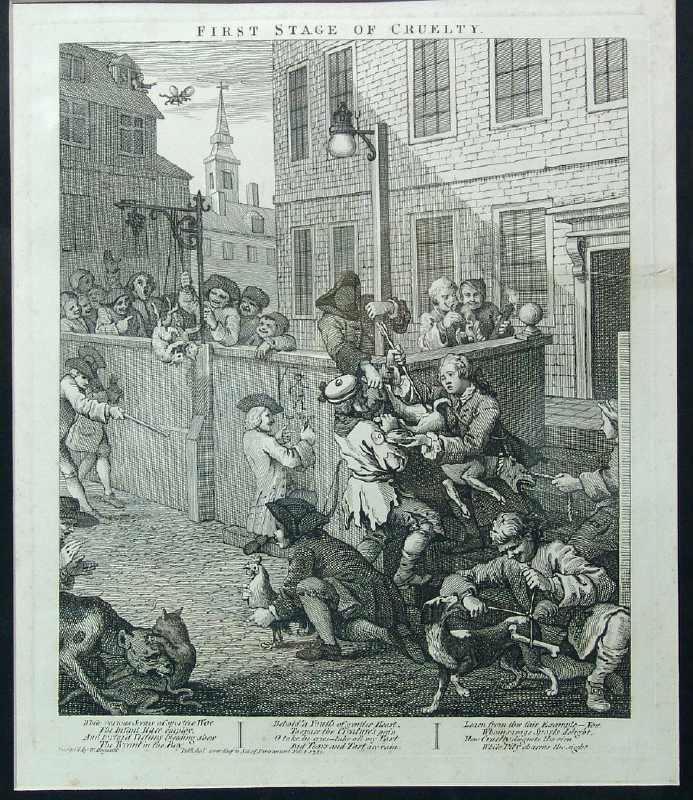
“Cock Throwing” is currently just what jesse.in.mb calls “Tuesday”; however, cock throwing was once also a popular British pastime until the early 19th century. The game was brilliant in its simplicity: a rooster is tied to a pole and then people throw sticks at it until it dies. A variation of cock throwing was basically “hit the piñata,” but with a live chicken instead of papier-mâché and blood and viscera instead of candy. Regardless of this, according to historians cock throwing was quite popular with children. Cock throwing was also a hallowed ritual associated with Shrove Tuesday, because Jesus Christ demands the blood of chickens offered in sacrifice.
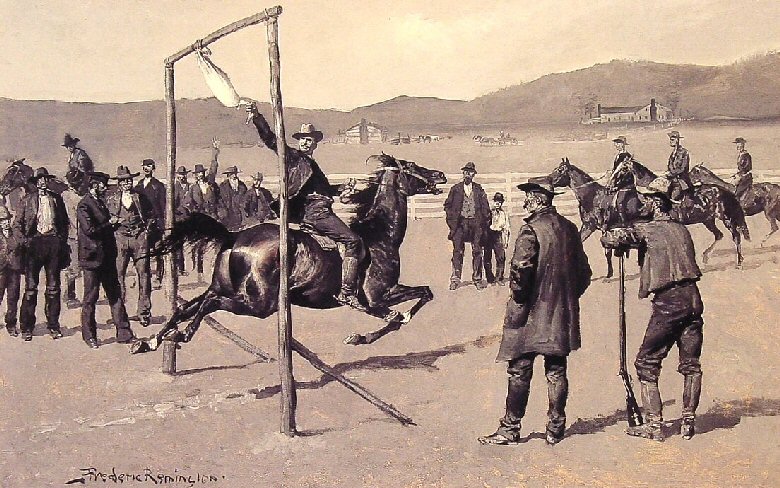
While originating in Spain, until about 150 years ago, goose pulling was the favorite sport of the Dixie. George Washington and Thomas Jefferson most likely participated in goose pulling. Indeed, contemporary reports detail that a goose pulling was one of the few social events in which the entire spectrum of society, from slave to plantation aristocracy, could be found participating together.
“A Gander-Pull” by Fredric Remington (1894)
So, just what is goose pulling? As further evidence that Christianity is actually a demonic cult focused on blood sacrifice and cannibalism, as part of Easter celebrations, a live goose with its neck greased was tied to a pole so that it hung head-first over a road. Competitors on horseback rode through the road at full gallop while attempting to pull the head off the goose’s body. Sometimes, obstacles would be placed on the path. According to one account, riders had to ride through a gauntlet of whips on their way to the pole. Spectators would bet on the proceedings and drinking copious amounts of whisky was expected.
In the United States, goose pulling would fade into obscurity after the Civil War. Thanks, Lincoln!
As evidenced by their pornography, the Germans are fucking lunatics. As it turns out, such lunacy has a long and storied tradition. Fuchsprellen, or fox tossing, was a popular sport among the aristocracy of Europe during the 17th and 18th centuries. Fox tossing involved using a giant slingshot to launch foxes and other animals into the air. Whoever tossed the animal the furthest won. Of course, you can imagine it wouldn’t be easy to keep a snarling, scratching and biting fox in place for long so that you could send it flying to its doom. Despite that, expert fox tossers could launch an animal 24 feet into the air. According to Wikipedia’s article on the sport, “Augustus II the Strong, the King of Poland and Elector of Saxony, held a famous tossing contest in Dresden at which 647 foxes, 533 hares, 34 badgers and 21 wildcats were tossed and killed. Augustus himself participated, reportedly demonstrating his strength by holding the end of his sling by just one finger, with two of the strongest men in his court on the other end.” Whereas goose pulling was seen as a test of one’s manliness, fox tossing was considered a fun party game where couples paired off to compete with one another.
As if death by slingshot wasn’t indignity enough, sometimes the animals would be decorated with “bits of cardboard, gaudy cloth and tinsel” as part of a masquerade.
Good ol’ boys and their punkin’ chunkin’ ain’t nothing but pussies.
If goose pulling was the national sport of Dixie, then baiting was the sport of Victorian Britain. Baiting involves pitting a pack of dogs against a chained animal in a fight to the death while spectators bet on the outcome. Pretty much every combination could be found, bear-baiting, bull-baiting, duck-baiting, etc.. And since we’ve all wondered who would win in a fight, 10 toddlers or 1 pit bull, it wasn’t long before someone had the idea to pit a human versus a dog to find out. In 1807, The Sporting Times reported on one such human-baiting match:
A fight between a man and Bull Dog took place some time ago to settle a bet. With its first charge the Bull Dog already succeeded in throwing and pinning its opponent. Although the dog’s jaws were nearly closed by a muzzle, it succeeded in sinking its teeth into the man’s body. Had the dog not been pulled away immediately, it would have disemboweled the man.
If this depiction is to scale, the outcome is understandable:
Not content to let the collective honor of our species be forever sullied, other human vs. dog deathmatches were organized. In 1874, a dwarf who went by the name of Brummy, agreed to fight a bulldog named Physic on account of a bet to prove Brummy’s claim that “no dog could lick a man.” The fight went 11 rounds, in which Brummy suffered several deep bite wounds to his arms, and the dog received so many blows to the head that it lost 2 of its teeth and one eye was swollen shut. Brummy won by knockout.
Another account of human-baiting comes from 1892, where a man by the name of James Oxley went 22 minutes against a dog named Crib. As one of the many previous lives of Mike Tyson, in this incarnation, Crib won the match by jumping over Oxley’s left shoulder, clamping on to his right ear, and slamming him to the ground. Oxley forced the dog to release his grip through a choke-hold, but at the cost of the upper part of his ear.
ZARDOZ SPEAKS TO YOU, HIS CHOSEN ONES. IT APPEARS THAT ZARDOZ WON HIS CASE ON APPEAL AT THE WEBSTER COUNTY RACING BOARD. WHEN ZARDOZ SHOWED UP TO GIVE TESTIMONY, THE BRUTALS ON THE BOARD ALL RAN OUT DOORS, JUMPED OUT WINDOWS AND OTHERWISE FLED IN AWE AND TERROR OF ZARDOZ.
Run Away! Run Away!
HOWEVER, ALL OTHER BRUTAL DRIVERS HAVE ANNOUNCED THEY WILL NO LONGER RACE FIGURE 8 WHEN ZARDOZ DOES. THUS, ZARDOZ WILL RETIRE UNDEFEATED. ZARDOZ DOES NOT WISH TO TAKE AWAY ENTERTAINMENT FROM BRUTAL CO-WORKERS AT LOCAL GRAIN CO-OP.
ZARDOZ DOES NOT WANT HIS CHOSEN ONES TO NOT BE ENTERTAINED AS WELL, SO HE BRINGS YOU THE GIFT OF THE LINK:
The National Rugby League is heading into the business end of the season (for a review of the NRL and an update through Round 16 see here).
Remember me?
The League has now played 19 rounds with 7 remaining. All the teams have had their two bye weeks, the annual State of Origin series is over (the universe was kept in balance as Queensland won the last two games after losing the opener, taking their third series in a row and 11 of the last 12 series overall).
From the moment we step on the field of play we can identify our starting point, pathway and destination.
The end of the State of Origin also means club teams welcome back those players who were playing in Origin. Going into Round 20, although none of the 16 teams have been mathematically eliminated, some of them will have to face up to reality. At the bottom of the table, Newcastle, Wests Tigers, and South Sydney are basically done with Canberra, New Zealand, Gold Coast, and Canterbury needing to win most of their remaining games and hope for teams above them to lose. However, the latter four do have the ability to put together a run.
How could a team this fierce be “done”?!?!?!
Two points (one game) outside the top 8 teams which will contest the finals (playoffs), are Penrith with St. George-Illawarra and Parramatta the teams most likely to miss out if the Panthers go on a tear. It is likely the current top 6 teams—Melbourne, Sydney, Brisbane, Manly, Cronulla, and North Queensland will all make the playoffs. It is less clear which will finish in the top 4 – which guarantees a second chance should a team lose early in the finals series.
More than half the Round 20 games have ramifications for teams fighting for playoff places but two of the most important will be Penrith vs. Gold Coast with the Panthers desperately needing a win to stay close to the playoffs while a loss for Gold Coast will basically end their season. Likewise, Canterbury face a tough must win game on the road at the Brisbane Broncos, made tougher as the Broncos need the win to stay in the top 4. The other key matchup is 10th placed Canberra, who also have to win, hosting top of the table Melbourne.
Although no one will be guaranteed a playoff spot after Round 20, it’s likely a few teams will be mathematically eliminated.
By BP
AFL Roundup 7/16-7/17
This weekend in Ozzie Rules the big match featured the top-of-the-ladder Adelaide Crows versus the 7th ranked Melbourne Demons. Adelaide didn’t disappoint (their fans), winning handily – 17 goals, 14 behinds for 116 points versus 10.10.70 for the Demons. Fuck you, Adelaide.
Too little, too late…
2nd place Geelong won against Hawthorn, and although the result is no surprise, the fact that they squeaked out only a 3 point (13.10.88 v. 12.13.85) win against a team that’s been mediocre for almost the entire season was.
3rd place GWS Giants managed to snap their 2 game draw streak. (Draws are usually a rarity in AFL). They did so by losing. A resurgent Sydney Swans (6th place) continued its rise, defeating the Giants for the Swans’ 6th straight win, showing that the bookies predictions for their current year top performance were not the result of hallucinogens. Sydney’s terrible performance starting the year remains unexplained.
4th place Port Adelaide stomped on the N Melbourne Roos, as did 5th place Richmond on the hapless Brisbane Lions.
The West Coast Eagles took St. Kilda’s place as the last (8th) team in the playoff form, crushing Freemantle, while Essendon dealt with the Saints.
For Glib interest, the Western Bulldogs won against the Carlton Blues, although that didn’t move WB up the ladder (or the Blues down), and Collingwood beat Gold Coast, resulting in them swapping 14th and 15th places.
I have often snarked about the superiority of Rugby Union over the lesser forms of foreign sportsball. We have already had a look at Rugby League here… So in this exciting edition of Foreign Footy I will illustrate the majesty of Rugby Union. What could be better than 15 athletes trying to move a ball to the end of the field and touching it down to score (OK, they kick through posts too)?
How about when the other team is allowed to tackle you – and when you are tackled to the ground, you have to let go of the ball, and the action continues (a ruck).
No NFL 3-5 seconds of action and a halt for 45 seconds or more.
It just doesn’t stop – in this case, Welshmen never yield.
In fact, the only time the action stops is when the ball goes out of bounds, a penalty is called or there is a score. OK, at halftime and the game end too, pedants…
Oh – none of that blocking stuff allowed. No forward passes either. Run with it forward, kick it and chase it down or pass it sideways or backward to a teammate.
When the ball comes back into play, it is either the Line-out (a throw in that would make NBA players wince).
The title is taken from C S Lewis I think, although it has been used multiple times on multiple people. I like the sound of it and the message – old books can be quite underrated these days. First of all, there is something purely of age, as people like old things. At the very least withstanding the test of time shows that there is a bit of quality. But mostly, if one is interested in humanity and human nature, it is a small view in the minds of past people.
History taught in Romania schools can be very limited from my point of view, concentrating on some major events which are considered notable. It is mostly rulers, battles, and lots of dates to be remembered for no particular reason. Also dates must be constantly converted from Julian to Gregorian calendars, because why the hell not. As a result most children don’t like history class and often do not learn history at all. I like history, but learned most of it outside school. School history annoyed me like it did most of my mates. And I always liked to read what was known for a given time period about how people lived and though, the laws the culture the economy. Not whoever was the big boss.
Old books can help a lot in understanding past people, sometimes more than histories. History books, while valuable, can be highly biased. Most chroniclers were paid by this king or that lord and wrote to please the patron. There is much boasting, exaggeration, and general nonsense.
Now, while it may be interesting to have actual old books, dusty ancient tomes of forgotten lore (I just wanted to use the word lore) around, I do not have any. But there is project Guttenberg and a new invention of the ebook reader. So making due.
Many or more accurately most old books that were written and survived to our modern days are religious or philosophical texts, myths or epics, chronicles of whole nations. But once in a while there is a book that is none of that stuff. But a quiet book, more reduced in scope but not in insight. It is simply on how to fish and live well, a fragment of Merry Olde England, of the 1650s, give or take. Which is why I like it, being a non-fishermen and all. Fishing, to be blunt is boring. It takes a long time and you don’t catch anything. But it can be of use if catching is not the point, but it is more of a form of meditation. I like to stare at a lake or river sometimes, to empty my thoughts, but usually I skip the rod in the water bit.
Now where was I? Right, back to the book. The author is one Izaak Walton, an innkeeper ‘s son by origin, an ironmonger by trade, and a writer by vocation. He lived through the English Civil War, a somewhat hectic and troubled time – oft covered by the standard histories and history classes. You learn of the Roundheads and their 7 game series against the Cavaliers, you learn dates and battles, laws and beheadings. Of Cromwell (MVP) and parliaments, and maybe what happened in Ireland. But what do you learn of the correct way to snag a trout or cook a chub, I ask you?
After said hectic times, old Izaak retired to the countryside, and spoke about the slow life, calm, quiet, contemplative. Fly fishing was an art and a form of quiet meditation. Also, to paraphrase the philosopher Ron Swanson, you get to kill something.
The book is, mind you, a bit pastoral fantasy, a walk through the countryside of the time that is more than slightly idealized.
There really is a lot about fish. Which time of year a certain type bites, what bait to use, how to make artificial lures (apparently, duck feathers work differently from pheasant feathers.) He talks also of over-fishing and environmental protection, and references the tragedy of the commons – a problem, he states, with rivers being that which belongs to all belongs to none. He also covers the subtle difference between making and enforcing legislation– there were types of fishing nets that were illegal to fish with since 1400s, but still were sold in most markets.
The book is in the form of a conversation, and it is not, to be fair, what one would call an easy read, if one does not like the style. It is the type of conversation where many lines are actually long speeches, so it is not necessarily a natural conversation, unless that is how people conversed at the time. The main characters are the fisherman Piscator and the hunter Venator meet early in the morning while walking from the city towards the countryside, and are glad of company and conversation, as the road can be lonely. The plot –so to speak- is Piscator teaching Venator angling, after the hunter was somewhat dismissive of the fisherman’s pastime, considering his passion more noble and interesting. By the way of conversation on the road he is won over by the angler, who begins teaching craft and life philosophy (and why otters should be made extinct, as they eat too much fish).
Throughout the book they travel the English countryside, looking for good bits of river and good clean houses, with honest landladies. A good house had clean rooms, clean bed-sheets smelling of lavender, and the landlady should be able dress (as in cook) your fish and make good ale. Ale was essential back then and not made industrially. Each house made its own ale. These houses were not the large inns of fantasy literature or RPGs, but smaller affairs with a few rooms to rent, and each traveller knew a few good ones.
As always, not all fish were appreciated in 1600s England, the trout and eel being considered the best, the chub one of the worst. This is where cooking- how to dress your fish- became important, as almost any fish could become a good meal if you knew how. The key, as far as I understood it reading the book, was lots of butter – a quarter pound or more – and some fragrant herbs, maybe some wine in the sauce. But mostly butter.
For each fish covered, chub or perch, trout or carp, eel or pike, the standard chapter tells you when it is in season, how to catch it and how to cook it. Maybe braised in wine, baked in the oven should one be available, or roasted on a spit, often stuffed with herbs and mushrooms and oysters. Do remember the quarter pound of butter though.
I liked reading about the European carp, as it is a very widely eaten fish in present day Romania, and some of the things in the book still apply. It is mentioned that the fish caught in running water is better than from still water. At Romanian fish mongers, the price and quality ranks are similar, wild caught carp is better than farmed, river caught is better than lake/pond fish. The best is considered the Danube carp, usually at least twice more expensive the farmed one. Another thing casually mentioned in the book as anecdote is how Jews eat the carp roe because their religion forbids them sturgeon roe. I understand from this that Englishmen did not eat carp roe, but present day Romanians do, usually mixed with mayo and onion. Althoug pike roe is proffered for this preparation.
In the book mister Walton speaks highly of good ale, but also on the importance of moderation. He usually has one glass in the morning as his breakfast drink, and he will not drink another until dinner (midday meal), and maybe one or two more in the evening, with good company and good conversation. In the beginning of the book, the travelers plan a stop for the morning pint at a good, honest house – you needed to know of one nearby anywhere you were – before heading to the fishing grounds.
Anyway I shouldn’t go on about it too much. I recommend the book, it is free and available, and so give it a read if it sounds good to you, might be an interesting view of 350 years ago, give or take.
Originally I was going to post about my experience shooting my new Mossberg Shockwave that I got this week. Unfortunately, after buying $200 worth of ammo and driving 30 minutes out into the desert I find out that it’s closed to target shooters due to extreme fire hazard. I guess all those taxes I pay don’t actually mean they go and put the fires out. Not that I’m bitter or anything. Then I thought I would celebrate Independence day and make a post about the guns of the American Revolution. It turns out that’s actually a pretty boring topic overall, with one notable exception I’ll mention below. So, I’m phoning it in this week with a hodgepodge of random gun tidbits. Think of it like the evening links, but gun themed. ZARDOZ would be proud.
The new Tavor 7. Fuck to the Yes!
The Hearing Protection Act is back! This time it’s called the SHUSH Act. That’s an acronym for Silencers Helping Us Save Hearing. I swear to god I picked the wrong line of work. No idea on the odds of this passing, but I sure hope it goes somewhere.
IWI announced they will be producing my favorite gun in 308. The new Tavor 7 will be 100% user reversible from right to left handed and be almost entirely ambidextrous. If this thing comes in at or below $2000 they are going to sell like ice water in hell.
Apparently the American Revolution was the birthplace of military sniping. Using Kentucky Long Rifles, American soldiers were able to pick off British officers from the treeline while the redcoats strutted around the open fields on horseback. There’s even one story of a particularly gifted individual making a kill shot from 400 yards, which quite frankly I would be hard pressed to do with a modern gun.
Speaking of snipers, no matter how tough you are, you aren’t as tough as this chick. I know I would have needed a new pair of depends after that.
One final thing I wanted to mention before I go. Someone mentioned this in the comments yesterday so I thought I would take a few minutes to tell you about the can cannon. It is an AR 15 upper receiver that attaches to any milspec lower and fires blanks. What good is a blank firing upper? By itself, it’s fucking useless. The can cannon, however, is designed to accept standard 12 ounce soda cans. It can launch these cans a phenomenal distance and they explode quite spectacularly at the end. It isn’t limited to cans, though. Tennis balls, apples, and just about anything you can cram into the sucker will launch when fired. They even make grappling hooks that load into the can cannon, for all your 80s ninja/mission impossible fantasies. Here’s a little demonstration video.
While these things look fun, they aren’t cheap. Right now they’re damn near $400 for the regular upper and almost $550 for the XL version. That’s a lot of scratch. I have some good news, though. If you want the fun of the can cannon but don’t have that kind of scratch, NCstar has you covered. For a mere $25 on Amazon you can pick up your very own golf ball launcher. This puppy will thread onto your AR barrel (or any barrel that uses AR threads) and let you drive those balls farther than Tiger Woods from 10 years ago. Just like with the can cannon, you can stuff whatever you want in there and see if it launches, but I would be a little more careful with this version. For one, there’s nothing stopping you from loading a live round instead of a blank, and that could cause some serious damage depending on what you have lodged in the launcher. The other issue is if something goes wrong and the gas can’t escape from the launcher it’s probably going to split your barrel, which will almost certainly wreck your day. Still, for 25 bucks you really can’t beat it, and in theory you can use it on any gun you want, not just ARs.


 Booze: Hurricane
 Tailgate of the Week