Blog

  • Friday Morning Links

    I’m still convinced that the Buckeyes got screwed by the committee, but whatever. I can’t stew on it forever. And for all I know I’m about to drive to Dallas (I know its in Arlington for the “well, actually” folks out there) and watch them lay an egg tonight from club level seats. But whatever. The Big Ten looks good so far in the bowl games. I hope that trend continues into this evening.

    I don’t know much else about sports right now. I’ve been so damn busy with familial responsibilities and the holidays (see the photo below of my entire extended family together for the first time ever at my parents’ 50th Wedding Anniversary) and traveling and now I’m getting more work done this week than any week throughout the year, with the exception of the last auction week.  Finishing on a high note and next week looks like its gonna start 2018 on a pretty high note as well.

    The entire Spicer (also known as the Very White) Family.

    So that’s why I’ve been gone and you guys have been treated to better links than I could have provided on my best of days.  Well, so solly, because I’m back now!  So you’re gonna have to live with me bringing you…the links!

    You want to know the main reason I think Donald Trump is awesome?  Because he does shit like this whenever he feels like it and the retards go full retard.  I mean…its pure genius.

    A good likeness. Where can I buy one?

    New York’s Finest doing what they do. What is it with those guys and apartment stairwells? Either they’re shooting people walking through one or they don’t even bother checking on a woman who gets strangled to death in it.  (Bonus DM Links: Aw, nuts!)

    I sure hope this happens. Although I hope the politics and influence on lawmakers doesn’t migrate as well. And to be honest, I don’t think it will. Because every time coastal elitists get outside their bubbles and visit cities in the heartland, they find…normal people living normal lives. And of course lower cost of living. And lower taxes. And less intrusive governments. And basically more of all the good stuff…except for those icky guns that are everywhere, although the crime rates are lower, so they stop worrying about them until their editors remind them of how evil and dangerous they are.

    What the fuck is wrong with people? I don’t have anything “clever: to add. This is just assholes being assholes.

    You know, there’s another option. You could always just choose to END THE DAMN PROGRAMS!!! But that might lead to a few less people dependent on government largesse. And we can’t have that, can we?

    Surprise! Surprise! Surprise! I’m dead.

    Yes, there is a slideshow involved. But they also have the good taste to give a list in the article of all the famous and infamous people that died in 2017. And since this is my final links of the year, I thought I’d post it.

    Final links of the year for me…wow.  I gotta be honest, you people have helped make 2017 the greatest year of my life.  The people who put this project together are some of my dearest friends and the work they have done is a testament to their skill, dedication and desire to make what has become an integral part of my life such a successful venture.  I can’t sing their praises loud enough and can’t come up with the words that express how thoroughly grateful I am to them for everything they’ve done. As for those of you who contribute your works, you guys have been an incredible addition and have expanded my knowledge in countless ways. The additions you have made not only inform, but they spur debate and increase the level of participation by an incredible amount. And those of you who comment have likewise increased my knowledge, have entertained me and have helped grow something I am so very proud to be a part of. Lastly, to the lurkers: get off your asses!

    Seriously, this has been a great year for me personally and professionally. I’ve lost things dear to me, sure. But my children are happy and healthy. My wife is happy and healthy. My friendships have grown. My business is thriving. And we beat Michigan again.  Here’s to 2017!

    And I Thank You.


  • Afternoon Out of Office Links

    Most of Swiss Servator’s in-box…

    Working between Christmas and New Year’s is a double edged sword. On one the side, it is not busy and you can swill coffee and surf the net, waiting for something, anything to come in to the ol’ in-box. On the other side…you can only drink so much coffee and take only so many “I am out of the office until January 2nd, you fool…you thought you would get in touch with anyone at this time of year?!” auto-replies to my emails.

    So I begged Brett to do the Afternoon Links – so as to be able to say I did something today, other than drink coffee and go stir crazy. He was kind enough to let me do so…

    • The Mouse has a new hotel policy that guarantees no libertarian will stay there;

    Along with the new term comes a policy that requires Disney cast members to enter each hotel room at least once a day to “ensure guest safety,” according to a report by Walt Disney World News Today.

    Before the policy, a “Do Not Disturb” sign would signal for employees to bypass the room. But now, Disney says that “the hotel and its staff reserve the right to enter your room for any purpose including, but not limited to, performing maintenance and repairs or checking on the safety and security of guests and property.”

    • Hope you got your look at GIANT NYC PAINTED DONG. It got covered. Be sure to read the whole thing, for some real, authentic frontier derp (i.e. The New Allen told CBS2 the Broome Street mural cost about $10,000 to produce, including grants from the Swedish government.)
    • Straffinrun got me looking for Japanese language news…TOO LATE, LOOKS LIKE ITS TIME TO LEARN ENGLISH!!!!
    • We at Glibertarians.com wish to offer you some helpful New Year’s Eve advice.


    Now go do, that comment voodoo, that you do…so well!
  • 5 Minute Japanese Lesson

    米軍ヘリの窓、校庭落下

    That is the headline from an article in the Yomiuri newspaper, December 14, 2017. Let’s yank it apart and see what it says and learn a little Japanese in the process.

    [米] is the kanji (Chinese character) for “rice”. There are thousands and thousands of kanji and take years to learn, but we’ll focus only on the ones in the headline. [米] is pronounced kome when it appears as a solo kanji and bei when it appears in combination with another kanji. In our headline it is in tandem with [軍] , so it’s pronounced bei in this case. Another use of [米] is in the kanji set [米国], or beikoku, which means “America”. It’s actually a shortened form of the original name for “America” which is [亜米利加], or Amerika. Today, [米] is often used to indicate that something is American as in [米大統領] or “American president”.

    Unfortunately, they had to use kanji to produce the phonetic sounds of words because the heathens wouldn’t use the ABC’s. For example, if you pile up the train wreck of nonsensical kanji [府亜区御府酢零馬] you come up with a reading of, “Fuck off, Slaver”. Sometimes for fun I’ll write, [味噌歩荷] on a piece of paper and have a young lady read it aloud. “Mi so ho nee? I no understand.”

    [軍] is pronounced the same as the English word “goon” (written as gun) and means “army”. So when we put [米] and [軍] together we get beigun or “rice army” or “rice goon” or, more accurately, “American Military”.

    Your average Japanese schoolyard

    [ヘリ] is written in katakana. Katakana is a system of 46 simple characters that is used for transcriptions of foreign words, loan words etc. [へ] is read as he (which is pronounced like “head” without the “d” sound) and [リ] is ri as in “reeeeeeeee”. [ヘリ] gives us heri which is the shortened form of [ヘリ コプター] or herikoputaa. Helicopter. For example, [ピノチェトのヘリコプター欲しい!] which means, “I want Pinochet’s helicopter!”

    [の] is no, and don’t you forget it. This is from the final system of writing called hiragana. Same number of characters as katakana, 46, and, as with katakana, can produce all the sounds you need in Japanese. Hiragana is basically the glue that holds a sentence together as it’s used for verb endings, prepositions and so on. [の] functions the same as the possessive “s”. [米軍ヘリの …] means, “American military helicopter’s…”

    Let’s speed this up. [窓] is mado and means “window”. [校] is kou and means “school”. [庭] is tei (or niwa when appearing solo) and means “garden”. [校庭] therefore is koutei or “schoolyard”. [落] is raku (or ochiru when solo) and means “fall”. [下] is ka (or shita when solo) and means “down”. So we can read the entire headline as, “beigun heri no mado, koutei rakka”.

    And there we have it, “American Military Helicopter’s Window Falls on Schoolyard”. This happened in Okinawa and similar incidents have happened over the years. Fortunately, none of the elementary school’s students were injured, but if a fatal incident were to occur due to U.S. military actions, you’d probably hear cries of, “Get these rice goons out of our schoolyard!”

  • Thursday Morning Urinary Emergency Links

    Sorry, this is literally last minute. But the link quality will be to our usual standards.

    I am convinced that Roy Moore is Gloria Allred’s spirit animal.

    Riven Hardest Hit. There really is such a thing as over-sharing.

    My cynicism meter went to 11 when I read this– the “concerned mom” works for an asbestos-litigation law firm, and the test lab she used is one that specializes in developing evidence for courtroom testimony in asbestos cases.

    Try harder next time, Bono.

    And in Old Guy Music, a song my band used to cover. I must have played this a thousand times.

  • Wednesday Afternoon Links

    What I learned this year is that my kids have a truly embarrassing amount of stuff, and are spoiled little shits about it. I think next year, I am limiting family to one gift for each, plus what Santa brings. And finding some sort of volunteer activity to do. I have good kids, and Monday was the first time I’ve been sad to watch them be themselves. How did you Glibs with older/adult children get them through the “MINE!” stage of the holidays?

    I know this went up in the comments earlier, but I can’t miss out on a big, old purple-veined dick joke.

    Vegas can be rough on cougars.

    This is probably of interest to our kind of people. (Not: Rand (Ayn or Paul), Gold Standard, Colloidal Silver, 27th Trimester Abortion)

    I hear it helps with nausea… more pregnant women turn to Mary Jane. (Misleading headline. It just says more pregnant women are using it.)


    A nice little strumming song for your Wednesday.

  • Christmas Food in Romania

    Fatty fatty piggy and some cheese
    Cold cuts, don’t forget the mustard

    “What is Romanian Christmas food?” is the question everyone asks. Well, since I did one of these things for Easter, I figured I might as well do one for Christmas. When all you heathens and heretics eat Chinese food and prime ribs and such, Eastern Orthodox do what God intended: slaughter a pig. It is rather traditional for any Romanian family of some size – well, older folk, I suppose, not kids these days… – to buy a whole pig, usually not from an industrial farm but from relatives in the country or a small farmer (we still call ’em peasants here). The pig is prepared nose to tail and little is wasted, to form a very large Christmas feast, which often results in the ambulance being called due to overeating (though never in my family).

    Lard, pure and simple

    So I will talk of the food I know. Other Romanians families may have somewhat different traditions. This year Christmas was a sad one as it was the first since my father passed away, but my mother and I decided to try to keep Christmas as close to usual as possible. We only got less than half a pig, though. We could have gotten a whole and frozen most of it, but I prefer cooking from fresh meat so I don’t freeze much. The pictures are not good – taken by phone and I don’t know shit about taking pictures – but the food is tastier than it looks.

    The liver

    The first meal of the day – usually around 9 AM – consists of what we call mezeluri, could be translated as cold cuts.  This includes leber (from the German word for liver, I think) which is basically the pig’s liver boiled and minced very fine, mixed with some pig fat minced very fine, some onion chopped fine and sauteed a little in oil, plus five eggs (for the average pig liver), beaten. This makes a liver pate-like paste which is then stuffed in a pig intestine and boiled as a whole for a bit more. Toba – meaning drum – may be similar to what you call head cheese in looks. It is made from parts of the pig’s head and trotters, plus years for the gristle –  gristle gives texture – boiled, chopped up roughly, stuffed into the pig’s stomach and boiled a little more. Șorici is basically raw pig’s skin, packed in salt for a few days – the pig is generally seared in order to remove the hair, so the skin may be slightly cooked in the process. Slănină is basically what Italians may call lardo – just less sophisticated, raw pig fat with a little skin attached, also slightly salt cured. Hard salty cheese and raw onion complete the meal, usually alongside bread and țuica.

    Never let a good animal stomach go to waste
    Drumroll…
    Romanian sausage is bigger than American
    Caltabos

    The second meal -around 12 – is of caltaboș, a thick boiled sausage. It is reasonably fatty pig’s meat minced more roughly, mixed with rice, seasoned with salt and pepper, stuffed in a piece of large intestine and boiled in a broth of mainly water, onions and a bay leaf. This is eaten hot with a squeeze of fresh lemon and some grated horseradish (fresh horseradish just grated and mixed with some salt and a little white wine vinegar). Generally, unlike sausage, the intestine casing is not eaten, and neither is the broth, which is used for cooking. Although red wine works better with pork, in my family we usually drink white with this one.


    Simple yet tasty
    Pie’s special meat ‘n sausage

    Around two or three, the sarmale come – stuffed cabbage leaves cooked with some tomato juice and wine. Red wine usually accompanies this meal, and sometimes a hot pepper to take the occasional bite out of.

    In the evening, stomach room permitting, the final meal is usually some roast or grilled pork – ribs in general – and sausage. The sausage is a simple but delicious affair, a mix of fatty pork and beef with salt, pepper, garlic and paprika. This is generally eaten alongside pickles. With this part, red wine continues to be drunk.

    Bet you don't see many of those in the US
    Gogosar and friends

    As dessert, traditionally it is cozonac (I mentioned it in my Easter post, it is, if I remember my Seinfeld, maybe similar to what polish call babka). More red wine here, if you can handle it, which many cannot. Cozonac goes well with red wine. The saying goes in Romania the only thing better in life than cozonac with wine is just wine.

    So that is about it, did not feel like writing a longer post so this will have to do. How Romanians gain weight during the winter holidays.

    Oh wait, almost forgot the picture of cozonac…


  • How I Spent My Wednesday Morning: Links

    If these seem rushed, it’s because I’ve got to freeze my nipples off and drive to work this morning. Sloopy, on the other hand, is relaxing on a beach chair in Bali, drinking a cocktail out of a coconut-shaped cup with a paper umbrella.

    Just from the headline, you know where this one is going. I note the after he left the Pittsburgh area, he moved to Florida, which seems fitting. Named his daughter “Lyric,” which I guess is the wypipo version of L’aQuan.

    Another news story where I hate everyone. Obama, please go away. Trump, please shut up. British royals, get a fucking job and stop sponging.

    OMG OMG TRUMP HATES TREES!!!!!!11!1!

    I’ve got a great idea! If we have trouble counting votes, let’s figure out a way to shovel money at lawyers.

    They left off the 11th thing: make it easy for “law enforcement” to spy on you. No way that shit is coming into our house.

    And by the way, you people disappointed me in the movie thread yesterday- not one mention of Polyester.

    OK, now your turn to suffer: Old Guy Music.

  • Movie List

    Nightly, OMWC and I look at each other and try to decide on the evening’s movie viewing…and are usually stuck. Everything we can think of is either something one of us has seen previously, or is “not available to stream” from the usual providers. And browsing, even the “secret” genre codes, usually turns up stuff that makes us shrug and say “meh.”

    So, help us out. In the comments on this post, please list a movie or two that you’d recommend. I’ll link this post in the permanent navigation under Entertainment so we can all find it when we need a movie suggestion. It’s my hope that the community will continue to add to it over time so we’ll have a pretty good list going forward.

    If we can all stick to just movie recs, it will stay useful, so NO SPOILERS and NO OFF TOPIC POSTS.

    Don’t make me stop this car.

    Ready? Go!

  • Winter Wasteland Afternoon Links

    Well, the thermometer finally got off of -1 degree…all the way up to 0. *narrows gaze at weather station*

    I had one errand to run today and got the post-Christmas clean up finished this morning, otherwise it is a hide in blankets, with coffee and Bailey’s day for me. I can hear the snorts of disgust at my weakness from the Minnesoda and Montana and Dakotas Glibs …

    So, I offer you Links as absolution:

    • Trumputin punishes our poor, selfless civil servants in DC, once again. That doesn’t look very swampy drain-y to me, Cheeto Mussolini!!!!!
    • King says, “don’t leave my kingdom.”
    • Um….when I was in the US Army, I was vaccinated against anthrax. I am not sure it means what the headline hints at.
    • You can’t spell “Untied” without “United“.

    OK, time to crawl back under the blanket on the couch.

  • A Deep Dive into Cryptocurrencies and Their Operation: Part 2

    In Part 1, we talked basic computer science. I highly recommend reading/re-reading Part 1 before reading this article if you don’t have a firm grasp on the basics of computer science.

    We’re going to start here in Part 2 by talking generically about some of the hurdles that cryptocurrencies have had to overcome, then we’ll define some terms, and finally we’ll put all the pieces together into a basic model of how a blockchain-based cryptocurrency works.

    Traditional Ways of Passing Data through an Untrusted Medium

    Let’s do a quick survey of a few ways that important data can be passed through an untrusted medium (i.e. the Internet). You’ll recognize some of these from Part 1.

    Encryption

    Pretend you have a secret message that you want to send from your computer to your friend’s computer. An easy example may be a message including your credit card information to purchase Glibertarians pink footie pajamas. How do you send that information from your computer, through a bunch of network devices (routers, switches, etc.) that are owned by neither you nor your friend, and to your friend without being intercepted by a nefarious third party?

    The easy answer is cryptography. Let’s change the message in a way that only your friend has the “key” to unchange it. There are many ways to do this, but one of the most common is public key cryptography. If you want more info on public key cryptography, check out Part 1.

    Secured Channels

    Sometimes, you’re sending a bunch of secret information across the network to the same place. The most common example is when you’re working from home. You’re transacting a bunch of secret information with your corporate servers, and it may be easier to just establish a secure channel between your computer and the corporate network so that you don’t have to manage the overhead of encrypting the info piecemeal. What am I describing? VPN.

    This doesn’t really have anything to do with blockchain, but it gives you a bit of context about how security can be implemented over the Internet.

    Trusted Authorities

    Trusted authorities also have nothing to do with blockchain, except to act as an opposing contrast to the way blockchain works. We talked in Part 1 about the two ways that public key cryptography can be used. One way is to securely send secret information across an untrusted link. Another way is to sign a message and validate that the message came from the person you think it did.

    What if I want to know that you’re legit before I send you all my personal information? STEVE SMITH could easily insert himself between  you and me, send me his public key, and then intercept and decrypt my response. This is called a “man in the middle” attack. Rather than just trust that the public key you supposedly sent me, I can reach out to a trusted 3rd party, who has your public key on file. I request your certificate from this trusted 3rd party (called the Certificate Authority), and compare the public key in the certificate with the public key you sent me to make sure it hasn’t been meddled with. The weakness of this method is that you have to trust the security of the Certificate Authority (the most well known CA is VeriSign).

    Blockchain uses some of the encryption technologies we have discussed, but specifically cannot use VPN or CA technology because blockchain is implemented in a completely trustless environment. Why is it a trustless environment? Because authority is distributed rather than centralized.

    Centralized, Decentralized, and Distributed: A Libertarian Way to Organize Things

    I’m going to keep this focused to the tech realm, but y’all are smart enough to expand these concepts outside the realm of computers. There are three main ways of organizing tech in order to accomplish a task. Centralized systems involve everybody reaching out to one single node (e.g. server or cluster of servers) in order to accomplish the task. Decentralized systems involve everybody reaching out to one of a small number of nodes in order to accomplish the task. Distributed systems involve everybody reaching out to everybody else in order to accomplish the task.

    Centralized

    Centralized systems are what we use on an everyday basis. I want to buy something from Amazon, so I connect to an Amazon server and make the purchase. You want something from Amazon, so you connect to an Amazon server and make your purchase. This is a centralized system*, everybody connects with an Amazon server in order to complete their transaction.

    * You could argue that Amazon runs a decentralized system, because there are Amazon servers all around the world to share the load of so many people shopping simultaneously. However, for this description, “centralized” refers to only one “entity”  being involved, no matter the number of physical servers.

    Decentralized

    Decentralized systems are less common, but are still used on a regular basis. I want to refinance my house, so I go to LendingTree or any one of the other online insurance brokers. I input my information, which is sent to a handful of banks and other lenders, and each lender returns the request individually. If one lender doesn’t respond, it’s not quite as efficient, but I still have access to all of the other lenders.

    Distributed

    What if we take it a step further? Rather than a handful of entities, everybody can be an entity and everybody interacts with everybody. For example, Uber. You submit a ride request, and other people choose whether or not they want to fulfill that request. Uber isn’t perfectly distributed, as there is a barrier to entry before you can drive for Uber, but the barrier is low enough that it’s essentially distributed for our purposes.

    How Transactions are Verified when Nobody can be Trusted

    We have two obstacles to get over before we can verify a transaction. The first obstacle is ensuring that nobody has stepped in and altered a legitimate transaction. The second obstacle is ensuring that legitimate creator of the transaction isn’t trying some funny business.

    We’ve already discussed a method for tackling the first obstacle, using public key signing. The person who is giving the money signs the transaction with their private key, and the public key is included in the transaction data. Then, anybody in the public can check the signature using the public key to make sure that the transaction was approved by the originator.

    What about the second obstacle? Well, that’s a little more complicated and involves some economic incentives. We’ll get into this in more detail in Part 3 of this series, but suffice it to say that pulling off a con to steal somebody’s cryptocurrency involves an impossibly large amount of computer resources, and an immense amount of luck. The incentive to steal is way overridden by the costs of acquiring the raw processing power required to make such a con even remotely possible.

    How does bitcoin get stolen, then? Usually some currency exchange website is hacked, and the private keys of users’ accounts (wallets) are compromised. It’s not a flaw in cryptocurrency, but in the exchange’s security. Blaming such hacks on cryptocurrency is like blaming the US Dollar because Chase’s system gets hacked.

    Definitions and Terms of Art

    Blockchain (Sometimes called distributed ledger technology) A list of connected messages that contain transaction information. The blockchain is copied to every node (computer) in the blockchain network, allowing each and every participant in the blockchain to examine the blockchain for inconsistencies.

    Cryptocurrency – A financial product that is transferred between people using a blockchain. Some people view cryptocurrencies as investment products (commodities). Others view cryptocurrencies as a currency. Many cryptocurrencies use a mathematical algorithm for “printing” new money that is rather deflationary, making them attractive long term investment vehicles.

    Bitcoin The original cryptocurrency that is trading for somewhere in the neighborhood of $11k per Bitcoin at the time of writing. You don’t have to buy full Bitcoins, but can buy as little as 0.0000001 Bitcoin.

    Smart Contract – Some uses of blockchain are less tightly coupled to currency. Ethereum, for example, is a broader use blockchain system, and includes smart contracts, which are publicly inspectable contracts that are mostly self-executing. For example, if getting the wifi password is keyed to paying your rent, the smart contract will retain the new month’s wifi password and will not release it to the tenant until rent is paid.

    Fork (of blocks in a chain) – A condition of the blockchain where two blocks are created and verified by different nodes in the network at substantially the same time. In such a situation, there is a “fork” until the next block is verified. Whichever forked block is retained by the node that verified the next block is the “winner”, ending the “fork.”

    Fork (of cryptocurrencies) – A split off of a new cryptocurrency from an old one. Usually this happens because the older cryptocurrency has some limitation or flaw that the new cryptocurrency resolves. Depending on the specific situation, the older currency may transform into the new currency.

    Merkle Tree – A type of binary tree (a hierarchical linked list where a “parent” node has at most two “children”) used to organize the cryptocurrency transactions stored within a block. Each leaf node (i.e. nodes without children) of the Merkle tree represents a transaction, and the parent nodes represent a combination of multiple transactions. Each node has a hash, with the root node (the parent of all parents) containing a transaction hash for the entire block. These hashes can be used to verify the accuracy of the transactions, and the transaction hash for the entire block is used in creating the hash for the block.

    Wallet – A data structure built around a user’s private key that retains all of the cryptocurrency that has been transferred to it.

    Exchange – A website that retains a cryptocurrency wallet for each of its users. Exchanges are like a cross between a bank and an investment broker.

    Blockchain? Is That Some New Type of Jewelry?

    Blockchain is the technical underpinning of cryptocurrencies. A blockchain is a linked list of data structures. Each data structure includes a header, a transaction ledger, and a pointer to the prior block.
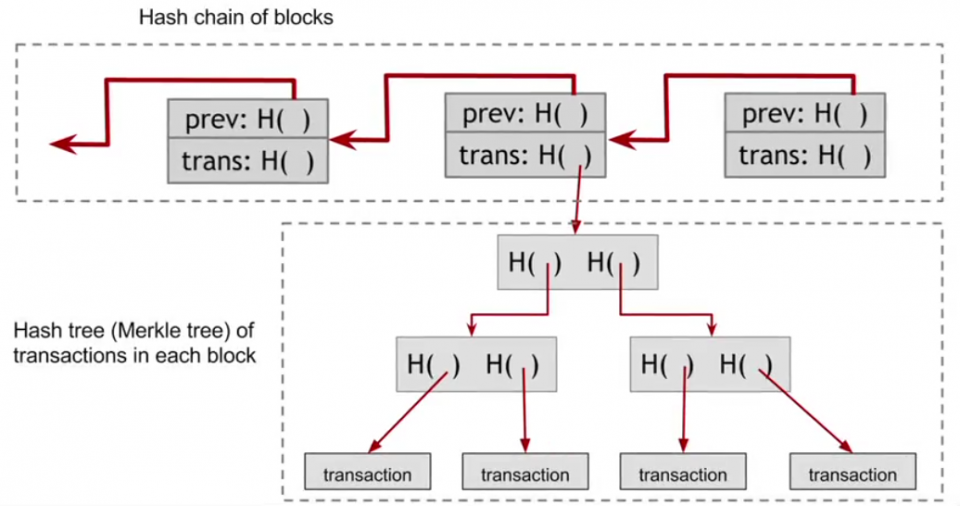
    Here is a very high-level view of what a blockchain looks like. You have ledger of transactions arranged in a tree form (a tree is a linked data structure kind of like a linked list, but with more than one relationship saved in the structure. For example, in a binary tree, each “parent” data structure has two “children”). The actual transactions are located in the leaf nodes (a leaf node has no children), and the root is the top parent node. The Merkle tree (the specific type of binary tree used for blockchain transactions) calculates the hash of each transaction, and then continues to hash the combined hashes up the tree until we get what’s called the Merkle root hash (shown as “trans: H( )”). The specifics of how all this works isn’t super important, and it’s fairly intuitive once you understand hashing. You’re essentially taking hashes of hashes until you get one single hash that represents all of the transactions in the block. Why do we want that?

    Because the hash of the block (used for security/verification purposes) isn’t the hash of the ENTIRE block, but only of the header of the block. The actual transactions and the Merkle tree are contained in the transaction ledger, and are not taken into account when calculating the hash of the block. However, the Merkle root hash (which takes into account all of the transactions) is located in the header of the block and is thus taken into account when calculating the hash of the header of the block. If a nefarious actor tried to change one of the transactions to route currency to his wallet, it would change the Merkle root hash, which would change the hash of the block, resulting in it being obvious to the blockchain network that something has been tampered with. We’ll go into more detail on this in Part 3 of the series.

    The last concept I want to bring up in this article is the increasing security over time. How does that work? Well, it has to do with the linked list of blocks. Let’s say we have three blocks that STEVE SMITH wants to corrupt in order to steal some cryptocurrency.
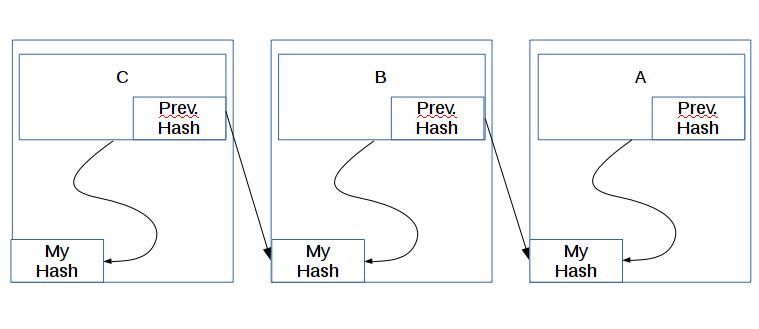
    STEVE SMITH will have the easiest time corrupting block C. Why? Because all he has to do is change the transactions and calculate the new hash for C. I say “all he has to do” as if it’s easy. We’ll talk in Part 3 about why this is nearly impossible to do. However, let’s assume for a moment that STEVE SMITH has a ton of computing resources and it isn’t quite nearly impossible to corrupt C anymore. Now, let’s see why the older a block is, the harder it is to corrupt.

    STEVE SMITH sees a huge transaction of cryptocurrency in block A and wants it for himself. In order to pull of his heist, he alters the transaction in block A, but now A’s “My Hash” is wrong (we’ll discuss tomorrow how the network knows it’s wrong). STEVE SMITH then spends a bit of time calculating A’s correct new My Hash. Once that’s done, there’s still a problem. B’s “Prev. Hash” is wrong, and the network will see the obvious inconsistency. STEVE SMITH changes B’s Prev. Hash to match A’s My Hash. Great! All fixed!

    But wait! B’s My Hash is calculated in part using B’s Prev. Hash, so now B’s My Hash is glaringly wrong. With a sigh of frustration, STEVE SMITH begins the time intensive process of calculating B’s new My Hash. STEVE SMITH, being one of the smartest of his race, sees that block C is going to have the same issue, so he quickly updates C’s Prev. Hash after figuring out B’s My Hash, and begins cranking on C’s My Hash. Finally, after a bit of time, STEVE SMITH has updated the blockchain and his crime was a success!!

    Or not. See, while he was cranking hard calculating new hashes for three blocks, the blockchain network was adding new blocks every few minutes (10 minutes for Bitcoin). His fraud sticks out like a sore thumb because blocks D through L all have the wrong hash when his “modified” blocks are included. In order for STEVE SMITH to succeed in his nefarious plan, he would need to control a significant portion of the entire world’s computing power, something on the order of 45% of the blockchain would need to be controlled to give his plan even a dismal chance.

    I’m going to stop here. We’re going to dive down to a place where giant octopi and fish with bioluminescent lures live in Part 3. We’ll discuss the details of how hashing is extensively used in the blockchain, how incentives are used to increase security through mining, how blockchain can be used outside of cryptocurrency, a description of the major cryptocurrencies and what they’re useful for, and some of the drawbacks of cryptocurrencies.