Introduction
“No state shall make or enforce any law which shall abridge the privileges or immunities of citizens of the United States…” – Fourteenth Amendment, U. S. Constitution
“No person shall be held to answer for a capital, or otherwise infamous crime, unless on a presentment or indictment of a grand jury, except in cases arising in the land or naval forces, or in the militia, when in actual service in time of war or public danger…” – Fifth Amendment, U. S. Constitution
We saw in Part One how, according to the Supreme Court, the Fourteenth Amendment doesn’t require the states to obey the grand-jury clause of the Fifth Amendment. Most of the Bill of Rights has been applied to the state – “incorporated” is the technical term – but not this part.
(In its incorporation cases, the Supreme Court likes to talk in terms of “due process,” but here’s Justice Clarence Thomas explaining how the Privileges and Immunities Clause is what we should be looking at.)
For the most part, when the U. S. Supreme Court exempts the states from part of the Bill of Rights, most states don’t take advantage of this. With some exceptions, the states chose on their own to obey the Bill of Rights, even when the Supremes wouldn’t hold them to it – state courts would sometimes interpret some rights differently than the federal courts, but they admitted the rights were applicable, if only as a matter of state law.
That’s not the case with the grand-jury clause. Here, the Supremes opened the door for the states to disobey this clause, and the states rushed through the open door.
Between the Civil War and the end of the First World War, many American states amended their constitutions so that suspects could go to trial for serious crimes without the approval of a grand jury (Michigan had started the ball rolling on the eve of the Civil War). This analysis summarizes the situation as of 2014. In most cases, grand juries were kept in reserve in case the prosecutors, in their discretion, wanted to use the grand jury procedure. Only two states – Pennsylvania and Connecticut (I would probably add Michigan) – banned grand juries even as an option (apart from extraordinary cases). Twenty-three holdout states still mandated that certain serious crimes be reviewed by grand juries, at least if the suspect demanded it.
Rather than give a comprehensive history of the victories of “reformers” who curtailed grand-jury rights in state after state, let me attempt to give some historical vignettes, and tie these vignettes together with some semblance of narrative coherence. Then later, I’ll give an account of the triumph of the reformers in their battle against the grand jury.
The Plessy Judge vs. Grand Juries
U. S. Supreme Court Justice Henry Billings Brown came to the Court too late to take part in the Hurtado case, which said the states could limit or abolish the right of a suspect to have his case considered by a grand jury. But Brown was one of the many would-be reformers of that era who wanted the institution of the grand jury largely abolished.

Brown gave a speech to the Ohio Bar Association in 1892 that included the judge’s discussion of this issue. Getting rid of grand juries, said Brown, would make criminal procedure more simple and efficient. Brown noted that he had begun his legal career in Connecticut, where grand-jury indictments were only required for crimes punishable with death or life imprisonment. Then Brown boasted of his fifteen-year legal career in Michigan (1860-1875), where grand juries were rarely used and were never required before a defendant could be brought to trial.
Brown suggested that grand juries may have been necessary in England to protect suspects against false charges by private accusers, but this problem didn’t exist in America. In America there were public prosecutors to bring charges and judges to rule on probable cause, and with these steadfast public servants on the job, Brown triumphantly concluded, grand juries were no longer necessary to shield suspects from wrongful accusations.
Brown went on to praise trial juries for their power of nullification – they could spare a guilty defendant, if punishing him went against local community norms. Of course, grand juries could perform that function too, sparing worthy but technically guilty suspects from the ordeal of a trial, not to mention saving them many legal expenses. That did not seem to occur to the Justice. “I think the question whether a man in a particular case should be punished for a crime is a question that is properly left to the public,” Brown said. But under Brown’s scheme, the nullification of an unfair charge would have to wait until the end of an excruciating trial for the suspect, since “the public” would only be able to get a word in edgewise after the trial was over. The public would be kept out of the decision of whether to bring charges in the first place.
Another defect in Brown’s logic is apparent with the growth of the plea-bargaining system, which requires a defendant to gamble on the possibility of a higher sentence if he wants to try his luck with a trial jury.
Brown concluded his speech with a boast that “[t]he Anglo-Saxon is a slow-moving race, but it rarely takes a step backward. It makes mistakes, but its progress has been in the right direction. No serious mistakes have yet been made.”
Speaking of serious Anglo-Saxon mistakes: four years after his speech, Brown again showed his ability to have things both ways and to spin nice-sounding legal theories which were oppressive in practice. Brown gave the Supreme Court’s decision in Plessy v. Ferguson. States could pass Jim Crow legislation separating blacks and whites, Brown’s opinion declared, so long as the separate facilities were “equal” (Justice John Marshal Harlan dissented in the Plessy case – Harlan had also defended the right to a grand jury in his dissent in the Hurtado case). Brown had affirmed the importance of equal protection under the law, while negating this principle in practice with his endorsement of racial segregation. In a similar manner, Brown had praised trial juries for their power of nullification, while calling for the abolition of grand juries which were in the best position to nullify charges against a suspect before he could be dragged through the court system.

Grand juries as scapegoats for police abuse
The fact that one of the most infamous racists in American judicial history wanted to abolish grand juries hasn’t stopped modern, hip and woke activists from throwing the racism charge at grand juries themselves.
In Minnesota, a proposed state constitutional amendment on the 1904 ballot would abolish the right to a grand jury and empower the legislature to decide how prosecutions were to be initiated – and it was correctly anticipated that the legislature would allow the elected county prosecutors to bring charges without grand jury approval. This concerned an anonymous “Voter,” who wrote to The Princeton Union to warn against the amendment. This voter was more skeptical about the professionalism of prosecutors than Justice Brown had been:
The grand jury is a body of citizens who are selected regardless of political belief or creed….[T]he law throws around them secrecy in their actions and they are entirely removed from all political taint or influence. It very often happens that county attorneys are not men wholly competent to exercise powers ordinarily delegated to a grand jury. Much of our politics is run on the “good fellow” plan and sometimes men are kept in office for being good fellows or for various reasons, regardless of qualifications or fitness for office….[County attorneys] are human and to say that their judgment in a case would be as good as as that of the members of a grand jury would be to make an extravagant statement.

A majority of Minnesotans went ahead and approved the amendment despite these arguments, and the legislature proceeded to give county attorneys the option of bringing charges without using grand juries. Grand juries would still be held in reserve if the prosecutor wanted to employ them, but suspects would no longer have the right to have their cases considered by grand juries. The optional system necessarily gives grand juries a bad odor – prosecutors who use grand juries when they don’t have to do so are often hiding behind the grand jurors’ skirts in order to pass the buck for controversial decisions. And sometimes the public falls for it.
In 2015, two Minneapolis cops confronted and shot Jamar Clark, who died of his injuries. The fact that Clark was black made the issue particularly volatile. Protesters demanded that the county attorney, Mike Freeman, investigate the shooting without involving a grand jury. Freeman had this option thanks to the voters’ decision back in 1904.
.jpg "\"Please take away rights from these people we don't like!\"")
The protesters got their wish. Freeman announced that his office would no longer use grand juries when investigating shootings by police. The president of the Minneapolis NAACP, Nekima Levy-Pounds, said:
I am overjoyed that in this instance Mike Freeman decided to do the right thing. Mike Freeman is fully aware that the grand jury process has been ineffective here and nationally in holding officers accountable. I believe sustained community pressure played a huge role in Mike Freeman’s decision.
Then Freeman, without the help of a grand jury, announced he wouldn’t be bringing charges. The omission of a grand jury didn’t placate the protesters. An NAACP spokesperson (not Levy-Pounds) said, “You, Mr. Freeman, did not give a fair and accurate portrayal…and let me tell you: If the city burns, it’s on your hands.”
Last I heard, Minneapolis was still standing, though the shooting did provoke some protests. Nevertheless, cutting the grand jury out of the loop in the Clark case didn’t ease community tensions, or lead to charges being filed (assuming for the sake of argument that charges ought to have been filed).
The opposition to grand juries was exacerbated when a grand jury in Missouri failed to charge Officer Darren Wilson for shooting Michael Brown. The grand jury’s decision sparked riots. But the Obama/Holder Justice Department, examining the evidence against Wilson, also decided not to bring charges, and there was no grand jury involvement in that decision. So a grand jury took the rap for taking the same position on a racially-charged police shooting as the country’s two top-ranked race-baiters.
(Click here for an article about a controversy over using grand juries in police-abuse cases in California.)
Grand juries came first
The grand jury system was itself created through the actions of a would-be reformer, Henry II of England. The ruler who encouraged St. Thomas Becket’s assassination…

…was not a civil libertarian, but he “built better than he knew” in creating the grand jury. Henry was thinking more in terms of law and order when he decreed that panels of his subjects would be summoned and commanded to report about crime in their localities. What Henry wanted was to root out criminals who had managed to evade justice. Before Henry’s decree, bringing alleged criminals to trial in the secular courts required a private accuser to voluntarily come forward, risking punishment if he failed to prove his charge – and risking retaliation from the criminal. Henry knew that there were criminals running around who were known to the general public, but not known to the courts, since nobody had the guts to make a formal accusation. Not to mention that England was an occupied country whose rulers spoke a foreign language (French) and might not be au courant with the news circulating among their English-speaking subjects.
So Henry II’s early versions of grand juries were required to name people in their area who were believed by the public to be guilty of serious crimes. The grand jurors were not making their own investigations or reaching their own conclusions, but were reporting what was widely believed among their neighbors. Malicious local gossip need not be reported – just the solid consensus of public opinion.
King Henry, the scourge of the Church, was actually adapting a procedure used in England’s Church courts. The Church’s jurists and reformers borrowed from Roman law the maxim that the public interest required crime to be punished. This was in contrast to the Germanic idea of using the justice system to mitigate blood feuds. The descendants of the Germans who conquered the Western Roman Empire wanted people who had mortal grudges against each other to resolve their differences without dragging entire clans into Hatfield/McCoy style, multigenerational cycles of reprisal and counter-reprisal. So if angry relatives came seeking an alleged murderer, the matter would be settled with a trial by battle (if the feud was among aristocrats) or by some form of ordeal (if the feud was among the lower orders) – putting your hand on a burning piece of iron, getting thrown in water to see if you floated, trying to swallow a morsel of bread after boasting of your innocence (choking=guilt). If these methods didn’t identify the criminal with 100% accuracy, at least it was an agreed-upon method, presided over by priests, to settle the feud and move on. And if a crime didn’t spark a feud, or if the victim or their would-be champions were too weak, then it was like “OK, forget about it and let’s have some more mead.”

The Church’s reformers noticed that a lot of crime was overlooked in this way, and that trial procedures left something to be desired in terms of accuracy. So the Church courts, at least in England, came up with a procedure which seemed to inspire Henry II. Instead of waiting for a private individual to take the initiative and prosecute, the Church’s judges would identify a suspect and summon a panel of the suspect’s neighbors to see if public opinion regarded the person as a criminal. If the community wasn’t fairly solid in believing that the suspect committed the crime in question, that was the end of the matter – or rather, any crimes would have to be settled in the “internal forum” (the confessional). But if the community witnesses were like, “yeah, everyone thinks he did it,” then that counted as “fama” – the equivalent of a formal accusation – and a trial would begin.
King Henry thought that was a good idea, so he created his early version of the grand jury to report to the secular courts about those people whom local public opinion identified as serious criminals. If a person was so reported, the accused would undergo an ordeal – apparently the throw-them-in-water-to-see-if-they-drown ordeal – because the criminal trial jury hadn’t been invented yet. Yes, in criminal cases there was only one jury, and that was the ancestor of the grand jury – and unless you put your reliance in the cold-water ordeal, you better hope that public opinion, as reflected by the grand jury’s accusation, was accurate.
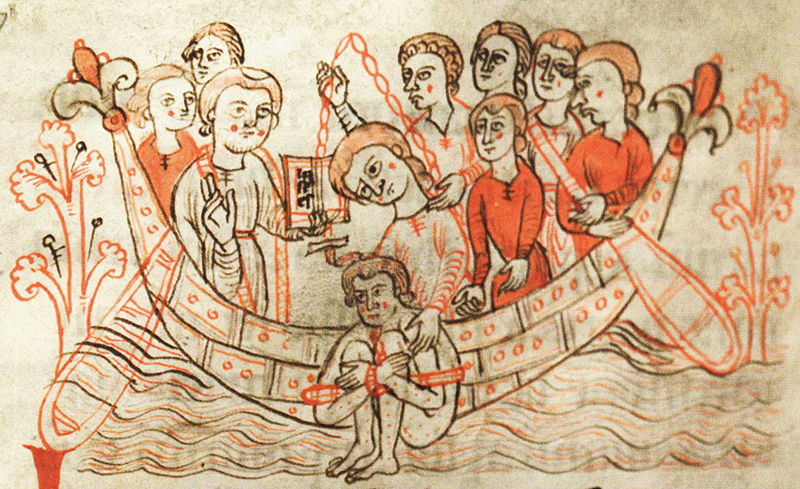
The creation of the English criminal jury was kind of forced on England by the Church. The Fourth Lateran Council in 1215, decided that priests should not preside at ordeals – because priests shouldn’t be shedding blood and because ordeals were not always reliable anyway. Without priests to bless the water ordeal, the practice fell into disuse, and so the English started using trial juries to decide the guilt or innocence of people who had been charged by grand juries with serious crimes.
Another important decision of the Fourth Lateran Council was in clarifying how church courts would go about ascertaining whether a suspect had a reputation as a criminal, so that the court could proceed in the absence of an individual accuser. It wasn’t enough if the rumors against the suspect were generated by “enemies and slanderers” – the public accusations had to come from “prudent and honest persons, not once only, but often.” Commentators gave Biblical examples: the clamor against the sinners of Sodom and Gomorrah, which prompted God to investigate (Genesis 18:20), and the complaints against the steward in Luke 16:1, which prompted the master to demand an accounting from the steward.
Since the creation of secular grand juries in England had probably been prompted by church-court procedure, it is not surprising that grand juries, acting on the same principles as the Fourth Vatican Council, undertook to distinguish between true and false public opinion. As the grand jury evolved, it came to do its own investigation, not simply reporting what their neighbors believed. Grand jurors were becoming the representatives of responsible public opinion by acting as “prudent and honest persons” and seeking reliable evidence about suspects.
But at least people who were accused by grand juries could now look forward to a full trial by another jury, not simply an arbitrary procedure like the water ordeal where one prevails only through blind good fortune. Even today, a small proportion of those who are indicted by grand juries go on to have their cases heard by a trial jury (the rest, of course, resolve their cases by plea-bargains, where the result totally isn’t arbitrary).
Works Consulted
Bab(b)ington Family – Descendants of John de Babington, http://members.iinet.net.au/~billeah/babingdesc.html
Henry Billings Brown, “Justice Brown’s Address,” in Proceedings of the Ohio State Bar Association, 13:35-51 (July, 1892).
Rebecca V. Colman, “Reason and Unreason in Early Medieval Law,” Journal of Interdisciplinary History, 4.4 (Spring, 1974), 571-591.
Nathan T. Elliff, “Notes on the Abolition of the English Grand Jury,” Journal of Criminal Law and Criminology, Volume 29,Issue 1 (May-June) Summer 1938.
Richard M. Fraher, “The Theoretical Justification for the New Criminal Law of the High Middle Ages: ‘Rei Publicae Interest, Ne Crimina Remaneant Impunita’” (1984). Articles by Maurer Faculty. 1854.
http://www.repository.law.indiana.edu/facpub/1854
Richard. H. Helmholz, “The Early History of the Grand Jury and the Canon Law,” 50 University of Chicago Law Review 613 (1983), online at http://chicagounbound.uchicago.edu/cgi/viewcontent.cgi?article=2484&context=journal_articles
Finbarr McAuley, “Canon Law and the End of the Ordeal.” Oxford Journal of Legal Studies, Vol. 26, Issue 3, pp. 473-513, 2006.
Kenneth Pennington, “Introduction to the Courts,” in Wilfried Hartmann and Kenneth Pennington (eds.), The History of Courts and Procedure in Medieval Canon Law. Washington, D. C.: Catholic University of America Press, 2016.
“Proposed Amendments to the Constitution of Minnesota,” Cook County Herald (Grand Marais, Minn)., Oct. 22, 1904, p. 8, column 1.
“Shall we abolish the grand jury,” The Princeton union, October 06, 1904, p. 3, column 2, http://bit.ly/2strpg7
Suja A. Thomas, The Missing American Jury: Restoring the Fundamental Constitutional Role of the Criminal, Civil, and Grand Juries. New York: Cambridge University Press, 2016.
___________, Nonincorporation: The Bill of Rights after McDonald v. Chicago, Notre Dame Law Review, Vol. 88, 2012.
Richard D. Younger, The people’s panel: the Grand Jury in the United States, 1634-1941. Providence, RI: American History Research Center, Brown University Press, 1963.